Cambridge A Level Travel and Tourism 9395 — 2013 Oct/Nov Paper 4 · Variant 2
9395/42/O/N/13 · 50 marks · ≈56 min
The question paper and its mark scheme, free to read here and free to download. This is Cambridge’s own paper, exactly as it was sat.
Question paper8 pages

Mark scheme5 pages
Answers below. Sit the paper first if you are practising.
Paper as text
Question paper, page 1
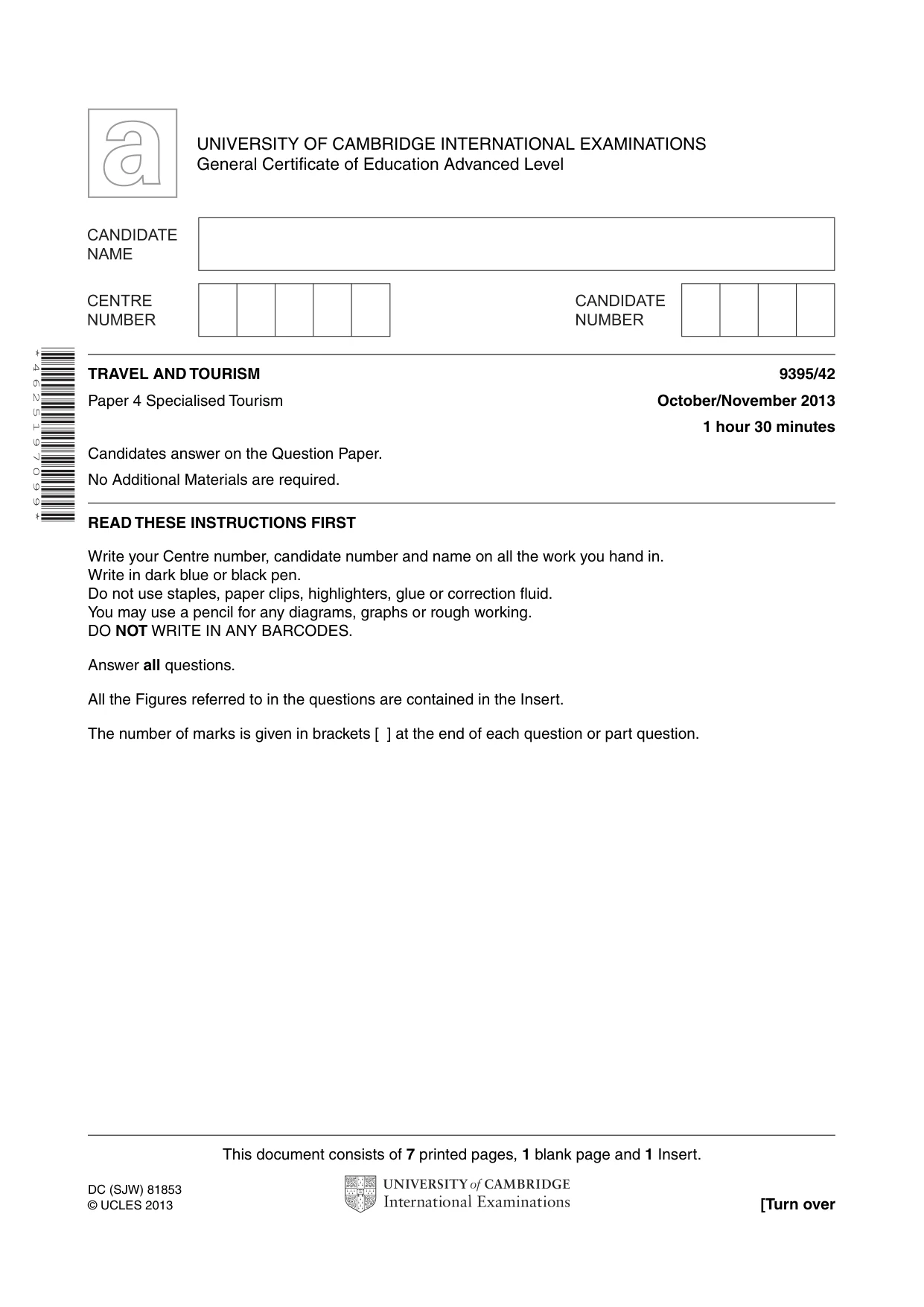
This document consists of 7 printed pages, 1 blank page and 1 Insert. DC (SJW) 81853 © UCLES 2013 [Turn over UNIVERSITY OF CAMBRIDGE INTERNATIONAL EXAMINATIONS General Certificate of Education Advanced Level * 4 6 2 5 1 9 7 0 9 9 * TRAVEL AND TOURISM 9395/42 Paper 4 Specialised Tourism October/November 2013 1 hour 30 minutes Candidates answer on the Question Paper. No Additional Materials are required. READ THESE INSTRUCTIONS FIRST Write your Centre number, candidate number and name on all the work you hand in. Write in dark blue or black pen. Do not use staples, paper clips, highlighters, glue or correction fluid. You may use a pencil for any diagrams, graphs or rough working. DO NOT WRITE IN ANY BARCODES. Answer all questions. All the Figures referred to in the questions are contained in the Insert. The number of marks is given in brackets [ ] at the end of each question or part question.
Question paper, page 2
2 9395/42/O/N/13 © UCLES 2013 For Examiner’s Use Question 1 Refer to Fig. 1 (Insert), information about a holiday in Scotland, UK. (a) Explain two likely negative economic impacts that result from the seasonal nature of tourism in this area. 1 … … … … 2 … … … …[4]
Question paper, page 3
3 9395/42/O/N/13 © UCLES 2013 [Turn over For Examiner’s Use (b) Analyse how the principles of ecotourism help to balance the negative social impacts of tourism in this area. … … … … … … … … … … … … … … … … … … … … … … … … … … …[9]
Question paper, page 4
4 9395/42/O/N/13 © UCLES 2013 For Examiner’s Use (c) Evaluate the extent to which ‘Wild at Heart’ and the village of Findhorn bring environmental benefits to this area of Scotland. … … … … … … … … … … … … … … … … … … … … … … … … … …[12] [Total: 25]
Question paper, page 5
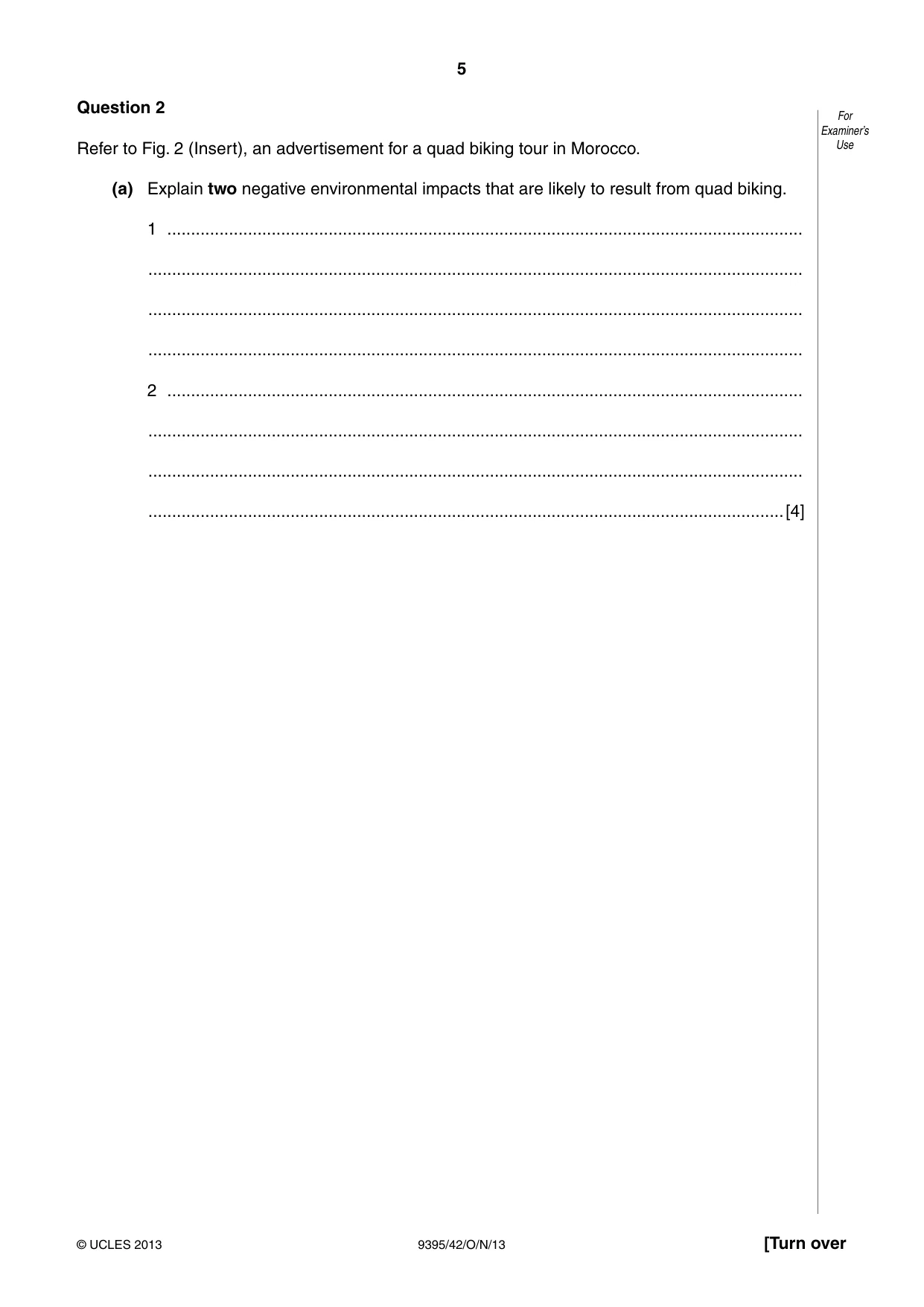
5 9395/42/O/N/13 © UCLES 2013 [Turn over For Examiner’s Use Question 2 Refer to Fig. 2 (Insert), an advertisement for a quad biking tour in Morocco. (a) Explain two negative environmental impacts that are likely to result from quad biking. 1 … … … … 2 … … … …[4]
Question paper, page 6
6 9395/42/O/N/13 © UCLES 2013 For Examiner’s Use (b) Analyse the reasons why some tourists wish to participate in adventure holidays, such as quad biking in Marrakech. … … … … … … … … … … … … … … … … … … … … … … … … … … …[9]
Question paper, page 7
7 9395/42/O/N/13 © UCLES 2013 For Examiner’s Use (c) Discuss how tourism can help to preserve traditional crafts in destinations such as Marrakech. … … … … … … … … … … … … … … … … … … … … … … … … … …[12] [Total: 25]
Question paper, page 8
8 9395/42/O/N/13 © UCLES 2013 Permission to reproduce items where third-party owned material protected by copyright is included has been sought and cleared where possible. Every reasonable effort has been made by the publisher (UCLES) to trace copyright holders, but if any items requiring clearance have unwittingly been included, the publisher will be pleased to make amends at the earliest possible opportunity. University of Cambridge International Examinations is part of the Cambridge Assessment Group. Cambridge Assessment is the brand name of University of Cambridge Local Examinations Syndicate (UCLES), which is itself a department of the University of Cambridge. BLANK PAGE
Mark scheme, page 1
CAMBRIDGE INTERNATIONAL EXAMINATIONS GCE Advanced Subsidiary Level and GCE Advanced Level MARK SCHEME for the October/November 2013 series 9395 TRAVEL AND TOURISM 9395/42 Paper 4 (Specialised Tourism), maximum raw mark 50 This mark scheme is published as an aid to teachers and candidates, to indicate the requirements of the examination. It shows the basis on which Examiners were instructed to award marks. It does not indicate the details of the discussions that took place at an Examiners’ meeting before marking began, which would have considered the acceptability of alternative answers. Mark schemes should be read in conjunction with the question paper and the Principal Examiner Report for Teachers. Cambridge will not enter into discussions about these mark schemes. Cambridge is publishing the mark schemes for the October/November 2013 series for most IGCSE, GCE Advanced Level and Advanced Subsidiary Level components and some Ordinary Level components.
Mark scheme, page 2
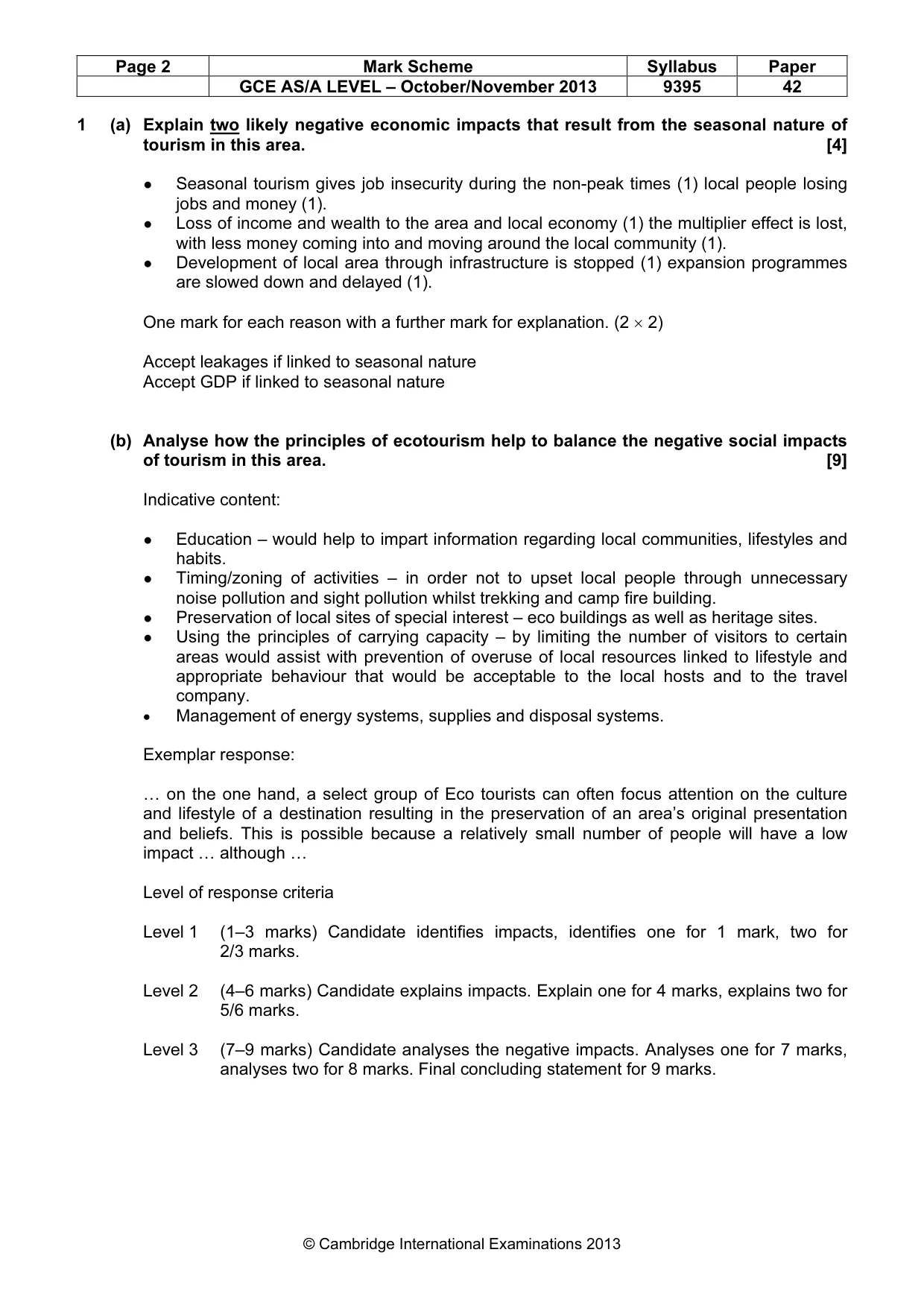
Page 2 Mark Scheme Syllabus Paper GCE AS/A LEVEL – October/November 2013 9395 42 © Cambridge International Examinations 2013 1 (a) Explain two likely negative economic impacts that result from the seasonal nature of tourism in this area. [4] ● Seasonal tourism gives job insecurity during the non-peak times (1) local people losing jobs and money (1). ● Loss of income and wealth to the area and local economy (1) the multiplier effect is lost, with less money coming into and moving around the local community (1). ● Development of local area through infrastructure is stopped (1) expansion programmes are slowed down and delayed (1). One mark for each reason with a further mark for explanation. (2 × 2) Accept leakages if linked to seasonal nature Accept GDP if linked to seasonal nature (b) Analyse how the principles of ecotourism help to balance the negative social impacts of tourism in this area. [9] Indicative content: ● Education – would help to impart information regarding local communities, lifestyles and habits. ● Timing/zoning of activities – in order not to upset local people through unnecessary noise pollution and sight pollution whilst trekking and camp fire building. ● Preservation of local sites of special interest – eco buildings as well as heritage sites. ● Using the principles of carrying capacity – by limiting the number of visitors to certain areas would assist with prevention of overuse of local resources linked to lifestyle and appropriate behaviour that would be acceptable to the local hosts and to the travel company. • Management of energy systems, supplies and disposal systems. Exemplar response: … on the one hand, a select group of Eco tourists can often focus attention on the culture and lifestyle of a destination resulting in the preservation of an area’s original presentation and beliefs. This is possible because a relatively small number of people will have a low impact … although … Level of response criteria Level 1 (1–3 marks) Candidate identifies impacts, identifies one for 1 mark, two for 2/3 marks. Level 2 (4–6 marks) Candidate explains impacts. Explain one for 4 marks, explains two for 5/6 marks. Level 3 (7–9 marks) Candidate analyses the negative impacts. Analyses one for 7 marks, analyses two for 8 marks. Final concluding statement for 9 marks.
Mark scheme, page 3
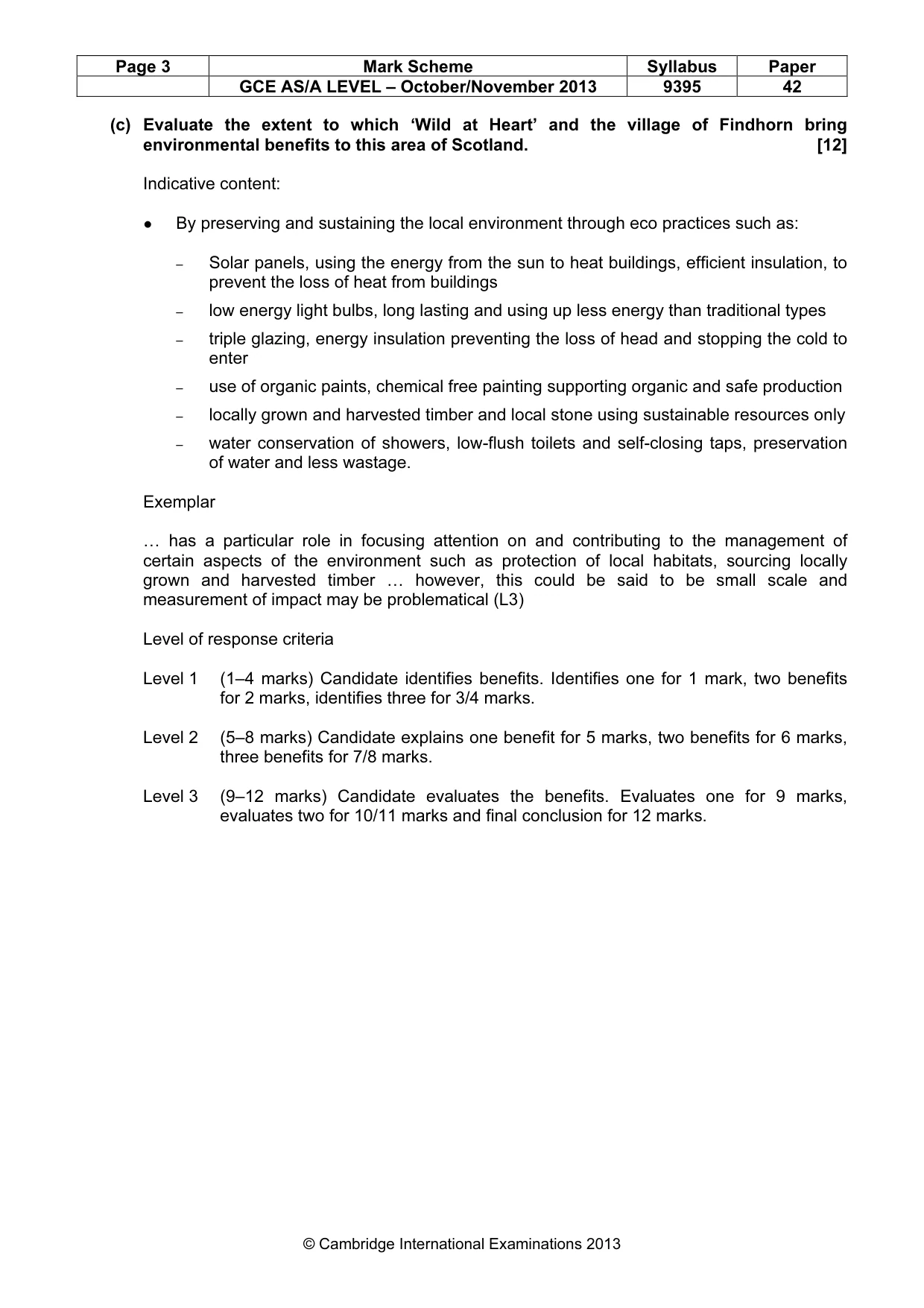
Page 3 Mark Scheme Syllabus Paper GCE AS/A LEVEL – October/November 2013 9395 42 © Cambridge International Examinations 2013 (c) Evaluate the extent to which ‘Wild at Heart’ and the village of Findhorn bring environmental benefits to this area of Scotland. [12] Indicative content: ● By preserving and sustaining the local environment through eco practices such as: – Solar panels, using the energy from the sun to heat buildings, efficient insulation, to prevent the loss of heat from buildings – low energy light bulbs, long lasting and using up less energy than traditional types – triple glazing, energy insulation preventing the loss of head and stopping the cold to enter – use of organic paints, chemical free painting supporting organic and safe production – locally grown and harvested timber and local stone using sustainable resources only – water conservation of showers, low-flush toilets and self-closing taps, preservation of water and less wastage. Exemplar … has a particular role in focusing attention on and contributing to the management of certain aspects of the environment such as protection of local habitats, sourcing locally grown and harvested timber … however, this could be said to be small scale and measurement of impact may be problematical (L3) Level of response criteria Level 1 (1–4 marks) Candidate identifies benefits. Identifies one for 1 mark, two benefits for 2 marks, identifies three for 3/4 marks. Level 2 (5–8 marks) Candidate explains one benefit for 5 marks, two benefits for 6 marks, three benefits for 7/8 marks. Level 3 (9–12 marks) Candidate evaluates the benefits. Evaluates one for 9 marks, evaluates two for 10/11 marks and final conclusion for 12 marks.
Mark scheme, page 4
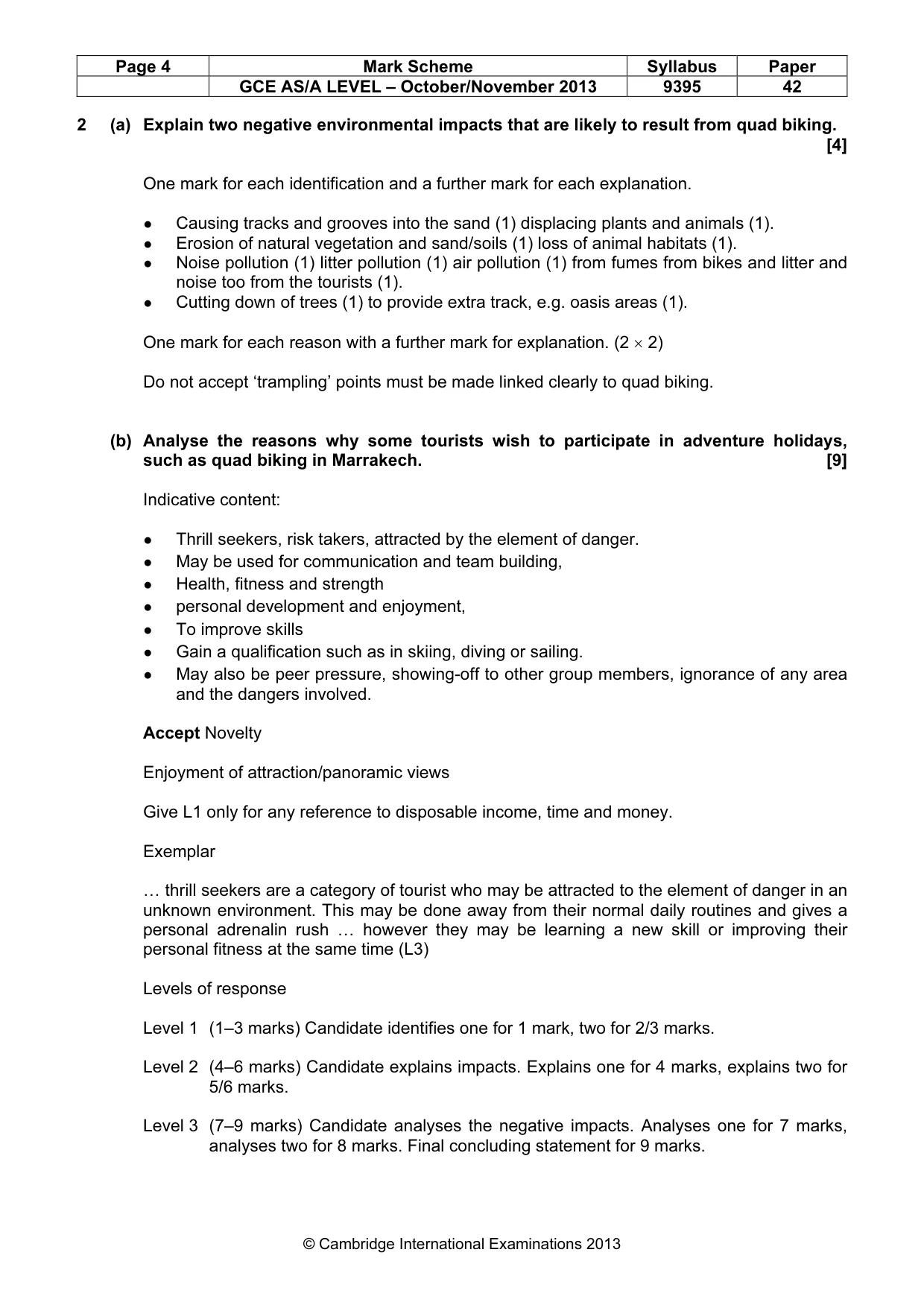
Page 4 Mark Scheme Syllabus Paper GCE AS/A LEVEL – October/November 2013 9395 42 © Cambridge International Examinations 2013 2 (a) Explain two negative environmental impacts that are likely to result from quad biking. [4] One mark for each identification and a further mark for each explanation. ● Causing tracks and grooves into the sand (1) displacing plants and animals (1). ● Erosion of natural vegetation and sand/soils (1) loss of animal habitats (1). ● Noise pollution (1) litter pollution (1) air pollution (1) from fumes from bikes and litter and noise too from the tourists (1). ● Cutting down of trees (1) to provide extra track, e.g. oasis areas (1). One mark for each reason with a further mark for explanation. (2 × 2) Do not accept ‘trampling’ points must be made linked clearly to quad biking. (b) Analyse the reasons why some tourists wish to participate in adventure holidays, such as quad biking in Marrakech. [9] Indicative content: ● Thrill seekers, risk takers, attracted by the element of danger. ● May be used for communication and team building, ● Health, fitness and strength ● personal development and enjoyment, ● To improve skills ● Gain a qualification such as in skiing, diving or sailing. ● May also be peer pressure, showing-off to other group members, ignorance of any area and the dangers involved. Accept Novelty Enjoyment of attraction/panoramic views Give L1 only for any reference to disposable income, time and money. Exemplar … thrill seekers are a category of tourist who may be attracted to the element of danger in an unknown environment. This may be done away from their normal daily routines and gives a personal adrenalin rush … however they may be learning a new skill or improving their personal fitness at the same time (L3) Levels of response Level 1 (1–3 marks) Candidate identifies one for 1 mark, two for 2/3 marks. Level 2 (4–6 marks) Candidate explains impacts. Explains one for 4 marks, explains two for 5/6 marks. Level 3 (7–9 marks) Candidate analyses the negative impacts. Analyses one for 7 marks, analyses two for 8 marks. Final concluding statement for 9 marks.
Mark scheme, page 5
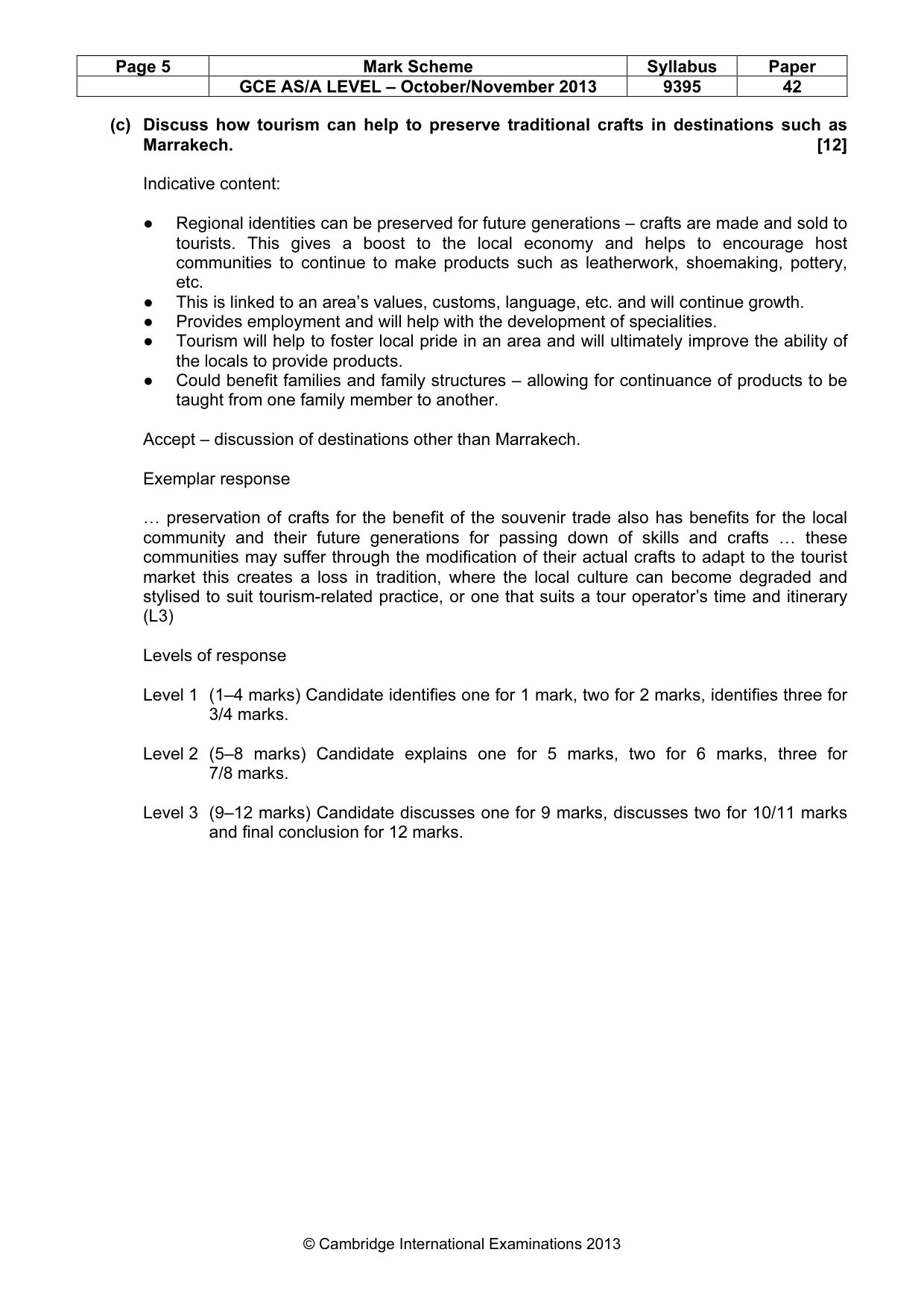
Page 5 Mark Scheme Syllabus Paper GCE AS/A LEVEL – October/November 2013 9395 42 © Cambridge International Examinations 2013 (c) Discuss how tourism can help to preserve traditional crafts in destinations such as Marrakech. [12] Indicative content: ● Regional identities can be preserved for future generations – crafts are made and sold to tourists. This gives a boost to the local economy and helps to encourage host communities to continue to make products such as leatherwork, shoemaking, pottery, etc. ● This is linked to an area’s values, customs, language, etc. and will continue growth. ● Provides employment and will help with the development of specialities. ● Tourism will help to foster local pride in an area and will ultimately improve the ability of the locals to provide products. ● Could benefit families and family structures – allowing for continuance of products to be taught from one family member to another. Accept – discussion of destinations other than Marrakech. Exemplar response … preservation of crafts for the benefit of the souvenir trade also has benefits for the local community and their future generations for passing down of skills and crafts … these communities may suffer through the modification of their actual crafts to adapt to the tourist market this creates a loss in tradition, where the local culture can become degraded and stylised to suit tourism-related practice, or one that suits a tour operator’s time and itinerary (L3) Levels of response Level 1 (1–4 marks) Candidate identifies one for 1 mark, two for 2 marks, identifies three for 3/4 marks. Level 2 (5–8 marks) Candidate explains one for 5 marks, two for 6 marks, three for 7/8 marks. Level 3 (9–12 marks) Candidate discusses one for 9 marks, discusses two for 10/11 marks and final conclusion for 12 marks.
What you needed in this session
Cambridge’s own grade thresholds for 2013 Oct/Nov, Paper 4 · Variant 2. A higher threshold means an easier paper — the bar moves with how the cohort did.