Cambridge A Level Travel and Tourism 9395 — 2012 Oct/Nov Paper 4 · Variant 1
9395/41/O/N/12 · 50 marks · ≈56 min
The question paper and its mark scheme, free to read here and free to download. This is Cambridge’s own paper, exactly as it was sat.
Question paper8 pages
Mark scheme5 pages
Answers below. Sit the paper first if you are practising.
Paper as text
Question paper, page 1
This document consists of 7 printed pages and 1 blank page. DC (SM) 49778/3 © UCLES 2012 [Turn over UNIVERSITY OF CAMBRIDGE INTERNATIONAL EXAMINATIONS General Certificate of Education Advanced Level * 9 9 4 3 3 0 3 0 1 6 * TRAVEL AND TOURISM 9395/04 Paper 4 Specialised Tourism October/November 2012 1 hour 30 minutes Candidates answer on the Question Paper. No Additional Materials are Required. READ THESE INSTRUCTIONS FIRST Write your Centre number, candidate number and name on all the work you hand in. Write in dark blue or black pen. Do not use staples, paper clips, highlighters, glue or correction fluid. You may use a pencil for any diagrams, graphs or rough working. DO NOT WRITE IN ANY BARCODES. Answer all questions. The number of marks is given in brackets [ ] at the end of each question or part question. For Examiner’s Use 1 2 Total
Question paper, page 2
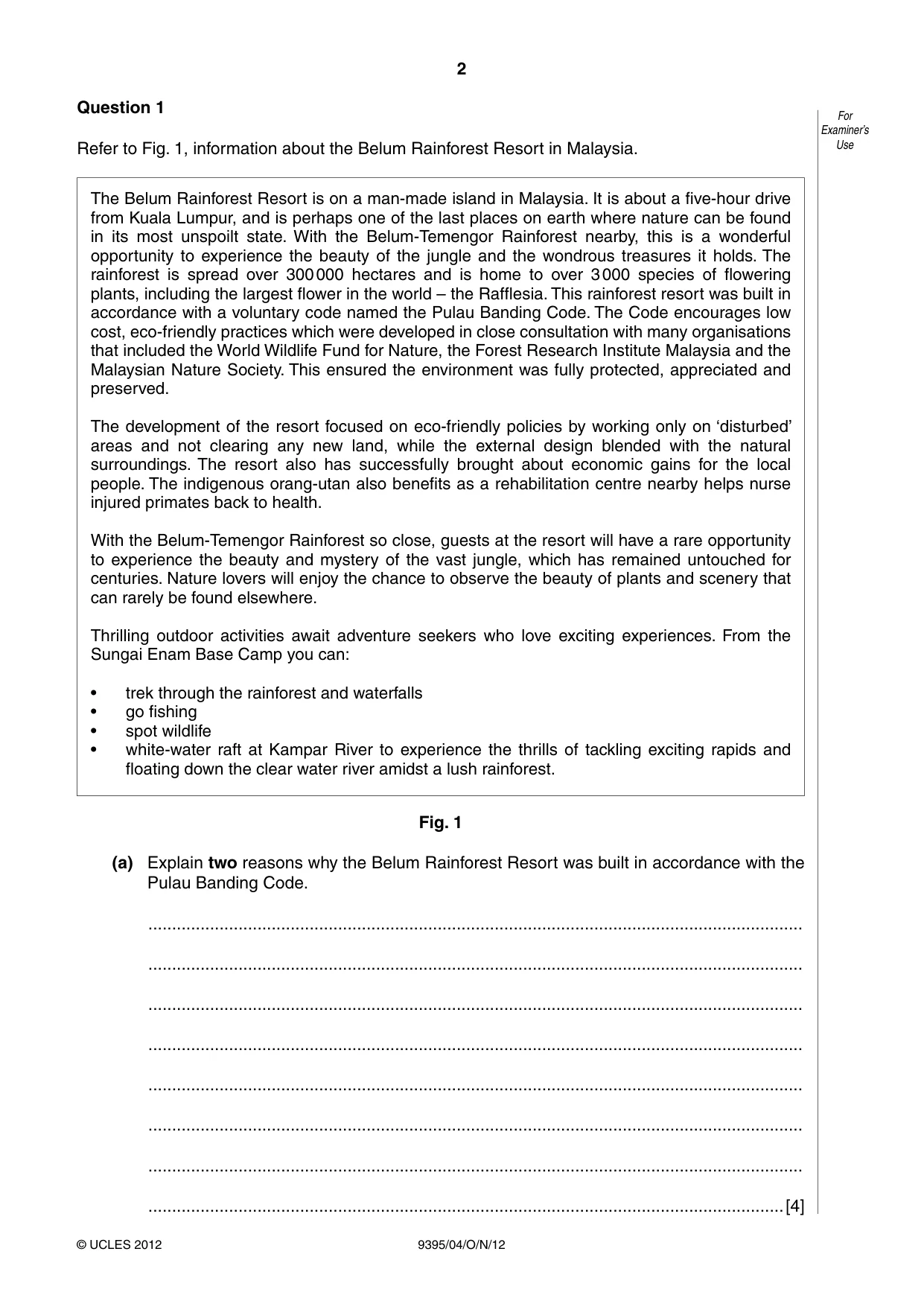
2 9395/04/O/N/12 © UCLES 2012 For Examiner’s Use Question 1 Refer to Fig. 1, information about the Belum Rainforest Resort in Malaysia. The Belum Rainforest Resort is on a man-made island in Malaysia. It is about a five-hour drive from Kuala Lumpur, and is perhaps one of the last places on earth where nature can be found in its most unspoilt state. With the Belum-Temengor Rainforest nearby, this is a wonderful opportunity to experience the beauty of the jungle and the wondrous treasures it holds. The rainforest is spread over 300 000 hectares and is home to over 3 000 species of flowering plants, including the largest flower in the world – the Rafflesia. This rainforest resort was built in accordance with a voluntary code named the Pulau Banding Code. The Code encourages low cost, eco-friendly practices which were developed in close consultation with many organisations that included the World Wildlife Fund for Nature, the Forest Research Institute Malaysia and the Malaysian Nature Society. This ensured the environment was fully protected, appreciated and preserved. The development of the resort focused on eco-friendly policies by working only on ‘disturbed’ areas and not clearing any new land, while the external design blended with the natural surroundings. The resort also has successfully brought about economic gains for the local people. The indigenous orang-utan also benefits as a rehabilitation centre nearby helps nurse injured primates back to health. With the Belum-Temengor Rainforest so close, guests at the resort will have a rare opportunity to experience the beauty and mystery of the vast jungle, which has remained untouched for centuries. Nature lovers will enjoy the chance to observe the beauty of plants and scenery that can rarely be found elsewhere. Thrilling outdoor activities await adventure seekers who love exciting experiences. From the Sungai Enam Base Camp you can: • trek through the rainforest and waterfalls • go fishing • spot wildlife • white-water raft at Kampar River to experience the thrills of tackling exciting rapids and floating down the clear water river amidst a lush rainforest. Fig. 1 (a) Explain two reasons why the Belum Rainforest Resort was built in accordance with the Pulau Banding Code. … … … … … … … …[4]
Question paper, page 3
3 9395/04/O/N/12 © UCLES 2012 [Turn over For Examiner’s Use (b) Discuss how the Belum Rainforest Resort is likely to bring economic benefits to the area. … … … … … … … … … … … … … … … … … … … … … … … … … … …[9]
Question paper, page 4
4 9395/04/O/N/12 © UCLES 2012 For Examiner’s Use (c) Assess the potential conflicts of providing adventure tourist activities in areas of great environmental importance. … … … … … … … … … … … … … … … … … … … … … … … … … …[12] [Total: 25]
Question paper, page 5
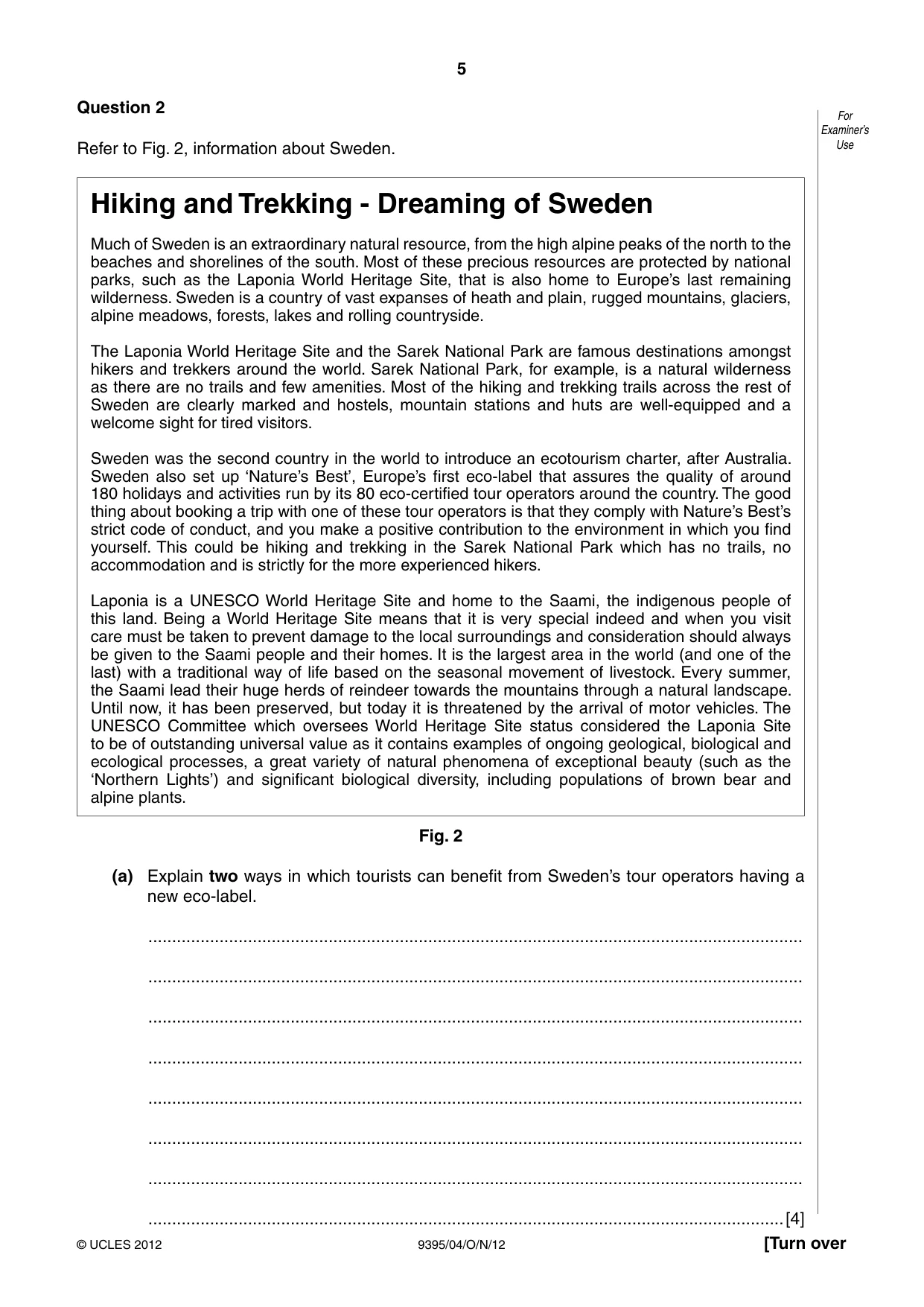
5 9395/04/O/N/12 © UCLES 2012 [Turn over For Examiner’s Use Question 2 Refer to Fig. 2, information about Sweden. Hiking and Trekking - Dreaming of Sweden Much of Sweden is an extraordinary natural resource, from the high alpine peaks of the north to the beaches and shorelines of the south. Most of these precious resources are protected by national parks, such as the Laponia World Heritage Site, that is also home to Europe’s last remaining wilderness. Sweden is a country of vast expanses of heath and plain, rugged mountains, glaciers, alpine meadows, forests, lakes and rolling countryside. The Laponia World Heritage Site and the Sarek National Park are famous destinations amongst hikers and trekkers around the world. Sarek National Park, for example, is a natural wilderness as there are no trails and few amenities. Most of the hiking and trekking trails across the rest of Sweden are clearly marked and hostels, mountain stations and huts are well-equipped and a welcome sight for tired visitors. Sweden was the second country in the world to introduce an ecotourism charter, after Australia. Sweden also set up ‘Nature’s Best’, Europe’s first eco-label that assures the quality of around 180 holidays and activities run by its 80 eco-certified tour operators around the country. The good thing about booking a trip with one of these tour operators is that they comply with Nature’s Best’s strict code of conduct, and you make a positive contribution to the environment in which you find yourself. This could be hiking and trekking in the Sarek National Park which has no trails, no accommodation and is strictly for the more experienced hikers. Laponia is a UNESCO World Heritage Site and home to the Saami, the indigenous people of this land. Being a World Heritage Site means that it is very special indeed and when you visit care must be taken to prevent damage to the local surroundings and consideration should always be given to the Saami people and their homes. It is the largest area in the world (and one of the last) with a traditional way of life based on the seasonal movement of livestock. Every summer, the Saami lead their huge herds of reindeer towards the mountains through a natural landscape. Until now, it has been preserved, but today it is threatened by the arrival of motor vehicles. The UNESCO Committee which oversees World Heritage Site status considered the Laponia Site to be of outstanding universal value as it contains examples of ongoing geological, biological and ecological processes, a great variety of natural phenomena of exceptional beauty (such as the ‘Northern Lights’) and significant biological diversity, including populations of brown bear and alpine plants. Fig. 2 (a) Explain two ways in which tourists can benefit from Sweden’s tour operators having a new eco-label. … … … … … … … …[4]
Question paper, page 6
6 9395/04/O/N/12 © UCLES 2012 For Examiner’s Use (b) Discuss how the designation of Laponia as a World Heritage Site may help to reduce the environmental impacts of tourism. … … … … … … … … … … … … … … … … … … … … … … … … … … …[9]
Question paper, page 7
7 9395/04/O/N/12 © UCLES 2012 For Examiner’s Use (c) Assess how the possible negative socio-cultural impacts of tourism can be reduced in Laponia. … … … … … … … … … … … … … … … … … … … … … … … … … …[12] [Total: 25]
Question paper, page 8
8 9395/04/O/N/12 © UCLES 2012 Copyright Acknowledgements: Case Study © ADAPTED: www.belumrainforestresort.com. Figure 2 © ADAPTED: www.visitsweden.com/sweden/attractions/outdoor-activities/hiking/. Permission to reproduce items where third-party owned material protected by copyright is included has been sought and cleared where possible. Every reasonable effort has been made by the publisher (UCLES) to trace copyright holders, but if any items requiring clearance have unwittingly been included, the publisher will be pleased to make amends at the earliest possible opportunity. University of Cambridge International Examinations is part of the Cambridge Assessment Group. Cambridge Assessment is the brand name of University of Cambridge Local Examinations Syndicate (UCLES), which is itself a department of the University of Cambridge. BLANK PAGE
Mark scheme, page 1
CAMBRIDGE INTERNATIONAL EXAMINATIONS GCE Advanced Subsidiary Level and GCE Advanced Level MARK SCHEME for the October/November 2012 series 9395 TRAVEL AND TOURISM 9395/04 Paper 4 (Specialised Tourism), maximum raw mark 50 This mark scheme is published as an aid to teachers and candidates, to indicate the requirements of the examination. It shows the basis on which Examiners were instructed to award marks. It does not indicate the details of the discussions that took place at an Examiners’ meeting before marking began, which would have considered the acceptability of alternative answers. Mark schemes should be read in conjunction with the question paper and the Principal Examiner Report for Teachers. Cambridge will not enter into discussions about these mark schemes. Cambridge is publishing the mark schemes for the October/November 2012 series for most IGCSE, GCE Advanced Level and Advanced Subsidiary Level components and some Ordinary Level components.
Mark scheme, page 2
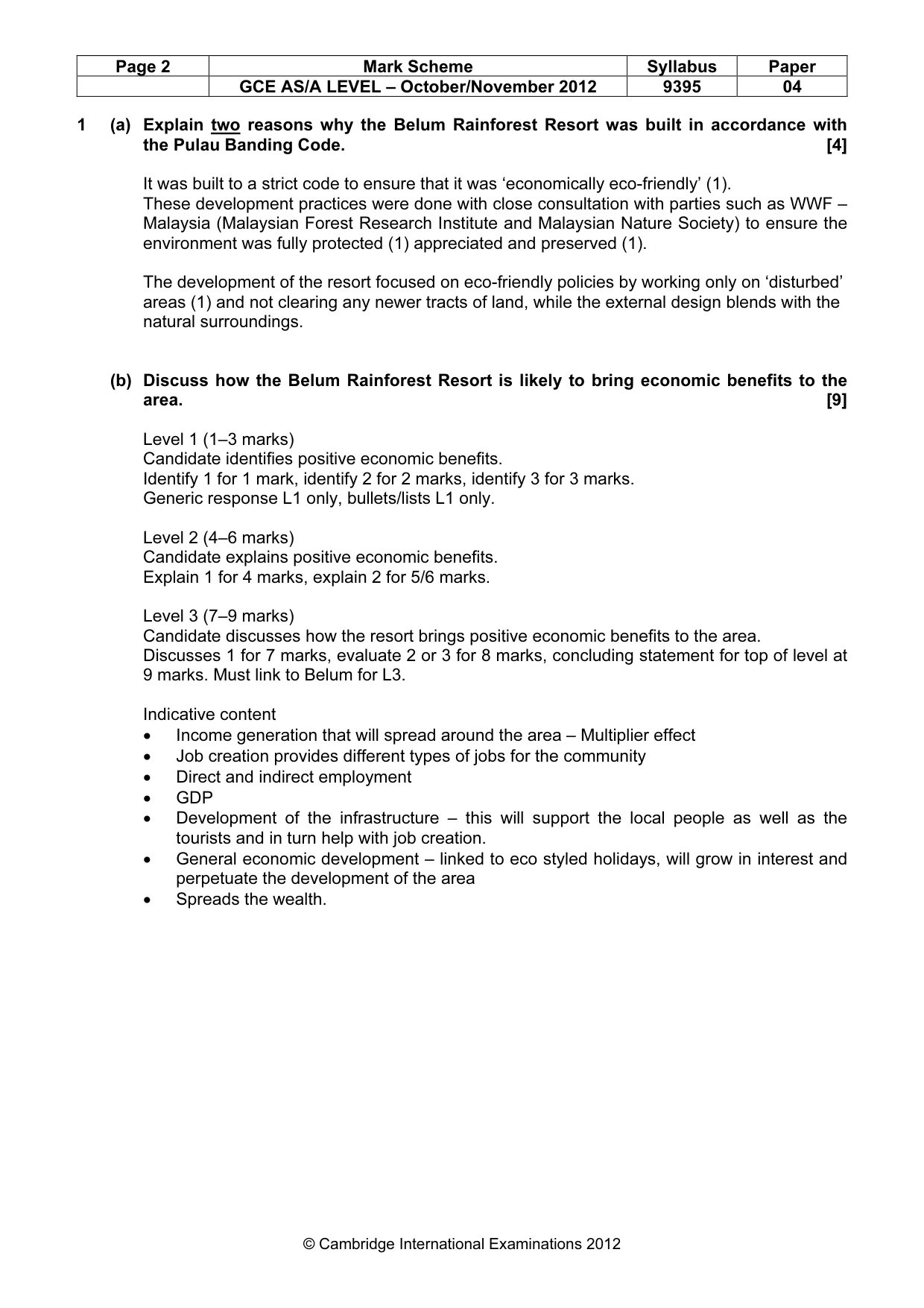
Page 2 Mark Scheme Syllabus Paper GCE AS/A LEVEL – October/November 2012 9395 04 © Cambridge International Examinations 2012 1 (a) Explain two reasons why the Belum Rainforest Resort was built in accordance with the Pulau Banding Code. [4] It was built to a strict code to ensure that it was ‘economically eco-friendly’ (1). These development practices were done with close consultation with parties such as WWF – Malaysia (Malaysian Forest Research Institute and Malaysian Nature Society) to ensure the environment was fully protected (1) appreciated and preserved (1). The development of the resort focused on eco-friendly policies by working only on ‘disturbed’ areas (1) and not clearing any newer tracts of land, while the external design blends with the natural surroundings. (b) Discuss how the Belum Rainforest Resort is likely to bring economic benefits to the area. [9] Level 1 (1–3 marks) Candidate identifies positive economic benefits. Identify 1 for 1 mark, identify 2 for 2 marks, identify 3 for 3 marks. Generic response L1 only, bullets/lists L1 only. Level 2 (4–6 marks) Candidate explains positive economic benefits. Explain 1 for 4 marks, explain 2 for 5/6 marks. Level 3 (7–9 marks) Candidate discusses how the resort brings positive economic benefits to the area. Discusses 1 for 7 marks, evaluate 2 or 3 for 8 marks, concluding statement for top of level at 9 marks. Must link to Belum for L3. Indicative content • Income generation that will spread around the area – Multiplier effect • Job creation provides different types of jobs for the community • Direct and indirect employment • GDP • Development of the infrastructure – this will support the local people as well as the tourists and in turn help with job creation. • General economic development – linked to eco styled holidays, will grow in interest and perpetuate the development of the area • Spreads the wealth.
Mark scheme, page 3
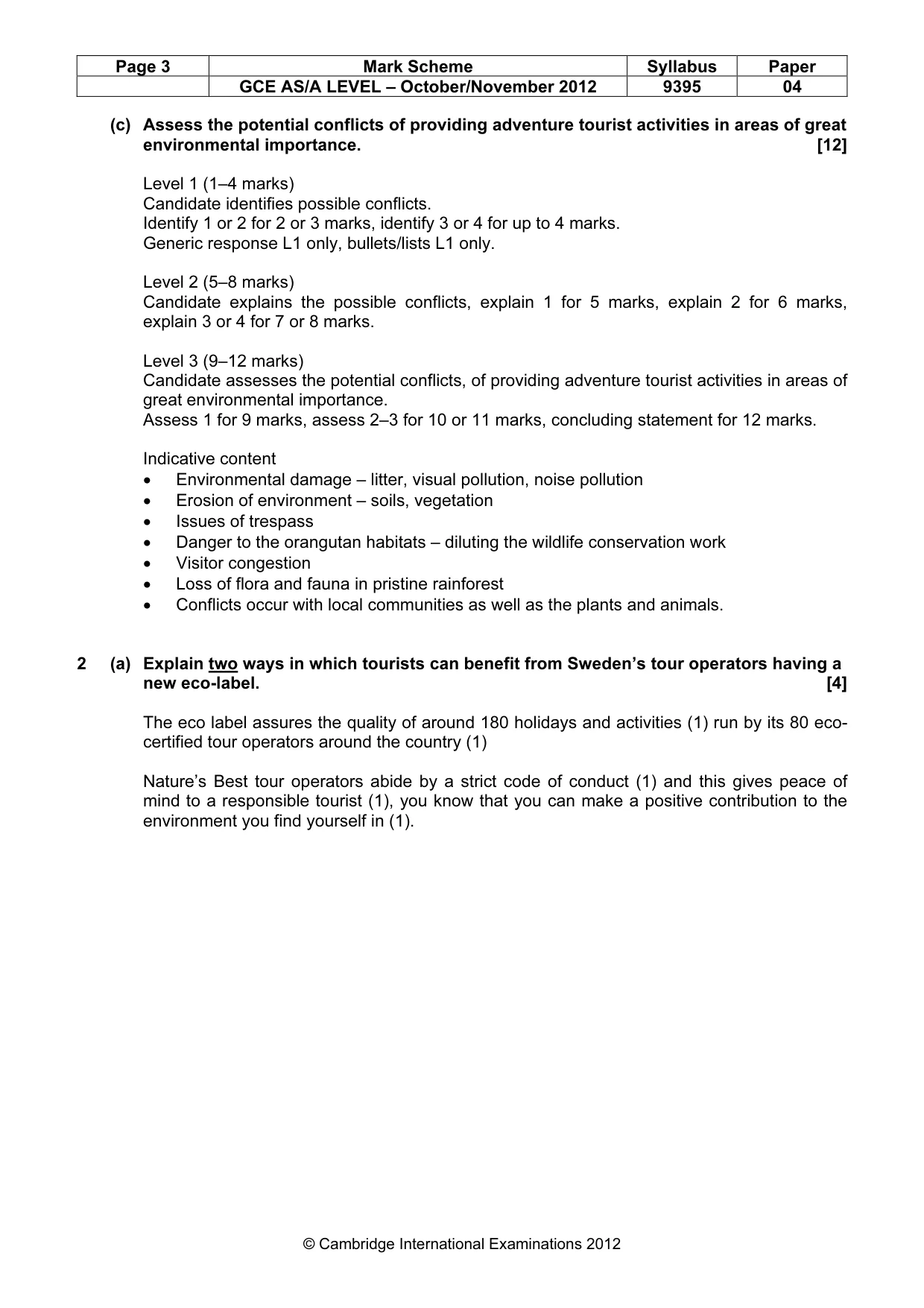
Page 3 Mark Scheme Syllabus Paper GCE AS/A LEVEL – October/November 2012 9395 04 © Cambridge International Examinations 2012 (c) Assess the potential conflicts of providing adventure tourist activities in areas of great environmental importance. [12] Level 1 (1–4 marks) Candidate identifies possible conflicts. Identify 1 or 2 for 2 or 3 marks, identify 3 or 4 for up to 4 marks. Generic response L1 only, bullets/lists L1 only. Level 2 (5–8 marks) Candidate explains the possible conflicts, explain 1 for 5 marks, explain 2 for 6 marks, explain 3 or 4 for 7 or 8 marks. Level 3 (9–12 marks) Candidate assesses the potential conflicts, of providing adventure tourist activities in areas of great environmental importance. Assess 1 for 9 marks, assess 2–3 for 10 or 11 marks, concluding statement for 12 marks. Indicative content • Environmental damage – litter, visual pollution, noise pollution • Erosion of environment – soils, vegetation • Issues of trespass • Danger to the orangutan habitats – diluting the wildlife conservation work • Visitor congestion • Loss of flora and fauna in pristine rainforest • Conflicts occur with local communities as well as the plants and animals. 2 (a) Explain two ways in which tourists can benefit from Sweden’s tour operators having a new eco-label. [4] The eco label assures the quality of around 180 holidays and activities (1) run by its 80 eco- certified tour operators around the country (1) Nature’s Best tour operators abide by a strict code of conduct (1) and this gives peace of mind to a responsible tourist (1), you know that you can make a positive contribution to the environment you find yourself in (1).
Mark scheme, page 4
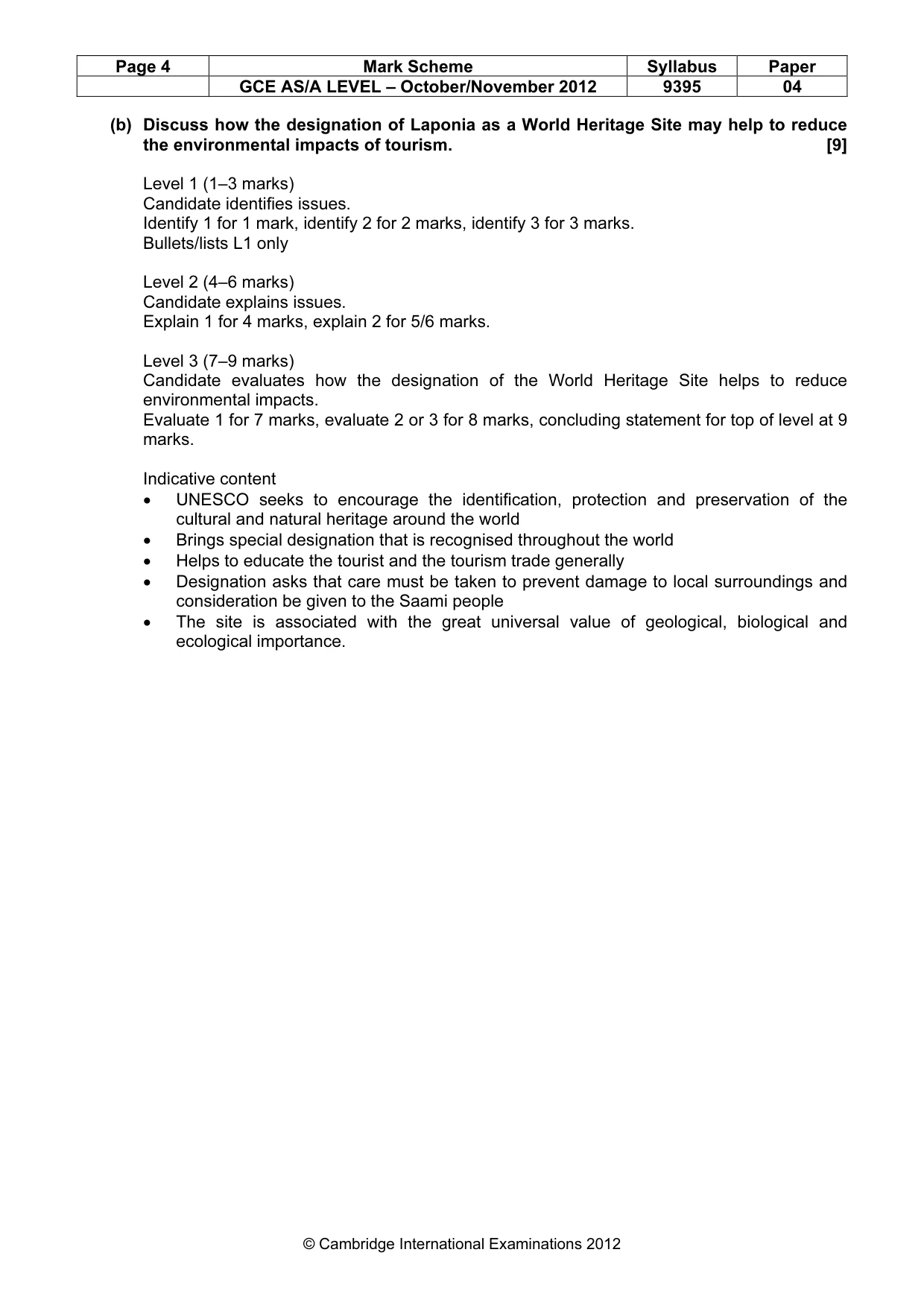
Page 4 Mark Scheme Syllabus Paper GCE AS/A LEVEL – October/November 2012 9395 04 © Cambridge International Examinations 2012 (b) Discuss how the designation of Laponia as a World Heritage Site may help to reduce the environmental impacts of tourism. [9] Level 1 (1–3 marks) Candidate identifies issues. Identify 1 for 1 mark, identify 2 for 2 marks, identify 3 for 3 marks. Bullets/lists L1 only Level 2 (4–6 marks) Candidate explains issues. Explain 1 for 4 marks, explain 2 for 5/6 marks. Level 3 (7–9 marks) Candidate evaluates how the designation of the World Heritage Site helps to reduce environmental impacts. Evaluate 1 for 7 marks, evaluate 2 or 3 for 8 marks, concluding statement for top of level at 9 marks. Indicative content • UNESCO seeks to encourage the identification, protection and preservation of the cultural and natural heritage around the world • Brings special designation that is recognised throughout the world • Helps to educate the tourist and the tourism trade generally • Designation asks that care must be taken to prevent damage to local surroundings and consideration be given to the Saami people • The site is associated with the great universal value of geological, biological and ecological importance.
Mark scheme, page 5
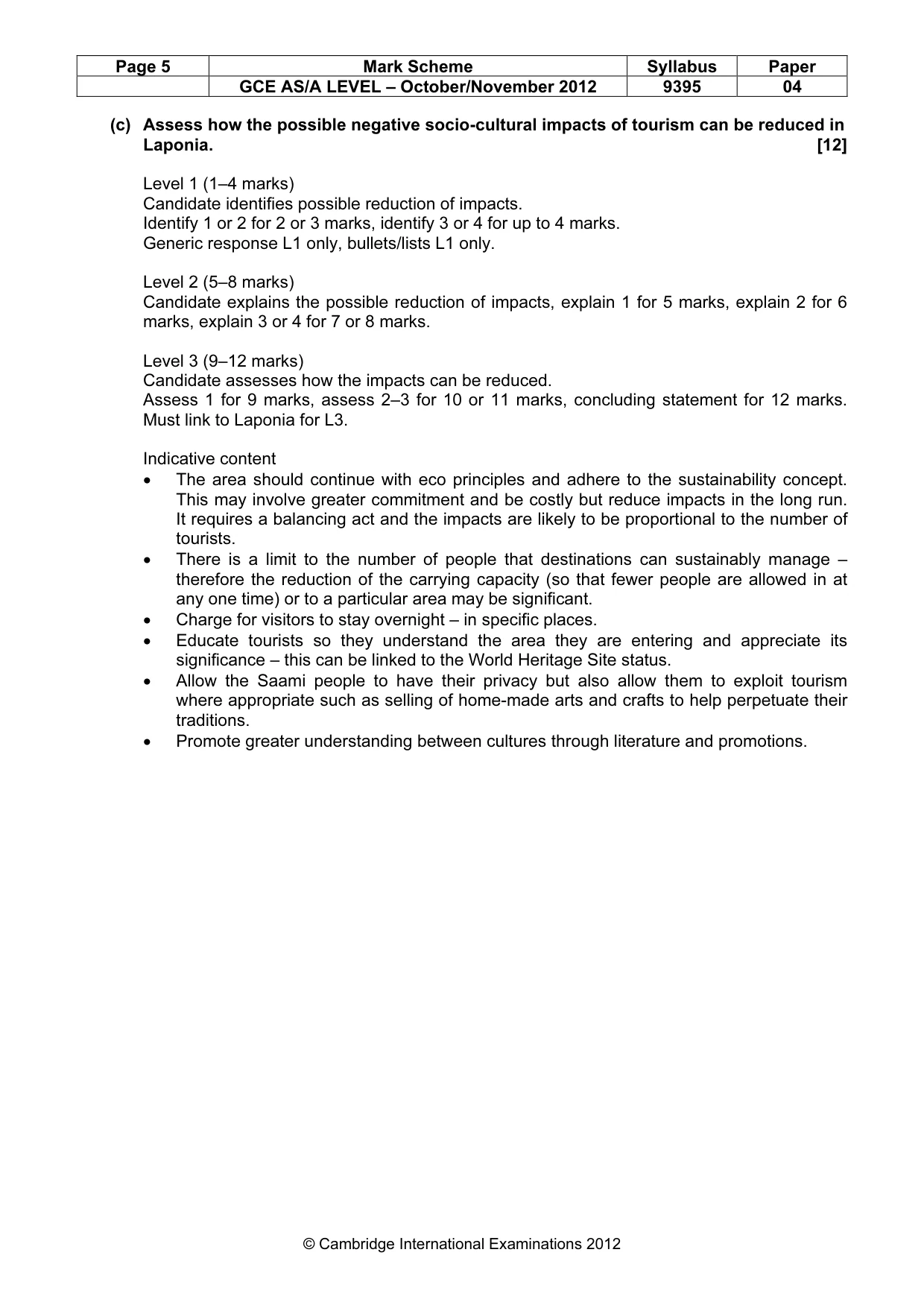
Page 5 Mark Scheme Syllabus Paper GCE AS/A LEVEL – October/November 2012 9395 04 © Cambridge International Examinations 2012 (c) Assess how the possible negative socio-cultural impacts of tourism can be reduced in Laponia. [12] Level 1 (1–4 marks) Candidate identifies possible reduction of impacts. Identify 1 or 2 for 2 or 3 marks, identify 3 or 4 for up to 4 marks. Generic response L1 only, bullets/lists L1 only. Level 2 (5–8 marks) Candidate explains the possible reduction of impacts, explain 1 for 5 marks, explain 2 for 6 marks, explain 3 or 4 for 7 or 8 marks. Level 3 (9–12 marks) Candidate assesses how the impacts can be reduced. Assess 1 for 9 marks, assess 2–3 for 10 or 11 marks, concluding statement for 12 marks. Must link to Laponia for L3. Indicative content • The area should continue with eco principles and adhere to the sustainability concept. This may involve greater commitment and be costly but reduce impacts in the long run. It requires a balancing act and the impacts are likely to be proportional to the number of tourists. • There is a limit to the number of people that destinations can sustainably manage – therefore the reduction of the carrying capacity (so that fewer people are allowed in at any one time) or to a particular area may be significant. • Charge for visitors to stay overnight – in specific places. • Educate tourists so they understand the area they are entering and appreciate its significance – this can be linked to the World Heritage Site status. • Allow the Saami people to have their privacy but also allow them to exploit tourism where appropriate such as selling of home-made arts and crafts to help perpetuate their traditions. • Promote greater understanding between cultures through literature and promotions.
What you needed in this session
Cambridge’s own grade thresholds for 2012 Oct/Nov, Paper 4 · Variant 1. A higher threshold means an easier paper — the bar moves with how the cohort did.