Cambridge A Level Travel and Tourism 9395 — 2012 Oct/Nov Paper 1 · Variant 1
9395/11/O/N/12 · 100 marks · ≈113 min
The question paper and its mark scheme, free to read here and free to download. This is Cambridge’s own paper, exactly as it was sat.
Question paper20 pages




Mark scheme8 pages
Answers below. Sit the paper first if you are practising.
Paper as text
Question paper, page 1
This document consists of 17 printed pages and 3 blank pages. DC (CW/JG) 51181/5 © UCLES 2012 [Turn over UNIVERSITY OF CAMBRIDGE INTERNATIONAL EXAMINATIONS General Certificate of Education Advanced Subsidiary Level and Advanced Level * 9 3 5 8 2 7 3 3 1 0 * TRAVEL AND TOURISM 9395/01 Paper 1 Core October/November 2012 2 hours 30 minutes Candidates answer on the Question Paper. No Additional Materials are required. READ THESE INSTRUCTIONS FIRST Write your Centre number, candidate number and name on all the work you hand in. Write in dark blue or black pen. Do not use staples, paper clips, highlighters, glue or correction fluid. You may use a pencil for any diagrams, graphs or rough working. DO NOT WRITE IN ANY BARCODES. Answer all questions. The number of marks is given in brackets [ ] at the end of each question or part question. For Examiner’s Use 1 2 3 4 Total
Question paper, page 2
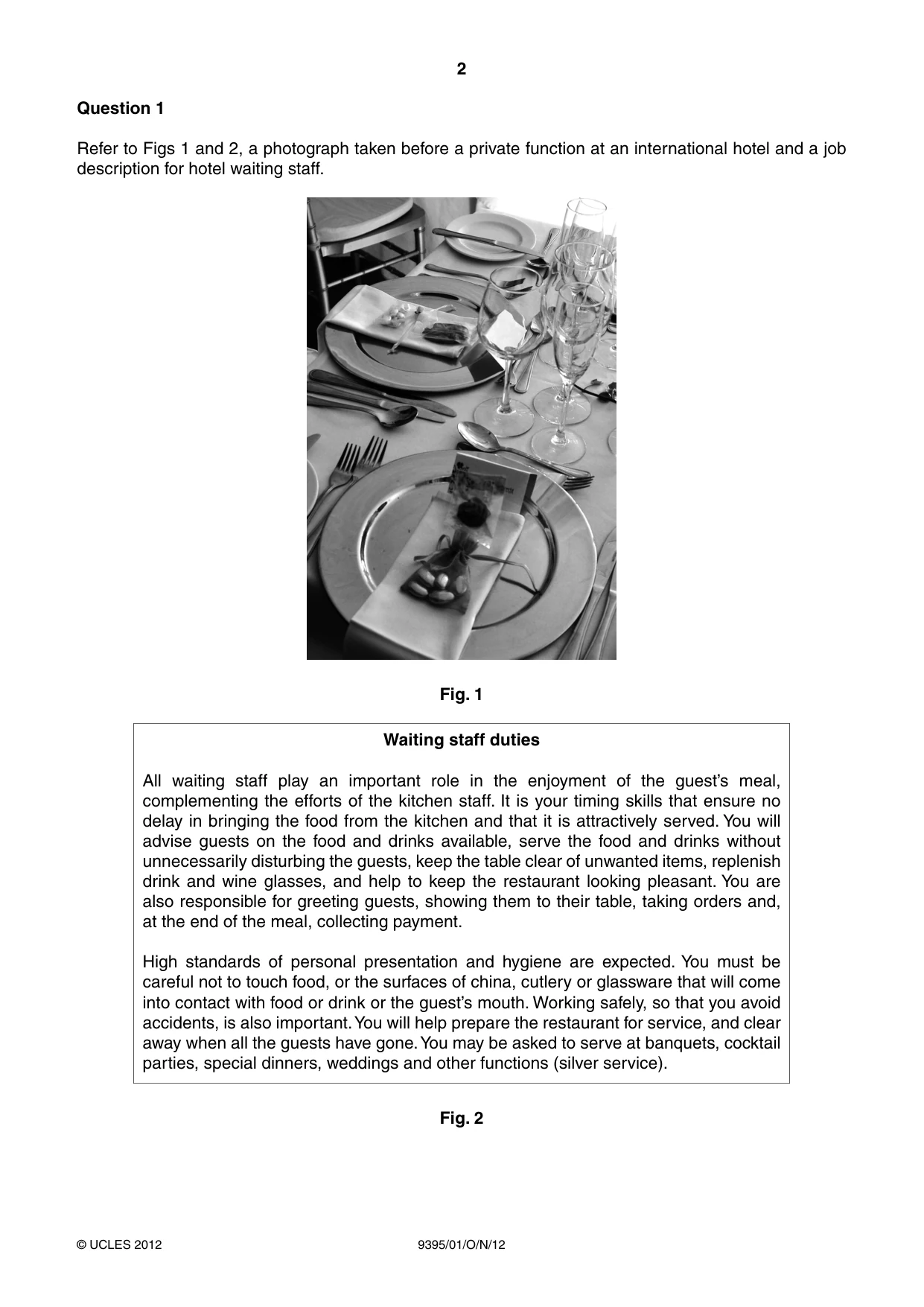
2 9395/01/O/N/12 © UCLES 2012 Question 1 Refer to Figs 1 and 2, a photograph taken before a private function at an international hotel and a job description for hotel waiting staff. Fig. 1 Waiting staff duties All waiting staff play an important role in the enjoyment of the guest’s meal, complementing the efforts of the kitchen staff. It is your timing skills that ensure no delay in bringing the food from the kitchen and that it is attractively served. You will advise guests on the food and drinks available, serve the food and drinks without unnecessarily disturbing the guests, keep the table clear of unwanted items, replenish drink and wine glasses, and help to keep the restaurant looking pleasant. You are also responsible for greeting guests, showing them to their table, taking orders and, at the end of the meal, collecting payment. High standards of personal presentation and hygiene are expected. You must be careful not to touch food, or the surfaces of china, cutlery or glassware that will come into contact with food or drink or the guest’s mouth. Working safely, so that you avoid accidents, is also important. You will help prepare the restaurant for service, and clear away when all the guests have gone. You may be asked to serve at banquets, cocktail parties, special dinners, weddings and other functions (silver service). Fig. 2
Question paper, page 3
3 9395/01/O/N/12 [Turn over © UCLES 2012 For Examiner’s Use (a) Identify four ways in which waiting staff are expected to interact with external customers. 1 … 2 … 3 … 4 …[4] (b) Briefly explain why waiting staff are given each of the following instructions: • uniforms should be clean and freshly pressed … … … … • fingernails should be clean, short and well-cared-for … … … … • do not use too much perfume … … … …[6]
Question paper, page 4
4 9395/01/O/N/12 © UCLES 2012 For Examiner’s Use (c) Waiting staff frequently have to prepare the restaurant for private functions, such as the one shown in Fig. 1. Describe how this is likely to involve contact with each of the following internal customers: • hotel laundry staff … … … … • kitchen staff … … … … • reception/reservations staff … … … …[6]
Question paper, page 5
5 9395/01/O/N/12 [Turn over © UCLES 2012 For Examiner’s Use (d) With reference to one travel and tourism job role with which you are familiar, assess the ways in which the employee’s performance can be monitored. Chosen travel and tourism job role … … … … … … … … … … … … … … … … … … … … … … … … … …[9] [Total: 25]
Question paper, page 6
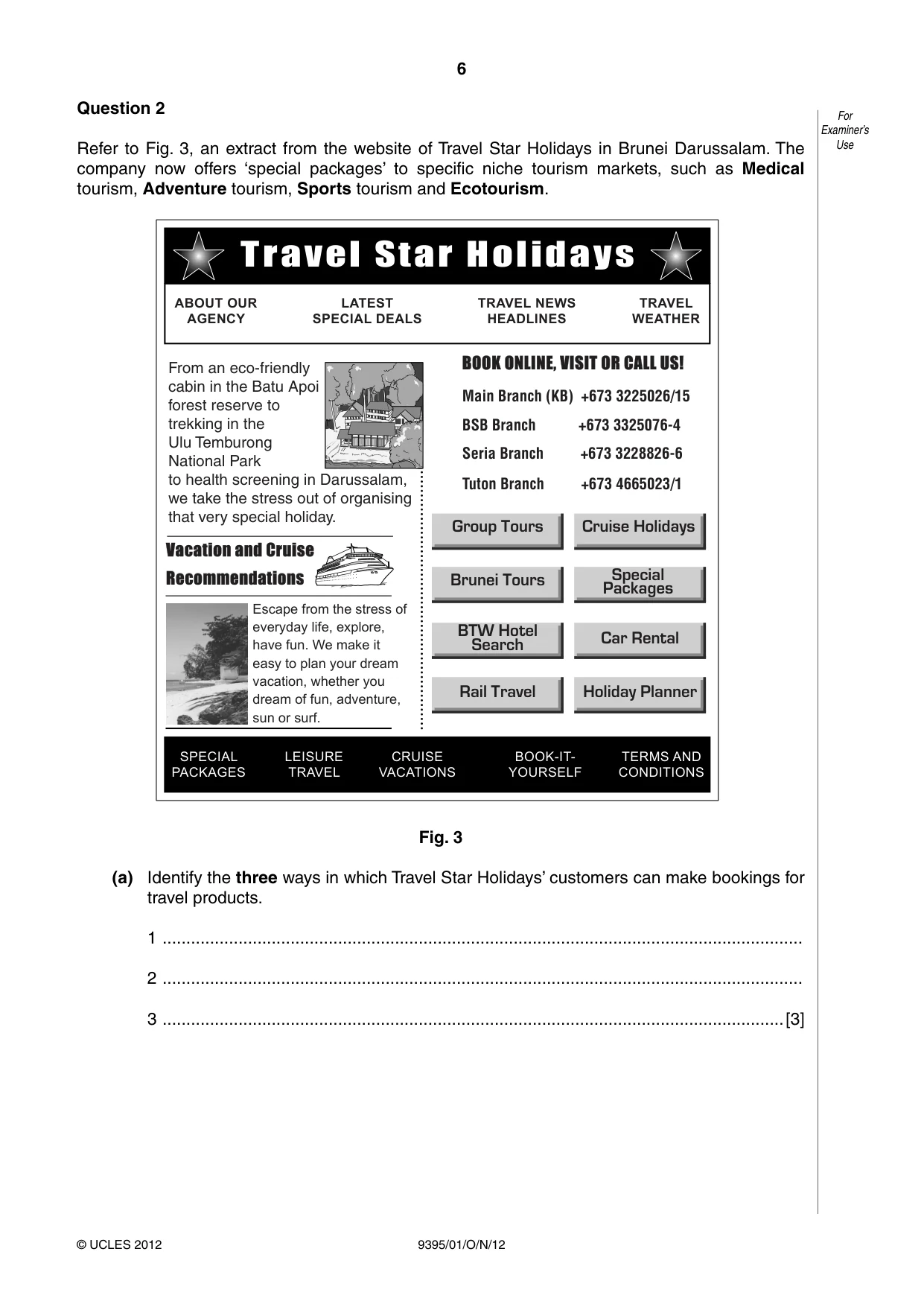
6 9395/01/O/N/12 © UCLES 2012 For Examiner’s Use Question 2 Refer to Fig. 3, an extract from the website of Travel Star Holidays in Brunei Darussalam. The company now offers ‘special packages’ to specific niche tourism markets, such as Medical tourism, Adventure tourism, Sports tourism and Ecotourism. Cruise Holidays Vacation and Cruise Recommendations Escape from the stress of everyday life, explore, have fun. We make it easy to plan your dream vacation, whether you dream of fun, adventure, sun or surf. Travel Star Holidays ABOUT OUR AGENCY LATEST SPECIAL DEALS TRAVEL NEWS HEADLINES TRAVEL WEATHER BOOK ONLINE, VISIT OR CALL US! Group Tours Special Packages Brunei Tours Car Rental BTW Hotel Search Holiday Planner Rail Travel SPECIAL PACKAGES LEISURE TRAVEL CRUISE VACATIONS BOOK-IT- YOURSELF TERMS AND CONDITIONS Main Branch (KB) +673 3225026/15 BSB Branch +673 3325076-4 Seria Branch +673 3228826-6 Tuton Branch +673 4665023/1 From an eco-friendly cabin in the Batu Apoi forest reserve to trekking in the Ulu Temburong National Park to health screening in Darussalam, we take the stress out of organising that very special holiday. Fig. 3 (a) Identify the three ways in which Travel Star Holidays’ customers can make bookings for travel products. 1 … 2 … 3 …[3]
Question paper, page 7
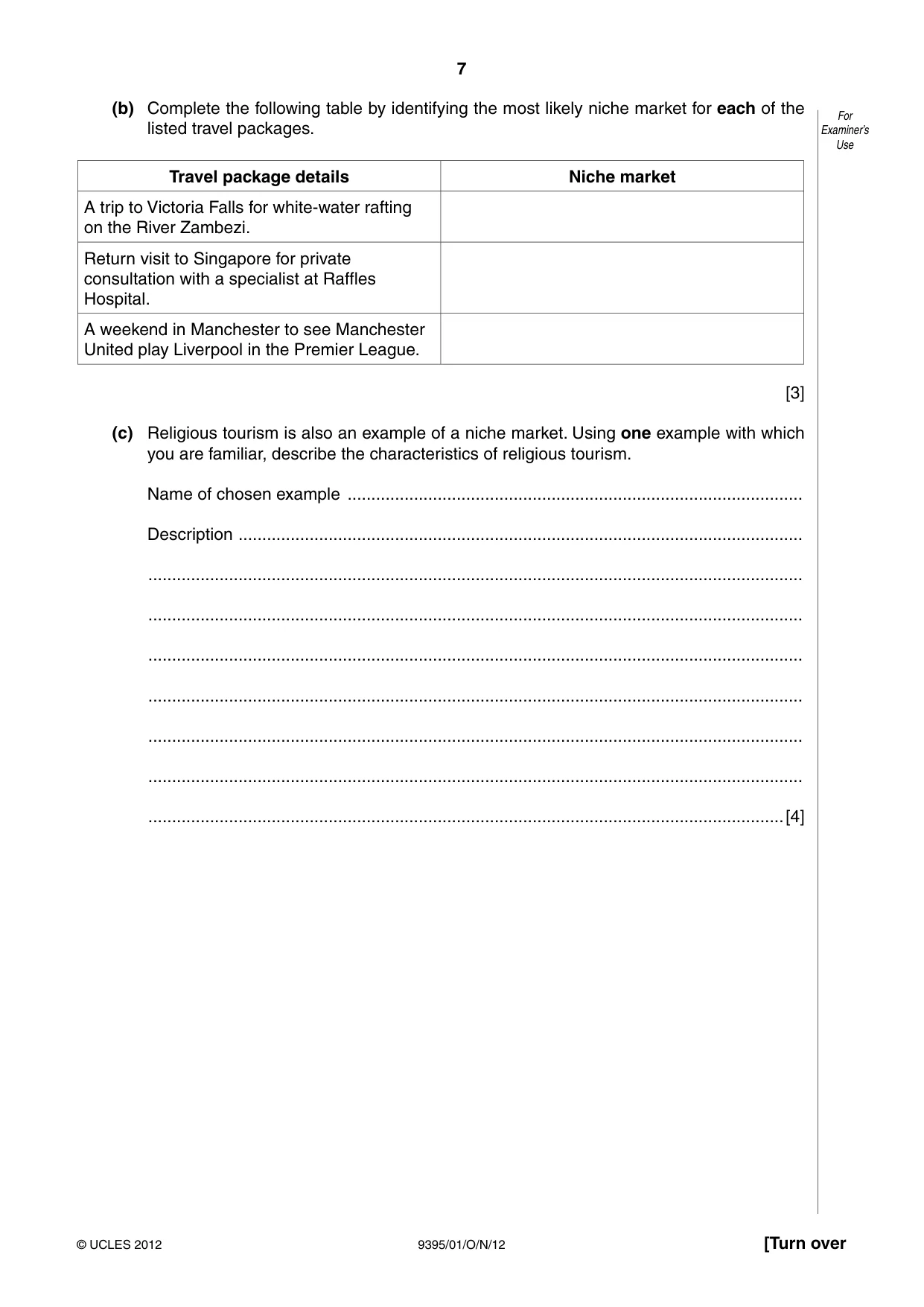
7 9395/01/O/N/12 [Turn over © UCLES 2012 For Examiner’s Use (b) Complete the following table by identifying the most likely niche market for each of the listed travel packages. Travel package details Niche market A trip to Victoria Falls for white-water rafting on the River Zambezi. Return visit to Singapore for private consultation with a specialist at Raffles Hospital. A weekend in Manchester to see Manchester United play Liverpool in the Premier League. [3] (c) Religious tourism is also an example of a niche market. Using one example with which you are familiar, describe the characteristics of religious tourism. Name of chosen example … Description … … … … … … … …[4]
Question paper, page 8
8 9395/01/O/N/12 © UCLES 2012 For Examiner’s Use (d) Some destinations are more popular than others. Discuss the problems that can arise when a destination exceeds its ‘carrying capacity’. … … … … … … … … … … … …[6]
Question paper, page 9
9 9395/01/O/N/12 [Turn over © UCLES 2012 For Examiner’s Use (e) With reference to one destination with which you are familiar, assess the range of accommodation that is available to meet the needs of different types of tourist. Name of chosen destination … … … … … … … … … … … … … … … … … … … … … … … … … …[9] [Total: 25]
Question paper, page 10
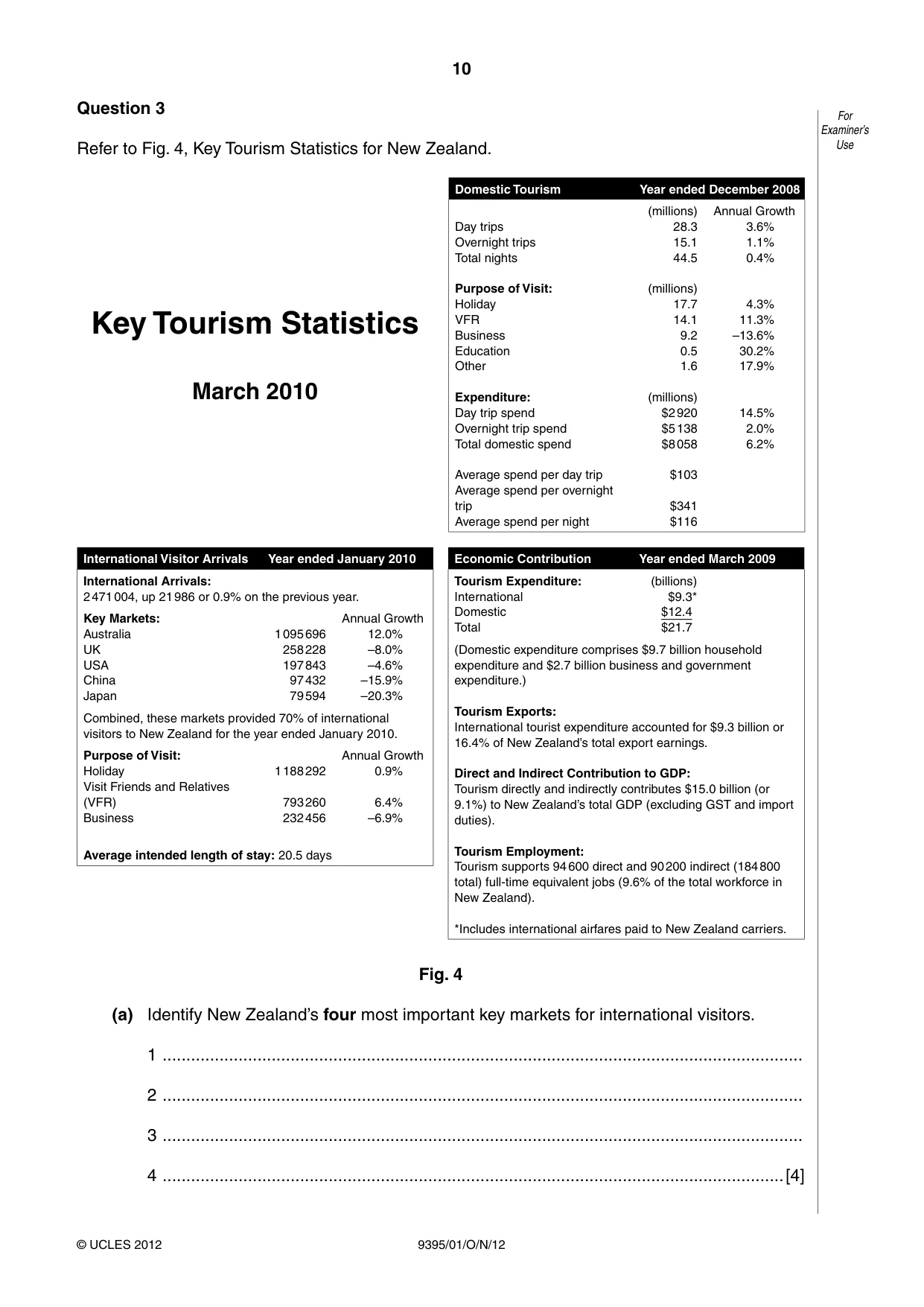
10 9395/01/O/N/12 © UCLES 2012 For Examiner’s Use Question 3 Refer to Fig. 4, Key Tourism Statistics for New Zealand. International Visitor Arrivals Year ended January 2010 International Arrivals: 2 471 004, up 21 986 or 0.9% on the previous year. Key Markets: Australia UK USA China Japan 1 095 696 258 228 197 843 97 432 79 594 Annual Growth 12.0% –8.0% –4.6% –15.9% –20.3% Combined, these markets provided 70% of international visitors to New Zealand for the year ended January 2010. Purpose of Visit: Holiday Visit Friends and Relatives (VFR) Business 1 188 292 793 260 232 456 Annual Growth 0.9% 6.4% –6.9% Average intended length of stay: 20.5 days Domestic Tourism Year ended December 2008 Day trips Overnight trips Total nights Purpose of Visit: Holiday VFR Business Education Other Expenditure: Day trip spend Overnight trip spend Total domestic spend Average spend per day trip Average spend per overnight trip Average spend per night (millions) 28.3 15.1 44.5 (millions) 17.7 14.1 9.2 0.5 1.6 (millions) $2 920 $5 138 $8 058 $103 $341 $116 Annual Growth 3.6% 1.1% 0.4% 4.3% 11.3% –13.6% 30.2% 17.9% 14.5% 2.0% 6.2% Economic Contribution Year ended March 2009 Tourism Expenditure: International Domestic Total (billions) $9.3* $12.4 $21.7 (Domestic expenditure comprises $9.7 billion household expenditure and $2.7 billion business and government expenditure.) Tourism Exports: International tourist expenditure accounted for $9.3 billion or 16.4% of New Zealand’s total export earnings. Direct and Indirect Contribution to GDP: Tourism directly and indirectly contributes $15.0 billion (or 9.1%) to New Zealand’s total GDP (excluding GST and import duties). Tourism Employment: Tourism supports 94 600 direct and 90 200 indirect (184 800 total) full-time equivalent jobs (9.6% of the total workforce in New Zealand). *Includes international airfares paid to New Zealand carriers. Key Tourism Statistics March 2010 Fig. 4 (a) Identify New Zealand’s four most important key markets for international visitors. 1 … 2 … 3 … 4 …[4]
Question paper, page 11
11 9395/01/O/N/12 [Turn over © UCLES 2012 For Examiner’s Use (b) The average international visitor length of stay in New Zealand is 20.5 days. This is much higher than in many other destinations. Explain two reasons why international visitor lengths of stay vary. 1 … … … … … … 2 … … … … … …[6] (c) Explain three changing socio-economic factors that cause increased levels of domestic tourism in countries such as New Zealand. 1 … … … … 2 … … … … 3 … … … …[6]
Question paper, page 12
12 9395/01/O/N/12 © UCLES 2012 For Examiner’s Use (d) With reference only to Fig. 4, assess the economic impacts of tourism in New Zealand. … … … … … … … … … … … … … … … … … … … … … … … … … …[9] [Total: 25]
Question paper, page 13
13 9395/01/O/N/12 © UCLES 2012 [Turn over PLEASE TURN OVER FOR QUESTION 4.
Question paper, page 14
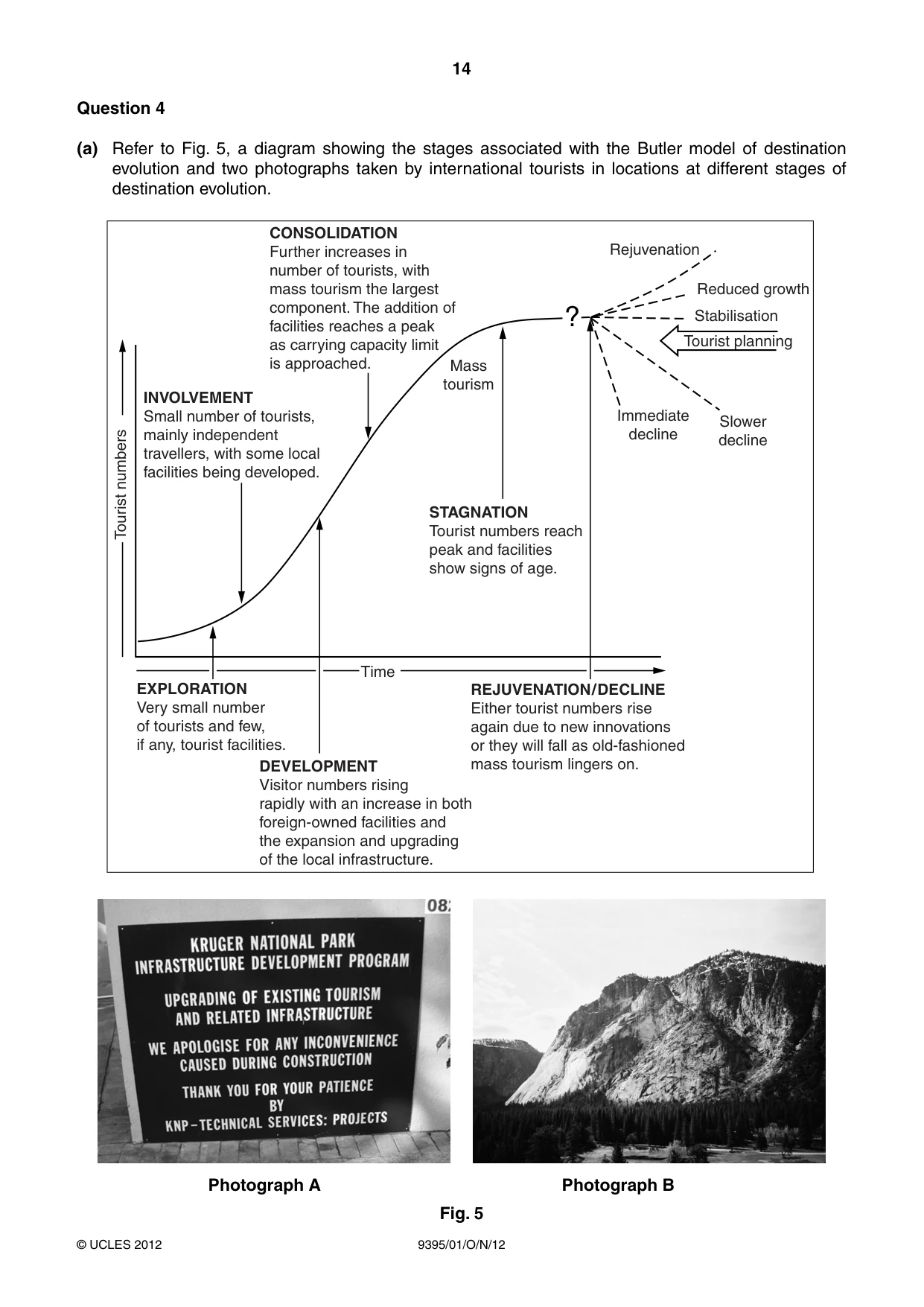
14 9395/01/O/N/12 © UCLES 2012 Question 4 (a) Refer to Fig. 5, a diagram showing the stages associated with the Butler model of destination evolution and two photographs taken by international tourists in locations at different stages of destination evolution. Time Tourist numbers EXPLORATION Very small number of tourists and few, if any, tourist facilities. STAGNATION Tourist numbers reach peak and facilities show signs of age. REJUVENATION / DECLINE Either tourist numbers rise again due to new innovations or they will fall as old-fashioned mass tourism lingers on. INVOLVEMENT Small number of tourists, mainly independent travellers, with some local facilities being developed. CONSOLIDATION Further increases in number of tourists, with mass tourism the largest component. The addition of facilities reaches a peak as carrying capacity limit is approached. DEVELOPMENT Visitor numbers rising rapidly with an increase in both foreign-owned facilities and the expansion and upgrading of the local infrastructure. Rejuvenation Reduced growth Stabilisation Slower decline Mass tourism Immediate decline Tourist planning Photograph A Photograph B Fig. 5
Question paper, page 15
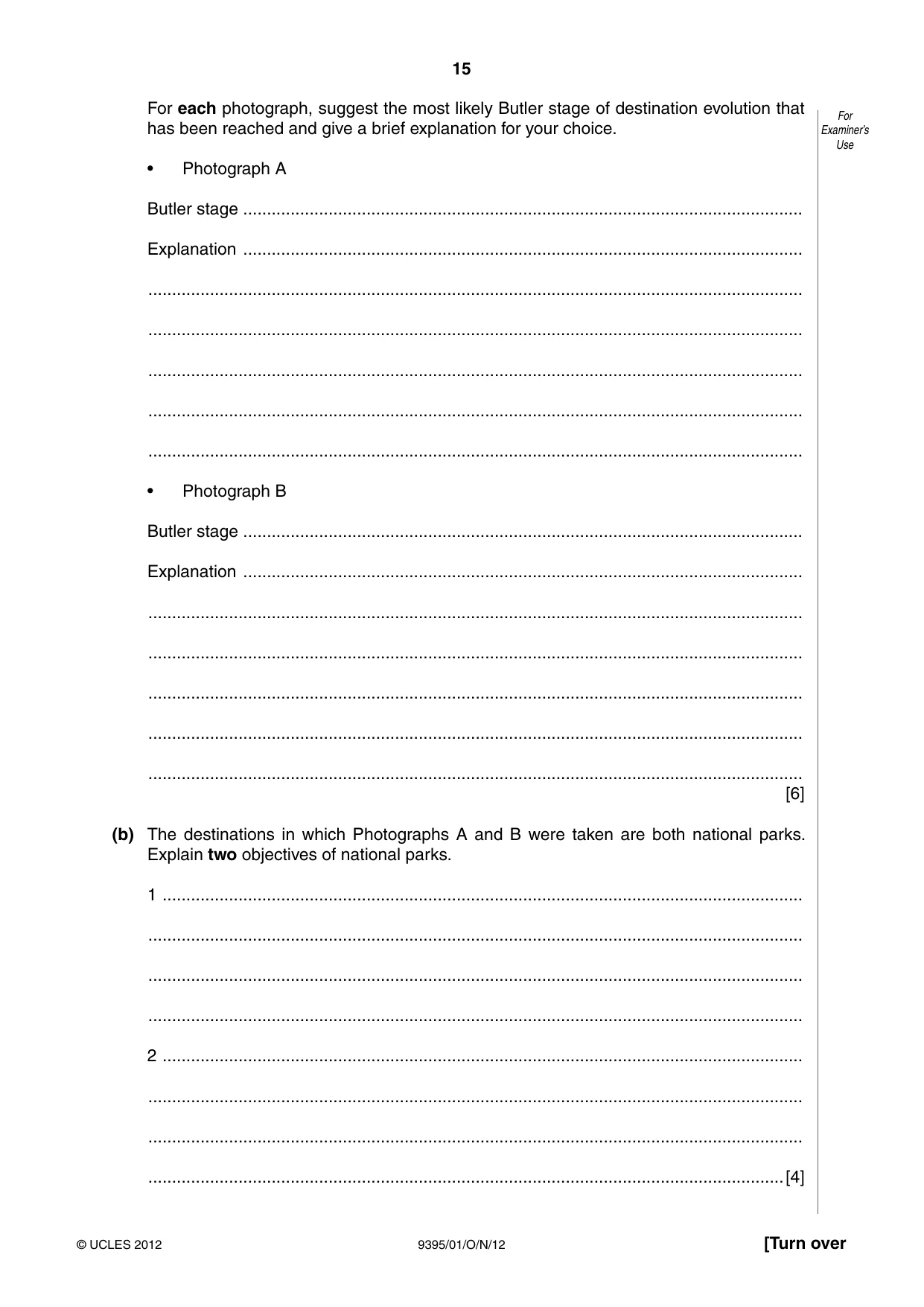
15 9395/01/O/N/12 [Turn over © UCLES 2012 For Examiner’s Use For each photograph, suggest the most likely Butler stage of destination evolution that has been reached and give a brief explanation for your choice. • Photograph A Butler stage … Explanation … … … … … … • Photograph B Butler stage … Explanation … … … … … … [6] (b) The destinations in which Photographs A and B were taken are both national parks. Explain two objectives of national parks. 1 … … … … 2 … … … …[4]
Question paper, page 16
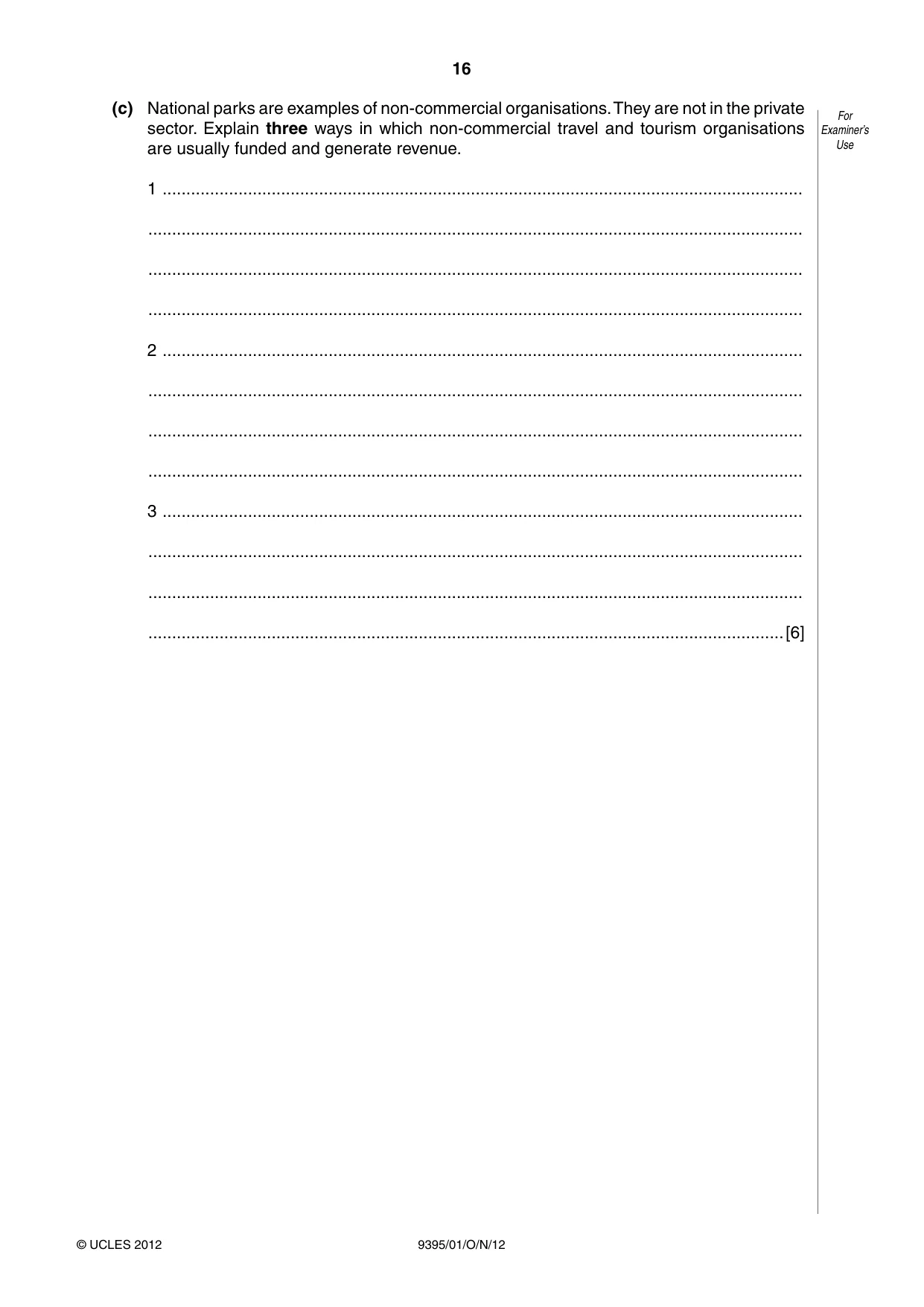
16 9395/01/O/N/12 © UCLES 2012 For Examiner’s Use (c) National parks are examples of non-commercial organisations. They are not in the private sector. Explain three ways in which non-commercial travel and tourism organisations are usually funded and generate revenue. 1 … … … … 2 … … … … 3 … … … …[6]
Question paper, page 17
17 9395/01/O/N/12 © UCLES 2012 For Examiner’s Use (d) With reference to one destination with which you are familiar, assess the threats to the future development of its tourism industry. Name of chosen destination … … … … … … … … … … … … … … … … … … … … … … … … … …[9] [Total: 25]
Question paper, page 18
18 9395/01/O/N/12 © UCLES 2012 BLANK PAGE
Question paper, page 19
19 9395/01/O/N/12 © UCLES 2012 BLANK PAGE
Question paper, page 20
20 9395/01/O/N/12 © UCLES 2012 BLANK PAGE Copyright Acknowledgements: Fig. 1 © John D Smith © UCLES. Fig. 4 © http://www.touristtimes.net.nz/site/tourtimes/files/KeyTourismStatisticsMar2010.pdf. Photograph A © John D Smith © UCLES. Photograph B © John D Smith © UCLES. Permission to reproduce items where third-party owned material protected by copyright is included has been sought and cleared where possible. Every reasonable effort has been made by the publisher (UCLES) to trace copyright holders, but if any items requiring clearance have unwittingly been included, the publisher will be pleased to make amends at the earliest possible opportunity. University of Cambridge International Examinations is part of the Cambridge Assessment Group. Cambridge Assessment is the brand name of University of Cambridge Local Examinations Syndicate (UCLES), which is itself a department of the University of Cambridge.
Mark scheme, page 1
CAMBRIDGE INTERNATIONAL EXAMINATIONS GCE Advanced Subsidiary Level and GCE Advanced Level MARK SCHEME for the October/November 2012 series 9395 TRAVEL AND TOURISM 9395/01 Paper 1 (Core Paper), maximum raw mark 100 This mark scheme is published as an aid to teachers and candidates, to indicate the requirements of the examination. It shows the basis on which Examiners were instructed to award marks. It does not indicate the details of the discussions that took place at an Examiners’ meeting before marking began, which would have considered the acceptability of alternative answers. Mark schemes should be read in conjunction with the question paper and the Principal Examiner Report for Teachers. Cambridge will not enter into discussions about these mark schemes. Cambridge is publishing the mark schemes for the October/November 2012 series for most IGCSE, GCE Advanced Level and Advanced Subsidiary Level components and some Ordinary Level components.
Mark scheme, page 2
Page 2 Mark Scheme Syllabus Paper GCE AS/A LEVEL – October/November 2012 9395 01 © Cambridge International Examinations 2012 1 (a) Identify four ways in which waiting staff are expected interact with external customers. [4] Award one mark for each of four valid identifications as indicated on Fig. 2 from: • greeting guests • showing them to their table • advise guests on the food and drinks available • taking orders • serve the food and drinks without unnecessarily disturbing the guests, • keep the table clear of unwanted items • replenish drink and wine glasses • collecting payment. (b) Briefly explain why waiting staff are given each of the following instructions: [6] In each instance, award one mark for the identification of a valid reason and then award a second mark for an appropriate explanatory development in context. • uniforms should be clean and freshly pressed: image (1) representing organisation (1) business-like appearance (1) customer expectation etc. (1) • fingernails should be clean, short and well-cared-for: H&S (1) food environment (1) image (1) customer expectation (1) • do not use too much perfume: unpleasant (1) allergic reaction (1) food environment (1) impair customer enjoyment (1). Credit all valid reasoning following the 1+1 format. (c) Waiting staff frequently have to prepare the restaurant for private functions, such as the one shown in Fig. 1. Describe how this is likely to involve contact with each of the following internal customers: [6] This involves some thoughtful reflection and interpretation of Fig. 1 based on the image of a fully laid table with place settings. Award one mark for each of three valid identifications based on Fig. 1 and then award a second mark for an appropriate development comment in each context. Correct ideas will include the following. • hotel laundry staff: linen (1) fresh table cloth and napkins (1) collect before service (1) send used ones after (1) • kitchen staff: food orders (1) collect for service (1) get menu information (1) special needs/requests etc. (1) • reception/reservations staff: number of guests (1) places required (1) cancellations/ additions (1) special requests etc. (1). Credit all valid linkages to given internal colleagues.
Mark scheme, page 3
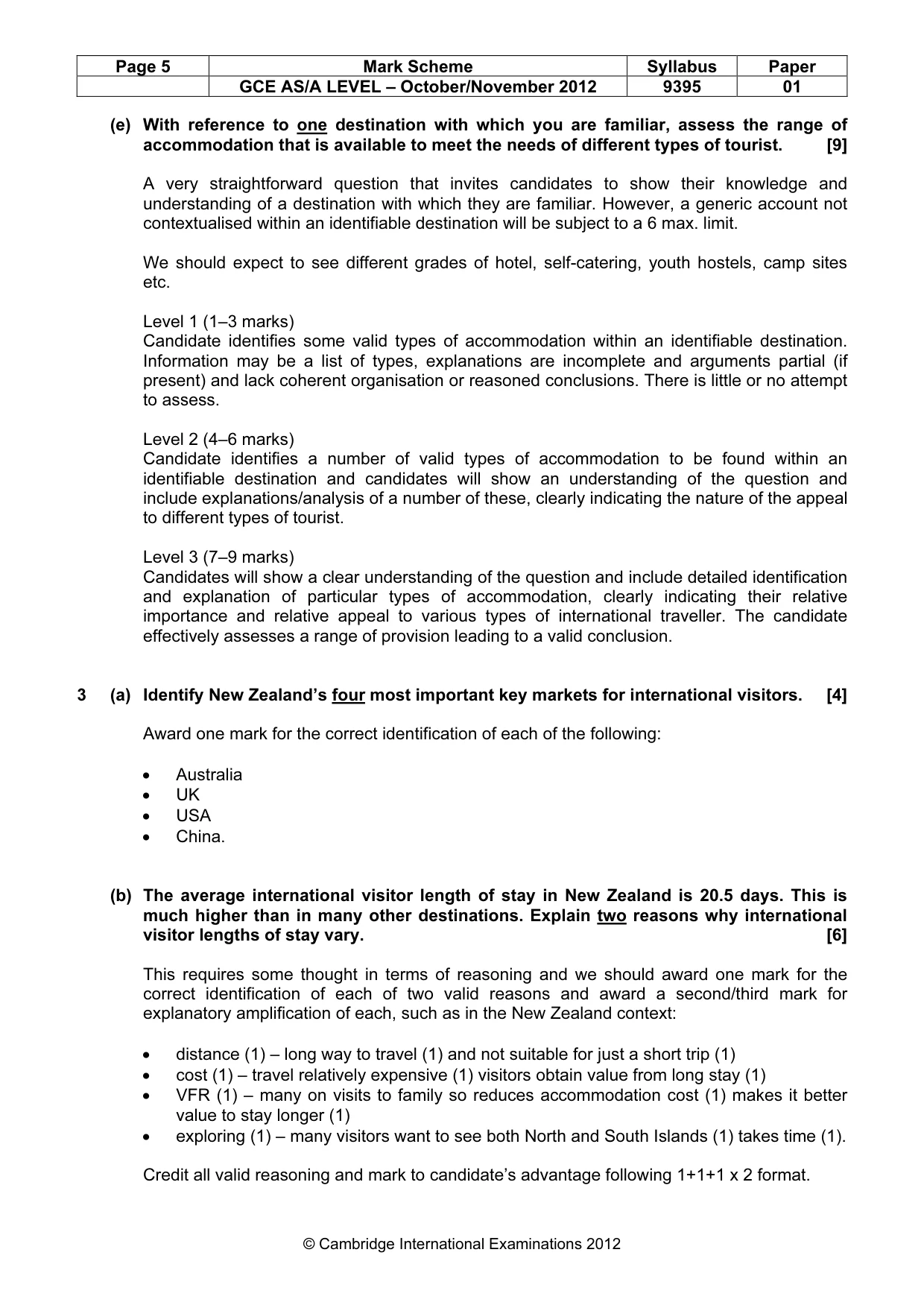
Page 3 Mark Scheme Syllabus Paper GCE AS/A LEVEL – October/November 2012 9395 01 © Cambridge International Examinations 2012 (d) With reference to one travel and tourism job role with which you are familiar, assess the ways in which the employee’s performance can be monitored. [9] The candidate’s answer should focus on one identifiable job role within any travel and tourism organisation without restriction. What is important is the quality of the assessment and the methods of monitoring should be valid for the specified role. Most job performances can be monitored in the following ways: • observation • performance at training • complaints • positive comment/feedback • team efficiency • results or targets achieved. Level 1 (1–3 marks) The candidate identifies/describes up to three valid ways, such as those indicated above. Level 2 (4–6 marks) [4 marks] – The candidate makes valid analytical comment(s) about one way. [5–6 marks] – The candidate makes valid analytical comment(s) about two or more ways. Level 3 (7–9 marks) [7 marks] – The candidate makes valid evaluative comment(s) in relation to one or more ways. [8–9 marks] – The candidate makes valid evaluative comment(s) in relation to two or more ways and comes to a conclusion as to which one(s) are most significant. 2 (a) Identify the three ways in which Travel Star Holidays’ customers can make bookings for travel products. [3] Award one mark for each of three identifications from Fig. 3 as follows: • online • telephone • visit shop/agency. (b) Complete the following table by identifying the most likely niche market for each of the listed travel packages. [3] Award one mark for each correct niche market identification as follows: • white-water rafting = adventure tourism • Singapore hospital = medical tourism • Manchester United v Liverpool = sports tourism
Mark scheme, page 4
Page 4 Mark Scheme Syllabus Paper GCE AS/A LEVEL – October/November 2012 9395 01 © Cambridge International Examinations 2012 (c) Religious tourism is also an example of a niche market. Using one example with which you are familiar, describe the characteristics of religious tourism. [4] Award one mark for the identification of a valid example of religious tourism and then award up to a further 3 marks for a logical description of the characteristics of such travel – allowing for the development of appropriate ideas. For example: Mecca and the Hajj (1) In 2010 1.8 million foreign pilgrims visited Mecca for Hajj, visiting key sites (1). The greater Hajj (al-hajj al-akbar) begins on the eighth day of the lunar month of Dhu al-Hijjah (1). If they are not already wearing it upon their arrival, pilgrims put on ihram clothing and then leave Mecca for the nearby town of Mina (1) where they spend the rest of the day. The Saudi government has put up thousands of large white tents at Mina to provide accommodations for all the pilgrims (1). 2 (d) Some destinations are more popular than others. Discuss the problems that can arise when a destination exceeds its ‘carrying capacity’. [6] Tourism Carrying Capacity is defined by the World Tourism Organisation as “the maximum number of people that may visit a tourist destination at the same time, without causing destruction of the physical, economic, socio-cultural environment and an unacceptable decrease in the quality of visitors' satisfaction”. Therefore, the carrying capacity is the point at which a destination or attraction starts experiencing adverse conditions as a result of the number of visitors. Thus, we are looking for problems caused. Level 1 (1–2 marks) will identify up to two appropriate issues, providing some detail but will be mainly descriptive. Level 2 (3–4 marks) can be awarded for an analysis of selected points, clearly indicating how negative impacts result in a poorer visitor experience. Level 3 (5–6 marks) can be awarded for evaluative comment about the significance/ importance of particular issues. The better answers will have a reasoned conclusion.
Mark scheme, page 5
Page 5 Mark Scheme Syllabus Paper GCE AS/A LEVEL – October/November 2012 9395 01 © Cambridge International Examinations 2012 (e) With reference to one destination with which you are familiar, assess the range of accommodation that is available to meet the needs of different types of tourist. [9] A very straightforward question that invites candidates to show their knowledge and understanding of a destination with which they are familiar. However, a generic account not contextualised within an identifiable destination will be subject to a 6 max. limit. We should expect to see different grades of hotel, self-catering, youth hostels, camp sites etc. Level 1 (1–3 marks) Candidate identifies some valid types of accommodation within an identifiable destination. Information may be a list of types, explanations are incomplete and arguments partial (if present) and lack coherent organisation or reasoned conclusions. There is little or no attempt to assess. Level 2 (4–6 marks) Candidate identifies a number of valid types of accommodation to be found within an identifiable destination and candidates will show an understanding of the question and include explanations/analysis of a number of these, clearly indicating the nature of the appeal to different types of tourist. Level 3 (7–9 marks) Candidates will show a clear understanding of the question and include detailed identification and explanation of particular types of accommodation, clearly indicating their relative importance and relative appeal to various types of international traveller. The candidate effectively assesses a range of provision leading to a valid conclusion. 3 (a) Identify New Zealand’s four most important key markets for international visitors. [4] Award one mark for the correct identification of each of the following: • Australia • UK • USA • China. (b) The average international visitor length of stay in New Zealand is 20.5 days. This is much higher than in many other destinations. Explain two reasons why international visitor lengths of stay vary. [6] This requires some thought in terms of reasoning and we should award one mark for the correct identification of each of two valid reasons and award a second/third mark for explanatory amplification of each, such as in the New Zealand context: • distance (1) – long way to travel (1) and not suitable for just a short trip (1) • cost (1) – travel relatively expensive (1) visitors obtain value from long stay (1) • VFR (1) – many on visits to family so reduces accommodation cost (1) makes it better value to stay longer (1) • exploring (1) – many visitors want to see both North and South Islands (1) takes time (1). Credit all valid reasoning and mark to candidate’s advantage following 1+1+1 x 2 format.
Mark scheme, page 6
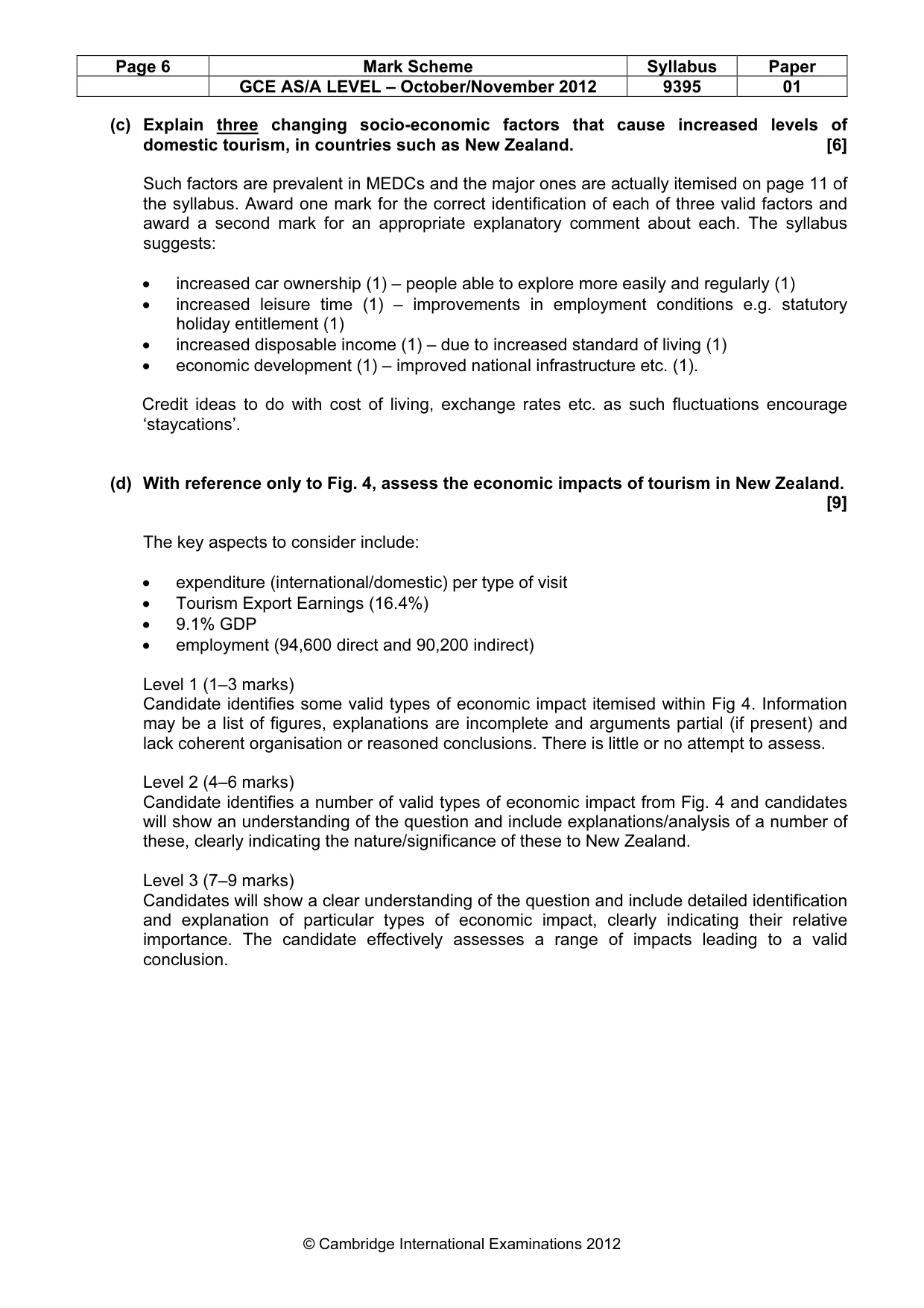
Page 6 Mark Scheme Syllabus Paper GCE AS/A LEVEL – October/November 2012 9395 01 © Cambridge International Examinations 2012 (c) Explain three changing socio-economic factors that cause increased levels of domestic tourism, in countries such as New Zealand. [6] Such factors are prevalent in MEDCs and the major ones are actually itemised on page 11 of the syllabus. Award one mark for the correct identification of each of three valid factors and award a second mark for an appropriate explanatory comment about each. The syllabus suggests: • increased car ownership (1) – people able to explore more easily and regularly (1) • increased leisure time (1) – improvements in employment conditions e.g. statutory holiday entitlement (1) • increased disposable income (1) – due to increased standard of living (1) • economic development (1) – improved national infrastructure etc. (1). Credit ideas to do with cost of living, exchange rates etc. as such fluctuations encourage ‘staycations’. (d) With reference only to Fig. 4, assess the economic impacts of tourism in New Zealand. [9] The key aspects to consider include: • expenditure (international/domestic) per type of visit • Tourism Export Earnings (16.4%) • 9.1% GDP • employment (94,600 direct and 90,200 indirect) Level 1 (1–3 marks) Candidate identifies some valid types of economic impact itemised within Fig 4. Information may be a list of figures, explanations are incomplete and arguments partial (if present) and lack coherent organisation or reasoned conclusions. There is little or no attempt to assess. Level 2 (4–6 marks) Candidate identifies a number of valid types of economic impact from Fig. 4 and candidates will show an understanding of the question and include explanations/analysis of a number of these, clearly indicating the nature/significance of these to New Zealand. Level 3 (7–9 marks) Candidates will show a clear understanding of the question and include detailed identification and explanation of particular types of economic impact, clearly indicating their relative importance. The candidate effectively assesses a range of impacts leading to a valid conclusion.
Mark scheme, page 7
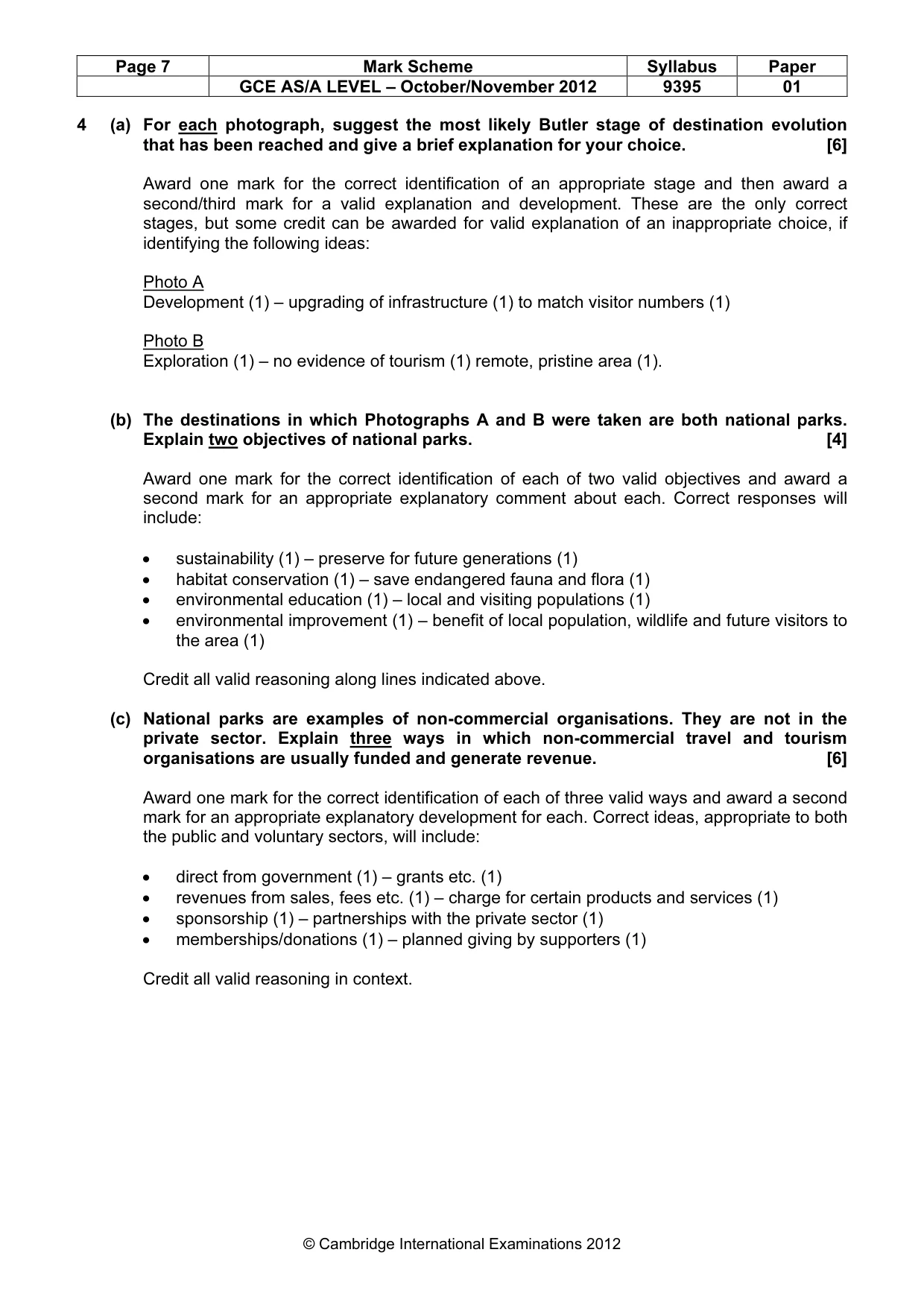
Page 7 Mark Scheme Syllabus Paper GCE AS/A LEVEL – October/November 2012 9395 01 © Cambridge International Examinations 2012 4 (a) For each photograph, suggest the most likely Butler stage of destination evolution that has been reached and give a brief explanation for your choice. [6] Award one mark for the correct identification of an appropriate stage and then award a second/third mark for a valid explanation and development. These are the only correct stages, but some credit can be awarded for valid explanation of an inappropriate choice, if identifying the following ideas: Photo A Development (1) – upgrading of infrastructure (1) to match visitor numbers (1) Photo B Exploration (1) – no evidence of tourism (1) remote, pristine area (1). (b) The destinations in which Photographs A and B were taken are both national parks. Explain two objectives of national parks. [4] Award one mark for the correct identification of each of two valid objectives and award a second mark for an appropriate explanatory comment about each. Correct responses will include: • sustainability (1) – preserve for future generations (1) • habitat conservation (1) – save endangered fauna and flora (1) • environmental education (1) – local and visiting populations (1) • environmental improvement (1) – benefit of local population, wildlife and future visitors to the area (1) Credit all valid reasoning along lines indicated above. (c) National parks are examples of non-commercial organisations. They are not in the private sector. Explain three ways in which non-commercial travel and tourism organisations are usually funded and generate revenue. [6] Award one mark for the correct identification of each of three valid ways and award a second mark for an appropriate explanatory development for each. Correct ideas, appropriate to both the public and voluntary sectors, will include: • direct from government (1) – grants etc. (1) • revenues from sales, fees etc. (1) – charge for certain products and services (1) • sponsorship (1) – partnerships with the private sector (1) • memberships/donations (1) – planned giving by supporters (1) Credit all valid reasoning in context.
Mark scheme, page 8
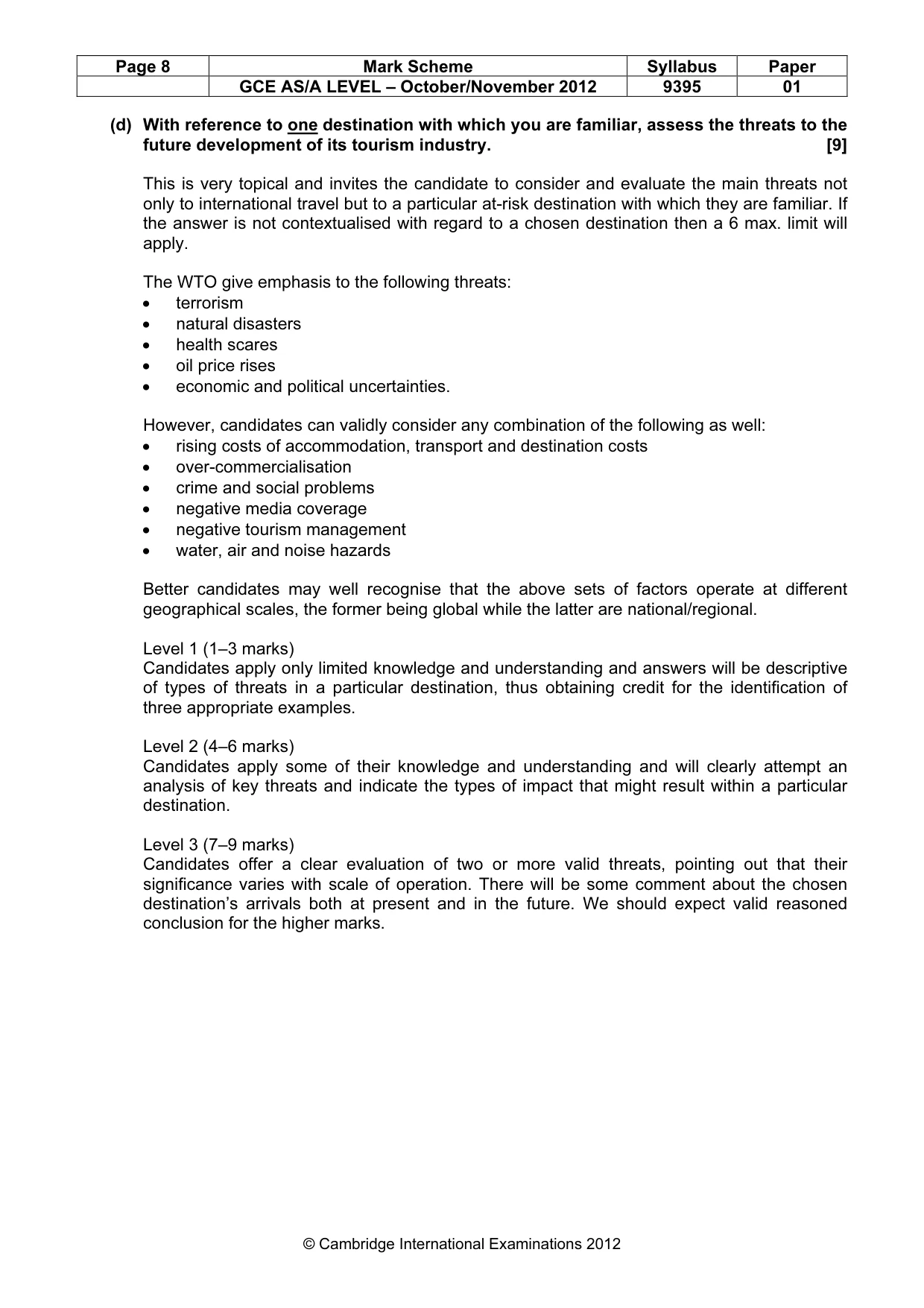
Page 8 Mark Scheme Syllabus Paper GCE AS/A LEVEL – October/November 2012 9395 01 © Cambridge International Examinations 2012 (d) With reference to one destination with which you are familiar, assess the threats to the future development of its tourism industry. [9] This is very topical and invites the candidate to consider and evaluate the main threats not only to international travel but to a particular at-risk destination with which they are familiar. If the answer is not contextualised with regard to a chosen destination then a 6 max. limit will apply. The WTO give emphasis to the following threats: • terrorism • natural disasters • health scares • oil price rises • economic and political uncertainties. However, candidates can validly consider any combination of the following as well: • rising costs of accommodation, transport and destination costs • over-commercialisation • crime and social problems • negative media coverage • negative tourism management • water, air and noise hazards Better candidates may well recognise that the above sets of factors operate at different geographical scales, the former being global while the latter are national/regional. Level 1 (1–3 marks) Candidates apply only limited knowledge and understanding and answers will be descriptive of types of threats in a particular destination, thus obtaining credit for the identification of three appropriate examples. Level 2 (4–6 marks) Candidates apply some of their knowledge and understanding and will clearly attempt an analysis of key threats and indicate the types of impact that might result within a particular destination. Level 3 (7–9 marks) Candidates offer a clear evaluation of two or more valid threats, pointing out that their significance varies with scale of operation. There will be some comment about the chosen destination’s arrivals both at present and in the future. We should expect valid reasoned conclusion for the higher marks.
What you needed in this session
Cambridge’s own grade thresholds for 2012 Oct/Nov, Paper 1 · Variant 1. A higher threshold means an easier paper — the bar moves with how the cohort did.