Cambridge A Level Travel and Tourism 9395 — 2012 May/June Paper 4 · Variant 1
9395/41/M/J/12 · 50 marks · ≈56 min
The question paper and its mark scheme, free to read here and free to download. This is Cambridge’s own paper, exactly as it was sat.
Question paper12 pages


Mark scheme5 pages
Answers below. Sit the paper first if you are practising.
Paper as text
Question paper, page 1
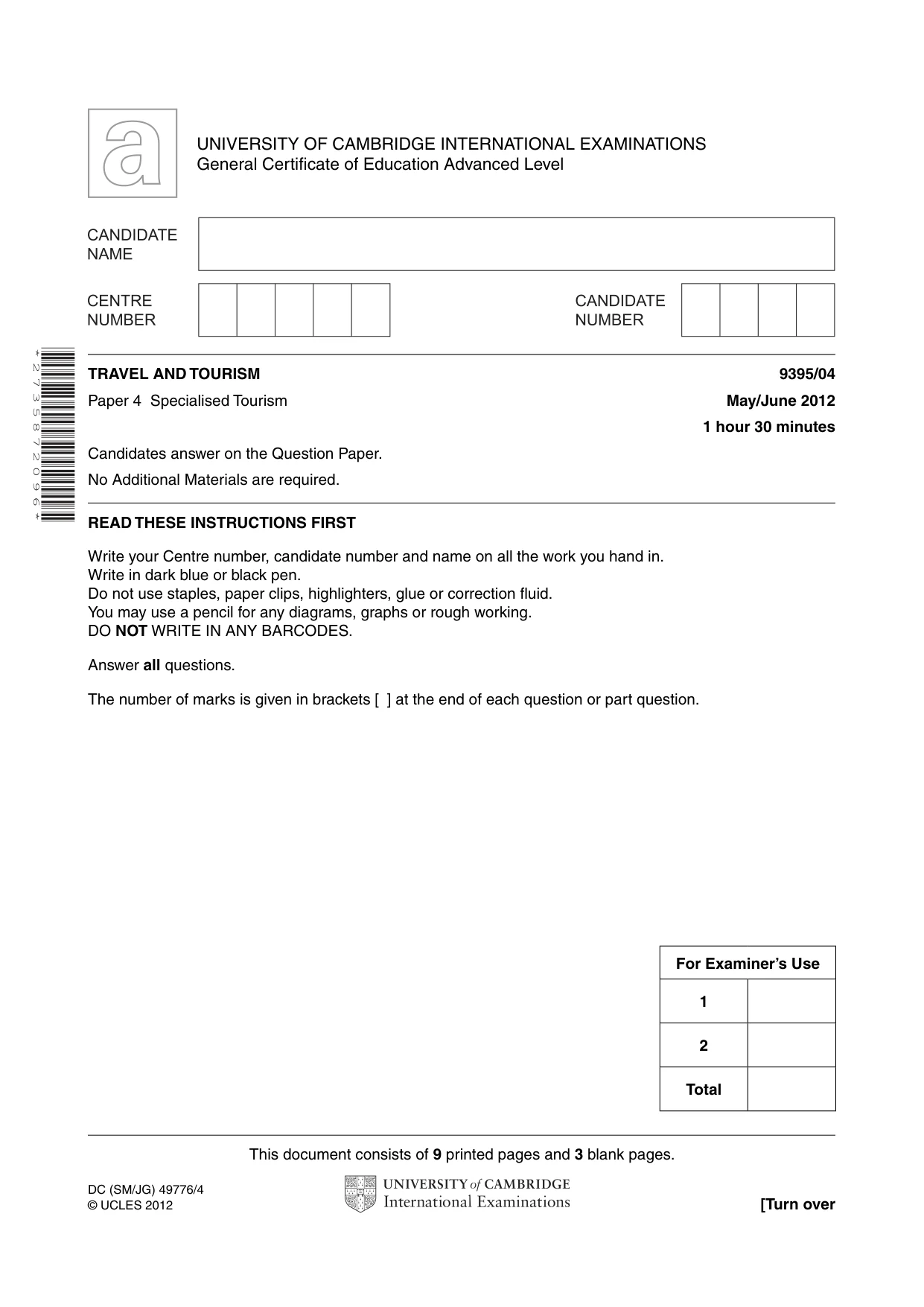
This document consists of 9 printed pages and 3 blank pages. DC (SM/JG) 49776/4 © UCLES 2012 [Turn over UNIVERSITY OF CAMBRIDGE INTERNATIONAL EXAMINATIONS General Certificate of Education Advanced Level * 2 7 3 5 8 7 2 0 9 6 * TRAVEL AND TOURISM 9395/04 Paper 4 Specialised Tourism May/June 2012 1 hour 30 minutes Candidates answer on the Question Paper. No Additional Materials are required. READ THESE INSTRUCTIONS FIRST Write your Centre number, candidate number and name on all the work you hand in. Write in dark blue or black pen. Do not use staples, paper clips, highlighters, glue or correction fluid. You may use a pencil for any diagrams, graphs or rough working. DO NOT WRITE IN ANY BARCODES. Answer all questions. The number of marks is given in brackets [ ] at the end of each question or part question. For Examiner’s Use 1 2 Total
Question paper, page 2
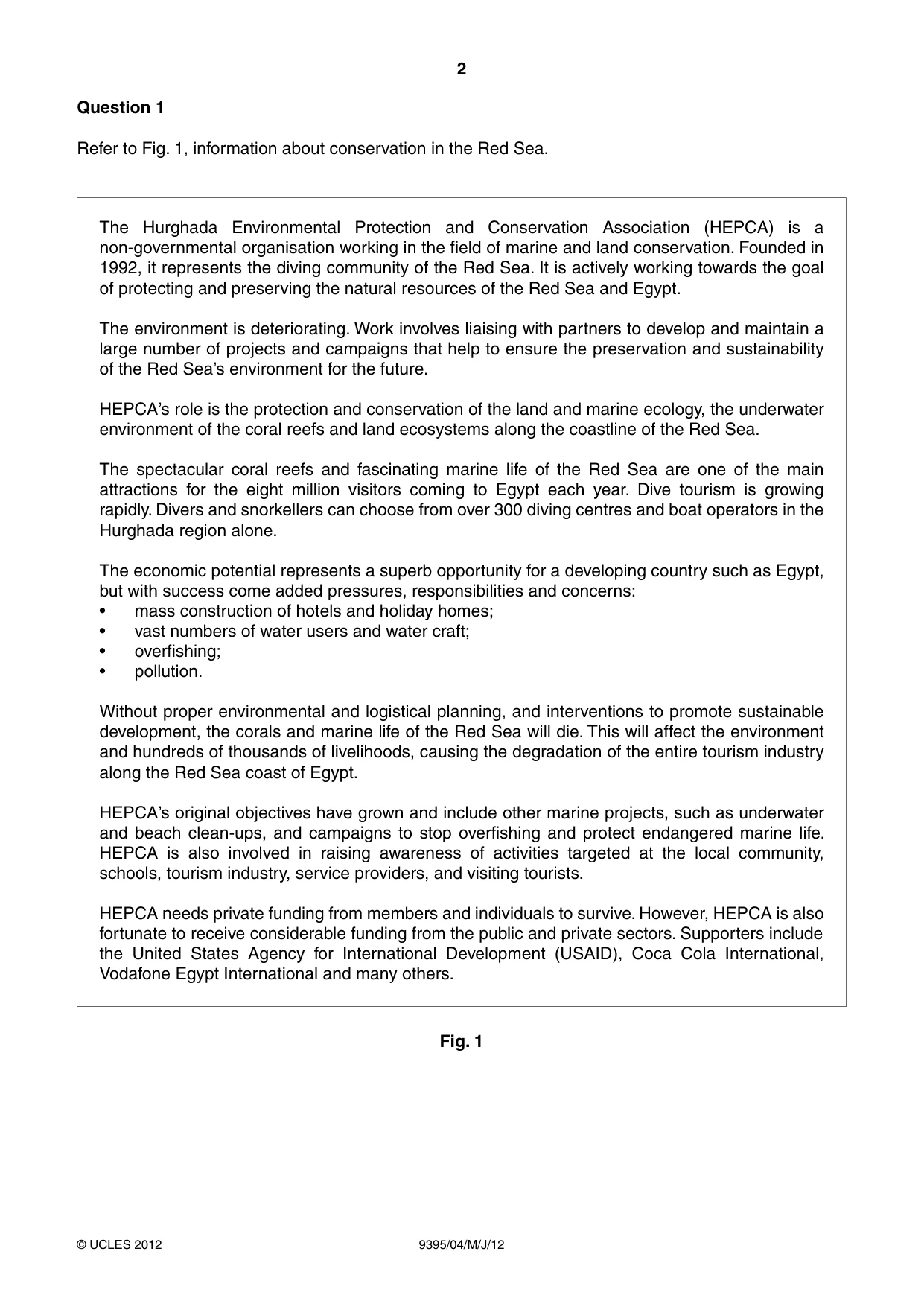
2 9395/04/M/J/12 © UCLES 2012 Question 1 Refer to Fig. 1, information about conservation in the Red Sea. The Hurghada Environmental Protection and Conservation Association (HEPCA) is a non-governmental organisation working in the field of marine and land conservation. Founded in 1992, it represents the diving community of the Red Sea. It is actively working towards the goal of protecting and preserving the natural resources of the Red Sea and Egypt. The environment is deteriorating. Work involves liaising with partners to develop and maintain a large number of projects and campaigns that help to ensure the preservation and sustainability of the Red Sea’s environment for the future. HEPCA’s role is the protection and conservation of the land and marine ecology, the underwater environment of the coral reefs and land ecosystems along the coastline of the Red Sea. The spectacular coral reefs and fascinating marine life of the Red Sea are one of the main attractions for the eight million visitors coming to Egypt each year. Dive tourism is growing rapidly. Divers and snorkellers can choose from over 300 diving centres and boat operators in the Hurghada region alone. The economic potential represents a superb opportunity for a developing country such as Egypt, but with success come added pressures, responsibilities and concerns: • mass construction of hotels and holiday homes; • vast numbers of water users and water craft; • overfishing; • pollution. Without proper environmental and logistical planning, and interventions to promote sustainable development, the corals and marine life of the Red Sea will die. This will affect the environment and hundreds of thousands of livelihoods, causing the degradation of the entire tourism industry along the Red Sea coast of Egypt. HEPCA’s original objectives have grown and include other marine projects, such as underwater and beach clean-ups, and campaigns to stop overfishing and protect endangered marine life. HEPCA is also involved in raising awareness of activities targeted at the local community, schools, tourism industry, service providers, and visiting tourists. HEPCA needs private funding from members and individuals to survive. However, HEPCA is also fortunate to receive considerable funding from the public and private sectors. Supporters include the United States Agency for International Development (USAID), Coca Cola International, Vodafone Egypt International and many others. Fig. 1
Question paper, page 3
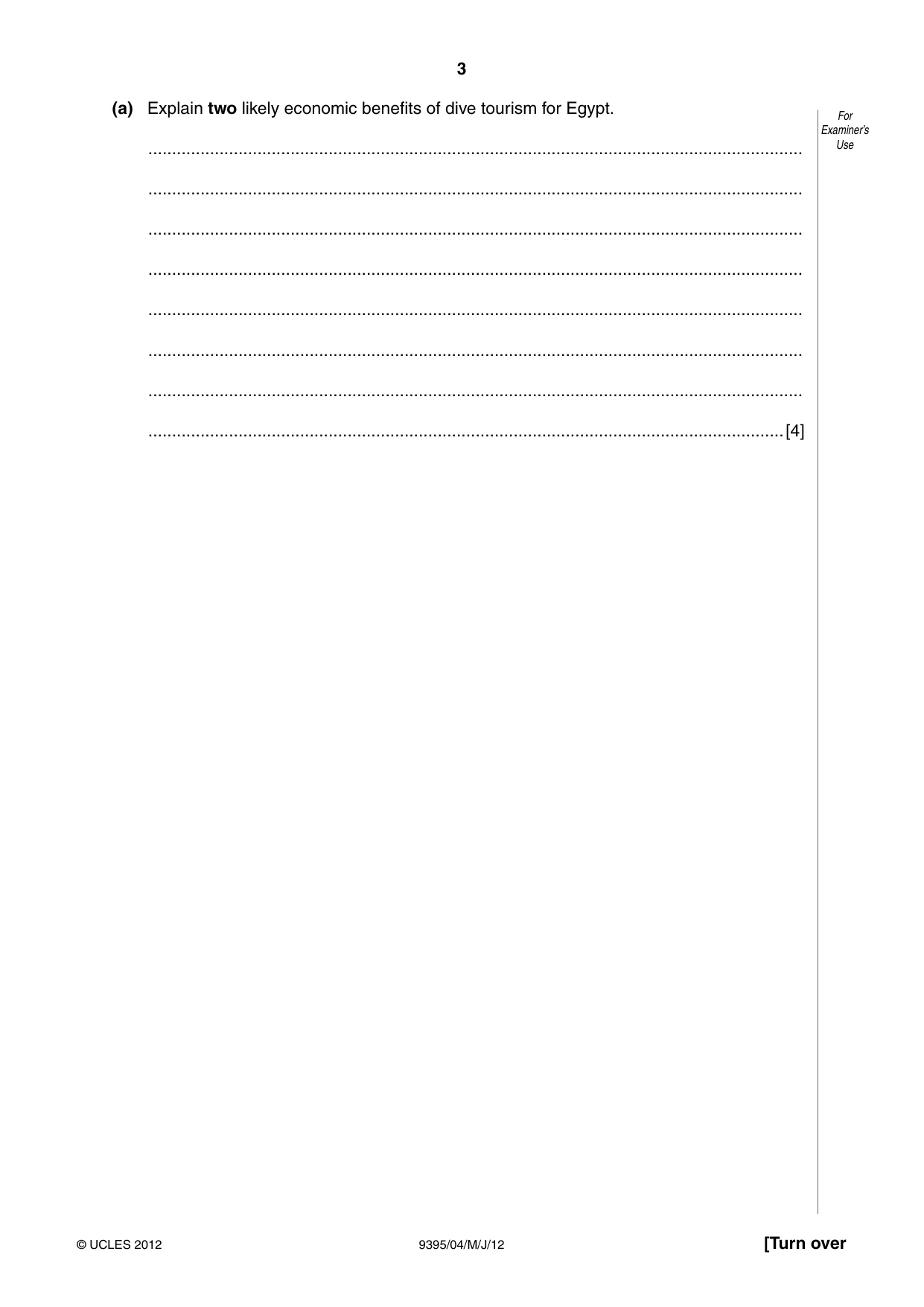
3 9395/04/M/J/12 © UCLES 2012 [Turn over For Examiner’s Use (a) Explain two likely economic benefits of dive tourism for Egypt. … … … … … … … …[4]
Question paper, page 4
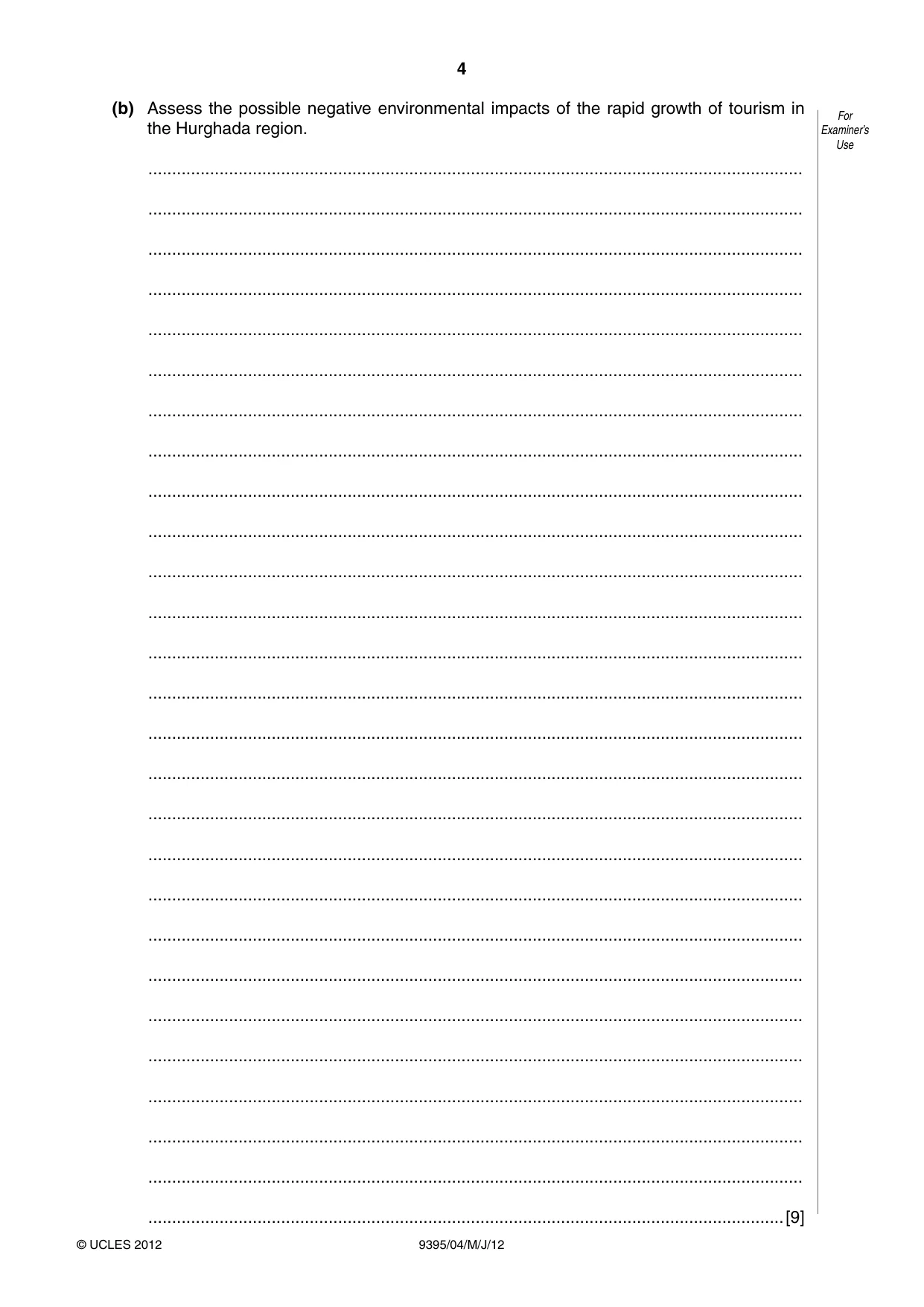
4 9395/04/M/J/12 © UCLES 2012 For Examiner’s Use (b) Assess the possible negative environmental impacts of the rapid growth of tourism in the Hurghada region. … … … … … … … … … … … … … … … … … … … … … … … … … … …[9]
Question paper, page 5
5 9395/04/M/J/12 © UCLES 2012 [Turn over For Examiner’s Use (c) Discuss the importance to the Hurghada Environmental Protection and Conservation Association (HEPCA) of having the support of partners in both the public and private sectors. … … … … … … … … … … … … … … … … … … … … … … … … …[12] [Total: 25]
Question paper, page 6
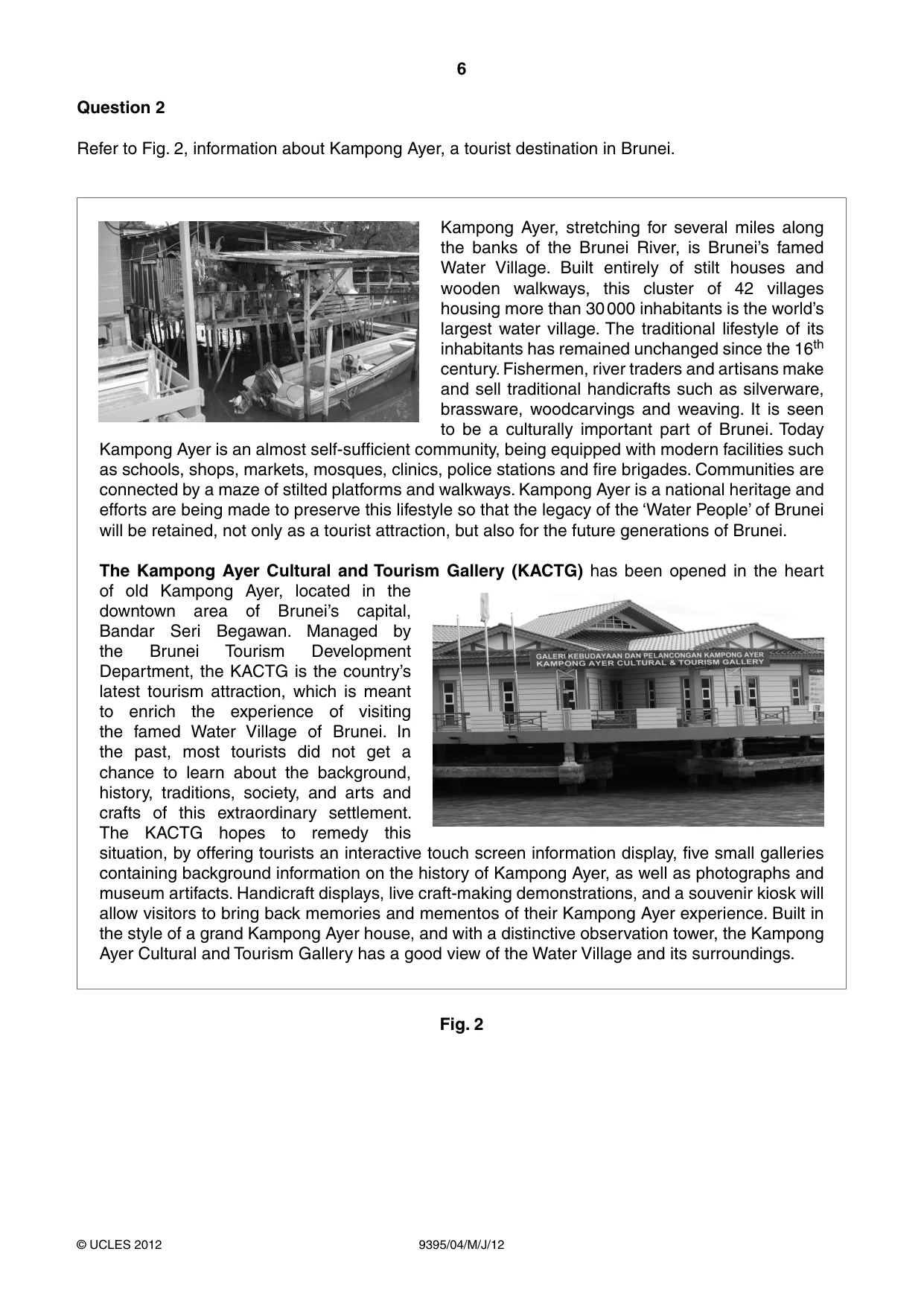
6 9395/04/M/J/12 © UCLES 2012 Question 2 Refer to Fig. 2, information about Kampong Ayer, a tourist destination in Brunei. Kampong Ayer, stretching for several miles along the banks of the Brunei River, is Brunei’s famed Water Village. Built entirely of stilt houses and wooden walkways, this cluster of 42 villages housing more than 30 000 inhabitants is the world’s largest water village. The traditional lifestyle of its inhabitants has remained unchanged since the 16th century. Fishermen, river traders and artisans make and sell traditional handicrafts such as silverware, brassware, woodcarvings and weaving. It is seen to be a culturally important part of Brunei. Today Kampong Ayer is an almost self-sufficient community, being equipped with modern facilities such as schools, shops, markets, mosques, clinics, police stations and fire brigades. Communities are connected by a maze of stilted platforms and walkways. Kampong Ayer is a national heritage and efforts are being made to preserve this lifestyle so that the legacy of the ‘Water People’ of Brunei will be retained, not only as a tourist attraction, but also for the future generations of Brunei. The Kampong Ayer Cultural and Tourism Gallery (KACTG) has been opened in the heart of old Kampong Ayer, located in the downtown area of Brunei’s capital, Bandar Seri Begawan. Managed by the Brunei Tourism Development Department, the KACTG is the country’s latest tourism attraction, which is meant to enrich the experience of visiting the famed Water Village of Brunei. In the past, most tourists did not get a chance to learn about the background, history, traditions, society, and arts and crafts of this extraordinary settlement. The KACTG hopes to remedy this situation, by offering tourists an interactive touch screen information display, five small galleries containing background information on the history of Kampong Ayer, as well as photographs and museum artifacts. Handicraft displays, live craft-making demonstrations, and a souvenir kiosk will allow visitors to bring back memories and mementos of their Kampong Ayer experience. Built in the style of a grand Kampong Ayer house, and with a distinctive observation tower, the Kampong Ayer Cultural and Tourism Gallery has a good view of the Water Village and its surroundings. Fig. 2
Question paper, page 7
7 9395/04/M/J/12 © UCLES 2012 [Turn over For Examiner’s Use (a) Identify and explain two ways in which Kampong Ayer is unique. … … … … … … … …[4]
Question paper, page 8
8 9395/04/M/J/12 © UCLES 2012 For Examiner’s Use (b) Discuss how the Kampong Ayer Cultural and Tourism Gallery (KACTG) helps to preserve the destination’s heritage and culture. … … … … … … … … … … … … … … … … … … … … … … … … … … …[9]
Question paper, page 9
9 9395/04/M/J/12 © UCLES 2012 For Examiner’s Use (c) Assess to what extent a large growth in tourism might destroy the heritage and lifestyles of the Kampong Ayer residents. … … … … … … … … … … … … … … … … … … … … … … … … … …[12] [Total: 25]
Question paper, page 10
10 9395/04/M/J/12 © UCLES 2012 BLANK PAGE
Question paper, page 11
11 9395/04/M/J/12 © UCLES 2012 BLANK PAGE
Question paper, page 12
12 9395/04/M/J/12 © UCLES 2012 Copyright Acknowledgements: Case Study © ADAPTED: www.hepca.com/red-sea-environment-news.aspx. Figure 2 © ADAPTED: www.bruneidirecthys.net/about_brunei/tourist_attraction.hrml. Figure 2 Photographs © Sue Stewart Permission to reproduce items where third-party owned material protected by copyright is included has been sought and cleared where possible. Every reasonable effort has been made by the publisher (UCLES) to trace copyright holders, but if any items requiring clearance have unwittingly been included, the publisher will be pleased to make amends at the earliest possible opportunity. University of Cambridge International Examinations is part of the Cambridge Assessment Group. Cambridge Assessment is the brand name of University of Cambridge Local Examinations Syndicate (UCLES), which is itself a department of the University of Cambridge. BLANK PAGE
Mark scheme, page 1
UNIVERSITY OF CAMBRIDGE INTERNATIONAL EXAMINATIONS GCE Advanced Level MARK SCHEME for the May/June 2012 question paper for the guidance of teachers 9395 TRAVEL AND TOURISM 9395/04 Paper 4 (Specialised Tourism), maximum raw mark 50 This mark scheme is published as an aid to teachers and candidates, to indicate the requirements of the examination. It shows the basis on which Examiners were instructed to award marks. It does not indicate the details of the discussions that took place at an Examiners’ meeting before marking began, which would have considered the acceptability of alternative answers. Mark schemes must be read in conjunction with the question papers and the report on the examination. • Cambridge will not enter into discussions or correspondence in connection with these mark schemes. Cambridge is publishing the mark schemes for the May/June 2012 question papers for most IGCSE, GCE Advanced Level and Advanced Subsidiary Level syllabuses and some Ordinary Level syllabuses.
Mark scheme, page 2
Page 2 Mark Scheme: Teachers’ version Syllabus Paper GCE A LEVEL – May/June 2012 9395 04 © University of Cambridge International Examinations 2012 1 (a) Explain two likely economic benefits of dive tourism for Egypt. [4] Brings tourists that will need accommodation, restaurants etc. and this will mean jobs (1) for the local people bringing wealth to the area (1). Economic development of an area will occur with new dive companies (1) this will result in the need for good local infrastructure (1) these will need to be built which will benefit both locals and tourists (1) and remain a legacy for the community as a whole (1). Two points with two explanations. (2 × 2) (b) Assess the possible negative environmental impacts of the rapid growth of tourism in the Hurghada region. [9] Level 1 (1–3 marks) Candidate identifies impacts. Level 2 (4–6 marks) Candidate explains impacts. Level 3 (7–9 marks) Candidate assesses environmental impacts of the explosion of tourism. Indicative content: • Mass construction of hotels • Over fishing • Vast number of water users – overcrowding • Pollution • Dirty beaches needing clean-ups • Endangered species – loss of indigenous species. Identification 1/2 for Level 1 only. Explain 2 for 4/5, Explain 3, 6 marks. Assess 2 for 7 marks, 3 for 8 marks. Sound and relevant conclusion 9 marks. Listing = Level 1 only.
Mark scheme, page 3
Page 3 Mark Scheme: Teachers’ version Syllabus Paper GCE A LEVEL – May/June 2012 9395 04 © University of Cambridge International Examinations 2012 (c) Discuss the importance to the Hurghada Environmental Protection and Conservation Association (HEPCA) of having the support of partners in both the public and private sectors. [12] Level 1 (1–4 marks) Candidate identifies issues. Level 2 (5–8 marks) Candidate explains issues. Level 3 (9–12 marks) Candidate discusses the importance of support of both public and private partners. Indicative content: • Support vital for funds • And promotion work • Egypt is not a rich country and the support of not only public but private companies will gain prestige and give credence to their campaigns • Gives international perspective – so not only local people who know about campaigns • The area is not only one of great beauty but also of environmental significance. Public supporters can give confidence within the area and local community • Helps to control tours and numbers of divers trying to reach reefs • Should prevent over development • Can help to develop projects that are seen to be impossible • Help to draw up policies. Identification 1/2 for Level 1 only. Explain 2 for 5/6, Explain 3, 7/8 marks. Assess 2 for 9 marks, 3 for 10/11 marks. Sound and relevant conclusion 12 marks. Listing = Level 1 only.
Mark scheme, page 4
Page 4 Mark Scheme: Teachers’ version Syllabus Paper GCE A LEVEL – May/June 2012 9395 04 © University of Cambridge International Examinations 2012 2 (a) Identify and explain two ways in which Kampong Ayer is unique. [4] • Not dependent on the area outside for its needs • Has schools, religious buildings to cater for all of the 30,000 people that live there (1) this then supports them in jobs • Keeps their heritage stable (1) by reduced influences (1) and sees the continuation of important cultural practices. (1) • Does not need external aid or tourists to survive. (1) Two points, one for each identification and a further mark each for explanation. Up to max of 4. (2 × 2) (b) Discuss how the Kampong Ayer Cultural and Tourism Gallery (KACTG) helps to preserve the destination’s heritage and culture. [9] Level 1 (1–3 marks) Candidate identifies issues. Level 2 (4–6 marks) Candidate explains issues. Level 3 (7–9 marks) Candidate discusses how KACTG preserve the heritage and culture of Brunei. Indicative content: • In the past, most tourists have not had a chance to learn about the background, history, traditions, society, and arts and crafts of this extraordinary settlement • KACTG becomes a must see attraction based on the water village and built in the same style • Educates visitors • Interactive displays and craft demonstrations • Creates a greater understanding/appreciation of the culture • Perpetuates interest • Is built in the heart of the community and therefore helps to maintain the traditions and sustain practices. Identification 1/2 for Level 1 only. Explain 2 for 4/5, Explain 3, 6 marks. Assess 2 for 7 marks, 3 for 8 marks. Sound and relevant conclusion 9 marks. Listing = Level 1 only.
Mark scheme, page 5
Page 5 Mark Scheme: Teachers’ version Syllabus Paper GCE A LEVEL – May/June 2012 9395 04 © University of Cambridge International Examinations 2012 (c) Assess to what extent a large growth in tourism might destroy the heritage and lifestyles of the Kampong Ayer residents. [12] Level 1 (1–4 marks) Candidate identifies negative aspects. Level 2 (5–8 marks) Candidate explains negative aspects. Level 3 (9–12 marks) Candidate assesses whether a large growth in tourism might destroy the heritage and lifestyles of the residents. Indicative content: • Significance of culture • Unique stilted village not geared up for visitors – most walkways are designed for residents and extra usage may affect privacy and lifestyles • Locals are self-sufficient in many areas – visitors may upset the balance and timeframe of work • Has many traditional heritage and cultural practices – possibility this may be lost, however could help to bring in extra income and sustain the area • Customs • Access to the village is via wooden walkways – not designed for visitors • Not geared up for large number of visitors – would need to direct them to the visitor gallery. • Demonstration effect could lead to change in values, loss of traditions • Tourists would bring jobs, income and wealth but area needs to have protection in order to prevent overcrowding, erosion, more litter, noise, etc. Identification 1/2 for Level 1 only. Explain 2 for 5/6, Explain 3, 7/8 marks. Assess 2 for 9 marks, 3 for 10/11 marks. Sound and relevant conclusion 12 marks. Listing = Level 1 only.
What you needed in this session
Cambridge’s own grade thresholds for 2012 May/June, Paper 4 · Variant 1. A higher threshold means an easier paper — the bar moves with how the cohort did.