Cambridge A Level Travel and Tourism 9395 — 2012 May/June Paper 1 · Variant 1
9395/11/M/J/12 · 100 marks · ≈113 min
The question paper and its mark scheme, free to read here and free to download. This is Cambridge’s own paper, exactly as it was sat.
Question paper16 pages


Mark scheme9 pages
Answers below. Sit the paper first if you are practising.
Paper as text
Question paper, page 1
This document consists of 15 printed pages and 1 blank page. DC (KN/SW) 51242/3 © UCLES 2012 [Turn over UNIVERSITY OF CAMBRIDGE INTERNATIONAL EXAMINATIONS General Certificate of Education Advanced Subsidiary and Advanced Level * 1 1 8 8 1 7 3 8 6 3 * TRAVEL AND TOURISM 9395/01 Paper 1 Core May/June 2012 2 hours 30 minutes Candidates answer on the Question Paper. No Additional Materials are required. READ THESE INSTRUCTIONS FIRST Write your Centre number, candidate number and name on all the work you hand in. Write in dark blue or black pen. Do not use staples, paper clips, highlighters, glue or correction fluid. You may use a pencil for any diagrams, graphs or rough working. DO NOT WRITE IN ANY BARCODES. Answer all questions. The number of marks is given in brackets [ ] at the end of each question or part question. For Examiner’s Use 1 2 3 4 Total
Question paper, page 2
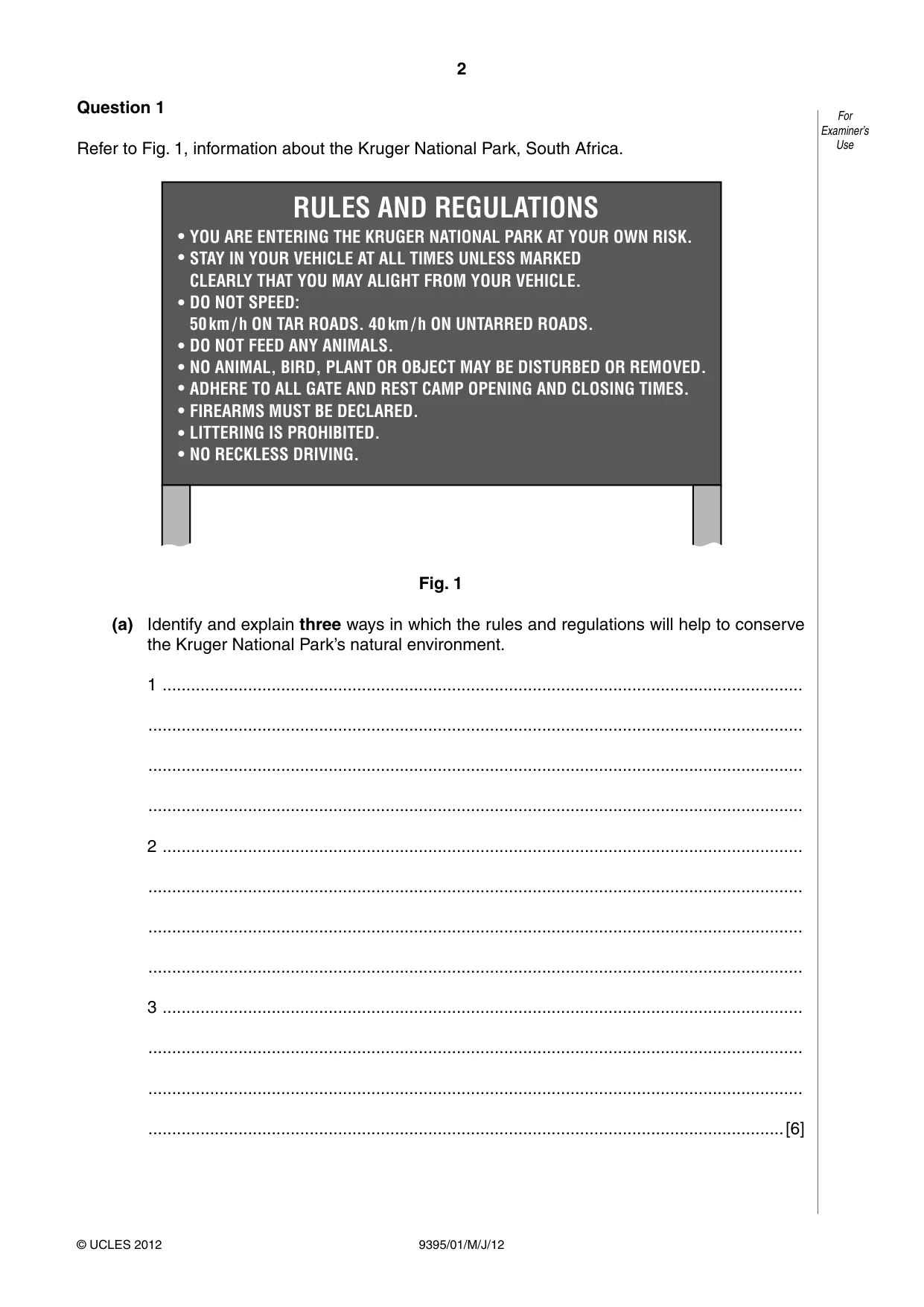
2 9395/01/M/J/12 © UCLES 2012 For Examiner’s Use Question 1 Refer to Fig. 1, information about the Kruger National Park, South Africa. RULES AND REGULATIONS YOU ARE ENTERING THE KRUGER NATIONAL PARK AT YOUR OWN RISK. STAY IN YOUR VEHICLE AT ALL TIMES UNLESS MARKED CLEARLY THAT YOU MAY ALIGHT FROM YOUR VEHICLE. DO NOT SPEED: 50 km / h ON TAR ROADS. 40 km / h ON UNTARRED ROADS. DO NOT FEED ANY ANIMALS. NO ANIMAL, BIRD, PLANT OR OBJECT MAY BE DISTURBED OR REMOVED. ADHERE TO ALL GATE AND REST CAMP OPENING AND CLOSING TIMES. FIREARMS MUST BE DECLARED. LITTERING IS PROHIBITED. NO RECKLESS DRIVING. Fig. 1 (a) Identify and explain three ways in which the rules and regulations will help to conserve the Kruger National Park’s natural environment. 1 … … … … 2 … … … … 3 … … … …[6]
Question paper, page 3
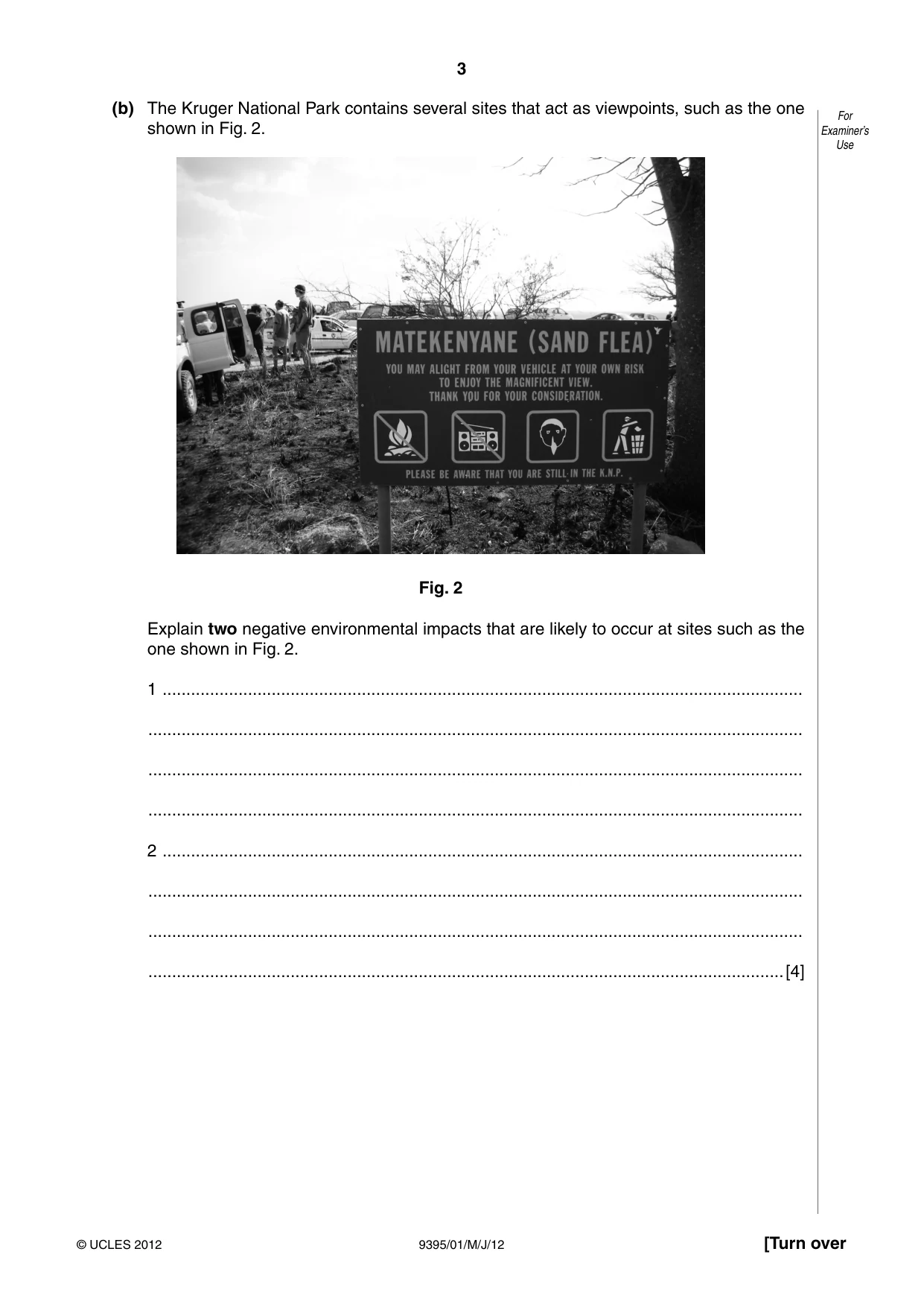
3 9395/01/M/J/12 © UCLES 2012 [Turn over For Examiner’s Use (b) The Kruger National Park contains several sites that act as viewpoints, such as the one shown in Fig. 2. Fig. 2 Explain two negative environmental impacts that are likely to occur at sites such as the one shown in Fig. 2. 1 … … … … 2 … … … …[4]
Question paper, page 4
4 9395/01/M/J/12 © UCLES 2012 For Examiner’s Use (c) Many visitors to the Kruger National Park will be international leisure travellers. Discuss the benefits of car hire to such tourists. … … … … … … … … … … … …[6]
Question paper, page 5
5 9395/01/M/J/12 © UCLES 2012 [Turn over For Examiner’s Use (d) Many destinations have both natural and built visitor attractions. With reference to one built visitor attraction with which you are familiar, discuss its appeal to different types of international traveller. Name of chosen built attraction … … … … … … … … … … … … … … … … … … … … … … … … …[9] [Total: 25]
Question paper, page 6
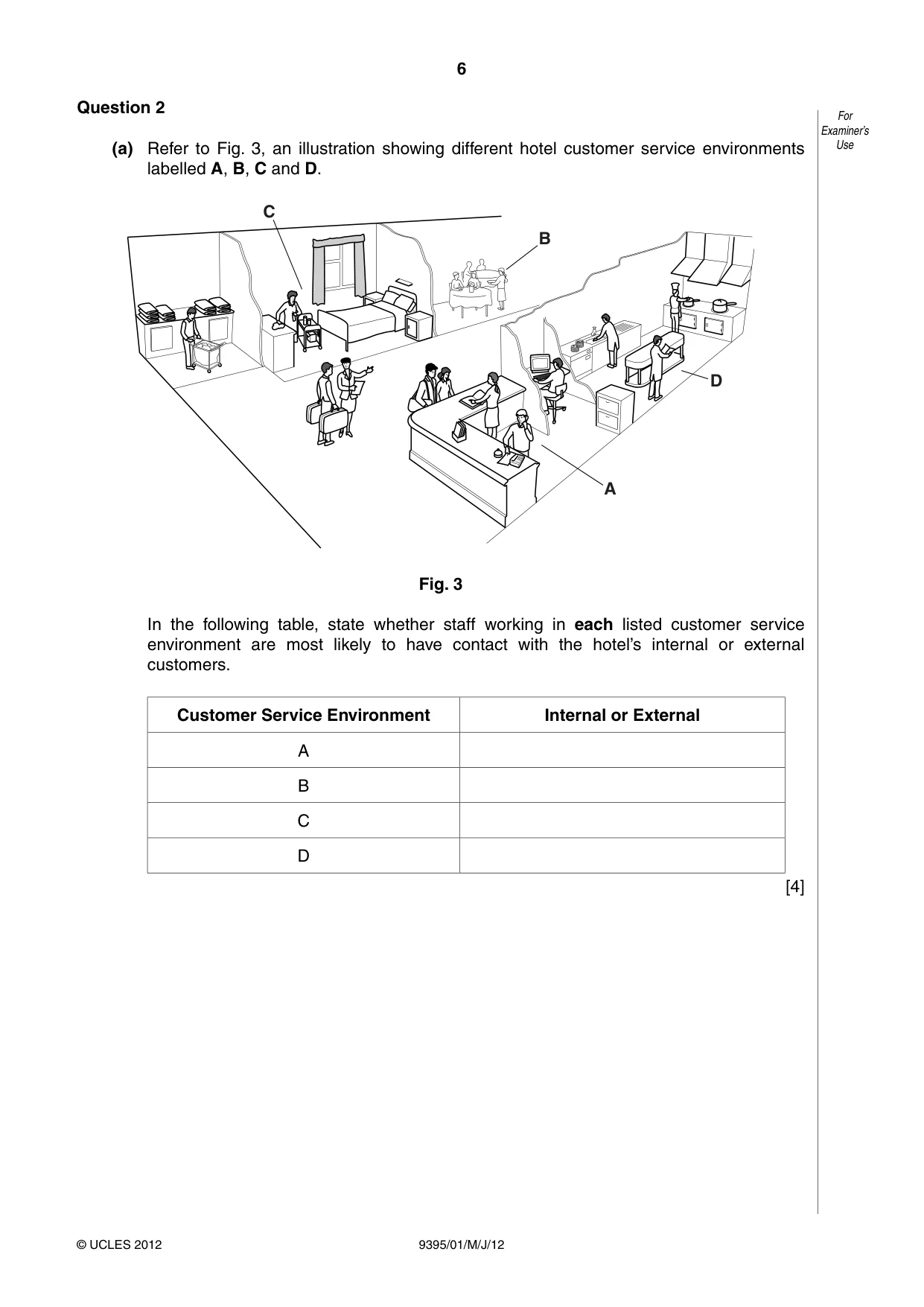
6 9395/01/M/J/12 © UCLES 2012 For Examiner’s Use Question 2 (a) Refer to Fig. 3, an illustration showing different hotel customer service environments labelled A, B, C and D. A D B C Fig. 3 In the following table, state whether staff working in each listed customer service environment are most likely to have contact with the hotel’s internal or external customers. Customer Service Environment Internal or External A B C D [4]
Question paper, page 7
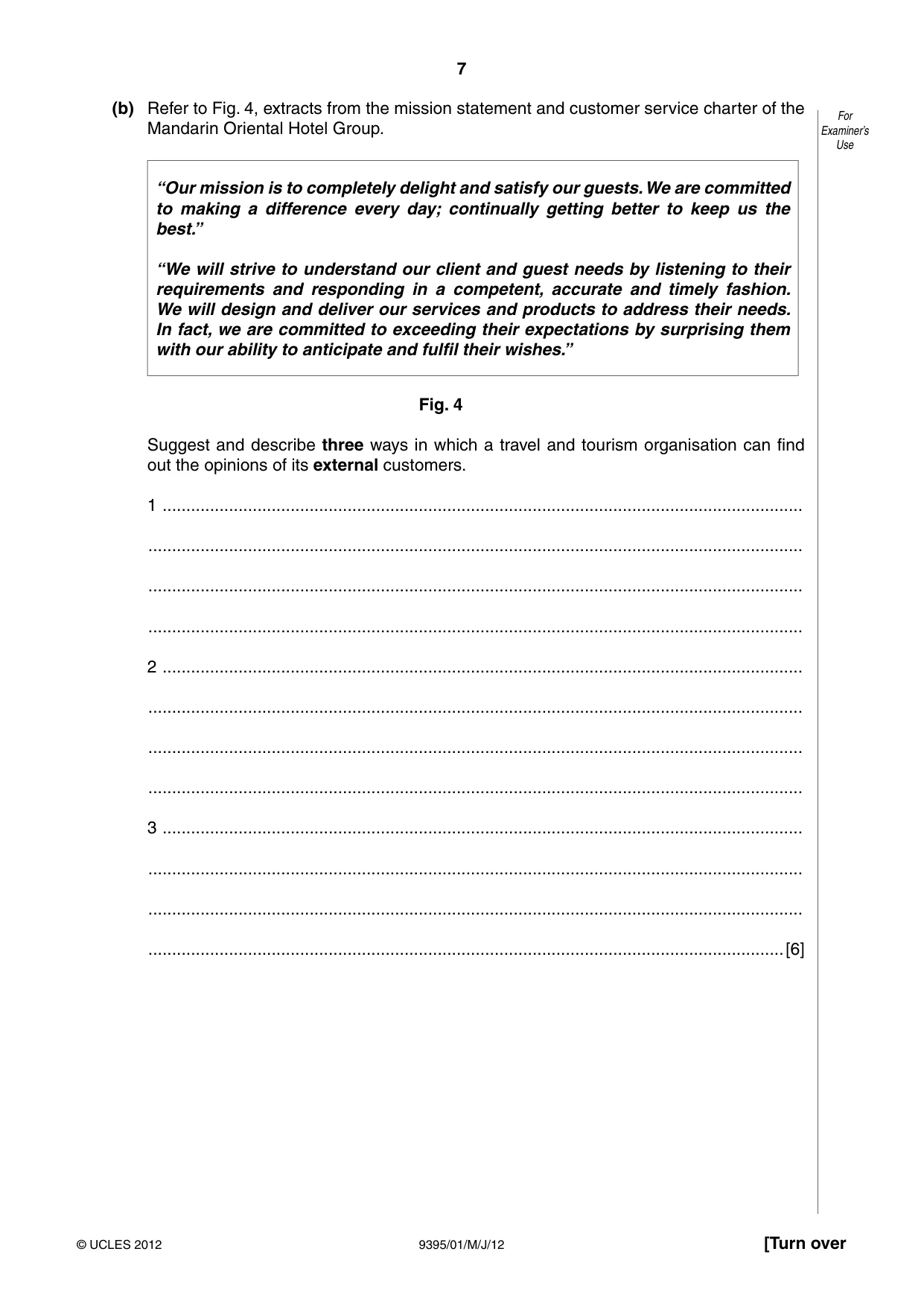
7 9395/01/M/J/12 © UCLES 2012 [Turn over For Examiner’s Use (b) Refer to Fig. 4, extracts from the mission statement and customer service charter of the Mandarin Oriental Hotel Group. “Our mission is to completely delight and satisfy our guests. We are committed to making a difference every day; continually getting better to keep us the best.” “We will strive to understand our client and guest needs by listening to their requirements and responding in a competent, accurate and timely fashion. We will design and deliver our services and products to address their needs. In fact, we are committed to exceeding their expectations by surprising them with our ability to anticipate and fulfil their wishes.” Fig. 4 Suggest and describe three ways in which a travel and tourism organisation can find out the opinions of its external customers. 1 … … … … 2 … … … … 3 … … … …[6]
Question paper, page 8
8 9395/01/M/J/12 © UCLES 2012 For Examiner’s Use (c) Some travel and tourism organisations use a system called ‘benchmarking’, which involves setting standards of quality, and then measuring performance against these standards. Explain how such a system might apply to three job roles within a named travel and tourism organisation with which you are familiar. Name of organisation … Job role 1 … How benchmarking might apply … … … … … Job role 2 … How benchmarking might apply … … … … … Job role 3 … How benchmarking might apply … … … … …[6]
Question paper, page 9
9 9395/01/M/J/12 © UCLES 2012 [Turn over For Examiner’s Use (d) With reference to one travel and tourism organisation with which you are familiar, discuss the ways in which it meets the needs of its internal customers. Name of chosen organisation … … … … … … … … … … … … … … … … … … … … … … … … … …[9] [Total: 25]
Question paper, page 10
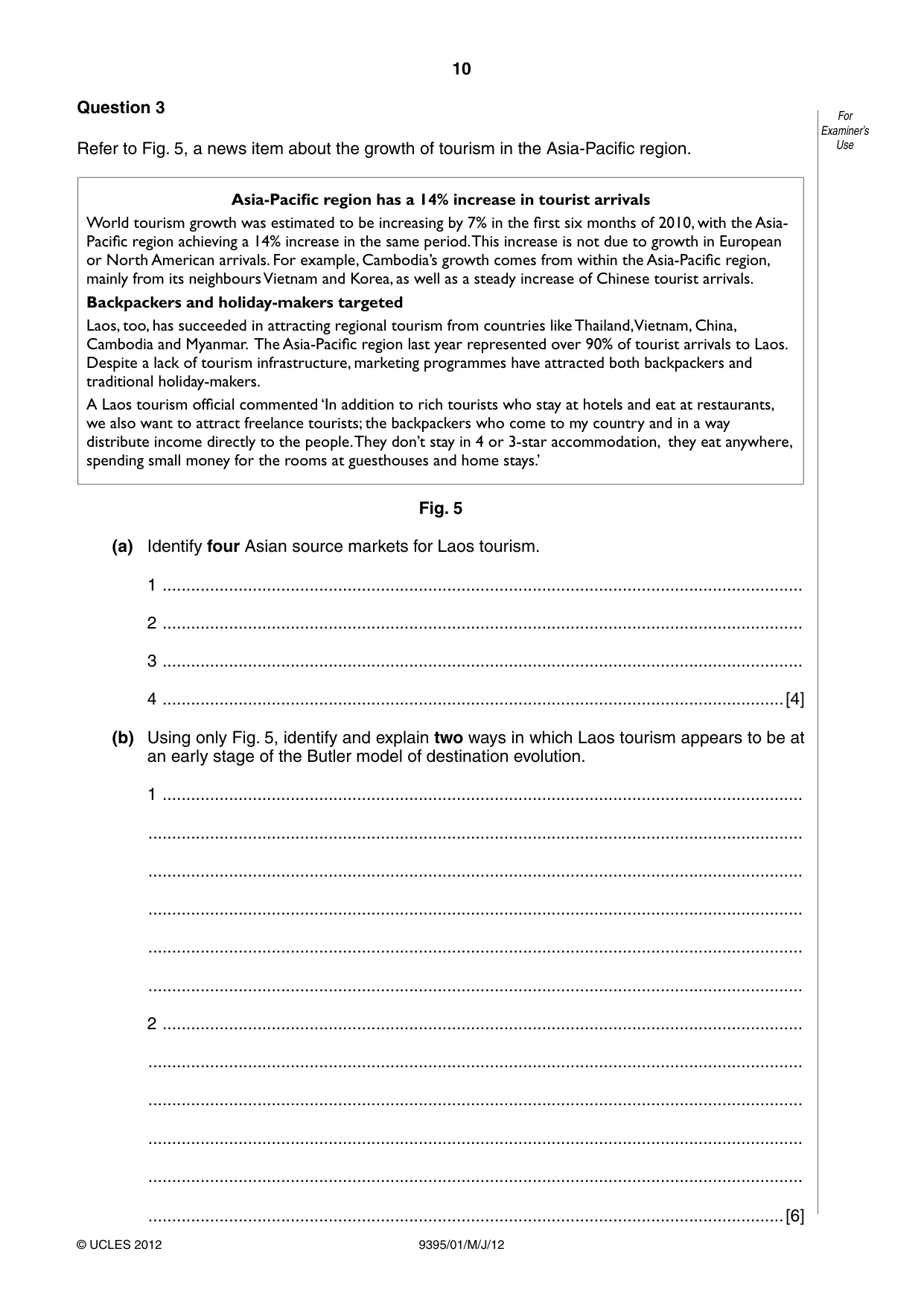
10 9395/01/M/J/12 © UCLES 2012 For Examiner’s Use Question 3 Refer to Fig. 5, a news item about the growth of tourism in the Asia-Pacific region. Asia-Pacifi c region has a 14% increase in tourist arrivals World tourism growth was estimated to be increasing by 7% in the fi rst six months of 2010, with the Asia- Pacifi c region achieving a 14% increase in the same period. This increase is not due to growth in European or North American arrivals. For example, Cambodia’s growth comes from within the Asia-Pacifi c region, mainly from its neighbours Vietnam and Korea, as well as a steady increase of Chinese tourist arrivals. Backpackers and holiday-makers targeted Laos, too, has succeeded in attracting regional tourism from countries like Thailand, Vietnam, China, Cambodia and Myanmar. The Asia-Pacifi c region last year represented over 90% of tourist arrivals to Laos. Despite a lack of tourism infrastructure, marketing programmes have attracted both backpackers and traditional holiday-makers. A Laos tourism offi cial commented ‘In addition to rich tourists who stay at hotels and eat at restaurants, we also want to attract freelance tourists; the backpackers who come to my country and in a way distribute income directly to the people. They don’t stay in 4 or 3-star accommodation, they eat anywhere, spending small money for the rooms at guesthouses and home stays.’ Fig. 5 (a) Identify four Asian source markets for Laos tourism. 1 … 2 … 3 … 4 …[4] (b) Using only Fig. 5, identify and explain two ways in which Laos tourism appears to be at an early stage of the Butler model of destination evolution. 1 … … … … … … 2 … … … … … …[6]
Question paper, page 11
11 9395/01/M/J/12 © UCLES 2012 [Turn over For Examiner’s Use (c) There has been a recent trend for tourists to visit poor squatter settlement areas in cities of the less economically developed world, such as Rio de Janeiro and Mumbai. The photograph in Fig. 6 shows an example of a squatter settlement. Fig. 6 Suggest and explain three negative socio-cultural impacts that might result from the development of this type of tourism. 1 … … … … 2 … … … … 3 … … … …[6]
Question paper, page 12
12 9395/01/M/J/12 © UCLES 2012 For Examiner’s Use (d) With reference to examples with which you are familiar, discuss how tourism development can regenerate destinations. … … … … … … … … … … … … … … … … … … … … … … … … … …[9] [Total: 25]
Question paper, page 13
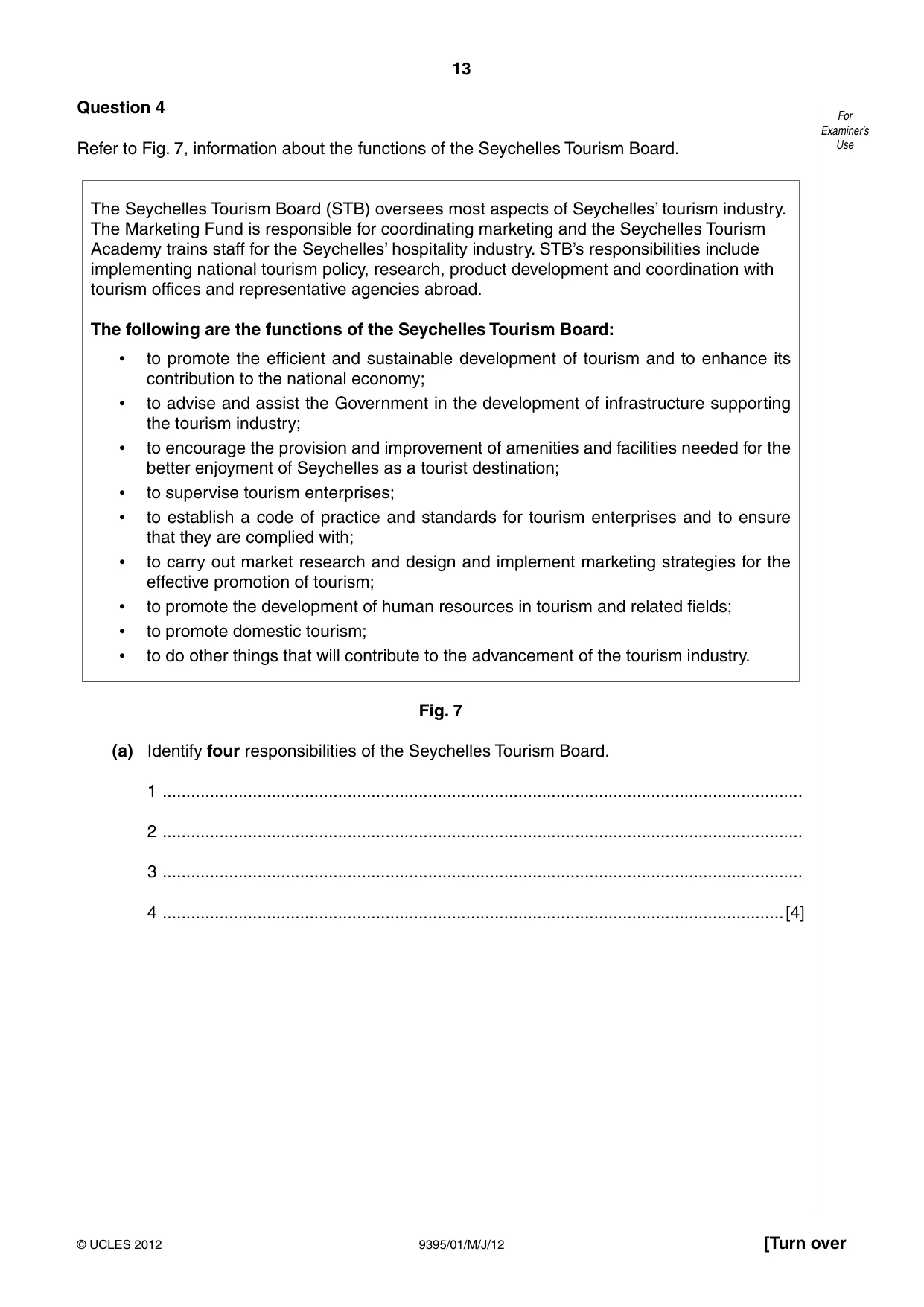
13 9395/01/M/J/12 © UCLES 2012 [Turn over For Examiner’s Use Question 4 Refer to Fig. 7, information about the functions of the Seychelles Tourism Board. The Seychelles Tourism Board (STB) oversees most aspects of Seychelles’ tourism industry. The Marketing Fund is responsible for coordinating marketing and the Seychelles Tourism Academy trains staff for the Seychelles’ hospitality industry. STB’s responsibilities include implementing national tourism policy, research, product development and coordination with tourism offi ces and representative agencies abroad. The following are the functions of the Seychelles Tourism Board: • to promote the efficient and sustainable development of tourism and to enhance its contribution to the national economy; • to advise and assist the Government in the development of infrastructure supporting the tourism industry; • to encourage the provision and improvement of amenities and facilities needed for the better enjoyment of Seychelles as a tourist destination; • to supervise tourism enterprises; • to establish a code of practice and standards for tourism enterprises and to ensure that they are complied with; • to carry out market research and design and implement marketing strategies for the effective promotion of tourism; • to promote the development of human resources in tourism and related fields; • to promote domestic tourism; • to do other things that will contribute to the advancement of the tourism industry. Fig. 7 (a) Identify four responsibilities of the Seychelles Tourism Board. 1 … 2 … 3 … 4 …[4]
Question paper, page 14
14 9395/01/M/J/12 © UCLES 2012 For Examiner’s Use (b) Suggest and explain three ways in which a national tourist board is likely to ‘supervise tourism enterprises’. 1 … … … … 2 … … … … 3 … … … …[6] (c) Explain three ways in which tourism is able to make a ‘contribution to the national economy’. 1 … … … … 2 … … … … 3 … … … …[6]
Question paper, page 15
15 9395/01/M/J/12 © UCLES 2012 For Examiner’s Use (d) With reference to examples with which you are familiar, discuss the ways in which it is possible for tourist boards ‘to promote domestic tourism’. … … … … … … … … … … … … … … … … … … … … … … … … … …[9] [Total: 25]
Question paper, page 16
16 9395/01/M/J/12 © UCLES 2012 Copyright Acknowledgements: Question 1 J Smith © UCLES. Question 2 Figure 4 © Mission statement extract; Mandarin Oriental Hotel Group. Permission to reproduce items where third-party owned material protected by copyright is included has been sought and cleared where possible. Every reasonable effort has been made by the publisher (UCLES) to trace copyright holders, but if any items requiring clearance have unwittingly been included, the publisher will be pleased to make amends at the earliest possible opportunity. University of Cambridge International Examinations is part of the Cambridge Assessment Group. Cambridge Assessment is the brand name of University of Cambridge Local Examinations Syndicate (UCLES), which is itself a department of the University of Cambridge. BLANK PAGE
Mark scheme, page 1
UNIVERSITY OF CAMBRIDGE INTERNATIONAL EXAMINATIONS GCE Advanced Subsidiary Level and GCE Advanced Level MARK SCHEME for the May/June 2012 question paper for the guidance of teachers 9395 TRAVEL AND TOURISM 9395/01 Paper 1 (Core Paper), maximum raw mark 100 This mark scheme is published as an aid to teachers and candidates, to indicate the requirements of the examination. It shows the basis on which Examiners were instructed to award marks. It does not indicate the details of the discussions that took place at an Examiners’ meeting before marking began, which would have considered the acceptability of alternative answers. Mark schemes must be read in conjunction with the question papers and the report on the examination. • Cambridge will not enter into discussions or correspondence in connection with these mark schemes. Cambridge is publishing the mark schemes for the May/June 2012 question papers for most IGCSE, GCE Advanced Level and Advanced Subsidiary Level syllabuses and some Ordinary Level syllabuses.
Mark scheme, page 2
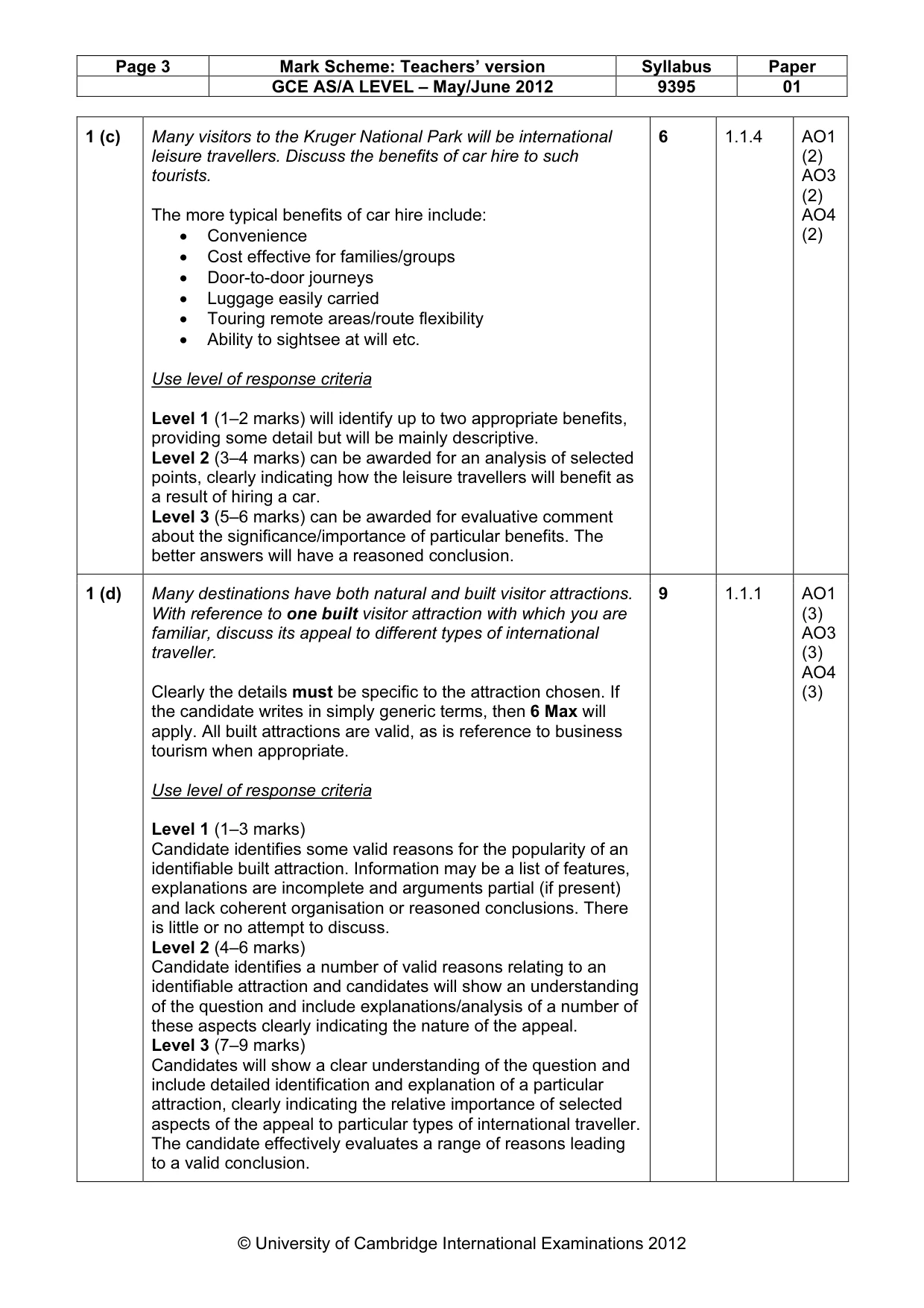
Page 2 Mark Scheme: Teachers’ version Syllabus Paper GCE AS/A LEVEL – May/June 2012 9395 01 © University of Cambridge International Examinations 2012 Q. No. Expected Answer Mark Focus AO 1 (a) Identify and explain three ways in which the rules and regulations will help to conserve the Kruger National Park’s natural environment. Award one mark for each correct identification up to a maximum of three identifications plus up to a further one mark for each of three valid explanations. Ways to include: • Stay in vehicles (1) – limits impact (1). • Do not speed (1) – prevents harm/damage (1). • Do not feed (1) – alters food chain (1). • No disturbance/removal (1) – limits ecosystem change(1). • No firearms (1) – limits poaching (1). Credit all valid reasoning based on Fig. 1. 6 1.2.2 AO2 (3) AO3 (3) 1 (b) Explain two negative environmental impacts that are likely to occur at sites such as the one shown in Fig. 2. Award one mark for each correct identification up to a maximum of two identifications plus up to a further one mark for each of two valid explanations. Valid impacts based on Fig. 2 to include: • Honeypot site (1) – congestion and overcrowding clearly evident (1). • Noise pollution (1) – large numbers (1). • Litter (1) – many groups/picnics (1). • Fire risk (1) – cooking/smoking (1). Credit all valid reasoning in context. 4 1.2.2 AO1 (2) AO3 (2)
Mark scheme, page 3
Page 3 Mark Scheme: Teachers’ version Syllabus Paper GCE AS/A LEVEL – May/June 2012 9395 01 © University of Cambridge International Examinations 2012 1 (c) Many visitors to the Kruger National Park will be international leisure travellers. Discuss the benefits of car hire to such tourists. The more typical benefits of car hire include: • Convenience • Cost effective for families/groups • Door-to-door journeys • Luggage easily carried • Touring remote areas/route flexibility • Ability to sightsee at will etc. Use level of response criteria Level 1 (1–2 marks) will identify up to two appropriate benefits, providing some detail but will be mainly descriptive. Level 2 (3–4 marks) can be awarded for an analysis of selected points, clearly indicating how the leisure travellers will benefit as a result of hiring a car. Level 3 (5–6 marks) can be awarded for evaluative comment about the significance/importance of particular benefits. The better answers will have a reasoned conclusion. 6 1.1.4 AO1 (2) AO3 (2) AO4 (2) 1 (d) Many destinations have both natural and built visitor attractions. With reference to one built visitor attraction with which you are familiar, discuss its appeal to different types of international traveller. Clearly the details must be specific to the attraction chosen. If the candidate writes in simply generic terms, then 6 Max will apply. All built attractions are valid, as is reference to business tourism when appropriate. Use level of response criteria Level 1 (1–3 marks) Candidate identifies some valid reasons for the popularity of an identifiable built attraction. Information may be a list of features, explanations are incomplete and arguments partial (if present) and lack coherent organisation or reasoned conclusions. There is little or no attempt to discuss. Level 2 (4–6 marks) Candidate identifies a number of valid reasons relating to an identifiable attraction and candidates will show an understanding of the question and include explanations/analysis of a number of these aspects clearly indicating the nature of the appeal. Level 3 (7–9 marks) Candidates will show a clear understanding of the question and include detailed identification and explanation of a particular attraction, clearly indicating the relative importance of selected aspects of the appeal to particular types of international traveller. The candidate effectively evaluates a range of reasons leading to a valid conclusion. 9 1.1.1 AO1 (3) AO3 (3) AO4 (3)
Mark scheme, page 4
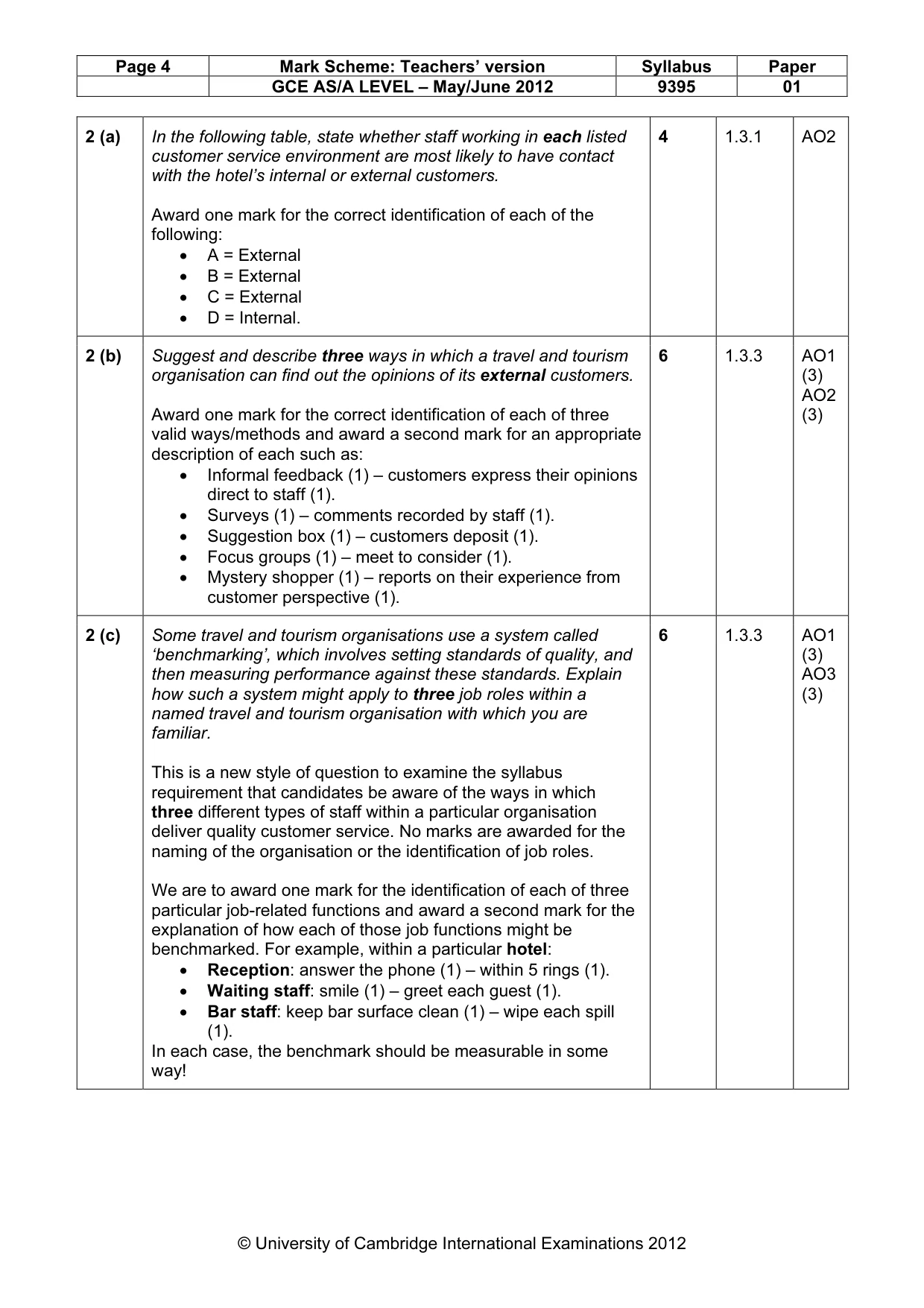
Page 4 Mark Scheme: Teachers’ version Syllabus Paper GCE AS/A LEVEL – May/June 2012 9395 01 © University of Cambridge International Examinations 2012 2 (a) In the following table, state whether staff working in each listed customer service environment are most likely to have contact with the hotel’s internal or external customers. Award one mark for the correct identification of each of the following: • A = External • B = External • C = External • D = Internal. 4 1.3.1 AO2 2 (b) Suggest and describe three ways in which a travel and tourism organisation can find out the opinions of its external customers. Award one mark for the correct identification of each of three valid ways/methods and award a second mark for an appropriate description of each such as: • Informal feedback (1) – customers express their opinions direct to staff (1). • Surveys (1) – comments recorded by staff (1). • Suggestion box (1) – customers deposit (1). • Focus groups (1) – meet to consider (1). • Mystery shopper (1) – reports on their experience from customer perspective (1). 6 1.3.3 AO1 (3) AO2 (3) 2 (c) Some travel and tourism organisations use a system called ‘benchmarking’, which involves setting standards of quality, and then measuring performance against these standards. Explain how such a system might apply to three job roles within a named travel and tourism organisation with which you are familiar. This is a new style of question to examine the syllabus requirement that candidates be aware of the ways in which three different types of staff within a particular organisation deliver quality customer service. No marks are awarded for the naming of the organisation or the identification of job roles. We are to award one mark for the identification of each of three particular job-related functions and award a second mark for the explanation of how each of those job functions might be benchmarked. For example, within a particular hotel: • Reception: answer the phone (1) – within 5 rings (1). • Waiting staff: smile (1) – greet each guest (1). • Bar staff: keep bar surface clean (1) – wipe each spill (1). In each case, the benchmark should be measurable in some way! 6 1.3.3 AO1 (3) AO3 (3)
Mark scheme, page 5
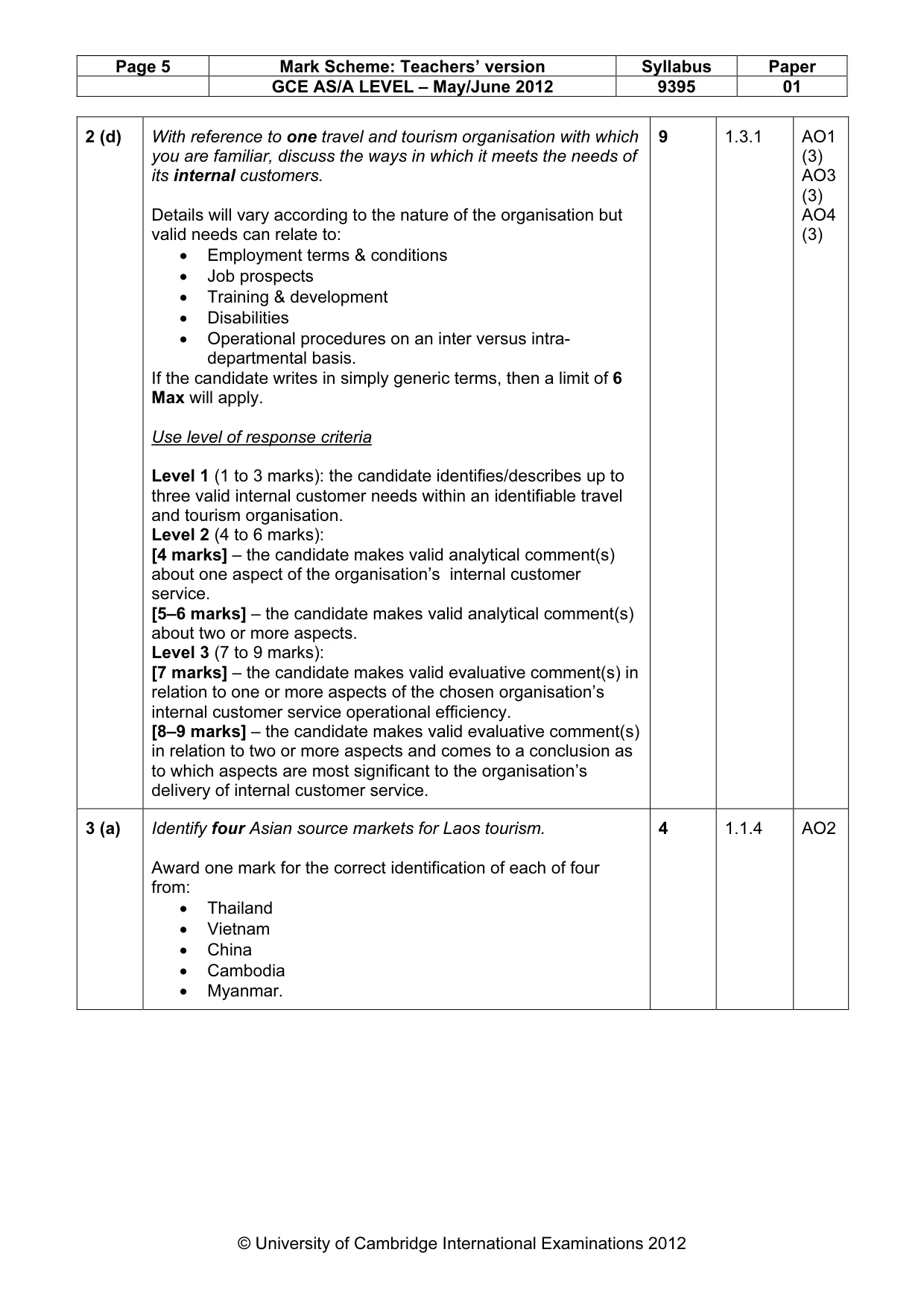
Page 5 Mark Scheme: Teachers’ version Syllabus Paper GCE AS/A LEVEL – May/June 2012 9395 01 © University of Cambridge International Examinations 2012 2 (d) With reference to one travel and tourism organisation with which you are familiar, discuss the ways in which it meets the needs of its internal customers. Details will vary according to the nature of the organisation but valid needs can relate to: • Employment terms & conditions • Job prospects • Training & development • Disabilities • Operational procedures on an inter versus intra- departmental basis. If the candidate writes in simply generic terms, then a limit of 6 Max will apply. Use level of response criteria Level 1 (1 to 3 marks): the candidate identifies/describes up to three valid internal customer needs within an identifiable travel and tourism organisation. Level 2 (4 to 6 marks): [4 marks] – the candidate makes valid analytical comment(s) about one aspect of the organisation’s internal customer service. [5–6 marks] – the candidate makes valid analytical comment(s) about two or more aspects. Level 3 (7 to 9 marks): [7 marks] – the candidate makes valid evaluative comment(s) in relation to one or more aspects of the chosen organisation’s internal customer service operational efficiency. [8–9 marks] – the candidate makes valid evaluative comment(s) in relation to two or more aspects and comes to a conclusion as to which aspects are most significant to the organisation’s delivery of internal customer service. 9 1.3.1 AO1 (3) AO3 (3) AO4 (3) 3 (a) Identify four Asian source markets for Laos tourism. Award one mark for the correct identification of each of four from: • Thailand • Vietnam • China • Cambodia • Myanmar. 4 1.1.4 AO2
Mark scheme, page 6
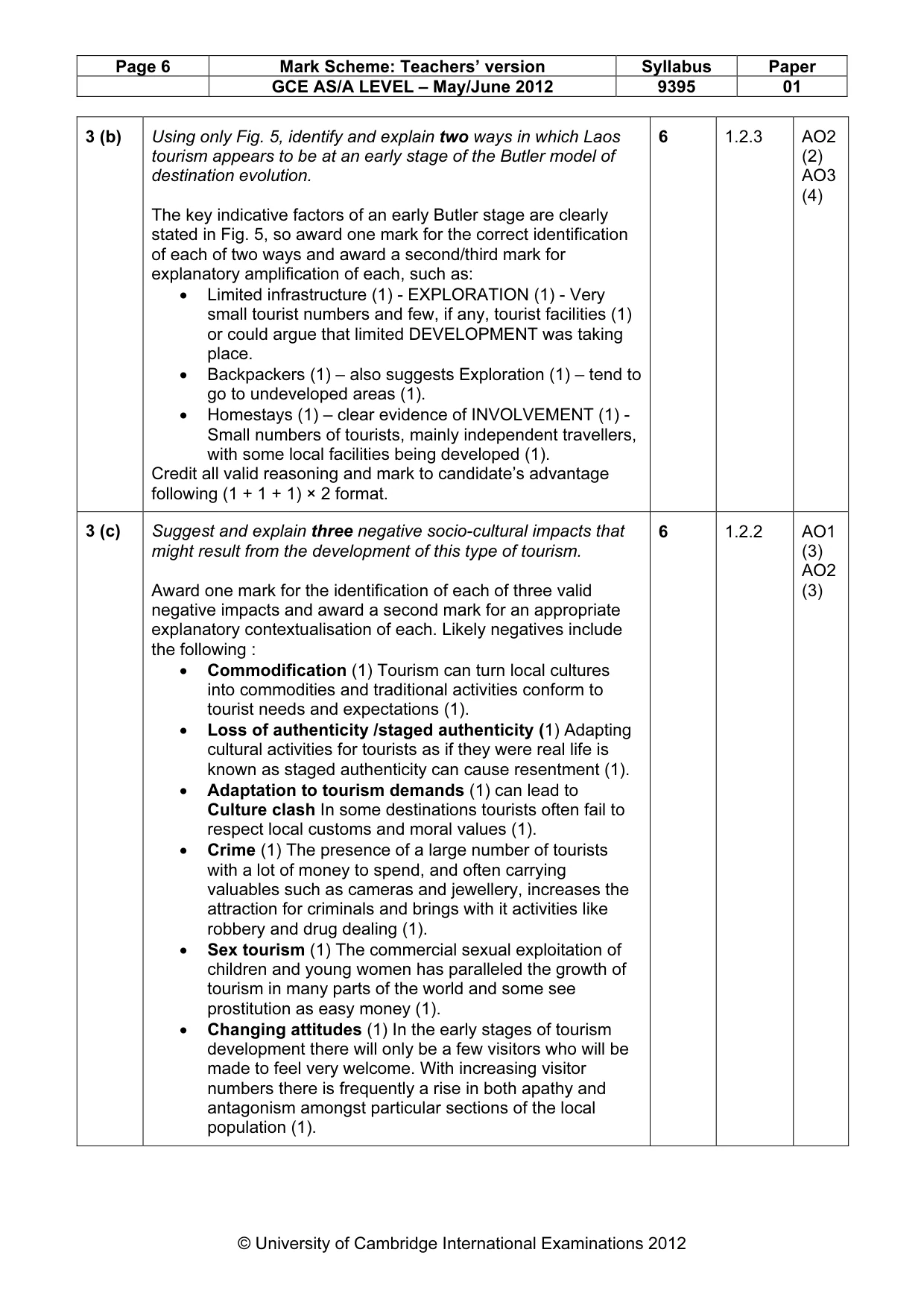
Page 6 Mark Scheme: Teachers’ version Syllabus Paper GCE AS/A LEVEL – May/June 2012 9395 01 © University of Cambridge International Examinations 2012 3 (b) Using only Fig. 5, identify and explain two ways in which Laos tourism appears to be at an early stage of the Butler model of destination evolution. The key indicative factors of an early Butler stage are clearly stated in Fig. 5, so award one mark for the correct identification of each of two ways and award a second/third mark for explanatory amplification of each, such as: • Limited infrastructure (1) - EXPLORATION (1) - Very small tourist numbers and few, if any, tourist facilities (1) or could argue that limited DEVELOPMENT was taking place. • Backpackers (1) – also suggests Exploration (1) – tend to go to undeveloped areas (1). • Homestays (1) – clear evidence of INVOLVEMENT (1) - Small numbers of tourists, mainly independent travellers, with some local facilities being developed (1). Credit all valid reasoning and mark to candidate’s advantage following (1 + 1 + 1) × 2 format. 6 1.2.3 AO2 (2) AO3 (4) 3 (c) Suggest and explain three negative socio-cultural impacts that might result from the development of this type of tourism. Award one mark for the identification of each of three valid negative impacts and award a second mark for an appropriate explanatory contextualisation of each. Likely negatives include the following : • Commodification (1) Tourism can turn local cultures into commodities and traditional activities conform to tourist needs and expectations (1). • Loss of authenticity /staged authenticity (1) Adapting cultural activities for tourists as if they were real life is known as staged authenticity can cause resentment (1). • Adaptation to tourism demands (1) can lead to Culture clash In some destinations tourists often fail to respect local customs and moral values (1). • Crime (1) The presence of a large number of tourists with a lot of money to spend, and often carrying valuables such as cameras and jewellery, increases the attraction for criminals and brings with it activities like robbery and drug dealing (1). • Sex tourism (1) The commercial sexual exploitation of children and young women has paralleled the growth of tourism in many parts of the world and some see prostitution as easy money (1). • Changing attitudes (1) In the early stages of tourism development there will only be a few visitors who will be made to feel very welcome. With increasing visitor numbers there is frequently a rise in both apathy and antagonism amongst particular sections of the local population (1). 6 1.2.2 AO1 (3) AO2 (3)
Mark scheme, page 7
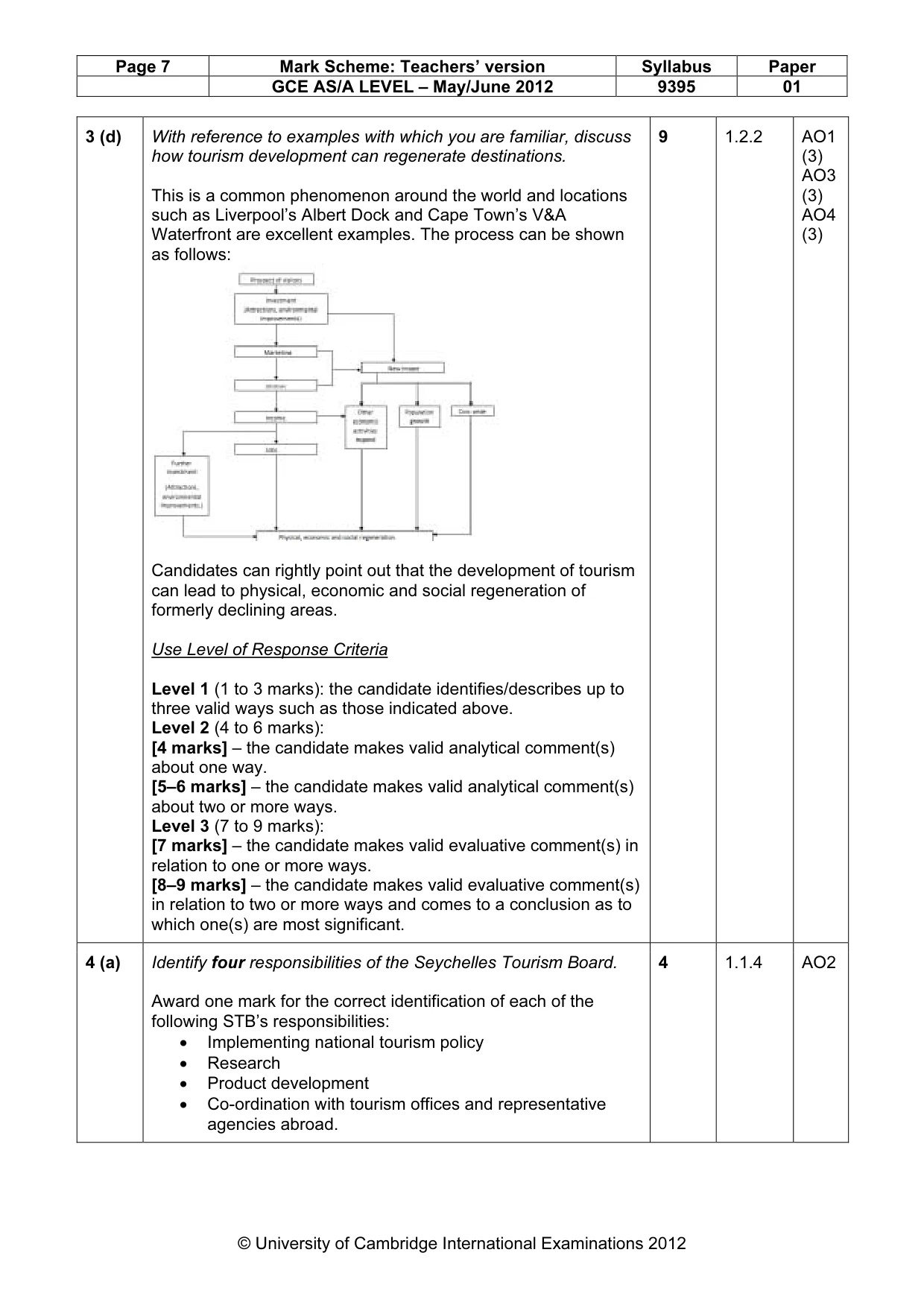
Page 7 Mark Scheme: Teachers’ version Syllabus Paper GCE AS/A LEVEL – May/June 2012 9395 01 © University of Cambridge International Examinations 2012 3 (d) With reference to examples with which you are familiar, discuss how tourism development can regenerate destinations. This is a common phenomenon around the world and locations such as Liverpool’s Albert Dock and Cape Town’s V&A Waterfront are excellent examples. The process can be shown as follows: Candidates can rightly point out that the development of tourism can lead to physical, economic and social regeneration of formerly declining areas. Use Level of Response Criteria Level 1 (1 to 3 marks): the candidate identifies/describes up to three valid ways such as those indicated above. Level 2 (4 to 6 marks): [4 marks] – the candidate makes valid analytical comment(s) about one way. [5–6 marks] – the candidate makes valid analytical comment(s) about two or more ways. Level 3 (7 to 9 marks): [7 marks] – the candidate makes valid evaluative comment(s) in relation to one or more ways. [8–9 marks] – the candidate makes valid evaluative comment(s) in relation to two or more ways and comes to a conclusion as to which one(s) are most significant. 9 1.2.2 AO1 (3) AO3 (3) AO4 (3) 4 (a) Identify four responsibilities of the Seychelles Tourism Board. Award one mark for the correct identification of each of the following STB’s responsibilities: • Implementing national tourism policy • Research • Product development • Co-ordination with tourism offices and representative agencies abroad. 4 1.1.4 AO2
Mark scheme, page 8
Page 8 Mark Scheme: Teachers’ version Syllabus Paper GCE AS/A LEVEL – May/June 2012 9395 01 © University of Cambridge International Examinations 2012 4 (b) Suggest and explain three ways in which a national tourist board is likely to “supervise tourism enterprises”. Award one mark for the correct identification of each of three valid ways/methods and award a second mark for an appropriate explanation of each. The example of the DTCM in Dubai is very appropriate as the DTCM is the principal authority for the planning, supervision and development of the tourism sector. • The DTCM has now taken over the licensing of hotels, hotel apartments, tour operators, tourist transport companies and travel agents(1) – control and regulation (1). • Its supervisory role (1) also covers all tourist, archaeological and heritage sites, tourism conferences and exhibitions, the operation of tourist information services and the organisation and licensing of tour guides(1). • Training schemes are operated (1) awards are given for exceeding set benchmarks (1). 6 1.2.1 AO1 (3) AO3 (3) 4 (c) Explain three ways in which tourism is able to make a “contribution to the national economy”. Award one mark for the correct identification of each of three valid ways/methods and award a second mark for an appropriate explanation of each. • Tourism expenditures generate income (1) and can stimulate the investment necessary to finance growth in other sectors(1). • Generation of foreign exchange earnings(1). Tourism is one of the top five export categories for as many as 83% of countries and is a main source of foreign exchange earnings for at least 38% of countries(1). • The WTO estimates that travel and tourism's direct, indirect, and personal tax contribution worldwide was over US$ 800 billion (1) thus allowing development (1). • The rapid expansion of international tourism has led to significant employment creation (1). Tourism can generate jobs directly and indirectly through the supply of goods and services needed by tourism-related businesses (1). • Money is earned from tourism is returned to the local economy (1) and has a great multiplier effect (1). 6 1.2.2 AO1 (3) AO2 (3)
Mark scheme, page 9
Page 9 Mark Scheme: Teachers’ version Syllabus Paper GCE AS/A LEVEL – May/June 2012 9395 01 © University of Cambridge International Examinations 2012 4 (d) With reference to examples with which you are familiar, discuss the ways in which it is possible for tourist boards “to promote domestic tourism”. This requires candidates to think about the role of NTOs in the context of domestic tourism and we should expect consideration to be given to some of the following aspects/functions: • A network of TICs – these are positioned in key areas providing easier access & supplying a range of leaflets for local attractions etc. • Advertising • Promotional campaigns • Competitions • Mobile services are provided in some destinations e.g. Singapore at various exhibition and convention venues to cater for business/MICE delegates • A dedicated 24/7 tourist telephone line is available to address enquiries on demand and is thus very convenient/accessible • Internet website with 24/7 availability. Use Level of Response Criteria Level 1 (1 to 3 marks): the candidate identifies/describes up to three valid ways such as those indicated above. Level 2 (4 to 6 marks): [4 marks] – the candidate makes valid analytical comment(s) about one way. [5–6 marks] – the candidate makes valid analytical comment(s) about two or more ways. Level 3 (7 to 9 marks): [7 marks] – the candidate makes valid evaluative comment(s) in relation to one or more ways. [8–9 marks] – the candidate makes valid evaluative comment(s) in relation to two or more ways and comes to a conclusion as to which one(s) are most significant. 9 1.2.1 AO1 (3) AO3 (3) AO4 (3)
What you needed in this session
Cambridge’s own grade thresholds for 2012 May/June, Paper 1 · Variant 1. A higher threshold means an easier paper — the bar moves with how the cohort did.