Cambridge A Level Travel and Tourism 9395 — 2011 Oct/Nov Paper 4 · Variant 1
9395/41/O/N/11 · 50 marks · ≈56 min
The question paper and its mark scheme, free to read here and free to download. This is Cambridge’s own paper, exactly as it was sat.
Question paper8 pages
Mark scheme5 pages
Answers below. Sit the paper first if you are practising.
Paper as text
Question paper, page 1
This document consists of 8 printed pages. DC (CW/SW) 35742/4 © UCLES 2011 [Turn over UNIVERSITY OF CAMBRIDGE INTERNATIONAL EXAMINATIONS General Certificate of Education Advanced Level * 7 4 6 4 3 2 8 1 2 6 * TRAVEL AND TOURISM 9395/04 Paper 4 Specialised Tourism October/November 2011 1 hour and 30 minutes Candidates answer on the Question Paper READ THESE INSTRUCTIONS FIRST Write your Centre number, candidate number and name on all the work you hand in. Write in dark blue or black pen. Do not use staples, paper clips, highlighters, glue or correction fluid. You may use a pencil for any diagrams, graphs or rough working. DO NOT WRITE IN ANY BARCODES. Answer all questions. The number of marks is given in brackets [ ] at the end of each question or part question. For Examiner’s Use 1 2 Total
Question paper, page 2
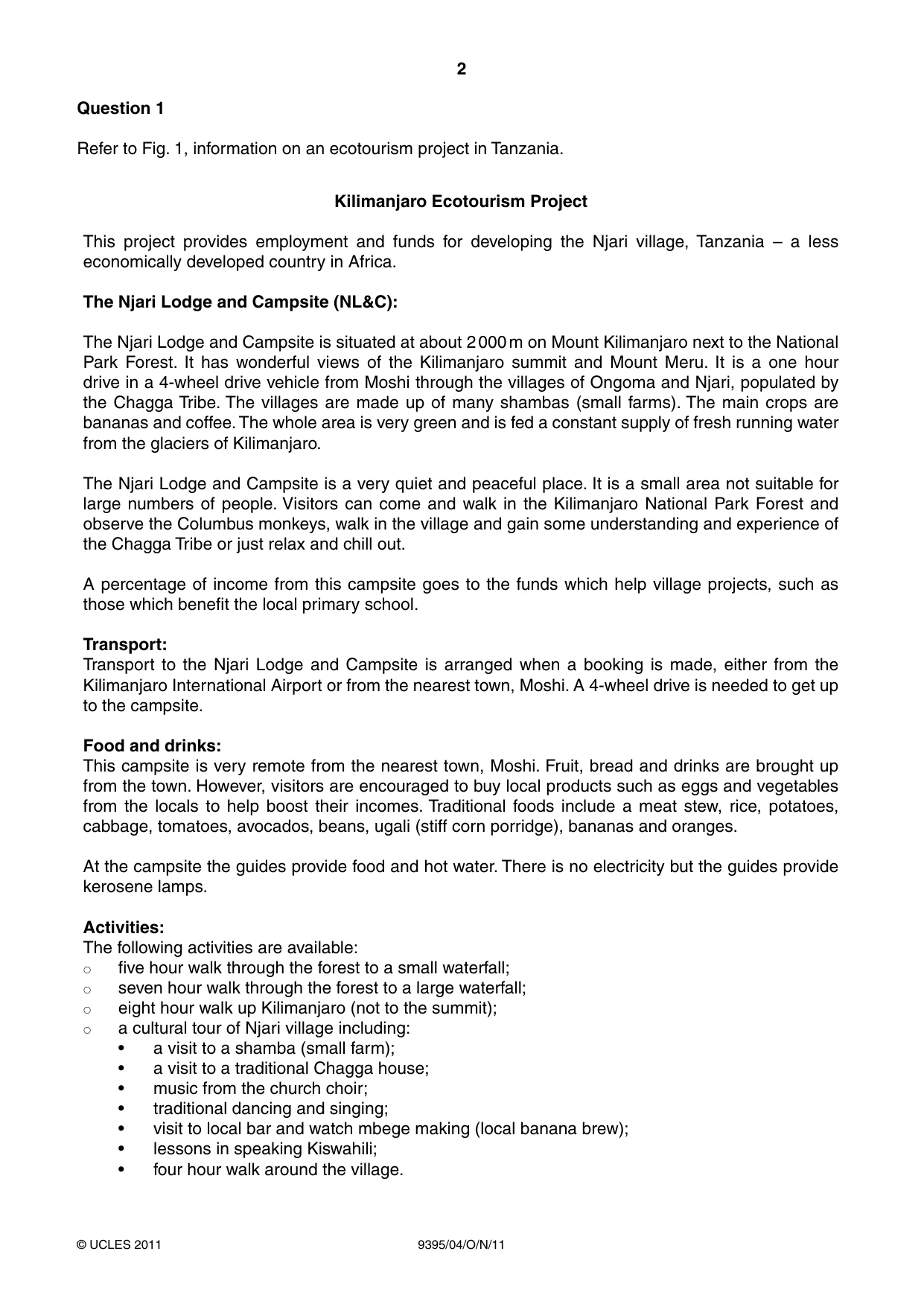
2 9395/04/O/N/11 © UCLES 2011 Question 1 Refer to Fig. 1, information on an ecotourism project in Tanzania. Kilimanjaro Ecotourism Project This project provides employment and funds for developing the Njari village, Tanzania – a less economically developed country in Africa. The Njari Lodge and Campsite (NL&C): The Njari Lodge and Campsite is situated at about 2 000 m on Mount Kilimanjaro next to the National Park Forest. It has wonderful views of the Kilimanjaro summit and Mount Meru. It is a one hour drive in a 4-wheel drive vehicle from Moshi through the villages of Ongoma and Njari, populated by the Chagga Tribe. The villages are made up of many shambas (small farms). The main crops are bananas and coffee. The whole area is very green and is fed a constant supply of fresh running water from the glaciers of Kilimanjaro. The Njari Lodge and Campsite is a very quiet and peaceful place. It is a small area not suitable for large numbers of people. Visitors can come and walk in the Kilimanjaro National Park Forest and observe the Columbus monkeys, walk in the village and gain some understanding and experience of the Chagga Tribe or just relax and chill out. A percentage of income from this campsite goes to the funds which help village projects, such as those which benefit the local primary school. Transport: Transport to the Njari Lodge and Campsite is arranged when a booking is made, either from the Kilimanjaro International Airport or from the nearest town, Moshi. A 4-wheel drive is needed to get up to the campsite. Food and drinks: This campsite is very remote from the nearest town, Moshi. Fruit, bread and drinks are brought up from the town. However, visitors are encouraged to buy local products such as eggs and vegetables from the locals to help boost their incomes. Traditional foods include a meat stew, rice, potatoes, cabbage, tomatoes, avocados, beans, ugali (stiff corn porridge), bananas and oranges. At the campsite the guides provide food and hot water. There is no electricity but the guides provide kerosene lamps. Activities: The following activities are available: { five hour walk through the forest to a small waterfall; { seven hour walk through the forest to a large waterfall; { eight hour walk up Kilimanjaro (not to the summit); { a cultural tour of Njari village including: • a visit to a shamba (small farm); • a visit to a traditional Chagga house; • music from the church choir; • traditional dancing and singing; • visit to local bar and watch mbege making (local banana brew); • lessons in speaking Kiswahili; • four hour walk around the village.
Question paper, page 3
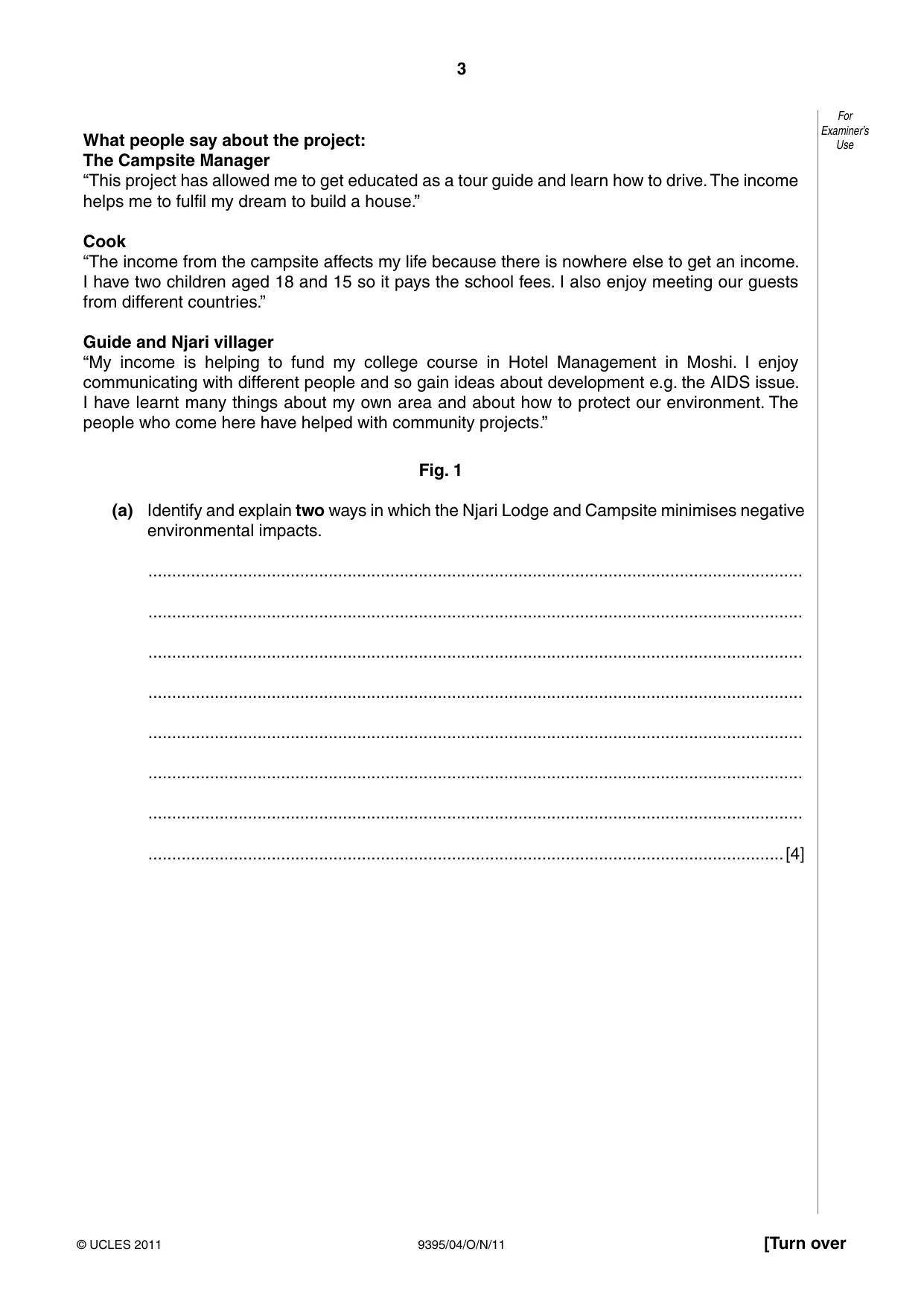
3 9395/04/O/N/11 © UCLES 2011 [Turn over For Examiner’s Use What people say about the project: The Campsite Manager “This project has allowed me to get educated as a tour guide and learn how to drive. The income helps me to fulfil my dream to build a house.” Cook “The income from the campsite affects my life because there is nowhere else to get an income. I have two children aged 18 and 15 so it pays the school fees. I also enjoy meeting our guests from different countries.” Guide and Njari villager “My income is helping to fund my college course in Hotel Management in Moshi. I enjoy communicating with different people and so gain ideas about development e.g. the AIDS issue. I have learnt many things about my own area and about how to protect our environment. The people who come here have helped with community projects.” Fig. 1 (a) Identify and explain two ways in which the Njari Lodge and Campsite minimises negative environmental impacts. … … … … … … … …[4]
Question paper, page 4
4 9395/04/O/N/11 © UCLES 2011 For Examiner’s Use (b) Discuss the importance to the community of the Njari Lodge and Campsite providing cultural activities for its visitors. … … … … … … … … … … … … … … … … … … … … … … … … … … …[9]
Question paper, page 5
5 9395/04/O/N/11 © UCLES 2011 [Turn over For Examiner’s Use (c) The success of the Kilimanjaro Ecotourism Project relies on the input and support of the local people. Evaluate the ways in which the input and support of the local people are vital to the success of the project. … … … … … … … … … … … … … … … … … … … … … … … …[12] [Total: 25]
Question paper, page 6
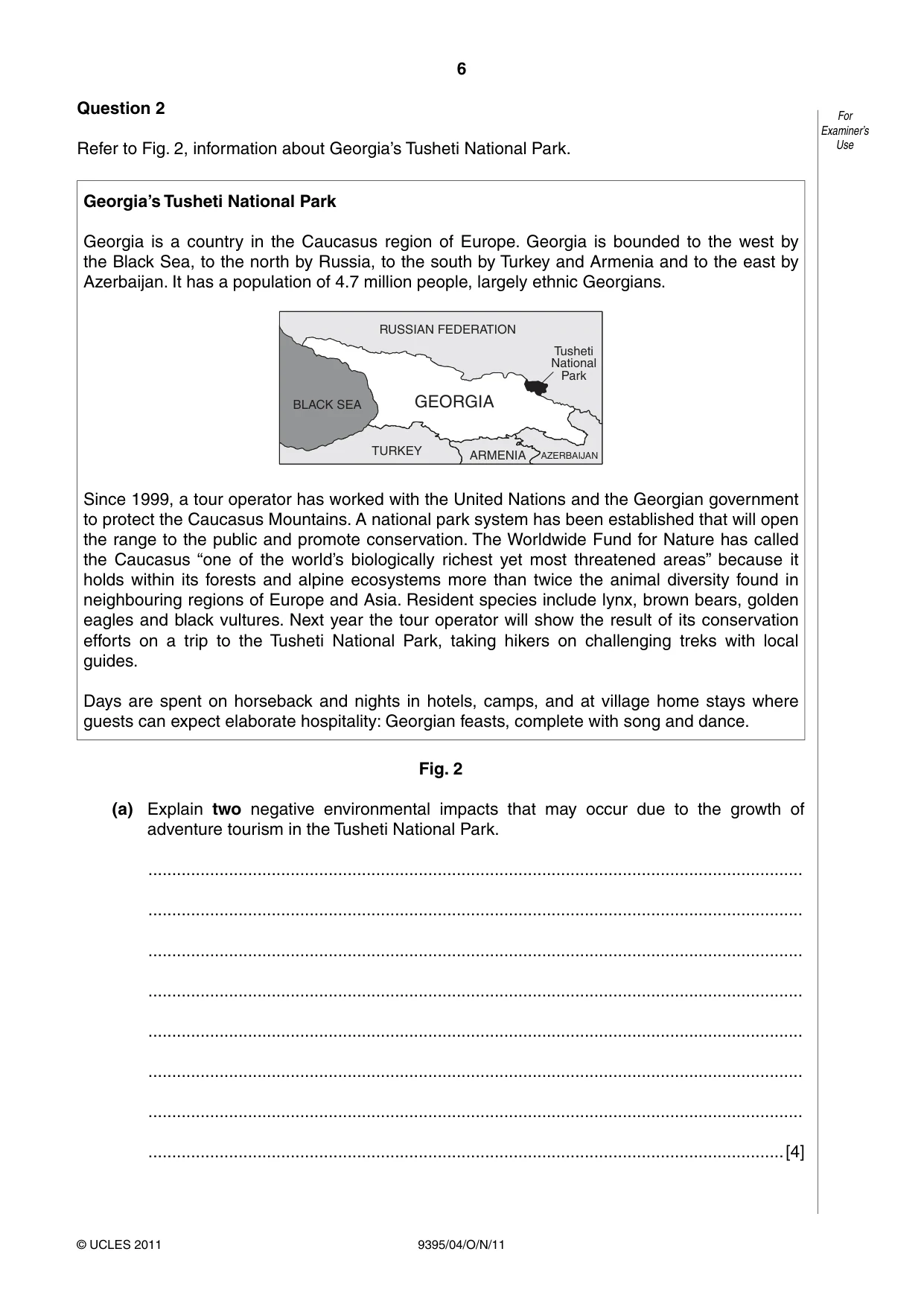
6 9395/04/O/N/11 © UCLES 2011 For Examiner’s Use Question 2 Refer to Fig. 2, information about Georgia’s Tusheti National Park. Georgia’s Tusheti National Park Georgia is a country in the Caucasus region of Europe. Georgia is bounded to the west by the Black Sea, to the north by Russia, to the south by Turkey and Armenia and to the east by Azerbaijan. It has a population of 4.7 million people, largely ethnic Georgians. GEORGIA RUSSIAN FEDERATION BLACK SEA TURKEY ARMENIA AZERBAIJAN Tusheti National Park Since 1999, a tour operator has worked with the United Nations and the Georgian government to protect the Caucasus Mountains. A national park system has been established that will open the range to the public and promote conservation. The Worldwide Fund for Nature has called the Caucasus “one of the world’s biologically richest yet most threatened areas” because it holds within its forests and alpine ecosystems more than twice the animal diversity found in neighbouring regions of Europe and Asia. Resident species include lynx, brown bears, golden eagles and black vultures. Next year the tour operator will show the result of its conservation efforts on a trip to the Tusheti National Park, taking hikers on challenging treks with local guides. Days are spent on horseback and nights in hotels, camps, and at village home stays where guests can expect elaborate hospitality: Georgian feasts, complete with song and dance. Fig. 2 (a) Explain two negative environmental impacts that may occur due to the growth of adventure tourism in the Tusheti National Park. … … … … … … … …[4]
Question paper, page 7
7 9395/04/O/N/11 © UCLES 2011 [Turn over For Examiner’s Use (b) Georgia is a new destination for adventure tourism. The area could become extremely popular with visitors. Assess the benefits to the local population of a growth in adventure tourism in this area. … … … … … … … … … … … … … … … … … … … … … … … … …[9]
Question paper, page 8
8 9395/04/O/N/11 © UCLES 2011 For Examiner’s Use Copyright Acknowledgements: Question 1 © adapted: http://www.kilimanjaroproject.com. Question 2 © adapted: http://www.nationalgeographic.com/adventure/adventure-travel/europe/georgia.html. Permission to reproduce items where third-party owned material protected by copyright is included has been sought and cleared where possible. Every reasonable effort has been made by the publisher (UCLES) to trace copyright holders, but if any items requiring clearance have unwittingly been included, the publisher will be pleased to make amends at the earliest possible opportunity. University of Cambridge International Examinations is part of the Cambridge Assessment Group. Cambridge Assessment is the brand name of University of Cambridge Local Examinations Syndicate (UCLES), which is itself a department of the University of Cambridge. (c) The tour operator works in partnership with the United Nations and the Georgian government to protect the mountains. Discuss the benefits of such a partnership to local communities. … … … … … … … … … … … … … … … … … … … … … … … …[12] [Total: 25]
Mark scheme, page 1
UNIVERSITY OF CAMBRIDGE INTERNATIONAL EXAMINATIONS GCE Advanced Subsidiary Level and GCE Advanced Level MARK SCHEME for the October/November 2011 question paper for the guidance of teachers 9395 TRAVEL AND TOURISM 9395/04 Paper 4 (Specialised Tourism), maximum raw mark 50 This mark scheme is published as an aid to teachers and candidates, to indicate the requirements of the examination. It shows the basis on which Examiners were instructed to award marks. It does not indicate the details of the discussions that took place at an Examiners’ meeting before marking began, which would have considered the acceptability of alternative answers. Mark schemes must be read in conjunction with the question papers and the report on the examination. • Cambridge will not enter into discussions or correspondence in connection with these mark schemes. Cambridge is publishing the mark schemes for the October/November 2011 question papers for most IGCSE, GCE Advanced Level and Advanced Subsidiary Level syllabuses and some Ordinary Level syllabuses.
Mark scheme, page 2
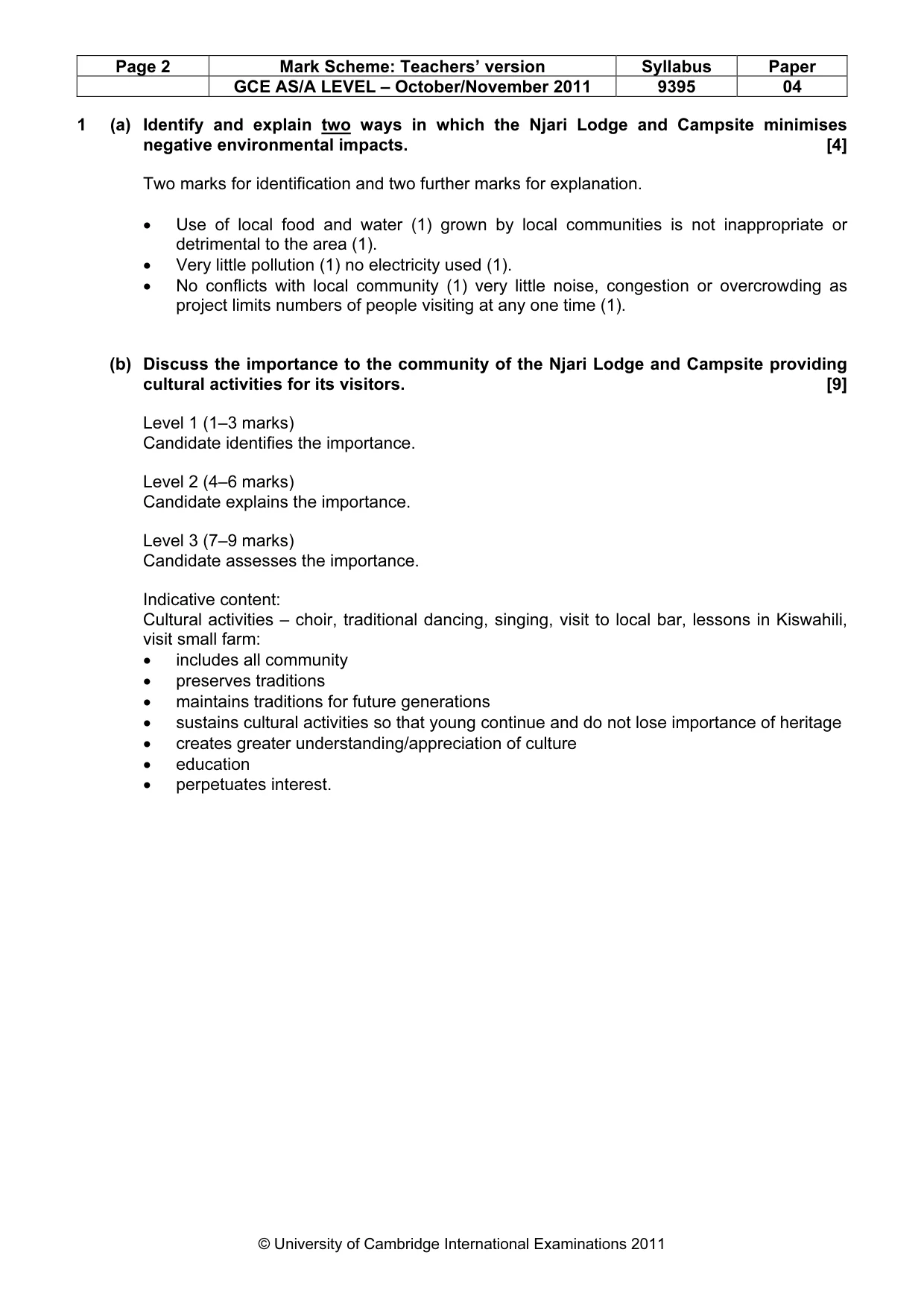
Page 2 Mark Scheme: Teachers’ version Syllabus Paper GCE AS/A LEVEL – October/November 2011 9395 04 © University of Cambridge International Examinations 2011 1 (a) Identify and explain two ways in which the Njari Lodge and Campsite minimises negative environmental impacts. [4] Two marks for identification and two further marks for explanation. • Use of local food and water (1) grown by local communities is not inappropriate or detrimental to the area (1). • Very little pollution (1) no electricity used (1). • No conflicts with local community (1) very little noise, congestion or overcrowding as project limits numbers of people visiting at any one time (1). (b) Discuss the importance to the community of the Njari Lodge and Campsite providing cultural activities for its visitors. [9] Level 1 (1–3 marks) Candidate identifies the importance. Level 2 (4–6 marks) Candidate explains the importance. Level 3 (7–9 marks) Candidate assesses the importance. Indicative content: Cultural activities – choir, traditional dancing, singing, visit to local bar, lessons in Kiswahili, visit small farm: • includes all community • preserves traditions • maintains traditions for future generations • sustains cultural activities so that young continue and do not lose importance of heritage • creates greater understanding/appreciation of culture • education • perpetuates interest.
Mark scheme, page 3
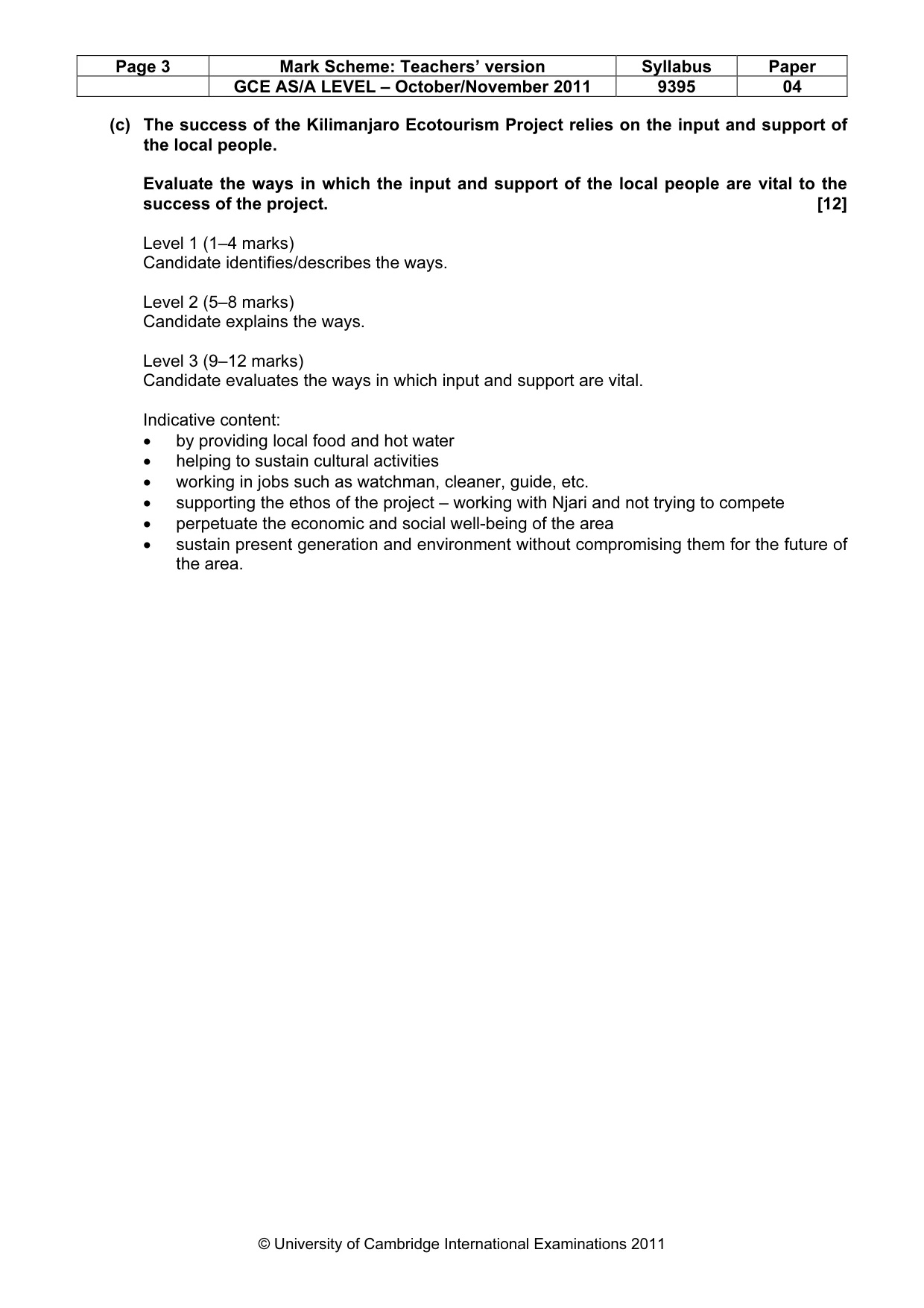
Page 3 Mark Scheme: Teachers’ version Syllabus Paper GCE AS/A LEVEL – October/November 2011 9395 04 © University of Cambridge International Examinations 2011 (c) The success of the Kilimanjaro Ecotourism Project relies on the input and support of the local people. Evaluate the ways in which the input and support of the local people are vital to the success of the project. [12] Level 1 (1–4 marks) Candidate identifies/describes the ways. Level 2 (5–8 marks) Candidate explains the ways. Level 3 (9–12 marks) Candidate evaluates the ways in which input and support are vital. Indicative content: • by providing local food and hot water • helping to sustain cultural activities • working in jobs such as watchman, cleaner, guide, etc. • supporting the ethos of the project – working with Njari and not trying to compete • perpetuate the economic and social well-being of the area • sustain present generation and environment without compromising them for the future of the area.
Mark scheme, page 4
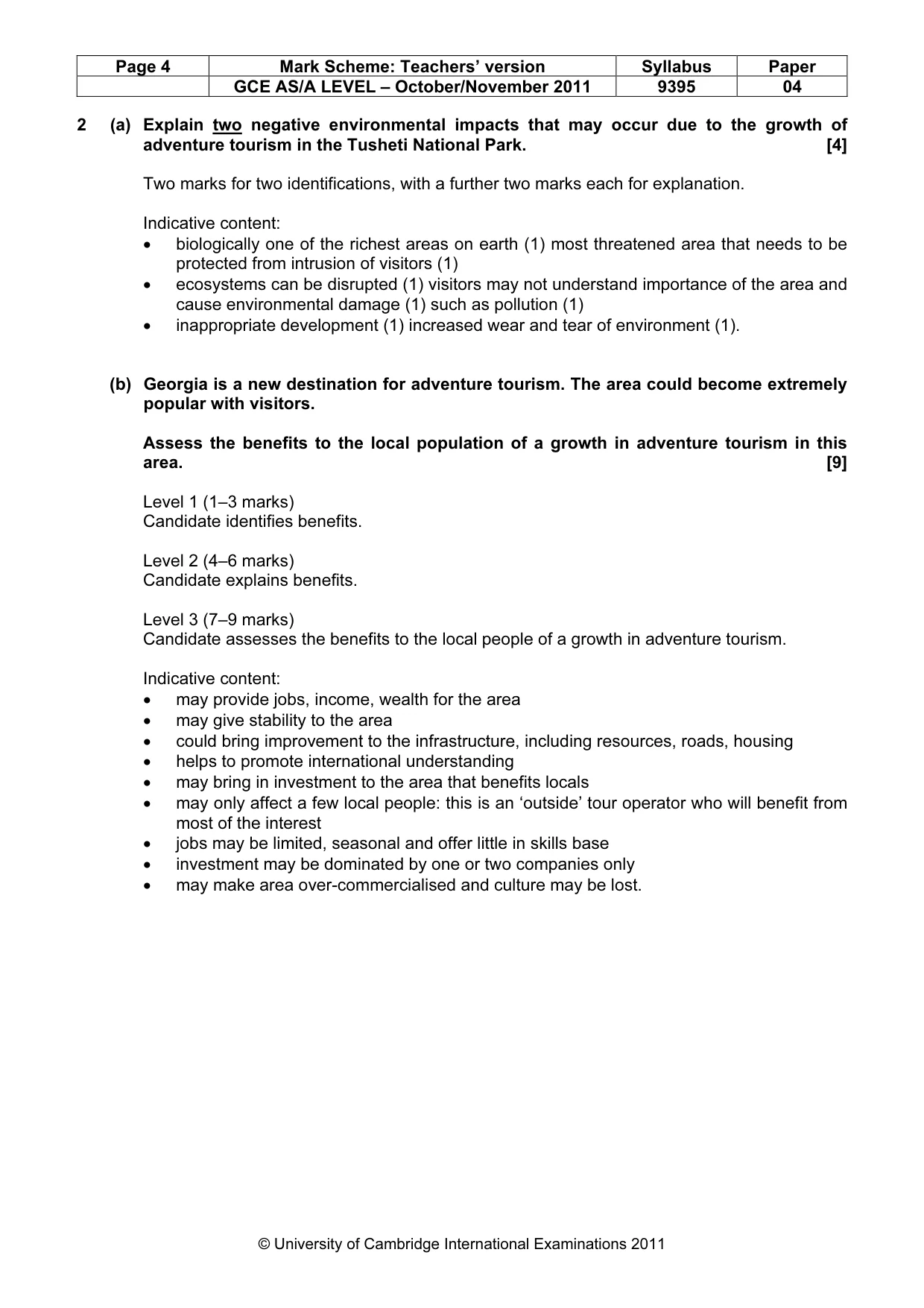
Page 4 Mark Scheme: Teachers’ version Syllabus Paper GCE AS/A LEVEL – October/November 2011 9395 04 © University of Cambridge International Examinations 2011 2 (a) Explain two negative environmental impacts that may occur due to the growth of adventure tourism in the Tusheti National Park. [4] Two marks for two identifications, with a further two marks each for explanation. Indicative content: • biologically one of the richest areas on earth (1) most threatened area that needs to be protected from intrusion of visitors (1) • ecosystems can be disrupted (1) visitors may not understand importance of the area and cause environmental damage (1) such as pollution (1) • inappropriate development (1) increased wear and tear of environment (1). (b) Georgia is a new destination for adventure tourism. The area could become extremely popular with visitors. Assess the benefits to the local population of a growth in adventure tourism in this area. [9] Level 1 (1–3 marks) Candidate identifies benefits. Level 2 (4–6 marks) Candidate explains benefits. Level 3 (7–9 marks) Candidate assesses the benefits to the local people of a growth in adventure tourism. Indicative content: • may provide jobs, income, wealth for the area • may give stability to the area • could bring improvement to the infrastructure, including resources, roads, housing • helps to promote international understanding • may bring in investment to the area that benefits locals • may only affect a few local people: this is an ‘outside’ tour operator who will benefit from most of the interest • jobs may be limited, seasonal and offer little in skills base • investment may be dominated by one or two companies only • may make area over-commercialised and culture may be lost.
Mark scheme, page 5
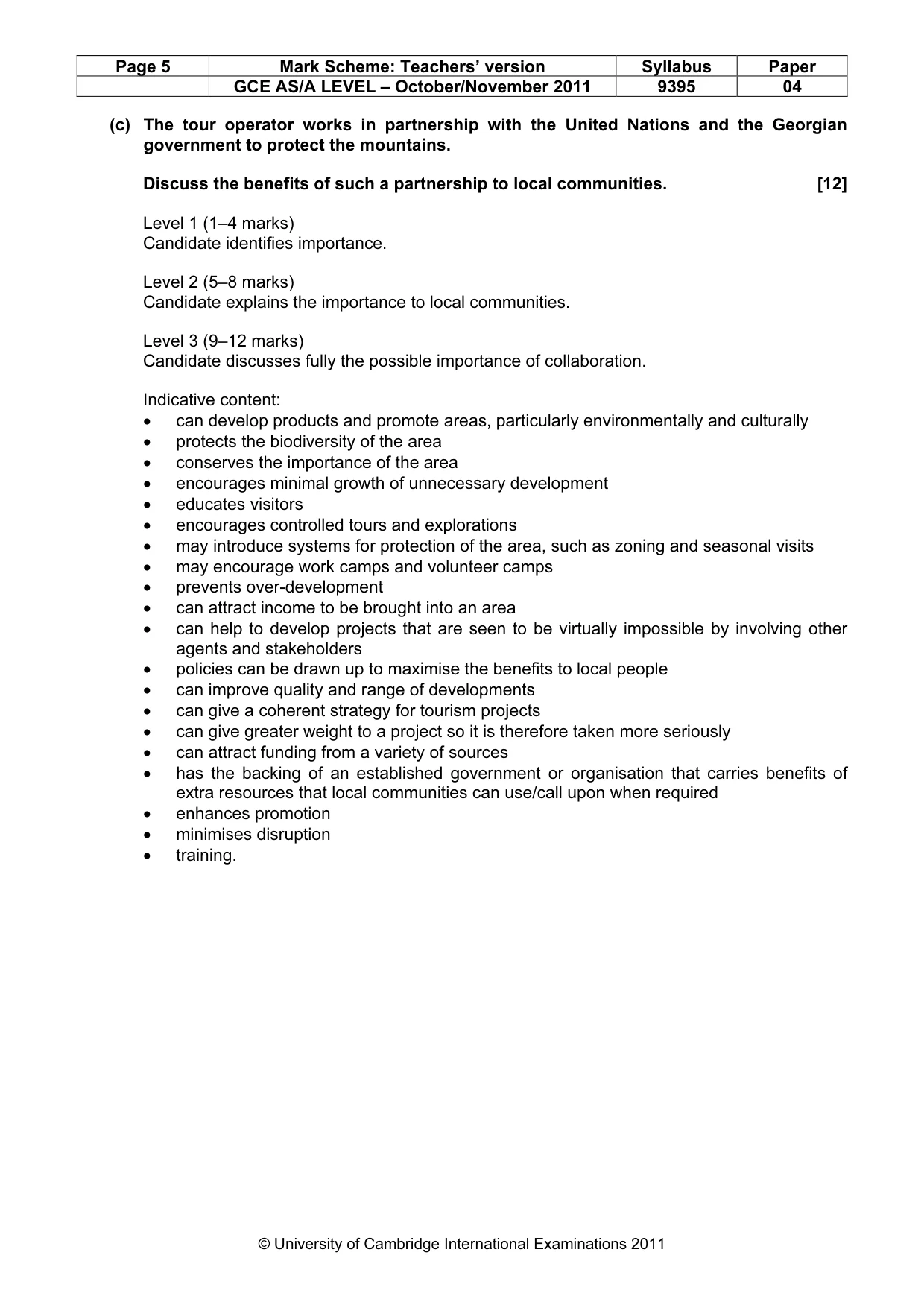
Page 5 Mark Scheme: Teachers’ version Syllabus Paper GCE AS/A LEVEL – October/November 2011 9395 04 © University of Cambridge International Examinations 2011 (c) The tour operator works in partnership with the United Nations and the Georgian government to protect the mountains. Discuss the benefits of such a partnership to local communities. [12] Level 1 (1–4 marks) Candidate identifies importance. Level 2 (5–8 marks) Candidate explains the importance to local communities. Level 3 (9–12 marks) Candidate discusses fully the possible importance of collaboration. Indicative content: • can develop products and promote areas, particularly environmentally and culturally • protects the biodiversity of the area • conserves the importance of the area • encourages minimal growth of unnecessary development • educates visitors • encourages controlled tours and explorations • may introduce systems for protection of the area, such as zoning and seasonal visits • may encourage work camps and volunteer camps • prevents over-development • can attract income to be brought into an area • can help to develop projects that are seen to be virtually impossible by involving other agents and stakeholders • policies can be drawn up to maximise the benefits to local people • can improve quality and range of developments • can give a coherent strategy for tourism projects • can give greater weight to a project so it is therefore taken more seriously • can attract funding from a variety of sources • has the backing of an established government or organisation that carries benefits of extra resources that local communities can use/call upon when required • enhances promotion • minimises disruption • training.
What you needed in this session
Cambridge’s own grade thresholds for 2011 Oct/Nov, Paper 4 · Variant 1. A higher threshold means an easier paper — the bar moves with how the cohort did.