Cambridge A Level Travel and Tourism 9395 — 2011 Oct/Nov Paper 1 · Variant 1
9395/11/O/N/11 · 100 marks · ≈113 min
The question paper and its mark scheme, free to read here and free to download. This is Cambridge’s own paper, exactly as it was sat.
Question paper16 pages

Mark scheme12 pages
Answers below. Sit the paper first if you are practising.
Paper as text
Question paper, page 1
This document consists of 15 printed pages and 1 blank page. DC (KN/DJ) 51408/7 R © UCLES 2011 [Turn over UNIVERSITY OF CAMBRIDGE INTERNATIONAL EXAMINATIONS General Certificate of Education Advanced Subsidiary Level and Advanced Level * 9 9 1 4 9 1 7 5 1 8 * TRAVEL AND TOURISM 9395/01 Paper 1 Core October/November 2011 2 hours and 30 minutes Candidates answer on the Question Paper. No Additional Materials are required. READ THESE INSTRUCTIONS FIRST Write your Centre number, candidate number and name on all work you hand in. Write in dark blue or black pen. Do not use staples, paper clips, highlighters, glue or correction fluid. You may use a pencil for any diagrams, graphs or rough working. DO NOT WRITE IN ANY BARCODES. Answer all questions. The number of marks is given in brackets [ ] at the end of each question or part question. For Examiner’s Use 1 2 3 4 Total
Question paper, page 2
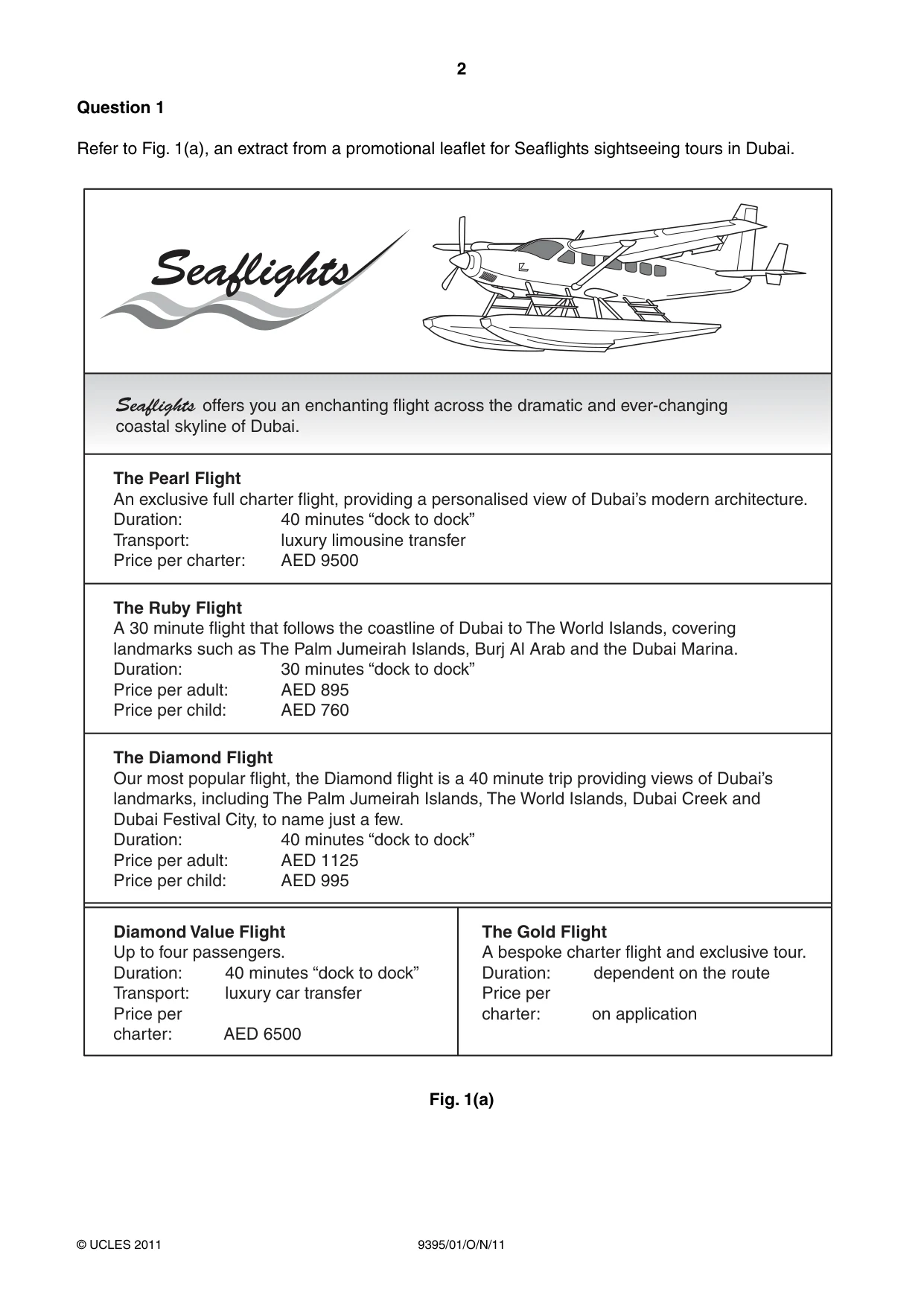
2 9395/01/O/N/11 © UCLES 2011 Question 1 Refer to Fig. 1(a), an extract from a promotional leaflet for Seaflights sightseeing tours in Dubai. Seaflights offers you an enchanting flight across the dramatic and ever-changing coastal skyline of Dubai. The Pearl Flight An exclusive full charter flight, providing a personalised view of Dubai’s modern architecture. Duration: 40 minutes “dock to dock” Transport: luxury limousine transfer Price per charter: AED 9500 The Ruby Flight A 30 minute flight that follows the coastline of Dubai to The World Islands, covering landmarks such as The Palm Jumeirah Islands, Burj Al Arab and the Dubai Marina. Duration: 30 minutes “dock to dock” Price per adult: AED 895 Price per child: AED 760 The Diamond Flight Our most popular flight, the Diamond flight is a 40 minute trip providing views of Dubai’s landmarks, including The Palm Jumeirah Islands, The World Islands, Dubai Creek and Dubai Festival City, to name just a few. Duration: 40 minutes “dock to dock” Price per adult: AED 1125 Price per child: AED 995 Diamond Value Flight Up to four passengers. Duration: 40 minutes “dock to dock” Transport: luxury car transfer Price per charter: AED 6500 The Gold Flight A bespoke charter flight and exclusive tour. Duration: dependent on the route Price per charter: on application Fig. 1(a)
Question paper, page 3
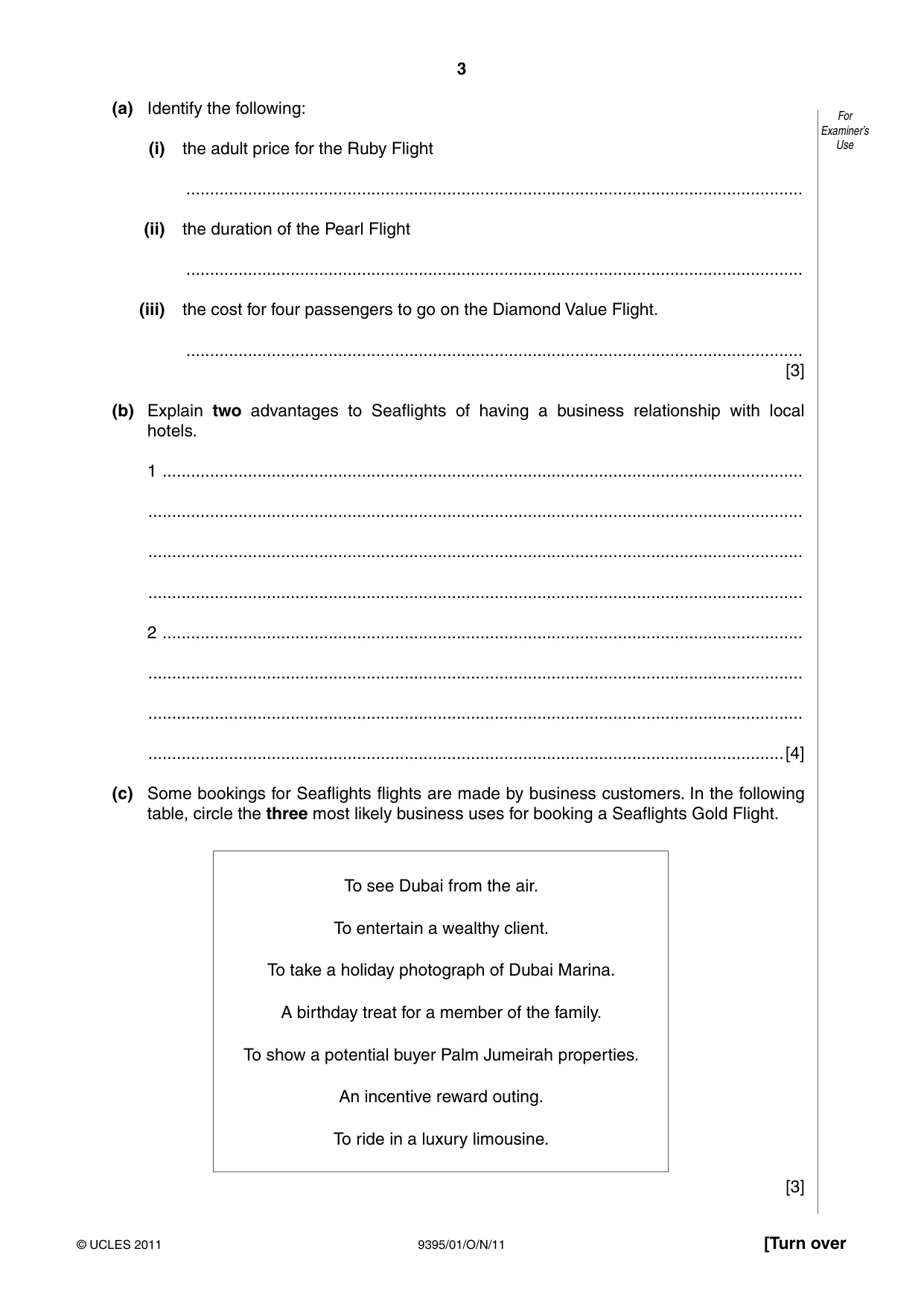
3 9395/01/O/N/11 © UCLES 2011 [Turn over For Examiner’s Use (a) Identify the following: (i) the adult price for the Ruby Flight … (ii) the duration of the Pearl Flight … (iii) the cost for four passengers to go on the Diamond Value Flight. … [3] (b) Explain two advantages to Seaflights of having a business relationship with local hotels. 1 … … … … 2 … … … …[4] (c) Some bookings for Seaflights flights are made by business customers. In the following table, circle the three most likely business uses for booking a Seaflights Gold Flight. To see Dubai from the air. To entertain a wealthy client. To take a holiday photograph of Dubai Marina. A birthday treat for a member of the family. To show a potential buyer Palm Jumeirah properties. An incentive reward outing. To ride in a luxury limousine. [3]
Question paper, page 4
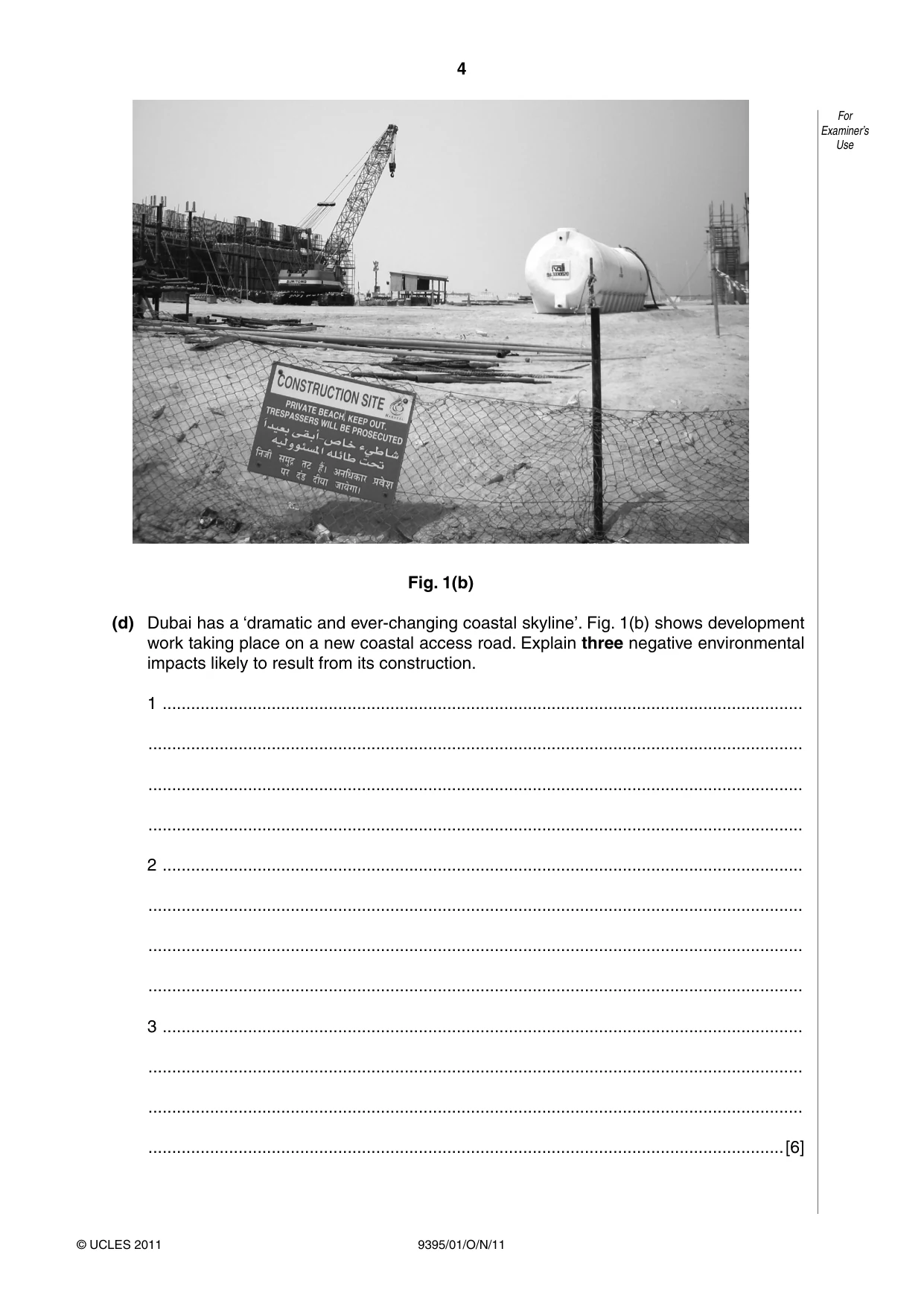
4 9395/01/O/N/11 © UCLES 2011 For Examiner’s Use Fig. 1(b) (d) Dubai has a ‘dramatic and ever-changing coastal skyline’. Fig. 1(b) shows development work taking place on a new coastal access road. Explain three negative environmental impacts likely to result from its construction. 1 … … … … 2 … … … … 3 … … … …[6]
Question paper, page 5
5 9395/01/O/N/11 © UCLES 2011 [Turn over For Examiner’s Use (e) All destinations will change through time. With reference to one destination with which you are familiar, discuss how it has changed and justify where it should be placed in terms of the Butler model of destination evolution. Name of chosen destination … … … … … … … … … … … … … … … … … … … … … … … … …[9] [Total: 25]
Question paper, page 6
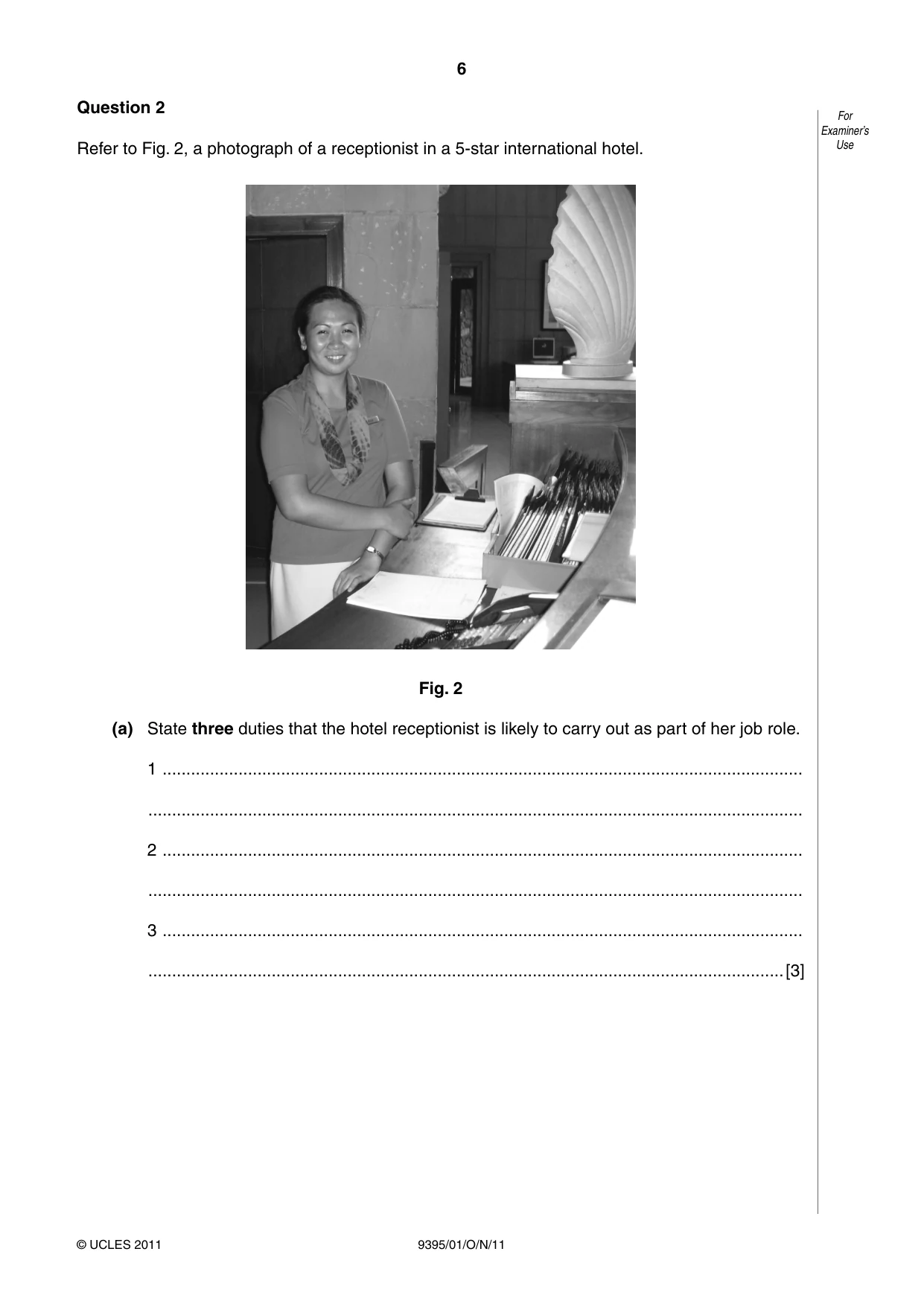
6 9395/01/O/N/11 © UCLES 2011 For Examiner’s Use Question 2 Refer to Fig. 2, a photograph of a receptionist in a 5-star international hotel. Fig. 2 (a) State three duties that the hotel receptionist is likely to carry out as part of her job role. 1 … … 2 … … 3 … …[3]
Question paper, page 7
7 9395/01/O/N/11 © UCLES 2011 [Turn over For Examiner’s Use (b) State and explain three likely aspects of good practice that hotel receptionists should follow when dealing with external customers. 1 … … … … 2 … … … … 3 … … … …[6] (c) The receptionist shown in Fig. 2 has received training in the use of new technology. Explain two ways in which such training is likely to result in improved customer service. 1 … … … … 2 … … … …[4]
Question paper, page 8
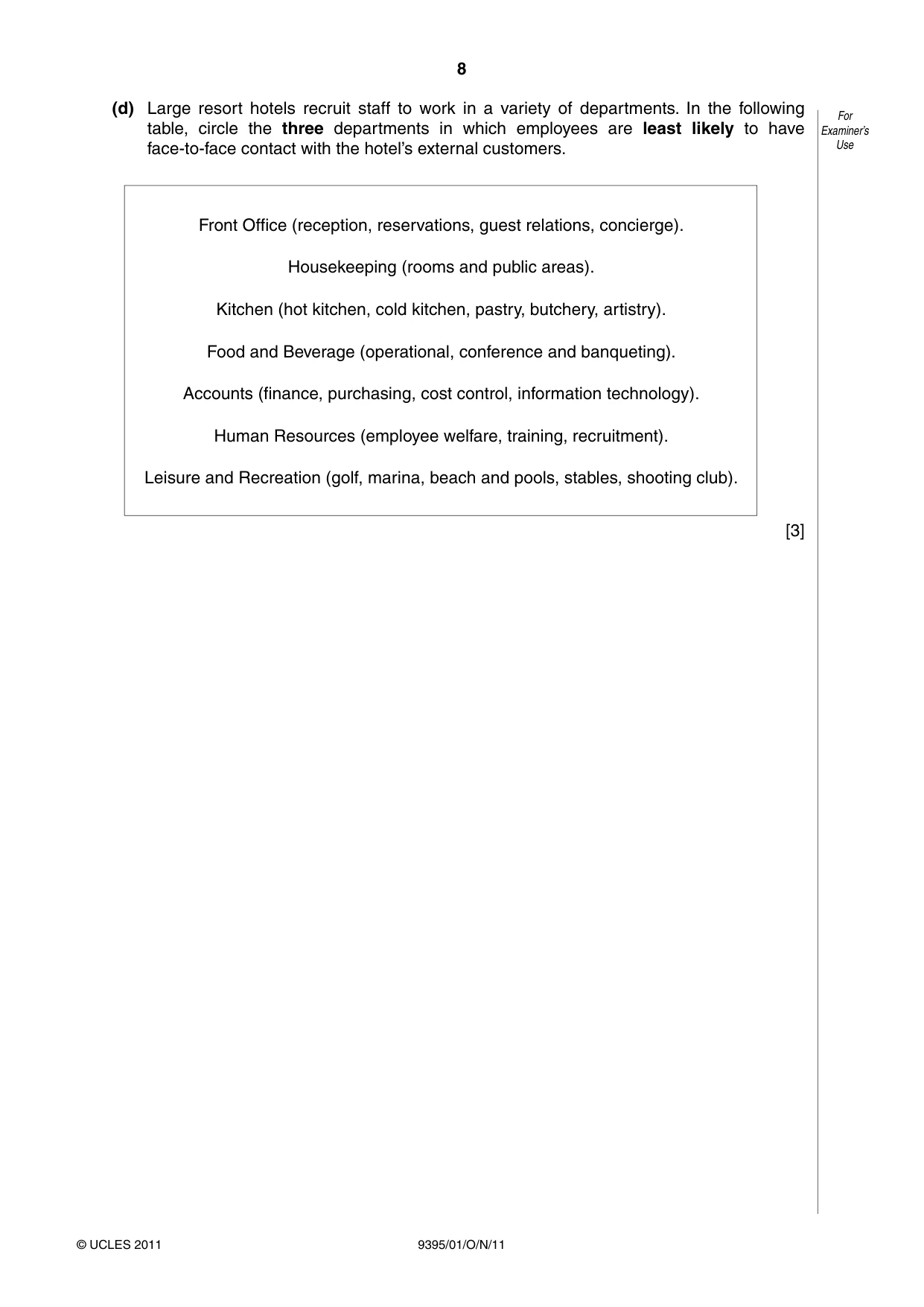
8 9395/01/O/N/11 © UCLES 2011 For Examiner’s Use (d) Large resort hotels recruit staff to work in a variety of departments. In the following table, circle the three departments in which employees are least likely to have face-to-face contact with the hotel’s external customers. Front Office (reception, reservations, guest relations, concierge). Housekeeping (rooms and public areas). Kitchen (hot kitchen, cold kitchen, pastry, butchery, artistry). Food and Beverage (operational, conference and banqueting). Accounts (finance, purchasing, cost control, information technology). Human Resources (employee welfare, training, recruitment). Leisure and Recreation (golf, marina, beach and pools, stables, shooting club). [3]
Question paper, page 9
9 9395/01/O/N/11 © UCLES 2011 [Turn over For Examiner’s Use (e) With reference to travel and tourism job roles with which you are familiar, discuss how product knowledge can increase levels of customer satisfaction. … … … … … … … … … … … … … … … … … … … … … … … … … …[9] [Total: 25]
Question paper, page 10
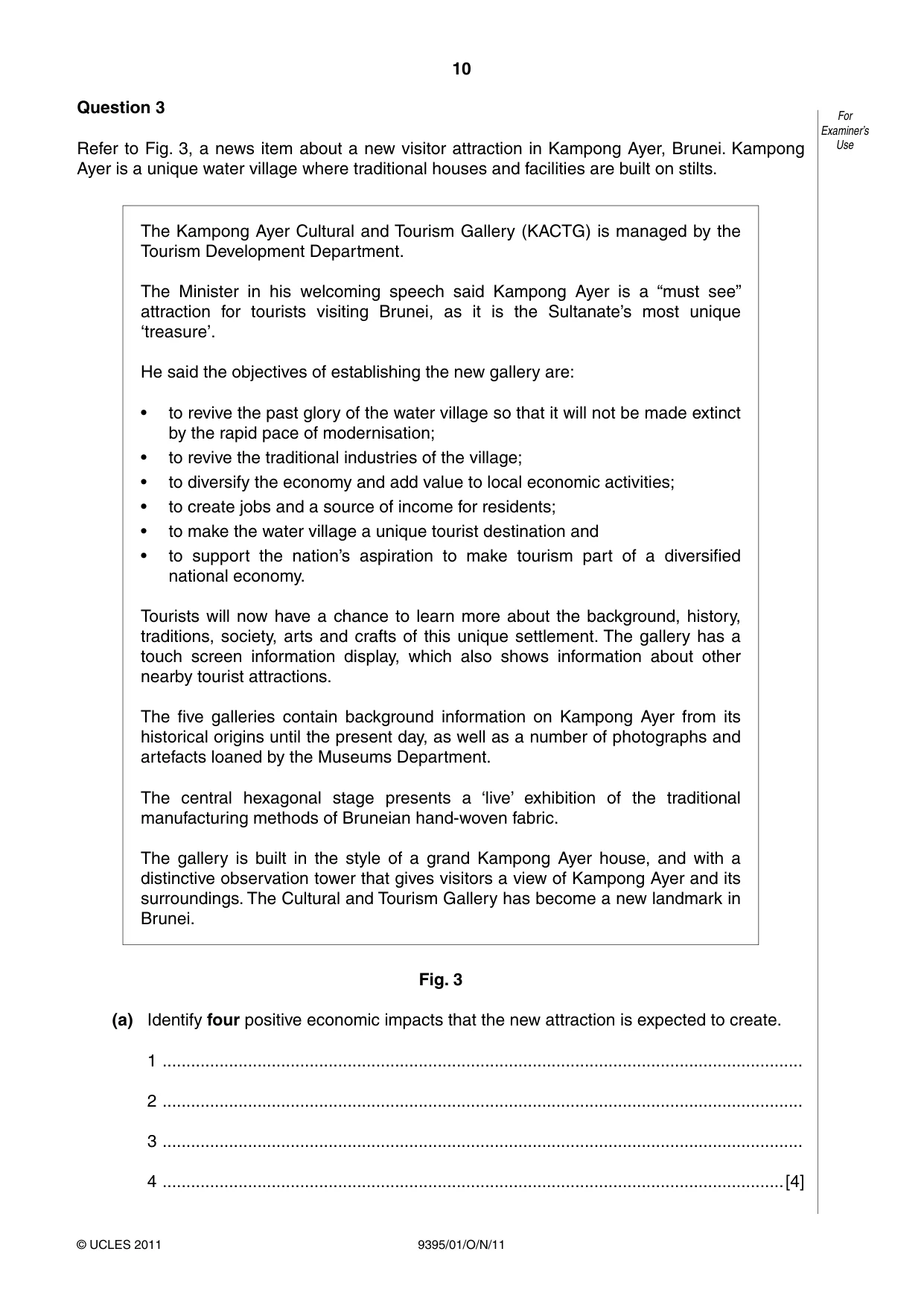
10 9395/01/O/N/11 © UCLES 2011 For Examiner’s Use Question 3 Refer to Fig. 3, a news item about a new visitor attraction in Kampong Ayer, Brunei. Kampong Ayer is a unique water village where traditional houses and facilities are built on stilts. The Kampong Ayer Cultural and Tourism Gallery (KACTG) is managed by the Tourism Development Department. The Minister in his welcoming speech said Kampong Ayer is a “must see” attraction for tourists visiting Brunei, as it is the Sultanate’s most unique ‘treasure’. He said the objectives of establishing the new gallery are: • to revive the past glory of the water village so that it will not be made extinct by the rapid pace of modernisation; • to revive the traditional industries of the village; • to diversify the economy and add value to local economic activities; • to create jobs and a source of income for residents; • to make the water village a unique tourist destination and • to support the nation’s aspiration to make tourism part of a diversified national economy. Tourists will now have a chance to learn more about the background, history, traditions, society, arts and crafts of this unique settlement. The gallery has a touch screen information display, which also shows information about other nearby tourist attractions. The five galleries contain background information on Kampong Ayer from its historical origins until the present day, as well as a number of photographs and artefacts loaned by the Museums Department. The central hexagonal stage presents a ‘live’ exhibition of the traditional manufacturing methods of Bruneian hand-woven fabric. The gallery is built in the style of a grand Kampong Ayer house, and with a distinctive observation tower that gives visitors a view of Kampong Ayer and its surroundings. The Cultural and Tourism Gallery has become a new landmark in Brunei. Fig. 3 (a) Identify four positive economic impacts that the new attraction is expected to create. 1 … 2 … 3 … 4 …[4]
Question paper, page 11
11 9395/01/O/N/11 © UCLES 2011 [Turn over For Examiner’s Use (b) Identify and explain three ways in which the new attraction is likely to appeal to overseas visitors. 1 … … … … 2 … … … … 3 … … … …[6] (c) Explain three different types of conflict that may arise between visiting tourists and the host population in destinations such as Brunei. 1 … … … … 2 … … … … 3 … … … …[6]
Question paper, page 12
12 9395/01/O/N/11 © UCLES 2011 For Examiner’s Use (d) Discuss the reasons why many tourists now make their own travel and accommodation arrangements. … … … … … … … … … … … … … … … … … … … … … … … … … …[9] [Total: 25]
Question paper, page 13
13 9395/01/O/N/11 © UCLES 2011 [Turn over BLANK PAGE PLEASE TURN OVER FOR QUESTION 4 Copyright Acknowledgements: Question 1 John Smith © UCLES Question 2 John Smith © UCLES Question 3 © Borneo Bulletin Question 4 © eturbonews.com Permission to reproduce items where third-party owned material protected by copyright is included has been sought and cleared where possible. Every reasonable effort has been made by the publisher (UCLES) to trace copyright holders, but if any items requiring clearance have unwittingly been included, the publisher will be pleased to make amends at the earliest possible opportunity. University of Cambridge International Examinations is part of the Cambridge Assessment Group. Cambridge Assessment is the brand name of University of Cambridge Local Examinations Syndicate (UCLES), which is itself a department of the University of Cambridge.
Question paper, page 14
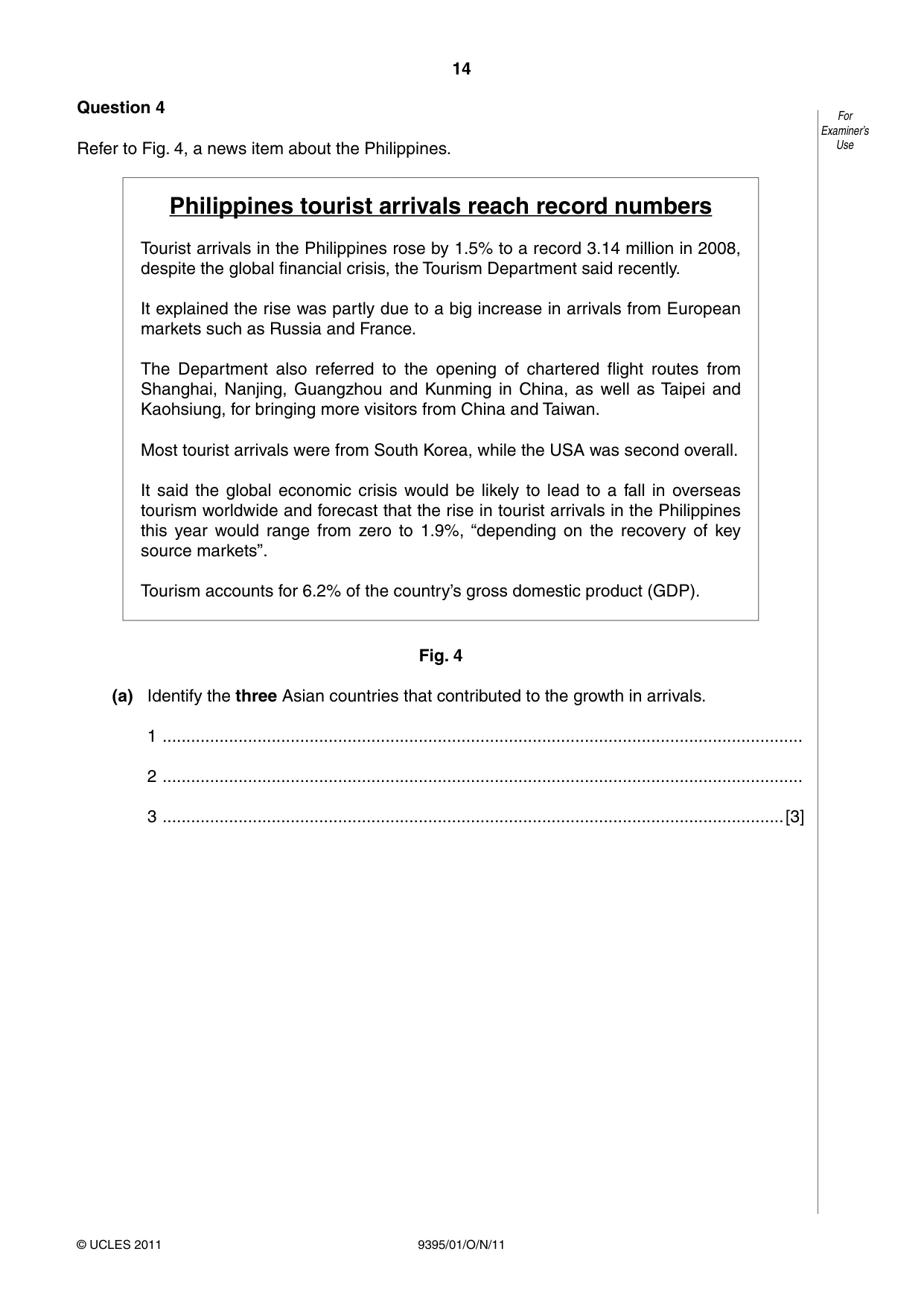
14 9395/01/O/N/11 © UCLES 2011 For Examiner’s Use Question 4 Refer to Fig. 4, a news item about the Philippines. Philippines tourist arrivals reach record numbers Tourist arrivals in the Philippines rose by 1.5% to a record 3.14 million in 2008, despite the global financial crisis, the Tourism Department said recently. It explained the rise was partly due to a big increase in arrivals from European markets such as Russia and France. The Department also referred to the opening of chartered flight routes from Shanghai, Nanjing, Guangzhou and Kunming in China, as well as Taipei and Kaohsiung, for bringing more visitors from China and Taiwan. Most tourist arrivals were from South Korea, while the USA was second overall. It said the global economic crisis would be likely to lead to a fall in overseas tourism worldwide and forecast that the rise in tourist arrivals in the Philippines this year would range from zero to 1.9%, “depending on the recovery of key source markets”. Tourism accounts for 6.2% of the country’s gross domestic product (GDP). Fig. 4 (a) Identify the three Asian countries that contributed to the growth in arrivals. 1 … 2 … 3 …[3]
Question paper, page 15
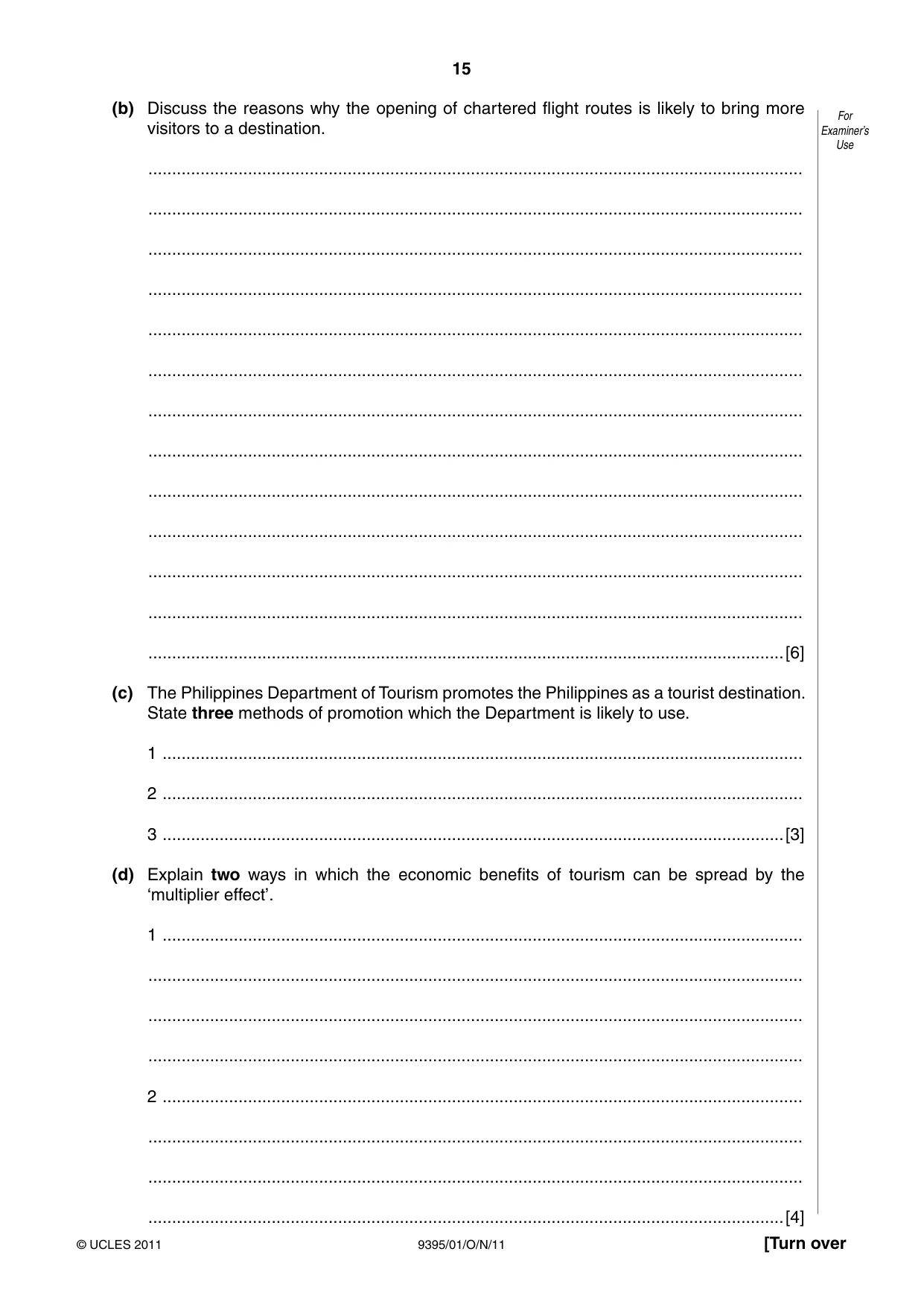
15 9395/01/O/N/11 © UCLES 2011 [Turn over For Examiner’s Use (b) Discuss the reasons why the opening of chartered flight routes is likely to bring more visitors to a destination. … … … … … … … … … … … … …[6] (c) The Philippines Department of Tourism promotes the Philippines as a tourist destination. State three methods of promotion which the Department is likely to use. 1 … 2 … 3 …[3] (d) Explain two ways in which the economic benefits of tourism can be spread by the ‘multiplier effect’. 1 … … … … 2 … … … …[4]
Question paper, page 16
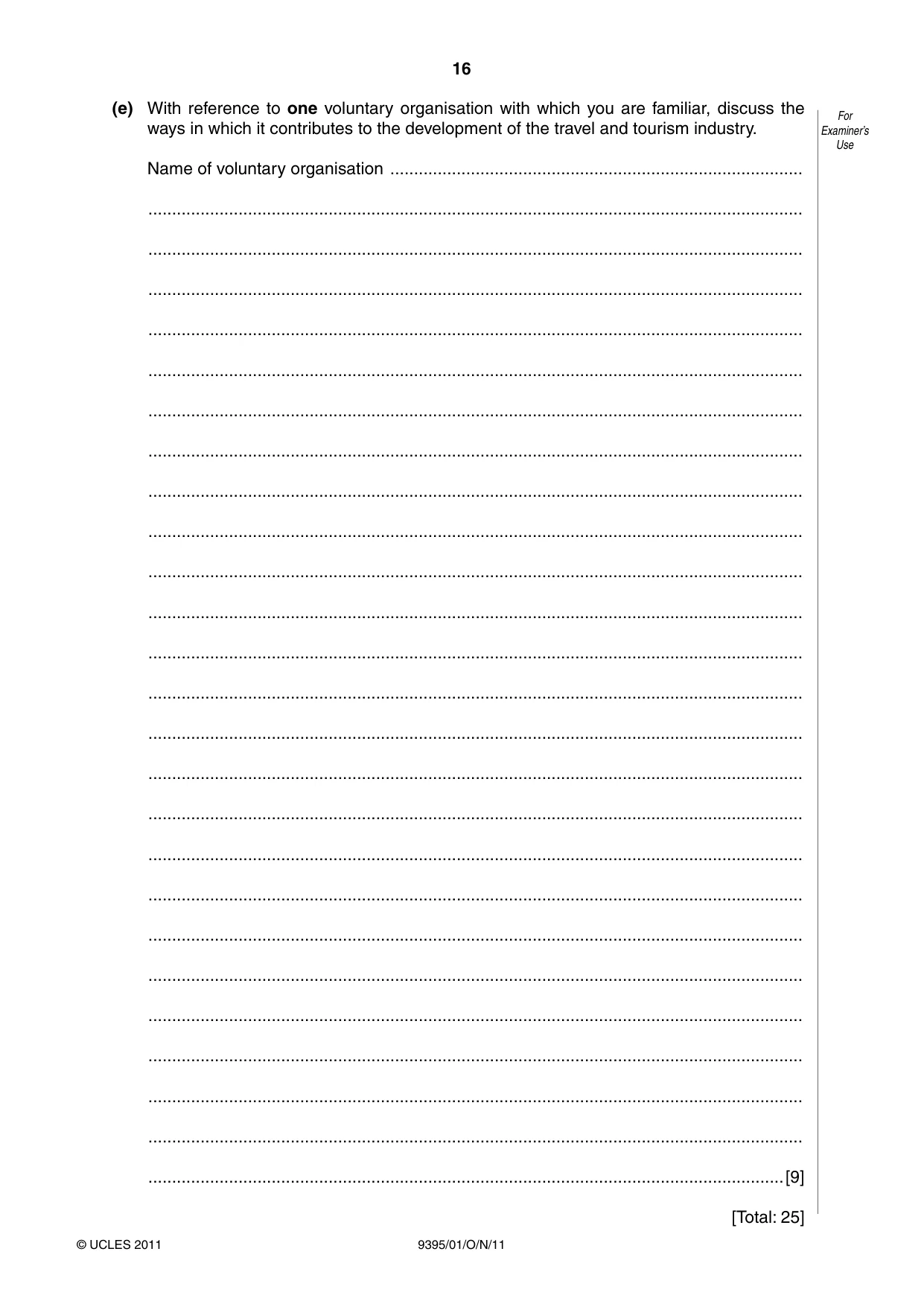
16 9395/01/O/N/11 © UCLES 2011 For Examiner’s Use (e) With reference to one voluntary organisation with which you are familiar, discuss the ways in which it contributes to the development of the travel and tourism industry. Name of voluntary organisation … … … … … … … … … … … … … … … … … … … … … … … … … …[9] [Total: 25]
Mark scheme, page 1
UNIVERSITY OF CAMBRIDGE INTERNATIONAL EXAMINATIONS GCE Advanced Subsidiary Level and GCE Advanced Level MARK SCHEME for the October/November 2011 question paper for the guidance of teachers 9395 TRAVEL AND TOURISM 9395/01 Paper 1 (Core Paper), maximum raw mark 100 This mark scheme is published as an aid to teachers and candidates, to indicate the requirements of the examination. It shows the basis on which Examiners were instructed to award marks. It does not indicate the details of the discussions that took place at an Examiners’ meeting before marking began, which would have considered the acceptability of alternative answers. Mark schemes must be read in conjunction with the question papers and the report on the examination. • Cambridge will not enter into discussions or correspondence in connection with these mark schemes. Cambridge is publishing the mark schemes for the October/November 2011 question papers for most IGCSE, GCE Advanced Level and Advanced Subsidiary Level syllabuses and some Ordinary Level syllabuses.
Mark scheme, page 2
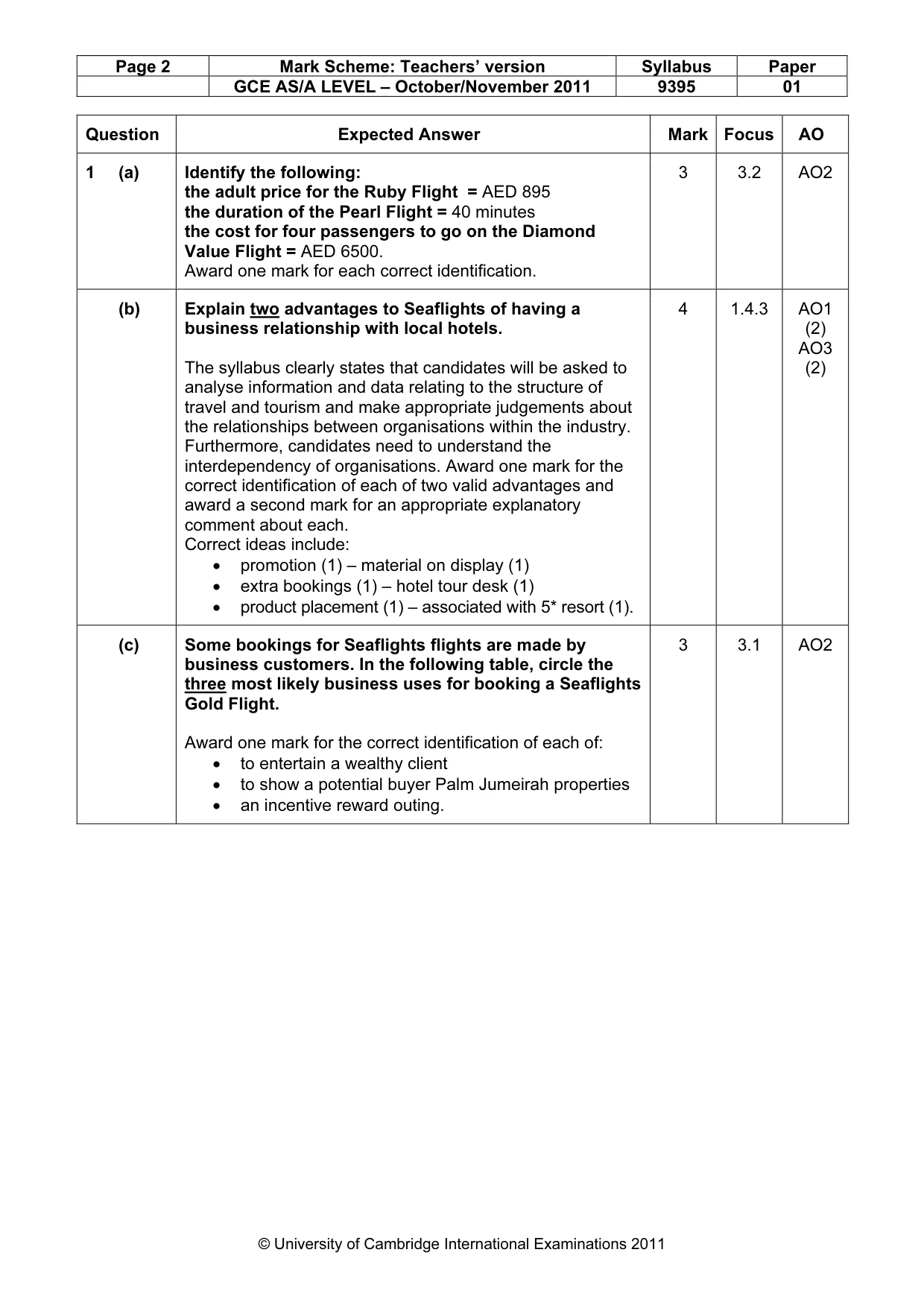
Page 2 Mark Scheme: Teachers’ version Syllabus Paper GCE AS/A LEVEL – October/November 2011 9395 01 © University of Cambridge International Examinations 2011 Question Expected Answer Mark Focus AO 1 (a) Identify the following: the adult price for the Ruby Flight = AED 895 the duration of the Pearl Flight = 40 minutes the cost for four passengers to go on the Diamond Value Flight = AED 6500. Award one mark for each correct identification. 3 3.2 AO2 (b) Explain two advantages to Seaflights of having a business relationship with local hotels. The syllabus clearly states that candidates will be asked to analyse information and data relating to the structure of travel and tourism and make appropriate judgements about the relationships between organisations within the industry. Furthermore, candidates need to understand the interdependency of organisations. Award one mark for the correct identification of each of two valid advantages and award a second mark for an appropriate explanatory comment about each. Correct ideas include: • promotion (1) – material on display (1) • extra bookings (1) – hotel tour desk (1) • product placement (1) – associated with 5* resort (1). 4 1.4.3 AO1 (2) AO3 (2) (c) Some bookings for Seaflights flights are made by business customers. In the following table, circle the three most likely business uses for booking a Seaflights Gold Flight. Award one mark for the correct identification of each of: • to entertain a wealthy client • to show a potential buyer Palm Jumeirah properties • an incentive reward outing. 3 3.1 AO2
Mark scheme, page 3
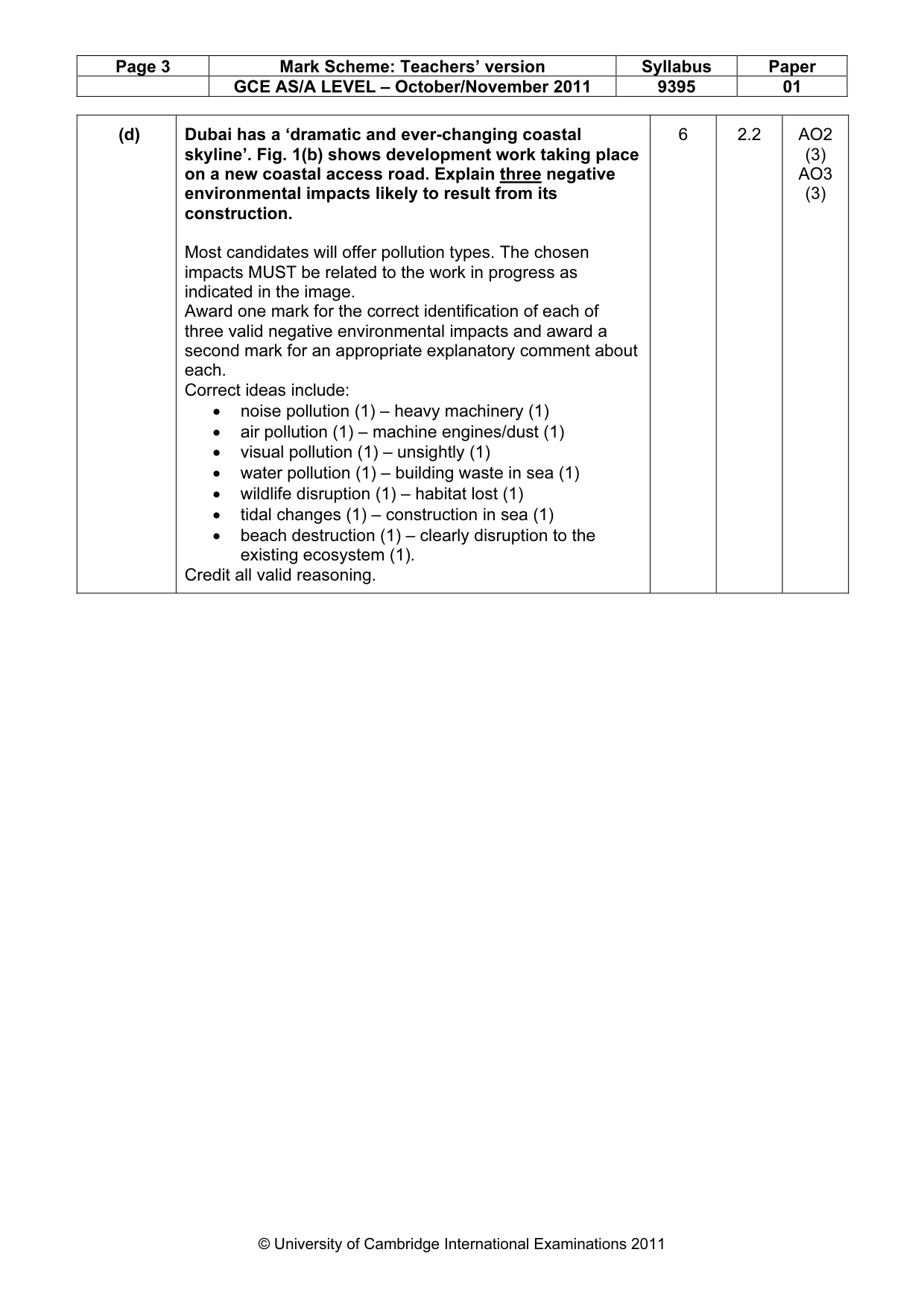
Page 3 Mark Scheme: Teachers’ version Syllabus Paper GCE AS/A LEVEL – October/November 2011 9395 01 © University of Cambridge International Examinations 2011 (d) Dubai has a ‘dramatic and ever-changing coastal skyline’. Fig. 1(b) shows development work taking place on a new coastal access road. Explain three negative environmental impacts likely to result from its construction. Most candidates will offer pollution types. The chosen impacts MUST be related to the work in progress as indicated in the image. Award one mark for the correct identification of each of three valid negative environmental impacts and award a second mark for an appropriate explanatory comment about each. Correct ideas include: • noise pollution (1) – heavy machinery (1) • air pollution (1) – machine engines/dust (1) • visual pollution (1) – unsightly (1) • water pollution (1) – building waste in sea (1) • wildlife disruption (1) – habitat lost (1) • tidal changes (1) – construction in sea (1) • beach destruction (1) – clearly disruption to the existing ecosystem (1). Credit all valid reasoning. 6 2.2 AO2 (3) AO3 (3)
Mark scheme, page 4
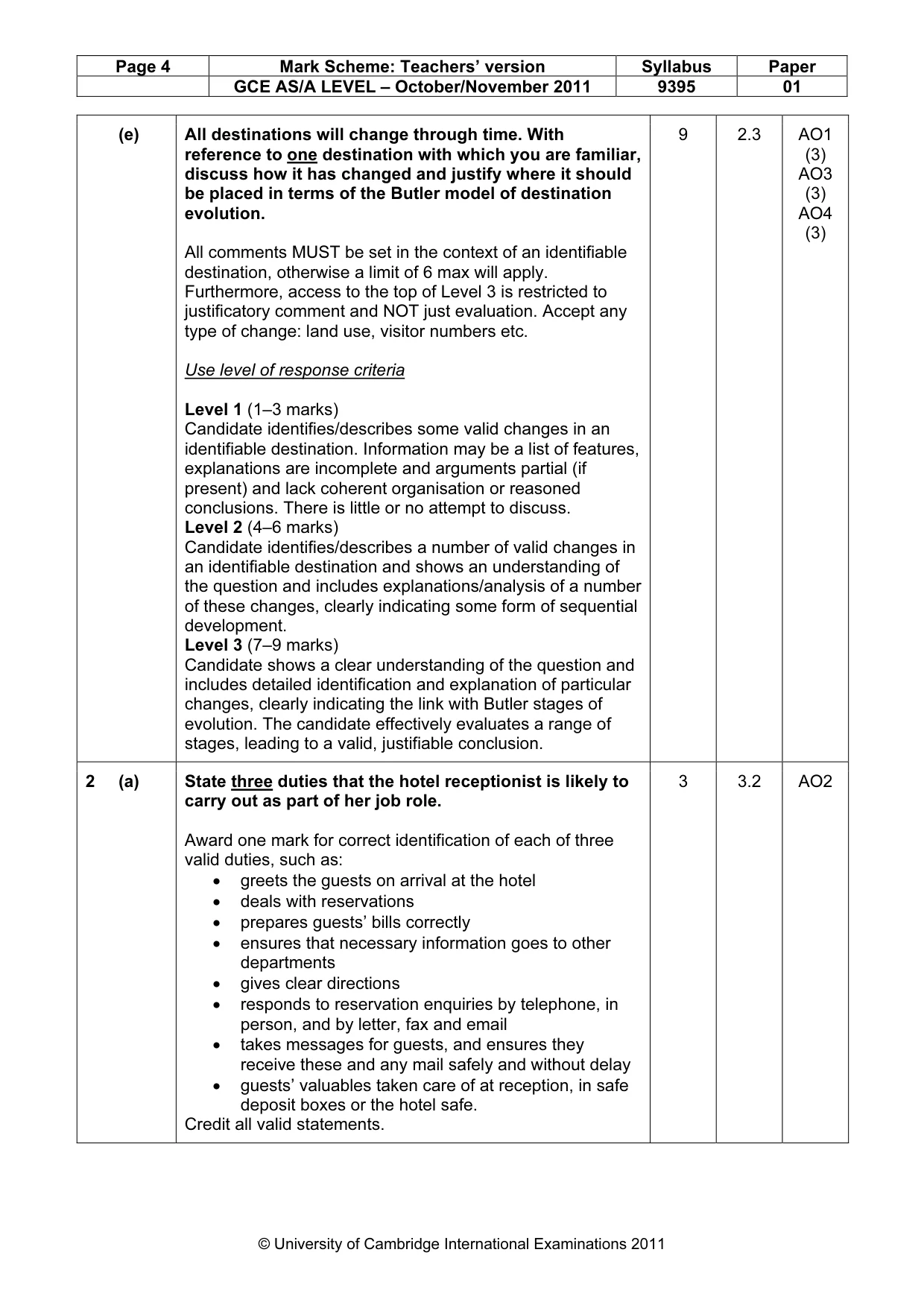
Page 4 Mark Scheme: Teachers’ version Syllabus Paper GCE AS/A LEVEL – October/November 2011 9395 01 © University of Cambridge International Examinations 2011 (e) All destinations will change through time. With reference to one destination with which you are familiar, discuss how it has changed and justify where it should be placed in terms of the Butler model of destination evolution. All comments MUST be set in the context of an identifiable destination, otherwise a limit of 6 max will apply. Furthermore, access to the top of Level 3 is restricted to justificatory comment and NOT just evaluation. Accept any type of change: land use, visitor numbers etc. Use level of response criteria Level 1 (1–3 marks) Candidate identifies/describes some valid changes in an identifiable destination. Information may be a list of features, explanations are incomplete and arguments partial (if present) and lack coherent organisation or reasoned conclusions. There is little or no attempt to discuss. Level 2 (4–6 marks) Candidate identifies/describes a number of valid changes in an identifiable destination and shows an understanding of the question and includes explanations/analysis of a number of these changes, clearly indicating some form of sequential development. Level 3 (7–9 marks) Candidate shows a clear understanding of the question and includes detailed identification and explanation of particular changes, clearly indicating the link with Butler stages of evolution. The candidate effectively evaluates a range of stages, leading to a valid, justifiable conclusion. 9 2.3 AO1 (3) AO3 (3) AO4 (3) 2 (a) State three duties that the hotel receptionist is likely to carry out as part of her job role. Award one mark for correct identification of each of three valid duties, such as: • greets the guests on arrival at the hotel • deals with reservations • prepares guests’ bills correctly • ensures that necessary information goes to other departments • gives clear directions • responds to reservation enquiries by telephone, in person, and by letter, fax and email • takes messages for guests, and ensures they receive these and any mail safely and without delay • guests’ valuables taken care of at reception, in safe deposit boxes or the hotel safe. Credit all valid statements. 3 3.2 AO2
Mark scheme, page 5
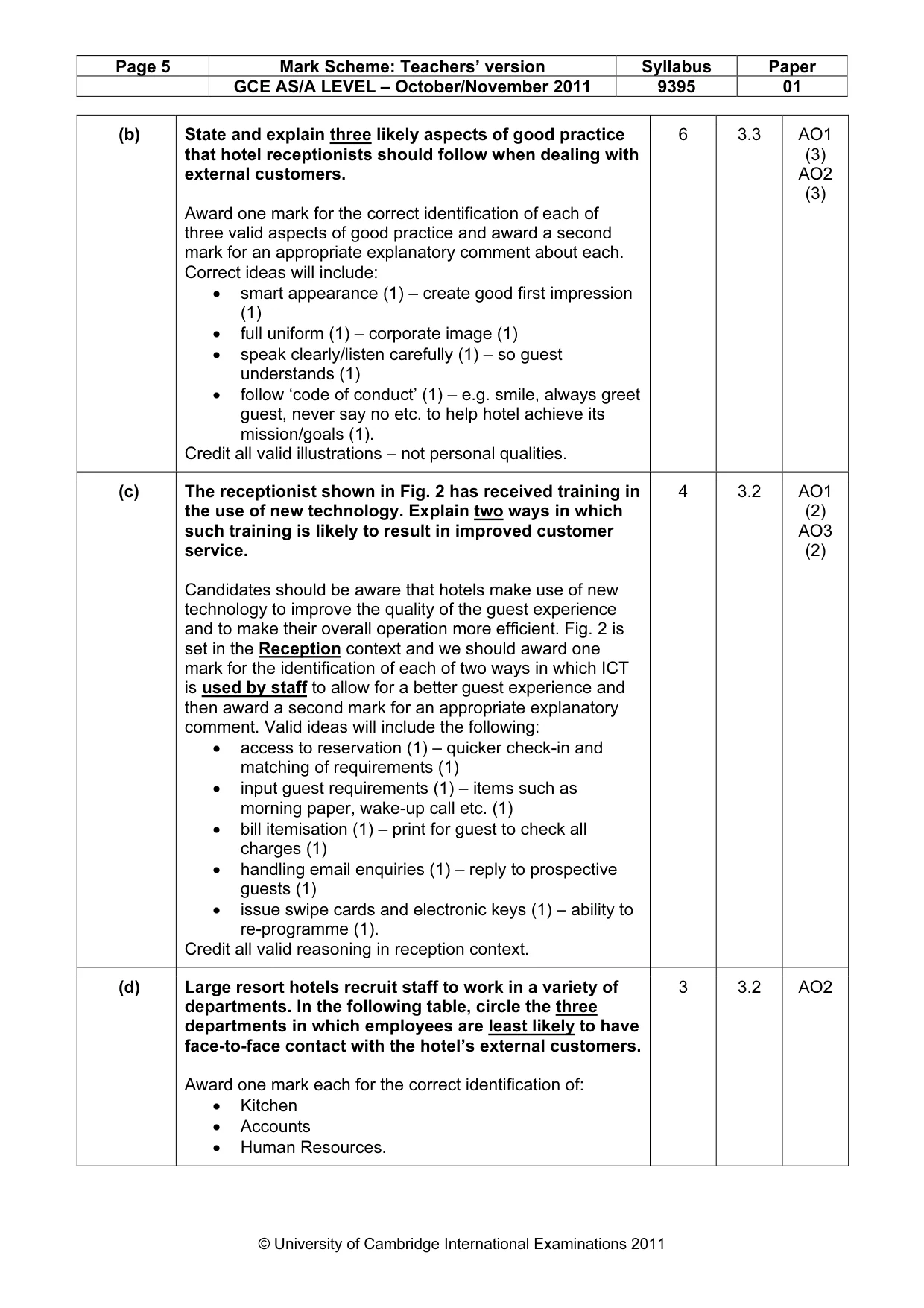
Page 5 Mark Scheme: Teachers’ version Syllabus Paper GCE AS/A LEVEL – October/November 2011 9395 01 © University of Cambridge International Examinations 2011 (b) State and explain three likely aspects of good practice that hotel receptionists should follow when dealing with external customers. Award one mark for the correct identification of each of three valid aspects of good practice and award a second mark for an appropriate explanatory comment about each. Correct ideas will include: • smart appearance (1) – create good first impression (1) • full uniform (1) – corporate image (1) • speak clearly/listen carefully (1) – so guest understands (1) • follow ‘code of conduct’ (1) – e.g. smile, always greet guest, never say no etc. to help hotel achieve its mission/goals (1). Credit all valid illustrations – not personal qualities. 6 3.3 AO1 (3) AO2 (3) (c) The receptionist shown in Fig. 2 has received training in the use of new technology. Explain two ways in which such training is likely to result in improved customer service. Candidates should be aware that hotels make use of new technology to improve the quality of the guest experience and to make their overall operation more efficient. Fig. 2 is set in the Reception context and we should award one mark for the identification of each of two ways in which ICT is used by staff to allow for a better guest experience and then award a second mark for an appropriate explanatory comment. Valid ideas will include the following: • access to reservation (1) – quicker check-in and matching of requirements (1) • input guest requirements (1) – items such as morning paper, wake-up call etc. (1) • bill itemisation (1) – print for guest to check all charges (1) • handling email enquiries (1) – reply to prospective guests (1) • issue swipe cards and electronic keys (1) – ability to re-programme (1). Credit all valid reasoning in reception context. 4 3.2 AO1 (2) AO3 (2) (d) Large resort hotels recruit staff to work in a variety of departments. In the following table, circle the three departments in which employees are least likely to have face-to-face contact with the hotel’s external customers. Award one mark each for the correct identification of: • Kitchen • Accounts • Human Resources. 3 3.2 AO2
Mark scheme, page 6
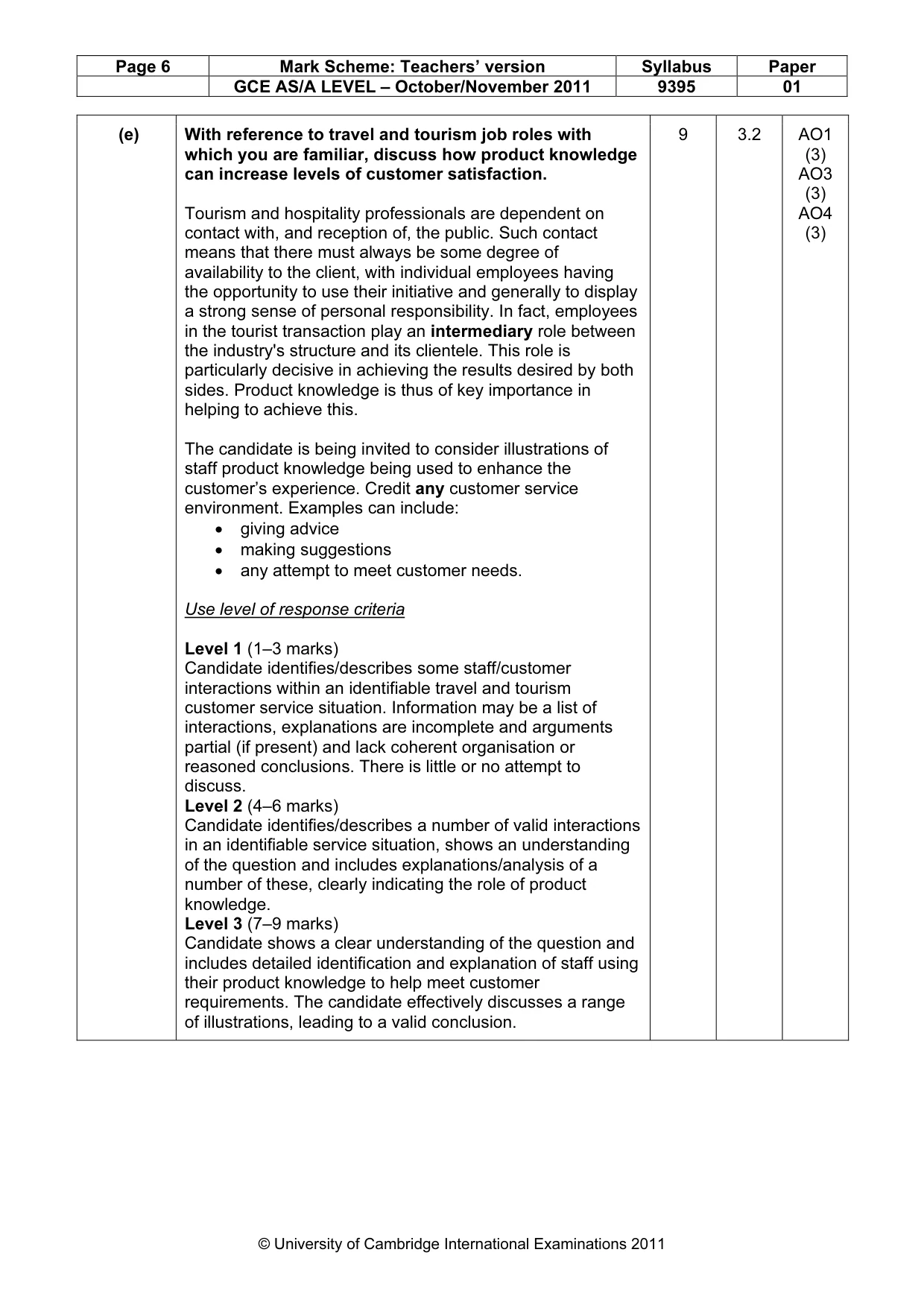
Page 6 Mark Scheme: Teachers’ version Syllabus Paper GCE AS/A LEVEL – October/November 2011 9395 01 © University of Cambridge International Examinations 2011 (e) With reference to travel and tourism job roles with which you are familiar, discuss how product knowledge can increase levels of customer satisfaction. Tourism and hospitality professionals are dependent on contact with, and reception of, the public. Such contact means that there must always be some degree of availability to the client, with individual employees having the opportunity to use their initiative and generally to display a strong sense of personal responsibility. In fact, employees in the tourist transaction play an intermediary role between the industry's structure and its clientele. This role is particularly decisive in achieving the results desired by both sides. Product knowledge is thus of key importance in helping to achieve this. The candidate is being invited to consider illustrations of staff product knowledge being used to enhance the customer’s experience. Credit any customer service environment. Examples can include: • giving advice • making suggestions • any attempt to meet customer needs. Use level of response criteria Level 1 (1–3 marks) Candidate identifies/describes some staff/customer interactions within an identifiable travel and tourism customer service situation. Information may be a list of interactions, explanations are incomplete and arguments partial (if present) and lack coherent organisation or reasoned conclusions. There is little or no attempt to discuss. Level 2 (4–6 marks) Candidate identifies/describes a number of valid interactions in an identifiable service situation, shows an understanding of the question and includes explanations/analysis of a number of these, clearly indicating the role of product knowledge. Level 3 (7–9 marks) Candidate shows a clear understanding of the question and includes detailed identification and explanation of staff using their product knowledge to help meet customer requirements. The candidate effectively discusses a range of illustrations, leading to a valid conclusion. 9 3.2 AO1 (3) AO3 (3) AO4 (3)
Mark scheme, page 7
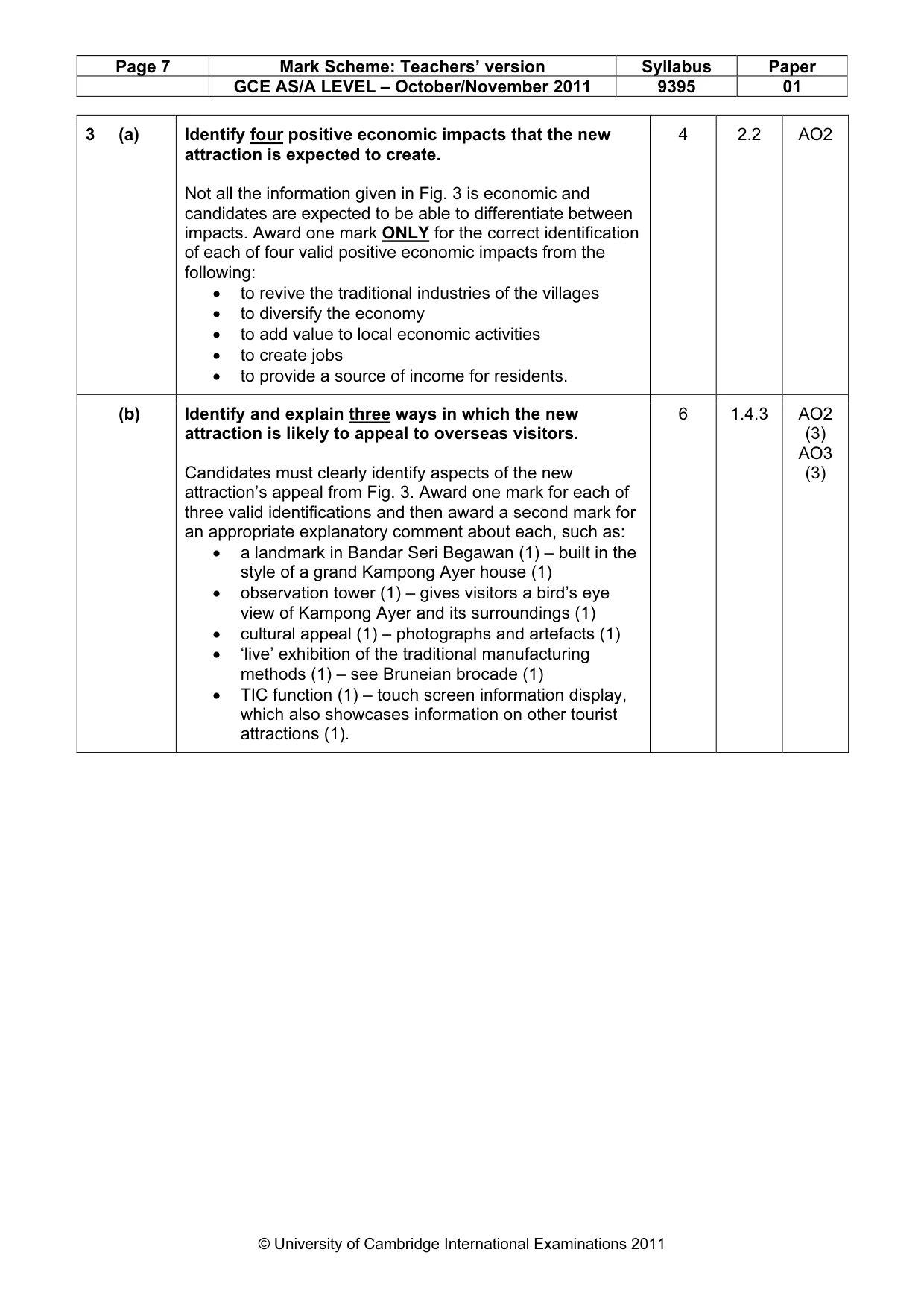
Page 7 Mark Scheme: Teachers’ version Syllabus Paper GCE AS/A LEVEL – October/November 2011 9395 01 © University of Cambridge International Examinations 2011 3 (a) Identify four positive economic impacts that the new attraction is expected to create. Not all the information given in Fig. 3 is economic and candidates are expected to be able to differentiate between impacts. Award one mark ONLY for the correct identification of each of four valid positive economic impacts from the following: • to revive the traditional industries of the villages • to diversify the economy • to add value to local economic activities • to create jobs • to provide a source of income for residents. 4 2.2 AO2 (b) Identify and explain three ways in which the new attraction is likely to appeal to overseas visitors. Candidates must clearly identify aspects of the new attraction’s appeal from Fig. 3. Award one mark for each of three valid identifications and then award a second mark for an appropriate explanatory comment about each, such as: • a landmark in Bandar Seri Begawan (1) – built in the style of a grand Kampong Ayer house (1) • observation tower (1) – gives visitors a bird’s eye view of Kampong Ayer and its surroundings (1) • cultural appeal (1) – photographs and artefacts (1) • ‘live’ exhibition of the traditional manufacturing methods (1) – see Bruneian brocade (1) • TIC function (1) – touch screen information display, which also showcases information on other tourist attractions (1). 6 1.4.3 AO2 (3) AO3 (3)
Mark scheme, page 8
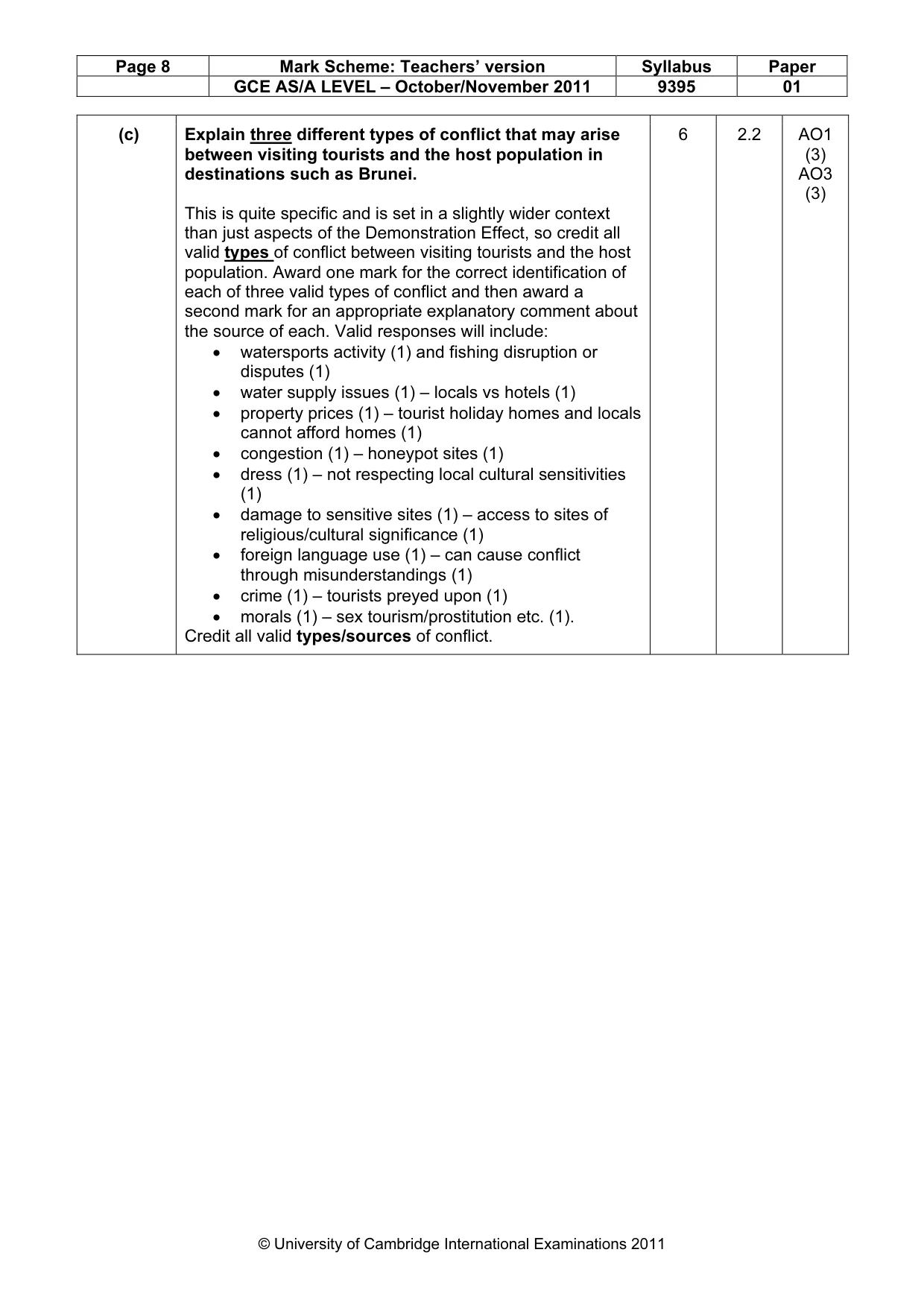
Page 8 Mark Scheme: Teachers’ version Syllabus Paper GCE AS/A LEVEL – October/November 2011 9395 01 © University of Cambridge International Examinations 2011 (c) Explain three different types of conflict that may arise between visiting tourists and the host population in destinations such as Brunei. This is quite specific and is set in a slightly wider context than just aspects of the Demonstration Effect, so credit all valid types of conflict between visiting tourists and the host population. Award one mark for the correct identification of each of three valid types of conflict and then award a second mark for an appropriate explanatory comment about the source of each. Valid responses will include: • watersports activity (1) and fishing disruption or disputes (1) • water supply issues (1) – locals vs hotels (1) • property prices (1) – tourist holiday homes and locals cannot afford homes (1) • congestion (1) – honeypot sites (1) • dress (1) – not respecting local cultural sensitivities (1) • damage to sensitive sites (1) – access to sites of religious/cultural significance (1) • foreign language use (1) – can cause conflict through misunderstandings (1) • crime (1) – tourists preyed upon (1) • morals (1) – sex tourism/prostitution etc. (1). Credit all valid types/sources of conflict. 6 2.2 AO1 (3) AO3 (3)
Mark scheme, page 9
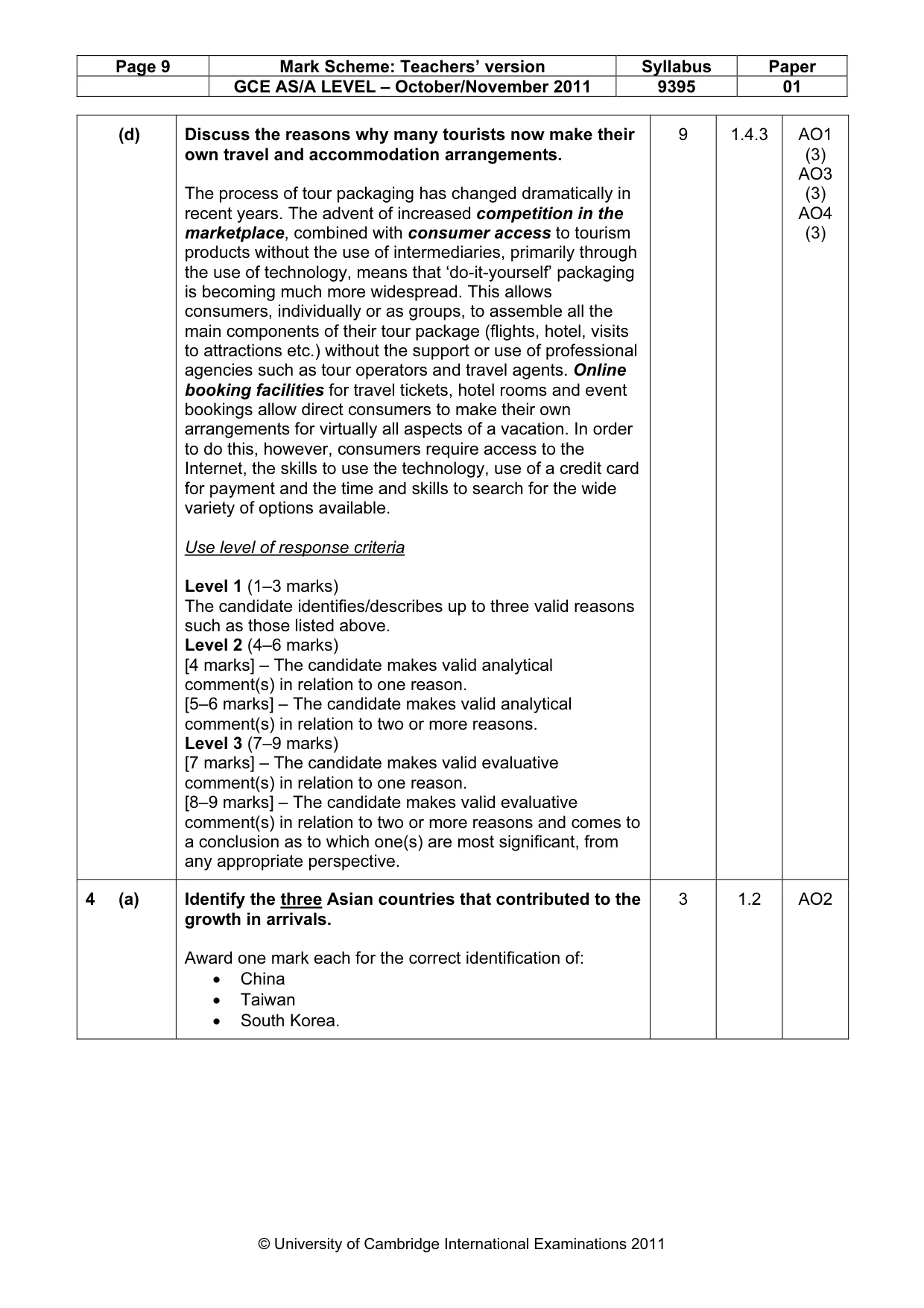
Page 9 Mark Scheme: Teachers’ version Syllabus Paper GCE AS/A LEVEL – October/November 2011 9395 01 © University of Cambridge International Examinations 2011 (d) Discuss the reasons why many tourists now make their own travel and accommodation arrangements. The process of tour packaging has changed dramatically in recent years. The advent of increased competition in the marketplace, combined with consumer access to tourism products without the use of intermediaries, primarily through the use of technology, means that ‘do-it-yourself’ packaging is becoming much more widespread. This allows consumers, individually or as groups, to assemble all the main components of their tour package (flights, hotel, visits to attractions etc.) without the support or use of professional agencies such as tour operators and travel agents. Online booking facilities for travel tickets, hotel rooms and event bookings allow direct consumers to make their own arrangements for virtually all aspects of a vacation. In order to do this, however, consumers require access to the Internet, the skills to use the technology, use of a credit card for payment and the time and skills to search for the wide variety of options available. Use level of response criteria Level 1 (1–3 marks) The candidate identifies/describes up to three valid reasons such as those listed above. Level 2 (4–6 marks) [4 marks] – The candidate makes valid analytical comment(s) in relation to one reason. [5–6 marks] – The candidate makes valid analytical comment(s) in relation to two or more reasons. Level 3 (7–9 marks) [7 marks] – The candidate makes valid evaluative comment(s) in relation to one reason. [8–9 marks] – The candidate makes valid evaluative comment(s) in relation to two or more reasons and comes to a conclusion as to which one(s) are most significant, from any appropriate perspective. 9 1.4.3 AO1 (3) AO3 (3) AO4 (3) 4 (a) Identify the three Asian countries that contributed to the growth in arrivals. Award one mark each for the correct identification of: • China • Taiwan • South Korea. 3 1.2 AO2
Mark scheme, page 10
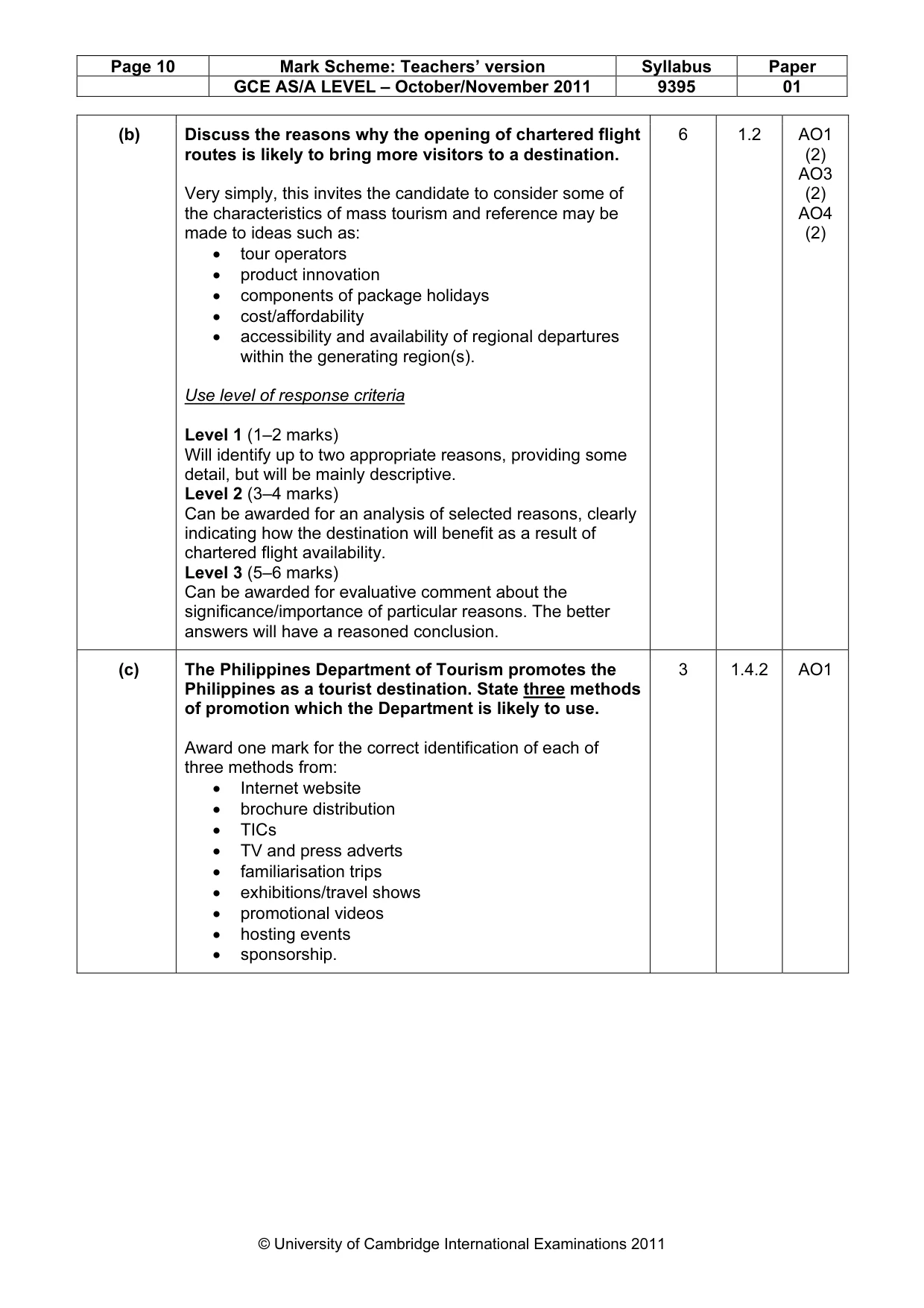
Page 10 Mark Scheme: Teachers’ version Syllabus Paper GCE AS/A LEVEL – October/November 2011 9395 01 © University of Cambridge International Examinations 2011 (b) Discuss the reasons why the opening of chartered flight routes is likely to bring more visitors to a destination. Very simply, this invites the candidate to consider some of the characteristics of mass tourism and reference may be made to ideas such as: • tour operators • product innovation • components of package holidays • cost/affordability • accessibility and availability of regional departures within the generating region(s). Use level of response criteria Level 1 (1–2 marks) Will identify up to two appropriate reasons, providing some detail, but will be mainly descriptive. Level 2 (3–4 marks) Can be awarded for an analysis of selected reasons, clearly indicating how the destination will benefit as a result of chartered flight availability. Level 3 (5–6 marks) Can be awarded for evaluative comment about the significance/importance of particular reasons. The better answers will have a reasoned conclusion. 6 1.2 AO1 (2) AO3 (2) AO4 (2) (c) The Philippines Department of Tourism promotes the Philippines as a tourist destination. State three methods of promotion which the Department is likely to use. Award one mark for the correct identification of each of three methods from: • Internet website • brochure distribution • TICs • TV and press adverts • familiarisation trips • exhibitions/travel shows • promotional videos • hosting events • sponsorship. 3 1.4.2 AO1
Mark scheme, page 11
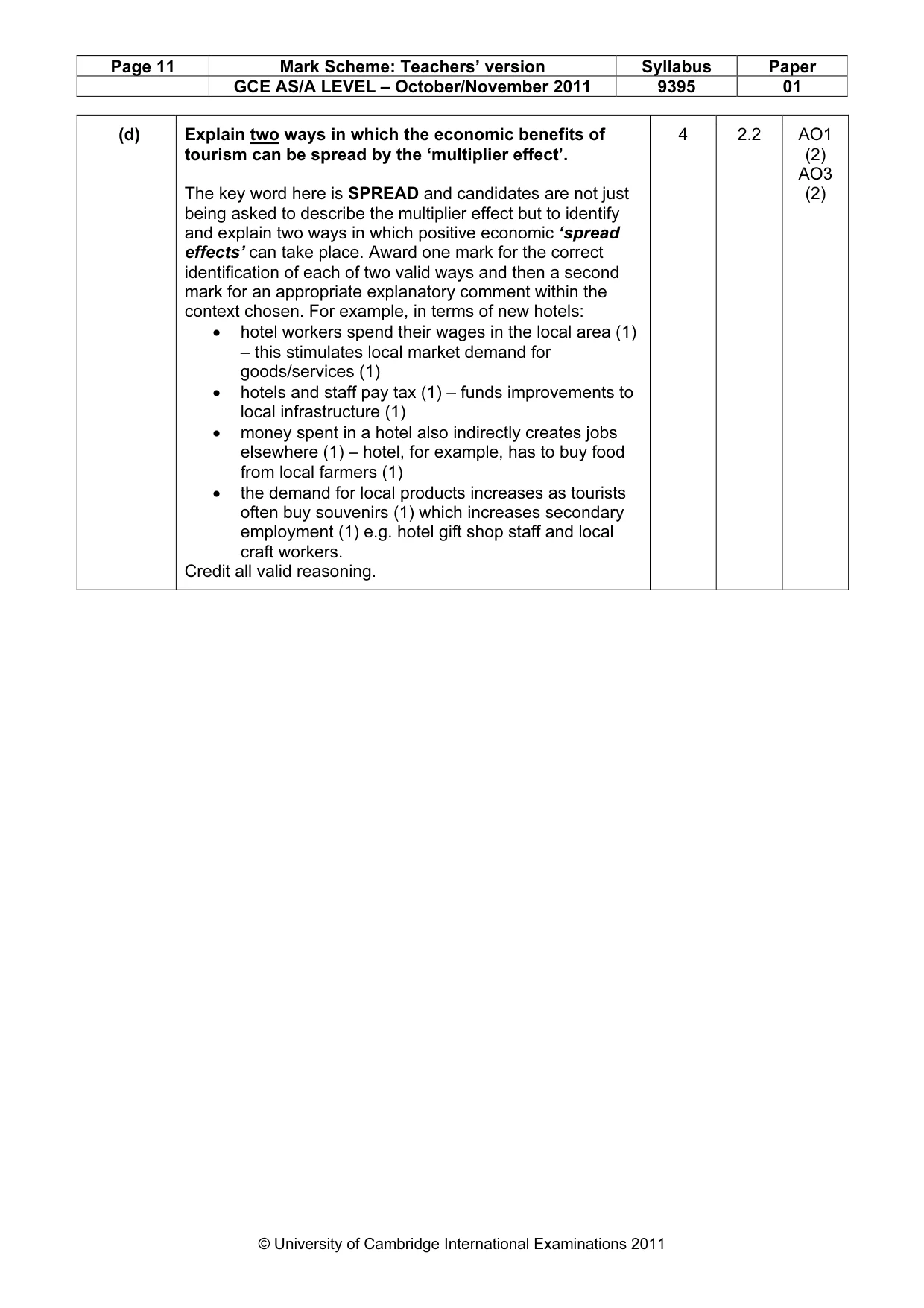
Page 11 Mark Scheme: Teachers’ version Syllabus Paper GCE AS/A LEVEL – October/November 2011 9395 01 © University of Cambridge International Examinations 2011 (d) Explain two ways in which the economic benefits of tourism can be spread by the ‘multiplier effect’. The key word here is SPREAD and candidates are not just being asked to describe the multiplier effect but to identify and explain two ways in which positive economic ‘spread effects’ can take place. Award one mark for the correct identification of each of two valid ways and then a second mark for an appropriate explanatory comment within the context chosen. For example, in terms of new hotels: • hotel workers spend their wages in the local area (1) – this stimulates local market demand for goods/services (1) • hotels and staff pay tax (1) – funds improvements to local infrastructure (1) • money spent in a hotel also indirectly creates jobs elsewhere (1) – hotel, for example, has to buy food from local farmers (1) • the demand for local products increases as tourists often buy souvenirs (1) which increases secondary employment (1) e.g. hotel gift shop staff and local craft workers. Credit all valid reasoning. 4 2.2 AO1 (2) AO3 (2)
Mark scheme, page 12
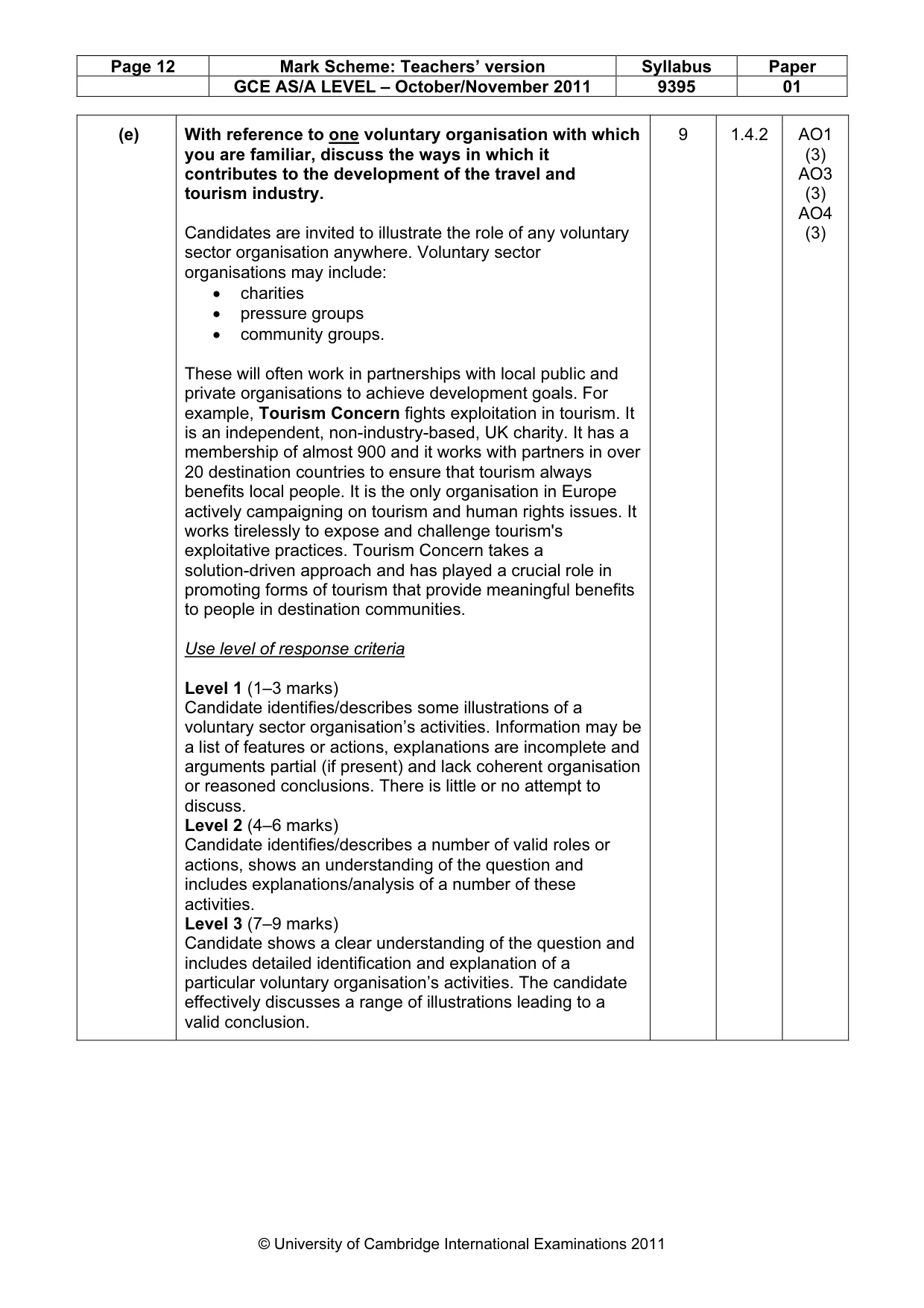
Page 12 Mark Scheme: Teachers’ version Syllabus Paper GCE AS/A LEVEL – October/November 2011 9395 01 © University of Cambridge International Examinations 2011 (e) With reference to one voluntary organisation with which you are familiar, discuss the ways in which it contributes to the development of the travel and tourism industry. Candidates are invited to illustrate the role of any voluntary sector organisation anywhere. Voluntary sector organisations may include: • charities • pressure groups • community groups. These will often work in partnerships with local public and private organisations to achieve development goals. For example, Tourism Concern fights exploitation in tourism. It is an independent, non-industry-based, UK charity. It has a membership of almost 900 and it works with partners in over 20 destination countries to ensure that tourism always benefits local people. It is the only organisation in Europe actively campaigning on tourism and human rights issues. It works tirelessly to expose and challenge tourism's exploitative practices. Tourism Concern takes a solution-driven approach and has played a crucial role in promoting forms of tourism that provide meaningful benefits to people in destination communities. Use level of response criteria Level 1 (1–3 marks) Candidate identifies/describes some illustrations of a voluntary sector organisation’s activities. Information may be a list of features or actions, explanations are incomplete and arguments partial (if present) and lack coherent organisation or reasoned conclusions. There is little or no attempt to discuss. Level 2 (4–6 marks) Candidate identifies/describes a number of valid roles or actions, shows an understanding of the question and includes explanations/analysis of a number of these activities. Level 3 (7–9 marks) Candidate shows a clear understanding of the question and includes detailed identification and explanation of a particular voluntary organisation’s activities. The candidate effectively discusses a range of illustrations leading to a valid conclusion. 9 1.4.2 AO1 (3) AO3 (3) AO4 (3)
What you needed in this session
Cambridge’s own grade thresholds for 2011 Oct/Nov, Paper 1 · Variant 1. A higher threshold means an easier paper — the bar moves with how the cohort did.