Cambridge A Level Travel and Tourism 9395 — 2011 May/June Paper 4 · Variant 1
9395/41/M/J/11 · 50 marks · ≈56 min
The question paper and its mark scheme, free to read here and free to download. This is Cambridge’s own paper, exactly as it was sat.
Question paper8 pages
Mark scheme4 pages
Answers below. Sit the paper first if you are practising.
Paper as text
Question paper, page 1
This document consists of 7 printed pages and 1 blank page. DC (LEO/DJ) 35748/3 © UCLES 2011 [Turn over UNIVERSITY OF CAMBRIDGE INTERNATIONAL EXAMINATIONS General Certificate of Education Advanced Level * 8 1 8 4 2 1 6 9 0 0 * TRAVEL AND TOURISM 9395/04 Paper 4 Specialised Tourism May/June 2011 1 hour 30 minutes Candidates answer on the Question Paper READ THESE INSTRUCTIONS FIRST Write your centre number, candidate number and name on all work you hand in. Write in dark blue or black pen. Do not use staples, paper clips, highlighters, glue or correction fluid. You may use a pencil for any diagrams, graphs or rough working. DO NOT WRITE IN ANY BARCODES. Answer all questions. The number of marks is given in brackets [ ] at the end of each question or part question. For Examiner’s Use 1 2 Total
Question paper, page 2
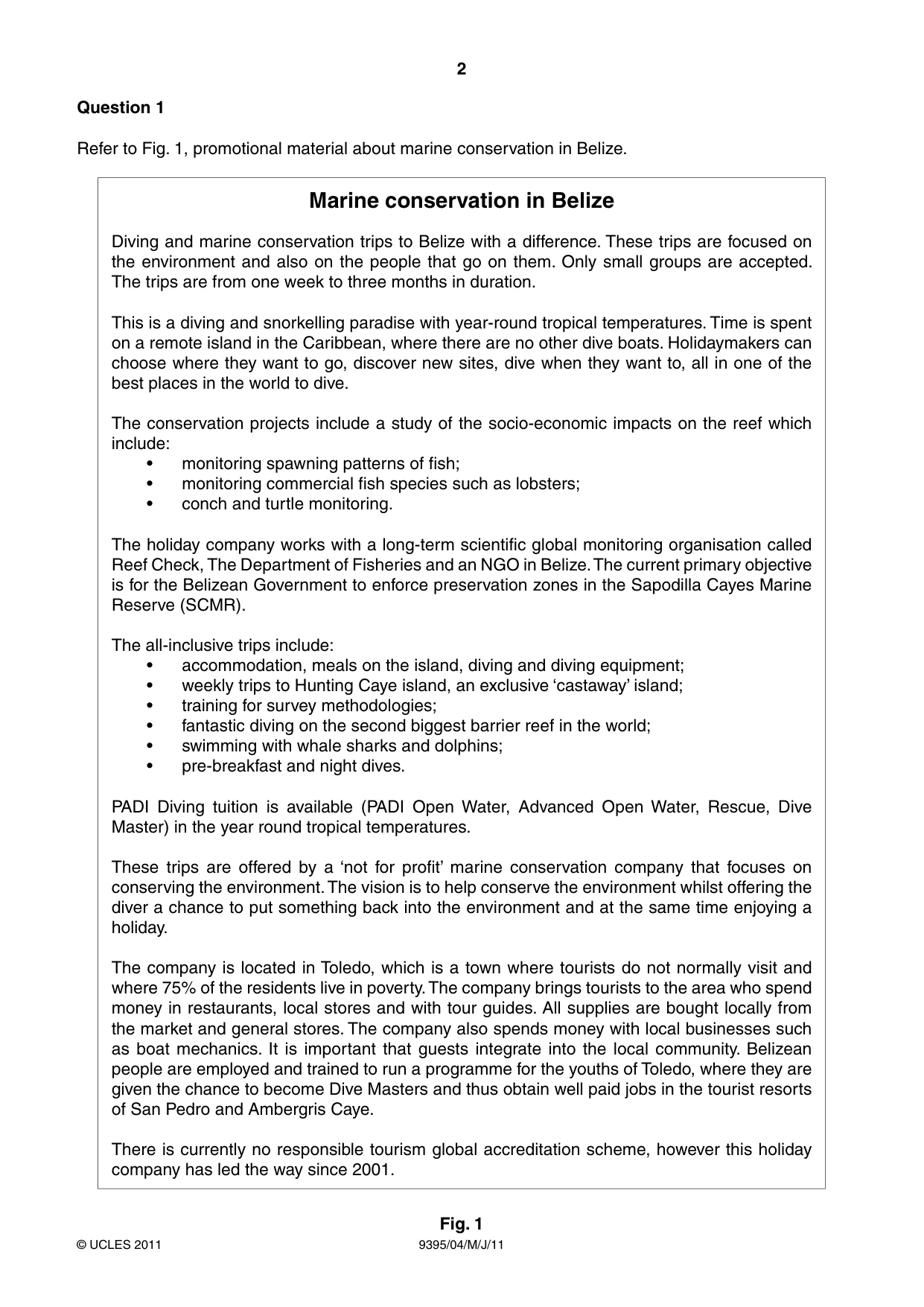
2 9395/04/M/J/11 © UCLES 2011 Question 1 Refer to Fig. 1, promotional material about marine conservation in Belize. Marine conservation in Belize Diving and marine conservation trips to Belize with a difference. These trips are focused on the environment and also on the people that go on them. Only small groups are accepted. The trips are from one week to three months in duration. This is a diving and snorkelling paradise with year-round tropical temperatures. Time is spent on a remote island in the Caribbean, where there are no other dive boats. Holidaymakers can choose where they want to go, discover new sites, dive when they want to, all in one of the best places in the world to dive. The conservation projects include a study of the socio-economic impacts on the reef which include: • monitoring spawning patterns of fish; • monitoring commercial fish species such as lobsters; • conch and turtle monitoring. The holiday company works with a long-term scientific global monitoring organisation called Reef Check, The Department of Fisheries and an NGO in Belize. The current primary objective is for the Belizean Government to enforce preservation zones in the Sapodilla Cayes Marine Reserve (SCMR). The all-inclusive trips include: • accommodation, meals on the island, diving and diving equipment; • weekly trips to Hunting Caye island, an exclusive ‘castaway’ island; • training for survey methodologies; • fantastic diving on the second biggest barrier reef in the world; • swimming with whale sharks and dolphins; • pre-breakfast and night dives. PADI Diving tuition is available (PADI Open Water, Advanced Open Water, Rescue, Dive Master) in the year round tropical temperatures. These trips are offered by a ‘not for profit’ marine conservation company that focuses on conserving the environment. The vision is to help conserve the environment whilst offering the diver a chance to put something back into the environment and at the same time enjoying a holiday. The company is located in Toledo, which is a town where tourists do not normally visit and where 75% of the residents live in poverty. The company brings tourists to the area who spend money in restaurants, local stores and with tour guides. All supplies are bought locally from the market and general stores. The company also spends money with local businesses such as boat mechanics. It is important that guests integrate into the local community. Belizean people are employed and trained to run a programme for the youths of Toledo, where they are given the chance to become Dive Masters and thus obtain well paid jobs in the tourist resorts of San Pedro and Ambergris Caye. There is currently no responsible tourism global accreditation scheme, however this holiday company has led the way since 2001. Fig. 1
Question paper, page 3
3 9395/04/M/J/11 © UCLES 2011 [Turn over For Examiner’s Use (a) Give three reasons why the Sapodilla Cayes Marine Reserve may benefit from marine conservation tourism. 1 … … 2 … … 3 … …[3] (b) Explain why it is important that “guests integrate into the local community.” … … … … … … … …[4] (c) Assess the need for a “responsible tourism global accreditation scheme”. … … … … … … … … … … … …[6]
Question paper, page 4
4 9395/04/M/J/11 © UCLES 2011 For Examiner’s Use (d) Discuss whether providing adventure tourism is compatible with conservation. … … … … … … … … … … … … … … … … … … … … … … … … … …[12] [Total: 25]
Question paper, page 5
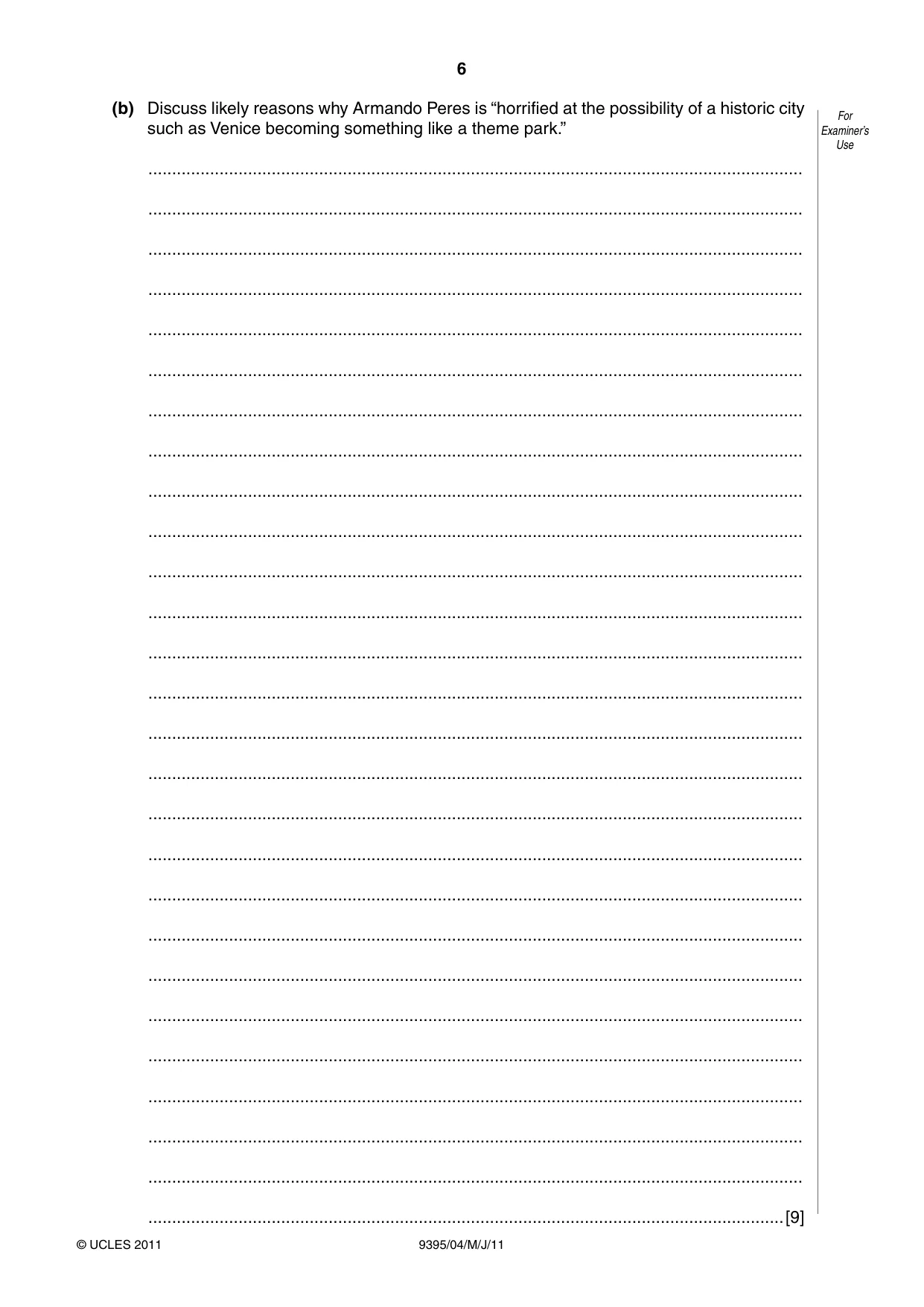
5 9395/04/M/J/11 © UCLES 2011 [Turn over For Examiner’s Use Question 2 Refer to Fig. 2, an article on Venice, Italy. Rialto Bridge, Venice Today Venice is so popular that it is struggling to cope with the 15 million tourists who visit every year. This has prompted tourism officials to draw up a code of conduct consisting of ten rules and suggestions, ranging from always keeping to the right when walking around the city, to how to make a complaint. Other rules and suggestions include wearing appropriate clothing and never stopping on bridges. Armando Peres, the man responsible for tourism in Venice, believes tourism is almost killing the city. “During the last few years the situation has really worsened because of the behaviour of the people,” he says. “They leave a lot of paper and glass everywhere, and they do not behave properly, so there was a need to remind them how to behave and to give them some good advice.” As the number of visitors has risen, the number of residents has fallen, driven away by an industry which has taken over the city. This is something which worries Armando Peres. “Of course we are horrified at the possibility of becoming something like a theme park,” he says. “We don’t want to be like that. We want to keep the town alive. We want people to come back to live in Venice.” So the tourists continue to fight their way through the crowds, and the Venetians continue to make their living from the tourists, while trying to live life as best they can. “Tourism is a necessary evil this city cannot live without, but anything these ten points can do to make life easier will certainly be welcome here.” Fig. 2 (a) Explain two reasons why Venice has introduced ten rules for tourists. 1 … … … … 2 … … … …[4]
Question paper, page 6
6 9395/04/M/J/11 © UCLES 2011 For Examiner’s Use (b) Discuss likely reasons why Armando Peres is “horrified at the possibility of a historic city such as Venice becoming something like a theme park.” … … … … … … … … … … … … … … … … … … … … … … … … … … …[9]
Question paper, page 7
7 9395/04/M/J/11 © UCLES 2011 For Examiner’s Use (c) Assess the extent to which tourism is seen as a necessary evil by the host population of historic cities such as Venice. … … … … … … … … … … … … … … … … … … … … … … … … … …[12] [Total: 25]
Question paper, page 8
8 9395/04/M/J/11 © UCLES 2011 Copyright Acknowledgements: Fig. 1 © adapted from: http://www.responsibletravel.com/Trip/Trip901561.htm. Fig. 2 © adapted from: http://news.bbc.co.uk/1/hi/world/europe/3111187.stm. Fig. 2 Photograph © S. Stewart. Permission to reproduce items where third-party owned material protected by copyright is included has been sought and cleared where possible. Every reasonable effort has been made by the publisher (UCLES) to trace copyright holders, but if any items requiring clearance have unwittingly been included, the publisher will be pleased to make amends at the earliest possible opportunity. University of Cambridge International Examinations is part of the Cambridge Assessment Group. Cambridge Assessment is the brand name of University of Cambridge Local Examinations Syndicate (UCLES), which is itself a department of the University of Cambridge. BLANK PAGE
Mark scheme, page 1
UNIVERSITY OF CAMBRIDGE INTERNATIONAL EXAMINATIONS GCE Advanced Subsidiary Level and GCE Advanced Level MARK SCHEME for the May/June 2011 question paper for the guidance of teachers 9395 TRAVEL AND TOURISM 9395/04 Paper 4 (Specialised Tourism), maximum raw mark 50 This mark scheme is published as an aid to teachers and candidates, to indicate the requirements of the examination. It shows the basis on which Examiners were instructed to award marks. It does not indicate the details of the discussions that took place at an Examiners’ meeting before marking began, which would have considered the acceptability of alternative answers. Mark schemes must be read in conjunction with the question papers and the report on the examination. • Cambridge will not enter into discussions or correspondence in connection with these mark schemes. Cambridge is publishing the mark schemes for the May/June 2011 question papers for most IGCSE, GCE Advanced Level and Advanced Subsidiary Level syllabuses and some Ordinary Level syllabuses.
Mark scheme, page 2
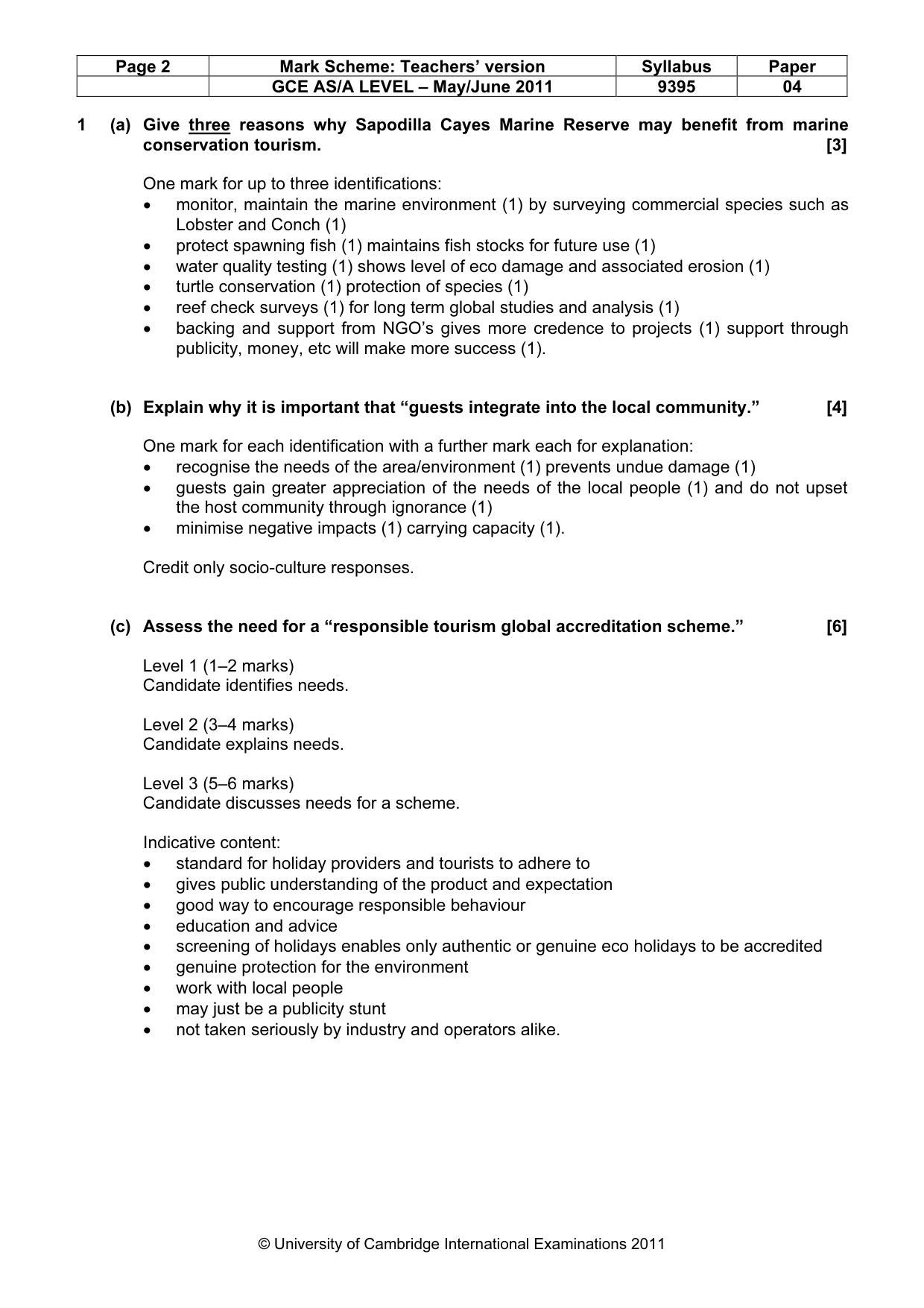
Page 2 Mark Scheme: Teachers’ version Syllabus Paper GCE AS/A LEVEL – May/June 2011 9395 04 © University of Cambridge International Examinations 2011 1 (a) Give three reasons why Sapodilla Cayes Marine Reserve may benefit from marine conservation tourism. [3] One mark for up to three identifications: • monitor, maintain the marine environment (1) by surveying commercial species such as Lobster and Conch (1) • protect spawning fish (1) maintains fish stocks for future use (1) • water quality testing (1) shows level of eco damage and associated erosion (1) • turtle conservation (1) protection of species (1) • reef check surveys (1) for long term global studies and analysis (1) • backing and support from NGO’s gives more credence to projects (1) support through publicity, money, etc will make more success (1). (b) Explain why it is important that “guests integrate into the local community.” [4] One mark for each identification with a further mark each for explanation: • recognise the needs of the area/environment (1) prevents undue damage (1) • guests gain greater appreciation of the needs of the local people (1) and do not upset the host community through ignorance (1) • minimise negative impacts (1) carrying capacity (1). Credit only socio-culture responses. (c) Assess the need for a “responsible tourism global accreditation scheme.” [6] Level 1 (1–2 marks) Candidate identifies needs. Level 2 (3–4 marks) Candidate explains needs. Level 3 (5–6 marks) Candidate discusses needs for a scheme. Indicative content: • standard for holiday providers and tourists to adhere to • gives public understanding of the product and expectation • good way to encourage responsible behaviour • education and advice • screening of holidays enables only authentic or genuine eco holidays to be accredited • genuine protection for the environment • work with local people • may just be a publicity stunt • not taken seriously by industry and operators alike.
Mark scheme, page 3
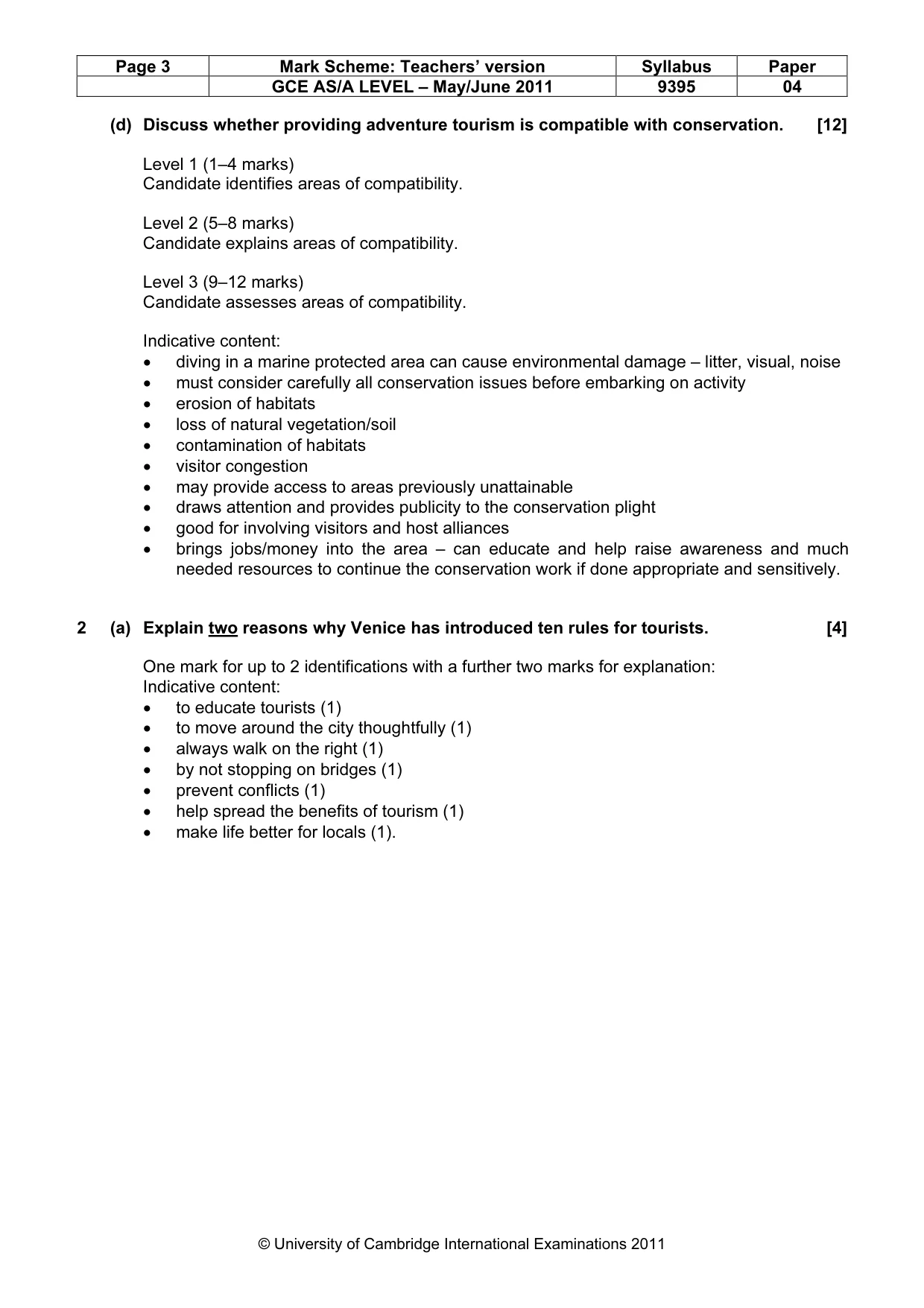
Page 3 Mark Scheme: Teachers’ version Syllabus Paper GCE AS/A LEVEL – May/June 2011 9395 04 © University of Cambridge International Examinations 2011 (d) Discuss whether providing adventure tourism is compatible with conservation. [12] Level 1 (1–4 marks) Candidate identifies areas of compatibility. Level 2 (5–8 marks) Candidate explains areas of compatibility. Level 3 (9–12 marks) Candidate assesses areas of compatibility. Indicative content: • diving in a marine protected area can cause environmental damage – litter, visual, noise • must consider carefully all conservation issues before embarking on activity • erosion of habitats • loss of natural vegetation/soil • contamination of habitats • visitor congestion • may provide access to areas previously unattainable • draws attention and provides publicity to the conservation plight • good for involving visitors and host alliances • brings jobs/money into the area – can educate and help raise awareness and much needed resources to continue the conservation work if done appropriate and sensitively. 2 (a) Explain two reasons why Venice has introduced ten rules for tourists. [4] One mark for up to 2 identifications with a further two marks for explanation: Indicative content: • to educate tourists (1) • to move around the city thoughtfully (1) • always walk on the right (1) • by not stopping on bridges (1) • prevent conflicts (1) • help spread the benefits of tourism (1) • make life better for locals (1).
Mark scheme, page 4
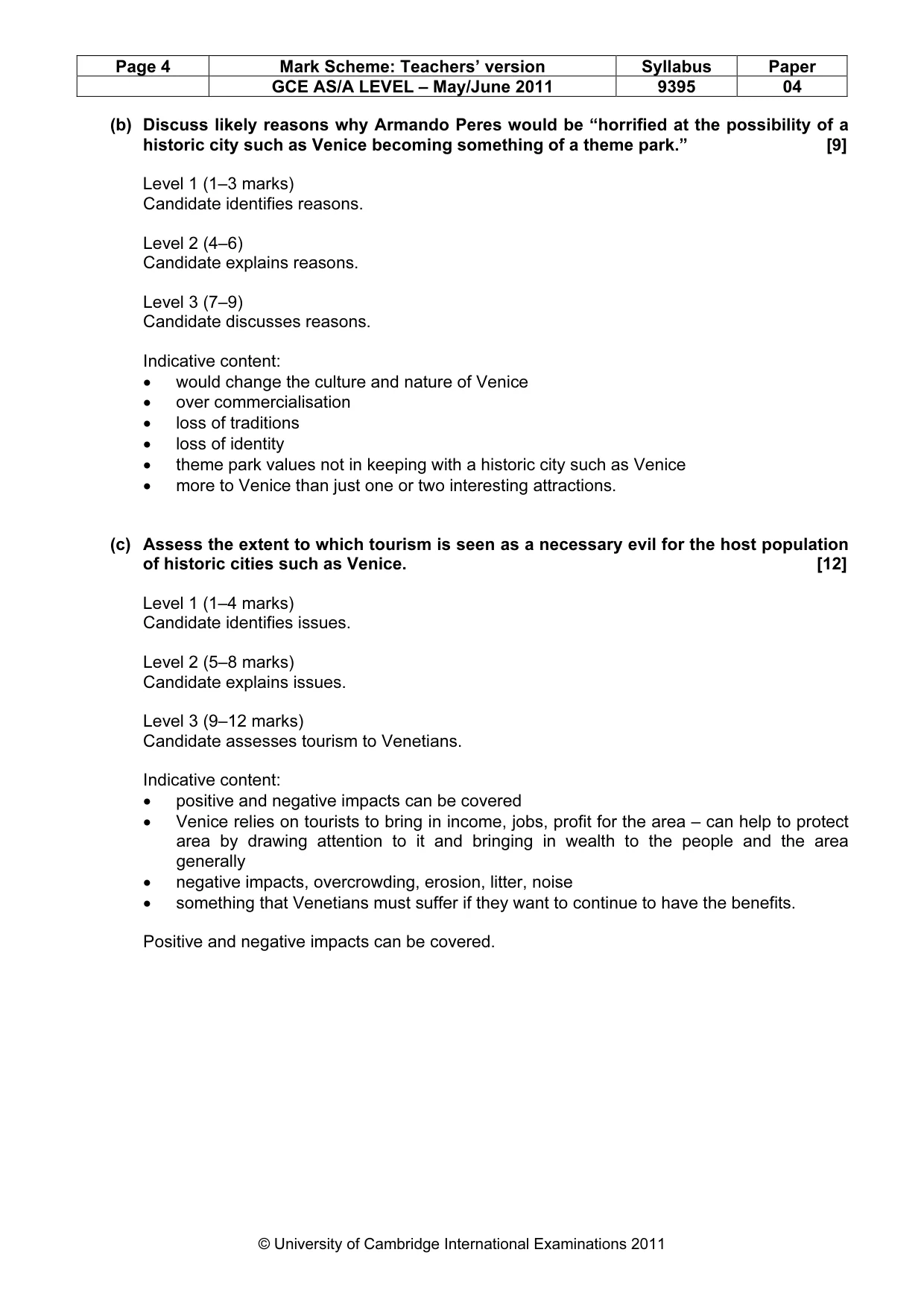
Page 4 Mark Scheme: Teachers’ version Syllabus Paper GCE AS/A LEVEL – May/June 2011 9395 04 © University of Cambridge International Examinations 2011 (b) Discuss likely reasons why Armando Peres would be “horrified at the possibility of a historic city such as Venice becoming something of a theme park.” [9] Level 1 (1–3 marks) Candidate identifies reasons. Level 2 (4–6) Candidate explains reasons. Level 3 (7–9) Candidate discusses reasons. Indicative content: • would change the culture and nature of Venice • over commercialisation • loss of traditions • loss of identity • theme park values not in keeping with a historic city such as Venice • more to Venice than just one or two interesting attractions. (c) Assess the extent to which tourism is seen as a necessary evil for the host population of historic cities such as Venice. [12] Level 1 (1–4 marks) Candidate identifies issues. Level 2 (5–8 marks) Candidate explains issues. Level 3 (9–12 marks) Candidate assesses tourism to Venetians. Indicative content: • positive and negative impacts can be covered • Venice relies on tourists to bring in income, jobs, profit for the area – can help to protect area by drawing attention to it and bringing in wealth to the people and the area generally • negative impacts, overcrowding, erosion, litter, noise • something that Venetians must suffer if they want to continue to have the benefits. Positive and negative impacts can be covered.
What you needed in this session
Cambridge’s own grade thresholds for 2011 May/June, Paper 4 · Variant 1. A higher threshold means an easier paper — the bar moves with how the cohort did.