Cambridge A Level Travel and Tourism 9395 — 2011 May/June Paper 1 · Variant 1
9395/11/M/J/11 · 100 marks · ≈113 min
The question paper and its mark scheme, free to read here and free to download. This is Cambridge’s own paper, exactly as it was sat.
Question paper16 pages
Mark scheme10 pages
Answers below. Sit the paper first if you are practising.
Paper as text
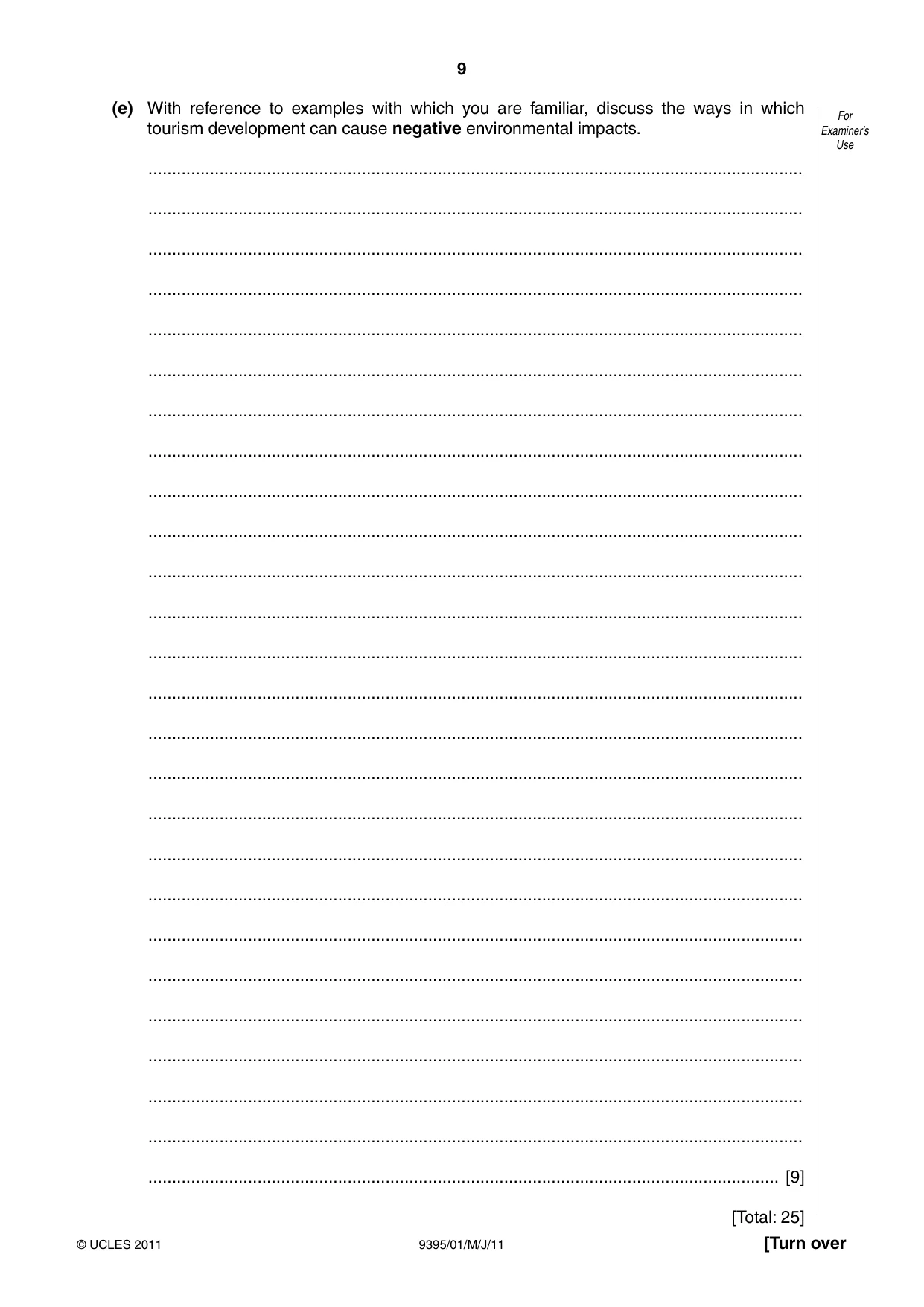
Question paper, page 1
This document consists of 16 printed pages. DC (NF/DJ) 35734/3 © UCLES 2011 [Turn over UNIVERSITY OF CAMBRIDGE INTERNATIONAL EXAMINATIONS General Certificate of Education Advanced Subsidiary Level and Advanced Level * 1 4 9 8 8 4 0 4 5 8 * TRAVEL AND TOURISM 9395/01 Paper 1 Core May/June 2011 2 hours and 30 minutes Candidates answer on the Question Paper. READ THESE INSTRUCTIONS FIRST Write your Centre number, candidate number and name on all the work you hand in. Write in dark blue or black pen. Do not use staples, paper clips, highlighters, glue or correction fluid. You may use a pencil for any diagrams, graphs or rough working. DO NOT WRITE IN ANY BARCODES. Answer all questions. The number of marks is given in brackets [ ] at the end of each question or part question. For Examiner’s Use 1 2 3 4 Total
Question paper, page 2
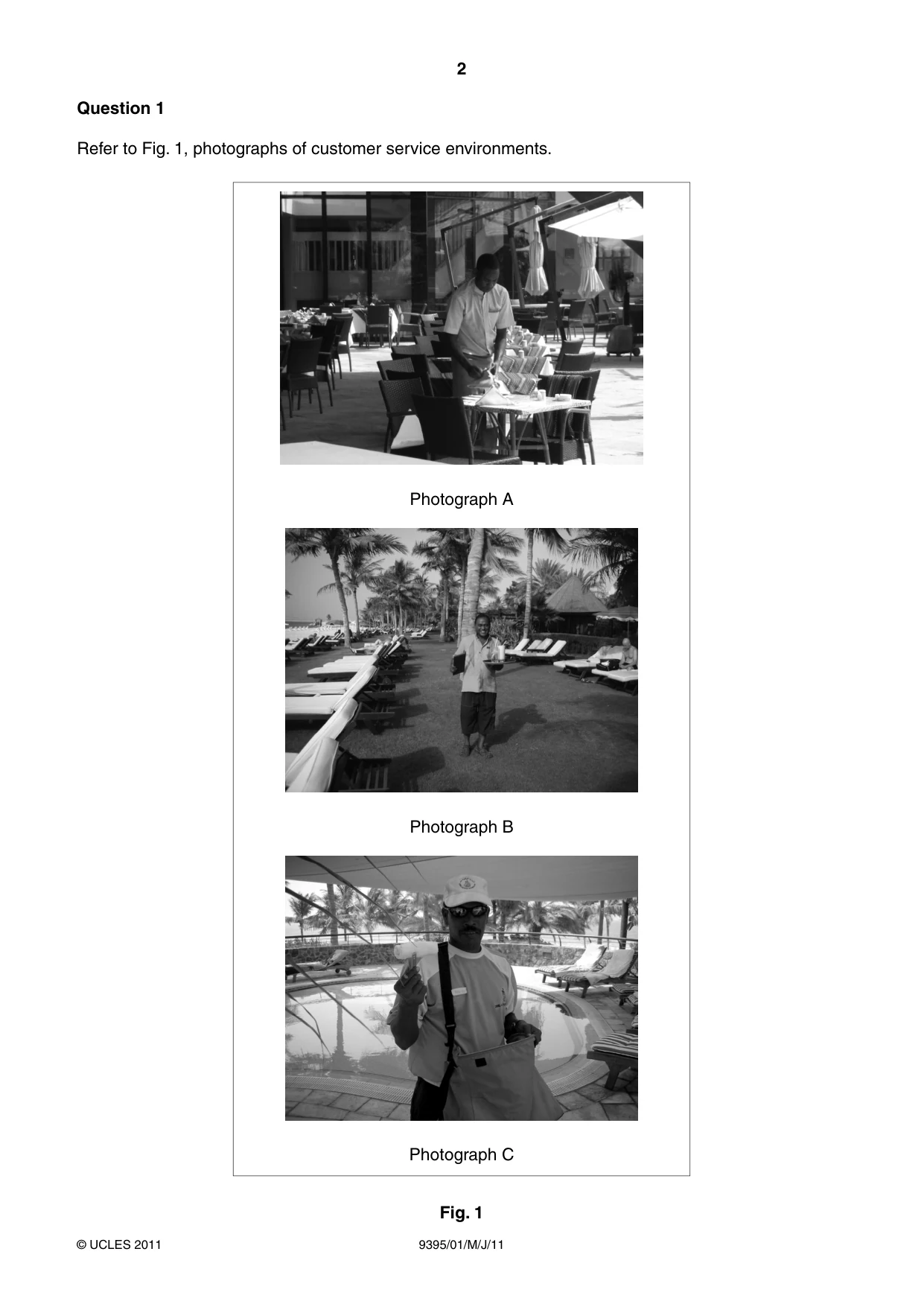
2 9395/01/M/J/11 © UCLES 2011 Question 1 Refer to Fig. 1, photographs of customer service environments. Photograph A Photograph B Photograph C Fig. 1
Question paper, page 3
3 9395/01/M/J/11 © UCLES 2011 [Turn over For Examiner’s Use (a) Photographs A, B and C in Fig. 1 were taken in different customer service environments within a large international 5-star resort. Complete the following table by identifying which photograph was taken in each of the listed customer service environments. Customer Service Environment Photograph Pool terrace Al fresco dining terrace Beachfront [3] (b) All three members of staff will have had customer service training. State and explain two likely advantages to the resort of providing staff with such training. 1 … … … … … … 2 … … … … … … [6]
Question paper, page 4
4 9395/01/M/J/11 © UCLES 2011 For Examiner’s Use (c) State three methods by which the resort management could monitor staff delivering customer service. 1 … … 2 … … 3 … … [3] (d) For one of the methods given in part (c), describe fully how the monitoring process is likely to operate. Name of chosen method … How the monitoring process operates … … … … … … … … … [4]
Question paper, page 5
5 9395/01/M/J/11 © UCLES 2011 [Turn over For Examiner’s Use (e) With reference to one travel and tourism organisation with which you are familiar, discuss the role played by teamwork in delivering quality customer service. Name of chosen organisation … … … … … … … … … … … … … … … … … … … … … … … … … … [9] [Total: 25]
Question paper, page 6
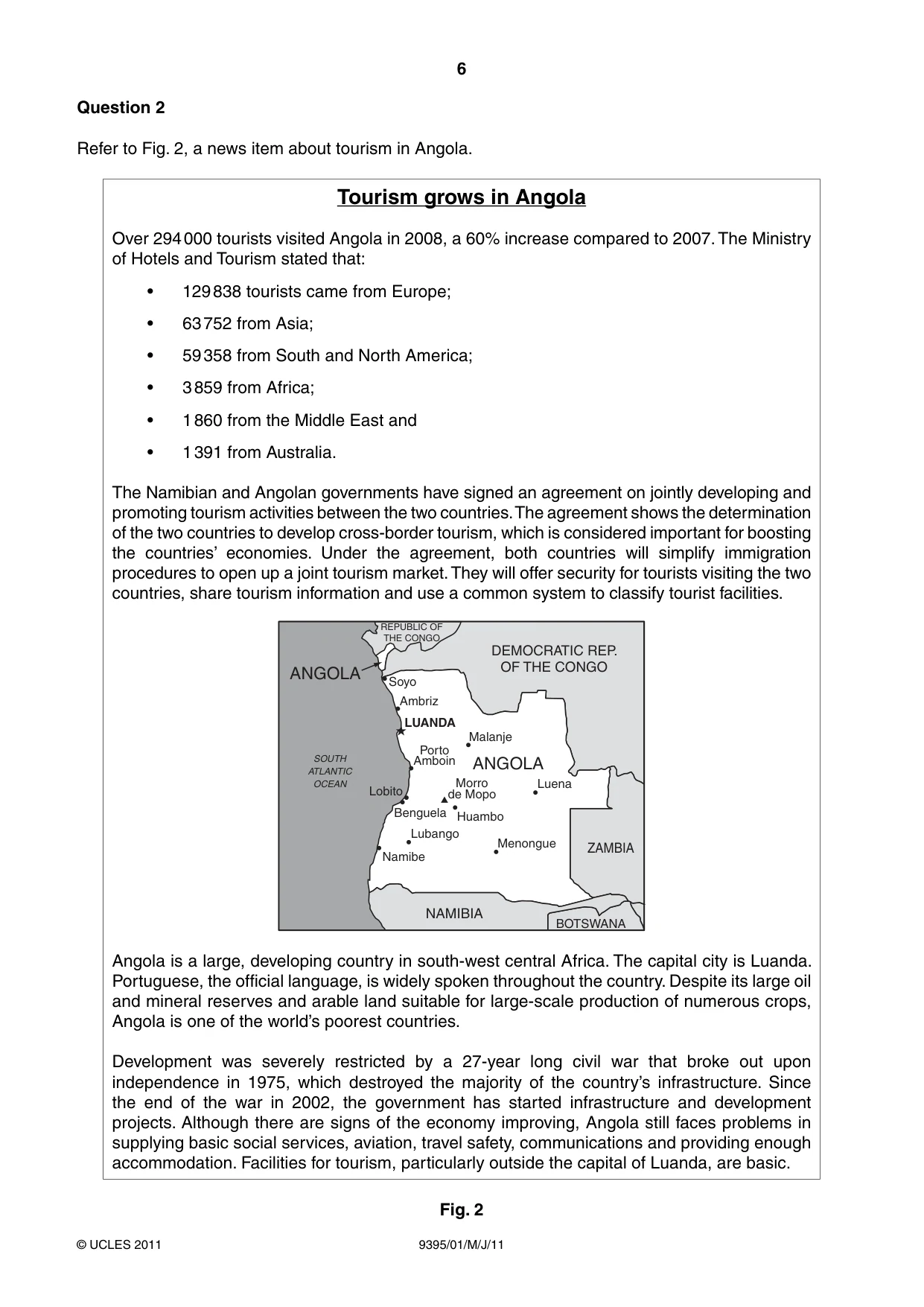
6 9395/01/M/J/11 © UCLES 2011 Question 2 Refer to Fig. 2, a news item about tourism in Angola. Tourism grows in Angola Over 294 000 tourists visited Angola in 2008, a 60% increase compared to 2007. The Ministry of Hotels and Tourism stated that: 129 838 tourists came from Europe; • 63 752 from Asia; • 59 358 from South and North America; • 3 859 from Africa; • 1 860 from the Middle East and • 1 391 from Australia. • The Namibian and Angolan governments have signed an agreement on jointly developing and promoting tourism activities between the two countries. The agreement shows the determination of the two countries to develop cross-border tourism, which is considered important for boosting the countries’ economies. Under the agreement, both countries will simplify immigration procedures to open up a joint tourism market. They will offer security for tourists visiting the two countries, share tourism information and use a common system to classify tourist facilities. DEMOCRATIC REP. OF THE CONGO REPUBLIC OF THE CONGO ANGOLA ANGOLA Soyo Ambriz Malanje Luena Huambo Morro de Mopo Menongue Lubango Namibe Benguela Lobito Porto Amboin LUANDA ZAMBIA NAMIBIA BOTSWANA SOUTH ATLANTIC OCEAN Angola is a large, developing country in south-west central Africa. The capital city is Luanda. Portuguese, the official language, is widely spoken throughout the country. Despite its large oil and mineral reserves and arable land suitable for large-scale production of numerous crops, Angola is one of the world’s poorest countries. Development was severely restricted by a 27-year long civil war that broke out upon independence in 1975, which destroyed the majority of the country’s infrastructure. Since the end of the war in 2002, the government has started infrastructure and development projects. Although there are signs of the economy improving, Angola still faces problems in supplying basic social services, aviation, travel safety, communications and providing enough accommodation. Facilities for tourism, particularly outside the capital of Luanda, are basic. Fig. 2
Question paper, page 7
7 9395/01/M/J/11 © UCLES 2011 [Turn over For Examiner’s Use (a) Identify three countries which share a border with Angola. 1 … 2 … 3 … [3] (b) Using only information from Fig. 2, identify and explain three ways in which Angola is at the Exploration Stage of the Butler model of destination evolution. 1 … … … … 2 … … … … 3 … … … … [6]
Question paper, page 8
8 9395/01/M/J/11 © UCLES 2011 For Examiner’s Use (c) Identify and explain two ways in which Angola’s joint agreement with Namibia will benefit the development of tourism in the country. 1 … … … … 2 … … … … [4] (d) State three ways in which overseas visitors are likely to experience the traditional culture of a destination. 1 … … 2 … … 3 … … [3]
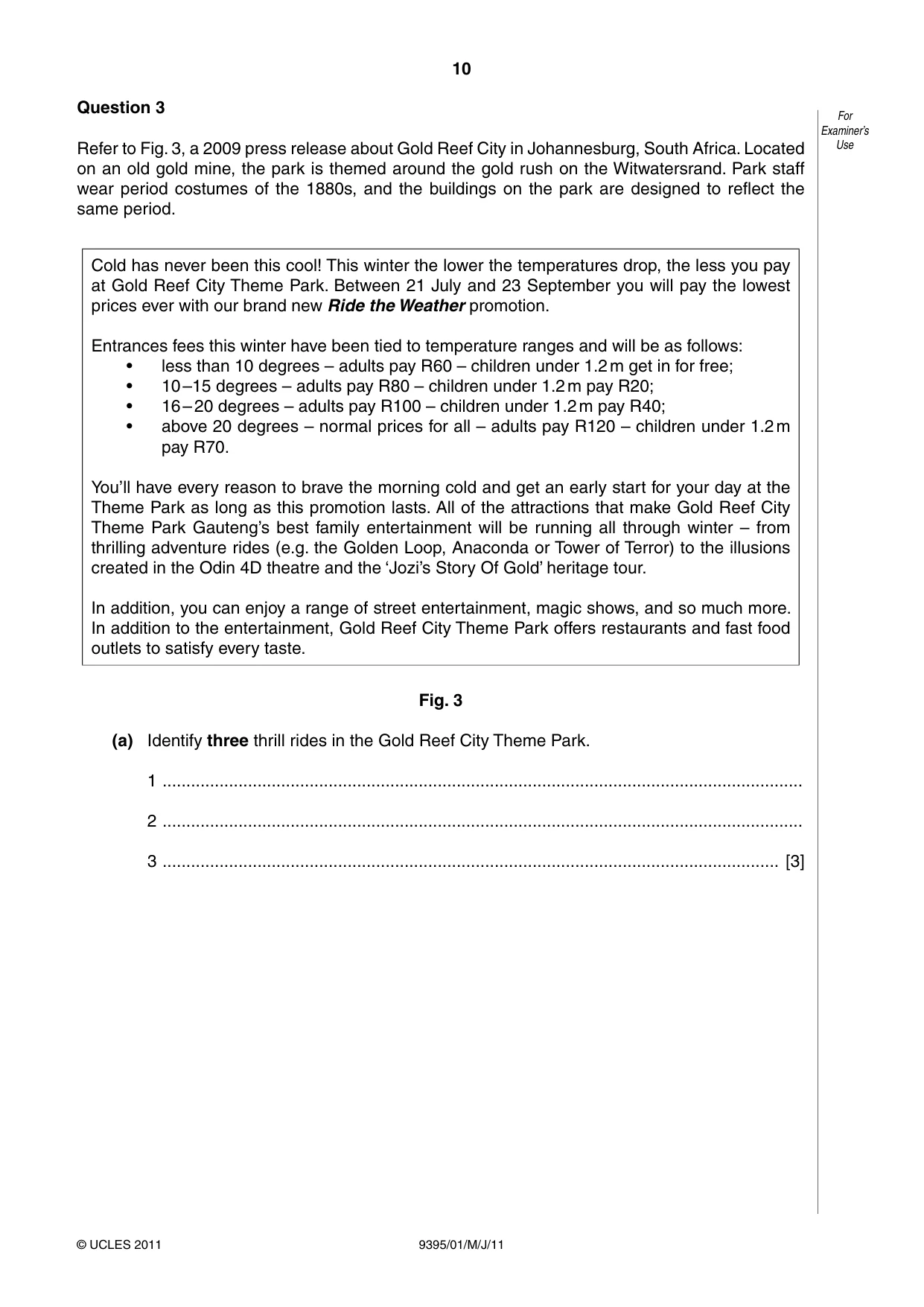
Question paper, page 9
9 9395/01/M/J/11 © UCLES 2011 [Turn over For Examiner’s Use (e) With reference to examples with which you are familiar, discuss the ways in which tourism development can cause negative environmental impacts. … … … … … … … … … … … … … … … … … … … … … … … … … … [9] [Total: 25]
Question paper, page 10
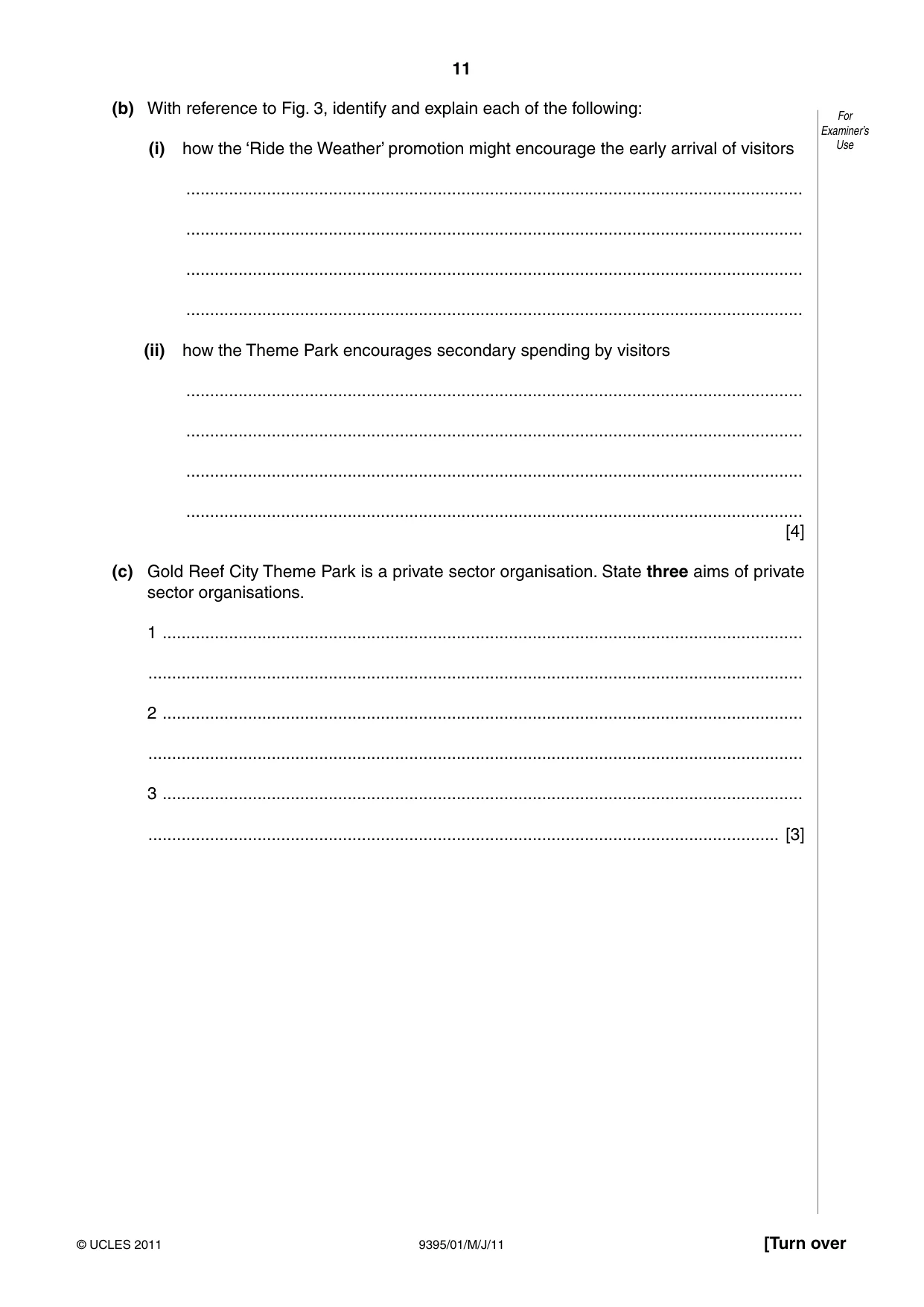
10 9395/01/M/J/11 © UCLES 2011 For Examiner’s Use Question 3 Refer to Fig. 3, a 2009 press release about Gold Reef City in Johannesburg, South Africa. Located on an old gold mine, the park is themed around the gold rush on the Witwatersrand. Park staff wear period costumes of the 1880s, and the buildings on the park are designed to reflect the same period. Cold has never been this cool! This winter the lower the temperatures drop, the less you pay at Gold Reef City Theme Park. Between 21 July and 23 September you will pay the lowest prices ever with our brand new Ride the Weather promotion. Entrances fees this winter have been tied to temperature ranges and will be as follows: less than 10 degrees – adults pay R60 – children under 1.2 m get in for free; • 10 –15 degrees – adults pay R80 – children under 1.2 m pay R20; • 16 – 20 degrees – adults pay R100 – children under 1.2 m pay R40; • above 20 degrees – normal prices for all – adults pay R120 – children under 1.2 m • pay R70. You’ll have every reason to brave the morning cold and get an early start for your day at the Theme Park as long as this promotion lasts. All of the attractions that make Gold Reef City Theme Park Gauteng’s best family entertainment will be running all through winter – from thrilling adventure rides (e.g. the Golden Loop, Anaconda or Tower of Terror) to the illusions created in the Odin 4D theatre and the ‘Jozi’s Story Of Gold’ heritage tour. In addition, you can enjoy a range of street entertainment, magic shows, and so much more. In addition to the entertainment, Gold Reef City Theme Park offers restaurants and fast food outlets to satisfy every taste. Fig. 3 (a) Identify three thrill rides in the Gold Reef City Theme Park. 1 … 2 … 3 … [3]
Question paper, page 11
11 9395/01/M/J/11 © UCLES 2011 [Turn over For Examiner’s Use (b) With reference to Fig. 3, identify and explain each of the following: (i) how the ‘Ride the Weather’ promotion might encourage the early arrival of visitors … … … … (ii) how the Theme Park encourages secondary spending by visitors … … … … [4] (c) Gold Reef City Theme Park is a private sector organisation. State three aims of private sector organisations. 1 … … 2 … … 3 … … [3]
Question paper, page 12
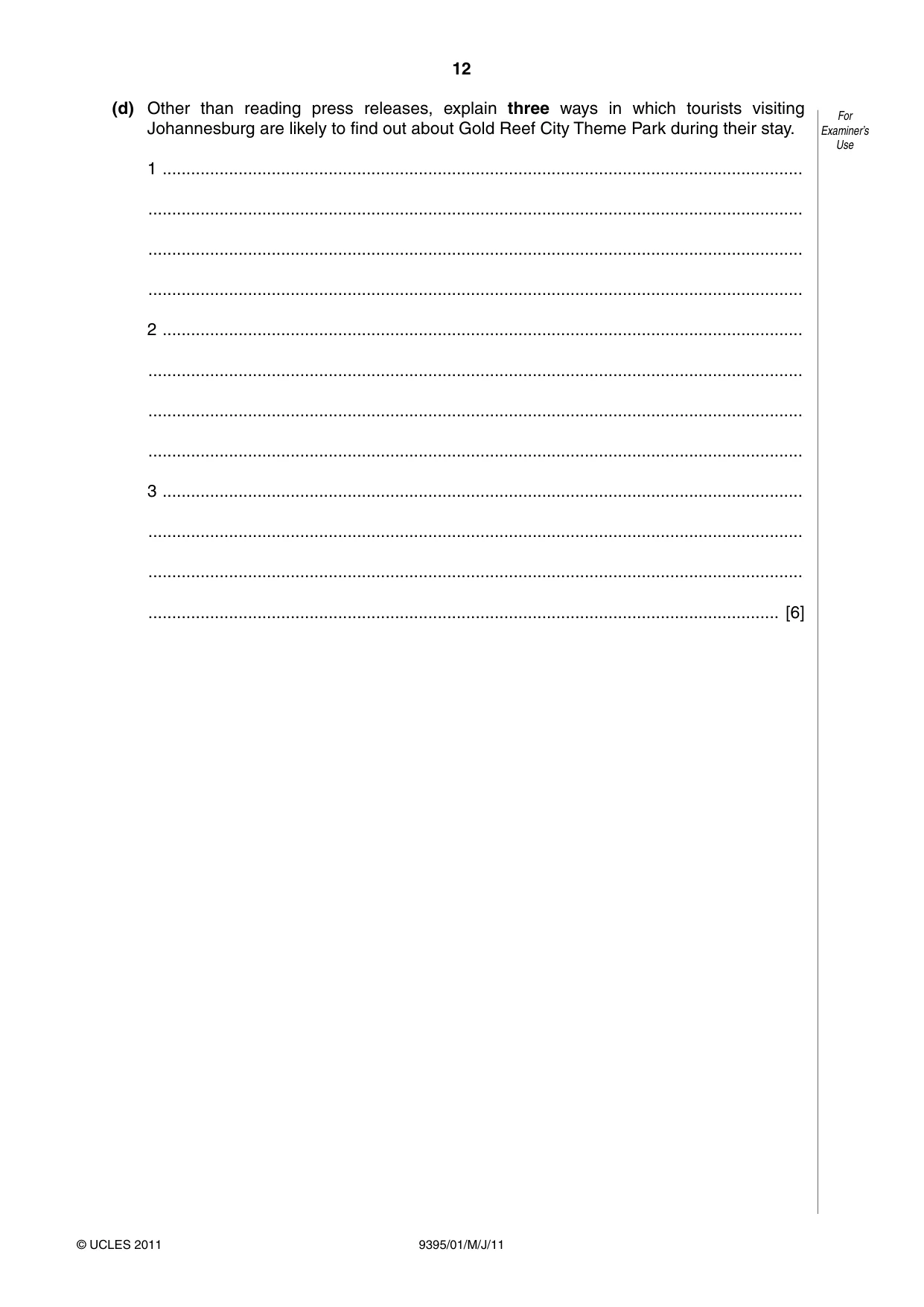
12 9395/01/M/J/11 © UCLES 2011 For Examiner’s Use (d) Other than reading press releases, explain three ways in which tourists visiting Johannesburg are likely to find out about Gold Reef City Theme Park during their stay. 1 … … … … 2 … … … … 3 … … … … [6]
Question paper, page 13
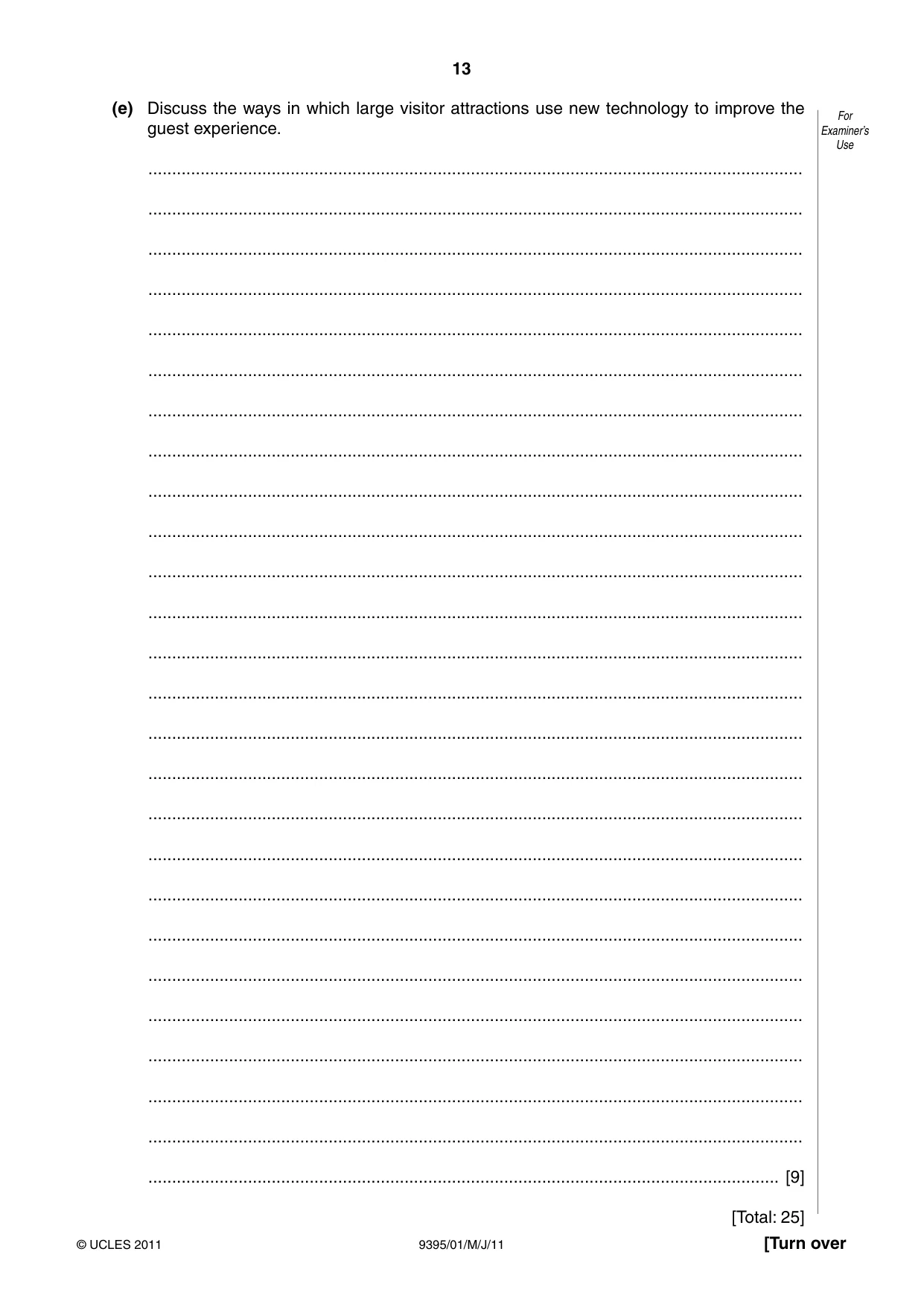
13 9395/01/M/J/11 © UCLES 2011 [Turn over For Examiner’s Use (e) Discuss the ways in which large visitor attractions use new technology to improve the guest experience. … … … … … … … … … … … … … … … … … … … … … … … … … … [9] [Total: 25]
Question paper, page 14
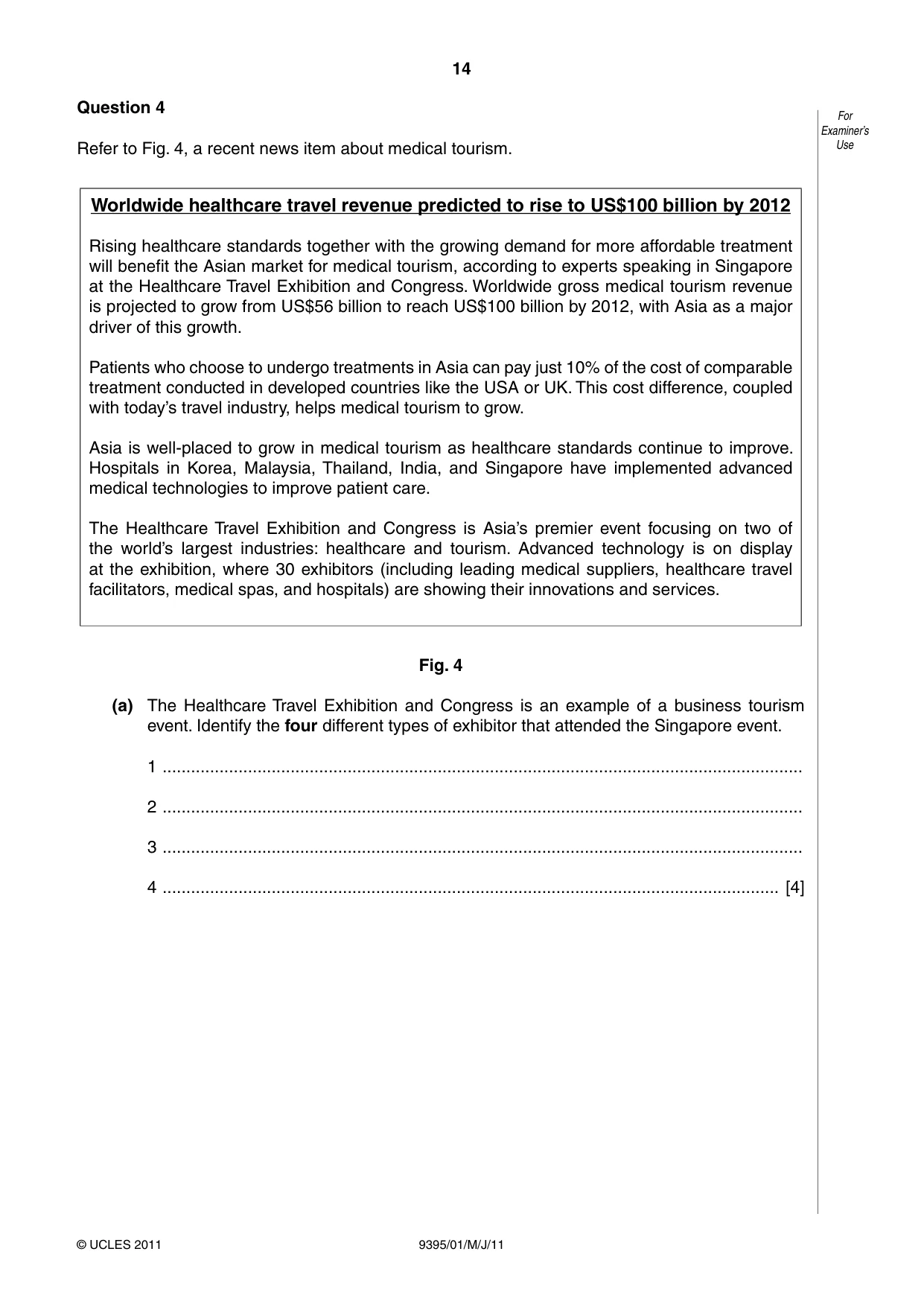
14 9395/01/M/J/11 © UCLES 2011 For Examiner’s Use Question 4 Refer to Fig. 4, a recent news item about medical tourism. Worldwide healthcare travel revenue predicted to rise to US$100 billion by 2012 Rising healthcare standards together with the growing demand for more affordable treatment will benefit the Asian market for medical tourism, according to experts speaking in Singapore at the Healthcare Travel Exhibition and Congress. Worldwide gross medical tourism revenue is projected to grow from US$56 billion to reach US$100 billion by 2012, with Asia as a major driver of this growth. Patients who choose to undergo treatments in Asia can pay just 10% of the cost of comparable treatment conducted in developed countries like the USA or UK. This cost difference, coupled with today’s travel industry, helps medical tourism to grow. Asia is well-placed to grow in medical tourism as healthcare standards continue to improve. Hospitals in Korea, Malaysia, Thailand, India, and Singapore have implemented advanced medical technologies to improve patient care. The Healthcare Travel Exhibition and Congress is Asia’s premier event focusing on two of the world’s largest industries: healthcare and tourism. Advanced technology is on display at the exhibition, where 30 exhibitors (including leading medical suppliers, healthcare travel facilitators, medical spas, and hospitals) are showing their innovations and services. Fig. 4 (a) The Healthcare Travel Exhibition and Congress is an example of a business tourism event. Identify the four different types of exhibitor that attended the Singapore event. 1 … 2 … 3 … 4 … [4]
Question paper, page 15
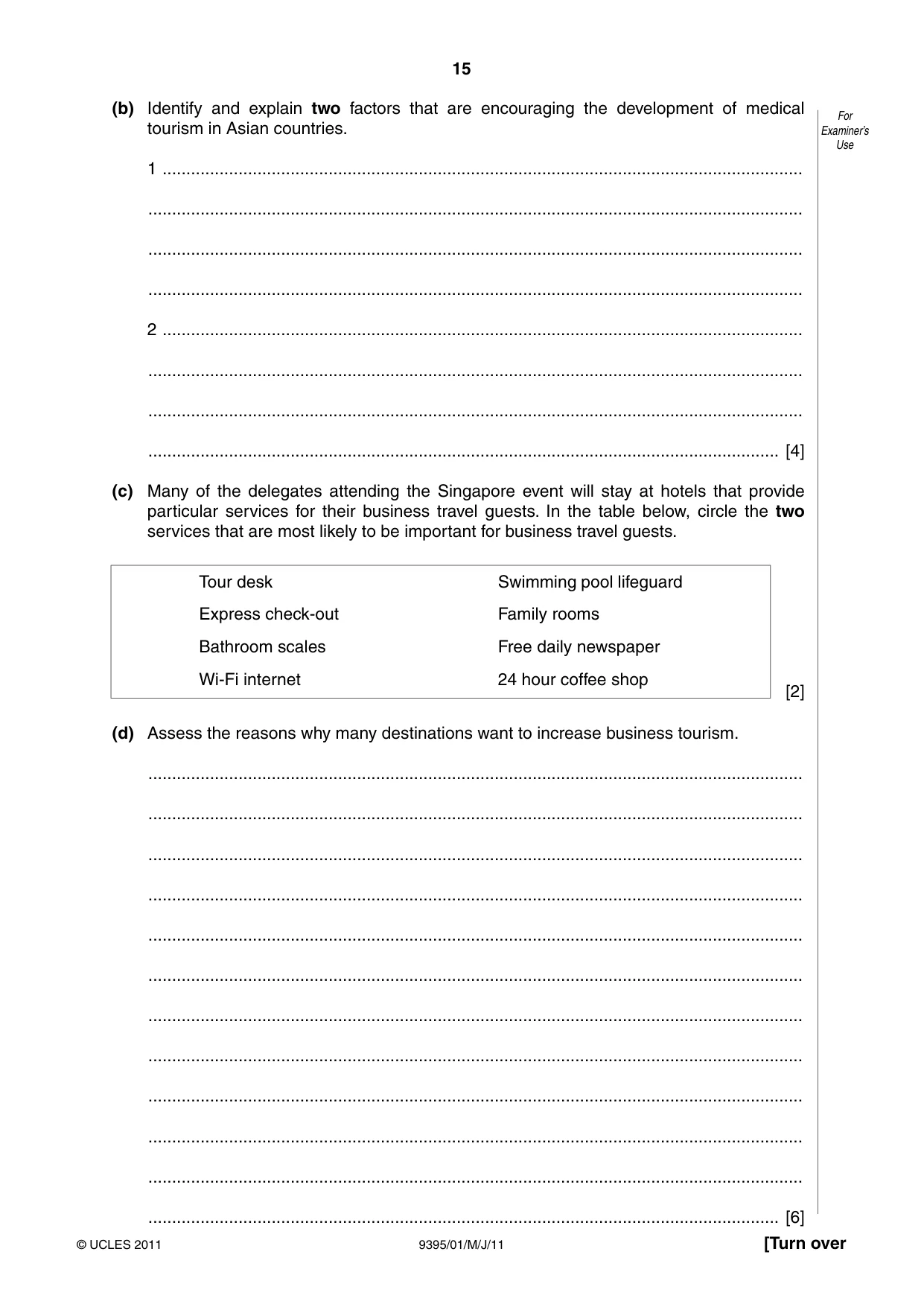
15 9395/01/M/J/11 © UCLES 2011 [Turn over For Examiner’s Use (b) Identify and explain two factors that are encouraging the development of medical tourism in Asian countries. 1 … … … … 2 … … … … [4] (c) Many of the delegates attending the Singapore event will stay at hotels that provide particular services for their business travel guests. In the table below, circle the two services that are most likely to be important for business travel guests. Tour desk Express check-out Bathroom scales Wi-Fi internet Swimming pool lifeguard Family rooms Free daily newspaper 24 hour coffee shop [2] (d) Assess the reasons why many destinations want to increase business tourism. … … … … … … … … … … … … [6]
Question paper, page 16
16 9395/01/M/J/11 © UCLES 2011 For Examiner’s Use (e) For one destination with which you are familiar, assess the reasons why it is popular with overseas visitors. Name of chosen destination … … … … … … … … … … … … … … … … … … … … … … … … … [9] [Total: 25] Copyright Acknowledgements: Question 1 Photographs A, B & C John D Smith © UCLES. Question 2 © Angola news item; www.eturbonews.com. Question 3 © www.goldreefcity.co.za. Question 4 © Health travel item; www.eturbonews.com. Permission to reproduce items where third-party owned material protected by copyright is included has been sought and cleared where possible. Every reasonable effort has been made by the publisher (UCLES) to trace copyright holders, but if any items requiring clearance have unwittingly been included, the publisher will be pleased to make amends at the earliest possible opportunity. University of Cambridge International Examinations is part of the Cambridge Assessment Group. Cambridge Assessment is the brand name of University of Cambridge Local Examinations Syndicate (UCLES), which is itself a department of the University of Cambridge.
Mark scheme, page 1
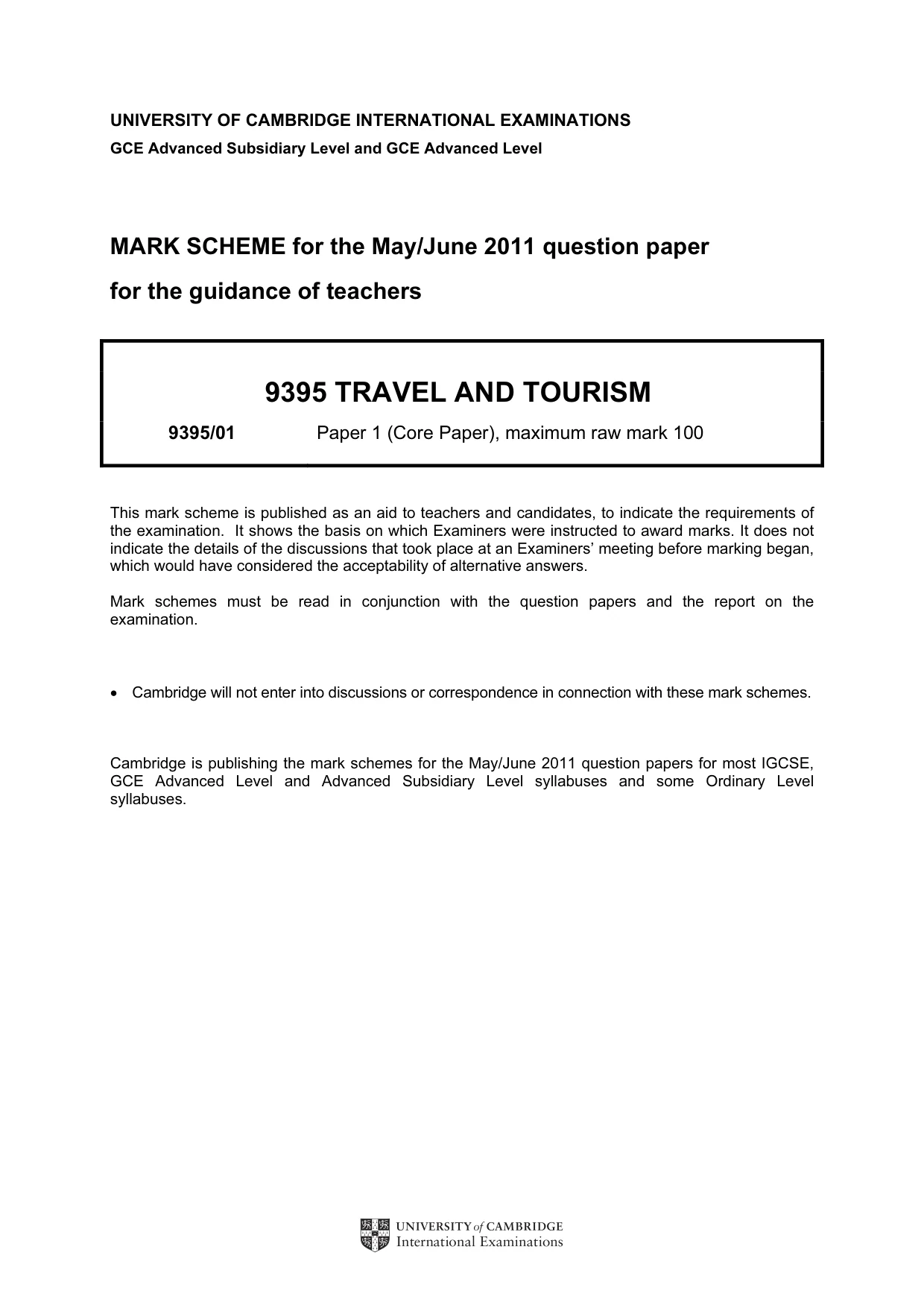
UNIVERSITY OF CAMBRIDGE INTERNATIONAL EXAMINATIONS GCE Advanced Subsidiary Level and GCE Advanced Level MARK SCHEME for the May/June 2011 question paper for the guidance of teachers 9395 TRAVEL AND TOURISM 9395/01 Paper 1 (Core Paper), maximum raw mark 100 This mark scheme is published as an aid to teachers and candidates, to indicate the requirements of the examination. It shows the basis on which Examiners were instructed to award marks. It does not indicate the details of the discussions that took place at an Examiners’ meeting before marking began, which would have considered the acceptability of alternative answers. Mark schemes must be read in conjunction with the question papers and the report on the examination. • Cambridge will not enter into discussions or correspondence in connection with these mark schemes. Cambridge is publishing the mark schemes for the May/June 2011 question papers for most IGCSE, GCE Advanced Level and Advanced Subsidiary Level syllabuses and some Ordinary Level syllabuses.
Mark scheme, page 2
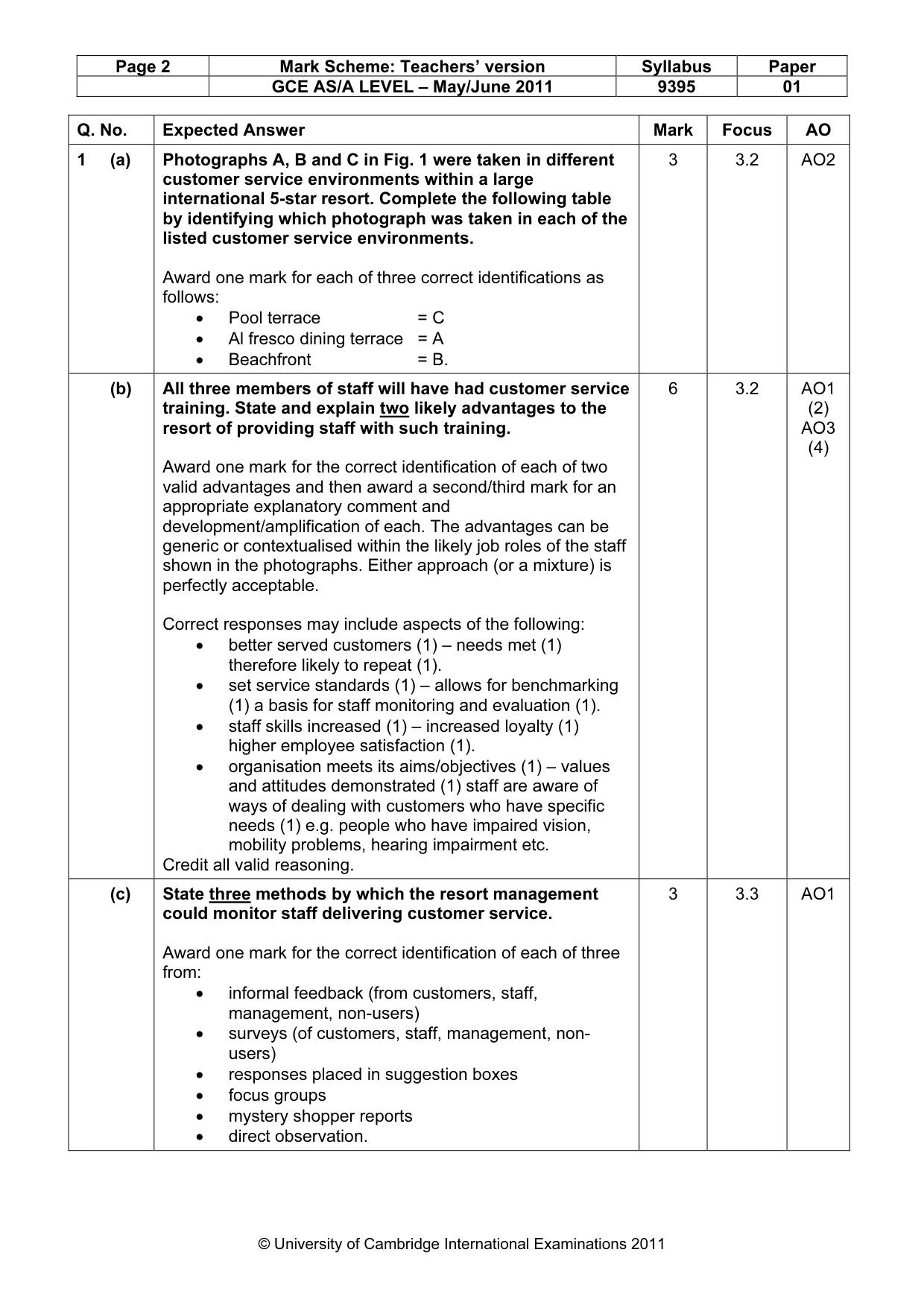
Page 2 Mark Scheme: Teachers’ version Syllabus Paper GCE AS/A LEVEL – May/June 2011 9395 01 © University of Cambridge International Examinations 2011 Q. No. Expected Answer Mark Focus AO 1 (a) Photographs A, B and C in Fig. 1 were taken in different customer service environments within a large international 5-star resort. Complete the following table by identifying which photograph was taken in each of the listed customer service environments. Award one mark for each of three correct identifications as follows: • Pool terrace = C • Al fresco dining terrace = A • Beachfront = B. 3 3.2 AO2 (b) All three members of staff will have had customer service training. State and explain two likely advantages to the resort of providing staff with such training. Award one mark for the correct identification of each of two valid advantages and then award a second/third mark for an appropriate explanatory comment and development/amplification of each. The advantages can be generic or contextualised within the likely job roles of the staff shown in the photographs. Either approach (or a mixture) is perfectly acceptable. Correct responses may include aspects of the following: • better served customers (1) – needs met (1) therefore likely to repeat (1). • set service standards (1) – allows for benchmarking (1) a basis for staff monitoring and evaluation (1). • staff skills increased (1) – increased loyalty (1) higher employee satisfaction (1). • organisation meets its aims/objectives (1) – values and attitudes demonstrated (1) staff are aware of ways of dealing with customers who have specific needs (1) e.g. people who have impaired vision, mobility problems, hearing impairment etc. Credit all valid reasoning. 6 3.2 AO1 (2) AO3 (4) (c) State three methods by which the resort management could monitor staff delivering customer service. Award one mark for the correct identification of each of three from: • informal feedback (from customers, staff, management, non-users) • surveys (of customers, staff, management, non- users) • responses placed in suggestion boxes • focus groups • mystery shopper reports • direct observation. 3 3.3 AO1
Mark scheme, page 3
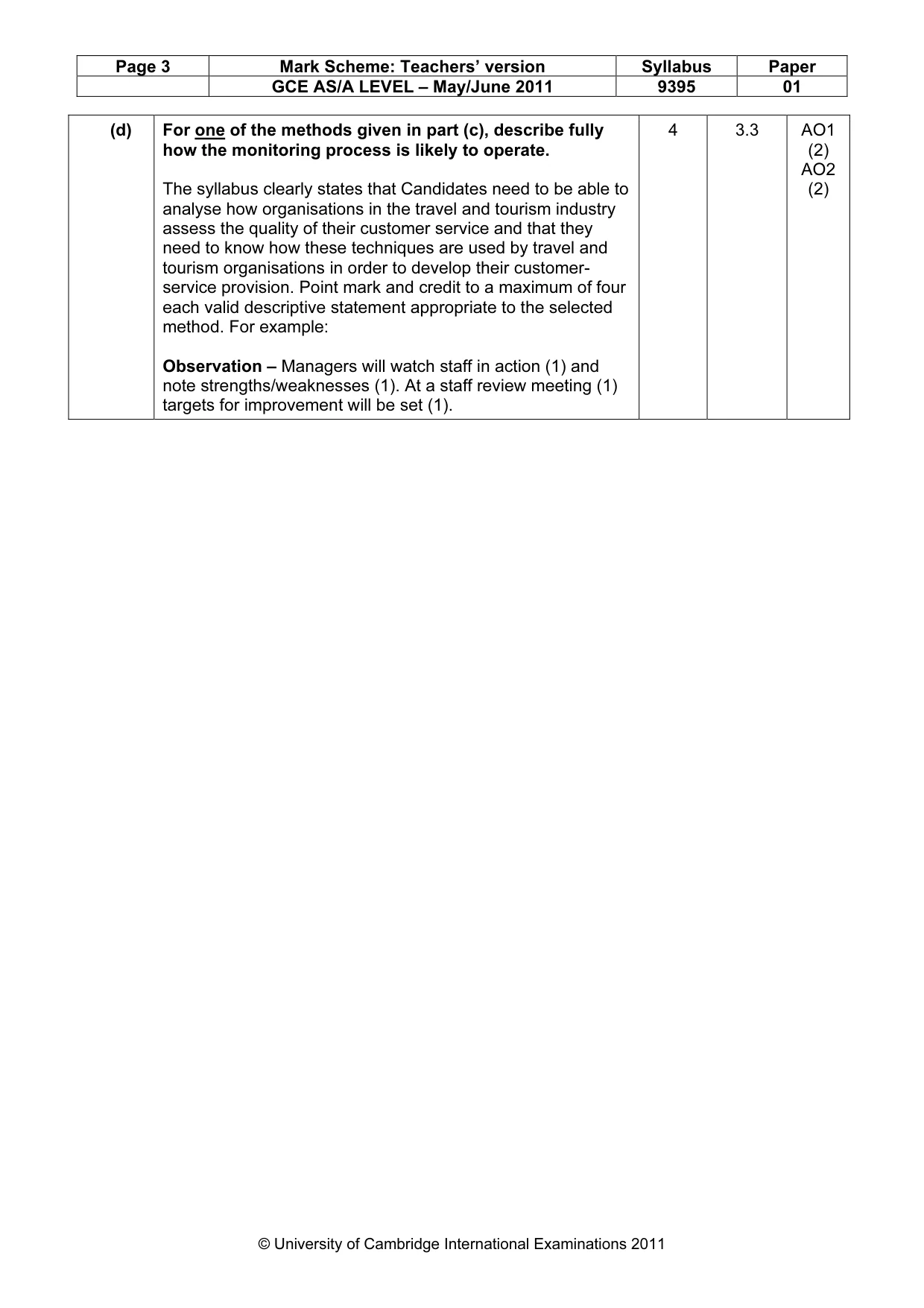
Page 3 Mark Scheme: Teachers’ version Syllabus Paper GCE AS/A LEVEL – May/June 2011 9395 01 © University of Cambridge International Examinations 2011 (d) For one of the methods given in part (c), describe fully how the monitoring process is likely to operate. The syllabus clearly states that Candidates need to be able to analyse how organisations in the travel and tourism industry assess the quality of their customer service and that they need to know how these techniques are used by travel and tourism organisations in order to develop their customer- service provision. Point mark and credit to a maximum of four each valid descriptive statement appropriate to the selected method. For example: Observation – Managers will watch staff in action (1) and note strengths/weaknesses (1). At a staff review meeting (1) targets for improvement will be set (1). 4 3.3 AO1 (2) AO2 (2)
Mark scheme, page 4
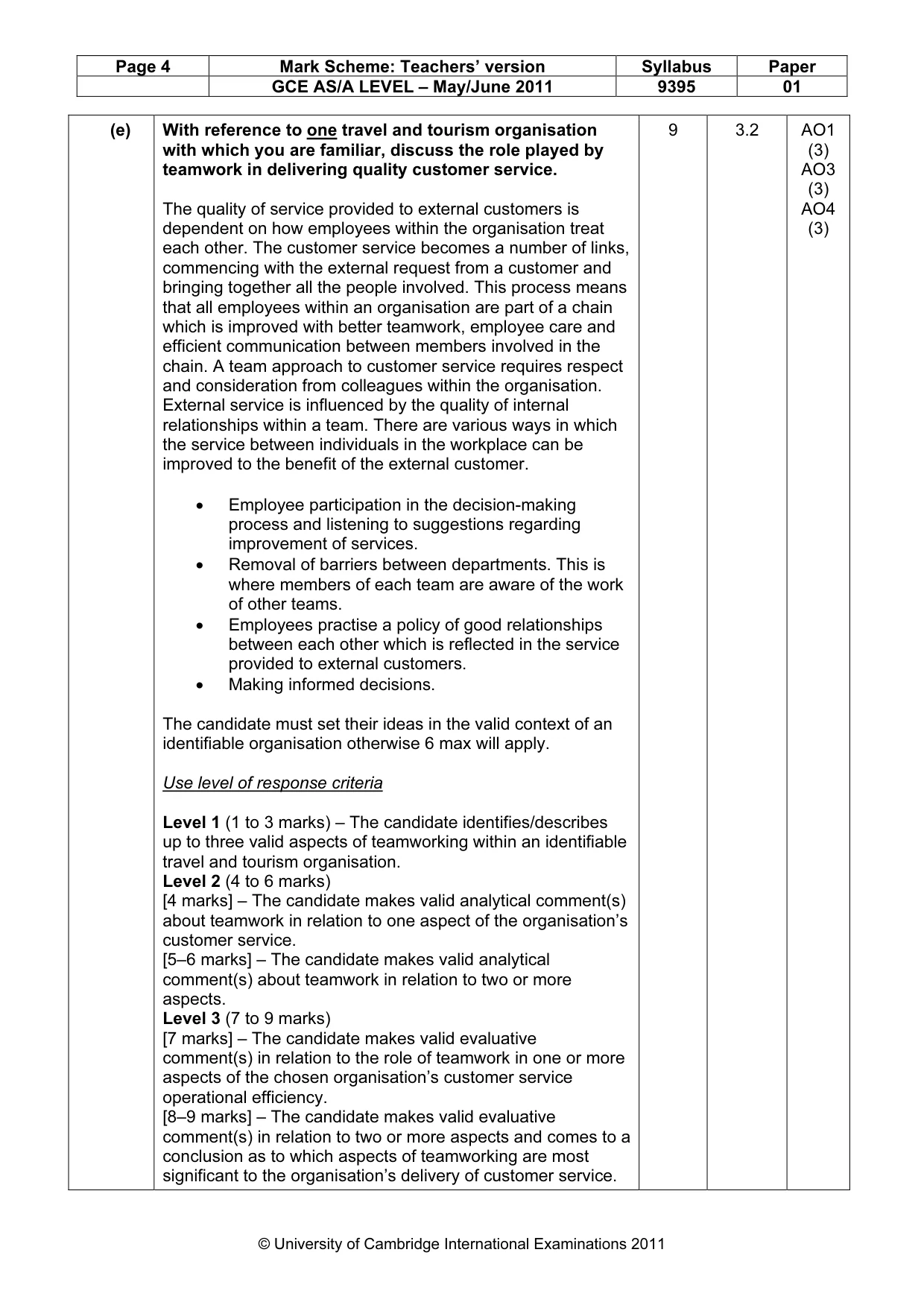
Page 4 Mark Scheme: Teachers’ version Syllabus Paper GCE AS/A LEVEL – May/June 2011 9395 01 © University of Cambridge International Examinations 2011 (e) With reference to one travel and tourism organisation with which you are familiar, discuss the role played by teamwork in delivering quality customer service. The quality of service provided to external customers is dependent on how employees within the organisation treat each other. The customer service becomes a number of links, commencing with the external request from a customer and bringing together all the people involved. This process means that all employees within an organisation are part of a chain which is improved with better teamwork, employee care and efficient communication between members involved in the chain. A team approach to customer service requires respect and consideration from colleagues within the organisation. External service is influenced by the quality of internal relationships within a team. There are various ways in which the service between individuals in the workplace can be improved to the benefit of the external customer. • Employee participation in the decision-making process and listening to suggestions regarding improvement of services. • Removal of barriers between departments. This is where members of each team are aware of the work of other teams. • Employees practise a policy of good relationships between each other which is reflected in the service provided to external customers. • Making informed decisions. The candidate must set their ideas in the valid context of an identifiable organisation otherwise 6 max will apply. Use level of response criteria Level 1 (1 to 3 marks) – The candidate identifies/describes up to three valid aspects of teamworking within an identifiable travel and tourism organisation. Level 2 (4 to 6 marks) [4 marks] – The candidate makes valid analytical comment(s) about teamwork in relation to one aspect of the organisation’s customer service. [5–6 marks] – The candidate makes valid analytical comment(s) about teamwork in relation to two or more aspects. Level 3 (7 to 9 marks) [7 marks] – The candidate makes valid evaluative comment(s) in relation to the role of teamwork in one or more aspects of the chosen organisation’s customer service operational efficiency. [8–9 marks] – The candidate makes valid evaluative comment(s) in relation to two or more aspects and comes to a conclusion as to which aspects of teamworking are most significant to the organisation’s delivery of customer service. 9 3.2 AO1 (3) AO3 (3) AO4 (3)
Mark scheme, page 5
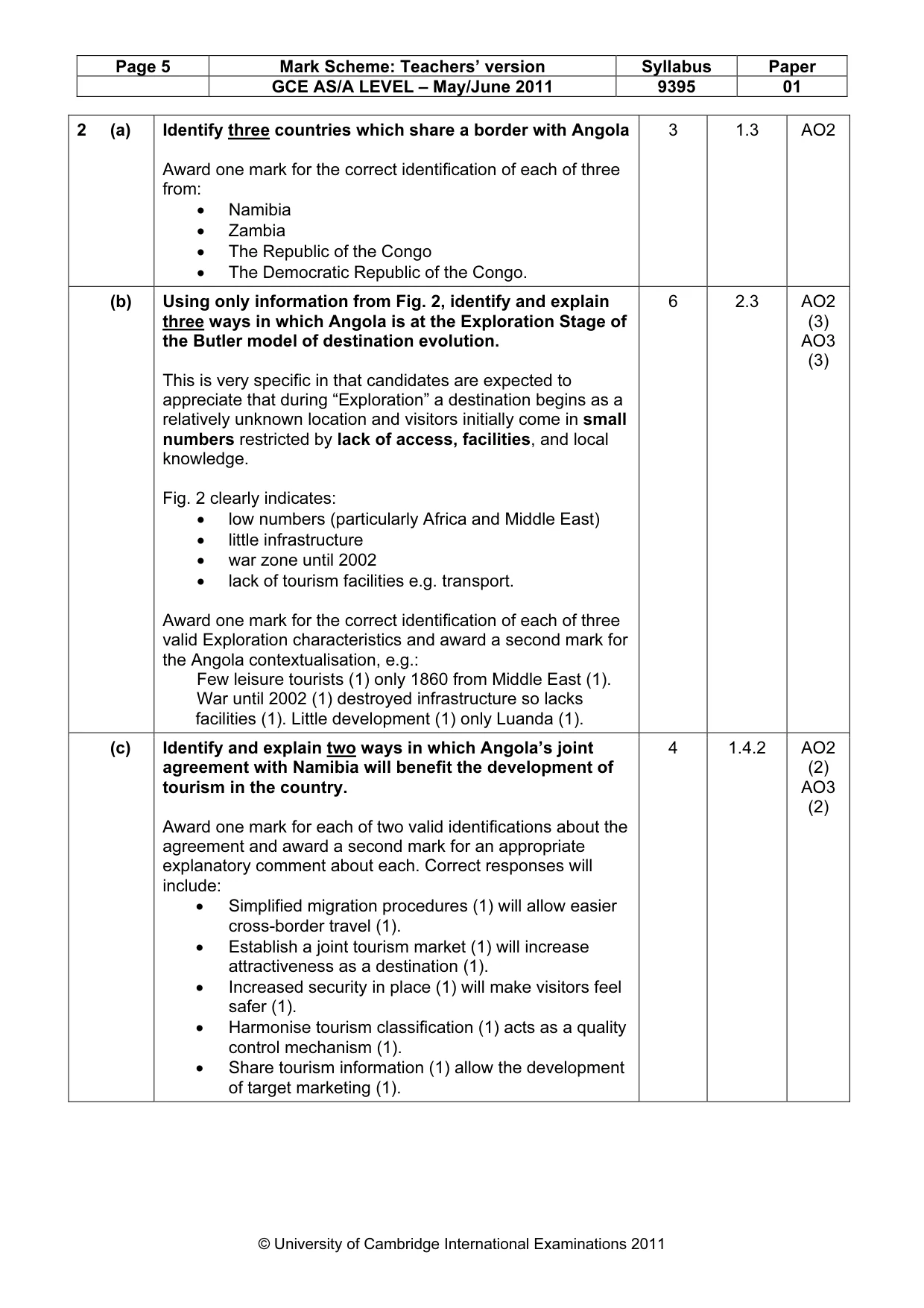
Page 5 Mark Scheme: Teachers’ version Syllabus Paper GCE AS/A LEVEL – May/June 2011 9395 01 © University of Cambridge International Examinations 2011 2 (a) Identify three countries which share a border with Angola Award one mark for the correct identification of each of three from: • Namibia • Zambia • The Republic of the Congo • The Democratic Republic of the Congo. 3 1.3 AO2 (b) Using only information from Fig. 2, identify and explain three ways in which Angola is at the Exploration Stage of the Butler model of destination evolution. This is very specific in that candidates are expected to appreciate that during “Exploration” a destination begins as a relatively unknown location and visitors initially come in small numbers restricted by lack of access, facilities, and local knowledge. Fig. 2 clearly indicates: • low numbers (particularly Africa and Middle East) • little infrastructure • war zone until 2002 • lack of tourism facilities e.g. transport. Award one mark for the correct identification of each of three valid Exploration characteristics and award a second mark for the Angola contextualisation, e.g.: Few leisure tourists (1) only 1860 from Middle East (1). War until 2002 (1) destroyed infrastructure so lacks facilities (1). Little development (1) only Luanda (1). 6 2.3 AO2 (3) AO3 (3) (c) Identify and explain two ways in which Angola’s joint agreement with Namibia will benefit the development of tourism in the country. Award one mark for each of two valid identifications about the agreement and award a second mark for an appropriate explanatory comment about each. Correct responses will include: • Simplified migration procedures (1) will allow easier cross-border travel (1). • Establish a joint tourism market (1) will increase attractiveness as a destination (1). • Increased security in place (1) will make visitors feel safer (1). • Harmonise tourism classification (1) acts as a quality control mechanism (1). • Share tourism information (1) allow the development of target marketing (1). 4 1.4.2 AO2 (2) AO3 (2)
Mark scheme, page 6
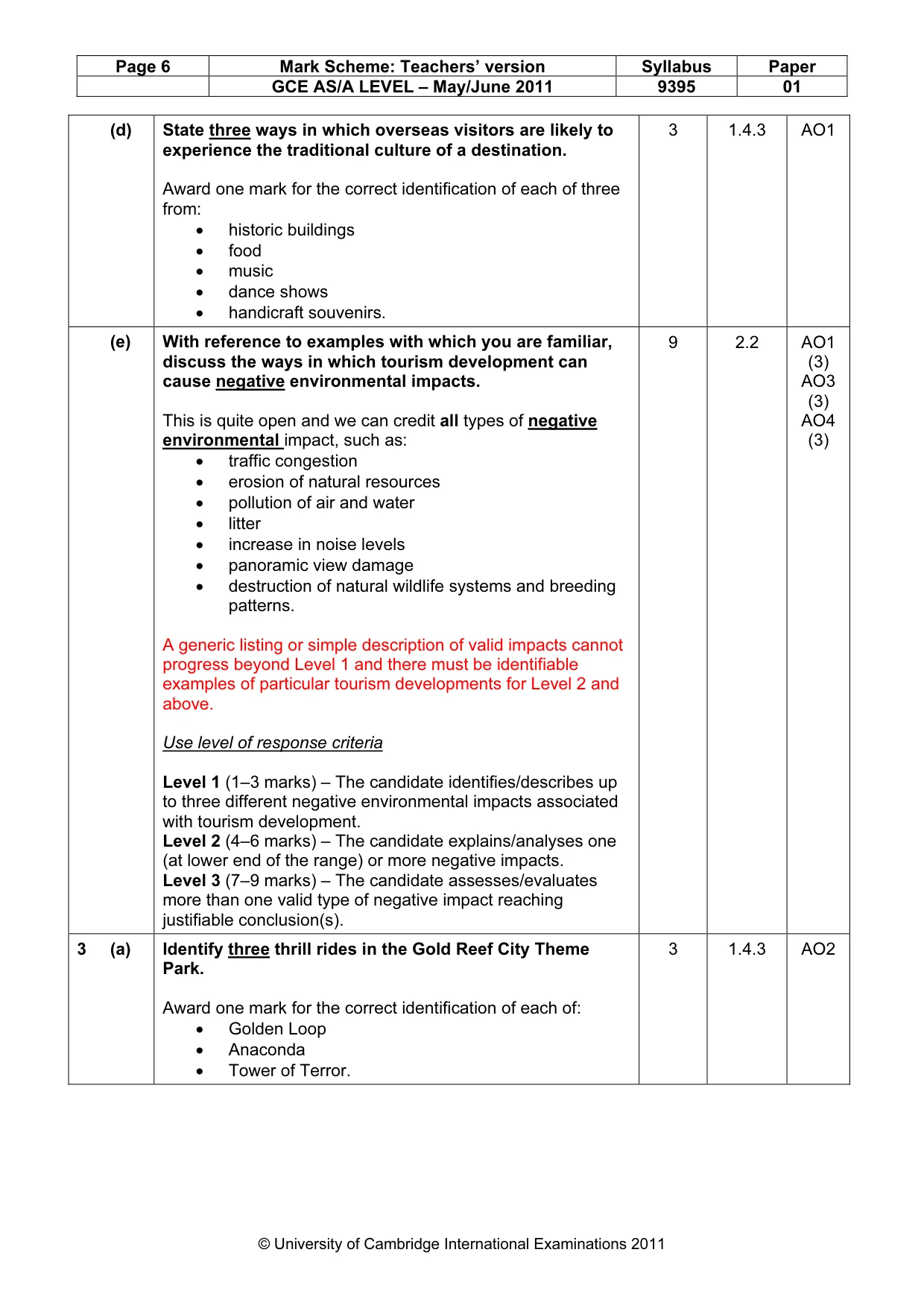
Page 6 Mark Scheme: Teachers’ version Syllabus Paper GCE AS/A LEVEL – May/June 2011 9395 01 © University of Cambridge International Examinations 2011 (d) State three ways in which overseas visitors are likely to experience the traditional culture of a destination. Award one mark for the correct identification of each of three from: • historic buildings • food • music • dance shows • handicraft souvenirs. 3 1.4.3 AO1 (e) With reference to examples with which you are familiar, discuss the ways in which tourism development can cause negative environmental impacts. This is quite open and we can credit all types of negative environmental impact, such as: • traffic congestion • erosion of natural resources • pollution of air and water • litter • increase in noise levels • panoramic view damage • destruction of natural wildlife systems and breeding patterns. A generic listing or simple description of valid impacts cannot progress beyond Level 1 and there must be identifiable examples of particular tourism developments for Level 2 and above. Use level of response criteria Level 1 (1–3 marks) – The candidate identifies/describes up to three different negative environmental impacts associated with tourism development. Level 2 (4–6 marks) – The candidate explains/analyses one (at lower end of the range) or more negative impacts. Level 3 (7–9 marks) – The candidate assesses/evaluates more than one valid type of negative impact reaching justifiable conclusion(s). 9 2.2 AO1 (3) AO3 (3) AO4 (3) 3 (a) Identify three thrill rides in the Gold Reef City Theme Park. Award one mark for the correct identification of each of: • Golden Loop • Anaconda • Tower of Terror. 3 1.4.3 AO2
Mark scheme, page 7
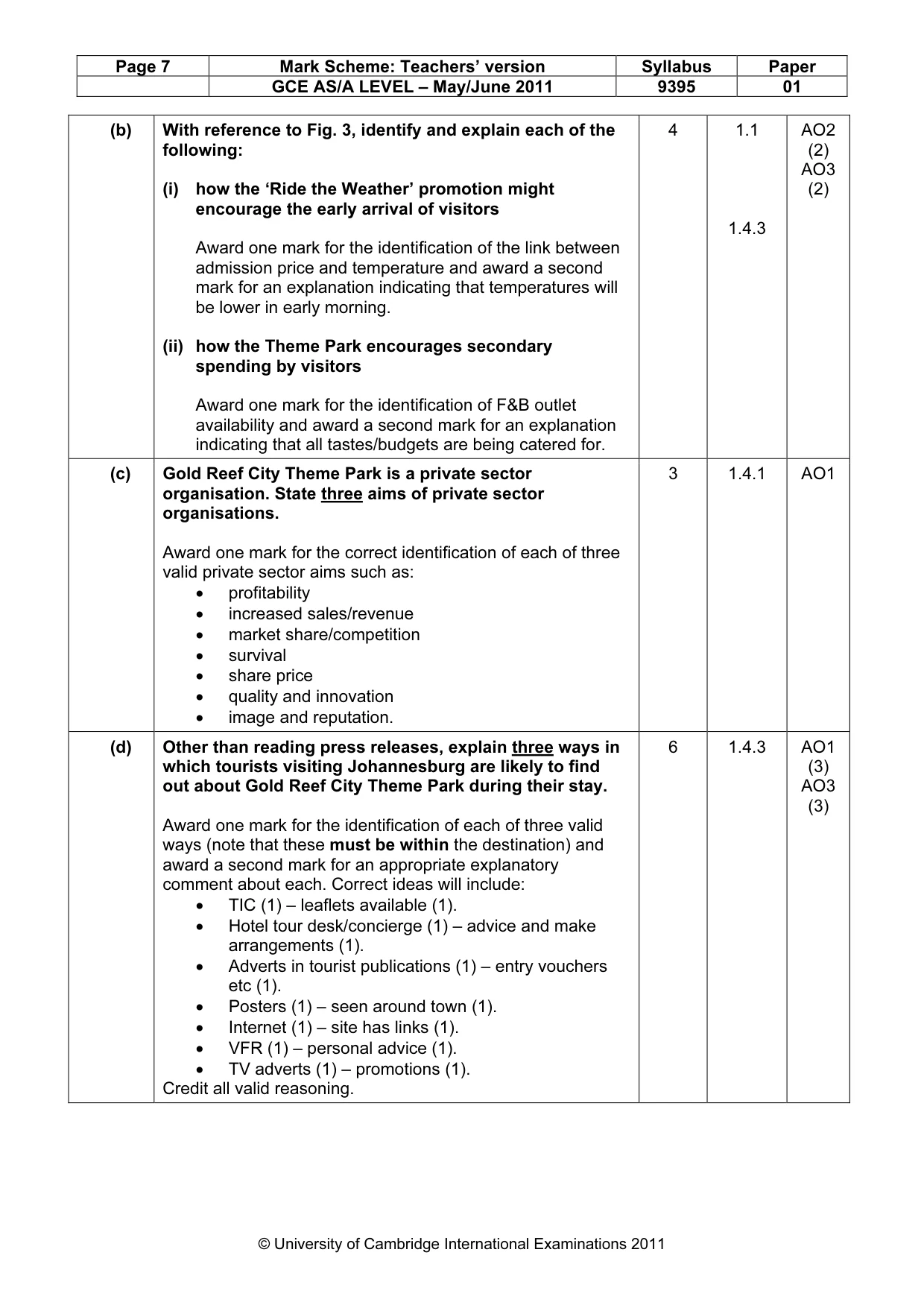
Page 7 Mark Scheme: Teachers’ version Syllabus Paper GCE AS/A LEVEL – May/June 2011 9395 01 © University of Cambridge International Examinations 2011 (b) With reference to Fig. 3, identify and explain each of the following: (i) how the ‘Ride the Weather’ promotion might encourage the early arrival of visitors Award one mark for the identification of the link between admission price and temperature and award a second mark for an explanation indicating that temperatures will be lower in early morning. (ii) how the Theme Park encourages secondary spending by visitors Award one mark for the identification of F&B outlet availability and award a second mark for an explanation indicating that all tastes/budgets are being catered for. 4 1.1 1.4.3 AO2 (2) AO3 (2) (c) Gold Reef City Theme Park is a private sector organisation. State three aims of private sector organisations. Award one mark for the correct identification of each of three valid private sector aims such as: • profitability • increased sales/revenue • market share/competition • survival • share price • quality and innovation • image and reputation. 3 1.4.1 AO1 (d) Other than reading press releases, explain three ways in which tourists visiting Johannesburg are likely to find out about Gold Reef City Theme Park during their stay. Award one mark for the identification of each of three valid ways (note that these must be within the destination) and award a second mark for an appropriate explanatory comment about each. Correct ideas will include: • TIC (1) – leaflets available (1). • Hotel tour desk/concierge (1) – advice and make arrangements (1). • Adverts in tourist publications (1) – entry vouchers etc (1). • Posters (1) – seen around town (1). • Internet (1) – site has links (1). • VFR (1) – personal advice (1). • TV adverts (1) – promotions (1). Credit all valid reasoning. 6 1.4.3 AO1 (3) AO3 (3)
Mark scheme, page 8
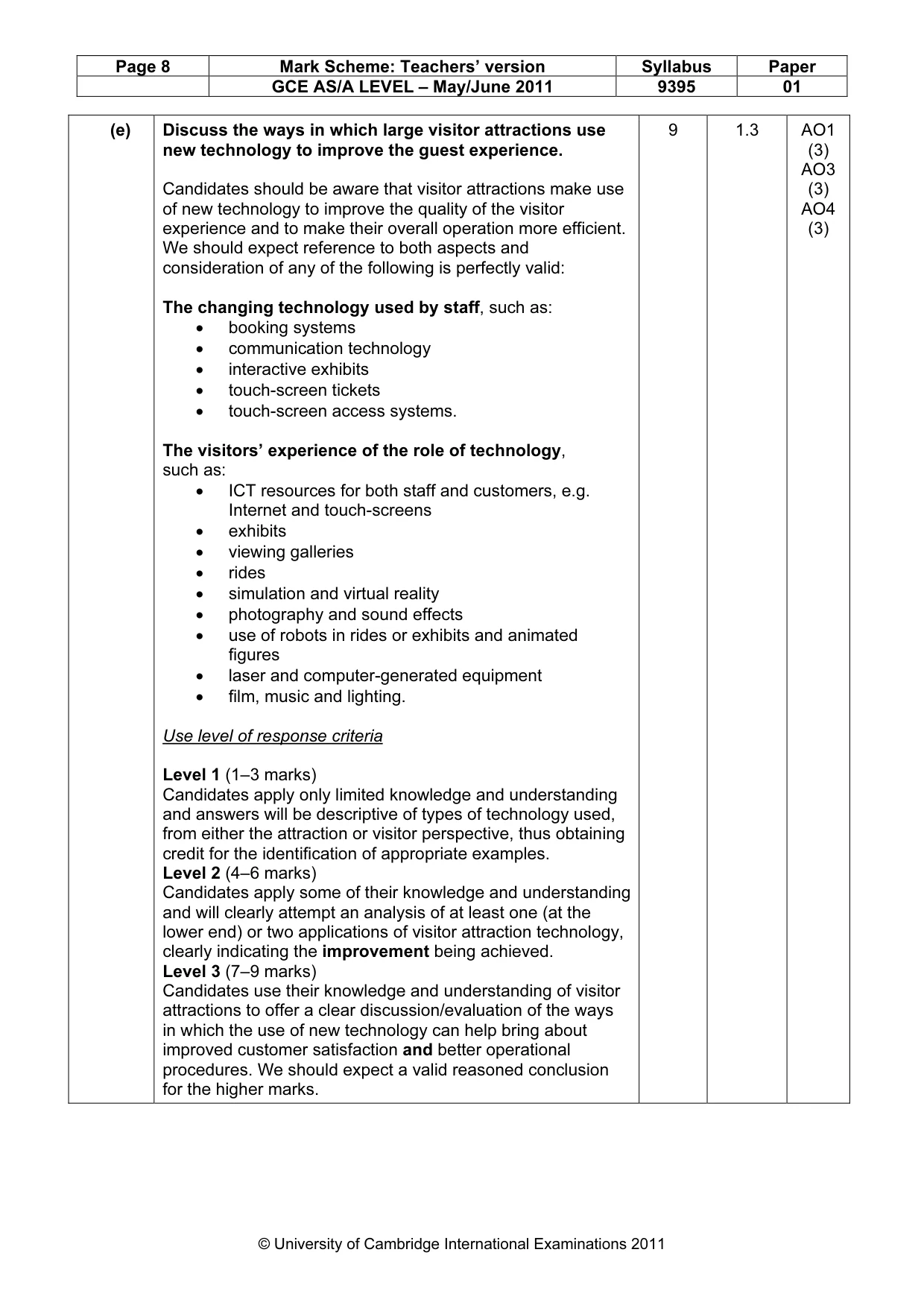
Page 8 Mark Scheme: Teachers’ version Syllabus Paper GCE AS/A LEVEL – May/June 2011 9395 01 © University of Cambridge International Examinations 2011 (e) Discuss the ways in which large visitor attractions use new technology to improve the guest experience. Candidates should be aware that visitor attractions make use of new technology to improve the quality of the visitor experience and to make their overall operation more efficient. We should expect reference to both aspects and consideration of any of the following is perfectly valid: The changing technology used by staff, such as: • booking systems • communication technology • interactive exhibits • touch-screen tickets • touch-screen access systems. The visitors’ experience of the role of technology, such as: • ICT resources for both staff and customers, e.g. Internet and touch-screens • exhibits • viewing galleries • rides • simulation and virtual reality • photography and sound effects • use of robots in rides or exhibits and animated figures • laser and computer-generated equipment • film, music and lighting. Use level of response criteria Level 1 (1–3 marks) Candidates apply only limited knowledge and understanding and answers will be descriptive of types of technology used, from either the attraction or visitor perspective, thus obtaining credit for the identification of appropriate examples. Level 2 (4–6 marks) Candidates apply some of their knowledge and understanding and will clearly attempt an analysis of at least one (at the lower end) or two applications of visitor attraction technology, clearly indicating the improvement being achieved. Level 3 (7–9 marks) Candidates use their knowledge and understanding of visitor attractions to offer a clear discussion/evaluation of the ways in which the use of new technology can help bring about improved customer satisfaction and better operational procedures. We should expect a valid reasoned conclusion for the higher marks. 9 1.3 AO1 (3) AO3 (3) AO4 (3)
Mark scheme, page 9
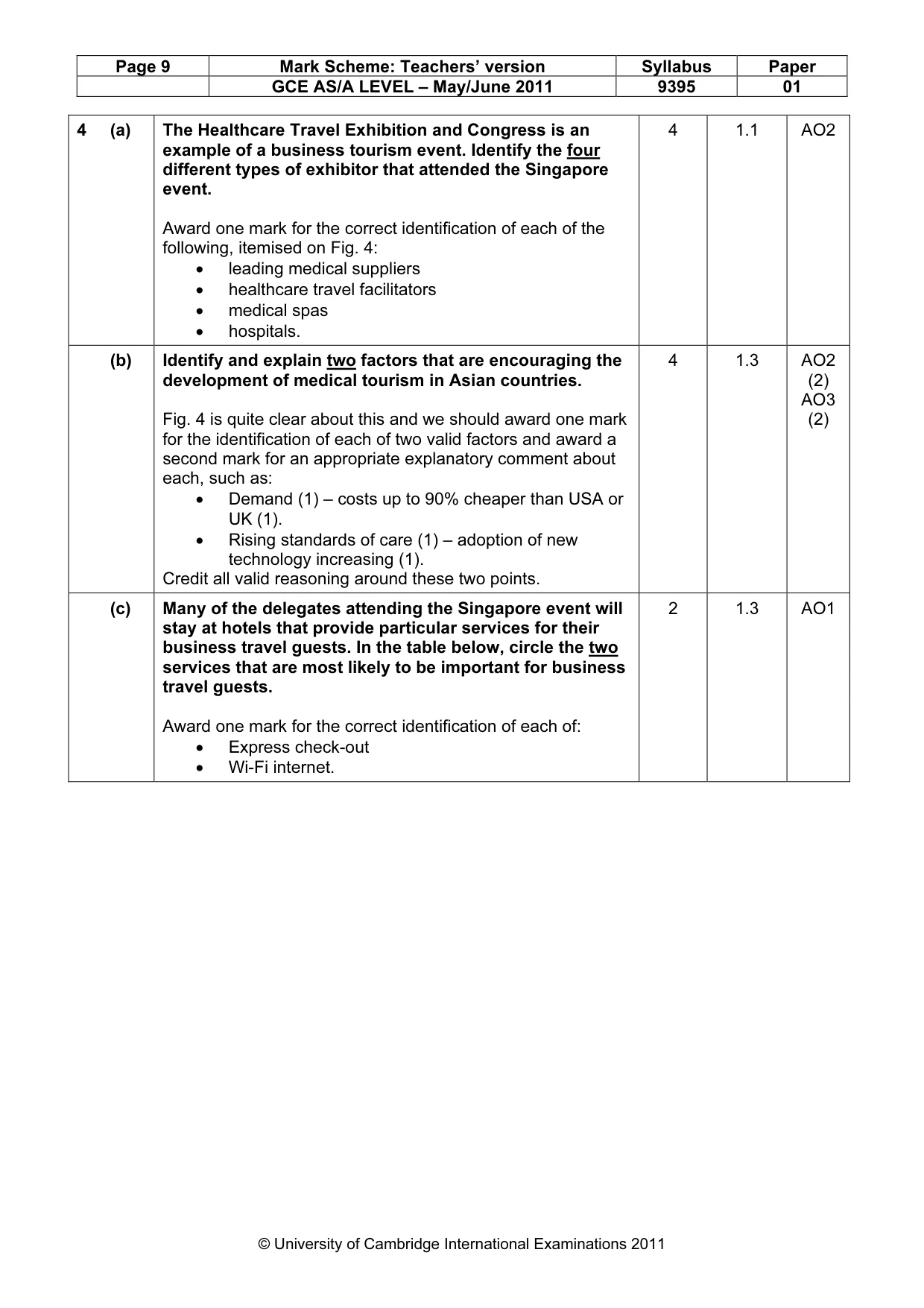
Page 9 Mark Scheme: Teachers’ version Syllabus Paper GCE AS/A LEVEL – May/June 2011 9395 01 © University of Cambridge International Examinations 2011 4 (a) The Healthcare Travel Exhibition and Congress is an example of a business tourism event. Identify the four different types of exhibitor that attended the Singapore event. Award one mark for the correct identification of each of the following, itemised on Fig. 4: • leading medical suppliers • healthcare travel facilitators • medical spas • hospitals. 4 1.1 AO2 (b) Identify and explain two factors that are encouraging the development of medical tourism in Asian countries. Fig. 4 is quite clear about this and we should award one mark for the identification of each of two valid factors and award a second mark for an appropriate explanatory comment about each, such as: • Demand (1) – costs up to 90% cheaper than USA or UK (1). • Rising standards of care (1) – adoption of new technology increasing (1). Credit all valid reasoning around these two points. 4 1.3 AO2 (2) AO3 (2) (c) Many of the delegates attending the Singapore event will stay at hotels that provide particular services for their business travel guests. In the table below, circle the two services that are most likely to be important for business travel guests. Award one mark for the correct identification of each of: • Express check-out • Wi-Fi internet. 2 1.3 AO1
Mark scheme, page 10
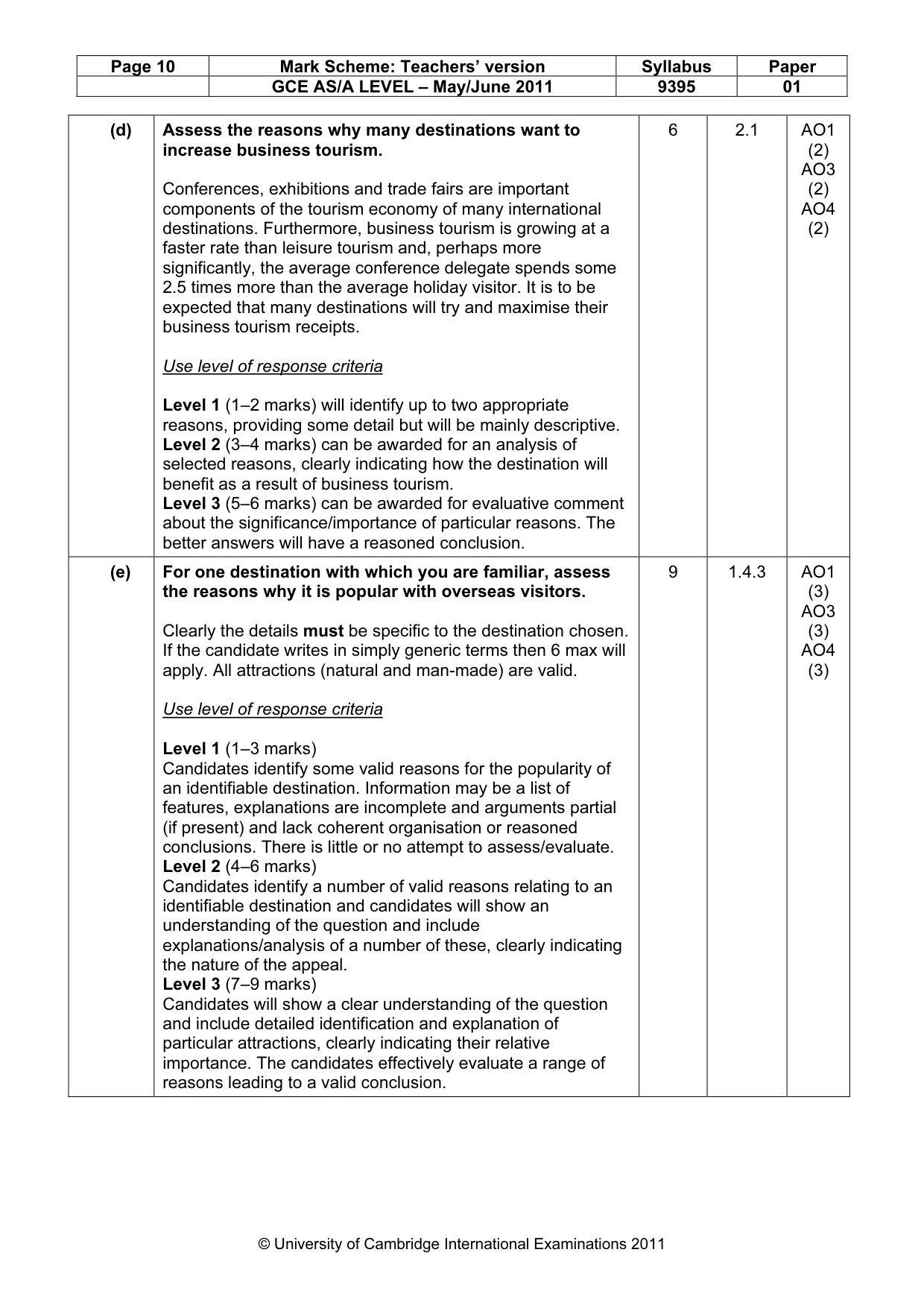
Page 10 Mark Scheme: Teachers’ version Syllabus Paper GCE AS/A LEVEL – May/June 2011 9395 01 © University of Cambridge International Examinations 2011 (d) Assess the reasons why many destinations want to increase business tourism. Conferences, exhibitions and trade fairs are important components of the tourism economy of many international destinations. Furthermore, business tourism is growing at a faster rate than leisure tourism and, perhaps more significantly, the average conference delegate spends some 2.5 times more than the average holiday visitor. It is to be expected that many destinations will try and maximise their business tourism receipts. Use level of response criteria Level 1 (1–2 marks) will identify up to two appropriate reasons, providing some detail but will be mainly descriptive. Level 2 (3–4 marks) can be awarded for an analysis of selected reasons, clearly indicating how the destination will benefit as a result of business tourism. Level 3 (5–6 marks) can be awarded for evaluative comment about the significance/importance of particular reasons. The better answers will have a reasoned conclusion. 6 2.1 AO1 (2) AO3 (2) AO4 (2) (e) For one destination with which you are familiar, assess the reasons why it is popular with overseas visitors. Clearly the details must be specific to the destination chosen. If the candidate writes in simply generic terms then 6 max will apply. All attractions (natural and man-made) are valid. Use level of response criteria Level 1 (1–3 marks) Candidates identify some valid reasons for the popularity of an identifiable destination. Information may be a list of features, explanations are incomplete and arguments partial (if present) and lack coherent organisation or reasoned conclusions. There is little or no attempt to assess/evaluate. Level 2 (4–6 marks) Candidates identify a number of valid reasons relating to an identifiable destination and candidates will show an understanding of the question and include explanations/analysis of a number of these, clearly indicating the nature of the appeal. Level 3 (7–9 marks) Candidates will show a clear understanding of the question and include detailed identification and explanation of particular attractions, clearly indicating their relative importance. The candidates effectively evaluate a range of reasons leading to a valid conclusion. 9 1.4.3 AO1 (3) AO3 (3) AO4 (3)
What you needed in this session
Cambridge’s own grade thresholds for 2011 May/June, Paper 1 · Variant 1. A higher threshold means an easier paper — the bar moves with how the cohort did.