Cambridge A Level Travel and Tourism 9395 — 2010 Oct/Nov Paper 4 · Variant 1
9395/41/O/N/10 · 50 marks · ≈56 min
The question paper and its mark scheme, free to read here and free to download. This is Cambridge’s own paper, exactly as it was sat.
Question paper12 pages
Mark scheme4 pages
Answers below. Sit the paper first if you are practising.
Paper as text
Question paper, page 1
This document consists of 10 printed pages and 2 blank pages. IB10 11_9395_04/3RP © UCLES 2010 [Turn over *0448427774* For Examiner's Use 1 2 Total UNIVERSITY OF CAMBRIDGE INTERNATIONAL EXAMINATIONS General Certificate of Education Advanced Level TRAVEL AND TOURISM 9395/04 Paper 4 Specialised Tourism October/November 2010 1 hour and 30 minutes Candidates answer on the Question Paper READ THESE INSTRUCTIONS FIRST Write your Centre number, candidate number and name on all the work you hand in. Write in dark blue or black pen. Do not use staples, paper clips, highlighters, glue or correction fluid. You may use a pencil for any diagrams, graphs or rough working. DO NOT WRITE IN ANY BARCODES Answer all questions. The number of marks is given in brackets [ ] at the end of each question or part question.
Question paper, page 2
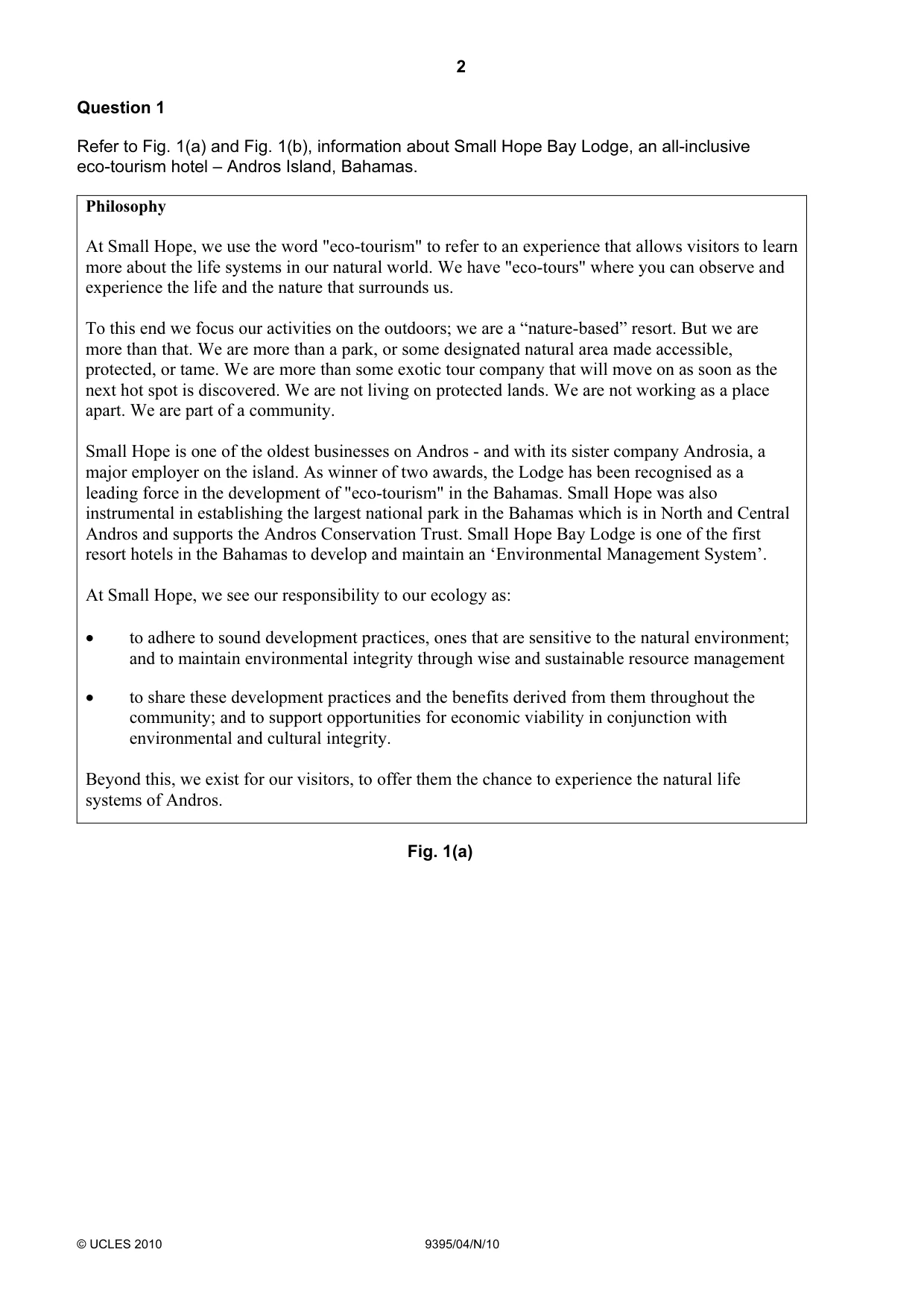
2 © UCLES 2010 9395/04/N/10 Question 1 Refer to Fig. 1(a) and Fig. 1(b), information about Small Hope Bay Lodge, an all-inclusive eco-tourism hotel – Andros Island, Bahamas. Philosophy At Small Hope, we use the word "eco-tourism" to refer to an experience that allows visitors to learn more about the life systems in our natural world. We have "eco-tours" where you can observe and experience the life and the nature that surrounds us. To this end we focus our activities on the outdoors; we are a “nature-based” resort. But we are more than that. We are more than a park, or some designated natural area made accessible, protected, or tame. We are more than some exotic tour company that will move on as soon as the next hot spot is discovered. We are not living on protected lands. We are not working as a place apart. We are part of a community. Small Hope is one of the oldest businesses on Andros - and with its sister company Androsia, a major employer on the island. As winner of two awards, the Lodge has been recognised as a leading force in the development of "eco-tourism" in the Bahamas. Small Hope was also instrumental in establishing the largest national park in the Bahamas which is in North and Central Andros and supports the Andros Conservation Trust. Small Hope Bay Lodge is one of the first resort hotels in the Bahamas to develop and maintain an ‘Environmental Management System’. At Small Hope, we see our responsibility to our ecology as: • to adhere to sound development practices, ones that are sensitive to the natural environment; and to maintain environmental integrity through wise and sustainable resource management • to share these development practices and the benefits derived from them throughout the community; and to support opportunities for economic viability in conjunction with environmental and cultural integrity. Beyond this, we exist for our visitors, to offer them the chance to experience the natural life systems of Andros. Fig. 1(a)
Question paper, page 3
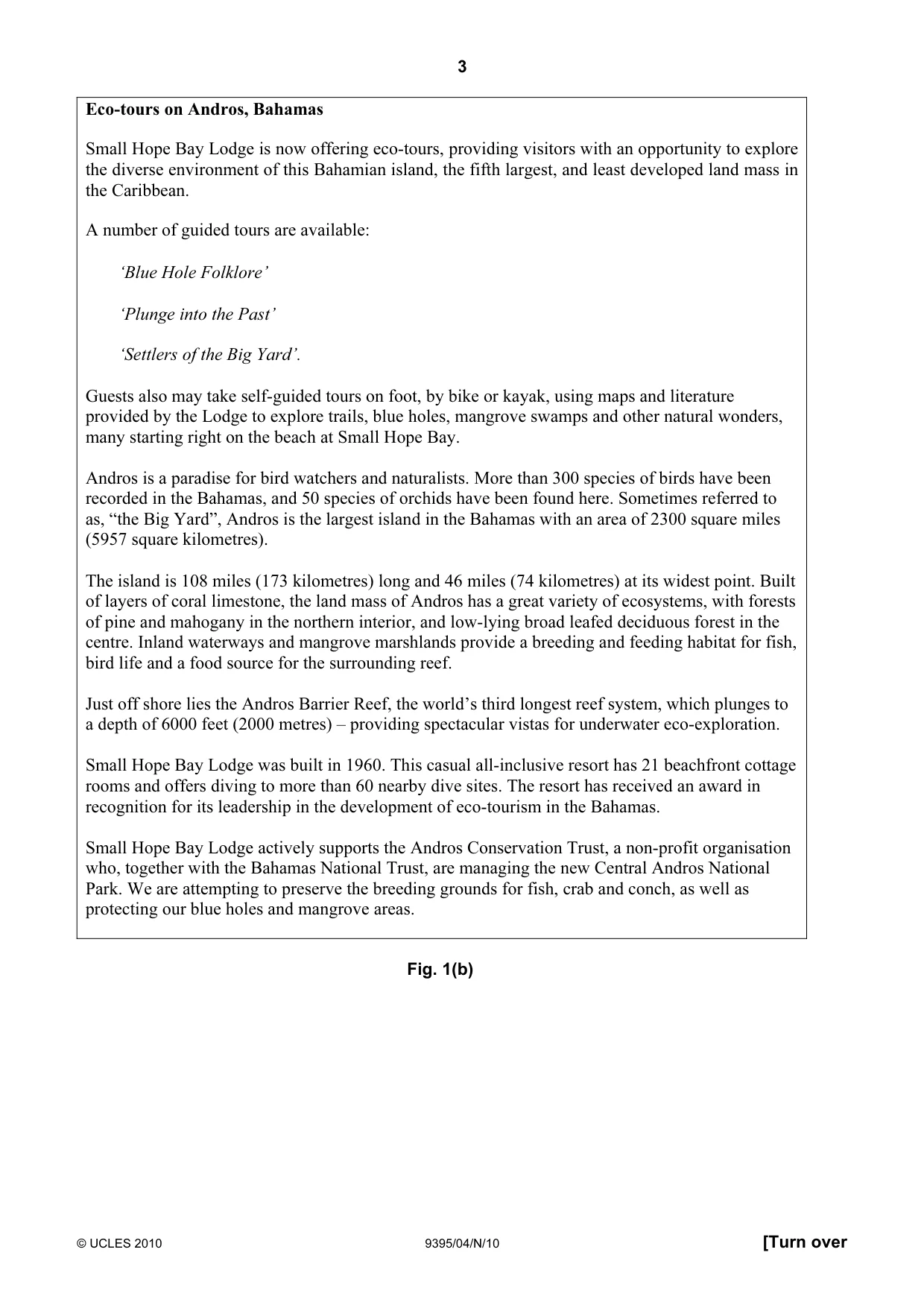
3 © UCLES 2010 9395/04/N/10 [Turn over Eco-tours on Andros, Bahamas Small Hope Bay Lodge is now offering eco-tours, providing visitors with an opportunity to explore the diverse environment of this Bahamian island, the fifth largest, and least developed land mass in the Caribbean. A number of guided tours are available: ‘Blue Hole Folklore’ ‘Plunge into the Past’ ‘Settlers of the Big Yard’. Guests also may take self-guided tours on foot, by bike or kayak, using maps and literature provided by the Lodge to explore trails, blue holes, mangrove swamps and other natural wonders, many starting right on the beach at Small Hope Bay. Andros is a paradise for bird watchers and naturalists. More than 300 species of birds have been recorded in the Bahamas, and 50 species of orchids have been found here. Sometimes referred to as, “the Big Yard”, Andros is the largest island in the Bahamas with an area of 2300 square miles (5957 square kilometres). The island is 108 miles (173 kilometres) long and 46 miles (74 kilometres) at its widest point. Built of layers of coral limestone, the land mass of Andros has a great variety of ecosystems, with forests of pine and mahogany in the northern interior, and low-lying broad leafed deciduous forest in the centre. Inland waterways and mangrove marshlands provide a breeding and feeding habitat for fish, bird life and a food source for the surrounding reef. Just off shore lies the Andros Barrier Reef, the world’s third longest reef system, which plunges to a depth of 6000 feet (2000 metres) – providing spectacular vistas for underwater eco-exploration. Small Hope Bay Lodge was built in 1960. This casual all-inclusive resort has 21 beachfront cottage rooms and offers diving to more than 60 nearby dive sites. The resort has received an award in recognition for its leadership in the development of eco-tourism in the Bahamas. Small Hope Bay Lodge actively supports the Andros Conservation Trust, a non-profit organisation who, together with the Bahamas National Trust, are managing the new Central Andros National Park. We are attempting to preserve the breeding grounds for fish, crab and conch, as well as protecting our blue holes and mangrove areas. Fig. 1(b)
Question paper, page 4
4 © UCLES 2010 9395/04/N/10 For Examiner's Use (a) Explain three ways in which a successful eco-tourism experience is likely to bring economic benefits to the local people of Andros Island. [6]
Question paper, page 5
5 © UCLES 2010 9395/04/N/10 [Turn over For Examiner's Use (b) Assess how the growth of tourism activity in Andros may have a negative environmental impact on the coastal environment. [9]
Question paper, page 6
6 © UCLES 2010 9395/04/N/10 For Examiner's Use (c) Discuss how the principles of eco-tourism may be compatible with an all-inclusive resort such as Small Hope Bay. [Total: 25] [10]
Question paper, page 7
7 9395/04/N/10 [Turn over BLANK PAGE PLEASE TURN OVER FOR QUESTION 2
Question paper, page 8
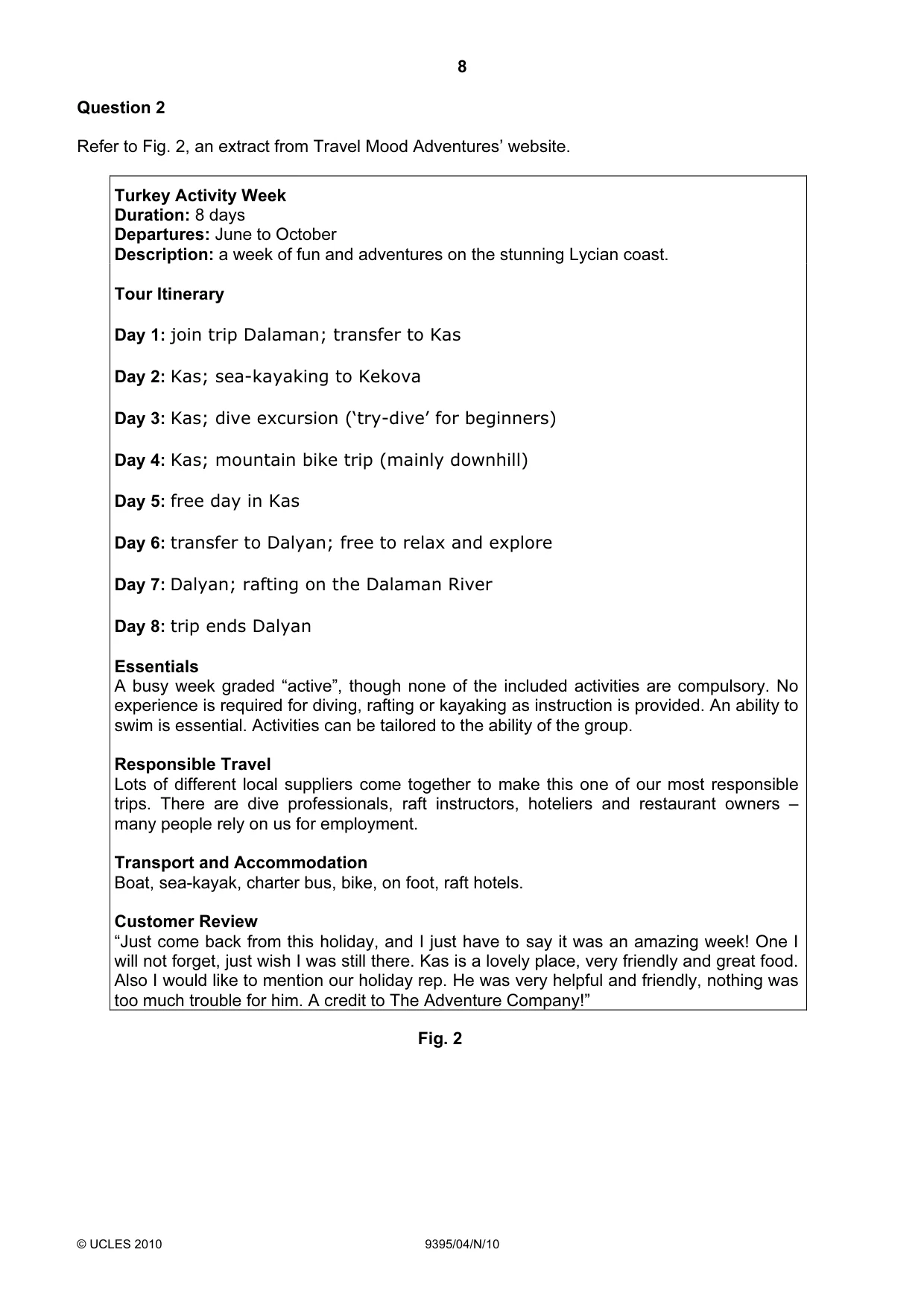
8 © UCLES 2010 9395/04/N/10 Question 2 Refer to Fig. 2, an extract from Travel Mood Adventures’ website. Turkey Activity Week Duration: 8 days Departures: June to October Description: a week of fun and adventures on the stunning Lycian coast. Tour Itinerary Day 1: join trip Dalaman; transfer to Kas Day 2: Kas; sea-kayaking to Kekova Day 3: Kas; dive excursion (‘try-dive’ for beginners) Day 4: Kas; mountain bike trip (mainly downhill) Day 5: free day in Kas Day 6: transfer to Dalyan; free to relax and explore Day 7: Dalyan; rafting on the Dalaman River Day 8: trip ends Dalyan Essentials A busy week graded “active”, though none of the included activities are compulsory. No experience is required for diving, rafting or kayaking as instruction is provided. An ability to swim is essential. Activities can be tailored to the ability of the group. Responsible Travel Lots of different local suppliers come together to make this one of our most responsible trips. There are dive professionals, raft instructors, hoteliers and restaurant owners – many people rely on us for employment. Transport and Accommodation Boat, sea-kayak, charter bus, bike, on foot, raft hotels. Customer Review “Just come back from this holiday, and I just have to say it was an amazing week! One I will not forget, just wish I was still there. Kas is a lovely place, very friendly and great food. Also I would like to mention our holiday rep. He was very helpful and friendly, nothing was too much trouble for him. A credit to The Adventure Company!” Fig. 2
Question paper, page 9
9 © UCLES 2010 9395/04/N/10 [Turn over For Examiner's Use (a) The adventure holiday in Kas only runs between June and October each year. State three negative economic impacts this may have on the local Turkish community. [3] (b) Explain two ways in which negative environmental impacts can be minimised at destinations such as Kas. [4]
Question paper, page 10
10 © UCLES 2010 9395/04/N/10 For Examiner's Use (c) Assess how the adventure activities in Kas may create negative impacts for other visitor groups. [9]
Question paper, page 11
11 © UCLES 2010 9395/04/N/10 For Examiner's Use (d) ‘Travel Mood Adventures’ believe they act as a responsible tour operator. Evaluate the social and cultural benefits to the local community of working with such organisations. [Total: 25] [9]
Question paper, page 12
12 Copyright Acknowledgements: Question 1 Figure 1(a) & 1(b) Question 2 Figure 2 © www.The Islands of the Bahamas-EcoTourism.mht. © www.travelmoodadventures.com. Permission to reproduce items where third-party owned material protected by copyright is included has been sought and cleared where possible. Every reasonable effort has been made by the publisher (UCLES) to trace copyright holders, but if any items requiring clearance have unwittingly been included, the publisher will be pleased to make amends at the earliest possible opportunity. University of Cambridge International Examinations is part of the Cambridge Assessment Group. Cambridge Assessment is the brand name of University of Cambridge Local Examinations Syndicate (UCLES), which is itself a department of the University of Cambridge. 9395/04/N/10 BLANK PAGE
Mark scheme, page 1
UNIVERSITY OF CAMBRIDGE INTERNATIONAL EXAMINATIONS GCE Advanced Subsidiary Level and GCE Advanced Level MARK SCHEME for the October/November 2010 question paper for the guidance of teachers 9395 TRAVEL AND TOURISM 9395/04 Paper 4 (Specialised Tourism), maximum raw mark 50 This mark scheme is published as an aid to teachers and candidates, to indicate the requirements of the examination. It shows the basis on which Examiners were instructed to award marks. It does not indicate the details of the discussions that took place at an Examiners’ meeting before marking began, which would have considered the acceptability of alternative answers. Mark schemes must be read in conjunction with the question papers and the report on the examination. • CIE will not enter into discussions or correspondence in connection with these mark schemes. CIE is publishing the mark schemes for the October/November 2010 question papers for most IGCSE, GCE Advanced Level and Advanced Subsidiary Level syllabuses and some Ordinary Level syllabuses.
Mark scheme, page 2
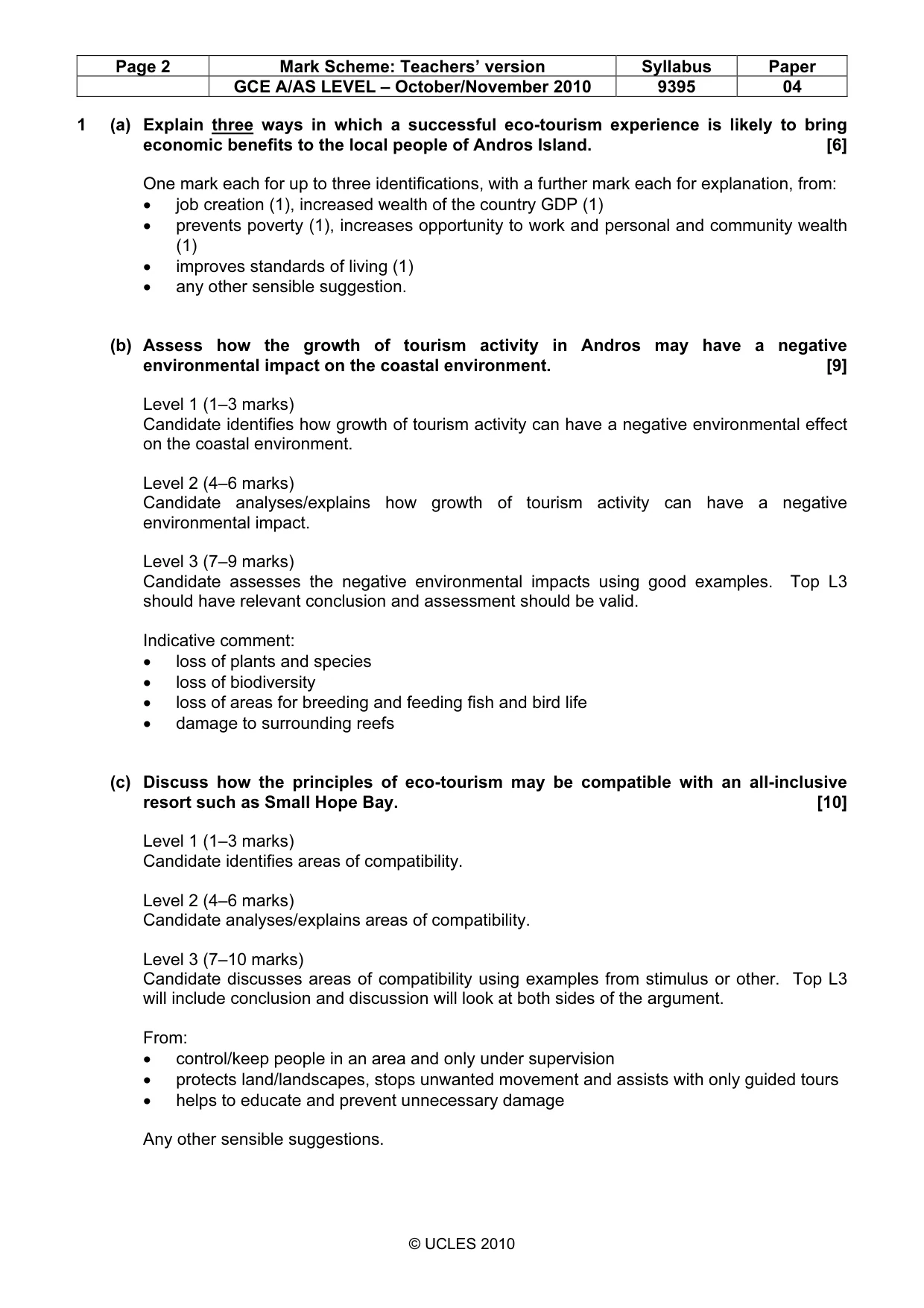
Page 2 Mark Scheme: Teachers’ version Syllabus Paper GCE A/AS LEVEL – October/November 2010 9395 04 © UCLES 2010 1 (a) Explain three ways in which a successful eco-tourism experience is likely to bring economic benefits to the local people of Andros Island. [6] One mark each for up to three identifications, with a further mark each for explanation, from: • job creation (1), increased wealth of the country GDP (1) • prevents poverty (1), increases opportunity to work and personal and community wealth (1) • improves standards of living (1) • any other sensible suggestion. (b) Assess how the growth of tourism activity in Andros may have a negative environmental impact on the coastal environment. [9] Level 1 (1–3 marks) Candidate identifies how growth of tourism activity can have a negative environmental effect on the coastal environment. Level 2 (4–6 marks) Candidate analyses/explains how growth of tourism activity can have a negative environmental impact. Level 3 (7–9 marks) Candidate assesses the negative environmental impacts using good examples. Top L3 should have relevant conclusion and assessment should be valid. Indicative comment: • loss of plants and species • loss of biodiversity • loss of areas for breeding and feeding fish and bird life • damage to surrounding reefs (c) Discuss how the principles of eco-tourism may be compatible with an all-inclusive resort such as Small Hope Bay. [10] Level 1 (1–3 marks) Candidate identifies areas of compatibility. Level 2 (4–6 marks) Candidate analyses/explains areas of compatibility. Level 3 (7–10 marks) Candidate discusses areas of compatibility using examples from stimulus or other. Top L3 will include conclusion and discussion will look at both sides of the argument. From: • control/keep people in an area and only under supervision • protects land/landscapes, stops unwanted movement and assists with only guided tours • helps to educate and prevent unnecessary damage Any other sensible suggestions.
Mark scheme, page 3
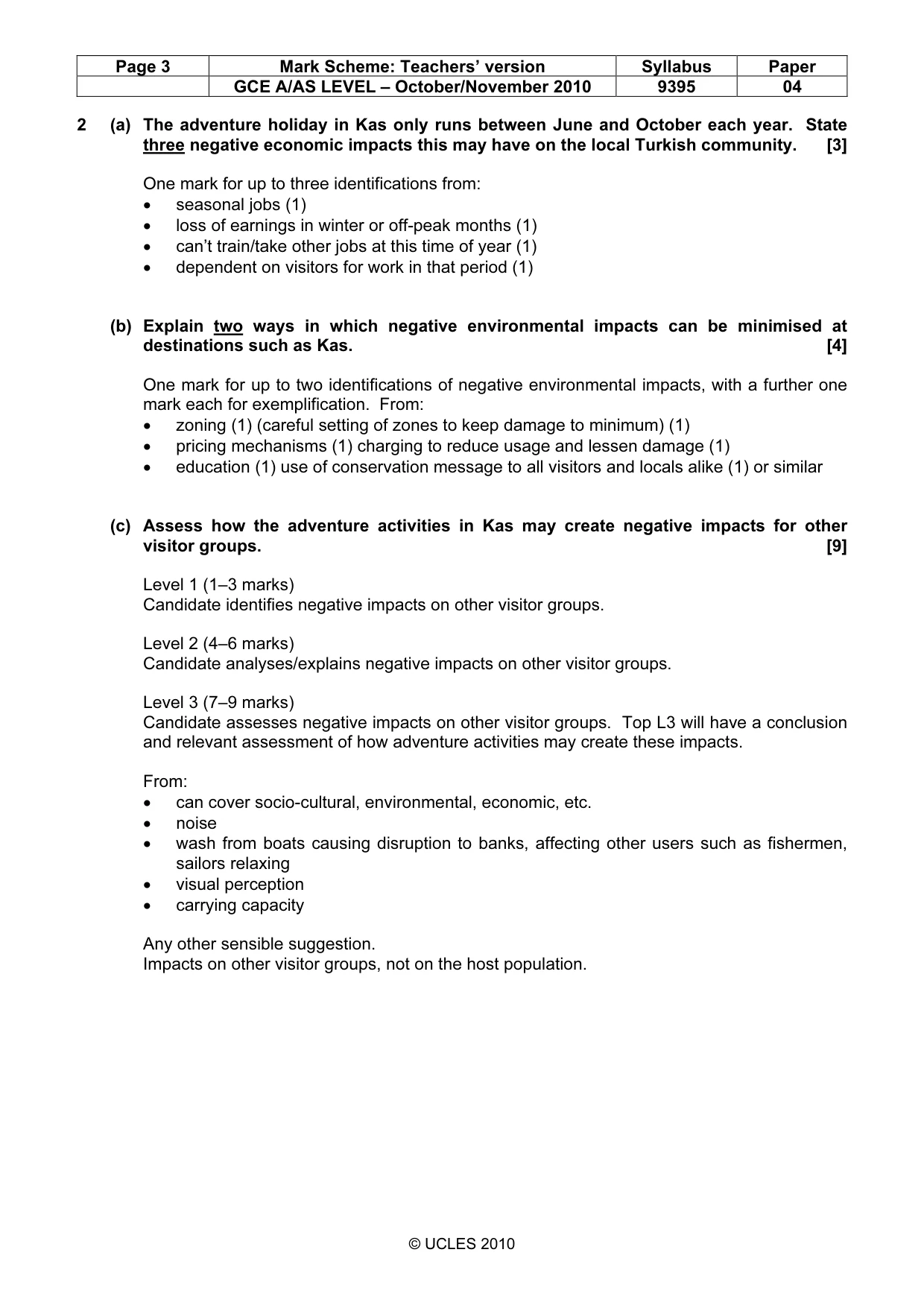
Page 3 Mark Scheme: Teachers’ version Syllabus Paper GCE A/AS LEVEL – October/November 2010 9395 04 © UCLES 2010 2 (a) The adventure holiday in Kas only runs between June and October each year. State three negative economic impacts this may have on the local Turkish community. [3] One mark for up to three identifications from: • seasonal jobs (1) • loss of earnings in winter or off-peak months (1) • can’t train/take other jobs at this time of year (1) • dependent on visitors for work in that period (1) (b) Explain two ways in which negative environmental impacts can be minimised at destinations such as Kas. [4] One mark for up to two identifications of negative environmental impacts, with a further one mark each for exemplification. From: • zoning (1) (careful setting of zones to keep damage to minimum) (1) • pricing mechanisms (1) charging to reduce usage and lessen damage (1) • education (1) use of conservation message to all visitors and locals alike (1) or similar (c) Assess how the adventure activities in Kas may create negative impacts for other visitor groups. [9] Level 1 (1–3 marks) Candidate identifies negative impacts on other visitor groups. Level 2 (4–6 marks) Candidate analyses/explains negative impacts on other visitor groups. Level 3 (7–9 marks) Candidate assesses negative impacts on other visitor groups. Top L3 will have a conclusion and relevant assessment of how adventure activities may create these impacts. From: • can cover socio-cultural, environmental, economic, etc. • noise • wash from boats causing disruption to banks, affecting other users such as fishermen, sailors relaxing • visual perception • carrying capacity Any other sensible suggestion. Impacts on other visitor groups, not on the host population.
Mark scheme, page 4
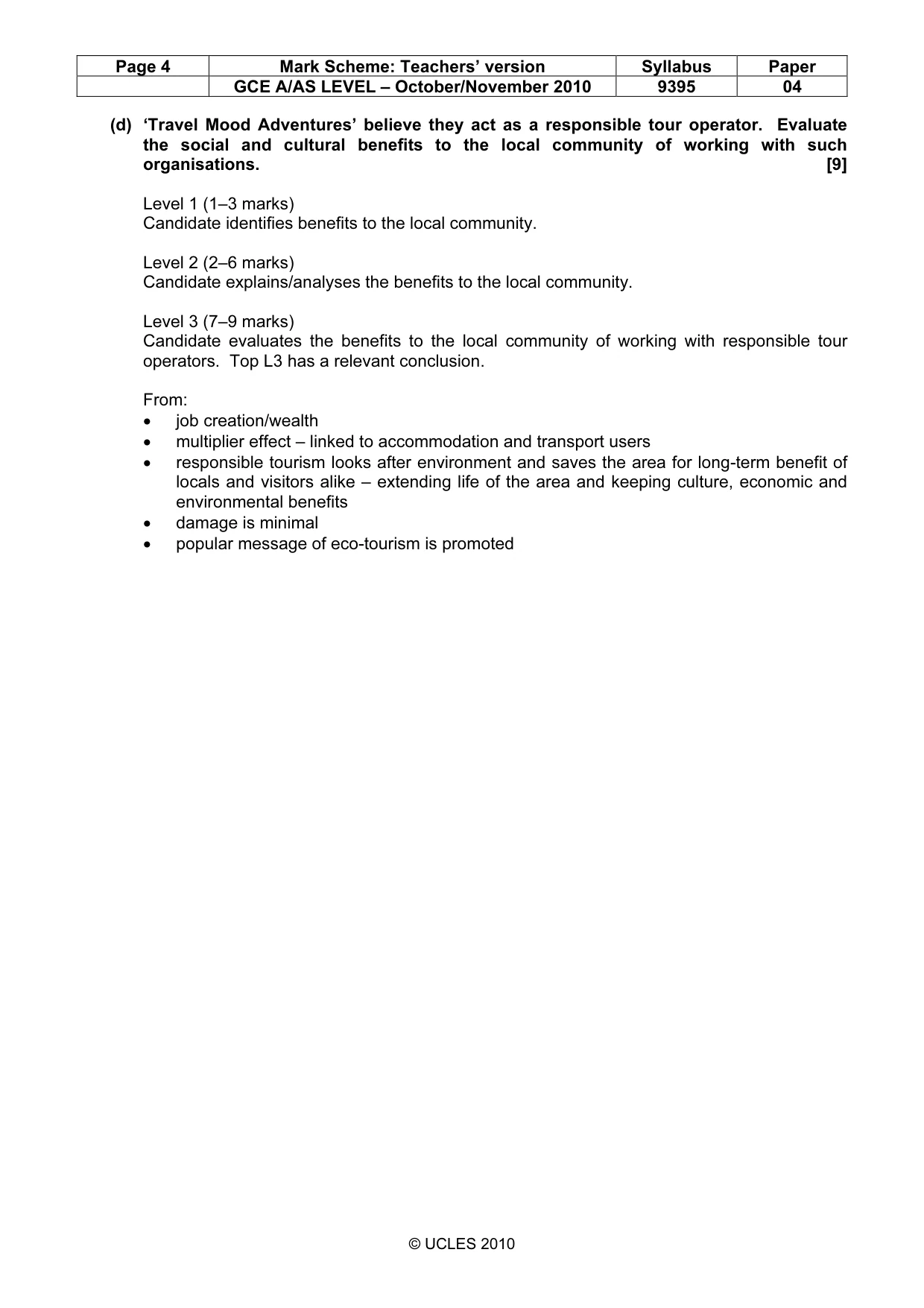
Page 4 Mark Scheme: Teachers’ version Syllabus Paper GCE A/AS LEVEL – October/November 2010 9395 04 © UCLES 2010 (d) ‘Travel Mood Adventures’ believe they act as a responsible tour operator. Evaluate the social and cultural benefits to the local community of working with such organisations. [9] Level 1 (1–3 marks) Candidate identifies benefits to the local community. Level 2 (2–6 marks) Candidate explains/analyses the benefits to the local community. Level 3 (7–9 marks) Candidate evaluates the benefits to the local community of working with responsible tour operators. Top L3 has a relevant conclusion. From: • job creation/wealth • multiplier effect – linked to accommodation and transport users • responsible tourism looks after environment and saves the area for long-term benefit of locals and visitors alike – extending life of the area and keeping culture, economic and environmental benefits • damage is minimal • popular message of eco-tourism is promoted
What you needed in this session
Cambridge’s own grade thresholds for 2010 Oct/Nov, Paper 4 · Variant 1. A higher threshold means an easier paper — the bar moves with how the cohort did.