Cambridge A Level Travel and Tourism 9395 — 2010 Oct/Nov Paper 1 · Variant 1
9395/11/O/N/10 · 100 marks · ≈113 min
The question paper and its mark scheme, free to read here and free to download. This is Cambridge’s own paper, exactly as it was sat.
Question paper20 pages





Mark scheme10 pages
Answers below. Sit the paper first if you are practising.

Paper as text
Question paper, page 1
This document consists of 15 printed pages and 5 blank pages. IB10 11_9395_01/6RP © UCLES 2010 [Turn over *4234077819* For Examiner's Use 1 2 3 4 Total UNIVERSITY OF CAMBRIDGE LOCAL EXAMINATIONS SYNDICATE General Certificate of Education Advanced Subsidiary Level and Advanced Level TRAVEL AND TOURISM 9395/01 Paper 1 Core October/November 2010 2 hours and 30 minutes Candidates answer on the Question Paper. READ THESE INSTRUCTIONS FIRST Write your Centre number, candidate number and name on all the work you hand in. Write in dark blue or black pen. Do not use staples, paper clips, highlighters, glue or correction fluid. You may use a pencil for any diagrams, graphs or rough working. DO NOT WRITE IN ANY BARCODES. Answer all questions. The number of marks is given in brackets [ ] at the end of each question or part question.
Question paper, page 2
2 © UCLES 2010 9395/01/O/N/10 For Examiner's Use Question 1 Refer to Fig. 1, a photograph of the reception area of a major 5 star international hotel. Fig.1 (a) State and explain three advantages to the hotel of having all staff in uniform. 1 2 3 [6] Content removed due to copyright restrictions
Question paper, page 3
3 © UCLES 2010 9395/01/O/N/10 [Turn over For Examiner's Use (b) Explain three customer service skills likely to be needed by the staff shown in Fig.1. Skill 1 Explanation Skill 2 Explanation Skill 3 Explanation [6] (c) Justify the use of a mystery shopper as an appropriate way to assess the visitor experience. [4]
Question paper, page 4
4 © UCLES 2010 9395/01/O/N/10 For Examiner's Use (d) With reference to one job role within a travel and tourism organisation with which you are familiar, assess the importance of teamwork in delivering excellent customer service. Job title and name of organisation [9] [Total: 25]
Question paper, page 5
5 © UCLES 2010 9395/01/O/N/10 [Turn over BLANK PAGE PLEASE TURN OVER FOR QUESTION 2.
Question paper, page 6
6 © UCLES 2010 9395/01/O/N/10 Question 2 Refer to Fig. 2, a news item about hotel development in the Maldives. Centara Hotels and Resorts announces new managed resort in the Maldives Centara Hotels and Resorts, Thailand’s leading hotel group, has invested US$49 million in a new property in the Maldives, which will be their first property outside of Thailand. Centara Grand Island Resort and Spa, located on South Ari Atoll, delivers a unique Premium 5 star resort experience. The resort is relatively close to Male Airport with an air transfer time of just 25 minutes or transfer by speed boat in 85 minutes. For diving enthusiasts, the resort enjoys an excellent local reef complete with a sunken shipwreck and is within easy reach of the top dive spots in Ari Atoll. The Centara Grand Island Resort and Spa provides an exceptional experience for both couples and the family market. Barefoot luxury is combined with an active and varied social programme for both adults and children. The resort's objective is to offer much more than a day-time, water-oriented resort experience. Adults enjoy premium levels of service with a variety of dining options. Children will benefit from the new Centara Hotels and Resorts Kids Club concept offering two venues – Kid Camp and E-zone. Guests will be able to choose from beachfront and over-water accommodation. Luxury Beachfront Pool Villas come complete with their own private pool and membership of the exclusive Island Club. Based around the small pool, Island Club guests enjoy premium levels of attention and service including access to the exclusive Club Lounge with daily servings of complimentary meals, snacks and drinks including evening cocktails and canapés. The private pool features refreshing Spa Cenvaree mist sprays, complimentary mineral water, pre-lunch cold towel service, afternoon fruits and sun bed concierge service. Fig. 2
Question paper, page 7
7 © UCLES 2010 9395/01/O/N/10 [Turn over For Examiner's Use (a) Identify two ways in which the resort will meet the needs of: (i) diving enthusiasts 1 2 (ii) children 1 2 [4] (b) Explain three advantages to guests of “Island Club” membership. 1 2 3 [6]
Question paper, page 8
8 © UCLES 2010 9395/01/O/N/10 For Examiner's Use (c) Centara Hotels and Resorts is a commercial organisation. Explain three likely reasons why it invested US$49 million in this new development. 1 2 3 [6]
Question paper, page 9
9 © UCLES 2010 9395/01/O/N/10 [Turn over For Examiner's Use (d) Discuss the reasons why many 5 star resorts, such as the Centara Grand Island Resort and Spa, have included a spa and health club as part of their facilities. [9] [Total: 25]
Question paper, page 10
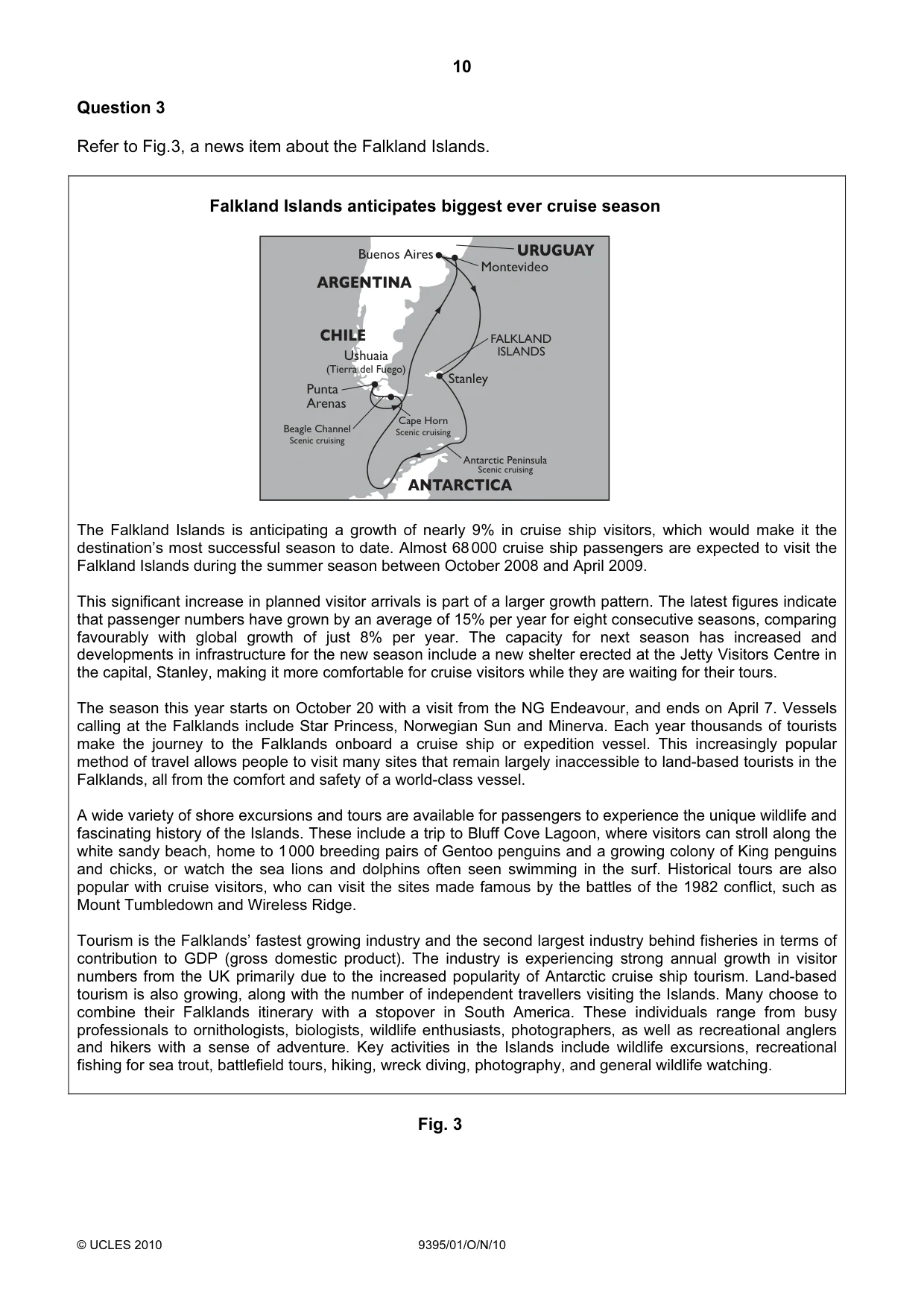
10 © UCLES 2010 9395/01/O/N/10 Question 3 Refer to Fig.3, a news item about the Falkland Islands. Falkland Islands anticipates biggest ever cruise season Buenos Aires Montevideo Stanley FALKLAND ISLANDS Punta Arenas Ushuaia (Tierra del Fuego) Beagle Channel Scenic cruising Cape Horn Scenic cruising Antarctic Peninsula Scenic cruising URUGUAY ARGENTINA CHILE ANTARCTICA The Falkland Islands is anticipating a growth of nearly 9% in cruise ship visitors, which would make it the destination’s most successful season to date. Almost 68 000 cruise ship passengers are expected to visit the Falkland Islands during the summer season between October 2008 and April 2009. This significant increase in planned visitor arrivals is part of a larger growth pattern. The latest figures indicate that passenger numbers have grown by an average of 15% per year for eight consecutive seasons, comparing favourably with global growth of just 8% per year. The capacity for next season has increased and developments in infrastructure for the new season include a new shelter erected at the Jetty Visitors Centre in the capital, Stanley, making it more comfortable for cruise visitors while they are waiting for their tours. The season this year starts on October 20 with a visit from the NG Endeavour, and ends on April 7. Vessels calling at the Falklands include Star Princess, Norwegian Sun and Minerva. Each year thousands of tourists make the journey to the Falklands onboard a cruise ship or expedition vessel. This increasingly popular method of travel allows people to visit many sites that remain largely inaccessible to land-based tourists in the Falklands, all from the comfort and safety of a world-class vessel. A wide variety of shore excursions and tours are available for passengers to experience the unique wildlife and fascinating history of the Islands. These include a trip to Bluff Cove Lagoon, where visitors can stroll along the white sandy beach, home to 1 000 breeding pairs of Gentoo penguins and a growing colony of King penguins and chicks, or watch the sea lions and dolphins often seen swimming in the surf. Historical tours are also popular with cruise visitors, who can visit the sites made famous by the battles of the 1982 conflict, such as Mount Tumbledown and Wireless Ridge. Tourism is the Falklands’ fastest growing industry and the second largest industry behind fisheries in terms of contribution to GDP (gross domestic product). The industry is experiencing strong annual growth in visitor numbers from the UK primarily due to the increased popularity of Antarctic cruise ship tourism. Land-based tourism is also growing, along with the number of independent travellers visiting the Islands. Many choose to combine their Falklands itinerary with a stopover in South America. These individuals range from busy professionals to ornithologists, biologists, wildlife enthusiasts, photographers, as well as recreational anglers and hikers with a sense of adventure. Key activities in the Islands include wildlife excursions, recreational fishing for sea trout, battlefield tours, hiking, wreck diving, photography, and general wildlife watching. Fig. 3
Question paper, page 11
11 © UCLES 2010 9395/01/O/N/10 [Turn over For Examiner's Use (a) Other than wildlife watching, identify four activities popular with tourists visiting the Falkland Islands. 1 2 3 4 [4] (b) Discuss the reasons why Falkland Island tourism is seasonal in nature. [6]
Question paper, page 12
12 © UCLES 2010 9395/01/O/N/10 For Examiner's Use (c) With reference to Fig. 3 explain three pieces of evidence to support the view that the Falkland Islands are in the ‘Development Stage’ of destination evolution. 1 2 3 [6]
Question paper, page 13
13 © UCLES 2010 9395/01/O/N/10 [Turn over For Examiner's Use (d) Assess the main reasons for the current growth in the popularity of cruise holidays. [9] [Total: 25]
Question paper, page 14
14 © UCLES 2010 9395/01/O/N/10 For Examiner's Use Question 4 Refer to photographs A, B, C and D which were taken in destinations popular with particular types of international leisure traveller. Photograph A Photograph B Photograph C Photograph D (a) Complete the following table by identifying which photograph was most likely to have been taken by each type of leisure traveller. TYPE OF LEISURE TRAVELLER PHOTOGRAPH Tourist interested in seeing the wonders of North America’s natural landscape. Family with young children staying at a child friendly destination. Retired couple on a European cultural sightseeing trip. Couple on a luxury winter sun holiday. [4]
Question paper, page 15
15 © UCLES 2010 9395/01/O/N/10 [Turn over For Examiner's Use (b) Explain three marketing and promotion methods that a national tourist board might use in order to increase the number of overseas visitors to the country. 1 2 3 [6] (c) Once at their chosen destination, overseas visitors are likely to visit the local Tourist Information Centre (TIC). Explain three ways in which a TIC is able to provide a service for such visitors. 1 2 3 [6]
Question paper, page 16
16 © UCLES 2010 9395/01/O/N/10 For Examiner's Use (d) Photographs A, B, C and D illustrate that tourism development can take place in contrasting environments. With reference to one destination with which you are familiar, discuss the environmental impacts that have resulted from the development of tourism. Name of chosen destination [9] [Total: 25]
Question paper, page 17
17 © UCLES 2010 9395/01/O/N/10 BLANK PAGE
Question paper, page 18
18 © UCLES 2010 9395/01/O/N/10 BLANK PAGE
Question paper, page 19
19 © UCLES 2010 9395/01/O/N/10 BLANK PAGE
Question paper, page 20
20 Copyright Acknowledgements: Question 1 Question 2 Question 3 Question 4 Photographs A, B, C, D John D Smith © UCLES © The Maldives; eturbonews.com. © http://www.falklands.gov.fk/gallery/index.php?display=4%20-%20Stanley%Ffc3024.jpg. John D Smith © UCLES. Permission to reproduce items where third-party owned material protected by copyright is included has been sought and cleared where possible. Every reasonable effort has been made by the publisher (UCLES) to trace copyright holders, but if any items requiring clearance have unwittingly been included, the publisher will be pleased to make amends at the earliest possible opportunity. University of Cambridge International Examinations is part of the Cambridge Assessment Group. Cambridge Assessment is the brand name of University of Cambridge Local Examinations Syndicate (UCLES), which is itself a department of the University of Cambridge. © UCLES 2010 9395/01/O/N/10 BLANK PAGE
Mark scheme, page 1
UNIVERSITY OF CAMBRIDGE INTERNATIONAL EXAMINATIONS GCE Advanced Subsidiary Level and GCE Advanced Level MARK SCHEME for the October/November 2010 question paper for the guidance of teachers 9395 TRAVEL AND TOURISM 9395/01 Paper 1 (Core Paper), maximum raw mark 100 This mark scheme is published as an aid to teachers and candidates, to indicate the requirements of the examination. It shows the basis on which Examiners were instructed to award marks. It does not indicate the details of the discussions that took place at an Examiners’ meeting before marking began, which would have considered the acceptability of alternative answers. Mark schemes must be read in conjunction with the question papers and the report on the examination. • CIE will not enter into discussions or correspondence in connection with these mark schemes. CIE is publishing the mark schemes for the October/November 2010 question papers for most IGCSE, GCE Advanced Level and Advanced Subsidiary Level syllabuses and some Ordinary Level syllabuses.
Mark scheme, page 2
Page 2 Mark Scheme: Teachers’ version Syllabus Paper GCE A/AS LEVEL – October/November 2010 9395 01 © UCLES 2010 1 (a) State and explain three advantages to the hotel of having all staff in uniform. [6] Award one mark for the identification of each of three valid reasons/advantages and one additional mark for an appropriate explanatory development of each. Valid ideas include: • recognition/easy identification (1) – guests know who to approach (1) • corporate image (1) – all staff maintain a businesslike appearance (1) • staff motivation (1) – company provides appropriate work clothes for employees (1) • cleanliness (1) – staff not in own clothes (1) Credit all valid reasoning. (b) Explain three customer service skills likely to be needed by the staff shown in Fig. 1. [6] Award one mark for the identification of each of three appropriate skills and award a further mark for a valid explanation of each, such as: • communication skills (1) – informing guests (1) • languages (1) – international setting (1) • numeracy (1) – dealing with cash (1) • H&S (1) – accidents (1) • selling skills (1) – taking bookings etc. (1) Credit all valid reasoning. (c) Justify the use of a mystery shopper as an appropriate way to assess the visitor experience. [4] This is essentially about quality control and the candidate can be awarded one mark for the identification of the mystery shopper role and awarded a further mark for a simple explanatory comment. Up to two additional marks can be awarded for a justification of being fit for purpose. Exemplar response: Mystery shopper tries out the product/service and experiences customer service first-hand (1). This is an accurate snapshot of the service environment (1). It is unbiased (1) and is a very representative way to sample customer service procedures in action (1).
Mark scheme, page 3
Page 3 Mark Scheme: Teachers’ version Syllabus Paper GCE A/AS LEVEL – October/November 2010 9395 01 © UCLES 2010 (d) With reference to one job role within a travel and tourism organisation with which you are familiar, assess the importance of teamwork in delivering excellent customer service. [9] This will vary with the example chosen but the key discriminator is the assessment. The question is not about the theory of teamwork but rather its place in operational efficiency. Use Level of Response Criteria Level 1 (1 to 3 marks) – the candidate identifies/describes up to three valid aspects of an identifiable job role/working situation. Level 2 (4 to 6 marks) [4 marks] – the candidate makes valid analytical comment(s) about teamwork in relation to one aspect of the job. [5–6 marks] – the candidate makes valid analytical comment(s) about teamwork in relation to two or more aspects. Level 3 (7 to 9 marks) [7 marks] – the candidate makes valid evaluative comment(s) in relation to the role of teamwork in one or more aspects of the chosen service situation. [8–9 marks] – the candidate makes valid evaluative comment(s) in relation to two or more aspects and comes to a conclusion as to which one(s) are most significant in terms of teamwork’s influence. Exemplar response: e.g. Hotel housekeeping In some hotels, the room attendants work in teams, so that one person strips the beds (L1), another cleans the bathrooms (L1), the beds are made together (L1), and so on. In this way, hotels are a good example of travel and tourism organisations that rely on teamwork and a well-trained staff. The key benefit of teamworking is improved operational efficiency (L2). For example, it may take an hour or longer to service a luxury suite with a sunken Jacuzzi, while in a hotel where the rooms are more basically furnished and similar in style, room attendants will be expected to do 15 or more during their shift. Teamwork allows for the housekeeping function to take place within a given time (L2). The system allows for self-checking to operate, which means that individual team members are responsible for checking their own rooms, subject to spot checks by the floor or head housekeeper, thus reducing supervision and increasing productivity (L3).
Mark scheme, page 4
Page 4 Mark Scheme: Teachers’ version Syllabus Paper GCE A/AS LEVEL – October/November 2010 9395 01 © UCLES 2010 2 (a) (i) Identify two ways in which the resort will meet the needs of diving enthusiasts. [2] Award one mark for the identification of each of two from: • local reef • complete with a sunken ship wreck • resort within easy reach of the top diving spots in Ari Atoll (ii) Identify two ways in which the resort will meet the needs of children. [2] Award one mark for the identification of each of two from: • Kids club • Kid Camp • E-Zone (b) Explain three advantages to guests of “Island Club” membership. [6] Award one mark for the identification of each of three valid ways and award a second mark for an appropriate explanatory comment about each. Correct ideas based on Fig. 2 include: • Island Club guests enjoy premium levels of attention and service (1) including access to the exclusive Club Lounge (1). • Daily servings of complimentary meals, snacks and drinks (1) including complimentary evening cocktails and canapés (1). • The private pool (1) features refreshing Spa Cenvaree mist sprays, complimentary mineral water, pre-lunch cold towel service, afternoon fruits (1). • sun bed concierge service (1) – can order (1). Credit all valid reasoning based on Fig. 2. (c) Centara Hotels and Resorts is a commercial organisation. Explain three likely reasons why it invested US$49 million in this new development. [6] Commercial organisations have certain key characteristics. Candidates should thus answer in context. Award one mark for the identification of each of three valid reasons and then a second mark for an appropriate explanatory comment. Correct ideas thus include: • profitability (1) – maintain/increase their market share (1) • generate dividend for shareholders (1) – they need to make return on investment (1) • revenues are important (1) – target-driven (1) Credit all valid reasoning.
Mark scheme, page 5
Page 5 Mark Scheme: Teachers’ version Syllabus Paper GCE A/AS LEVEL – October/November 2010 9395 01 © UCLES 2010 (d) Discuss the reasons why many 5 star resorts, such as the Centara Grand Island Resort and Spa, have included a spa and health club as part of their facilities. [9] This question is set in the context of customer trends and candidates are expected to consider current international traveller 5 star needs and expectations. There is a strong demand from the leisure-travelling public who are adopting a more health-conscious lifestyle and who are prepared to spend serious amounts of money on personal wellbeing. This has resulted in the segmentation of users into three identifiable groups, depending on their level of participation. Many resort hotels have introduced spa facilities to help attract customers. The current trend for health and wellbeing means that many guests will expect such facilities. The more facilities offered, the greater the potential appeal of the resort and so income generation will increase. As well as beauty and health treatments, sport and recreation opportunities will be available, allowing visitors more choice of leisure activity. Use Level of Response Criteria Level 1 (1 to 3 marks) – the candidate identifies/describes up to three valid reasons. Level 2 (4 to 6 marks) [4 marks] – the candidate makes valid analytical comment(s) about one reason. [5–6 marks] – the candidate makes valid analytical comment(s) about two or more reasons. Level 3 (7 to 9 marks) [7 marks] – the candidate makes valid evaluative comment(s) in relation to one or more reasons. [8–9 marks] – the candidate makes valid evaluative comment(s) in relation to two or more reasons and comes to a conclusion as to which one(s) are most significant. Exemplar response: Many resort hotels have introduced spa facilities to help attract customers (L1). It has become common to see major resort properties throughout the world developing spas as part of their leisure facilities (L1) and clients usually have a range of options including: • full body massage • manicure or pedicure • facial • body scrub or wrap • aromatherapy • hydrotherapy treatment. Spa travellers tend to agree that the most important factors to consider when choosing a spa vacation destination are the quality of the accommodation, personalised service, cost/value for money and the type and range of spa treatments available (L2). The current trend for health and wellbeing means that many guests will expect a range of facilities. The more facilities offered, the greater the potential appeal of the resort and so income generation will increase (L3). As well as beauty and health treatments, sport and recreation opportunities will be available, allowing visitors more choice of leisure activity. Furthermore, when combined with the provision of child-related services (babysitting services, children’s programmes) and outdoor activities (golf, tennis, skiing), spa services offer further guest relaxation opportunities. These circumstances largely explain the recent trend in the spa industry of linking golf/spa and ski/spa as sought-after leisure travel combinations (L3).
Mark scheme, page 6
Page 6 Mark Scheme: Teachers’ version Syllabus Paper GCE A/AS LEVEL – October/November 2010 9395 01 © UCLES 2010 3 (a) Other than wildlife watching, identify four activities popular with tourists visiting the Falkland Islands. [4] Award one mark for the identification of each of four from: • recreational fishing for sea trout • battlefield tours • hiking/walking • wreck diving • photography (b) Discuss the reasons why Falkland Island tourism is seasonal in nature. [6] Candidates may regard this as obvious but the climatic conditions need to be considered in proper context, as indicated in Fig. 3. It is not so much the climate of the Falklands, but the fact that most visitors are en route to Antarctica. Furthermore, the wildlife (one of the major attractions) is also seasonal and the majority of tourist activities take place outdoors. Use Level of Response Criteria Level 1 (1 or 2 marks) – the candidate identifies/describes one or two valid reasons such as those mentioned above. Level 2 (3 or 4 marks) – the candidate analyses one or two appropriate reasons. Level 3 (5 or 6 marks) – the candidate evaluates the identified reasons and comes to a conclusion as to which one(s) are most significant. Exemplar response: The season lasts from late October to early April, summer in the southern hemisphere (L1). Outside this time the climate is too harsh for cruise visitors (L1) as low temperatures, rough seas and icebergs are all hazards (L2). Also, the wildlife will be seasonal (L1) in their habitat and visits will not take place when there is little to see (L2). However, as most cruises call on their way to Antarctica, such travel can only take place in summer when seas are ice-free (L3). (c) With reference to Fig. 3 explain three pieces of evidence to support the view that the Falkland Islands are in the ‘Development Stage’ of destination evolution. [6] This is clearly set in terms of the Butler model. Award one mark for the identification of each of three pieces of Fig. 3 evidence that suggest the Development Stage and award a second mark for a valid explanatory comment about each. Correct ideas thus include: • 68,000 forecast (1) – significant increase in planned arrivals (1) • passenger numbers have grown by an average of 15% per annum for eight consecutive seasons (1) – clearly developing still (1) • the capacity for next season has increased (1) – and developments in infrastructure (1) for the new season include a new shelter erected at the Jetty Visitors Centre • numbers still low in absolute terms (1) – room for continued growth (1) • infrastructure and facilities are also still quite limited (1) – room for more (1) Credit all valid reasoning based on Fig. 3.
Mark scheme, page 7
Page 7 Mark Scheme: Teachers’ version Syllabus Paper GCE A/AS LEVEL – October/November 2010 9395 01 © UCLES 2010 (d) Assess the main reasons for the current growth in the popularity of cruise holidays. [9] In the early 2000s, the number of cruise passengers worldwide grew by between 8% and 9% a year. In the longer term, South East Asia has enormous potential for the development of cruise holidays. Cruise trends in the UK include a rise in the popularity of mass-market cruise holidays lasting a week or more, a fall in demand for premium-cost cruises and an increase in budget cruising. Key factors influencing this and all leisure tourism include: • aging world population (western countries) • active lifestyle of older traveller • development of emerging markets • growing disposable income of the youth market segment • increased awareness about impact of tourism on environment etc. The above will decisively influence the number of tourists, motivation, destination and product choices as well as activities of future travellers. Use Level of Response Criteria Level 1 (1 to 3 marks) – the candidate identifies/describes up to three valid reasons for the growth of the cruise market – including key features of the product(s). Level 2 (4 to 6 marks) [4 marks] – the candidate makes valid analytical comment(s) about one key reason. [5–6 marks] – the candidate makes valid analytical comment(s) about two or more reasons. Level 3 (7 to 9 marks) [7 marks] – the candidate makes valid evaluative comment(s) in relation to one or more aspects of a key reason. [8–9 marks] – the candidate makes valid evaluative comment(s) in relation to two or more reasons and comes to a conclusion as to which one(s) are most significant in terms of cruise market growth. Exemplar response: Key factors influencing cruising within the leisure tourism marketplace include the more active lifestyle of the older traveller, the development of new emerging markets and the growing disposable income of the key market segments (L1). The all-inclusive nature of cruises offers excellent value for money (L2) and the facilities on board cater for a range of interests, be they active or passive (L2). One of the main attractions is visiting different destinations and new itineraries are constantly being introduced (L3), together with a range of large luxury vessels. The market has room for further growth.
Mark scheme, page 8
Page 8 Mark Scheme: Teachers’ version Syllabus Paper GCE A/AS LEVEL – October/November 2010 9395 01 © UCLES 2010 4 (a) Complete the following table by identifying which photograph was most likely to have been taken by each type of leisure traveller. [4] Award one mark for each, as follows: N. American natural landscape = D Children-friendly destination = B Cultural sightseeing trip = A Winter sun holiday = C (b) Explain three marketing and promotion methods that a national tourist board might use in order to increase the number of overseas visitors to the country. [6] Award one mark for the identification of each of three valid methods and award a second mark for an appropriate explanatory comment about each. Correct ideas include: • website (1) – worldwide access (1) • familiarisation trips (1) – host travel agents (1) • attend trade fairs (1) – showcase country and destinations (1) • media campaigns (1) – advertising (1) • overseas offices (1) – develop key markets (1) Credit all valid reasoning. (c) Once at their chosen destination, overseas visitors are likely to visit the local Tourist Information Centre (TIC). Explain three ways in which a TIC is able to provide a service for such visitors. [6] Award one mark for the identification of each of three valid ways and award a second mark for an appropriate explanatory comment about each. Correct ideas include: • visitor attraction information (1) – advice where to go (1) • staff speak foreign languages (1) – easy to understand (1) • accommodation services (1) – e.g. UK’s Book a Bed Ahead (BABA) scheme (1) • souvenirs etc. (1) – appeal to visitors (1) • Bureau de Change (1) – convenient (1) • sell tickets for tours, events (1) – convenient for visitor Credit all valid reasoning.
Mark scheme, page 9
Page 9 Mark Scheme: Teachers’ version Syllabus Paper GCE A/AS LEVEL – October/November 2010 9395 01 © UCLES 2010 (d) Photographs A, B, C and D illustrate that tourism development can take place in contrasting environments. With reference to one destination with which you are familiar, discuss the environmental impacts that have resulted from the development of tourism. [9] This is quite specific and the impacts mentioned should relate to an identifiable destination. Credit both positives and negatives without restriction. They should identify and explain examples of positive effects, e.g.: • conservation of heritage sites • regeneration and redevelopment of derelict sites • pollution controls • traffic management schemes etc. Identify examples of negative effects, e.g.: • urban sprawl • traffic congestion • ‘honeypot’ sites • footpath erosion • loss of open space • water supply issues • wildlife habitat disruption/loss • loss of bio-diversity • water and air pollution issues Use Level of Response Criteria Level 1 (1 to 3 marks) – the candidate identifies/describes up to three valid impacts. Level 2 (4 to 6 marks) [4 marks] – the candidate makes valid analytical comment(s) about one impact. [5–6 marks] – the candidate makes valid analytical comment(s) about two or more impacts. Level 3 (7 to 9 marks) [7 marks] – the candidate makes valid evaluative comment(s) in relation to one or more impacts. [8–9 marks] – the candidate makes valid evaluative comment(s) in relation to two or more impacts and comes to a conclusion as to which one(s) are most significant in terms of their chosen destination. Exemplar response: e.g. Machu Picchu in Peru The reserve around Machu Picchu, located in the Peruvian Andes 480 km south east of Lima, was set up by the Peruvian Government in 1981. The site is of ecological significance because of its diverse and fragile ecosystems, including rare species of orchids and the endangered spectacled bear. The ruins of this highly important Inca city lie 2,430 m above sea-level in the upper Amazon basin, with a spectacular setting overlooking the River Urubamba. It lies on a 500 year-old partly paved route, called the Inca Trail. UNESCO designated Machu Picchu a World Heritage Site in 1983. Physically, the whole reserve, but especially the city site and trail, is under permanent threat of degradation (L1) due to its fragile ecological balance. Furthermore, because of its precarious position with steep slopes and heavy seasonal rainfall, it is at risk from severe mudslides and erosion (L1). Fires that are set off by local farmers desperate to make a subsistence living in the harsh environment are an added problem. Tourists using the same trail over and over again trample the vegetation and soil (L1), eventually causing damage that can lead to loss of biodiversity and other impacts (L2). Such damage can be even more extensive when visitors frequently stray off established trails (L2).
Mark scheme, page 10
Page 10 Mark Scheme: Teachers’ version Syllabus Paper GCE A/AS LEVEL – October/November 2010 9395 01 © UCLES 2010 The main threat to this whole site is the sheer pressure of visitor numbers. Up to 2,000 people visit Machu Picchu itself daily, with visitor numbers growing at 6% per year. These tourists largely contribute to pollution in the area by leaving rubbish along the banks of the Urubamba River and untreated sewage within it (L3). Problems are focused also on the campsites for backpacking groups, unregulated latrines and issues of waste disposal. The site has become a ‘honeypot’, with frequently over 1,000 people all trying to see sunrise in Machu Picchu at the same time (L3).
What you needed in this session
Cambridge’s own grade thresholds for 2010 Oct/Nov, Paper 1 · Variant 1. A higher threshold means an easier paper — the bar moves with how the cohort did.