Cambridge A Level Travel and Tourism 9395 — 2010 May/June Paper 4 · Variant 1
9395/41/M/J/10 · 50 marks · ≈56 min
The question paper and its mark scheme, free to read here and free to download. This is Cambridge’s own paper, exactly as it was sat.
Question paper12 pages


Mark scheme5 pages
Answers below. Sit the paper first if you are practising.
Paper as text
Question paper, page 1
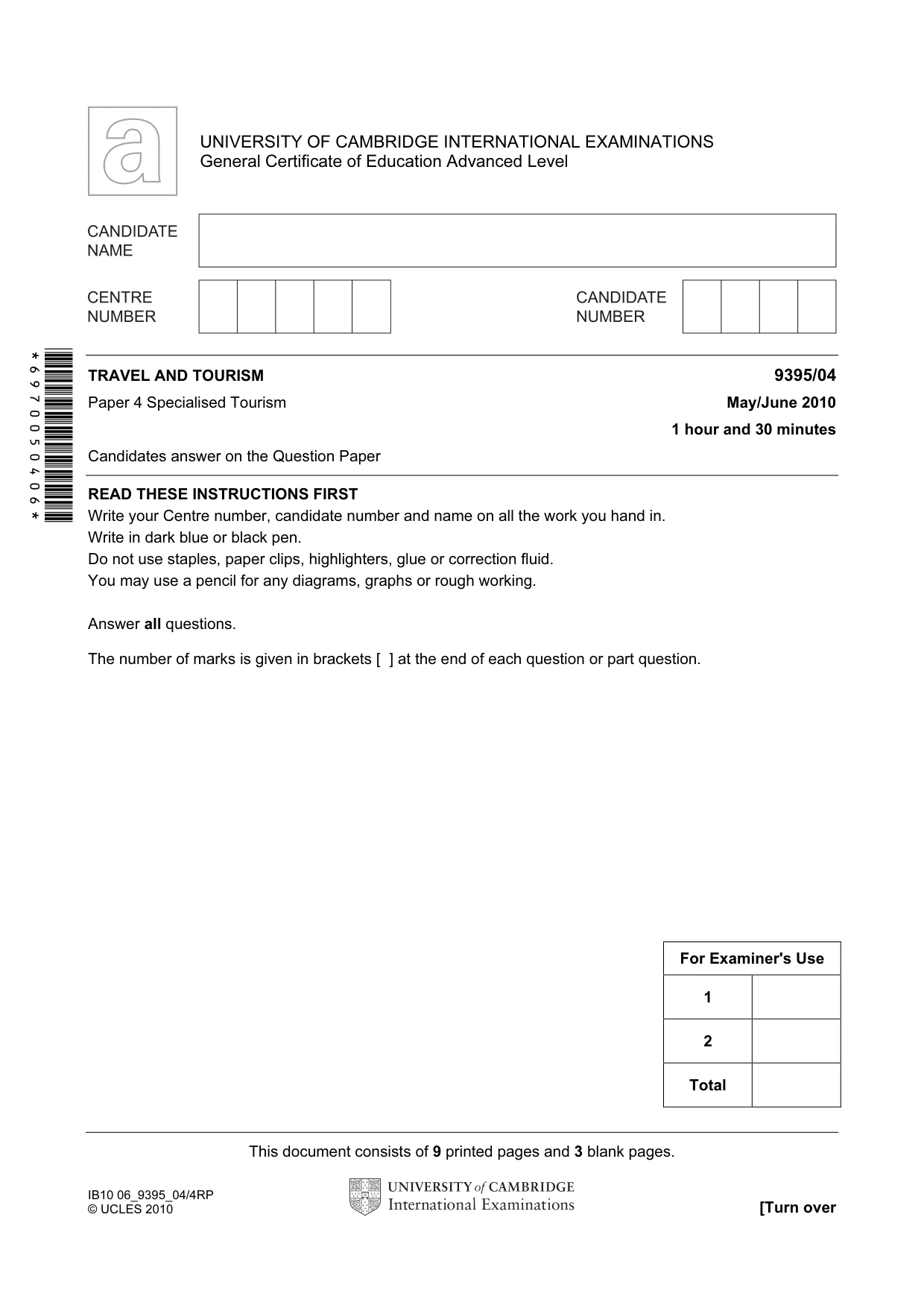
This document consists of 9 printed pages and 3 blank pages. IB10 06_9395_04/4RP © UCLES 2010 [Turn over *6970050406* For Examiner's Use 1 2 Total UNIVERSITY OF CAMBRIDGE INTERNATIONAL EXAMINATIONS General Certificate of Education Advanced Level TRAVEL AND TOURISM 9395/04 Paper 4 Specialised Tourism May/June 2010 1 hour and 30 minutes Candidates answer on the Question Paper READ THESE INSTRUCTIONS FIRST Write your Centre number, candidate number and name on all the work you hand in. Write in dark blue or black pen. Do not use staples, paper clips, highlighters, glue or correction fluid. You may use a pencil for any diagrams, graphs or rough working. Answer all questions. The number of marks is given in brackets [ ] at the end of each question or part question.
Question paper, page 2
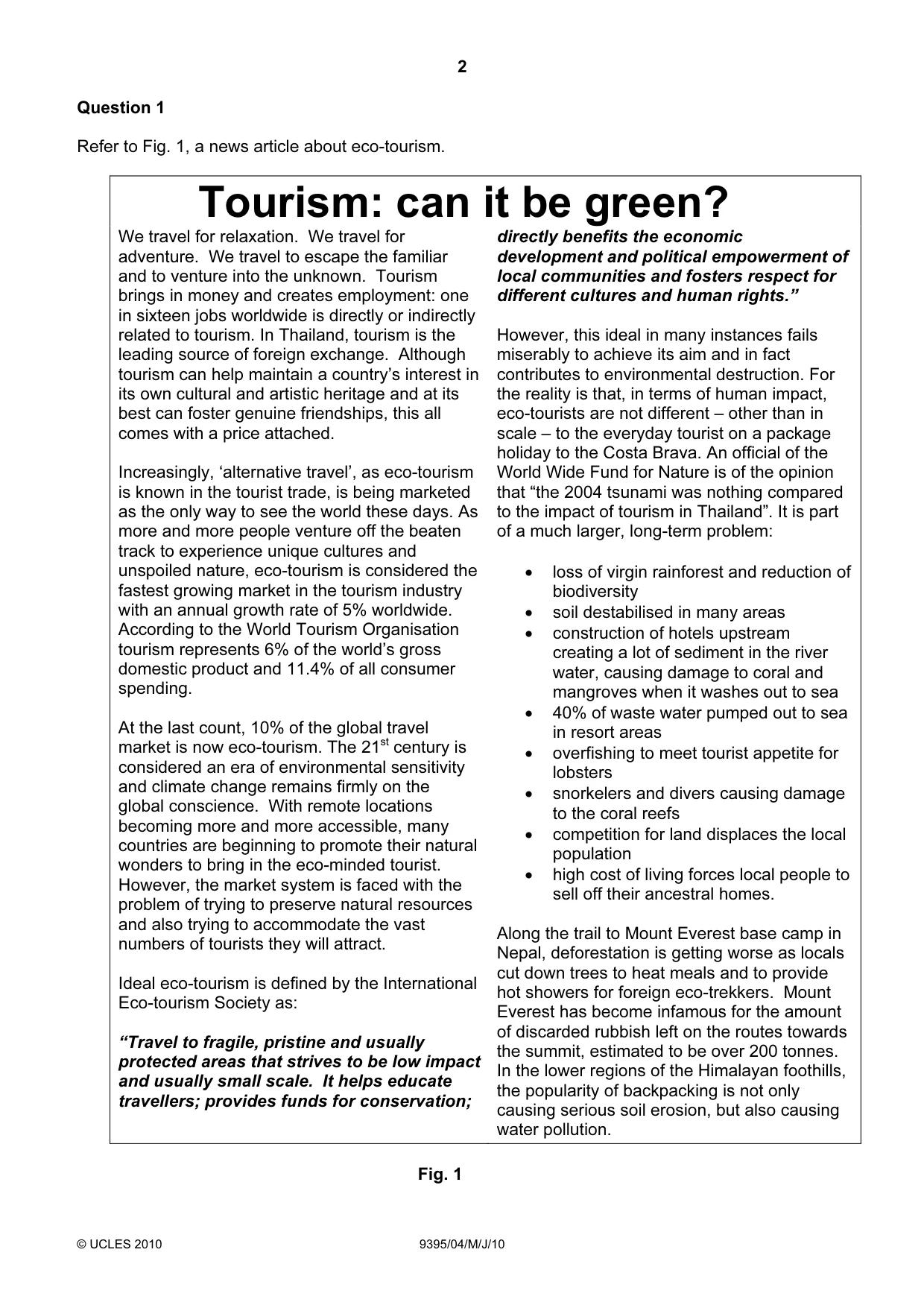
2 © UCLES 2010 9395/04/M/J/10 Question 1 Refer to Fig. 1, a news article about eco-tourism. Tourism: can it be green? We travel for relaxation. We travel for adventure. We travel to escape the familiar and to venture into the unknown. Tourism brings in money and creates employment: one in sixteen jobs worldwide is directly or indirectly related to tourism. In Thailand, tourism is the leading source of foreign exchange. Although tourism can help maintain a country’s interest in its own cultural and artistic heritage and at its best can foster genuine friendships, this all comes with a price attached. Increasingly, ‘alternative travel’, as eco-tourism is known in the tourist trade, is being marketed as the only way to see the world these days. As more and more people venture off the beaten track to experience unique cultures and unspoiled nature, eco-tourism is considered the fastest growing market in the tourism industry with an annual growth rate of 5% worldwide. According to the World Tourism Organisation tourism represents 6% of the world’s gross domestic product and 11.4% of all consumer spending. At the last count, 10% of the global travel market is now eco-tourism. The 21st century is considered an era of environmental sensitivity and climate change remains firmly on the global conscience. With remote locations becoming more and more accessible, many countries are beginning to promote their natural wonders to bring in the eco-minded tourist. However, the market system is faced with the problem of trying to preserve natural resources and also trying to accommodate the vast numbers of tourists they will attract. Ideal eco-tourism is defined by the International Eco-tourism Society as: “Travel to fragile, pristine and usually protected areas that strives to be low impact and usually small scale. It helps educate travellers; provides funds for conservation; directly benefits the economic development and political empowerment of local communities and fosters respect for different cultures and human rights.” However, this ideal in many instances fails miserably to achieve its aim and in fact contributes to environmental destruction. For the reality is that, in terms of human impact, eco-tourists are not different – other than in scale – to the everyday tourist on a package holiday to the Costa Brava. An official of the World Wide Fund for Nature is of the opinion that “the 2004 tsunami was nothing compared to the impact of tourism in Thailand”. It is part of a much larger, long-term problem: • loss of virgin rainforest and reduction of biodiversity • soil destabilised in many areas • construction of hotels upstream creating a lot of sediment in the river water, causing damage to coral and mangroves when it washes out to sea • 40% of waste water pumped out to sea in resort areas • overfishing to meet tourist appetite for lobsters • snorkelers and divers causing damage to the coral reefs • competition for land displaces the local population • high cost of living forces local people to sell off their ancestral homes. Along the trail to Mount Everest base camp in Nepal, deforestation is getting worse as locals cut down trees to heat meals and to provide hot showers for foreign eco-trekkers. Mount Everest has become infamous for the amount of discarded rubbish left on the routes towards the summit, estimated to be over 200 tonnes. In the lower regions of the Himalayan foothills, the popularity of backpacking is not only causing serious soil erosion, but also causing water pollution. Fig. 1
Question paper, page 3
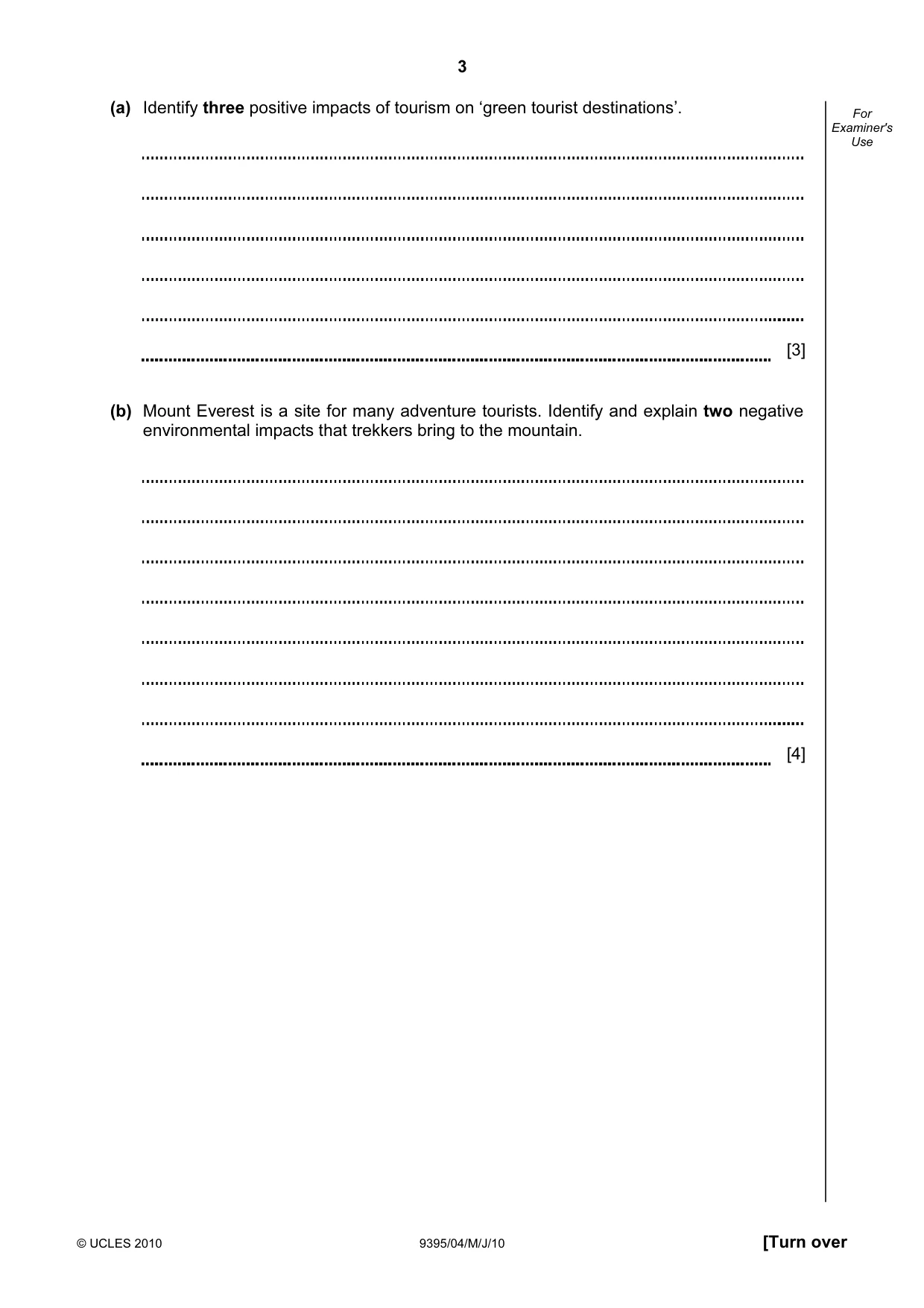
3 © UCLES 2010 9395/04/M/J/10 [Turn over For Examiner's Use (a) Identify three positive impacts of tourism on ‘green tourist destinations’. [3] (b) Mount Everest is a site for many adventure tourists. Identify and explain two negative environmental impacts that trekkers bring to the mountain. [4]
Question paper, page 4
4 © UCLES 2010 9395/04/M/J/10 For Examiner's Use (c) Discuss reasons why the World Wide Fund for Nature official thinks that the “2004 tsunami was nothing compared to the impact of tourism in Thailand”. [9]
Question paper, page 5
5 © UCLES 2010 9395/04/M/J/10 [Turn over For Examiner's Use (d) Fig. 1 gives a very negative view of eco-tourism. With reference to one eco-tourism project with which you are familiar, evaluate its successes on a local scale. Name of project: [9] [Total: 25]
Question paper, page 6
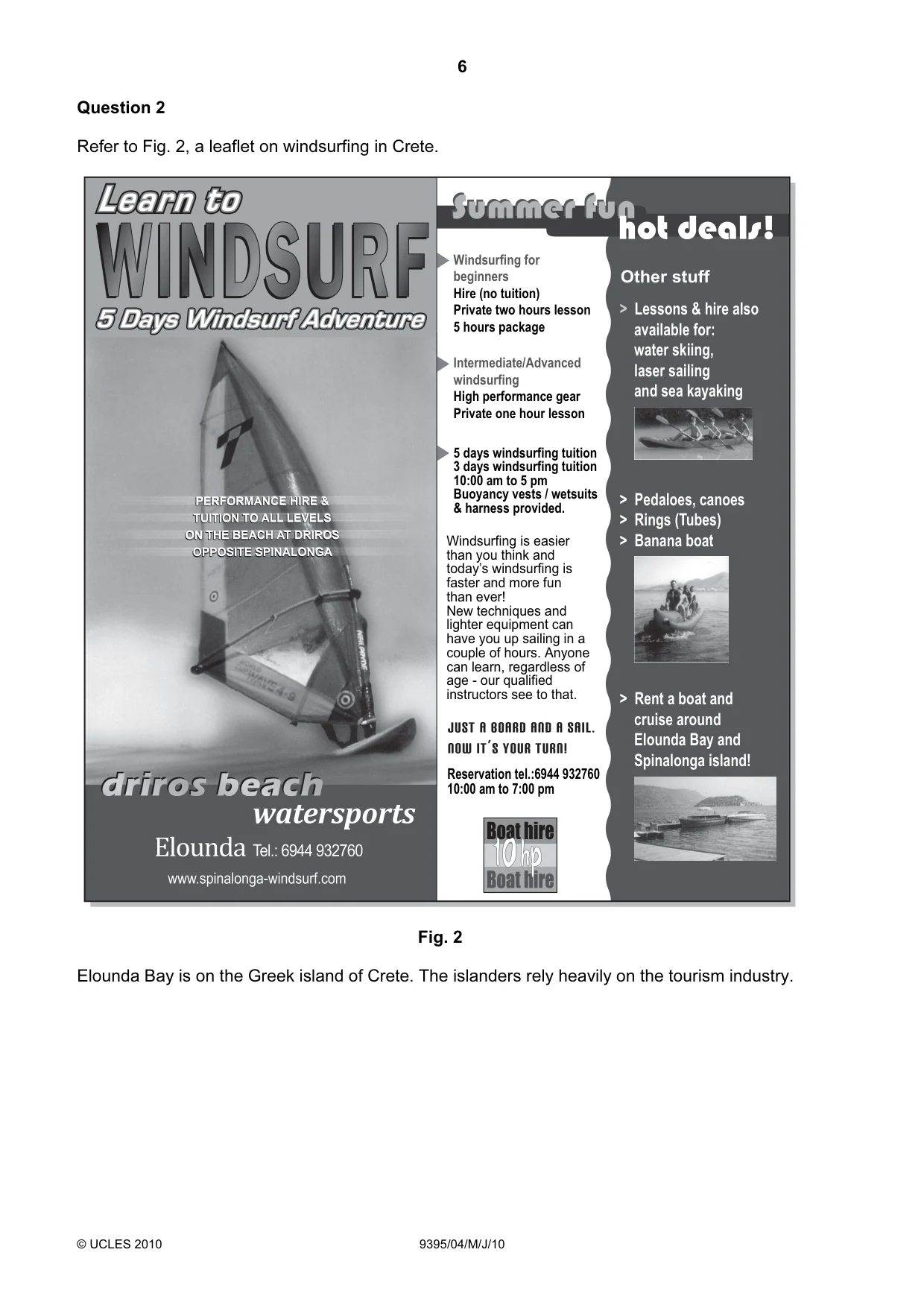
6 © UCLES 2010 9395/04/M/J/10 Question 2 Refer to Fig. 2, a leaflet on windsurfing in Crete. Other stuff > Lessons & hire also available for: water skiing, laser sailing and sea kayaking Windsurfing for beginners Hire (no tuition) Private two hours lesson 5 hours package Intermediate/Advanced windsurfing High performance gear Private one hour lesson Windsurfing is easier than you think and today’s windsurfing is faster and more fun than ever! New techniques and lighter equipment can have you up sailing in a couple of hours. Anyone can learn, regardless of age - our qualified instructors see to that. Reservation tel.:6944 932760 10:00 am to 7:00 pm 5 days windsurfing tuition 3 days windsurfing tuition 10:00 am to 5 pm Buoyancy vests / wetsuits & harness provided. > Pedaloes, canoes > Rings (Tubes) > Banana boat > Rent a boat and cruise around Elounda Bay and Spinalonga island! Fig. 2 Elounda Bay is on the Greek island of Crete. The islanders rely heavily on the tourism industry.
Question paper, page 7
7 © UCLES 2010 9395/04/M/J/10 [Turn over For Examiner's Use (a) Identify and explain three ways in which adventure tourism has encouraged the growth of businesses in Elounda Bay. [6]
Question paper, page 8
8 © UCLES 2010 9395/04/M/J/10 For Examiner's Use (b) Assess the problems that an over-reliance on tourism may bring to local communities similar to those on the Greek Islands. [9]
Question paper, page 9
9 © UCLES 2010 9395/04/M/J/10 For Examiner's Use (c) Discuss how the cultures and traditions of host populations may conflict with the pursuits of adventure tourists. [Total: 25] [10]
Question paper, page 10
10 © UCLES 2010 9395/04/M/J/10 BLANK PAGE
Question paper, page 11
11 © UCLES 2010 9395/04/M/J/10 BLANK PAGE
Question paper, page 12
12 Copyright acknowledgements: Figure 1 Figure 2 © Socialist Standard; Socialist Party of Great Britain; July 2008. © Learn to Windsurf; Elounda, Island of Crete; Driros Beach Watersports. Permission to reproduce items where third-party owned material protected by copyright is included has been sought and cleared where possible. Every reasonable effort has been made by the publisher (UCLES) to trace copyright holders, but if any items requiring clearance have unwittingly been included, the publisher will be pleased to make amends at the earliest possible opportunity. University of Cambridge International Examinations is part of the Cambridge Assessment Group. Cambridge Assessment is the brand name of University of Cambridge Local Examinations Syndicate (UCLES), which is itself a department of the University of Cambridge. © UCLES 2010 9395/04/M/J/10 BLANK PAGE
Mark scheme, page 1
UNIVERSITY OF CAMBRIDGE INTERNATIONAL EXAMINATIONS GCE Advanced Subsidiary Level and GCE Advanced Level MARK SCHEME for the May/June 2010 question paper for the guidance of teachers 9395 TRAVEL AND TOURISM 9395/04 Paper 4 (Specialised Tourism), maximum raw mark 50 This mark scheme is published as an aid to teachers and candidates, to indicate the requirements of the examination. It shows the basis on which Examiners were instructed to award marks. It does not indicate the details of the discussions that took place at an Examiners’ meeting before marking began, which would have considered the acceptability of alternative answers. Mark schemes must be read in conjunction with the question papers and the report on the examination. • CIE will not enter into discussions or correspondence in connection with these mark schemes. CIE is publishing the mark schemes for the May/June 2010 question papers for most IGCSE, GCE Advanced Level and Advanced Subsidiary Level syllabuses and some Ordinary Level syllabuses.
Mark scheme, page 2
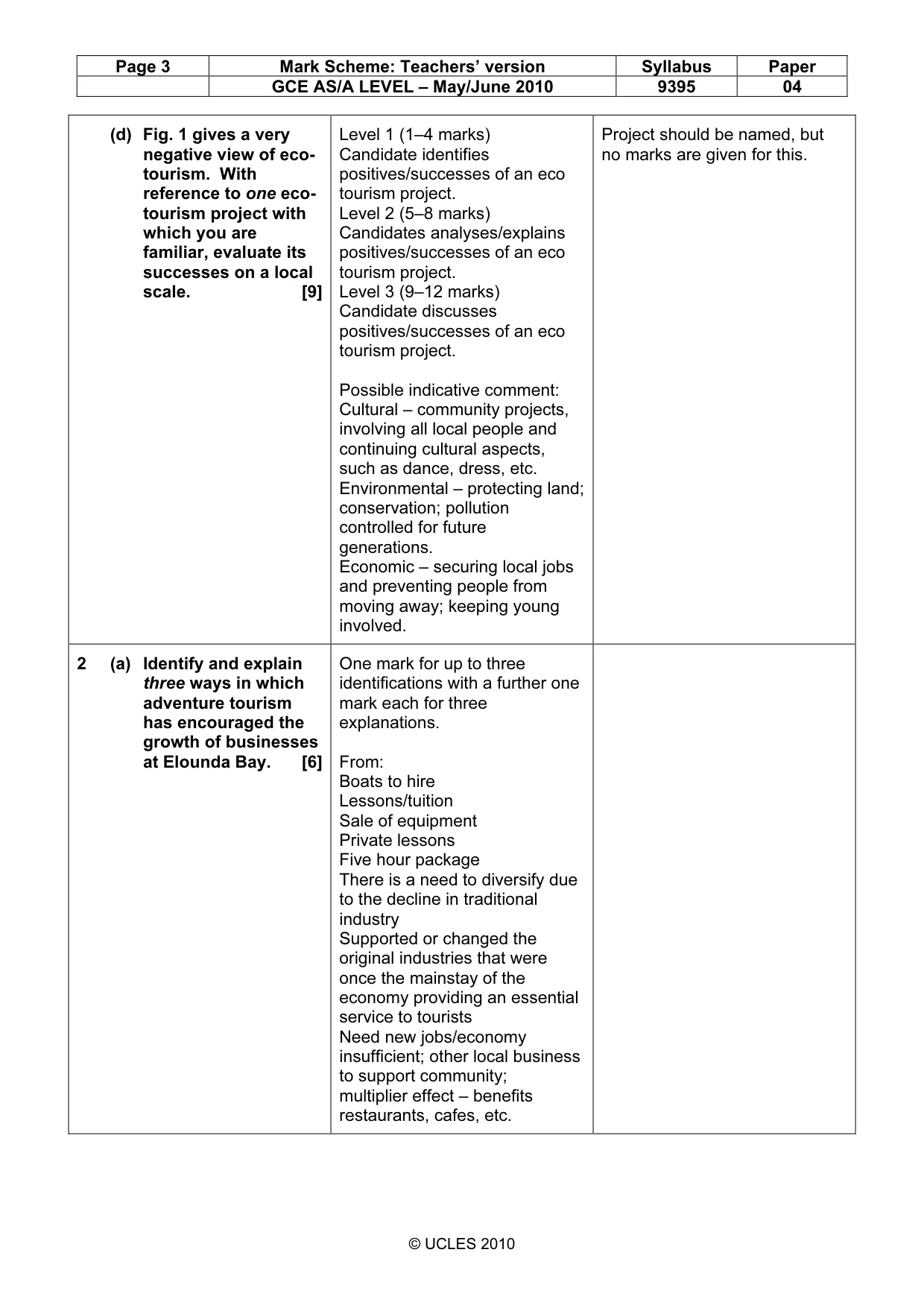
Page 2 Mark Scheme: Teachers’ version Syllabus Paper GCE AS/A LEVEL – May/June 2010 9395 04 © UCLES 2010 Question Answer Guidance 1 (a) Identify three positive impacts of tourism on ‘green tourist destinations’. [3] [1 × 3] One mark for up to three identifications from: • Brings in wealth • Creates employment • In Thailand tourism is main source of foreign exchange • Maintain a country’s interest in its own cultural and artistic heritage • Foster genuine friendships (b) Mount Everest is a site for many adventure tourists. Identify and explain two negative environmental impacts that trekkers bring to the mountain. [4] [2 × 2] One mark each for up to two identifications with a further two marks for exemplification. Discarded rubbish left on routes towards summit (1) 2000 tons (1) Soil erosion (1) caused by lots of walker trampling (1) Water pollution (1) visitor causing pollution waste increased (1) (c) Discuss reasons why the World Wildlife Fund for Nature official thinks that the “2004 tsunami was nothing compared to the impact of tourism in Thailand.” [9] Level of response, 1, 2, 3 Level 1 (1–3 marks) Candidate identifies reasons Level 2 (4–6 marks) Candidate explains the reasons Level 3 (7–9 marks) Candidate evaluates the reasons Indicative comment: • expensive land • people forced to sell ancestral homes losing only asset • competition for schools • local community suffer • over-fishing • corals damaged • lost biodiversity • lost primary forest/soil • building of hotels upstream is creating a lot of sediment in the water • also affects mangroves on east coast • waste water still pumped out to sea
Mark scheme, page 3
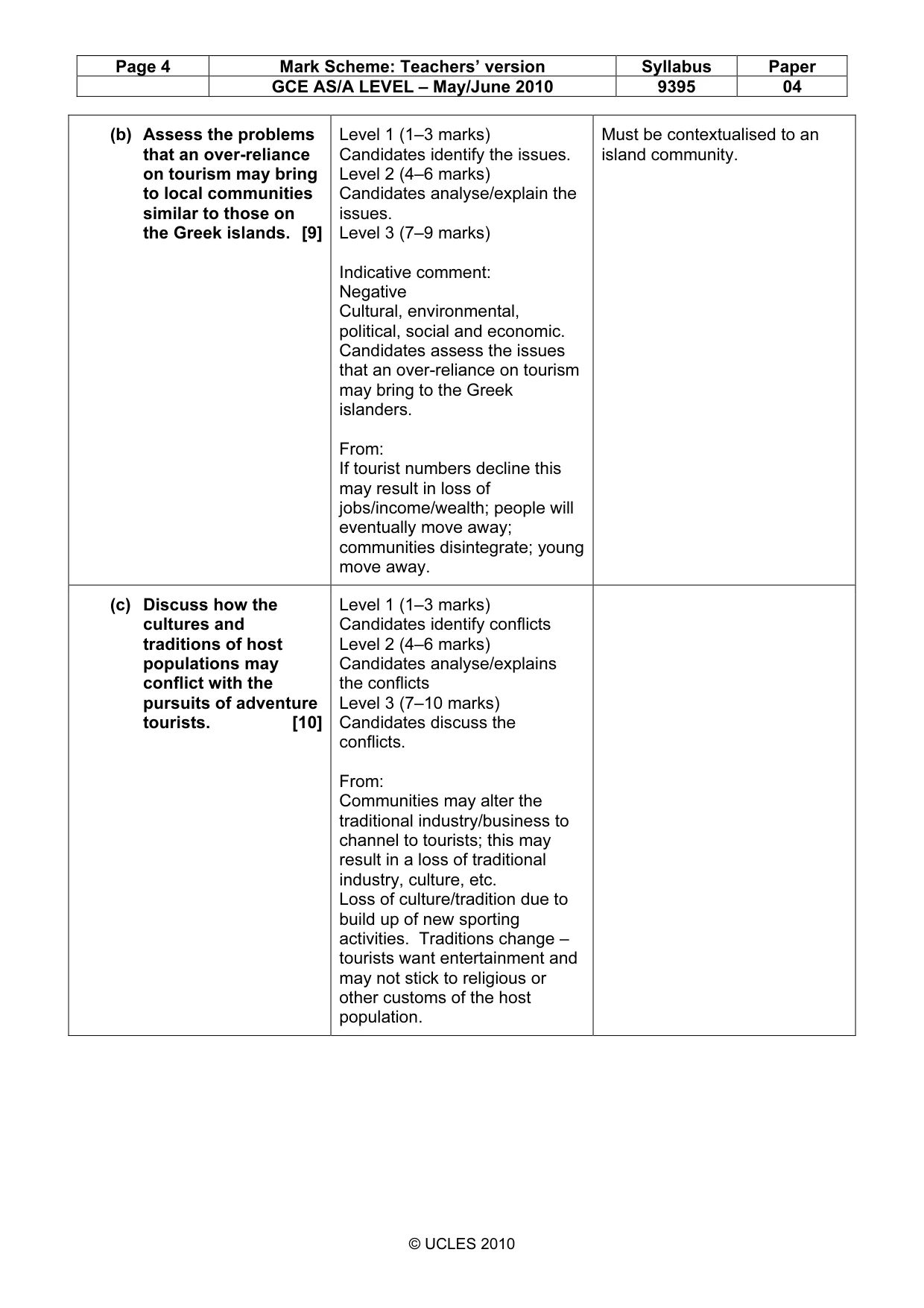
Page 3 Mark Scheme: Teachers’ version Syllabus Paper GCE AS/A LEVEL – May/June 2010 9395 04 © UCLES 2010 (d) Fig. 1 gives a very negative view of eco- tourism. With reference to one eco- tourism project with which you are familiar, evaluate its successes on a local scale. [9] Level 1 (1–4 marks) Candidate identifies positives/successes of an eco tourism project. Level 2 (5–8 marks) Candidates analyses/explains positives/successes of an eco tourism project. Level 3 (9–12 marks) Candidate discusses positives/successes of an eco tourism project. Possible indicative comment: Cultural – community projects, involving all local people and continuing cultural aspects, such as dance, dress, etc. Environmental – protecting land; conservation; pollution controlled for future generations. Economic – securing local jobs and preventing people from moving away; keeping young involved. Project should be named, but no marks are given for this. 2 (a) Identify and explain three ways in which adventure tourism has encouraged the growth of businesses at Elounda Bay. [6] One mark for up to three identifications with a further one mark each for three explanations. From: Boats to hire Lessons/tuition Sale of equipment Private lessons Five hour package There is a need to diversify due to the decline in traditional industry Supported or changed the original industries that were once the mainstay of the economy providing an essential service to tourists Need new jobs/economy insufficient; other local business to support community; multiplier effect – benefits restaurants, cafes, etc.
Mark scheme, page 4
Page 4 Mark Scheme: Teachers’ version Syllabus Paper GCE AS/A LEVEL – May/June 2010 9395 04 © UCLES 2010 (b) Assess the problems that an over-reliance on tourism may bring to local communities similar to those on the Greek islands. [9] Level 1 (1–3 marks) Candidates identify the issues. Level 2 (4–6 marks) Candidates analyse/explain the issues. Level 3 (7–9 marks) Indicative comment: Negative Cultural, environmental, political, social and economic. Candidates assess the issues that an over-reliance on tourism may bring to the Greek islanders. From: If tourist numbers decline this may result in loss of jobs/income/wealth; people will eventually move away; communities disintegrate; young move away. Must be contextualised to an island community. (c) Discuss how the cultures and traditions of host populations may conflict with the pursuits of adventure tourists. [10] Level 1 (1–3 marks) Candidates identify conflicts Level 2 (4–6 marks) Candidates analyse/explains the conflicts Level 3 (7–10 marks) Candidates discuss the conflicts. From: Communities may alter the traditional industry/business to channel to tourists; this may result in a loss of traditional industry, culture, etc. Loss of culture/tradition due to build up of new sporting activities. Traditions change – tourists want entertainment and may not stick to religious or other customs of the host population.
Mark scheme, page 5
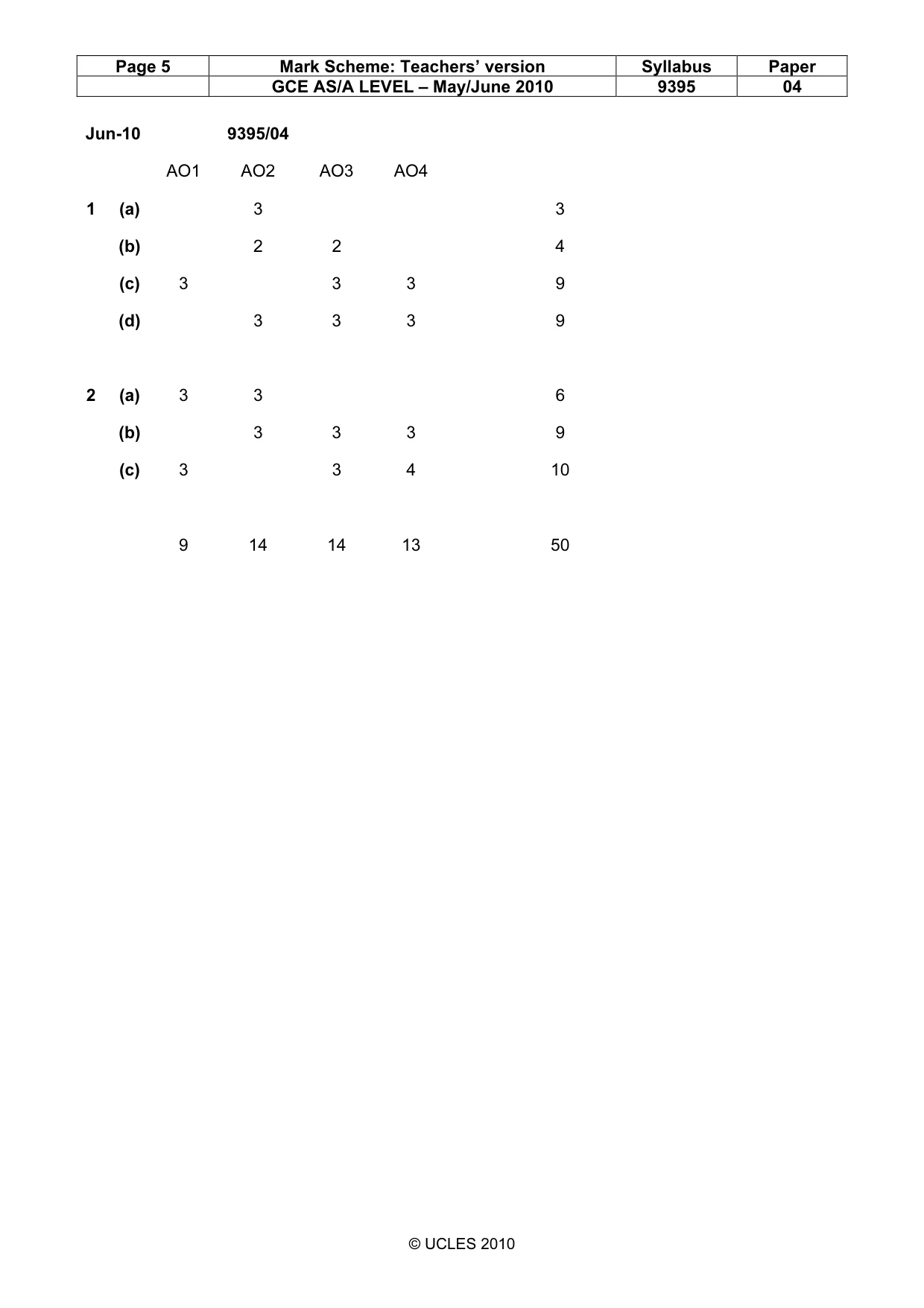
Page 5 Mark Scheme: Teachers’ version Syllabus Paper GCE AS/A LEVEL – May/June 2010 9395 04 © UCLES 2010 Jun-10 9395/04 AO1 AO2 AO3 AO4 1 (a) 3 3 (b) 2 2 4 (c) 3 3 3 9 (d) 3 3 3 9 2 (a) 3 3 6 (b) 3 3 3 9 (c) 3 3 4 10 9 14 14 13 50
What you needed in this session
Cambridge’s own grade thresholds for 2010 May/June, Paper 4 · Variant 1. A higher threshold means an easier paper — the bar moves with how the cohort did.