Cambridge A Level Travel and Tourism 9395 — 2010 May/June Paper 1 · Variant 1
9395/11/M/J/10 · 100 marks · ≈113 min
The question paper and its mark scheme, free to read here and free to download. This is Cambridge’s own paper, exactly as it was sat.
Question paper16 pages




Mark scheme11 pages
Answers below. Sit the paper first if you are practising.
Paper as text
Question paper, page 1
This document consists of 15 printed pages and 1 blank page. IB10 06_9395_01/7RP © UCLES 2010 [Turn over *2862855984* For Examiner's Use 1 2 3 4 Total UNIVERSITY OF CAMBRIDGE INTERNATIONAL EXAMINATIONS General Certificate of Education Advanced Level TRAVEL AND TOURISM 9395/01 Paper 1 Core May/June 2010 2 hours and 30 minutes Candidates answer on the Question Paper READ THESE INSTRUCTIONS FIRST Write your Centre number, candidate number and name on all the work you hand in. Write in dark blue or black pen. Do not use staples, paper clips, highlighters, glue or correction fluid. You may use a pencil for any diagrams, graphs or rough working. DO NOT WRITE IN ANY BARCODES. Answer all questions. The number of marks is given in brackets [ ] at the end of each question or part question.
Question paper, page 2
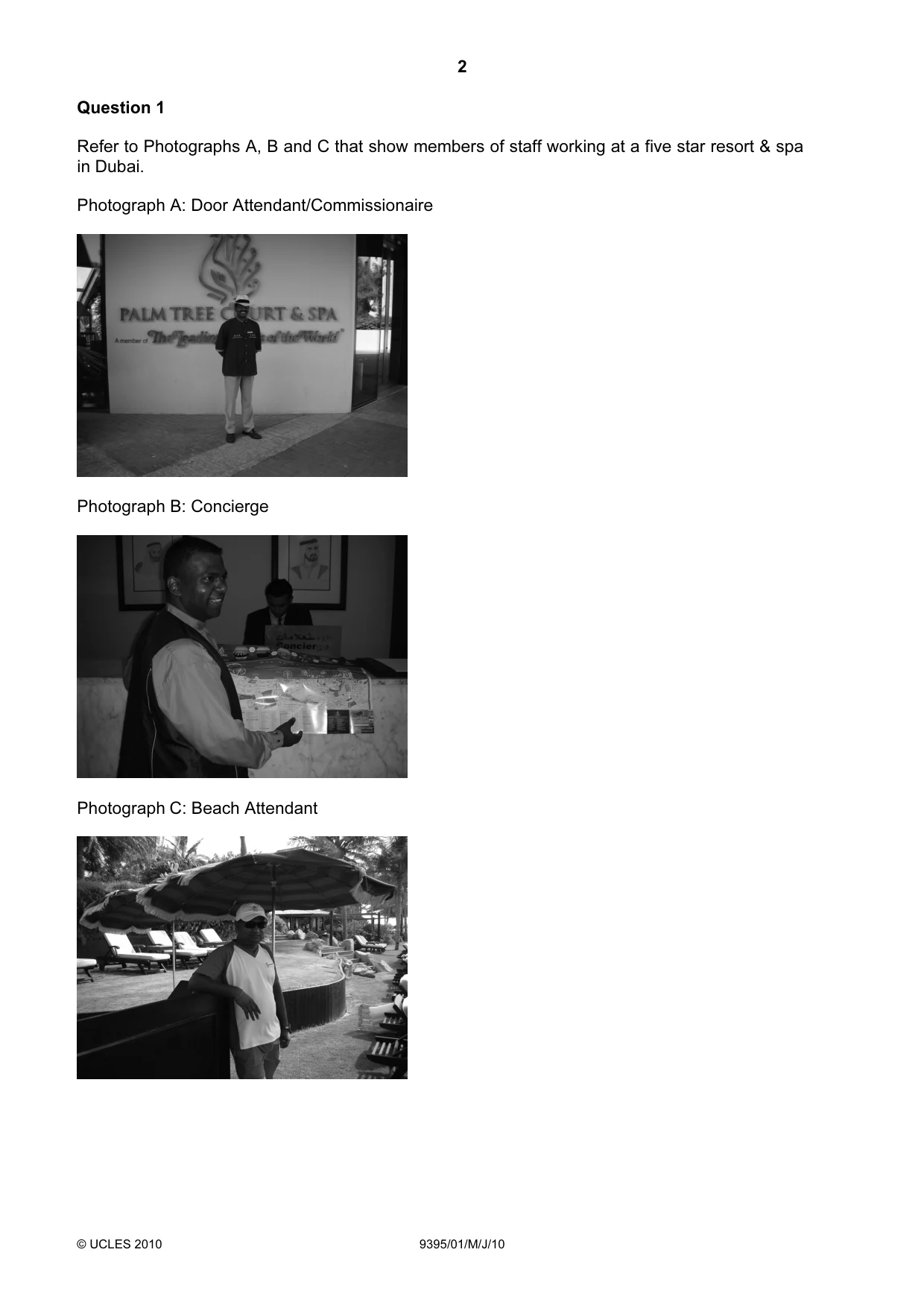
2 © UCLES 2010 9395/01/M/J/10 Question 1 Refer to Photographs A, B and C that show members of staff working at a five star resort & spa in Dubai. Photograph A: Door Attendant/Commissionaire Photograph B: Concierge Photograph C: Beach Attendant
Question paper, page 3
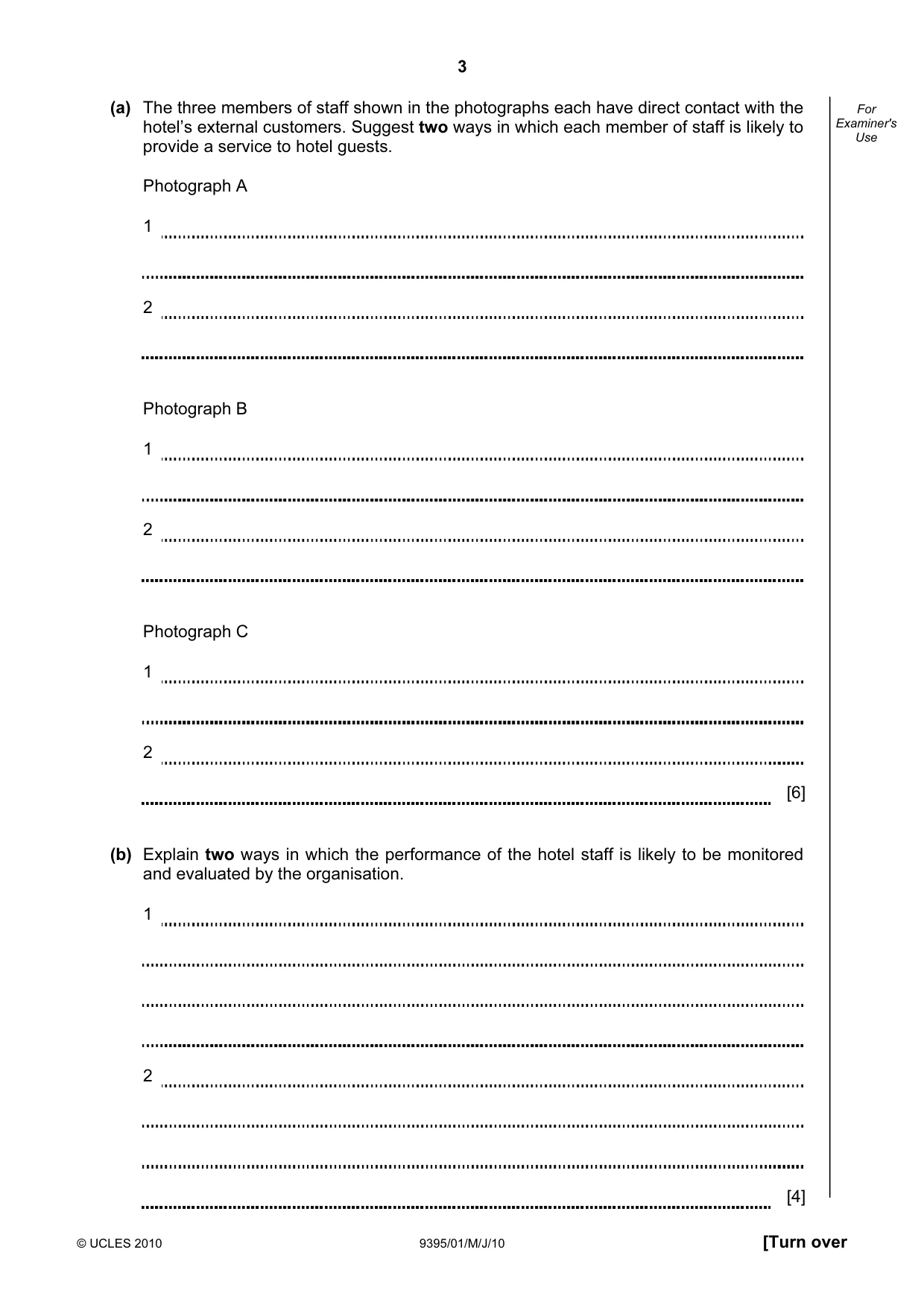
3 © UCLES 2010 9395/01/M/J/10 [Turn over For Examiner's Use (a) The three members of staff shown in the photographs each have direct contact with the hotel’s external customers. Suggest two ways in which each member of staff is likely to provide a service to hotel guests. Photograph A 1 2 Photograph B 1 2 Photograph C 1 2 [6] (b) Explain two ways in which the performance of the hotel staff is likely to be monitored and evaluated by the organisation. 1 2 [4]
Question paper, page 4
4 © UCLES 2010 9395/01/M/J/10 For Examiner's Use (c) Discuss how travel and tourism organisations are likely to benefit from providing effective customer service to their internal customers. [6]
Question paper, page 5
5 © UCLES 2010 9395/01/M/J/10 [Turn over For Examiner's Use (d) Assess the extent to which a customer service situation of your choice involves the following three components (often referred to as “The Moment of Truth”): • the nature of the service task being performed; • the service standards expected, both by the customer and the provider; • the service delivery system for the task at hand. Chosen customer service situation: [9] [Total: 25]
Question paper, page 6
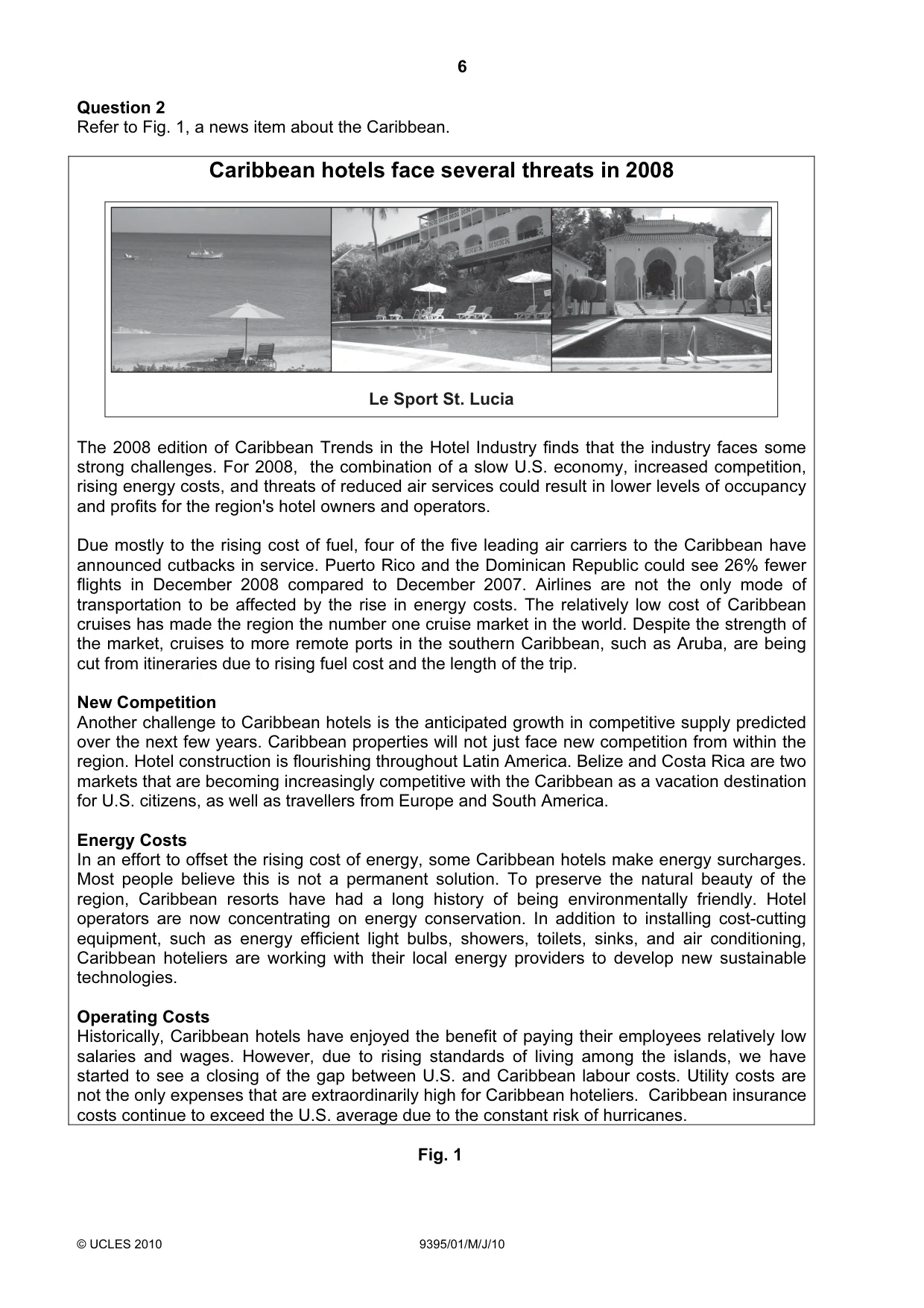
6 © UCLES 2010 9395/01/M/J/10 Question 2 Refer to Fig. 1, a news item about the Caribbean. Fig. 1 Caribbean hotels face several threats in 2008 Le Sport St. Lucia The 2008 edition of Caribbean Trends in the Hotel Industry finds that the industry faces some strong challenges. For 2008, the combination of a slow U.S. economy, increased competition, rising energy costs, and threats of reduced air services could result in lower levels of occupancy and profits for the region's hotel owners and operators. Due mostly to the rising cost of fuel, four of the five leading air carriers to the Caribbean have announced cutbacks in service. Puerto Rico and the Dominican Republic could see 26% fewer flights in December 2008 compared to December 2007. Airlines are not the only mode of transportation to be affected by the rise in energy costs. The relatively low cost of Caribbean cruises has made the region the number one cruise market in the world. Despite the strength of the market, cruises to more remote ports in the southern Caribbean, such as Aruba, are being cut from itineraries due to rising fuel cost and the length of the trip. New Competition Another challenge to Caribbean hotels is the anticipated growth in competitive supply predicted over the next few years. Caribbean properties will not just face new competition from within the region. Hotel construction is flourishing throughout Latin America. Belize and Costa Rica are two markets that are becoming increasingly competitive with the Caribbean as a vacation destination for U.S. citizens, as well as travellers from Europe and South America. Energy Costs In an effort to offset the rising cost of energy, some Caribbean hotels make energy surcharges. Most people believe this is not a permanent solution. To preserve the natural beauty of the region, Caribbean resorts have had a long history of being environmentally friendly. Hotel operators are now concentrating on energy conservation. In addition to installing cost-cutting equipment, such as energy efficient light bulbs, showers, toilets, sinks, and air conditioning, Caribbean hoteliers are working with their local energy providers to develop new sustainable technologies. Operating Costs Historically, Caribbean hotels have enjoyed the benefit of paying their employees relatively low salaries and wages. However, due to rising standards of living among the islands, we have started to see a closing of the gap between U.S. and Caribbean labour costs. Utility costs are not the only expenses that are extraordinarily high for Caribbean hoteliers. Caribbean insurance costs continue to exceed the U.S. average due to the constant risk of hurricanes.
Question paper, page 7
7 © UCLES 2010 9395/01/M/J/10 [Turn over For Examiner's Use (a) Identify three Caribbean destinations at risk from the reduction of transport services to the region. 1 2 3 [3] (b) Identify two Central American destinations that are starting to compete with traditional Caribbean resorts. 1 2 [2] (c) Fig. 1 states that “Caribbean resorts have had a long history of being environmentally friendly”. State three environmentally friendly actions hotels may take and explain how each might result in a positive local environmental impact. 1 2 3 [6]
Question paper, page 8
8 © UCLES 2010 9395/01/M/J/10 For Examiner's Use (d) Fig. 1 contains images of the all-inclusive Le Sport resort in St Lucia. (i) Name the natural hazard that is a seasonal risk at the resort. [1] (ii) Suggest and explain two strategies which could be used by the resort to maintain occupancy rates throughout the year. 1 2 [4]
Question paper, page 9
9 © UCLES 2010 9395/01/M/J/10 [Turn over For Examiner's Use (e) Discuss the reasons why many leisure travellers to the Caribbean will make their holiday arrangements using the services of a local travel agency. [9] [Total: 25]
Question paper, page 10
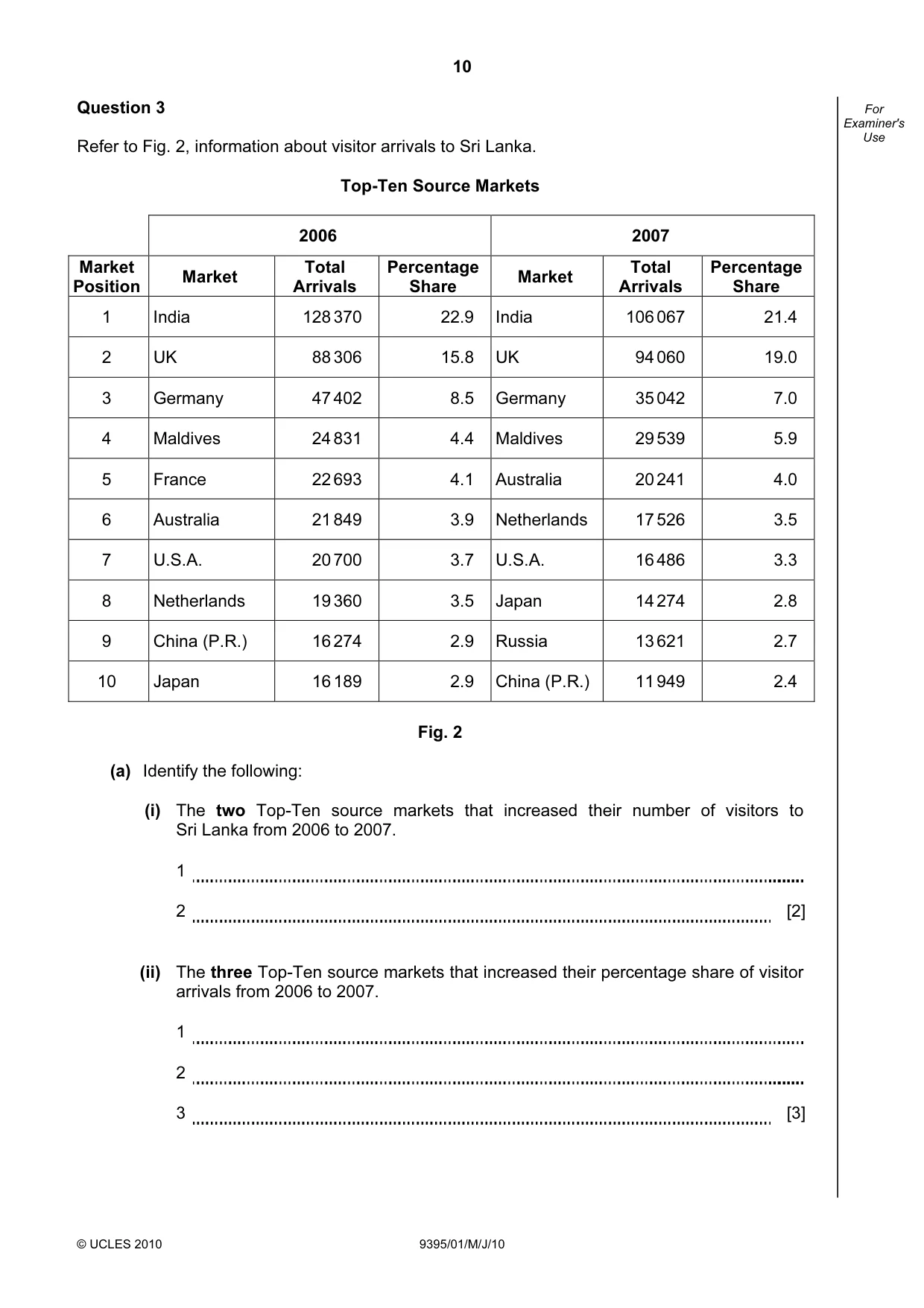
10 © UCLES 2010 9395/01/M/J/10 For Examiner's Use Question 3 Refer to Fig. 2, information about visitor arrivals to Sri Lanka. Top-Ten Source Markets 2006 2007 Market Position Market Total Arrivals Percentage Share Market Total Arrivals Percentage Share 1 India 128 370 22.9 India 106 067 21.4 2 UK 88 306 15.8 UK 94 060 19.0 3 Germany 47 402 8.5 Germany 35 042 7.0 4 Maldives 24 831 4.4 Maldives 29 539 5.9 5 France 22 693 4.1 Australia 20 241 4.0 6 Australia 21 849 3.9 Netherlands 17 526 3.5 7 U.S.A. 20 700 3.7 U.S.A. 16 486 3.3 8 Netherlands 19 360 3.5 Japan 14 274 2.8 9 China (P.R.) 16 274 2.9 Russia 13 621 2.7 10 Japan 16 189 2.9 China (P.R.) 11 949 2.4 Fig. 2 (a) Identify the following: (i) The two Top-Ten source markets that increased their number of visitors to Sri Lanka from 2006 to 2007. 1 2 [2] (ii) The three Top-Ten source markets that increased their percentage share of visitor arrivals from 2006 to 2007. 1 2 3 [3]
Question paper, page 11
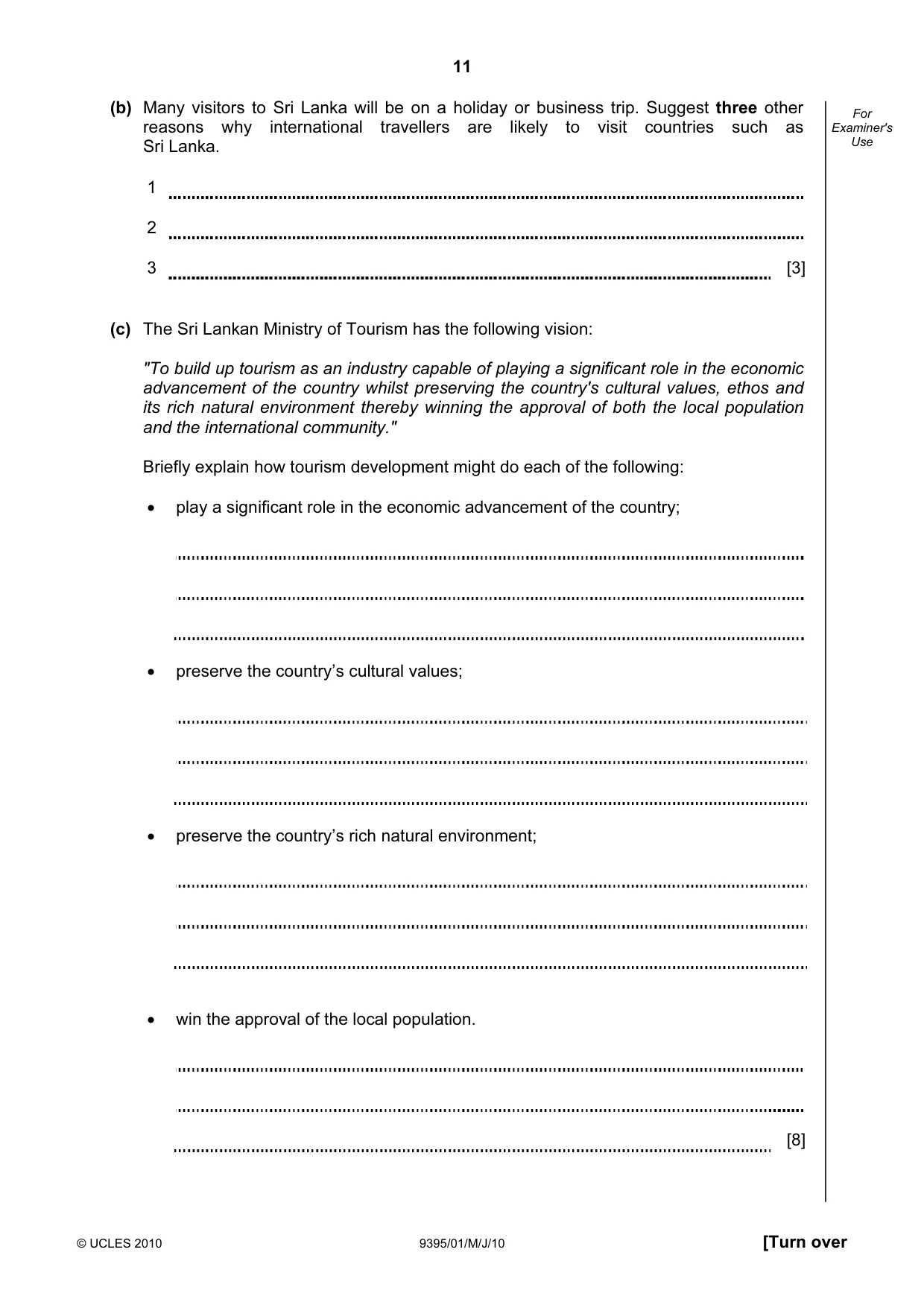
11 © UCLES 2010 9395/01/M/J/10 [Turn over For Examiner's Use (b) Many visitors to Sri Lanka will be on a holiday or business trip. Suggest three other reasons why international travellers are likely to visit countries such as Sri Lanka. 1 2 3 [3] (c) The Sri Lankan Ministry of Tourism has the following vision: "To build up tourism as an industry capable of playing a significant role in the economic advancement of the country whilst preserving the country's cultural values, ethos and its rich natural environment thereby winning the approval of both the local population and the international community." Briefly explain how tourism development might do each of the following: • play a significant role in the economic advancement of the country; • preserve the country’s cultural values; • preserve the country’s rich natural environment; • win the approval of the local population. [8]
Question paper, page 12
12 © UCLES 2010 9395/01/M/J/10 For Examiner's Use (d) Whilst tourism is increasing in destinations like Sri Lanka, it is facing stagnation/decline in other areas. With reference to examples with which you are familiar, discuss reasons why destinations suffer stagnation and decline. [9] [Total: 25]
Question paper, page 13
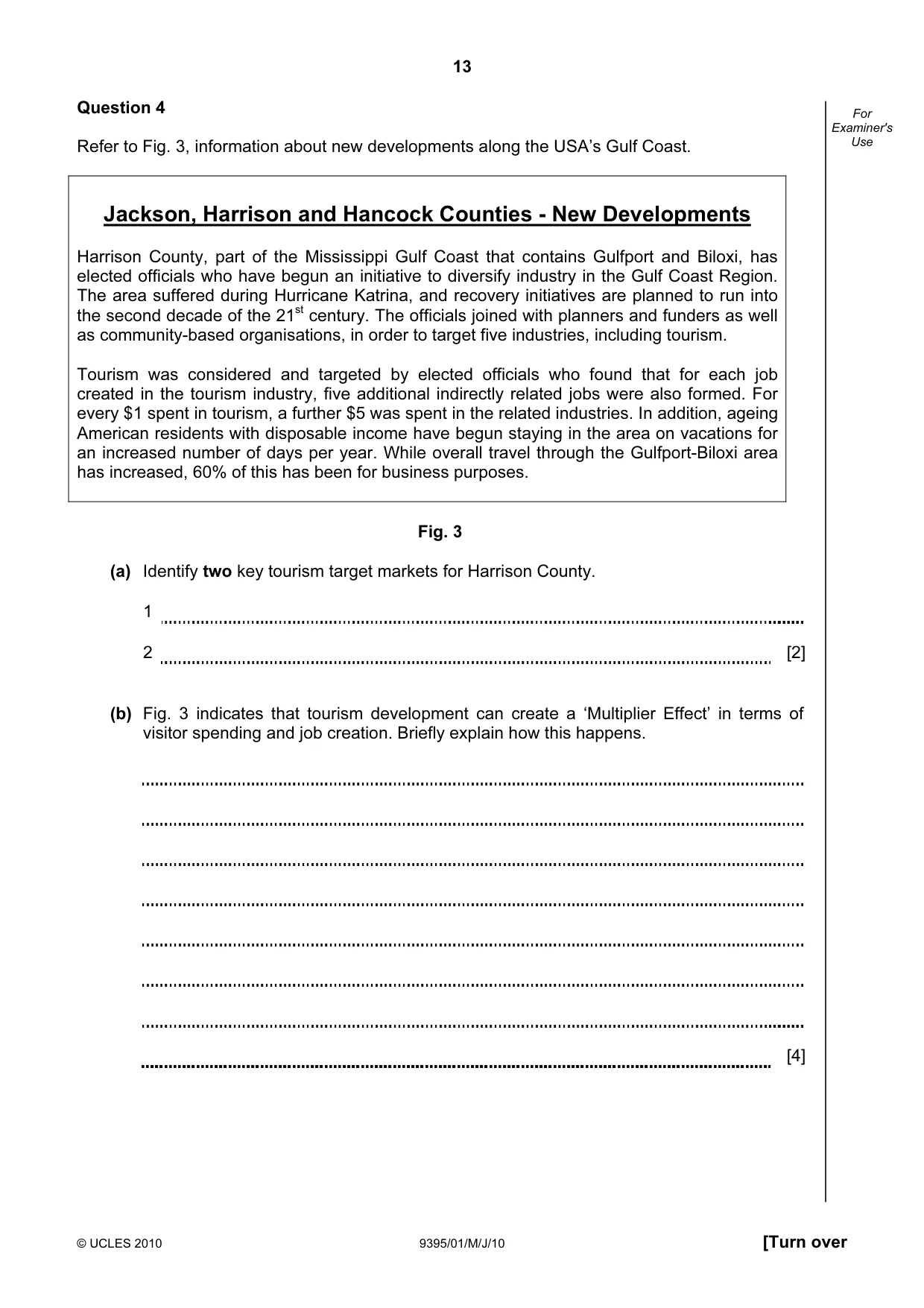
13 © UCLES 2010 9395/01/M/J/10 [Turn over For Examiner's Use Question 4 Refer to Fig. 3, information about new developments along the USA’s Gulf Coast. Jackson, Harrison and Hancock Counties - New Developments Harrison County, part of the Mississippi Gulf Coast that contains Gulfport and Biloxi, has elected officials who have begun an initiative to diversify industry in the Gulf Coast Region. The area suffered during Hurricane Katrina, and recovery initiatives are planned to run into the second decade of the 21st century. The officials joined with planners and funders as well as community-based organisations, in order to target five industries, including tourism. Tourism was considered and targeted by elected officials who found that for each job created in the tourism industry, five additional indirectly related jobs were also formed. For every $1 spent in tourism, a further $5 was spent in the related industries. In addition, ageing American residents with disposable income have begun staying in the area on vacations for an increased number of days per year. While overall travel through the Gulfport-Biloxi area has increased, 60% of this has been for business purposes. Fig. 3 (a) Identify two key tourism target markets for Harrison County. 1 2 [2] (b) Fig. 3 indicates that tourism development can create a ‘Multiplier Effect’ in terms of visitor spending and job creation. Briefly explain how this happens. [4]
Question paper, page 14
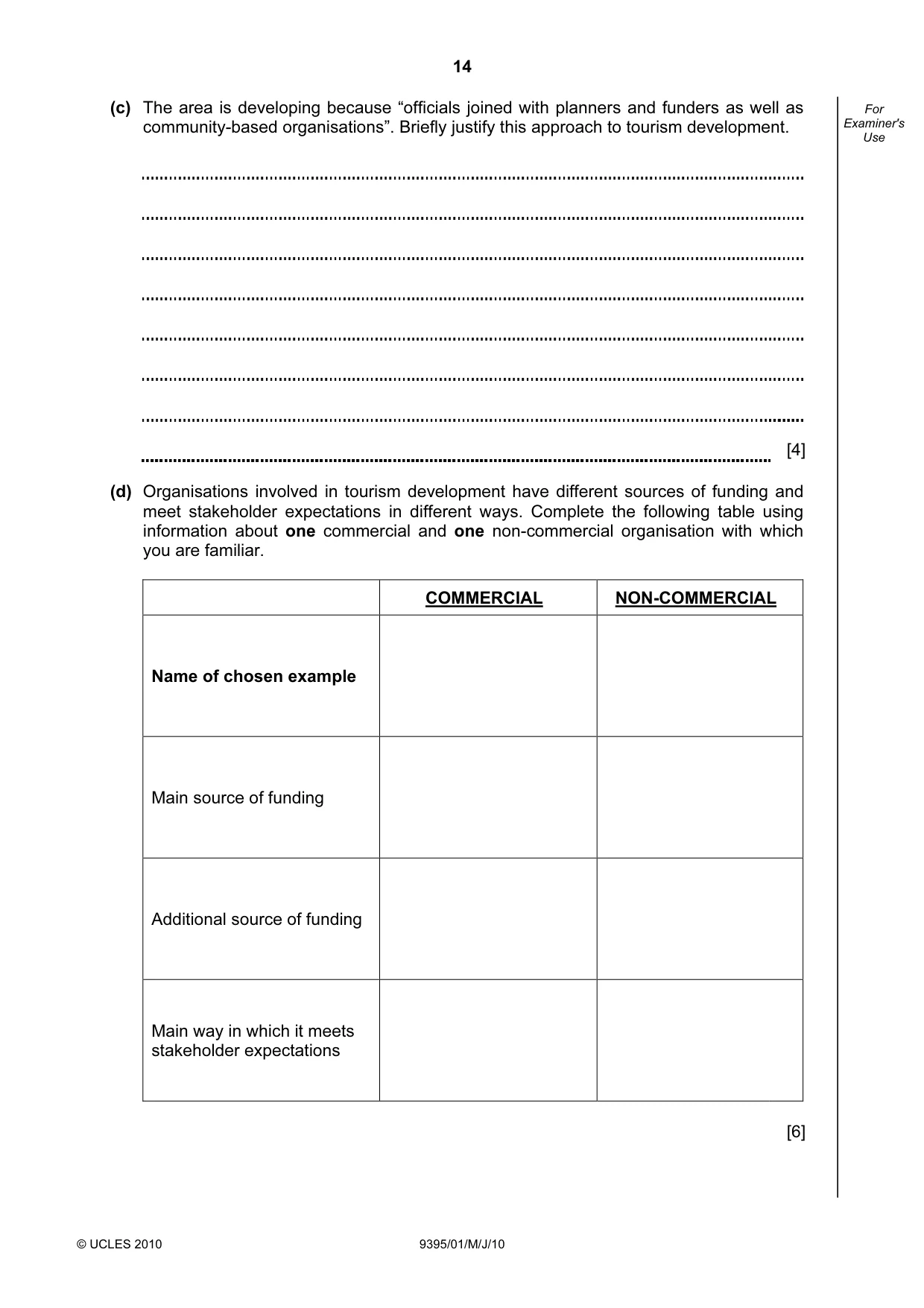
14 © UCLES 2010 9395/01/M/J/10 For Examiner's Use (c) The area is developing because “officials joined with planners and funders as well as community-based organisations”. Briefly justify this approach to tourism development. [4] (d) Organisations involved in tourism development have different sources of funding and meet stakeholder expectations in different ways. Complete the following table using information about one commercial and one non-commercial organisation with which you are familiar. COMMERCIAL NON-COMMERCIAL Name of chosen example Main source of funding Additional source of funding Main way in which it meets stakeholder expectations [6]
Question paper, page 15
15 © UCLES 2010 9395/01/M/J/10 For Examiner's Use (e) With reference to examples with which you are familiar, discuss the ways in which national governments can influence the quality of the local tourism product. [9] [Total: 25]
Question paper, page 16
16 Copyright Acknowledgements: Question 1 Photographs A, B & C Question 2 Question 2 Figure 1 Photographs Question 3 Question 4 John D Smith © UCLES. © Caribbean Hotels; eturbonews.com. John D Smith © UCLES. © Sri Lanka Data Table Visitor Numbers; sltbstatistics.org. © Map and News Item, Gulfport, Mississippi, USA; hubpages.com. Permission to reproduce items where third-party owned material protected by copyright is included has been sought and cleared where possible. Every reasonable effort has been made by the publisher (UCLES) to trace copyright holders, but if any items requiring clearance have unwittingly been included, the publisher will be pleased to make amends at the earliest possible opportunity. University of Cambridge International Examinations is part of the Cambridge Assessment Group. Cambridge Assessment is the brand name of University of Cambridge Local Examinations Syndicate (UCLES), which is itself a department of the University of Cambridge. © UCLES 2010 9395/01/M/J/10 BLANK PAGE
Mark scheme, page 1
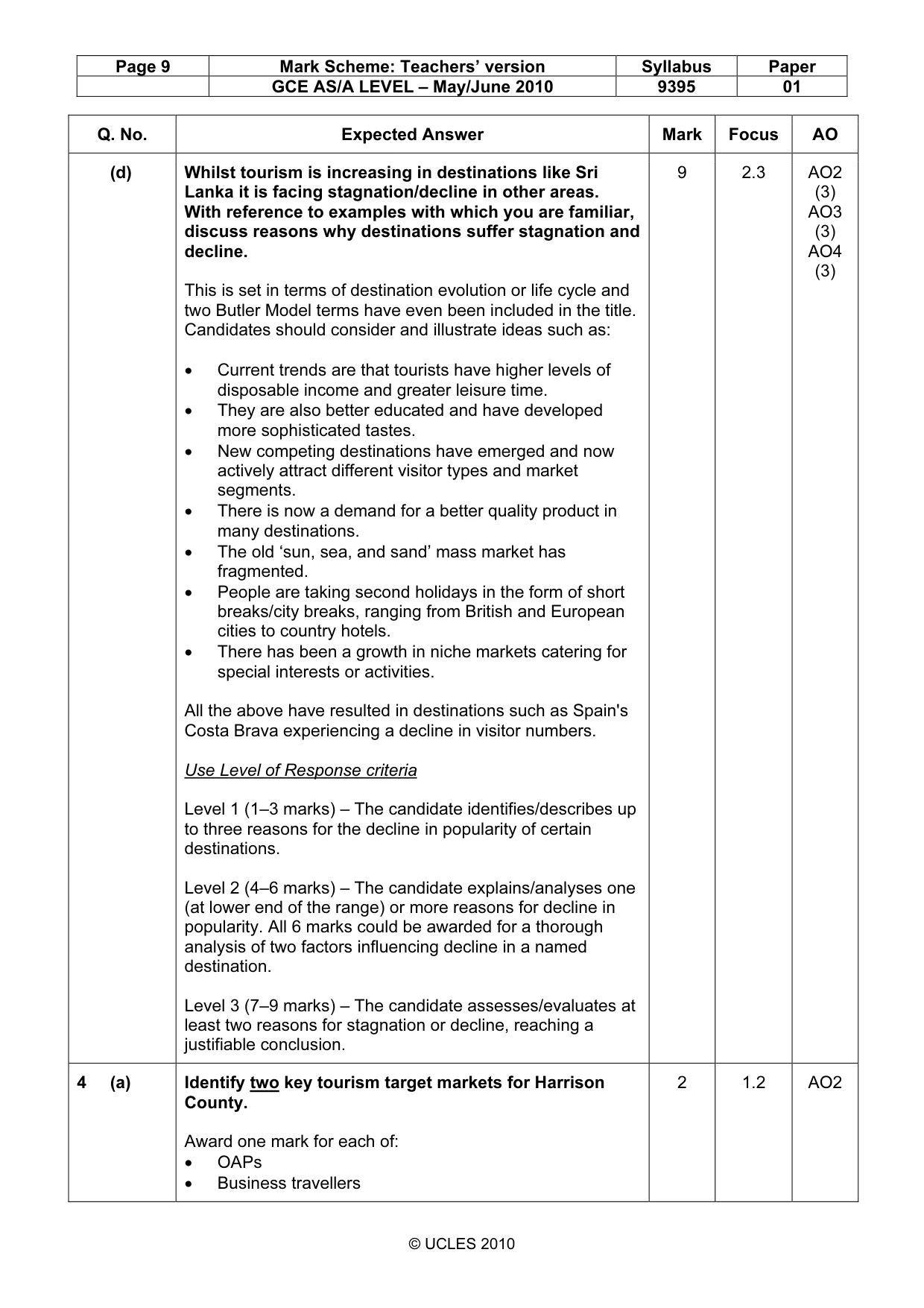
UNIVERSITY OF CAMBRIDGE INTERNATIONAL EXAMINATIONS GCE Advanced Subsidiary Level and GCE Advanced Level MARK SCHEME for the May/June 2010 question paper for the guidance of teachers 9395 TRAVEL AND TOURISM 9395/01 Paper 1 (Core Paper), maximum raw mark 100 This mark scheme is published as an aid to teachers and candidates, to indicate the requirements of the examination. It shows the basis on which Examiners were instructed to award marks. It does not indicate the details of the discussions that took place at an Examiners’ meeting before marking began, which would have considered the acceptability of alternative answers. Mark schemes must be read in conjunction with the question papers and the report on the examination. • CIE will not enter into discussions or correspondence in connection with these mark schemes. CIE is publishing the mark schemes for the May/June 2010 question papers for most IGCSE, GCE Advanced Level and Advanced Subsidiary Level syllabuses and some Ordinary Level syllabuses.
Mark scheme, page 2
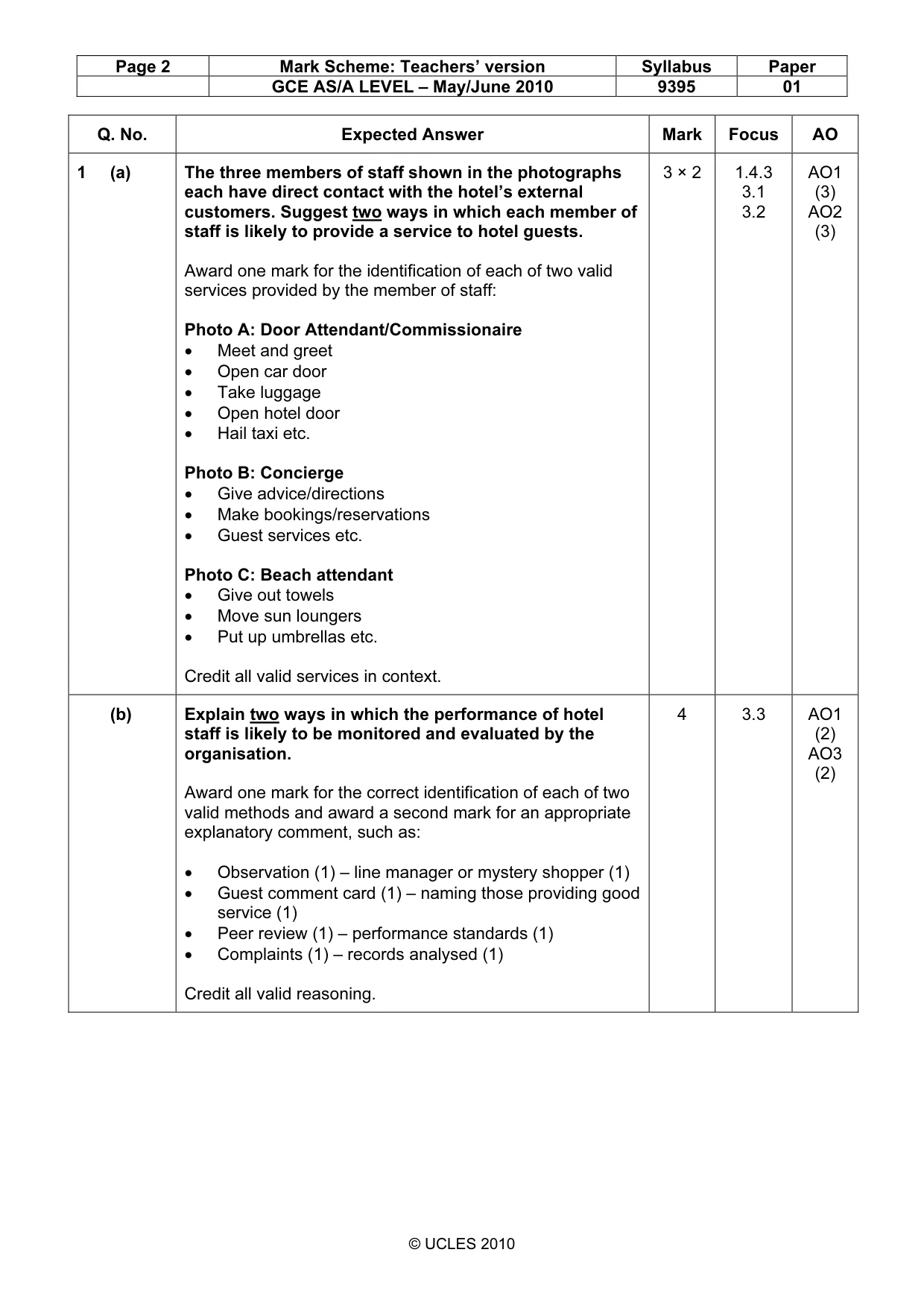
Page 2 Mark Scheme: Teachers’ version Syllabus Paper GCE AS/A LEVEL – May/June 2010 9395 01 © UCLES 2010 Q. No. Expected Answer Mark Focus AO 1 (a) The three members of staff shown in the photographs each have direct contact with the hotel’s external customers. Suggest two ways in which each member of staff is likely to provide a service to hotel guests. Award one mark for the identification of each of two valid services provided by the member of staff: Photo A: Door Attendant/Commissionaire • Meet and greet • Open car door • Take luggage • Open hotel door • Hail taxi etc. Photo B: Concierge • Give advice/directions • Make bookings/reservations • Guest services etc. Photo C: Beach attendant • Give out towels • Move sun loungers • Put up umbrellas etc. Credit all valid services in context. 3 × 2 1.4.3 3.1 3.2 AO1 (3) AO2 (3) (b) Explain two ways in which the performance of hotel staff is likely to be monitored and evaluated by the organisation. Award one mark for the correct identification of each of two valid methods and award a second mark for an appropriate explanatory comment, such as: • Observation (1) – line manager or mystery shopper (1) • Guest comment card (1) – naming those providing good service (1) • Peer review (1) – performance standards (1) • Complaints (1) – records analysed (1) Credit all valid reasoning. 4 3.3 AO1 (2) AO3 (2)
Mark scheme, page 3
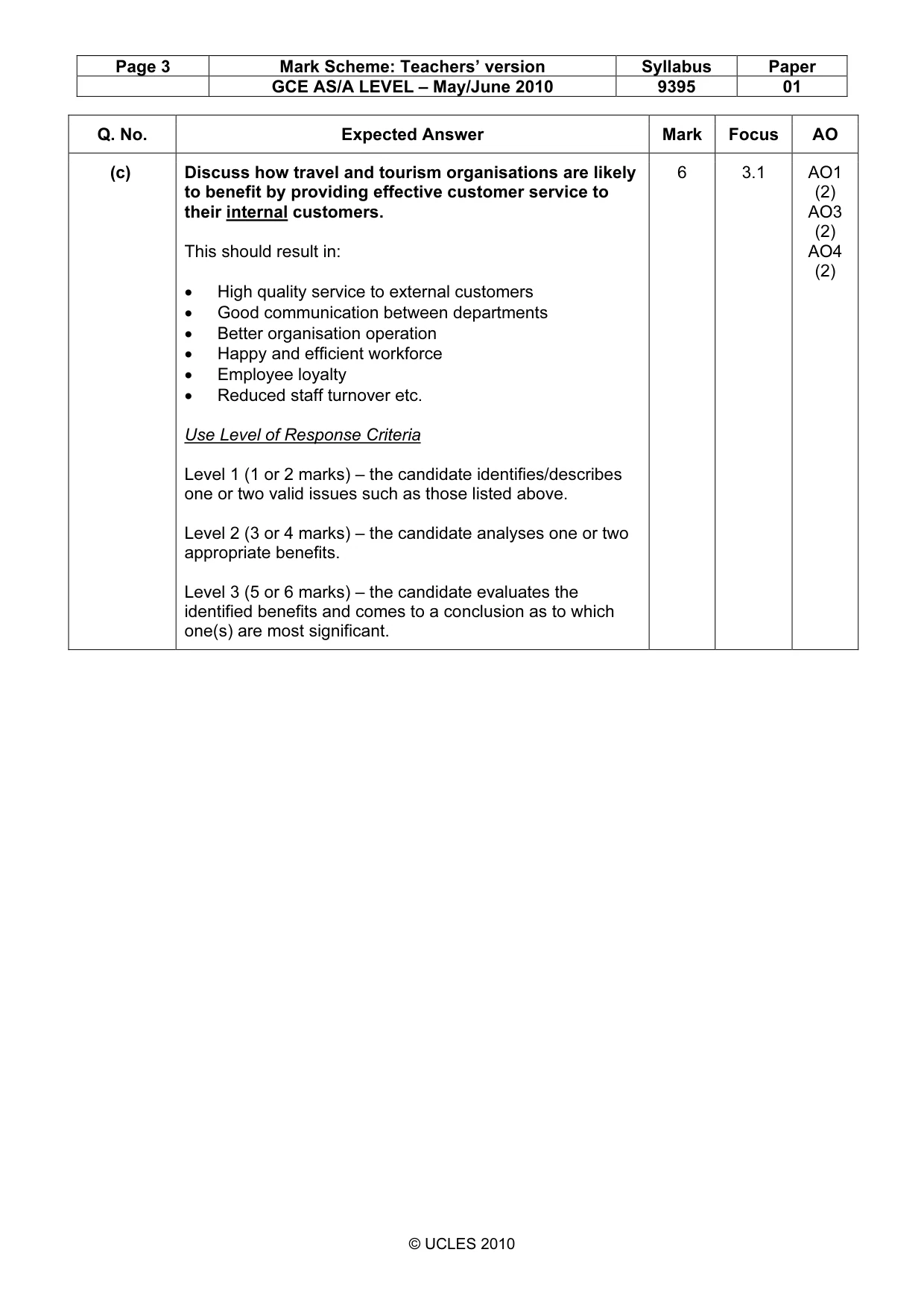
Page 3 Mark Scheme: Teachers’ version Syllabus Paper GCE AS/A LEVEL – May/June 2010 9395 01 © UCLES 2010 Q. No. Expected Answer Mark Focus AO (c) Discuss how travel and tourism organisations are likely to benefit by providing effective customer service to their internal customers. This should result in: • High quality service to external customers • Good communication between departments • Better organisation operation • Happy and efficient workforce • Employee loyalty • Reduced staff turnover etc. Use Level of Response Criteria Level 1 (1 or 2 marks) – the candidate identifies/describes one or two valid issues such as those listed above. Level 2 (3 or 4 marks) – the candidate analyses one or two appropriate benefits. Level 3 (5 or 6 marks) – the candidate evaluates the identified benefits and comes to a conclusion as to which one(s) are most significant. 6 3.1 AO1 (2) AO3 (2) AO4 (2)
Mark scheme, page 4
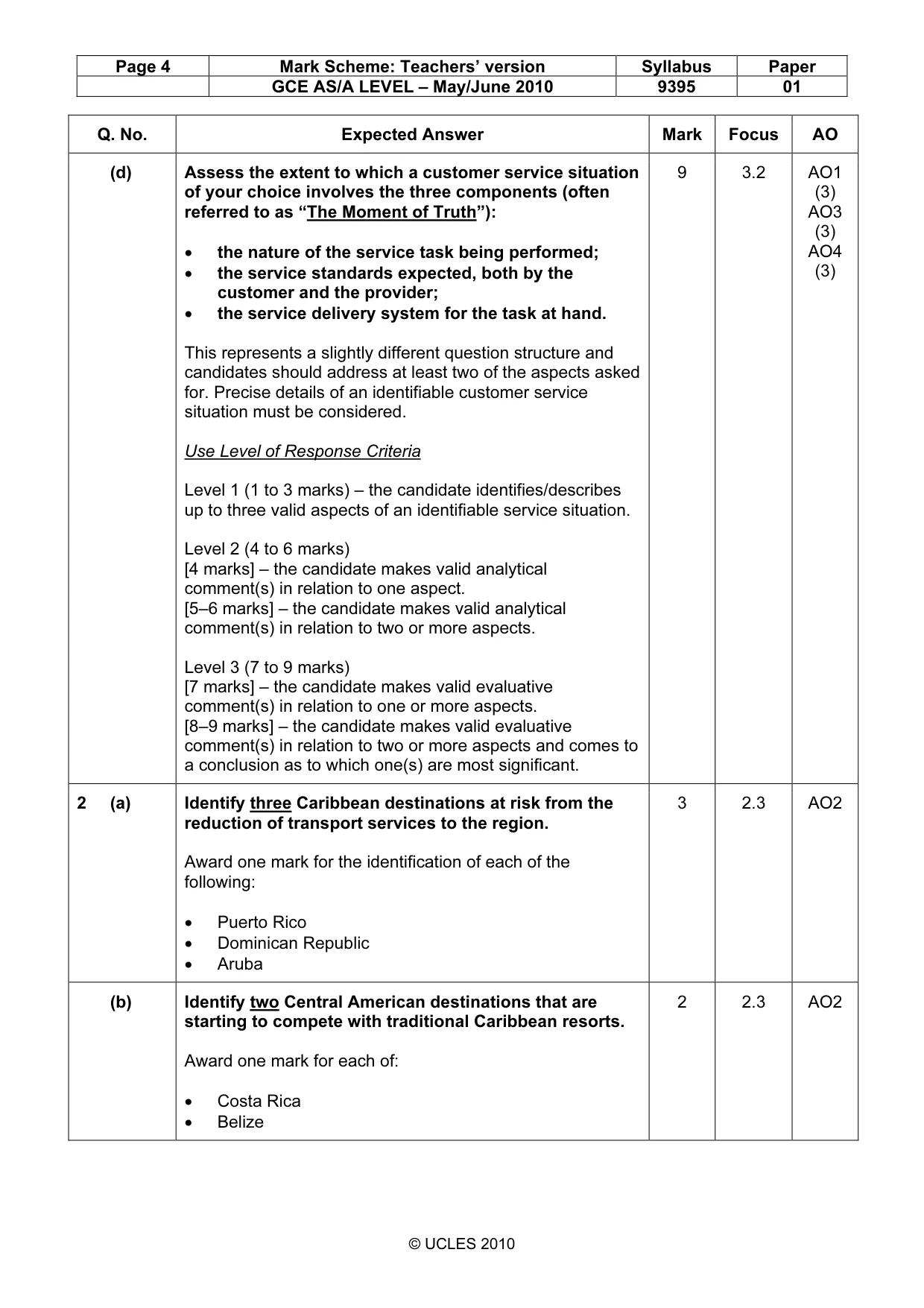
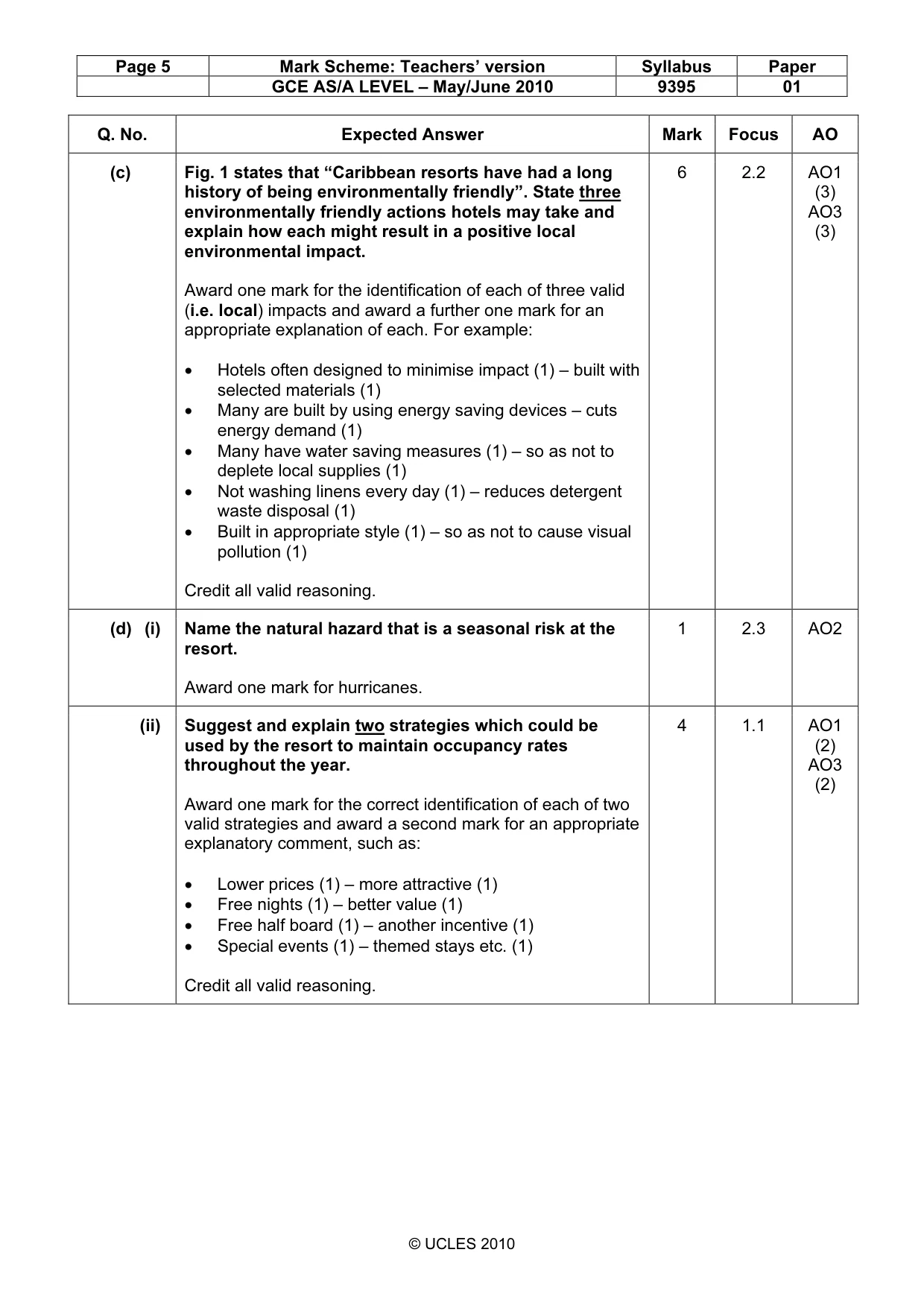
Page 4 Mark Scheme: Teachers’ version Syllabus Paper GCE AS/A LEVEL – May/June 2010 9395 01 © UCLES 2010 Q. No. Expected Answer Mark Focus AO (d) Assess the extent to which a customer service situation of your choice involves the three components (often referred to as “The Moment of Truth”): • the nature of the service task being performed; • the service standards expected, both by the customer and the provider; • the service delivery system for the task at hand. This represents a slightly different question structure and candidates should address at least two of the aspects asked for. Precise details of an identifiable customer service situation must be considered. Use Level of Response Criteria Level 1 (1 to 3 marks) – the candidate identifies/describes up to three valid aspects of an identifiable service situation. Level 2 (4 to 6 marks) [4 marks] – the candidate makes valid analytical comment(s) in relation to one aspect. [5–6 marks] – the candidate makes valid analytical comment(s) in relation to two or more aspects. Level 3 (7 to 9 marks) [7 marks] – the candidate makes valid evaluative comment(s) in relation to one or more aspects. [8–9 marks] – the candidate makes valid evaluative comment(s) in relation to two or more aspects and comes to a conclusion as to which one(s) are most significant. 9 3.2 AO1 (3) AO3 (3) AO4 (3) 2 (a) Identify three Caribbean destinations at risk from the reduction of transport services to the region. Award one mark for the identification of each of the following: • Puerto Rico • Dominican Republic • Aruba 3 2.3 AO2 (b) Identify two Central American destinations that are starting to compete with traditional Caribbean resorts. Award one mark for each of: • Costa Rica • Belize 2 2.3 AO2
Mark scheme, page 5
Page 5 Mark Scheme: Teachers’ version Syllabus Paper GCE AS/A LEVEL – May/June 2010 9395 01 © UCLES 2010 Q. No. Expected Answer Mark Focus AO (c) Fig. 1 states that “Caribbean resorts have had a long history of being environmentally friendly”. State three environmentally friendly actions hotels may take and explain how each might result in a positive local environmental impact. Award one mark for the identification of each of three valid (i.e. local) impacts and award a further one mark for an appropriate explanation of each. For example: • Hotels often designed to minimise impact (1) – built with selected materials (1) • Many are built by using energy saving devices – cuts energy demand (1) • Many have water saving measures (1) – so as not to deplete local supplies (1) • Not washing linens every day (1) – reduces detergent waste disposal (1) • Built in appropriate style (1) – so as not to cause visual pollution (1) Credit all valid reasoning. 6 2.2 AO1 (3) AO3 (3) (d) (i) Name the natural hazard that is a seasonal risk at the resort. Award one mark for hurricanes. 1 2.3 AO2 (ii) Suggest and explain two strategies which could be used by the resort to maintain occupancy rates throughout the year. Award one mark for the correct identification of each of two valid strategies and award a second mark for an appropriate explanatory comment, such as: • Lower prices (1) – more attractive (1) • Free nights (1) – better value (1) • Free half board (1) – another incentive (1) • Special events (1) – themed stays etc. (1) Credit all valid reasoning. 4 1.1 AO1 (2) AO3 (2)
Mark scheme, page 6
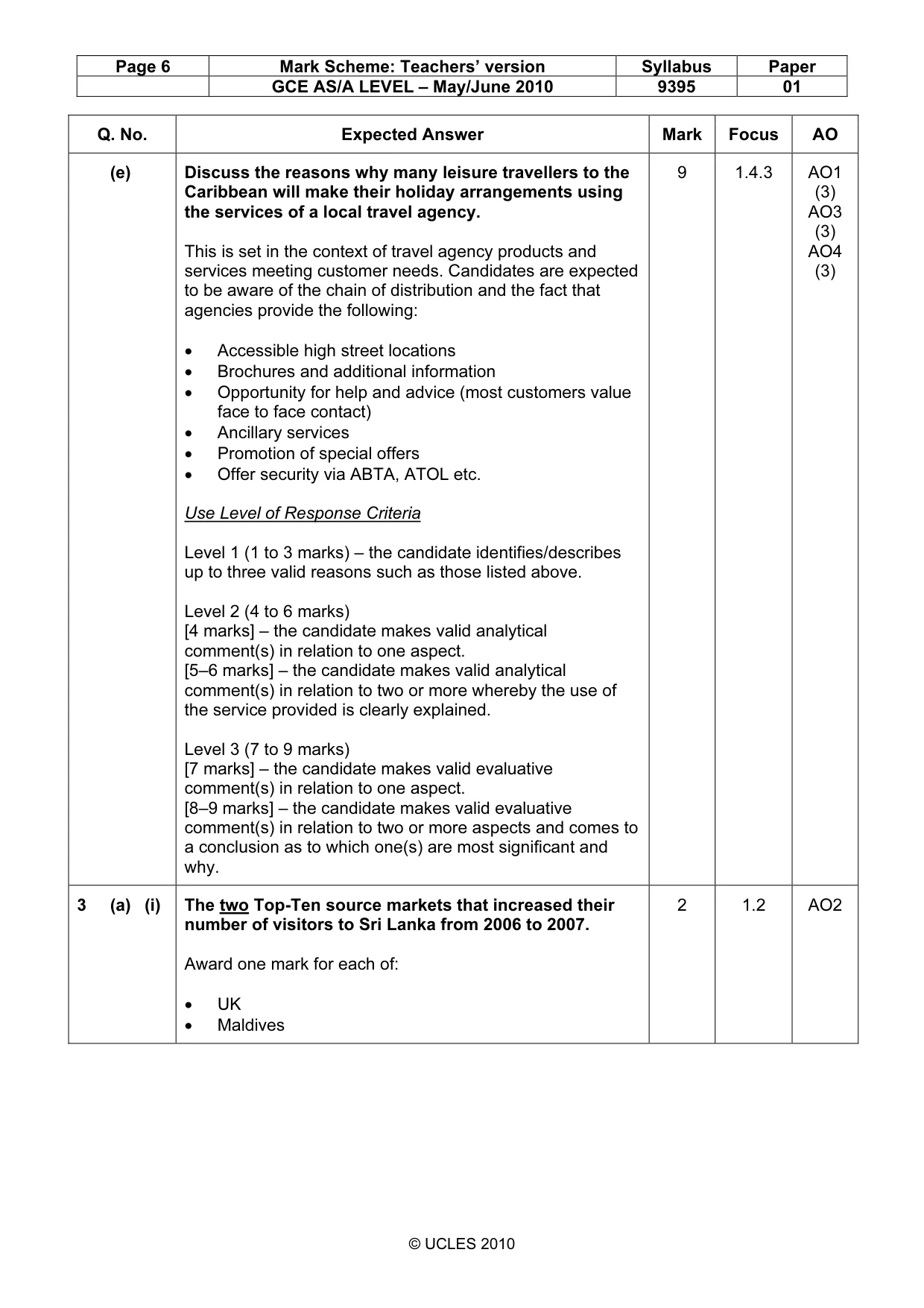
Page 6 Mark Scheme: Teachers’ version Syllabus Paper GCE AS/A LEVEL – May/June 2010 9395 01 © UCLES 2010 Q. No. Expected Answer Mark Focus AO (e) Discuss the reasons why many leisure travellers to the Caribbean will make their holiday arrangements using the services of a local travel agency. This is set in the context of travel agency products and services meeting customer needs. Candidates are expected to be aware of the chain of distribution and the fact that agencies provide the following: • Accessible high street locations • Brochures and additional information • Opportunity for help and advice (most customers value face to face contact) • Ancillary services • Promotion of special offers • Offer security via ABTA, ATOL etc. Use Level of Response Criteria Level 1 (1 to 3 marks) – the candidate identifies/describes up to three valid reasons such as those listed above. Level 2 (4 to 6 marks) [4 marks] – the candidate makes valid analytical comment(s) in relation to one aspect. [5–6 marks] – the candidate makes valid analytical comment(s) in relation to two or more whereby the use of the service provided is clearly explained. Level 3 (7 to 9 marks) [7 marks] – the candidate makes valid evaluative comment(s) in relation to one aspect. [8–9 marks] – the candidate makes valid evaluative comment(s) in relation to two or more aspects and comes to a conclusion as to which one(s) are most significant and why. 9 1.4.3 AO1 (3) AO3 (3) AO4 (3) 3 (a) (i) The two Top-Ten source markets that increased their number of visitors to Sri Lanka from 2006 to 2007. Award one mark for each of: • UK • Maldives 2 1.2 AO2
Mark scheme, page 7
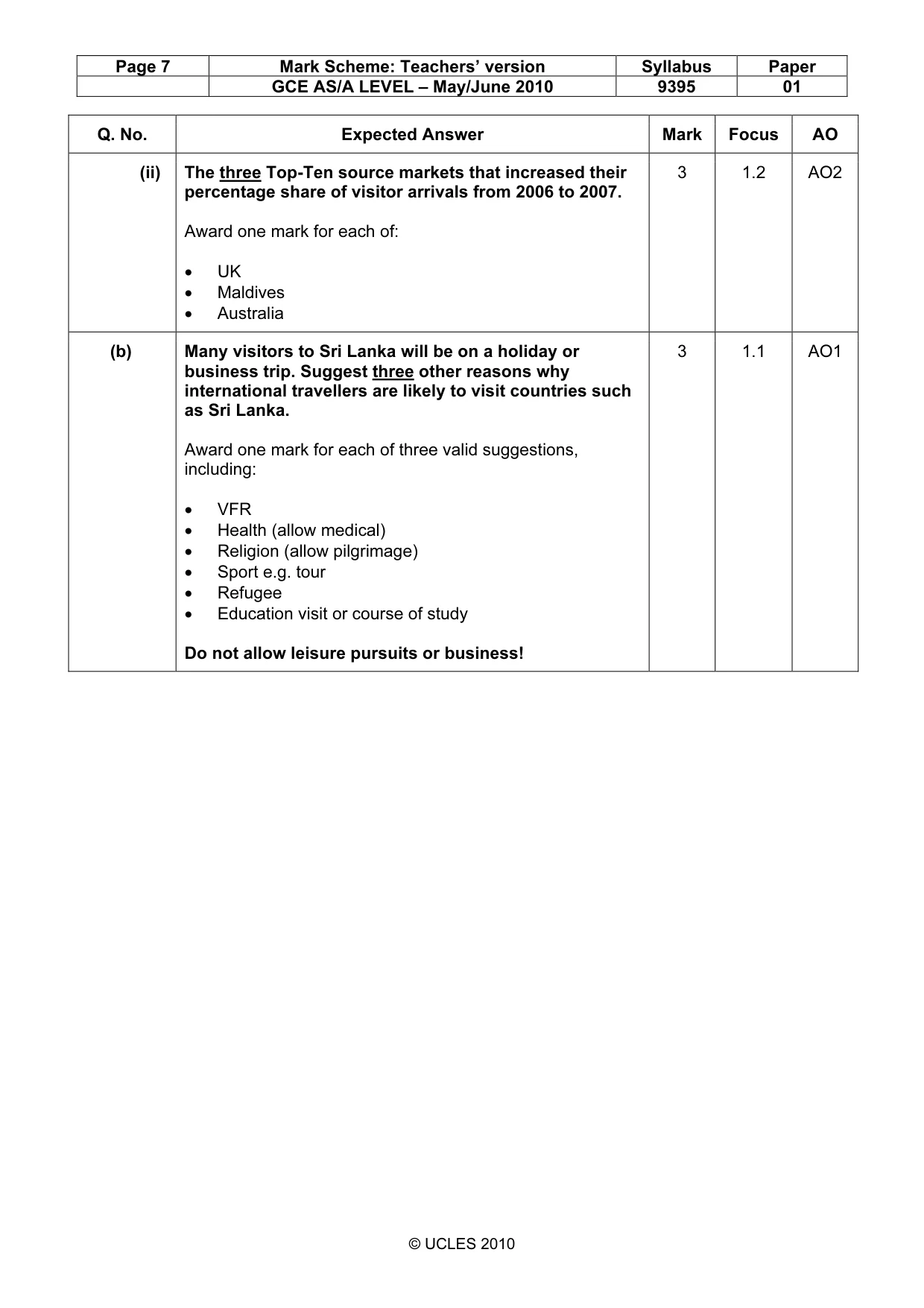
Page 7 Mark Scheme: Teachers’ version Syllabus Paper GCE AS/A LEVEL – May/June 2010 9395 01 © UCLES 2010 Q. No. Expected Answer Mark Focus AO (ii) The three Top-Ten source markets that increased their percentage share of visitor arrivals from 2006 to 2007. Award one mark for each of: • UK • Maldives • Australia 3 1.2 AO2 (b) Many visitors to Sri Lanka will be on a holiday or business trip. Suggest three other reasons why international travellers are likely to visit countries such as Sri Lanka. Award one mark for each of three valid suggestions, including: • VFR • Health (allow medical) • Religion (allow pilgrimage) • Sport e.g. tour • Refugee • Education visit or course of study Do not allow leisure pursuits or business! 3 1.1 AO1
Mark scheme, page 8
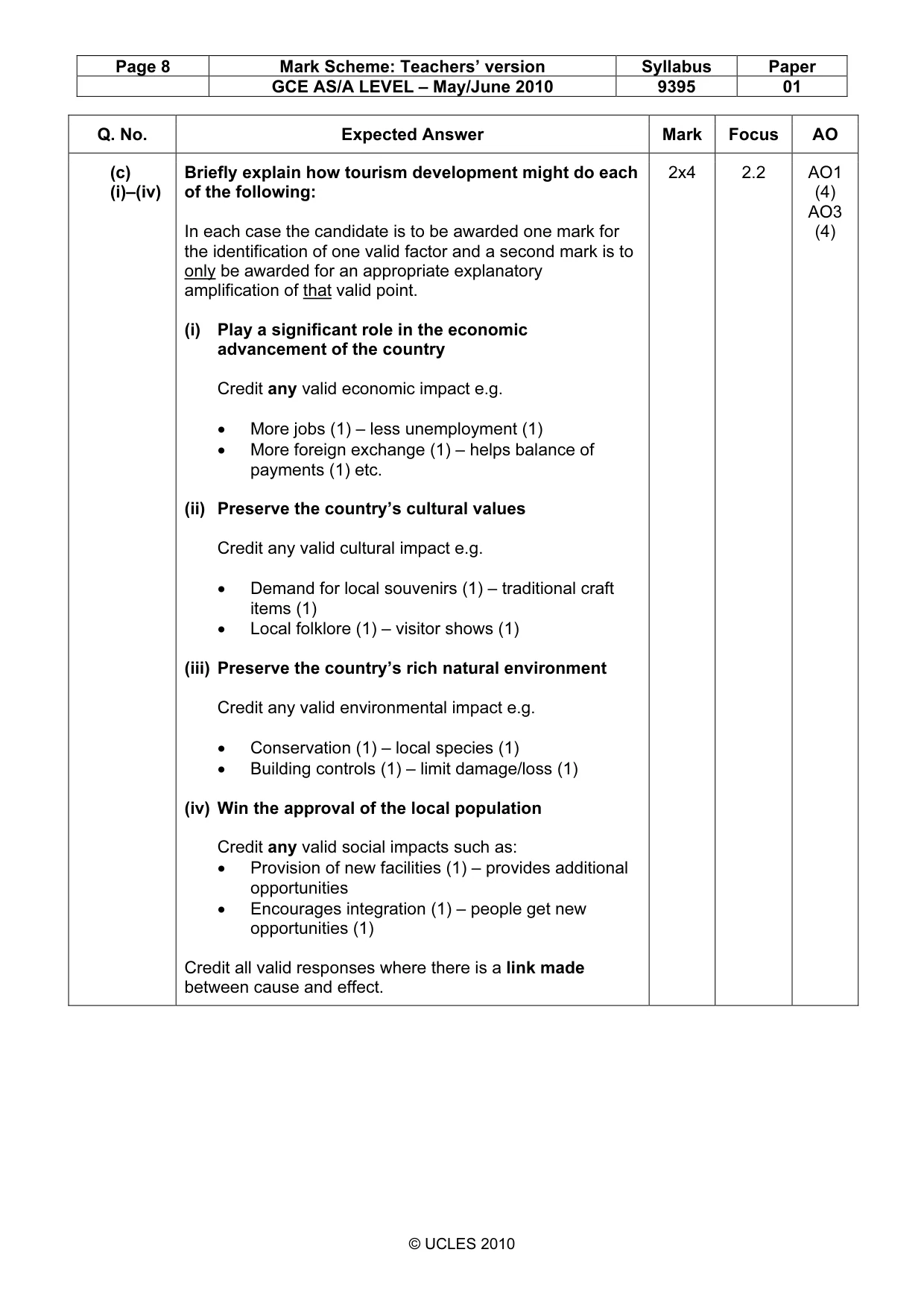
Page 8 Mark Scheme: Teachers’ version Syllabus Paper GCE AS/A LEVEL – May/June 2010 9395 01 © UCLES 2010 Q. No. Expected Answer Mark Focus AO (c) (i)–(iv) Briefly explain how tourism development might do each of the following: In each case the candidate is to be awarded one mark for the identification of one valid factor and a second mark is to only be awarded for an appropriate explanatory amplification of that valid point. (i) Play a significant role in the economic advancement of the country Credit any valid economic impact e.g. • More jobs (1) – less unemployment (1) • More foreign exchange (1) – helps balance of payments (1) etc. (ii) Preserve the country’s cultural values Credit any valid cultural impact e.g. • Demand for local souvenirs (1) – traditional craft items (1) • Local folklore (1) – visitor shows (1) (iii) Preserve the country’s rich natural environment Credit any valid environmental impact e.g. • Conservation (1) – local species (1) • Building controls (1) – limit damage/loss (1) (iv) Win the approval of the local population Credit any valid social impacts such as: • Provision of new facilities (1) – provides additional opportunities • Encourages integration (1) – people get new opportunities (1) Credit all valid responses where there is a link made between cause and effect. 2x4 2.2 AO1 (4) AO3 (4)
Mark scheme, page 9
Page 9 Mark Scheme: Teachers’ version Syllabus Paper GCE AS/A LEVEL – May/June 2010 9395 01 © UCLES 2010 Q. No. Expected Answer Mark Focus AO (d) Whilst tourism is increasing in destinations like Sri Lanka it is facing stagnation/decline in other areas. With reference to examples with which you are familiar, discuss reasons why destinations suffer stagnation and decline. This is set in terms of destination evolution or life cycle and two Butler Model terms have even been included in the title. Candidates should consider and illustrate ideas such as: • Current trends are that tourists have higher levels of disposable income and greater leisure time. • They are also better educated and have developed more sophisticated tastes. • New competing destinations have emerged and now actively attract different visitor types and market segments. • There is now a demand for a better quality product in many destinations. • The old ‘sun, sea, and sand’ mass market has fragmented. • People are taking second holidays in the form of short breaks/city breaks, ranging from British and European cities to country hotels. • There has been a growth in niche markets catering for special interests or activities. All the above have resulted in destinations such as Spain's Costa Brava experiencing a decline in visitor numbers. Use Level of Response criteria Level 1 (1–3 marks) – The candidate identifies/describes up to three reasons for the decline in popularity of certain destinations. Level 2 (4–6 marks) – The candidate explains/analyses one (at lower end of the range) or more reasons for decline in popularity. All 6 marks could be awarded for a thorough analysis of two factors influencing decline in a named destination. Level 3 (7–9 marks) – The candidate assesses/evaluates at least two reasons for stagnation or decline, reaching a justifiable conclusion. 9 2.3 AO2 (3) AO3 (3) AO4 (3) 4 (a) Identify two key tourism target markets for Harrison County. Award one mark for each of: • OAPs • Business travellers 2 1.2 AO2
Mark scheme, page 10
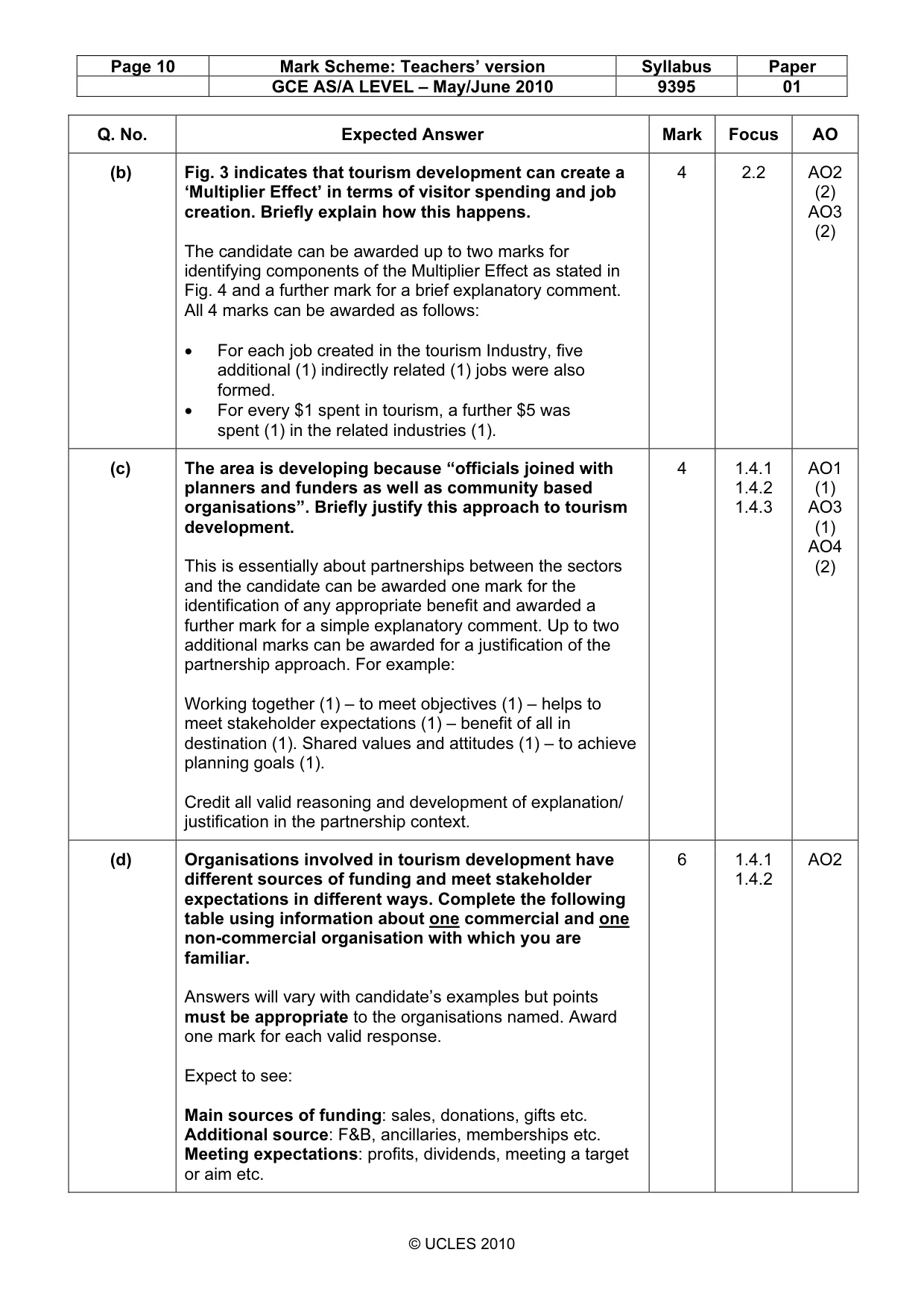
Page 10 Mark Scheme: Teachers’ version Syllabus Paper GCE AS/A LEVEL – May/June 2010 9395 01 © UCLES 2010 Q. No. Expected Answer Mark Focus AO (b) Fig. 3 indicates that tourism development can create a ‘Multiplier Effect’ in terms of visitor spending and job creation. Briefly explain how this happens. The candidate can be awarded up to two marks for identifying components of the Multiplier Effect as stated in Fig. 4 and a further mark for a brief explanatory comment. All 4 marks can be awarded as follows: • For each job created in the tourism Industry, five additional (1) indirectly related (1) jobs were also formed. • For every $1 spent in tourism, a further $5 was spent (1) in the related industries (1). 4 2.2 AO2 (2) AO3 (2) (c) The area is developing because “officials joined with planners and funders as well as community based organisations”. Briefly justify this approach to tourism development. This is essentially about partnerships between the sectors and the candidate can be awarded one mark for the identification of any appropriate benefit and awarded a further mark for a simple explanatory comment. Up to two additional marks can be awarded for a justification of the partnership approach. For example: Working together (1) – to meet objectives (1) – helps to meet stakeholder expectations (1) – benefit of all in destination (1). Shared values and attitudes (1) – to achieve planning goals (1). Credit all valid reasoning and development of explanation/ justification in the partnership context. 4 1.4.1 1.4.2 1.4.3 AO1 (1) AO3 (1) AO4 (2) (d) Organisations involved in tourism development have different sources of funding and meet stakeholder expectations in different ways. Complete the following table using information about one commercial and one non-commercial organisation with which you are familiar. Answers will vary with candidate’s examples but points must be appropriate to the organisations named. Award one mark for each valid response. Expect to see: Main sources of funding: sales, donations, gifts etc. Additional source: F&B, ancillaries, memberships etc. Meeting expectations: profits, dividends, meeting a target or aim etc. 6 1.4.1 1.4.2 AO2
Mark scheme, page 11
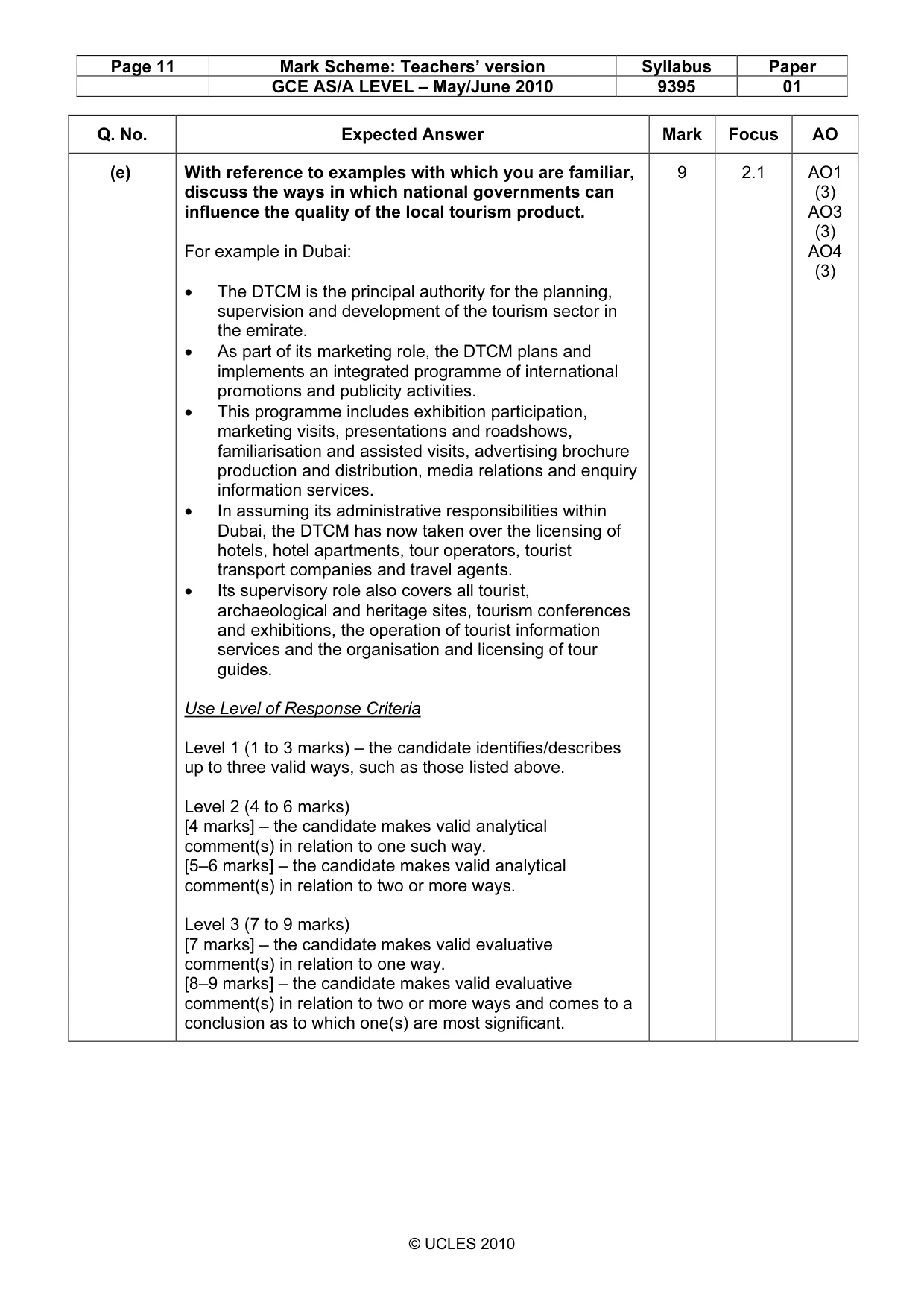
Page 11 Mark Scheme: Teachers’ version Syllabus Paper GCE AS/A LEVEL – May/June 2010 9395 01 © UCLES 2010 Q. No. Expected Answer Mark Focus AO (e) With reference to examples with which you are familiar, discuss the ways in which national governments can influence the quality of the local tourism product. For example in Dubai: • The DTCM is the principal authority for the planning, supervision and development of the tourism sector in the emirate. • As part of its marketing role, the DTCM plans and implements an integrated programme of international promotions and publicity activities. • This programme includes exhibition participation, marketing visits, presentations and roadshows, familiarisation and assisted visits, advertising brochure production and distribution, media relations and enquiry information services. • In assuming its administrative responsibilities within Dubai, the DTCM has now taken over the licensing of hotels, hotel apartments, tour operators, tourist transport companies and travel agents. • Its supervisory role also covers all tourist, archaeological and heritage sites, tourism conferences and exhibitions, the operation of tourist information services and the organisation and licensing of tour guides. Use Level of Response Criteria Level 1 (1 to 3 marks) – the candidate identifies/describes up to three valid ways, such as those listed above. Level 2 (4 to 6 marks) [4 marks] – the candidate makes valid analytical comment(s) in relation to one such way. [5–6 marks] – the candidate makes valid analytical comment(s) in relation to two or more ways. Level 3 (7 to 9 marks) [7 marks] – the candidate makes valid evaluative comment(s) in relation to one way. [8–9 marks] – the candidate makes valid evaluative comment(s) in relation to two or more ways and comes to a conclusion as to which one(s) are most significant. 9 2.1 AO1 (3) AO3 (3) AO4 (3)
What you needed in this session
Cambridge’s own grade thresholds for 2010 May/June, Paper 1 · Variant 1. A higher threshold means an easier paper — the bar moves with how the cohort did.