Cambridge A Level Travel and Tourism 9395 — 2009 Oct/Nov Paper 1 · Variant 1
9395/11/O/N/09 · 100 marks · ≈113 min
The question paper and its mark scheme, free to read here and free to download. This is Cambridge’s own paper, exactly as it was sat.
Question paper20 pages




Mark scheme9 pages
Answers below. Sit the paper first if you are practising.
Paper as text
Question paper, page 1
This document consists of 16 printed pages and 4 blank pages. IB09 11_9395_01/3RP © UCLES 2009 [Turn over *4287522417* For Examiner's Use 1 2 3 4 Total UNIVERSITY OF CAMBRIDGE INTERNATIONAL EXAMINATIONS General Certificate of Education Advanced Level TRAVEL AND TOURISM 9395/01 Paper 1 Core November 2009 2 hours and 30 minutes Candidates answer on the Question Paper. No Additional Materials are required. READ THESE INSTRUCTIONS FIRST Write your Centre number, candidate number and name on all the work you hand in. Write in dark blue or black pen. Do not use staples, paper clips, highlighters, glue or correction fluid. You may use a pencil for any diagrams, graphs or rough working. DO NOT WRITE IN ANY BARCODES. Answer all questions. The number of marks is given in brackets [ ] at the end of each question or part question.
Question paper, page 2
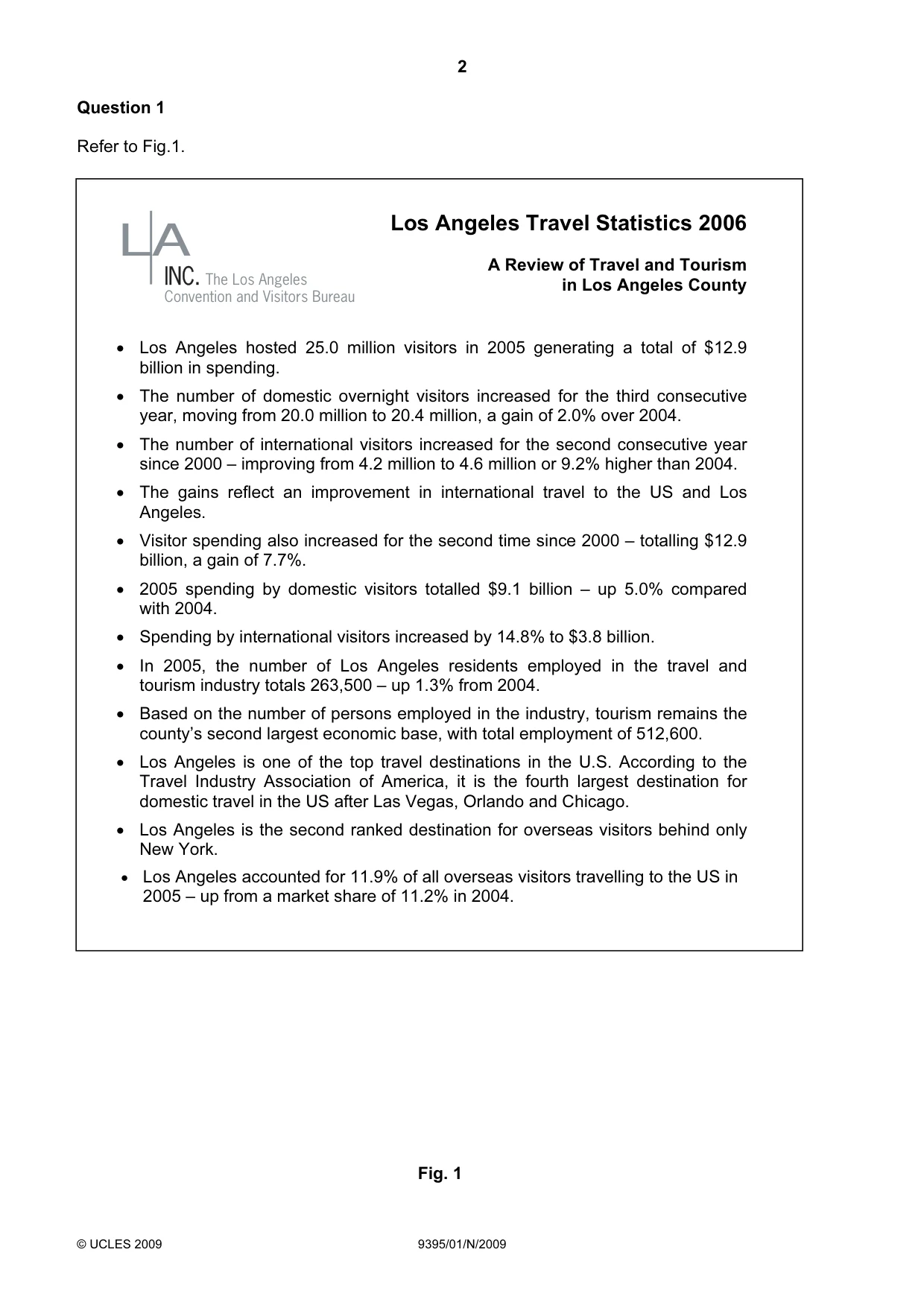
2 © UCLES 2009 9395/01/N/2009 Question 1 Refer to Fig.1. INC INC. The Los Angeles Convention and Visitors’ Bureau LA INC INC. The Los Angeles Convention and Visitors’ Bureau LA Fig. 1 Fig. 1 Los Angeles Travel Statistics 2006 A Review of Travel and Tourism in Los Angeles County • Los Angeles hosted 25.0 million visitors in 2005 generating a total of $12.9 billion in spending. • The number of domestic overnight visitors increased for the third consecutive year, moving from 20.0 million to 20.4 million, a gain of 2.0% over 2004. • The number of international visitors increased for the second consecutive year since 2000 – improving from 4.2 million to 4.6 million or 9.2% higher than 2004. • The gains reflect an improvement in international travel to the US and Los Angeles. • Visitor spending also increased for the second time since 2000 – totalling $12.9 billion, a gain of 7.7%. • 2005 spending by domestic visitors totalled $9.1 billion – up 5.0% compared with 2004. • Spending by international visitors increased by 14.8% to $3.8 billion. • In 2005, the number of Los Angeles residents employed in the travel and tourism industry totals 263,500 – up 1.3% from 2004. • Based on the number of persons employed in the industry, tourism remains the county’s second largest economic base, with total employment of 512,600. • Los Angeles is one of the top travel destinations in the U.S. According to the Travel Industry Association of America, it is the fourth largest destination for domestic travel in the US after Las Vegas, Orlando and Chicago. • Los Angeles is the second ranked destination for overseas visitors behind only New York. • Los Angeles accounted for 11.9% of all overseas visitors travelling to the US in 2005 – up from a market share of 11.2% in 2004. INC INC. The Los Angeles Convention and Visitors Bureau LA
Question paper, page 3
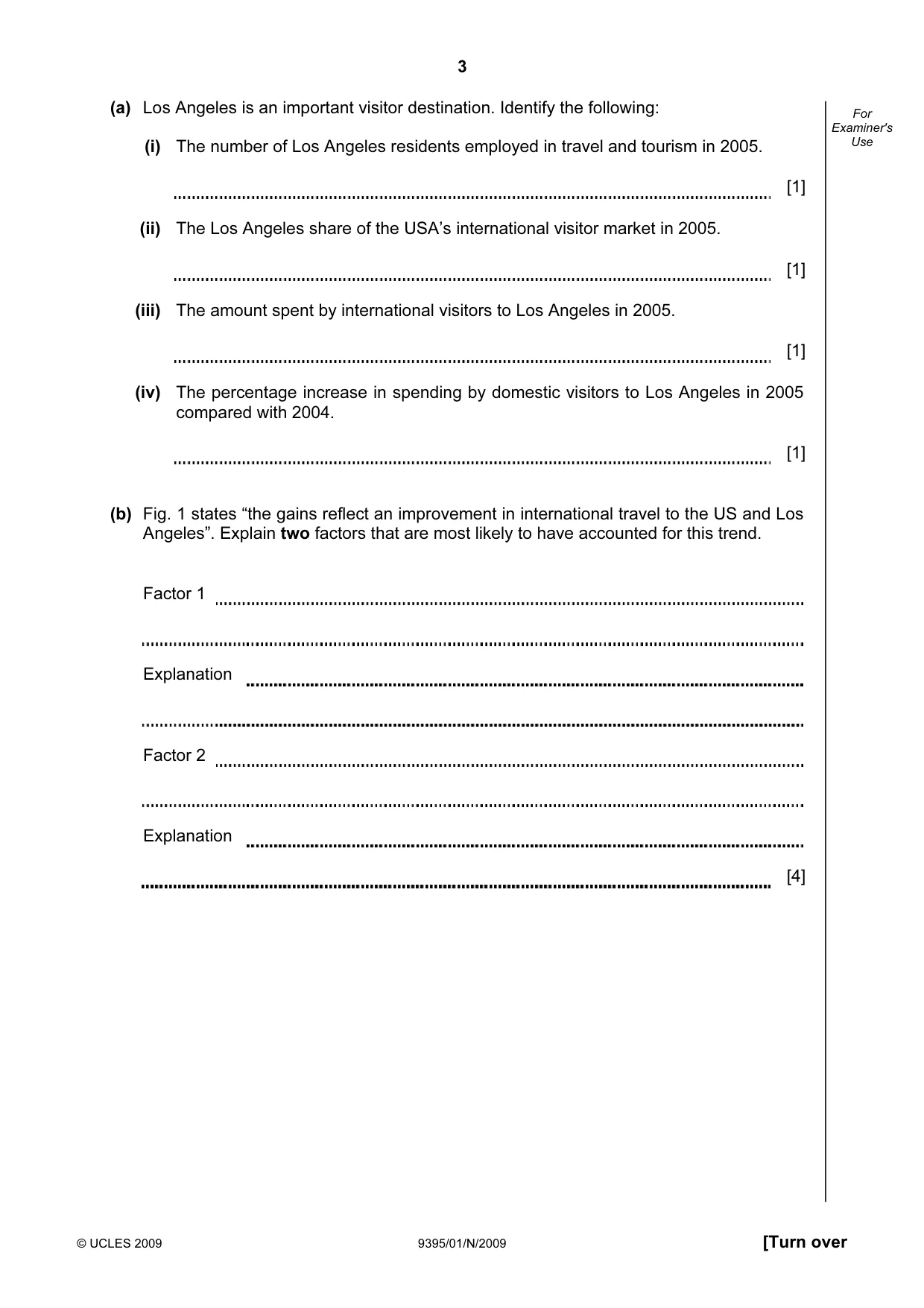
3 © UCLES 2009 9395/01/N/2009 [Turn over For Examiner's Use (a) Los Angeles is an important visitor destination. Identify the following: (i) The number of Los Angeles residents employed in travel and tourism in 2005. [1] (ii) The Los Angeles share of the USA’s international visitor market in 2005. [1] (iii) The amount spent by international visitors to Los Angeles in 2005. [1] (iv) The percentage increase in spending by domestic visitors to Los Angeles in 2005 compared with 2004. [1] (b) Fig. 1 states “the gains reflect an improvement in international travel to the US and Los Angeles”. Explain two factors that are most likely to have accounted for this trend. Factor 1 Explanation Factor 2 Explanation [4]
Question paper, page 4
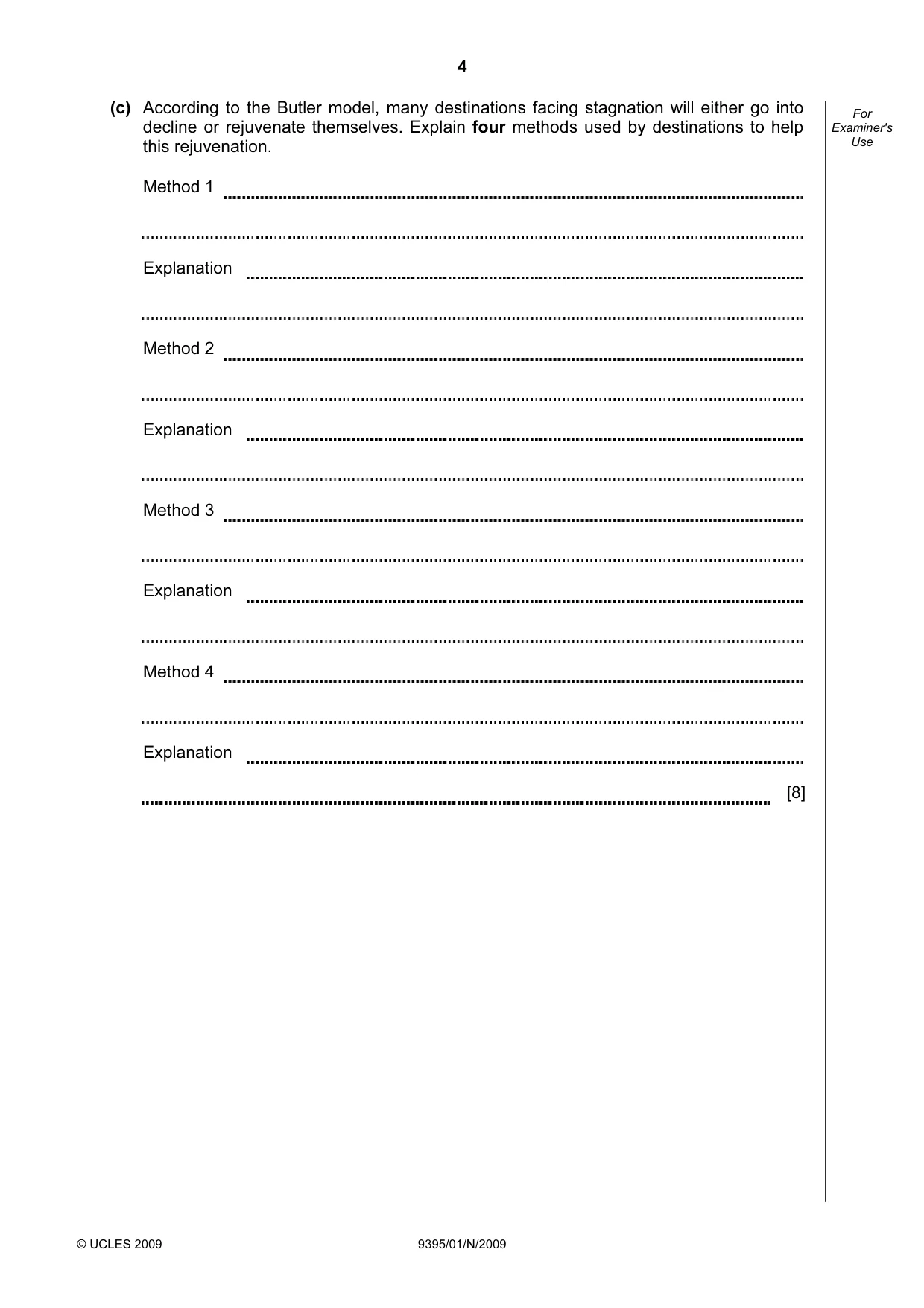
4 © UCLES 2009 9395/01/N/2009 For Examiner's Use (c) According to the Butler model, many destinations facing stagnation will either go into decline or rejuvenate themselves. Explain four methods used by destinations to help this rejuvenation. Method 1 Explanation Method 2 Explanation Method 3 Explanation Method 4 Explanation [8]
Question paper, page 5
5 © UCLES 2009 9395/01/N/2009 [Turn over For Examiner's Use (d) Many destinations have a specialised visitors bureau to help attract tourists. Discuss the ways in which such organisations can help the development of tourism. [9] [Total: 25]
Question paper, page 6
6 © UCLES 2009 9395/01/N/2009 Question 2 Refer to Fig. 2, an extract from the Travel China Guide website. Fig. 2 Travel China Guide is the largest online tour operator in China. Our travel consultants offer many choices, from luxurious group packages to tailor-made private tours, with 24-hour toll- free telephone services for our valued guests. Plan today to explore Chinese civilisation in this beautiful and mysterious land. Contact Us: Headquarters Mailing Address: Suite 508, Yu Yuan Mansion, No.65 Nan Er Huan Xi Duan, Xian, P.R.C. 710068 Suggestions & Comments: For any comments about our website or services, please complete the form below. **Indicates the field is required. Name ** E-Mail ** Country/Region -- please select -- Address Zip Code Comments ** Submit
Question paper, page 7
7 © UCLES 2009 9395/01/N/2009 [Turn over For Examiner's Use (a) Identify the three ways in which external customers may contact Travel China Guide. 1 2 3 [3] (b) Travel China Guide encourages external customer comments. Explain three different uses of such customer feedback. Use 1 Explanation Use 2 Explanation Use 3 Explanation [6] (c) All travel and tourism organisations, such as Travel China Guide, try to provide effective customer service to their internal customers in order to create good working relationships. State three advantages of this to the organisation. 1 2 3 [3]
Question paper, page 8
8 © UCLES 2009 9395/01/N/2009 For Examiner's Use (d) For one travel and tourism job role within an outlet with which you are familiar, describe the staff training provided and recommend one way in which the training can be improved. Title of job role: Name of outlet: Details of training provided: Recommended improvement: [4]
Question paper, page 9
9 © UCLES 2009 9395/01/N/2009 [Turn over For Examiner's Use (e) With reference to one travel and tourism organisation with which you are familiar, assess the ways it meets the needs of different types of external customer. [9] [Total: 25]
Question paper, page 10
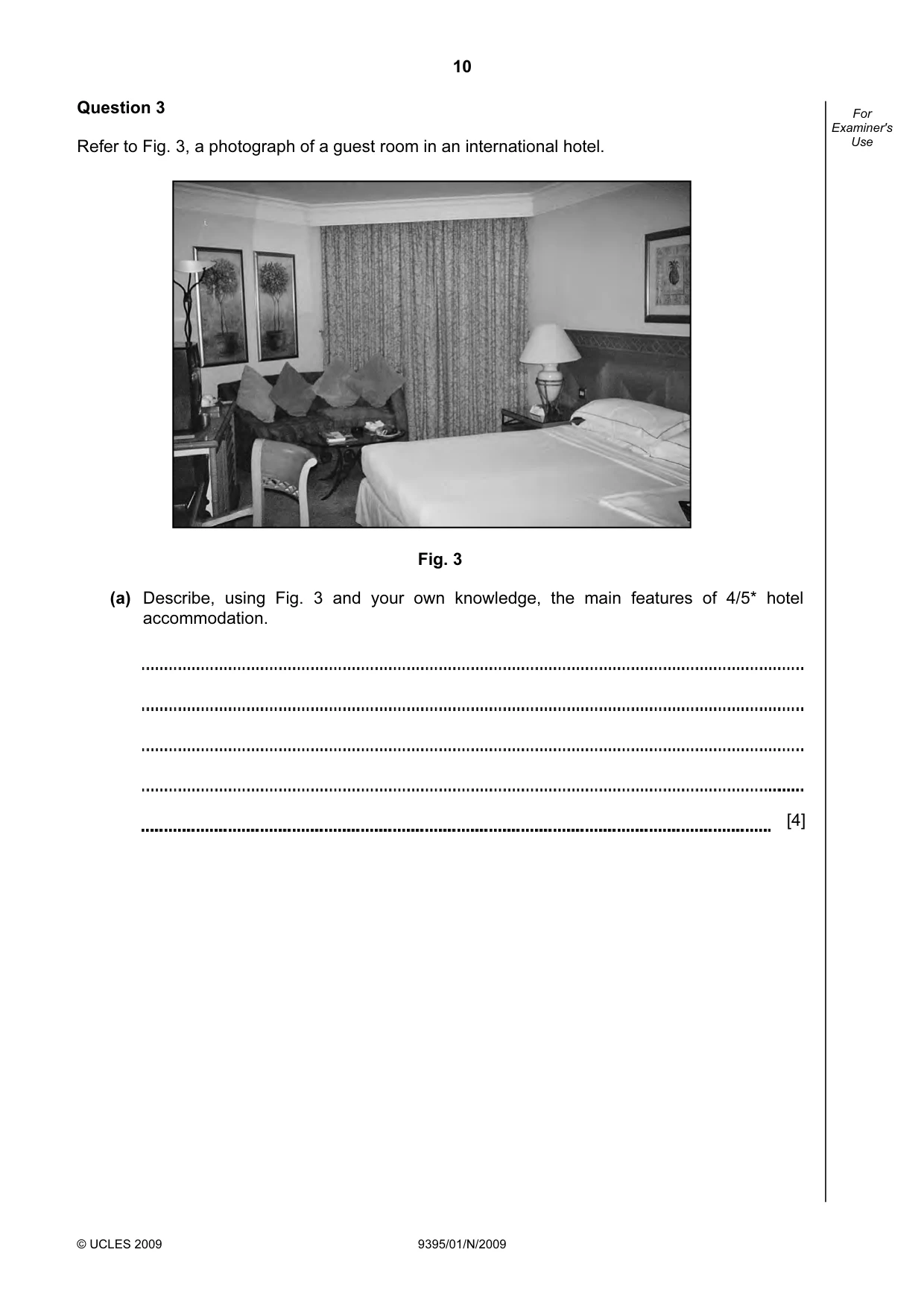
10 © UCLES 2009 9395/01/N/2009 For Examiner's Use Question 3 Refer to Fig. 3, a photograph of a guest room in an international hotel. Fig. 3 (a) Describe, using Fig. 3 and your own knowledge, the main features of 4/5* hotel accommodation. [4]
Question paper, page 11
11 © UCLES 2009 9395/01/N/2009 [Turn over For Examiner's Use (b) Explain three different types of room service usually provided for guests in international 4/5* hotels. Service 1 Explanation Service 2 Explanation Service 3 Explanation [6] (c) In most hotels several different types of accommodation can be booked. Define the following: (i) Double with Bed and Breakfast [2] (ii) Twin with Half Board [2] (iii) Single with Full Board [2]
Question paper, page 12
12 © UCLES 2009 9395/01/N/2009 For Examiner's Use (d) Discuss the negative impacts on people and the environment that can result when large resort hotel complexes are established in Less Economically Developed Countries (LEDCs). [9] [Total: 25]
Question paper, page 14
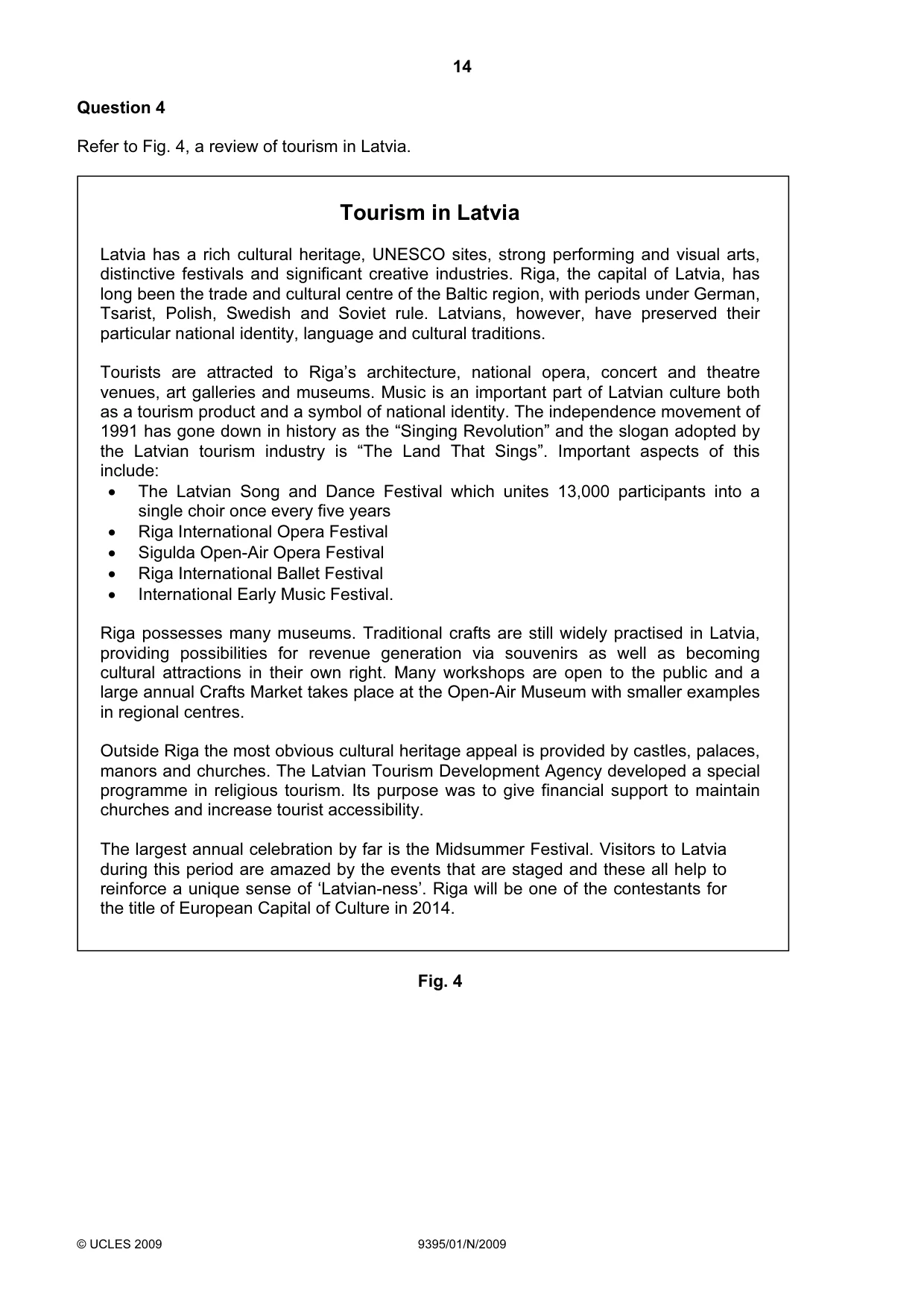
14 © UCLES 2009 9395/01/N/2009 Question 4 Refer to Fig. 4, a review of tourism in Latvia. Fig. 4 Tourism in Latvia Latvia has a rich cultural heritage, UNESCO sites, strong performing and visual arts, distinctive festivals and significant creative industries. Riga, the capital of Latvia, has long been the trade and cultural centre of the Baltic region, with periods under German, Tsarist, Polish, Swedish and Soviet rule. Latvians, however, have preserved their particular national identity, language and cultural traditions. Tourists are attracted to Riga’s architecture, national opera, concert and theatre venues, art galleries and museums. Music is an important part of Latvian culture both as a tourism product and a symbol of national identity. The independence movement of 1991 has gone down in history as the “Singing Revolution” and the slogan adopted by the Latvian tourism industry is “The Land That Sings”. Important aspects of this include: • The Latvian Song and Dance Festival which unites 13,000 participants into a single choir once every five years • Riga International Opera Festival • Sigulda Open-Air Opera Festival • Riga International Ballet Festival • International Early Music Festival. Riga possesses many museums. Traditional crafts are still widely practised in Latvia, providing possibilities for revenue generation via souvenirs as well as becoming cultural attractions in their own right. Many workshops are open to the public and a large annual Crafts Market takes place at the Open-Air Museum with smaller examples in regional centres. Outside Riga the most obvious cultural heritage appeal is provided by castles, palaces, manors and churches. The Latvian Tourism Development Agency developed a special programme in religious tourism. Its purpose was to give financial support to maintain churches and increase tourist accessibility. The largest annual celebration by far is the Midsummer Festival. Visitors to Latvia during this period are amazed by the events that are staged and these all help to reinforce a unique sense of ‘Latvian-ness’. Riga will be one of the contestants for the title of European Capital of Culture in 2014.
Question paper, page 15
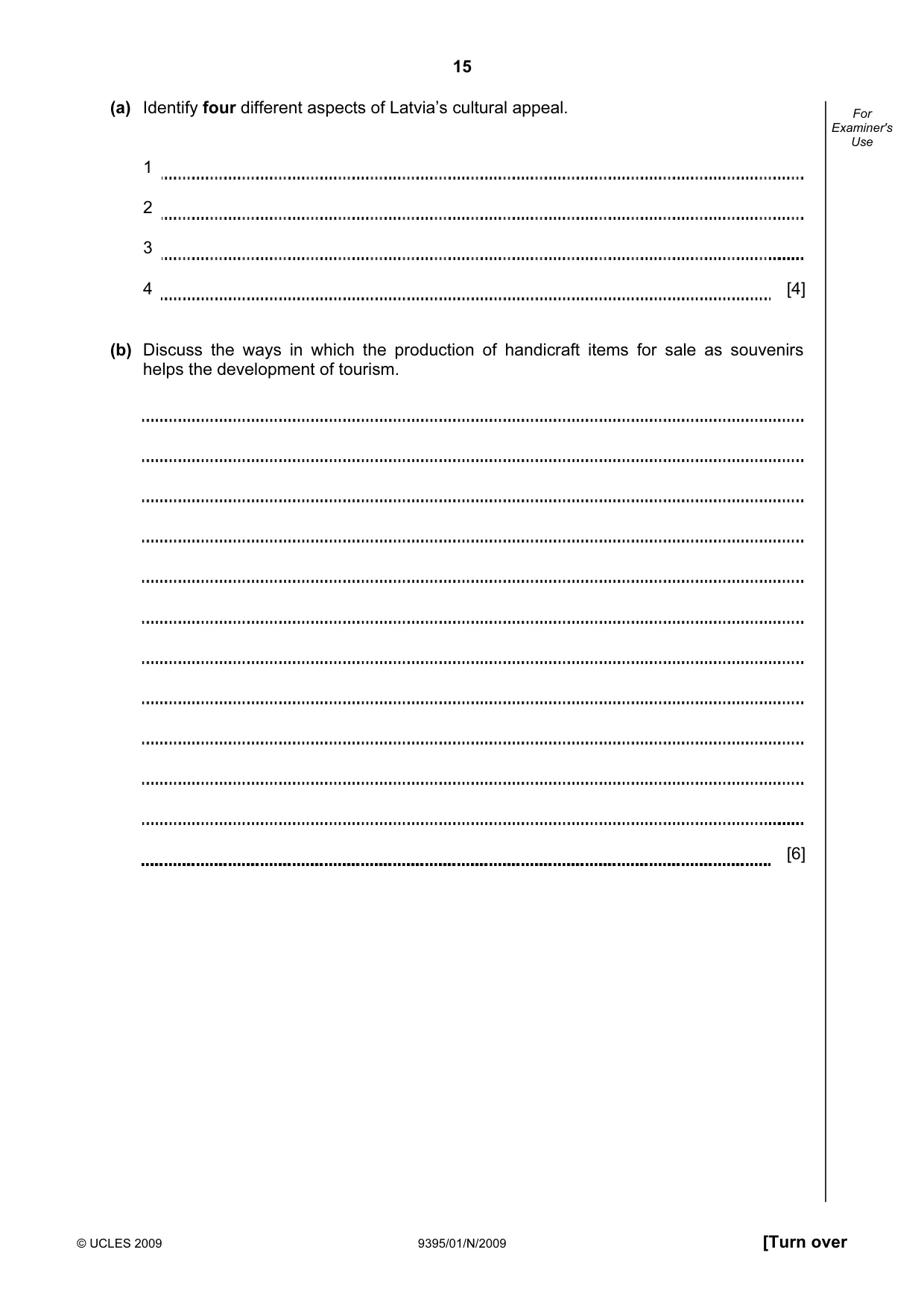
15 © UCLES 2009 9395/01/N/2009 [Turn over For Examiner's Use (a) Identify four different aspects of Latvia’s cultural appeal. 1 2 3 4 [4] (b) Discuss the ways in which the production of handicraft items for sale as souvenirs helps the development of tourism. [6]
Question paper, page 16
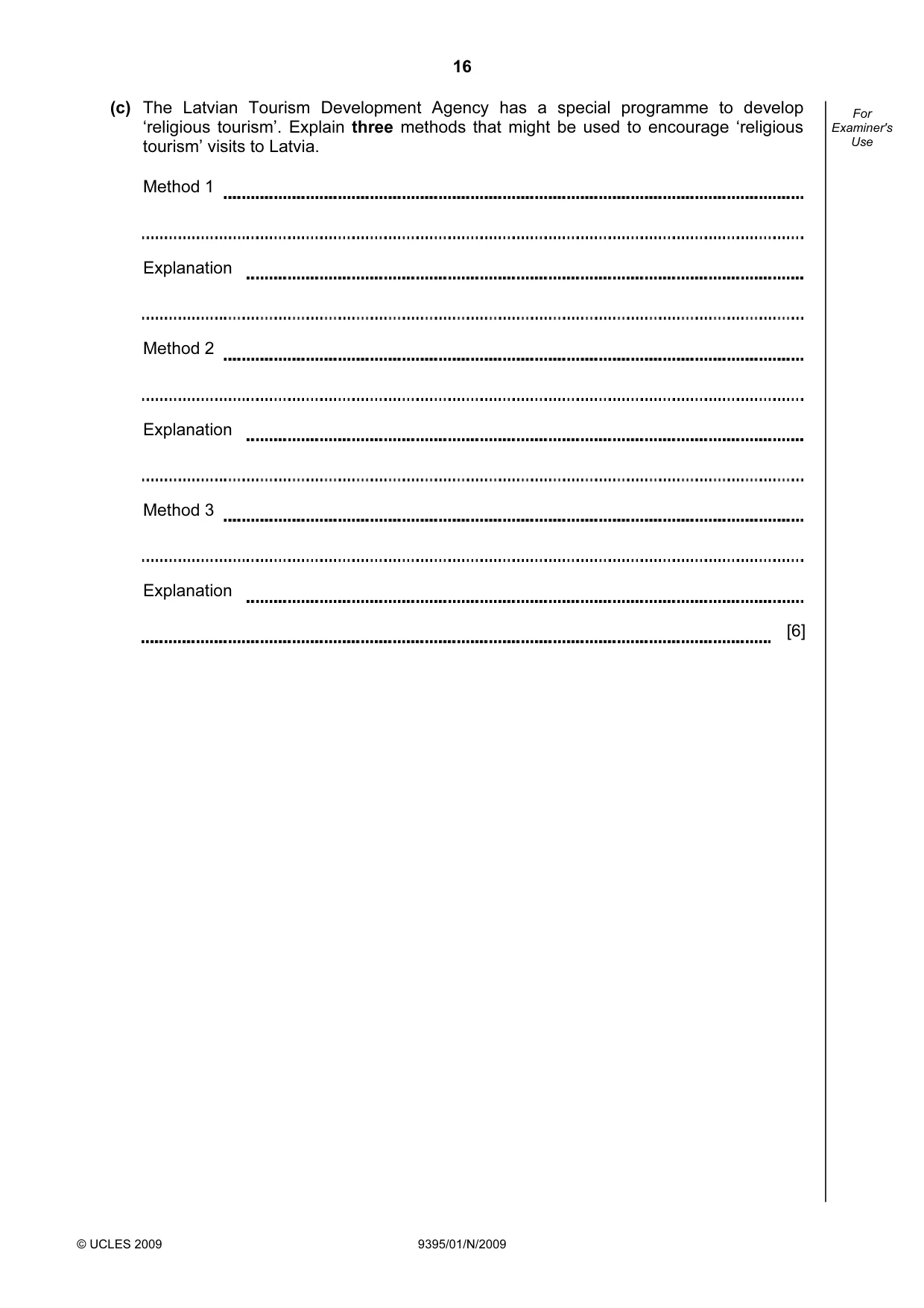
16 © UCLES 2009 9395/01/N/2009 For Examiner's Use (c) The Latvian Tourism Development Agency has a special programme to develop ‘religious tourism’. Explain three methods that might be used to encourage ‘religious tourism’ visits to Latvia. Method 1 Explanation Method 2 Explanation Method 3 Explanation [6]
Question paper, page 17
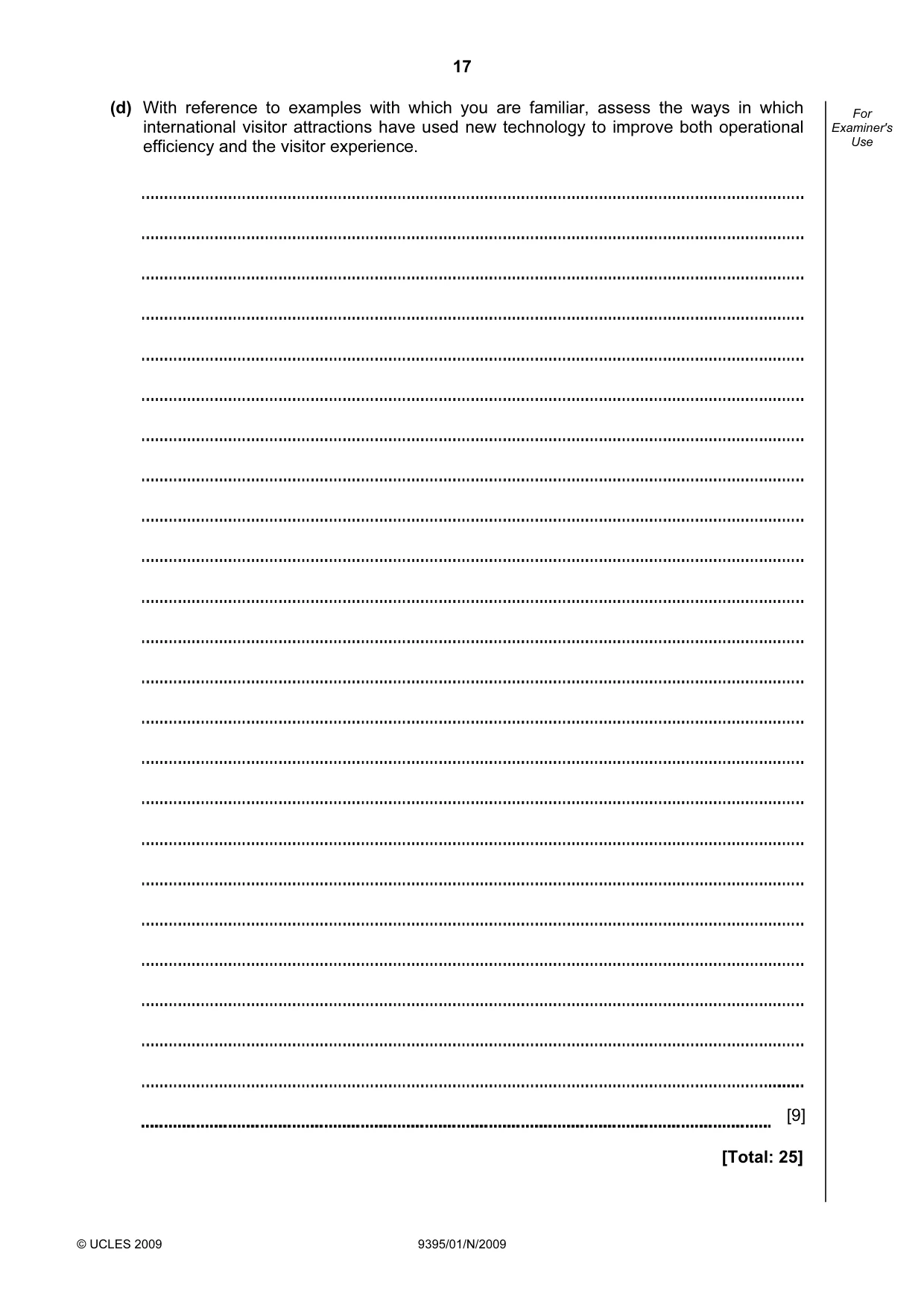
17 © UCLES 2009 9395/01/N/2009 For Examiner's Use (d) With reference to examples with which you are familiar, assess the ways in which international visitor attractions have used new technology to improve both operational efficiency and the visitor experience. [9] [Total: 25]
Question paper, page 20
20 Copyright Acknowledgements: Question 1 Question 2 Question 3 © LA Travel Statistics; LA Inc. © www.travelchinaguide.com J D Smith © UCLES Permission to reproduce items where third-party owned material protected by copyright is included has been sought and cleared where possible. Every reasonable effort has been made by the publisher (UCLES) to trace copyright holders, but if any items requiring clearance have unwittingly been included, the publisher will be pleased to make amends at the earliest possible opportunity. University of Cambridge International Examinations is part of the Cambridge Assessment Group. Cambridge Assessment is the brand name of University of Cambridge Local Examinations Syndicate (UCLES), which is itself a department of the University of Cambridge. 9395/01/N/2009 BLANK PAGE
Mark scheme, page 1
UNIVERSITY OF CAMBRIDGE INTERNATIONAL EXAMINATIONS GCE Advanced Subsidiary Level and GCE Advanced Level MARK SCHEME for the October/November 2009 question paper for the guidance of teachers 9395 TRAVEL AND TOURISM 9395/01 Paper 1 (Core), maximum raw mark 100 This mark scheme is published as an aid to teachers and candidates, to indicate the requirements of the examination. It shows the basis on which Examiners were instructed to award marks. It does not indicate the details of the discussions that took place at an Examiners’ meeting before marking began, which would have considered the acceptability of alternative answers. Mark schemes must be read in conjunction with the question papers and the report on the examination. • CIE will not enter into discussions or correspondence in connection with these mark schemes. CIE is publishing the mark schemes for the October/November 2009 question papers for most IGCSE, GCE Advanced Level and Advanced Subsidiary Level syllabuses and some Ordinary Level syllabuses.
Mark scheme, page 2
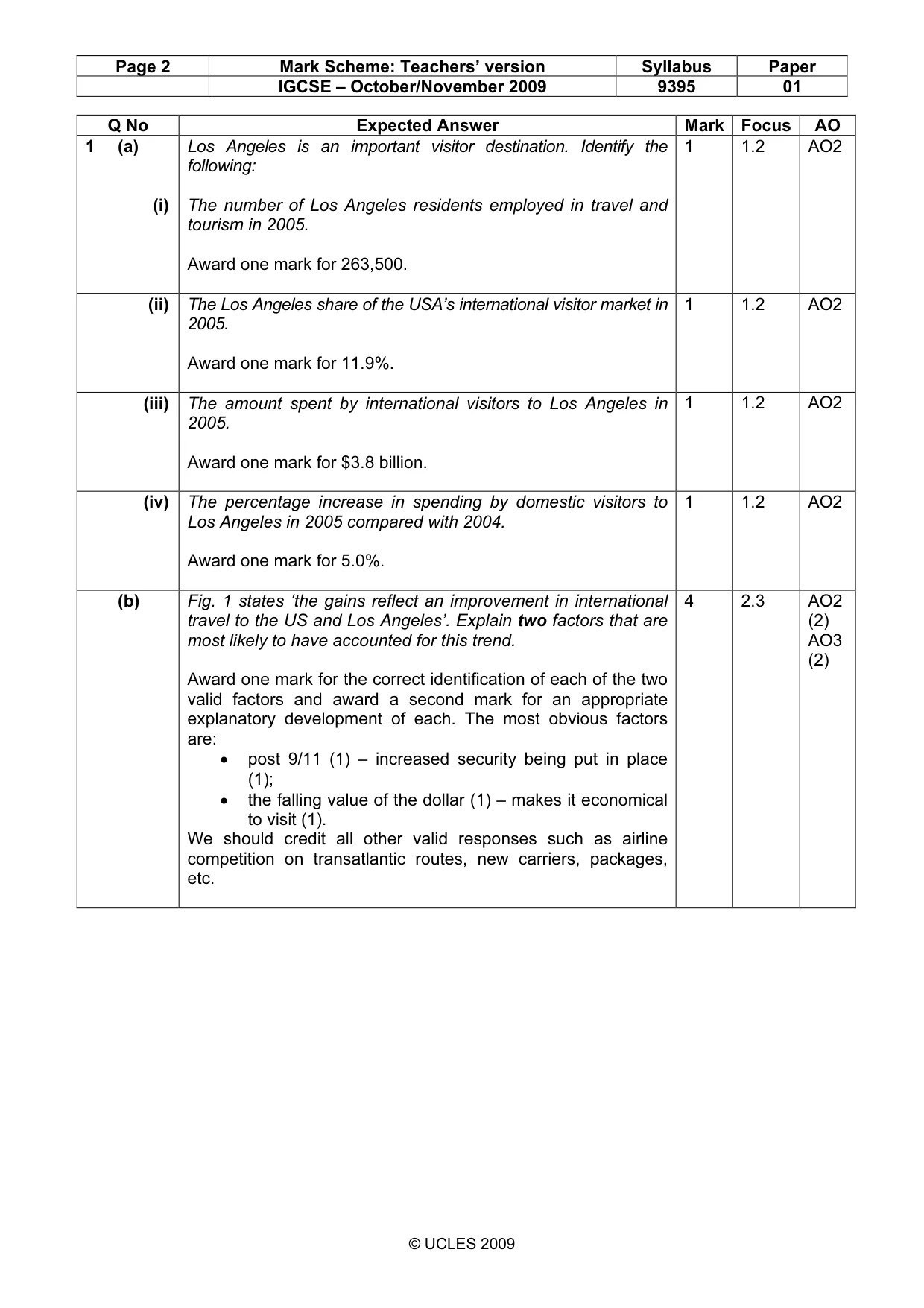
Page 2 Mark Scheme: Teachers’ version Syllabus Paper IGCSE – October/November 2009 9395 01 © UCLES 2009 Q No Expected Answer Mark Focus AO 1 (a) (i) Los Angeles is an important visitor destination. Identify the following: The number of Los Angeles residents employed in travel and tourism in 2005. Award one mark for 263,500. 1 1.2 AO2 (ii) The Los Angeles share of the USA’s international visitor market in 2005. Award one mark for 11.9%. 1 1.2 AO2 (iii) The amount spent by international visitors to Los Angeles in 2005. Award one mark for $3.8 billion. 1 1.2 AO2 (iv) The percentage increase in spending by domestic visitors to Los Angeles in 2005 compared with 2004. Award one mark for 5.0%. 1 1.2 AO2 (b) Fig. 1 states ‘the gains reflect an improvement in international travel to the US and Los Angeles’. Explain two factors that are most likely to have accounted for this trend. Award one mark for the correct identification of each of the two valid factors and award a second mark for an appropriate explanatory development of each. The most obvious factors are: • post 9/11 (1) – increased security being put in place (1); • the falling value of the dollar (1) – makes it economical to visit (1). We should credit all other valid responses such as airline competition on transatlantic routes, new carriers, packages, etc. 4 2.3 AO2 (2) AO3 (2)
Mark scheme, page 3
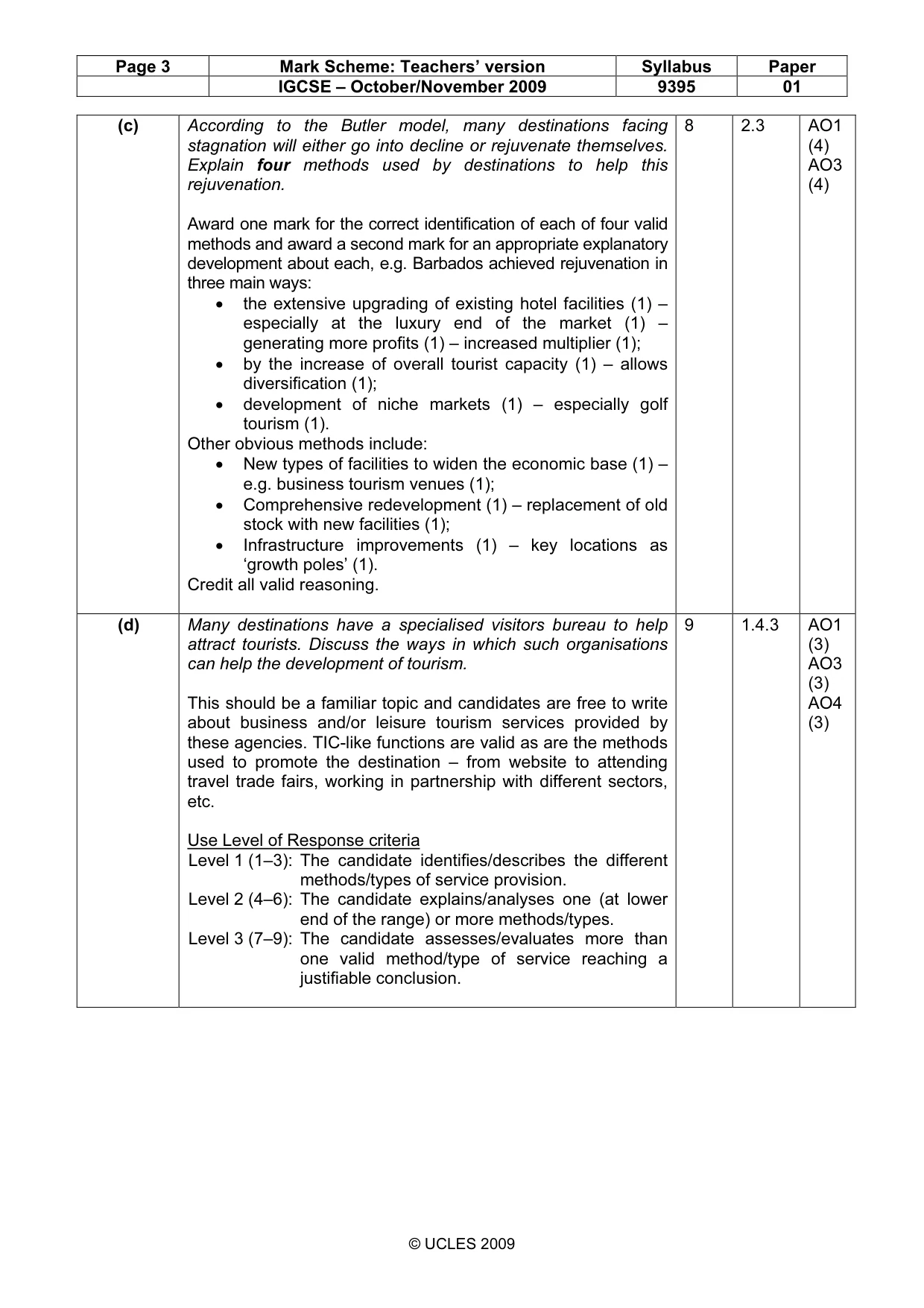
Page 3 Mark Scheme: Teachers’ version Syllabus Paper IGCSE – October/November 2009 9395 01 © UCLES 2009 (c) According to the Butler model, many destinations facing stagnation will either go into decline or rejuvenate themselves. Explain four methods used by destinations to help this rejuvenation. Award one mark for the correct identification of each of four valid methods and award a second mark for an appropriate explanatory development about each, e.g. Barbados achieved rejuvenation in three main ways: • the extensive upgrading of existing hotel facilities (1) – especially at the luxury end of the market (1) – generating more profits (1) – increased multiplier (1); • by the increase of overall tourist capacity (1) – allows diversification (1); • development of niche markets (1) – especially golf tourism (1). Other obvious methods include: • New types of facilities to widen the economic base (1) – e.g. business tourism venues (1); • Comprehensive redevelopment (1) – replacement of old stock with new facilities (1); • Infrastructure improvements (1) – key locations as ‘growth poles’ (1). Credit all valid reasoning. 8 2.3 AO1 (4) AO3 (4) (d) Many destinations have a specialised visitors bureau to help attract tourists. Discuss the ways in which such organisations can help the development of tourism. This should be a familiar topic and candidates are free to write about business and/or leisure tourism services provided by these agencies. TIC-like functions are valid as are the methods used to promote the destination – from website to attending travel trade fairs, working in partnership with different sectors, etc. Use Level of Response criteria Level 1 (1–3): The candidate identifies/describes the different methods/types of service provision. Level 2 (4–6): The candidate explains/analyses one (at lower end of the range) or more methods/types. Level 3 (7–9): The candidate assesses/evaluates more than one valid method/type of service reaching a justifiable conclusion. 9 1.4.3 AO1 (3) AO3 (3) AO4 (3)
Mark scheme, page 4
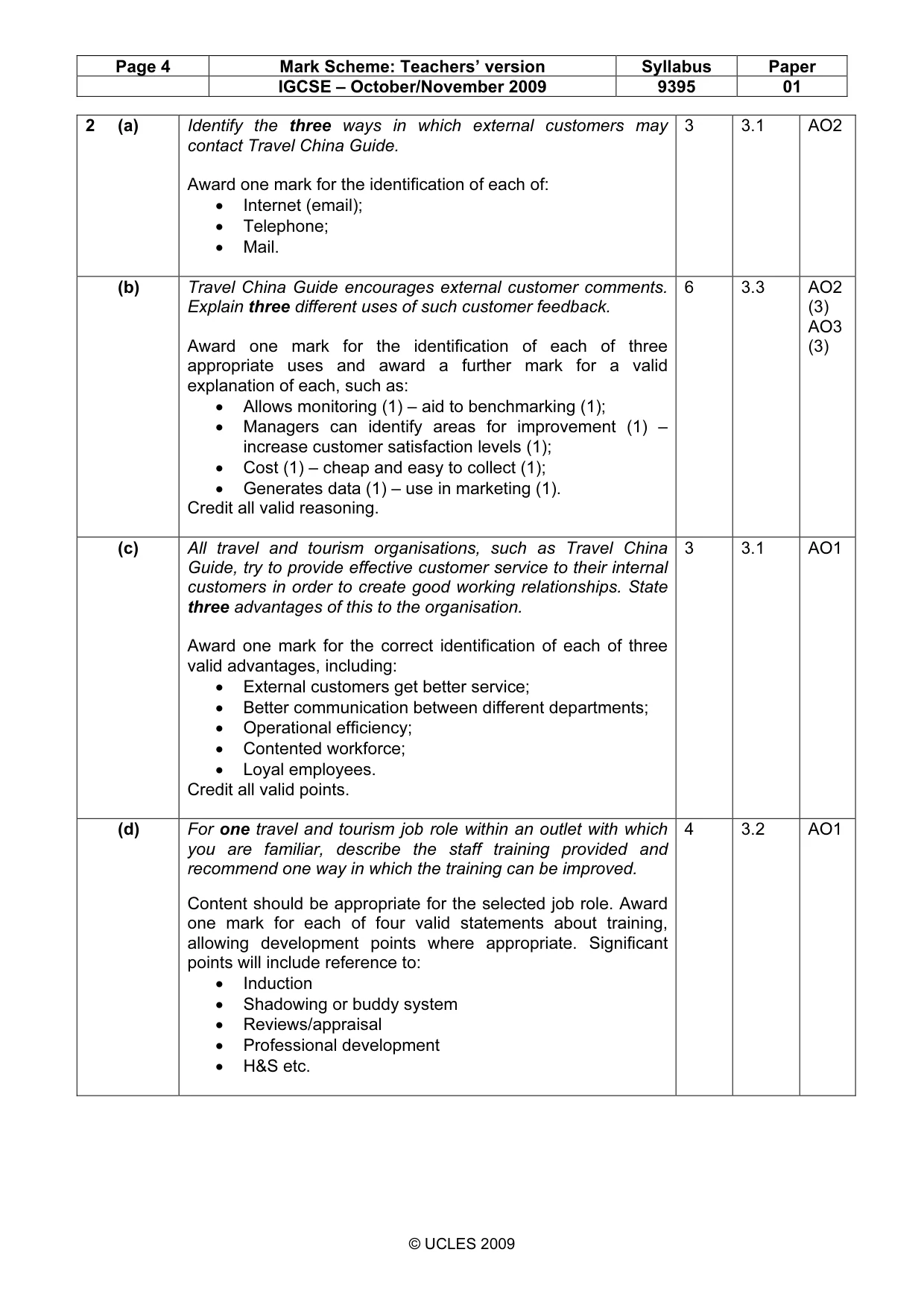
Page 4 Mark Scheme: Teachers’ version Syllabus Paper IGCSE – October/November 2009 9395 01 © UCLES 2009 2 (a) Identify the three ways in which external customers may contact Travel China Guide. Award one mark for the identification of each of: • Internet (email); • Telephone; • Mail. 3 3.1 AO2 (b) Travel China Guide encourages external customer comments. Explain three different uses of such customer feedback. Award one mark for the identification of each of three appropriate uses and award a further mark for a valid explanation of each, such as: • Allows monitoring (1) – aid to benchmarking (1); • Managers can identify areas for improvement (1) – increase customer satisfaction levels (1); • Cost (1) – cheap and easy to collect (1); • Generates data (1) – use in marketing (1). Credit all valid reasoning. 6 3.3 AO2 (3) AO3 (3) (c) All travel and tourism organisations, such as Travel China Guide, try to provide effective customer service to their internal customers in order to create good working relationships. State three advantages of this to the organisation. Award one mark for the correct identification of each of three valid advantages, including: • External customers get better service; • Better communication between different departments; • Operational efficiency; • Contented workforce; • Loyal employees. Credit all valid points. 3 3.1 AO1 (d) For one travel and tourism job role within an outlet with which you are familiar, describe the staff training provided and recommend one way in which the training can be improved. Content should be appropriate for the selected job role. Award one mark for each of four valid statements about training, allowing development points where appropriate. Significant points will include reference to: • Induction • Shadowing or buddy system • Reviews/appraisal • Professional development • H&S etc. 4 3.2 AO1
Mark scheme, page 5
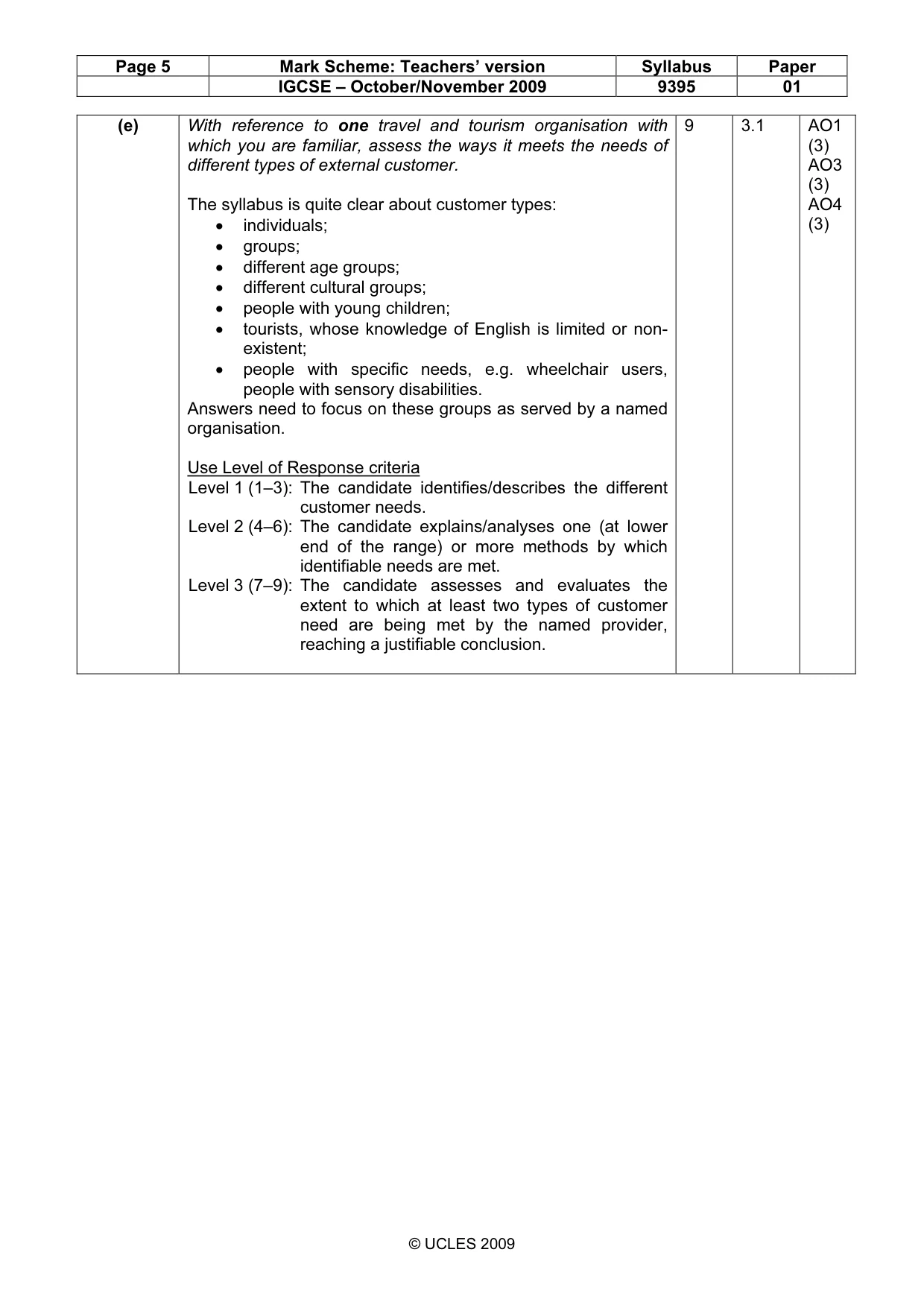
Page 5 Mark Scheme: Teachers’ version Syllabus Paper IGCSE – October/November 2009 9395 01 © UCLES 2009 (e) With reference to one travel and tourism organisation with which you are familiar, assess the ways it meets the needs of different types of external customer. The syllabus is quite clear about customer types: • individuals; • groups; • different age groups; • different cultural groups; • people with young children; • tourists, whose knowledge of English is limited or non- existent; • people with specific needs, e.g. wheelchair users, people with sensory disabilities. Answers need to focus on these groups as served by a named organisation. Use Level of Response criteria Level 1 (1–3): The candidate identifies/describes the different customer needs. Level 2 (4–6): The candidate explains/analyses one (at lower end of the range) or more methods by which identifiable needs are met. Level 3 (7–9): The candidate assesses and evaluates the extent to which at least two types of customer need are being met by the named provider, reaching a justifiable conclusion. 9 3.1 AO1 (3) AO3 (3) AO4 (3)
Mark scheme, page 6
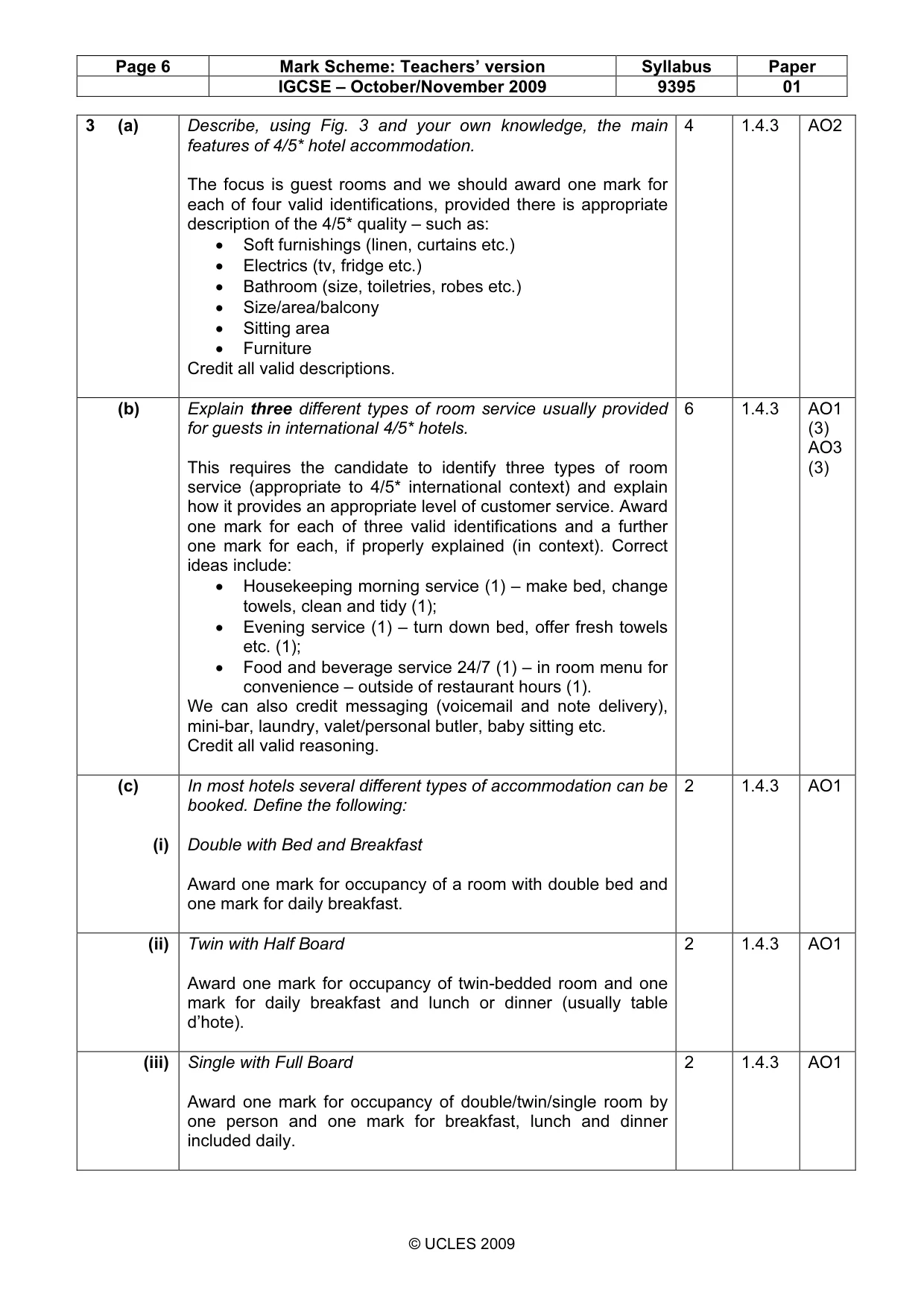
Page 6 Mark Scheme: Teachers’ version Syllabus Paper IGCSE – October/November 2009 9395 01 © UCLES 2009 3 (a) Describe, using Fig. 3 and your own knowledge, the main features of 4/5* hotel accommodation. The focus is guest rooms and we should award one mark for each of four valid identifications, provided there is appropriate description of the 4/5* quality – such as: • Soft furnishings (linen, curtains etc.) • Electrics (tv, fridge etc.) • Bathroom (size, toiletries, robes etc.) • Size/area/balcony • Sitting area • Furniture Credit all valid descriptions. 4 1.4.3 AO2 (b) Explain three different types of room service usually provided for guests in international 4/5* hotels. This requires the candidate to identify three types of room service (appropriate to 4/5* international context) and explain how it provides an appropriate level of customer service. Award one mark for each of three valid identifications and a further one mark for each, if properly explained (in context). Correct ideas include: • Housekeeping morning service (1) – make bed, change towels, clean and tidy (1); • Evening service (1) – turn down bed, offer fresh towels etc. (1); • Food and beverage service 24/7 (1) – in room menu for convenience – outside of restaurant hours (1). We can also credit messaging (voicemail and note delivery), mini-bar, laundry, valet/personal butler, baby sitting etc. Credit all valid reasoning. 6 1.4.3 AO1 (3) AO3 (3) (c) (i) In most hotels several different types of accommodation can be booked. Define the following: Double with Bed and Breakfast Award one mark for occupancy of a room with double bed and one mark for daily breakfast. 2 1.4.3 AO1 (ii) Twin with Half Board Award one mark for occupancy of twin-bedded room and one mark for daily breakfast and lunch or dinner (usually table d’hote). 2 1.4.3 AO1 (iii) Single with Full Board Award one mark for occupancy of double/twin/single room by one person and one mark for breakfast, lunch and dinner included daily. 2 1.4.3 AO1
Mark scheme, page 7
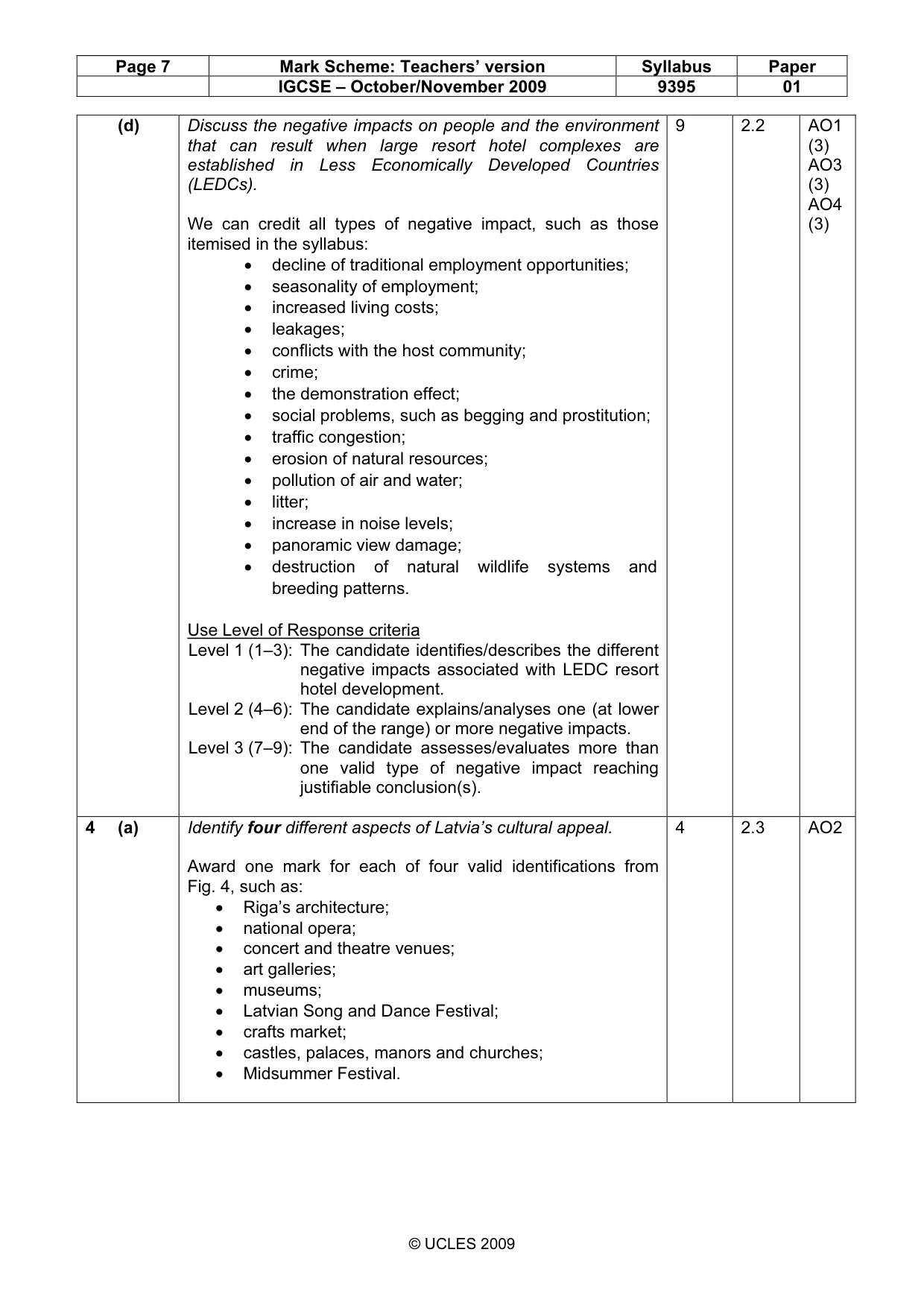
Page 7 Mark Scheme: Teachers’ version Syllabus Paper IGCSE – October/November 2009 9395 01 © UCLES 2009 (d) Discuss the negative impacts on people and the environment that can result when large resort hotel complexes are established in Less Economically Developed Countries (LEDCs). We can credit all types of negative impact, such as those itemised in the syllabus: • decline of traditional employment opportunities; • seasonality of employment; • increased living costs; • leakages; • conflicts with the host community; • crime; • the demonstration effect; • social problems, such as begging and prostitution; • traffic congestion; • erosion of natural resources; • pollution of air and water; • litter; • increase in noise levels; • panoramic view damage; • destruction of natural wildlife systems and breeding patterns. Use Level of Response criteria Level 1 (1–3): The candidate identifies/describes the different negative impacts associated with LEDC resort hotel development. Level 2 (4–6): The candidate explains/analyses one (at lower end of the range) or more negative impacts. Level 3 (7–9): The candidate assesses/evaluates more than one valid type of negative impact reaching justifiable conclusion(s). 9 2.2 AO1 (3) AO3 (3) AO4 (3) 4 (a) Identify four different aspects of Latvia’s cultural appeal. Award one mark for each of four valid identifications from Fig. 4, such as: • Riga’s architecture; • national opera; • concert and theatre venues; • art galleries; • museums; • Latvian Song and Dance Festival; • crafts market; • castles, palaces, manors and churches; • Midsummer Festival. 4 2.3 AO2
Mark scheme, page 8
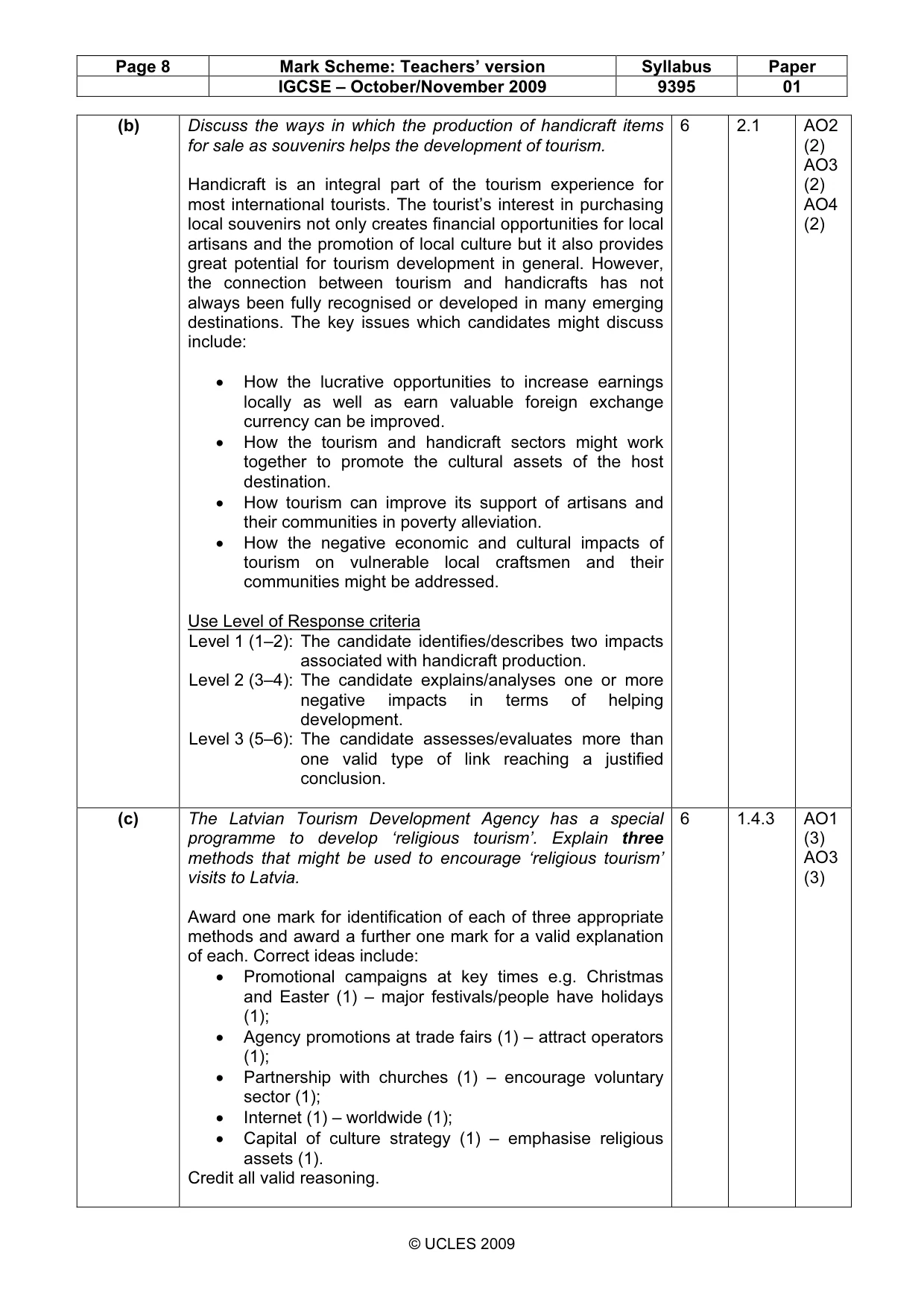
Page 8 Mark Scheme: Teachers’ version Syllabus Paper IGCSE – October/November 2009 9395 01 © UCLES 2009 (b) Discuss the ways in which the production of handicraft items for sale as souvenirs helps the development of tourism. Handicraft is an integral part of the tourism experience for most international tourists. The tourist’s interest in purchasing local souvenirs not only creates financial opportunities for local artisans and the promotion of local culture but it also provides great potential for tourism development in general. However, the connection between tourism and handicrafts has not always been fully recognised or developed in many emerging destinations. The key issues which candidates might discuss include: • How the lucrative opportunities to increase earnings locally as well as earn valuable foreign exchange currency can be improved. • How the tourism and handicraft sectors might work together to promote the cultural assets of the host destination. • How tourism can improve its support of artisans and their communities in poverty alleviation. • How the negative economic and cultural impacts of tourism on vulnerable local craftsmen and their communities might be addressed. Use Level of Response criteria Level 1 (1–2): The candidate identifies/describes two impacts associated with handicraft production. Level 2 (3–4): The candidate explains/analyses one or more negative impacts in terms of helping development. Level 3 (5–6): The candidate assesses/evaluates more than one valid type of link reaching a justified conclusion. 6 2.1 AO2 (2) AO3 (2) AO4 (2) (c) The Latvian Tourism Development Agency has a special programme to develop ‘religious tourism’. Explain three methods that might be used to encourage ‘religious tourism’ visits to Latvia. Award one mark for identification of each of three appropriate methods and award a further one mark for a valid explanation of each. Correct ideas include: • Promotional campaigns at key times e.g. Christmas and Easter (1) – major festivals/people have holidays (1); • Agency promotions at trade fairs (1) – attract operators (1); • Partnership with churches (1) – encourage voluntary sector (1); • Internet (1) – worldwide (1); • Capital of culture strategy (1) – emphasise religious assets (1). Credit all valid reasoning. 6 1.4.3 AO1 (3) AO3 (3)
Mark scheme, page 9
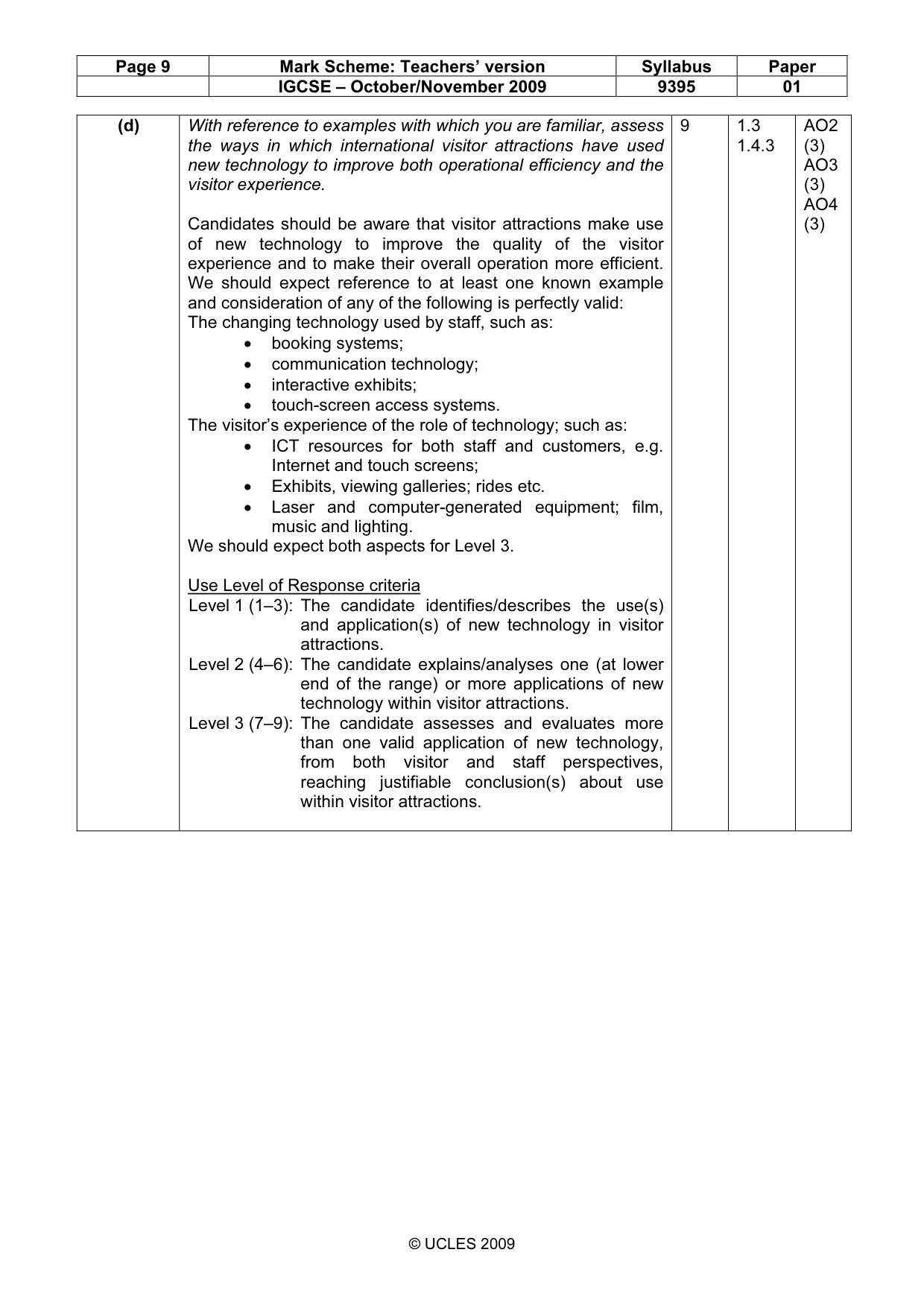
Page 9 Mark Scheme: Teachers’ version Syllabus Paper IGCSE – October/November 2009 9395 01 © UCLES 2009 (d) With reference to examples with which you are familiar, assess the ways in which international visitor attractions have used new technology to improve both operational efficiency and the visitor experience. Candidates should be aware that visitor attractions make use of new technology to improve the quality of the visitor experience and to make their overall operation more efficient. We should expect reference to at least one known example and consideration of any of the following is perfectly valid: The changing technology used by staff, such as: • booking systems; • communication technology; • interactive exhibits; • touch-screen access systems. The visitor’s experience of the role of technology; such as: • ICT resources for both staff and customers, e.g. Internet and touch screens; • Exhibits, viewing galleries; rides etc. • Laser and computer-generated equipment; film, music and lighting. We should expect both aspects for Level 3. Use Level of Response criteria Level 1 (1–3): The candidate identifies/describes the use(s) and application(s) of new technology in visitor attractions. Level 2 (4–6): The candidate explains/analyses one (at lower end of the range) or more applications of new technology within visitor attractions. Level 3 (7–9): The candidate assesses and evaluates more than one valid application of new technology, from both visitor and staff perspectives, reaching justifiable conclusion(s) about use within visitor attractions. 9 1.3 1.4.3 AO2 (3) AO3 (3) AO4 (3)
What you needed in this session
Cambridge’s own grade thresholds for 2009 Oct/Nov, Paper 1 · Variant 1. A higher threshold means an easier paper — the bar moves with how the cohort did.