Cambridge A Level Travel and Tourism 9395 — 2009 May/June Paper 4 · Variant 1
9395/41/M/J/09 · 50 marks · ≈56 min
The question paper and its mark scheme, free to read here and free to download. This is Cambridge’s own paper, exactly as it was sat.
Question paper12 pages




Mark scheme4 pages
Answers below. Sit the paper first if you are practising.
Paper as text
Question paper, page 1
This document consists of 10 printed pages and 2 blank pages. IB09 06_9395_04/3RP © UCLES 2009 [Turn over *7772068799* For Examiner's Use 1 2 Total UNIVERSITY OF CAMBRIDGE INTERNATIONAL EXAMINATIONS General Certificate of Education Advanced Level TRAVEL AND TOURISM 9395/04 Paper 4 Specialised Tourism June 2009 1 hour and 30 minutes Candidates answer on the Question Paper READ THESE INSTRUCTIONS FIRST Write your Centre number, candidate number and name on all the work you hand in. Write in dark blue or black pen. Do not use staples, paper clips, highlighters, glue or correction fluid. You may use a pencil for any diagrams, graphs or rough working. DO NOT WRITE IN ANY BARCODES. Answer all questions. The number of marks is given in brackets [ ] at the end of each question or part question.
Question paper, page 2
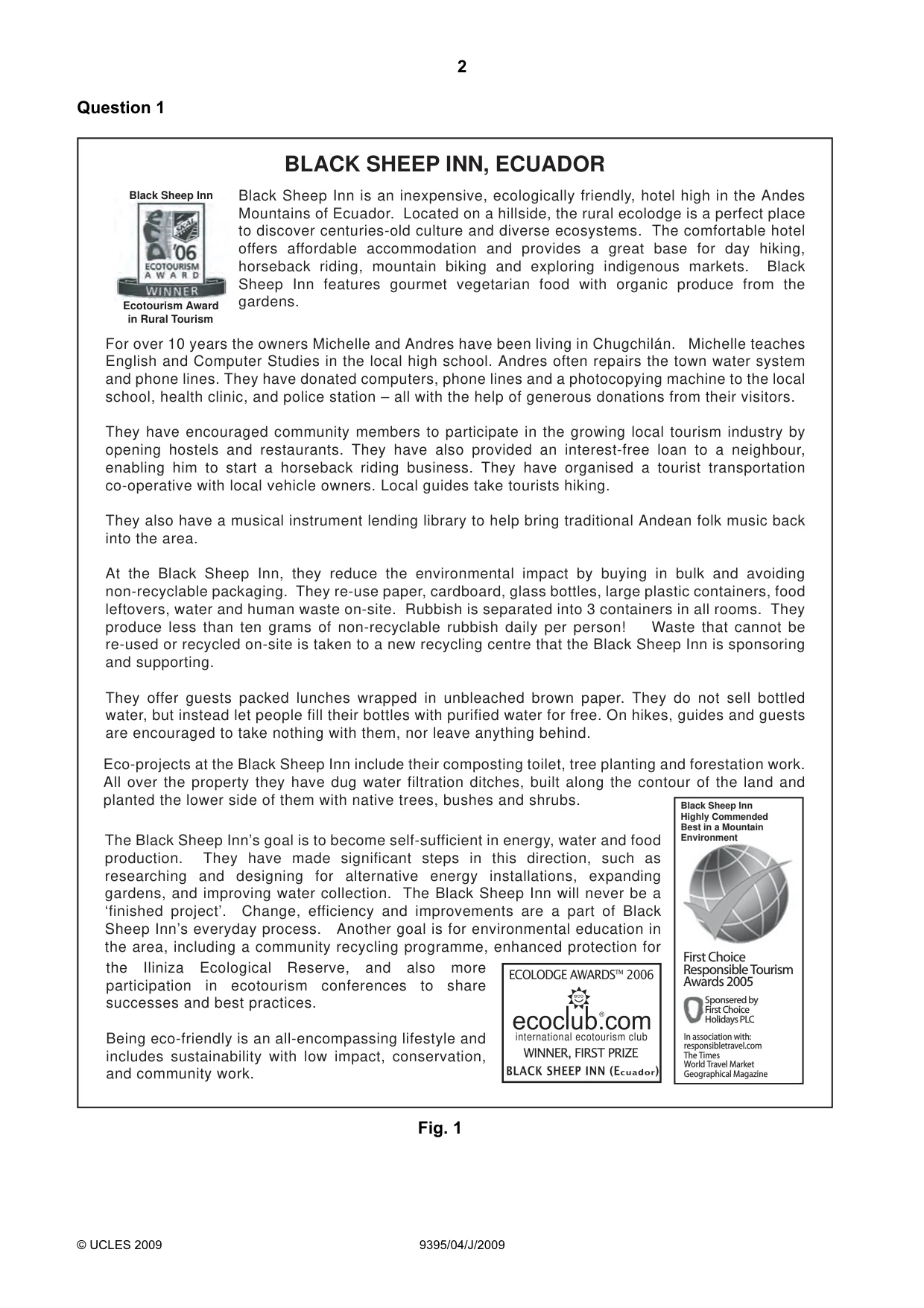
2 © UCLES 2009 9395/04/J/2009 Question 1 Black Sheep Inn is an inexpensive, ecologically friendly, hotel high in the Andes Mountains of Ecuador. Located on a hillside, the rural ecolodge is a perfect place to discover centuries-old culture and diverse ecosystems. The comfortable hotel offers affordable accommodation and provides a great base for day hiking, horseback riding, mountain biking and exploring indigenous markets. Black Sheep Inn features gourmet vegetarian food with organic produce from the gardens. For over 10 years the owners Michelle and Andres have been living in Chugchilán. Michelle teaches English and Computer Studies in the local high school. Andres often repairs the town water system and phone lines. They have donated computers, phone lines and a photocopying machine to the local school, health clinic, and police station – all with the help of generous donations from their visitors. They have encouraged community members to participate in the growing local tourism industry by opening hostels and restaurants. They have also provided an interest-free loan to a neighbour, enabling him to start a horseback riding business. They have organised a tourist transportation co-operative with local vehicle owners. Local guides take tourists hiking. They also have a musical instrument lending library to help bring traditional Andean folk music back into the area. At the Black Sheep Inn, they reduce the environmental impact by buying in bulk and avoiding non-recyclable packaging. They re-use paper, cardboard, glass bottles, large plastic containers, food leftovers, water and human waste on-site. Rubbish is separated into 3 containers in all rooms. They produce less than ten grams of non-recyclable rubbish daily per person! Waste that cannot be re-used or recycled on-site is taken to a new recycling centre that the Black Sheep Inn is sponsoring and supporting. They offer guests packed lunches wrapped in unbleached brown paper. They do not sell bottled water, but instead let people fill their bottles with purified water for free. On hikes, guides and guests are encouraged to take nothing with them, nor leave anything behind. Eco-projects at the Black Sheep Inn include their composting toilet, tree planting and forestation work. All over the property they have dug water filtration ditches, built along the contour of the land and planted the lower side of them with native trees, bushes and shrubs. The Black Sheep Inn’s goal is to become self-sufficient in energy, water and food production. They have made significant steps in this direction, such as researching and designing for alternative energy installations, expanding gardens, and improving water collection. The Black Sheep Inn will never be a ‘finished project’. Change, efficiency and improvements are a part of Black Sheep Inn’s everyday process. Another goal is for environmental education in the area, including a community recycling programme, enhanced protection for the Iliniza Ecological Reserve, and also more participation in ecotourism conferences to share successes and best practices. Being eco-friendly is an all-encompassing lifestyle and includes sustainability with low impact, conservation, and community work. Black Sheep Inn Ecotourism Award in Rural Tourism BLACK SHEEP INN, ECUADOR international ecotourism club Black Sheep Inn Black Sheep Inn Highly Commended Highly Commended Best in a Mountain Best in a Mountain Environment Environment First Choice First Choice Responsible Tourism Responsible Tourism Awards 2005 Awards 2005 Sponsered by Sponsered by First Choice First Choice Holidays PLC Holidays PLC In association with: In association with: responsibletravel.com responsibletravel.com The Times The Times World Travel Market World Travel Market Geographical Magazine Geographical Magazine Fig. 1
Question paper, page 3
3 © UCLES 2009 9395/04/J/2009 [Turn over For Examiner's Use Refer to Fig. 1. (a) Define the term ‘eco-tourism’. [2] (b) Explain two ways in which Michelle and Andres have encouraged local tourism development projects. 1 2 [4]
Question paper, page 4
4 © UCLES 2009 9395/04/J/2009 For Examiner's Use (c) Assess the methods that could be used “to help bring traditional Andean folk music back into the area”. [9]
Question paper, page 5
5 © UCLES 2009 9395/04/J/2009 [Turn over For Examiner's Use (d) Discuss how ecologically friendly organisations, such as the Black Sheep Inn, can have a positive environmental impact at both a local and national level. You should refer to examples with which you are familiar.
Question paper, page 6
6 © UCLES 2009 9395/04/J/2009 For Examiner's Use [10] [Total: 25]
Question paper, page 8
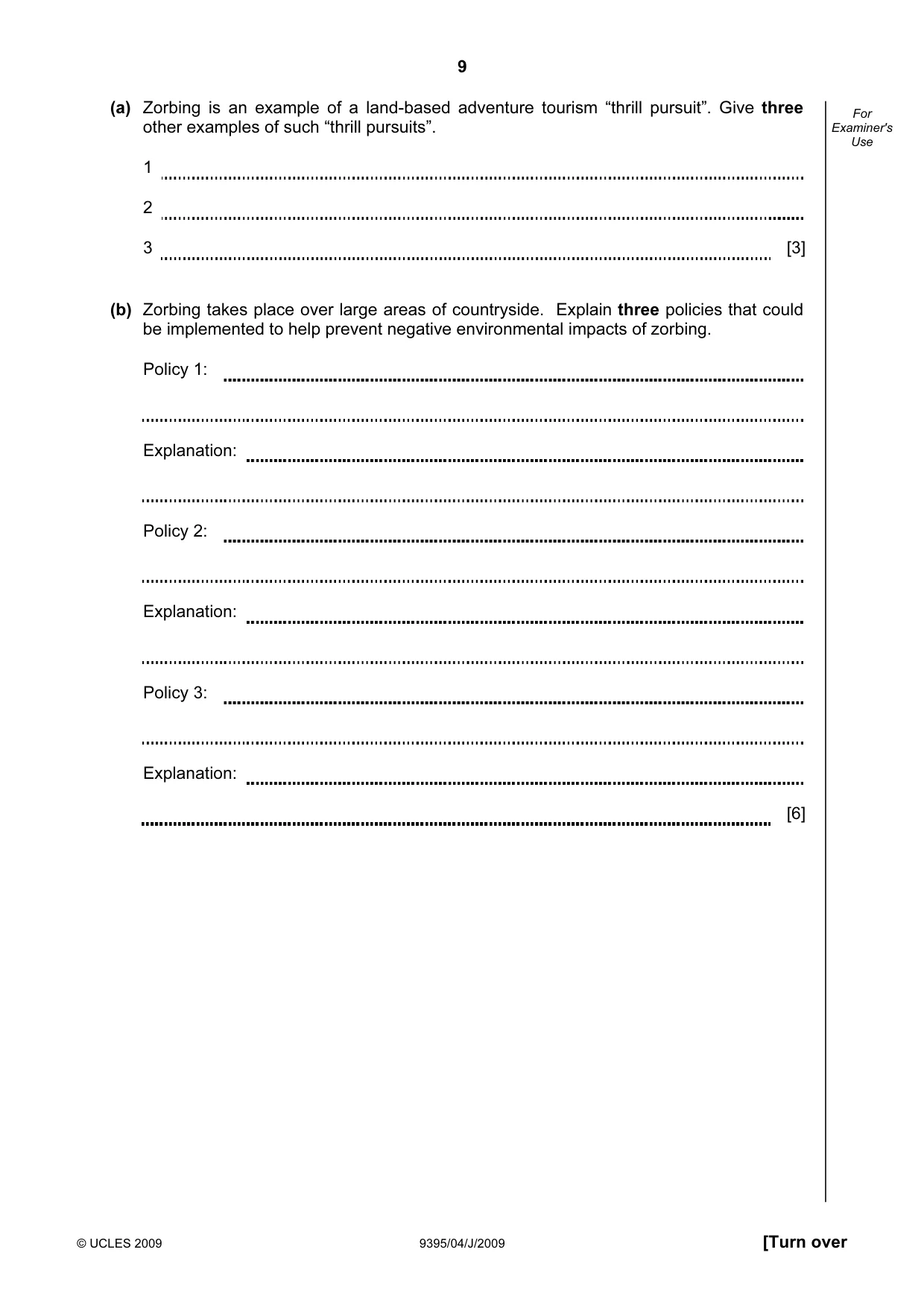
8 © UCLES 2009 9395/04/J/2009 Question 2 Zorbing is the next adventure tourism activity from New Zealand, the nation that developed bungee jumping and a host of many more outrageous thrill pursuits. It is a question you may not have asked yourself but if you can imagine yourself rolling down a hill inside a gigantic inflatable ball (zorb), then the answer should be 'yes!' The quiet, scenic beauty in the countryside is soon disturbed by the sound of laughter and screaming as one person after another is sent hurtling 200 metres downhill. The Zorb is an 11 foot (3.75m) high inflatable TO TO Z O RB OR NOT RB OR NOT TO TO Z O RB? RB? transparent ball which you can ride inside. Two feet (0.6m) of air protects you from the ground enabling you to Zorb down hills at speed. You have a choice of being harnessed securely inside the zorb before being sent head over heels downhill. Or, for the brave at heart, you can find out first hand what it feels like with just you, the zorb, no harness and even ten litres of water! It is like a cross between a water-slide and a rollercoaster. Fig. 2
Question paper, page 9
9 © UCLES 2009 9395/04/J/2009 [Turn over For Examiner's Use (a) Zorbing is an example of a land-based adventure tourism “thrill pursuit”. Give three other examples of such “thrill pursuits”. 1 2 3 [3] (b) Zorbing takes place over large areas of countryside. Explain three policies that could be implemented to help prevent negative environmental impacts of zorbing. Policy 1: Explanation: Policy 2: Explanation: Policy 3: Explanation: [6]
Question paper, page 10
10 © UCLES 2009 9395/04/J/2009 For Examiner's Use (c) Explain three ways in which the rapid growth in adventure tourism may create negative socio-cultural impacts. 1 2 3 [6] (d) With reference to one adventure tourism activity you have studied, discuss its economic impacts on the local community. Name of activity:
Question paper, page 11
11 © UCLES 2009 9395/04/J/2009 For Examiner's Use [10] [Total: 25]
Question paper, page 12
12 9395/04 June 2009 Copyright Acknowledgements: Question 1 Question 2 © www.blacksheepinn.com Man in Zorb against Sunset; © Image State/Alamy New Zealand’s Exciting Sport Zorbing; © Bill Bachmann/Alamy Text © www.visitbritain.com Permission to reproduce items where third-party owned material protected by copyright is included has been sought and cleared where possible. Every reasonable effort has been made by the publisher (UCLES) to trace copyright holders, but if any items requiring clearance have unwittingly been included, the publisher will be pleased to make amends at the earliest possible opportunity. University of Cambridge International Examinations is part of the Cambridge Assessment Group. Cambridge Assessment is the brand name of University of Cambridge Local Examinations Syndicate (UCLES), which is itself a department of the University of Cambridge. © UCLES 2009 9395/04/J/2009 BLANK PAGE
Mark scheme, page 1
UNIVERSITY OF CAMBRIDGE INTERNATIONAL EXAMINATIONS GCE Advanced Subsidiary Level and GCE Advanced Level MARK SCHEME for the May/June 2009 question paper for the guidance of teachers 9395 TRAVEL AND TOURISM 9395/04 Paper 4 (Specialised Tourism), maximum raw mark 50 This mark scheme is published as an aid to teachers and candidates, to indicate the requirements of the examination. It shows the basis on which Examiners were instructed to award marks. It does not indicate the details of the discussions that took place at an Examiners’ meeting before marking began, which would have considered the acceptability of alternative answers. Mark schemes must be read in conjunction with the question papers and the report on the examination. • CIE will not enter into discussions or correspondence in connection with these mark schemes. CIE is publishing the mark schemes for the May/June 2009 question papers for most IGCSE, GCE Advanced Level and Advanced Subsidiary Level syllabuses and some Ordinary Level syllabuses.
Mark scheme, page 2
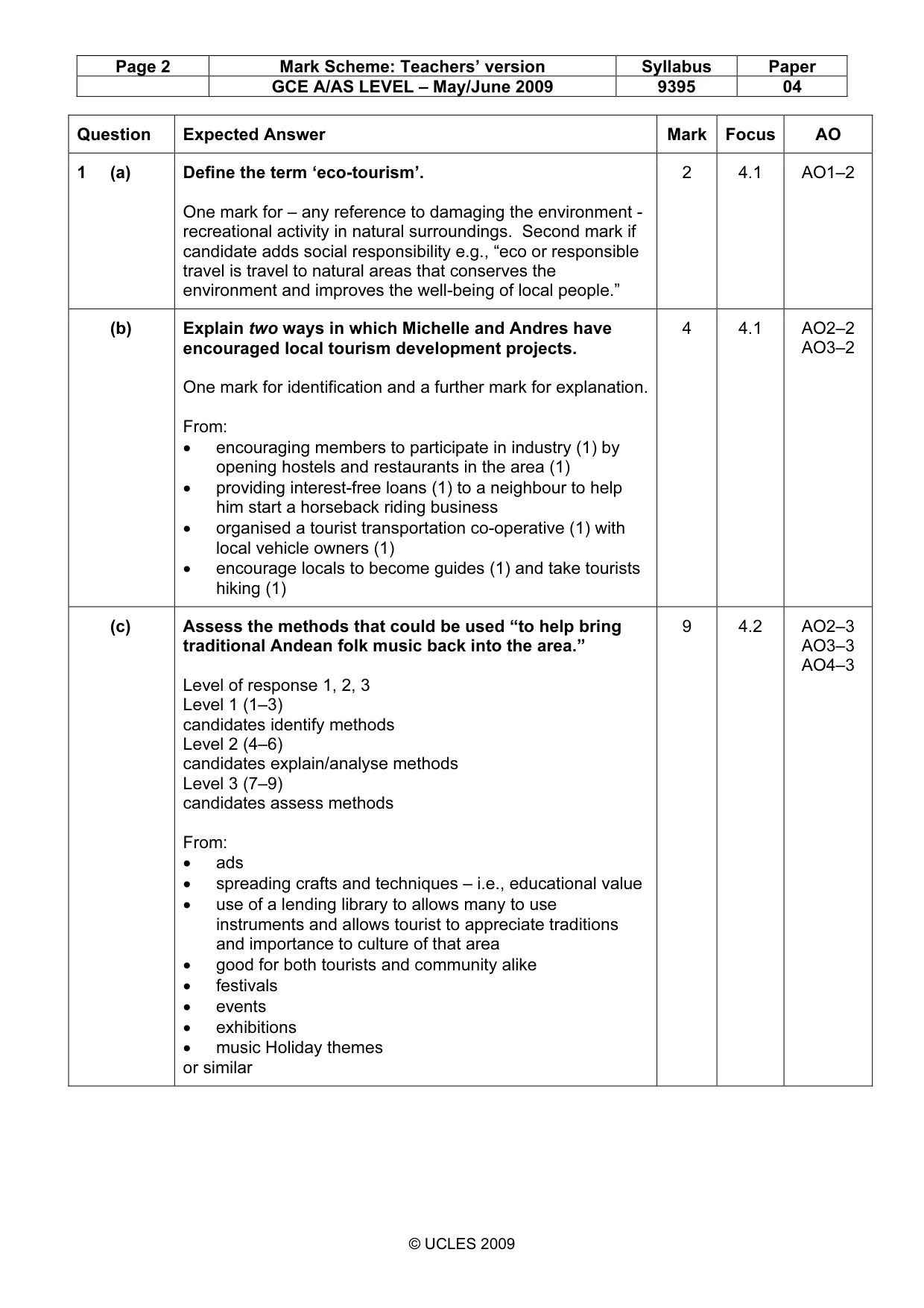
Page 2 Mark Scheme: Teachers’ version Syllabus Paper GCE A/AS LEVEL – May/June 2009 9395 04 © UCLES 2009 Question Expected Answer Mark Focus AO 1 (a) Define the term ‘eco-tourism’. One mark for – any reference to damaging the environment - recreational activity in natural surroundings. Second mark if candidate adds social responsibility e.g., “eco or responsible travel is travel to natural areas that conserves the environment and improves the well-being of local people.” 2 4.1 AO1–2 (b) Explain two ways in which Michelle and Andres have encouraged local tourism development projects. One mark for identification and a further mark for explanation. From: • encouraging members to participate in industry (1) by opening hostels and restaurants in the area (1) • providing interest-free loans (1) to a neighbour to help him start a horseback riding business • organised a tourist transportation co-operative (1) with local vehicle owners (1) • encourage locals to become guides (1) and take tourists hiking (1) 4 4.1 AO2–2 AO3–2 (c) Assess the methods that could be used “to help bring traditional Andean folk music back into the area.” Level of response 1, 2, 3 Level 1 (1–3) candidates identify methods Level 2 (4–6) candidates explain/analyse methods Level 3 (7–9) candidates assess methods From: • ads • spreading crafts and techniques – i.e., educational value • use of a lending library to allows many to use instruments and allows tourist to appreciate traditions and importance to culture of that area • good for both tourists and community alike • festivals • events • exhibitions • music Holiday themes or similar 9 4.2 AO2–3 AO3–3 AO4–3
Mark scheme, page 3
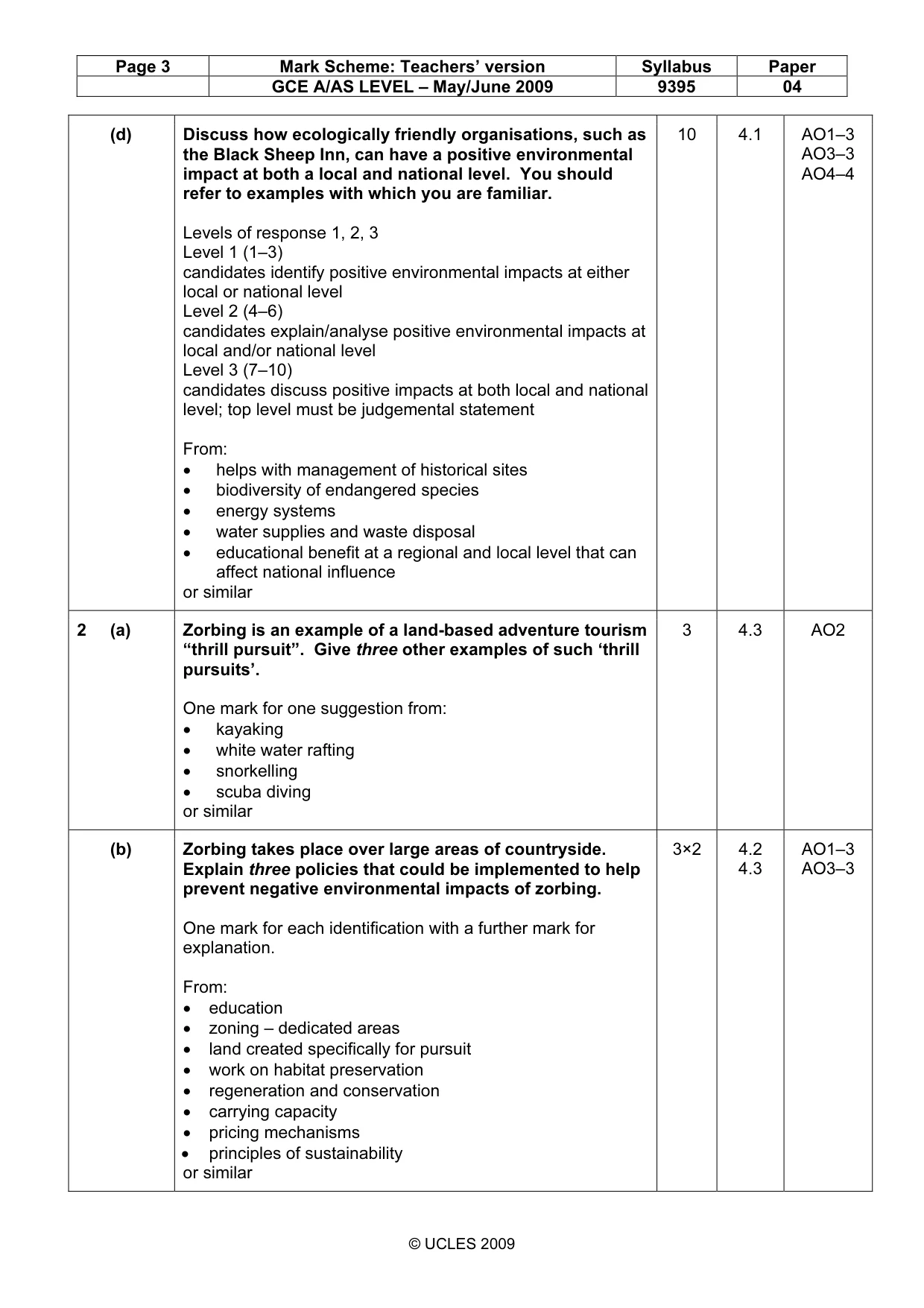
Page 3 Mark Scheme: Teachers’ version Syllabus Paper GCE A/AS LEVEL – May/June 2009 9395 04 © UCLES 2009 (d) Discuss how ecologically friendly organisations, such as the Black Sheep Inn, can have a positive environmental impact at both a local and national level. You should refer to examples with which you are familiar. Levels of response 1, 2, 3 Level 1 (1–3) candidates identify positive environmental impacts at either local or national level Level 2 (4–6) candidates explain/analyse positive environmental impacts at local and/or national level Level 3 (7–10) candidates discuss positive impacts at both local and national level; top level must be judgemental statement From: • helps with management of historical sites • biodiversity of endangered species • energy systems • water supplies and waste disposal • educational benefit at a regional and local level that can affect national influence or similar 10 4.1 AO1–3 AO3–3 AO4–4 2 (a) Zorbing is an example of a land-based adventure tourism “thrill pursuit”. Give three other examples of such ‘thrill pursuits’. One mark for one suggestion from: • kayaking • white water rafting • snorkelling • scuba diving or similar 3 4.3 AO2 (b) Zorbing takes place over large areas of countryside. Explain three policies that could be implemented to help prevent negative environmental impacts of zorbing. One mark for each identification with a further mark for explanation. From: • education • zoning – dedicated areas • land created specifically for pursuit • work on habitat preservation • regeneration and conservation • carrying capacity • pricing mechanisms • principles of sustainability or similar 3×2 4.2 4.3 AO1–3 AO3–3
Mark scheme, page 4
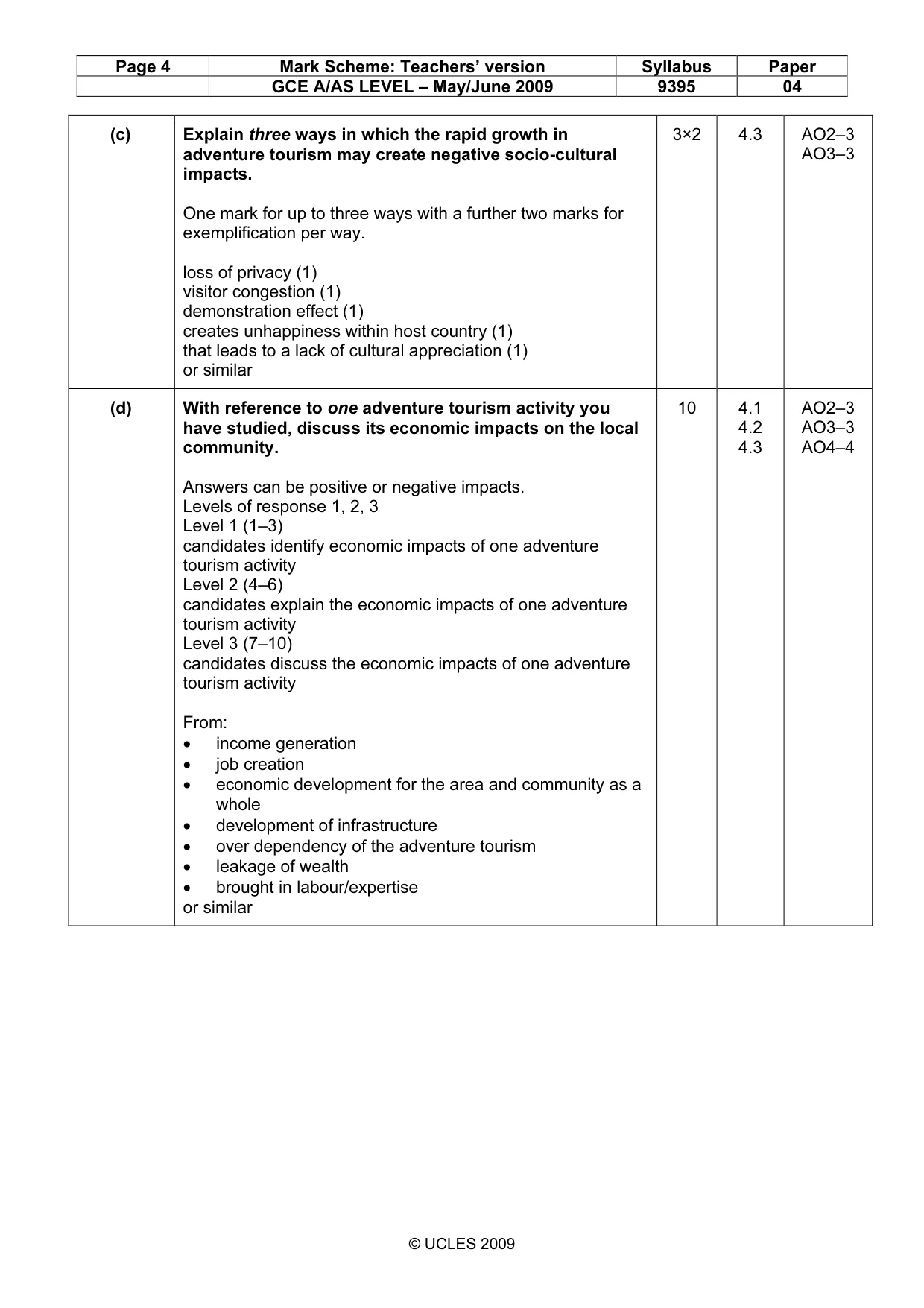
Page 4 Mark Scheme: Teachers’ version Syllabus Paper GCE A/AS LEVEL – May/June 2009 9395 04 © UCLES 2009 (c) Explain three ways in which the rapid growth in adventure tourism may create negative socio-cultural impacts. One mark for up to three ways with a further two marks for exemplification per way. loss of privacy (1) visitor congestion (1) demonstration effect (1) creates unhappiness within host country (1) that leads to a lack of cultural appreciation (1) or similar 3×2 4.3 AO2–3 AO3–3 (d) With reference to one adventure tourism activity you have studied, discuss its economic impacts on the local community. Answers can be positive or negative impacts. Levels of response 1, 2, 3 Level 1 (1–3) candidates identify economic impacts of one adventure tourism activity Level 2 (4–6) candidates explain the economic impacts of one adventure tourism activity Level 3 (7–10) candidates discuss the economic impacts of one adventure tourism activity From: • income generation • job creation • economic development for the area and community as a whole • development of infrastructure • over dependency of the adventure tourism • leakage of wealth • brought in labour/expertise or similar 10 4.1 4.2 4.3 AO2–3 AO3–3 AO4–4
What you needed in this session
Cambridge’s own grade thresholds for 2009 May/June, Paper 4 · Variant 1. A higher threshold means an easier paper — the bar moves with how the cohort did.