Cambridge A Level Travel and Tourism 9395 — 2009 May/June Paper 1 · Variant 1
9395/11/M/J/09 · 100 marks · ≈113 min
The question paper and its mark scheme, free to read here and free to download. This is Cambridge’s own paper, exactly as it was sat.
Question paper16 pages





Mark scheme7 pages
Answers below. Sit the paper first if you are practising.
Paper as text
Question paper, page 1
This document consists of 14 printed pages and 2 blank pages. IB09 06_9395_01/6RP © UCLES 2009 [Turn over *2640189813* For Examiner's Use 1 2 3 4 Total UNIVERSITY OF CAMBRIDGE INTERNATIONAL EXAMINATIONS General Certificate of Education Advanced Level TRAVEL AND TOURISM 9395/01 Paper 1 Core June 2009 2 hours and 30 minutes Candidates answer on the Question Paper. READ THESE INSTRUCTIONS FIRST Write your Centre number, candidate number and name on all the work you hand in. Write in dark blue or black pen. Do not use staples, paper clips, highlighters, glue or correction fluid. You may use a pencil for any diagrams, graphs or rough working. DO NOT WRITE IN ANY BARCODES. Answer all questions. The number of marks is given in brackets [ ] at the end of each question or part question.
Question paper, page 2
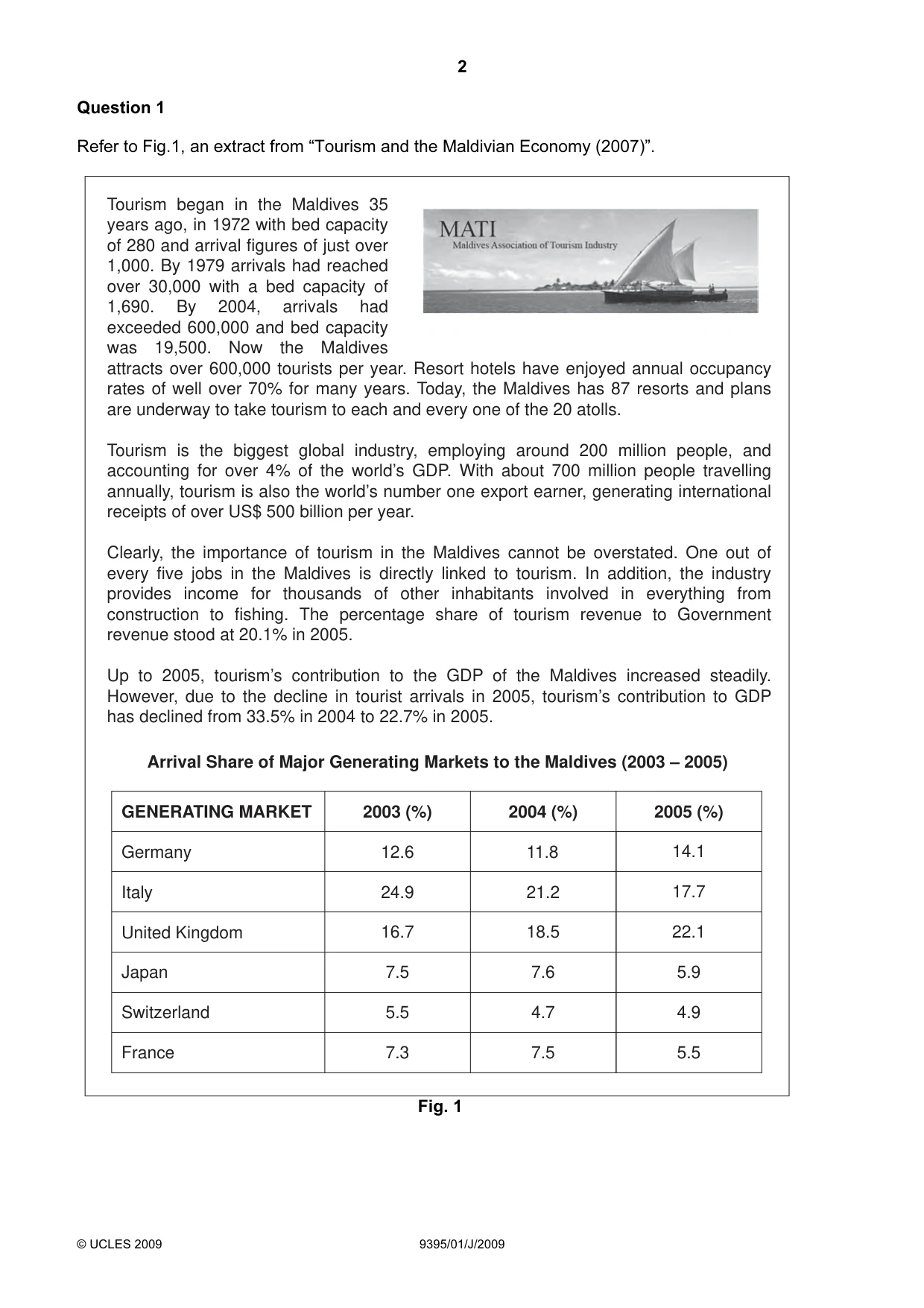
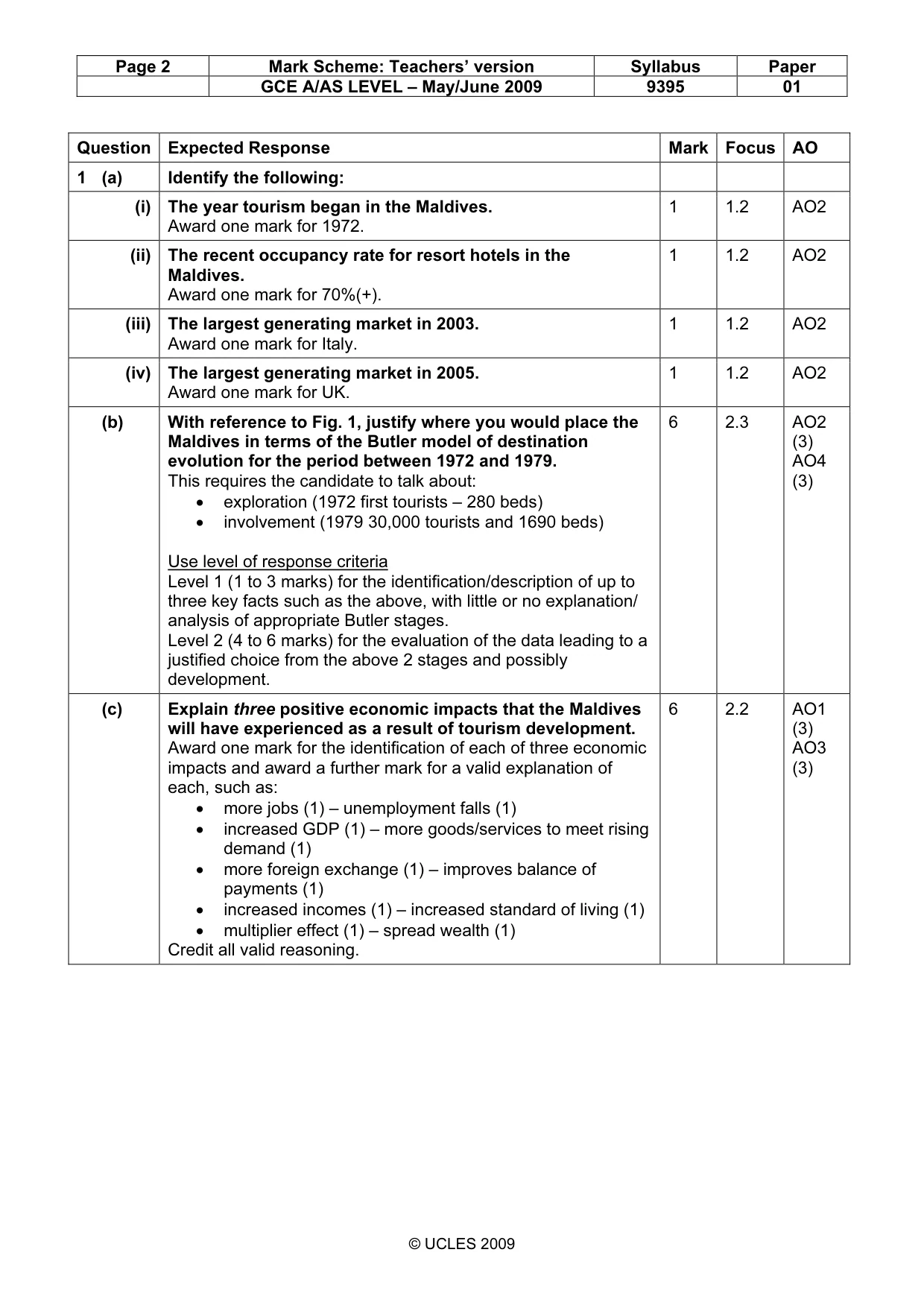
2 © UCLES 2009 9395/01/J/2009 Question 1 Refer to Fig.1, an extract from “Tourism and the Maldivian Economy (2007)”. Tourism began in the Maldives 35 years ago, in 1972 with bed capacity of 280 and arrival figures of just over 1,000. By 1979 arrivals had reached over 30,000 with a bed capacity of 1,690. By 2004, arrivals had exceeded 600,000 and bed capacity was 19,500. Now the Maldives attracts over 600,000 tourists per year. Resort hotels have enjoyed annual occupancy rates of well over 70% for many years. Today, the Maldives has 87 resorts and plans are underway to take tourism to each and every one of the 20 atolls. Tourism is the biggest global industry, employing around 200 million people, and accounting for over 4% of the world’s GDP. With about 700 million people travelling annually, tourism is also the world’s number one export earner, generating international receipts of over US$ 500 billion per year. Clearly, the importance of tourism in the Maldives cannot be overstated. One out of every five jobs in the Maldives is directly linked to tourism. In addition, the industry provides income for thousands of other inhabitants involved in everything from construction to fishing. The percentage share of tourism revenue to Government revenue stood at 20.1% in 2005. Up to 2005, tourism’s contribution to the GDP of the Maldives increased steadily. However, due to the decline in tourist arrivals in 2005, tourism’s contribution to GDP has declined from 33.5% in 2004 to 22.7% in 2005. Arrival Share of Major Generating Markets to the Maldives (2003 – 2005) GENERATING MARKET Germany Italy United Kingdom Japan Switzerland France 2003 (%) 12.6 24.9 16.7 7.5 5.5 7.3 2004 (%) 11.8 21.2 18.5 7.6 4.7 7.5 2005 (%) 14.1 17.7 22.1 5.9 4.9 5.5 Fig. 1
Question paper, page 3
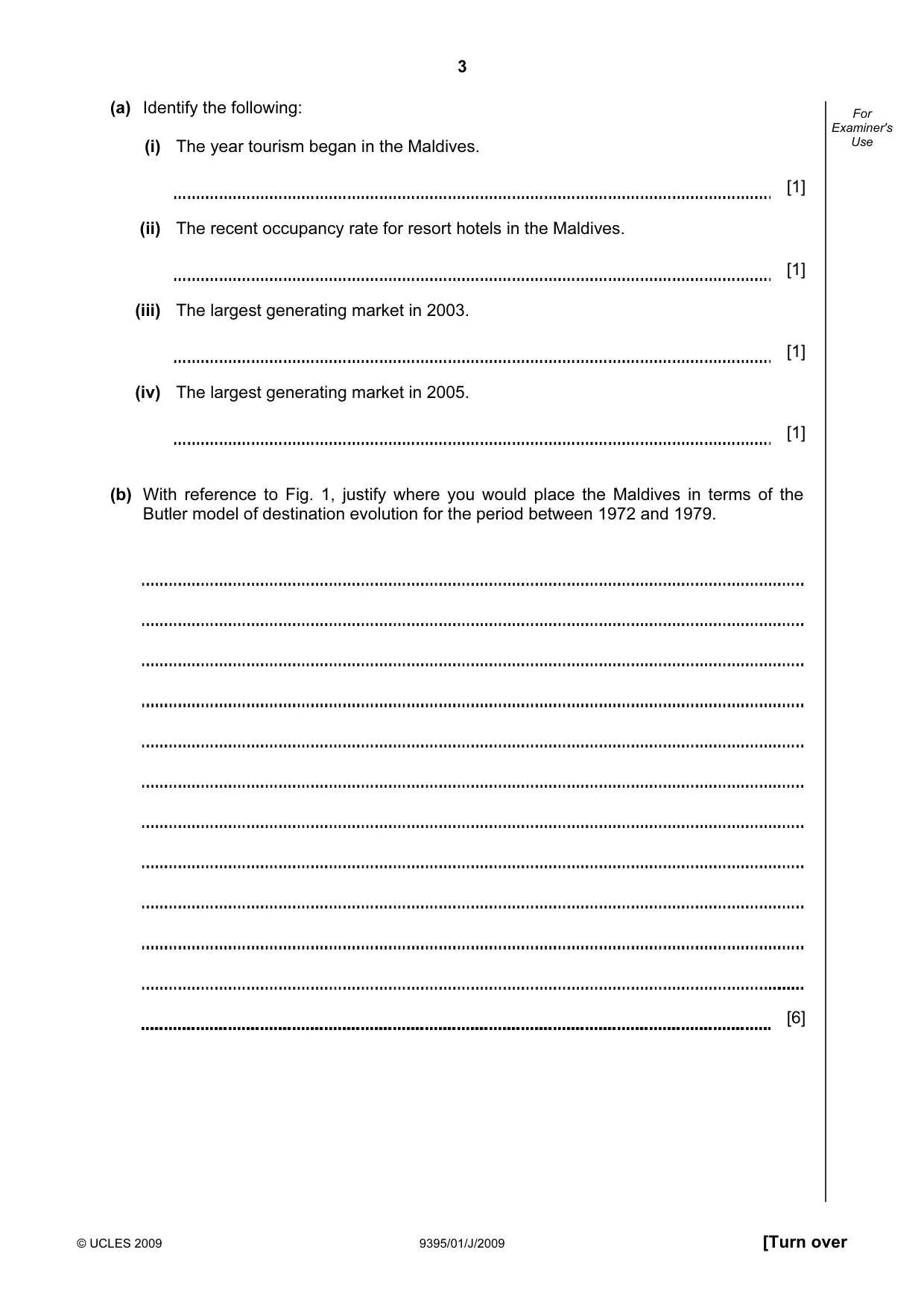
3 © UCLES 2009 9395/01/J/2009 [Turn over For Examiner's Use (a) Identify the following: (i) The year tourism began in the Maldives. [1] (ii) The recent occupancy rate for resort hotels in the Maldives. [1] (iii) The largest generating market in 2003. [1] (iv) The largest generating market in 2005. [1] (b) With reference to Fig. 1, justify where you would place the Maldives in terms of the Butler model of destination evolution for the period between 1972 and 1979. [6]
Question paper, page 4
4 © UCLES 2009 9395/01/J/2009 For Examiner's Use (c) Explain three positive economic impacts that the Maldives will have experienced as a result of tourism development. Impact 1 Explanation Impact 2 Explanation Impact 3 Explanation [6]
Question paper, page 5
5 © UCLES 2009 9395/01/J/2009 [Turn over For Examiner's Use (d) Discuss the factors that have contributed to the growth of international leisure travel in the last 30 years. [9] [Total: 25]
Question paper, page 6
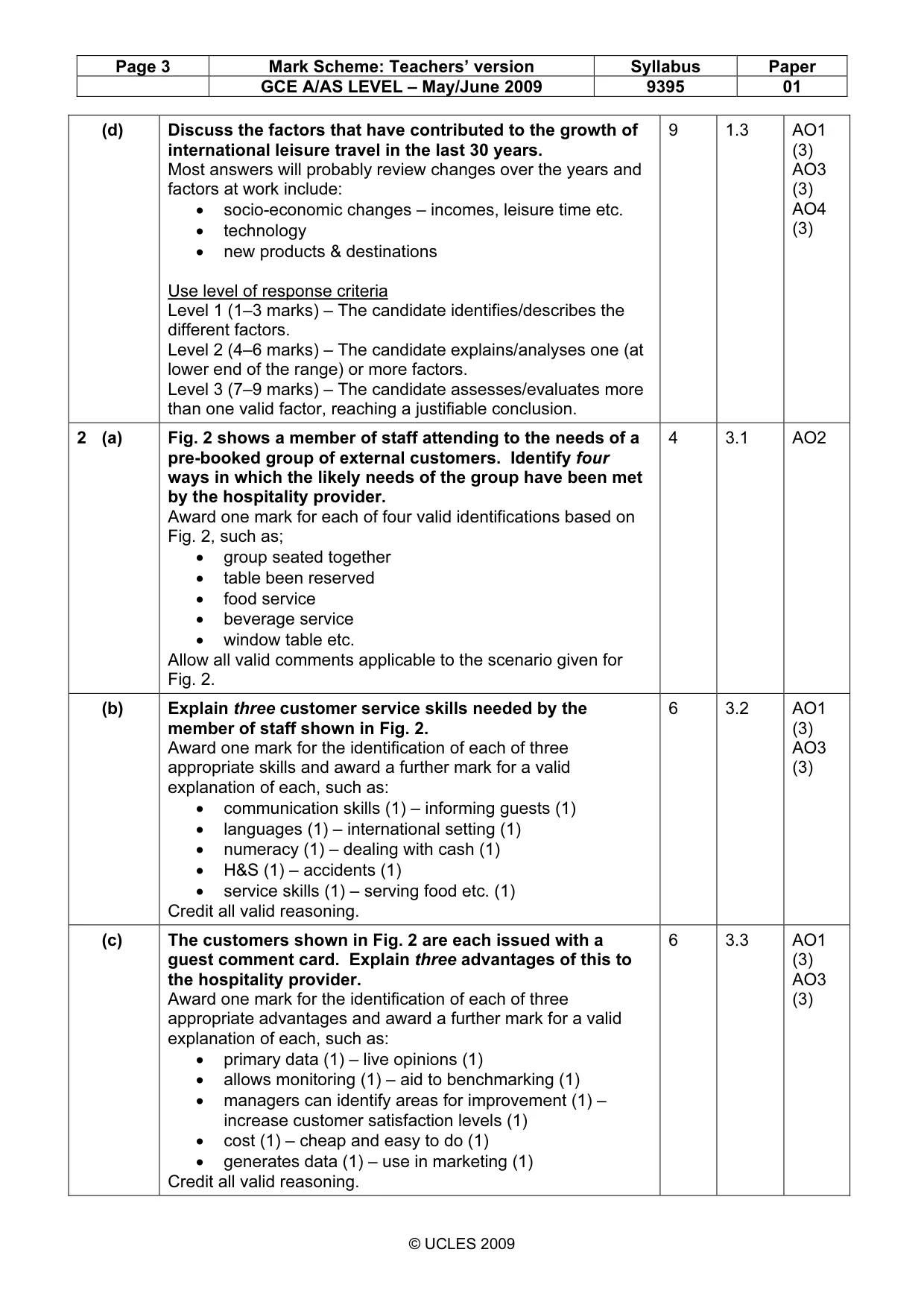
6 © UCLES 2009 9395/01/J/2009 For Examiner's Use Question 2 Refer to Fig. 2, a photograph taken in an international hospitality customer service environment. Fig. 2 (a) Fig. 2 shows a member of staff attending to the needs of a pre-booked group of external customers. Identify four ways in which the likely needs of the group have been met by the hospitality provider. 1 2 3 4 [4]
Question paper, page 7
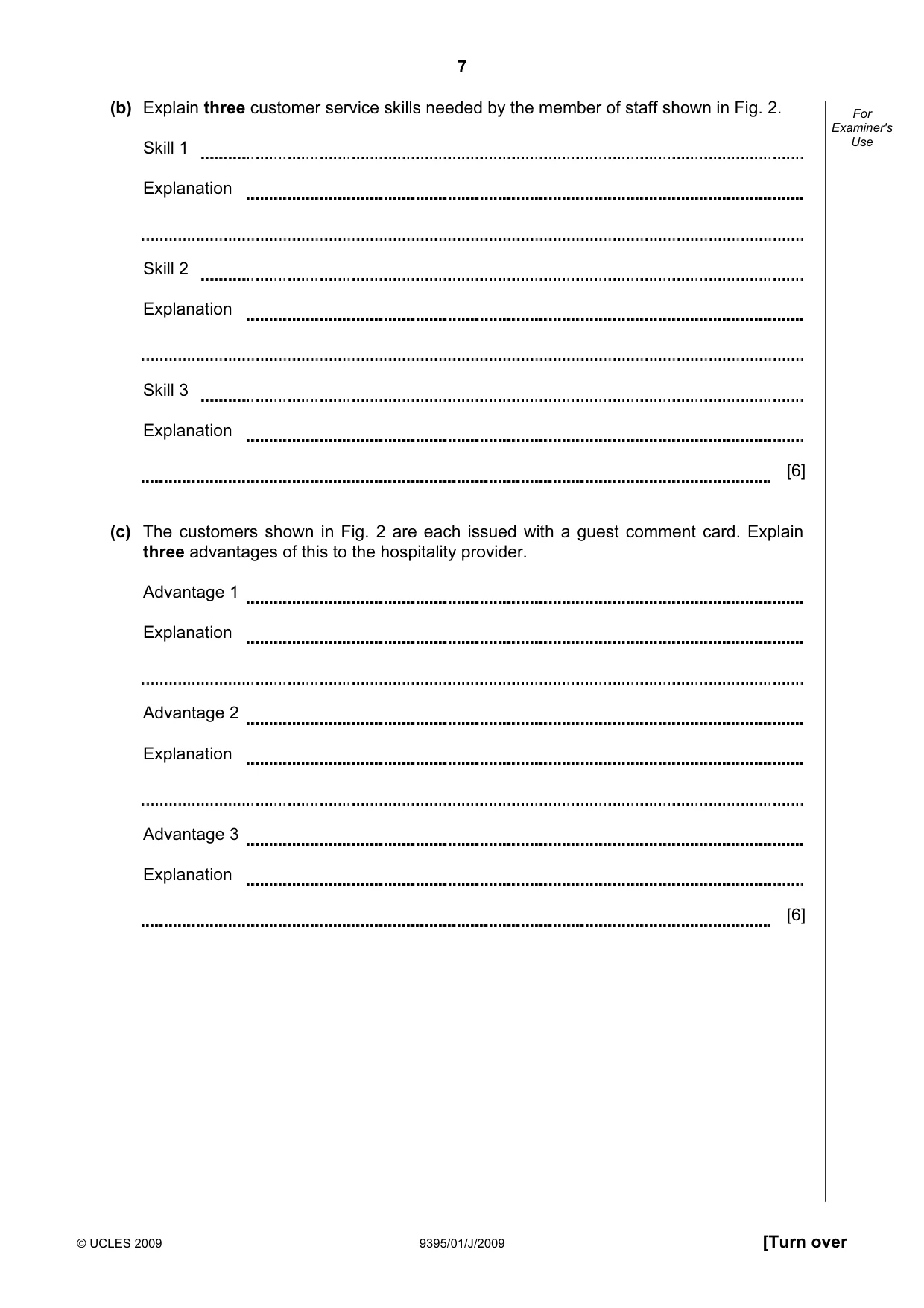
7 © UCLES 2009 9395/01/J/2009 [Turn over For Examiner's Use (b) Explain three customer service skills needed by the member of staff shown in Fig. 2. Skill 1 Explanation Skill 2 Explanation Skill 3 Explanation [6] (c) The customers shown in Fig. 2 are each issued with a guest comment card. Explain three advantages of this to the hospitality provider. Advantage 1 Explanation Advantage 2 Explanation Advantage 3 Explanation [6]
Question paper, page 8
8 © UCLES 2009 9395/01/J/2009 For Examiner's Use (d) With reference to one travel and tourism organisation with which you are familiar, compare and contrast the ways in which quality customer service is delivered by staff in two different job roles. Name of organisation: [9] [Total: 25]
Question paper, page 10
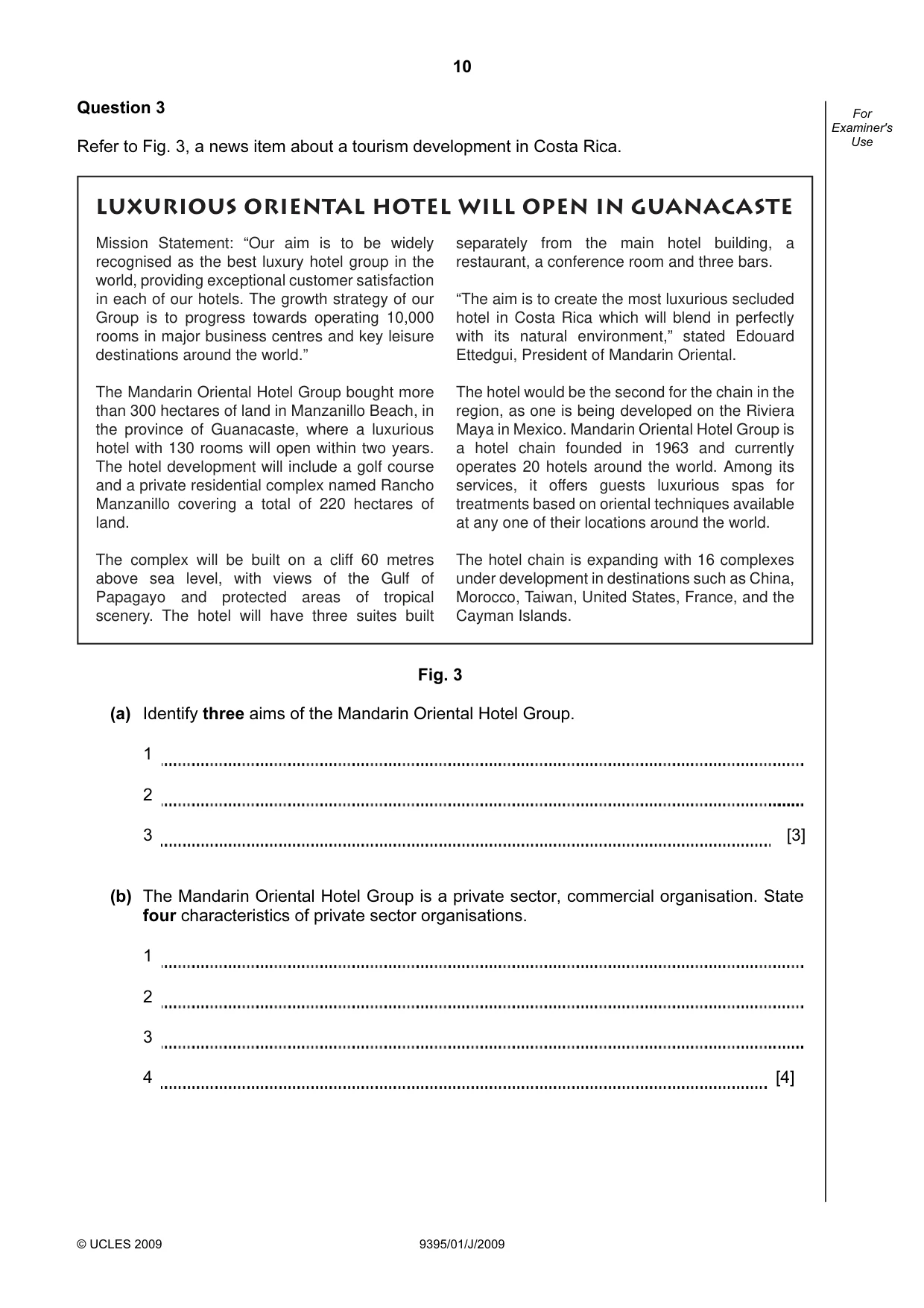
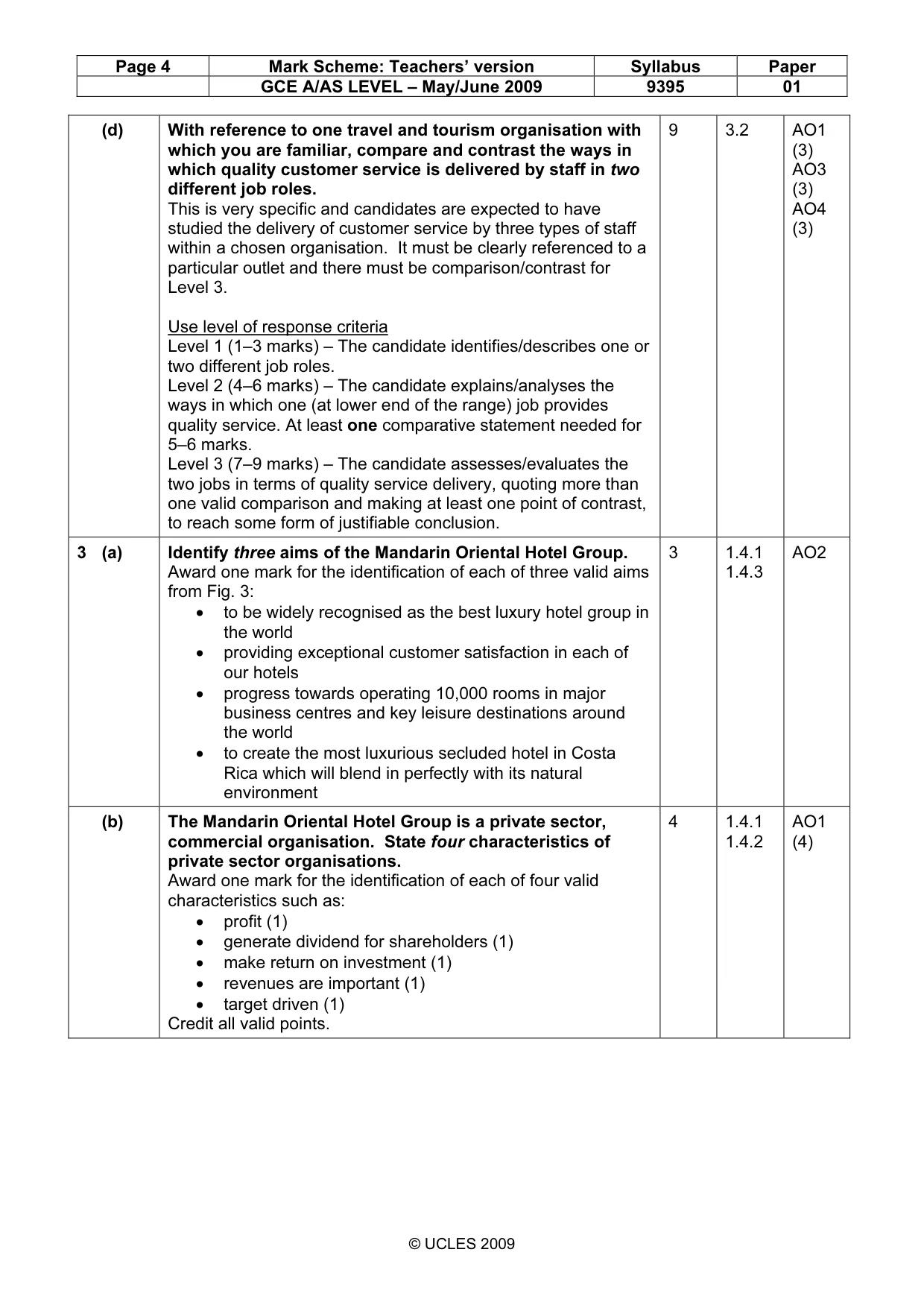
10 © UCLES 2009 9395/01/J/2009 For Examiner's Use Question 3 Refer to Fig. 3, a news item about a tourism development in Costa Rica. LUXURIOUS ORIENTAL HOTEL WILL OPEN IN GUANACASTE Mission Statement: “Our aim is to be widely recognised as the best luxury hotel group in the world, providing exceptional customer satisfaction in each of our hotels. The growth strategy of our Group is to progress towards operating 10,000 rooms in major business centres and key leisure destinations around the world.” The Mandarin Oriental Hotel Group bought more than 300 hectares of land in Manzanillo Beach, in the province of Guanacaste, where a luxurious hotel with 130 rooms will open within two years. The hotel development will include a golf course and a private residential complex named Rancho Manzanillo covering a total of 220 hectares of land. The complex will be built on a cliff 60 metres above sea level, with views of the Gulf of Papagayo and protected areas of tropical scenery. The hotel will have three suites built separately from the main hotel building, a restaurant, a conference room and three bars. “The aim is to create the most luxurious secluded hotel in Costa Rica which will blend in perfectly with its natural environment,” stated Edouard Ettedgui, President of Mandarin Oriental. The hotel would be the second for the chain in the region, as one is being developed on the Riviera Maya in Mexico. Mandarin Oriental Hotel Group is a hotel chain founded in 1963 and currently operates 20 hotels around the world. Among its services, it offers guests luxurious spas for treatments based on oriental techniques available at any one of their locations around the world. The hotel chain is expanding with 16 complexes under development in destinations such as China, Morocco, Taiwan, United States, France, and the Cayman Islands. Fig. 3 (a) Identify three aims of the Mandarin Oriental Hotel Group. 1 2 3 [3] (b) The Mandarin Oriental Hotel Group is a private sector, commercial organisation. State four characteristics of private sector organisations. 1 2 3 4 [4]
Question paper, page 11
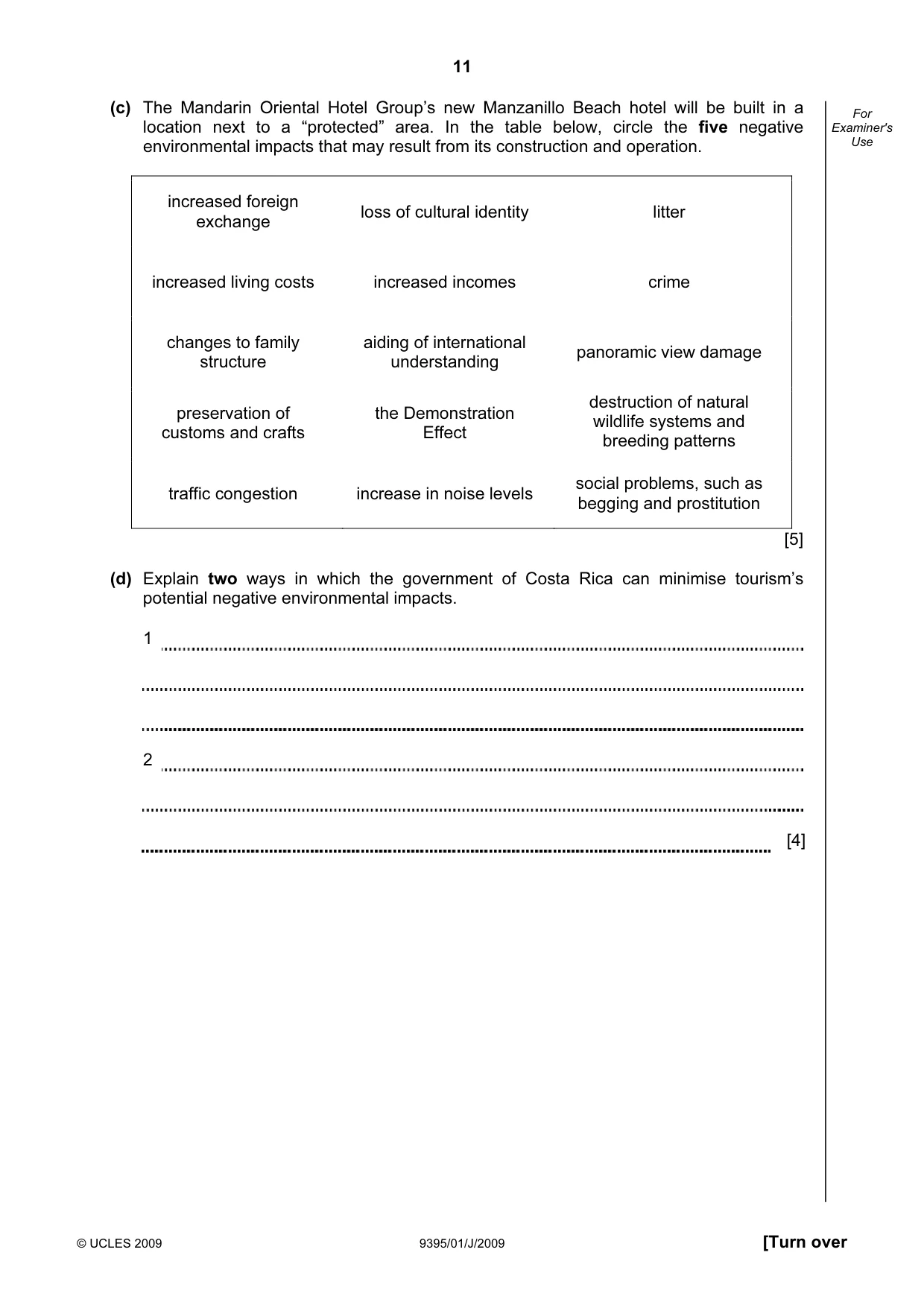
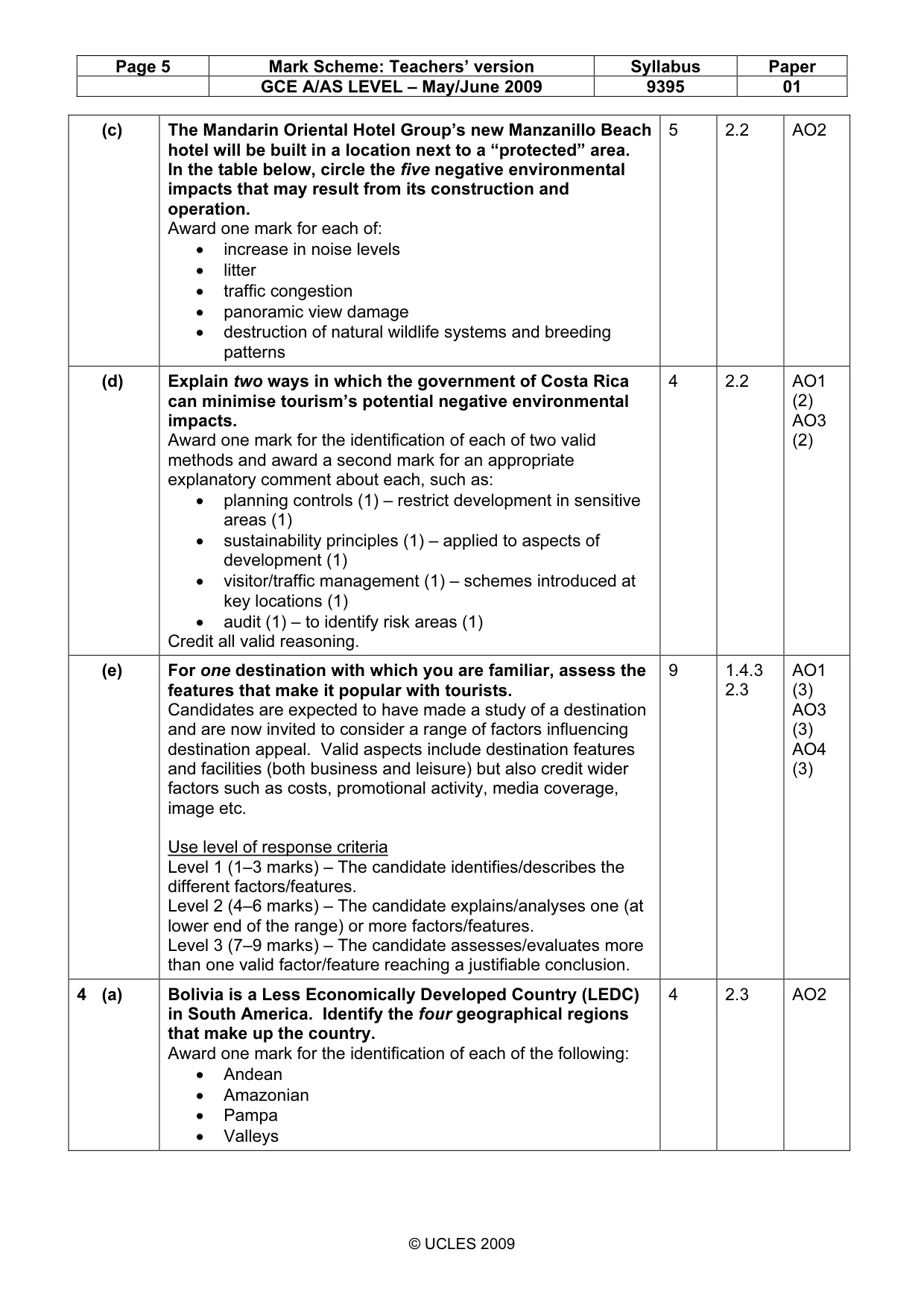
11 © UCLES 2009 9395/01/J/2009 [Turn over For Examiner's Use (c) The Mandarin Oriental Hotel Group’s new Manzanillo Beach hotel will be built in a location next to a “protected” area. In the table below, circle the five negative environmental impacts that may result from its construction and operation. increased foreign exchange loss of cultural identity litter increased living costs increased incomes crime changes to family structure aiding of international understanding panoramic view damage preservation of customs and crafts the Demonstration Effect destruction of natural wildlife systems and breeding patterns traffic congestion increase in noise levels social problems, such as begging and prostitution [5] (d) Explain two ways in which the government of Costa Rica can minimise tourism’s potential negative environmental impacts. 1 2 [4]
Question paper, page 12
12 © UCLES 2009 9395/01/J/2009 For Examiner's Use (e) For one destination with which you are familiar, assess the features that make it popular with tourists. Name of chosen destination: [9] [Total: 25]
Question paper, page 14
14 © UCLES 2009 9395/01/J/2009 For Examiner's Use Question 4 Refer to Fig. 4, a news item about Bolivia. Bolivia to invest millions of dollars in developing indigenous community tourism The Bolivian Government has presented its National Tourism Plan which will require an investment of US$200 million over five years. The main objective of the Plan is to create jobs and generate revenue, in order to reduce the poverty that exists among the country’s indigenous communities, which currently account for 70% of Bolivia’s population. The National Tourism Plan (2006-2011), will focus on the promotion of indigenous community tourism, both within the country and abroad, according to the Deputy Minister for Tourism, Ricardo Cox. The economic and social benefits will be distributed among the various rural and indigenous communities throughout the country. These communities can develop into important tourist attractions. Under the slogan "Authenticity Still Exists", the Plan will promote sustainable tourism, preserving the natural, historical and cultural resources of the country’s different regions. Bolivia has 17 eco-regions in which different ethnic groups co-exist. The Plan aims to develop tourism that involves both public and private sector organisations. The campaign created by the Bolivian Government identifies 12 "star" destinations that combine both natural appeal and culture, located throughout the Andean, Amazonian, Pampa and Valley regions of the country. Outstanding attractions include the Jesuit missions, the salt marshes, the coloured lagoons, Lake Titicaca, Oruro, Potosi-Sucre and the Che Route. With the implementation of its National Tourism Plan, Bolivia aims to double the number of visitors over a period of five years, whilst making sure the country’s tourist carrying capacity is not exceeded. In fact, during the first half of 2006, tourism grew by 21.4% compared to the same period the previous year, producing record figures in terms of visitor numbers. Bolivia Bolivia Fig. 4 (a) Bolivia is a Less Economically Developed Country (LEDC) in South America. Identify the four geographical regions that make up the country. 1 2 3 4 [4]
Question paper, page 15
15 © UCLES 2009 9395/01/J/2009 [Turn over For Examiner's Use (b) Bolivia’s tourism industry is starting to grow. To control this growth Bolivia has a National Tourism Plan. Using evidence from Fig. 4, suggest reasons why the total number of visitors is likely to stay within the country’s tourist carrying capacity. [4] (c) Bolivia’s 2006 to 2011 National Tourism Plan has the slogan “Authenticity Still Exists”. (i) Explain the socio-cultural benefits for the rural and indigenous communities. [4] (ii) Explain how the natural environment benefits from the National Tourism Plan. [4]
Question paper, page 16
16 Copyright Acknowledgements: Question 1 Question 2 Question 3 Question 4 © Tourism and the Maldivian Economy; 2007. © Image of businessmen dining; Alamy. © www.visitcostarica.com © Bolivia News Item; www.traveldailynews.com Permission to reproduce items where third-party owned material protected by copyright is included has been sought and cleared where possible. Every reasonable effort has been made by the publisher (UCLES) to trace copyright holders, but if any items requiring clearance have unwittingly been included, the publisher will be pleased to make amends at the earliest possible opportunity. University of Cambridge International Examinations is part of the Cambridge Assessment Group. Cambridge Assessment is the brand name of University of Cambridge Local Examinations Syndicate (UCLES), which is itself a department of the University of Cambridge. © UCLES 2009 9395/01/J/2009 For Examiner's Use (d) With reference to examples with which you are familiar, discuss the ways in which destinations may extend their season. [Total: 25] [9]
Mark scheme, page 1
UNIVERSITY OF CAMBRIDGE INTERNATIONAL EXAMINATIONS GCE Advanced Subsidiary Level and GCE Advanced Level MARK SCHEME for the May/June 2009 question paper for the guidance of teachers 9395 TRAVEL AND TOURISM 9395/01 Paper 1 (Core Paper), maximum raw mark 100 This mark scheme is published as an aid to teachers and candidates, to indicate the requirements of the examination. It shows the basis on which Examiners were instructed to award marks. It does not indicate the details of the discussions that took place at an Examiners’ meeting before marking began, which would have considered the acceptability of alternative answers. Mark schemes must be read in conjunction with the question papers and the report on the examination. • CIE will not enter into discussions or correspondence in connection with these mark schemes. CIE is publishing the mark schemes for the May/June 2009 question papers for most IGCSE, GCE Advanced Level and Advanced Subsidiary Level syllabuses and some Ordinary Level syllabuses.
Mark scheme, page 2
Page 2 Mark Scheme: Teachers’ version Syllabus Paper GCE A/AS LEVEL – May/June 2009 9395 01 © UCLES 2009 Question Expected Response Mark Focus AO 1 (a) Identify the following: (i) The year tourism began in the Maldives. Award one mark for 1972. 1 1.2 AO2 (ii) The recent occupancy rate for resort hotels in the Maldives. Award one mark for 70%(+). 1 1.2 AO2 (iii) The largest generating market in 2003. Award one mark for Italy. 1 1.2 AO2 (iv) The largest generating market in 2005. Award one mark for UK. 1 1.2 AO2 (b) With reference to Fig. 1, justify where you would place the Maldives in terms of the Butler model of destination evolution for the period between 1972 and 1979. This requires the candidate to talk about: • exploration (1972 first tourists – 280 beds) • involvement (1979 30,000 tourists and 1690 beds) Use level of response criteria Level 1 (1 to 3 marks) for the identification/description of up to three key facts such as the above, with little or no explanation/ analysis of appropriate Butler stages. Level 2 (4 to 6 marks) for the evaluation of the data leading to a justified choice from the above 2 stages and possibly development. 6 2.3 AO2 (3) AO4 (3) (c) Explain three positive economic impacts that the Maldives will have experienced as a result of tourism development. Award one mark for the identification of each of three economic impacts and award a further mark for a valid explanation of each, such as: • more jobs (1) – unemployment falls (1) • increased GDP (1) – more goods/services to meet rising demand (1) • more foreign exchange (1) – improves balance of payments (1) • increased incomes (1) – increased standard of living (1) • multiplier effect (1) – spread wealth (1) Credit all valid reasoning. 6 2.2 AO1 (3) AO3 (3)
Mark scheme, page 3
Page 3 Mark Scheme: Teachers’ version Syllabus Paper GCE A/AS LEVEL – May/June 2009 9395 01 © UCLES 2009 (d) Discuss the factors that have contributed to the growth of international leisure travel in the last 30 years. Most answers will probably review changes over the years and factors at work include: • socio-economic changes – incomes, leisure time etc. • technology • new products & destinations Use level of response criteria Level 1 (1–3 marks) – The candidate identifies/describes the different factors. Level 2 (4–6 marks) – The candidate explains/analyses one (at lower end of the range) or more factors. Level 3 (7–9 marks) – The candidate assesses/evaluates more than one valid factor, reaching a justifiable conclusion. 9 1.3 AO1 (3) AO3 (3) AO4 (3) 2 (a) Fig. 2 shows a member of staff attending to the needs of a pre-booked group of external customers. Identify four ways in which the likely needs of the group have been met by the hospitality provider. Award one mark for each of four valid identifications based on Fig. 2, such as; • group seated together • table been reserved • food service • beverage service • window table etc. Allow all valid comments applicable to the scenario given for Fig. 2. 4 3.1 AO2 (b) Explain three customer service skills needed by the member of staff shown in Fig. 2. Award one mark for the identification of each of three appropriate skills and award a further mark for a valid explanation of each, such as: • communication skills (1) – informing guests (1) • languages (1) – international setting (1) • numeracy (1) – dealing with cash (1) • H&S (1) – accidents (1) • service skills (1) – serving food etc. (1) Credit all valid reasoning. 6 3.2 AO1 (3) AO3 (3) (c) The customers shown in Fig. 2 are each issued with a guest comment card. Explain three advantages of this to the hospitality provider. Award one mark for the identification of each of three appropriate advantages and award a further mark for a valid explanation of each, such as: • primary data (1) – live opinions (1) • allows monitoring (1) – aid to benchmarking (1) • managers can identify areas for improvement (1) – increase customer satisfaction levels (1) • cost (1) – cheap and easy to do (1) • generates data (1) – use in marketing (1) Credit all valid reasoning. 6 3.3 AO1 (3) AO3 (3)
Mark scheme, page 4
Page 4 Mark Scheme: Teachers’ version Syllabus Paper GCE A/AS LEVEL – May/June 2009 9395 01 © UCLES 2009 (d) With reference to one travel and tourism organisation with which you are familiar, compare and contrast the ways in which quality customer service is delivered by staff in two different job roles. This is very specific and candidates are expected to have studied the delivery of customer service by three types of staff within a chosen organisation. It must be clearly referenced to a particular outlet and there must be comparison/contrast for Level 3. Use level of response criteria Level 1 (1–3 marks) – The candidate identifies/describes one or two different job roles. Level 2 (4–6 marks) – The candidate explains/analyses the ways in which one (at lower end of the range) job provides quality service. At least one comparative statement needed for 5–6 marks. Level 3 (7–9 marks) – The candidate assesses/evaluates the two jobs in terms of quality service delivery, quoting more than one valid comparison and making at least one point of contrast, to reach some form of justifiable conclusion. 9 3.2 AO1 (3) AO3 (3) AO4 (3) 3 (a) Identify three aims of the Mandarin Oriental Hotel Group. Award one mark for the identification of each of three valid aims from Fig. 3: • to be widely recognised as the best luxury hotel group in the world • providing exceptional customer satisfaction in each of our hotels • progress towards operating 10,000 rooms in major business centres and key leisure destinations around the world • to create the most luxurious secluded hotel in Costa Rica which will blend in perfectly with its natural environment 3 1.4.1 1.4.3 AO2 (b) The Mandarin Oriental Hotel Group is a private sector, commercial organisation. State four characteristics of private sector organisations. Award one mark for the identification of each of four valid characteristics such as: • profit (1) • generate dividend for shareholders (1) • make return on investment (1) • revenues are important (1) • target driven (1) Credit all valid points. 4 1.4.1 1.4.2 AO1 (4)
Mark scheme, page 5
Page 5 Mark Scheme: Teachers’ version Syllabus Paper GCE A/AS LEVEL – May/June 2009 9395 01 © UCLES 2009 (c) The Mandarin Oriental Hotel Group’s new Manzanillo Beach hotel will be built in a location next to a “protected” area. In the table below, circle the five negative environmental impacts that may result from its construction and operation. Award one mark for each of: • increase in noise levels • litter • traffic congestion • panoramic view damage • destruction of natural wildlife systems and breeding patterns 5 2.2 AO2 (d) Explain two ways in which the government of Costa Rica can minimise tourism’s potential negative environmental impacts. Award one mark for the identification of each of two valid methods and award a second mark for an appropriate explanatory comment about each, such as: • planning controls (1) – restrict development in sensitive areas (1) • sustainability principles (1) – applied to aspects of development (1) • visitor/traffic management (1) – schemes introduced at key locations (1) • audit (1) – to identify risk areas (1) Credit all valid reasoning. 4 2.2 AO1 (2) AO3 (2) (e) For one destination with which you are familiar, assess the features that make it popular with tourists. Candidates are expected to have made a study of a destination and are now invited to consider a range of factors influencing destination appeal. Valid aspects include destination features and facilities (both business and leisure) but also credit wider factors such as costs, promotional activity, media coverage, image etc. Use level of response criteria Level 1 (1–3 marks) – The candidate identifies/describes the different factors/features. Level 2 (4–6 marks) – The candidate explains/analyses one (at lower end of the range) or more factors/features. Level 3 (7–9 marks) – The candidate assesses/evaluates more than one valid factor/feature reaching a justifiable conclusion. 9 1.4.3 2.3 AO1 (3) AO3 (3) AO4 (3) 4 (a) Bolivia is a Less Economically Developed Country (LEDC) in South America. Identify the four geographical regions that make up the country. Award one mark for the identification of each of the following: • Andean • Amazonian • Pampa • Valleys 4 2.3 AO2
Mark scheme, page 6
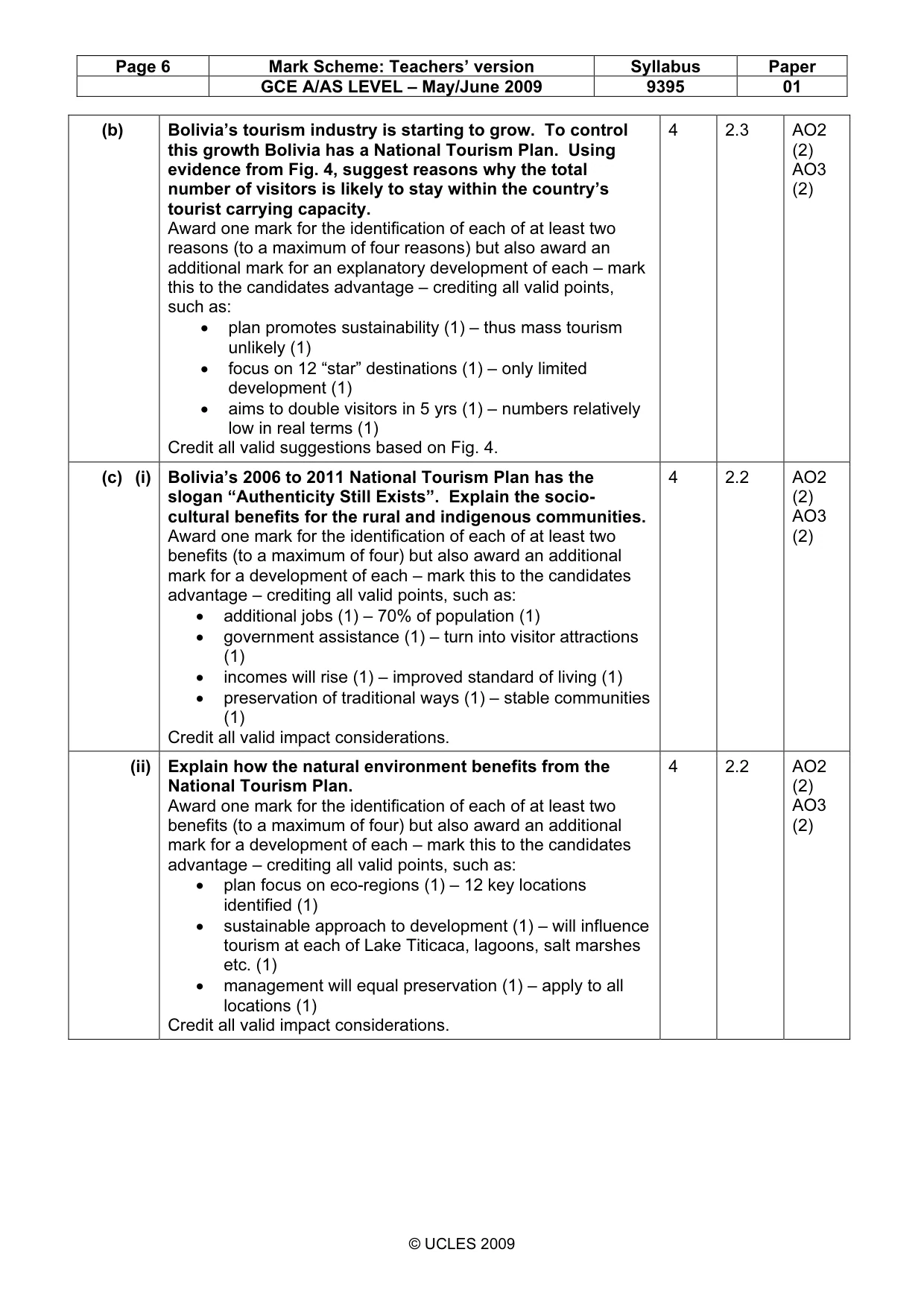
Page 6 Mark Scheme: Teachers’ version Syllabus Paper GCE A/AS LEVEL – May/June 2009 9395 01 © UCLES 2009 (b) Bolivia’s tourism industry is starting to grow. To control this growth Bolivia has a National Tourism Plan. Using evidence from Fig. 4, suggest reasons why the total number of visitors is likely to stay within the country’s tourist carrying capacity. Award one mark for the identification of each of at least two reasons (to a maximum of four reasons) but also award an additional mark for an explanatory development of each – mark this to the candidates advantage – crediting all valid points, such as: • plan promotes sustainability (1) – thus mass tourism unlikely (1) • focus on 12 “star” destinations (1) – only limited development (1) • aims to double visitors in 5 yrs (1) – numbers relatively low in real terms (1) Credit all valid suggestions based on Fig. 4. 4 2.3 AO2 (2) AO3 (2) (c) (i) Bolivia’s 2006 to 2011 National Tourism Plan has the slogan “Authenticity Still Exists”. Explain the socio- cultural benefits for the rural and indigenous communities. Award one mark for the identification of each of at least two benefits (to a maximum of four) but also award an additional mark for a development of each – mark this to the candidates advantage – crediting all valid points, such as: • additional jobs (1) – 70% of population (1) • government assistance (1) – turn into visitor attractions (1) • incomes will rise (1) – improved standard of living (1) • preservation of traditional ways (1) – stable communities (1) Credit all valid impact considerations. 4 2.2 AO2 (2) AO3 (2) (ii) Explain how the natural environment benefits from the National Tourism Plan. Award one mark for the identification of each of at least two benefits (to a maximum of four) but also award an additional mark for a development of each – mark this to the candidates advantage – crediting all valid points, such as: • plan focus on eco-regions (1) – 12 key locations identified (1) • sustainable approach to development (1) – will influence tourism at each of Lake Titicaca, lagoons, salt marshes etc. (1) • management will equal preservation (1) – apply to all locations (1) Credit all valid impact considerations. 4 2.2 AO2 (2) AO3 (2)
Mark scheme, page 7
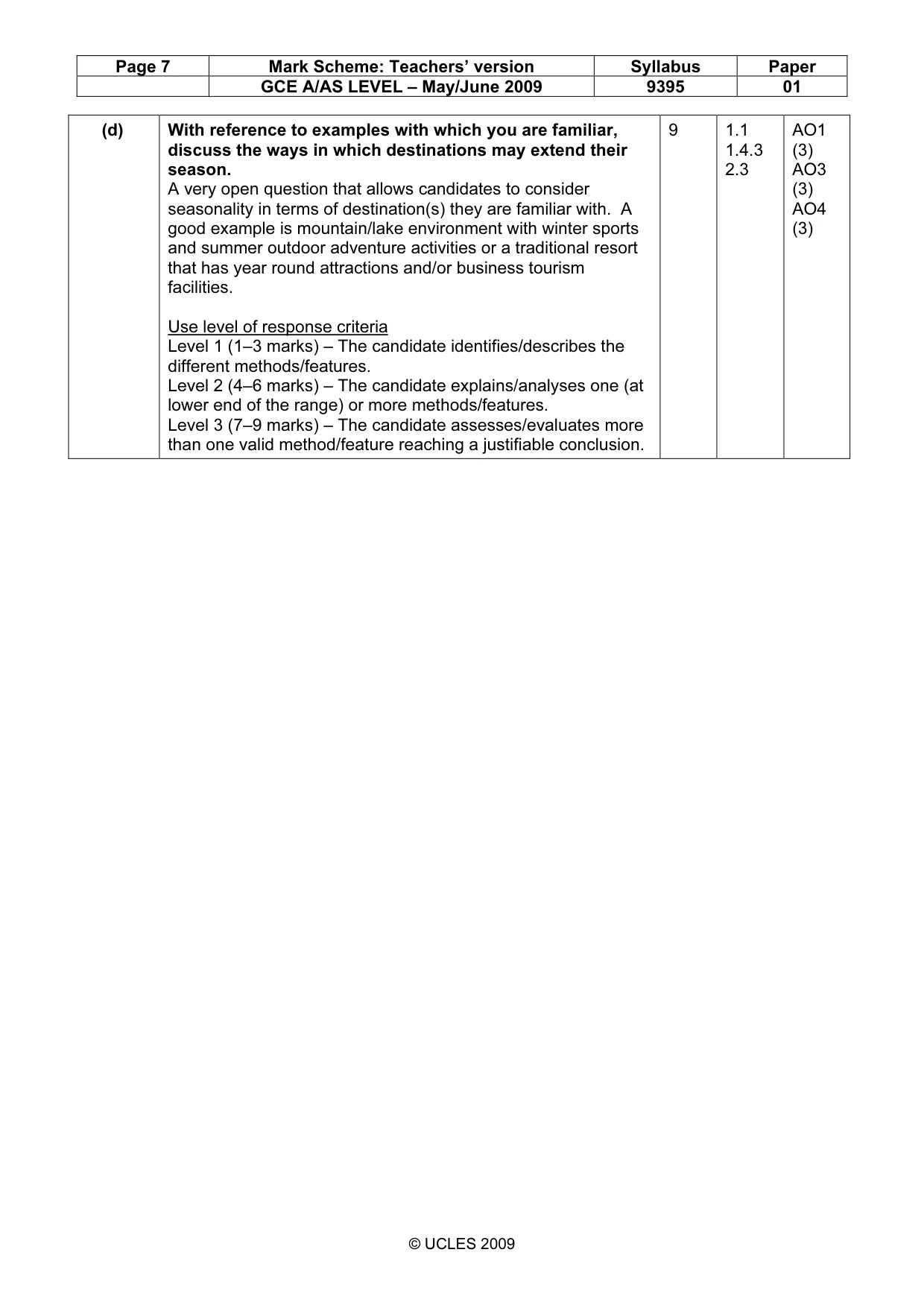
Page 7 Mark Scheme: Teachers’ version Syllabus Paper GCE A/AS LEVEL – May/June 2009 9395 01 © UCLES 2009 (d) With reference to examples with which you are familiar, discuss the ways in which destinations may extend their season. A very open question that allows candidates to consider seasonality in terms of destination(s) they are familiar with. A good example is mountain/lake environment with winter sports and summer outdoor adventure activities or a traditional resort that has year round attractions and/or business tourism facilities. Use level of response criteria Level 1 (1–3 marks) – The candidate identifies/describes the different methods/features. Level 2 (4–6 marks) – The candidate explains/analyses one (at lower end of the range) or more methods/features. Level 3 (7–9 marks) – The candidate assesses/evaluates more than one valid method/feature reaching a justifiable conclusion. 9 1.1 1.4.3 2.3 AO1 (3) AO3 (3) AO4 (3)
What you needed in this session
Cambridge’s own grade thresholds for 2009 May/June, Paper 1 · Variant 1. A higher threshold means an easier paper — the bar moves with how the cohort did.