Cambridge A Level Thinking Skills 9694 — 2017 Oct/Nov Paper 4 · Variant 2
9694/42/O/N/17 · 50 marks · ≈56 min
The question paper and its mark scheme, free to read here and free to download. This is Cambridge’s own paper, exactly as it was sat.
Question paper8 pages

Mark scheme11 pages
Answers below. Sit the paper first if you are practising.
Paper as text
Question paper, page 1
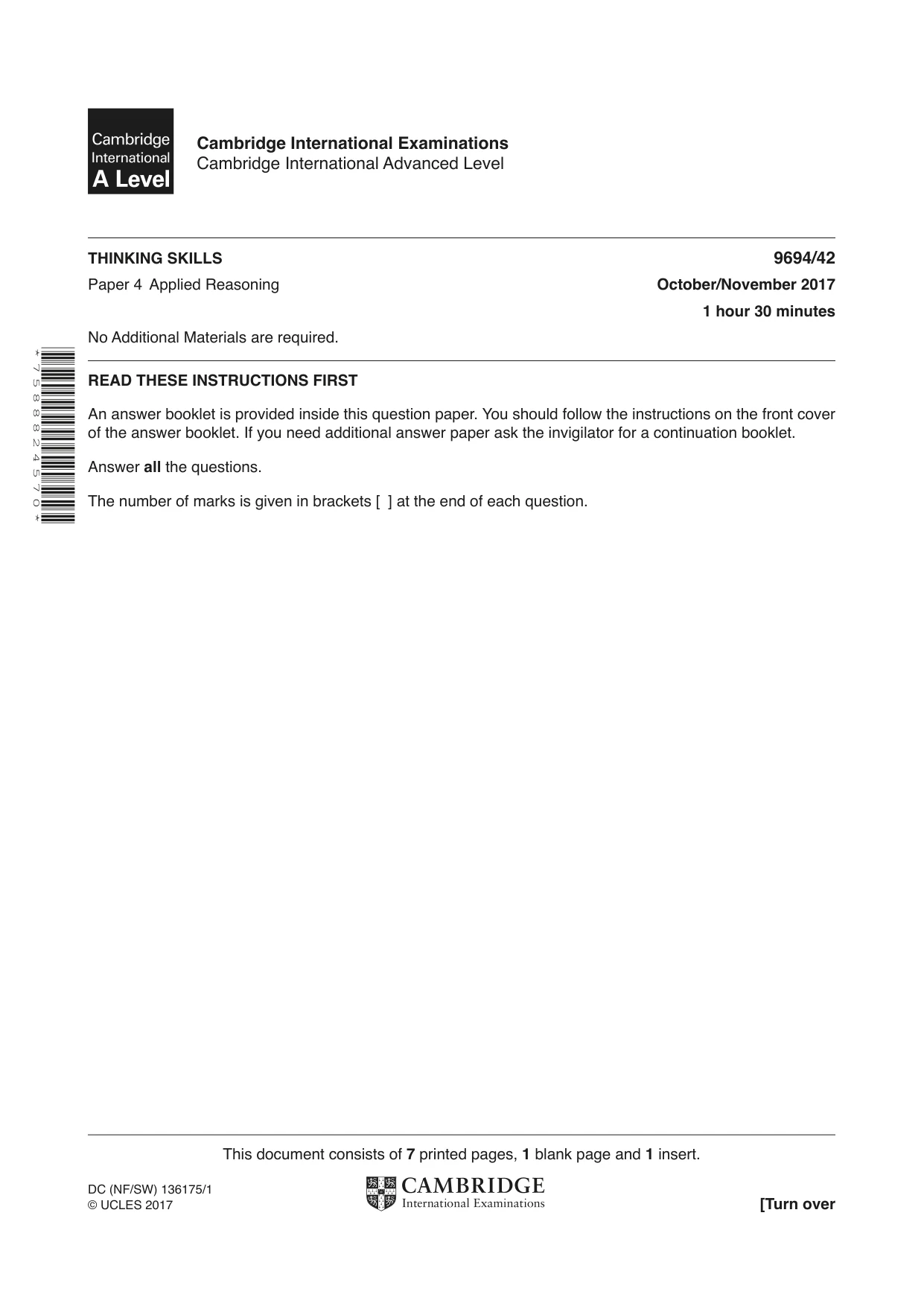
* 7 5 8 8 8 2 4 5 7 0 * This document consists of 7 printed pages, 1 blank page and 1 insert. DC (NF/SW) 136175/1 © UCLES 2017 [Turn over Cambridge International Examinations Cambridge International Advanced Level THINKING SKILLS 9694/42 Paper 4 Applied Reasoning October/November 2017 1 hour 30 minutes No Additional Materials are required. READ THESE INSTRUCTIONS FIRST An answer booklet is provided inside this question paper. You should follow the instructions on the front cover of the answer booklet. If you need additional answer paper ask the invigilator for a continuation booklet. Answer all the questions. The number of marks is given in brackets [ ] at the end of each question.
Question paper, page 2
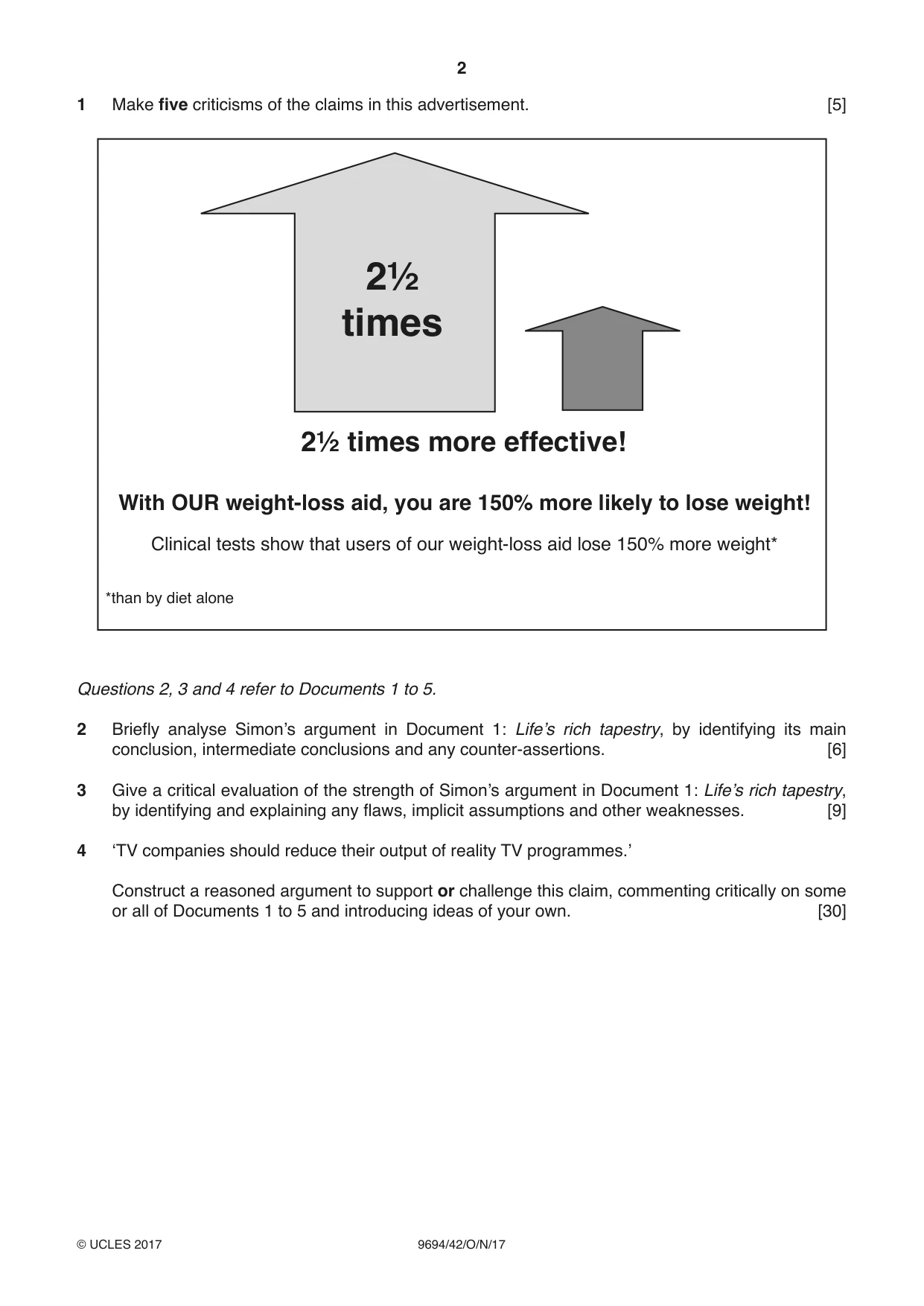
2 9694/42/O/N/17 © UCLES 2017 1 Make five criticisms of the claims in this advertisement. [5] Clinical tests show that users of our weight-loss aid lose 150% more weight* *than by diet alone With OUR weight-loss aid, you are 150% more likely to lose weight! 2½ times more effective! 2½ times Questions 2, 3 and 4 refer to Documents 1 to 5. 2 Briefly analyse Simon’s argument in Document 1: Life’s rich tapestry, by identifying its main conclusion, intermediate conclusions and any counter-assertions. [6] 3 Give a critical evaluation of the strength of Simon’s argument in Document 1: Life’s rich tapestry, by identifying and explaining any flaws, implicit assumptions and other weaknesses. [9] 4 ‘TV companies should reduce their output of reality TV programmes.’ Construct a reasoned argument to support or challenge this claim, commenting critically on some or all of Documents 1 to 5 and introducing ideas of your own. [30]
Question paper, page 3
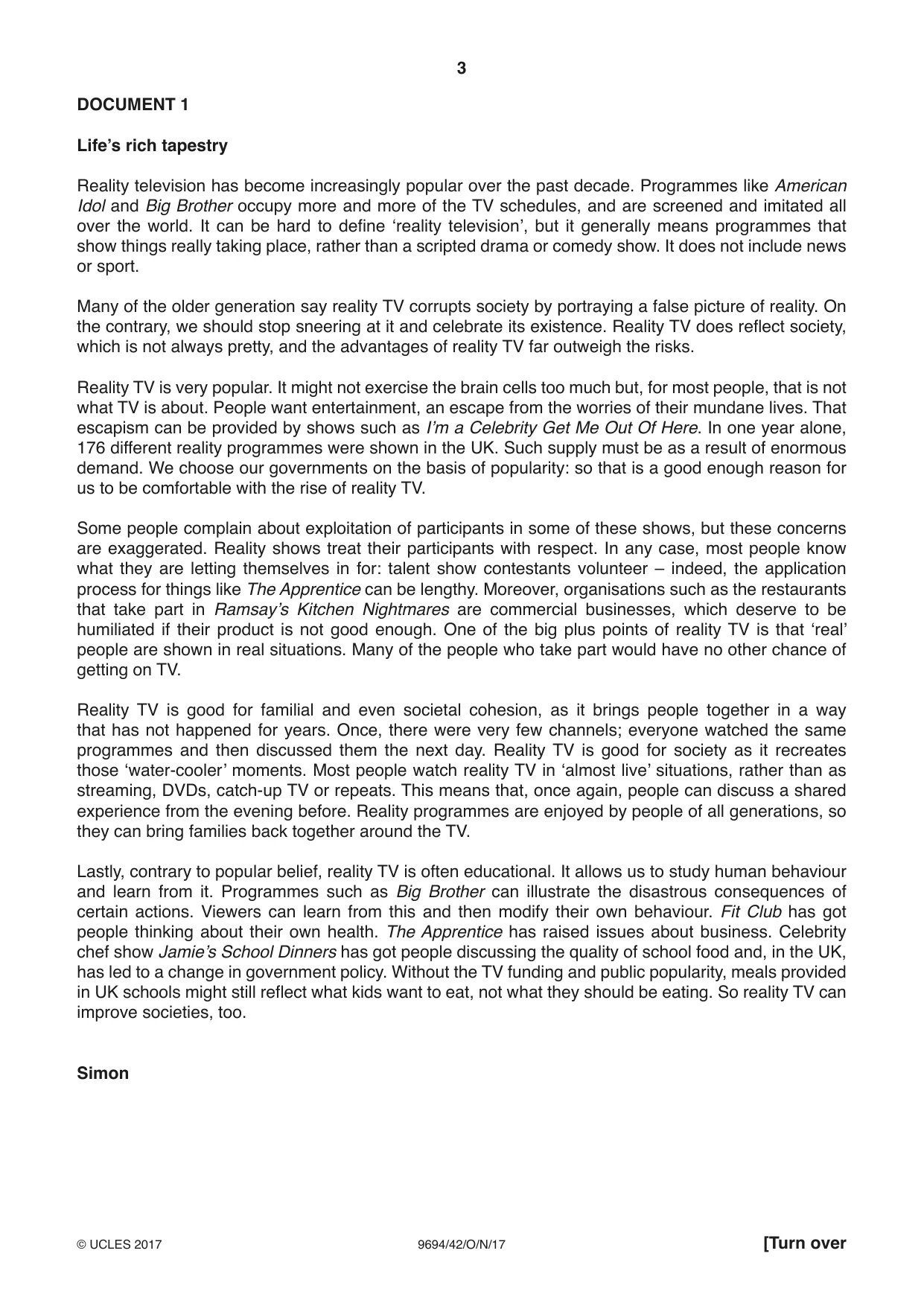
3 9694/42/O/N/17 © UCLES 2017 [Turn over DOCUMENT 1 Life’s rich tapestry Reality television has become increasingly popular over the past decade. Programmes like American Idol and Big Brother occupy more and more of the TV schedules, and are screened and imitated all over the world. It can be hard to define ‘reality television’, but it generally means programmes that show things really taking place, rather than a scripted drama or comedy show. It does not include news or sport. Many of the older generation say reality TV corrupts society by portraying a false picture of reality. On the contrary, we should stop sneering at it and celebrate its existence. Reality TV does reflect society, which is not always pretty, and the advantages of reality TV far outweigh the risks. Reality TV is very popular. It might not exercise the brain cells too much but, for most people, that is not what TV is about. People want entertainment, an escape from the worries of their mundane lives. That escapism can be provided by shows such as I’m a Celebrity Get Me Out Of Here. In one year alone, 176 different reality programmes were shown in the UK. Such supply must be as a result of enormous demand. We choose our governments on the basis of popularity: so that is a good enough reason for us to be comfortable with the rise of reality TV. Some people complain about exploitation of participants in some of these shows, but these concerns are exaggerated. Reality shows treat their participants with respect. In any case, most people know what they are letting themselves in for: talent show contestants volunteer – indeed, the application process for things like The Apprentice can be lengthy. Moreover, organisations such as the restaurants that take part in Ramsay’s Kitchen Nightmares are commercial businesses, which deserve to be humiliated if their product is not good enough. One of the big plus points of reality TV is that ‘real’ people are shown in real situations. Many of the people who take part would have no other chance of getting on TV. Reality TV is good for familial and even societal cohesion, as it brings people together in a way that has not happened for years. Once, there were very few channels; everyone watched the same programmes and then discussed them the next day. Reality TV is good for society as it recreates those ‘water-cooler’ moments. Most people watch reality TV in ‘almost live’ situations, rather than as streaming, DVDs, catch-up TV or repeats. This means that, once again, people can discuss a shared experience from the evening before. Reality programmes are enjoyed by people of all generations, so they can bring families back together around the TV. Lastly, contrary to popular belief, reality TV is often educational. It allows us to study human behaviour and learn from it. Programmes such as Big Brother can illustrate the disastrous consequences of certain actions. Viewers can learn from this and then modify their own behaviour. Fit Club has got people thinking about their own health. The Apprentice has raised issues about business. Celebrity chef show Jamie’s School Dinners has got people discussing the quality of school food and, in the UK, has led to a change in government policy. Without the TV funding and public popularity, meals provided in UK schools might still reflect what kids want to eat, not what they should be eating. So reality TV can improve societies, too. Simon
Question paper, page 4
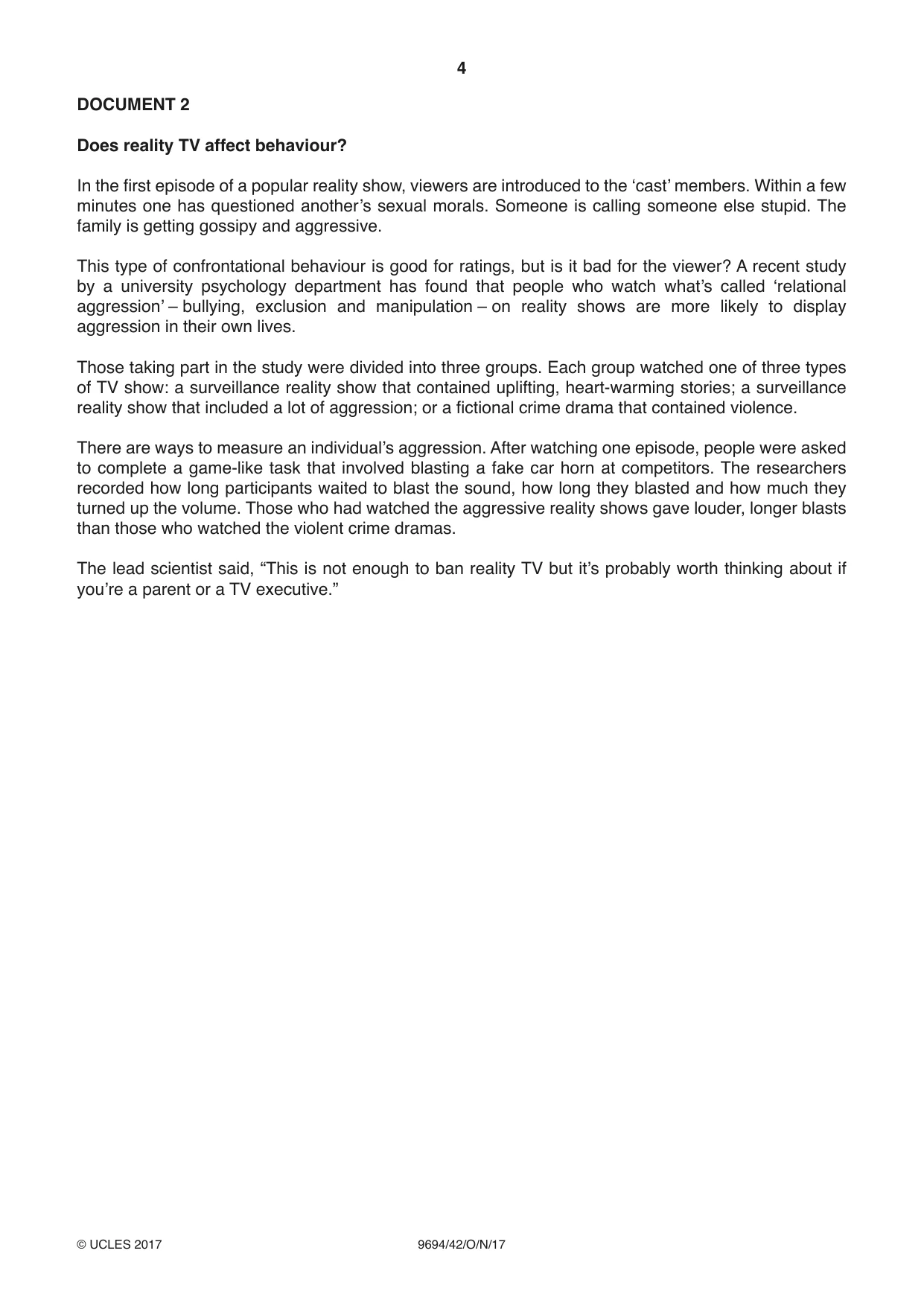
4 9694/42/O/N/17 © UCLES 2017 DOCUMENT 2 Does reality TV affect behaviour? In the first episode of a popular reality show, viewers are introduced to the ‘cast’ members. Within a few minutes one has questioned another’s sexual morals. Someone is calling someone else stupid. The family is getting gossipy and aggressive. This type of confrontational behaviour is good for ratings, but is it bad for the viewer? A recent study by a university psychology department has found that people who watch what’s called ‘relational aggression’ – bullying, exclusion and manipulation – on reality shows are more likely to display aggression in their own lives. Those taking part in the study were divided into three groups. Each group watched one of three types of TV show: a surveillance reality show that contained uplifting, heart-warming stories; a surveillance reality show that included a lot of aggression; or a fictional crime drama that contained violence. There are ways to measure an individual’s aggression. After watching one episode, people were asked to complete a game-like task that involved blasting a fake car horn at competitors. The researchers recorded how long participants waited to blast the sound, how long they blasted and how much they turned up the volume. Those who had watched the aggressive reality shows gave louder, longer blasts than those who watched the violent crime dramas. The lead scientist said, “This is not enough to ban reality TV but it’s probably worth thinking about if you’re a parent or a TV executive.”
Question paper, page 5
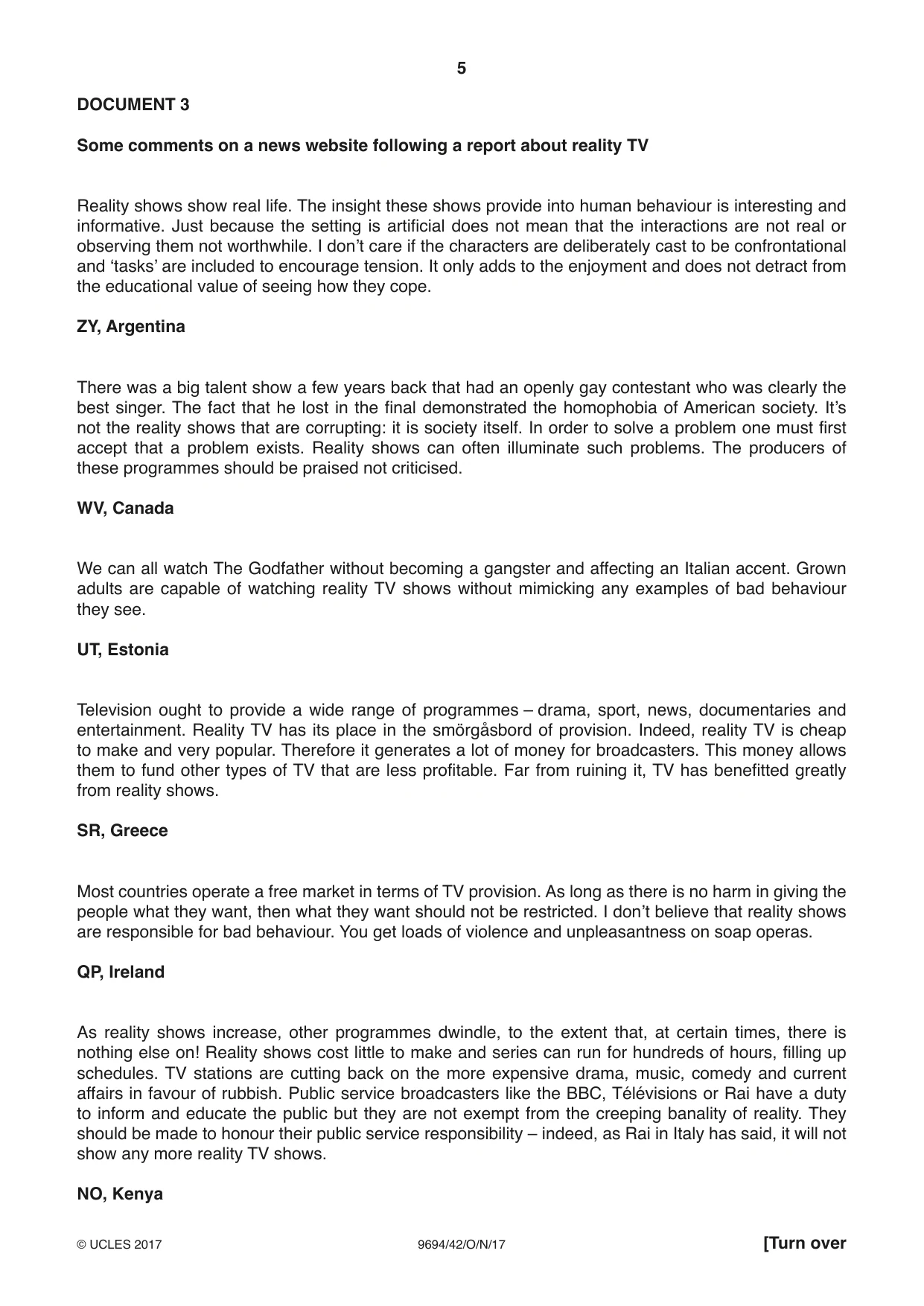
5 9694/42/O/N/17 © UCLES 2017 [Turn over DOCUMENT 3 Some comments on a news website following a report about reality TV Reality shows show real life. The insight these shows provide into human behaviour is interesting and informative. Just because the setting is artificial does not mean that the interactions are not real or observing them not worthwhile. I don’t care if the characters are deliberately cast to be confrontational and ‘tasks’ are included to encourage tension. It only adds to the enjoyment and does not detract from the educational value of seeing how they cope. ZY, Argentina There was a big talent show a few years back that had an openly gay contestant who was clearly the best singer. The fact that he lost in the final demonstrated the homophobia of American society. It’s not the reality shows that are corrupting: it is society itself. In order to solve a problem one must first accept that a problem exists. Reality shows can often illuminate such problems. The producers of these programmes should be praised not criticised. WV, Canada We can all watch The Godfather without becoming a gangster and affecting an Italian accent. Grown adults are capable of watching reality TV shows without mimicking any examples of bad behaviour they see. UT, Estonia Television ought to provide a wide range of programmes – drama, sport, news, documentaries and entertainment. Reality TV has its place in the smörgåsbord of provision. Indeed, reality TV is cheap to make and very popular. Therefore it generates a lot of money for broadcasters. This money allows them to fund other types of TV that are less profitable. Far from ruining it, TV has benefitted greatly from reality shows. SR, Greece Most countries operate a free market in terms of TV provision. As long as there is no harm in giving the people what they want, then what they want should not be restricted. I don’t believe that reality shows are responsible for bad behaviour. You get loads of violence and unpleasantness on soap operas. QP, Ireland As reality shows increase, other programmes dwindle, to the extent that, at certain times, there is nothing else on! Reality shows cost little to make and series can run for hundreds of hours, filling up schedules. TV stations are cutting back on the more expensive drama, music, comedy and current affairs in favour of rubbish. Public service broadcasters like the BBC, Télévisions or Rai have a duty to inform and educate the public but they are not exempt from the creeping banality of reality. They should be made to honour their public service responsibility – indeed, as Rai in Italy has said, it will not show any more reality TV shows. NO, Kenya
Question paper, page 6
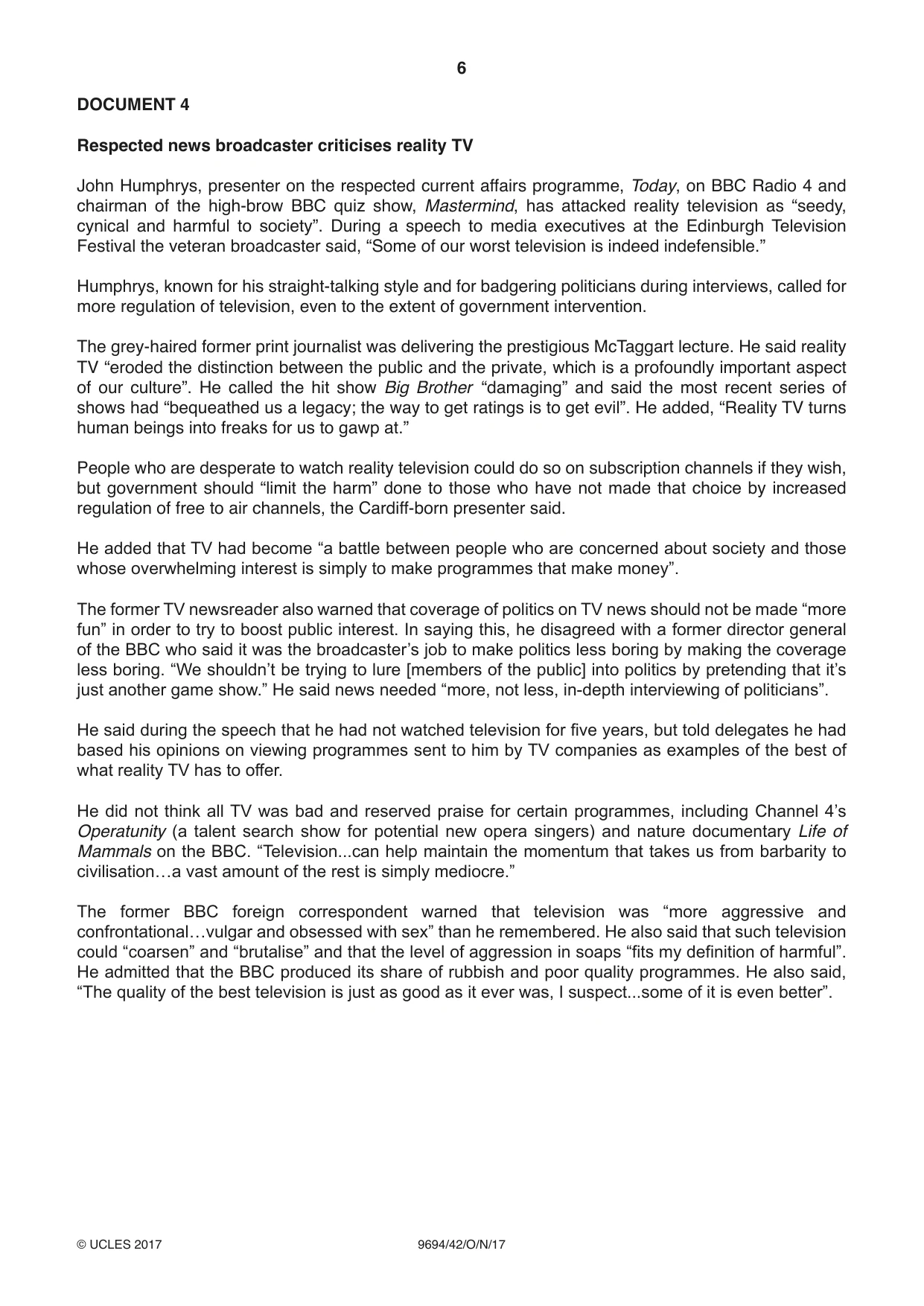
6 9694/42/O/N/17 © UCLES 2017 DOCUMENT 4 Respected news broadcaster criticises reality TV John Humphrys, presenter on the respected current affairs programme, Today, on BBC Radio 4 and chairman of the high-brow BBC quiz show, Mastermind, has attacked reality television as “seedy, cynical and harmful to society”. During a speech to media executives at the Edinburgh Television Festival the veteran broadcaster said, “Some of our worst television is indeed indefensible.” Humphrys, known for his straight-talking style and for badgering politicians during interviews, called for more regulation of television, even to the extent of government intervention. The grey-haired former print journalist was delivering the prestigious McTaggart lecture. He said reality TV “eroded the distinction between the public and the private, which is a profoundly important aspect of our culture”. He called the hit show Big Brother “damaging” and said the most recent series of shows had “bequeathed us a legacy; the way to get ratings is to get evil”. He added, “Reality TV turns human beings into freaks for us to gawp at.” People who are desperate to watch reality television could do so on subscription channels if they wish, but government should “limit the harm” done to those who have not made that choice by increased regulation of free to air channels, the Cardiff-born presenter said. He added that TV had become “a battle between people who are concerned about society and those whose overwhelming interest is simply to make programmes that make money”. The former TV newsreader also warned that coverage of politics on TV news should not be made “more fun” in order to try to boost public interest. In saying this, he disagreed with a former director general of the BBC who said it was the broadcaster’s job to make politics less boring by making the coverage less boring. “We shouldn’t be trying to lure [members of the public] into politics by pretending that it’s just another game show.” He said news needed “more, not less, in-depth interviewing of politicians”. He said during the speech that he had not watched television for five years, but told delegates he had based his opinions on viewing programmes sent to him by TV companies as examples of the best of what reality TV has to offer. He did not think all TV was bad and reserved praise for certain programmes, including Channel 4’s Operatunity (a talent search show for potential new opera singers) and nature documentary Life of Mammals on the BBC. “Television...can help maintain the momentum that takes us from barbarity to civilisation…a vast amount of the rest is simply mediocre.” The former BBC foreign correspondent warned that television was “more aggressive and confrontational…vulgar and obsessed with sex” than he remembered. He also said that such television could “coarsen” and “brutalise” and that the level of aggression in soaps “fits my definition of harmful”. He admitted that the BBC produced its share of rubbish and poor quality programmes. He also said, “The quality of the best television is just as good as it ever was, I suspect...some of it is even better”.
Question paper, page 7
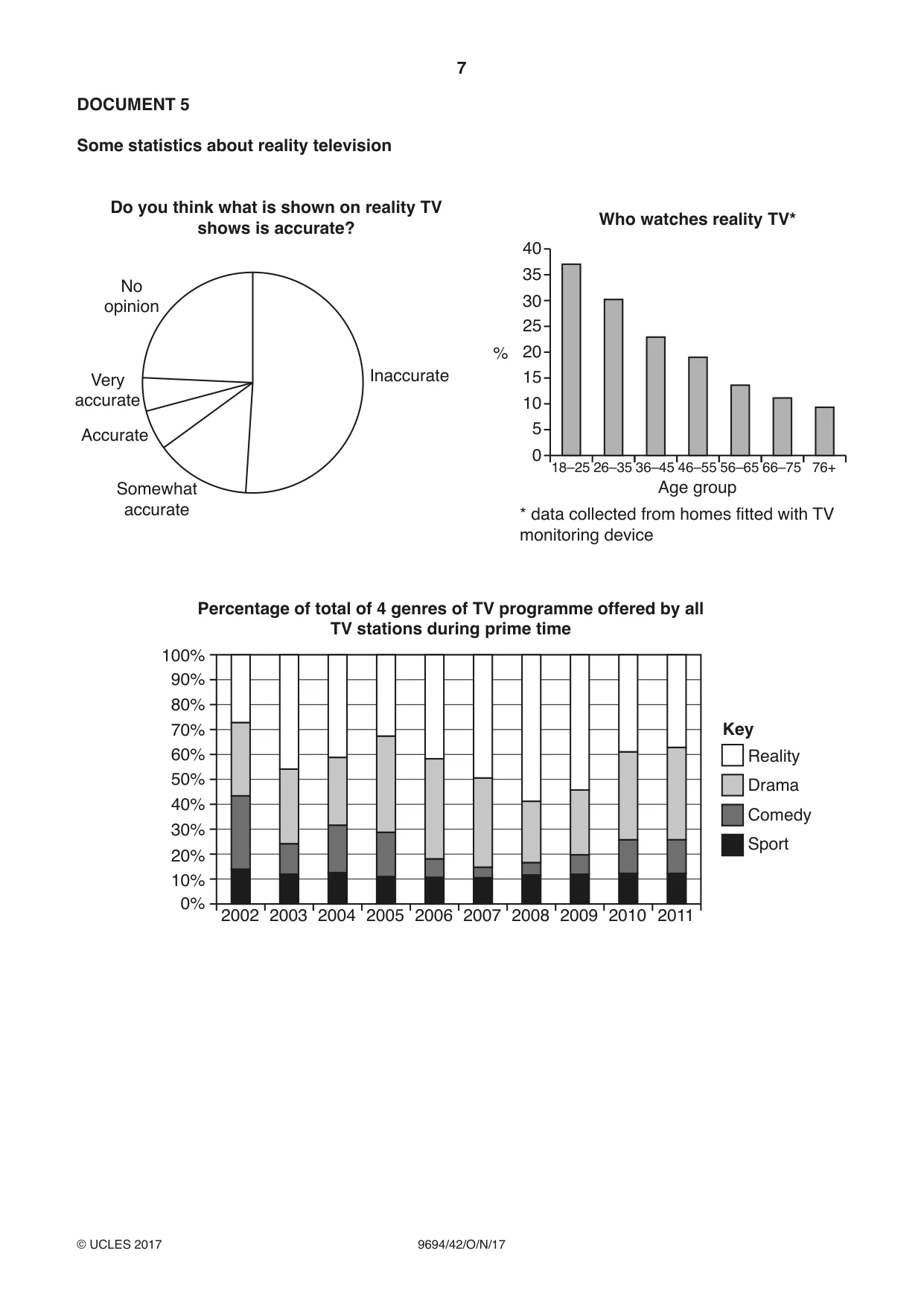
7 9694/42/O/N/17 © UCLES 2017 DOCUMENT 5 Some statistics about reality television 18–25 40 35 30 25 20 % 15 10 5 0 26–35 36–45 46–55 Age group * data collected from homes fitted with TV monitoring device Who watches reality TV* Percentage of total of 4 genres of TV programme offered by all TV stations during prime time Do you think what is shown on reality TV shows is accurate? 56–65 66–75 76+ No opinion Inaccurate Accurate Somewhat accurate Very accurate 100% 0% 10% 20% 30% 40% 50% 60% 70% 80% 90% 2002 2003 2004 2005 2006 Reality Drama Comedy Sport Key 2007 2008 2009 2010 2011
Question paper, page 8
8 9694/42/O/N/17 © UCLES 2017 BLANK PAGE Permission to reproduce items where third-party owned material protected by copyright is included has been sought and cleared where possible. Every reasonable effort has been made by the publisher (UCLES) to trace copyright holders, but if any items requiring clearance have unwittingly been included, the publisher will be pleased to make amends at the earliest possible opportunity. To avoid the issue of disclosure of answer-related information to candidates, all copyright acknowledgements are reproduced online in the Cambridge International Examinations Copyright Acknowledgements Booklet. This is produced for each series of examinations and is freely available to download at www.cie.org.uk after the live examination series. Cambridge International Examinations is part of the Cambridge Assessment Group. Cambridge Assessment is the brand name of University of Cambridge Local Examinations Syndicate (UCLES), which is itself a department of the University of Cambridge.
Mark scheme, page 1
® IGCSE is a registered trademark. This document consists of 11 printed pages. © UCLES 2017 [Turn over Cambridge Assessment International Education Cambridge International Advanced Level THINKING SKILLS 9694/42 Paper 4 Applied Reasoning October/November 2017 MARK SCHEME Maximum Mark: 50 Published This mark scheme is published as an aid to teachers and candidates, to indicate the requirements of the examination. It shows the basis on which Examiners were instructed to award marks. It does not indicate the details of the discussions that took place at an Examiners’ meeting before marking began, which would have considered the acceptability of alternative answers. Mark schemes should be read in conjunction with the question paper and the Principal Examiner Report for Teachers. Cambridge International will not enter into discussions about these mark schemes. Cambridge International is publishing the mark schemes for the October/November 2017 series for most Cambridge IGCSE®, Cambridge International A and AS Level components and some Cambridge O Level components.
Mark scheme, page 2
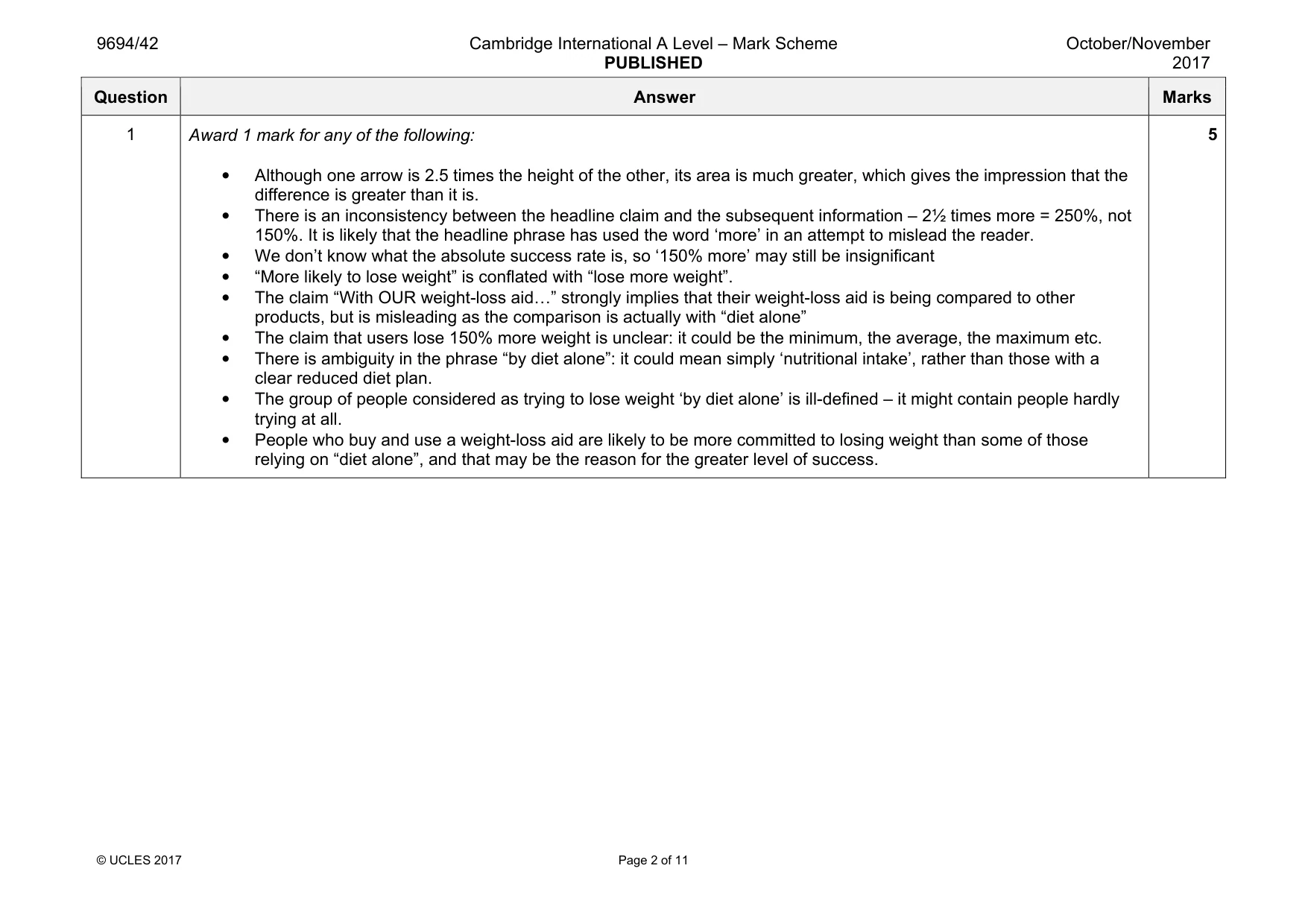
9694/42 Cambridge International A Level – Mark Scheme PUBLISHED October/November 2017 © UCLES 2017 Page 2 of 11 Question Answer Marks 1 Award 1 mark for any of the following: • Although one arrow is 2.5 times the height of the other, its area is much greater, which gives the impression that the difference is greater than it is. • There is an inconsistency between the headline claim and the subsequent information – 2½ times more = 250%, not 150%. It is likely that the headline phrase has used the word ‘more’ in an attempt to mislead the reader. • We don’t know what the absolute success rate is, so ‘150% more’ may still be insignificant • “More likely to lose weight” is conflated with “lose more weight”. • The claim “With OUR weight-loss aid«” strongly implies that their weight-loss aid is being compared to other products, but is misleading as the comparison is actually with “diet alone” • The claim that users lose 150% more weight is unclear: it could be the minimum, the average, the maximum etc. • There is ambiguity in the phrase “by diet alone”: it could mean simply ‘nutritional intake’, rather than those with a clear reduced diet plan. • The group of people considered as trying to lose weight ‘by diet alone’ is ill-defined – it might contain people hardly trying at all. • People who buy and use a weight-loss aid are likely to be more committed to losing weight than some of those relying on “diet alone”, and that may be the reason for the greater level of success. 5
Mark scheme, page 3
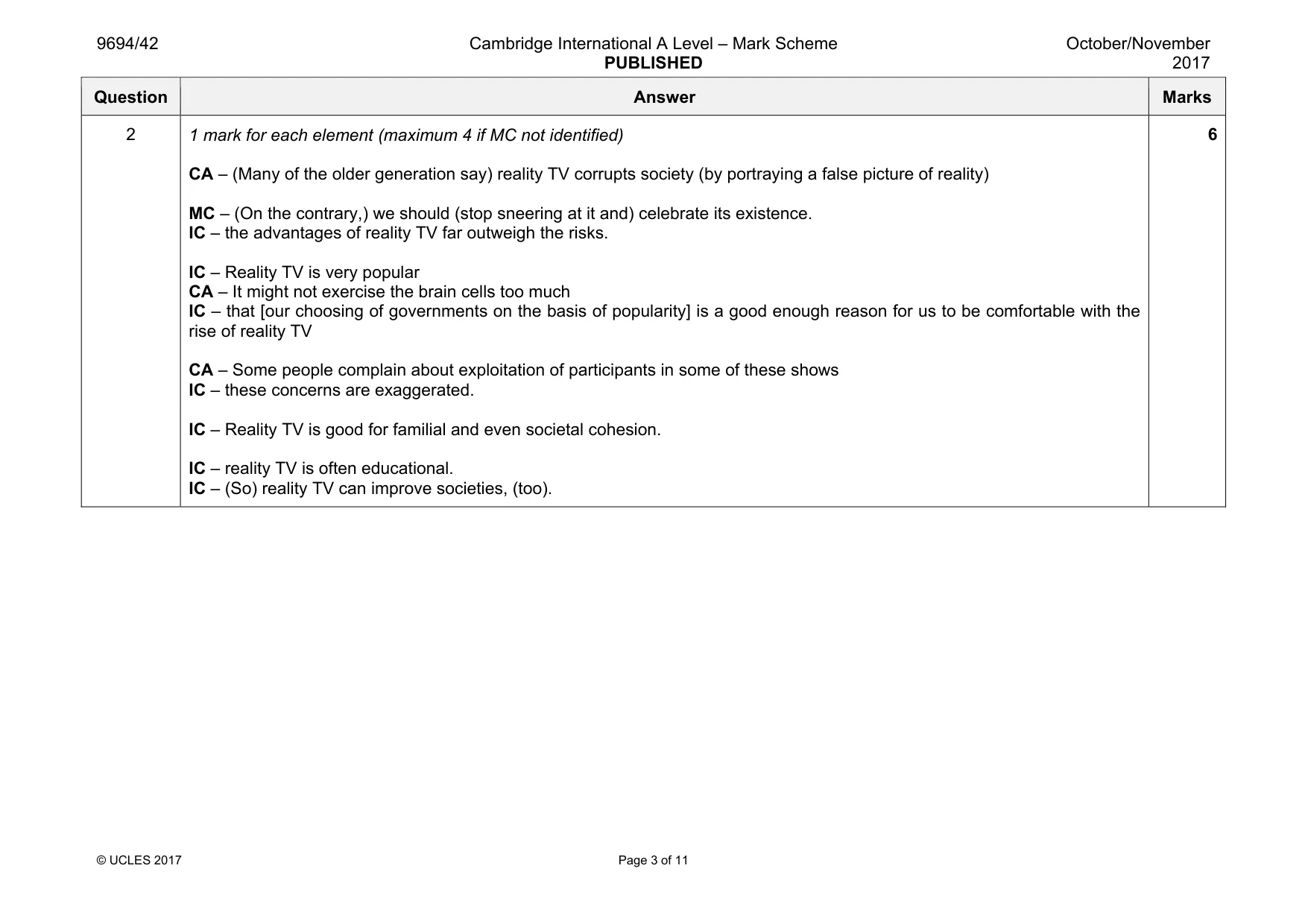
9694/42 Cambridge International A Level – Mark Scheme PUBLISHED October/November 2017 © UCLES 2017 Page 3 of 11 Question Answer Marks 2 1 mark for each element (maximum 4 if MC not identified) CA – (Many of the older generation say) reality TV corrupts society (by portraying a false picture of reality) MC – (On the contrary,) we should (stop sneering at it and) celebrate its existence. IC – the advantages of reality TV far outweigh the risks. IC – Reality TV is very popular CA – It might not exercise the brain cells too much IC – that [our choosing of governments on the basis of popularity] is a good enough reason for us to be comfortable with the rise of reality TV CA – Some people complain about exploitation of participants in some of these shows IC – these concerns are exaggerated. IC – Reality TV is good for familial and even societal cohesion. IC – reality TV is often educational. IC – (So) reality TV can improve societies, (too). 6
Mark scheme, page 4
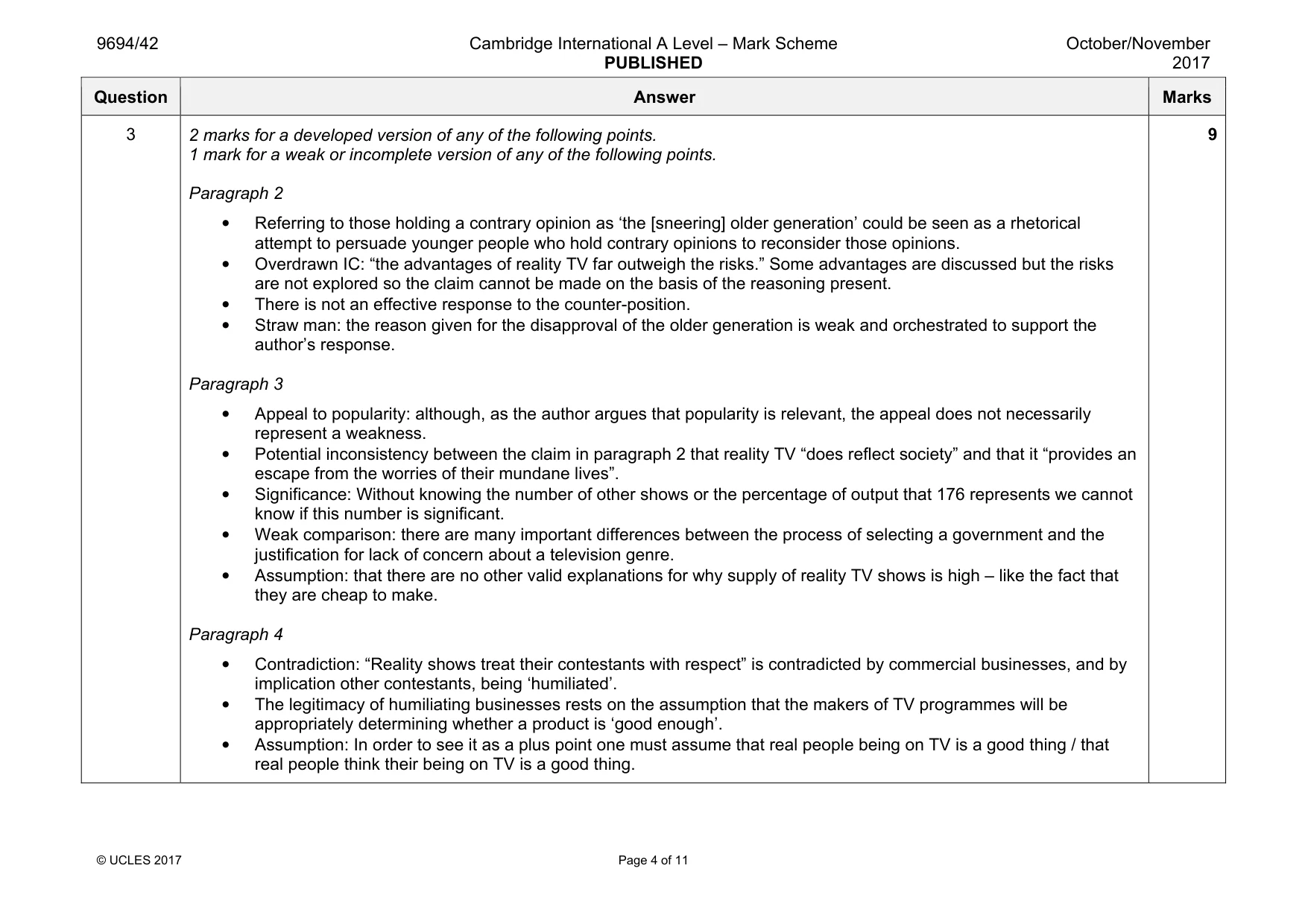
9694/42 Cambridge International A Level – Mark Scheme PUBLISHED October/November 2017 © UCLES 2017 Page 4 of 11 Question Answer Marks 3 2 marks for a developed version of any of the following points. 1 mark for a weak or incomplete version of any of the following points. Paragraph 2 • Referring to those holding a contrary opinion as ‘the [sneering] older generation’ could be seen as a rhetorical attempt to persuade younger people who hold contrary opinions to reconsider those opinions. • Overdrawn IC: “the advantages of reality TV far outweigh the risks.” Some advantages are discussed but the risks are not explored so the claim cannot be made on the basis of the reasoning present. • There is not an effective response to the counter-position. • Straw man: the reason given for the disapproval of the older generation is weak and orchestrated to support the author’s response. Paragraph 3 • Appeal to popularity: although, as the author argues that popularity is relevant, the appeal does not necessarily represent a weakness. • Potential inconsistency between the claim in paragraph 2 that reality TV “does reflect society” and that it “provides an escape from the worries of their mundane lives”. • Significance: Without knowing the number of other shows or the percentage of output that 176 represents we cannot know if this number is significant. • Weak comparison: there are many important differences between the process of selecting a government and the justification for lack of concern about a television genre. • Assumption: that there are no other valid explanations for why supply of reality TV shows is high – like the fact that they are cheap to make. Paragraph 4 • Contradiction: “Reality shows treat their contestants with respect” is contradicted by commercial businesses, and by implication other contestants, being ‘humiliated’. • The legitimacy of humiliating businesses rests on the assumption that the makers of TV programmes will be appropriately determining whether a product is ‘good enough’. • Assumption: In order to see it as a plus point one must assume that real people being on TV is a good thing / that real people think their being on TV is a good thing. 9
Mark scheme, page 5
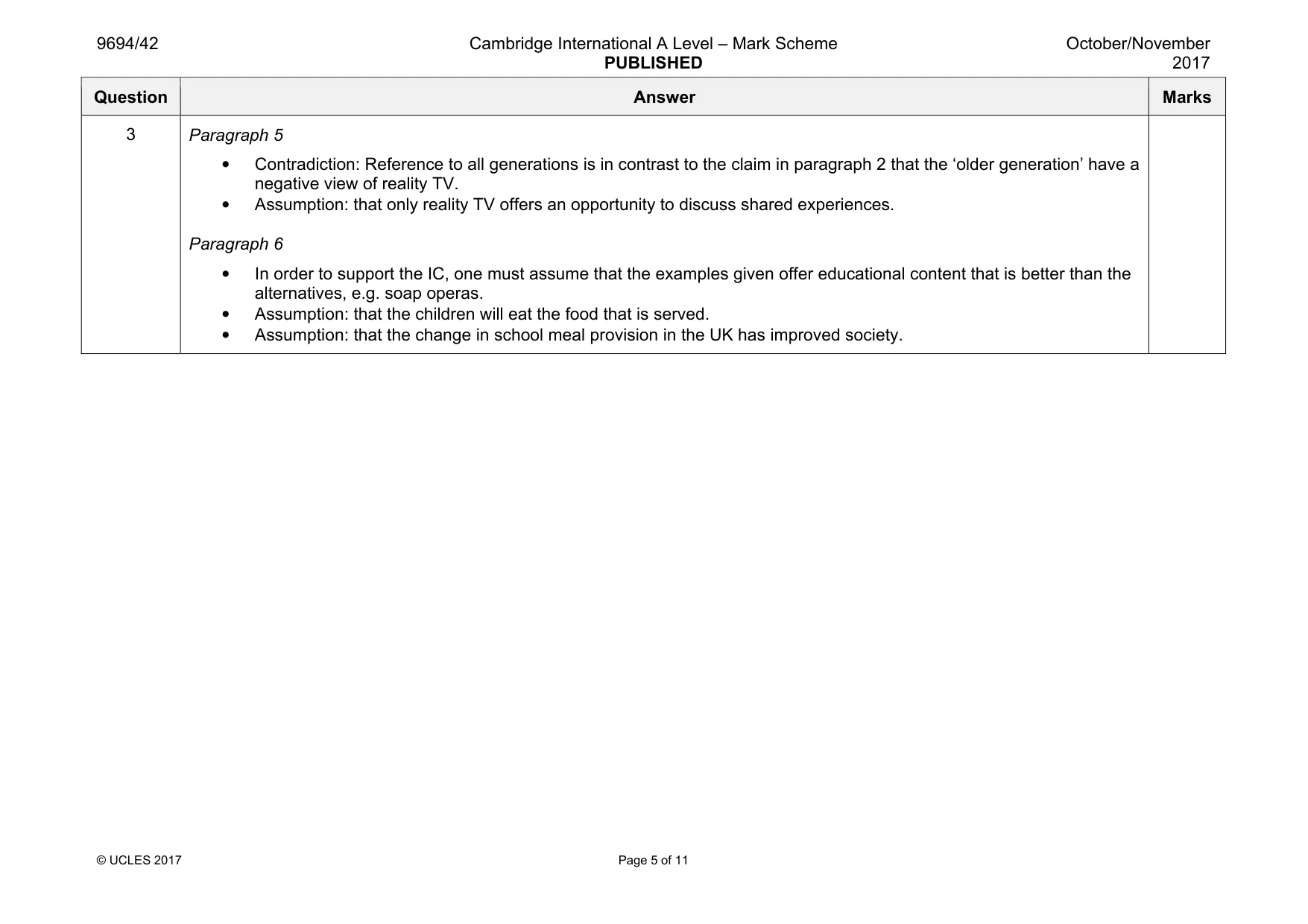
9694/42 Cambridge International A Level – Mark Scheme PUBLISHED October/November 2017 © UCLES 2017 Page 5 of 11 Question Answer Marks 3 Paragraph 5 • Contradiction: Reference to all generations is in contrast to the claim in paragraph 2 that the ‘older generation’ have a negative view of reality TV. • Assumption: that only reality TV offers an opportunity to discuss shared experiences. Paragraph 6 • In order to support the IC, one must assume that the examples given offer educational content that is better than the alternatives, e.g. soap operas. • Assumption: that the children will eat the food that is served. • Assumption: that the change in school meal provision in the UK has improved society.
Mark scheme, page 6
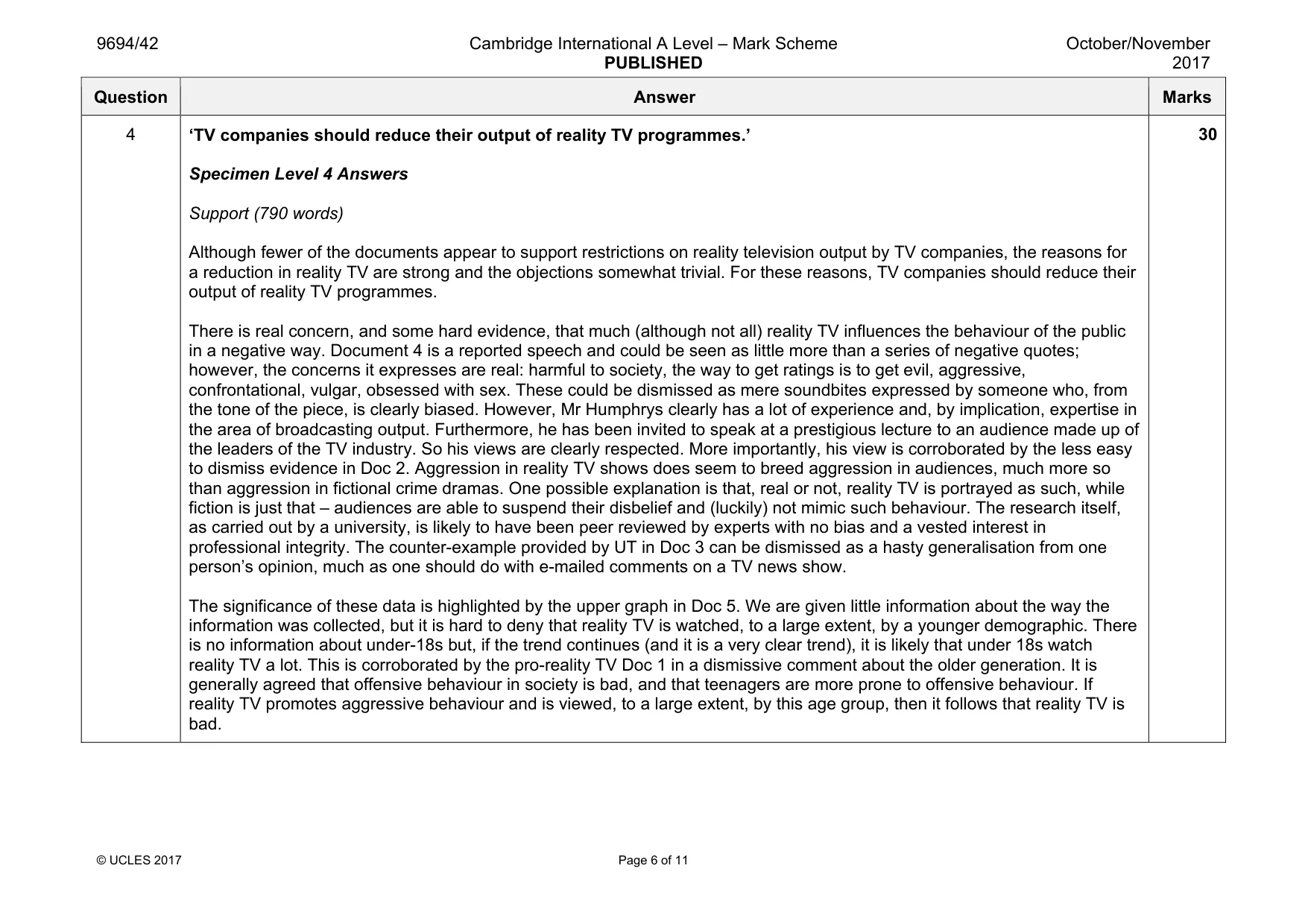
9694/42 Cambridge International A Level – Mark Scheme PUBLISHED October/November 2017 © UCLES 2017 Page 6 of 11 Question Answer Marks 4 ‘TV companies should reduce their output of reality TV programmes.’ Specimen Level 4 Answers Support (790 words) Although fewer of the documents appear to support restrictions on reality television output by TV companies, the reasons for a reduction in reality TV are strong and the objections somewhat trivial. For these reasons, TV companies should reduce their output of reality TV programmes. There is real concern, and some hard evidence, that much (although not all) reality TV influences the behaviour of the public in a negative way. Document 4 is a reported speech and could be seen as little more than a series of negative quotes; however, the concerns it expresses are real: harmful to society, the way to get ratings is to get evil, aggressive, confrontational, vulgar, obsessed with sex. These could be dismissed as mere soundbites expressed by someone who, from the tone of the piece, is clearly biased. However, Mr Humphrys clearly has a lot of experience and, by implication, expertise in the area of broadcasting output. Furthermore, he has been invited to speak at a prestigious lecture to an audience made up of the leaders of the TV industry. So his views are clearly respected. More importantly, his view is corroborated by the less easy to dismiss evidence in Doc 2. Aggression in reality TV shows does seem to breed aggression in audiences, much more so than aggression in fictional crime dramas. One possible explanation is that, real or not, reality TV is portrayed as such, while fiction is just that – audiences are able to suspend their disbelief and (luckily) not mimic such behaviour. The research itself, as carried out by a university, is likely to have been peer reviewed by experts with no bias and a vested interest in professional integrity. The counter-example provided by UT in Doc 3 can be dismissed as a hasty generalisation from one person’s opinion, much as one should do with e-mailed comments on a TV news show. The significance of these data is highlighted by the upper graph in Doc 5. We are given little information about the way the information was collected, but it is hard to deny that reality TV is watched, to a large extent, by a younger demographic. There is no information about under-18s but, if the trend continues (and it is a very clear trend), it is likely that under 18s watch reality TV a lot. This is corroborated by the pro-reality TV Doc 1 in a dismissive comment about the older generation. It is generally agreed that offensive behaviour in society is bad, and that teenagers are more prone to offensive behaviour. If reality TV promotes aggressive behaviour and is viewed, to a large extent, by this age group, then it follows that reality TV is bad. 30
Mark scheme, page 7
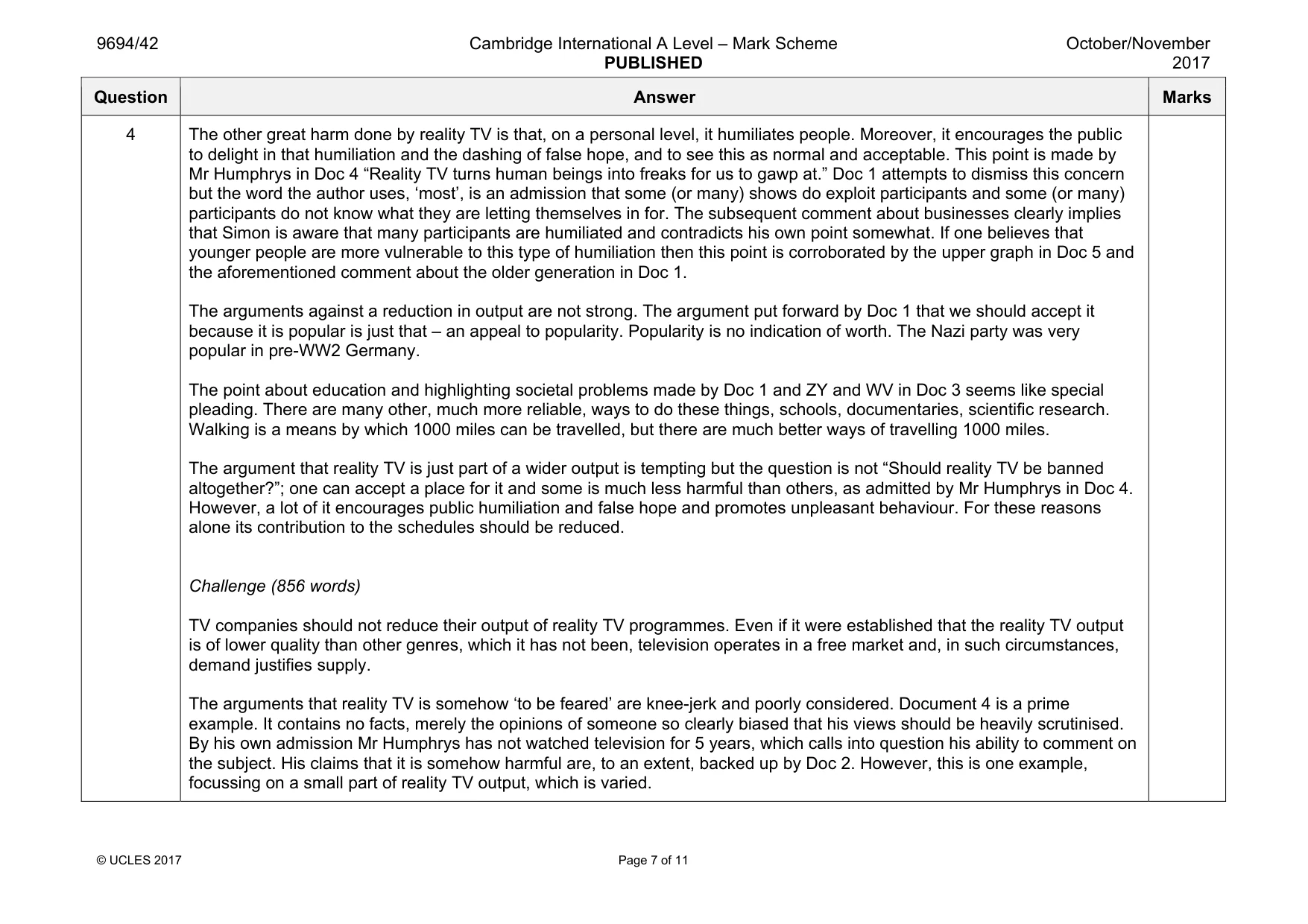
9694/42 Cambridge International A Level – Mark Scheme PUBLISHED October/November 2017 © UCLES 2017 Page 7 of 11 Question Answer Marks 4 The other great harm done by reality TV is that, on a personal level, it humiliates people. Moreover, it encourages the public to delight in that humiliation and the dashing of false hope, and to see this as normal and acceptable. This point is made by Mr Humphrys in Doc 4 “Reality TV turns human beings into freaks for us to gawp at.” Doc 1 attempts to dismiss this concern but the word the author uses, ‘most’, is an admission that some (or many) shows do exploit participants and some (or many) participants do not know what they are letting themselves in for. The subsequent comment about businesses clearly implies that Simon is aware that many participants are humiliated and contradicts his own point somewhat. If one believes that younger people are more vulnerable to this type of humiliation then this point is corroborated by the upper graph in Doc 5 and the aforementioned comment about the older generation in Doc 1. The arguments against a reduction in output are not strong. The argument put forward by Doc 1 that we should accept it because it is popular is just that – an appeal to popularity. Popularity is no indication of worth. The Nazi party was very popular in pre-WW2 Germany. The point about education and highlighting societal problems made by Doc 1 and ZY and WV in Doc 3 seems like special pleading. There are many other, much more reliable, ways to do these things, schools, documentaries, scientific research. Walking is a means by which 1000 miles can be travelled, but there are much better ways of travelling 1000 miles. The argument that reality TV is just part of a wider output is tempting but the question is not “Should reality TV be banned altogether?”; one can accept a place for it and some is much less harmful than others, as admitted by Mr Humphrys in Doc 4. However, a lot of it encourages public humiliation and false hope and promotes unpleasant behaviour. For these reasons alone its contribution to the schedules should be reduced. Challenge (856 words) TV companies should not reduce their output of reality TV programmes. Even if it were established that the reality TV output is of lower quality than other genres, which it has not been, television operates in a free market and, in such circumstances, demand justifies supply. The arguments that reality TV is somehow ‘to be feared’ are knee-jerk and poorly considered. Document 4 is a prime example. It contains no facts, merely the opinions of someone so clearly biased that his views should be heavily scrutinised. By his own admission Mr Humphrys has not watched television for 5 years, which calls into question his ability to comment on the subject. His claims that it is somehow harmful are, to an extent, backed up by Doc 2. However, this is one example, focussing on a small part of reality TV output, which is varied.
Mark scheme, page 8
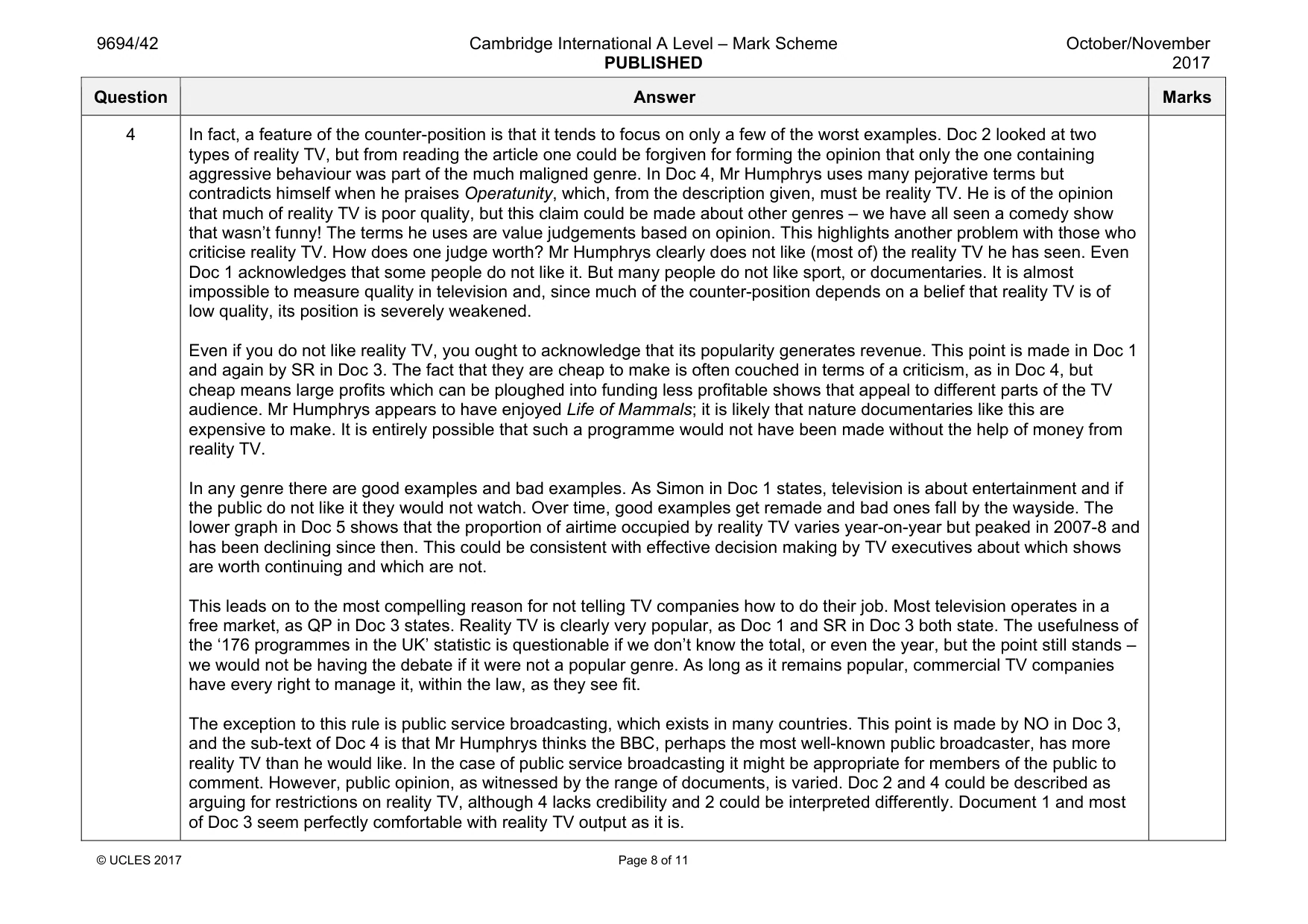
9694/42 Cambridge International A Level – Mark Scheme PUBLISHED October/November 2017 © UCLES 2017 Page 8 of 11 Question Answer Marks 4 In fact, a feature of the counter-position is that it tends to focus on only a few of the worst examples. Doc 2 looked at two types of reality TV, but from reading the article one could be forgiven for forming the opinion that only the one containing aggressive behaviour was part of the much maligned genre. In Doc 4, Mr Humphrys uses many pejorative terms but contradicts himself when he praises Operatunity, which, from the description given, must be reality TV. He is of the opinion that much of reality TV is poor quality, but this claim could be made about other genres – we have all seen a comedy show that wasn’t funny! The terms he uses are value judgements based on opinion. This highlights another problem with those who criticise reality TV. How does one judge worth? Mr Humphrys clearly does not like (most of) the reality TV he has seen. Even Doc 1 acknowledges that some people do not like it. But many people do not like sport, or documentaries. It is almost impossible to measure quality in television and, since much of the counter-position depends on a belief that reality TV is of low quality, its position is severely weakened. Even if you do not like reality TV, you ought to acknowledge that its popularity generates revenue. This point is made in Doc 1 and again by SR in Doc 3. The fact that they are cheap to make is often couched in terms of a criticism, as in Doc 4, but cheap means large profits which can be ploughed into funding less profitable shows that appeal to different parts of the TV audience. Mr Humphrys appears to have enjoyed Life of Mammals; it is likely that nature documentaries like this are expensive to make. It is entirely possible that such a programme would not have been made without the help of money from reality TV. In any genre there are good examples and bad examples. As Simon in Doc 1 states, television is about entertainment and if the public do not like it they would not watch. Over time, good examples get remade and bad ones fall by the wayside. The lower graph in Doc 5 shows that the proportion of airtime occupied by reality TV varies year-on-year but peaked in 2007-8 and has been declining since then. This could be consistent with effective decision making by TV executives about which shows are worth continuing and which are not. This leads on to the most compelling reason for not telling TV companies how to do their job. Most television operates in a free market, as QP in Doc 3 states. Reality TV is clearly very popular, as Doc 1 and SR in Doc 3 both state. The usefulness of the ‘176 programmes in the UK’ statistic is questionable if we don’t know the total, or even the year, but the point still stands – we would not be having the debate if it were not a popular genre. As long as it remains popular, commercial TV companies have every right to manage it, within the law, as they see fit. The exception to this rule is public service broadcasting, which exists in many countries. This point is made by NO in Doc 3, and the sub-text of Doc 4 is that Mr Humphrys thinks the BBC, perhaps the most well-known public broadcaster, has more reality TV than he would like. In the case of public service broadcasting it might be appropriate for members of the public to comment. However, public opinion, as witnessed by the range of documents, is varied. Doc 2 and 4 could be described as arguing for restrictions on reality TV, although 4 lacks credibility and 2 could be interpreted differently. Document 1 and most of Doc 3 seem perfectly comfortable with reality TV output as it is.
Mark scheme, page 9
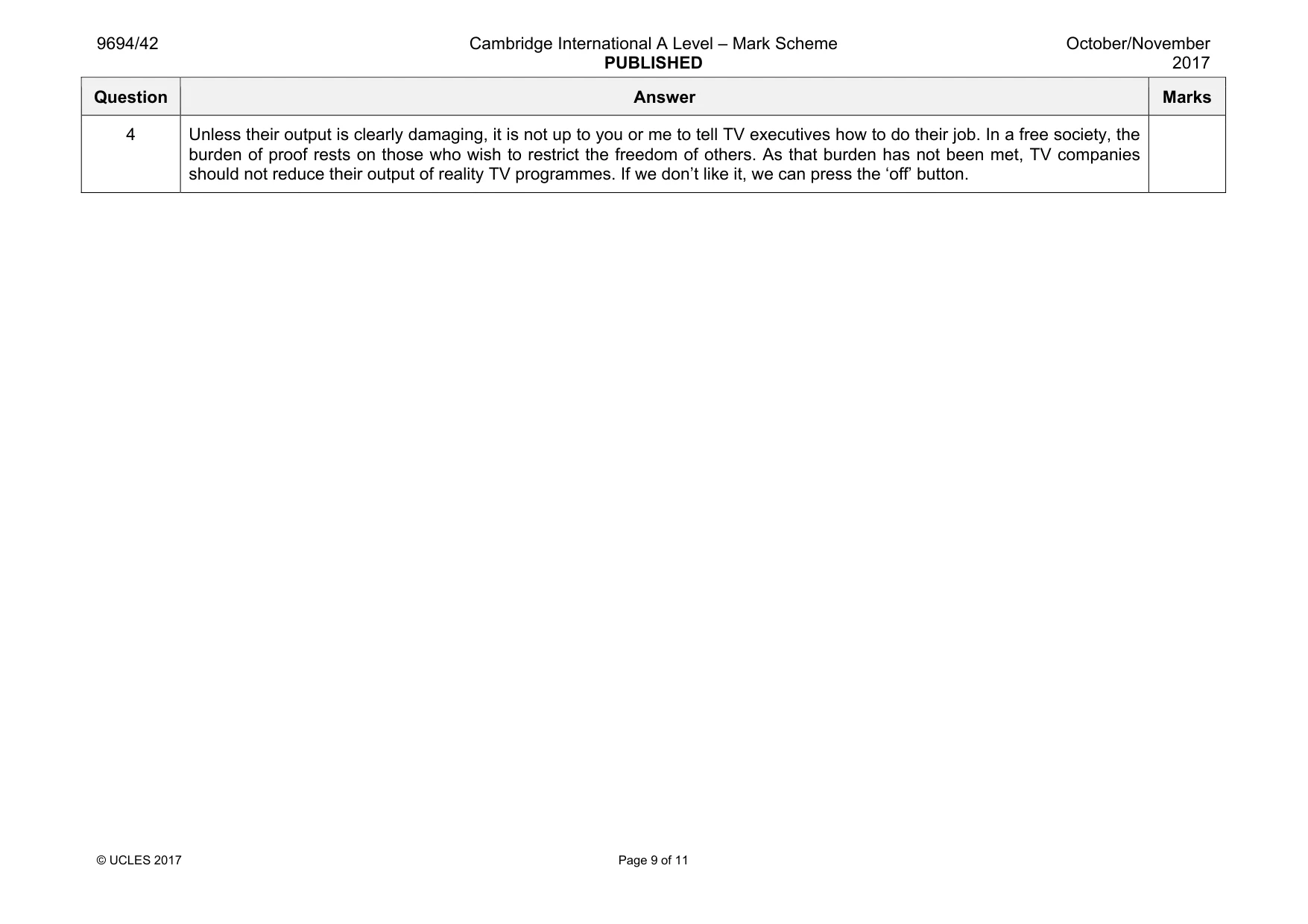
9694/42 Cambridge International A Level – Mark Scheme PUBLISHED October/November 2017 © UCLES 2017 Page 9 of 11 Question Answer Marks 4 Unless their output is clearly damaging, it is not up to you or me to tell TV executives how to do their job. In a free society, the burden of proof rests on those who wish to restrict the freedom of others. As that burden has not been met, TV companies should not reduce their output of reality TV programmes. If we don’t like it, we can press the ‘off’ button.
Mark scheme, page 10
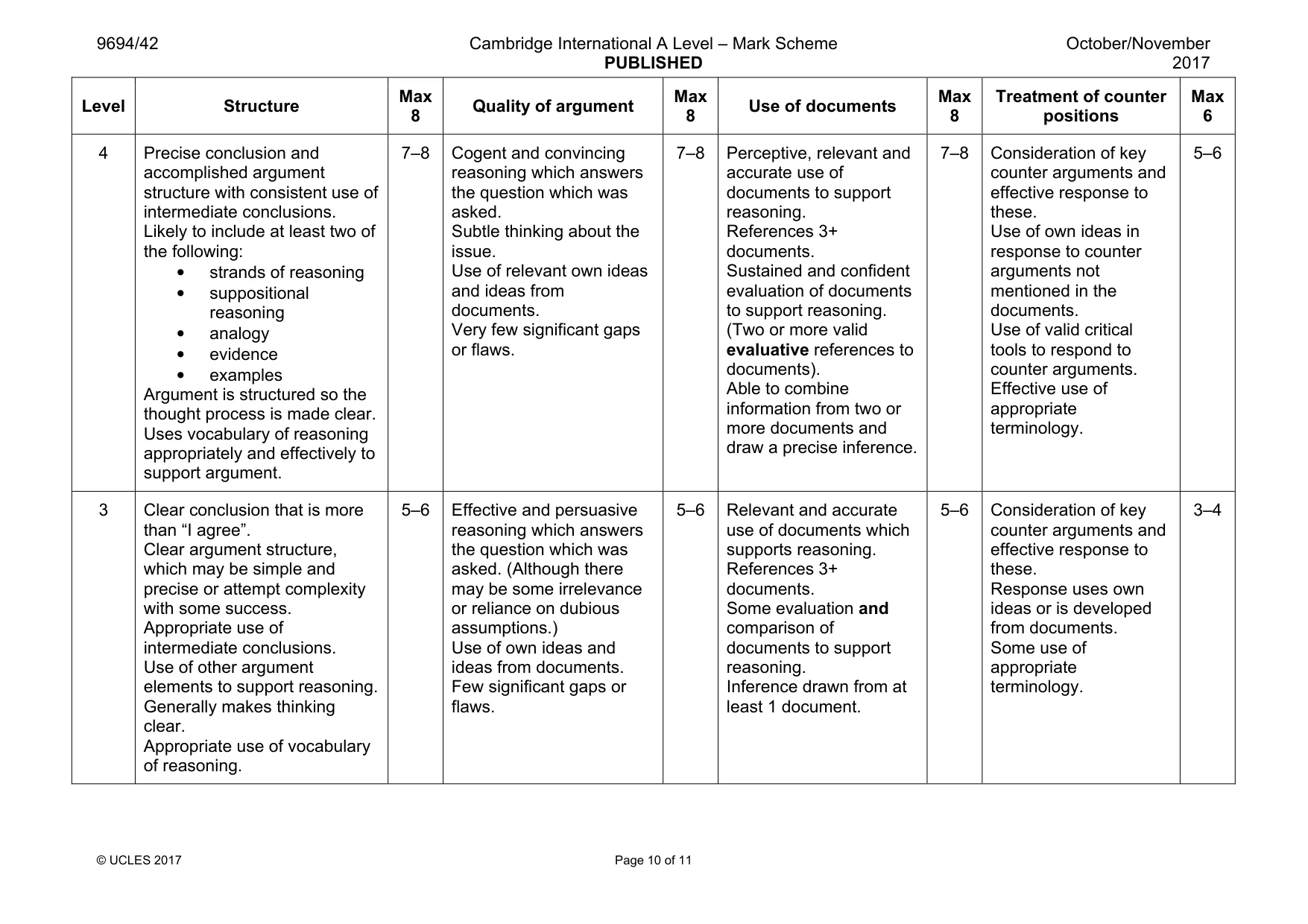
9694/42 Cambridge International A Level – Mark Scheme PUBLISHED October/November 2017 © UCLES 2017 Page 10 of 11 Level Structure Max 8 Quality of argument Max 8 Use of documents Max 8 Treatment of counter positions Max 6 4 Precise conclusion and accomplished argument structure with consistent use of intermediate conclusions. Likely to include at least two of the following: • strands of reasoning • suppositional reasoning • analogy • evidence • examples Argument is structured so the thought process is made clear. Uses vocabulary of reasoning appropriately and effectively to support argument. 7–8 Cogent and convincing reasoning which answers the question which was asked. Subtle thinking about the issue. Use of relevant own ideas and ideas from documents. Very few significant gaps or flaws. 7–8 Perceptive, relevant and accurate use of documents to support reasoning. References 3+ documents. Sustained and confident evaluation of documents to support reasoning. (Two or more valid evaluative references to documents). Able to combine information from two or more documents and draw a precise inference. 7–8 Consideration of key counter arguments and effective response to these. Use of own ideas in response to counter arguments not mentioned in the documents. Use of valid critical tools to respond to counter arguments. Effective use of appropriate terminology. 5–6 3 Clear conclusion that is more than “I agree”. Clear argument structure, which may be simple and precise or attempt complexity with some success. Appropriate use of intermediate conclusions. Use of other argument elements to support reasoning. Generally makes thinking clear. Appropriate use of vocabulary of reasoning. 5–6 Effective and persuasive reasoning which answers the question which was asked. (Although there may be some irrelevance or reliance on dubious assumptions.) Use of own ideas and ideas from documents. Few significant gaps or flaws. 5–6 Relevant and accurate use of documents which supports reasoning. References 3+ documents. Some evaluation and comparison of documents to support reasoning. Inference drawn from at least 1 document. 5–6 Consideration of key counter arguments and effective response to these. Response uses own ideas or is developed from documents. Some use of appropriate terminology. 3–4
Mark scheme, page 11
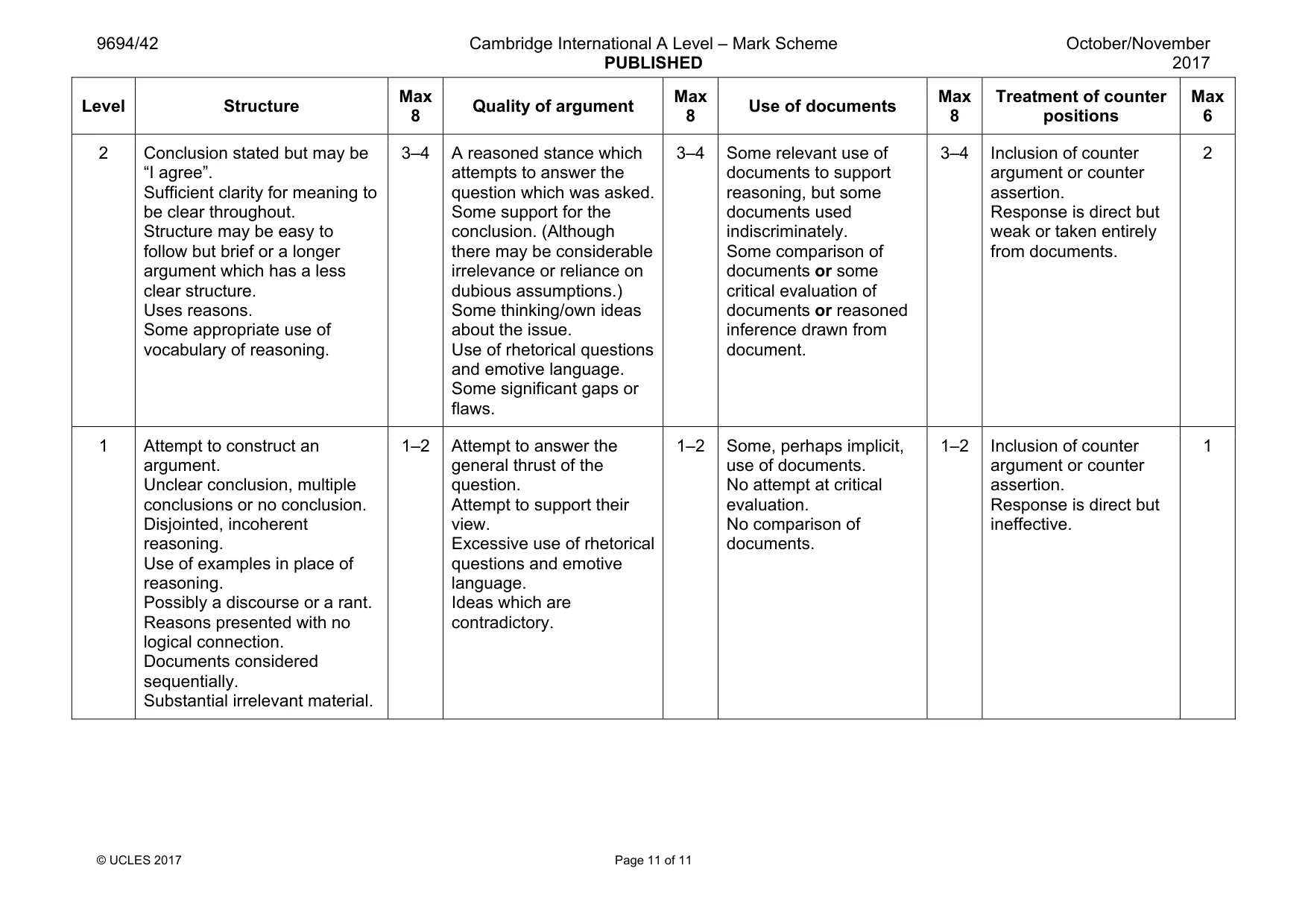
9694/42 Cambridge International A Level – Mark Scheme PUBLISHED October/November 2017 © UCLES 2017 Page 11 of 11 Level Structure Max 8 Quality of argument Max 8 Use of documents Max 8 Treatment of counter positions Max 6 2 Conclusion stated but may be “I agree”. Sufficient clarity for meaning to be clear throughout. Structure may be easy to follow but brief or a longer argument which has a less clear structure. Uses reasons. Some appropriate use of vocabulary of reasoning. 3–4 A reasoned stance which attempts to answer the question which was asked. Some support for the conclusion. (Although there may be considerable irrelevance or reliance on dubious assumptions.) Some thinking/own ideas about the issue. Use of rhetorical questions and emotive language. Some significant gaps or flaws. 3–4 Some relevant use of documents to support reasoning, but some documents used indiscriminately. Some comparison of documents or some critical evaluation of documents or reasoned inference drawn from document. 3–4 Inclusion of counter argument or counter assertion. Response is direct but weak or taken entirely from documents. 2 1 Attempt to construct an argument. Unclear conclusion, multiple conclusions or no conclusion. Disjointed, incoherent reasoning. Use of examples in place of reasoning. Possibly a discourse or a rant. Reasons presented with no logical connection. Documents considered sequentially. Substantial irrelevant material. 1–2 Attempt to answer the general thrust of the question. Attempt to support their view. Excessive use of rhetorical questions and emotive language. Ideas which are contradictory. 1–2 Some, perhaps implicit, use of documents. No attempt at critical evaluation. No comparison of documents. 1–2 Inclusion of counter argument or counter assertion. Response is direct but ineffective. 1
What you needed in this session
Cambridge’s own grade thresholds for 2017 Oct/Nov, Paper 4 · Variant 2. A higher threshold means an easier paper — the bar moves with how the cohort did.