Cambridge A Level Thinking Skills 9694 — 2015 May/June Paper 4 · Variant 2
9694/42/M/J/15 · 50 marks · ≈56 min
The question paper and its mark scheme, free to read here and free to download. This is Cambridge’s own paper, exactly as it was sat.
Question paper8 pages
Mark scheme8 pages
Answers below. Sit the paper first if you are practising.
Paper as text
Question paper, page 1
This document consists of 7 printed pages, 1 blank page and 1 insert. IB15 06_9694_42/RP © UCLES 2015 [Turn over *9878358915* Cambridge International Examinations Cambridge International Advanced Level THINKING SKILLS 9694/42 Paper 4 Applied Reasoning May/June 2015 1 hour 30 minutes No Additional Materials are required. READ THESE INSTRUCTIONS FIRST An answer booklet is provided inside this question paper. You should follow the instructions on the front cover of the answer booklet. If you need additional answer paper ask the invigilator for a continuation booklet. Answer all the questions. The number of marks is given in brackets [ ] at the end of each question.
Question paper, page 2
2 © UCLES 2015 9694/42/M/J/15 1 Study the information below and answer the question that follows. $5 000 000 a year wasted by local schools A recent study suggests that local schools may have wasted as much as $5 000 000 in the last year. The study looked at the prices paid for items such as books, furniture, computers and building repairs in a number of local schools. The schools bought expensive items and services when there were less expensive alternatives available. Apart from staff wages, the schools spent a total of $100 000 over a period of one month, but they could have bought the equivalent for $20 000 less if they had used other suppliers. Over a year that is a potential saving of $240 000. The schools that were involved make up 5% of the schools in the county so it is likely that schools in the county are wasting $4 800 000 every year. Make five criticisms of the statistics used in the passage or any inferences drawn from them. [5] Questions 2, 3 and 4 refer to Documents 1 to 5. 2 Briefly analyse Student President’s argument in Document 1: Response by the Student Union of Barchester University to the draft proposals for a new degree of Bachelor of Humanities, by identifying its main conclusion, intermediate conclusions and any counter-assertions. [6] 3 Give a critical evaluation of the strength of Student President’s argument in Document 1: Response by the Student Union of Barchester University to the draft proposals for a new degree of Bachelor of Humanities, by identifying and explaining any flaws, implicit assumptions and other weaknesses. [9] 4 ‘Universities should award degrees on the basis of Continuous Assessment (CA).’ Construct a reasoned argument to support or challenge this claim, commenting critically on some or all of Documents 1 to 5 and introducing ideas of your own. [30]
Question paper, page 3
3 © UCLES 2015 9694/42/M/J/15 [Turn over DOCUMENT 1 Response by the Student Union of Barchester University to the draft proposals for a new degree of Bachelor of Humanities We are disappointed that, under the draft proposals, degrees will be awarded solely on the basis of written examinations taken at the end of the course. Since the panel which produced the proposals was chaired by the former Dean of Humanities, now retired, it is not surprising that the proposals are so old-fashioned and backward-looking. We recommend that the new degree should be assessed solely by essays and projects written during the course. This will put our university in the forefront of innovation. Instead of remaining in the third rank of universities, implementing our suggestion will make us be seen as trend-setters. Some students perform badly in examinations because they are nervous under stress, have poor memories or find it difficult to think quickly. It is unfair that they should be penalised for these difficulties, because they are not their fault. These problems are especially relevant to this course, because it is aimed at mature students, many of whom are likely to have a history of academic failure. Traditional written examinations assess short-term memory, superficial thinking and the ability to write quickly. These are not the skills which Higher Education should be developing. The purpose of universities is to enable students to explore subjects at depth, to develop their own, informed opinions on matters of universal importance, and to ponder unhurriedly on the mysteries of the universe. The former Dean has argued that unseen written examinations produce a wider range of marks than assessment by essays, but that is not a valid reason for relying on them. You could obtain an even greater spread by listing the candidates according to their birthdays, but it would not be measuring anything significant. By contrast, writing an essay forces students to engage with the material they have been taught or can discover for themselves and to apply it to a specific issue. These are the skills which employers are looking for. Group projects are especially valuable, since they develop and assess teamwork in addition to other skills. So anyone who passes a degree assessed in these ways should be in a very strong position for gaining a job. This is also the reason why there is no merit in the superficial criticism that students might “cheat” by obtaining their essays from the internet. The ability to answer problems by researching on the internet is, in fact, one of the most valuable skills in the modern workplace. Assessing modules promptly has many advantages over the traditional pattern of assessment. It consolidates the learning from each module more efficiently, and it also solves the problem of what to do about students who miss final exams or perform below their best because of illness or family problems. Finally, it helps students if any difficulties they may have in understanding or applying their studies are revealed early enough in their education for them to try harder or to ask for help. Student President
Question paper, page 4
4 © UCLES 2015 9694/42/M/J/15 DOCUMENT 2 Against Continuous Assessment In recent years there has been a gradual move by higher education institutions worldwide in favour of a continuous assessment approach. Very few courses are now assessed by means of all-or-nothing ‘finals’ at the very end. There are, admittedly, some advantages to the new approach, but continuous assessment can have a harmful effect on the learning process. Splitting an academic year in two and dividing exams between winter and summer does have benefits. Most modules only last for a single semester and having an examination soon after the last lecture of term makes a lot of sense. There is no point in waiting until the summer when it has been months since you last looked at notes on that subject. However, I would not want to go any further than that. When choosing modules, I read through a module description and check how I shall be assessed. If a module has an essay, a presentation and an end of semester exam, I am less inclined to take it. Why? Because by week 4 the date is set for my presentation; by week 6 I receive the title of an essay that is due on the last day of term and which I can’t really start working on until I’ve got the presentation out of the way; then on top of all that, I have to study for an end-of-semester exam. The result is that I am under constant pressure through the whole module, cramming and rushing to finish essays and presentations. Instead of learning and having a real interest in the subject, I end up concentrating all my attention on impending deadlines. Student website
Question paper, page 5
5 © UCLES 2015 9694/42/M/J/15 [Turn over DOCUMENT 3 A Right Place to Buy Coursework Thousands of university students buy coursework every week. Why does it happen? How does it happen? Do they have problems with academic writing? Are there any other reasons? Although you may be one of the best students, responsible and hardworking, there is always a chance of failure. It happens regardless of your skills and knowledge, but rather due to unexpected circumstances. You may fall ill or have too much other stuff on your mind. If you buy coursework online, it helps you concentrate and solve other important issues. Every education system has its flaws. Sometimes it is physically impossible to cope with everything. When it happens, try to pick what’s more important. It is often easier to buy coursework while working on writing assignments for other classes. Academic writing might be not your thing. Can you imagine a practical application of this kind of educational activity? We can’t. However, a curriculum of every university includes tens of them. That is why sometimes you feel so tired of doing unnecessary research that to buy coursework feels to be the only option. Again, you may be an excellent writer not confident in your talents. Sometimes a paper is just a regular assignment, while in other cases it might determine a great deal of your final rating. If so, why not buy coursework from experienced specialists and get a secured high grade? We do guarantee you a good mark. If you buy coursework from us, it gives you a great deal of free time. You may use it to work and get money. Thus, you literally earn by ordering from us. Finally, if you buy coursework from us, no one will ever find out. We take security issues seriously and struggle to protect our customer database. Due to the above-mentioned, we dare to claim that ordering from our company is not only beneficial, but plain reasonable. Buy coursework online and forget your worries – they will be our job. We’re ready to do it now! Advertisement from essay-writing company
Question paper, page 6
6 © UCLES 2015 9694/42/M/J/15 DOCUMENT 4 The Bologna Process and the European Higher Education Area The Bologna Process is a series of ministerial meetings and agreements between European countries designed to ensure comparability in the standards and quality of higher education qualifications. This process has created the European Higher Education Area (EHEA). Universities which are part of the EHEA have had to develop a new way of looking at the teaching—learning process. Students are at the centre of the learning process, and so the assessment systems have to be designed to assist them in this process, by enabling them to know throughout the term what they have (or have not) learned, to what extent they have achieved the objectives of a subject or activity, in what areas they need to improve, and so on. This new learning process demands, therefore, that student assessment should be continuous. This new approach to the assessment process has caused important changes in the methodology of lecturers. They must now include in their courses a variety of activities that will be assessed and thus constitute part of the student’s final mark. Students are now required to do more work (such as completing various assignments and participating in class) in order to pass the subject. A survey of practice within the EHEA has discovered that the following methods of Continuous Assessment are in use: • End-of-term tests are very common and represent a hang-over from the previous system of assessment, which relied entirely on end-of-course examinations. • Mid-term exams are theoretical or practical tests done during the term; on some courses, material tested in this way is never tested again and can therefore be forgotten. • Exercises and case studies consist of practical exercises or analytical case studies that students are assigned to do, either in class or privately. • Essays are written assignments handed in by students and typically involve reading and comprehension of texts and personal reasoning. • Teamwork consists of a final essay or project, typically done throughout the term by several students working together. • Oral presentations are the equivalent of an essay, project or case study, presented orally to a group instead of (or as well as) in writing. • Student progress consists of the record of students’ attendance and observation by the lecturer of the interest shown in class. Guidebook to Higher Education in Europe
Question paper, page 7
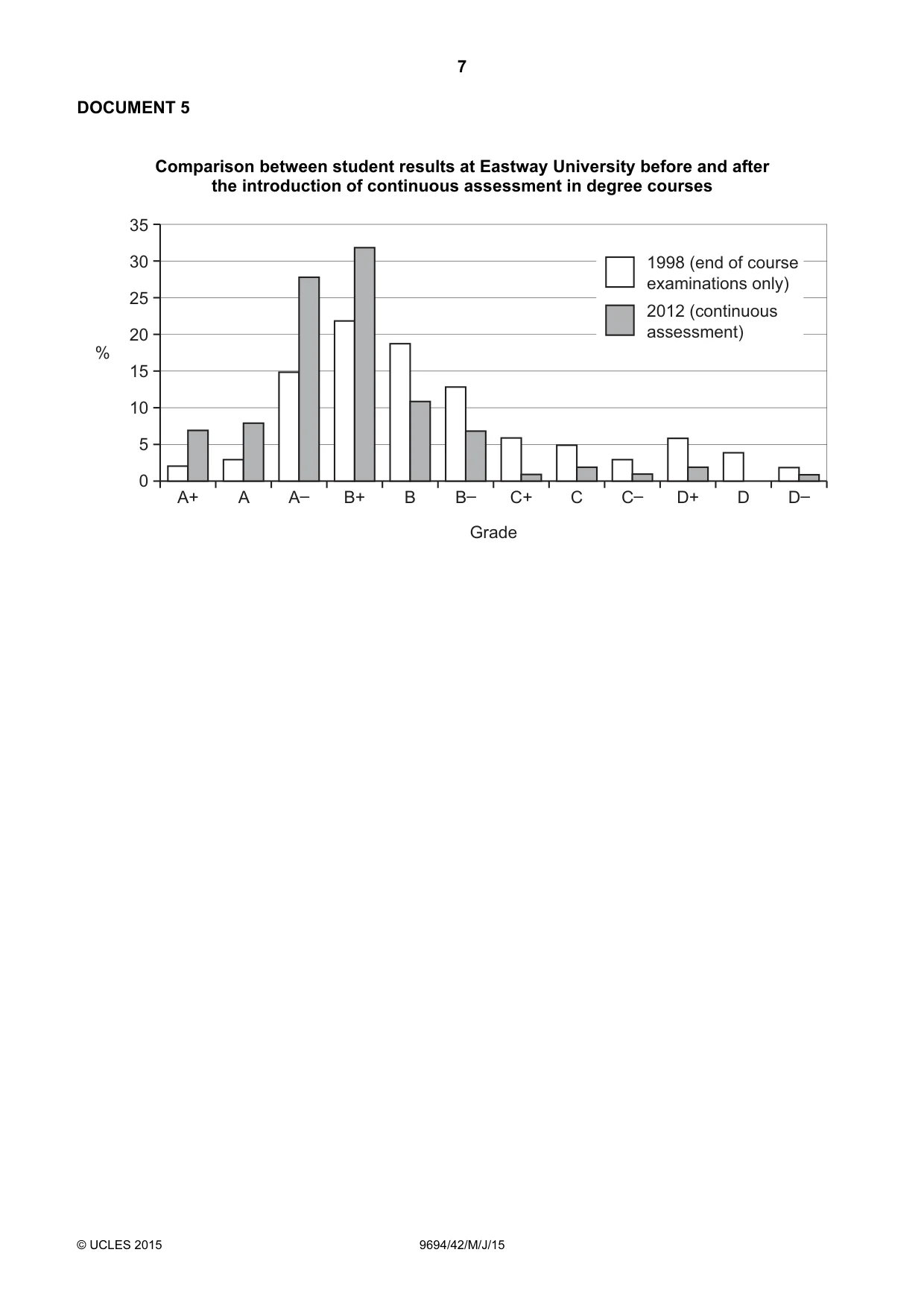
7 © UCLES 2015 9694/42/M/J/15 DOCUMENT 5 Comparison between student results at Eastway University before and after the introduction of continuous assessment in degree courses 35 30 25 20 15 10 5 0 % A+ A A– B+ B B– C+ C C– D+ D D– Grade 1998 (end of course examinations only) 2012 (continuous assessment)
Question paper, page 8
8 Permission to reproduce items where third-party owned material protected by copyright is included has been sought and cleared where possible. Every reasonable effort has been made by the publisher (UCLES) to trace copyright holders, but if any items requiring clearance have unwittingly been included, the publisher will be pleased to make amends at the earliest possible opportunity. To avoid the issue of disclosure of answer-related information to candidates, all copyright acknowledgements are reproduced online in the Cambridge International Examinations Copyright Acknowledgements Booklet. This is produced for each series of examinations and is freely available to download at www.cie.org.uk after the live examination series. Cambridge International Examinations is part of the Cambridge Assessment Group. Cambridge Assessment is the brand name of University of Cambridge Local Examinations Syndicate (UCLES), which is itself a department of the University of Cambridge. © UCLES 2015 9694/42/M/J/15 BLANK PAGE
Mark scheme, page 1
® IGCSE is the registered trademark of Cambridge International Examinations. CAMBRIDGE INTERNATIONAL EXAMINATIONS Cambridge International Advanced Level MARK SCHEME for the May/June 2015 series 9694 THINKING SKILLS 9694/42 Paper 4 (Applied Reasoning), maximum raw mark 50 This mark scheme is published as an aid to teachers and candidates, to indicate the requirements of the examination. It shows the basis on which Examiners were instructed to award marks. It does not indicate the details of the discussions that took place at an Examiners’ meeting before marking began, which would have considered the acceptability of alternative answers. Mark schemes should be read in conjunction with the question paper and the Principal Examiner Report for Teachers. Cambridge will not enter into discussions about these mark schemes. Cambridge is publishing the mark schemes for the May/June 2015 series for most Cambridge IGCSE®, Cambridge International A and AS Level components and some Cambridge O Level components.
Mark scheme, page 2
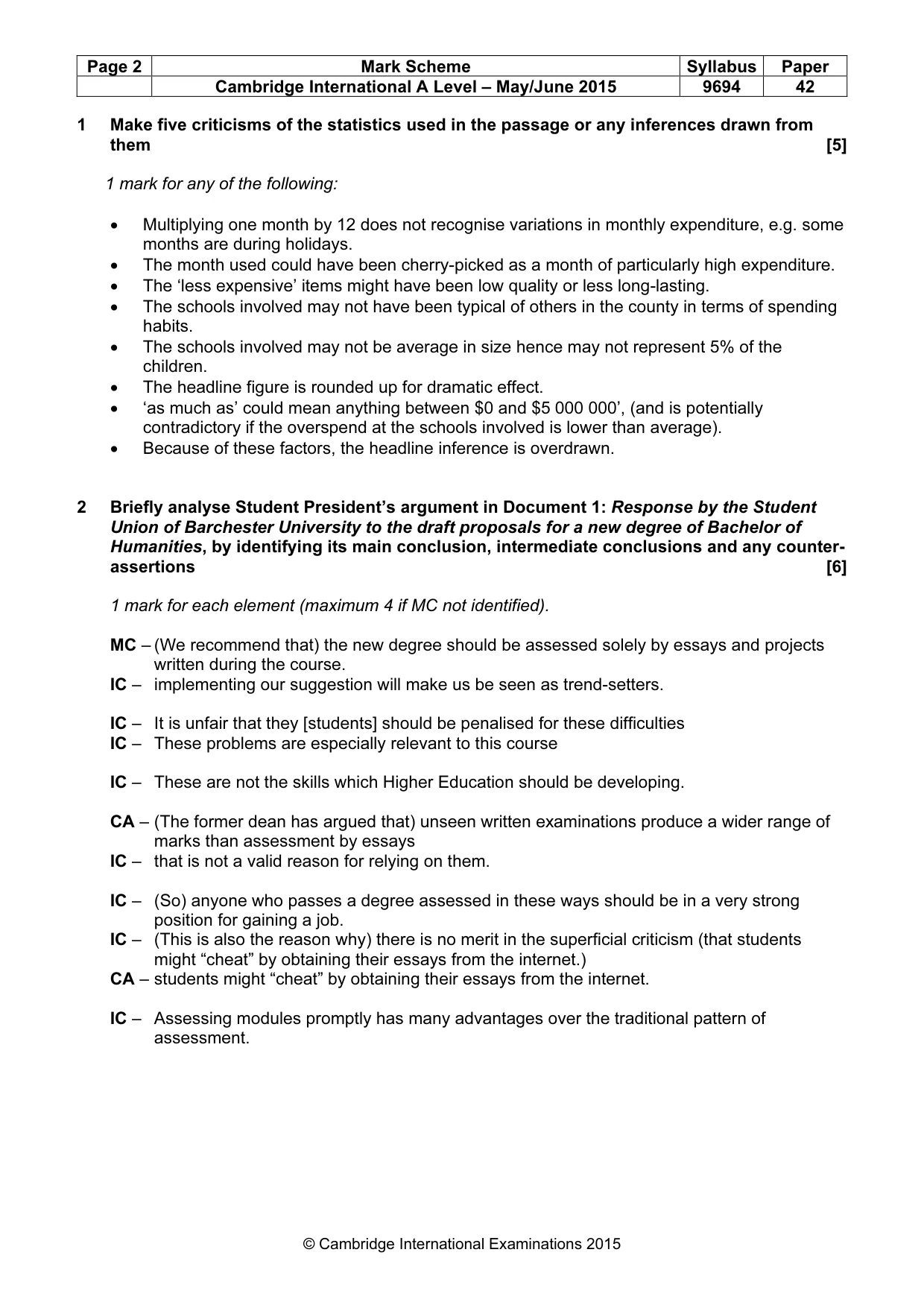
Page 2 Mark Scheme Syllabus Paper Cambridge International A Level – May/June 2015 9694 42 © Cambridge International Examinations 2015 1 Make five criticisms of the statistics used in the passage or any inferences drawn from them [5] 1 mark for any of the following: • Multiplying one month by 12 does not recognise variations in monthly expenditure, e.g. some months are during holidays. • The month used could have been cherry-picked as a month of particularly high expenditure. • The ‘less expensive’ items might have been low quality or less long-lasting. • The schools involved may not have been typical of others in the county in terms of spending habits. • The schools involved may not be average in size hence may not represent 5% of the children. • The headline figure is rounded up for dramatic effect. • ‘as much as’ could mean anything between $0 and $5 000 000’, (and is potentially contradictory if the overspend at the schools involved is lower than average). • Because of these factors, the headline inference is overdrawn. 2 Briefly analyse Student President’s argument in Document 1: Response by the Student Union of Barchester University to the draft proposals for a new degree of Bachelor of Humanities, by identifying its main conclusion, intermediate conclusions and any counter- assertions [6] 1 mark for each element (maximum 4 if MC not identified). MC – (We recommend that) the new degree should be assessed solely by essays and projects written during the course. IC – implementing our suggestion will make us be seen as trend-setters. IC – It is unfair that they [students] should be penalised for these difficulties IC – These problems are especially relevant to this course IC – These are not the skills which Higher Education should be developing. CA – (The former dean has argued that) unseen written examinations produce a wider range of marks than assessment by essays IC – that is not a valid reason for relying on them. IC – (So) anyone who passes a degree assessed in these ways should be in a very strong position for gaining a job. IC – (This is also the reason why) there is no merit in the superficial criticism (that students might “cheat” by obtaining their essays from the internet.) CA – students might “cheat” by obtaining their essays from the internet. IC – Assessing modules promptly has many advantages over the traditional pattern of assessment.
Mark scheme, page 3
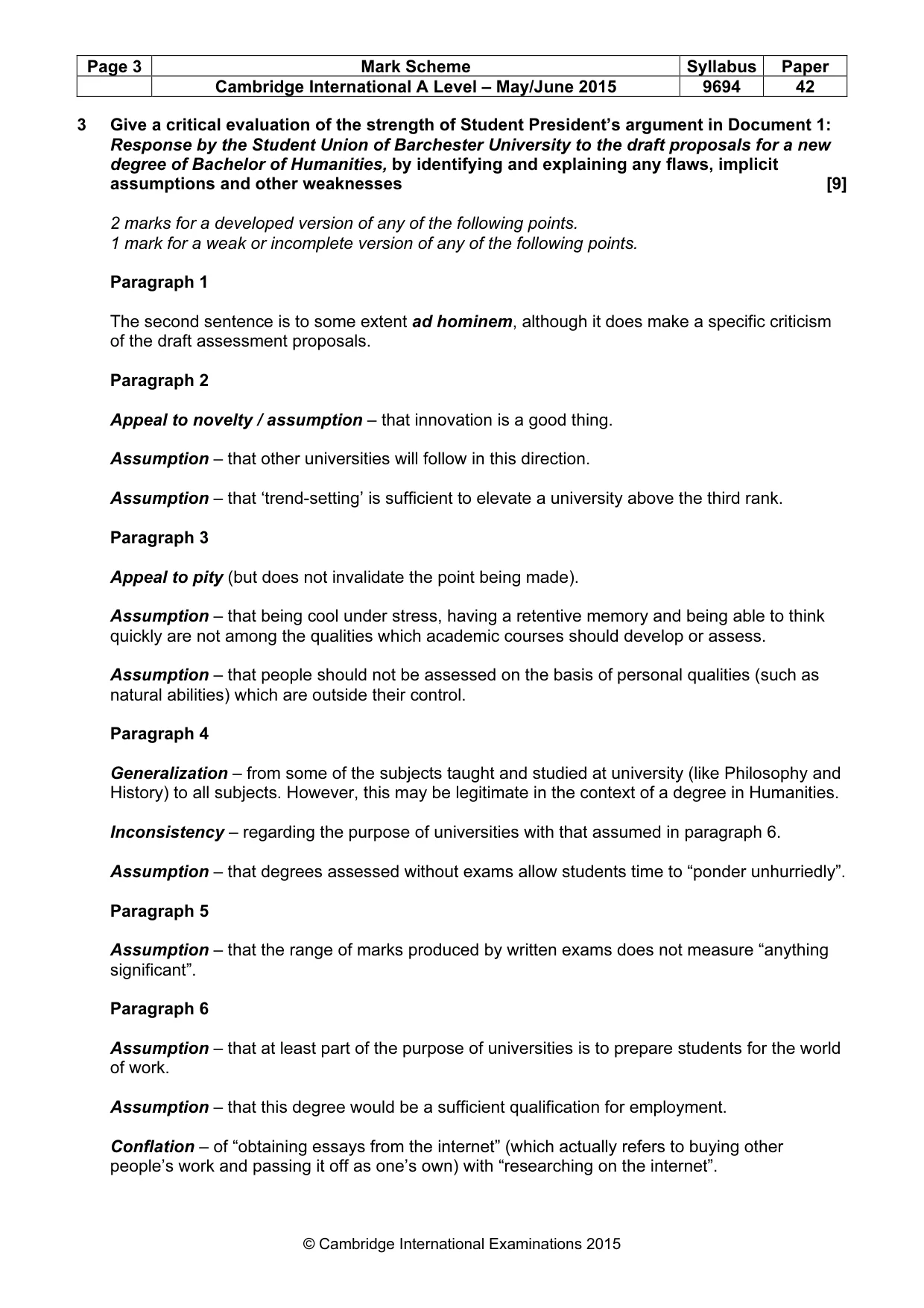
Page 3 Mark Scheme Syllabus Paper Cambridge International A Level – May/June 2015 9694 42 © Cambridge International Examinations 2015 3 Give a critical evaluation of the strength of Student President’s argument in Document 1: Response by the Student Union of Barchester University to the draft proposals for a new degree of Bachelor of Humanities, by identifying and explaining any flaws, implicit assumptions and other weaknesses [9] 2 marks for a developed version of any of the following points. 1 mark for a weak or incomplete version of any of the following points. Paragraph 1 The second sentence is to some extent ad hominem, although it does make a specific criticism of the draft assessment proposals. Paragraph 2 Appeal to novelty / assumption – that innovation is a good thing. Assumption – that other universities will follow in this direction. Assumption – that ‘trend-setting’ is sufficient to elevate a university above the third rank. Paragraph 3 Appeal to pity (but does not invalidate the point being made). Assumption – that being cool under stress, having a retentive memory and being able to think quickly are not among the qualities which academic courses should develop or assess. Assumption – that people should not be assessed on the basis of personal qualities (such as natural abilities) which are outside their control. Paragraph 4 Generalization – from some of the subjects taught and studied at university (like Philosophy and History) to all subjects. However, this may be legitimate in the context of a degree in Humanities. Inconsistency – regarding the purpose of universities with that assumed in paragraph 6. Assumption – that degrees assessed without exams allow students time to “ponder unhurriedly”. Paragraph 5 Assumption – that the range of marks produced by written exams does not measure “anything significant”. Paragraph 6 Assumption – that at least part of the purpose of universities is to prepare students for the world of work. Assumption – that this degree would be a sufficient qualification for employment. Conflation – of “obtaining essays from the internet” (which actually refers to buying other people’s work and passing it off as one’s own) with “researching on the internet”.
Mark scheme, page 4
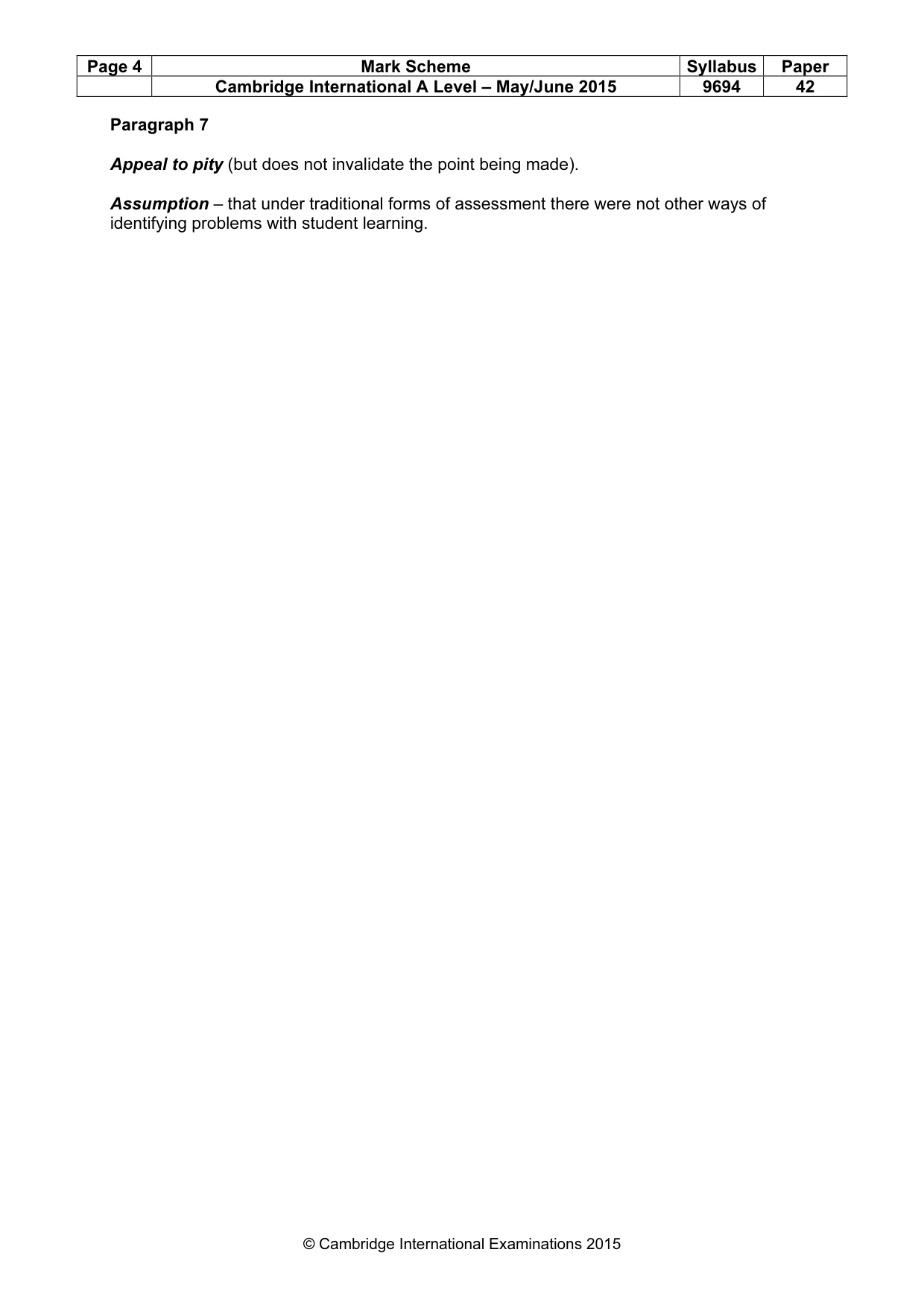
Page 4 Mark Scheme Syllabus Paper Cambridge International A Level – May/June 2015 9694 42 © Cambridge International Examinations 2015 Paragraph 7 Appeal to pity (but does not invalidate the point being made). Assumption – that under traditional forms of assessment there were not other ways of identifying problems with student learning.
Mark scheme, page 5
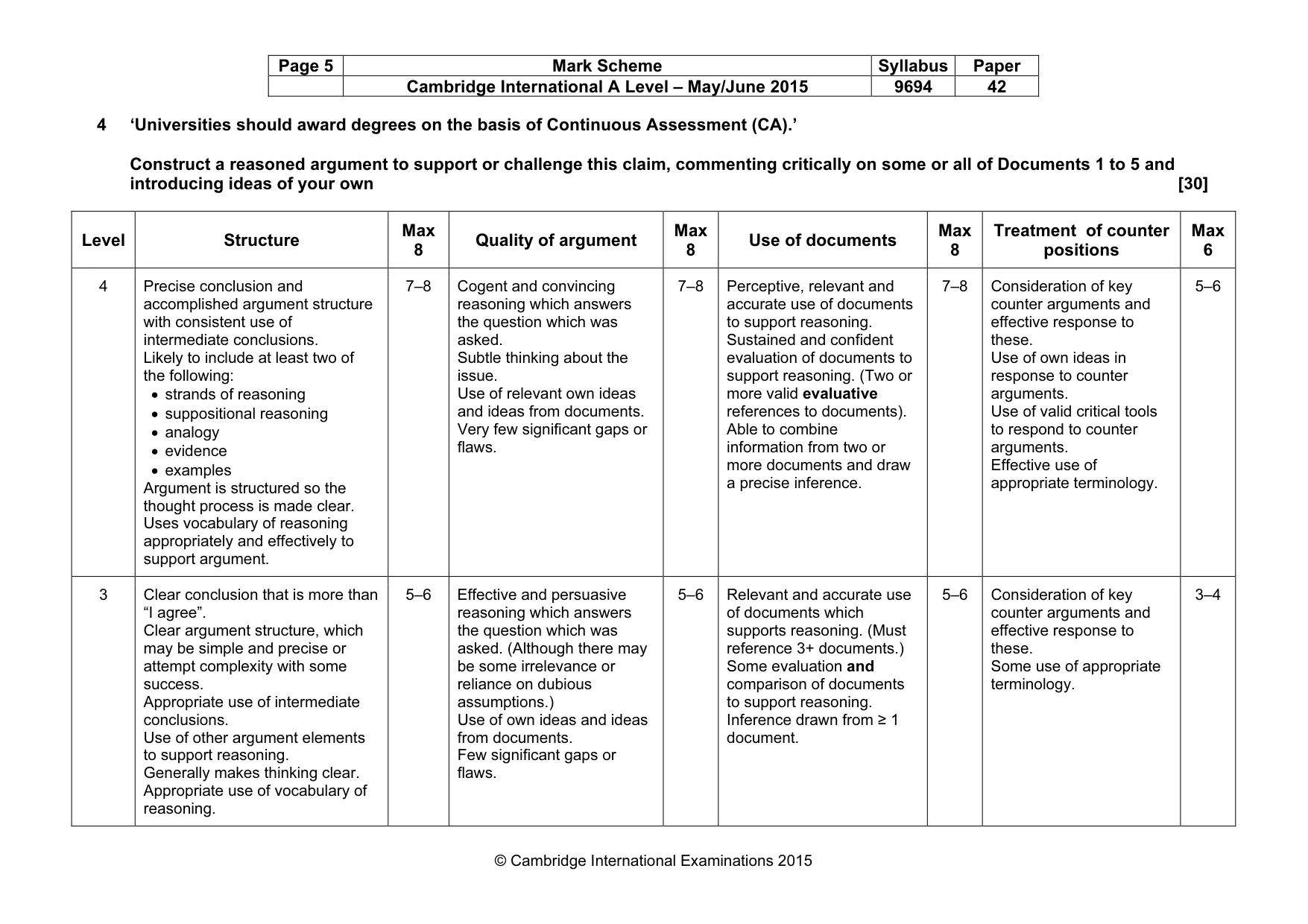
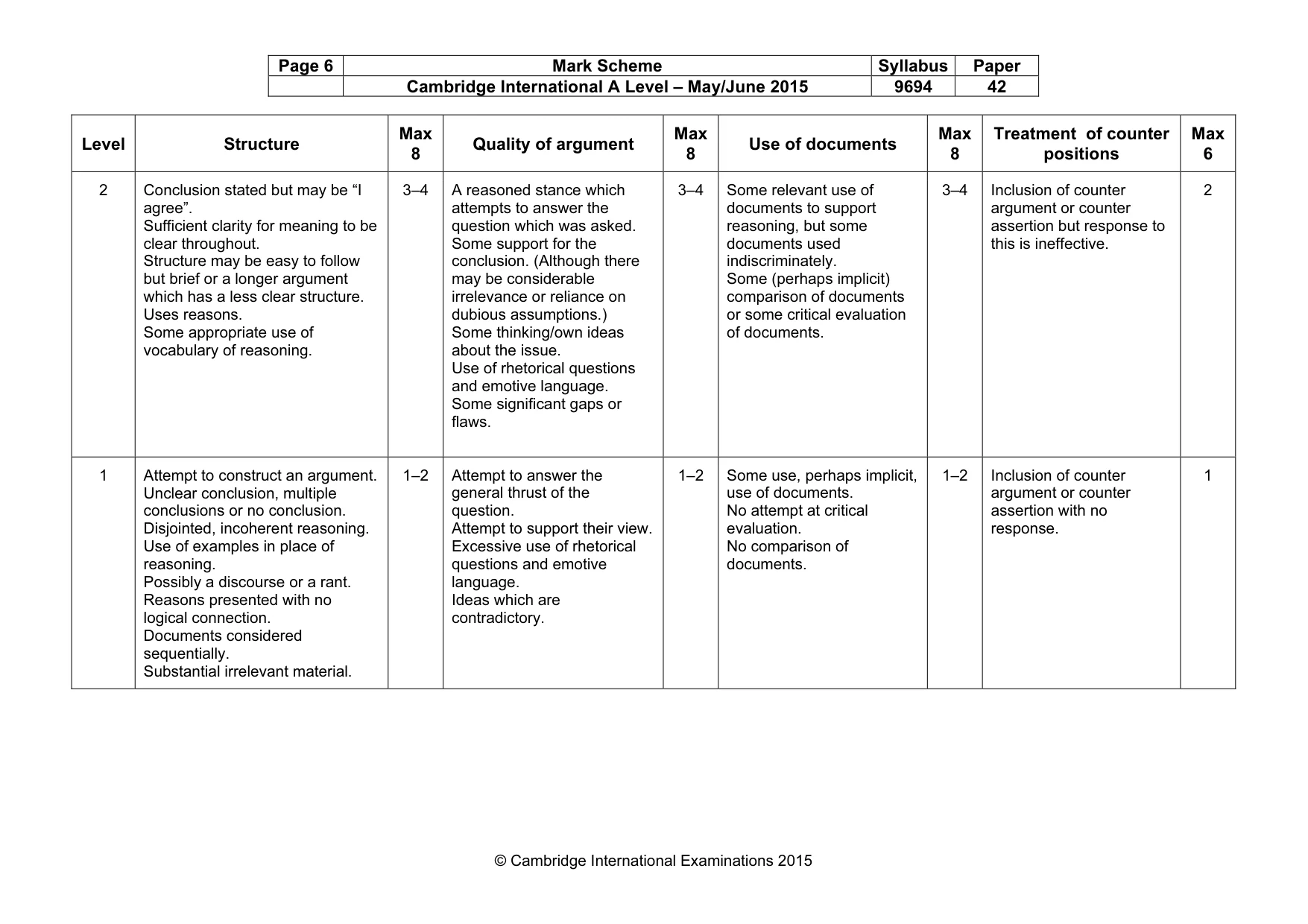
Page 5 Mark Scheme Syllabus Paper Cambridge International A Level – May/June 2015 9694 42 © Cambridge International Examinations 2015 4 ‘Universities should award degrees on the basis of Continuous Assessment (CA).’ Construct a reasoned argument to support or challenge this claim, commenting critically on some or all of Documents 1 to 5 and introducing ideas of your own [30] Level Structure Max 8 Quality of argument Max 8 Use of documents Max 8 Treatment of counter positions Max 6 4 Precise conclusion and accomplished argument structure with consistent use of intermediate conclusions. Likely to include at least two of the following: • strands of reasoning • suppositional reasoning • analogy • evidence • examples Argument is structured so the thought process is made clear. Uses vocabulary of reasoning appropriately and effectively to support argument. 7–8 Cogent and convincing reasoning which answers the question which was asked. Subtle thinking about the issue. Use of relevant own ideas and ideas from documents. Very few significant gaps or flaws. 7–8 Perceptive, relevant and accurate use of documents to support reasoning. Sustained and confident evaluation of documents to support reasoning. (Two or more valid evaluative references to documents). Able to combine information from two or more documents and draw a precise inference. 7–8 Consideration of key counter arguments and effective response to these. Use of own ideas in response to counter arguments. Use of valid critical tools to respond to counter arguments. Effective use of appropriate terminology. 5–6 3 Clear conclusion that is more than “I agree”. Clear argument structure, which may be simple and precise or attempt complexity with some success. Appropriate use of intermediate conclusions. Use of other argument elements to support reasoning. Generally makes thinking clear. Appropriate use of vocabulary of reasoning. 5–6 Effective and persuasive reasoning which answers the question which was asked. (Although there may be some irrelevance or reliance on dubious assumptions.) Use of own ideas and ideas from documents. Few significant gaps or flaws. 5–6 Relevant and accurate use of documents which supports reasoning. (Must reference 3+ documents.) Some evaluation and comparison of documents to support reasoning. Inference drawn from ≥ 1 document. 5–6 Consideration of key counter arguments and effective response to these. Some use of appropriate terminology. 3–4
Mark scheme, page 6
Page 6 Mark Scheme Syllabus Paper Cambridge International A Level – May/June 2015 9694 42 © Cambridge International Examinations 2015 Level Structure Max 8 Quality of argument Max 8 Use of documents Max 8 Treatment of counter positions Max 6 2 Conclusion stated but may be “I agree”. Sufficient clarity for meaning to be clear throughout. Structure may be easy to follow but brief or a longer argument which has a less clear structure. Uses reasons. Some appropriate use of vocabulary of reasoning. 3–4 A reasoned stance which attempts to answer the question which was asked. Some support for the conclusion. (Although there may be considerable irrelevance or reliance on dubious assumptions.) Some thinking/own ideas about the issue. Use of rhetorical questions and emotive language. Some significant gaps or flaws. 3–4 Some relevant use of documents to support reasoning, but some documents used indiscriminately. Some (perhaps implicit) comparison of documents or some critical evaluation of documents. 3–4 Inclusion of counter argument or counter assertion but response to this is ineffective. 2 1 Attempt to construct an argument. Unclear conclusion, multiple conclusions or no conclusion. Disjointed, incoherent reasoning. Use of examples in place of reasoning. Possibly a discourse or a rant. Reasons presented with no logical connection. Documents considered sequentially. Substantial irrelevant material. 1–2 Attempt to answer the general thrust of the question. Attempt to support their view. Excessive use of rhetorical questions and emotive language. Ideas which are contradictory. 1–2 Some use, perhaps implicit, use of documents. No attempt at critical evaluation. No comparison of documents. 1–2 Inclusion of counter argument or counter assertion with no response. 1
Mark scheme, page 7
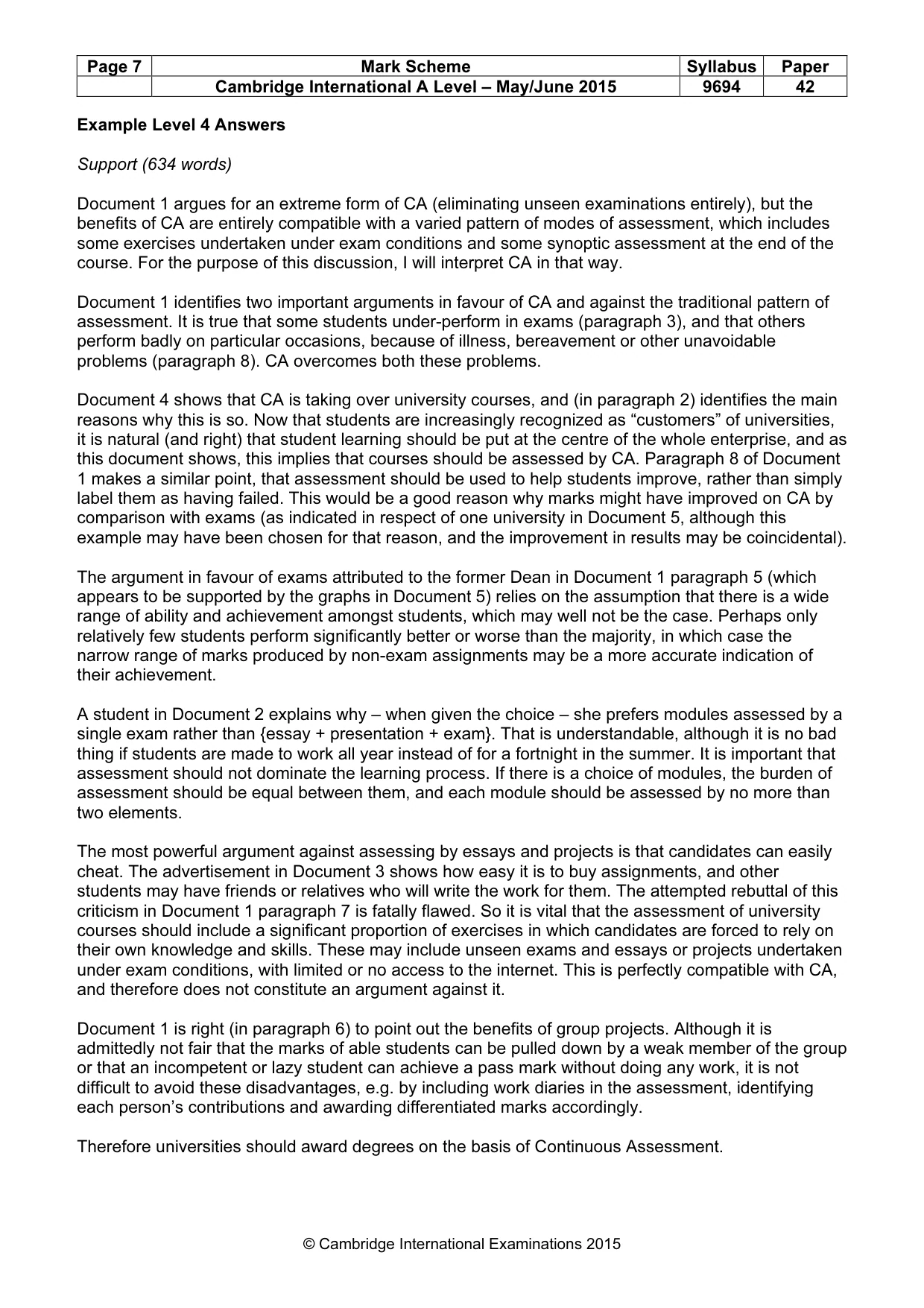
Page 7 Mark Scheme Syllabus Paper Cambridge International A Level – May/June 2015 9694 42 © Cambridge International Examinations 2015 Example Level 4 Answers Support (634 words) Document 1 argues for an extreme form of CA (eliminating unseen examinations entirely), but the benefits of CA are entirely compatible with a varied pattern of modes of assessment, which includes some exercises undertaken under exam conditions and some synoptic assessment at the end of the course. For the purpose of this discussion, I will interpret CA in that way. Document 1 identifies two important arguments in favour of CA and against the traditional pattern of assessment. It is true that some students under-perform in exams (paragraph 3), and that others perform badly on particular occasions, because of illness, bereavement or other unavoidable problems (paragraph 8). CA overcomes both these problems. Document 4 shows that CA is taking over university courses, and (in paragraph 2) identifies the main reasons why this is so. Now that students are increasingly recognized as “customers” of universities, it is natural (and right) that student learning should be put at the centre of the whole enterprise, and as this document shows, this implies that courses should be assessed by CA. Paragraph 8 of Document 1 makes a similar point, that assessment should be used to help students improve, rather than simply label them as having failed. This would be a good reason why marks might have improved on CA by comparison with exams (as indicated in respect of one university in Document 5, although this example may have been chosen for that reason, and the improvement in results may be coincidental). The argument in favour of exams attributed to the former Dean in Document 1 paragraph 5 (which appears to be supported by the graphs in Document 5) relies on the assumption that there is a wide range of ability and achievement amongst students, which may well not be the case. Perhaps only relatively few students perform significantly better or worse than the majority, in which case the narrow range of marks produced by non-exam assignments may be a more accurate indication of their achievement. A student in Document 2 explains why – when given the choice – she prefers modules assessed by a single exam rather than {essay + presentation + exam}. That is understandable, although it is no bad thing if students are made to work all year instead of for a fortnight in the summer. It is important that assessment should not dominate the learning process. If there is a choice of modules, the burden of assessment should be equal between them, and each module should be assessed by no more than two elements. The most powerful argument against assessing by essays and projects is that candidates can easily cheat. The advertisement in Document 3 shows how easy it is to buy assignments, and other students may have friends or relatives who will write the work for them. The attempted rebuttal of this criticism in Document 1 paragraph 7 is fatally flawed. So it is vital that the assessment of university courses should include a significant proportion of exercises in which candidates are forced to rely on their own knowledge and skills. These may include unseen exams and essays or projects undertaken under exam conditions, with limited or no access to the internet. This is perfectly compatible with CA, and therefore does not constitute an argument against it. Document 1 is right (in paragraph 6) to point out the benefits of group projects. Although it is admittedly not fair that the marks of able students can be pulled down by a weak member of the group or that an incompetent or lazy student can achieve a pass mark without doing any work, it is not difficult to avoid these disadvantages, e.g. by including work diaries in the assessment, identifying each person’s contributions and awarding differentiated marks accordingly. Therefore universities should award degrees on the basis of Continuous Assessment.
Mark scheme, page 8
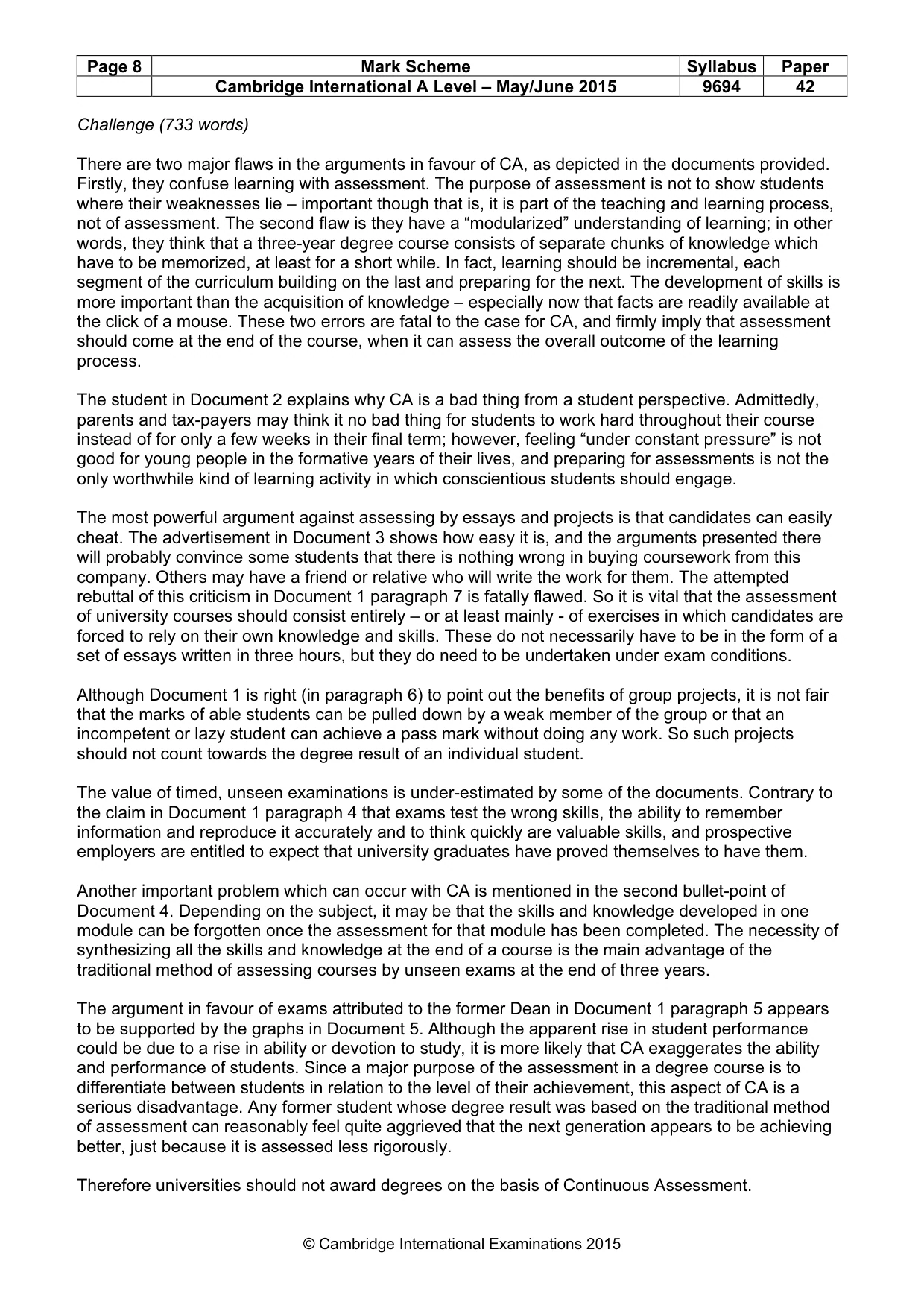
Page 8 Mark Scheme Syllabus Paper Cambridge International A Level – May/June 2015 9694 42 © Cambridge International Examinations 2015 Challenge (733 words) There are two major flaws in the arguments in favour of CA, as depicted in the documents provided. Firstly, they confuse learning with assessment. The purpose of assessment is not to show students where their weaknesses lie – important though that is, it is part of the teaching and learning process, not of assessment. The second flaw is they have a “modularized” understanding of learning; in other words, they think that a three-year degree course consists of separate chunks of knowledge which have to be memorized, at least for a short while. In fact, learning should be incremental, each segment of the curriculum building on the last and preparing for the next. The development of skills is more important than the acquisition of knowledge – especially now that facts are readily available at the click of a mouse. These two errors are fatal to the case for CA, and firmly imply that assessment should come at the end of the course, when it can assess the overall outcome of the learning process. The student in Document 2 explains why CA is a bad thing from a student perspective. Admittedly, parents and tax-payers may think it no bad thing for students to work hard throughout their course instead of for only a few weeks in their final term; however, feeling “under constant pressure” is not good for young people in the formative years of their lives, and preparing for assessments is not the only worthwhile kind of learning activity in which conscientious students should engage. The most powerful argument against assessing by essays and projects is that candidates can easily cheat. The advertisement in Document 3 shows how easy it is, and the arguments presented there will probably convince some students that there is nothing wrong in buying coursework from this company. Others may have a friend or relative who will write the work for them. The attempted rebuttal of this criticism in Document 1 paragraph 7 is fatally flawed. So it is vital that the assessment of university courses should consist entirely – or at least mainly - of exercises in which candidates are forced to rely on their own knowledge and skills. These do not necessarily have to be in the form of a set of essays written in three hours, but they do need to be undertaken under exam conditions. Although Document 1 is right (in paragraph 6) to point out the benefits of group projects, it is not fair that the marks of able students can be pulled down by a weak member of the group or that an incompetent or lazy student can achieve a pass mark without doing any work. So such projects should not count towards the degree result of an individual student. The value of timed, unseen examinations is under-estimated by some of the documents. Contrary to the claim in Document 1 paragraph 4 that exams test the wrong skills, the ability to remember information and reproduce it accurately and to think quickly are valuable skills, and prospective employers are entitled to expect that university graduates have proved themselves to have them. Another important problem which can occur with CA is mentioned in the second bullet-point of Document 4. Depending on the subject, it may be that the skills and knowledge developed in one module can be forgotten once the assessment for that module has been completed. The necessity of synthesizing all the skills and knowledge at the end of a course is the main advantage of the traditional method of assessing courses by unseen exams at the end of three years. The argument in favour of exams attributed to the former Dean in Document 1 paragraph 5 appears to be supported by the graphs in Document 5. Although the apparent rise in student performance could be due to a rise in ability or devotion to study, it is more likely that CA exaggerates the ability and performance of students. Since a major purpose of the assessment in a degree course is to differentiate between students in relation to the level of their achievement, this aspect of CA is a serious disadvantage. Any former student whose degree result was based on the traditional method of assessment can reasonably feel quite aggrieved that the next generation appears to be achieving better, just because it is assessed less rigorously. Therefore universities should not award degrees on the basis of Continuous Assessment.
What you needed in this session
Cambridge’s own grade thresholds for 2015 May/June, Paper 4 · Variant 2. A higher threshold means an easier paper — the bar moves with how the cohort did.