Cambridge A Level Thinking Skills 9694 — 2012 May/June Paper 2 · Variant 3
9694/23/M/J/12 · 45 marks · ≈51 min
The question paper and its mark scheme, free to read here and free to download. This is Cambridge’s own paper, exactly as it was sat.
Question paper8 pages



Mark scheme8 pages
Answers below. Sit the paper first if you are practising.
Paper as text
Question paper, page 1
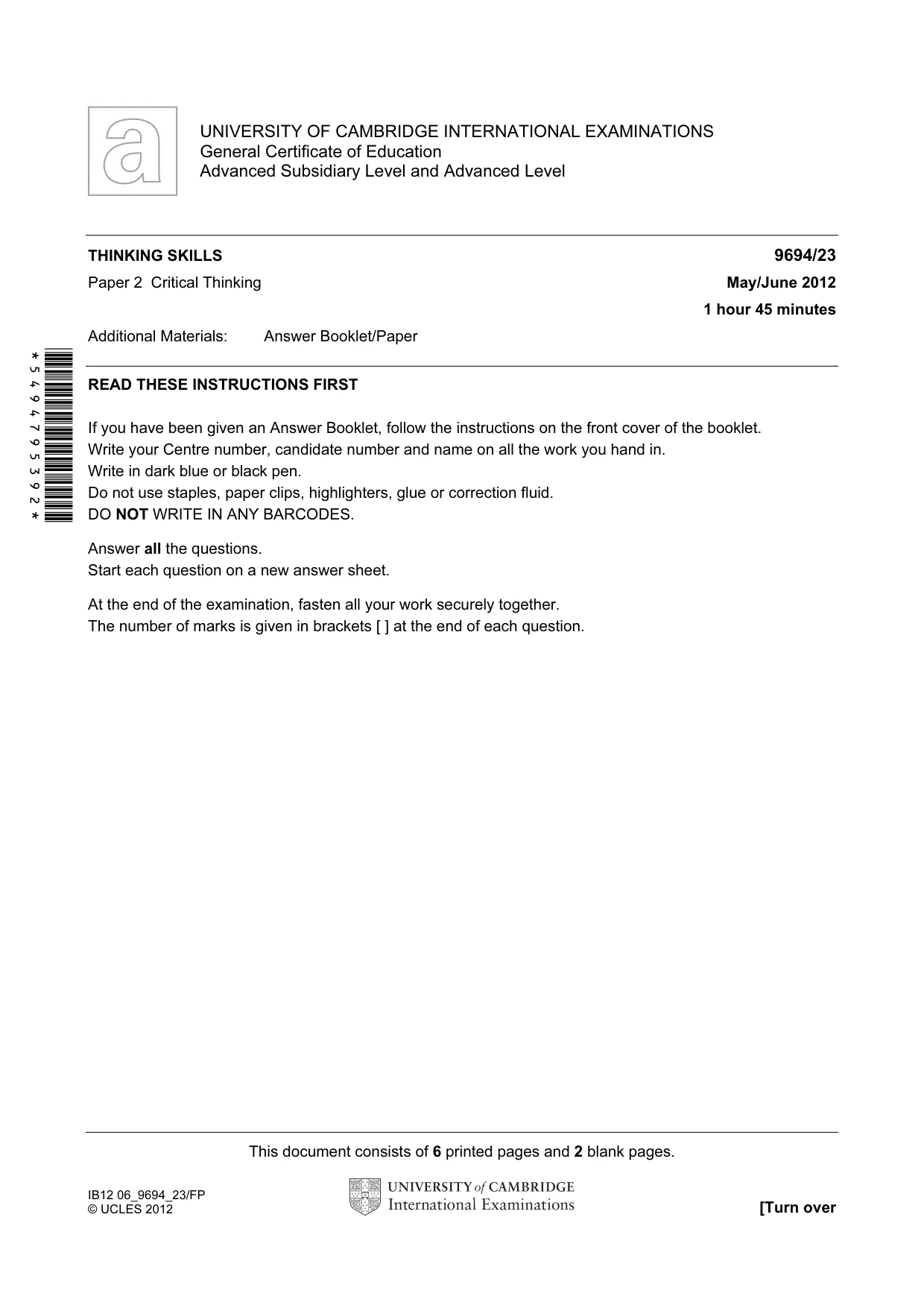
This document consists of 6 printed pages and 2 blank pages. IB12 06_9694_23/FP © UCLES 2012 [Turn over *5494795392* UNIVERSITY OF CAMBRIDGE INTERNATIONAL EXAMINATIONS General Certificate of Education Advanced Subsidiary Level and Advanced Level THINKING SKILLS 9694/23 Paper 2 Critical Thinking May/June 2012 1 hour 45 minutes Additional Materials: Answer Booklet/Paper READ THESE INSTRUCTIONS FIRST If you have been given an Answer Booklet, follow the instructions on the front cover of the booklet. Write your Centre number, candidate number and name on all the work you hand in. Write in dark blue or black pen. Do not use staples, paper clips, highlighters, glue or correction fluid. DO NOT WRITE IN ANY BARCODES. Answer all the questions. Start each question on a new answer sheet. At the end of the examination, fasten all your work securely together. The number of marks is given in brackets [ ] at the end of each question.
Question paper, page 2
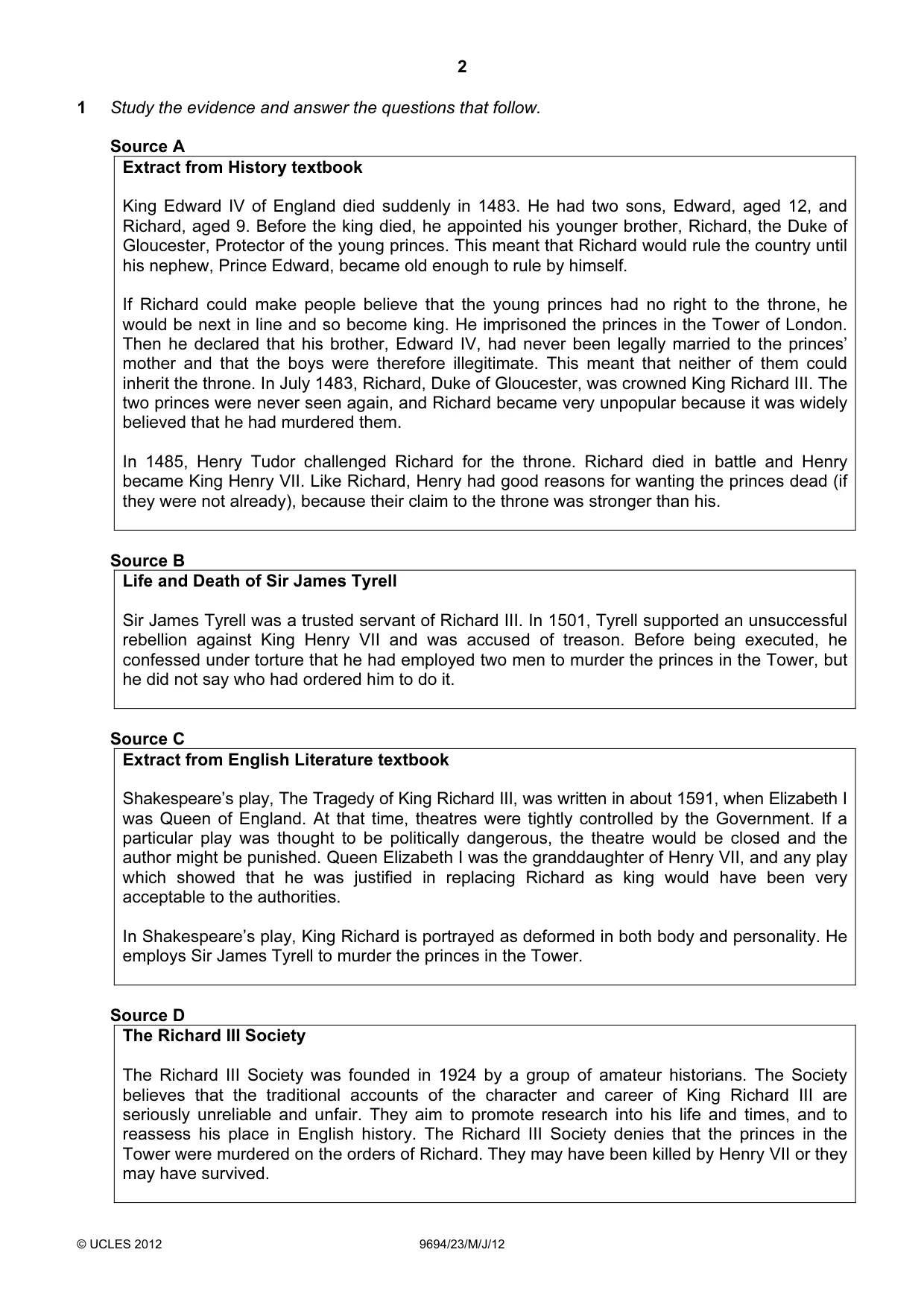
2 © UCLES 2012 9694/23/M/J/12 1 Study the evidence and answer the questions that follow. Source A Extract from History textbook King Edward IV of England died suddenly in 1483. He had two sons, Edward, aged 12, and Richard, aged 9. Before the king died, he appointed his younger brother, Richard, the Duke of Gloucester, Protector of the young princes. This meant that Richard would rule the country until his nephew, Prince Edward, became old enough to rule by himself. If Richard could make people believe that the young princes had no right to the throne, he would be next in line and so become king. He imprisoned the princes in the Tower of London. Then he declared that his brother, Edward IV, had never been legally married to the princes’ mother and that the boys were therefore illegitimate. This meant that neither of them could inherit the throne. In July 1483, Richard, Duke of Gloucester, was crowned King Richard III. The two princes were never seen again, and Richard became very unpopular because it was widely believed that he had murdered them. In 1485, Henry Tudor challenged Richard for the throne. Richard died in battle and Henry became King Henry VII. Like Richard, Henry had good reasons for wanting the princes dead (if they were not already), because their claim to the throne was stronger than his. Source B Life and Death of Sir James Tyrell Sir James Tyrell was a trusted servant of Richard III. In 1501, Tyrell supported an unsuccessful rebellion against King Henry VII and was accused of treason. Before being executed, he confessed under torture that he had employed two men to murder the princes in the Tower, but he did not say who had ordered him to do it. Source C Extract from English Literature textbook Shakespeare’s play, The Tragedy of King Richard III, was written in about 1591, when Elizabeth I was Queen of England. At that time, theatres were tightly controlled by the Government. If a particular play was thought to be politically dangerous, the theatre would be closed and the author might be punished. Queen Elizabeth I was the granddaughter of Henry VII, and any play which showed that he was justified in replacing Richard as king would have been very acceptable to the authorities. In Shakespeare’s play, King Richard is portrayed as deformed in both body and personality. He employs Sir James Tyrell to murder the princes in the Tower. Source D The Richard III Society The Richard III Society was founded in 1924 by a group of amateur historians. The Society believes that the traditional accounts of the character and career of King Richard III are seriously unreliable and unfair. They aim to promote research into his life and times, and to reassess his place in English history. The Richard III Society denies that the princes in the Tower were murdered on the orders of Richard. They may have been killed by Henry VII or they may have survived.
Question paper, page 3
3 © UCLES 2012 9694/23/M/J/12 [Turn over (a) How reliable is Tyrell’s evidence (Source B) in discovering whether the princes in the Tower were murdered? [3] (b) How useful are the views of the Richard III Society in Source D in discovering whether Richard ordered the murder of the princes in the Tower? [3] (c) In 1674, builders repairing the Tower of London discovered the skeletons of two children under a staircase. On the orders of King Charles II, they were re-buried in Westminster Abbey. How significant is this discovery in deciding whether the princes were murdered? [3] (d) How do you think the two princes died? Write a short, reasoned argument to support your conclusion, with critical reference to the evidence provided and with consideration of any plausible alternative scenarios. [6]
Question paper, page 4
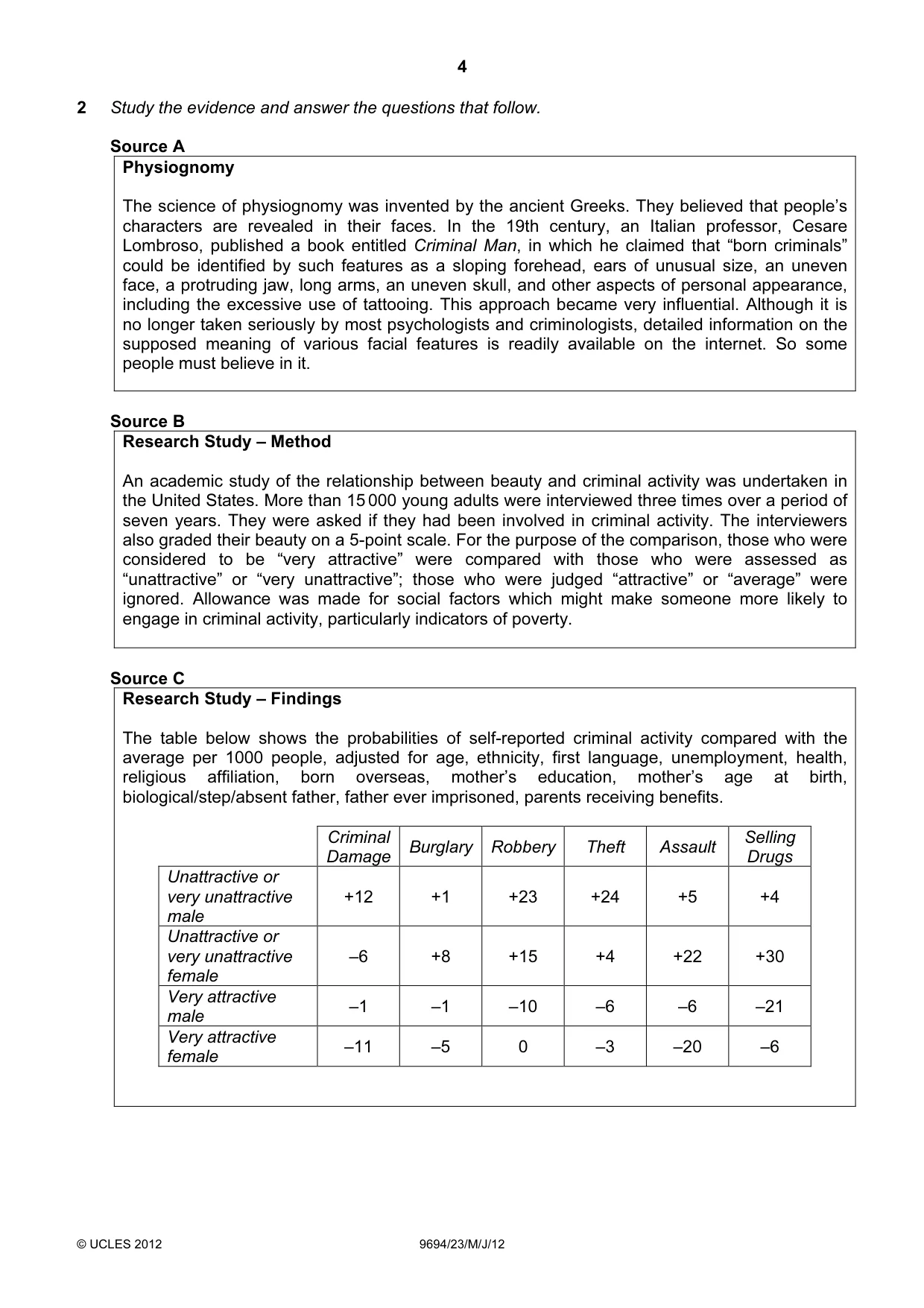
4 © UCLES 2012 9694/23/M/J/12 2 Study the evidence and answer the questions that follow. Source A Physiognomy The science of physiognomy was invented by the ancient Greeks. They believed that people’s characters are revealed in their faces. In the 19th century, an Italian professor, Cesare Lombroso, published a book entitled Criminal Man, in which he claimed that “born criminals” could be identified by such features as a sloping forehead, ears of unusual size, an uneven face, a protruding jaw, long arms, an uneven skull, and other aspects of personal appearance, including the excessive use of tattooing. This approach became very influential. Although it is no longer taken seriously by most psychologists and criminologists, detailed information on the supposed meaning of various facial features is readily available on the internet. So some people must believe in it. Source B Research Study – Method An academic study of the relationship between beauty and criminal activity was undertaken in the United States. More than 15 000 young adults were interviewed three times over a period of seven years. They were asked if they had been involved in criminal activity. The interviewers also graded their beauty on a 5-point scale. For the purpose of the comparison, those who were considered to be “very attractive” were compared with those who were assessed as “unattractive” or “very unattractive”; those who were judged “attractive” or “average” were ignored. Allowance was made for social factors which might make someone more likely to engage in criminal activity, particularly indicators of poverty. Source C Research Study – Findings The table below shows the probabilities of self-reported criminal activity compared with the average per 1000 people, adjusted for age, ethnicity, first language, unemployment, health, religious affiliation, born overseas, mother’s education, mother’s age at birth, biological/step/absent father, father ever imprisoned, parents receiving benefits. Criminal Damage Burglary Robbery Theft Assault Selling Drugs Unattractive or very unattractive male +12 +1 +23 +24 +5 +4 Unattractive or very unattractive female –6 +8 +15 +4 +22 +30 Very attractive male –1 –1 –10 –6 –6 –21 Very attractive female –11 –5 0 –3 –20 –6
Question paper, page 5
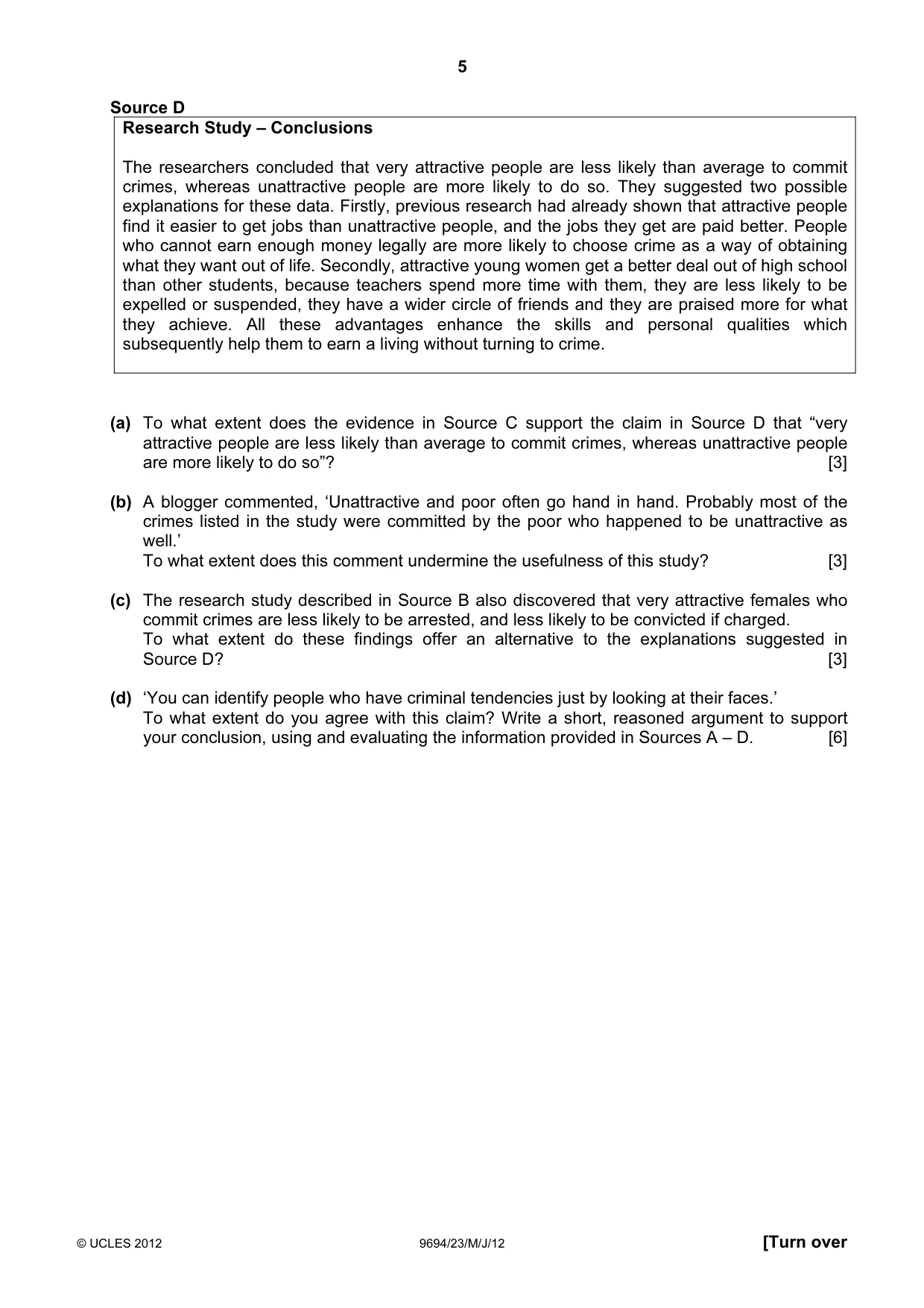
5 © UCLES 2012 9694/23/M/J/12 [Turn over Source D Research Study – Conclusions The researchers concluded that very attractive people are less likely than average to commit crimes, whereas unattractive people are more likely to do so. They suggested two possible explanations for these data. Firstly, previous research had already shown that attractive people find it easier to get jobs than unattractive people, and the jobs they get are paid better. People who cannot earn enough money legally are more likely to choose crime as a way of obtaining what they want out of life. Secondly, attractive young women get a better deal out of high school than other students, because teachers spend more time with them, they are less likely to be expelled or suspended, they have a wider circle of friends and they are praised more for what they achieve. All these advantages enhance the skills and personal qualities which subsequently help them to earn a living without turning to crime. (a) To what extent does the evidence in Source C support the claim in Source D that “very attractive people are less likely than average to commit crimes, whereas unattractive people are more likely to do so”? [3] (b) A blogger commented, ‘Unattractive and poor often go hand in hand. Probably most of the crimes listed in the study were committed by the poor who happened to be unattractive as well.’ To what extent does this comment undermine the usefulness of this study? [3] (c) The research study described in Source B also discovered that very attractive females who commit crimes are less likely to be arrested, and less likely to be convicted if charged. To what extent do these findings offer an alternative to the explanations suggested in Source D? [3] (d) ‘You can identify people who have criminal tendencies just by looking at their faces.’ To what extent do you agree with this claim? Write a short, reasoned argument to support your conclusion, using and evaluating the information provided in Sources A – D. [6]
Question paper, page 6
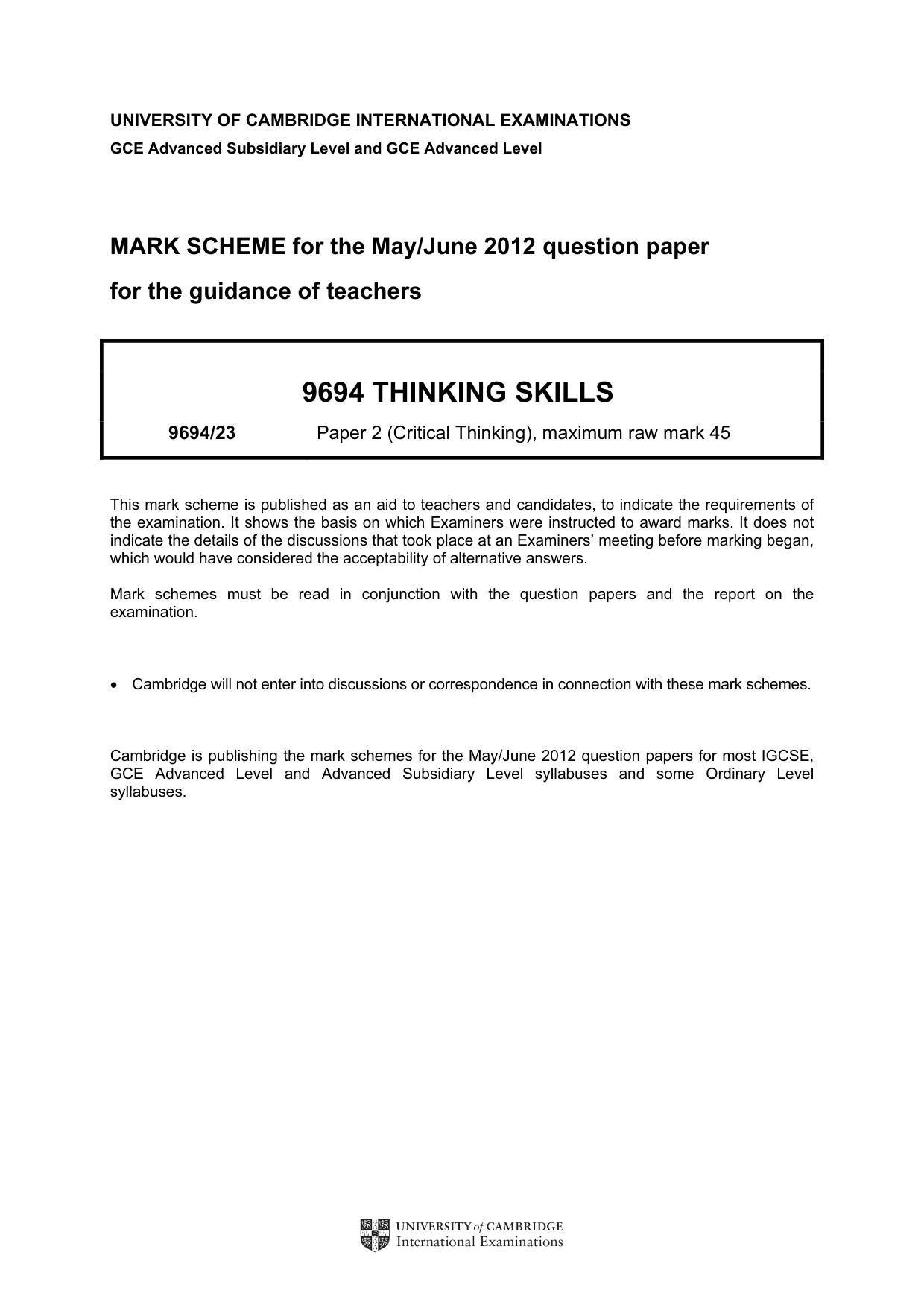
6 © UCLES 2012 9694/23/M/J/12 3 Read the passage and answer the questions below. 1 We need urgently to develop ways of punishing criminals apart from sending them to prison. Law- breakers have already cost the country money through their dishonest deeds, but it then costs us even more to punish them. This is ridiculous and unfair, and in today’s economic climate we cannot afford to continue with it. 2 Prison did not originate as a punishment. In ancient times, the main punishment for criminals was death, and prison was simply a safe place to keep them as they awaited execution. 3 Depriving criminals of their liberty fails to compensate victims or society. Instead of adding a further burden to public expenditure, as they do under the present system, criminals should be made to repay society for the harm they have done. They could do the kinds of socially valuable work which no one can afford to pay for, such as collecting litter and sweeping the streets. If they were made to wear a distinctive uniform (such as a bright pink jacket emblazoned with the word “Offender”) while doing this community work, they would be exposed to the contempt and insults of passers-by, which in many cases might help them to realise the consequences of their misdeeds and motivate them to obey the law in future. 4 Recent studies have shown that a high proportion of prisoners in the UK suffer from mental illness. They therefore need to be treated instead of punished. 5 It does not matter if criminals are harmed by their punishment – in fact, that is the whole point of punishment – but the harm inflicted by prison is long-term and counter-productive. No one would seriously argue that criminals should be punished by being prevented from ever again working for their living, by developing a mental illness, by their wife or partner leaving them and forming a new relationship, or by losing contact with their children. Yet there is abundant statistical and anecdotal evidence that these are the typical consequences of serving a lengthy term of imprisonment. Rather than motivating and equipping criminals to become productive and responsible members of society, prison ensures that they will never do so. 6 Another problem with prison is that it punishes the wrong people. Wives or partners and children of prisoners suffer more than the prisoners themselves. If you are in prison, you do not lie awake worrying about how to pay the rent or where the next meal is coming from, but your partner probably does. (a) Using the exact words from the passage as far as possible, identify the main conclusion. [2] (b) Using the exact words from the passage as far as possible, identify three reasons used to support the main conclusion. [3] (c) Evaluate the reasoning in the argument. In your answer you should consider any strengths, weaknesses, flaws and unstated assumptions. [5] (d) ‘The punishment for crime should be so severe that people will not risk it.’ Write your own argument to support or challenge this claim. The conclusion of your argument must be stated. [5]
Question paper, page 7
7 © UCLES 2012 9694/23/M/J/12 BLANK PAGE
Question paper, page 8
8 Permission to reproduce items where third-party owned material protected by copyright is included has been sought and cleared where possible. Every reasonable effort has been made by the publisher (UCLES) to trace copyright holders, but if any items requiring clearance have unwittingly been included, the publisher will be pleased to make amends at the earliest possible opportunity. University of Cambridge International Examinations is part of the Cambridge Assessment Group. Cambridge Assessment is the brand name of University of Cambridge Local Examinations Syndicate (UCLES), which is itself a department of the University of Cambridge. © UCLES 2012 9694/23/M/J/12 BLANK PAGE
Mark scheme, page 1
UNIVERSITY OF CAMBRIDGE INTERNATIONAL EXAMINATIONS GCE Advanced Subsidiary Level and GCE Advanced Level MARK SCHEME for the May/June 2012 question paper for the guidance of teachers 9694 THINKING SKILLS 9694/23 Paper 2 (Critical Thinking), maximum raw mark 45 This mark scheme is published as an aid to teachers and candidates, to indicate the requirements of the examination. It shows the basis on which Examiners were instructed to award marks. It does not indicate the details of the discussions that took place at an Examiners’ meeting before marking began, which would have considered the acceptability of alternative answers. Mark schemes must be read in conjunction with the question papers and the report on the examination. • Cambridge will not enter into discussions or correspondence in connection with these mark schemes. Cambridge is publishing the mark schemes for the May/June 2012 question papers for most IGCSE, GCE Advanced Level and Advanced Subsidiary Level syllabuses and some Ordinary Level syllabuses.
Mark scheme, page 2
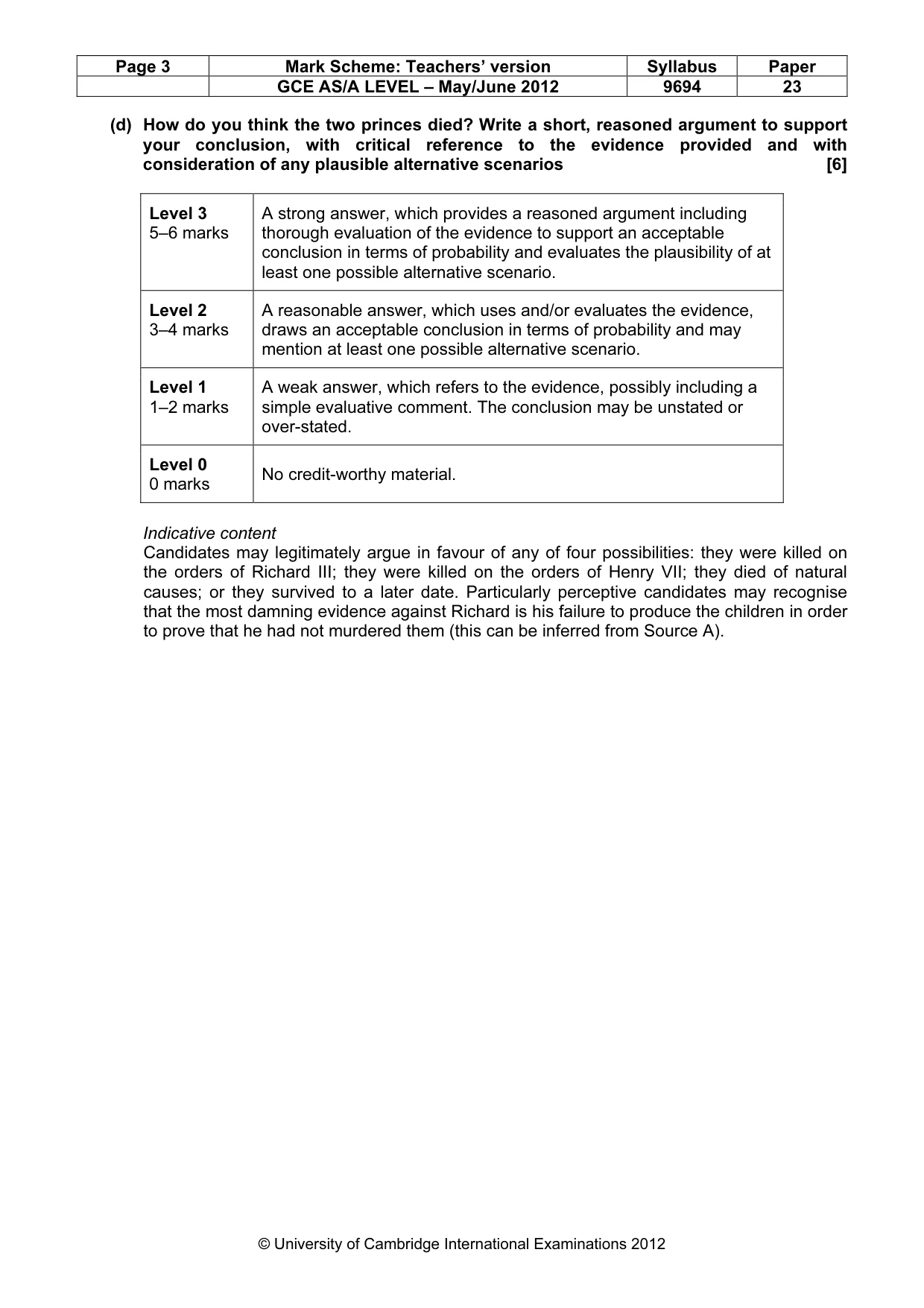
Page 2 Mark Scheme: Teachers’ version Syllabus Paper GCE AS/A LEVEL – May/June 2012 9694 23 © University of Cambridge International Examinations 2012 1 (a) How reliable is Tyrell’s evidence (Source B) in discovering whether the princes in the Tower were murdered? [3] (Rather) unreliable [1]. Although he had excellent ability to know what happened [1], under torture he would probably have admitted whatever his tormentors wanted him to admit [1]. A report from officials loyal to Henry VII is presumably the only source for this information, and they would have reported whatever the King wanted them to report, whether Tyrell had said it or not [1]. Maximum 2 if only one side considered. Award mark for judgement only if the judgement is supported. (b) How useful are the views of the Richard III Society in Source D in discovering whether Richard ordered the murder of the princes in the Tower? [3] Neither very useful, nor entirely useless [1]. The Society’s bias to interpret evidence in favour of their beliefs reduces their credibility [1]; however, this bias may not extend very far because of their academic aims; so their belief may well be plausible [1]. Although the Society is a modern one, and the events took place long ago (poor ability to see) [1], they may be able to study relevant documents in a scholarly way [1], or their amateur status may prevent them from doing so [1]. The views are useful because they offer an alternative perspective [1]. Maximum 2 if only one side considered. Award mark for judgement only if the judgement is supported. (c) In 1674, builders repairing the Tower of London discovered the skeletons of two children under a staircase; on the orders of King Charles II, they were re-buried in Westminster Abbey. How significant is this discovery in deciding whether the princes were murdered? [3] Not very significant. [No mark for judgement.] The discovery is consistent with the princes’ having been murdered [1] but far from decisive [1]. Charles II appears to have believed the skeletons were those of the princes [1], but they could have been of other children [1] (less likely if there is no record of any other two children being imprisoned in the Tower [1]). Even if the skeletons were of the two princes, they may have died of natural causes [1], although the fact that the skeletons were found under a staircase suggests foul play [1].
Mark scheme, page 3
Page 3 Mark Scheme: Teachers’ version Syllabus Paper GCE AS/A LEVEL – May/June 2012 9694 23 © University of Cambridge International Examinations 2012 (d) How do you think the two princes died? Write a short, reasoned argument to support your conclusion, with critical reference to the evidence provided and with consideration of any plausible alternative scenarios [6] Level 3 5–6 marks A strong answer, which provides a reasoned argument including thorough evaluation of the evidence to support an acceptable conclusion in terms of probability and evaluates the plausibility of at least one possible alternative scenario. Level 2 3–4 marks A reasonable answer, which uses and/or evaluates the evidence, draws an acceptable conclusion in terms of probability and may mention at least one possible alternative scenario. Level 1 1–2 marks A weak answer, which refers to the evidence, possibly including a simple evaluative comment. The conclusion may be unstated or over-stated. Level 0 0 marks No credit-worthy material. Indicative content Candidates may legitimately argue in favour of any of four possibilities: they were killed on the orders of Richard III; they were killed on the orders of Henry VII; they died of natural causes; or they survived to a later date. Particularly perceptive candidates may recognise that the most damning evidence against Richard is his failure to produce the children in order to prove that he had not murdered them (this can be inferred from Source A).
Mark scheme, page 4
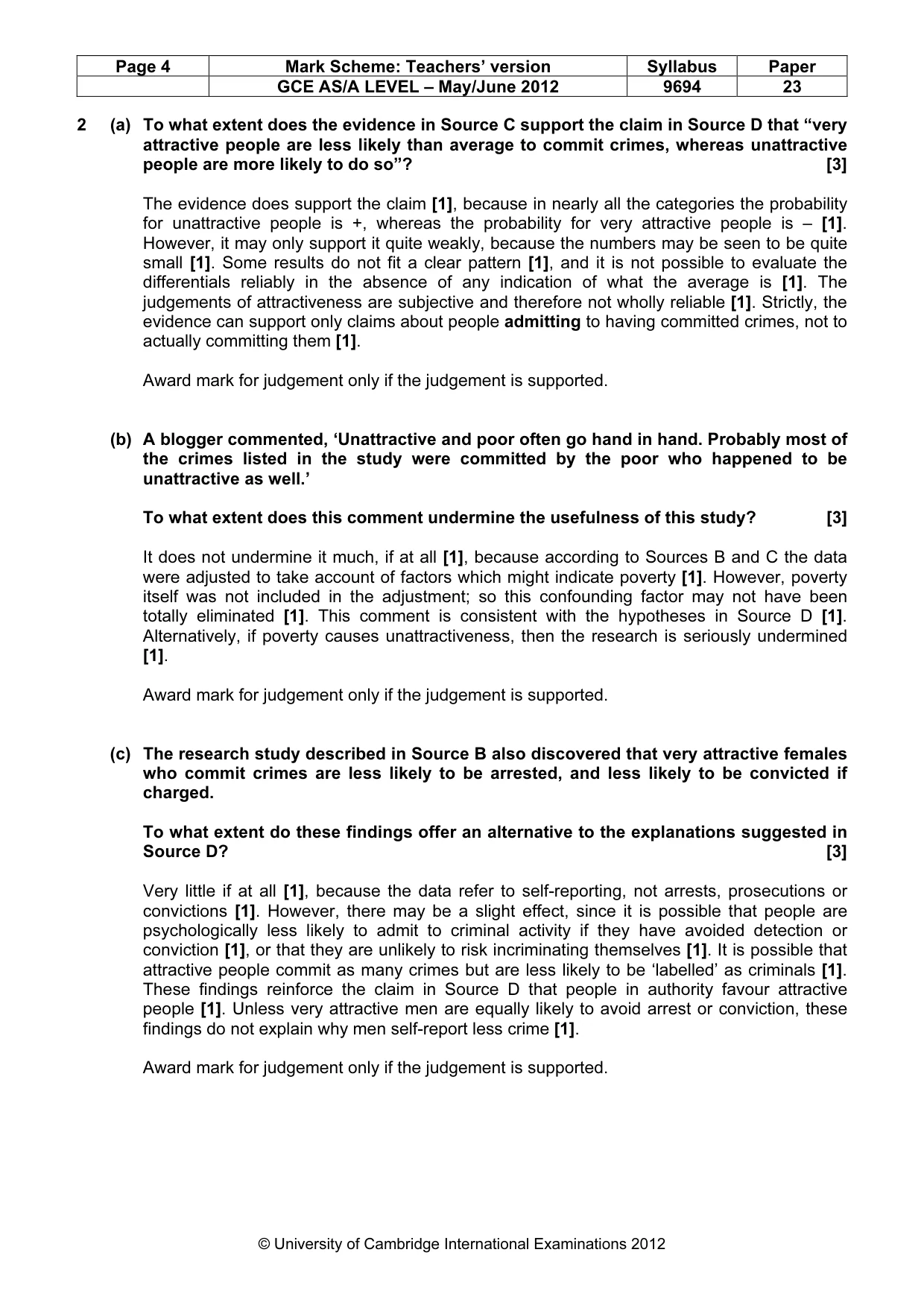
Page 4 Mark Scheme: Teachers’ version Syllabus Paper GCE AS/A LEVEL – May/June 2012 9694 23 © University of Cambridge International Examinations 2012 2 (a) To what extent does the evidence in Source C support the claim in Source D that “very attractive people are less likely than average to commit crimes, whereas unattractive people are more likely to do so”? [3] The evidence does support the claim [1], because in nearly all the categories the probability for unattractive people is +, whereas the probability for very attractive people is – [1]. However, it may only support it quite weakly, because the numbers may be seen to be quite small [1]. Some results do not fit a clear pattern [1], and it is not possible to evaluate the differentials reliably in the absence of any indication of what the average is [1]. The judgements of attractiveness are subjective and therefore not wholly reliable [1]. Strictly, the evidence can support only claims about people admitting to having committed crimes, not to actually committing them [1]. Award mark for judgement only if the judgement is supported. (b) A blogger commented, ‘Unattractive and poor often go hand in hand. Probably most of the crimes listed in the study were committed by the poor who happened to be unattractive as well.’ To what extent does this comment undermine the usefulness of this study? [3] It does not undermine it much, if at all [1], because according to Sources B and C the data were adjusted to take account of factors which might indicate poverty [1]. However, poverty itself was not included in the adjustment; so this confounding factor may not have been totally eliminated [1]. This comment is consistent with the hypotheses in Source D [1]. Alternatively, if poverty causes unattractiveness, then the research is seriously undermined [1]. Award mark for judgement only if the judgement is supported. (c) The research study described in Source B also discovered that very attractive females who commit crimes are less likely to be arrested, and less likely to be convicted if charged. To what extent do these findings offer an alternative to the explanations suggested in Source D? [3] Very little if at all [1], because the data refer to self-reporting, not arrests, prosecutions or convictions [1]. However, there may be a slight effect, since it is possible that people are psychologically less likely to admit to criminal activity if they have avoided detection or conviction [1], or that they are unlikely to risk incriminating themselves [1]. It is possible that attractive people commit as many crimes but are less likely to be ‘labelled’ as criminals [1]. These findings reinforce the claim in Source D that people in authority favour attractive people [1]. Unless very attractive men are equally likely to avoid arrest or conviction, these findings do not explain why men self-report less crime [1]. Award mark for judgement only if the judgement is supported.
Mark scheme, page 5
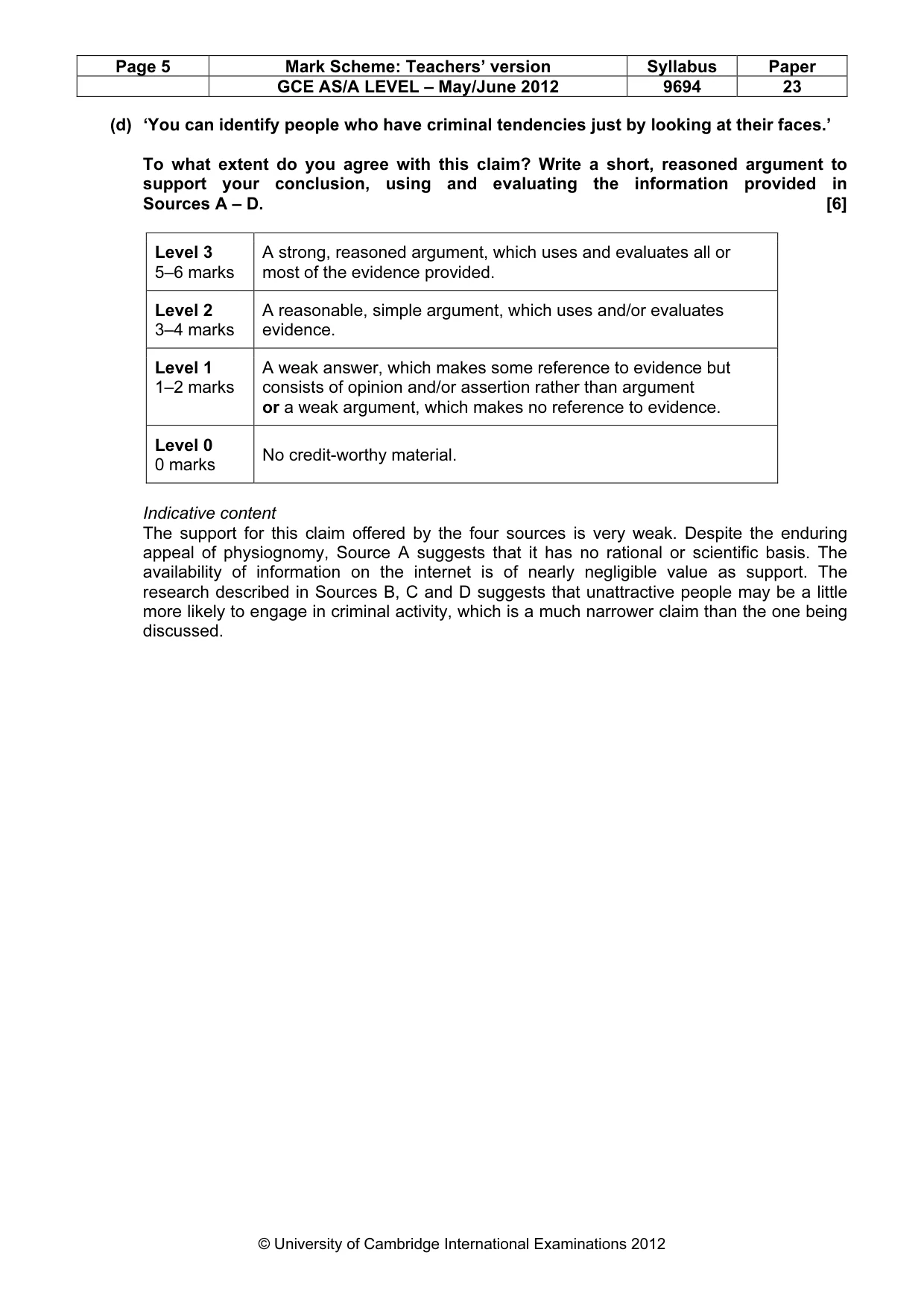
Page 5 Mark Scheme: Teachers’ version Syllabus Paper GCE AS/A LEVEL – May/June 2012 9694 23 © University of Cambridge International Examinations 2012 (d) ‘You can identify people who have criminal tendencies just by looking at their faces.’ To what extent do you agree with this claim? Write a short, reasoned argument to support your conclusion, using and evaluating the information provided in Sources A – D. [6] Level 3 5–6 marks A strong, reasoned argument, which uses and evaluates all or most of the evidence provided. Level 2 3–4 marks A reasonable, simple argument, which uses and/or evaluates evidence. Level 1 1–2 marks A weak answer, which makes some reference to evidence but consists of opinion and/or assertion rather than argument or a weak argument, which makes no reference to evidence. Level 0 0 marks No credit-worthy material. Indicative content The support for this claim offered by the four sources is very weak. Despite the enduring appeal of physiognomy, Source A suggests that it has no rational or scientific basis. The availability of information on the internet is of nearly negligible value as support. The research described in Sources B, C and D suggests that unattractive people may be a little more likely to engage in criminal activity, which is a much narrower claim than the one being discussed.
Mark scheme, page 6
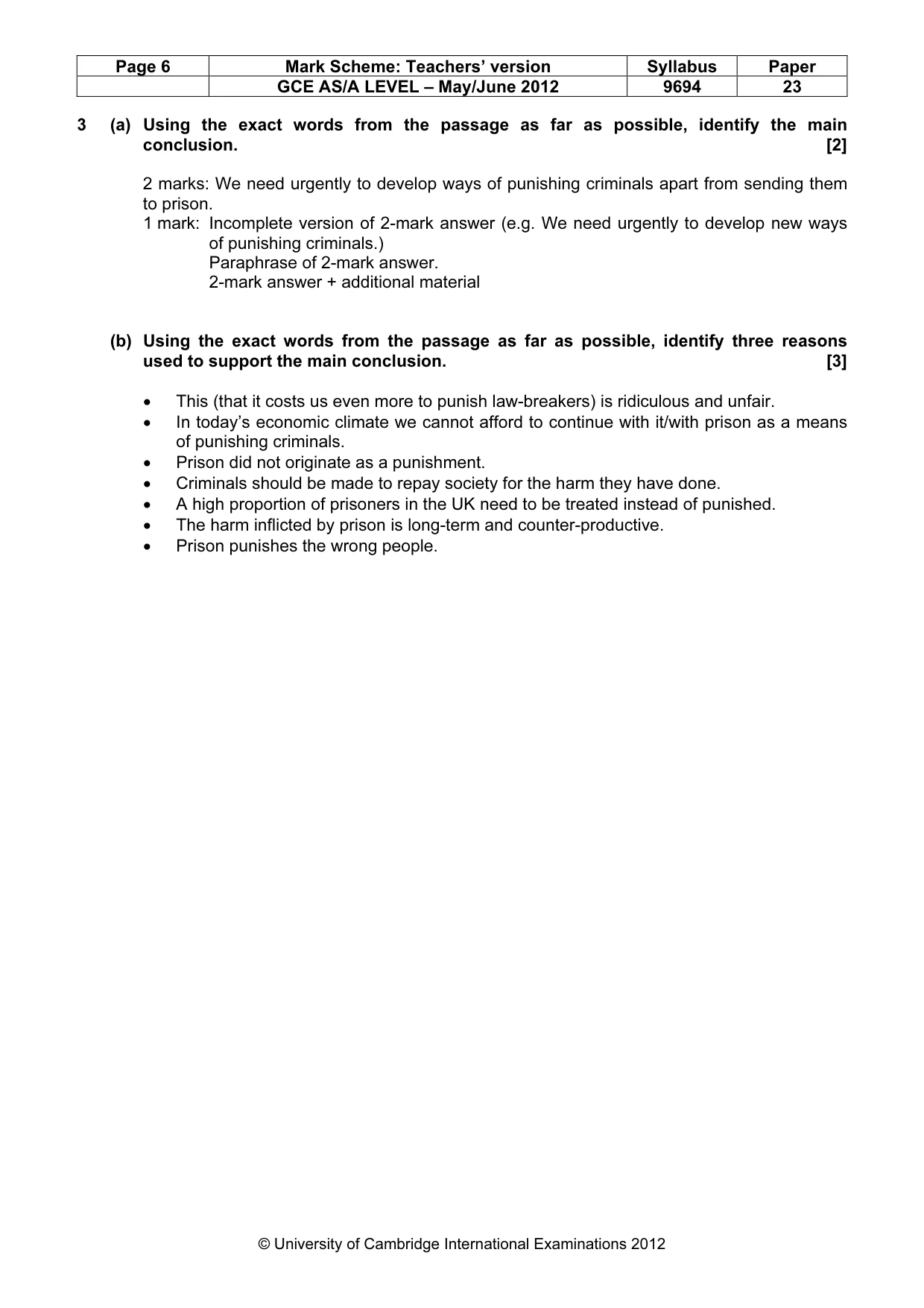
Page 6 Mark Scheme: Teachers’ version Syllabus Paper GCE AS/A LEVEL – May/June 2012 9694 23 © University of Cambridge International Examinations 2012 3 (a) Using the exact words from the passage as far as possible, identify the main conclusion. [2] 2 marks: We need urgently to develop ways of punishing criminals apart from sending them to prison. 1 mark: Incomplete version of 2-mark answer (e.g. We need urgently to develop new ways of punishing criminals.) Paraphrase of 2-mark answer. 2-mark answer + additional material (b) Using the exact words from the passage as far as possible, identify three reasons used to support the main conclusion. [3] • This (that it costs us even more to punish law-breakers) is ridiculous and unfair. • In today’s economic climate we cannot afford to continue with it/with prison as a means of punishing criminals. • Prison did not originate as a punishment. • Criminals should be made to repay society for the harm they have done. • A high proportion of prisoners in the UK need to be treated instead of punished. • The harm inflicted by prison is long-term and counter-productive. • Prison punishes the wrong people.
Mark scheme, page 7
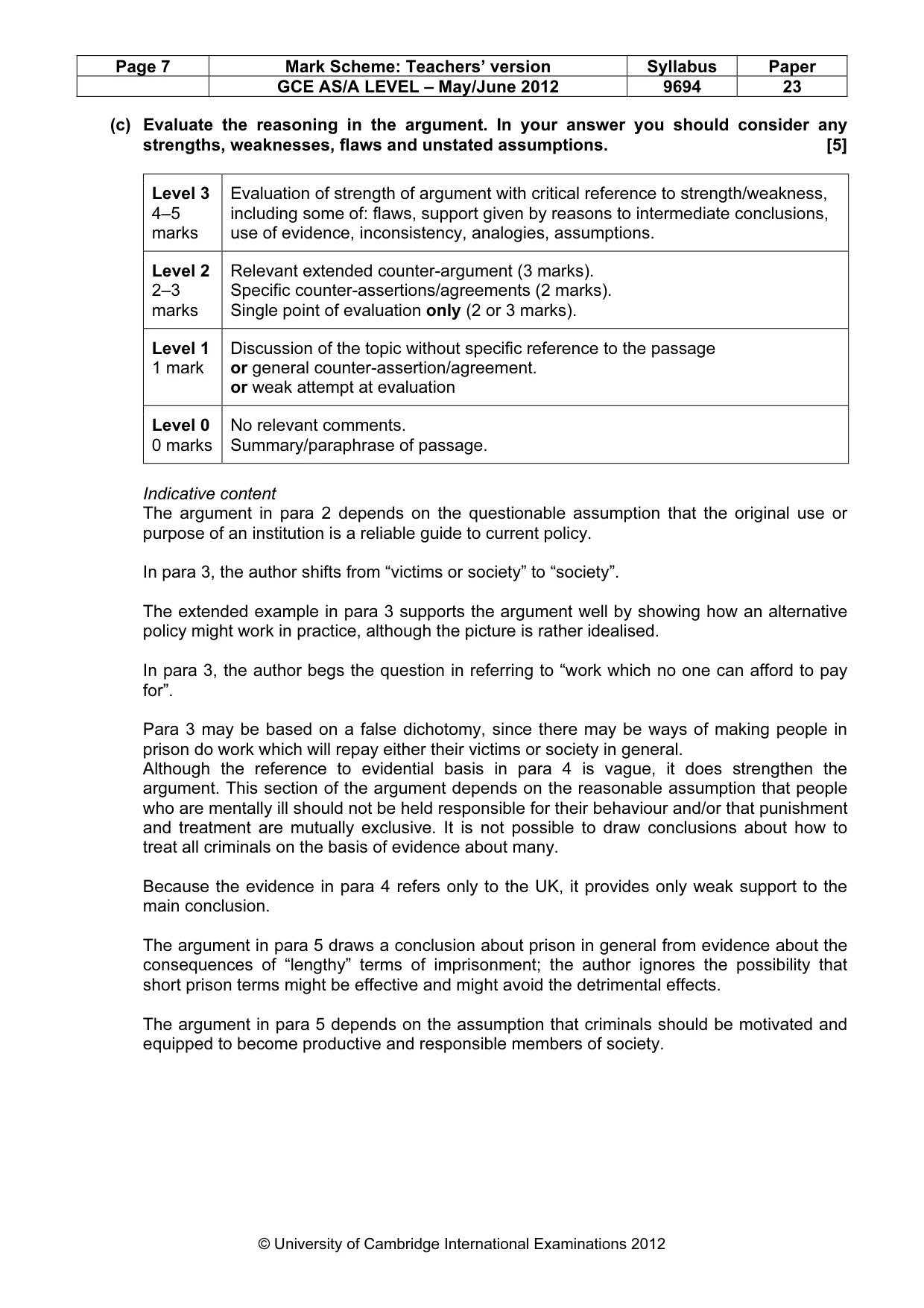
Page 7 Mark Scheme: Teachers’ version Syllabus Paper GCE AS/A LEVEL – May/June 2012 9694 23 © University of Cambridge International Examinations 2012 (c) Evaluate the reasoning in the argument. In your answer you should consider any strengths, weaknesses, flaws and unstated assumptions. [5] Level 3 4–5 marks Evaluation of strength of argument with critical reference to strength/weakness, including some of: flaws, support given by reasons to intermediate conclusions, use of evidence, inconsistency, analogies, assumptions. Level 2 2–3 marks Relevant extended counter-argument (3 marks). Specific counter-assertions/agreements (2 marks). Single point of evaluation only (2 or 3 marks). Level 1 1 mark Discussion of the topic without specific reference to the passage or general counter-assertion/agreement. or weak attempt at evaluation Level 0 0 marks No relevant comments. Summary/paraphrase of passage. Indicative content The argument in para 2 depends on the questionable assumption that the original use or purpose of an institution is a reliable guide to current policy. In para 3, the author shifts from “victims or society” to “society”. The extended example in para 3 supports the argument well by showing how an alternative policy might work in practice, although the picture is rather idealised. In para 3, the author begs the question in referring to “work which no one can afford to pay for”. Para 3 may be based on a false dichotomy, since there may be ways of making people in prison do work which will repay either their victims or society in general. Although the reference to evidential basis in para 4 is vague, it does strengthen the argument. This section of the argument depends on the reasonable assumption that people who are mentally ill should not be held responsible for their behaviour and/or that punishment and treatment are mutually exclusive. It is not possible to draw conclusions about how to treat all criminals on the basis of evidence about many. Because the evidence in para 4 refers only to the UK, it provides only weak support to the main conclusion. The argument in para 5 draws a conclusion about prison in general from evidence about the consequences of “lengthy” terms of imprisonment; the author ignores the possibility that short prison terms might be effective and might avoid the detrimental effects. The argument in para 5 depends on the assumption that criminals should be motivated and equipped to become productive and responsible members of society.
Mark scheme, page 8
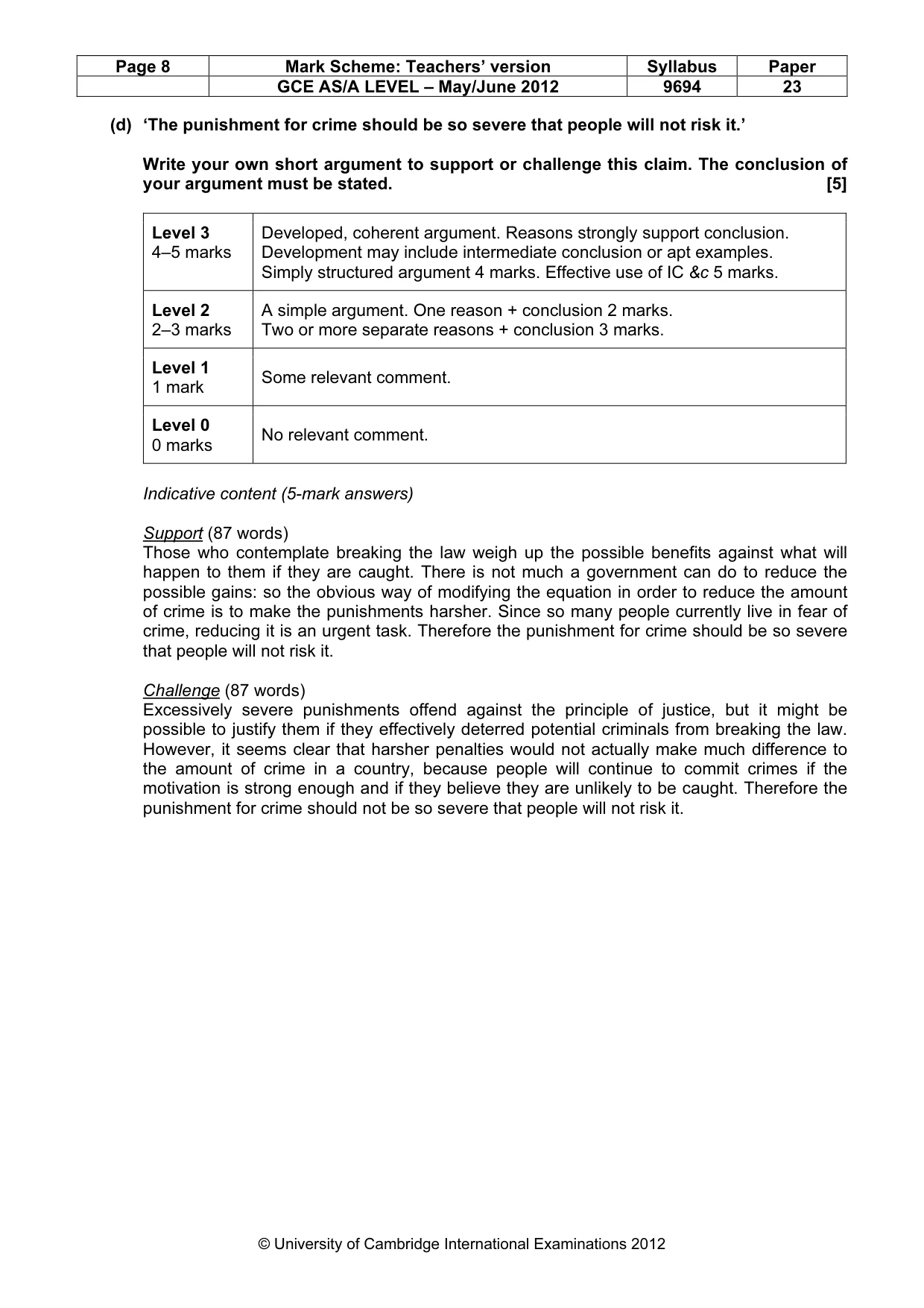
Page 8 Mark Scheme: Teachers’ version Syllabus Paper GCE AS/A LEVEL – May/June 2012 9694 23 © University of Cambridge International Examinations 2012 (d) ‘The punishment for crime should be so severe that people will not risk it.’ Write your own short argument to support or challenge this claim. The conclusion of your argument must be stated. [5] Level 3 4–5 marks Developed, coherent argument. Reasons strongly support conclusion. Development may include intermediate conclusion or apt examples. Simply structured argument 4 marks. Effective use of IC &c 5 marks. Level 2 2–3 marks A simple argument. One reason + conclusion 2 marks. Two or more separate reasons + conclusion 3 marks. Level 1 1 mark Some relevant comment. Level 0 0 marks No relevant comment. Indicative content (5-mark answers) Support (87 words) Those who contemplate breaking the law weigh up the possible benefits against what will happen to them if they are caught. There is not much a government can do to reduce the possible gains: so the obvious way of modifying the equation in order to reduce the amount of crime is to make the punishments harsher. Since so many people currently live in fear of crime, reducing it is an urgent task. Therefore the punishment for crime should be so severe that people will not risk it. Challenge (87 words) Excessively severe punishments offend against the principle of justice, but it might be possible to justify them if they effectively deterred potential criminals from breaking the law. However, it seems clear that harsher penalties would not actually make much difference to the amount of crime in a country, because people will continue to commit crimes if the motivation is strong enough and if they believe they are unlikely to be caught. Therefore the punishment for crime should not be so severe that people will not risk it.
What you needed in this session
Cambridge’s own grade thresholds for 2012 May/June, Paper 2 · Variant 3. A higher threshold means an easier paper — the bar moves with how the cohort did.