Cambridge A Level Thinking Skills 9694 — 2011 May/June Paper 2 · Variant 3
9694/23/M/J/11 · 45 marks · ≈51 min
The question paper and its mark scheme, free to read here and free to download. This is Cambridge’s own paper, exactly as it was sat.
Question paper8 pages


Mark scheme8 pages
Answers below. Sit the paper first if you are practising.
Paper as text
Question paper, page 1
This document consists of 6 printed pages and 2 blank pages. IB11 06_9694_23/FP © UCLES 2011 [Turn over *5642439452* UNIVERSITY OF CAMBRIDGE INTERNATIONAL EXAMINATIONS General Certificate of Education Advanced Subsidiary Level and Advanced Level THINKING SKILLS 9694/23 Paper 2 Critical Thinking May/June 2011 1 hour 45 minutes Additional Materials: Answer Booklet/Paper READ THESE INSTRUCTIONS FIRST If you have been given an Answer Booklet, follow the instructions on the front cover of the booklet. Write your Centre number, candidate number and name on all the work you hand in. Write in dark blue or black pen. Do not use staples, paper clips, highlighters, glue or correction fluid. DO NOT WRITE IN ANY BARCODES. Answer all the questions. Start each question on a new answer sheet. At the end of the examination, fasten all your work securely together. The number of marks is given in brackets [ ] at the end of each question.
Question paper, page 2
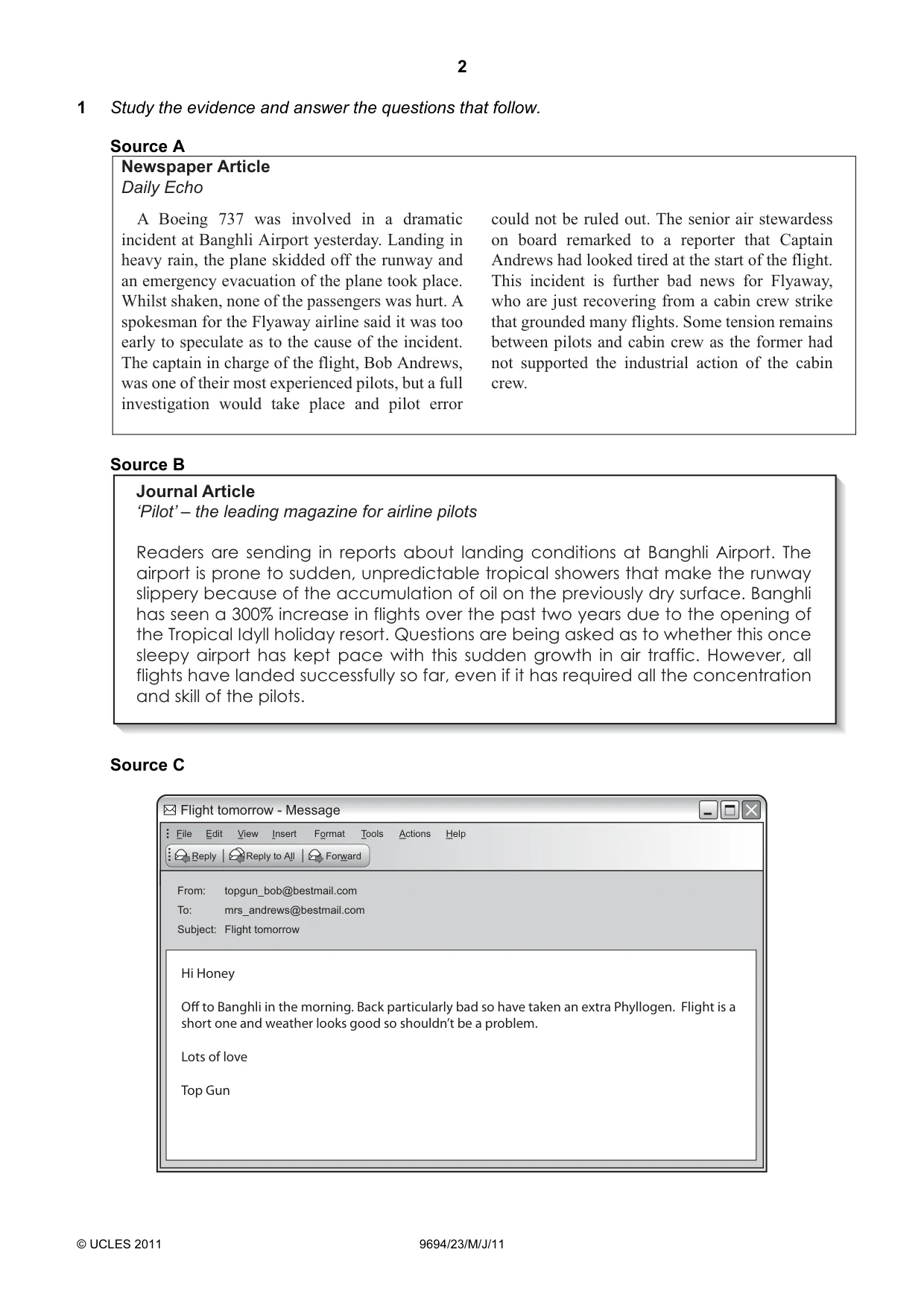
2 © UCLES 2011 9694/23/M/J/11 1 Study the evidence and answer the questions that follow. Source A A Boeing 737 was involved in a dramatic incident at Banghli Airport yesterday. Landing in heavy rain, the plane skidded off the runway and an emergency evacuation of the plane took place. Whilst shaken, none of the passengers was hurt. A spokesman for the Flyaway airline said it was too early to speculate as to the cause of the incident. The captain in charge of the flight, Bob Andrews, was one of their most experienced pilots, but a full investigation would take place and pilot error could not be ruled out. The senior air stewardess on board remarked to a reporter that Captain Andrews had looked tired at the start of the flight. This incident is further bad news for Flyaway, who are just recovering from a cabin crew strike that grounded many flights. Some tension remains between pilots and cabin crew as the former had not supported the industrial action of the cabin crew. Newspaper Article Daily Echo Source B Journal Article ‘Pilot’ – the leading magazine for airline pilots Readers are sending in reports about landing conditions at Banghli Airport. The airport is prone to sudden, unpredictable tropical showers that make the runway slippery because of the accumulation of oil on the previously dry surface. Banghli has seen a 300% increase in flights over the past two years due to the opening of the Tropical Idyll holiday resort. Questions are being asked as to whether this once sleepy airport has kept pace with this sudden growth in air traffic. However, all flights have landed successfully so far, even if it has required all the concentration and skill of the pilots. Source C File Edit View Insert Format Tools Actions Help Reply Forward Reply to All Flight tomorrow - Message From: topgun_bob@bestmail.com To: mrs_andrews@bestmail.com Subject: Flight tomorrow Hi Honey Off to Banghli in the morning. Back particularly bad so have taken an extra Phyllogen. Flight is a short one and weather looks good so shouldn’t be a problem. Lots of love Top Gun
Question paper, page 3
3 © UCLES 2011 9694/23/M/J/11 [Turn over Source D Leaflet accompanying Phyllogen pain relief tablets These tablets should only be taken if prescribed by your doctor. May cause drowsiness if recommended dose is exceeded. If pain persists you should see your doctor. Source E Banghli Airport information for passengers Welcome to Banghli Airport! We have embarked on an exciting programme of expansion over the last 2 years and you will find many of your favourite shops are here – so your waiting time should fly by! At busy times you may have to wait in one of our temporary marquees before entering the terminal – we apologise if this happens to you. (a) How reliable is the information given by the senior air stewardess in Source A? Justify your answer. [3] (b) How significant would the information in Source D be in an enquiry into Bob Andrews’ responsibility for the incident at Banghli Airport? [3] (c) Suggest one piece of additional information it would be useful to have about this incident. Explain how this would help you make a decision about what happened. [3] (d) How likely is it that Bob Andrews was responsible for the plane skidding on landing at Banghli Airport? Write a short, reasoned argument to support your conclusion, with critical reference to the evidence provided and considering plausible alternative scenarios. [6]
Question paper, page 4
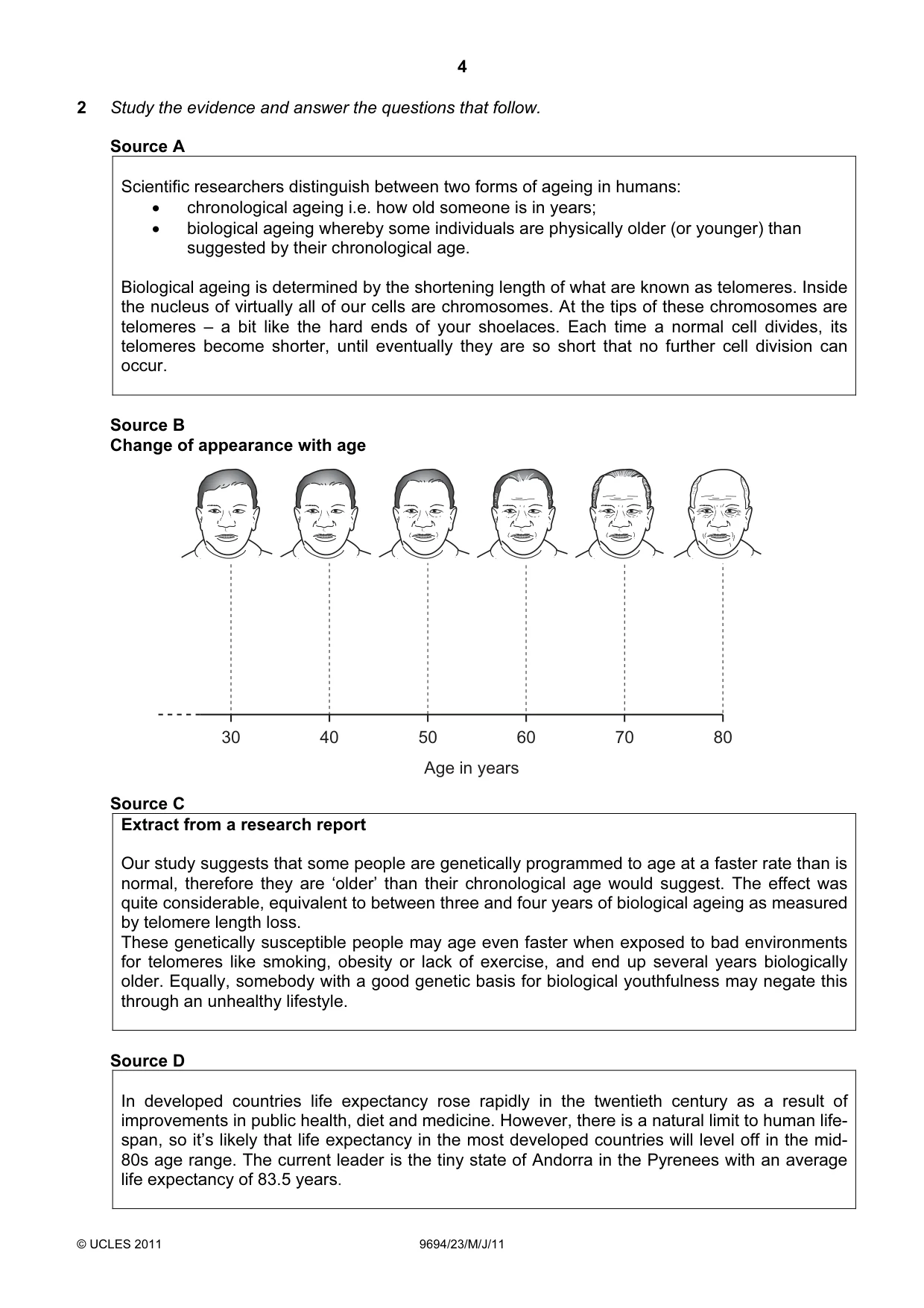
4 © UCLES 2011 9694/23/M/J/11 2 Study the evidence and answer the questions that follow. Source A Scientific researchers distinguish between two forms of ageing in humans: • chronological ageing i.e. how old someone is in years; • biological ageing whereby some individuals are physically older (or younger) than suggested by their chronological age. Biological ageing is determined by the shortening length of what are known as telomeres. Inside the nucleus of virtually all of our cells are chromosomes. At the tips of these chromosomes are telomeres – a bit like the hard ends of your shoelaces. Each time a normal cell divides, its telomeres become shorter, until eventually they are so short that no further cell division can occur. Source B Change of appearance with age 30 40 50 60 70 80 Age in years Source C Extract from a research report Our study suggests that some people are genetically programmed to age at a faster rate than is normal, therefore they are ‘older’ than their chronological age would suggest. The effect was quite considerable, equivalent to between three and four years of biological ageing as measured by telomere length loss. These genetically susceptible people may age even faster when exposed to bad environments for telomeres like smoking, obesity or lack of exercise, and end up several years biologically older. Equally, somebody with a good genetic basis for biological youthfulness may negate this through an unhealthy lifestyle. Source D In developed countries life expectancy rose rapidly in the twentieth century as a result of improvements in public health, diet and medicine. However, there is a natural limit to human life- span, so it’s likely that life expectancy in the most developed countries will level off in the mid- 80s age range. The current leader is the tiny state of Andorra in the Pyrenees with an average life expectancy of 83.5 years.
Question paper, page 5
5 © UCLES 2011 9694/23/M/J/11 [Turn over Source E Assessing how well a person operates (functional age) seems to be a more rational basis for categorising a person’s age than chronological age alone, although only the latter can be easily and accurately measured. This implies that the norm of qualifying for a retirement pension at a fixed chronological age (e.g. 65) should be abandoned in favour of people retiring when they reach an age that means they are not functioning effectively. However, so far, it has not been determined whether or not individuals whose functional age was lower than their chronological age have actually lived longer. (a) Can we reliably conclude from Source A that cell division is a normal part of life for all organisms? Explain your answer. [3] (b) Look at Source B. With the help of the information in Sources A and E, assess to what extent Source B is incompatible with the idea of biological ageing. [3] (c) ‘Some individuals are born with shorter telomere lengths than others.’ How useful is this information in assessing whether genetic factors outweigh lifestyle factors in determining biological ageing? [3] (d) Should qualification for a retirement pension be determined by functional rather than chronological age? Write a short, reasoned argument to support your conclusion, using and evaluating the information provided in Sources A – E. [6]
Question paper, page 6
6 © UCLES 2011 9694/23/M/J/11 3 Read the passage and answer the questions below. 1 Biofuel is the name given to any fuel that is produced from the processing of plants. It is increasingly seen as a solution to the decline in the supply of fossil fuels like coal and oil and also offering a ‘green’ solution to the planet’s energy needs. 2 However, there is a problem in deciding whether biofuel is really a ‘green’ form of energy. On the one hand, it is derived from a renewable resource, as more plants can always be grown to replace those that are used up. It could also be, in theory, ‘carbon neutral’ as the plants that produce biofuel absorb carbon dioxide which will help compensate for that produced by the burning of the fuel. 3 On the other hand, it can be argued that the growing of many of the plants used to produce biofuel, particularly palm trees, is responsible for much of the loss of tropical rainforest. This tropical rainforest provides a crucial mechanism by which the planet absorbs CO2. The cultivation of plants for biofuel would be a totally inadequate compensation for the loss of these rainforests. 4 But this dilemma can be quickly resolved if biofuel production is confined to those plants, such as elephant grass, which can be grown in non-tropical conditions and therefore not threaten the tropical rainforest. So there is an environmentally friendly way of producing biofuel. We should not reject an excellent solution to the dwindling supply of fossil fuels just because of the objections of a few environmental extremists. Those who oppose biofuels have an anti-car agenda – they want us all to get around by horse and cart. 5 We should promote biofuels as the way forward – it is either that or the end of civilisation as we know it. With biofuels we can be sure that the fuel needs of advanced technological society have been catered for, so we can look forward to ever-growing prosperity and progress. Big oil companies agree that this is the direction in which catering for our fuel needs should go, and they should know what they are talking about. (a) Using the exact words from the passage as far as possible, identify the main conclusion in the argument in paragraphs 4 and 5. [2] (b) Using the exact words from the passage as far as possible, identify three reasons used to support the main conclusion. [3] (c) Evaluate the reasoning in the argument. In your answer you should consider any strengths, weaknesses, flaws and unstated assumptions. [5] (d) ‘We cannot both tackle global warming and increase our progress and prosperity.’ Write your own short argument to support or challenge this claim. [5]
Question paper, page 7
7 © UCLES 2011 9694/23/M/J/11 BLANK PAGE
Question paper, page 8
8 Permission to reproduce items where third-party owned material protected by copyright is included has been sought and cleared where possible. Every reasonable effort has been made by the publisher (UCLES) to trace copyright holders, but if any items requiring clearance have unwittingly been included, the publisher will be pleased to make amends at the earliest possible opportunity. University of Cambridge International Examinations is part of the Cambridge Assessment Group. Cambridge Assessment is the brand name of University of Cambridge Local Examinations Syndicate (UCLES), which is itself a department of the University of Cambridge. © UCLES 2011 9694/23/M/J/11 BLANK PAGE
Mark scheme, page 1
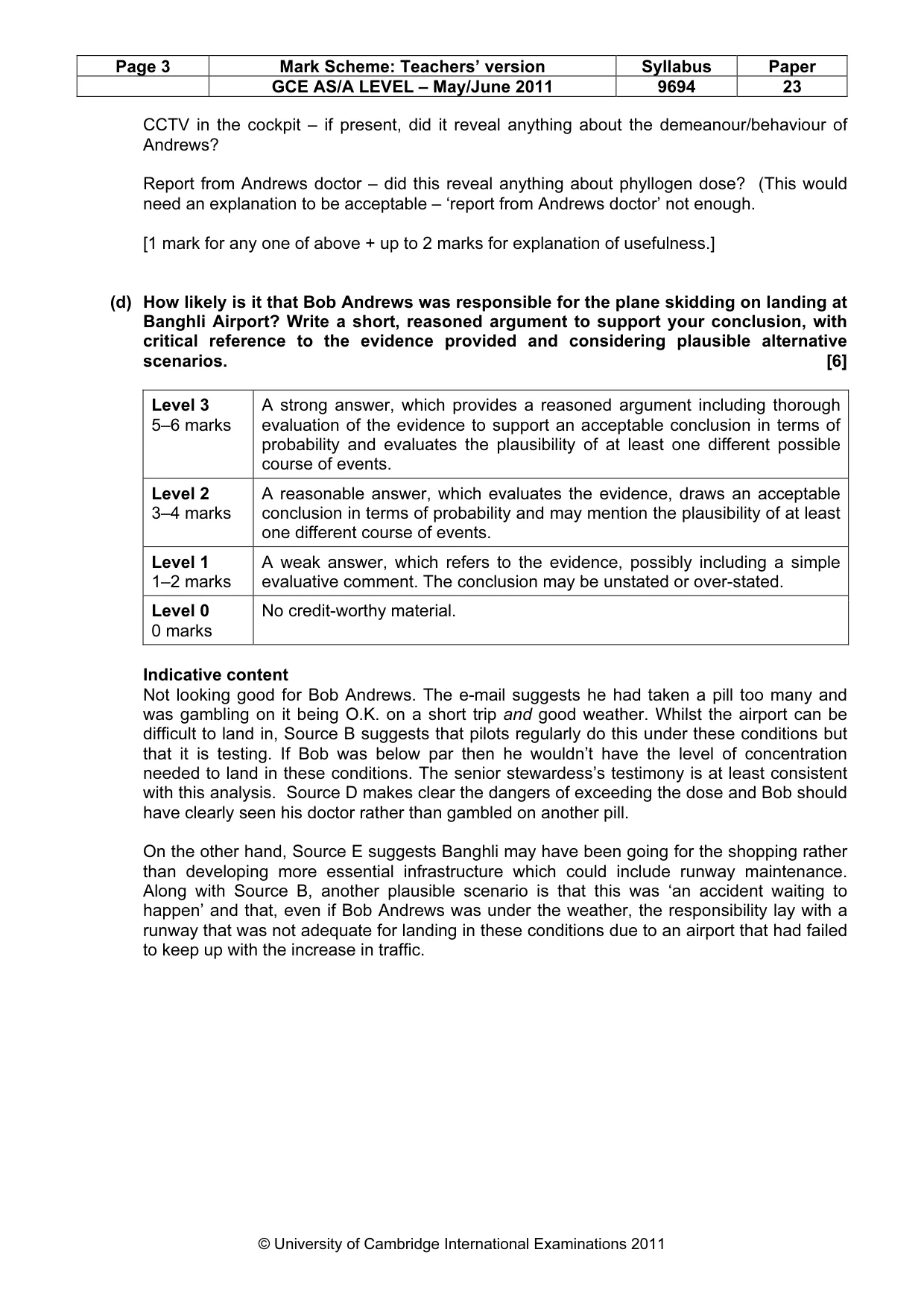
UNIVERSITY OF CAMBRIDGE INTERNATIONAL EXAMINATIONS GCE Advanced Subsidiary Level and GCE Advanced Level MARK SCHEME for the May/June 2011 question paper for the guidance of teachers 9694 THINKING SKILLS 9694/23 Paper 2 (Critical Thinking), maximum raw mark 45 This mark scheme is published as an aid to teachers and candidates, to indicate the requirements of the examination. It shows the basis on which Examiners were instructed to award marks. It does not indicate the details of the discussions that took place at an Examiners’ meeting before marking began, which would have considered the acceptability of alternative answers. Mark schemes must be read in conjunction with the question papers and the report on the examination. • Cambridge will not enter into discussions or correspondence in connection with these mark schemes. Cambridge is publishing the mark schemes for the May/June 2011 question papers for most IGCSE, GCE Advanced Level and Advanced Subsidiary Level syllabuses and some Ordinary Level syllabuses.
Mark scheme, page 2
Page 2 Mark Scheme: Teachers’ version Syllabus Paper GCE AS/A LEVEL – May/June 2011 9694 23 © University of Cambridge International Examinations 2011 1 (a) How reliable is the information given by the senior air stewardess in Source A? Justify your answer. [3] As a senior air stewardess she should have the experience and expertise to judge how fit a pilot looks to fly [1]. However, ‘looking tired’ is a rather vague expression and doesn’t mean that the pilot was sleepy or drowsy as such [1]. Moreover there may be an element of bias as we are told that there is tension between cabin and flight crew [1]. On the other hand, this information would be consistent with the idea that Bob Andrews had taken too many pills [1]. Give 1 mark for judgement if followed by a relevant point from above. 1 mark per relevant point from above. Do not allow ‘ability to see’ on its own. (b) How significant would the information in Source D be in an enquiry into Bob Andrews’ responsibility for the incident at Banghli Airport? [3] It would show that there was a danger of drowsiness/lack of concentration when taking these tablets. [1]. We know from Source C that Bob Andrews is taking these tablets [1] and that he had taken an ‘extra one’ which suggests he may have exceeded the recommended dose [1]. However ‘extra one’ is too vague to be sure of this [1]. Bob Andrews may not have read the leaflet accompanying the tablets but this would be irresponsible behaviour and not a very good defence for him [2 marks for this point in its entirety]. Give this last point if the ‘reverse’ is offered i.e. if he had read the leaflet which would mean he was irresponsible to have acted against its advice. Not significant [1] because the effects may have worn off by the time any enquiry took place [1]. (c) Suggest one piece of additional information it would be useful to have about this incident. Explain how this would help you make a decision about what happened. [3] Main areas here would be: Information about conversations in the cockpit e.g. did the co-pilot offer to do the landing/suggest the captain looked tired etc. This would help by confirming that there was concern about the captain’s ability to land successfully. An absence of such conversation would bolster Andrews’s position. More detail about landings at Banghli. Whilst an incident hasn’t happened before how close has it come to being a skid? This would help by suggesting that this was ‘an accident waiting to happen’ and, again would bolster Andrews’ position. More information about the airline/aircraft. Was it old? Does this airline have a lot of incidents like this? Are its planes well-maintained? If there was negative information about the plane or the airline this would again exonerate Andrews. More information about the dose and / or duration of the drugs e.g. did he habitually take less than the prescribed maximum? Bob Andrews medical condition after the landing e.g. had drug test revealed high levels of phyllogen? Passenger announcements – had passengers thought that Andrews sounded drowsy/tired?
Mark scheme, page 3
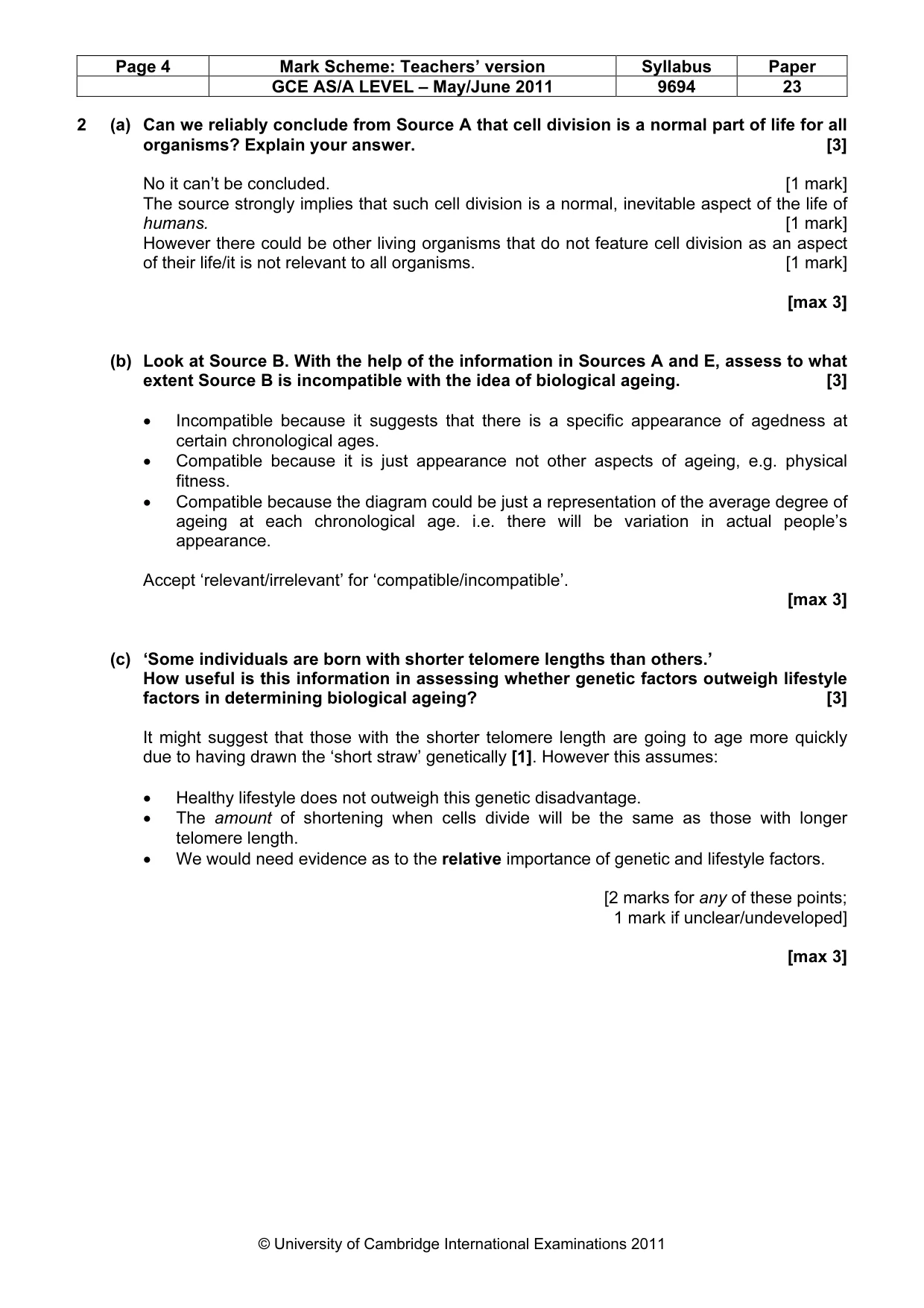
Page 3 Mark Scheme: Teachers’ version Syllabus Paper GCE AS/A LEVEL – May/June 2011 9694 23 © University of Cambridge International Examinations 2011 CCTV in the cockpit – if present, did it reveal anything about the demeanour/behaviour of Andrews? Report from Andrews doctor – did this reveal anything about phyllogen dose? (This would need an explanation to be acceptable – ‘report from Andrews doctor’ not enough. [1 mark for any one of above + up to 2 marks for explanation of usefulness.] (d) How likely is it that Bob Andrews was responsible for the plane skidding on landing at Banghli Airport? Write a short, reasoned argument to support your conclusion, with critical reference to the evidence provided and considering plausible alternative scenarios. [6] Level 3 5–6 marks A strong answer, which provides a reasoned argument including thorough evaluation of the evidence to support an acceptable conclusion in terms of probability and evaluates the plausibility of at least one different possible course of events. Level 2 3–4 marks A reasonable answer, which evaluates the evidence, draws an acceptable conclusion in terms of probability and may mention the plausibility of at least one different course of events. Level 1 1–2 marks A weak answer, which refers to the evidence, possibly including a simple evaluative comment. The conclusion may be unstated or over-stated. Level 0 0 marks No credit-worthy material. Indicative content Not looking good for Bob Andrews. The e-mail suggests he had taken a pill too many and was gambling on it being O.K. on a short trip and good weather. Whilst the airport can be difficult to land in, Source B suggests that pilots regularly do this under these conditions but that it is testing. If Bob was below par then he wouldn’t have the level of concentration needed to land in these conditions. The senior stewardess’s testimony is at least consistent with this analysis. Source D makes clear the dangers of exceeding the dose and Bob should have clearly seen his doctor rather than gambled on another pill. On the other hand, Source E suggests Banghli may have been going for the shopping rather than developing more essential infrastructure which could include runway maintenance. Along with Source B, another plausible scenario is that this was ‘an accident waiting to happen’ and that, even if Bob Andrews was under the weather, the responsibility lay with a runway that was not adequate for landing in these conditions due to an airport that had failed to keep up with the increase in traffic.
Mark scheme, page 4
Page 4 Mark Scheme: Teachers’ version Syllabus Paper GCE AS/A LEVEL – May/June 2011 9694 23 © University of Cambridge International Examinations 2011 2 (a) Can we reliably conclude from Source A that cell division is a normal part of life for all organisms? Explain your answer. [3] No it can’t be concluded. [1 mark] The source strongly implies that such cell division is a normal, inevitable aspect of the life of humans. [1 mark] However there could be other living organisms that do not feature cell division as an aspect of their life/it is not relevant to all organisms. [1 mark] [max 3] (b) Look at Source B. With the help of the information in Sources A and E, assess to what extent Source B is incompatible with the idea of biological ageing. [3] • Incompatible because it suggests that there is a specific appearance of agedness at certain chronological ages. • Compatible because it is just appearance not other aspects of ageing, e.g. physical fitness. • Compatible because the diagram could be just a representation of the average degree of ageing at each chronological age. i.e. there will be variation in actual people’s appearance. Accept ‘relevant/irrelevant’ for ‘compatible/incompatible’. [max 3] (c) ‘Some individuals are born with shorter telomere lengths than others.’ How useful is this information in assessing whether genetic factors outweigh lifestyle factors in determining biological ageing? [3] It might suggest that those with the shorter telomere length are going to age more quickly due to having drawn the ‘short straw’ genetically [1]. However this assumes: • Healthy lifestyle does not outweigh this genetic disadvantage. • The amount of shortening when cells divide will be the same as those with longer telomere length. • We would need evidence as to the relative importance of genetic and lifestyle factors. [2 marks for any of these points; 1 mark if unclear/undeveloped] [max 3]
Mark scheme, page 5
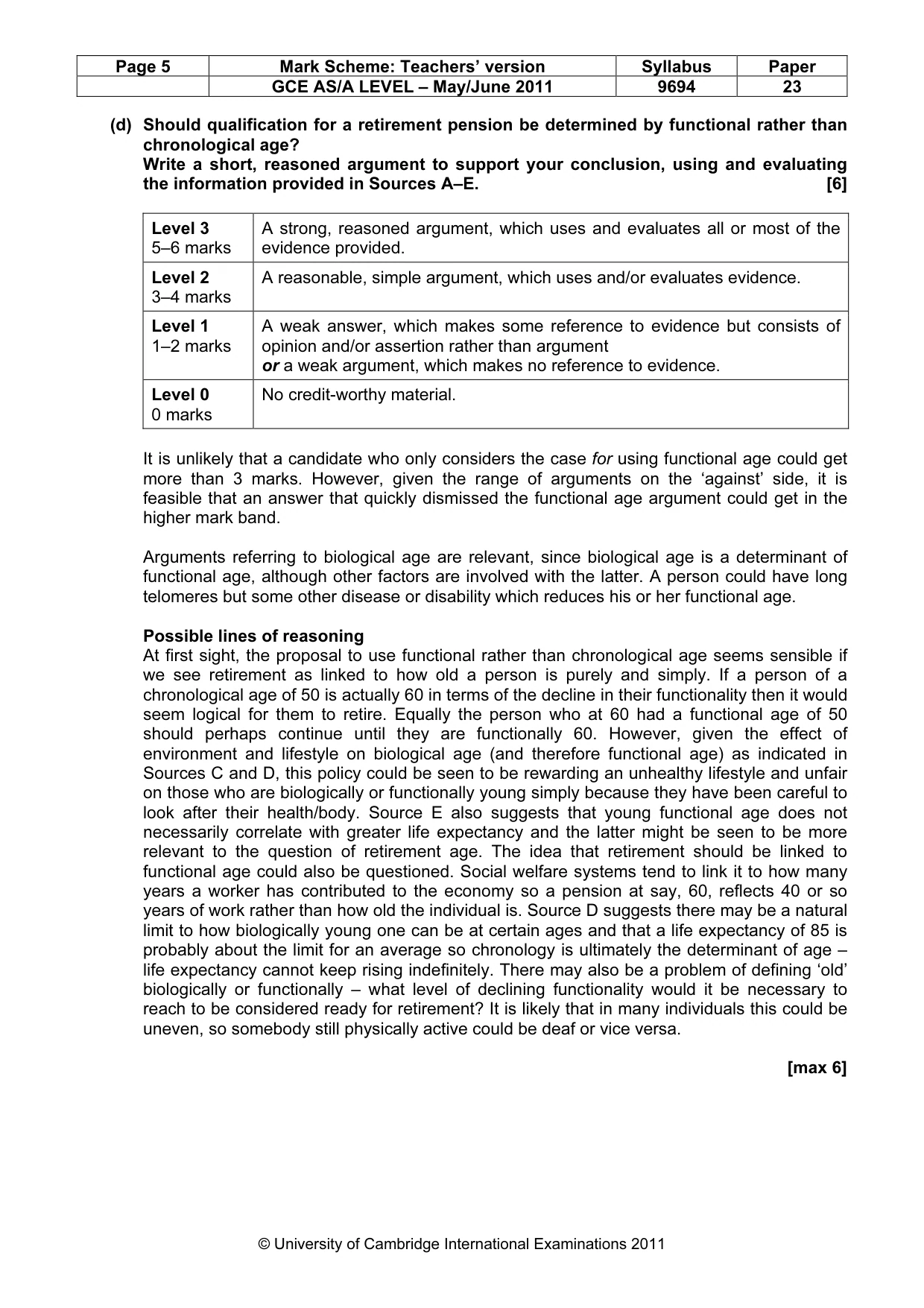
Page 5 Mark Scheme: Teachers’ version Syllabus Paper GCE AS/A LEVEL – May/June 2011 9694 23 © University of Cambridge International Examinations 2011 (d) Should qualification for a retirement pension be determined by functional rather than chronological age? Write a short, reasoned argument to support your conclusion, using and evaluating the information provided in Sources A–E. [6] Level 3 5–6 marks A strong, reasoned argument, which uses and evaluates all or most of the evidence provided. Level 2 3–4 marks A reasonable, simple argument, which uses and/or evaluates evidence. Level 1 1–2 marks A weak answer, which makes some reference to evidence but consists of opinion and/or assertion rather than argument or a weak argument, which makes no reference to evidence. Level 0 0 marks No credit-worthy material. It is unlikely that a candidate who only considers the case for using functional age could get more than 3 marks. However, given the range of arguments on the ‘against’ side, it is feasible that an answer that quickly dismissed the functional age argument could get in the higher mark band. Arguments referring to biological age are relevant, since biological age is a determinant of functional age, although other factors are involved with the latter. A person could have long telomeres but some other disease or disability which reduces his or her functional age. Possible lines of reasoning At first sight, the proposal to use functional rather than chronological age seems sensible if we see retirement as linked to how old a person is purely and simply. If a person of a chronological age of 50 is actually 60 in terms of the decline in their functionality then it would seem logical for them to retire. Equally the person who at 60 had a functional age of 50 should perhaps continue until they are functionally 60. However, given the effect of environment and lifestyle on biological age (and therefore functional age) as indicated in Sources C and D, this policy could be seen to be rewarding an unhealthy lifestyle and unfair on those who are biologically or functionally young simply because they have been careful to look after their health/body. Source E also suggests that young functional age does not necessarily correlate with greater life expectancy and the latter might be seen to be more relevant to the question of retirement age. The idea that retirement should be linked to functional age could also be questioned. Social welfare systems tend to link it to how many years a worker has contributed to the economy so a pension at say, 60, reflects 40 or so years of work rather than how old the individual is. Source D suggests there may be a natural limit to how biologically young one can be at certain ages and that a life expectancy of 85 is probably about the limit for an average so chronology is ultimately the determinant of age – life expectancy cannot keep rising indefinitely. There may also be a problem of defining ‘old’ biologically or functionally – what level of declining functionality would it be necessary to reach to be considered ready for retirement? It is likely that in many individuals this could be uneven, so somebody still physically active could be deaf or vice versa. [max 6]
Mark scheme, page 6
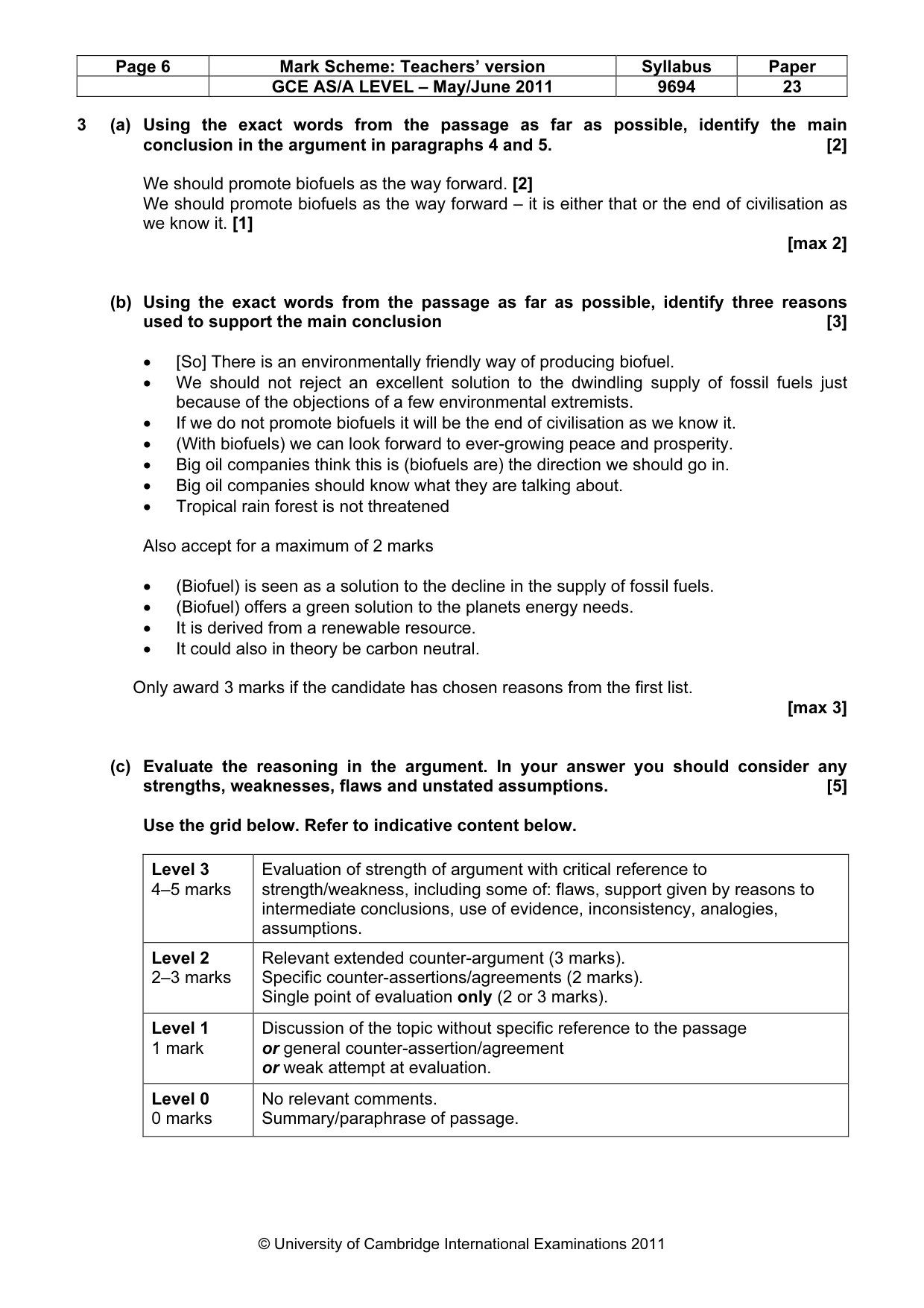
Page 6 Mark Scheme: Teachers’ version Syllabus Paper GCE AS/A LEVEL – May/June 2011 9694 23 © University of Cambridge International Examinations 2011 3 (a) Using the exact words from the passage as far as possible, identify the main conclusion in the argument in paragraphs 4 and 5. [2] We should promote biofuels as the way forward. [2] We should promote biofuels as the way forward – it is either that or the end of civilisation as we know it. [1] [max 2] (b) Using the exact words from the passage as far as possible, identify three reasons used to support the main conclusion [3] • [So] There is an environmentally friendly way of producing biofuel. • We should not reject an excellent solution to the dwindling supply of fossil fuels just because of the objections of a few environmental extremists. • If we do not promote biofuels it will be the end of civilisation as we know it. • (With biofuels) we can look forward to ever-growing peace and prosperity. • Big oil companies think this is (biofuels are) the direction we should go in. • Big oil companies should know what they are talking about. • Tropical rain forest is not threatened Also accept for a maximum of 2 marks • (Biofuel) is seen as a solution to the decline in the supply of fossil fuels. • (Biofuel) offers a green solution to the planets energy needs. • It is derived from a renewable resource. • It could also in theory be carbon neutral. Only award 3 marks if the candidate has chosen reasons from the first list. [max 3] (c) Evaluate the reasoning in the argument. In your answer you should consider any strengths, weaknesses, flaws and unstated assumptions. [5] Use the grid below. Refer to indicative content below. Level 3 4–5 marks Evaluation of strength of argument with critical reference to strength/weakness, including some of: flaws, support given by reasons to intermediate conclusions, use of evidence, inconsistency, analogies, assumptions. Level 2 2–3 marks Relevant extended counter-argument (3 marks). Specific counter-assertions/agreements (2 marks). Single point of evaluation only (2 or 3 marks). Level 1 1 mark Discussion of the topic without specific reference to the passage or general counter-assertion/agreement or weak attempt at evaluation. Level 0 0 marks No relevant comments. Summary/paraphrase of passage.
Mark scheme, page 7
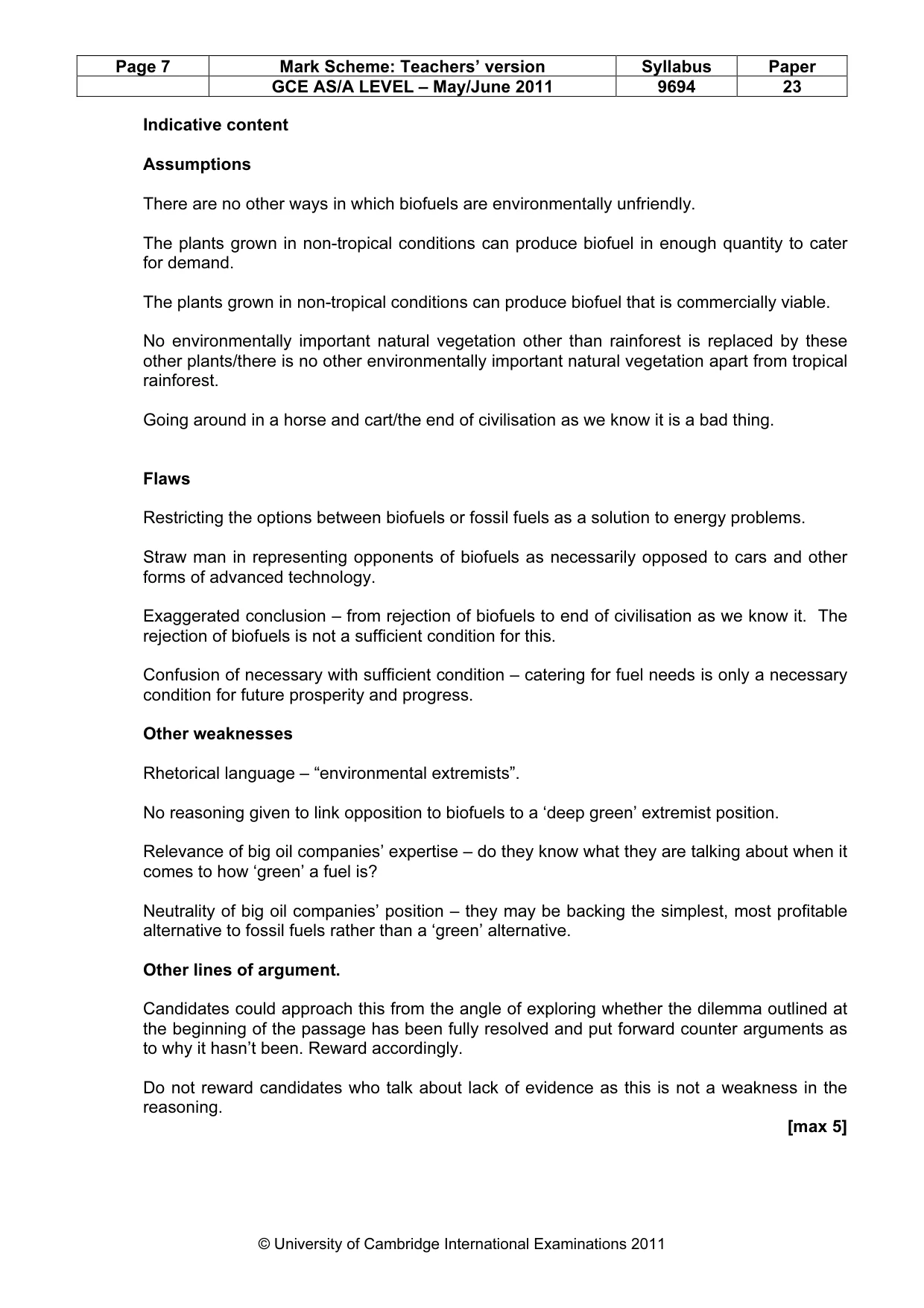
Page 7 Mark Scheme: Teachers’ version Syllabus Paper GCE AS/A LEVEL – May/June 2011 9694 23 © University of Cambridge International Examinations 2011 Indicative content Assumptions There are no other ways in which biofuels are environmentally unfriendly. The plants grown in non-tropical conditions can produce biofuel in enough quantity to cater for demand. The plants grown in non-tropical conditions can produce biofuel that is commercially viable. No environmentally important natural vegetation other than rainforest is replaced by these other plants/there is no other environmentally important natural vegetation apart from tropical rainforest. Going around in a horse and cart/the end of civilisation as we know it is a bad thing. Flaws Restricting the options between biofuels or fossil fuels as a solution to energy problems. Straw man in representing opponents of biofuels as necessarily opposed to cars and other forms of advanced technology. Exaggerated conclusion – from rejection of biofuels to end of civilisation as we know it. The rejection of biofuels is not a sufficient condition for this. Confusion of necessary with sufficient condition – catering for fuel needs is only a necessary condition for future prosperity and progress. Other weaknesses Rhetorical language – “environmental extremists”. No reasoning given to link opposition to biofuels to a ‘deep green’ extremist position. Relevance of big oil companies’ expertise – do they know what they are talking about when it comes to how ‘green’ a fuel is? Neutrality of big oil companies’ position – they may be backing the simplest, most profitable alternative to fossil fuels rather than a ‘green’ alternative. Other lines of argument. Candidates could approach this from the angle of exploring whether the dilemma outlined at the beginning of the passage has been fully resolved and put forward counter arguments as to why it hasn’t been. Reward accordingly. Do not reward candidates who talk about lack of evidence as this is not a weakness in the reasoning. [max 5]
Mark scheme, page 8
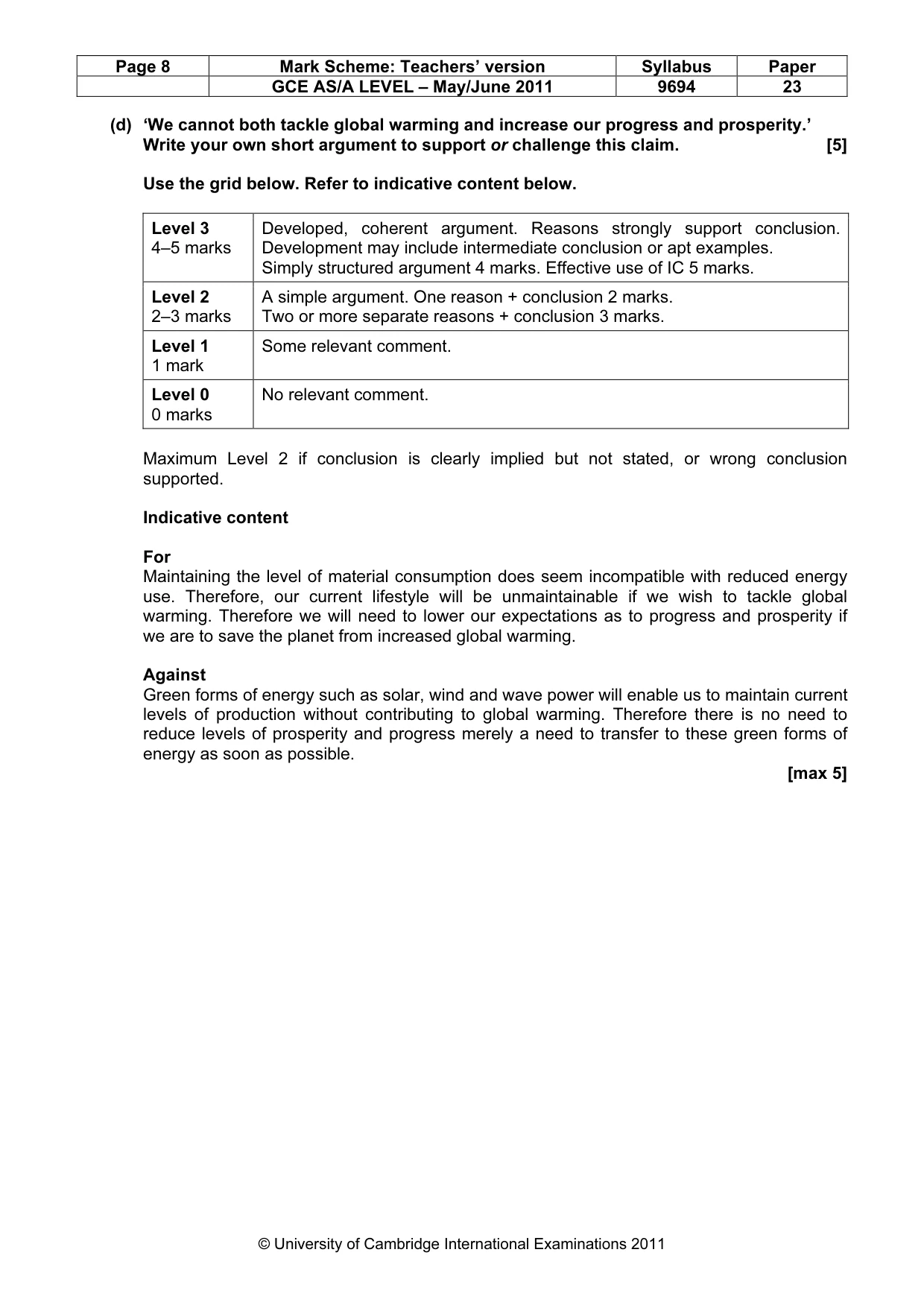
Page 8 Mark Scheme: Teachers’ version Syllabus Paper GCE AS/A LEVEL – May/June 2011 9694 23 © University of Cambridge International Examinations 2011 (d) ‘We cannot both tackle global warming and increase our progress and prosperity.’ Write your own short argument to support or challenge this claim. [5] Use the grid below. Refer to indicative content below. Level 3 4–5 marks Developed, coherent argument. Reasons strongly support conclusion. Development may include intermediate conclusion or apt examples. Simply structured argument 4 marks. Effective use of IC 5 marks. Level 2 2–3 marks A simple argument. One reason + conclusion 2 marks. Two or more separate reasons + conclusion 3 marks. Level 1 1 mark Some relevant comment. Level 0 0 marks No relevant comment. Maximum Level 2 if conclusion is clearly implied but not stated, or wrong conclusion supported. Indicative content For Maintaining the level of material consumption does seem incompatible with reduced energy use. Therefore, our current lifestyle will be unmaintainable if we wish to tackle global warming. Therefore we will need to lower our expectations as to progress and prosperity if we are to save the planet from increased global warming. Against Green forms of energy such as solar, wind and wave power will enable us to maintain current levels of production without contributing to global warming. Therefore there is no need to reduce levels of prosperity and progress merely a need to transfer to these green forms of energy as soon as possible. [max 5]
What you needed in this session
Cambridge’s own grade thresholds for 2011 May/June, Paper 2 · Variant 3. A higher threshold means an easier paper — the bar moves with how the cohort did.