Cambridge A Level Telugu (A Level only) 9690 — 2012 Oct/Nov Paper 5 · Variant 1
9690/51/O/N/12
The question paper and its mark scheme, free to read here and free to download. This is Cambridge’s own paper, exactly as it was sat.
Question paper2 pages
Mark scheme
No mark scheme is in the library for this paper.
Paper as text
Question paper, page 1
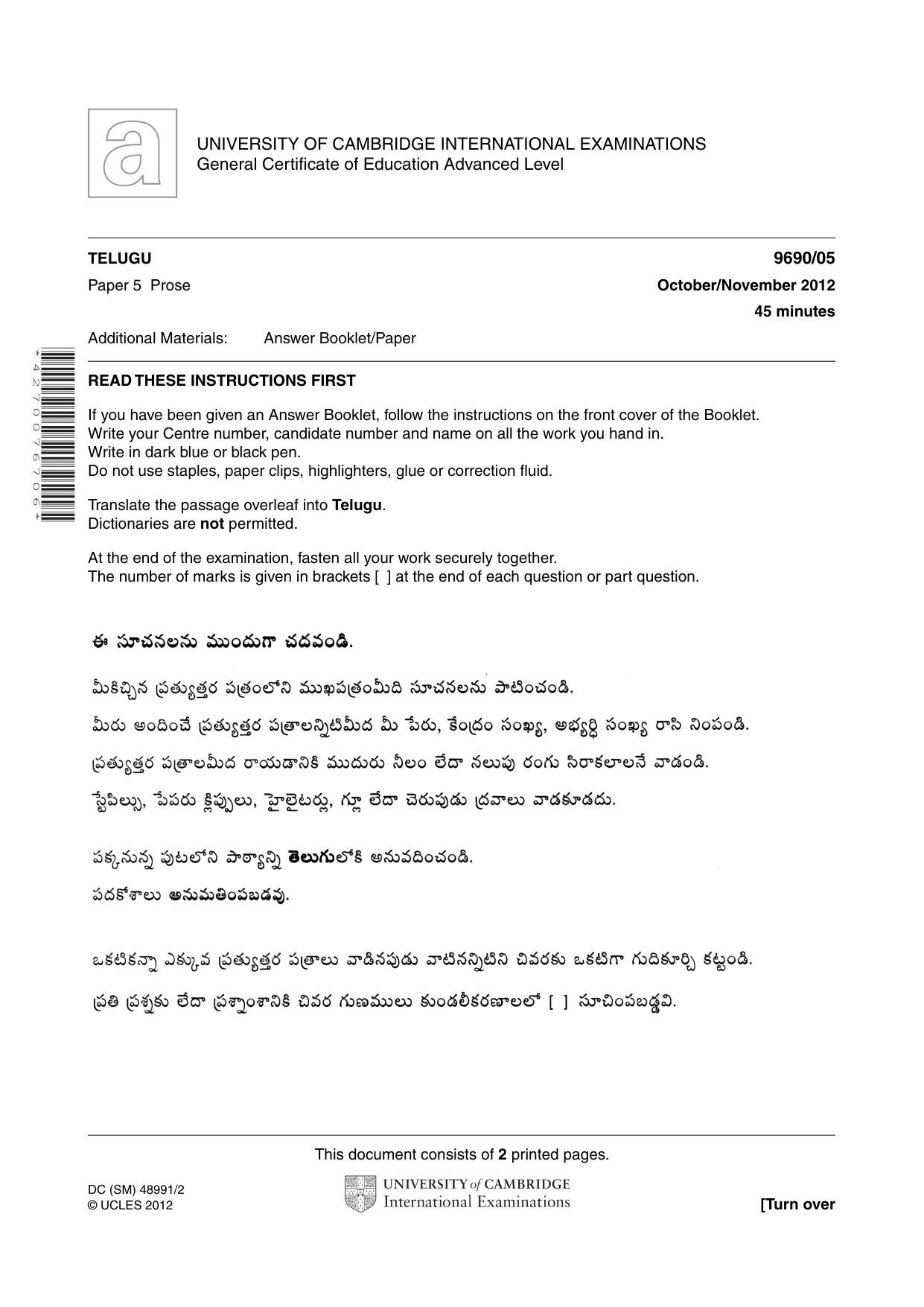
This document consists of 2 printed pages. DC (SM) 48991/2 © UCLES 2012 [Turn over UNIVERSITY OF CAMBRIDGE INTERNATIONAL EXAMINATIONS General Certificate of Education Advanced Level * 4 2 7 0 0 7 6 7 0 6 * TELUGU 9690/05 Paper 5 Prose October/November 2012 45 minutes Additional Materials: Answer Booklet/Paper READ THESE INSTRUCTIONS FIRST If you have been given an Answer Booklet, follow the instructions on the front cover of the Booklet. Write your Centre number, candidate number and name on all the work you hand in. Write in dark blue or black pen. Do not use staples, paper clips, highlighters, glue or correction fluid. Translate the passage overleaf into Telugu. Dictionaries are not permitted. At the end of the examination, fasten all your work securely together. The number of marks is given in brackets [ ] at the end of each question or part question.
Question paper, page 2
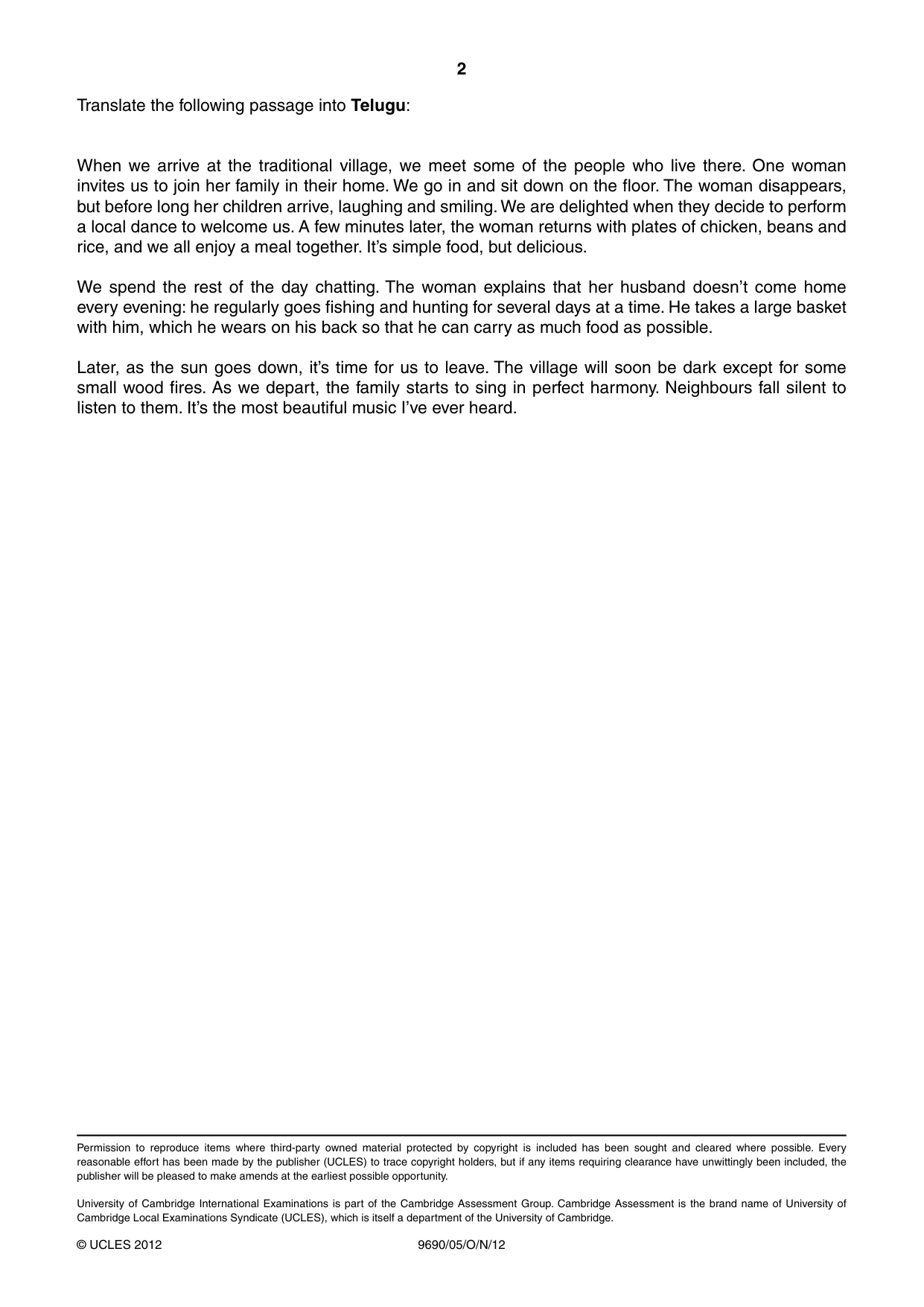
2 9690/05/O/N/12 © UCLES 2012 Permission to reproduce items where third-party owned material protected by copyright is included has been sought and cleared where possible. Every reasonable effort has been made by the publisher (UCLES) to trace copyright holders, but if any items requiring clearance have unwittingly been included, the publisher will be pleased to make amends at the earliest possible opportunity. University of Cambridge International Examinations is part of the Cambridge Assessment Group. Cambridge Assessment is the brand name of University of Cambridge Local Examinations Syndicate (UCLES), which is itself a department of the University of Cambridge. Translate the following passage into Telugu: When we arrive at the traditional village, we meet some of the people who live there. One woman invites us to join her family in their home. We go in and sit down on the floor. The woman disappears, but before long her children arrive, laughing and smiling. We are delighted when they decide to perform a local dance to welcome us. A few minutes later, the woman returns with plates of chicken, beans and rice, and we all enjoy a meal together. It’s simple food, but delicious. We spend the rest of the day chatting. The woman explains that her husband doesn’t come home every evening: he regularly goes fishing and hunting for several days at a time. He takes a large basket with him, which he wears on his back so that he can carry as much food as possible. Later, as the sun goes down, it’s time for us to leave. The village will soon be dark except for some small wood fires. As we depart, the family starts to sing in perfect harmony. Neighbours fall silent to listen to them. It’s the most beautiful music I’ve ever heard.