Cambridge A Level Telugu (A Level only) 9690 — 2011 Oct/Nov Paper 5 · Variant 1
9690/51/O/N/11
The question paper and its mark scheme, free to read here and free to download. This is Cambridge’s own paper, exactly as it was sat.
Question paper2 pages
Mark scheme
No mark scheme is in the library for this paper.
Paper as text
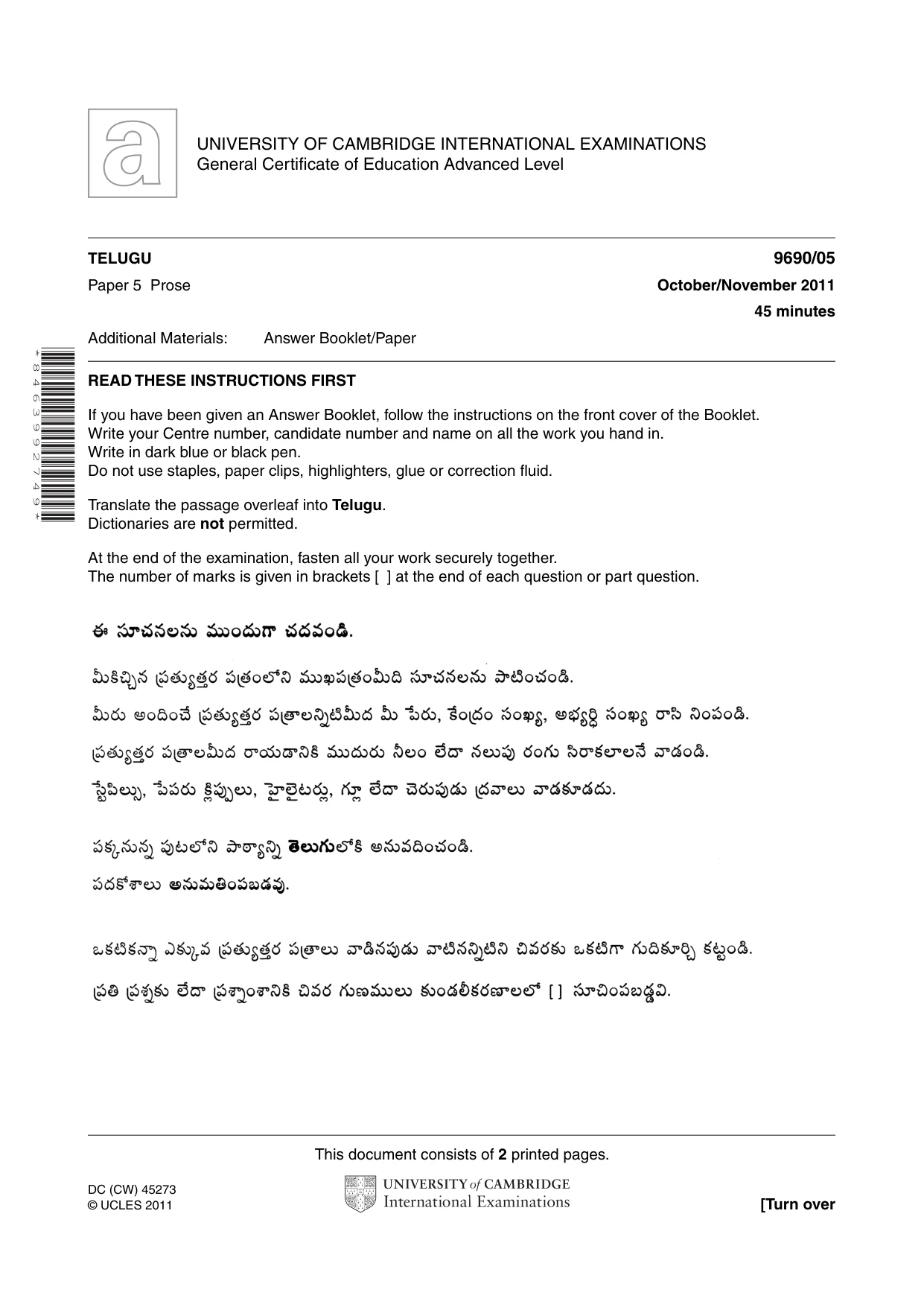
Question paper, page 1
This document consists of 2 printed pages. DC (CW) 45273 © UCLES 2011 [Turn over UNIVERSITY OF CAMBRIDGE INTERNATIONAL EXAMINATIONS General Certificate of Education Advanced Level * 8 4 6 3 9 9 2 7 4 9 * TELUGU 9690/05 Paper 5 Prose October/November 2011 45 minutes Additional Materials: Answer Booklet/Paper READ THESE INSTRUCTIONS FIRST If you have been given an Answer Booklet, follow the instructions on the front cover of the Booklet. Write your Centre number, candidate number and name on all the work you hand in. Write in dark blue or black pen. Do not use staples, paper clips, highlighters, glue or correction fluid. Translate the passage overleaf into Telugu. Dictionaries are not permitted. At the end of the examination, fasten all your work securely together. The number of marks is given in brackets [ ] at the end of each question or part question.
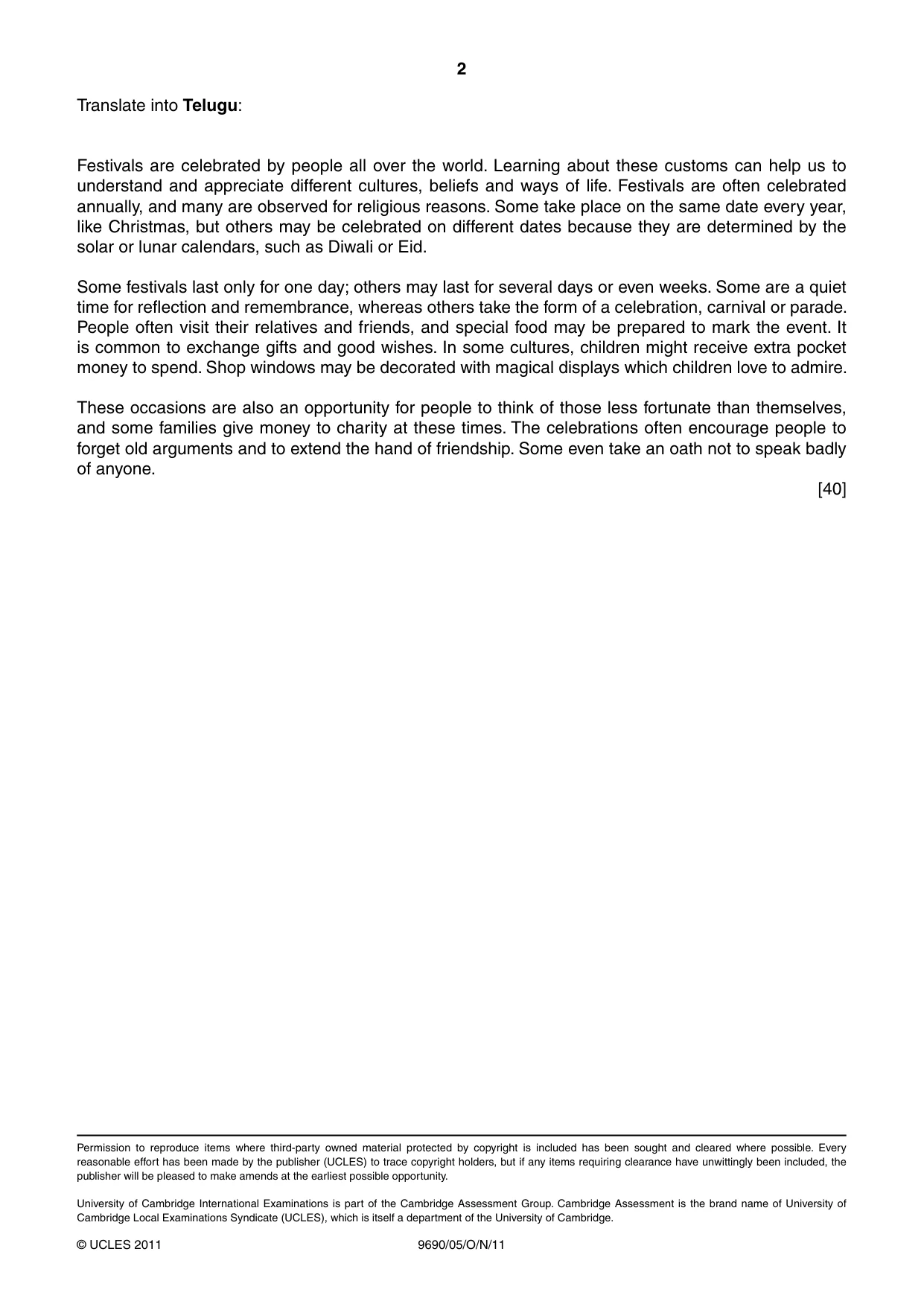
Question paper, page 2
2 9690/05/O/N/11 © UCLES 2011 Permission to reproduce items where third-party owned material protected by copyright is included has been sought and cleared where possible. Every reasonable effort has been made by the publisher (UCLES) to trace copyright holders, but if any items requiring clearance have unwittingly been included, the publisher will be pleased to make amends at the earliest possible opportunity. University of Cambridge International Examinations is part of the Cambridge Assessment Group. Cambridge Assessment is the brand name of University of Cambridge Local Examinations Syndicate (UCLES), which is itself a department of the University of Cambridge. Translate into Telugu: Festivals are celebrated by people all over the world. Learning about these customs can help us to understand and appreciate different cultures, beliefs and ways of life. Festivals are often celebrated annually, and many are observed for religious reasons. Some take place on the same date every year, like Christmas, but others may be celebrated on different dates because they are determined by the solar or lunar calendars, such as Diwali or Eid. Some festivals last only for one day; others may last for several days or even weeks. Some are a quiet time for reflection and remembrance, whereas others take the form of a celebration, carnival or parade. People often visit their relatives and friends, and special food may be prepared to mark the event. It is common to exchange gifts and good wishes. In some cultures, children might receive extra pocket money to spend. Shop windows may be decorated with magical displays which children love to admire. These occasions are also an opportunity for people to think of those less fortunate than themselves, and some families give money to charity at these times. The celebrations often encourage people to forget old arguments and to extend the hand of friendship. Some even take an oath not to speak badly of anyone. [40]