Cambridge A Level Spanish - Literature (AS Level only) 8673 — 2020 May/June Paper 4 · Variant 1
8673/41/M/J/20
The question paper and its mark scheme, free to read here and free to download. This is Cambridge’s own paper, exactly as it was sat.
Question paper8 pages

Mark scheme4 pages
Answers below. Sit the paper first if you are practising.
Paper as text
Question paper, page 1
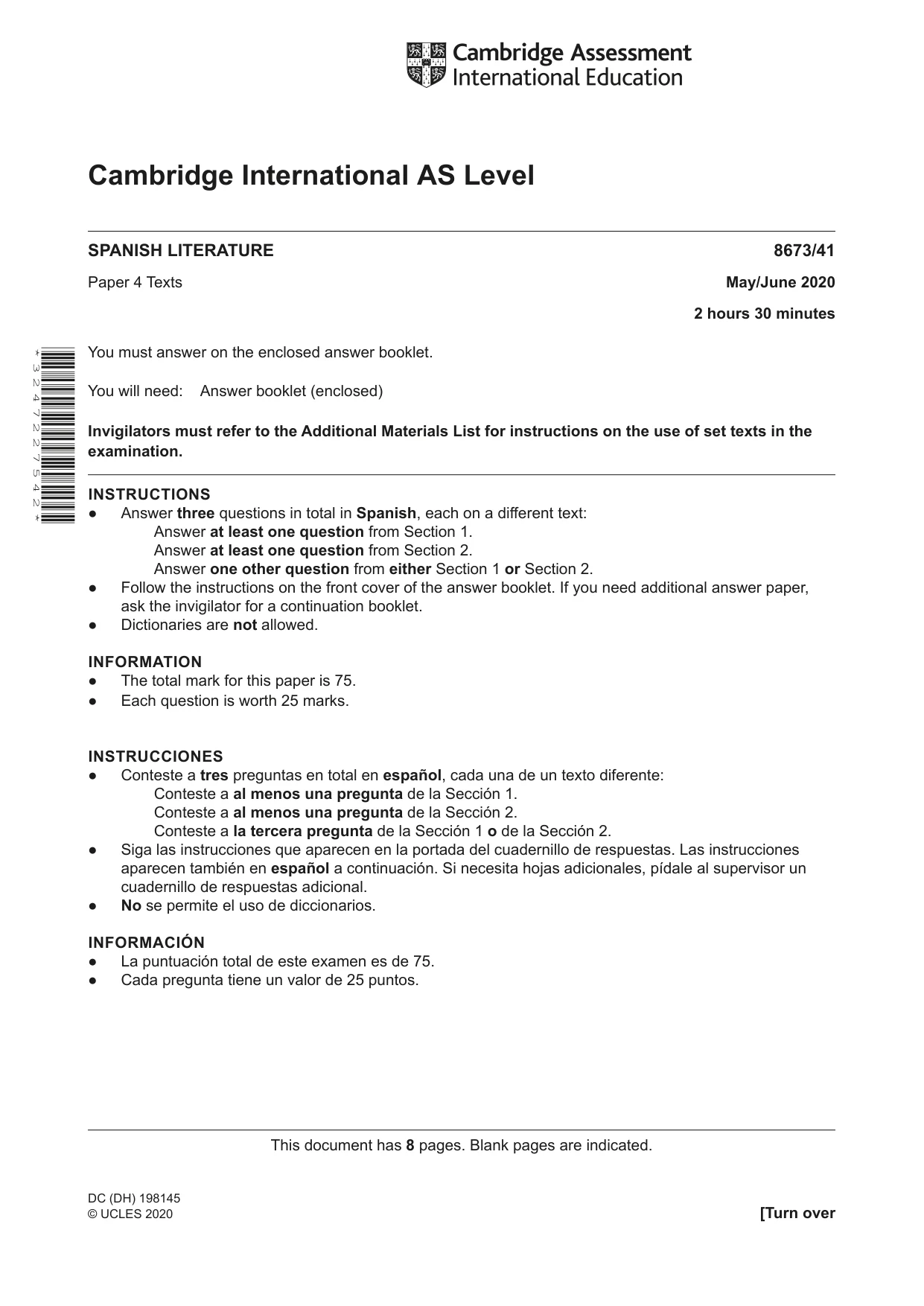
Cambridge International AS Level DC (DH) 198145 © UCLES 2020 [Turn over This document has 8 pages. Blank pages are indicated. * 3 2 4 7 2 2 7 5 4 2 * SPANISH LITERATURE 8673/41 Paper 4 Texts May/June 2020 2 hours 30 minutes You must answer on the enclosed answer booklet. You will need: Answer booklet (enclosed) Invigilators must refer to the Additional Materials List for instructions on the use of set texts in the examination. INSTRUCTIONS ● Answer three questions in total in Spanish, each on a different text: Answer at least one question from Section 1. Answer at least one question from Section 2. Answer one other question from either Section 1 or Section 2. ● Follow the instructions on the front cover of the answer booklet. If you need additional answer paper, ask the invigilator for a continuation booklet. ● Dictionaries are not allowed. INFORMATION ● The total mark for this paper is 75. ● Each question is worth 25 marks. INSTRUCCIONES ● Conteste a tres preguntas en total en español, cada una de un texto diferente: Conteste a al menos una pregunta de la Sección 1. Conteste a al menos una pregunta de la Sección 2. Conteste a la tercera pregunta de la Sección 1 o de la Sección 2. ● Siga las instrucciones que aparecen en la portada del cuadernillo de respuestas. Las instrucciones aparecen también en español a continuación. Si necesita hojas adicionales, pídale al supervisor un cuadernillo de respuestas adicional. ● No se permite el uso de diccionarios. INFORMACIÓN ● La puntuación total de este examen es de 75. ● Cada pregunta tiene un valor de 25 puntos.
Question paper, page 2
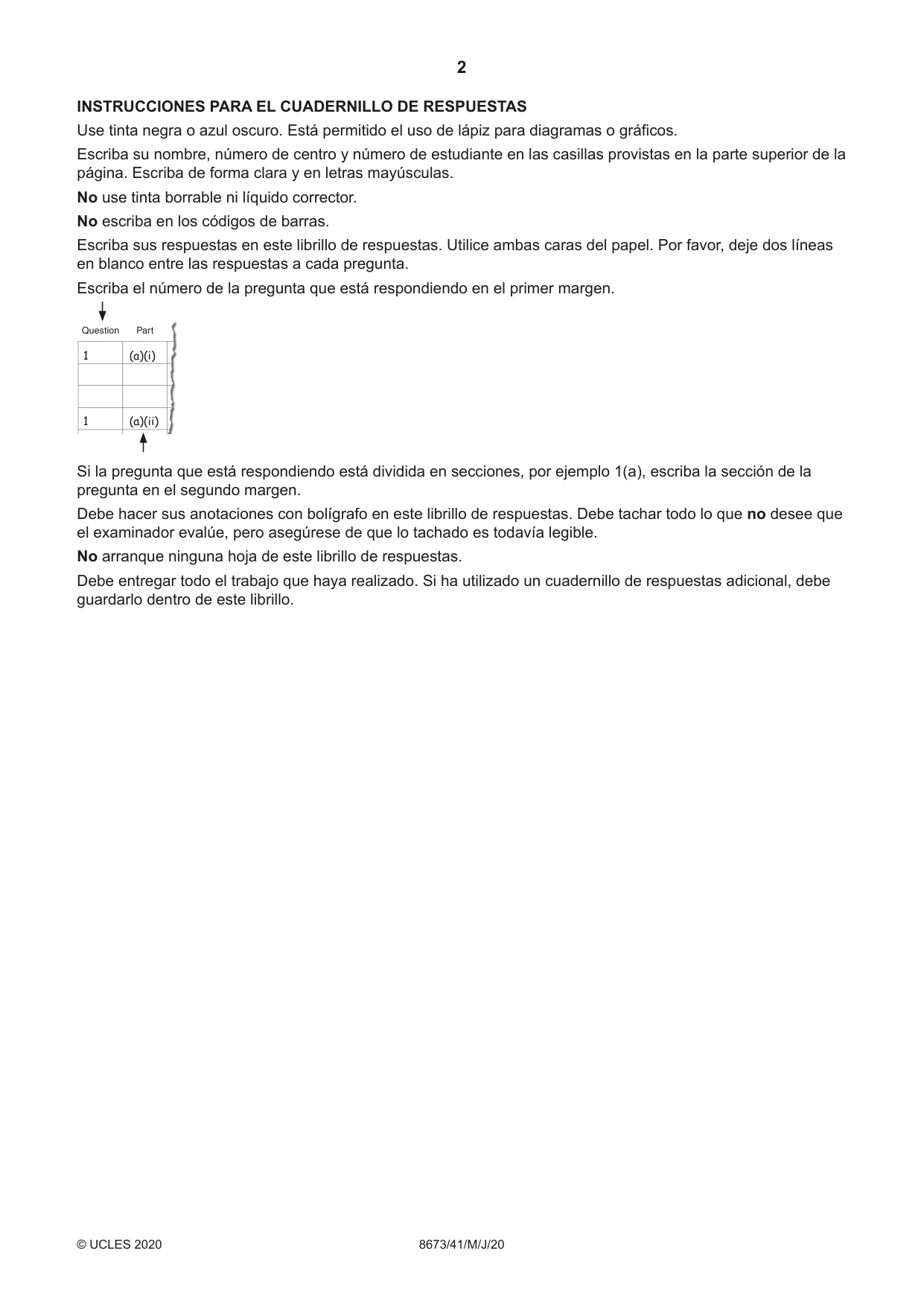
2 8673/41/M/J/20 © UCLES 2020 INSTRUCCIONES PARA EL CUADERNILLO DE RESPUESTAS Use tinta negra o azul oscuro. Está permitido el uso de lápiz para diagramas o gráficos. Escriba su nombre, número de centro y número de estudiante en las casillas provistas en la parte superior de la página. Escriba de forma clara y en letras mayúsculas. No use tinta borrable ni líquido corrector. No escriba en los códigos de barras. Escriba sus respuestas en este librillo de respuestas. Utilice ambas caras del papel. Por favor, deje dos líneas en blanco entre las respuestas a cada pregunta. Escriba el número de la pregunta que está respondiendo en el primer margen. Question Part 1 1 (a)(i) (a)(ii) Si la pregunta que está respondiendo está dividida en secciones, por ejemplo 1(a), escriba la sección de la pregunta en el segundo margen. Debe hacer sus anotaciones con bolígrafo en este librillo de respuestas. Debe tachar todo lo que no desee que el examinador evalúe, pero asegúrese de que lo tachado es todavía legible. No arranque ninguna hoja de este librillo de respuestas. Debe entregar todo el trabajo que haya realizado. Si ha utilizado un cuadernillo de respuestas adicional, debe guardarlo dentro de este librillo.
Question paper, page 3
3 8673/41/M/J/20 © UCLES 2020 [Turn over BLANK PAGE
Question paper, page 4
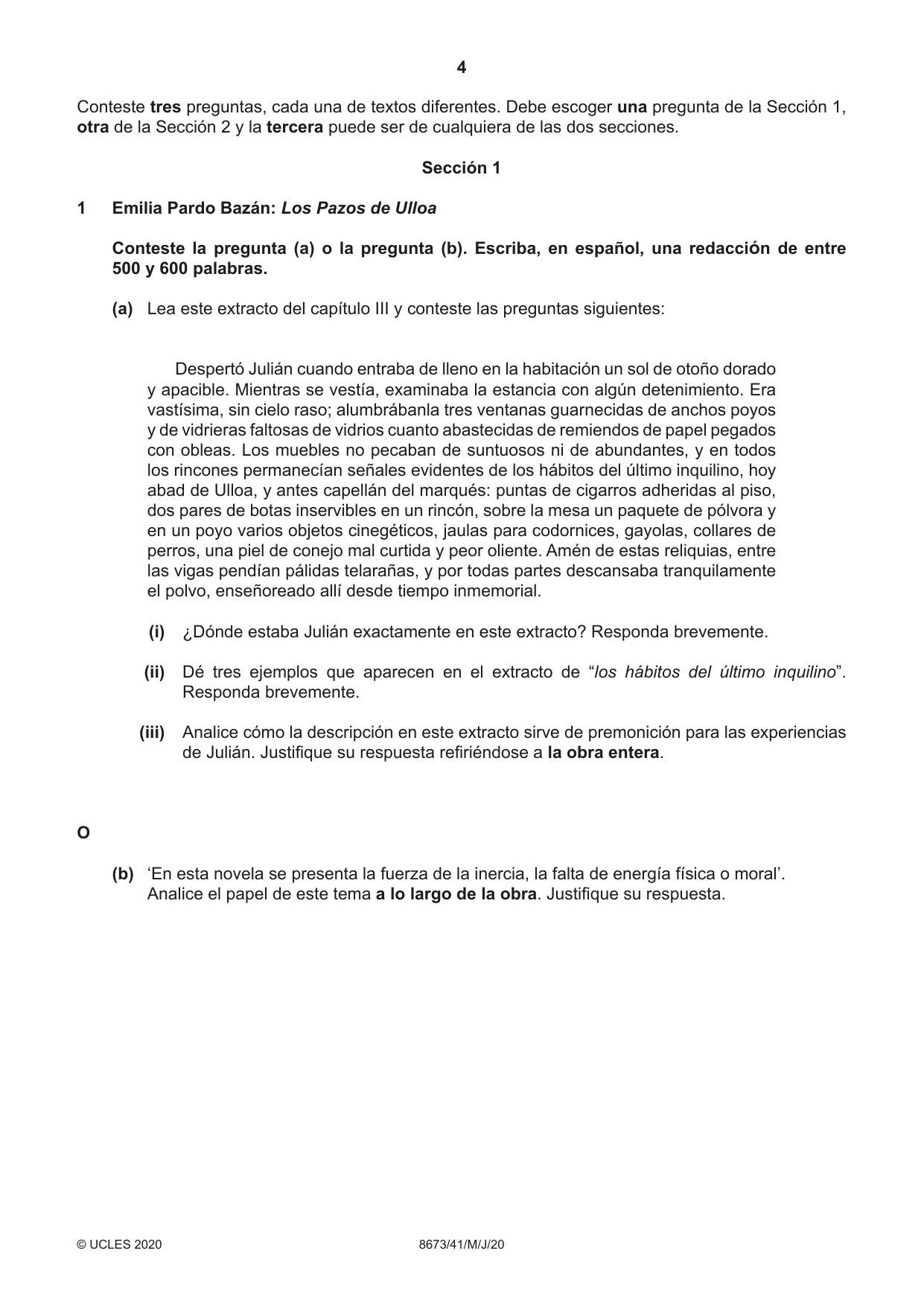
4 8673/41/M/J/20 © UCLES 2020 Conteste tres preguntas, cada una de textos diferentes. Debe escoger una pregunta de la Sección 1, otra de la Sección 2 y la tercera puede ser de cualquiera de las dos secciones. Sección 1 1 Emilia Pardo Bazán: Los Pazos de Ulloa Conteste la pregunta (a) o la pregunta (b). Escriba, en español, una redacción de entre 500 y 600 palabras. (a) Lea este extracto del capítulo III y conteste las preguntas siguientes: Despertó Julián cuando entraba de lleno en la habitación un sol de otoño dorado y apacible. Mientras se vestía, examinaba la estancia con algún detenimiento. Era vastísima, sin cielo raso; alumbrábanla tres ventanas guarnecidas de anchos poyos y de vidrieras faltosas de vidrios cuanto abastecidas de remiendos de papel pegados con obleas. Los muebles no pecaban de suntuosos ni de abundantes, y en todos los rincones permanecían señales evidentes de los hábitos del último inquilino, hoy abad de Ulloa, y antes capellán del marqués: puntas de cigarros adheridas al piso, dos pares de botas inservibles en un rincón, sobre la mesa un paquete de pólvora y en un poyo varios objetos cinegéticos, jaulas para codornices, gayolas, collares de perros, una piel de conejo mal curtida y peor oliente. Amén de estas reliquias, entre las vigas pendían pálidas telarañas, y por todas partes descansaba tranquilamente el polvo, enseñoreado allí desde tiempo inmemorial. (i) ¿Dónde estaba Julián exactamente en este extracto? Responda brevemente. (ii) Dé tres ejemplos que aparecen en el extracto de “los hábitos del último inquilino”. Responda brevemente. (iii) Analice cómo la descripción en este extracto sirve de premonición para las experiencias de Julián. Justifique su respuesta refiriéndose a la obra entera. O (b) ‘En esta novela se presenta la fuerza de la inercia, la falta de energía física o moral’. Analice el papel de este tema a lo largo de la obra. Justifique su respuesta.
Question paper, page 5
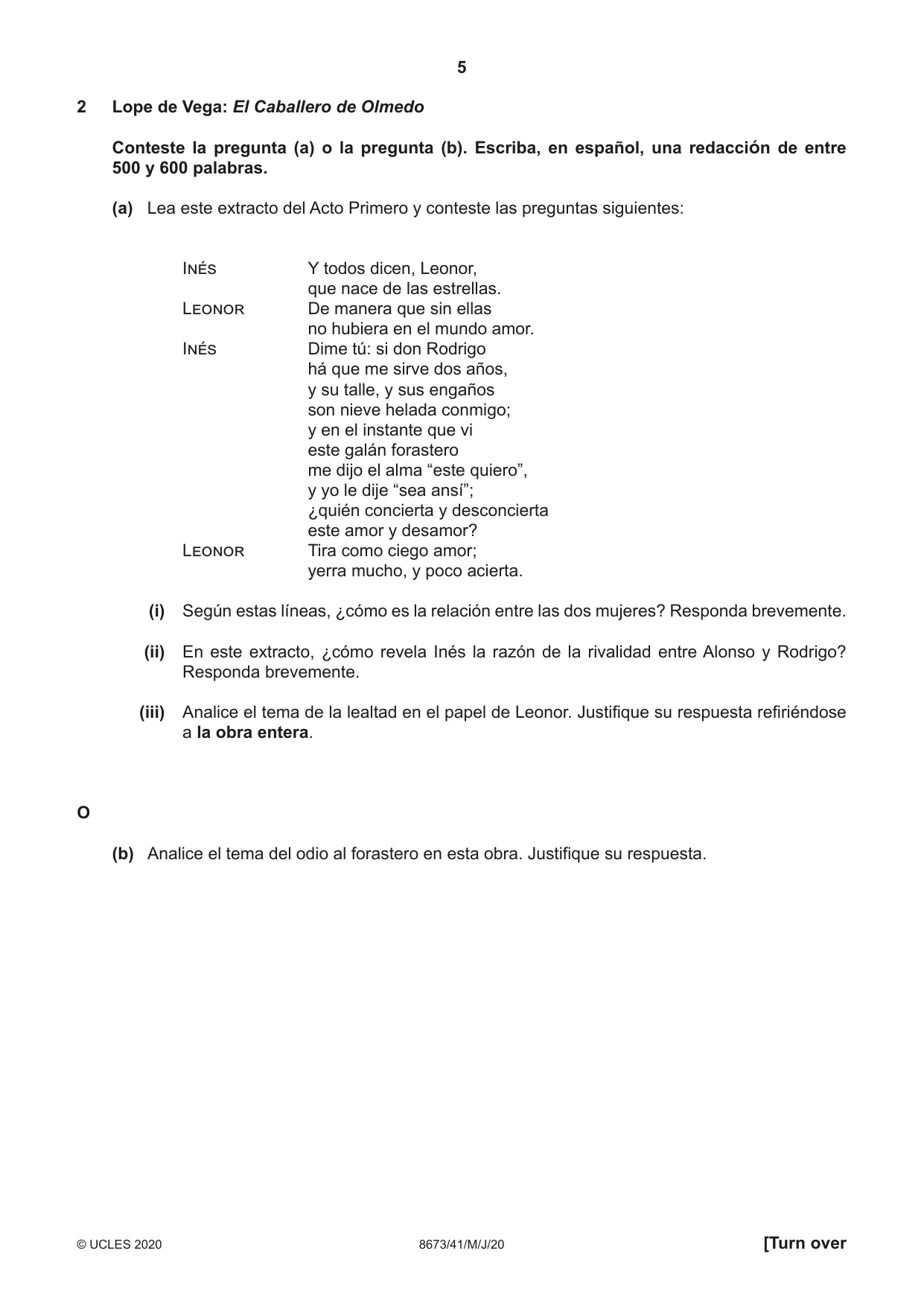
5 8673/41/M/J/20 © UCLES 2020 [Turn over 2 Lope de Vega: El Caballero de Olmedo Conteste la pregunta (a) o la pregunta (b). Escriba, en español, una redacción de entre 500 y 600 palabras. (a) Lea este extracto del Acto Primero y conteste las preguntas siguientes: Inés Y todos dicen, Leonor, que nace de las estrellas. Leonor De manera que sin ellas no hubiera en el mundo amor. Inés Dime tú: si don Rodrigo há que me sirve dos años, y su talle, y sus engaños son nieve helada conmigo; y en el instante que vi este galán forastero me dijo el alma “este quiero”, y yo le dije “sea ansí”; ¿quién concierta y desconcierta este amor y desamor? Leonor Tira como ciego amor; yerra mucho, y poco acierta. (i) Según estas líneas, ¿cómo es la relación entre las dos mujeres? Responda brevemente. (ii) En este extracto, ¿cómo revela Inés la razón de la rivalidad entre Alonso y Rodrigo? Responda brevemente. (iii) Analice el tema de la lealtad en el papel de Leonor. Justifique su respuesta refiriéndose a la obra entera. O (b) Analice el tema del odio al forastero en esta obra. Justifique su respuesta.
Question paper, page 6
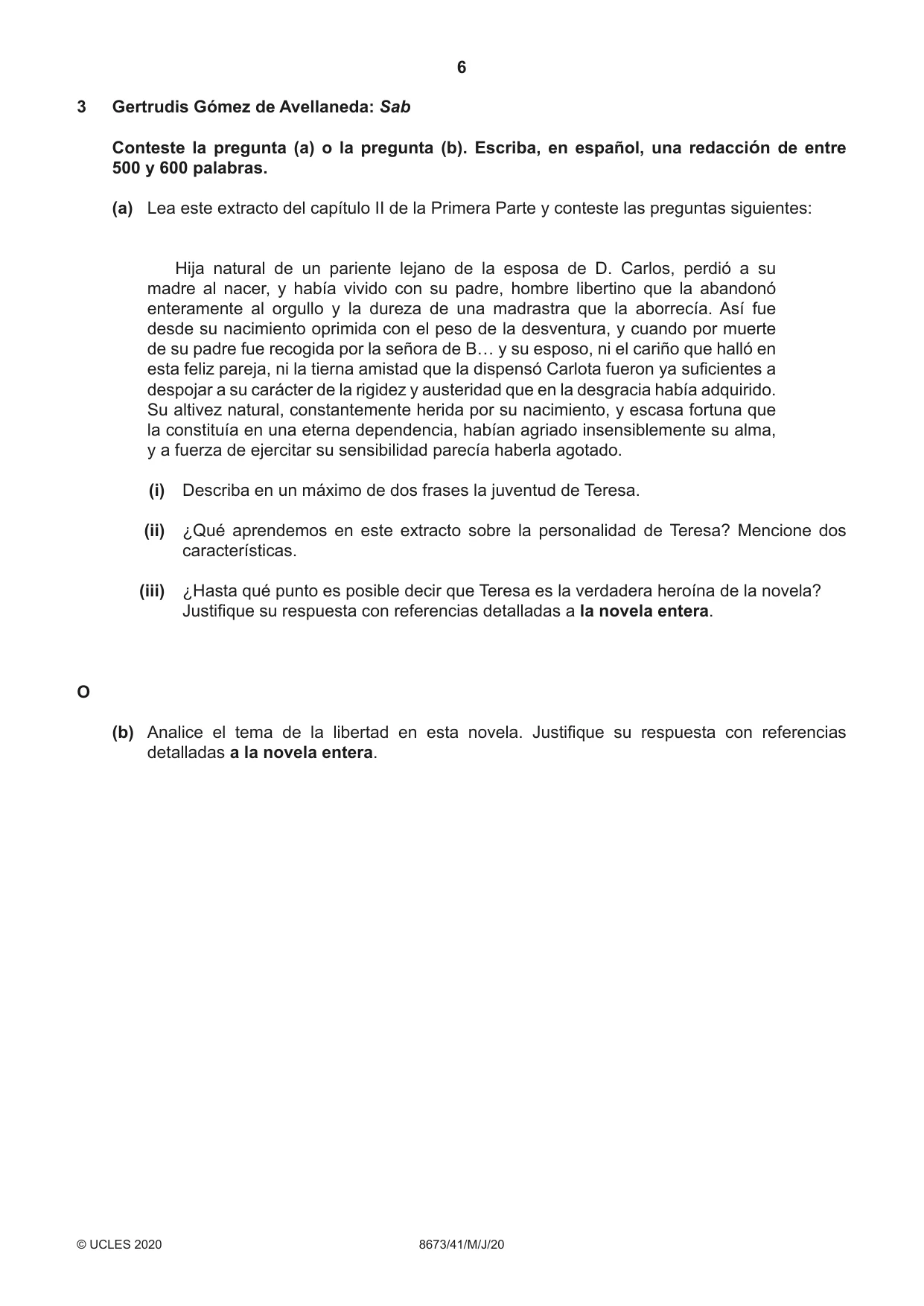
6 8673/41/M/J/20 © UCLES 2020 3 Gertrudis Gómez de Avellaneda: Sab Conteste la pregunta (a) o la pregunta (b). Escriba, en español, una redacción de entre 500 y 600 palabras. (a) Lea este extracto del capítulo II de la Primera Parte y conteste las preguntas siguientes: Hija natural de un pariente lejano de la esposa de D. Carlos, perdió a su madre al nacer, y había vivido con su padre, hombre libertino que la abandonó enteramente al orgullo y la dureza de una madrastra que la aborrecía. Así fue desde su nacimiento oprimida con el peso de la desventura, y cuando por muerte de su padre fue recogida por la señora de B… y su esposo, ni el cariño que halló en esta feliz pareja, ni la tierna amistad que la dispensó Carlota fueron ya suficientes a despojar a su carácter de la rigidez y austeridad que en la desgracia había adquirido. Su altivez natural, constantemente herida por su nacimiento, y escasa fortuna que la constituía en una eterna dependencia, habían agriado insensiblemente su alma, y a fuerza de ejercitar su sensibilidad parecía haberla agotado. (i) Describa en un máximo de dos frases la juventud de Teresa. (ii) ¿Qué aprendemos en este extracto sobre la personalidad de Teresa? Mencione dos características. (iii) ¿Hasta qué punto es posible decir que Teresa es la verdadera heroína de la novela? Justifique su respuesta con referencias detalladas a la novela entera. O (b) Analice el tema de la libertad en esta novela. Justifique su respuesta con referencias detalladas a la novela entera.
Question paper, page 7
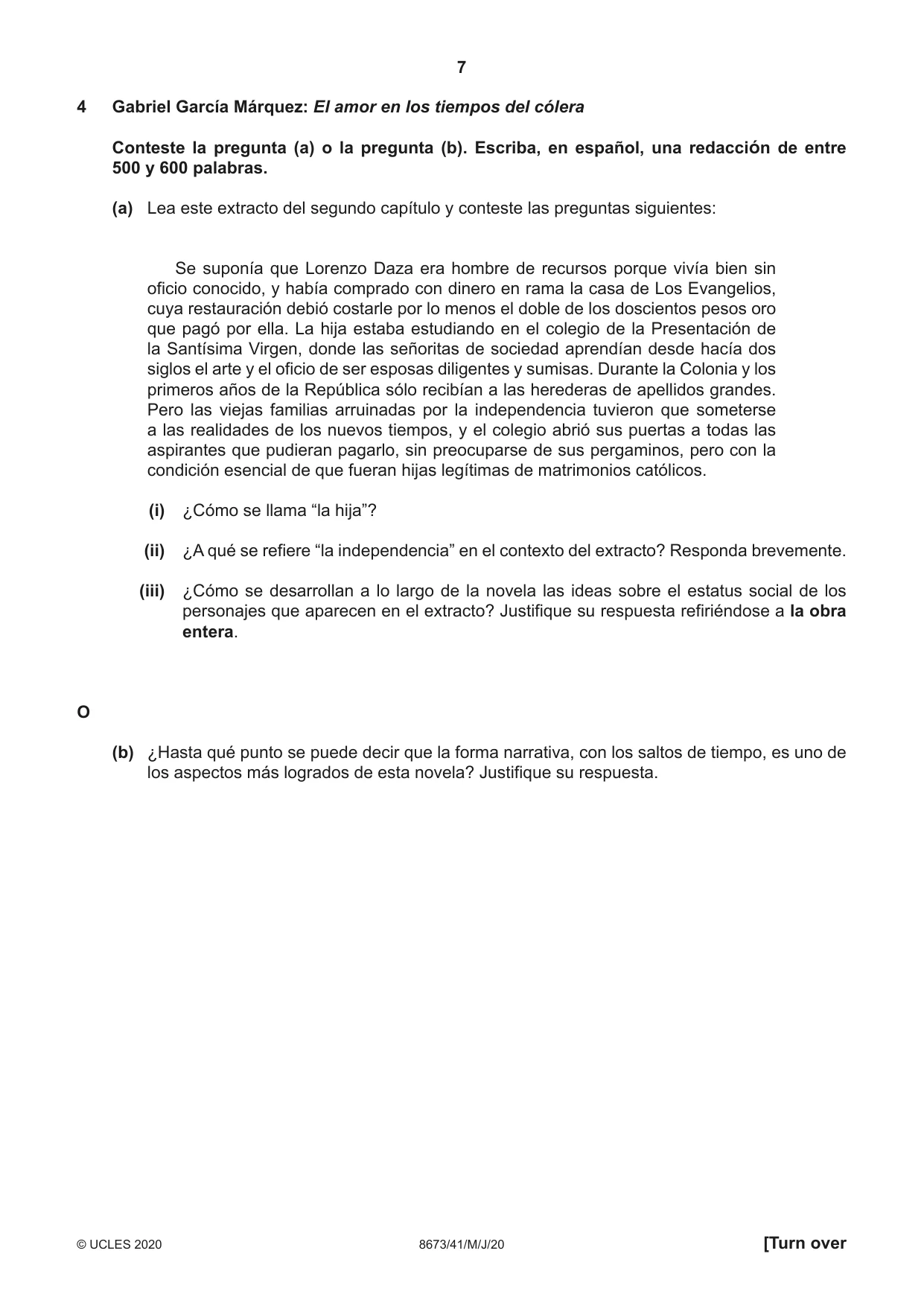
7 8673/41/M/J/20 © UCLES 2020 [Turn over 4 Gabriel García Márquez: El amor en los tiempos del cólera Conteste la pregunta (a) o la pregunta (b). Escriba, en español, una redacción de entre 500 y 600 palabras. (a) Lea este extracto del segundo capítulo y conteste las preguntas siguientes: Se suponía que Lorenzo Daza era hombre de recursos porque vivía bien sin oficio conocido, y había comprado con dinero en rama la casa de Los Evangelios, cuya restauración debió costarle por lo menos el doble de los doscientos pesos oro que pagó por ella. La hija estaba estudiando en el colegio de la Presentación de la Santísima Virgen, donde las señoritas de sociedad aprendían desde hacía dos siglos el arte y el oficio de ser esposas diligentes y sumisas. Durante la Colonia y los primeros años de la República sólo recibían a las herederas de apellidos grandes. Pero las viejas familias arruinadas por la independencia tuvieron que someterse a las realidades de los nuevos tiempos, y el colegio abrió sus puertas a todas las aspirantes que pudieran pagarlo, sin preocuparse de sus pergaminos, pero con la condición esencial de que fueran hijas legítimas de matrimonios católicos. (i) ¿Cómo se llama “la hija”? (ii) ¿A qué se refiere “la independencia” en el contexto del extracto? Responda brevemente. (iii) ¿Cómo se desarrollan a lo largo de la novela las ideas sobre el estatus social de los personajes que aparecen en el extracto? Justifique su respuesta refiriéndose a la obra entera. O (b) ¿Hasta qué punto se puede decir que la forma narrativa, con los saltos de tiempo, es uno de los aspectos más logrados de esta novela? Justifique su respuesta.
Question paper, page 8
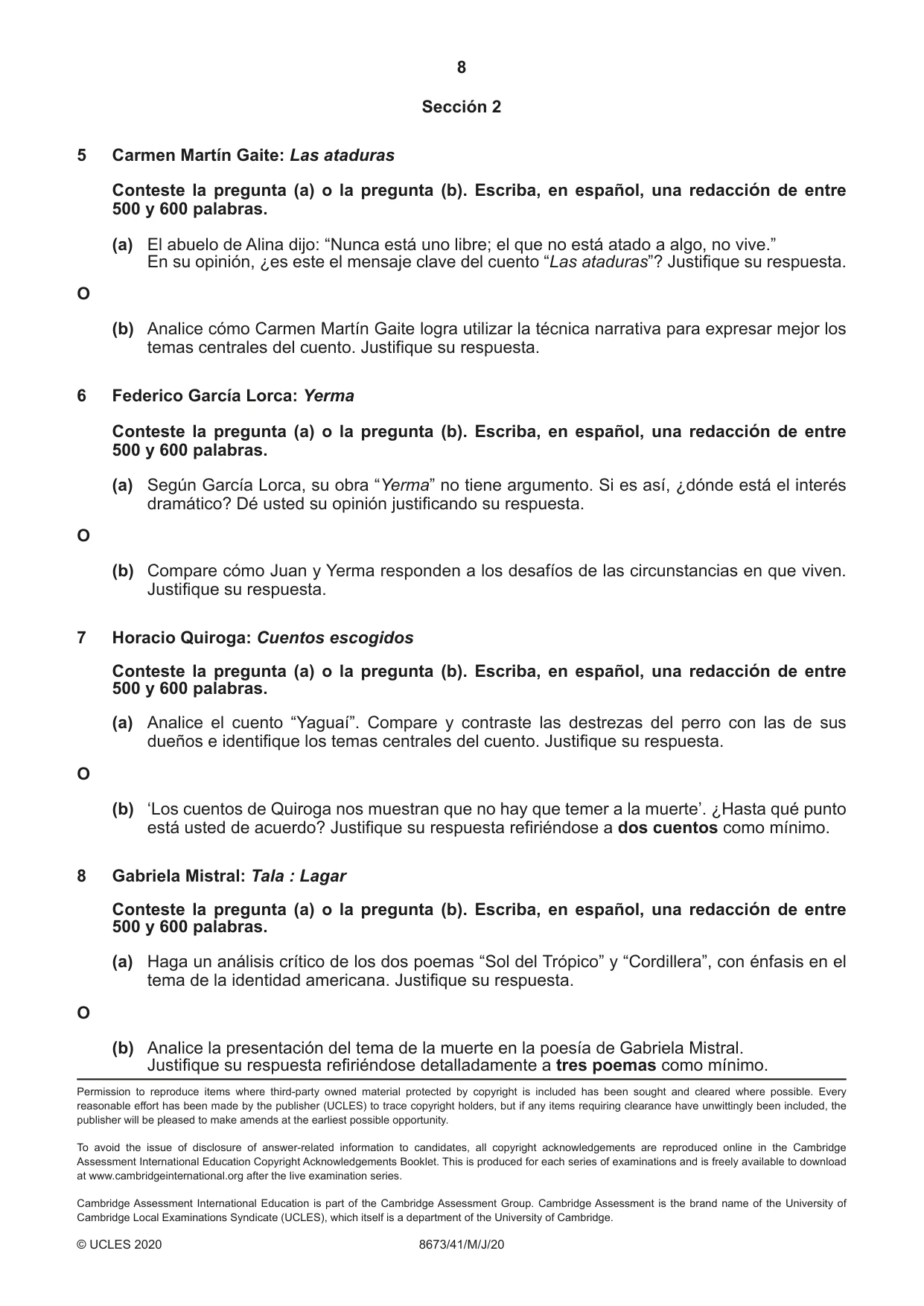
8 8673/41/M/J/20 © UCLES 2020 Permission to reproduce items where third-party owned material protected by copyright is included has been sought and cleared where possible. Every reasonable effort has been made by the publisher (UCLES) to trace copyright holders, but if any items requiring clearance have unwittingly been included, the publisher will be pleased to make amends at the earliest possible opportunity. To avoid the issue of disclosure of answer-related information to candidates, all copyright acknowledgements are reproduced online in the Cambridge Assessment International Education Copyright Acknowledgements Booklet. This is produced for each series of examinations and is freely available to download at www.cambridgeinternational.org after the live examination series. Cambridge Assessment International Education is part of the Cambridge Assessment Group. Cambridge Assessment is the brand name of the University of Cambridge Local Examinations Syndicate (UCLES), which itself is a department of the University of Cambridge. Sección 2 5 Carmen Martín Gaite: Las ataduras Conteste la pregunta (a) o la pregunta (b). Escriba, en español, una redacción de entre 500 y 600 palabras. (a) El abuelo de Alina dijo: “Nunca está uno libre; el que no está atado a algo, no vive.” En su opinión, ¿es este el mensaje clave del cuento “Las ataduras”? Justifique su respuesta. O (b) Analice cómo Carmen Martín Gaite logra utilizar la técnica narrativa para expresar mejor los temas centrales del cuento. Justifique su respuesta. 6 Federico García Lorca: Yerma Conteste la pregunta (a) o la pregunta (b). Escriba, en español, una redacción de entre 500 y 600 palabras. (a) Según García Lorca, su obra “Yerma” no tiene argumento. Si es así, ¿dónde está el interés dramático? Dé usted su opinión justificando su respuesta. O (b) Compare cómo Juan y Yerma responden a los desafíos de las circunstancias en que viven. Justifique su respuesta. 7 Horacio Quiroga: Cuentos escogidos Conteste la pregunta (a) o la pregunta (b). Escriba, en español, una redacción de entre 500 y 600 palabras. (a) Analice el cuento “Yaguaí”. Compare y contraste las destrezas del perro con las de sus dueños e identifique los temas centrales del cuento. Justifique su respuesta. O (b) ‘Los cuentos de Quiroga nos muestran que no hay que temer a la muerte’. ¿Hasta qué punto está usted de acuerdo? Justifique su respuesta refiriéndose a dos cuentos como mínimo. 8 Gabriela Mistral: Tala : Lagar Conteste la pregunta (a) o la pregunta (b). Escriba, en español, una redacción de entre 500 y 600 palabras. (a) Haga un análisis crítico de los dos poemas “Sol del Trópico” y “Cordillera”, con énfasis en el tema de la identidad americana. Justifique su respuesta. O (b) Analice la presentación del tema de la muerte en la poesía de Gabriela Mistral. Justifique su respuesta refiriéndose detalladamente a tres poemas como mínimo.
Mark scheme, page 1
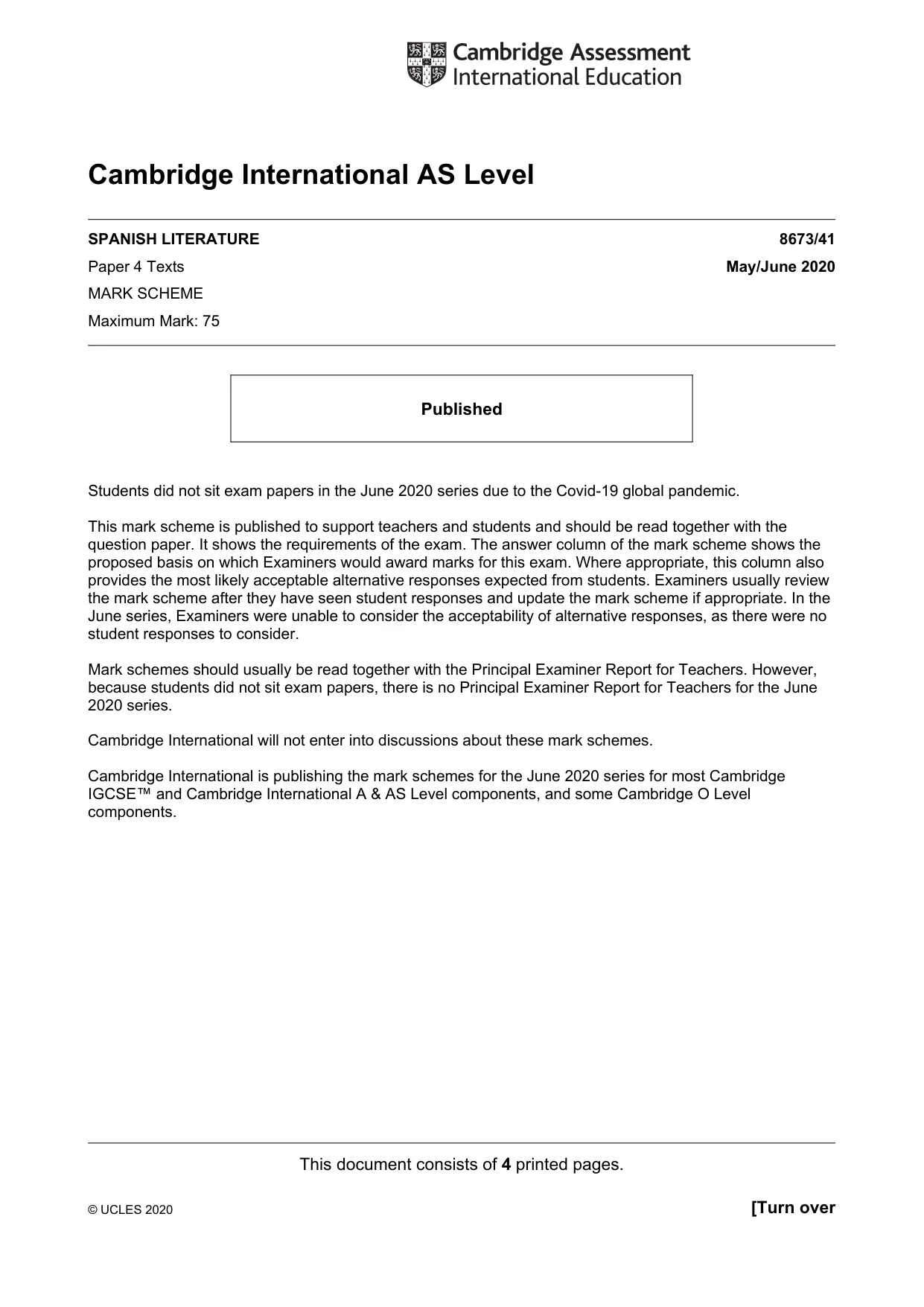
This document consists of 4 printed pages. © UCLES 2020 [Turn over Cambridge International AS Level SPANISH LITERATURE 8673/41 Paper 4 Texts May/June 2020 MARK SCHEME Maximum Mark: 75 Published Students did not sit exam papers in the June 2020 series due to the Covid-19 global pandemic. This mark scheme is published to support teachers and students and should be read together with the question paper. It shows the requirements of the exam. The answer column of the mark scheme shows the proposed basis on which Examiners would award marks for this exam. Where appropriate, this column also provides the most likely acceptable alternative responses expected from students. Examiners usually review the mark scheme after they have seen student responses and update the mark scheme if appropriate. In the June series, Examiners were unable to consider the acceptability of alternative responses, as there were no student responses to consider. Mark schemes should usually be read together with the Principal Examiner Report for Teachers. However, because students did not sit exam papers, there is no Principal Examiner Report for Teachers for the June 2020 series. Cambridge International will not enter into discussions about these mark schemes. Cambridge International is publishing the mark schemes for the June 2020 series for most Cambridge IGCSE™ and Cambridge International A & AS Level components, and some Cambridge O Level components.
Mark scheme, page 2
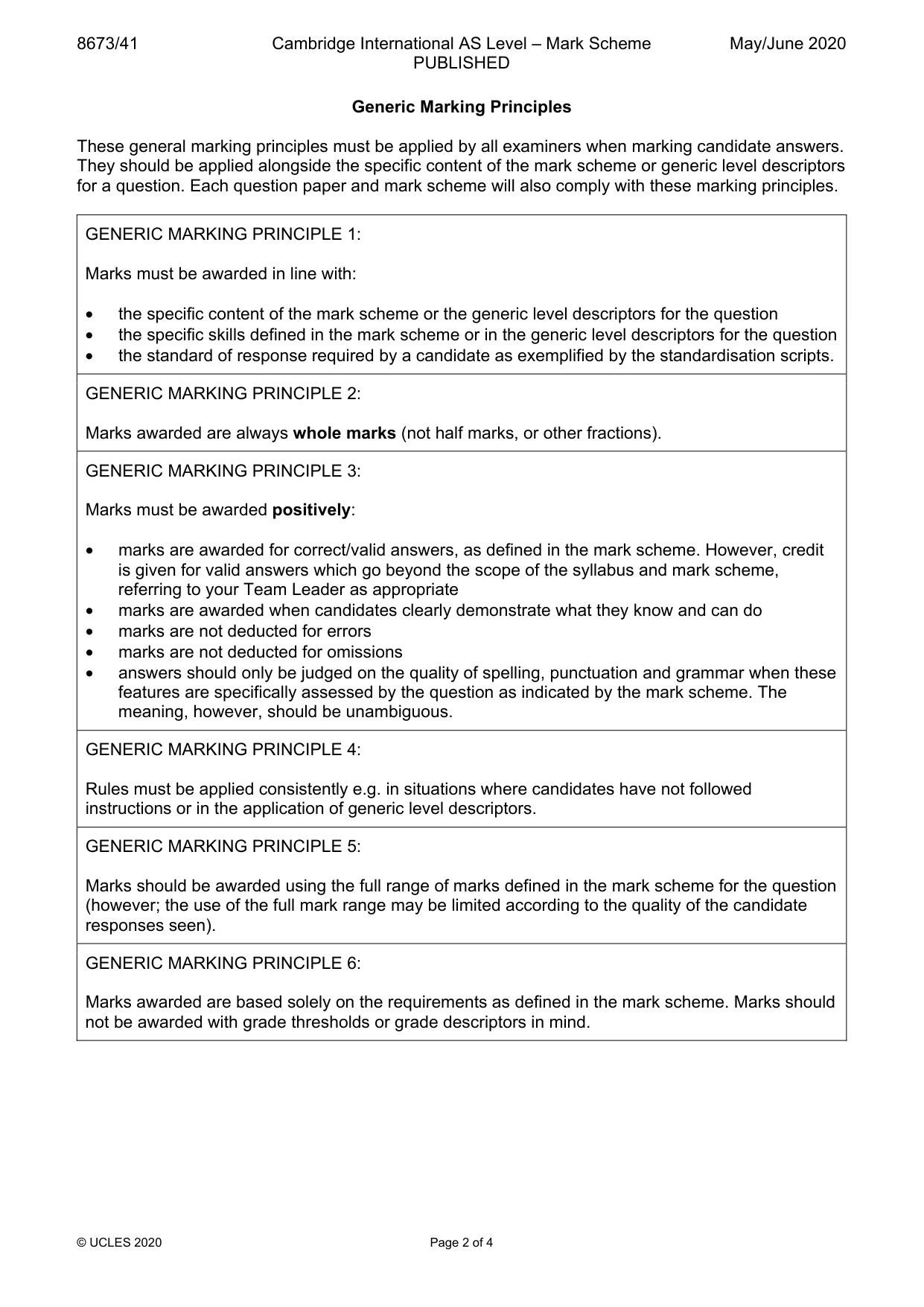
8673/41 Cambridge International AS Level – Mark Scheme PUBLISHED May/June 2020 © UCLES 2020 Page 2 of 4 Generic Marking Principles These general marking principles must be applied by all examiners when marking candidate answers. They should be applied alongside the specific content of the mark scheme or generic level descriptors for a question. Each question paper and mark scheme will also comply with these marking principles. GENERIC MARKING PRINCIPLE 1: Marks must be awarded in line with: • the specific content of the mark scheme or the generic level descriptors for the question • the specific skills defined in the mark scheme or in the generic level descriptors for the question • the standard of response required by a candidate as exemplified by the standardisation scripts. GENERIC MARKING PRINCIPLE 2: Marks awarded are always whole marks (not half marks, or other fractions). GENERIC MARKING PRINCIPLE 3: Marks must be awarded positively: • marks are awarded for correct/valid answers, as defined in the mark scheme. However, credit is given for valid answers which go beyond the scope of the syllabus and mark scheme, referring to your Team Leader as appropriate • marks are awarded when candidates clearly demonstrate what they know and can do • marks are not deducted for errors • marks are not deducted for omissions • answers should only be judged on the quality of spelling, punctuation and grammar when these features are specifically assessed by the question as indicated by the mark scheme. The meaning, however, should be unambiguous. GENERIC MARKING PRINCIPLE 4: Rules must be applied consistently e.g. in situations where candidates have not followed instructions or in the application of generic level descriptors. GENERIC MARKING PRINCIPLE 5: Marks should be awarded using the full range of marks defined in the mark scheme for the question (however; the use of the full mark range may be limited according to the quality of the candidate responses seen). GENERIC MARKING PRINCIPLE 6: Marks awarded are based solely on the requirements as defined in the mark scheme. Marks should not be awarded with grade thresholds or grade descriptors in mind.
Mark scheme, page 3
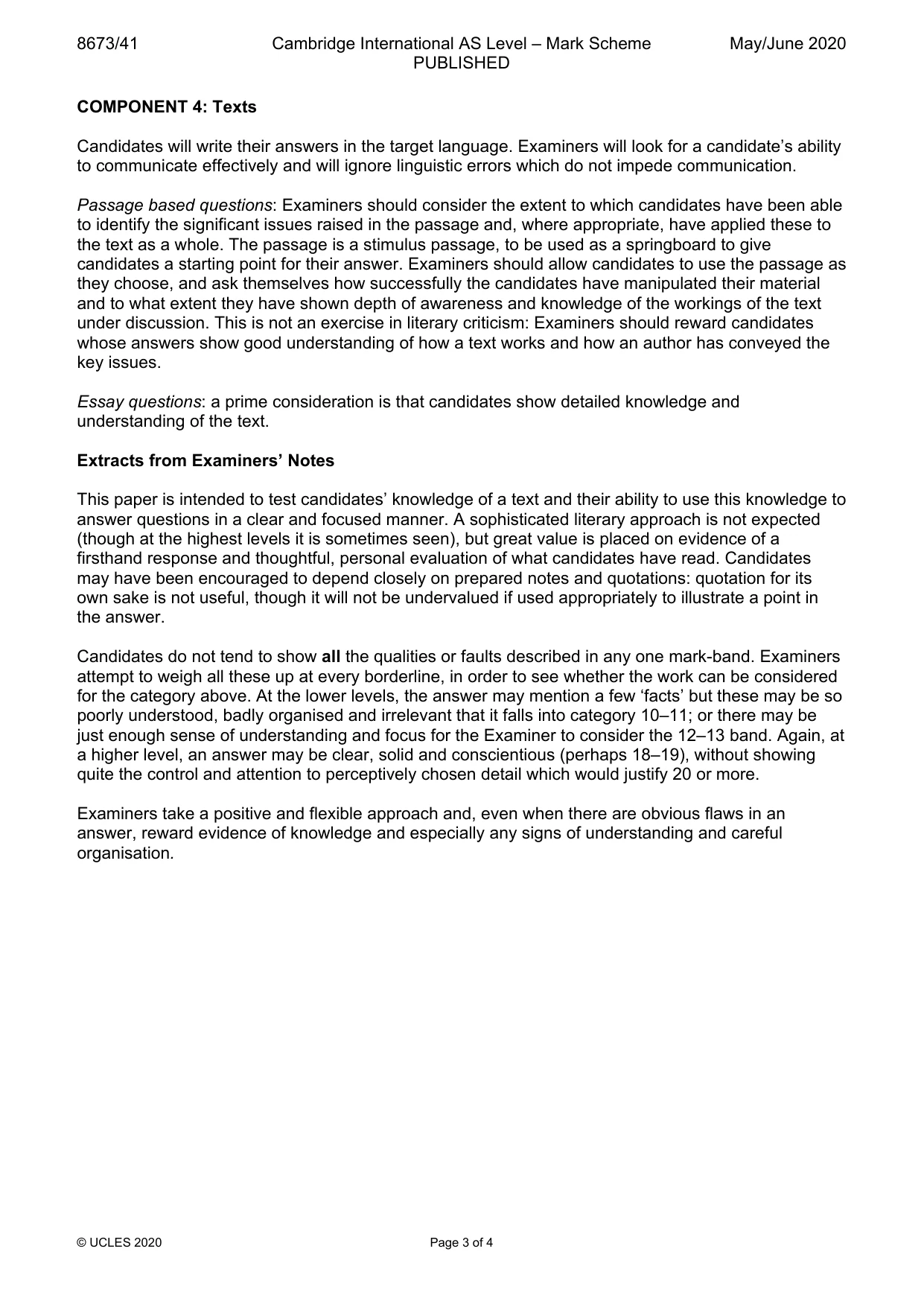
8673/41 Cambridge International AS Level – Mark Scheme PUBLISHED May/June 2020 © UCLES 2020 Page 3 of 4 COMPONENT 4: Texts Candidates will write their answers in the target language. Examiners will look for a candidate’s ability to communicate effectively and will ignore linguistic errors which do not impede communication. Passage based questions: Examiners should consider the extent to which candidates have been able to identify the significant issues raised in the passage and, where appropriate, have applied these to the text as a whole. The passage is a stimulus passage, to be used as a springboard to give candidates a starting point for their answer. Examiners should allow candidates to use the passage as they choose, and ask themselves how successfully the candidates have manipulated their material and to what extent they have shown depth of awareness and knowledge of the workings of the text under discussion. This is not an exercise in literary criticism: Examiners should reward candidates whose answers show good understanding of how a text works and how an author has conveyed the key issues. Essay questions: a prime consideration is that candidates show detailed knowledge and understanding of the text. Extracts from Examiners’ Notes This paper is intended to test candidates’ knowledge of a text and their ability to use this knowledge to answer questions in a clear and focused manner. A sophisticated literary approach is not expected (though at the highest levels it is sometimes seen), but great value is placed on evidence of a firsthand response and thoughtful, personal evaluation of what candidates have read. Candidates may have been encouraged to depend closely on prepared notes and quotations: quotation for its own sake is not useful, though it will not be undervalued if used appropriately to illustrate a point in the answer. Candidates do not tend to show all the qualities or faults described in any one mark-band. Examiners attempt to weigh all these up at every borderline, in order to see whether the work can be considered for the category above. At the lower levels, the answer may mention a few ‘facts’ but these may be so poorly understood, badly organised and irrelevant that it falls into category 10–11; or there may be just enough sense of understanding and focus for the Examiner to consider the 12–13 band. Again, at a higher level, an answer may be clear, solid and conscientious (perhaps 18–19), without showing quite the control and attention to perceptively chosen detail which would justify 20 or more. Examiners take a positive and flexible approach and, even when there are obvious flaws in an answer, reward evidence of knowledge and especially any signs of understanding and careful organisation.
Mark scheme, page 4
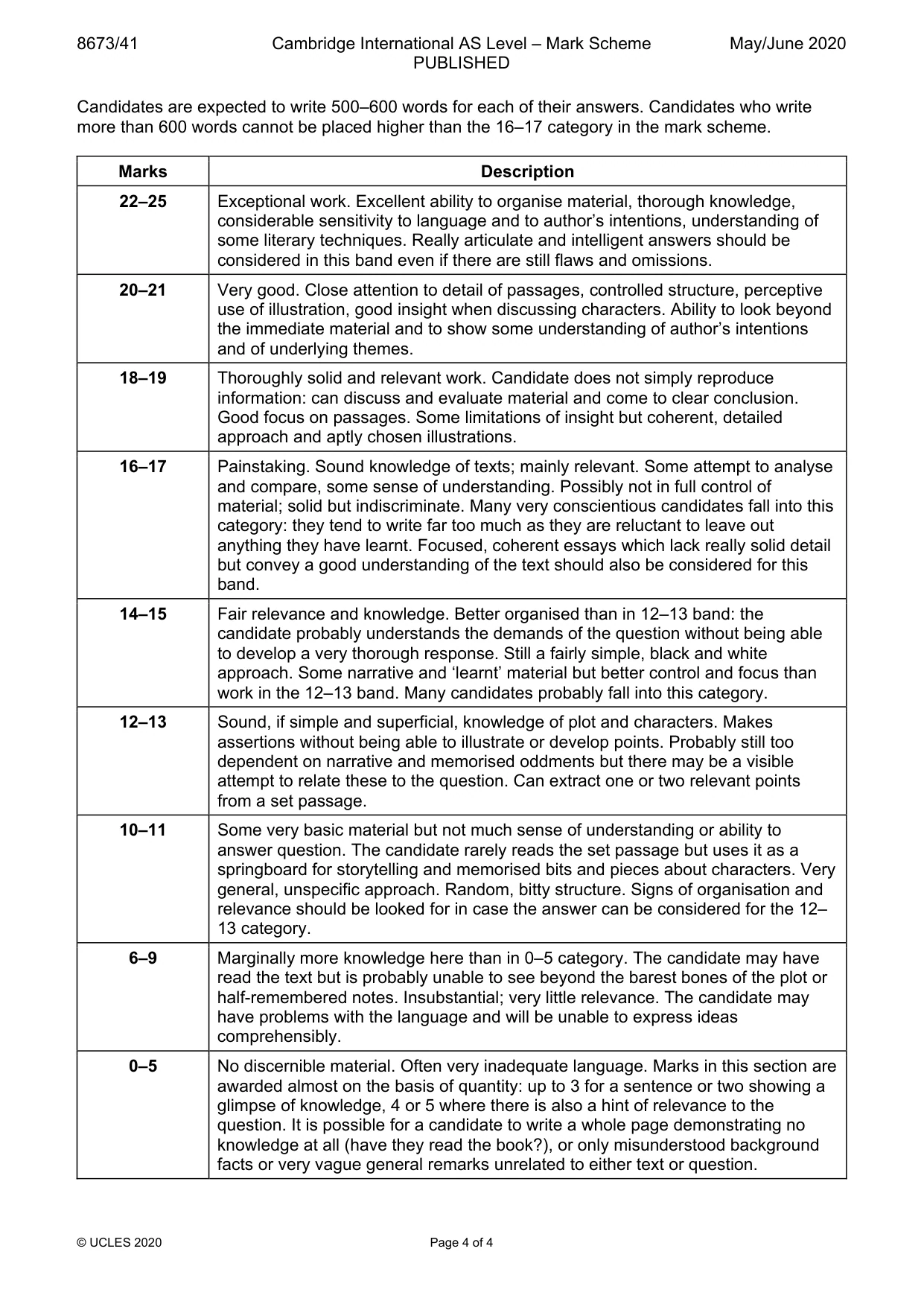
8673/41 Cambridge International AS Level – Mark Scheme PUBLISHED May/June 2020 © UCLES 2020 Page 4 of 4 Candidates are expected to write 500–600 words for each of their answers. Candidates who write more than 600 words cannot be placed higher than the 16–17 category in the mark scheme. Marks Description 22–25 Exceptional work. Excellent ability to organise material, thorough knowledge, considerable sensitivity to language and to author’s intentions, understanding of some literary techniques. Really articulate and intelligent answers should be considered in this band even if there are still flaws and omissions. 20–21 Very good. Close attention to detail of passages, controlled structure, perceptive use of illustration, good insight when discussing characters. Ability to look beyond the immediate material and to show some understanding of author’s intentions and of underlying themes. 18–19 Thoroughly solid and relevant work. Candidate does not simply reproduce information: can discuss and evaluate material and come to clear conclusion. Good focus on passages. Some limitations of insight but coherent, detailed approach and aptly chosen illustrations. 16–17 Painstaking. Sound knowledge of texts; mainly relevant. Some attempt to analyse and compare, some sense of understanding. Possibly not in full control of material; solid but indiscriminate. Many very conscientious candidates fall into this category: they tend to write far too much as they are reluctant to leave out anything they have learnt. Focused, coherent essays which lack really solid detail but convey a good understanding of the text should also be considered for this band. 14–15 Fair relevance and knowledge. Better organised than in 12–13 band: the candidate probably understands the demands of the question without being able to develop a very thorough response. Still a fairly simple, black and white approach. Some narrative and ‘learnt’ material but better control and focus than work in the 12–13 band. Many candidates probably fall into this category. 12–13 Sound, if simple and superficial, knowledge of plot and characters. Makes assertions without being able to illustrate or develop points. Probably still too dependent on narrative and memorised oddments but there may be a visible attempt to relate these to the question. Can extract one or two relevant points from a set passage. 10–11 Some very basic material but not much sense of understanding or ability to answer question. The candidate rarely reads the set passage but uses it as a springboard for storytelling and memorised bits and pieces about characters. Very general, unspecific approach. Random, bitty structure. Signs of organisation and relevance should be looked for in case the answer can be considered for the 12– 13 category. 6–9 Marginally more knowledge here than in 0–5 category. The candidate may have read the text but is probably unable to see beyond the barest bones of the plot or half-remembered notes. Insubstantial; very little relevance. The candidate may have problems with the language and will be unable to express ideas comprehensibly. 0–5 No discernible material. Often very inadequate language. Marks in this section are awarded almost on the basis of quantity: up to 3 for a sentence or two showing a glimpse of knowledge, 4 or 5 where there is also a hint of relevance to the question. It is possible for a candidate to write a whole page demonstrating no knowledge at all (have they read the book?), or only misunderstood background facts or very vague general remarks unrelated to either text or question.