Cambridge A Level Spanish - Literature (AS Level only) 8673 — 2019 Oct/Nov Paper 4 · Variant 2
8673/42/O/N/19 · 75 marks · ≈84 min
The question paper and its mark scheme, free to read here and free to download. This is Cambridge’s own paper, exactly as it was sat.
Question paper8 pages


Mark scheme4 pages
Answers below. Sit the paper first if you are practising.
Paper as text
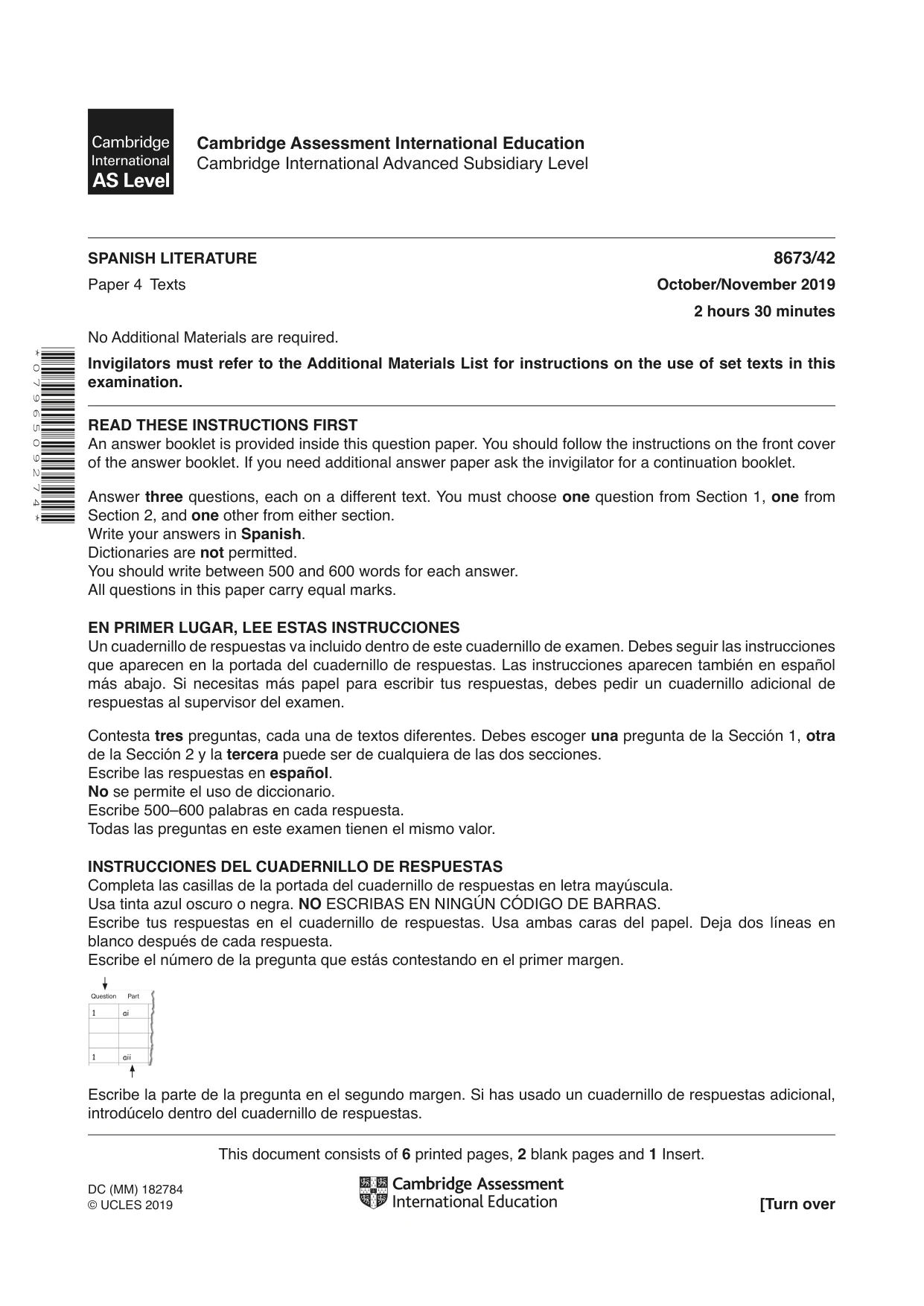
Question paper, page 1
This document consists of 6 printed pages, 2 blank pages and 1 Insert. DC (MM) 182784 © UCLES 2019 [Turn over Cambridge Assessment International Education Cambridge International Advanced Subsidiary Level * 0 7 9 6 5 0 9 2 7 4 * SPANISH LITERATURE 8673/42 Paper 4 Texts October/November 2019 2 hours 30 minutes No Additional Materials are required. Invigilators must refer to the Additional Materials List for instructions on the use of set texts in this examination. READ THESE INSTRUCTIONS FIRST An answer booklet is provided inside this question paper. You should follow the instructions on the front cover of the answer booklet. If you need additional answer paper ask the invigilator for a continuation booklet. Answer three questions, each on a different text. You must choose one question from Section 1, one from Section 2, and one other from either section. Write your answers in Spanish. Dictionaries are not permitted. You should write between 500 and 600 words for each answer. All questions in this paper carry equal marks. EN PRIMER LUGAR, LEE ESTAS INSTRUCCIONES Un cuadernillo de respuestas va incluido dentro de este cuadernillo de examen. Debes seguir las instrucciones que aparecen en la portada del cuadernillo de respuestas. Las instrucciones aparecen también en español más abajo. Si necesitas más papel para escribir tus respuestas, debes pedir un cuadernillo adicional de respuestas al supervisor del examen. Contesta tres preguntas, cada una de textos diferentes. Debes escoger una pregunta de la Sección 1, otra de la Sección 2 y la tercera puede ser de cualquiera de las dos secciones. Escribe las respuestas en español. No se permite el uso de diccionario. Escribe 500–600 palabras en cada respuesta. Todas las preguntas en este examen tienen el mismo valor. INSTRUCCIONES DEL CUADERNILLO DE RESPUESTAS Completa las casillas de la portada del cuadernillo de respuestas en letra mayúscula. Usa tinta azul oscuro o negra. NO ESCRIBAS EN NINGÚN CÓDIGO DE BARRAS. Escribe tus respuestas en el cuadernillo de respuestas. Usa ambas caras del papel. Deja dos líneas en blanco después de cada respuesta. Escribe el número de la pregunta que estás contestando en el primer margen. Escribe la parte de la pregunta en el segundo margen. Si has usado un cuadernillo de respuestas adicional, introdúcelo dentro del cuadernillo de respuestas.
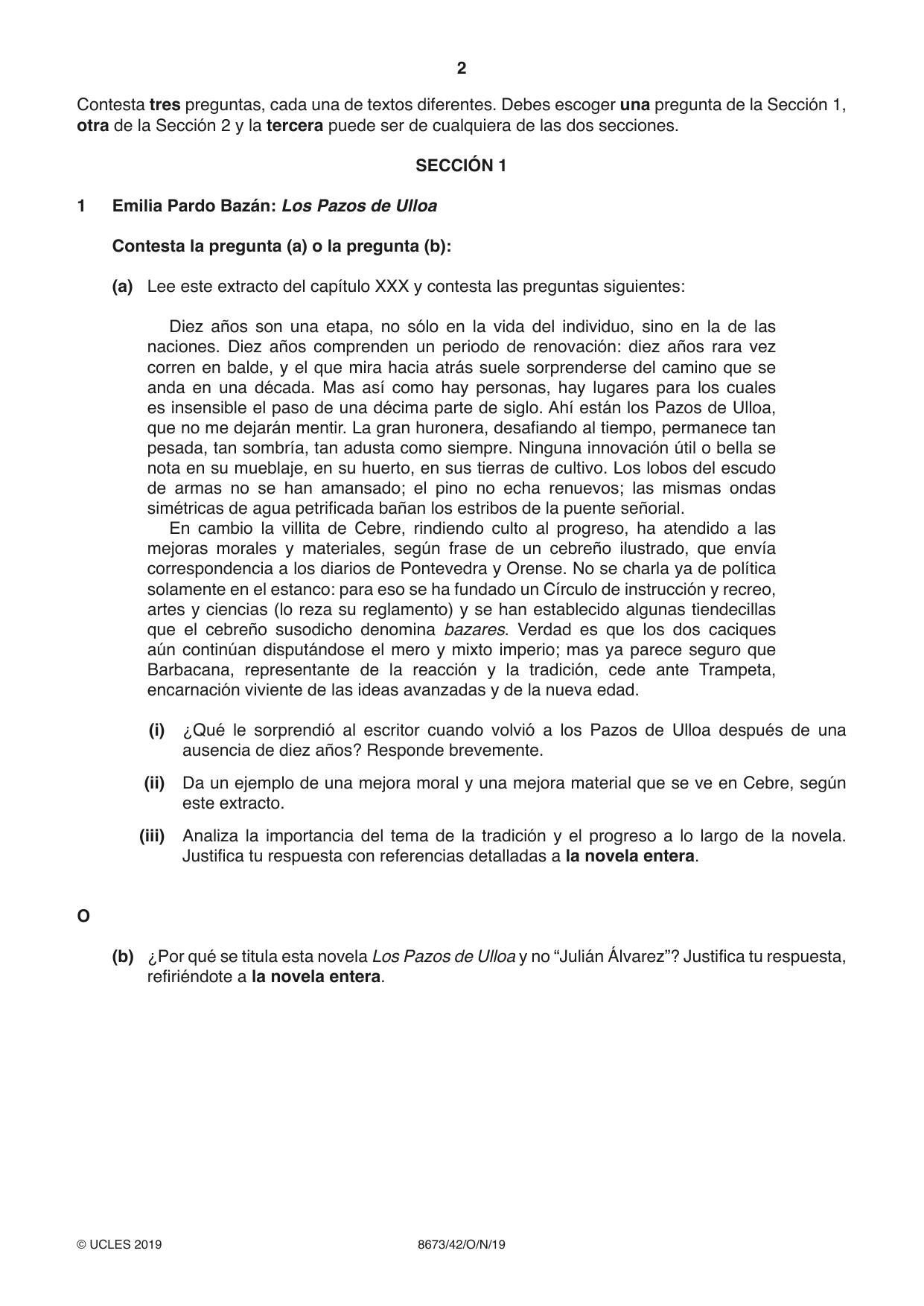
Question paper, page 2
2 8673/42/O/N/19 © UCLES 2019 Contesta tres preguntas, cada una de textos diferentes. Debes escoger una pregunta de la Sección 1, otra de la Sección 2 y la tercera puede ser de cualquiera de las dos secciones. SECCIÓN 1 1 Emilia Pardo Bazán: Los Pazos de Ulloa Contesta la pregunta (a) o la pregunta (b): (a) Lee este extracto del capítulo XXX y contesta las preguntas siguientes: Diez años son una etapa, no sólo en la vida del individuo, sino en la de las naciones. Diez años comprenden un periodo de renovación: diez años rara vez corren en balde, y el que mira hacia atrás suele sorprenderse del camino que se anda en una década. Mas así como hay personas, hay lugares para los cuales es insensible el paso de una décima parte de siglo. Ahí están los Pazos de Ulloa, que no me dejarán mentir. La gran huronera, desafiando al tiempo, permanece tan pesada, tan sombría, tan adusta como siempre. Ninguna innovación útil o bella se nota en su mueblaje, en su huerto, en sus tierras de cultivo. Los lobos del escudo de armas no se han amansado; el pino no echa renuevos; las mismas ondas simétricas de agua petrificada bañan los estribos de la puente señorial. En cambio la villita de Cebre, rindiendo culto al progreso, ha atendido a las mejoras morales y materiales, según frase de un cebreño ilustrado, que envía correspondencia a los diarios de Pontevedra y Orense. No se charla ya de política solamente en el estanco: para eso se ha fundado un Círculo de instrucción y recreo, artes y ciencias (lo reza su reglamento) y se han establecido algunas tiendecillas que el cebreño susodicho denomina bazares. Verdad es que los dos caciques aún continúan disputándose el mero y mixto imperio; mas ya parece seguro que Barbacana, representante de la reacción y la tradición, cede ante Trampeta, encarnación viviente de las ideas avanzadas y de la nueva edad. (i) ¿Qué le sorprendió al escritor cuando volvió a los Pazos de Ulloa después de una ausencia de diez años? Responde brevemente. (ii) Da un ejemplo de una mejora moral y una mejora material que se ve en Cebre, según este extracto. (iii) Analiza la importancia del tema de la tradición y el progreso a lo largo de la novela. Justifica tu respuesta con referencias detalladas a la novela entera. O (b) ¿Por qué se titula esta novela Los Pazos de Ulloa y no “Julián Álvarez”? Justifica tu respuesta, refiriéndote a la novela entera.
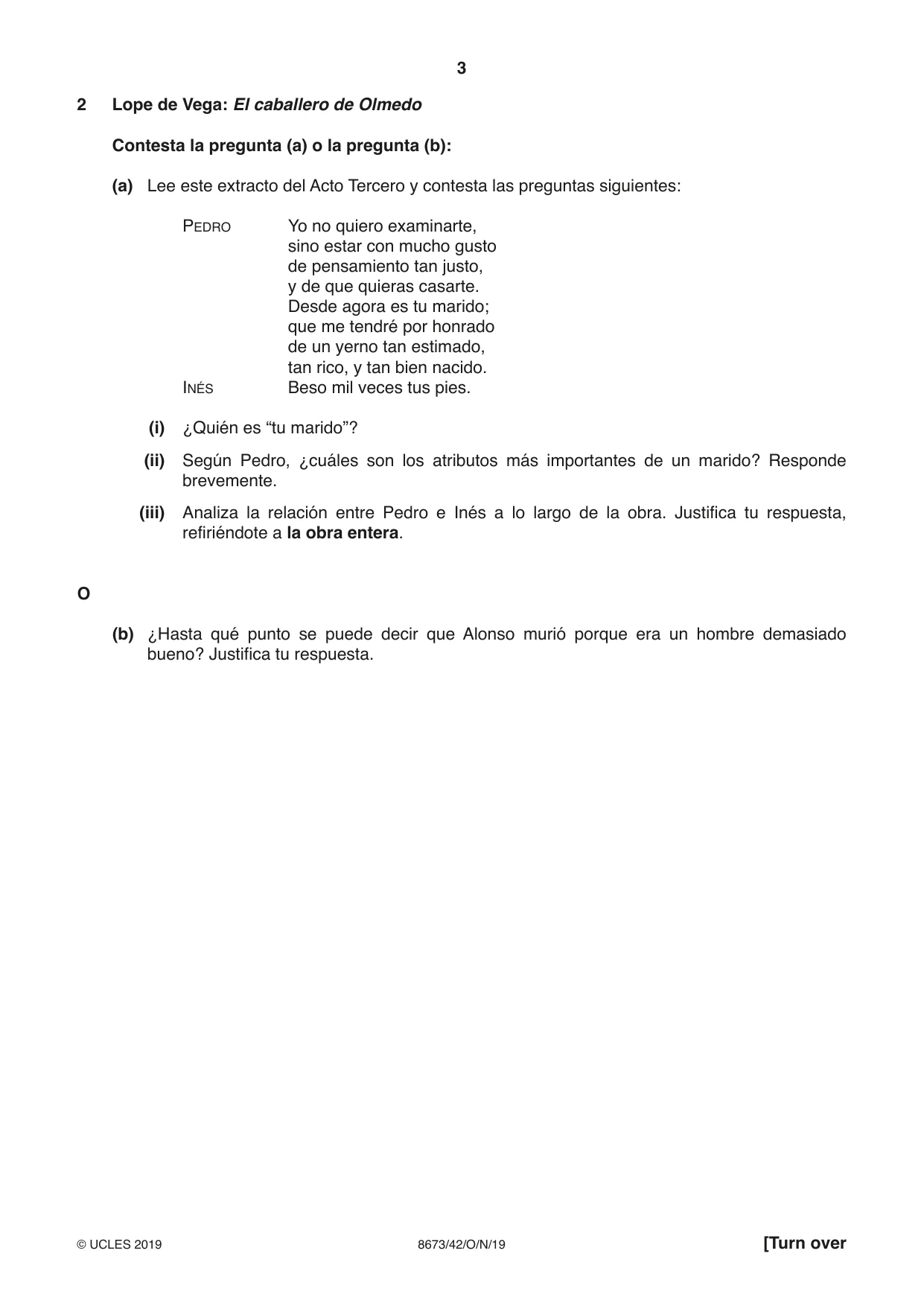
Question paper, page 3
3 8673/42/O/N/19 © UCLES 2019 [Turn over 2 Lope de Vega: El caballero de Olmedo Contesta la pregunta (a) o la pregunta (b): (a) Lee este extracto del Acto Tercero y contesta las preguntas siguientes: Pedro Yo no quiero examinarte, sino estar con mucho gusto de pensamiento tan justo, y de que quieras casarte. Desde agora es tu marido; que me tendré por honrado de un yerno tan estimado, tan rico, y tan bien nacido. Inés Beso mil veces tus pies. (i) ¿Quién es “tu marido”? (ii) Según Pedro, ¿cuáles son los atributos más importantes de un marido? Responde brevemente. (iii) Analiza la relación entre Pedro e Inés a lo largo de la obra. Justifica tu respuesta, refiriéndote a la obra entera. O (b) ¿Hasta qué punto se puede decir que Alonso murió porque era un hombre demasiado bueno? Justifica tu respuesta.
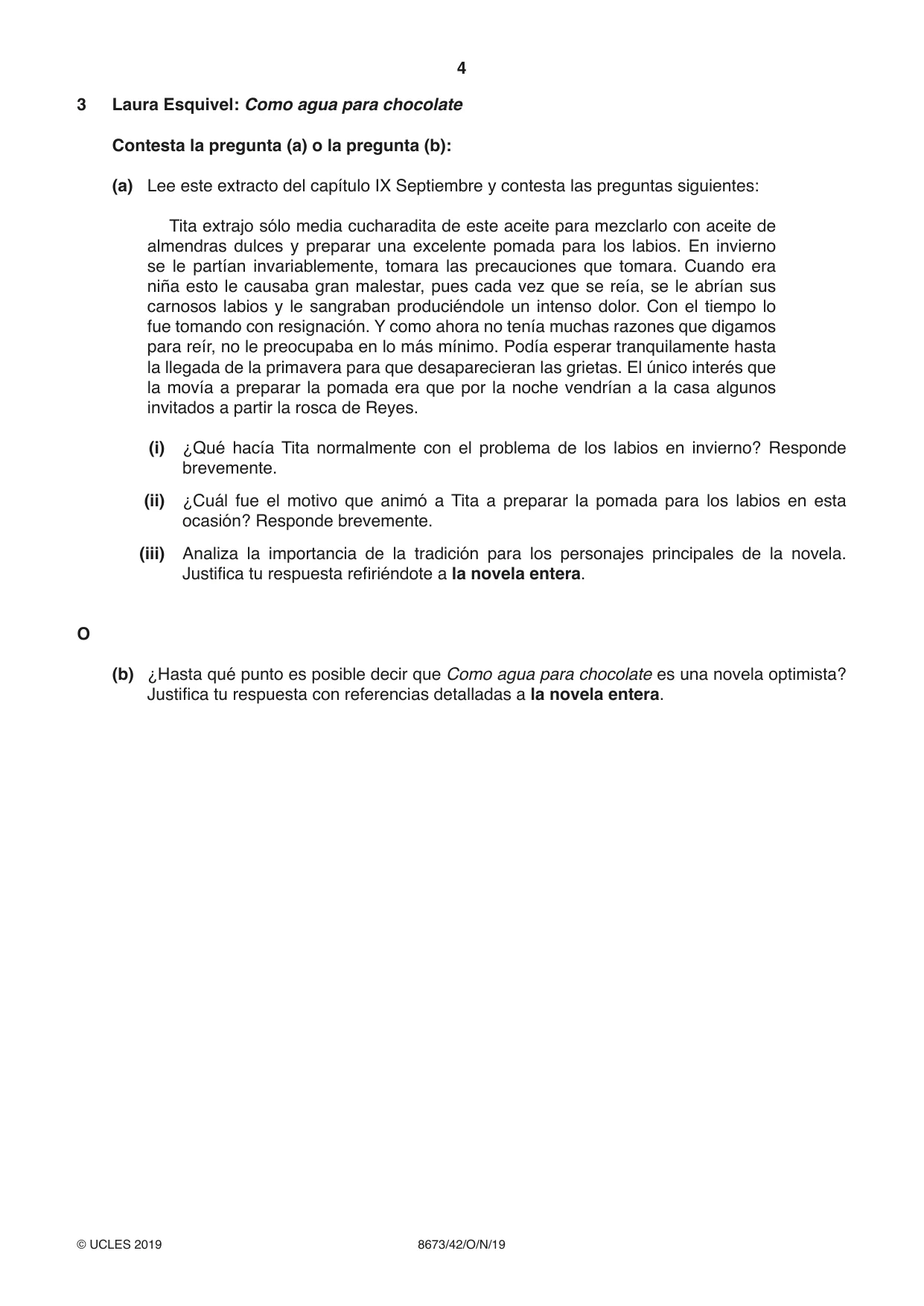
Question paper, page 4
4 8673/42/O/N/19 © UCLES 2019 3 Laura Esquivel: Como agua para chocolate Contesta la pregunta (a) o la pregunta (b): (a) Lee este extracto del capítulo IX Septiembre y contesta las preguntas siguientes: Tita extrajo sólo media cucharadita de este aceite para mezclarlo con aceite de almendras dulces y preparar una excelente pomada para los labios. En invierno se le partían invariablemente, tomara las precauciones que tomara. Cuando era niña esto le causaba gran malestar, pues cada vez que se reía, se le abrían sus carnosos labios y le sangraban produciéndole un intenso dolor. Con el tiempo lo fue tomando con resignación. Y como ahora no tenía muchas razones que digamos para reír, no le preocupaba en lo más mínimo. Podía esperar tranquilamente hasta la llegada de la primavera para que desaparecieran las grietas. El único interés que la movía a preparar la pomada era que por la noche vendrían a la casa algunos invitados a partir la rosca de Reyes. (i) ¿Qué hacía Tita normalmente con el problema de los labios en invierno? Responde brevemente. (ii) ¿Cuál fue el motivo que animó a Tita a preparar la pomada para los labios en esta ocasión? Responde brevemente. (iii) Analiza la importancia de la tradición para los personajes principales de la novela. Justifica tu respuesta refiriéndote a la novela entera. O (b) ¿Hasta qué punto es posible decir que Como agua para chocolate es una novela optimista? Justifica tu respuesta con referencias detalladas a la novela entera.
Question paper, page 5
5 8673/42/O/N/19 © UCLES 2019 [Turn over 4 Rodolfo Usigli: El gesticulador Contesta la pregunta (a) o la pregunta (b): (a) Lee este extracto de las escenas III y IV del Acto Primero y contesta las preguntas siguientes: César Decía usted que su universidad tiene mucho dinero … ¿Cuánto, por ejemplo? Bolton (un poco desconcertado por lo directo de la pregunta) No sé. A mí me han dado una suma para mi trabajo de búsqueda, pero podría consultar … si viera los documentos. (JulIa entra de la cocina, cruza y se dirige a la puerta izquierda, saliendo. César la sigue con la vista, sin dejar de hablar, hasta que desaparece.) César Parece que desconfía usted. Bolton No soy yo quien puede comprar, es Harvard. César (dudando) Ustedes lo compran todo. Bolton (sonriendo) ¿Por qué no, si es para la cultura? César Los códices, los manuscritos, los incunables, las joyas arqueológicas de México; comprarían a Taxco, si pudieran llevárselo a su casa. Ahora le toca el turno a la verdad sobre César Rubio. Bolton (ante lo inesperado del ataque) No entiendo. ¿Está usted ofendido? Hace un momento parecía comunicativo. César También a mí me apasiona el tema. Pero todo lo que poseo es la verdad sobre César Rubio … y no podría darla por poco dinero … ni sin ciertas condiciones. (i) ¿Cómo critica César Rubio a Bolton en este extracto? (ii) ¿Qué motivo tiene César para ayudar a Bolton en este extracto? Responde brevemente. (iii) ¿Hasta qué punto sirve este extracto para darnos un entendimiento completo de la conciencia o la moralidad de César? Justifica tu respuesta con referencias detalladas a la obra entera. O (b) Analiza el papel de Navarro a lo largo de la obra. Justifica tu respuesta.
Question paper, page 6
6 8673/42/O/N/19 © UCLES 2019 SECCIÓN 2 5 Ramón J Sender: Réquiem por un campesino español Contesta la pregunta (a) o la pregunta (b): (a) Analiza el papel de la Jerónima a lo largo de la novela. Justifica tu respuesta. O (b) Los personajes principales representan estereotipos de la sociedad española, lo cual es esencial para comunicar el mensaje de la novela. ¿Hasta qué punto estás de acuerdo? Justifica tu respuesta. 6 Federico García Lorca: Yerma Contesta la pregunta (a) o la pregunta (b): (a) Analiza por qué muchos personajes de esta obra no llevan nombre propio. Justifica tu respuesta. O (b) En una tragedia, el héroe es una persona buena que comete un error, sufre como consecuencia y se da cuenta de su fatal fallo. ¿Quién o quiénes son las figuras trágicas en Yerma? Justifica tu respuesta. 7 Brotherston, ed: Spanish American Modernista Poets: A Critical Anthology Contesta la pregunta (a) o la pregunta (b): (a) Haz un análisis crítico del poema “Nox” de Salvador Díaz Mirón, con énfasis en los recursos estilísticos que utiliza el poeta para reforzar el tema central. Justifica tu respuesta. O (b) En tu opinión, ¿cuáles son los dos poetas de esta antología que mejor consiguen crear una poesía con voz latinoamericana? Justifica tu respuesta refiriéndote a dos poemas de cada poeta escogido como mínimo. 8 Horacio Quiroga: Cuentos Escogidos Contesta la pregunta (a) o la pregunta (b): (a) Analiza la importancia de la tensión dramática en estos cuentos. Justifica tu respuesta refiriéndote a dos cuentos como mínimo. O (b) Analiza la presentación de la muerte en los cuentos “A la deriva” y “El hombre muerto”. Justifica tu respuesta.
Question paper, page 7
7 8673/42/O/N/19 © UCLES 2019 BLANK PAGE
Question paper, page 8
8 8673/42/O/N/19 © UCLES 2019 Permission to reproduce items where third-party owned material protected by copyright is included has been sought and cleared where possible. Every reasonable effort has been made by the publisher (UCLES) to trace copyright holders, but if any items requiring clearance have unwittingly been included, the publisher will be pleased to make amends at the earliest possible opportunity. To avoid the issue of disclosure of answer-related information to candidates, all copyright acknowledgements are reproduced online in the Cambridge Assessment International Education Copyright Acknowledgements Booklet. This is produced for each series of examinations and is freely available to download at www.cambridgeinternational.org after the live examination series. Cambridge Assessment International Education is part of the Cambridge Assessment Group. Cambridge Assessment is the brand name of the University of Cambridge Local Examinations Syndicate (UCLES), which itself is a department of the University of Cambridge. BLANK PAGE
Mark scheme, page 1
This document consists of 4 printed pages. © UCLES 2019 [Turn over Cambridge Assessment International Education Cambridge International Advanced Subsidiary Level SPANISH LITERATURE 8673/42 Paper 4 Texts October/November 2019 MARK SCHEME Maximum Mark: 75 Published This mark scheme is published as an aid to teachers and candidates, to indicate the requirements of the examination. It shows the basis on which Examiners were instructed to award marks. It does not indicate the details of the discussions that took place at an Examiners’ meeting before marking began, which would have considered the acceptability of alternative answers. Mark schemes should be read in conjunction with the question paper and the Principal Examiner Report for Teachers. Cambridge International will not enter into discussions about these mark schemes. Cambridge International is publishing the mark schemes for the October/November 2019 series for most Cambridge IGCSE™, Cambridge International A and AS Level components and some Cambridge O Level components.
Mark scheme, page 2
8673/42 Cambridge International AS Level – Mark Scheme PUBLISHED October/November 2019 © UCLES 2019 Page 2 of 4 Generic Marking Principles These general marking principles must be applied by all examiners when marking candidate answers. They should be applied alongside the specific content of the mark scheme or generic level descriptors for a question. Each question paper and mark scheme will also comply with these marking principles. GENERIC MARKING PRINCIPLE 1: Marks must be awarded in line with: • the specific content of the mark scheme or the generic level descriptors for the question • the specific skills defined in the mark scheme or in the generic level descriptors for the question • the standard of response required by a candidate as exemplified by the standardisation scripts. GENERIC MARKING PRINCIPLE 2: Marks awarded are always whole marks (not half marks, or other fractions). GENERIC MARKING PRINCIPLE 3: Marks must be awarded positively: • marks are awarded for correct/valid answers, as defined in the mark scheme. However, credit is given for valid answers which go beyond the scope of the syllabus and mark scheme, referring to your Team Leader as appropriate • marks are awarded when candidates clearly demonstrate what they know and can do • marks are not deducted for errors • marks are not deducted for omissions • answers should only be judged on the quality of spelling, punctuation and grammar when these features are specifically assessed by the question as indicated by the mark scheme. The meaning, however, should be unambiguous. GENERIC MARKING PRINCIPLE 4: Rules must be applied consistently e.g. in situations where candidates have not followed instructions or in the application of generic level descriptors. GENERIC MARKING PRINCIPLE 5: Marks should be awarded using the full range of marks defined in the mark scheme for the question (however; the use of the full mark range may be limited according to the quality of the candidate responses seen). GENERIC MARKING PRINCIPLE 6: Marks awarded are based solely on the requirements as defined in the mark scheme. Marks should not be awarded with grade thresholds or grade descriptors in mind.
Mark scheme, page 3
8673/42 Cambridge International AS Level – Mark Scheme PUBLISHED October/November 2019 © UCLES 2019 Page 3 of 4 COMPONENT 4: Texts Candidates will write their answers in the target language. Examiners will look for a candidate’s ability to communicate effectively and will ignore linguistic errors which do not impede communication. Passage based questions: Examiners should consider the extent to which candidates have been able to identify the significant issues raised in the passage and, where appropriate, have applied these to the text as a whole. The passage is a stimulus passage, to be used as a springboard to give candidates a starting point for their answer. Examiners should allow candidates to use the passage as they choose, and ask themselves how successfully the candidates have manipulated their material and to what extent they have shown depth of awareness and knowledge of the workings of the text under discussion. This is not an exercise in literary criticism: Examiners should reward candidates whose answers show good understanding of how a text works and how an author has conveyed the key issues. Essay questions: a prime consideration is that candidates show detailed knowledge and understanding of the text. Extracts from Examiners’ Notes This paper is intended to test candidates’ knowledge of a text and their ability to use this knowledge to answer questions in a clear and focused manner. A sophisticated literary approach is not expected (though at the highest levels it is sometimes seen), but great value is placed on evidence of a firsthand response and thoughtful, personal evaluation of what candidates have read. Candidates may have been encouraged to depend closely on prepared notes and quotations: quotation for its own sake is not useful, though it will not be undervalued if used appropriately to illustrate a point in the answer. Candidates do not tend to show all the qualities or faults described in any one mark-band. Examiners attempt to weigh all these up at every borderline, in order to see whether the work can be considered for the category above. At the lower levels, the answer may mention a few ‘facts’ but these may be so poorly understood, badly organised and irrelevant that it falls into category 10–11; or there may be just enough sense of understanding and focus for the Examiner to consider the 12–13 band. Again, at a higher level, an answer may be clear, solid and conscientious (perhaps 18–19), without showing quite the control and attention to perceptively chosen detail which would justify 20 or more. Examiners take a positive and flexible approach and, even when there are obvious flaws in an answer, reward evidence of knowledge and especially any signs of understanding and careful organisation.
Mark scheme, page 4
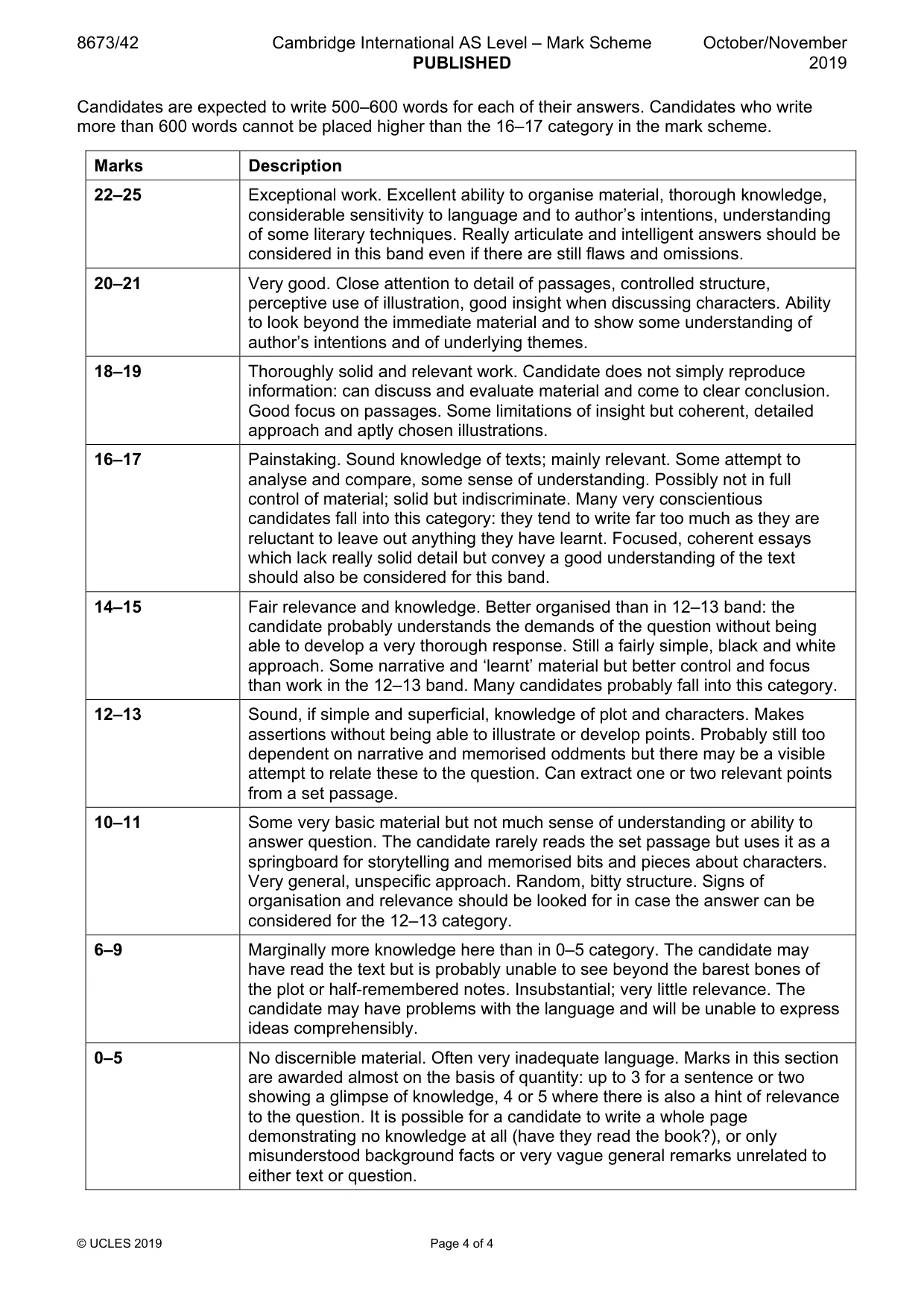
8673/42 Cambridge International AS Level – Mark Scheme PUBLISHED October/November 2019 © UCLES 2019 Page 4 of 4 Candidates are expected to write 500–600 words for each of their answers. Candidates who write more than 600 words cannot be placed higher than the 16–17 category in the mark scheme. Marks Description 22–25 Exceptional work. Excellent ability to organise material, thorough knowledge, considerable sensitivity to language and to author’s intentions, understanding of some literary techniques. Really articulate and intelligent answers should be considered in this band even if there are still flaws and omissions. 20–21 Very good. Close attention to detail of passages, controlled structure, perceptive use of illustration, good insight when discussing characters. Ability to look beyond the immediate material and to show some understanding of author’s intentions and of underlying themes. 18–19 Thoroughly solid and relevant work. Candidate does not simply reproduce information: can discuss and evaluate material and come to clear conclusion. Good focus on passages. Some limitations of insight but coherent, detailed approach and aptly chosen illustrations. 16–17 Painstaking. Sound knowledge of texts; mainly relevant. Some attempt to analyse and compare, some sense of understanding. Possibly not in full control of material; solid but indiscriminate. Many very conscientious candidates fall into this category: they tend to write far too much as they are reluctant to leave out anything they have learnt. Focused, coherent essays which lack really solid detail but convey a good understanding of the text should also be considered for this band. 14–15 Fair relevance and knowledge. Better organised than in 12–13 band: the candidate probably understands the demands of the question without being able to develop a very thorough response. Still a fairly simple, black and white approach. Some narrative and ‘learnt’ material but better control and focus than work in the 12–13 band. Many candidates probably fall into this category. 12–13 Sound, if simple and superficial, knowledge of plot and characters. Makes assertions without being able to illustrate or develop points. Probably still too dependent on narrative and memorised oddments but there may be a visible attempt to relate these to the question. Can extract one or two relevant points from a set passage. 10–11 Some very basic material but not much sense of understanding or ability to answer question. The candidate rarely reads the set passage but uses it as a springboard for storytelling and memorised bits and pieces about characters. Very general, unspecific approach. Random, bitty structure. Signs of organisation and relevance should be looked for in case the answer can be considered for the 12–13 category. 6–9 Marginally more knowledge here than in 0–5 category. The candidate may have read the text but is probably unable to see beyond the barest bones of the plot or half-remembered notes. Insubstantial; very little relevance. The candidate may have problems with the language and will be unable to express ideas comprehensibly. 0–5 No discernible material. Often very inadequate language. Marks in this section are awarded almost on the basis of quantity: up to 3 for a sentence or two showing a glimpse of knowledge, 4 or 5 where there is also a hint of relevance to the question. It is possible for a candidate to write a whole page demonstrating no knowledge at all (have they read the book?), or only misunderstood background facts or very vague general remarks unrelated to either text or question.
What you needed in this session
Cambridge’s own grade thresholds for 2019 Oct/Nov, Paper 4 · Variant 2. A higher threshold means an easier paper — the bar moves with how the cohort did.