Cambridge A Level Spanish - Literature (AS Level only) 8673 — 2010 Oct/Nov Paper 4 · Variant 1
8673/41/O/N/10 · 75 marks · ≈84 min
The question paper and its mark scheme, free to read here and free to download. This is Cambridge’s own paper, exactly as it was sat.
Question paper8 pages
Mark scheme3 pages
Answers below. Sit the paper first if you are practising.
Paper as text
Question paper, page 1
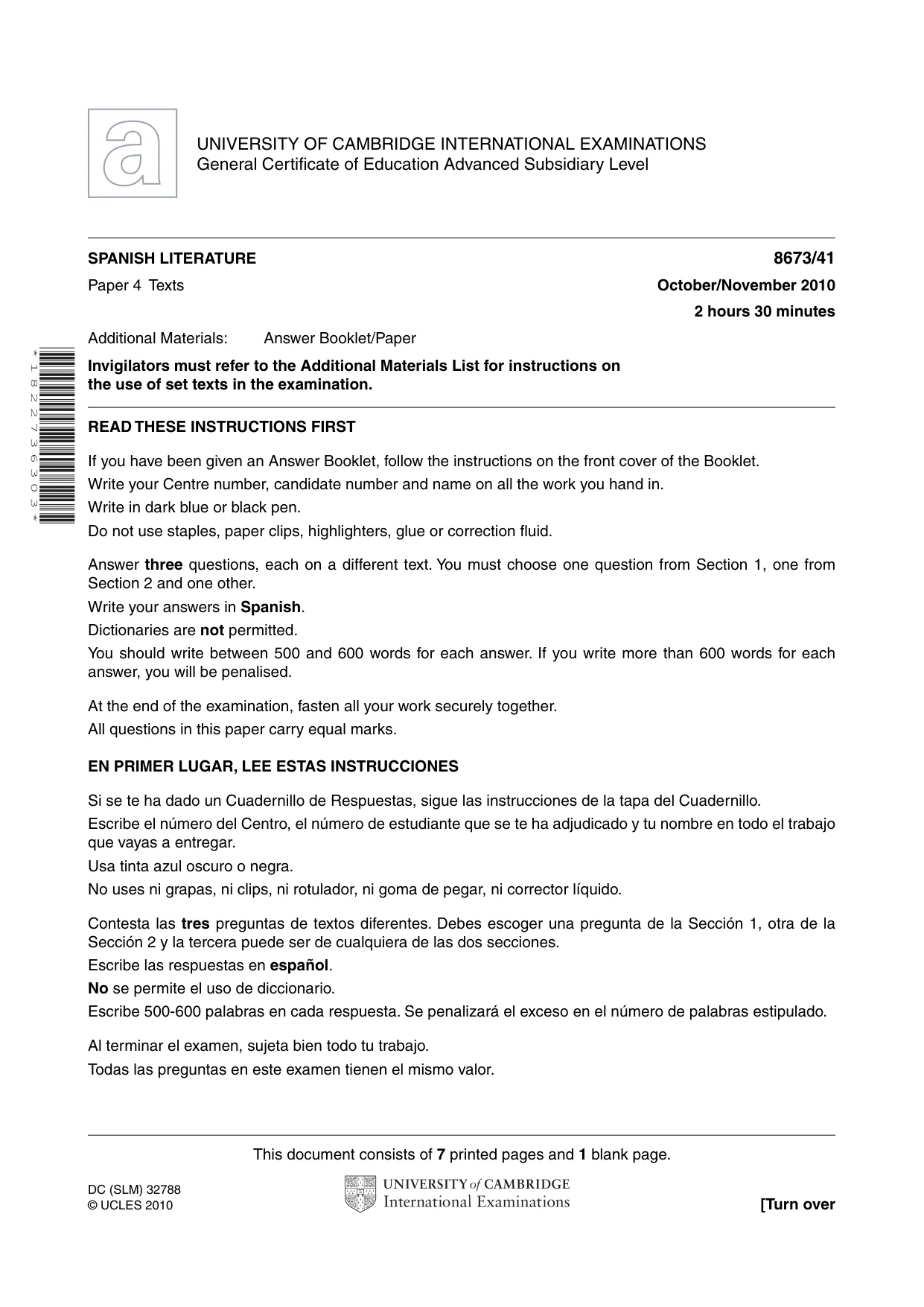
This document consists of 7 printed pages and 1 blank page. DC (SLM) 32788 © UCLES 2010 [Turn over UNIVERSITY OF CAMBRIDGE INTERNATIONAL EXAMINATIONS General Certificate of Education Advanced Subsidiary Level SPANISH LITERATURE 8673/41 Paper 4 Texts October/November 2010 2 hours 30 minutes Additional Materials: Answer Booklet/Paper Invigilators must refer to the Additional Materials List for instructions on the use of set texts in the examination. READ THESE INSTRUCTIONS FIRST If you have been given an Answer Booklet, follow the instructions on the front cover of the Booklet. Write your Centre number, candidate number and name on all the work you hand in. Write in dark blue or black pen. Do not use staples, paper clips, highlighters, glue or correction fluid. Answer three questions, each on a different text. You must choose one question from Section 1, one from Section 2 and one other. Write your answers in Spanish. Dictionaries are not permitted. You should write between 500 and 600 words for each answer. If you write more than 600 words for each answer, you will be penalised. At the end of the examination, fasten all your work securely together. All questions in this paper carry equal marks. EN PRIMER LUGAR, LEE ESTAS INSTRUCCIONES Si se te ha dado un Cuadernillo de Respuestas, sigue las instrucciones de la tapa del Cuadernillo. Escribe el número del Centro, el número de estudiante que se te ha adjudicado y tu nombre en todo el trabajo que vayas a entregar. Usa tinta azul oscuro o negra. No uses ni grapas, ni clips, ni rotulador, ni goma de pegar, ni corrector líquido. Contesta las tres preguntas de textos diferentes. Debes escoger una pregunta de la Sección 1, otra de la Sección 2 y la tercera puede ser de cualquiera de las dos secciones. Escribe las respuestas en español. No se permite el uso de diccionario. Escribe 500-600 palabras en cada respuesta. Se penalizará el exceso en el número de palabras estipulado. Al terminar el examen, sujeta bien todo tu trabajo. Todas las preguntas en este examen tienen el mismo valor. * 1 8 2 2 7 3 6 3 0 3 *
Question paper, page 2
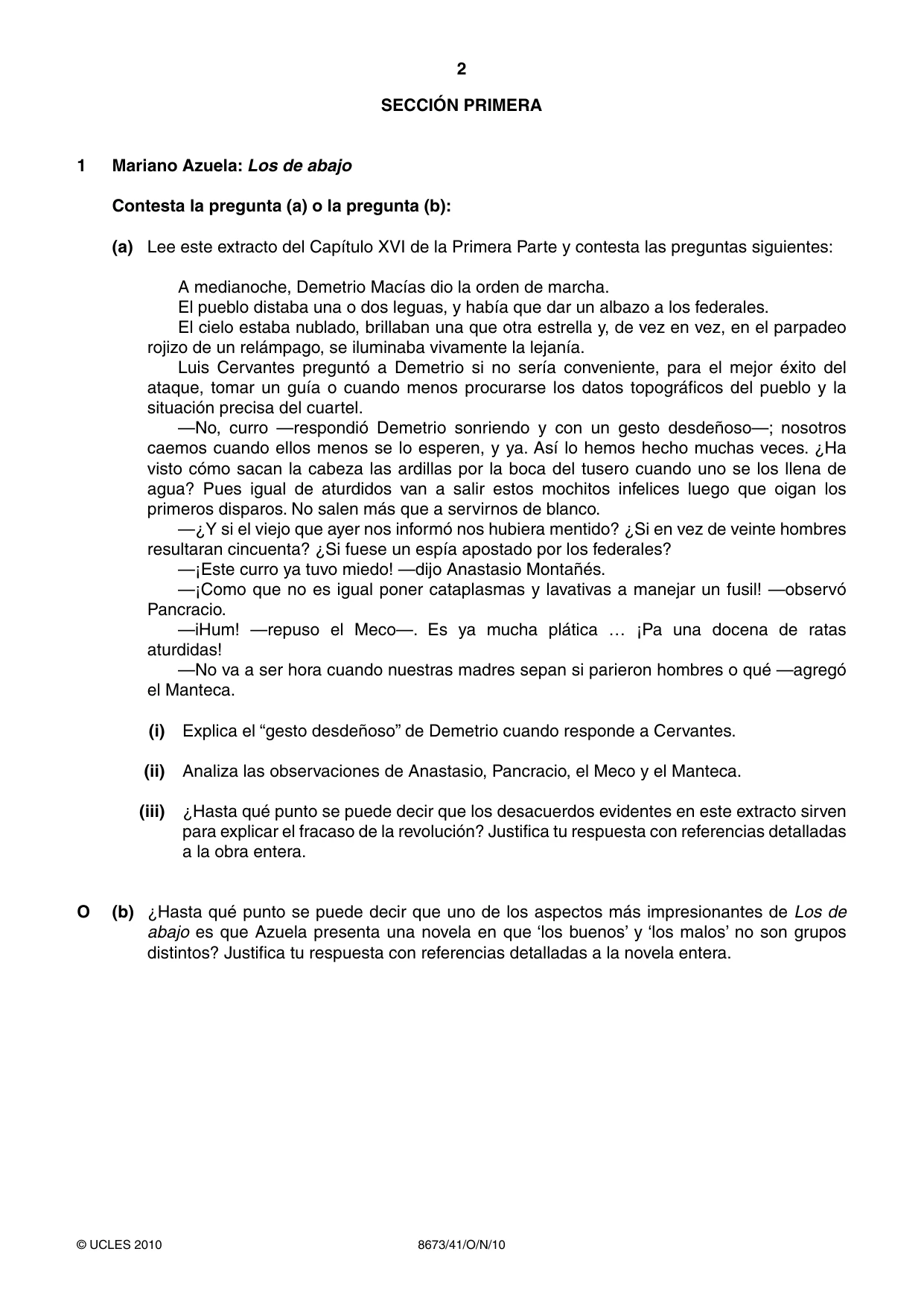
2 8673/41/O/N/10 © UCLES 2010 SECCIÓN PRIMERA 1 Mariano Azuela: Los de abajo Contesta la pregunta (a) o la pregunta (b): (a) Lee este extracto del Capítulo XVI de la Primera Parte y contesta las preguntas siguientes: A medianoche, Demetrio Macías dio la orden de marcha. El pueblo distaba una o dos leguas, y había que dar un albazo a los federales. El cielo estaba nublado, brillaban una que otra estrella y, de vez en vez, en el parpadeo rojizo de un relámpago, se iluminaba vivamente la lejanía. Luis Cervantes preguntó a Demetrio si no sería conveniente, para el mejor éxito del ataque, tomar un guía o cuando menos procurarse los datos topográficos del pueblo y la situación precisa del cuartel. —No, curro —respondió Demetrio sonriendo y con un gesto desdeñoso—; nosotros caemos cuando ellos menos se lo esperen, y ya. Así lo hemos hecho muchas veces. ¿Ha visto cómo sacan la cabeza las ardillas por la boca del tusero cuando uno se los llena de agua? Pues igual de aturdidos van a salir estos mochitos infelices luego que oigan los primeros disparos. No salen más que a servirnos de blanco. —¿Y si el viejo que ayer nos informó nos hubiera mentido? ¿Si en vez de veinte hombres resultaran cincuenta? ¿Si fuese un espía apostado por los federales? —¡Este curro ya tuvo miedo! —dijo Anastasio Montañés. —¡Como que no es igual poner cataplasmas y lavativas a manejar un fusil! —observó Pancracio. —iHum! —repuso el Meco—. Es ya mucha plática … ¡Pa una docena de ratas aturdidas! —No va a ser hora cuando nuestras madres sepan si parieron hombres o qué —agregó el Manteca. (i) Explica el “gesto desdeñoso” de Demetrio cuando responde a Cervantes. (ii) Analiza las observaciones de Anastasio, Pancracio, el Meco y el Manteca. (iii) ¿Hasta qué punto se puede decir que los desacuerdos evidentes en este extracto sirven para explicar el fracaso de la revolución? Justifica tu respuesta con referencias detalladas a la obra entera. O (b) ¿Hasta qué punto se puede decir que uno de los aspectos más impresionantes de Los de abajo es que Azuela presenta una novela en que ‘los buenos’ y ‘los malos’ no son grupos distintos? Justifica tu respuesta con referencias detalladas a la novela entera.
Question paper, page 3
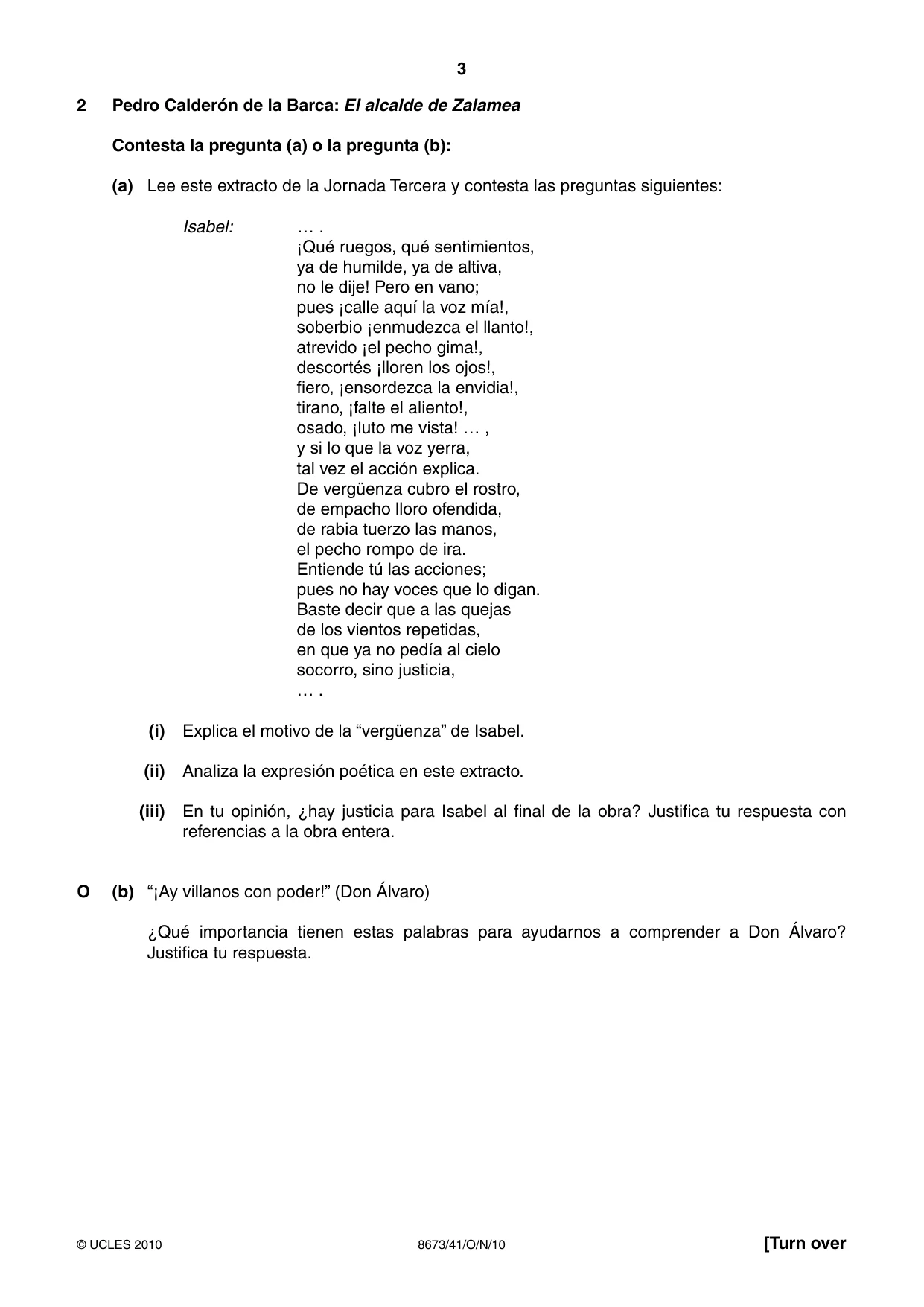
3 8673/41/O/N/10 © UCLES 2010 [Turn over 2 Pedro Calderón de la Barca: El alcalde de Zalamea Contesta la pregunta (a) o la pregunta (b): (a) Lee este extracto de la Jornada Tercera y contesta las preguntas siguientes: Isabel: … . ¡Qué ruegos, qué sentimientos, ya de humilde, ya de altiva, no le dije! Pero en vano; pues ¡calle aquí la voz mía!, soberbio ¡enmudezca el llanto!, atrevido ¡el pecho gima!, descortés ¡lloren los ojos!, fiero, ¡ensordezca la envidia!, tirano, ¡falte el aliento!, osado, ¡luto me vista! … , y si lo que la voz yerra, tal vez el acción explica. De vergü enza cubro el rostro, de empacho lloro ofendida, de rabia tuerzo las manos, el pecho rompo de ira. Entiende tú las acciones; pues no hay voces que lo digan. Baste decir que a las quejas de los vientos repetidas, en que ya no pedía al cielo socorro, sino justicia, … . (i) Explica el motivo de la “vergüenza” de Isabel. (ii) Analiza la expresión poética en este extracto. (iii) En tu opinión, ¿hay justicia para Isabel al final de la obra? Justifica tu respuesta con referencias a la obra entera. O (b) “¡Ay villanos con poder!” (Don Álvaro) ¿Qué importancia tienen estas palabras para ayudarnos a comprender a Don Álvaro? Justifica tu respuesta.
Question paper, page 4
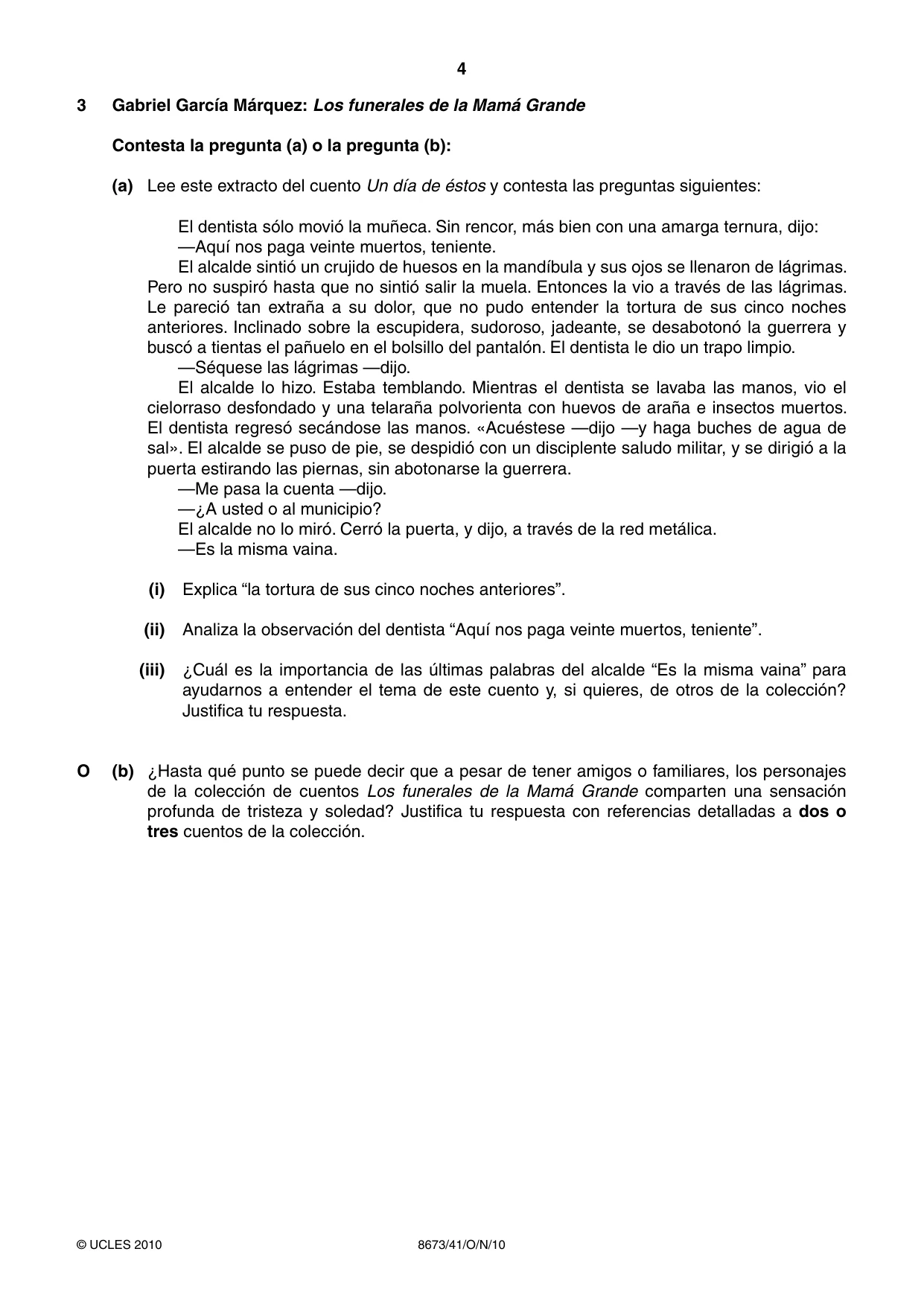
4 8673/41/O/N/10 © UCLES 2010 3 Gabriel García Márquez: Los funerales de la Mamá Grande Contesta la pregunta (a) o la pregunta (b): (a) Lee este extracto del cuento Un día de éstos y contesta las preguntas siguientes: El dentista sólo movió la muñeca. Sin rencor, más bien con una amarga ternura, dijo: —Aquí nos paga veinte muertos, teniente. El alcalde sintió un crujido de huesos en la mandíbula y sus ojos se llenaron de lágrimas. Pero no suspiró hasta que no sintió salir la muela. Entonces la vio a través de las lágrimas. Le pareció tan extraña a su dolor, que no pudo entender la tortura de sus cinco noches anteriores. Inclinado sobre la escupidera, sudoroso, jadeante, se desabotonó la guerrera y buscó a tientas el pañuelo en el bolsillo del pantalón. El dentista le dio un trapo limpio. —Séquese las lágrimas —dijo. El alcalde lo hizo. Estaba temblando. Mientras el dentista se lavaba las manos, vio el cielorraso desfondado y una telaraña polvorienta con huevos de araña e insectos muertos. El dentista regresó secándose las manos. «Acuéstese —dijo —y haga buches de agua de sal». El alcalde se puso de pie, se despidió con un disciplente saludo militar, y se dirigió a la puerta estirando las piernas, sin abotonarse la guerrera. —Me pasa la cuenta —dijo. —¿A usted o al municipio? El alcalde no lo miró. Cerró la puerta, y dijo, a través de la red metálica. —Es la misma vaina. (i) Explica “la tortura de sus cinco noches anteriores”. (ii) Analiza la observación del dentista “Aquí nos paga veinte muertos, teniente”. (iii) ¿Cuál es la importancia de las últimas palabras del alcalde “Es la misma vaina” para ayudarnos a entender el tema de este cuento y, si quieres, de otros de la colección? Justifica tu respuesta. O (b) ¿Hasta qué punto se puede decir que a pesar de tener amigos o familiares, los personajes de la colección de cuentos Los funerales de la Mamá Grande comparten una sensación profunda de tristeza y soledad? Justifica tu respuesta con referencias detalladas a dos o tres cuentos de la colección.
Question paper, page 5
5 8673/41/O/N/10 © UCLES 2010 [Turn over 4 Antonio Buero Vallejo: Hoy es fiesta Contesta la pregunta (a) o la pregunta (b): (a) Lee este extracto del Acto Tercero y contesta las preguntas siguientes: Daniela: (Los ve salir, y, tras una pausa, temerosa, se acerca a su madre.) Mamá … Doña Balbina: (Se vuelve lentamente y la mira. Estalla.) ¡Tú me has denunciado a los vecinos! ¡Tú! Daniela: (Retrocede, desconcertada.) ¡Por salvarte! Doña Balbina: ¿Por salvarme! ¡Je! De sobra sé lo mucho que me quieres. Daniela: Hubiera sido peor si no … ¿No lo comprendes? Doña Balbina: ¡No, no lo comprendo! De momento, disimular; después, ya veríamos. Pero nos habríamos ahorrado esta humillación. ¡Esta humillación que tú le has reservado a tu madre! Daniela: ¡Perdóname! Doña Balbina: La palabra de ese Quijote, ¿no? Daniela: (Atribulada.) ¡Nos ha salvado! Doña Balbina: ¿Y qué? Bien perdidas estamos, de todos modos. Hoy, por lo pronto, cenaremos aire, a causa de esa hermosa comedia del perdón en la que también he tenido yo que echar mis lagrimitas … Daniela: (Destrozada.) No, mamá, no … Doña Balbina: Y ahora, tú quieres continuarla conmigo. ¡Pero no te lo tolero! ¡Tú me has delatado porque me odias, y eso lo tendrás que pagar! (Va hacia la puerta, vuelve sobre sus pasos, toma su silla y reanuda la marcha.) Daniela: (Con las manos juntas.) ¡Mamá! Doña Balbina: (Desde la puerta, muy seca.) Bribona. (Sale. Daniela se vuelve de cara al proscenio, con la desesperación en el rostro y el pecho agitado.) Daniela: Todo está perdido. (i) Explica el significado de estas palabras: “¡Tú me has denunciado a los vecinos!”. (ii) En tu opinión, ¿hasta qué punto merece Daniela las palabras de su madre? (iii) “De momento, disimular”. ¿Cuál es la importancia de estas palabras para ayudarnos a entender la obra entera? Justifica tu respuesta. O (b) ‘La tragedia en la obra Hoy es fiesta no es consecuencia de la pobreza material, sino de la incapacidad de los personajes para aceptar la vida que tienen que vivir’. ¿Estás de acuerdo con esta opinión? Justifica tu respuesta.
Question paper, page 6
6 8673/41/O/N/10 © UCLES 2010 5 Lauro Olmo: La camisa Contesta la pregunta (a) o la pregunta (b): (a) Lee este extracto del Acto Segundo y contesta las preguntas siguientes: Lola: ¿Está seca? Lolita: (Que ha dejado la ropa encima de la cama) Está buena pa la plancha. Lola: Mira a ver cuántas arenques hay. ¿De dónde vienes? Lolita: (Abriendo una pequeña alacena, saca un plato con sardinas arenques) He estado con Rosita. Hay doce arenques, madre. (Deja el plato donde estaba y cierra la alacena) Lola: No me gusta que salgas con Nacho. Tú no estás pa novios toavía. Lolita: Pero, madre, ¡si no … ! Lola: ¡Lo dicho! Anda (echándole unos calcetines), zúrcele los calcetines a tu padre. (Termina de planchar la camisa y la deja sobre una silla. Se dispone a planchar los pantalones) Lolita: (Se sienta. Ha cogido una caja de costura. Hilvana una aguja, disponiéndose a zurcir los calcetines) Nacho quiere irse a Alemania, a trabajar y a ganar mucho dinero. Lola: Tós queremos irnos a alguna parte. Tós menos el estúpido de tu padre, que no sé qué espera. “Juan, hay que tomar una decisión. No podemos seguir así.” “Espera, Lola; espera.” Y siempre igual: espera, espera. (Va al fogón y cambia la plancha. Regresa) (i) ¿Por qué dice Lola a Lolita que “Tú no estás pa novios toavía”? (ii) Explica el significado de las palabras “No podemos seguir así”. (iii) ¿Cuál es la importancia de este extracto para ayudarnos a entender la obra entera? Justifica tu respuesta. O (b) En tu opinión, ¿ofrece Lauro Olmo una solución a los problemas presentados en la obra? Justifica tu respuesta.
Question paper, page 7
7 8673/41/O/N/10 © UCLES 2010 SECCIÓN SEGUNDA 6 Carlos Ruiz Zafón: La sombra del viento O (a) En tu opinión, ¿cómo se manifiestan las fuerzas del mal en La sombra del viento? Justifica tu respuesta. O (b) ¿Hasta qué punto se puede decir que La sombra del viento es una novela en que el humor juega un papel muy importante? Justifica tu respuesta. 7 Paola Kaufmann: El lago O (a) Analiza la importancia del título de la novela El lago. Justifica tu respuesta. O (b) En tu opinión, ¿ofrece El lago una visión pesimista del género humano? Justifica tu respuesta. 8 Federico García Lorca: La casa de Bernarda Alba O (a) Analiza la importancia de la casa en la obra La casa de Bernarda Alba. Justifica tu respuesta. O (b) “ ... nos pudrimos por el que dirán”. (Magdalena) En tu opinión, ¿es ésta la esencia de la obra La casa de Bernarda Alba? Justifica tu respuesta. 9 Rubén Darío: Selección de poemas O (a) Haz un análisis crítico del poema Era un aire suave con referencias detalladas a los temas y a la versificación. O (b) Un crítico ha dicho que Rubén Darío era un poeta internacional. ¿Estás de acuerdo? Justifica tu respuesta. 10 Laura Esquivel: Como agua para chocolate O (a) En tu opinión, ¿por qué dio Laura Esquivel este título a la novela Como agua para chocolate? Justifica tu respuesta. O (b) ¿Estás de acuerdo con la opinión de que es imposible compadecerse de Rosaura? Analiza su papel en la novela Como agua para chocolate.
Question paper, page 8
8 8673/41/O/N/10 © UCLES 2010 BLANK PAGE Copyright Acknowledgements: Question 1a © Mariano Azuela; Los de abajo; Harrap; 1973. Question 2a © Pedro Calderón de la Barca; El alcalde de Zalamea; Catedra; 1986. Question 3a © Gabriel García Márquez; Los funerales de la Mamá Grande; Ed. Alfaguara S.A.; 1985. Question 4a © Antonio Buero Vallejo; Hoy es fiesta; Harrap; 1964. Question 5a © Lauro Olmo; La camisa; Pergamon Press; 1968. Permission to reproduce items where third-party owned material protected by copyright is included has been sought and cleared where possible. Every reasonable effort has been made by the publisher (UCLES) to trace copyright holders, but if any items requiring clearance have unwittingly been included, the publisher will be pleased to make amends at the earliest possible opportunity. University of Cambridge International Examinations is part of the Cambridge Assessment Group. Cambridge Assessment is the brand name of University of Cambridge Local Examinations Syndicate (UCLES), which is itself a department of the University of Cambridge.
Mark scheme, page 1
UNIVERSITY OF CAMBRIDGE INTERNATIONAL EXAMINATIONS GCE Advanced Subsidiary Level MARK SCHEME for the October/November 2010 question paper for the guidance of teachers 8673 SPANISH LITERATURE 8673/41 Paper 4 (Texts), maximum raw mark 75 This mark scheme is published as an aid to teachers and candidates, to indicate the requirements of the examination. It shows the basis on which Examiners were instructed to award marks. It does not indicate the details of the discussions that took place at an Examiners’ meeting before marking began, which would have considered the acceptability of alternative answers. Mark schemes must be read in conjunction with the question papers and the report on the examination. • CIE will not enter into discussions or correspondence in connection with these mark schemes. CIE is publishing the mark schemes for the October/November 2010 question papers for most IGCSE, GCE Advanced Level and Advanced Subsidiary Level syllabuses and some Ordinary Level syllabuses.
Mark scheme, page 2
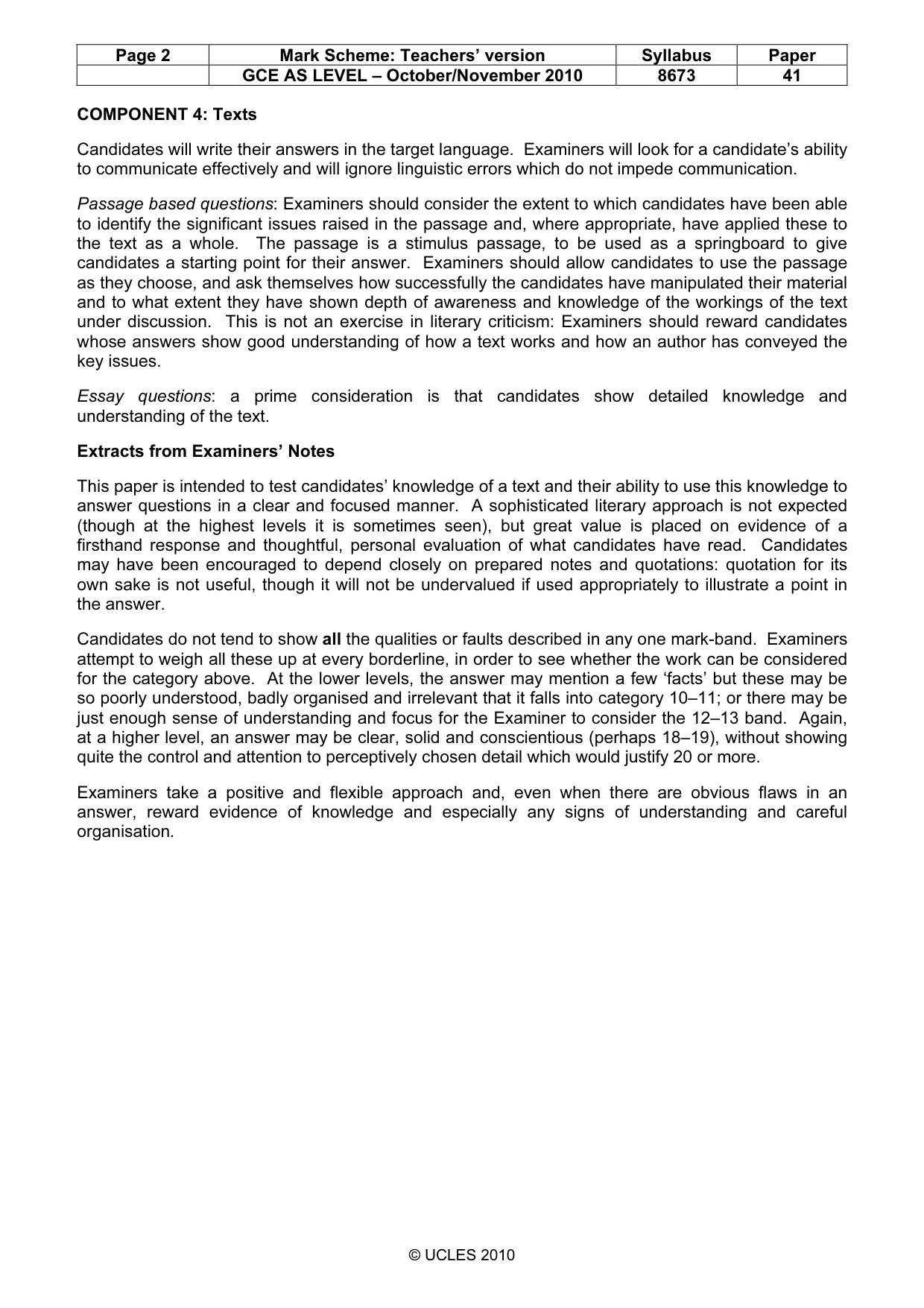
Page 2 Mark Scheme: Teachers’ version Syllabus Paper GCE AS LEVEL – October/November 2010 8673 41 © UCLES 2010 COMPONENT 4: Texts Candidates will write their answers in the target language. Examiners will look for a candidate’s ability to communicate effectively and will ignore linguistic errors which do not impede communication. Passage based questions: Examiners should consider the extent to which candidates have been able to identify the significant issues raised in the passage and, where appropriate, have applied these to the text as a whole. The passage is a stimulus passage, to be used as a springboard to give candidates a starting point for their answer. Examiners should allow candidates to use the passage as they choose, and ask themselves how successfully the candidates have manipulated their material and to what extent they have shown depth of awareness and knowledge of the workings of the text under discussion. This is not an exercise in literary criticism: Examiners should reward candidates whose answers show good understanding of how a text works and how an author has conveyed the key issues. Essay questions: a prime consideration is that candidates show detailed knowledge and understanding of the text. Extracts from Examiners’ Notes This paper is intended to test candidates’ knowledge of a text and their ability to use this knowledge to answer questions in a clear and focused manner. A sophisticated literary approach is not expected (though at the highest levels it is sometimes seen), but great value is placed on evidence of a firsthand response and thoughtful, personal evaluation of what candidates have read. Candidates may have been encouraged to depend closely on prepared notes and quotations: quotation for its own sake is not useful, though it will not be undervalued if used appropriately to illustrate a point in the answer. Candidates do not tend to show all the qualities or faults described in any one mark-band. Examiners attempt to weigh all these up at every borderline, in order to see whether the work can be considered for the category above. At the lower levels, the answer may mention a few ‘facts’ but these may be so poorly understood, badly organised and irrelevant that it falls into category 10–11; or there may be just enough sense of understanding and focus for the Examiner to consider the 12–13 band. Again, at a higher level, an answer may be clear, solid and conscientious (perhaps 18–19), without showing quite the control and attention to perceptively chosen detail which would justify 20 or more. Examiners take a positive and flexible approach and, even when there are obvious flaws in an answer, reward evidence of knowledge and especially any signs of understanding and careful organisation.
Mark scheme, page 3
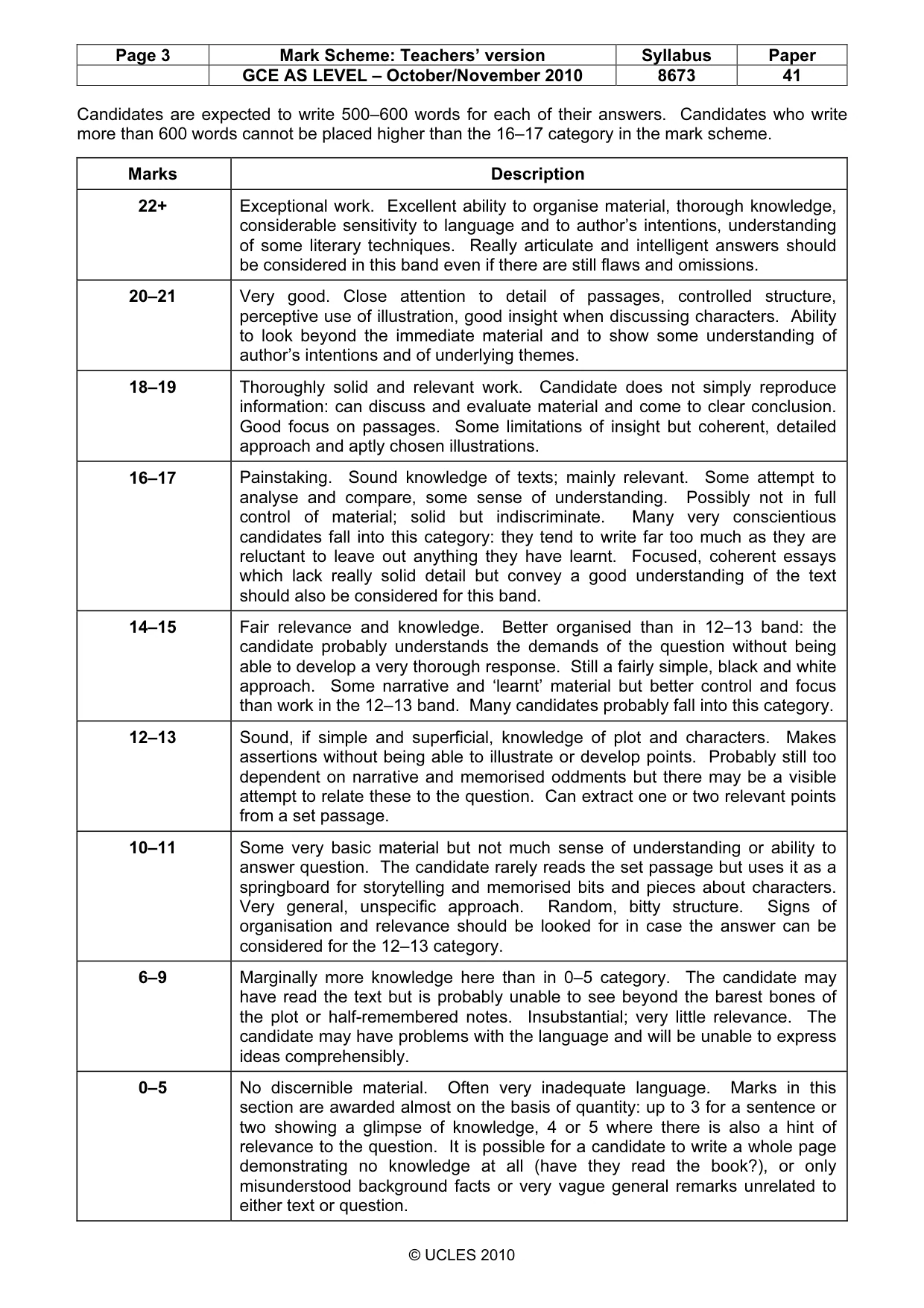
Page 3 Mark Scheme: Teachers’ version Syllabus Paper GCE AS LEVEL – October/November 2010 8673 41 © UCLES 2010 Candidates are expected to write 500–600 words for each of their answers. Candidates who write more than 600 words cannot be placed higher than the 16–17 category in the mark scheme. Marks Description 22+ Exceptional work. Excellent ability to organise material, thorough knowledge, considerable sensitivity to language and to author’s intentions, understanding of some literary techniques. Really articulate and intelligent answers should be considered in this band even if there are still flaws and omissions. 20–21 Very good. Close attention to detail of passages, controlled structure, perceptive use of illustration, good insight when discussing characters. Ability to look beyond the immediate material and to show some understanding of author’s intentions and of underlying themes. 18–19 Thoroughly solid and relevant work. Candidate does not simply reproduce information: can discuss and evaluate material and come to clear conclusion. Good focus on passages. Some limitations of insight but coherent, detailed approach and aptly chosen illustrations. 16–17 Painstaking. Sound knowledge of texts; mainly relevant. Some attempt to analyse and compare, some sense of understanding. Possibly not in full control of material; solid but indiscriminate. Many very conscientious candidates fall into this category: they tend to write far too much as they are reluctant to leave out anything they have learnt. Focused, coherent essays which lack really solid detail but convey a good understanding of the text should also be considered for this band. 14–15 Fair relevance and knowledge. Better organised than in 12–13 band: the candidate probably understands the demands of the question without being able to develop a very thorough response. Still a fairly simple, black and white approach. Some narrative and ‘learnt’ material but better control and focus than work in the 12–13 band. Many candidates probably fall into this category. 12–13 Sound, if simple and superficial, knowledge of plot and characters. Makes assertions without being able to illustrate or develop points. Probably still too dependent on narrative and memorised oddments but there may be a visible attempt to relate these to the question. Can extract one or two relevant points from a set passage. 10–11 Some very basic material but not much sense of understanding or ability to answer question. The candidate rarely reads the set passage but uses it as a springboard for storytelling and memorised bits and pieces about characters. Very general, unspecific approach. Random, bitty structure. Signs of organisation and relevance should be looked for in case the answer can be considered for the 12–13 category. 6–9 Marginally more knowledge here than in 0–5 category. The candidate may have read the text but is probably unable to see beyond the barest bones of the plot or half-remembered notes. Insubstantial; very little relevance. The candidate may have problems with the language and will be unable to express ideas comprehensibly. 0–5 No discernible material. Often very inadequate language. Marks in this section are awarded almost on the basis of quantity: up to 3 for a sentence or two showing a glimpse of knowledge, 4 or 5 where there is also a hint of relevance to the question. It is possible for a candidate to write a whole page demonstrating no knowledge at all (have they read the book?), or only misunderstood background facts or very vague general remarks unrelated to either text or question.
What you needed in this session
Cambridge’s own grade thresholds for 2010 Oct/Nov, Paper 4 · Variant 1. A higher threshold means an easier paper — the bar moves with how the cohort did.