Cambridge A Level Spanish - Literature (AS Level only) 8673 — 2010 May/June Paper 4 · Variant 1
8673/41/M/J/10 · 75 marks · ≈84 min
The question paper and its mark scheme, free to read here and free to download. This is Cambridge’s own paper, exactly as it was sat.
Question paper8 pages

Mark scheme3 pages
Answers below. Sit the paper first if you are practising.
Paper as text
Question paper, page 1
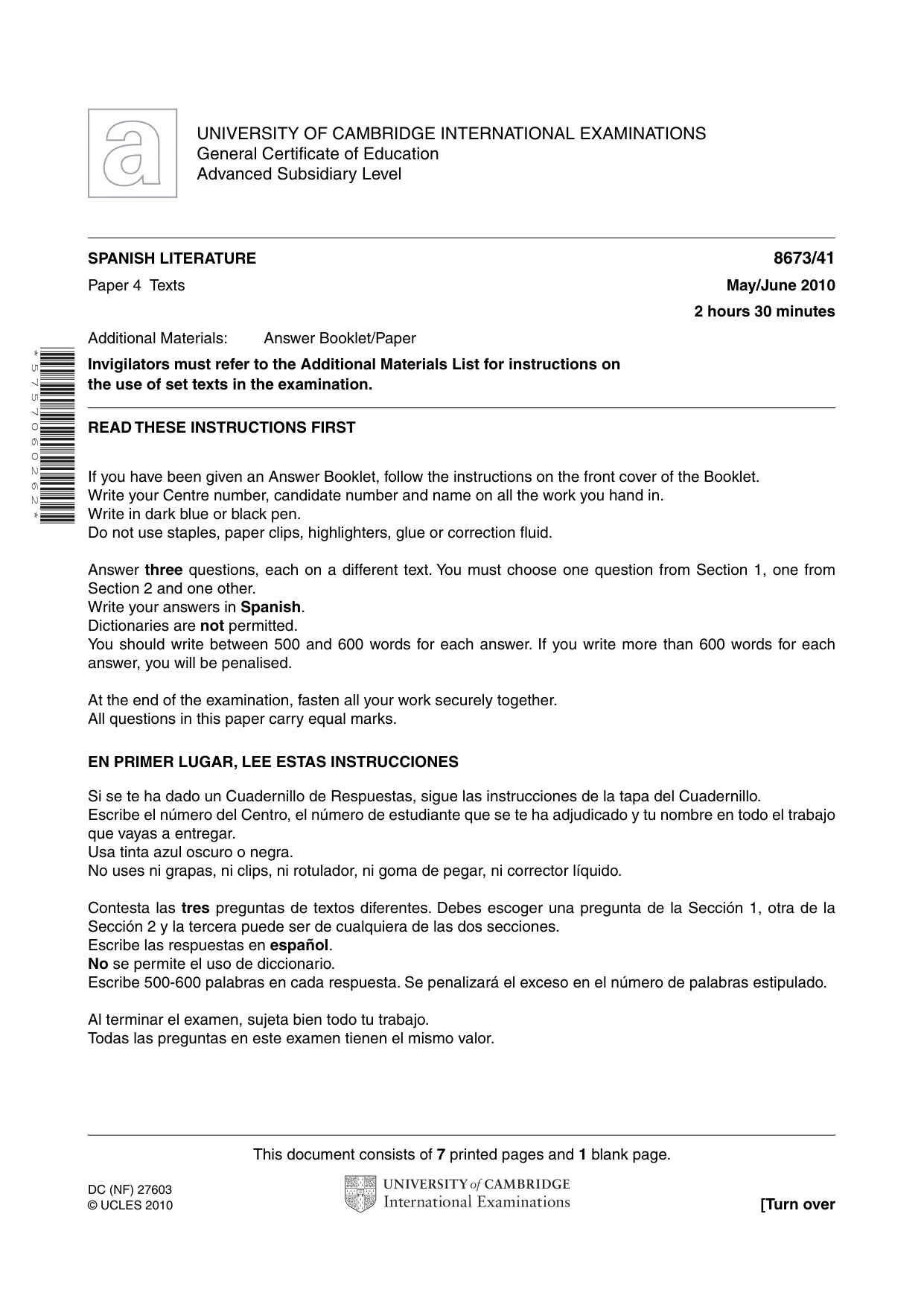
This document consists of 7 printed pages and 1 blank page. DC (NF) 27603 © UCLES 2010 [Turn over UNIVERSITY OF CAMBRIDGE INTERNATIONAL EXAMINATIONS General Certificate of Education Advanced Subsidiary Level * 5 7 5 7 0 6 0 2 6 2 * SPANISH LITERATURE 8673/41 Paper 4 Texts May/June 2010 2 hours 30 minutes Additional Materials: Answer Booklet/Paper Invigilators must refer to the Additional Materials List for instructions on the use of set texts in the examination. READ THESE INSTRUCTIONS FIRST If you have been given an Answer Booklet, follow the instructions on the front cover of the Booklet. Write your Centre number, candidate number and name on all the work you hand in. Write in dark blue or black pen. Do not use staples, paper clips, highlighters, glue or correction fluid. Answer three questions, each on a different text. You must choose one question from Section 1, one from Section 2 and one other. Write your answers in Spanish. Dictionaries are not permitted. You should write between 500 and 600 words for each answer. If you write more than 600 words for each answer, you will be penalised. At the end of the examination, fasten all your work securely together. All questions in this paper carry equal marks. EN PRIMER LUGAR, LEE ESTAS INSTRUCCIONES Si se te ha dado un Cuadernillo de Respuestas, sigue las instrucciones de la tapa del Cuadernillo. Escribe el número del Centro, el número de estudiante que se te ha adjudicado y tu nombre en todo el trabajo que vayas a entregar. Usa tinta azul oscuro o negra. No uses ni grapas, ni clips, ni rotulador, ni goma de pegar, ni corrector líquido. Contesta las tres preguntas de textos diferentes. Debes escoger una pregunta de la Sección 1, otra de la Sección 2 y la tercera puede ser de cualquiera de las dos secciones. Escribe las respuestas en español. No se permite el uso de diccionario. Escribe 500-600 palabras en cada respuesta. Se penalizará el exceso en el número de palabras estipulado. Al terminar el examen, sujeta bien todo tu trabajo. Todas las preguntas en este examen tienen el mismo valor.
Question paper, page 2
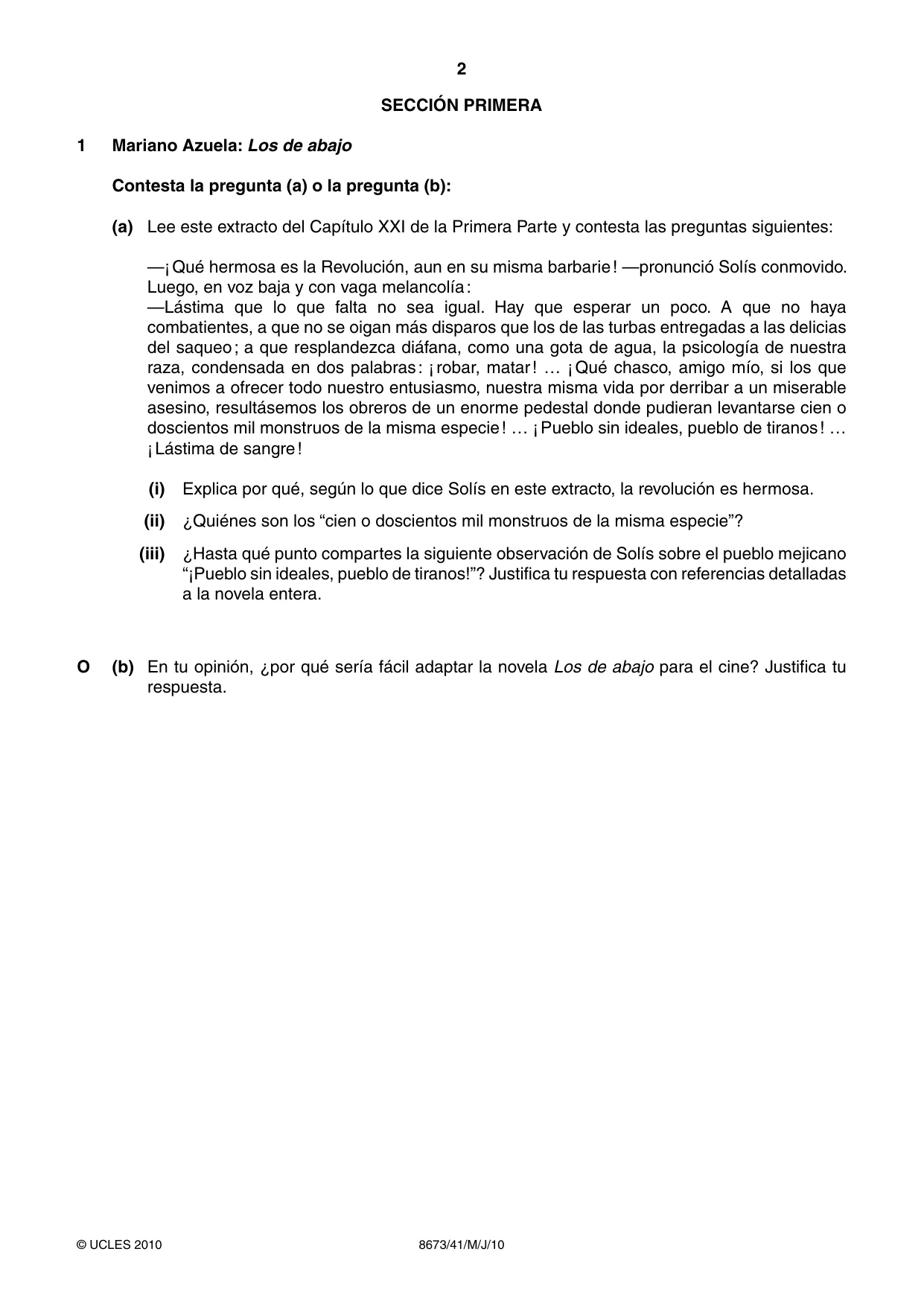
2 8673/41/M/J/10 © UCLES 2010 SECCIÓN PRIMERA 1 Mariano Azuela: Los de abajo Contesta la pregunta (a) o la pregunta (b): (a) Lee este extracto del Capítulo XXI de la Primera Parte y contesta las preguntas siguientes: —¡ Qué hermosa es la Revolución, aun en su misma barbarie ! —pronunció Solís conmovido. Luego, en voz baja y con vaga melancolía : —Lástima que lo que falta no sea igual. Hay que esperar un poco. A que no haya combatientes, a que no se oigan más disparos que los de las turbas entregadas a las delicias del saqueo ; a que resplandezca diáfana, como una gota de agua, la psicología de nuestra raza, condensada en dos palabras : ¡ robar, matar ! … ¡ Qué chasco, amigo mío, si los que venimos a ofrecer todo nuestro entusiasmo, nuestra misma vida por derribar a un miserable asesino, resultásemos los obreros de un enorme pedestal donde pudieran levantarse cien o doscientos mil monstruos de la misma especie ! … ¡ Pueblo sin ideales, pueblo de tiranos ! … ¡ Lástima de sangre ! (i) Explica por qué, según lo que dice Solís en este extracto, la revolución es hermosa. (ii) ¿Quiénes son los “cien o doscientos mil monstruos de la misma especie”? (iii) ¿Hasta qué punto compartes la siguiente observación de Solís sobre el pueblo mejicano “¡Pueblo sin ideales, pueblo de tiranos!”? Justifica tu respuesta con referencias detalladas a la novela entera. O (b) En tu opinión, ¿por qué sería fácil adaptar la novela Los de abajo para el cine? Justifica tu respuesta.
Question paper, page 3
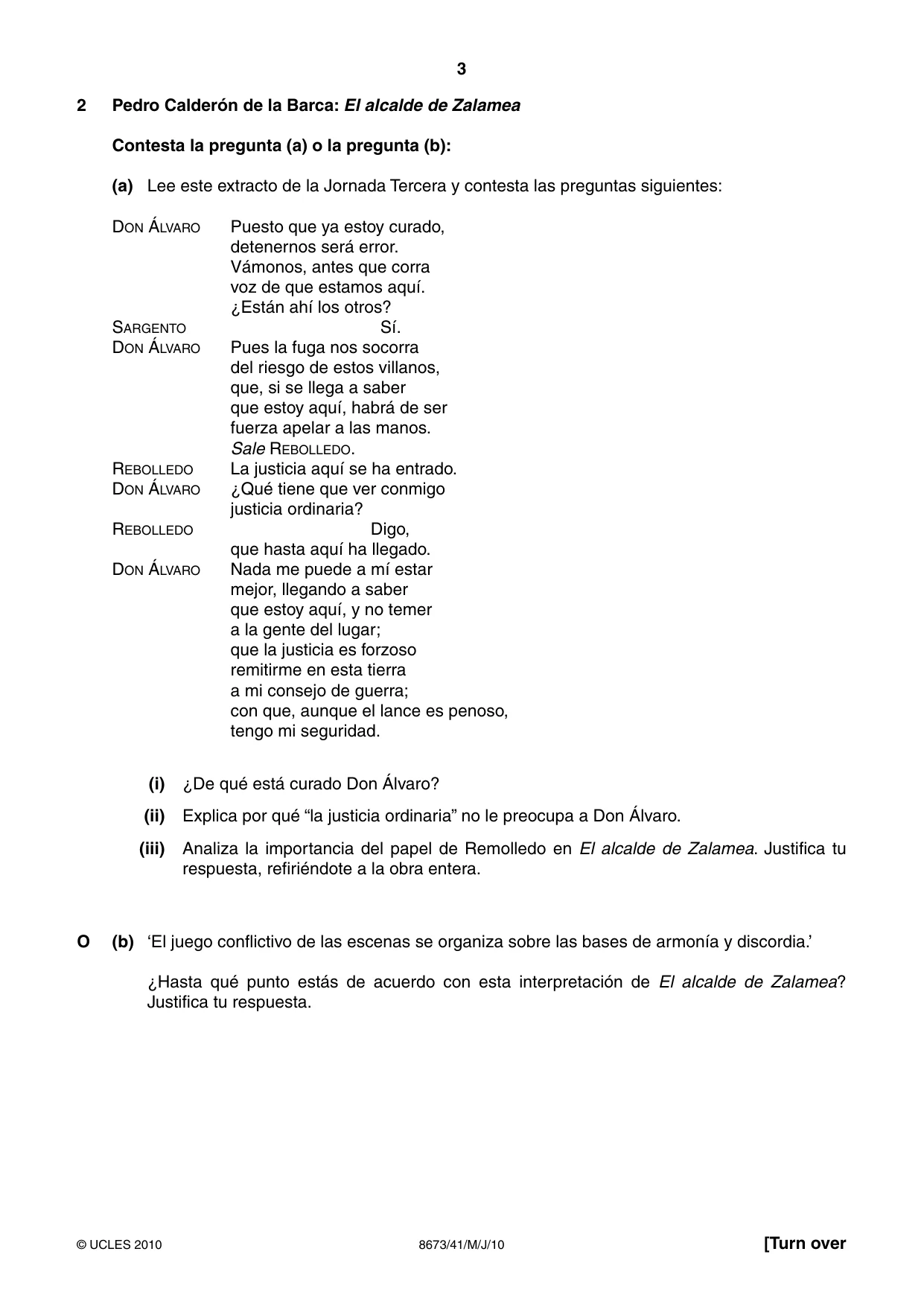
3 8673/41/M/J/10 © UCLES 2010 [Turn over 2 Pedro Calderón de la Barca: El alcalde de Zalamea Contesta la pregunta (a) o la pregunta (b): (a) Lee este extracto de la Jornada Tercera y contesta las preguntas siguientes: DON ÁLVARO Puesto que ya estoy curado, detenernos será error. Vámonos, antes que corra voz de que estamos aquí. ¿Están ahí los otros? SARGENTO Sí. DON ÁLVARO Pues la fuga nos socorra del riesgo de estos villanos, que, si se llega a saber que estoy aquí, habrá de ser fuerza apelar a las manos. Sale REBOLLEDO. REBOLLEDO La justicia aquí se ha entrado. DON ÁLVARO ¿Qué tiene que ver conmigo justicia ordinaria? REBOLLEDO Digo, que hasta aquí ha llegado. DON ÁLVARO Nada me puede a mí estar mejor, llegando a saber que estoy aquí, y no temer a la gente del lugar; que la justicia es forzoso remitirme en esta tierra a mi consejo de guerra; con que, aunque el lance es penoso, tengo mi seguridad. (i) ¿De qué está curado Don Álvaro? (ii) Explica por qué “la justicia ordinaria” no le preocupa a Don Álvaro. (iii) Analiza la importancia del papel de Remolledo en El alcalde de Zalamea. Justifica tu respuesta, refiriéndote a la obra entera. O (b) ‘El juego conflictivo de las escenas se organiza sobre las bases de armonía y discordia.’ ¿Hasta qué punto estás de acuerdo con esta interpretación de El alcalde de Zalamea? Justifica tu respuesta.
Question paper, page 4
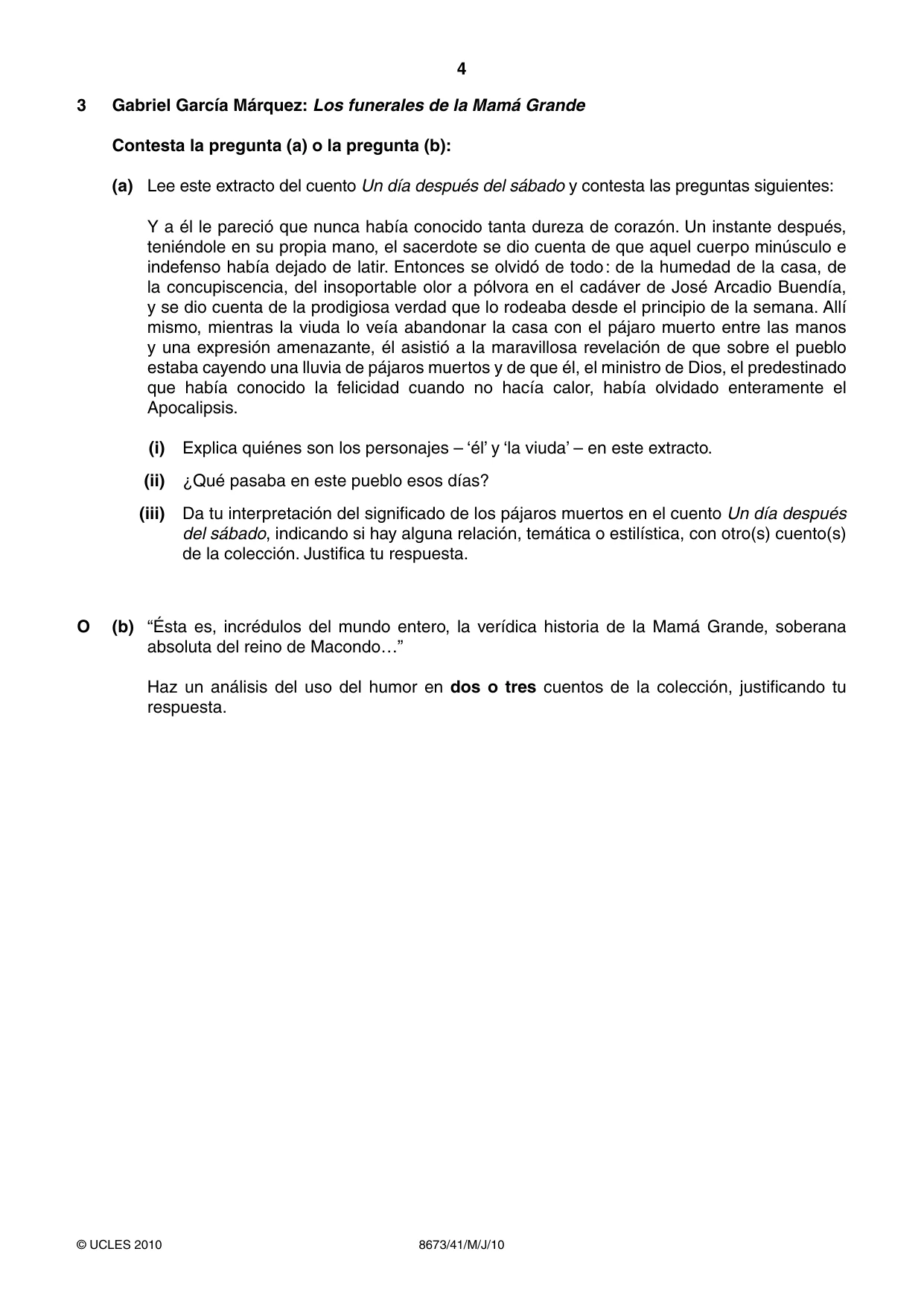
4 8673/41/M/J/10 © UCLES 2010 3 Gabriel García Márquez: Los funerales de la Mamá Grande Contesta la pregunta (a) o la pregunta (b): (a) Lee este extracto del cuento Un día después del sábado y contesta las preguntas siguientes: Y a él le pareció que nunca había conocido tanta dureza de corazón. Un instante después, teniéndole en su propia mano, el sacerdote se dio cuenta de que aquel cuerpo minúsculo e indefenso había dejado de latir. Entonces se olvidó de todo : de la humedad de la casa, de la concupiscencia, del insoportable olor a pólvora en el cadáver de José Arcadio Buendía, y se dio cuenta de la prodigiosa verdad que lo rodeaba desde el principio de la semana. Allí mismo, mientras la viuda lo veía abandonar la casa con el pájaro muerto entre las manos y una expresión amenazante, él asistió a la maravillosa revelación de que sobre el pueblo estaba cayendo una lluvia de pájaros muertos y de que él, el ministro de Dios, el predestinado que había conocido la felicidad cuando no hacía calor, había olvidado enteramente el Apocalipsis. (i) Explica quiénes son los personajes – ‘él’ y ‘la viuda’ – en este extracto. (ii) ¿Qué pasaba en este pueblo esos días? (iii) Da tu interpretación del significado de los pájaros muertos en el cuento Un día después del sábado, indicando si hay alguna relación, temática o estilística, con otro(s) cuento(s) de la colección. Justifica tu respuesta. O (b) “Ésta es, incrédulos del mundo entero, la verídica historia de la Mamá Grande, soberana absoluta del reino de Macondo…” Haz un análisis del uso del humor en dos o tres cuentos de la colección, justificando tu respuesta.
Question paper, page 5
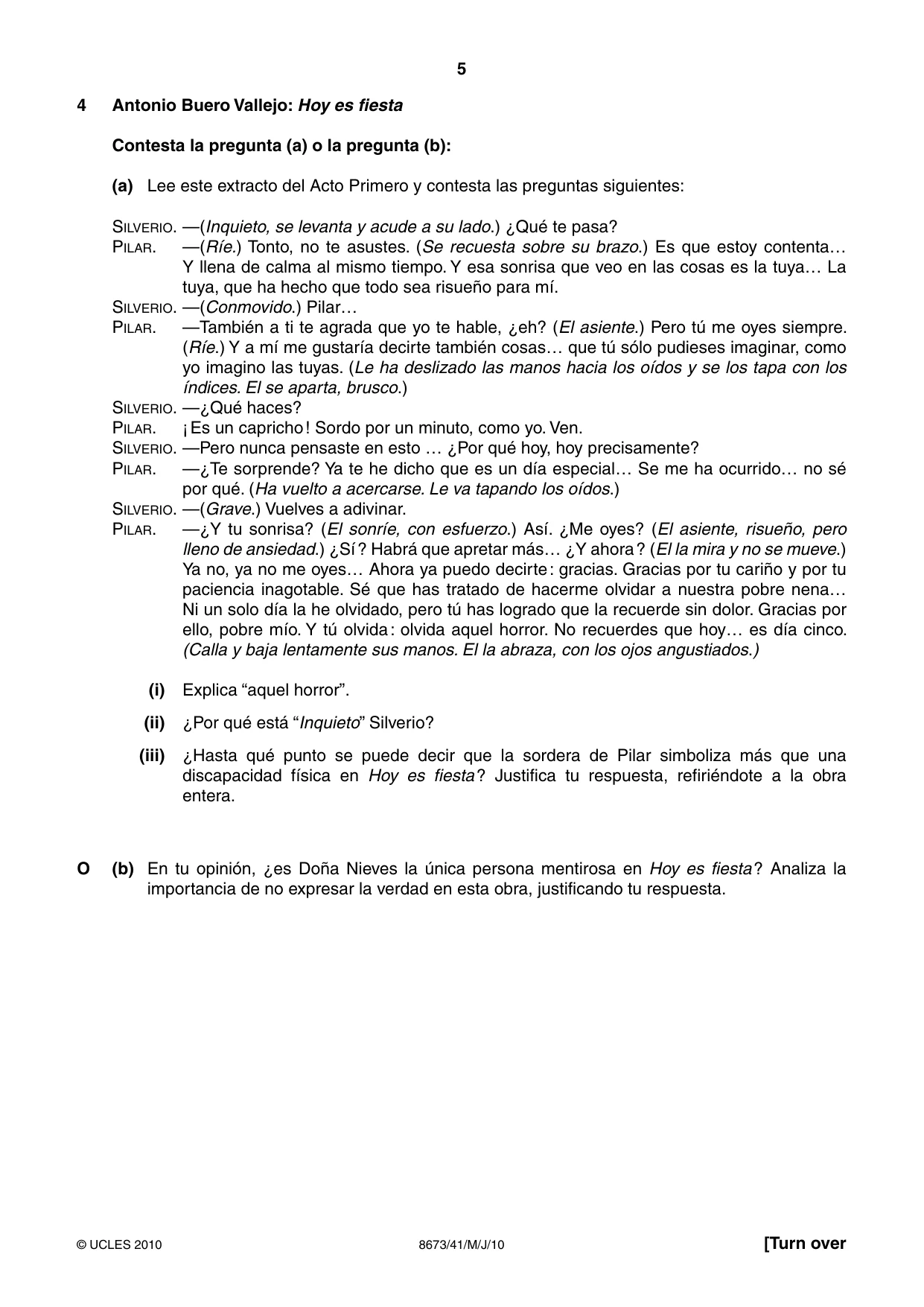
5 8673/41/M/J/10 © UCLES 2010 [Turn over 4 Antonio Buero Vallejo: Hoy es fiesta Contesta la pregunta (a) o la pregunta (b): (a) Lee este extracto del Acto Primero y contesta las preguntas siguientes: SILVERIO. —(Inquieto, se levanta y acude a su lado.) ¿Qué te pasa? PILAR. —(Ríe.) Tonto, no te asustes. (Se recuesta sobre su brazo.) Es que estoy contenta… Y llena de calma al mismo tiempo. Y esa sonrisa que veo en las cosas es la tuya… La tuya, que ha hecho que todo sea risueño para mí. SILVERIO. —(Conmovido.) Pilar… PILAR. —También a ti te agrada que yo te hable, ¿eh? (El asiente.) Pero tú me oyes siempre. (Ríe.) Y a mí me gustaría decirte también cosas… que tú sólo pudieses imaginar, como yo imagino las tuyas. (Le ha deslizado las manos hacia los oídos y se los tapa con los índices. El se aparta, brusco.) SILVERIO. —¿Qué haces? PILAR. ¡ Es un capricho ! Sordo por un minuto, como yo. Ven. SILVERIO. —Pero nunca pensaste en esto … ¿Por qué hoy, hoy precisamente? PILAR. —¿Te sorprende? Ya te he dicho que es un día especial… Se me ha ocurrido… no sé por qué. (Ha vuelto a acercarse. Le va tapando los oídos.) SILVERIO. —(Grave.) Vuelves a adivinar. PILAR. —¿Y tu sonrisa? (El sonríe, con esfuerzo.) Así. ¿Me oyes? (El asiente, risueño, pero lleno de ansiedad.) ¿Sí ? Habrá que apretar más… ¿Y ahora ? (El la mira y no se mueve.) Ya no, ya no me oyes… Ahora ya puedo decirte : gracias. Gracias por tu cariño y por tu paciencia inagotable. Sé que has tratado de hacerme olvidar a nuestra pobre nena… Ni un solo día la he olvidado, pero tú has logrado que la recuerde sin dolor. Gracias por ello, pobre mío. Y tú olvida : olvida aquel horror. No recuerdes que hoy… es día cinco. (Calla y baja lentamente sus manos. El la abraza, con los ojos angustiados.) (i) Explica “aquel horror”. (ii) ¿Por qué está “Inquieto” Silverio? (iii) ¿Hasta qué punto se puede decir que la sordera de Pilar simboliza más que una discapacidad física en Hoy es fiesta ? Justifica tu respuesta, refiriéndote a la obra entera. O (b) En tu opinión, ¿es Doña Nieves la única persona mentirosa en Hoy es fiesta ? Analiza la importancia de no expresar la verdad en esta obra, justificando tu respuesta.
Question paper, page 6
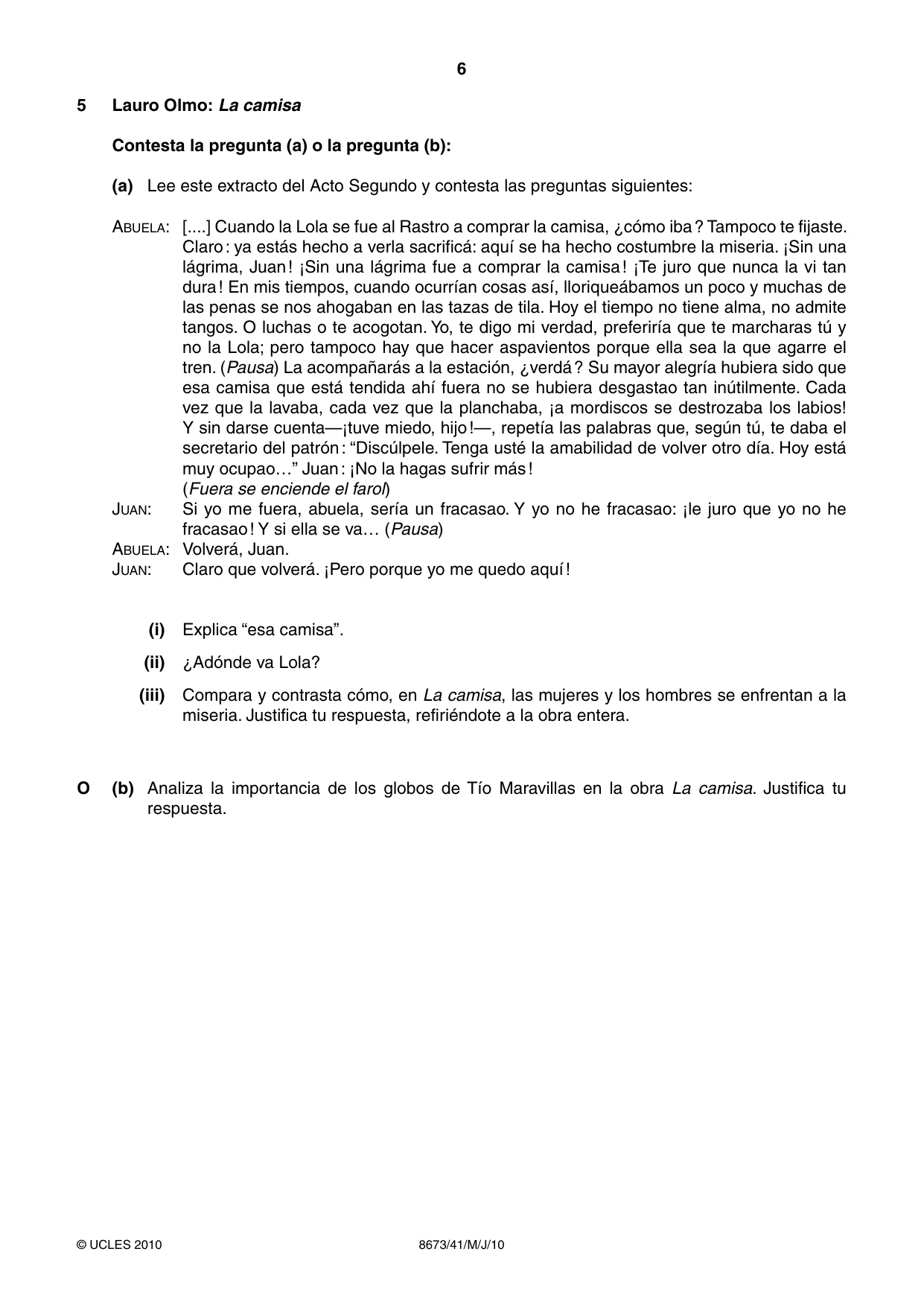
6 8673/41/M/J/10 © UCLES 2010 5 Lauro Olmo: La camisa Contesta la pregunta (a) o la pregunta (b): (a) Lee este extracto del Acto Segundo y contesta las preguntas siguientes: ABUELA: […] Cuando la Lola se fue al Rastro a comprar la camisa, ¿cómo iba ? Tampoco te fijaste. Claro : ya estás hecho a verla sacrificá: aquí se ha hecho costumbre la miseria. ¡Sin una lágrima, Juan ! ¡Sin una lágrima fue a comprar la camisa ! ¡Te juro que nunca la vi tan dura ! En mis tiempos, cuando ocurrían cosas así, lloriqueábamos un poco y muchas de las penas se nos ahogaban en las tazas de tila. Hoy el tiempo no tiene alma, no admite tangos. O luchas o te acogotan. Yo, te digo mi verdad, preferiría que te marcharas tú y no la Lola; pero tampoco hay que hacer aspavientos porque ella sea la que agarre el tren. (Pausa) La acompañarás a la estación, ¿verdá ? Su mayor alegría hubiera sido que esa camisa que está tendida ahí fuera no se hubiera desgastao tan inútilmente. Cada vez que la lavaba, cada vez que la planchaba, ¡a mordiscos se destrozaba los labios! Y sin darse cuenta—¡tuve miedo, hijo !—, repetía las palabras que, según tú, te daba el secretario del patrón : “Discúlpele. Tenga usté la amabilidad de volver otro día. Hoy está muy ocupao…” Juan : ¡No la hagas sufrir más ! (Fuera se enciende el farol) JUAN: Si yo me fuera, abuela, sería un fracasao. Y yo no he fracasao: ¡le juro que yo no he fracasao ! Y si ella se va… (Pausa) ABUELA: Volverá, Juan. JUAN: Claro que volverá. ¡Pero porque yo me quedo aquí ! (i) Explica “esa camisa”. (ii) ¿Adónde va Lola? (iii) Compara y contrasta cómo, en La camisa, las mujeres y los hombres se enfrentan a la miseria. Justifica tu respuesta, refiriéndote a la obra entera. O (b) Analiza la importancia de los globos de Tío Maravillas en la obra La camisa. Justifica tu respuesta.
Question paper, page 7
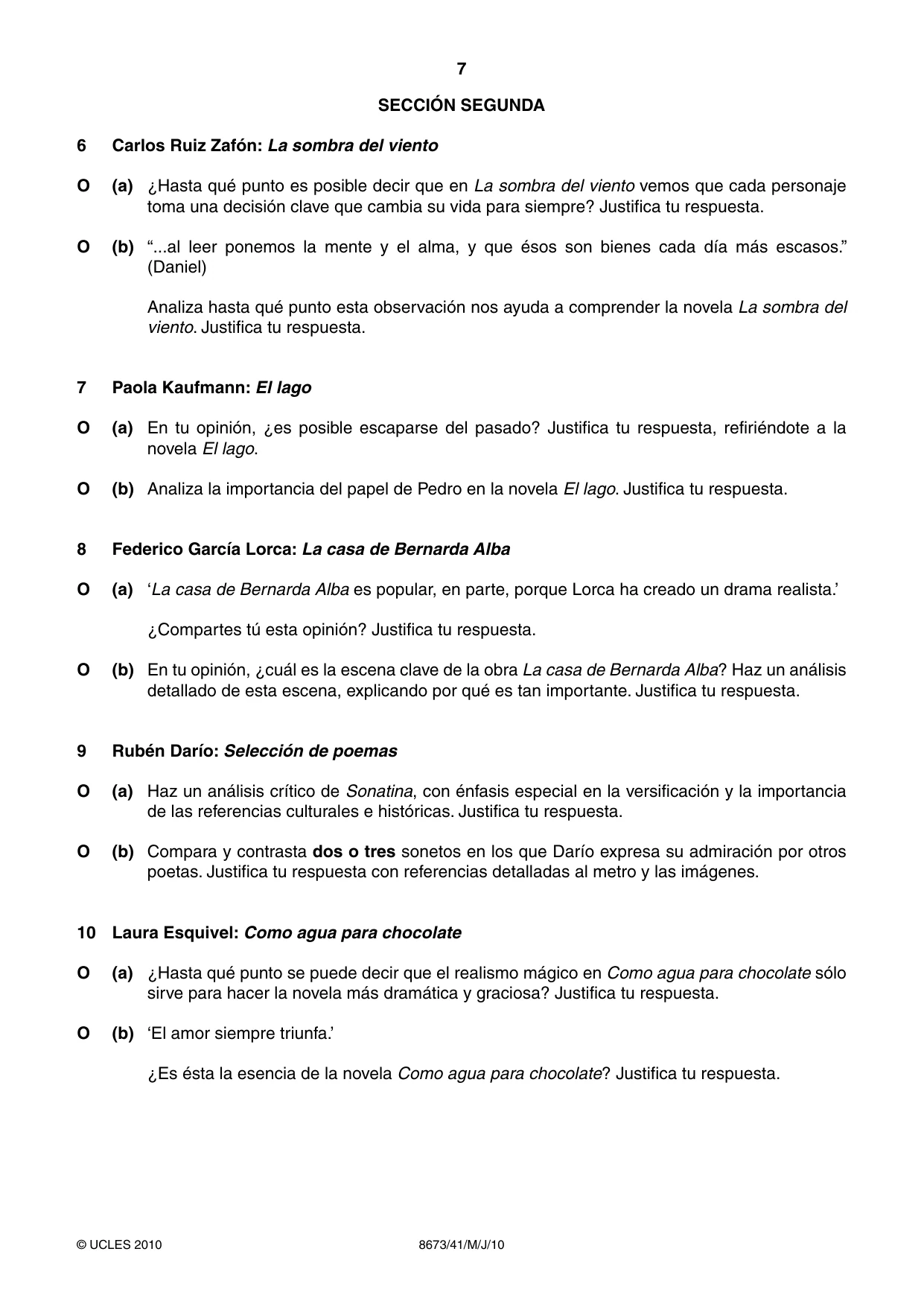
7 8673/41/M/J/10 © UCLES 2010 SECCIÓN SEGUNDA 6 Carlos Ruiz Zafón: La sombra del viento O (a) ¿Hasta qué punto es posible decir que en La sombra del viento vemos que cada personaje toma una decisión clave que cambia su vida para siempre? Justifica tu respuesta. O (b) “...al leer ponemos la mente y el alma, y que ésos son bienes cada día más escasos.” (Daniel) Analiza hasta qué punto esta observación nos ayuda a comprender la novela La sombra del viento. Justifica tu respuesta. 7 Paola Kaufmann: El lago O (a) En tu opinión, ¿es posible escaparse del pasado? Justifica tu respuesta, refiriéndote a la novela El lago. O (b) Analiza la importancia del papel de Pedro en la novela El lago. Justifica tu respuesta. 8 Federico García Lorca: La casa de Bernarda Alba O (a) ‘La casa de Bernarda Alba es popular, en parte, porque Lorca ha creado un drama realista.’ ¿Compartes tú esta opinión? Justifica tu respuesta. O (b) En tu opinión, ¿cuál es la escena clave de la obra La casa de Bernarda Alba? Haz un análisis detallado de esta escena, explicando por qué es tan importante. Justifica tu respuesta. 9 Rubén Darío: Selección de poemas O (a) Haz un análisis crítico de Sonatina, con énfasis especial en la versificación y la importancia de las referencias culturales e históricas. Justifica tu respuesta. O (b) Compara y contrasta dos o tres sonetos en los que Darío expresa su admiración por otros poetas. Justifica tu respuesta con referencias detalladas al metro y las imágenes. 10 Laura Esquivel: Como agua para chocolate O (a) ¿Hasta qué punto se puede decir que el realismo mágico en Como agua para chocolate sólo sirve para hacer la novela más dramática y graciosa? Justifica tu respuesta. O (b) ‘El amor siempre triunfa.’ ¿Es ésta la esencia de la novela Como agua para chocolate? Justifica tu respuesta.
Question paper, page 8
8 © UCLES 2010 8673/41/M/J/10 Copyright Acknowledgements: Question 1a © Mariano Azuela; Los de abajo; Harrap; 1973. Question 2a © Pedro Calderón de la Barca; El alcalde de Zalamea; Ediciones Cátedra; 1986. Question 3a © Gabriel García Márquez; Los funerales de la Mamá Grande; Ediciones Alfaguara; 1985. Question 4a © Antonio Buero Vallejo; Hoy es fiesta; Harrap; 1964. Question 5a © Lauro Olmo; La camisa; Pergamon Press; 1968. Permission to reproduce items where third-party owned material protected by copyright is included has been sought and cleared where possible. Every reasonable effort has been made by the publisher (UCLES) to trace copyright holders, but if any items requiring clearance have unwittingly been included, the publisher will be pleased to make amends at the earliest possible opportunity. University of Cambridge International Examinations is part of the Cambridge Assessment Group. Cambridge Assessment is the brand name of University of Cambridge Local Examinations Syndicate (UCLES), which is itself a department of the University of Cambridge. BLANK PAGE
Mark scheme, page 1
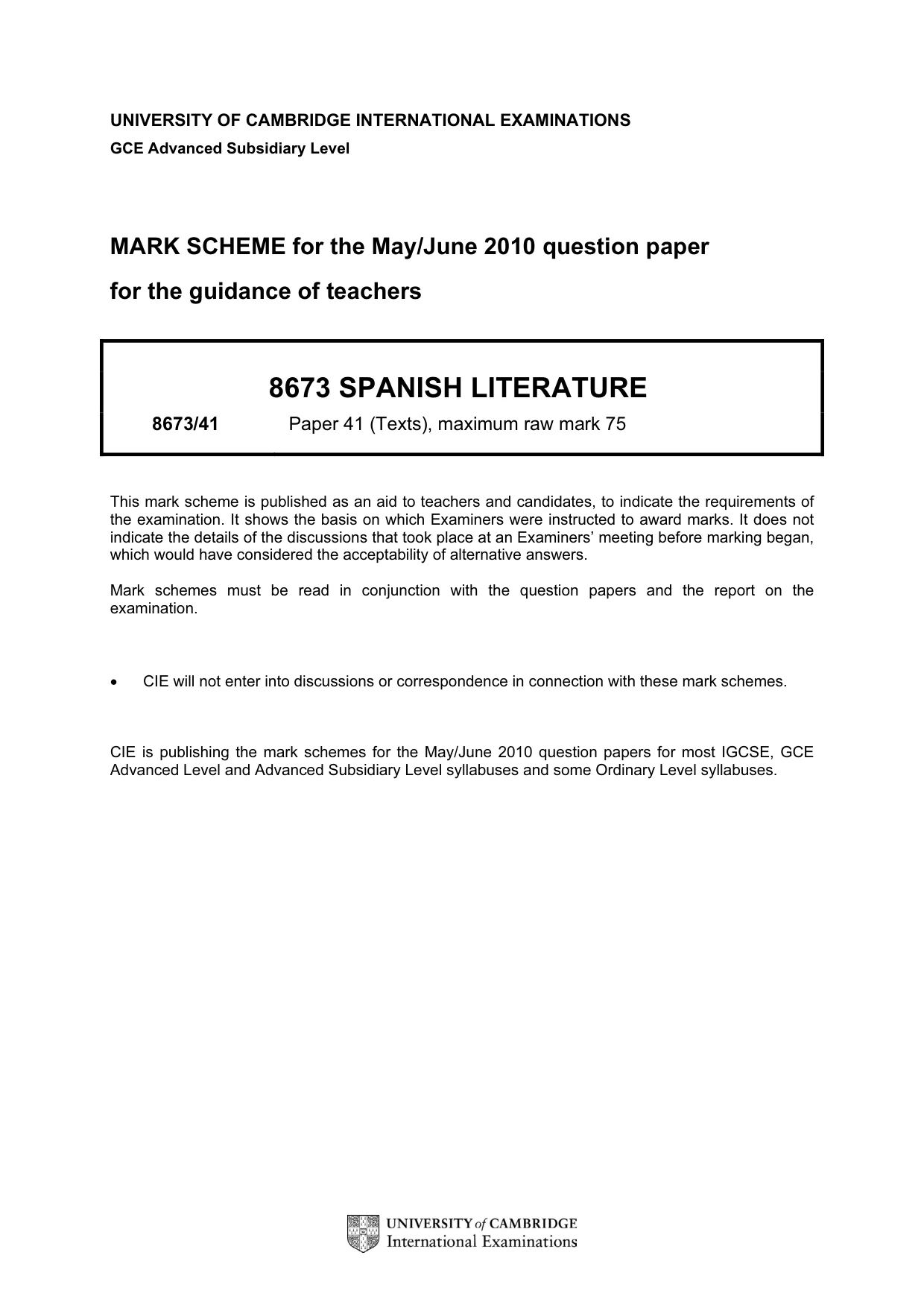
UNIVERSITY OF CAMBRIDGE INTERNATIONAL EXAMINATIONS GCE Advanced Subsidiary Level MARK SCHEME for the May/June 2010 question paper for the guidance of teachers 8673 SPANISH LITERATURE 8673/41 Paper 41 (Texts), maximum raw mark 75 This mark scheme is published as an aid to teachers and candidates, to indicate the requirements of the examination. It shows the basis on which Examiners were instructed to award marks. It does not indicate the details of the discussions that took place at an Examiners’ meeting before marking began, which would have considered the acceptability of alternative answers. Mark schemes must be read in conjunction with the question papers and the report on the examination. • CIE will not enter into discussions or correspondence in connection with these mark schemes. CIE is publishing the mark schemes for the May/June 2010 question papers for most IGCSE, GCE Advanced Level and Advanced Subsidiary Level syllabuses and some Ordinary Level syllabuses.
Mark scheme, page 2
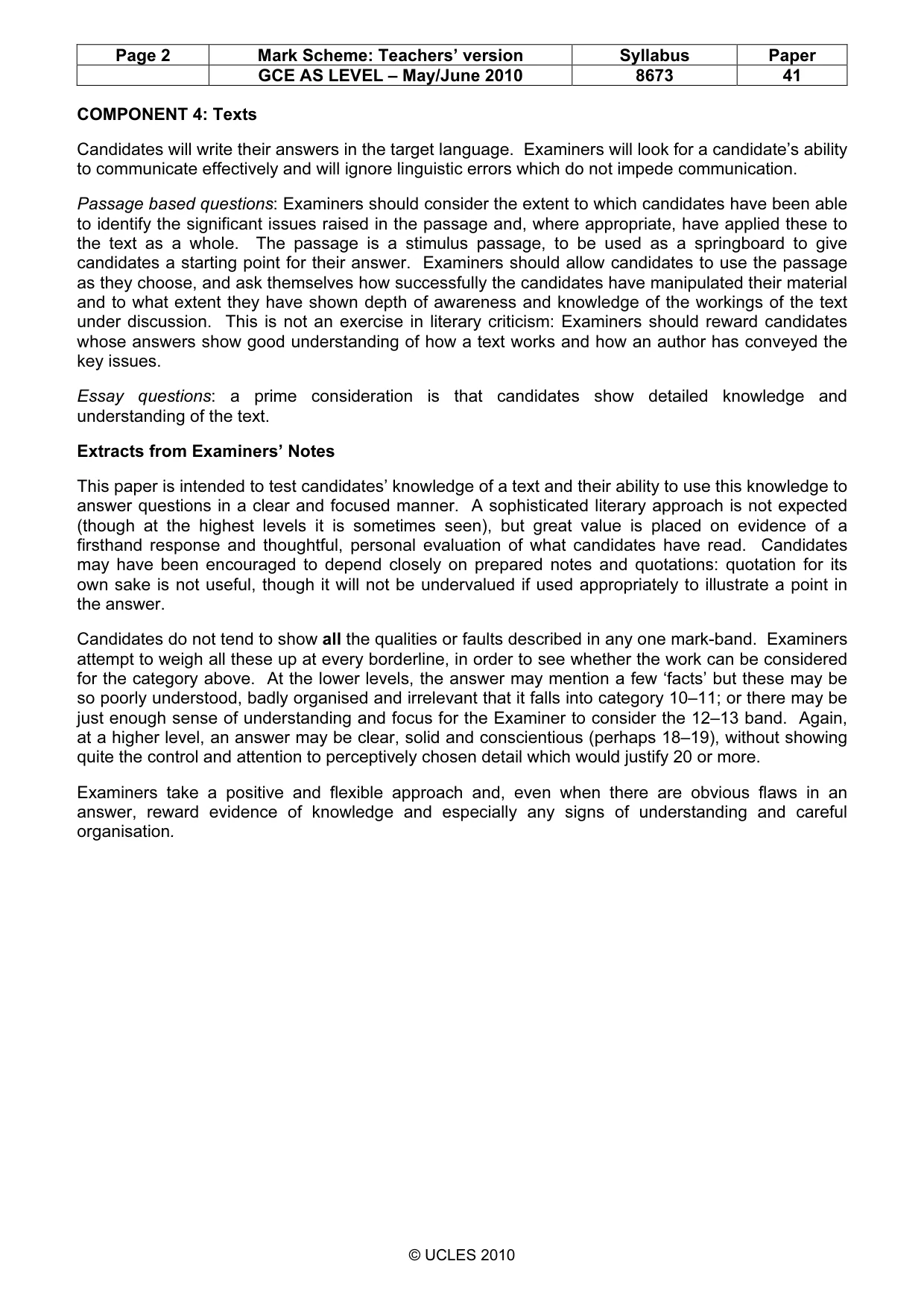
Page 2 Mark Scheme: Teachers’ version Syllabus Paper GCE AS LEVEL – May/June 2010 8673 41 © UCLES 2010 COMPONENT 4: Texts Candidates will write their answers in the target language. Examiners will look for a candidate’s ability to communicate effectively and will ignore linguistic errors which do not impede communication. Passage based questions: Examiners should consider the extent to which candidates have been able to identify the significant issues raised in the passage and, where appropriate, have applied these to the text as a whole. The passage is a stimulus passage, to be used as a springboard to give candidates a starting point for their answer. Examiners should allow candidates to use the passage as they choose, and ask themselves how successfully the candidates have manipulated their material and to what extent they have shown depth of awareness and knowledge of the workings of the text under discussion. This is not an exercise in literary criticism: Examiners should reward candidates whose answers show good understanding of how a text works and how an author has conveyed the key issues. Essay questions: a prime consideration is that candidates show detailed knowledge and understanding of the text. Extracts from Examiners’ Notes This paper is intended to test candidates’ knowledge of a text and their ability to use this knowledge to answer questions in a clear and focused manner. A sophisticated literary approach is not expected (though at the highest levels it is sometimes seen), but great value is placed on evidence of a firsthand response and thoughtful, personal evaluation of what candidates have read. Candidates may have been encouraged to depend closely on prepared notes and quotations: quotation for its own sake is not useful, though it will not be undervalued if used appropriately to illustrate a point in the answer. Candidates do not tend to show all the qualities or faults described in any one mark-band. Examiners attempt to weigh all these up at every borderline, in order to see whether the work can be considered for the category above. At the lower levels, the answer may mention a few ‘facts’ but these may be so poorly understood, badly organised and irrelevant that it falls into category 10–11; or there may be just enough sense of understanding and focus for the Examiner to consider the 12–13 band. Again, at a higher level, an answer may be clear, solid and conscientious (perhaps 18–19), without showing quite the control and attention to perceptively chosen detail which would justify 20 or more. Examiners take a positive and flexible approach and, even when there are obvious flaws in an answer, reward evidence of knowledge and especially any signs of understanding and careful organisation.
Mark scheme, page 3
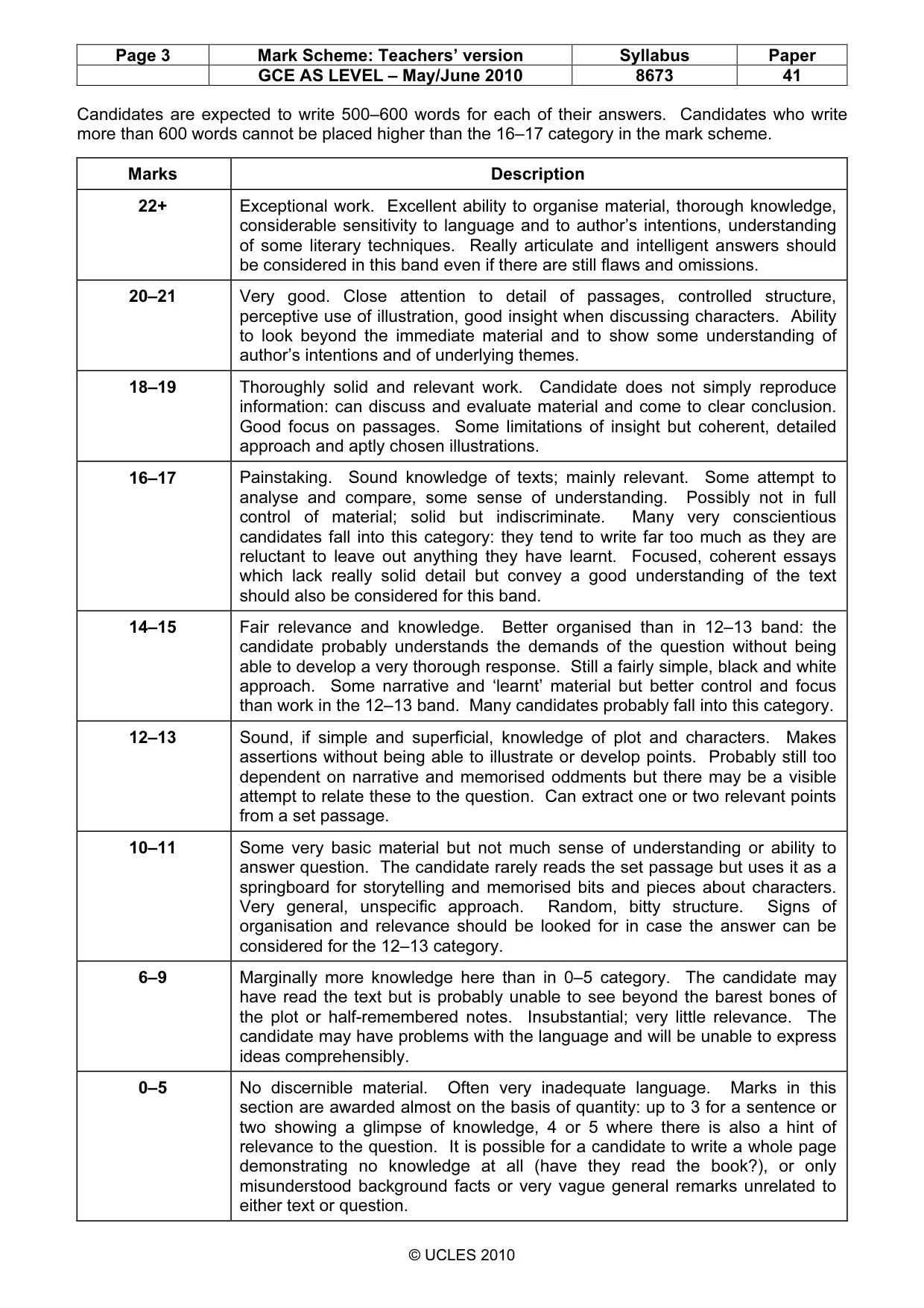
Page 3 Mark Scheme: Teachers’ version Syllabus Paper GCE AS LEVEL – May/June 2010 8673 41 © UCLES 2010 Candidates are expected to write 500–600 words for each of their answers. Candidates who write more than 600 words cannot be placed higher than the 16–17 category in the mark scheme. Marks Description 22+ Exceptional work. Excellent ability to organise material, thorough knowledge, considerable sensitivity to language and to author’s intentions, understanding of some literary techniques. Really articulate and intelligent answers should be considered in this band even if there are still flaws and omissions. 20–21 Very good. Close attention to detail of passages, controlled structure, perceptive use of illustration, good insight when discussing characters. Ability to look beyond the immediate material and to show some understanding of author’s intentions and of underlying themes. 18–19 Thoroughly solid and relevant work. Candidate does not simply reproduce information: can discuss and evaluate material and come to clear conclusion. Good focus on passages. Some limitations of insight but coherent, detailed approach and aptly chosen illustrations. 16–17 Painstaking. Sound knowledge of texts; mainly relevant. Some attempt to analyse and compare, some sense of understanding. Possibly not in full control of material; solid but indiscriminate. Many very conscientious candidates fall into this category: they tend to write far too much as they are reluctant to leave out anything they have learnt. Focused, coherent essays which lack really solid detail but convey a good understanding of the text should also be considered for this band. 14–15 Fair relevance and knowledge. Better organised than in 12–13 band: the candidate probably understands the demands of the question without being able to develop a very thorough response. Still a fairly simple, black and white approach. Some narrative and ‘learnt’ material but better control and focus than work in the 12–13 band. Many candidates probably fall into this category. 12–13 Sound, if simple and superficial, knowledge of plot and characters. Makes assertions without being able to illustrate or develop points. Probably still too dependent on narrative and memorised oddments but there may be a visible attempt to relate these to the question. Can extract one or two relevant points from a set passage. 10–11 Some very basic material but not much sense of understanding or ability to answer question. The candidate rarely reads the set passage but uses it as a springboard for storytelling and memorised bits and pieces about characters. Very general, unspecific approach. Random, bitty structure. Signs of organisation and relevance should be looked for in case the answer can be considered for the 12–13 category. 6–9 Marginally more knowledge here than in 0–5 category. The candidate may have read the text but is probably unable to see beyond the barest bones of the plot or half-remembered notes. Insubstantial; very little relevance. The candidate may have problems with the language and will be unable to express ideas comprehensibly. 0–5 No discernible material. Often very inadequate language. Marks in this section are awarded almost on the basis of quantity: up to 3 for a sentence or two showing a glimpse of knowledge, 4 or 5 where there is also a hint of relevance to the question. It is possible for a candidate to write a whole page demonstrating no knowledge at all (have they read the book?), or only misunderstood background facts or very vague general remarks unrelated to either text or question.
What you needed in this session
Cambridge’s own grade thresholds for 2010 May/June, Paper 4 · Variant 1. A higher threshold means an easier paper — the bar moves with how the cohort did.