Cambridge A Level Spanish - Language (AS Level only) 8685 — 2020 Oct/Nov Paper 2 · Variant 3
8685/23/O/N/20 · 70 marks · ≈79 min
The question paper and its mark scheme, free to read here and free to download. This is Cambridge’s own paper, exactly as it was sat.
Question paper8 pages
Mark scheme17 pages
Answers below. Sit the paper first if you are practising.
Paper as text
Question paper, page 1
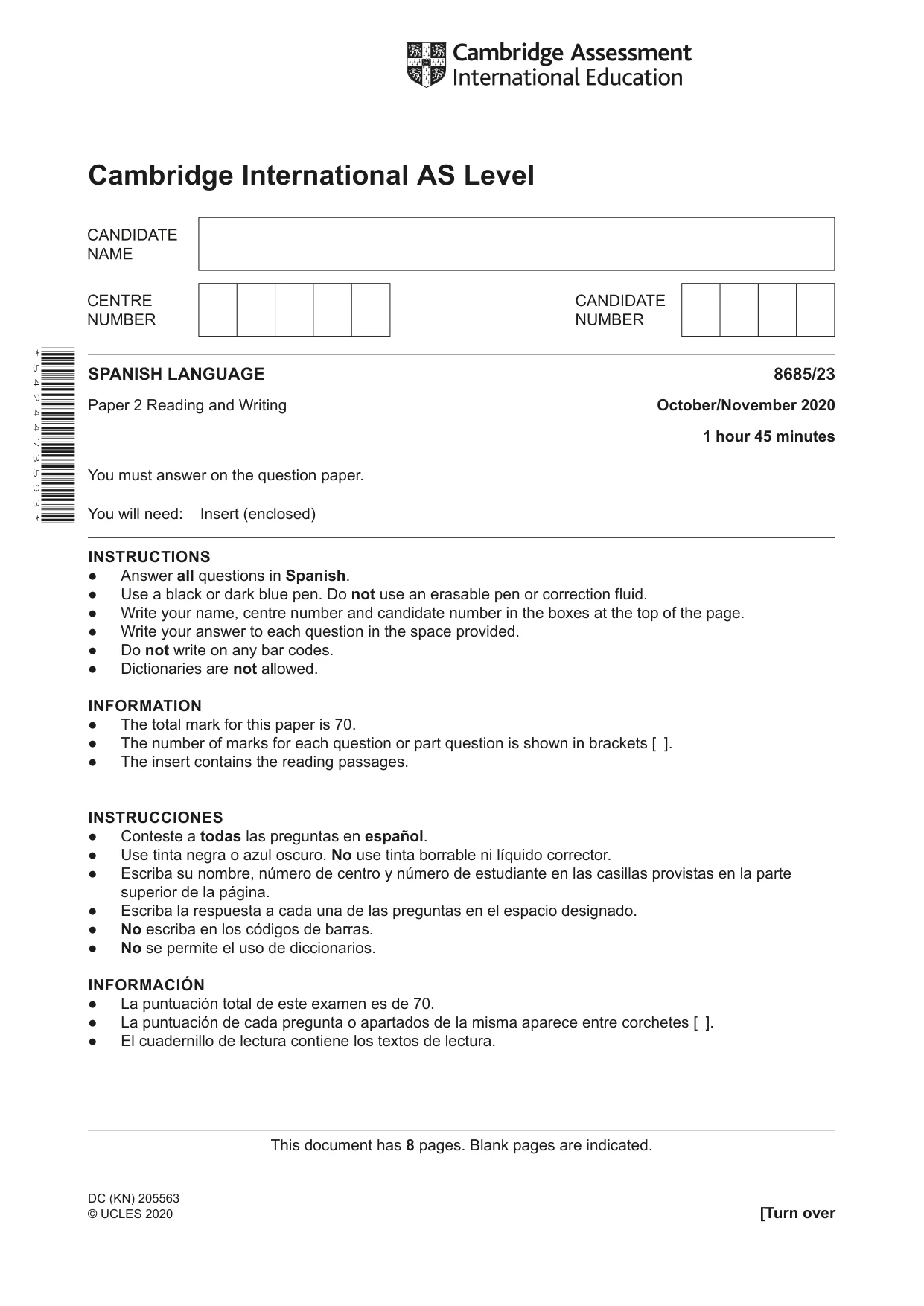
Cambridge International AS Level SPANISH LANGUAGE 8685/23 Paper 2 Reading and Writing October/November 2020 1 hour 45 minutes You must answer on the question paper. You will need: Insert (enclosed) INSTRUCTIONS ● Answer all questions in Spanish. ● Use a black or dark blue pen. Do not use an erasable pen or correction fluid. ● Write your name, centre number and candidate number in the boxes at the top of the page. ● Write your answer to each question in the space provided. ● Do not write on any bar codes. ● Dictionaries are not allowed. INFORMATION ● The total mark for this paper is 70. ● The number of marks for each question or part question is shown in brackets [ ]. ● The insert contains the reading passages. INSTRUCCIONES ● Conteste a todas las preguntas en español. ● Use tinta negra o azul oscuro. No use tinta borrable ni líquido corrector. ● Escriba su nombre, número de centro y número de estudiante en las casillas provistas en la parte superior de la página. ● Escriba la respuesta a cada una de las preguntas en el espacio designado. ● No escriba en los códigos de barras. ● No se permite el uso de diccionarios. INFORMACIÓN ● La puntuación total de este examen es de 70. ● La puntuación de cada pregunta o apartados de la misma aparece entre corchetes [ ]. ● El cuadernillo de lectura contiene los textos de lectura. This document has 8 pages. Blank pages are indicated. DC (KN) 205563 © UCLES 2020 [Turn over * 5 4 2 4 4 7 3 5 9 3 *
Question paper, page 2
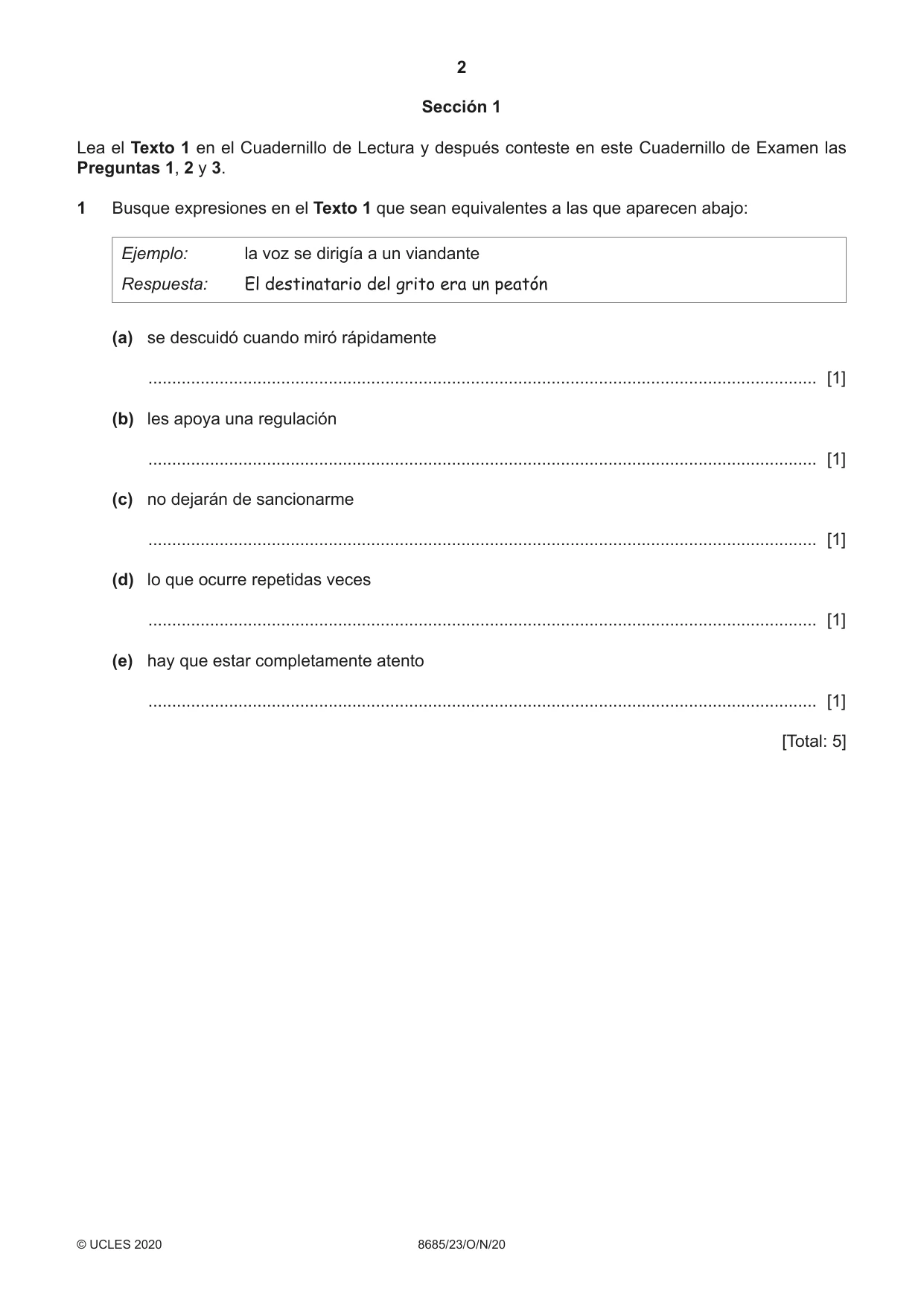
2 8685/23/O/N/20 © UCLES 2020 Sección 1 Lea el Texto 1 en el Cuadernillo de Lectura y después conteste en este Cuadernillo de Examen las Preguntas 1, 2 y 3. 1 Busque expresiones en el Texto 1 que sean equivalentes a las que aparecen abajo: Ejemplo: la voz se dirigía a un viandante Respuesta: El destinatario del grito era un peatón (a) se descuidó cuando miró rápidamente … [1] (b) les apoya una regulación … [1] (c) no dejarán de sancionarme … [1] (d) lo que ocurre repetidas veces … [1] (e) hay que estar completamente atento … [1] [Total: 5]
Question paper, page 3
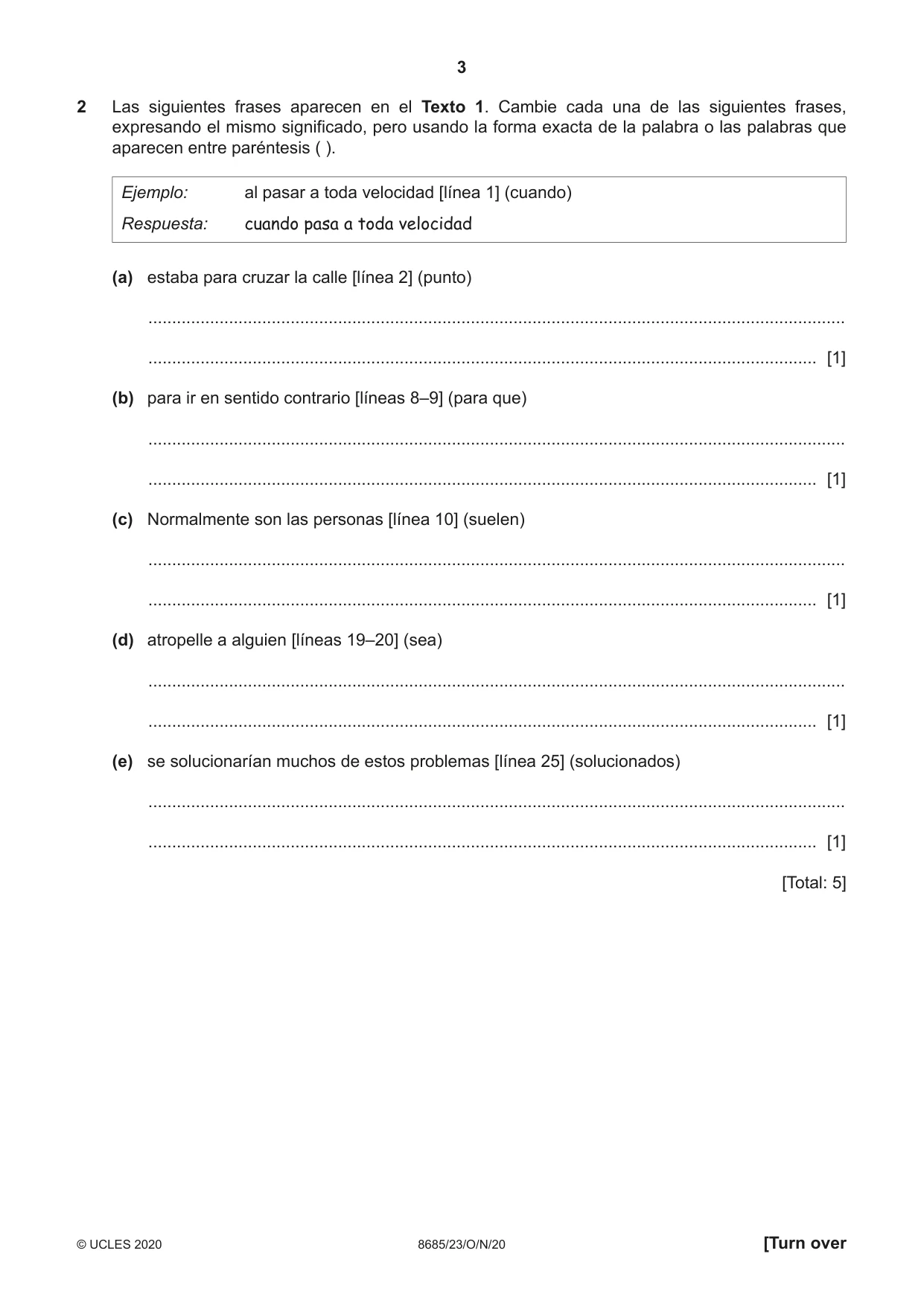
3 8685/23/O/N/20 © UCLES 2020 [Turn over 2 Las siguientes frases aparecen en el Texto 1. Cambie cada una de las siguientes frases, expresando el mismo significado, pero usando la forma exacta de la palabra o las palabras que aparecen entre paréntesis ( ). Ejemplo: al pasar a toda velocidad [línea 1] (cuando) Respuesta: cuando pasa a toda velocidad (a) estaba para cruzar la calle [línea 2] (punto) … … [1] (b) para ir en sentido contrario [líneas 8–9] (para que) … … [1] (c) Normalmente son las personas [línea 10] (suelen) … … [1] (d) atropelle a alguien [líneas 19–20] (sea) … … [1] (e) se solucionarían muchos de estos problemas [línea 25] (solucionados) … … [1] [Total: 5]
Question paper, page 4
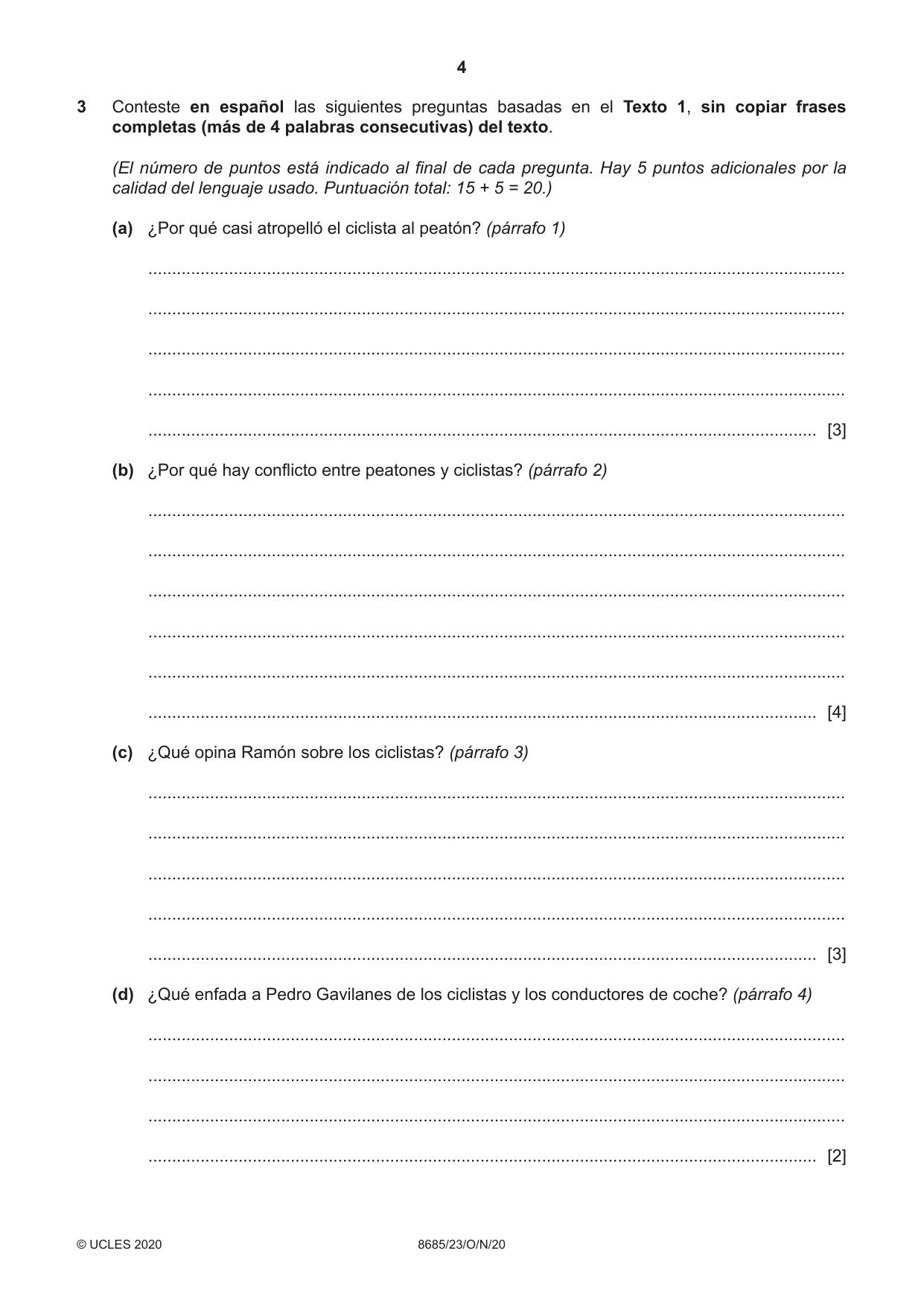
4 8685/23/O/N/20 © UCLES 2020 3 Conteste en español las siguientes preguntas basadas en el Texto 1, sin copiar frases completas (más de 4 palabras consecutivas) del texto. (El número de puntos está indicado al final de cada pregunta. Hay 5 puntos adicionales por la calidad del lenguaje usado. Puntuación total: 15 + 5 = 20.) (a) ¿Por qué casi atropelló el ciclista al peatón? (párrafo 1) … … … … … [3] (b) ¿Por qué hay conflicto entre peatones y ciclistas? (párrafo 2) … … … … … … [4] (c) ¿Qué opina Ramón sobre los ciclistas? (párrafo 3) … … … … … [3] (d) ¿Qué enfada a Pedro Gavilanes de los ciclistas y los conductores de coche? (párrafo 4) … … … … [2]
Question paper, page 5
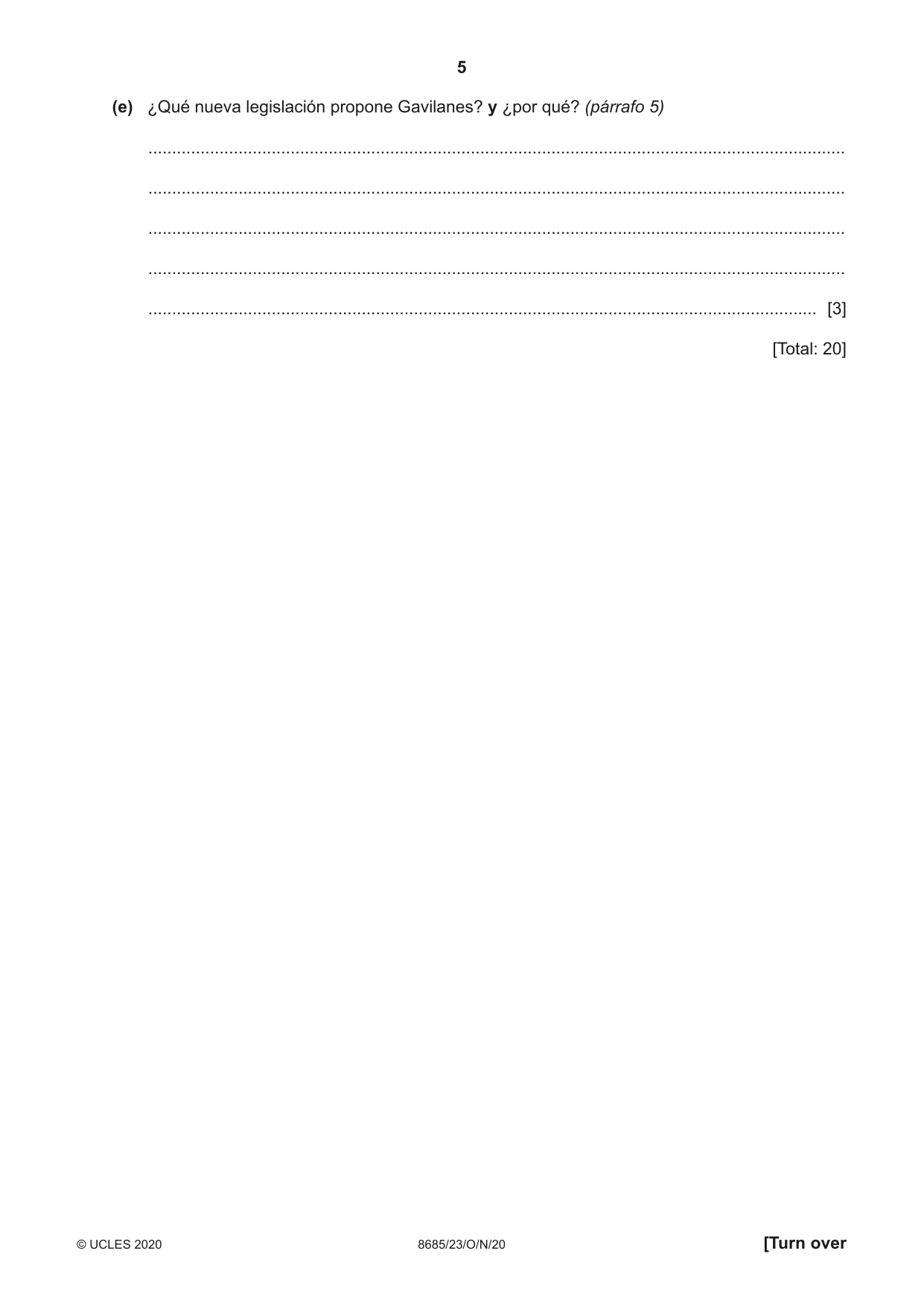
5 8685/23/O/N/20 © UCLES 2020 [Turn over (e) ¿Qué nueva legislación propone Gavilanes? y ¿por qué? (párrafo 5) … … … … … [3] [Total: 20]
Question paper, page 6
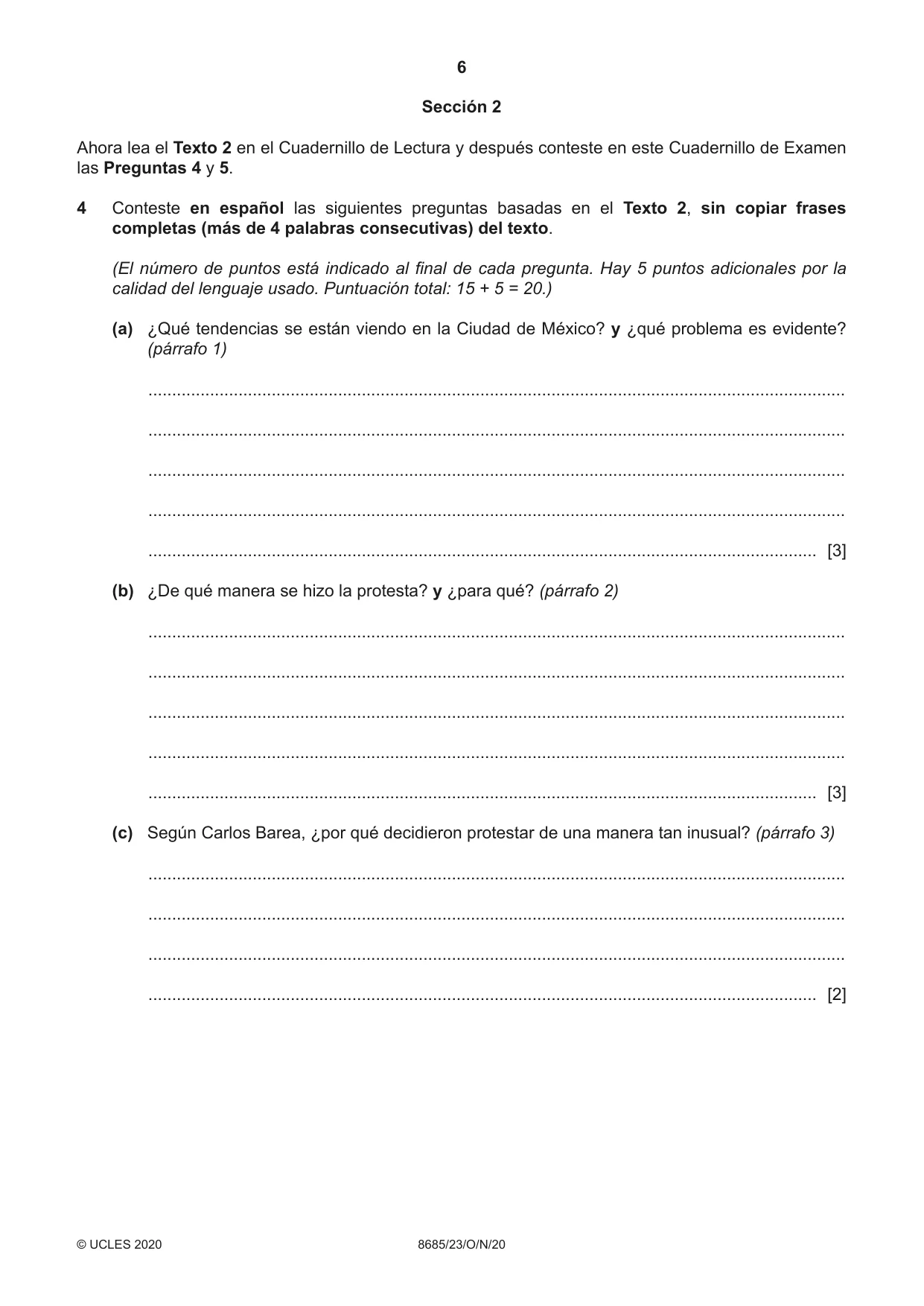
6 8685/23/O/N/20 © UCLES 2020 Sección 2 Ahora lea el Texto 2 en el Cuadernillo de Lectura y después conteste en este Cuadernillo de Examen las Preguntas 4 y 5. 4 Conteste en español las siguientes preguntas basadas en el Texto 2, sin copiar frases completas (más de 4 palabras consecutivas) del texto. (El número de puntos está indicado al final de cada pregunta. Hay 5 puntos adicionales por la calidad del lenguaje usado. Puntuación total: 15 + 5 = 20.) (a) ¿Qué tendencias se están viendo en la Ciudad de México? y ¿qué problema es evidente? (párrafo 1) … … … … … [3] (b) ¿De qué manera se hizo la protesta? y ¿para qué? (párrafo 2) … … … … … [3] (c) Según Carlos Barea, ¿por qué decidieron protestar de una manera tan inusual? (párrafo 3) … … … … [2]
Question paper, page 7
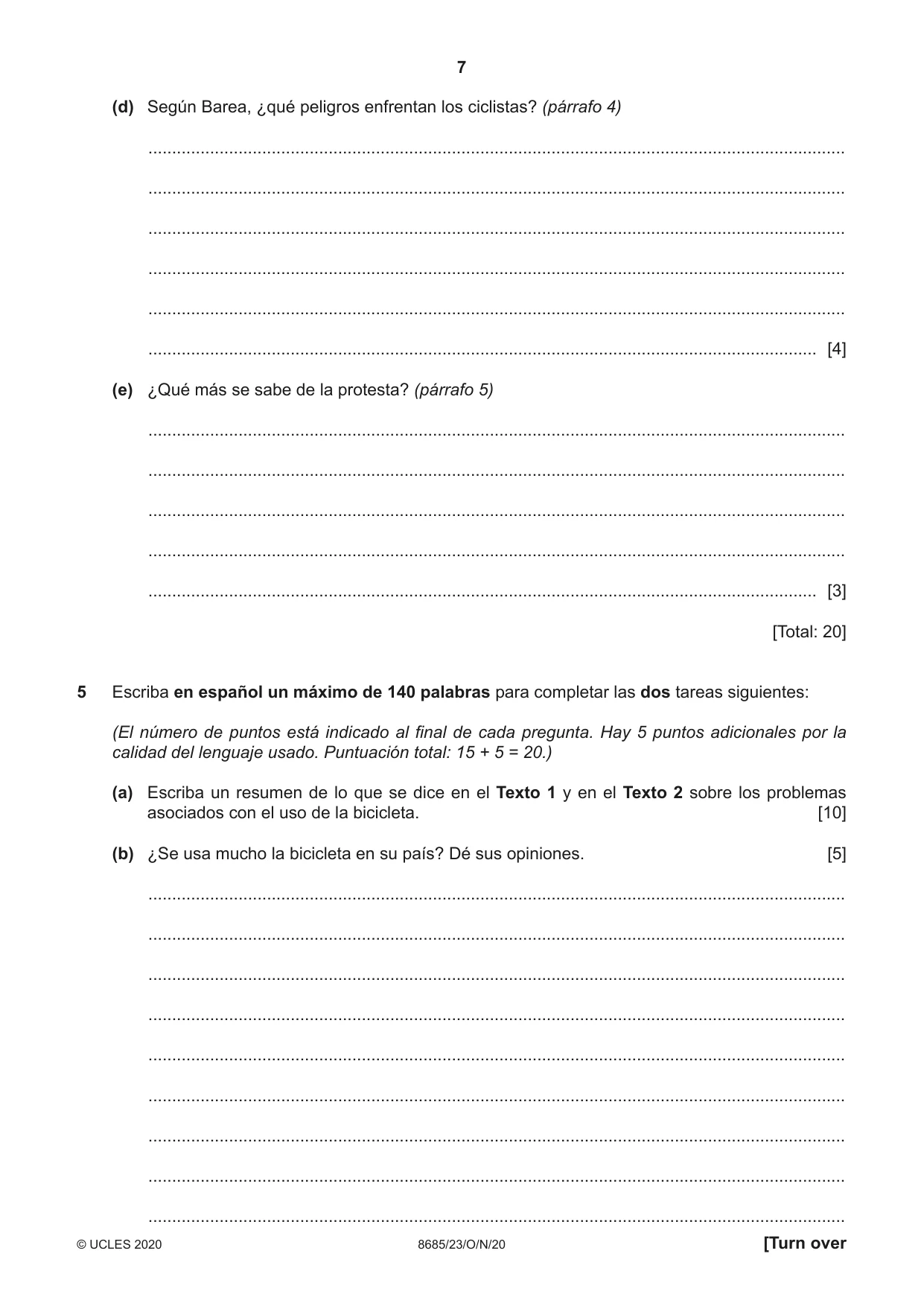
7 8685/23/O/N/20 © UCLES 2020 [Turn over (d) Según Barea, ¿qué peligros enfrentan los ciclistas? (párrafo 4) … … … … … … [4] (e) ¿Qué más se sabe de la protesta? (párrafo 5) … … … … … [3] [Total: 20] 5 Escriba en español un máximo de 140 palabras para completar las dos tareas siguientes: (El número de puntos está indicado al final de cada pregunta. Hay 5 puntos adicionales por la calidad del lenguaje usado. Puntuación total: 15 + 5 = 20.) (a) Escriba un resumen de lo que se dice en el Texto 1 y en el Texto 2 sobre los problemas asociados con el uso de la bicicleta. [10] (b) ¿Se usa mucho la bicicleta en su país? Dé sus opiniones. [5] … … … … … … … … …
Question paper, page 8
8 8685/23/O/N/20 © UCLES 2020 Permission to reproduce items where third-party owned material protected by copyright is included has been sought and cleared where possible. Every reasonable effort has been made by the publisher (UCLES) to trace copyright holders, but if any items requiring clearance have unwittingly been included, the publisher will be pleased to make amends at the earliest possible opportunity. To avoid the issue of disclosure of answer-related information to candidates, all copyright acknowledgements are reproduced online in the Cambridge Assessment International Education Copyright Acknowledgements Booklet. This is produced for each series of examinations and is freely available to download at www.cambridgeinternational.org after the live examination series. Cambridge Assessment International Education is part of the Cambridge Assessment Group. Cambridge Assessment is the brand name of the University of Cambridge Local Examinations Syndicate (UCLES), which itself is a department of the University of Cambridge. … … … … … … … … … … … … … … … … … … … … … … … [Total: 20]
Mark scheme, page 1
This document consists of 17 printed pages. © UCLES 2020 [Turn over Cambridge International AS Level SPANISH LANGUAGE 8685/23 Paper 2 Reading and Writing October/November 2020 MARK SCHEME Maximum Mark: 70 Published This mark scheme is published as an aid to teachers and candidates, to indicate the requirements of the examination. It shows the basis on which Examiners were instructed to award marks. It does not indicate the details of the discussions that took place at an Examiners’ meeting before marking began, which would have considered the acceptability of alternative answers. Mark schemes should be read in conjunction with the question paper and the Principal Examiner Report for Teachers. Cambridge International will not enter into discussions about these mark schemes. Cambridge International is publishing the mark schemes for the October/November 2020 series for most Cambridge IGCSE™, Cambridge International A and AS Level and Cambridge Pre-U components, and some Cambridge O Level components.
Mark scheme, page 2
8685/23 Cambridge International AS Level – Mark Scheme PUBLISHED October/November 2020 © UCLES 2020 Page 2 of 17 Generic Marking Principles These general marking principles must be applied by all examiners when marking candidate answers. They should be applied alongside the specific content of the mark scheme or generic level descriptors for a question. Each question paper and mark scheme will also comply with these marking principles. GENERIC MARKING PRINCIPLE 1: Marks must be awarded in line with: • the specific content of the mark scheme or the generic level descriptors for the question • the specific skills defined in the mark scheme or in the generic level descriptors for the question • the standard of response required by a candidate as exemplified by the standardisation scripts. GENERIC MARKING PRINCIPLE 2: Marks awarded are always whole marks (not half marks, or other fractions). GENERIC MARKING PRINCIPLE 3: Marks must be awarded positively: • marks are awarded for correct/valid answers, as defined in the mark scheme. However, credit is given for valid answers which go beyond the scope of the syllabus and mark scheme, referring to your Team Leader as appropriate • marks are awarded when candidates clearly demonstrate what they know and can do • marks are not deducted for errors • marks are not deducted for omissions • answers should only be judged on the quality of spelling, punctuation and grammar when these features are specifically assessed by the question as indicated by the mark scheme. The meaning, however, should be unambiguous. GENERIC MARKING PRINCIPLE 4: Rules must be applied consistently, e.g. in situations where candidates have not followed instructions or in the application of generic level descriptors.
Mark scheme, page 3
8685/23 Cambridge International AS Level – Mark Scheme PUBLISHED October/November 2020 © UCLES 2020 Page 3 of 17 GENERIC MARKING PRINCIPLE 5: Marks should be awarded using the full range of marks defined in the mark scheme for the question (however; the use of the full mark range may be limited according to the quality of the candidate responses seen). GENERIC MARKING PRINCIPLE 6: Marks awarded are based solely on the requirements as defined in the mark scheme. Marks should not be awarded with grade thresholds or grade descriptors in mind.
Mark scheme, page 4
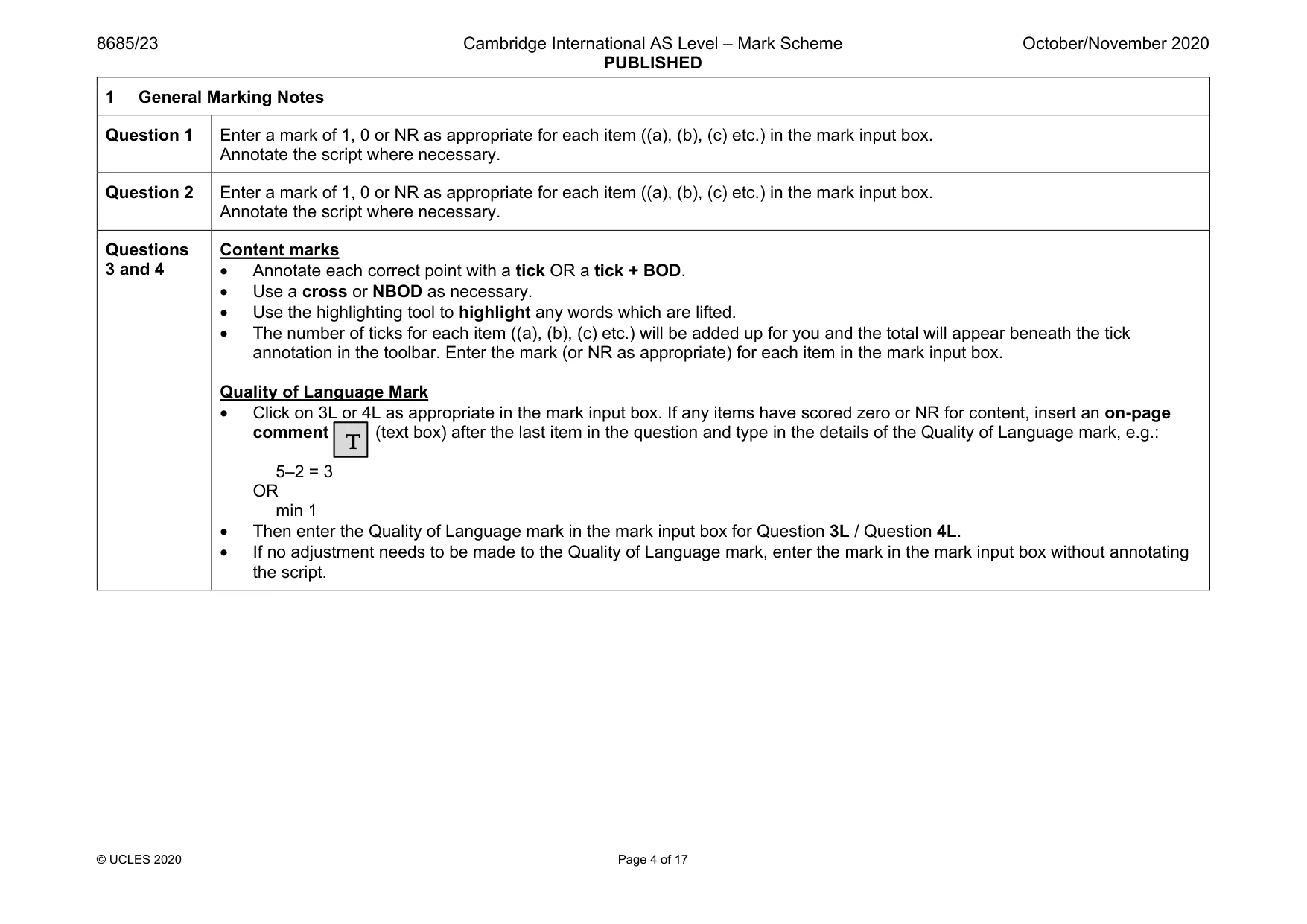
8685/23 Cambridge International AS Level – Mark Scheme PUBLISHED October/November 2020 © UCLES 2020 Page 4 of 17 1 General Marking Notes Question 1 Enter a mark of 1, 0 or NR as appropriate for each item ((a), (b), (c) etc.) in the mark input box. Annotate the script where necessary. Question 2 Enter a mark of 1, 0 or NR as appropriate for each item ((a), (b), (c) etc.) in the mark input box. Annotate the script where necessary. Questions 3 and 4 Content marks • Annotate each correct point with a tick OR a tick + BOD. • Use a cross or NBOD as necessary. • Use the highlighting tool to highlight any words which are lifted. • The number of ticks for each item ((a), (b), (c) etc.) will be added up for you and the total will appear beneath the tick annotation in the toolbar. Enter the mark (or NR as appropriate) for each item in the mark input box. Quality of Language Mark • Click on 3L or 4L as appropriate in the mark input box. If any items have scored zero or NR for content, insert an on-page comment (text box) after the last item in the question and type in the details of the Quality of Language mark, e.g.: 5–2 = 3 OR min 1 • Then enter the Quality of Language mark in the mark input box for Question 3L / Question 4L. • If no adjustment needs to be made to the Quality of Language mark, enter the mark in the mark input box without annotating the script. T
Mark scheme, page 5
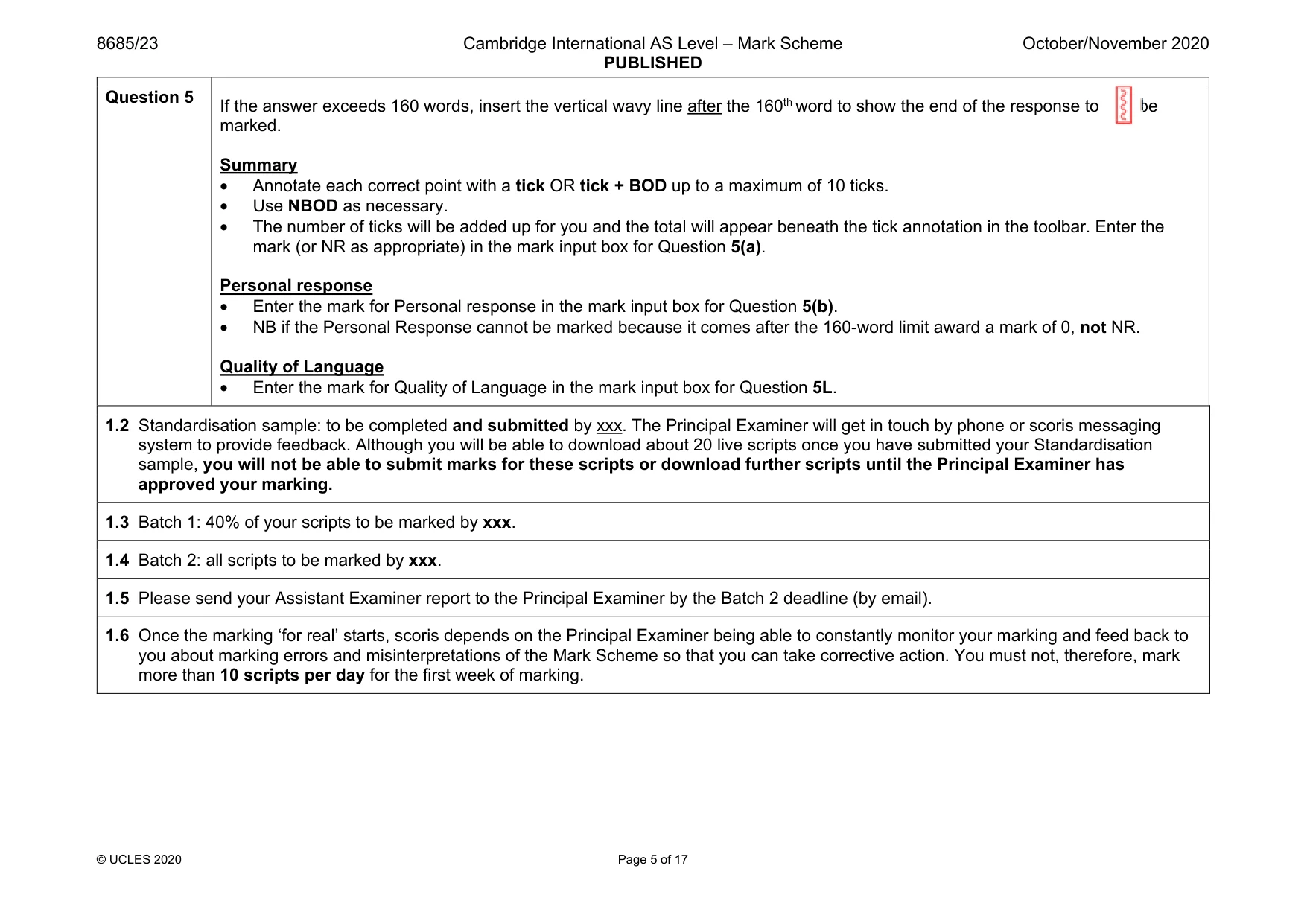
8685/23 Cambridge International AS Level – Mark Scheme PUBLISHED October/November 2020 © UCLES 2020 Page 5 of 17 Question 5 If the answer exceeds 160 words, insert the vertical wavy line after the 160th word to show the end of the response to be marked. Summary • Annotate each correct point with a tick OR tick + BOD up to a maximum of 10 ticks. • Use NBOD as necessary. • The number of ticks will be added up for you and the total will appear beneath the tick annotation in the toolbar. Enter the mark (or NR as appropriate) in the mark input box for Question 5(a). Personal response • Enter the mark for Personal response in the mark input box for Question 5(b). • NB if the Personal Response cannot be marked because it comes after the 160-word limit award a mark of 0, not NR. Quality of Language • Enter the mark for Quality of Language in the mark input box for Question 5L. 1.2 Standardisation sample: to be completed and submitted by xxx. The Principal Examiner will get in touch by phone or scoris messaging system to provide feedback. Although you will be able to download about 20 live scripts once you have submitted your Standardisation sample, you will not be able to submit marks for these scripts or download further scripts until the Principal Examiner has approved your marking. 1.3 Batch 1: 40% of your scripts to be marked by xxx. 1.4 Batch 2: all scripts to be marked by xxx. 1.5 Please send your Assistant Examiner report to the Principal Examiner by the Batch 2 deadline (by email). 1.6 Once the marking ‘for real’ starts, scoris depends on the Principal Examiner being able to constantly monitor your marking and feed back to you about marking errors and misinterpretations of the Mark Scheme so that you can take corrective action. You must not, therefore, mark more than 10 scripts per day for the first week of marking.
Mark scheme, page 6
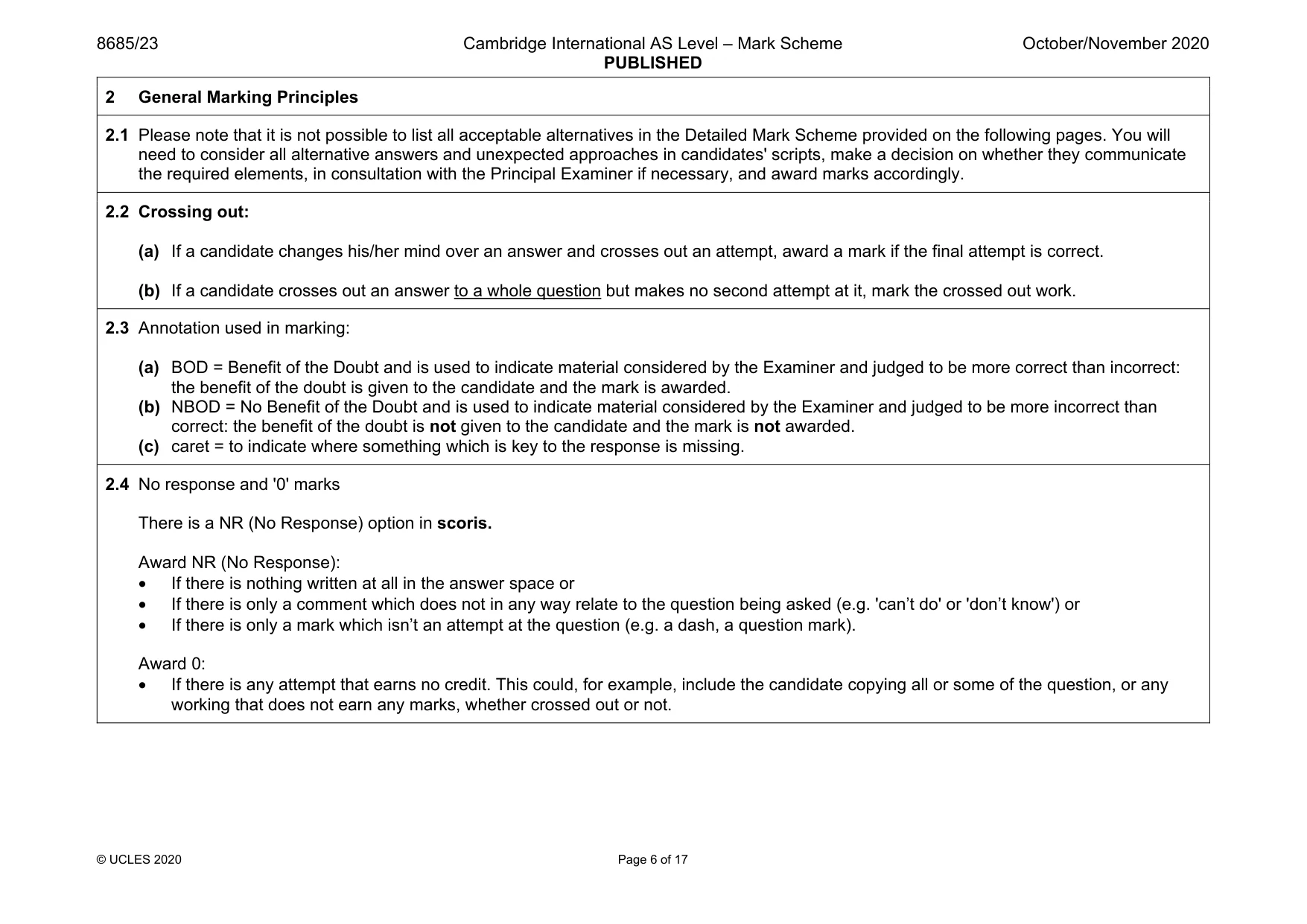
8685/23 Cambridge International AS Level – Mark Scheme PUBLISHED October/November 2020 © UCLES 2020 Page 6 of 17 2 General Marking Principles 2.1 Please note that it is not possible to list all acceptable alternatives in the Detailed Mark Scheme provided on the following pages. You will need to consider all alternative answers and unexpected approaches in candidates' scripts, make a decision on whether they communicate the required elements, in consultation with the Principal Examiner if necessary, and award marks accordingly. 2.2 Crossing out: (a) If a candidate changes his/her mind over an answer and crosses out an attempt, award a mark if the final attempt is correct. (b) If a candidate crosses out an answer to a whole question but makes no second attempt at it, mark the crossed out work. 2.3 Annotation used in marking: (a) BOD = Benefit of the Doubt and is used to indicate material considered by the Examiner and judged to be more correct than incorrect: the benefit of the doubt is given to the candidate and the mark is awarded. (b) NBOD = No Benefit of the Doubt and is used to indicate material considered by the Examiner and judged to be more incorrect than correct: the benefit of the doubt is not given to the candidate and the mark is not awarded. (c) caret = to indicate where something which is key to the response is missing. 2.4 No response and '0' marks There is a NR (No Response) option in scoris. Award NR (No Response): • If there is nothing written at all in the answer space or • If there is only a comment which does not in any way relate to the question being asked (e.g. 'can’t do' or 'don’t know') or • If there is only a mark which isn’t an attempt at the question (e.g. a dash, a question mark). Award 0: • If there is any attempt that earns no credit. This could, for example, include the candidate copying all or some of the question, or any working that does not earn any marks, whether crossed out or not.
Mark scheme, page 7
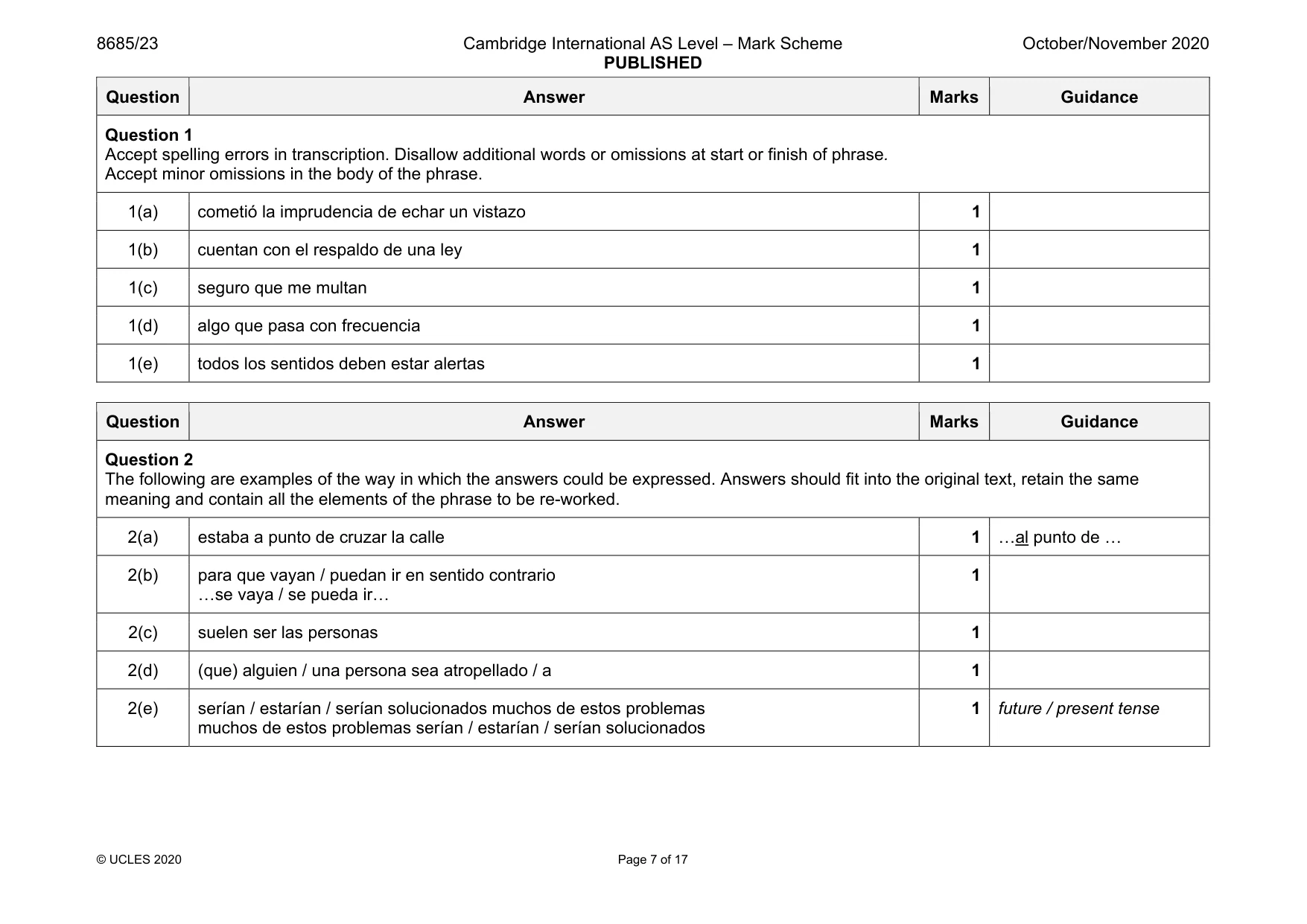
8685/23 Cambridge International AS Level – Mark Scheme PUBLISHED October/November 2020 © UCLES 2020 Page 7 of 17 Question Answer Marks Guidance Question 1 Accept spelling errors in transcription. Disallow additional words or omissions at start or finish of phrase. Accept minor omissions in the body of the phrase. 1(a) cometió la imprudencia de echar un vistazo 1 1(b) cuentan con el respaldo de una ley 1 1(c) seguro que me multan 1 1(d) algo que pasa con frecuencia 1 1(e) todos los sentidos deben estar alertas 1 Question Answer Marks Guidance Question 2 The following are examples of the way in which the answers could be expressed. Answers should fit into the original text, retain the same meaning and contain all the elements of the phrase to be re-worked. 2(a) estaba a punto de cruzar la calle 1 …al punto de … 2(b) para que vayan / puedan ir en sentido contrario …se vaya / se pueda ir… 1 2(c) suelen ser las personas 1 2(d) (que) alguien / una persona sea atropellado / a 1 2(e) serían / estarían / serían solucionados muchos de estos problemas muchos de estos problemas serían / estarían / serían solucionados 1 future / present tense
Mark scheme, page 8
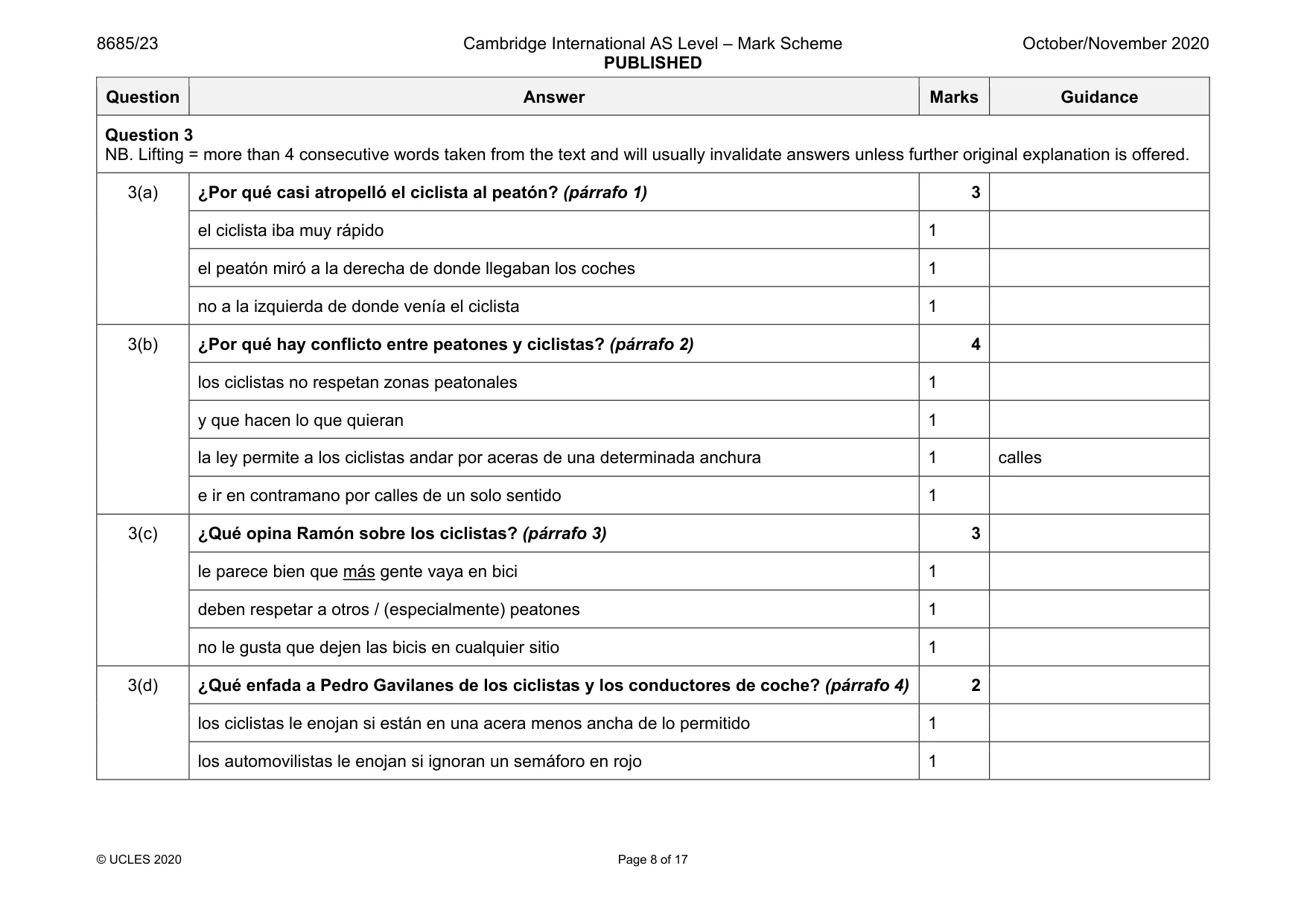
8685/23 Cambridge International AS Level – Mark Scheme PUBLISHED October/November 2020 © UCLES 2020 Page 8 of 17 Question Answer Marks Guidance Question 3 NB. Lifting = more than 4 consecutive words taken from the text and will usually invalidate answers unless further original explanation is offered. 3(a) ¿Por qué casi atropelló el ciclista al peatón? (párrafo 1) 3 el ciclista iba muy rápido 1 el peatón miró a la derecha de donde llegaban los coches 1 no a la izquierda de donde venía el ciclista 1 3(b) ¿Por qué hay conflicto entre peatones y ciclistas? (párrafo 2) 4 los ciclistas no respetan zonas peatonales 1 y que hacen lo que quieran 1 la ley permite a los ciclistas andar por aceras de una determinada anchura 1 calles e ir en contramano por calles de un solo sentido 1 3(c) ¿Qué opina Ramón sobre los ciclistas? (párrafo 3) 3 le parece bien que más gente vaya en bici 1 deben respetar a otros / (especialmente) peatones 1 no le gusta que dejen las bicis en cualquier sitio 1 3(d) ¿Qué enfada a Pedro Gavilanes de los ciclistas y los conductores de coche? (párrafo 4) 2 los ciclistas le enojan si están en una acera menos ancha de lo permitido 1 los automovilistas le enojan si ignoran un semáforo en rojo 1
Mark scheme, page 9
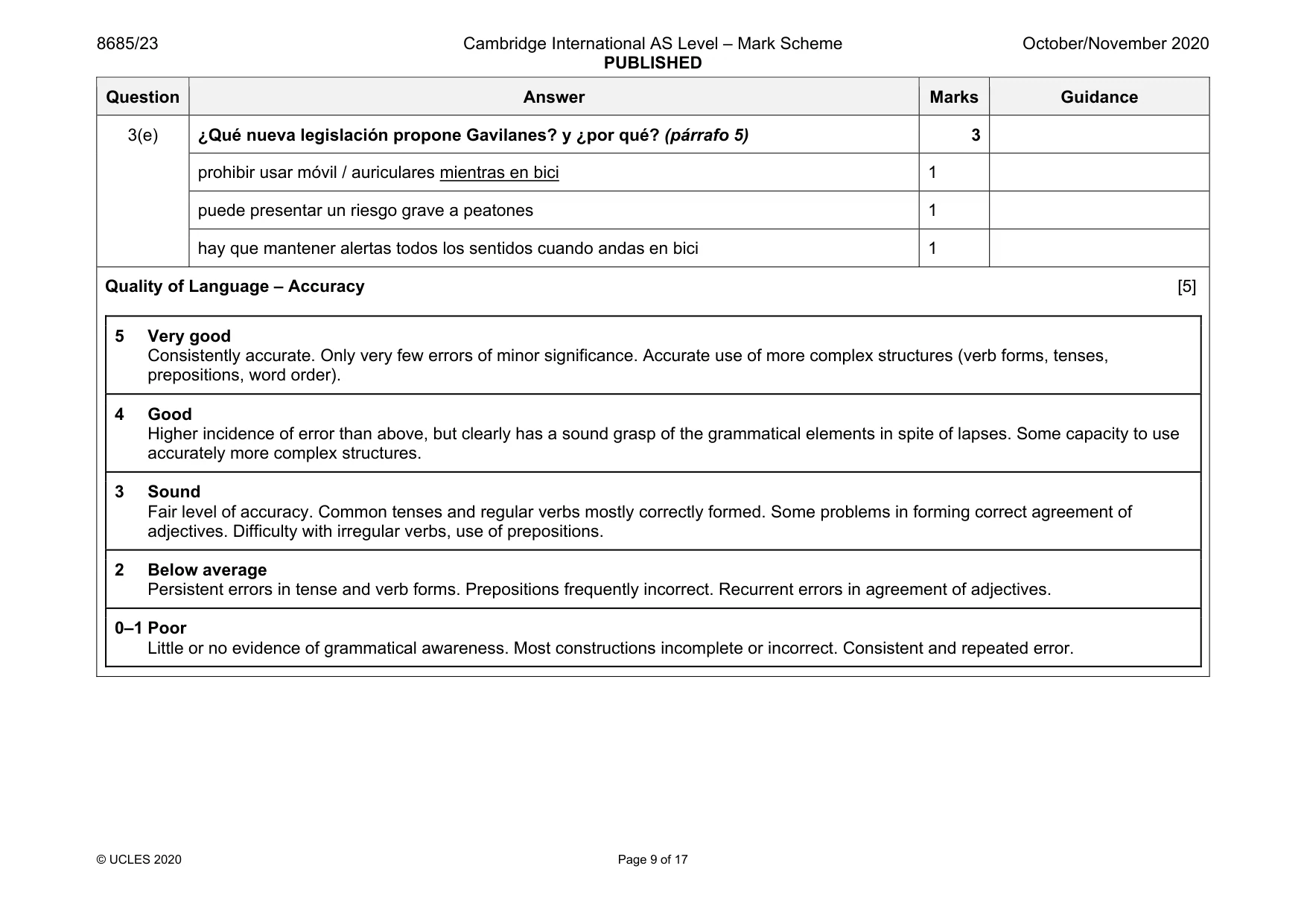
8685/23 Cambridge International AS Level – Mark Scheme PUBLISHED October/November 2020 © UCLES 2020 Page 9 of 17 Question Answer Marks Guidance 3(e) ¿Qué nueva legislación propone Gavilanes? y ¿por qué? (párrafo 5) 3 prohibir usar móvil / auriculares mientras en bici 1 puede presentar un riesgo grave a peatones 1 hay que mantener alertas todos los sentidos cuando andas en bici 1 Quality of Language – Accuracy [5] 5 Very good Consistently accurate. Only very few errors of minor significance. Accurate use of more complex structures (verb forms, tenses, prepositions, word order). 4 Good Higher incidence of error than above, but clearly has a sound grasp of the grammatical elements in spite of lapses. Some capacity to use accurately more complex structures. 3 Sound Fair level of accuracy. Common tenses and regular verbs mostly correctly formed. Some problems in forming correct agreement of adjectives. Difficulty with irregular verbs, use of prepositions. 2 Below average Persistent errors in tense and verb forms. Prepositions frequently incorrect. Recurrent errors in agreement of adjectives. 0–1 Poor Little or no evidence of grammatical awareness. Most constructions incomplete or incorrect. Consistent and repeated error.
Mark scheme, page 10
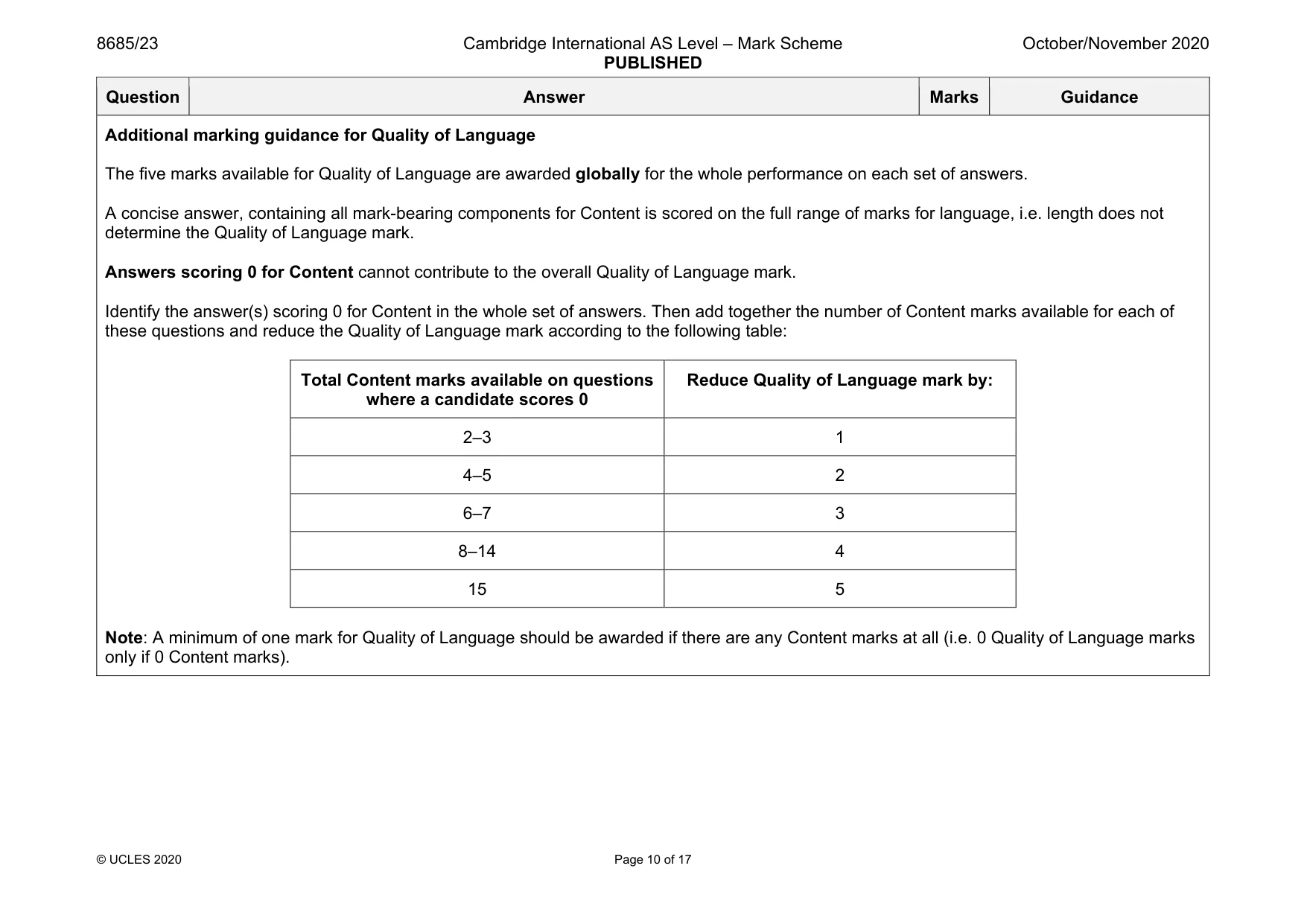
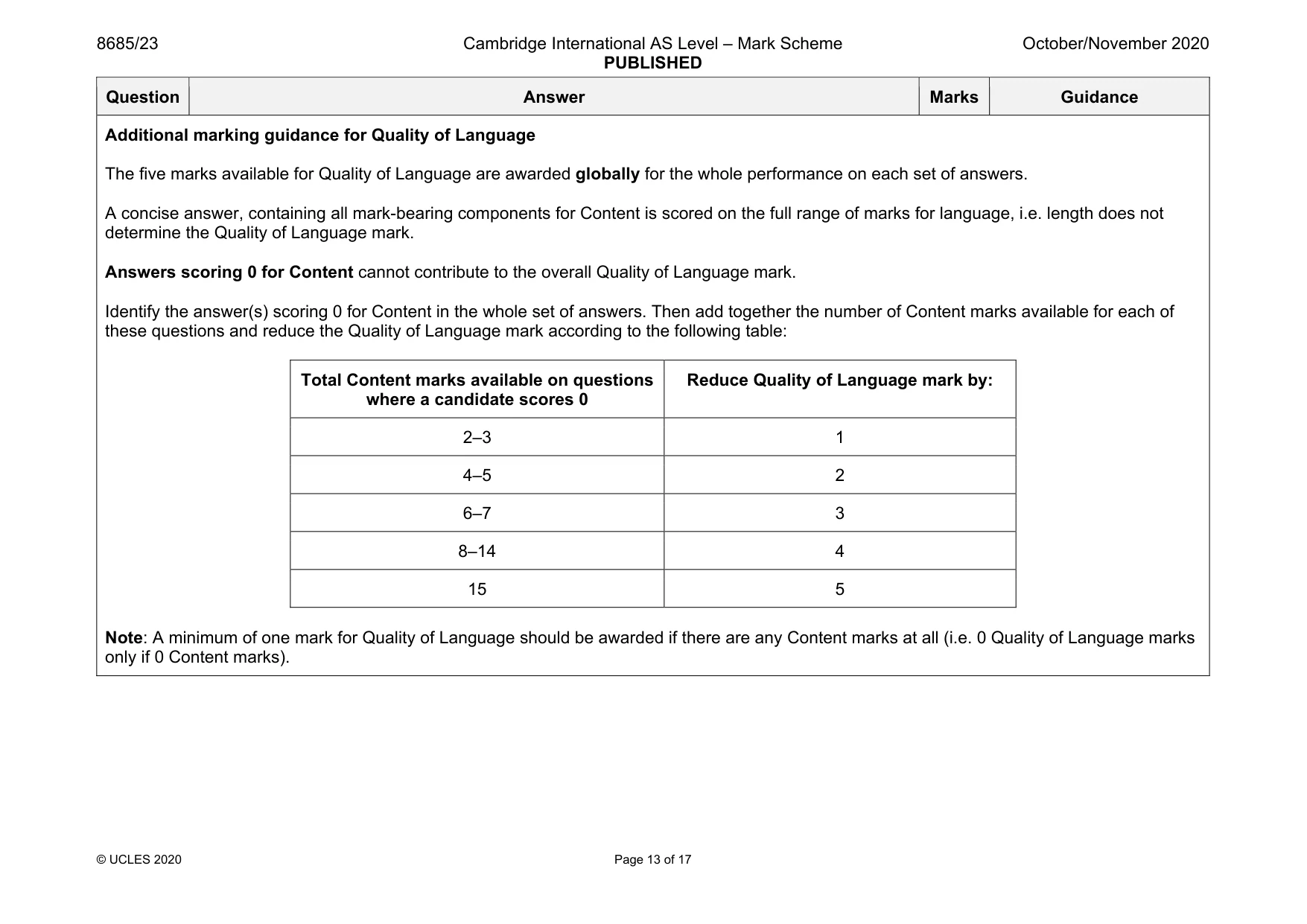
8685/23 Cambridge International AS Level – Mark Scheme PUBLISHED October/November 2020 © UCLES 2020 Page 10 of 17 Question Answer Marks Guidance Additional marking guidance for Quality of Language The five marks available for Quality of Language are awarded globally for the whole performance on each set of answers. A concise answer, containing all mark-bearing components for Content is scored on the full range of marks for language, i.e. length does not determine the Quality of Language mark. Answers scoring 0 for Content cannot contribute to the overall Quality of Language mark. Identify the answer(s) scoring 0 for Content in the whole set of answers. Then add together the number of Content marks available for each of these questions and reduce the Quality of Language mark according to the following table: Total Content marks available on questions where a candidate scores 0 Reduce Quality of Language mark by: 2–3 1 4–5 2 6–7 3 8–14 4 15 5 Note: A minimum of one mark for Quality of Language should be awarded if there are any Content marks at all (i.e. 0 Quality of Language marks only if 0 Content marks).
Mark scheme, page 11
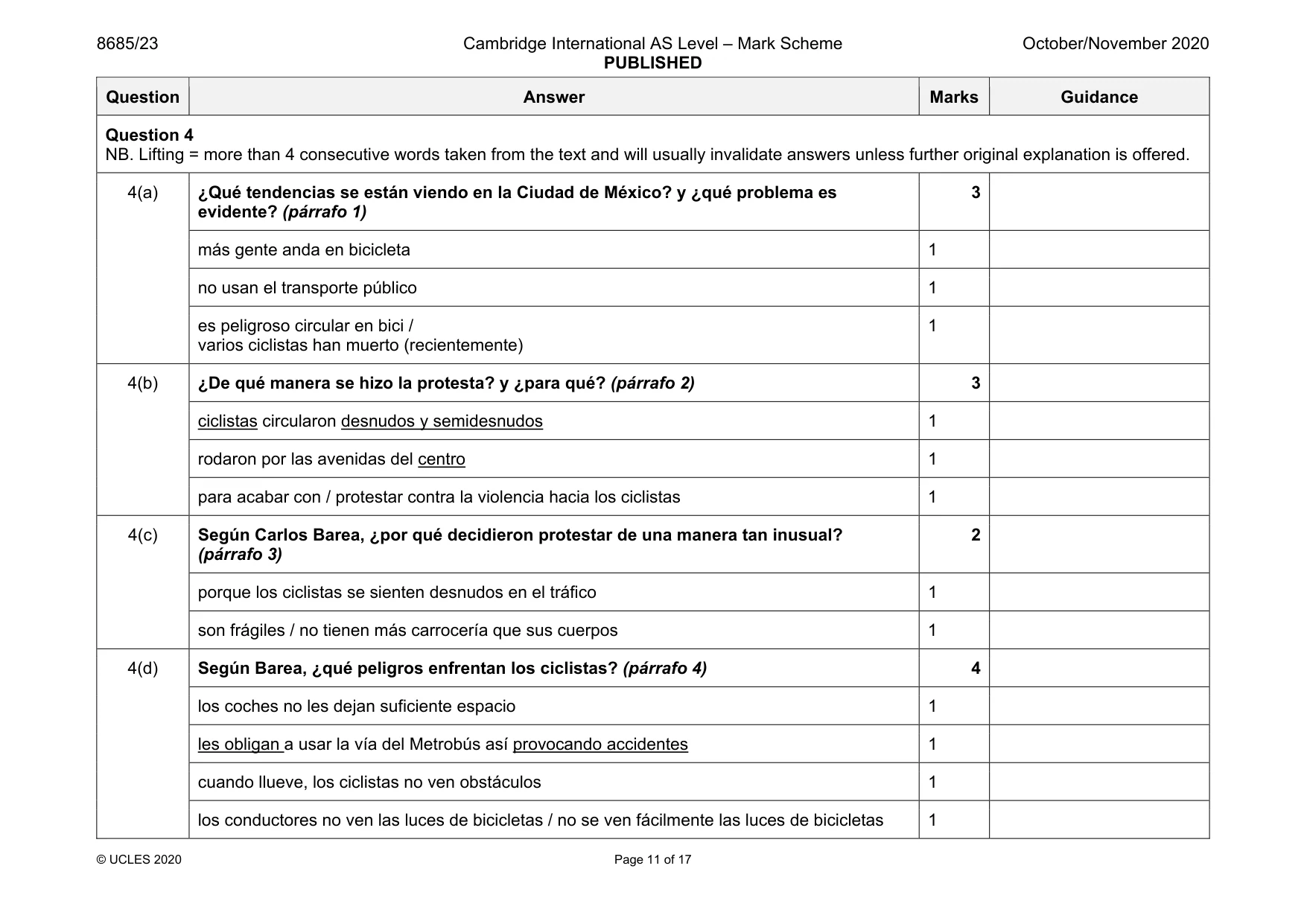
8685/23 Cambridge International AS Level – Mark Scheme PUBLISHED October/November 2020 © UCLES 2020 Page 11 of 17 Question Answer Marks Guidance Question 4 NB. Lifting = more than 4 consecutive words taken from the text and will usually invalidate answers unless further original explanation is offered. 4(a) ¿Qué tendencias se están viendo en la Ciudad de México? y ¿qué problema es evidente? (párrafo 1) 3 más gente anda en bicicleta 1 no usan el transporte público 1 es peligroso circular en bici / varios ciclistas han muerto (recientemente) 1 4(b) ¿De qué manera se hizo la protesta? y ¿para qué? (párrafo 2) 3 ciclistas circularon desnudos y semidesnudos 1 rodaron por las avenidas del centro 1 para acabar con / protestar contra la violencia hacia los ciclistas 1 4(c) Según Carlos Barea, ¿por qué decidieron protestar de una manera tan inusual? (párrafo 3) 2 porque los ciclistas se sienten desnudos en el tráfico 1 son frágiles / no tienen más carrocería que sus cuerpos 1 4(d) Según Barea, ¿qué peligros enfrentan los ciclistas? (párrafo 4) 4 los coches no les dejan suficiente espacio 1 les obligan a usar la vía del Metrobús así provocando accidentes 1 cuando llueve, los ciclistas no ven obstáculos 1 los conductores no ven las luces de bicicletas / no se ven fácilmente las luces de bicicletas 1
Mark scheme, page 12
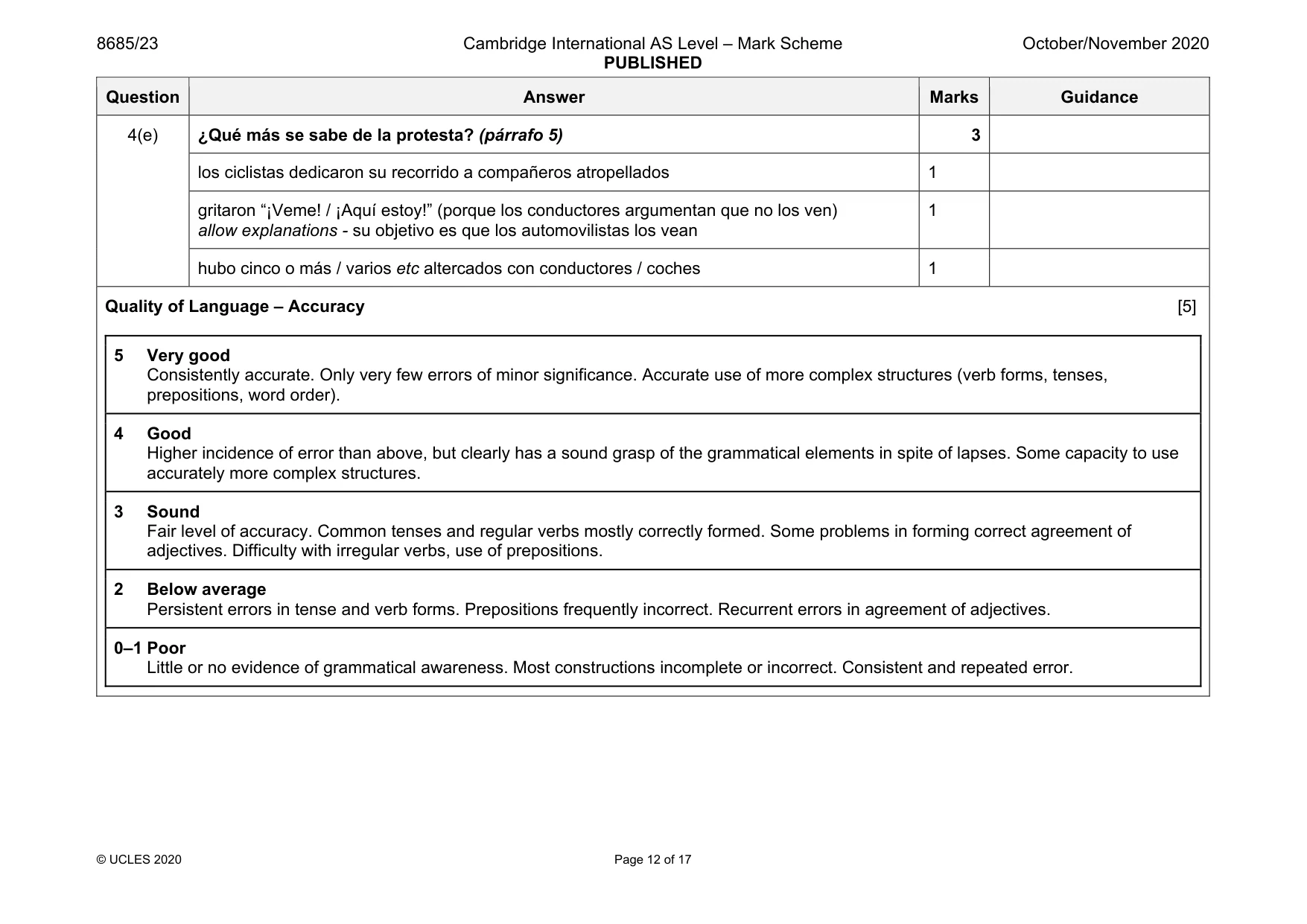
8685/23 Cambridge International AS Level – Mark Scheme PUBLISHED October/November 2020 © UCLES 2020 Page 12 of 17 Question Answer Marks Guidance 4(e) ¿Qué más se sabe de la protesta? (párrafo 5) 3 los ciclistas dedicaron su recorrido a compañeros atropellados 1 gritaron “¡Veme! / ¡Aquí estoy!” (porque los conductores argumentan que no los ven) allow explanations - su objetivo es que los automovilistas los vean 1 hubo cinco o más / varios etc altercados con conductores / coches 1 Quality of Language – Accuracy [5] 5 Very good Consistently accurate. Only very few errors of minor significance. Accurate use of more complex structures (verb forms, tenses, prepositions, word order). 4 Good Higher incidence of error than above, but clearly has a sound grasp of the grammatical elements in spite of lapses. Some capacity to use accurately more complex structures. 3 Sound Fair level of accuracy. Common tenses and regular verbs mostly correctly formed. Some problems in forming correct agreement of adjectives. Difficulty with irregular verbs, use of prepositions. 2 Below average Persistent errors in tense and verb forms. Prepositions frequently incorrect. Recurrent errors in agreement of adjectives. 0–1 Poor Little or no evidence of grammatical awareness. Most constructions incomplete or incorrect. Consistent and repeated error.
Mark scheme, page 13
8685/23 Cambridge International AS Level – Mark Scheme PUBLISHED October/November 2020 © UCLES 2020 Page 13 of 17 Question Answer Marks Guidance Additional marking guidance for Quality of Language The five marks available for Quality of Language are awarded globally for the whole performance on each set of answers. A concise answer, containing all mark-bearing components for Content is scored on the full range of marks for language, i.e. length does not determine the Quality of Language mark. Answers scoring 0 for Content cannot contribute to the overall Quality of Language mark. Identify the answer(s) scoring 0 for Content in the whole set of answers. Then add together the number of Content marks available for each of these questions and reduce the Quality of Language mark according to the following table: Total Content marks available on questions where a candidate scores 0 Reduce Quality of Language mark by: 2–3 1 4–5 2 6–7 3 8–14 4 15 5 Note: A minimum of one mark for Quality of Language should be awarded if there are any Content marks at all (i.e. 0 Quality of Language marks only if 0 Content marks).
Mark scheme, page 14
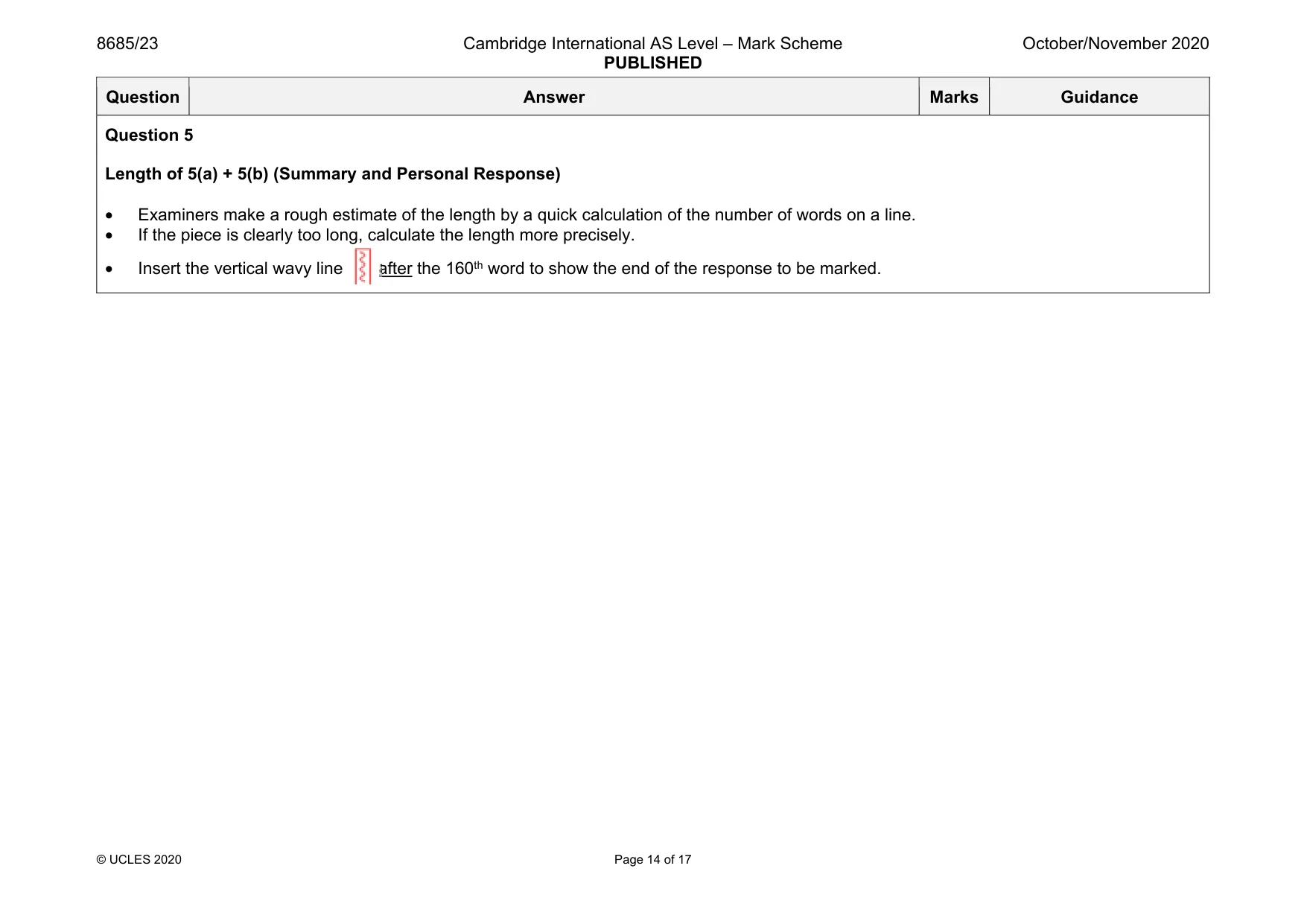
8685/23 Cambridge International AS Level – Mark Scheme PUBLISHED October/November 2020 © UCLES 2020 Page 14 of 17 Question Answer Marks Guidance Question 5 Length of 5(a) + 5(b) (Summary and Personal Response) • Examiners make a rough estimate of the length by a quick calculation of the number of words on a line. • If the piece is clearly too long, calculate the length more precisely. • Insert the vertical wavy line after the 160th word to show the end of the response to be marked.
Mark scheme, page 15
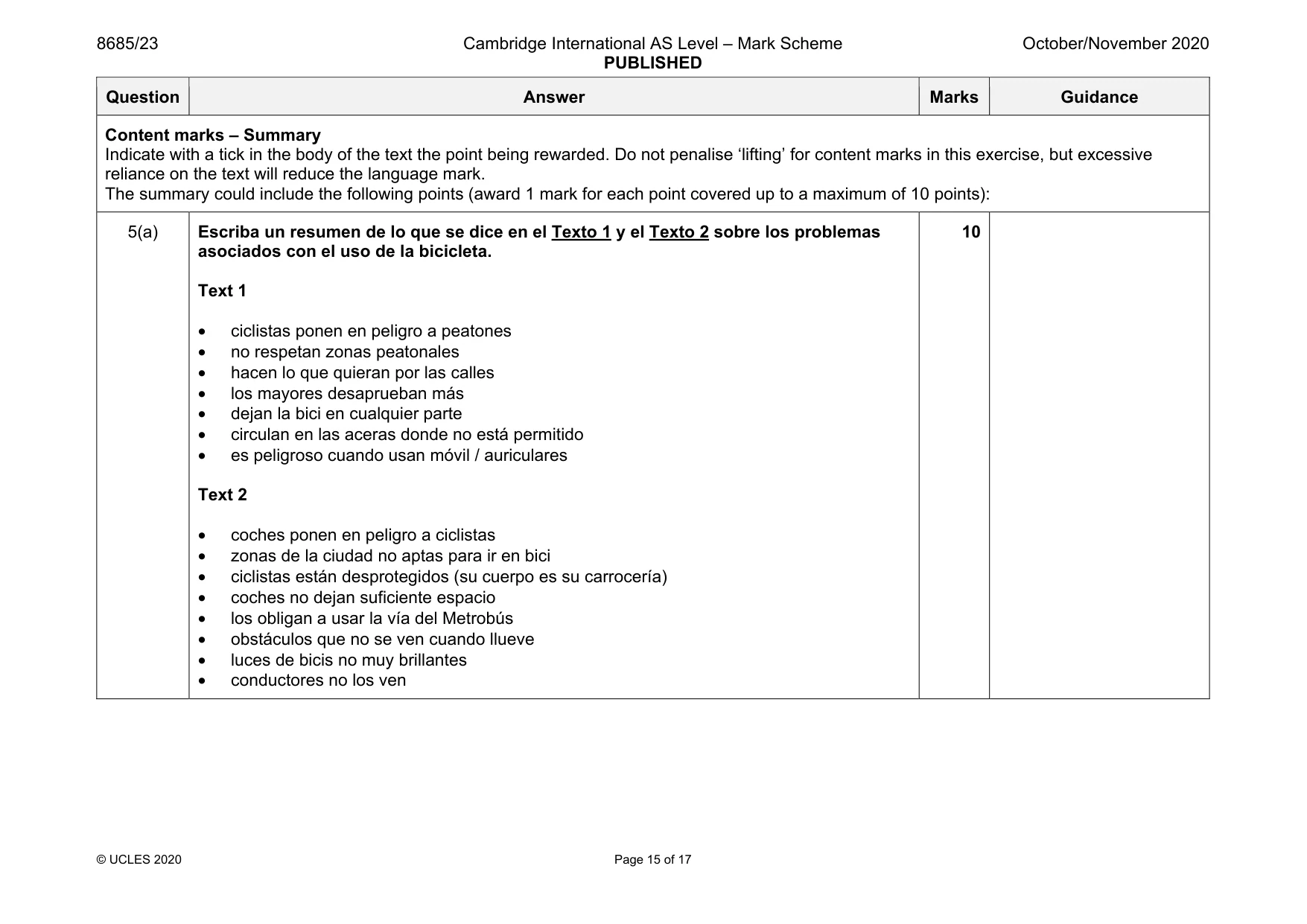
8685/23 Cambridge International AS Level – Mark Scheme PUBLISHED October/November 2020 © UCLES 2020 Page 15 of 17 Question Answer Marks Guidance Content marks – Summary Indicate with a tick in the body of the text the point being rewarded. Do not penalise ‘lifting’ for content marks in this exercise, but excessive reliance on the text will reduce the language mark. The summary could include the following points (award 1 mark for each point covered up to a maximum of 10 points): 5(a) Escriba un resumen de lo que se dice en el Texto 1 y el Texto 2 sobre los problemas asociados con el uso de la bicicleta. Text 1 • ciclistas ponen en peligro a peatones • no respetan zonas peatonales • hacen lo que quieran por las calles • los mayores desaprueban más • dejan la bici en cualquier parte • circulan en las aceras donde no está permitido • es peligroso cuando usan móvil / auriculares Text 2 • coches ponen en peligro a ciclistas • zonas de la ciudad no aptas para ir en bici • ciclistas están desprotegidos (su cuerpo es su carrocería) • coches no dejan suficiente espacio • los obligan a usar la vía del Metrobús • obstáculos que no se ven cuando llueve • luces de bicis no muy brillantes • conductores no los ven 10
Mark scheme, page 16
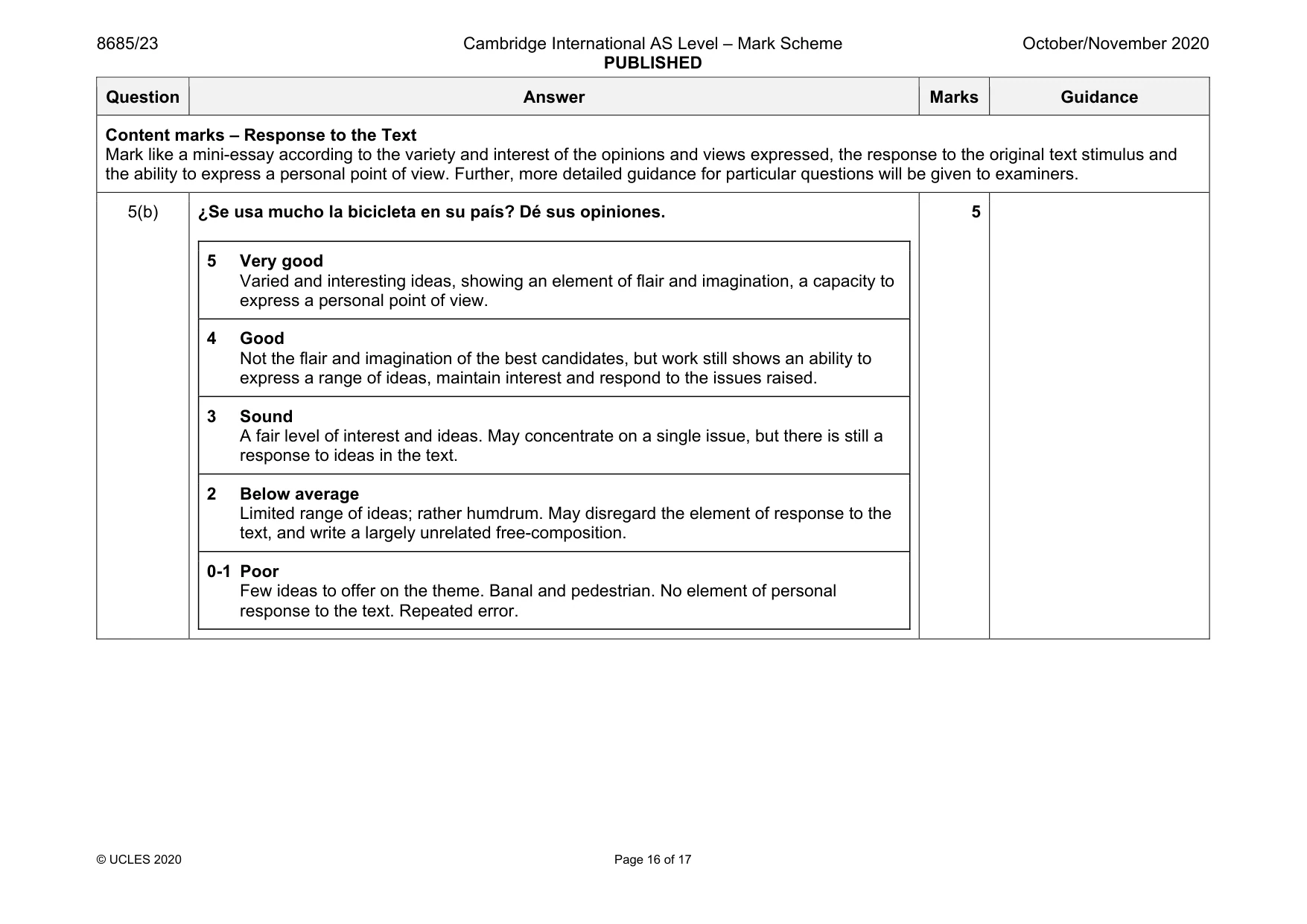
8685/23 Cambridge International AS Level – Mark Scheme PUBLISHED October/November 2020 © UCLES 2020 Page 16 of 17 Question Answer Marks Guidance Content marks – Response to the Text Mark like a mini-essay according to the variety and interest of the opinions and views expressed, the response to the original text stimulus and the ability to express a personal point of view. Further, more detailed guidance for particular questions will be given to examiners. 5(b) ¿Se usa mucho la bicicleta en su país? Dé sus opiniones. 5 Very good Varied and interesting ideas, showing an element of flair and imagination, a capacity to express a personal point of view. 4 Good Not the flair and imagination of the best candidates, but work still shows an ability to express a range of ideas, maintain interest and respond to the issues raised. 3 Sound A fair level of interest and ideas. May concentrate on a single issue, but there is still a response to ideas in the text. 2 Below average Limited range of ideas; rather humdrum. May disregard the element of response to the text, and write a largely unrelated free-composition. 0-1 Poor Few ideas to offer on the theme. Banal and pedestrian. No element of personal response to the text. Repeated error. 5
Mark scheme, page 17
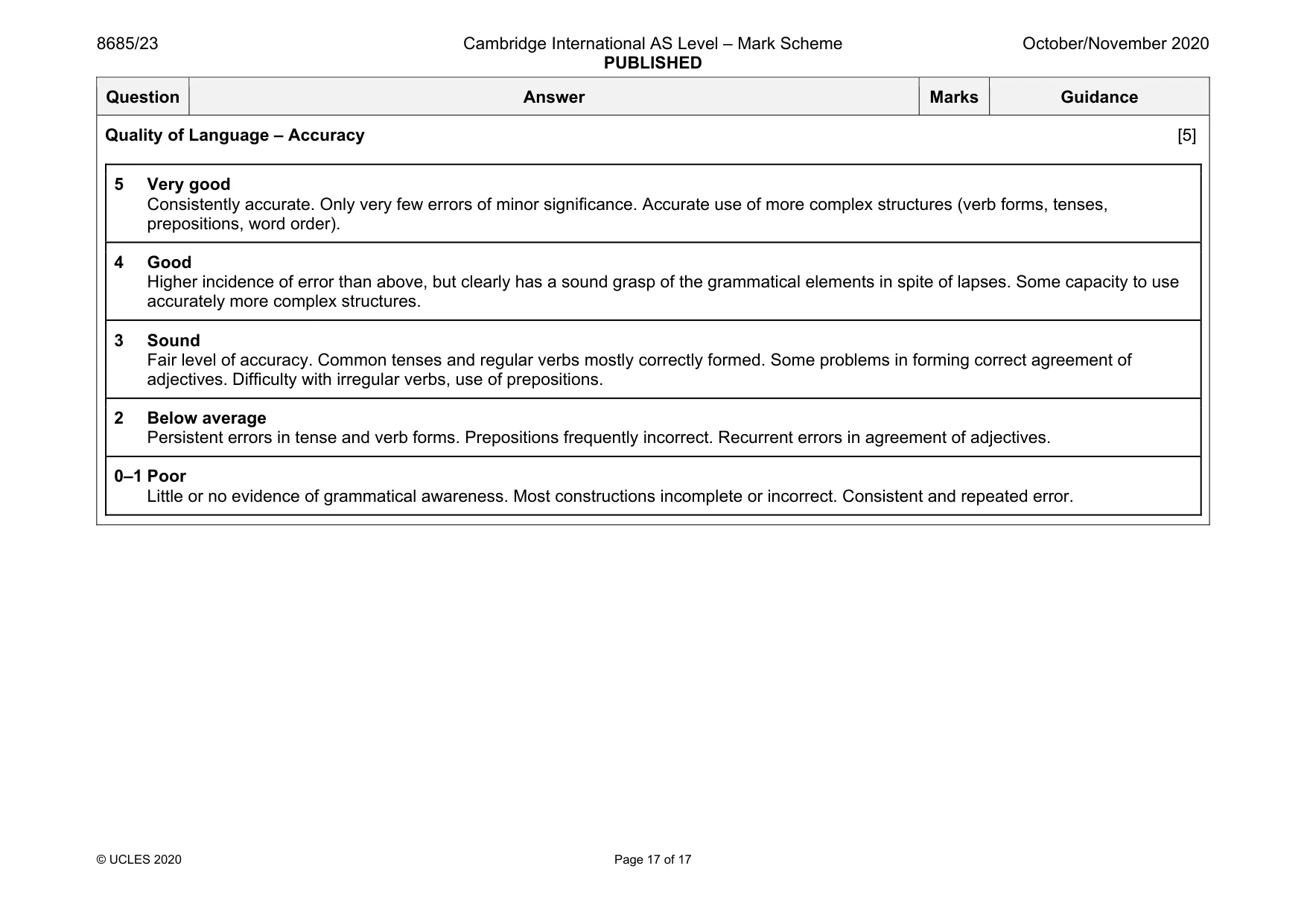
8685/23 Cambridge International AS Level – Mark Scheme PUBLISHED October/November 2020 © UCLES 2020 Page 17 of 17 Question Answer Marks Guidance Quality of Language – Accuracy [5] 5 Very good Consistently accurate. Only very few errors of minor significance. Accurate use of more complex structures (verb forms, tenses, prepositions, word order). 4 Good Higher incidence of error than above, but clearly has a sound grasp of the grammatical elements in spite of lapses. Some capacity to use accurately more complex structures. 3 Sound Fair level of accuracy. Common tenses and regular verbs mostly correctly formed. Some problems in forming correct agreement of adjectives. Difficulty with irregular verbs, use of prepositions. 2 Below average Persistent errors in tense and verb forms. Prepositions frequently incorrect. Recurrent errors in agreement of adjectives. 0–1 Poor Little or no evidence of grammatical awareness. Most constructions incomplete or incorrect. Consistent and repeated error.
What you needed in this session
Cambridge’s own grade thresholds for 2020 Oct/Nov, Paper 2 · Variant 3. A higher threshold means an easier paper — the bar moves with how the cohort did.