Cambridge A Level Spanish (A Level only) 9719 — 2018 Oct/Nov Paper 4 · Variant 3
9719/43/O/N/18 · 75 marks · ≈84 min
The question paper and its mark scheme, free to read here and free to download. This is Cambridge’s own paper, exactly as it was sat.
Question paper8 pages


Mark scheme4 pages
Answers below. Sit the paper first if you are practising.
Paper as text
Question paper, page 1
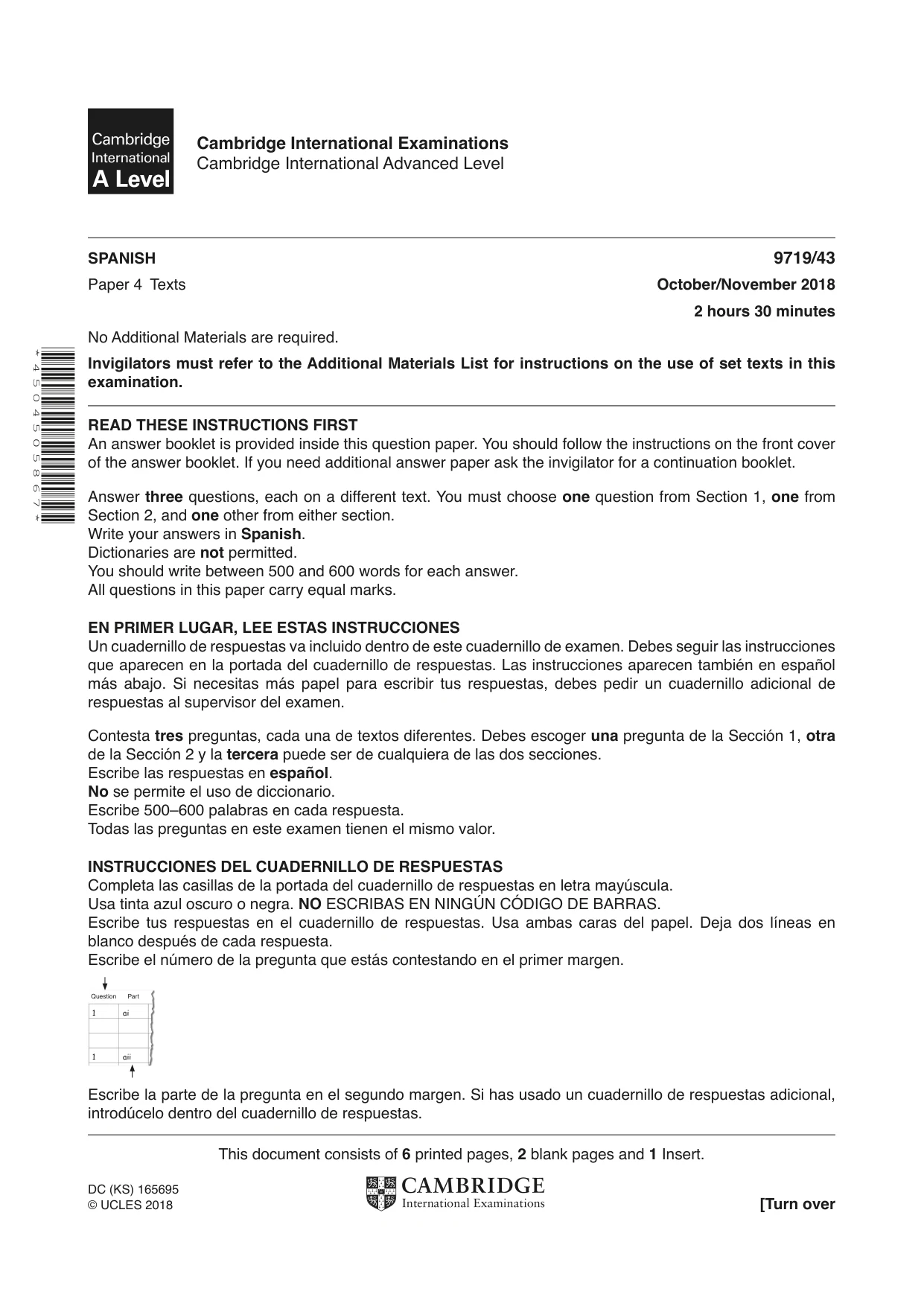
* 4 5 0 4 5 0 5 8 6 7 * This document consists of 6 printed pages, 2 blank pages and 1 Insert. DC (KS) 165695 © UCLES 2018 [Turn over Cambridge International Examinations Cambridge International Advanced Level SPANISH 9719/43 Paper 4 Texts October/November 2018 2 hours 30 minutes No Additional Materials are required. Invigilators must refer to the Additional Materials List for instructions on the use of set texts in this examination. READ THESE INSTRUCTIONS FIRST An answer booklet is provided inside this question paper. You should follow the instructions on the front cover of the answer booklet. If you need additional answer paper ask the invigilator for a continuation booklet. Answer three questions, each on a different text. You must choose one question from Section 1, one from Section 2, and one other from either section. Write your answers in Spanish. Dictionaries are not permitted. You should write between 500 and 600 words for each answer. All questions in this paper carry equal marks. EN PRIMER LUGAR, LEE ESTAS INSTRUCCIONES Un cuadernillo de respuestas va incluido dentro de este cuadernillo de examen. Debes seguir las instrucciones que aparecen en la portada del cuadernillo de respuestas. Las instrucciones aparecen también en español más abajo. Si necesitas más papel para escribir tus respuestas, debes pedir un cuadernillo adicional de respuestas al supervisor del examen. Contesta tres preguntas, cada una de textos diferentes. Debes escoger una pregunta de la Sección 1, otra de la Sección 2 y la tercera puede ser de cualquiera de las dos secciones. Escribe las respuestas en español. No se permite el uso de diccionario. Escribe 500–600 palabras en cada respuesta. Todas las preguntas en este examen tienen el mismo valor. INSTRUCCIONES DEL CUADERNILLO DE RESPUESTAS Completa las casillas de la portada del cuadernillo de respuestas en letra mayúscula. Usa tinta azul oscuro o negra. NO ESCRIBAS EN NINGÚN CÓDIGO DE BARRAS. Escribe tus respuestas en el cuadernillo de respuestas. Usa ambas caras del papel. Deja dos líneas en blanco después de cada respuesta. Escribe el número de la pregunta que estás contestando en el primer margen. Question Part 1 1 ai aii Escribe la parte de la pregunta en el segundo margen. Si has usado un cuadernillo de respuestas adicional, introdúcelo dentro del cuadernillo de respuestas.
Question paper, page 2
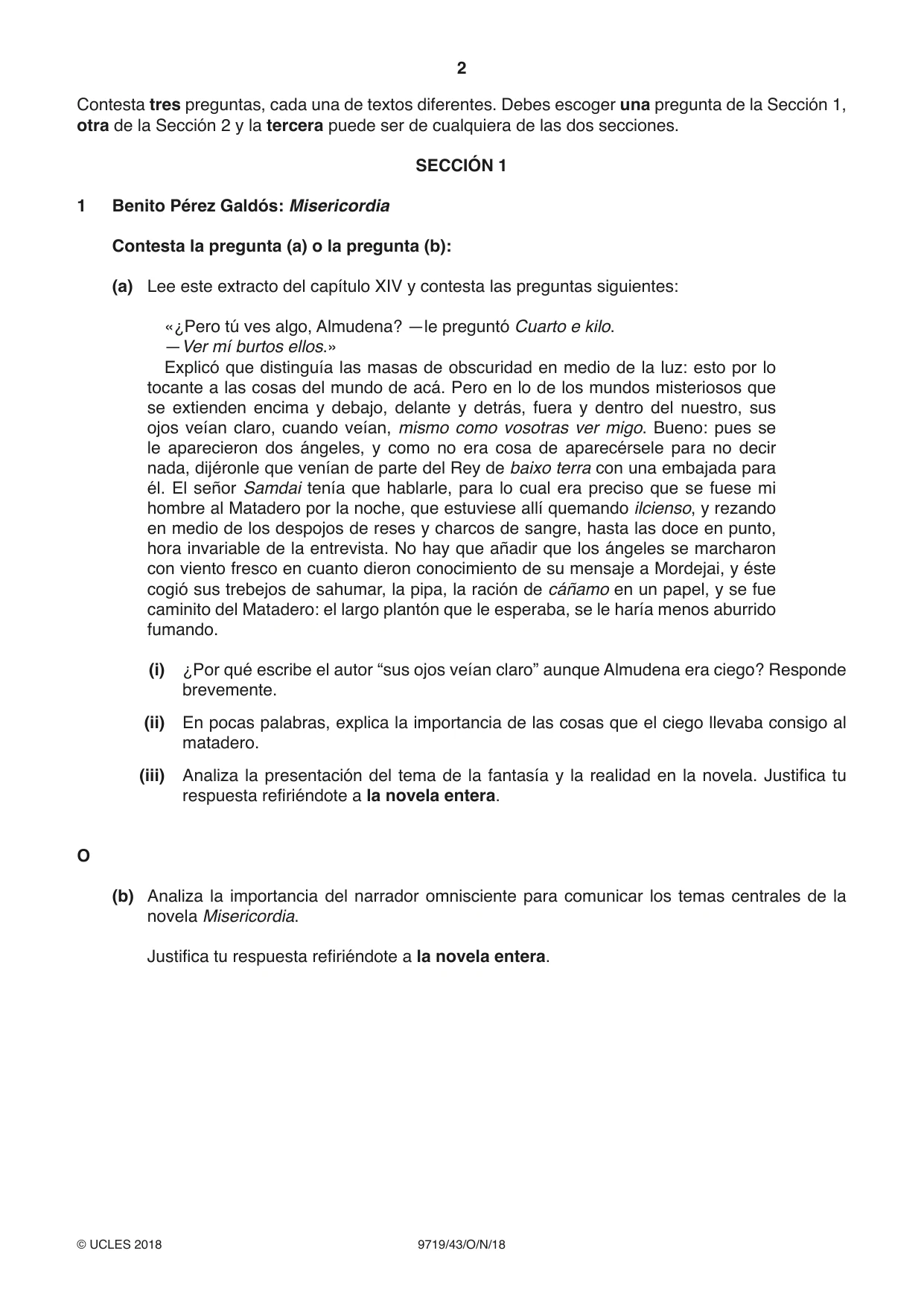
2 9719/43/O/N/18 © UCLES 2018 Contesta tres preguntas, cada una de textos diferentes. Debes escoger una pregunta de la Sección 1, otra de la Sección 2 y la tercera puede ser de cualquiera de las dos secciones. SECCIÓN 1 1 Benito Pérez Galdós: Misericordia Contesta la pregunta (a) o la pregunta (b): (a) Lee este extracto del capítulo XIV y contesta las preguntas siguientes: «¿Pero tú ves algo, Almudena? —le preguntó Cuarto e kilo. —Ver mí burtos ellos.» Explicó que distinguía las masas de obscuridad en medio de la luz: esto por lo tocante a las cosas del mundo de acá. Pero en lo de los mundos misteriosos que se extienden encima y debajo, delante y detrás, fuera y dentro del nuestro, sus ojos veían claro, cuando veían, mismo como vosotras ver migo. Bueno: pues se le aparecieron dos ángeles, y como no era cosa de aparecérsele para no decir nada, dijéronle que venían de parte del Rey de baixo terra con una embajada para él. El señor Samdai tenía que hablarle, para lo cual era preciso que se fuese mi hombre al Matadero por la noche, que estuviese allí quemando ilcienso, y rezando en medio de los despojos de reses y charcos de sangre, hasta las doce en punto, hora invariable de la entrevista. No hay que añadir que los ángeles se marcharon con viento fresco en cuanto dieron conocimiento de su mensaje a Mordejai, y éste cogió sus trebejos de sahumar, la pipa, la ración de cáñamo en un papel, y se fue caminito del Matadero: el largo plantón que le esperaba, se le haría menos aburrido fumando. (i) ¿Por qué escribe el autor “sus ojos veían claro” aunque Almudena era ciego? Responde brevemente. (ii) En pocas palabras, explica la importancia de las cosas que el ciego llevaba consigo al matadero. (iii) Analiza la presentación del tema de la fantasía y la realidad en la novela. Justifica tu respuesta refiriéndote a la novela entera. O (b) Analiza la importancia del narrador omnisciente para comunicar los temas centrales de la novela Misericordia. Justifica tu respuesta refiriéndote a la novela entera.
Question paper, page 3
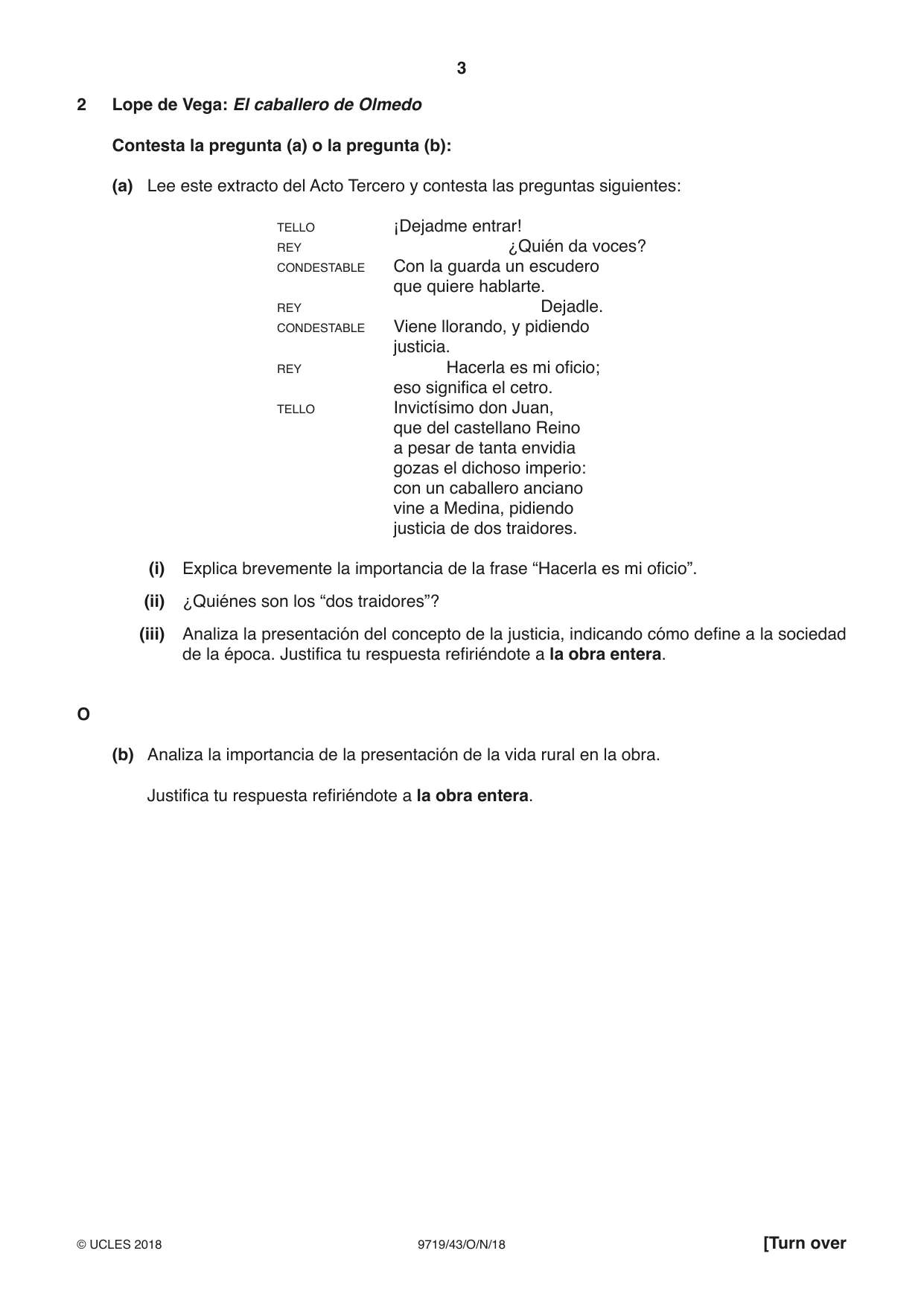
3 9719/43/O/N/18 © UCLES 2018 [Turn over 2 Lope de Vega: El caballero de Olmedo Contesta la pregunta (a) o la pregunta (b): (a) Lee este extracto del Acto Tercero y contesta las preguntas siguientes: tello ¡Dejadme entrar! rey ¿Quién da voces? condestable Con la guarda un escudero que quiere hablarte. rey Dejadle. condestable Viene llorando, y pidiendo justicia. rey Hacerla es mi oficio; eso significa el cetro. tello Invictísimo don Juan, que del castellano Reino a pesar de tanta envidia gozas el dichoso imperio: con un caballero anciano vine a Medina, pidiendo justicia de dos traidores. (i) Explica brevemente la importancia de la frase “Hacerla es mi oficio”. (ii) ¿Quiénes son los “dos traidores”? (iii) Analiza la presentación del concepto de la justicia, indicando cómo define a la sociedad de la época. Justifica tu respuesta refiriéndote a la obra entera. O (b) Analiza la importancia de la presentación de la vida rural en la obra. Justifica tu respuesta refiriéndote a la obra entera.
Question paper, page 4
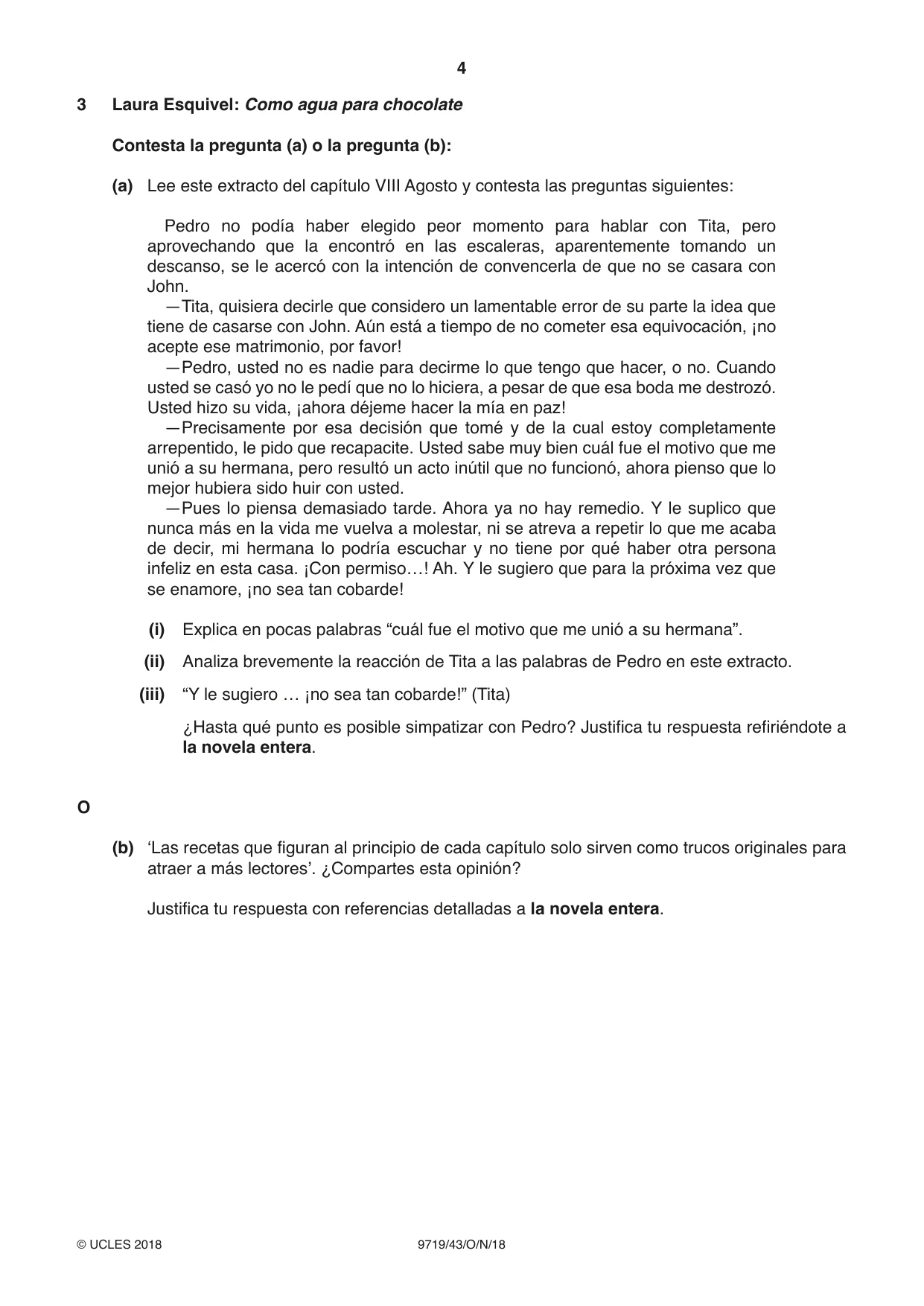
4 9719/43/O/N/18 © UCLES 2018 3 Laura Esquivel: Como agua para chocolate Contesta la pregunta (a) o la pregunta (b): (a) Lee este extracto del capítulo VIII Agosto y contesta las preguntas siguientes: Pedro no podía haber elegido peor momento para hablar con Tita, pero aprovechando que la encontró en las escaleras, aparentemente tomando un descanso, se le acercó con la intención de convencerla de que no se casara con John. —Tita, quisiera decirle que considero un lamentable error de su parte la idea que tiene de casarse con John. Aún está a tiempo de no cometer esa equivocación, ¡no acepte ese matrimonio, por favor! —Pedro, usted no es nadie para decirme lo que tengo que hacer, o no. Cuando usted se casó yo no le pedí que no lo hiciera, a pesar de que esa boda me destrozó. Usted hizo su vida, ¡ahora déjeme hacer la mía en paz! —Precisamente por esa decisión que tomé y de la cual estoy completamente arrepentido, le pido que recapacite. Usted sabe muy bien cuál fue el motivo que me unió a su hermana, pero resultó un acto inútil que no funcionó, ahora pienso que lo mejor hubiera sido huir con usted. —Pues lo piensa demasiado tarde. Ahora ya no hay remedio. Y le suplico que nunca más en la vida me vuelva a molestar, ni se atreva a repetir lo que me acaba de decir, mi hermana lo podría escuchar y no tiene por qué haber otra persona infeliz en esta casa. ¡Con permiso…! Ah. Y le sugiero que para la próxima vez que se enamore, ¡no sea tan cobarde! (i) Explica en pocas palabras “cuál fue el motivo que me unió a su hermana”. (ii) Analiza brevemente la reacción de Tita a las palabras de Pedro en este extracto. (iii) “Y le sugiero … ¡no sea tan cobarde!” (Tita) ¿Hasta qué punto es posible simpatizar con Pedro? Justifica tu respuesta refiriéndote a la novela entera. O (b) ‘Las recetas que figuran al principio de cada capítulo solo sirven como trucos originales para atraer a más lectores’. ¿Compartes esta opinión? Justifica tu respuesta con referencias detalladas a la novela entera.
Question paper, page 5
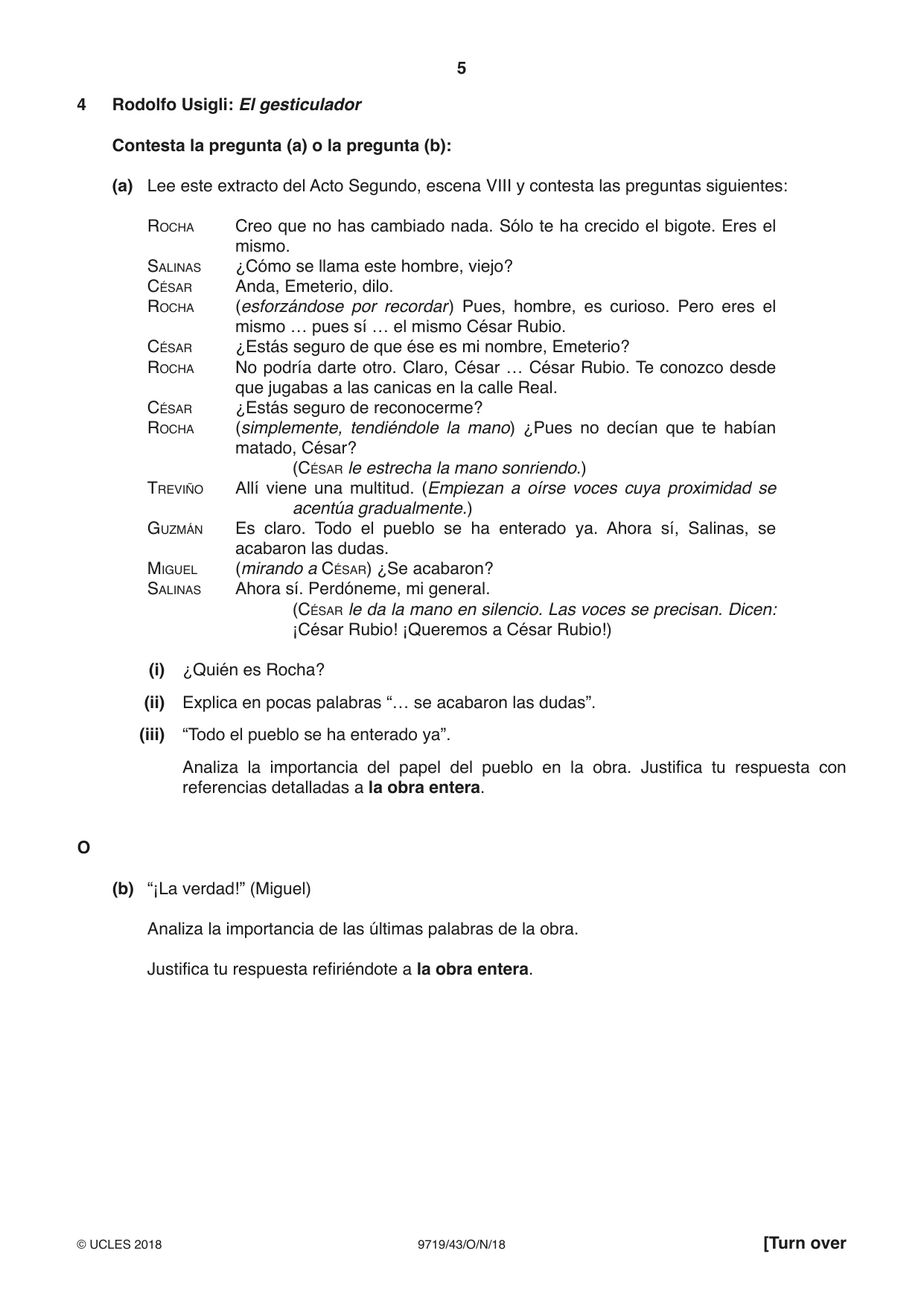
5 9719/43/O/N/18 © UCLES 2018 [Turn over 4 Rodolfo Usigli: El gesticulador Contesta la pregunta (a) o la pregunta (b): (a) Lee este extracto del Acto Segundo, escena VIII y contesta las preguntas siguientes: rocha Creo que no has cambiado nada. Sólo te ha crecido el bigote. Eres el mismo. salinas ¿Cómo se llama este hombre, viejo? césar Anda, Emeterio, dilo. rocha (esforzándose por recordar) Pues, hombre, es curioso. Pero eres el mismo … pues sí … el mismo César Rubio. césar ¿Estás seguro de que ése es mi nombre, Emeterio? rocha No podría darte otro. Claro, César … César Rubio. Te conozco desde que jugabas a las canicas en la calle Real. césar ¿Estás seguro de reconocerme? rocha (simplemente, tendiéndole la mano) ¿Pues no decían que te habían matado, César? (césar le estrecha la mano sonriendo.) treviño Allí viene una multitud. (Empiezan a oírse voces cuya proximidad se acentúa gradualmente.) Guzmán Es claro. Todo el pueblo se ha enterado ya. Ahora sí, Salinas, se acabaron las dudas. miGuel (mirando a césar) ¿Se acabaron? salinas Ahora sí. Perdóneme, mi general. (césar le da la mano en silencio. Las voces se precisan. Dicen: ¡César Rubio! ¡Queremos a César Rubio!) (i) ¿Quién es Rocha? (ii) Explica en pocas palabras “… se acabaron las dudas”. (iii) “Todo el pueblo se ha enterado ya”. Analiza la importancia del papel del pueblo en la obra. Justifica tu respuesta con referencias detalladas a la obra entera. O (b) “¡La verdad!” (Miguel) Analiza la importancia de las últimas palabras de la obra. Justifica tu respuesta refiriéndote a la obra entera.
Question paper, page 6
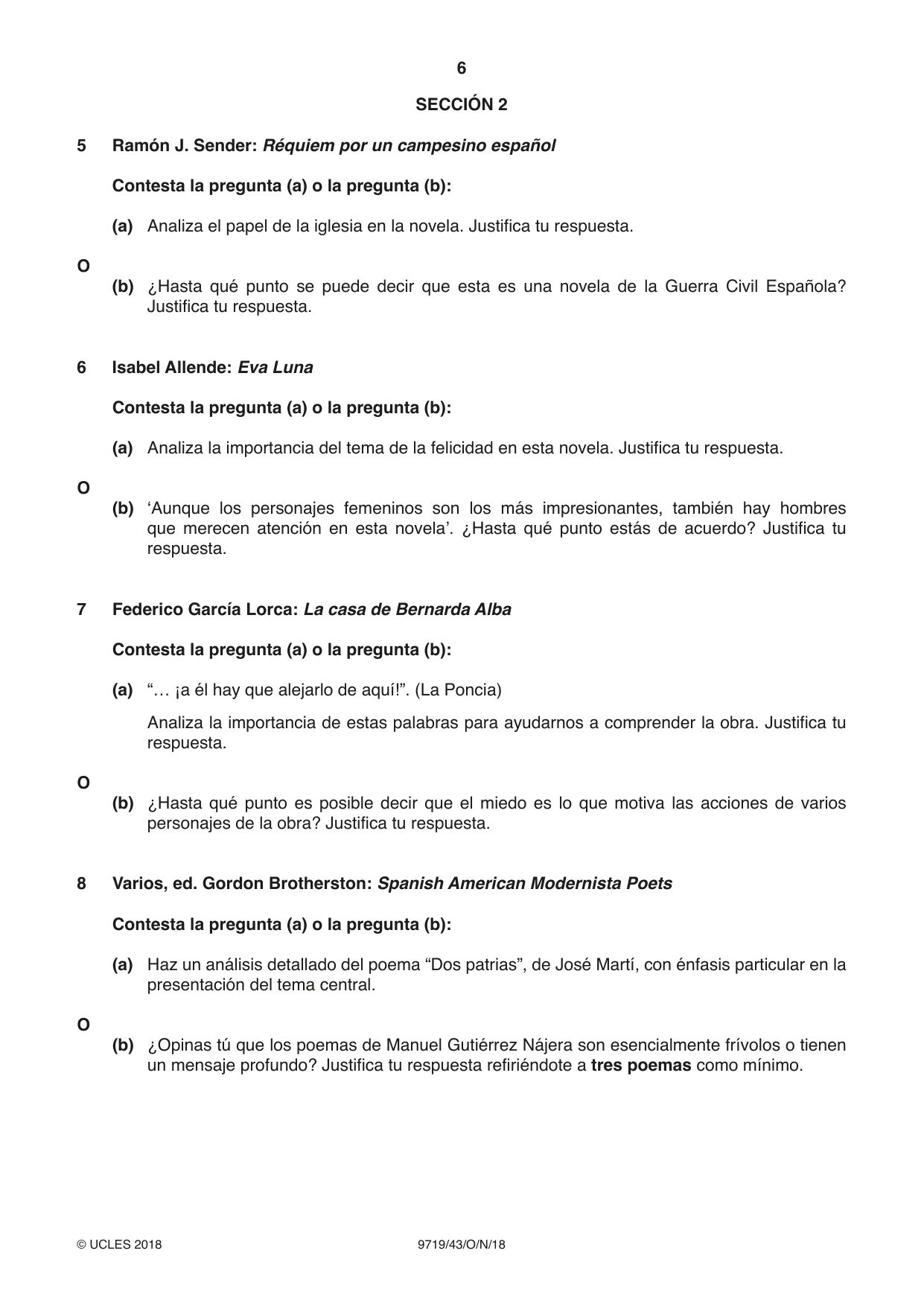
6 9719/43/O/N/18 © UCLES 2018 SECCIÓN 2 5 Ramón J. Sender: Réquiem por un campesino español Contesta la pregunta (a) o la pregunta (b): (a) Analiza el papel de la iglesia en la novela. Justifica tu respuesta. O (b) ¿Hasta qué punto se puede decir que esta es una novela de la Guerra Civil Española? Justifica tu respuesta. 6 Isabel Allende: Eva Luna Contesta la pregunta (a) o la pregunta (b): (a) Analiza la importancia del tema de la felicidad en esta novela. Justifica tu respuesta. O (b) ‘Aunque los personajes femeninos son los más impresionantes, también hay hombres que merecen atención en esta novela’. ¿Hasta qué punto estás de acuerdo? Justifica tu respuesta. 7 Federico García Lorca: La casa de Bernarda Alba Contesta la pregunta (a) o la pregunta (b): (a) “… ¡a él hay que alejarlo de aquí!”. (La Poncia) Analiza la importancia de estas palabras para ayudarnos a comprender la obra. Justifica tu respuesta. O (b) ¿Hasta qué punto es posible decir que el miedo es lo que motiva las acciones de varios personajes de la obra? Justifica tu respuesta. 8 Varios, ed. Gordon Brotherston: Spanish American Modernista Poets Contesta la pregunta (a) o la pregunta (b): (a) Haz un análisis detallado del poema “Dos patrias”, de José Martí, con énfasis particular en la presentación del tema central. O (b) ¿Opinas tú que los poemas de Manuel Gutiérrez Nájera son esencialmente frívolos o tienen un mensaje profundo? Justifica tu respuesta refiriéndote a tres poemas como mínimo.
Question paper, page 7
7 9719/43/O/N/18 © UCLES 2018 BLANK PAGE
Question paper, page 8
8 9719/43/O/N/18 © UCLES 2018 BLANK PAGE Permission to reproduce items where third-party owned material protected by copyright is included has been sought and cleared where possible. Every reasonable effort has been made by the publisher (UCLES) to trace copyright holders, but if any items requiring clearance have unwittingly been included, the publisher will be pleased to make amends at the earliest possible opportunity. To avoid the issue of disclosure of answer-related information to candidates, all copyright acknowledgements are reproduced online in the Cambridge International Examinations Copyright Acknowledgements Booklet. This is produced for each series of examinations and is freely available to download at www.cie.org.uk after the live examination series. Cambridge International Examinations is part of the Cambridge Assessment Group. Cambridge Assessment is the brand name of University of Cambridge Local Examinations Syndicate (UCLES), which is itself a department of the University of Cambridge.
Mark scheme, page 1
This document consists of 4 printed pages. © UCLES 2018 [Turn over Cambridge Assessment International Education Cambridge International Advanced Level SPANISH 9719/43 Paper 4 Texts October/November 2018 MARK SCHEME Maximum Mark: 75 Published This mark scheme is published as an aid to teachers and candidates, to indicate the requirements of the examination. It shows the basis on which Examiners were instructed to award marks. It does not indicate the details of the discussions that took place at an Examiners’ meeting before marking began, which would have considered the acceptability of alternative answers. Mark schemes should be read in conjunction with the question paper and the Principal Examiner Report for Teachers. Cambridge International will not enter into discussions about these mark schemes. Cambridge International is publishing the mark schemes for the October/November 2018 series for most Cambridge IGCSE™, Cambridge International A and AS Level components and some Cambridge O Level components.
Mark scheme, page 2
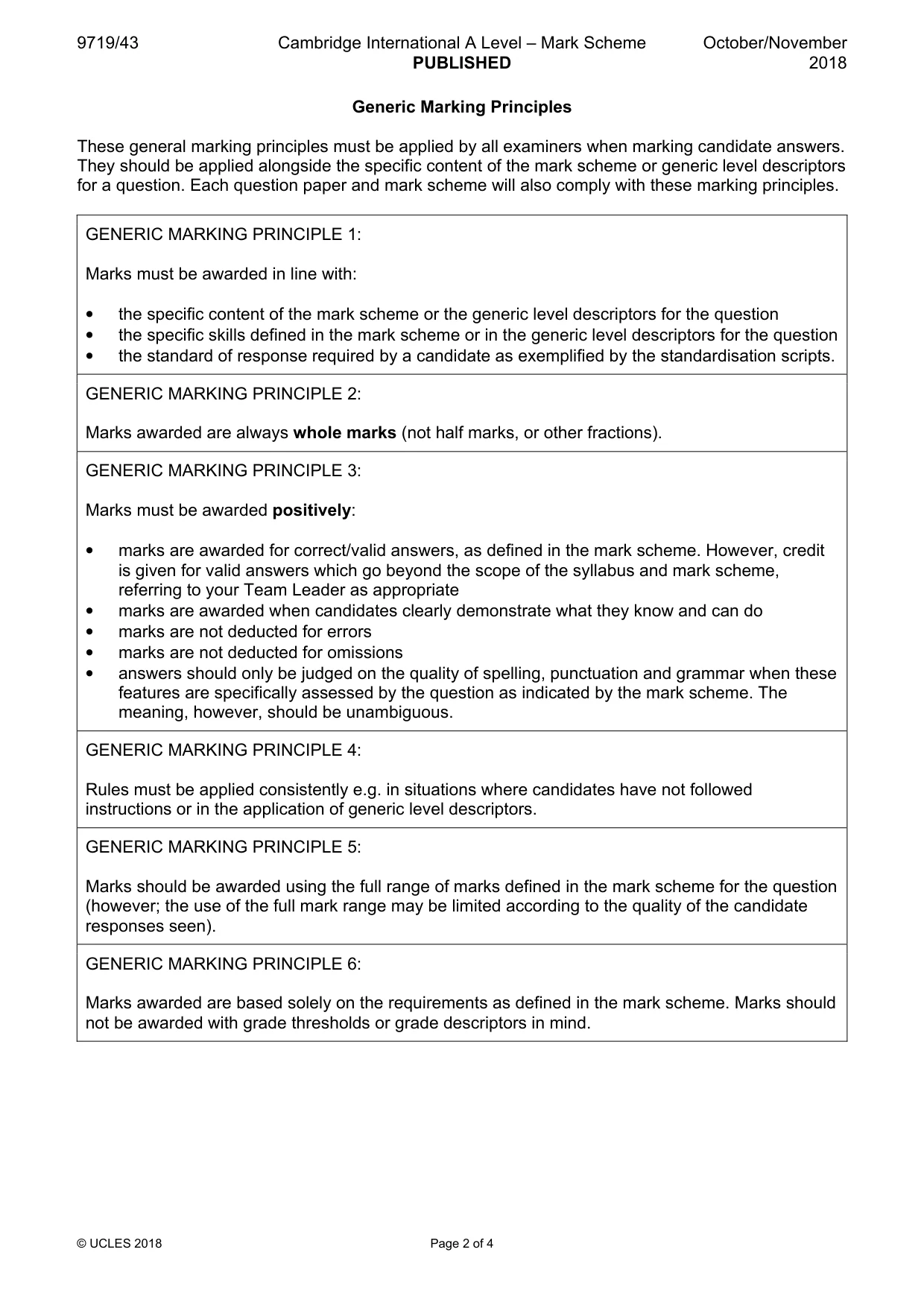
9719/43 Cambridge International A Level – Mark Scheme PUBLISHED October/November 2018 © UCLES 2018 Page 2 of 4 Generic Marking Principles These general marking principles must be applied by all examiners when marking candidate answers. They should be applied alongside the specific content of the mark scheme or generic level descriptors for a question. Each question paper and mark scheme will also comply with these marking principles. GENERIC MARKING PRINCIPLE 1: Marks must be awarded in line with: • the specific content of the mark scheme or the generic level descriptors for the question • the specific skills defined in the mark scheme or in the generic level descriptors for the question • the standard of response required by a candidate as exemplified by the standardisation scripts. GENERIC MARKING PRINCIPLE 2: Marks awarded are always whole marks (not half marks, or other fractions). GENERIC MARKING PRINCIPLE 3: Marks must be awarded positively: • marks are awarded for correct/valid answers, as defined in the mark scheme. However, credit is given for valid answers which go beyond the scope of the syllabus and mark scheme, referring to your Team Leader as appropriate • marks are awarded when candidates clearly demonstrate what they know and can do • marks are not deducted for errors • marks are not deducted for omissions • answers should only be judged on the quality of spelling, punctuation and grammar when these features are specifically assessed by the question as indicated by the mark scheme. The meaning, however, should be unambiguous. GENERIC MARKING PRINCIPLE 4: Rules must be applied consistently e.g. in situations where candidates have not followed instructions or in the application of generic level descriptors. GENERIC MARKING PRINCIPLE 5: Marks should be awarded using the full range of marks defined in the mark scheme for the question (however; the use of the full mark range may be limited according to the quality of the candidate responses seen). GENERIC MARKING PRINCIPLE 6: Marks awarded are based solely on the requirements as defined in the mark scheme. Marks should not be awarded with grade thresholds or grade descriptors in mind.
Mark scheme, page 3
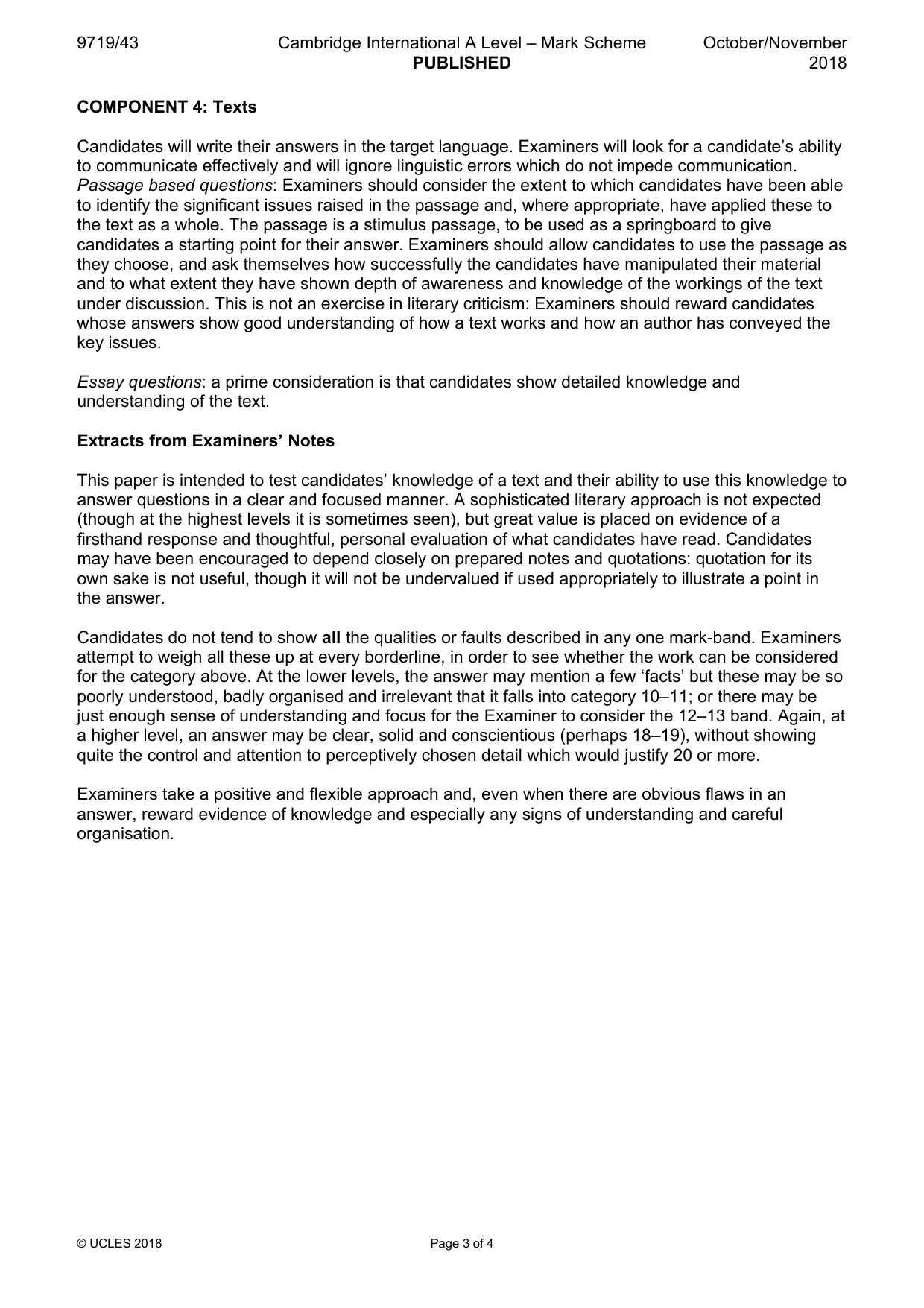
9719/43 Cambridge International A Level – Mark Scheme PUBLISHED October/November 2018 © UCLES 2018 Page 3 of 4 COMPONENT 4: Texts Candidates will write their answers in the target language. Examiners will look for a candidate’s ability to communicate effectively and will ignore linguistic errors which do not impede communication. Passage based questions: Examiners should consider the extent to which candidates have been able to identify the significant issues raised in the passage and, where appropriate, have applied these to the text as a whole. The passage is a stimulus passage, to be used as a springboard to give candidates a starting point for their answer. Examiners should allow candidates to use the passage as they choose, and ask themselves how successfully the candidates have manipulated their material and to what extent they have shown depth of awareness and knowledge of the workings of the text under discussion. This is not an exercise in literary criticism: Examiners should reward candidates whose answers show good understanding of how a text works and how an author has conveyed the key issues. Essay questions: a prime consideration is that candidates show detailed knowledge and understanding of the text. Extracts from Examiners’ Notes This paper is intended to test candidates’ knowledge of a text and their ability to use this knowledge to answer questions in a clear and focused manner. A sophisticated literary approach is not expected (though at the highest levels it is sometimes seen), but great value is placed on evidence of a firsthand response and thoughtful, personal evaluation of what candidates have read. Candidates may have been encouraged to depend closely on prepared notes and quotations: quotation for its own sake is not useful, though it will not be undervalued if used appropriately to illustrate a point in the answer. Candidates do not tend to show all the qualities or faults described in any one mark-band. Examiners attempt to weigh all these up at every borderline, in order to see whether the work can be considered for the category above. At the lower levels, the answer may mention a few ‘facts’ but these may be so poorly understood, badly organised and irrelevant that it falls into category 10–11; or there may be just enough sense of understanding and focus for the Examiner to consider the 12–13 band. Again, at a higher level, an answer may be clear, solid and conscientious (perhaps 18–19), without showing quite the control and attention to perceptively chosen detail which would justify 20 or more. Examiners take a positive and flexible approach and, even when there are obvious flaws in an answer, reward evidence of knowledge and especially any signs of understanding and careful organisation.
Mark scheme, page 4
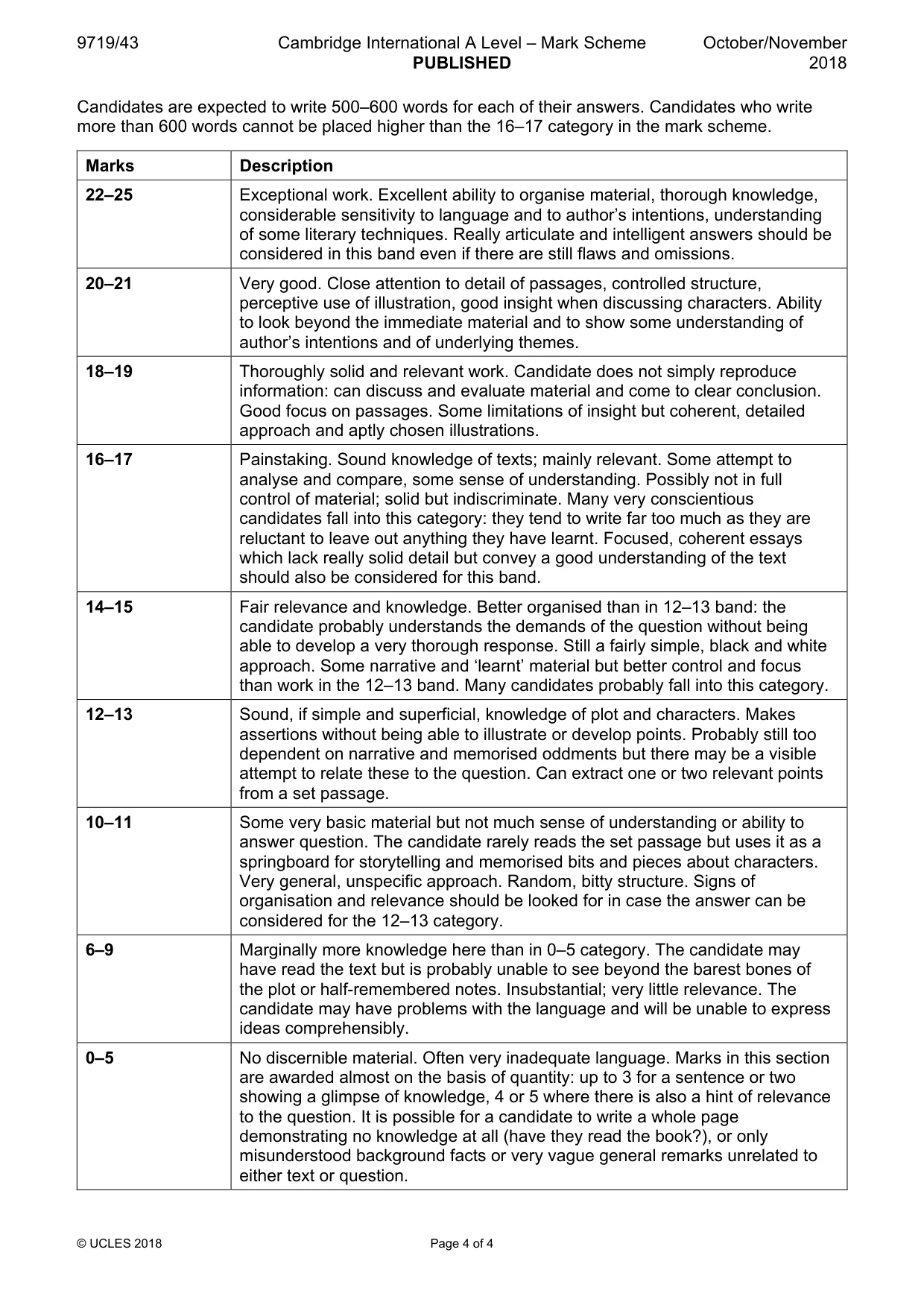
9719/43 Cambridge International A Level – Mark Scheme PUBLISHED October/November 2018 © UCLES 2018 Page 4 of 4 Candidates are expected to write 500–600 words for each of their answers. Candidates who write more than 600 words cannot be placed higher than the 16–17 category in the mark scheme. Marks Description 22–25 Exceptional work. Excellent ability to organise material, thorough knowledge, considerable sensitivity to language and to author’s intentions, understanding of some literary techniques. Really articulate and intelligent answers should be considered in this band even if there are still flaws and omissions. 20–21 Very good. Close attention to detail of passages, controlled structure, perceptive use of illustration, good insight when discussing characters. Ability to look beyond the immediate material and to show some understanding of author’s intentions and of underlying themes. 18–19 Thoroughly solid and relevant work. Candidate does not simply reproduce information: can discuss and evaluate material and come to clear conclusion. Good focus on passages. Some limitations of insight but coherent, detailed approach and aptly chosen illustrations. 16–17 Painstaking. Sound knowledge of texts; mainly relevant. Some attempt to analyse and compare, some sense of understanding. Possibly not in full control of material; solid but indiscriminate. Many very conscientious candidates fall into this category: they tend to write far too much as they are reluctant to leave out anything they have learnt. Focused, coherent essays which lack really solid detail but convey a good understanding of the text should also be considered for this band. 14–15 Fair relevance and knowledge. Better organised than in 12–13 band: the candidate probably understands the demands of the question without being able to develop a very thorough response. Still a fairly simple, black and white approach. Some narrative and ‘learnt’ material but better control and focus than work in the 12–13 band. Many candidates probably fall into this category. 12–13 Sound, if simple and superficial, knowledge of plot and characters. Makes assertions without being able to illustrate or develop points. Probably still too dependent on narrative and memorised oddments but there may be a visible attempt to relate these to the question. Can extract one or two relevant points from a set passage. 10–11 Some very basic material but not much sense of understanding or ability to answer question. The candidate rarely reads the set passage but uses it as a springboard for storytelling and memorised bits and pieces about characters. Very general, unspecific approach. Random, bitty structure. Signs of organisation and relevance should be looked for in case the answer can be considered for the 12–13 category. 6–9 Marginally more knowledge here than in 0–5 category. The candidate may have read the text but is probably unable to see beyond the barest bones of the plot or half-remembered notes. Insubstantial; very little relevance. The candidate may have problems with the language and will be unable to express ideas comprehensibly. 0–5 No discernible material. Often very inadequate language. Marks in this section are awarded almost on the basis of quantity: up to 3 for a sentence or two showing a glimpse of knowledge, 4 or 5 where there is also a hint of relevance to the question. It is possible for a candidate to write a whole page demonstrating no knowledge at all (have they read the book?), or only misunderstood background facts or very vague general remarks unrelated to either text or question.
What you needed in this session
Cambridge’s own grade thresholds for 2018 Oct/Nov, Paper 4 · Variant 3. A higher threshold means an easier paper — the bar moves with how the cohort did.