Cambridge A Level Spanish (A Level only) 9719 — 2016 Oct/Nov Paper 2 · Variant 2
9719/22/O/N/16 · 70 marks · ≈79 min
The question paper and its mark scheme, free to read here and free to download. This is Cambridge’s own paper, exactly as it was sat.
Question paper8 pages
Mark scheme10 pages
Answers below. Sit the paper first if you are practising.
Paper as text
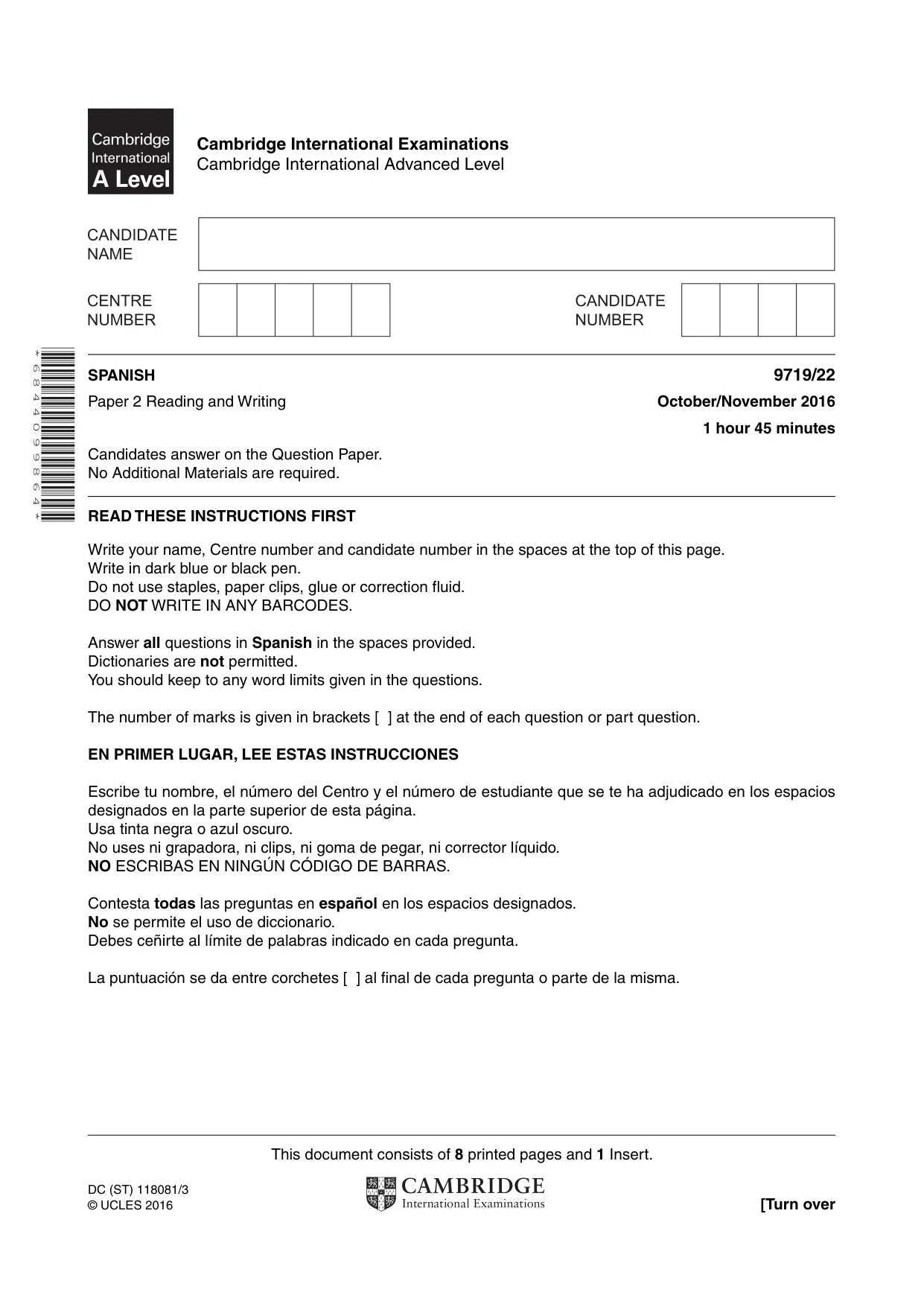
Question paper, page 1
This document consists of 8 printed pages and 1 Insert. DC (ST) 118081/3 © UCLES 2016 [Turn over Cambridge International Examinations Cambridge International Advanced Level * 6 8 4 4 0 9 9 8 6 4 * SPANISH 9719/22 Paper 2 Reading and Writing October/November 2016 1 hour 45 minutes Candidates answer on the Question Paper. No Additional Materials are required. READ THESE INSTRUCTIONS FIRST Write your name, Centre number and candidate number in the spaces at the top of this page. Write in dark blue or black pen. Do not use staples, paper clips, glue or correction fluid. DO NOT WRITE IN ANY BARCODES. Answer all questions in Spanish in the spaces provided. Dictionaries are not permitted. You should keep to any word limits given in the questions. The number of marks is given in brackets [ ] at the end of each question or part question. EN PRIMER LUGAR, LEE ESTAS INSTRUCCIONES Escribe tu nombre, el número del Centro y el número de estudiante que se te ha adjudicado en los espacios designados en la parte superior de esta página. Usa tinta negra o azul oscuro. No uses ni grapadora, ni clips, ni goma de pegar, ni corrector líquido. NO ESCRIBAS EN NINGÚN CÓDIGO DE BARRAS. Contesta todas las preguntas en español en los espacios designados. No se permite el uso de diccionario. Debes ceñirte al límite de palabras indicado en cada pregunta. La puntuación se da entre corchetes [ ] al final de cada pregunta o parte de la misma.
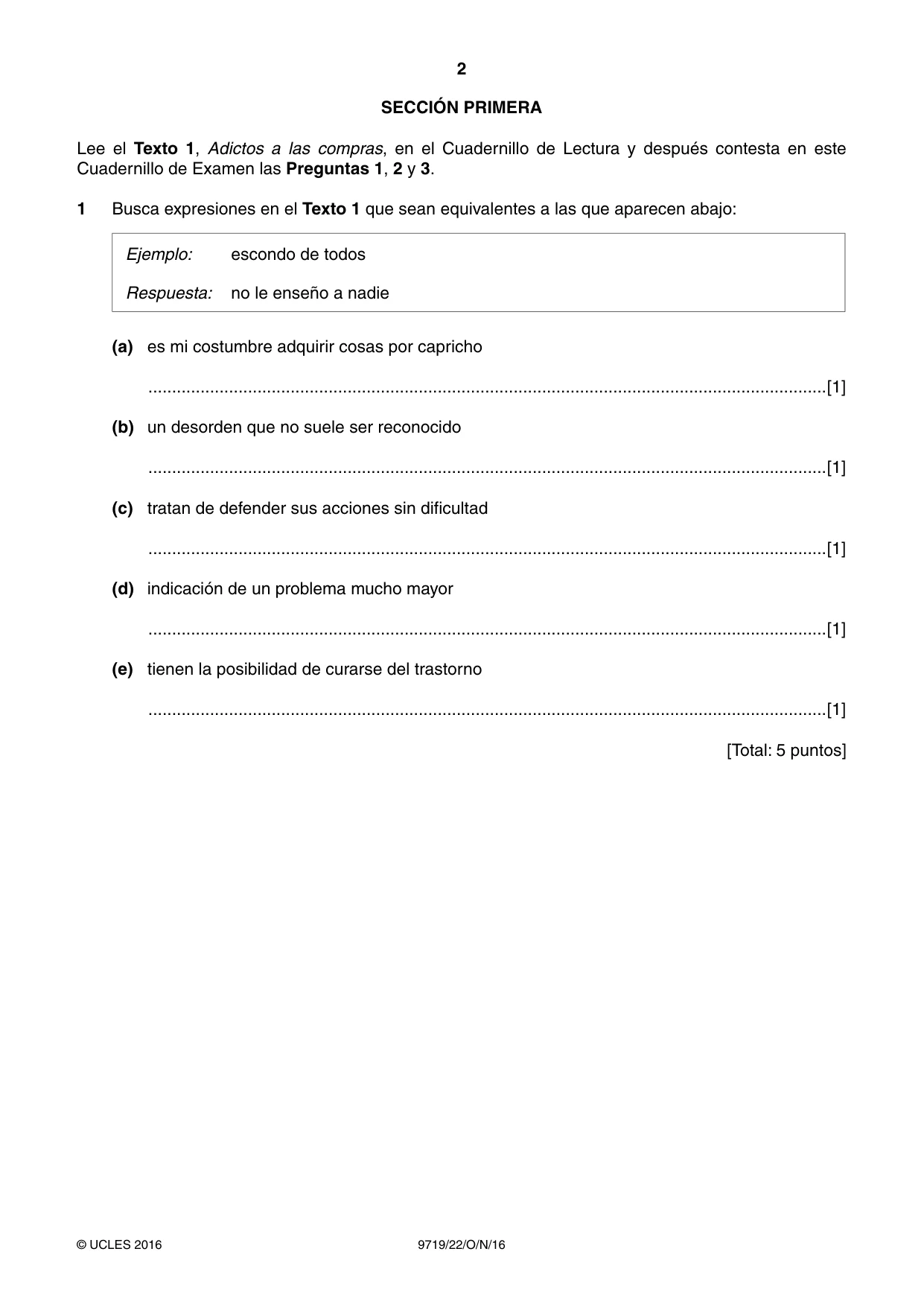
Question paper, page 2
2 9719/22/O/N/16 © UCLES 2016 SECCIÓN PRIMERA Lee el Texto 1, Adictos a las compras, en el Cuadernillo de Lectura y después contesta en este Cuadernillo de Examen las Preguntas 1, 2 y 3. 1 Busca expresiones en el Texto 1 que sean equivalentes a las que aparecen abajo: Ejemplo: escondo de todos Respuesta: no le enseño a nadie (a) es mi costumbre adquirir cosas por capricho …[1] (b) un desorden que no suele ser reconocido …[1] (c) tratan de defender sus acciones sin dificultad …[1] (d) indicación de un problema mucho mayor …[1] (e) tienen la posibilidad de curarse del trastorno …[1] [Total: 5 puntos]
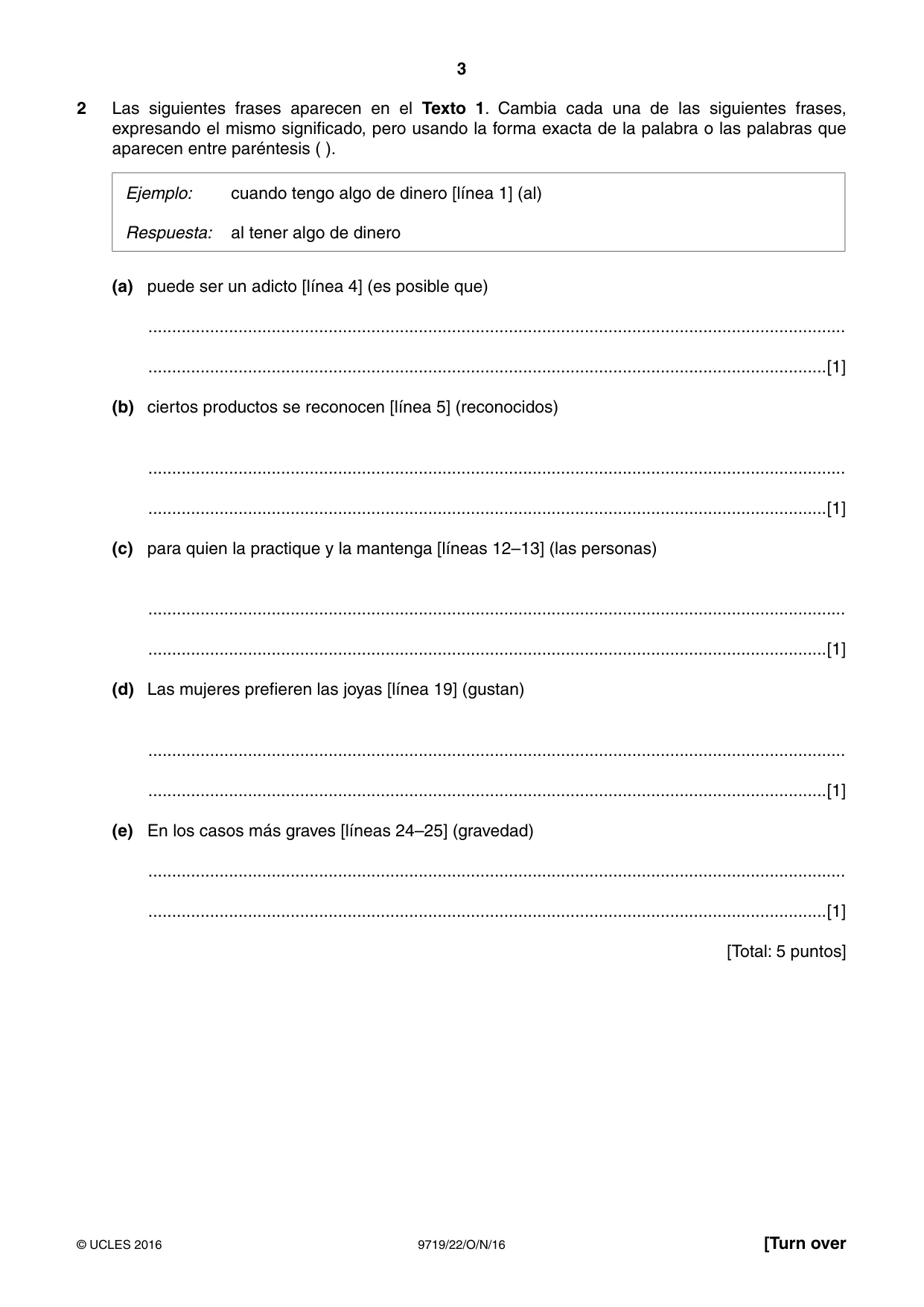
Question paper, page 3
3 9719/22/O/N/16 © UCLES 2016 [Turn over 2 Las siguientes frases aparecen en el Texto 1. Cambia cada una de las siguientes frases, expresando el mismo significado, pero usando la forma exacta de la palabra o las palabras que aparecen entre paréntesis ( ). Ejemplo: cuando tengo algo de dinero [línea 1] (al) Respuesta: al tener algo de dinero (a) puede ser un adicto [línea 4] (es posible que) … …[1] (b) ciertos productos se reconocen [línea 5] (reconocidos) … …[1] (c) para quien la practique y la mantenga [líneas 12–13] (las personas) … …[1] (d) Las mujeres prefieren las joyas [línea 19] (gustan) … …[1] (e) En los casos más graves [líneas 24–25] (gravedad) … …[1] [Total: 5 puntos]
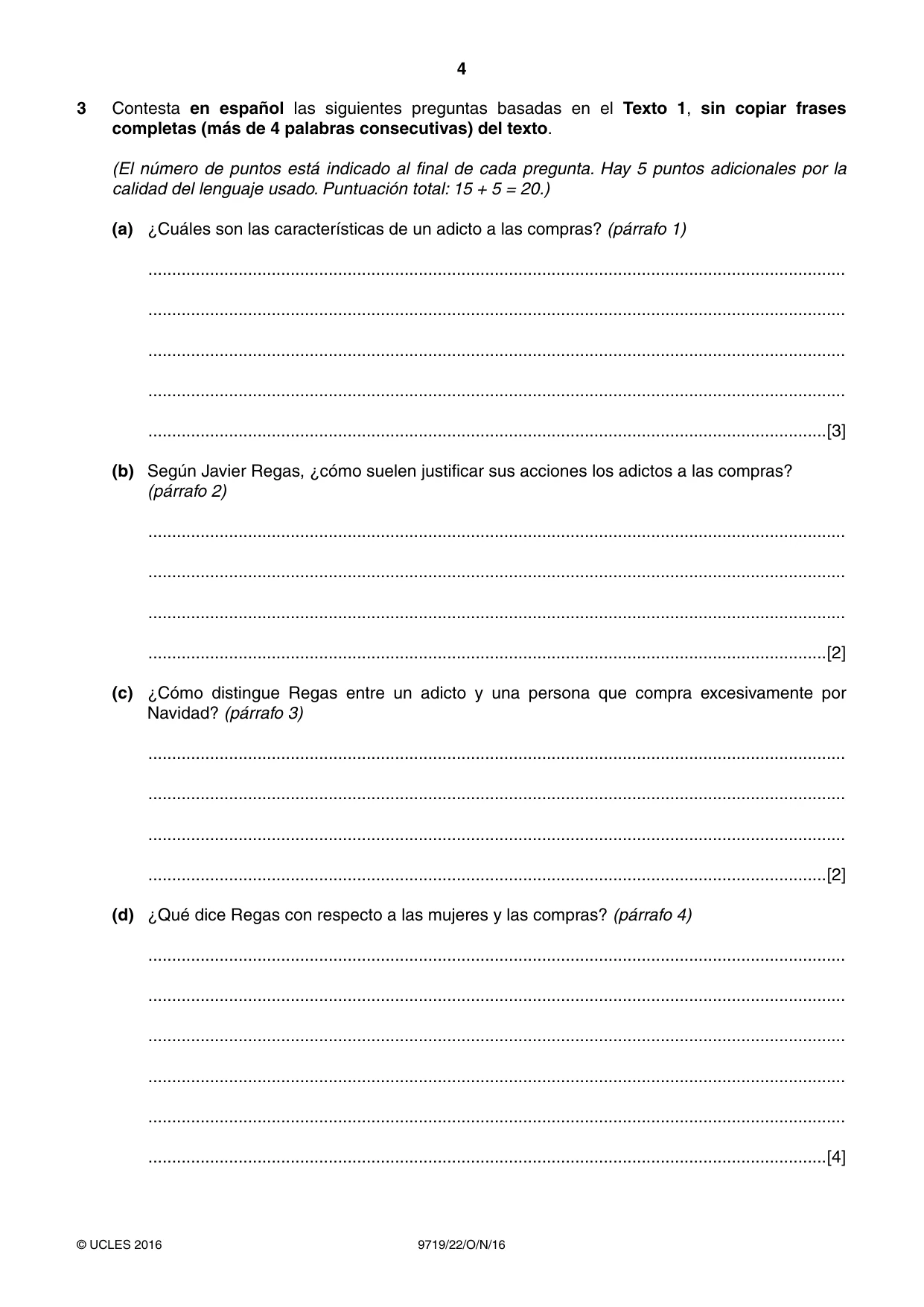
Question paper, page 4
4 9719/22/O/N/16 © UCLES 2016 3 Contesta en español las siguientes preguntas basadas en el Texto 1, sin copiar frases completas (más de 4 palabras consecutivas) del texto. (El número de puntos está indicado al final de cada pregunta. Hay 5 puntos adicionales por la calidad del lenguaje usado. Puntuación total: 15 + 5 = 20.) (a) ¿Cuáles son las características de un adicto a las compras? (párrafo 1) … … … … …[3] (b) Según Javier Regas, ¿cómo suelen justificar sus acciones los adictos a las compras? (párrafo 2) … … … …[2] (c) ¿Cómo distingue Regas entre un adicto y una persona que compra excesivamente por Navidad? (párrafo 3) … … … …[2] (d) ¿Qué dice Regas con respecto a las mujeres y las compras? (párrafo 4) … … … … … …[4]
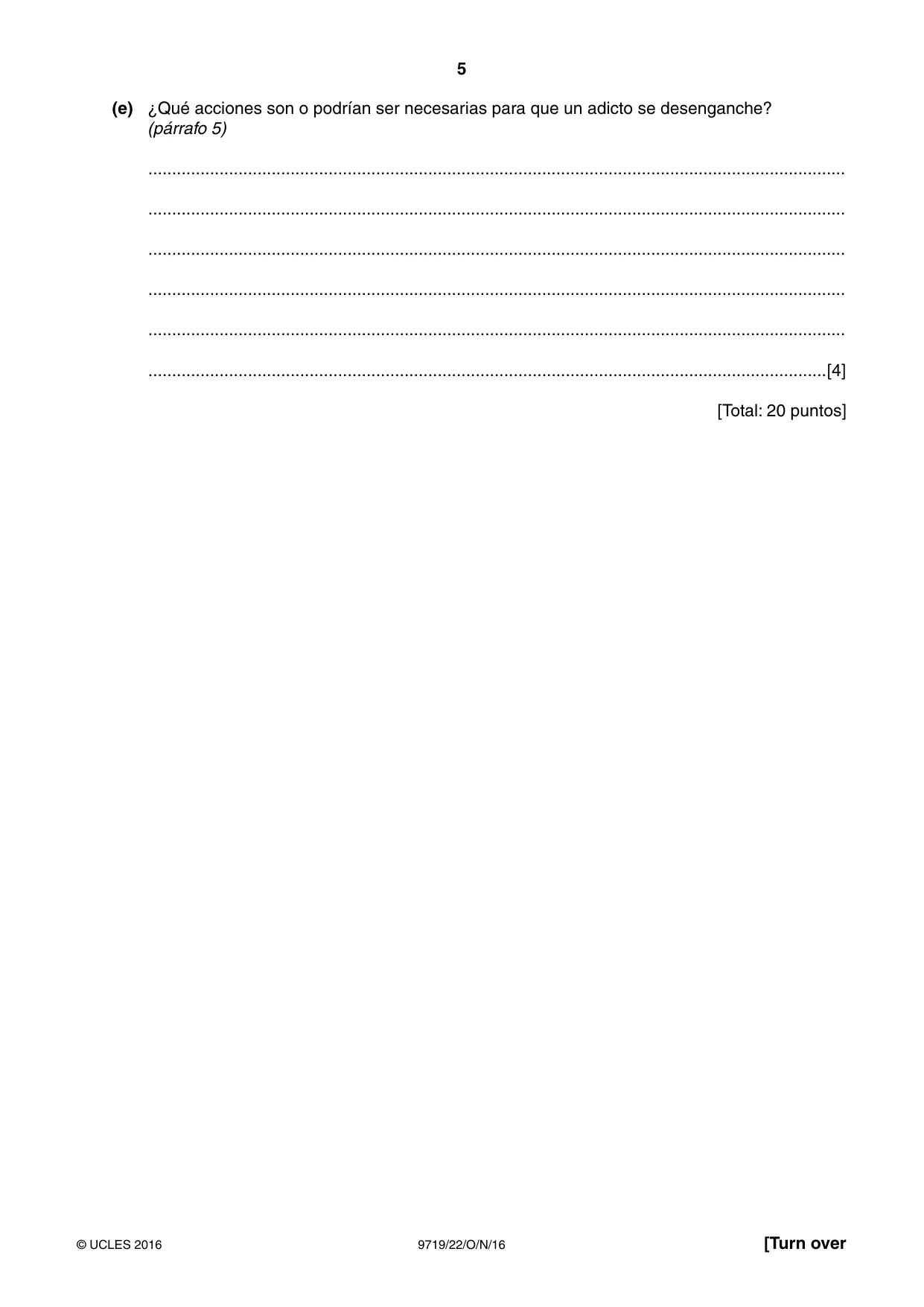
Question paper, page 5
5 9719/22/O/N/16 © UCLES 2016 [Turn over (e) ¿Qué acciones son o podrían ser necesarias para que un adicto se desenganche? (párrafo 5) … … … … … …[4] [Total: 20 puntos]
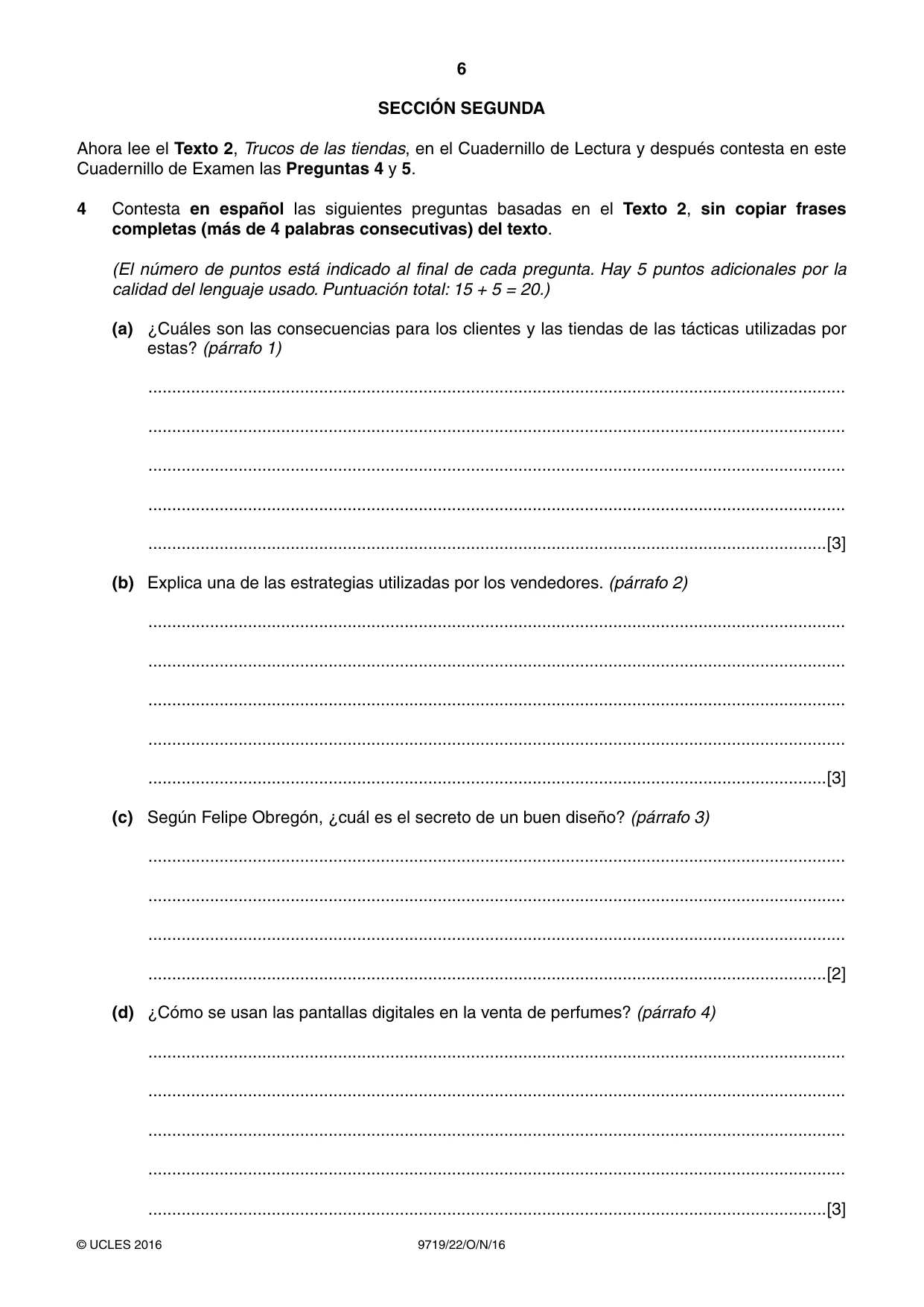
Question paper, page 6
6 9719/22/O/N/16 © UCLES 2016 SECCIÓN SEGUNDA Ahora lee el Texto 2, Trucos de las tiendas, en el Cuadernillo de Lectura y después contesta en este Cuadernillo de Examen las Preguntas 4 y 5. 4 Contesta en español las siguientes preguntas basadas en el Texto 2, sin copiar frases completas (más de 4 palabras consecutivas) del texto. (El número de puntos está indicado al final de cada pregunta. Hay 5 puntos adicionales por la calidad del lenguaje usado. Puntuación total: 15 + 5 = 20.) (a) ¿Cuáles son las consecuencias para los clientes y las tiendas de las tácticas utilizadas por estas? (párrafo 1) … … … … …[3] (b) Explica una de las estrategias utilizadas por los vendedores. (párrafo 2) … … … … …[3] (c) Según Felipe Obregón, ¿cuál es el secreto de un buen diseño? (párrafo 3) … … … …[2] (d) ¿Cómo se usan las pantallas digitales en la venta de perfumes? (párrafo 4) … … … … …[3]
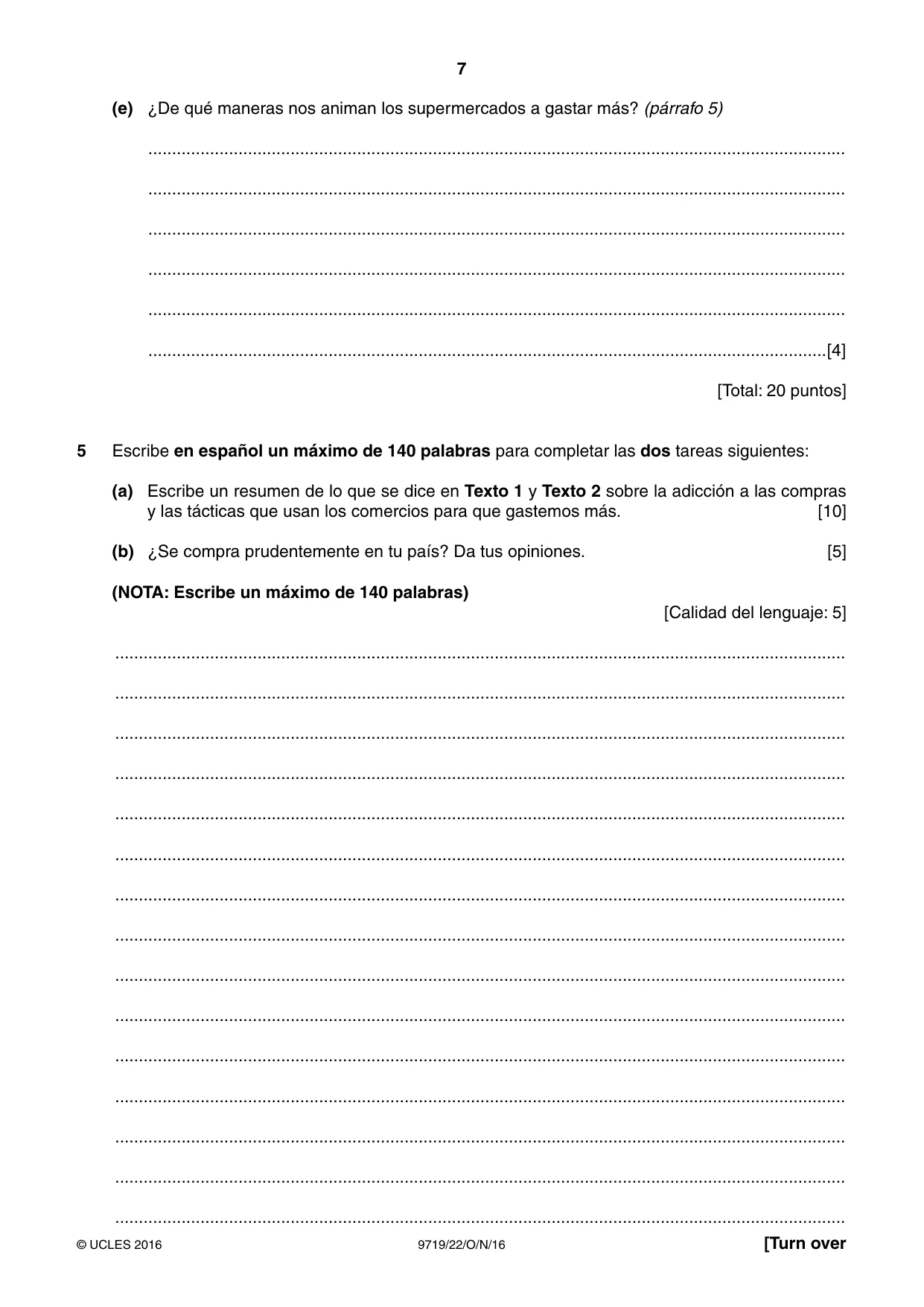
Question paper, page 7
7 9719/22/O/N/16 © UCLES 2016 [Turn over (e) ¿De qué maneras nos animan los supermercados a gastar más? (párrafo 5) … … … … … …[4] [Total: 20 puntos] 5 Escribe en español un máximo de 140 palabras para completar las dos tareas siguientes: (a) Escribe un resumen de lo que se dice en Texto 1 y Texto 2 sobre la adicción a las co mpras y las tácticas que usan los comercios para que gastemos más. [10] (b) ¿Se compra prudentemente en tu país? Da tus opiniones. [5] (NOTA: Escribe un máximo de 140 palabras) [Calidad del lenguaje: 5] … … … … … … … … … … … … … … …
Question paper, page 8
8 9719/22/O/N/16 © UCLES 2016 Permission to reproduce items where third-party owned material protected by copyright is included has been sought and cleared where possible. Every reasonable effort has been made by the publisher (UCLES) to trace copyright holders, but if any items requiring clearance have unwittingly been included, the publisher will be pleased to make amends at the earliest possible opportunity. To avoid the issue of disclosure of answer-related information to candidates, all copyright acknowledgements are reproduced online in the Cambridge International Examinations Copyright Acknowledgements Booklet. This is produced for each series of examinations and is freely available to download at www.cie.org.uk after the live examination series. Cambridge International Examinations is part of the Cambridge Assessment Group. Cambridge Assessment is the brand name of University of Cambridge Local Examinations Syndicate (UCLES), which is itself a department of the University of Cambridge. … … … … … … … … … … … … … … … … … … … … … … … [Total: 20 puntos]
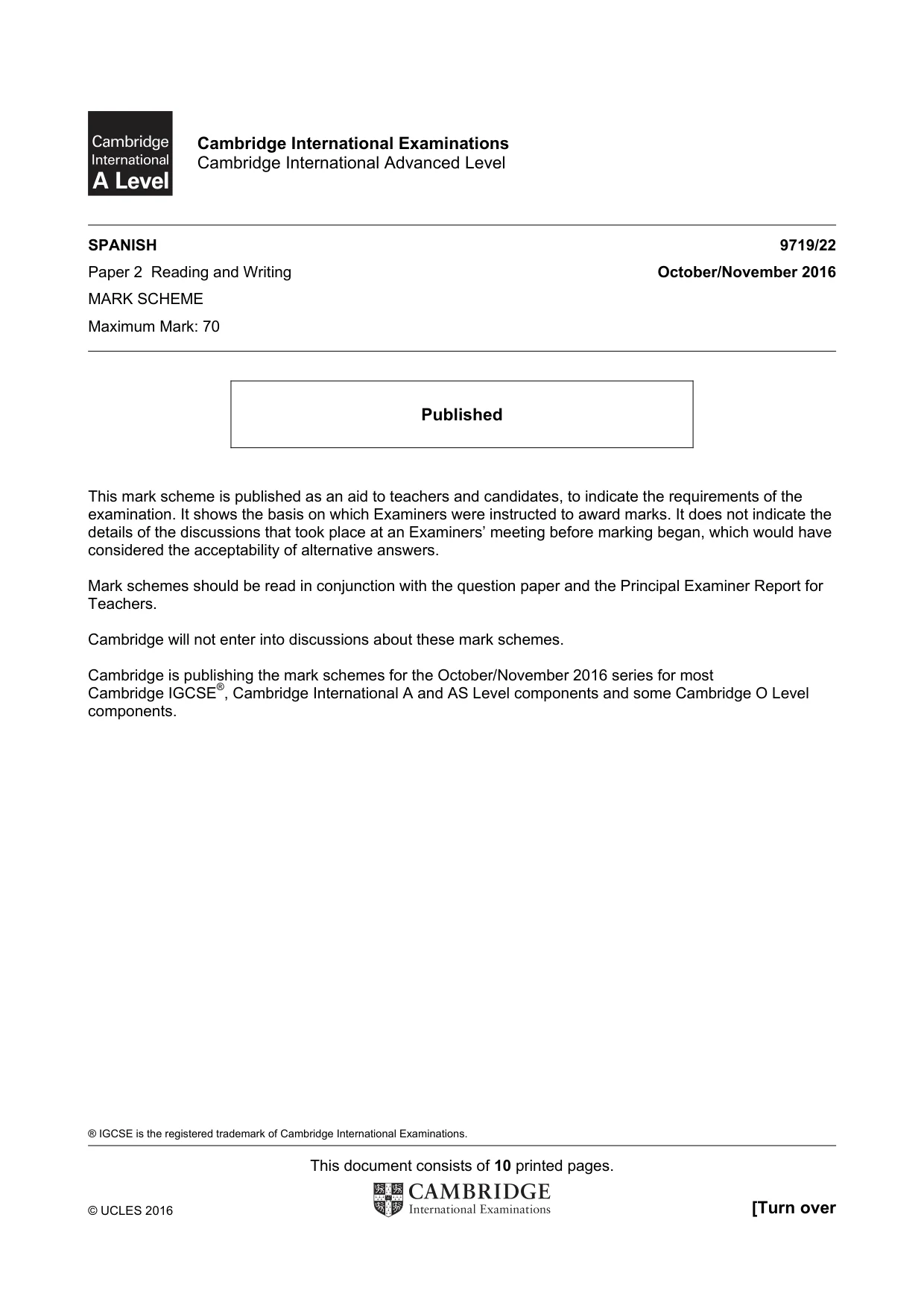
Mark scheme, page 1
® IGCSE is the registered trademark of Cambridge International Examinations. This document consists of 10 printed pages. © UCLES 2016 [Turn over Cambridge International Examinations Cambridge International Advanced Level SPANISH 9719/22 Paper 2 Reading and Writing October/November 2016 MARK SCHEME Maximum Mark: 70 Published This mark scheme is published as an aid to teachers and candidates, to indicate the requirements of the examination. It shows the basis on which Examiners were instructed to award marks. It does not indicate the details of the discussions that took place at an Examiners’ meeting before marking began, which would have considered the acceptability of alternative answers. Mark schemes should be read in conjunction with the question paper and the Principal Examiner Report for Teachers. Cambridge will not enter into discussions about these mark schemes. Cambridge is publishing the mark schemes for the October/November 2016 series for most Cambridge IGCSE®, Cambridge International A and AS Level components and some Cambridge O Level components.
Mark scheme, page 2
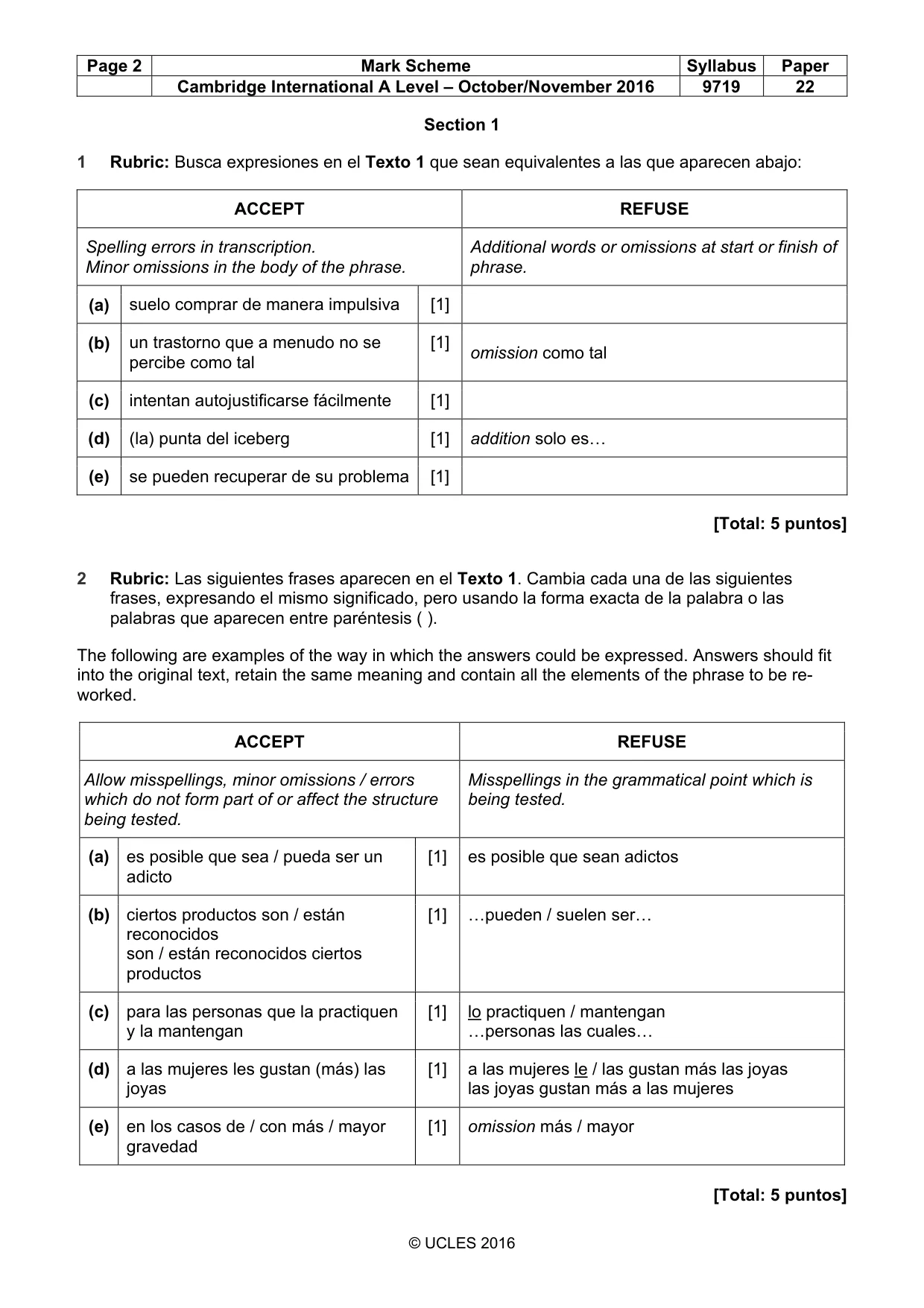
Page 2 Mark Scheme Syllabus Paper Cambridge International A Level – October/November 2016 9719 22 © UCLES 2016 Section 1 1 Rubric: Busca expresiones en el Texto 1 que sean equivalentes a las que aparecen abajo: ACCEPT REFUSE Spelling errors in transcription. Minor omissions in the body of the phrase. Additional words or omissions at start or finish of phrase. (a) suelo comprar de manera impulsiva [1] (b) un trastorno que a menudo no se percibe como tal [1] omission como tal (c) intentan autojustificarse fácilmente [1] (d) (la) punta del iceberg [1] addition solo es… (e) se pueden recuperar de su problema [1] [Total: 5 puntos] 2 Rubric: Las siguientes frases aparecen en el Texto 1. Cambia cada una de las siguientes frases, expresando el mismo significado, pero usando la forma exacta de la palabra o las palabras que aparecen entre paréntesis ( ). The following are examples of the way in which the answers could be expressed. Answers should fit into the original text, retain the same meaning and contain all the elements of the phrase to be re- worked. ACCEPT REFUSE Allow misspellings, minor omissions / errors which do not form part of or affect the structure being tested. Misspellings in the grammatical point which is being tested. (a) es posible que sea / pueda ser un adicto [1] es posible que sean adictos (b) ciertos productos son / están reconocidos son / están reconocidos ciertos productos [1] …pueden / suelen ser… (c) para las personas que la practiquen y la mantengan [1] lo practiquen / mantengan …personas las cuales… (d) a las mujeres les gustan (más) las joyas [1] a las mujeres le / las gustan más las joyas las joyas gustan más a las mujeres (e) en los casos de / con más / mayor gravedad [1] omission más / mayor [Total: 5 puntos]
Mark scheme, page 3
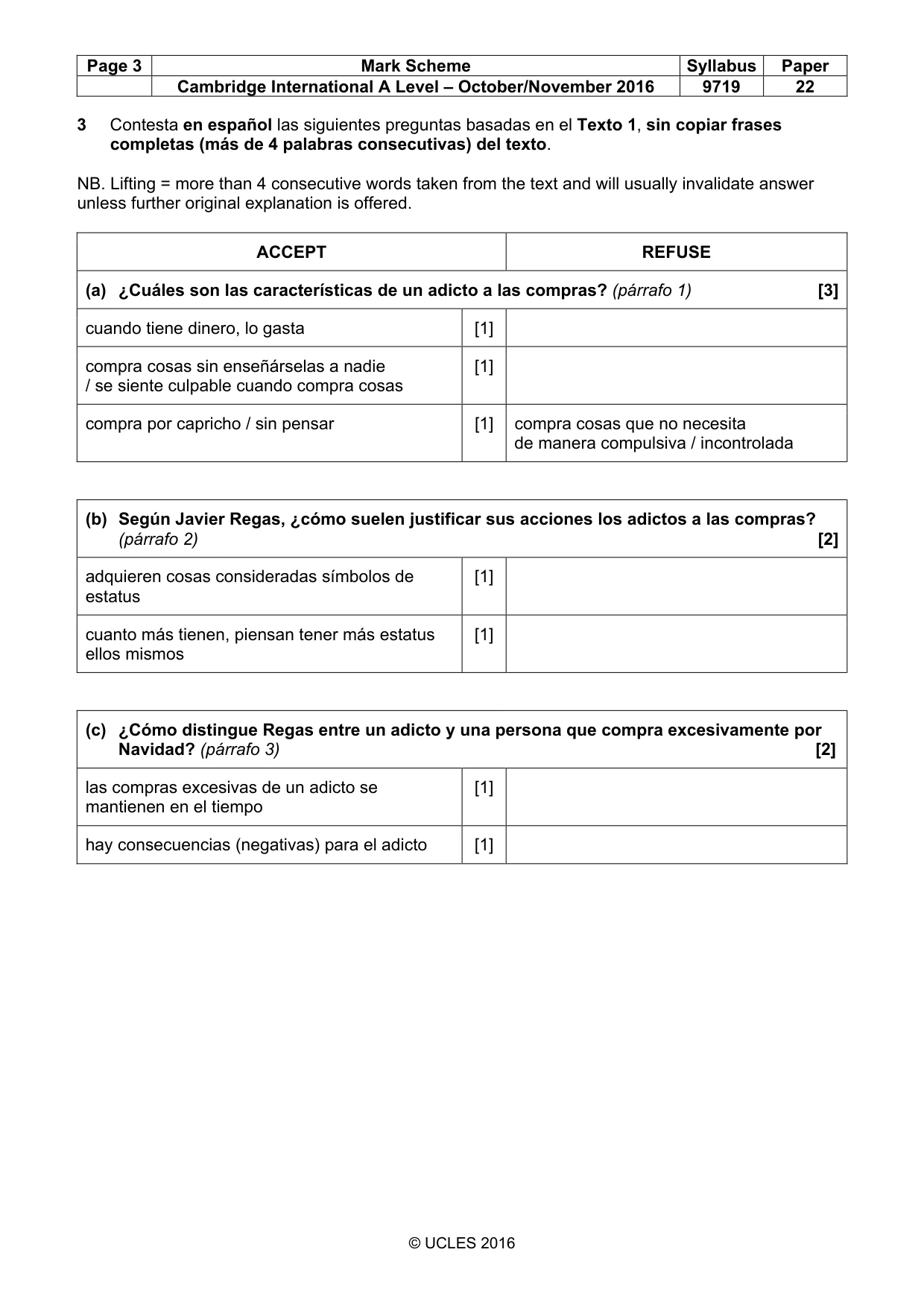
Page 3 Mark Scheme Syllabus Paper Cambridge International A Level – October/November 2016 9719 22 © UCLES 2016 3 Contesta en español las siguientes preguntas basadas en el Texto 1, sin copiar frases completas (más de 4 palabras consecutivas) del texto. NB. Lifting = more than 4 consecutive words taken from the text and will usually invalidate answer unless further original explanation is offered. ACCEPT REFUSE (a) ¿Cuáles son las características de un adicto a las compras? (párrafo 1) [3] cuando tiene dinero, lo gasta [1] compra cosas sin enseñárselas a nadie / se siente culpable cuando compra cosas [1] compra por capricho / sin pensar [1] compra cosas que no necesita de manera compulsiva / incontrolada (b) Según Javier Regas, ¿cómo suelen justificar sus acciones los adictos a las compras? (párrafo 2) [2] adquieren cosas consideradas símbolos de estatus [1] cuanto más tienen, piensan tener más estatus ellos mismos [1] (c) ¿Cómo distingue Regas entre un adicto y una persona que compra excesivamente por Navidad? (párrafo 3) [2] las compras excesivas de un adicto se mantienen en el tiempo [1] hay consecuencias (negativas) para el adicto [1]
Mark scheme, page 4
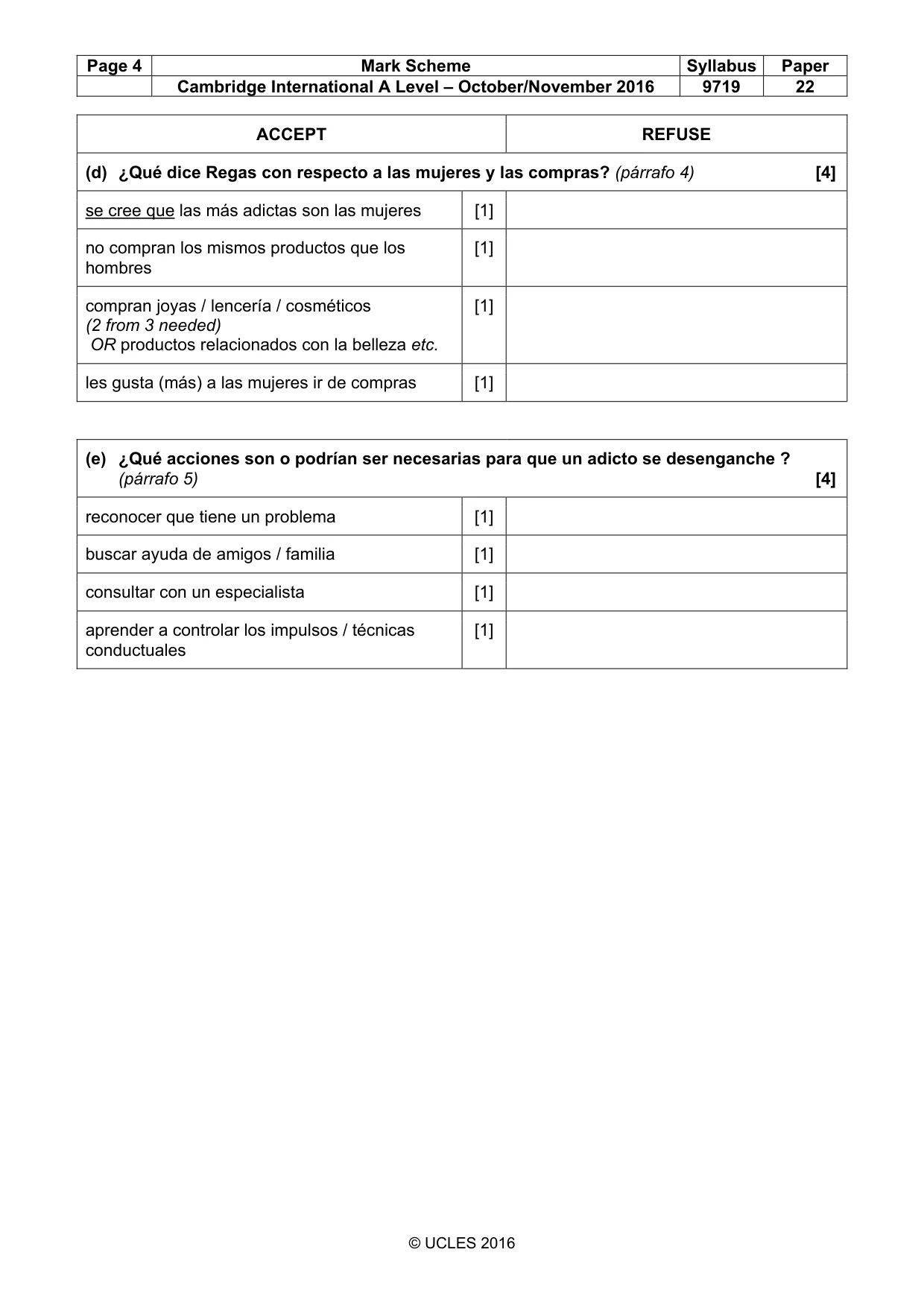
Page 4 Mark Scheme Syllabus Paper Cambridge International A Level – October/November 2016 9719 22 © UCLES 2016 ACCEPT REFUSE (d) ¿Qué dice Regas con respecto a las mujeres y las compras? (párrafo 4) [4] se cree que las más adictas son las mujeres [1] no compran los mismos productos que los hombres [1] compran joyas / lencería / cosméticos (2 from 3 needed) OR productos relacionados con la belleza etc. [1] les gusta (más) a las mujeres ir de compras [1] (e) ¿Qué acciones son o podrían ser necesarias para que un adicto se desenganche ? (párrafo 5) [4] reconocer que tiene un problema [1] buscar ayuda de amigos / familia [1] consultar con un especialista [1] aprender a controlar los impulsos / técnicas conductuales [1]
Mark scheme, page 5
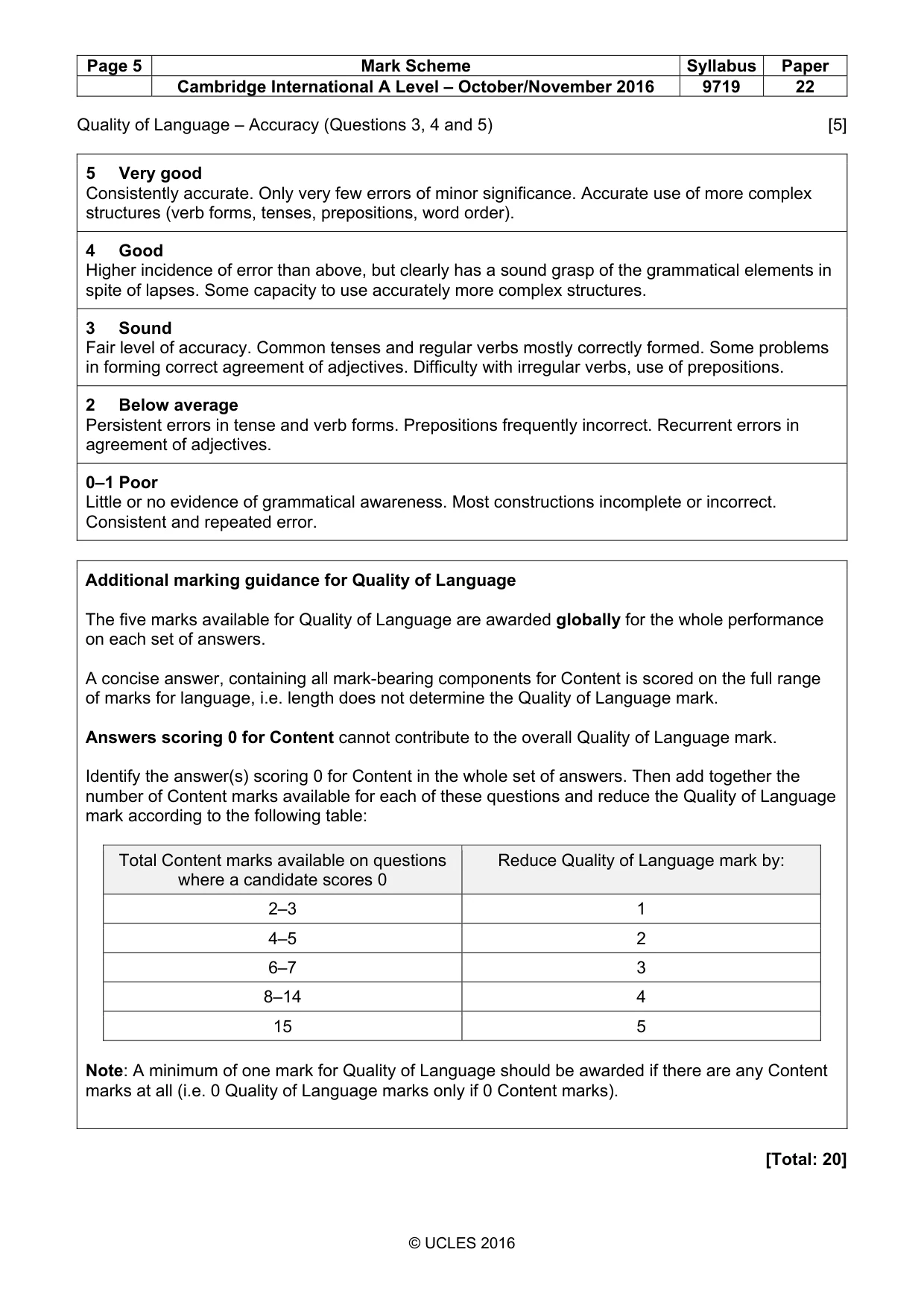
Page 5 Mark Scheme Syllabus Paper Cambridge International A Level – October/November 2016 9719 22 © UCLES 2016 Quality of Language – Accuracy (Questions 3, 4 and 5) [5] 5 Very good Consistently accurate. Only very few errors of minor significance. Accurate use of more complex structures (verb forms, tenses, prepositions, word order). 4 Good Higher incidence of error than above, but clearly has a sound grasp of the grammatical elements in spite of lapses. Some capacity to use accurately more complex structures. 3 Sound Fair level of accuracy. Common tenses and regular verbs mostly correctly formed. Some problems in forming correct agreement of adjectives. Difficulty with irregular verbs, use of prepositions. 2 Below average Persistent errors in tense and verb forms. Prepositions frequently incorrect. Recurrent errors in agreement of adjectives. 0–1 Poor Little or no evidence of grammatical awareness. Most constructions incomplete or incorrect. Consistent and repeated error. Additional marking guidance for Quality of Language The five marks available for Quality of Language are awarded globally for the whole performance on each set of answers. A concise answer, containing all mark-bearing components for Content is scored on the full range of marks for language, i.e. length does not determine the Quality of Language mark. Answers scoring 0 for Content cannot contribute to the overall Quality of Language mark. Identify the answer(s) scoring 0 for Content in the whole set of answers. Then add together the number of Content marks available for each of these questions and reduce the Quality of Language mark according to the following table: Total Content marks available on questions where a candidate scores 0 Reduce Quality of Language mark by: 2–3 1 4–5 2 6–7 3 8–14 4 15 5 Note: A minimum of one mark for Quality of Language should be awarded if there are any Content marks at all (i.e. 0 Quality of Language marks only if 0 Content marks). [Total: 20]
Mark scheme, page 6
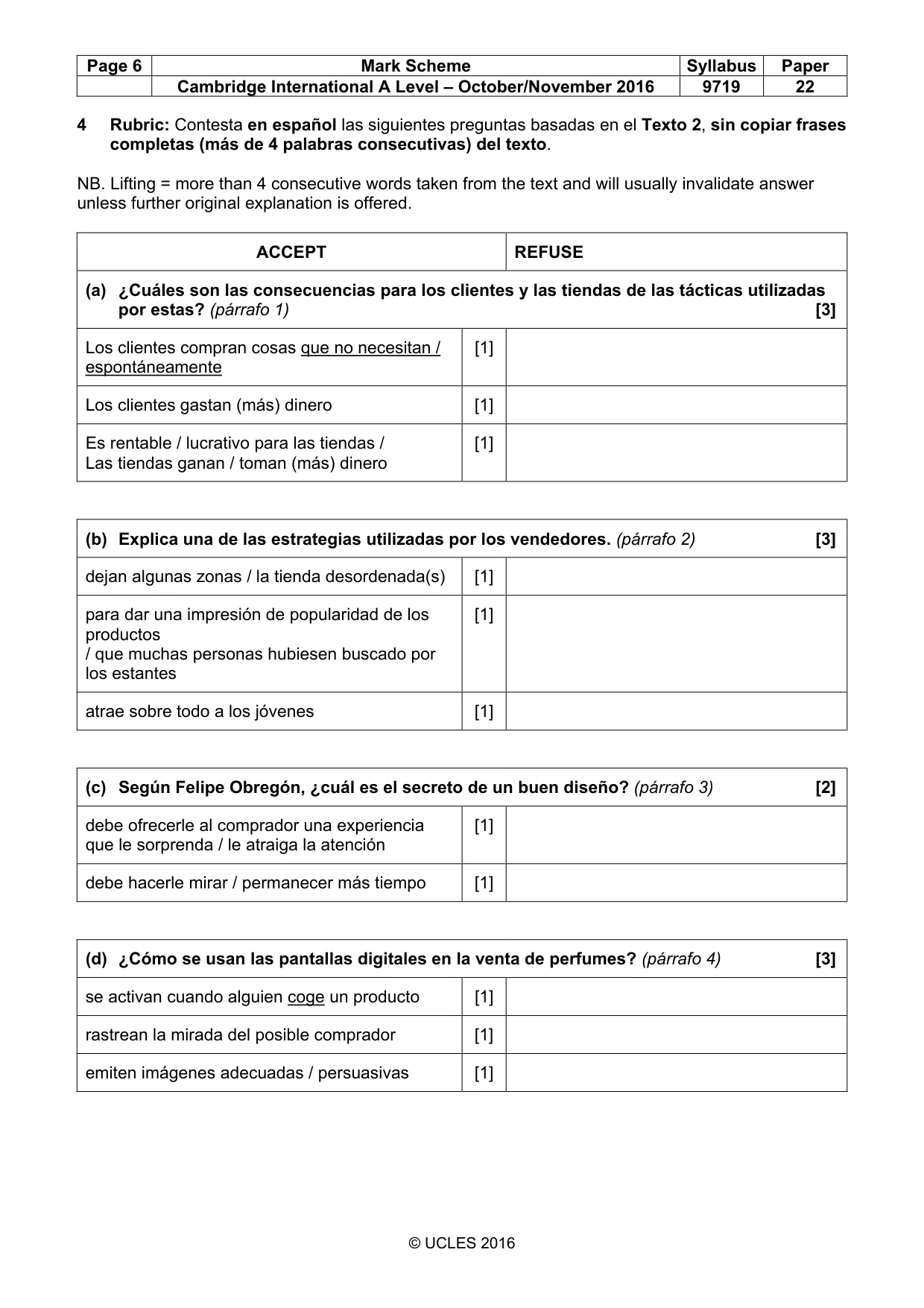
Page 6 Mark Scheme Syllabus Paper Cambridge International A Level – October/November 2016 9719 22 © UCLES 2016 4 Rubric: Contesta en español las siguientes preguntas basadas en el Texto 2, sin copiar frases completas (más de 4 palabras consecutivas) del texto. NB. Lifting = more than 4 consecutive words taken from the text and will usually invalidate answer unless further original explanation is offered. ACCEPT REFUSE (a) ¿Cuáles son las consecuencias para los clientes y las tiendas de las tácticas utilizadas por estas? (párrafo 1) [3] Los clientes compran cosas que no necesitan / espontáneamente [1] Los clientes gastan (más) dinero [1] Es rentable / lucrativo para las tiendas / Las tiendas ganan / toman (más) dinero [1] (b) Explica una de las estrategias utilizadas por los vendedores. (párrafo 2) [3] dejan algunas zonas / la tienda desordenada(s) [1] para dar una impresión de popularidad de los productos / que muchas personas hubiesen buscado por los estantes [1] atrae sobre todo a los jóvenes [1] (c) Según Felipe Obregón, ¿cuál es el secreto de un buen diseño? (párrafo 3) [2] debe ofrecerle al comprador una experiencia que le sorprenda / le atraiga la atención [1] debe hacerle mirar / permanecer más tiempo [1] (d) ¿Cómo se usan las pantallas digitales en la venta de perfumes? (párrafo 4) [3] se activan cuando alguien coge un producto [1] rastrean la mirada del posible comprador [1] emiten imágenes adecuadas / persuasivas [1]
Mark scheme, page 7
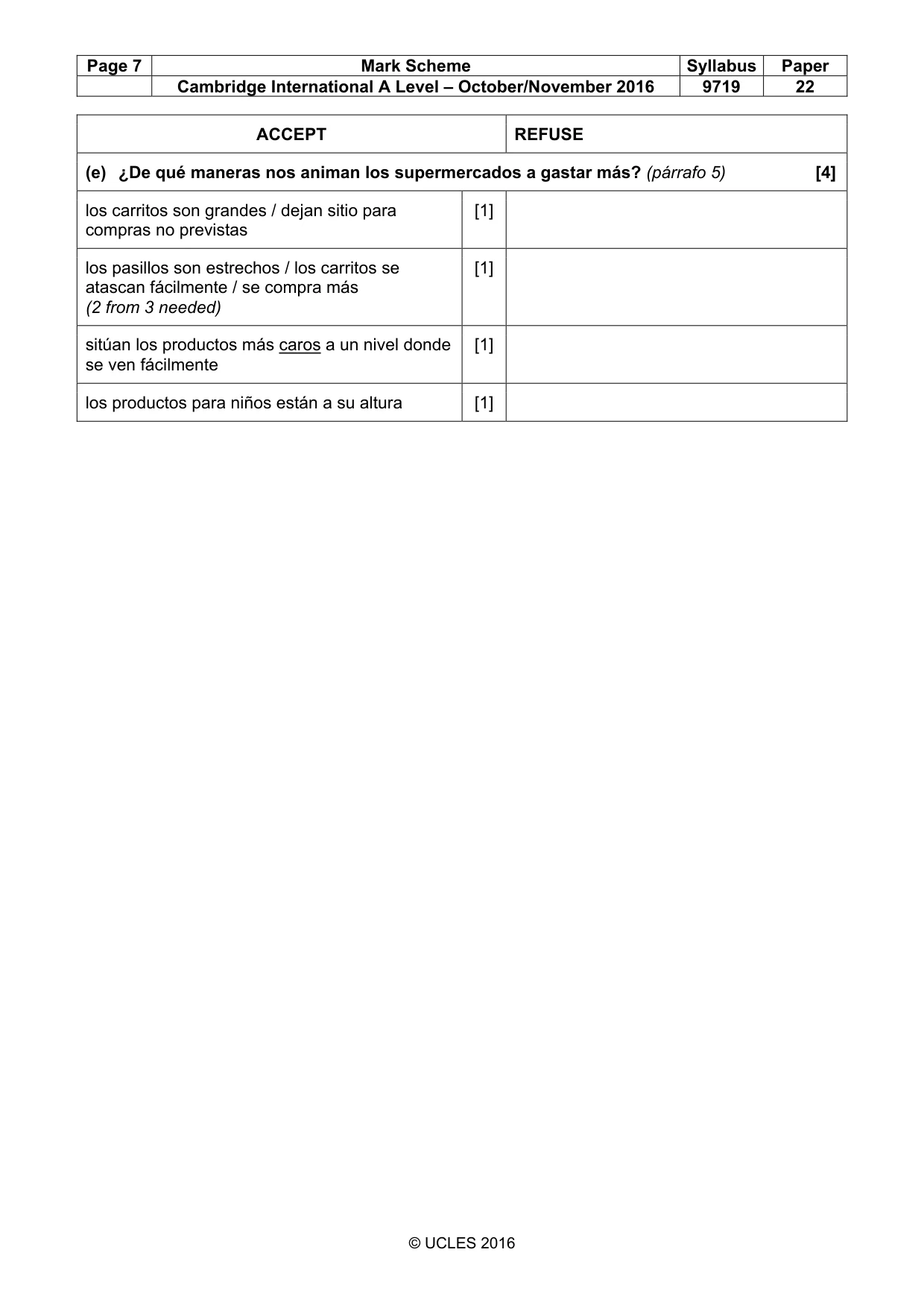
Page 7 Mark Scheme Syllabus Paper Cambridge International A Level – October/November 2016 9719 22 © UCLES 2016 ACCEPT REFUSE (e) ¿De qué maneras nos animan los supermercados a gastar más? (párrafo 5) [4] los carritos son grandes / dejan sitio para compras no previstas [1] los pasillos son estrechos / los carritos se atascan fácilmente / se compra más (2 from 3 needed) [1] sitúan los productos más caros a un nivel donde se ven fácilmente [1] los productos para niños están a su altura [1]
Mark scheme, page 8
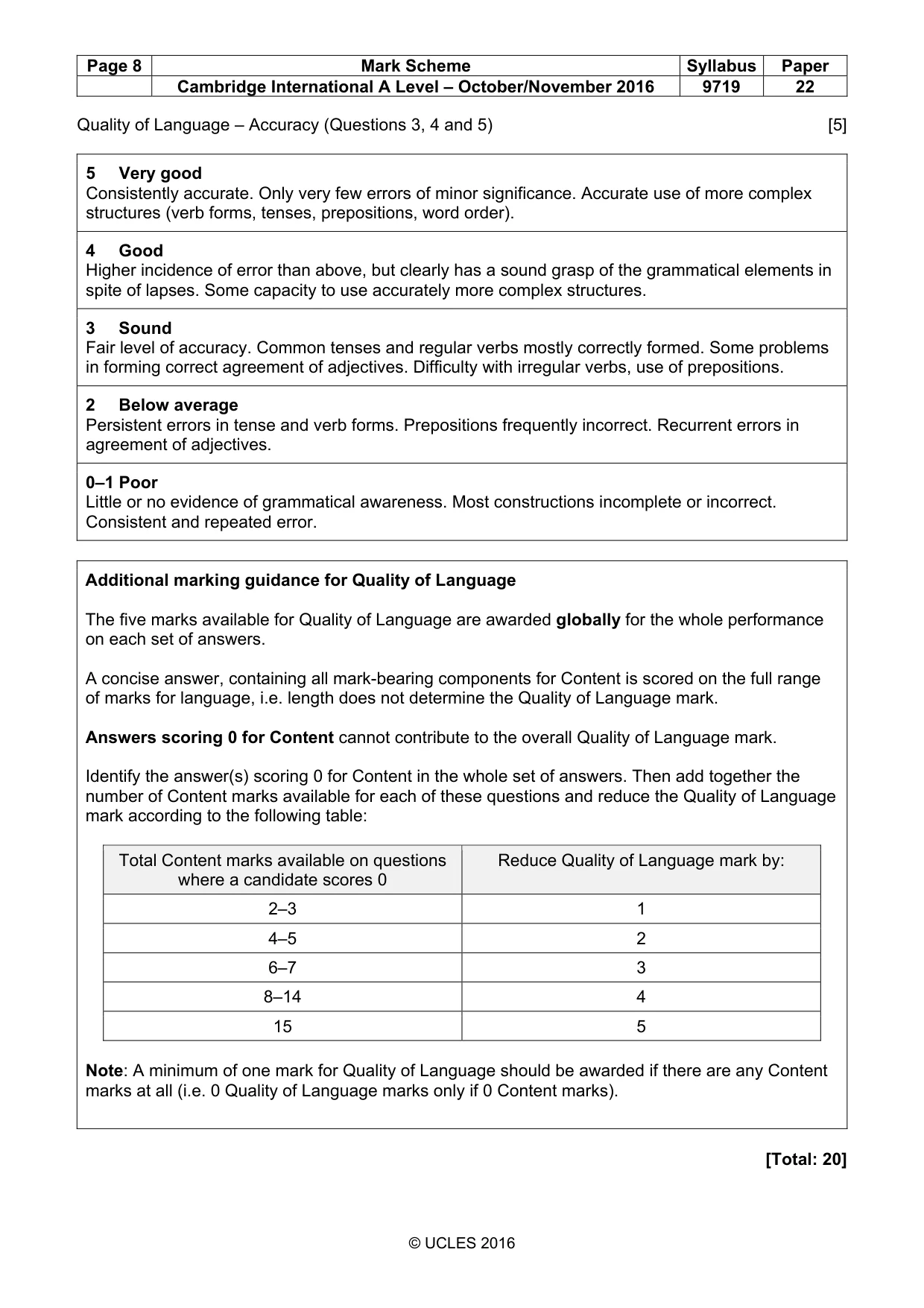
Page 8 Mark Scheme Syllabus Paper Cambridge International A Level – October/November 2016 9719 22 © UCLES 2016 Quality of Language – Accuracy (Questions 3, 4 and 5) [5] 5 Very good Consistently accurate. Only very few errors of minor significance. Accurate use of more complex structures (verb forms, tenses, prepositions, word order). 4 Good Higher incidence of error than above, but clearly has a sound grasp of the grammatical elements in spite of lapses. Some capacity to use accurately more complex structures. 3 Sound Fair level of accuracy. Common tenses and regular verbs mostly correctly formed. Some problems in forming correct agreement of adjectives. Difficulty with irregular verbs, use of prepositions. 2 Below average Persistent errors in tense and verb forms. Prepositions frequently incorrect. Recurrent errors in agreement of adjectives. 0–1 Poor Little or no evidence of grammatical awareness. Most constructions incomplete or incorrect. Consistent and repeated error. Additional marking guidance for Quality of Language The five marks available for Quality of Language are awarded globally for the whole performance on each set of answers. A concise answer, containing all mark-bearing components for Content is scored on the full range of marks for language, i.e. length does not determine the Quality of Language mark. Answers scoring 0 for Content cannot contribute to the overall Quality of Language mark. Identify the answer(s) scoring 0 for Content in the whole set of answers. Then add together the number of Content marks available for each of these questions and reduce the Quality of Language mark according to the following table: Total Content marks available on questions where a candidate scores 0 Reduce Quality of Language mark by: 2–3 1 4–5 2 6–7 3 8–14 4 15 5 Note: A minimum of one mark for Quality of Language should be awarded if there are any Content marks at all (i.e. 0 Quality of Language marks only if 0 Content marks). [Total: 20]
Mark scheme, page 9
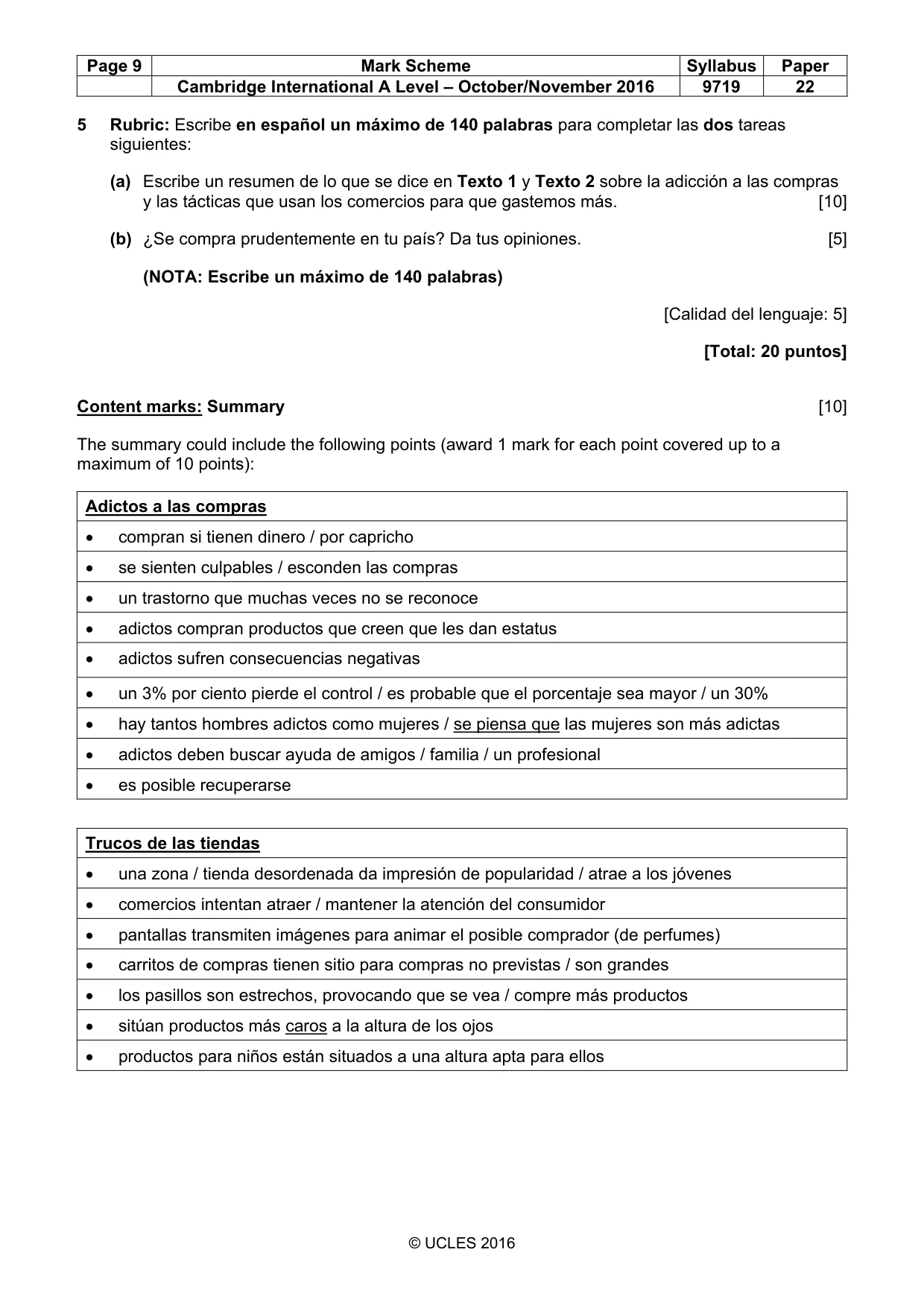
Page 9 Mark Scheme Syllabus Paper Cambridge International A Level – October/November 2016 9719 22 © UCLES 2016 5 Rubric: Escribe en español un máximo de 140 palabras para completar las dos tareas siguientes: (a) Escribe un resumen de lo que se dice en Texto 1 y Texto 2 sobre la adicción a las compras y las tácticas que usan los comercios para que gastemos más. [10] (b) ¿Se compra prudentemente en tu país? Da tus opiniones. [5] (NOTA: Escribe un máximo de 140 palabras) [Calidad del lenguaje: 5] [Total: 20 puntos] Content marks: Summary [10] The summary could include the following points (award 1 mark for each point covered up to a maximum of 10 points): Adictos a las compras • compran si tienen dinero / por capricho • se sienten culpables / esconden las compras • un trastorno que muchas veces no se reconoce • adictos compran productos que creen que les dan estatus • adictos sufren consecuencias negativas • un 3% por ciento pierde el control / es probable que el porcentaje sea mayor / un 30% • hay tantos hombres adictos como mujeres / se piensa que las mujeres son más adictas • adictos deben buscar ayuda de amigos / familia / un profesional • es posible recuperarse Trucos de las tiendas • una zona / tienda desordenada da impresión de popularidad / atrae a los jóvenes • comercios intentan atraer / mantener la atención del consumidor • pantallas transmiten imágenes para animar el posible comprador (de perfumes) • carritos de compras tienen sitio para compras no previstas / son grandes • los pasillos son estrechos, provocando que se vea / compre más productos • sitúan productos más caros a la altura de los ojos • productos para niños están situados a una altura apta para ellos
Mark scheme, page 10
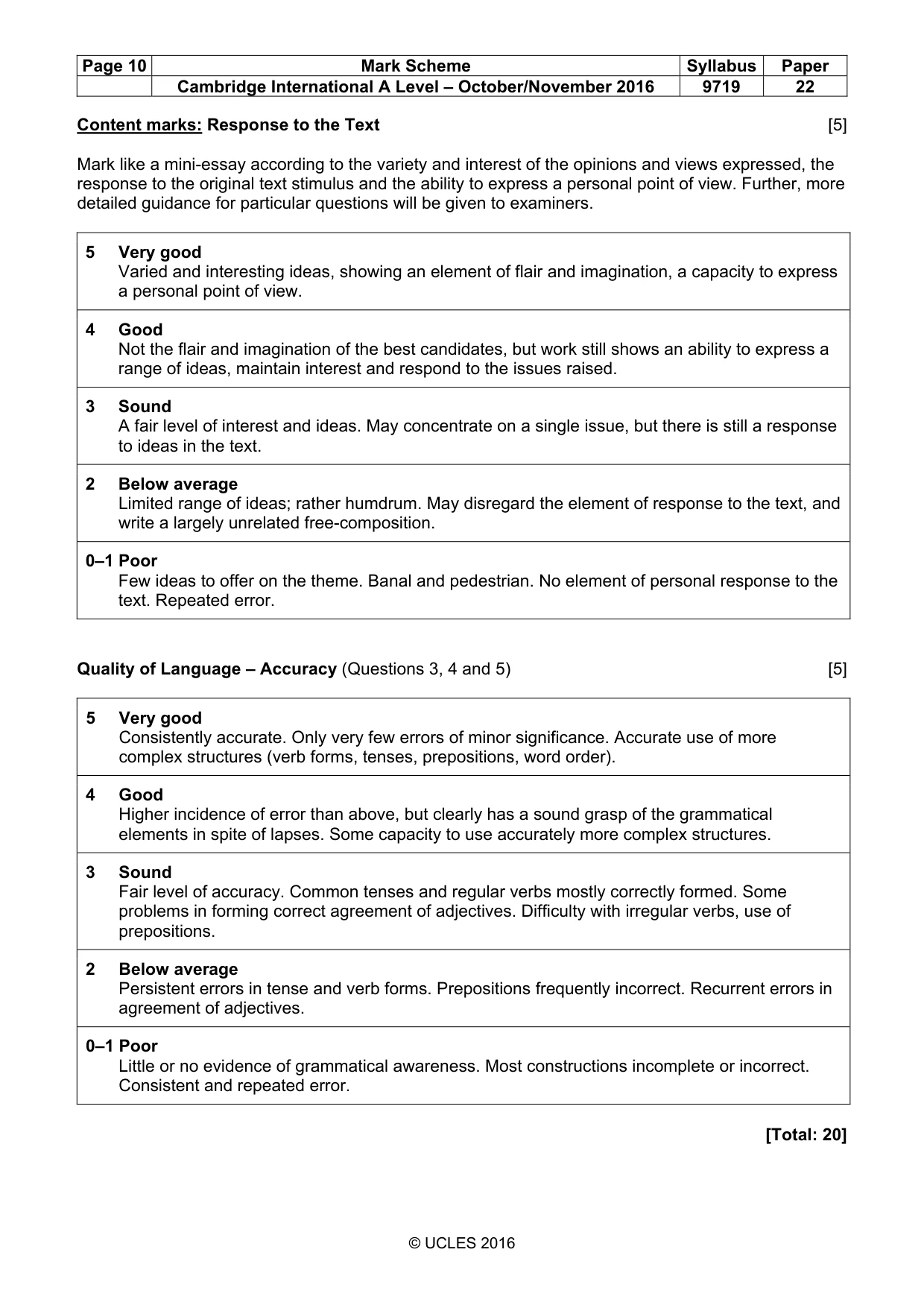
Page 10 Mark Scheme Syllabus Paper Cambridge International A Level – October/November 2016 9719 22 © UCLES 2016 Content marks: Response to the Text [5] Mark like a mini-essay according to the variety and interest of the opinions and views expressed, the response to the original text stimulus and the ability to express a personal point of view. Further, more detailed guidance for particular questions will be given to examiners. 5 Very good Varied and interesting ideas, showing an element of flair and imagination, a capacity to express a personal point of view. 4 Good Not the flair and imagination of the best candidates, but work still shows an ability to express a range of ideas, maintain interest and respond to the issues raised. 3 Sound A fair level of interest and ideas. May concentrate on a single issue, but there is still a response to ideas in the text. 2 Below average Limited range of ideas; rather humdrum. May disregard the element of response to the text, and write a largely unrelated free-composition. 0–1 Poor Few ideas to offer on the theme. Banal and pedestrian. No element of personal response to the text. Repeated error. Quality of Language – Accuracy (Questions 3, 4 and 5) [5] 5 Very good Consistently accurate. Only very few errors of minor significance. Accurate use of more complex structures (verb forms, tenses, prepositions, word order). 4 Good Higher incidence of error than above, but clearly has a sound grasp of the grammatical elements in spite of lapses. Some capacity to use accurately more complex structures. 3 Sound Fair level of accuracy. Common tenses and regular verbs mostly correctly formed. Some problems in forming correct agreement of adjectives. Difficulty with irregular verbs, use of prepositions. 2 Below average Persistent errors in tense and verb forms. Prepositions frequently incorrect. Recurrent errors in agreement of adjectives. 0–1 Poor Little or no evidence of grammatical awareness. Most constructions incomplete or incorrect. Consistent and repeated error. [Total: 20]
What you needed in this session
Cambridge’s own grade thresholds for 2016 Oct/Nov, Paper 2 · Variant 2. A higher threshold means an easier paper — the bar moves with how the cohort did.