Cambridge A Level Spanish (A Level only) 9719 — 2016 Oct/Nov Paper 2 · Variant 1
9719/21/O/N/16 · 70 marks · ≈79 min
The question paper and its mark scheme, free to read here and free to download. This is Cambridge’s own paper, exactly as it was sat.
Question paper4 pages
Mark scheme11 pages
Answers below. Sit the paper first if you are practising.
Paper as text
Question paper, page 1
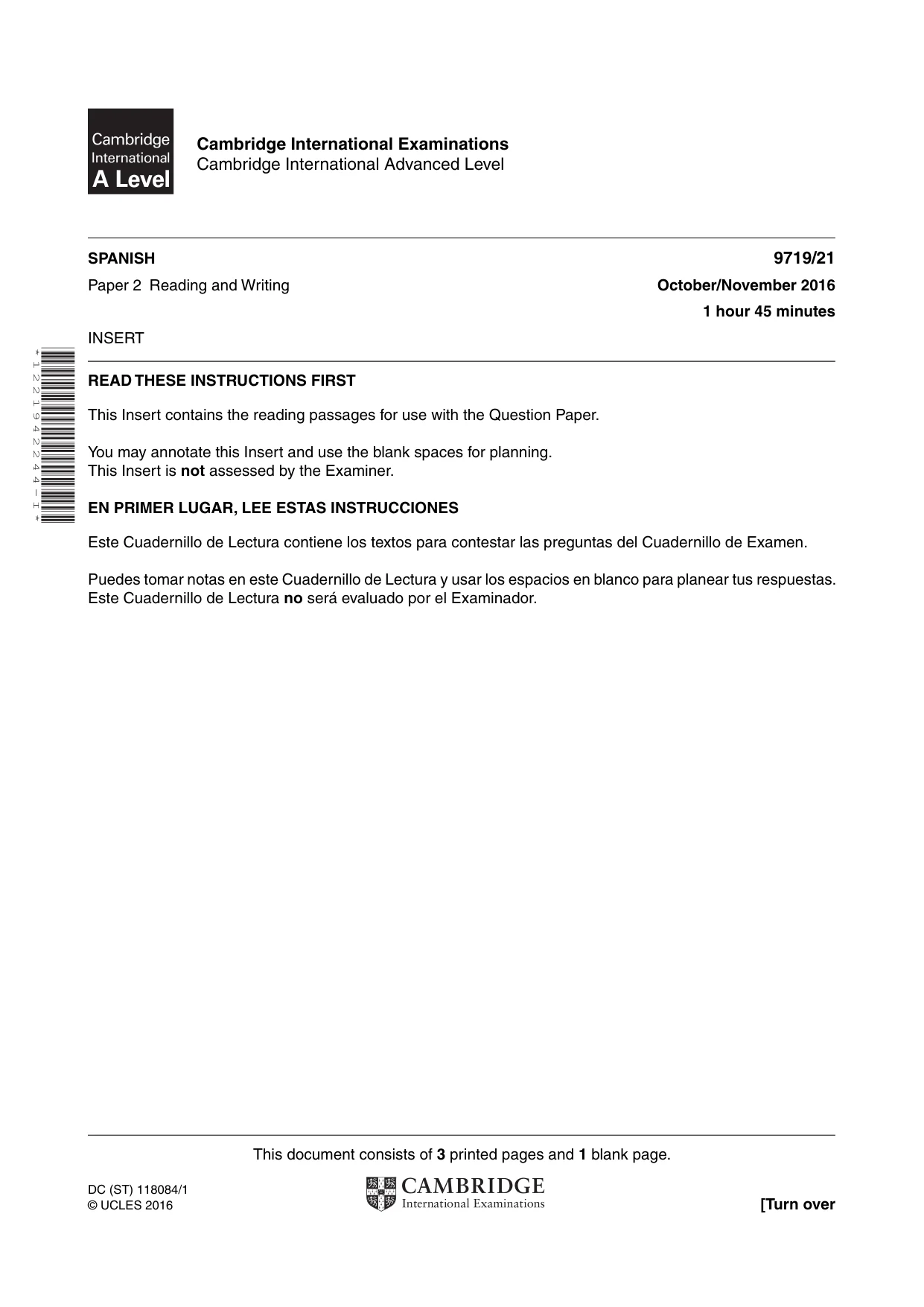
This document consists of 3 printed pages and 1 blank page. DC (ST) 118084/1 © UCLES 2016 [Turn over Cambridge International Examinations Cambridge International Advanced Level * 1 2 2 1 9 4 2 2 4 4 - I * SPANISH 9719/21 Paper 2 Reading and Writing October/November 2016 1 hour 45 minutes INSERT READ THESE INSTRUCTIONS FIRST This Insert contains the reading passages for use with the Question Paper. You may annotate this Insert and use the blank spaces for planning. This Insert is not assessed by the Examiner. EN PRIMER LUGAR, LEE ESTAS INSTRUCCIONES Este Cuadernillo de Lectura contiene los textos para contestar las preguntas del Cuadernillo de Examen. Puedes tomar notas en este Cuadernillo de Lectura y usar los espacios en blanco para planear tus respuestas. Este Cuadernillo de Lectura no será evaluado por el Examinador.
Question paper, page 2
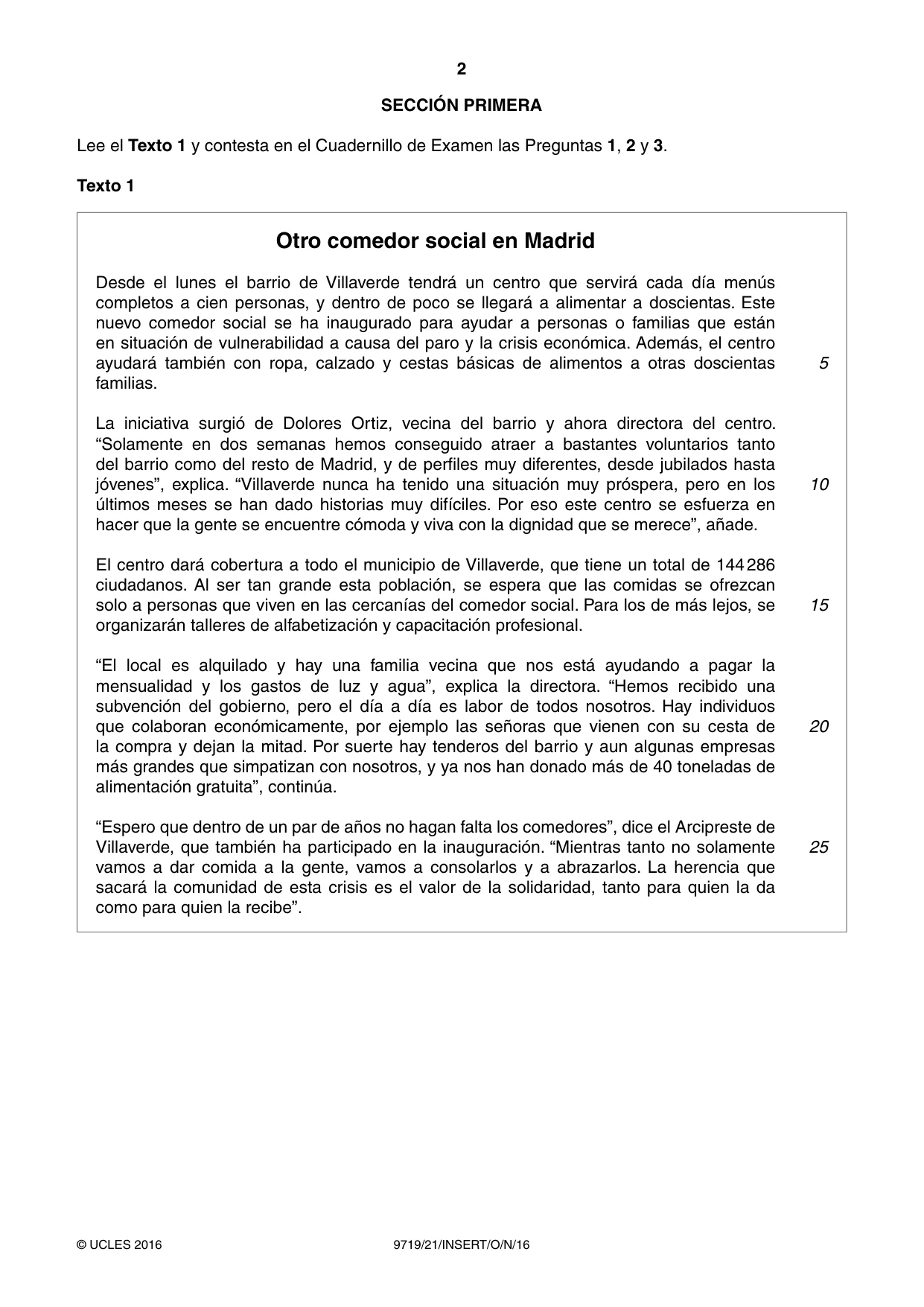
2 9719/21/INSERT/O/N/16 © UCLES 2016 SECCIÓN PRIMERA Lee el Texto 1 y contesta en el Cuadernillo de Examen las Preguntas 1, 2 y 3. Texto 1 Otro comedor social en Madrid Desde el lunes el barrio de Villaverde tendrá un centro que servirá cada día menús completos a cien personas, y dentro de poco se llegará a alimentar a doscientas. Este nuevo comedor social se ha inaugurado para ayudar a personas o familias que están en situación de vulnerabilidad a causa del paro y la crisis económica. Además, el centro ayudará también con ropa, calzado y cestas básicas de alimentos a otras doscientas familias. La iniciativa surgió de Dolores Ortiz, vecina del barrio y ahora directora del centro. “Solamente en dos semanas hemos conseguido atraer a bastantes voluntarios tanto del barrio como del resto de Madrid, y de perfiles muy diferentes, desde jubilados hasta jóvenes”, explica. “Villaverde nunca ha tenido una situación muy próspera, pero en los últimos meses se han dado historias muy difíciles. Por eso este centro se esfuerza en hacer que la gente se encuentre cómoda y viva con la dignidad que se merece”, añade. El centro dará cobertura a todo el municipio de Villaverde, que tiene un total de 144 286 ciudadanos. Al ser tan grande esta población, se espera que las comidas se ofrezcan solo a personas que viven en las cercanías del comedor social. Para los de más lejos, se organizarán talleres de alfabetización y capacitación profesional. “El local es alquilado y hay una familia vecina que nos está ayudando a pagar la mensualidad y los gastos de luz y agua”, explica la directora. “Hemos recibido una subvención del gobierno, pero el día a día es labor de todos nosotros. Hay individuos que colaboran económicamente, por ejemplo las señoras que vienen con su cesta de la compra y dejan la mitad. Por suerte hay tenderos del barrio y aun algunas empresas más grandes que simpatizan con nosotros, y ya nos han donado más de 40 toneladas de alimentación gratuita”, continúa. “Espero que dentro de un par de años no hagan falta los comedores”, dice el Arcipreste de Villaverde, que también ha participado en la inauguración. “Mientras tanto no solamente vamos a dar comida a la gente, vamos a consolarlos y a abrazarlos. La herencia que sacará la comunidad de esta crisis es el valor de la solidaridad, tanto para quien la da como para quien la recibe”. 5 10 15 20 25
Question paper, page 3
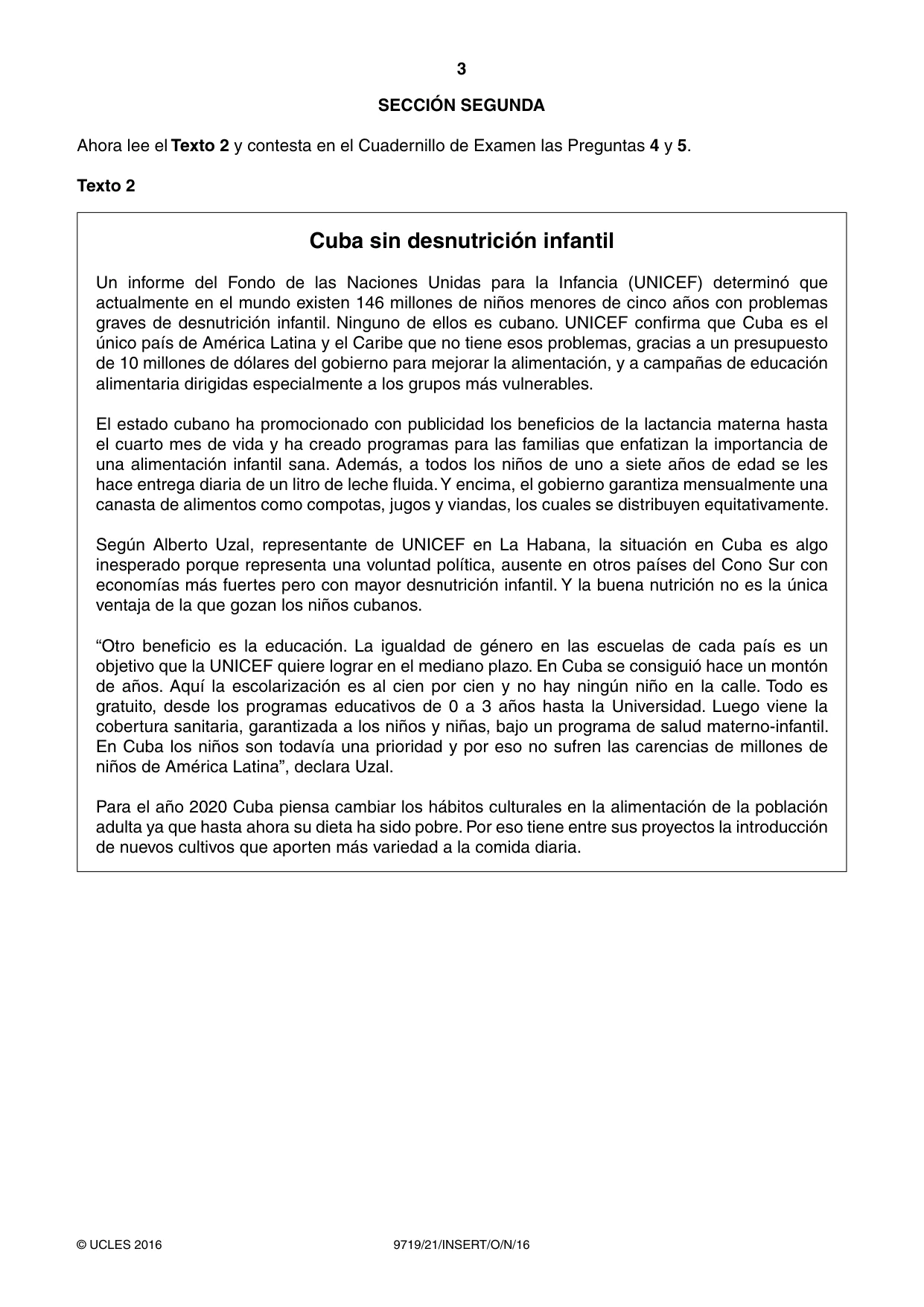
3 9719/21/INSERT/O/N/16 © UCLES 2016 SECCIÓN SEGUNDA Ahora lee el Texto 2 y contesta en el Cuadernillo de Examen las Preguntas 4 y 5. Texto 2 Cuba sin desnutrición infantil Un informe del Fondo de las Naciones Unidas para la Infancia (UNICEF) determinó que actualmente en el mundo existen 146 millones de niños menores de cinco años con problemas graves de desnutrición infantil. Ninguno de ellos es cubano. UNICEF confirma que Cuba es el único país de América Latina y el Caribe que no tiene esos problemas, gracias a un presupuesto de 10 millones de dólares del gobierno para mejorar la alimentación, y a campañas de educación alimentaria dirigidas especialmente a los grupos más vulnerables. El estado cubano ha promocionado con publicidad los beneficios de la lactancia materna hasta el cuarto mes de vida y ha creado programas para las familias que enfatizan la importancia de una alimentación infantil sana. Además, a todos los niños de uno a siete años de edad se les hace entrega diaria de un litro de leche fluida. Y encima, el gobierno garantiza mensualmente una canasta de alimentos como compotas, jugos y viandas, los cuales se distribuyen equitativamente. Según Alberto Uzal, representante de UNICEF en La Habana, la situación en Cuba es algo inesperado porque representa una voluntad política, ausente en otros países del Cono Sur con economías más fuertes pero con mayor desnutrición infantil. Y la buena nutrición no es la única ventaja de la que gozan los niños cubanos. “Otro beneficio es la educación. La igualdad de género en las escuelas de cada país es un objetivo que la UNICEF quiere lograr en el mediano plazo. En Cuba se consiguió hace un montón de años. Aquí la escolarización es al cien por cien y no hay ningún niño en la calle. Todo es gratuito, desde los programas educativos de 0 a 3 años hasta la Universidad. Luego viene la cobertura sanitaria, garantizada a los niños y niñas, bajo un programa de salud materno-infantil. En Cuba los niños son todavía una prioridad y por eso no sufren las carencias de millones de niños de América Latina”, declara Uzal. Para el año 2020 Cuba piensa cambiar los hábitos culturales en la alimentación de la población adulta ya que hasta ahora su dieta ha sido pobre. Por eso tiene entre sus proyectos la introducción de nuevos cultivos que aporten más variedad a la comida diaria.
Question paper, page 4
4 9719/21/INSERT/O/N/16 © UCLES 2016 BLANK PAGE Permission to reproduce items where third-party owned material protected by copyright is included has been sought and cleared where possible. Every reasonable effort has been made by the publisher (UCLES) to trace copyright holders, but if any items requiring clearance have unwittingly been included, the publisher will be pleased to make amends at the earliest possible opportunity. To avoid the issue of disclosure of answer-related information to candidates, all copyright acknowledgements are reproduced online in the Cambridge International Examinations Copyright Acknowledgements Booklet. This is produced for each series of examinations and is freely available to download at www.cie.org.uk after the live examination series. Cambridge International Examinations is part of the Cambridge Assessment Group. Cambridge Assessment is the brand name of University of Cambridge Local Examinations Syndicate (UCLES), which is itself a department of the University of Cambridge.
Mark scheme, page 1
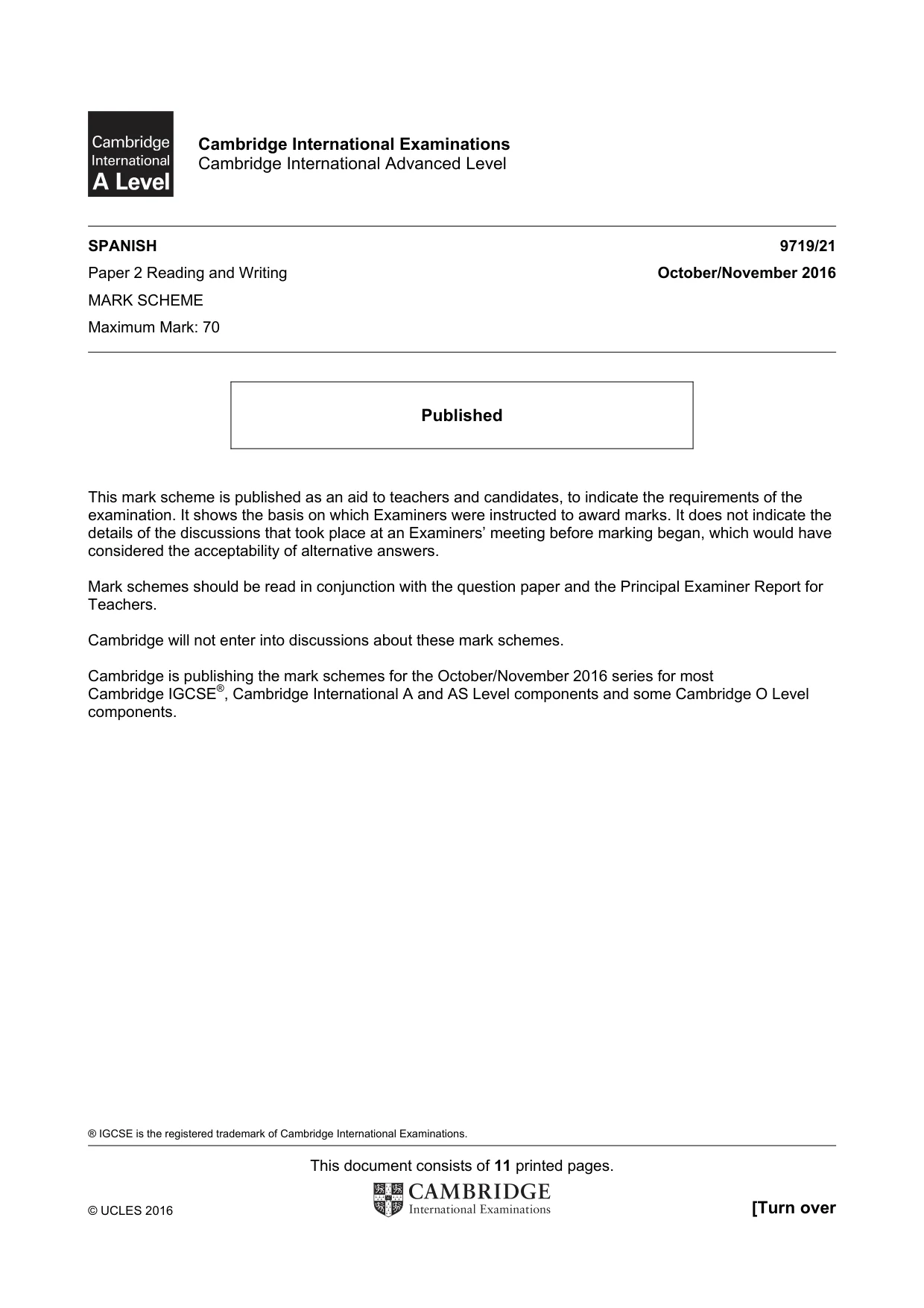
® IGCSE is the registered trademark of Cambridge International Examinations. This document consists of 11 printed pages. © UCLES 2016 [Turn over Cambridge International Examinations Cambridge International Advanced Level SPANISH 9719/21 Paper 2 Reading and Writing October/November 2016 MARK SCHEME Maximum Mark: 70 Published This mark scheme is published as an aid to teachers and candidates, to indicate the requirements of the examination. It shows the basis on which Examiners were instructed to award marks. It does not indicate the details of the discussions that took place at an Examiners’ meeting before marking began, which would have considered the acceptability of alternative answers. Mark schemes should be read in conjunction with the question paper and the Principal Examiner Report for Teachers. Cambridge will not enter into discussions about these mark schemes. Cambridge is publishing the mark schemes for the October/November 2016 series for most Cambridge IGCSE®, Cambridge International A and AS Level components and some Cambridge O Level components.
Mark scheme, page 2
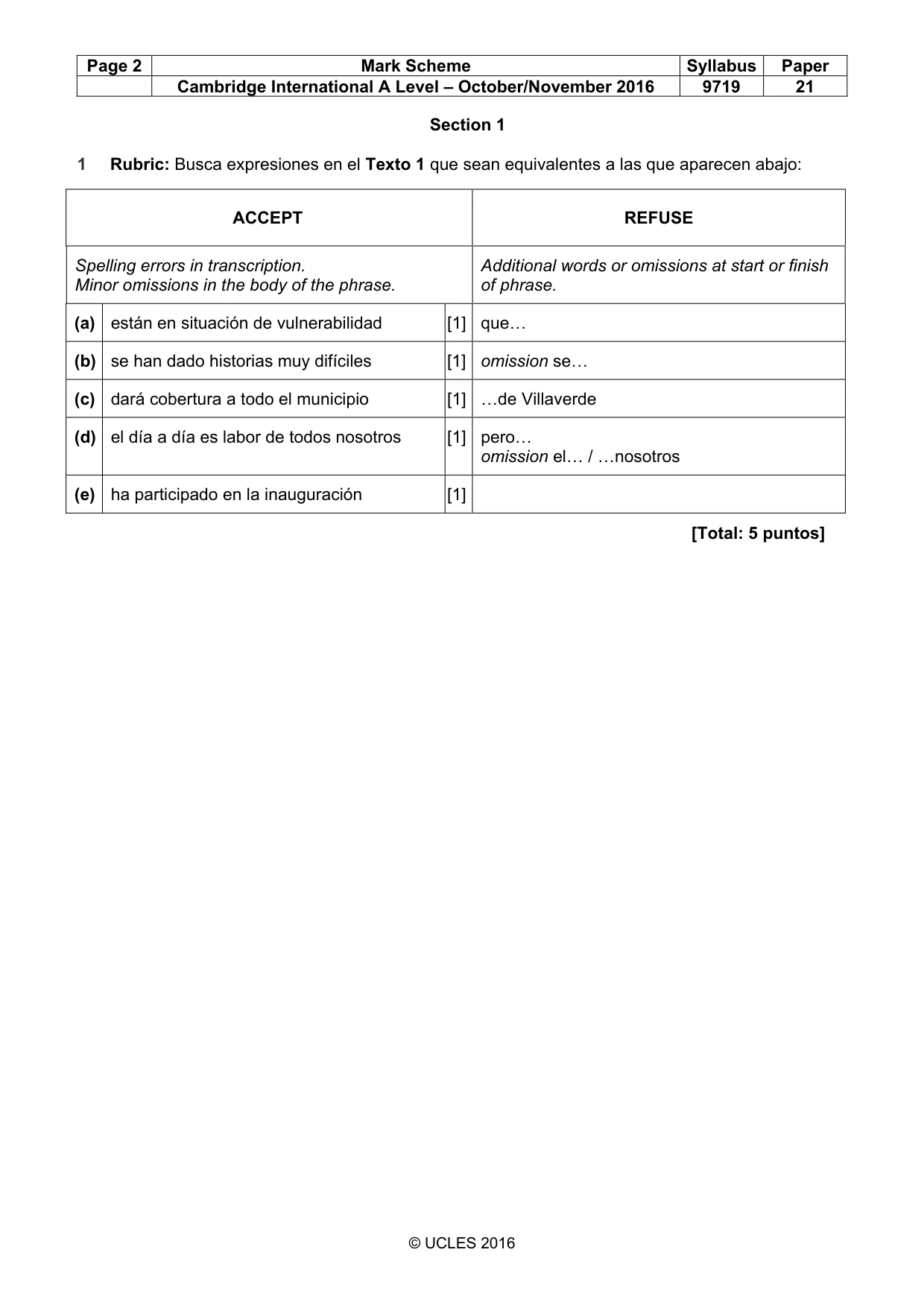
Page 2 Mark Scheme Syllabus Paper Cambridge International A Level – October/November 2016 9719 21 © UCLES 2016 Section 1 1 Rubric: Busca expresiones en el Texto 1 que sean equivalentes a las que aparecen abajo: ACCEPT REFUSE Spelling errors in transcription. Minor omissions in the body of the phrase. Additional words or omissions at start or finish of phrase. (a) están en situación de vulnerabilidad [1] que… (b) se han dado historias muy difíciles [1] omission se… (c) dará cobertura a todo el municipio [1] …de Villaverde (d) el día a día es labor de todos nosotros [1] pero… omission el… / …nosotros (e) ha participado en la inauguración [1] [Total: 5 puntos]
Mark scheme, page 3
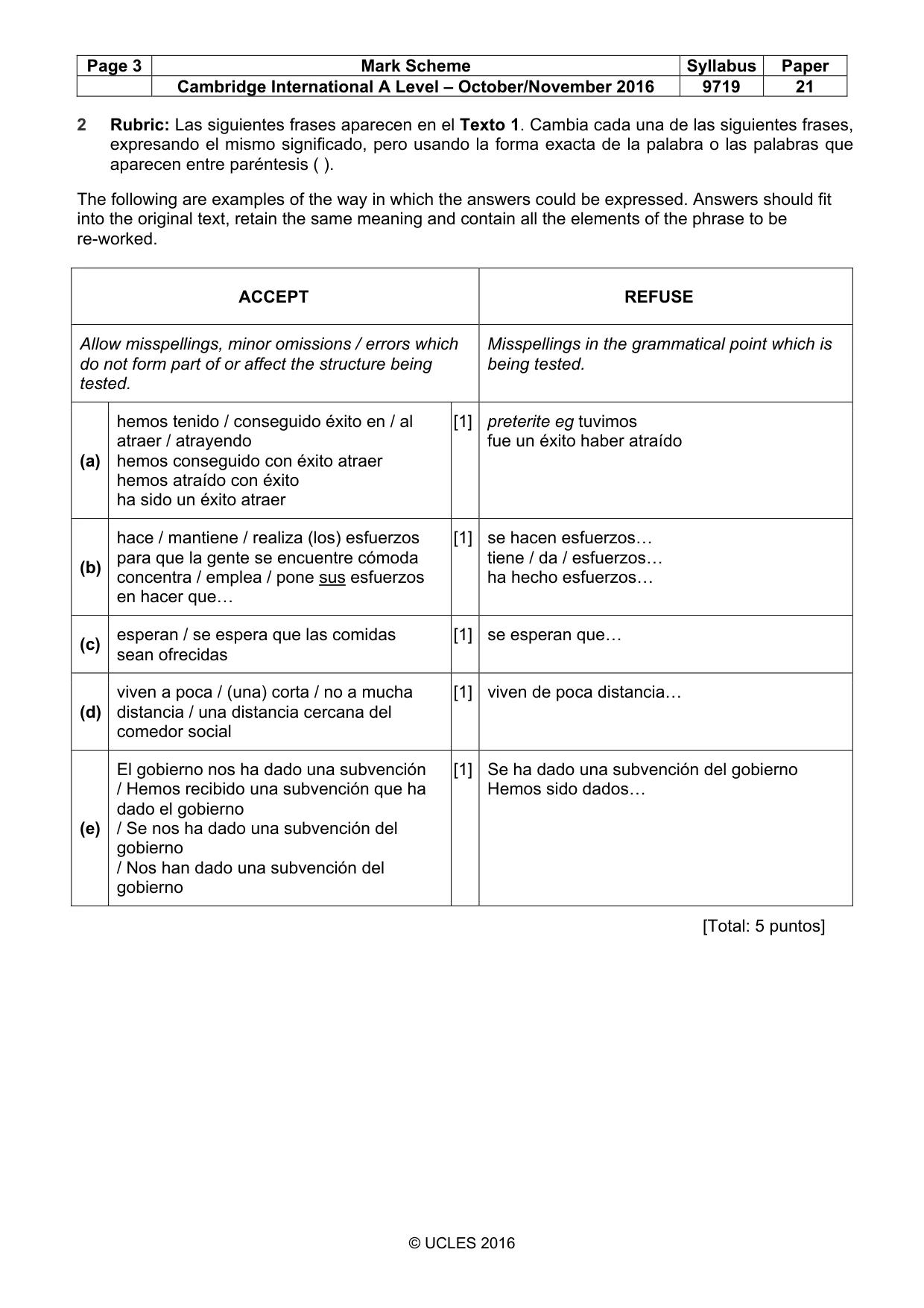
Page 3 Mark Scheme Syllabus Paper Cambridge International A Level – October/November 2016 9719 21 © UCLES 2016 2 Rubric: Las siguientes frases aparecen en el Texto 1. Cambia cada una de las siguientes frases, expresando el mismo significado, pero usando la forma exacta de la palabra o las palabras que aparecen entre paréntesis ( ). The following are examples of the way in which the answers could be expressed. Answers should fit into the original text, retain the same meaning and contain all the elements of the phrase to be re-worked. ACCEPT REFUSE Allow misspellings, minor omissions / errors which do not form part of or affect the structure being tested. Misspellings in the grammatical point which is being tested. (a) hemos tenido / conseguido éxito en / al atraer / atrayendo hemos conseguido con éxito atraer hemos atraído con éxito ha sido un éxito atraer [1] preterite eg tuvimos fue un éxito haber atraído (b) hace / mantiene / realiza (los) esfuerzos para que la gente se encuentre cómoda concentra / emplea / pone sus esfuerzos en hacer que… [1] se hacen esfuerzos… tiene / da / esfuerzos… ha hecho esfuerzos… (c) esperan / se espera que las comidas sean ofrecidas [1] se esperan que… (d) viven a poca / (una) corta / no a mucha distancia / una distancia cercana del comedor social [1] viven de poca distancia… (e) El gobierno nos ha dado una subvención / Hemos recibido una subvención que ha dado el gobierno / Se nos ha dado una subvención del gobierno / Nos han dado una subvención del gobierno [1] Se ha dado una subvención del gobierno Hemos sido dados… [Total: 5 puntos]
Mark scheme, page 4
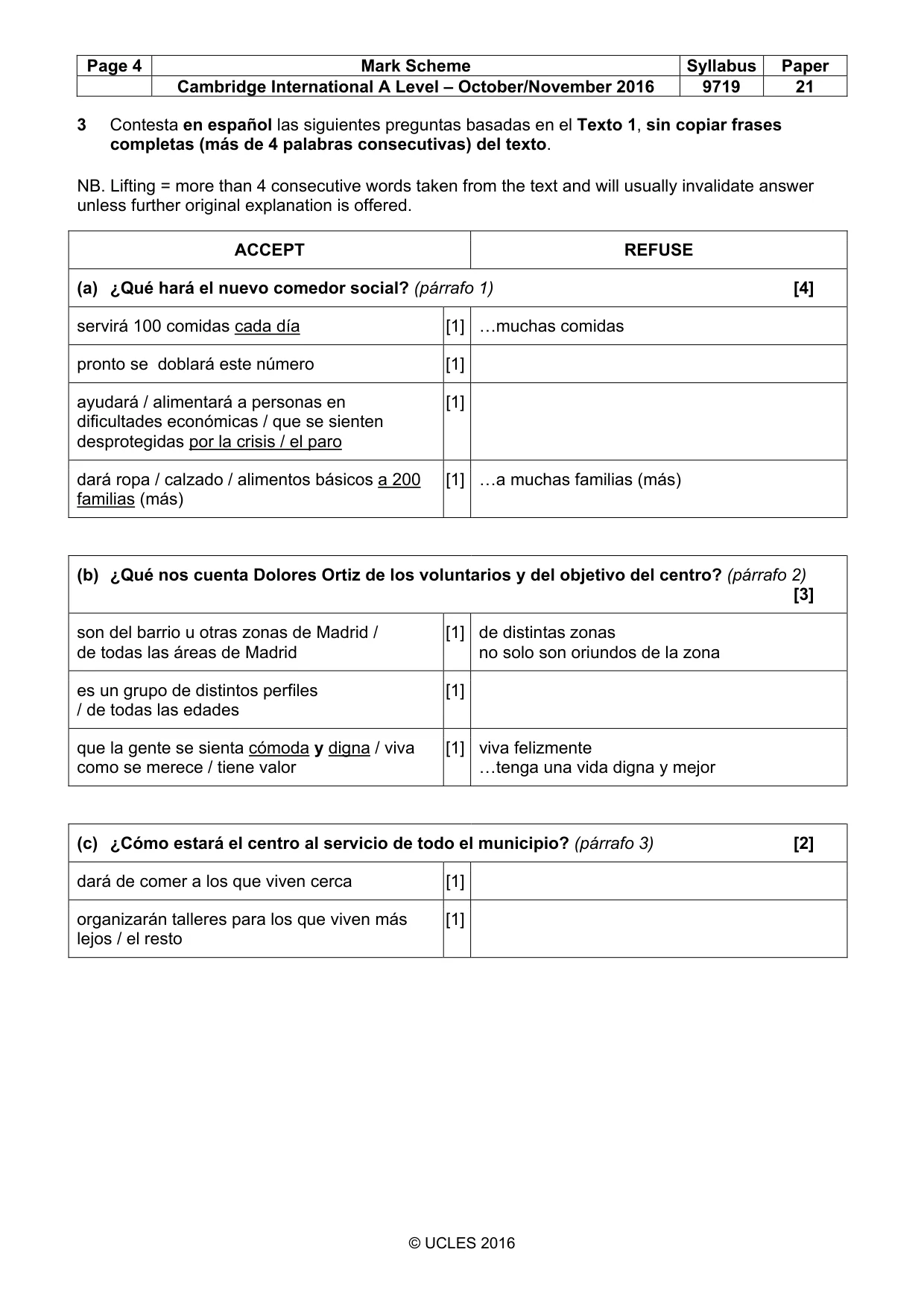
Page 4 Mark Scheme Syllabus Paper Cambridge International A Level – October/November 2016 9719 21 © UCLES 2016 3 Contesta en español las siguientes preguntas basadas en el Texto 1, sin copiar frases completas (más de 4 palabras consecutivas) del texto. NB. Lifting = more than 4 consecutive words taken from the text and will usually invalidate answer unless further original explanation is offered. ACCEPT REFUSE (a) ¿Qué hará el nuevo comedor social? (párrafo 1) [4] servirá 100 comidas cada día [1] …muchas comidas pronto se doblará este número [1] ayudará / alimentará a personas en dificultades económicas / que se sienten desprotegidas por la crisis / el paro [1] dará ropa / calzado / alimentos básicos a 200 familias (más) [1] …a muchas familias (más) (b) ¿Qué nos cuenta Dolores Ortiz de los voluntarios y del objetivo del centro? (párrafo 2) [3] son del barrio u otras zonas de Madrid / de todas las áreas de Madrid [1] de distintas zonas no solo son oriundos de la zona es un grupo de distintos perfiles / de todas las edades [1] que la gente se sienta cómoda y digna / viva como se merece / tiene valor [1] viva felizmente …tenga una vida digna y mejor (c) ¿Cómo estará el centro al servicio de todo el municipio? (párrafo 3) [2] dará de comer a los que viven cerca [1] organizarán talleres para los que viven más lejos / el resto [1]
Mark scheme, page 5
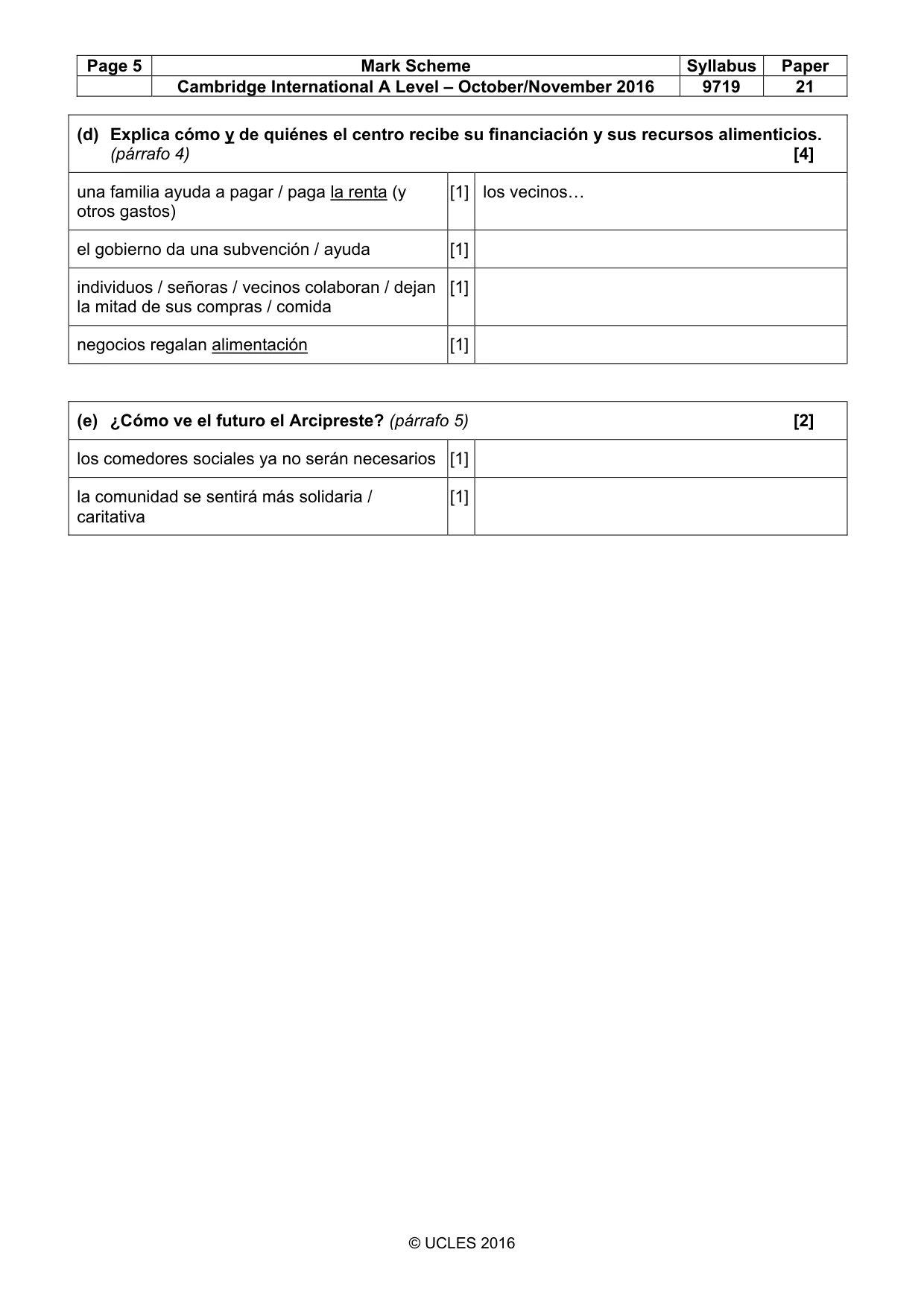
Page 5 Mark Scheme Syllabus Paper Cambridge International A Level – October/November 2016 9719 21 © UCLES 2016 (d) Explica cómo y de quiénes el centro recibe su financiación y sus recursos alimenticios. (párrafo 4) [4] una familia ayuda a pagar / paga la renta (y otros gastos) [1] los vecinos… el gobierno da una subvención / ayuda [1] individuos / señoras / vecinos colaboran / dejan la mitad de sus compras / comida [1] negocios regalan alimentación [1] (e) ¿Cómo ve el futuro el Arcipreste? (párrafo 5) [2] los comedores sociales ya no serán necesarios [1] la comunidad se sentirá más solidaria / caritativa [1]
Mark scheme, page 6
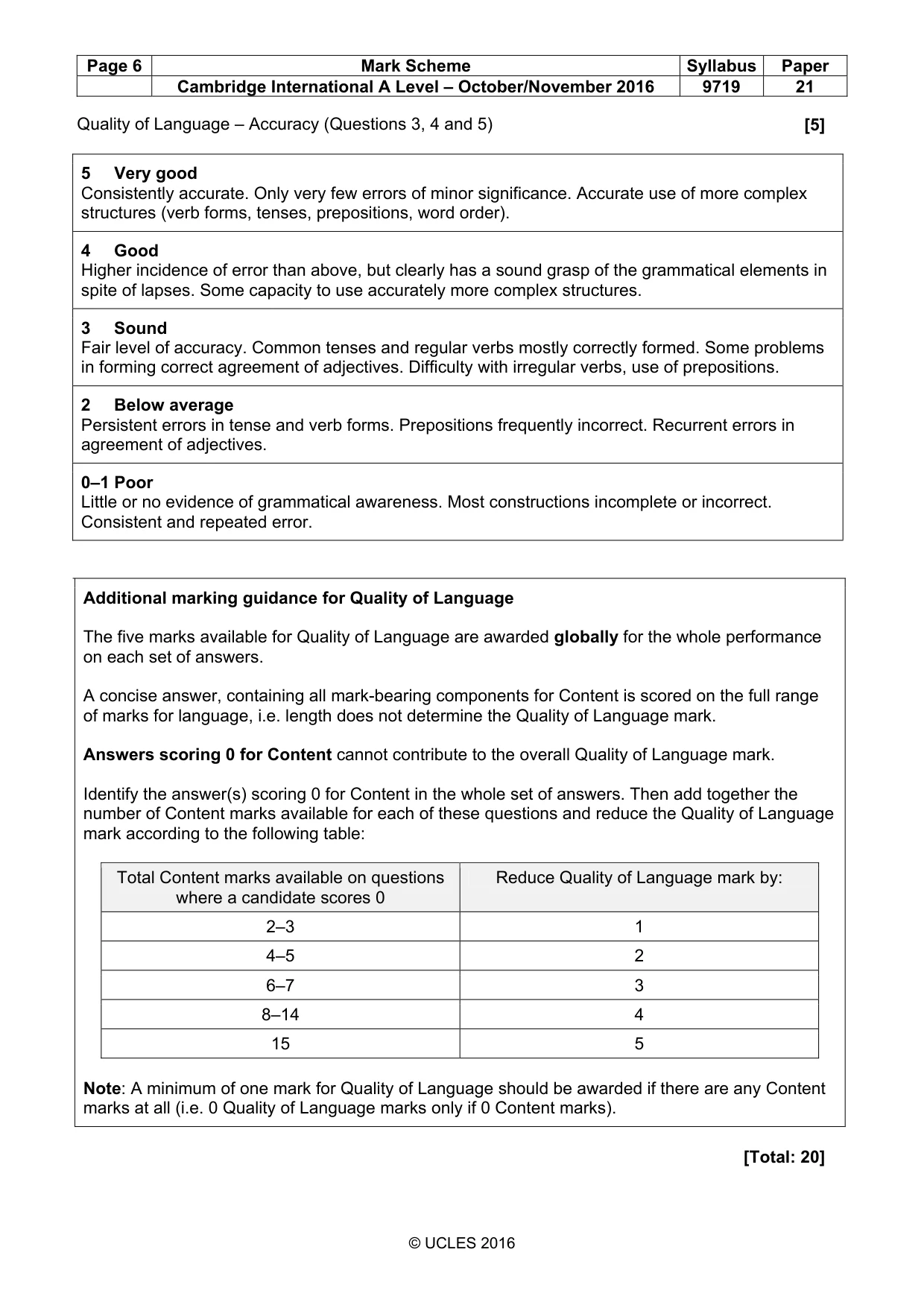
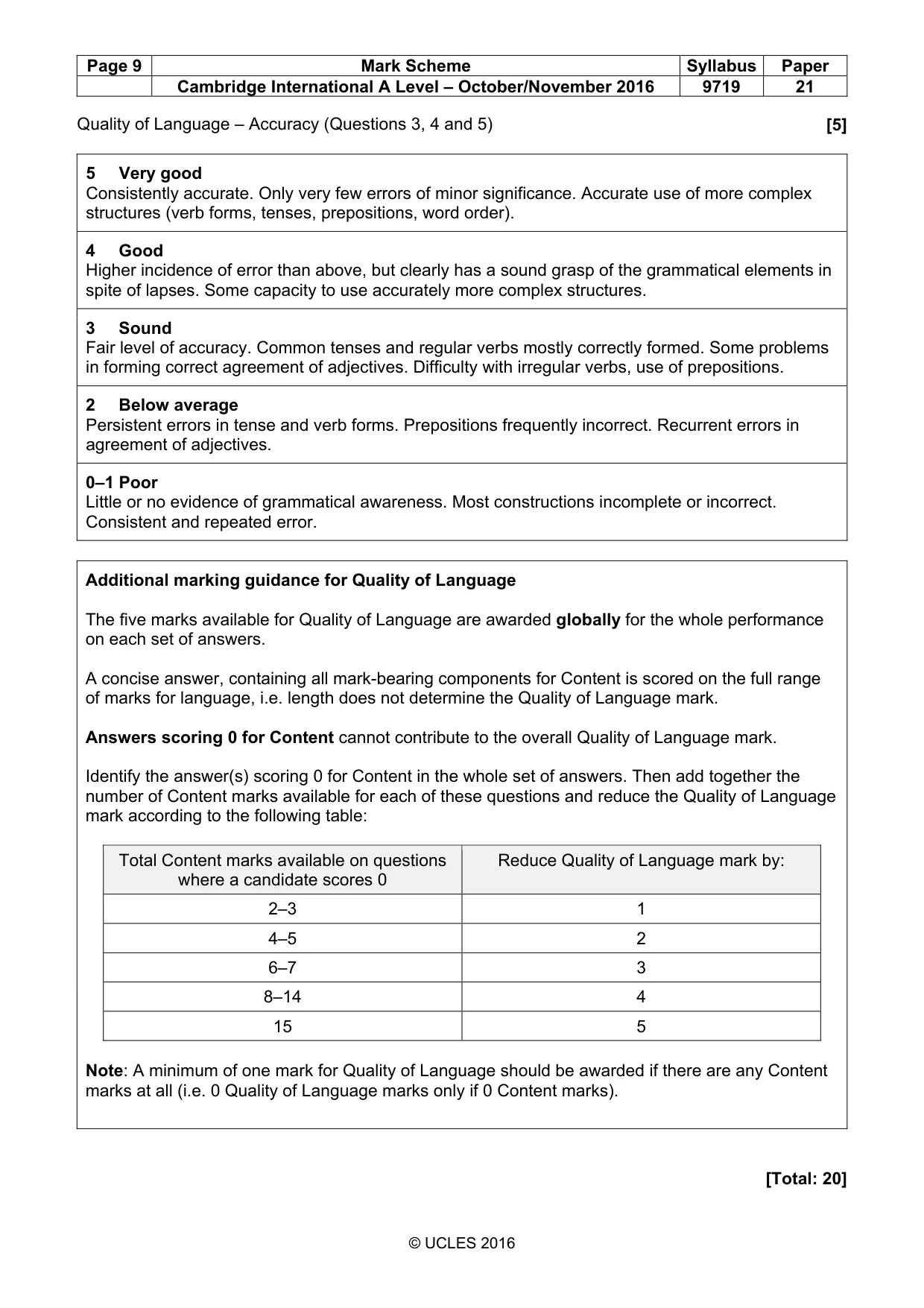
Page 6 Mark Scheme Syllabus Paper Cambridge International A Level – October/November 2016 9719 21 © UCLES 2016 Quality of Language – Accuracy (Questions 3, 4 and 5) [5] 5 Very good Consistently accurate. Only very few errors of minor significance. Accurate use of more complex structures (verb forms, tenses, prepositions, word order). 4 Good Higher incidence of error than above, but clearly has a sound grasp of the grammatical elements in spite of lapses. Some capacity to use accurately more complex structures. 3 Sound Fair level of accuracy. Common tenses and regular verbs mostly correctly formed. Some problems in forming correct agreement of adjectives. Difficulty with irregular verbs, use of prepositions. 2 Below average Persistent errors in tense and verb forms. Prepositions frequently incorrect. Recurrent errors in agreement of adjectives. 0–1 Poor Little or no evidence of grammatical awareness. Most constructions incomplete or incorrect. Consistent and repeated error. Additional marking guidance for Quality of Language The five marks available for Quality of Language are awarded globally for the whole performance on each set of answers. A concise answer, containing all mark-bearing components for Content is scored on the full range of marks for language, i.e. length does not determine the Quality of Language mark. Answers scoring 0 for Content cannot contribute to the overall Quality of Language mark. Identify the answer(s) scoring 0 for Content in the whole set of answers. Then add together the number of Content marks available for each of these questions and reduce the Quality of Language mark according to the following table: Total Content marks available on questions where a candidate scores 0 Reduce Quality of Language mark by: 2–3 1 4–5 2 6–7 3 8–14 4 15 5 Note: A minimum of one mark for Quality of Language should be awarded if there are any Content marks at all (i.e. 0 Quality of Language marks only if 0 Content marks). [Total: 20]
Mark scheme, page 7
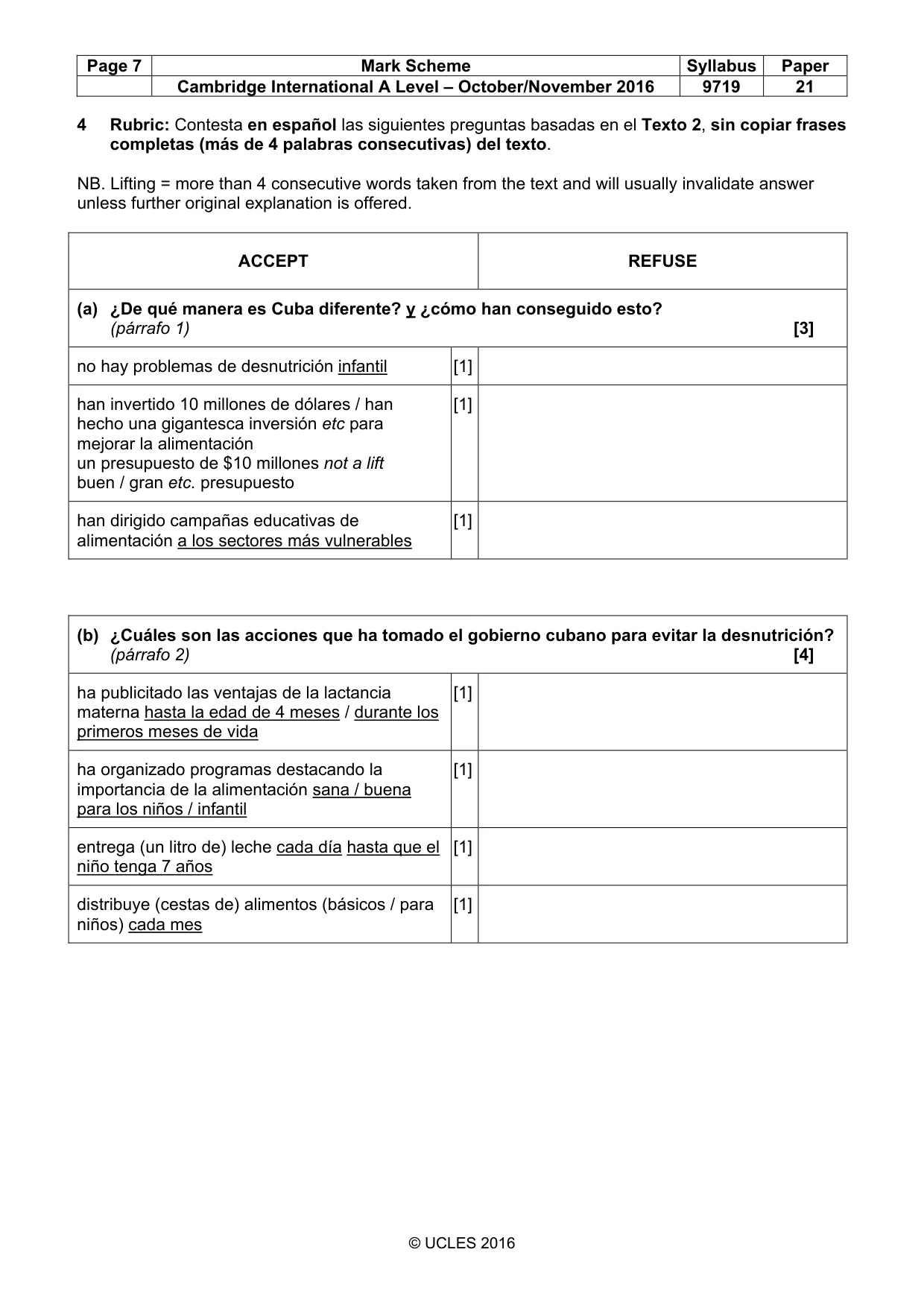
Page 7 Mark Scheme Syllabus Paper Cambridge International A Level – October/November 2016 9719 21 © UCLES 2016 4 Rubric: Contesta en español las siguientes preguntas basadas en el Texto 2, sin copiar frases completas (más de 4 palabras consecutivas) del texto. NB. Lifting = more than 4 consecutive words taken from the text and will usually invalidate answer unless further original explanation is offered. ACCEPT REFUSE (a) ¿De qué manera es Cuba diferente? y ¿cómo han conseguido esto? (párrafo 1) [3] no hay problemas de desnutrición infantil [1] han invertido 10 millones de dólares / han hecho una gigantesca inversión etc para mejorar la alimentación un presupuesto de $10 millones not a lift buen / gran etc. presupuesto [1] han dirigido campañas educativas de alimentación a los sectores más vulnerables [1] (b) ¿Cuáles son las acciones que ha tomado el gobierno cubano para evitar la desnutrición? (párrafo 2) [4] ha publicitado las ventajas de la lactancia materna hasta la edad de 4 meses / durante los primeros meses de vida [1] ha organizado programas destacando la importancia de la alimentación sana / buena para los niños / infantil [1] entrega (un litro de) leche cada día hasta que el niño tenga 7 años [1] distribuye (cestas de) alimentos (básicos / para niños) cada mes [1]
Mark scheme, page 8
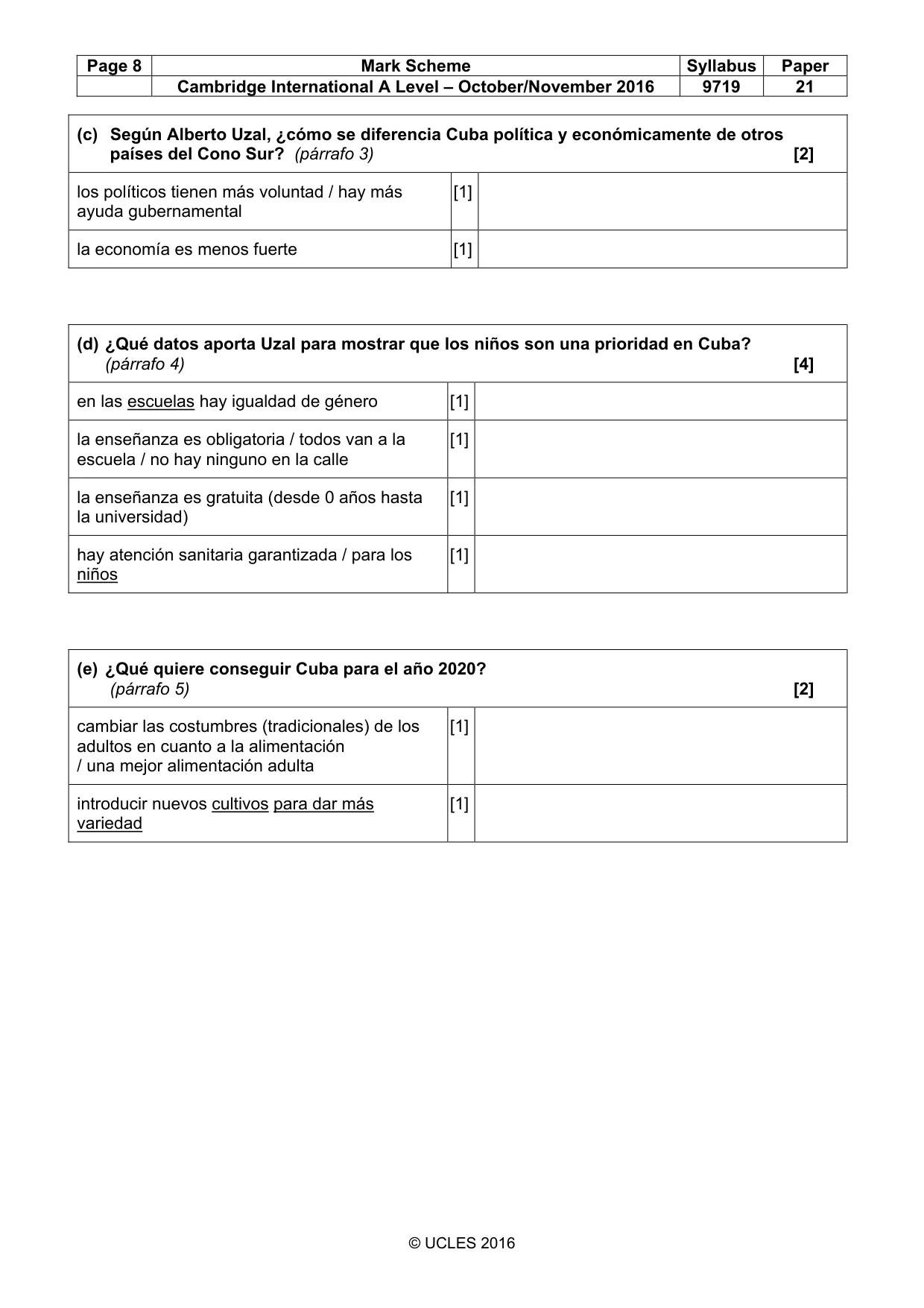
Page 8 Mark Scheme Syllabus Paper Cambridge International A Level – October/November 2016 9719 21 © UCLES 2016 (c) Según Alberto Uzal, ¿cómo se diferencia Cuba política y económicamente de otros países del Cono Sur? (párrafo 3) [2] los políticos tienen más voluntad / hay más ayuda gubernamental [1] la economía es menos fuerte [1] (d) ¿Qué datos aporta Uzal para mostrar que los niños son una prioridad en Cuba? (párrafo 4) [4] en las escuelas hay igualdad de género [1] la enseñanza es obligatoria / todos van a la escuela / no hay ninguno en la calle [1] la enseñanza es gratuita (desde 0 años hasta la universidad) [1] hay atención sanitaria garantizada / para los niños [1] (e) ¿Qué quiere conseguir Cuba para el año 2020? (párrafo 5) [2] cambiar las costumbres (tradicionales) de los adultos en cuanto a la alimentación / una mejor alimentación adulta [1] introducir nuevos cultivos para dar más variedad [1]
Mark scheme, page 9
Page 9 Mark Scheme Syllabus Paper Cambridge International A Level – October/November 2016 9719 21 © UCLES 2016 Quality of Language – Accuracy (Questions 3, 4 and 5) [5] 5 Very good Consistently accurate. Only very few errors of minor significance. Accurate use of more complex structures (verb forms, tenses, prepositions, word order). 4 Good Higher incidence of error than above, but clearly has a sound grasp of the grammatical elements in spite of lapses. Some capacity to use accurately more complex structures. 3 Sound Fair level of accuracy. Common tenses and regular verbs mostly correctly formed. Some problems in forming correct agreement of adjectives. Difficulty with irregular verbs, use of prepositions. 2 Below average Persistent errors in tense and verb forms. Prepositions frequently incorrect. Recurrent errors in agreement of adjectives. 0–1 Poor Little or no evidence of grammatical awareness. Most constructions incomplete or incorrect. Consistent and repeated error. Additional marking guidance for Quality of Language The five marks available for Quality of Language are awarded globally for the whole performance on each set of answers. A concise answer, containing all mark-bearing components for Content is scored on the full range of marks for language, i.e. length does not determine the Quality of Language mark. Answers scoring 0 for Content cannot contribute to the overall Quality of Language mark. Identify the answer(s) scoring 0 for Content in the whole set of answers. Then add together the number of Content marks available for each of these questions and reduce the Quality of Language mark according to the following table: Total Content marks available on questions where a candidate scores 0 Reduce Quality of Language mark by: 2–3 1 4–5 2 6–7 3 8–14 4 15 5 Note: A minimum of one mark for Quality of Language should be awarded if there are any Content marks at all (i.e. 0 Quality of Language marks only if 0 Content marks). [Total: 20]
Mark scheme, page 10
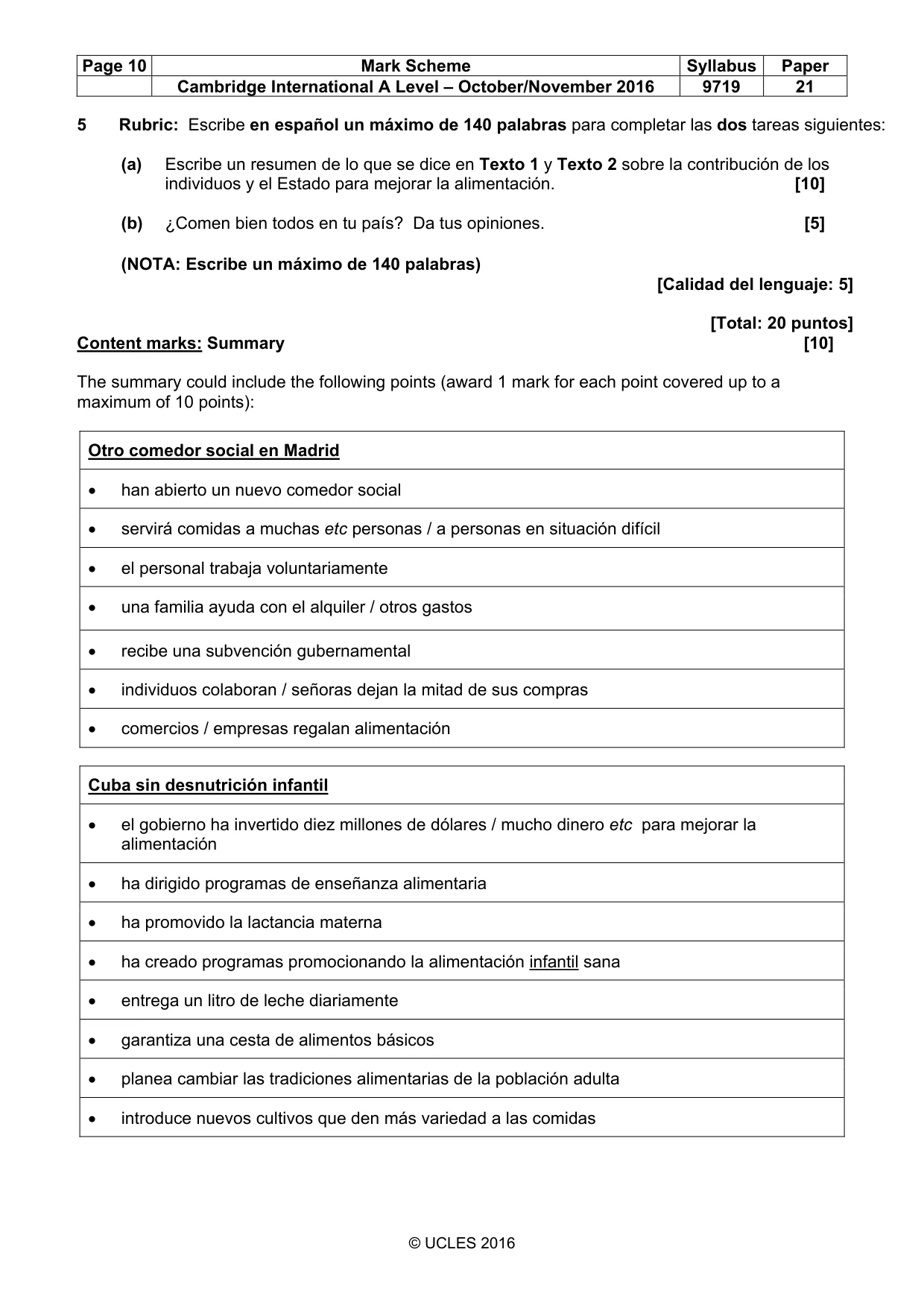
Page 10 Mark Scheme Syllabus Paper Cambridge International A Level – October/November 2016 9719 21 © UCLES 2016 5 Rubric: Escribe en español un máximo de 140 palabras para completar las dos tareas siguientes: (a) Escribe un resumen de lo que se dice en Texto 1 y Texto 2 sobre la contribución de los individuos y el Estado para mejorar la alimentación. [10] (b) ¿Comen bien todos en tu país? Da tus opiniones. [5] (NOTA: Escribe un máximo de 140 palabras) [Calidad del lenguaje: 5] [Total: 20 puntos] Content marks: Summary [10] The summary could include the following points (award 1 mark for each point covered up to a maximum of 10 points): Otro comedor social en Madrid • han abierto un nuevo comedor social • servirá comidas a muchas etc personas / a personas en situación difícil • el personal trabaja voluntariamente • una familia ayuda con el alquiler / otros gastos • recibe una subvención gubernamental • individuos colaboran / señoras dejan la mitad de sus compras • comercios / empresas regalan alimentación Cuba sin desnutrición infantil • el gobierno ha invertido diez millones de dólares / mucho dinero etc para mejorar la alimentación • ha dirigido programas de enseñanza alimentaria • ha promovido la lactancia materna • ha creado programas promocionando la alimentación infantil sana • entrega un litro de leche diariamente • garantiza una cesta de alimentos básicos • planea cambiar las tradiciones alimentarias de la población adulta • introduce nuevos cultivos que den más variedad a las comidas
Mark scheme, page 11
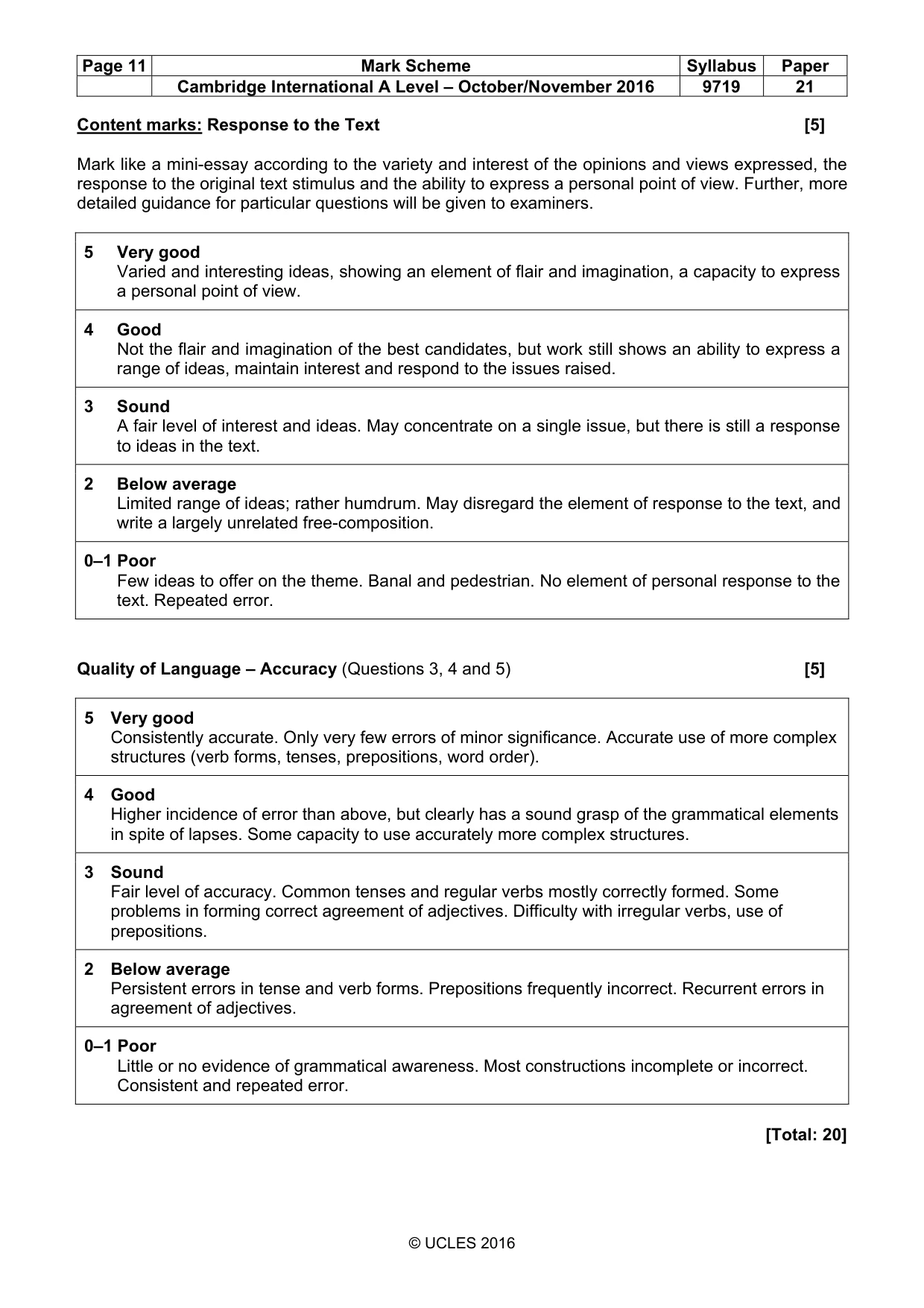
Page 11 Mark Scheme Syllabus Paper Cambridge International A Level – October/November 2016 9719 21 © UCLES 2016 Content marks: Response to the Text [5] Mark like a mini-essay according to the variety and interest of the opinions and views expressed, the response to the original text stimulus and the ability to express a personal point of view. Further, more detailed guidance for particular questions will be given to examiners. 5 Very good Varied and interesting ideas, showing an element of flair and imagination, a capacity to express a personal point of view. 4 Good Not the flair and imagination of the best candidates, but work still shows an ability to express a range of ideas, maintain interest and respond to the issues raised. 3 Sound A fair level of interest and ideas. May concentrate on a single issue, but there is still a response to ideas in the text. 2 Below average Limited range of ideas; rather humdrum. May disregard the element of response to the text, and write a largely unrelated free-composition. 0–1 Poor Few ideas to offer on the theme. Banal and pedestrian. No element of personal response to the text. Repeated error. Quality of Language – Accuracy (Questions 3, 4 and 5) [5] 5 Very good Consistently accurate. Only very few errors of minor significance. Accurate use of more complex structures (verb forms, tenses, prepositions, word order). 4 Good Higher incidence of error than above, but clearly has a sound grasp of the grammatical elements in spite of lapses. Some capacity to use accurately more complex structures. 3 Sound Fair level of accuracy. Common tenses and regular verbs mostly correctly formed. Some problems in forming correct agreement of adjectives. Difficulty with irregular verbs, use of prepositions. 2 Below average Persistent errors in tense and verb forms. Prepositions frequently incorrect. Recurrent errors in agreement of adjectives. 0–1 Poor Little or no evidence of grammatical awareness. Most constructions incomplete or incorrect. Consistent and repeated error. [Total: 20]
What you needed in this session
Cambridge’s own grade thresholds for 2016 Oct/Nov, Paper 2 · Variant 1. A higher threshold means an easier paper — the bar moves with how the cohort did.