Cambridge A Level Spanish (A Level only) 9719 — 2014 May/June Paper 2 · Variant 1
9719/21/M/J/14 · 70 marks · ≈79 min
The question paper and its mark scheme, free to read here and free to download. This is Cambridge’s own paper, exactly as it was sat.
Question paper8 pages



Mark scheme13 pages
Answers below. Sit the paper first if you are practising.
Paper as text
Question paper, page 1
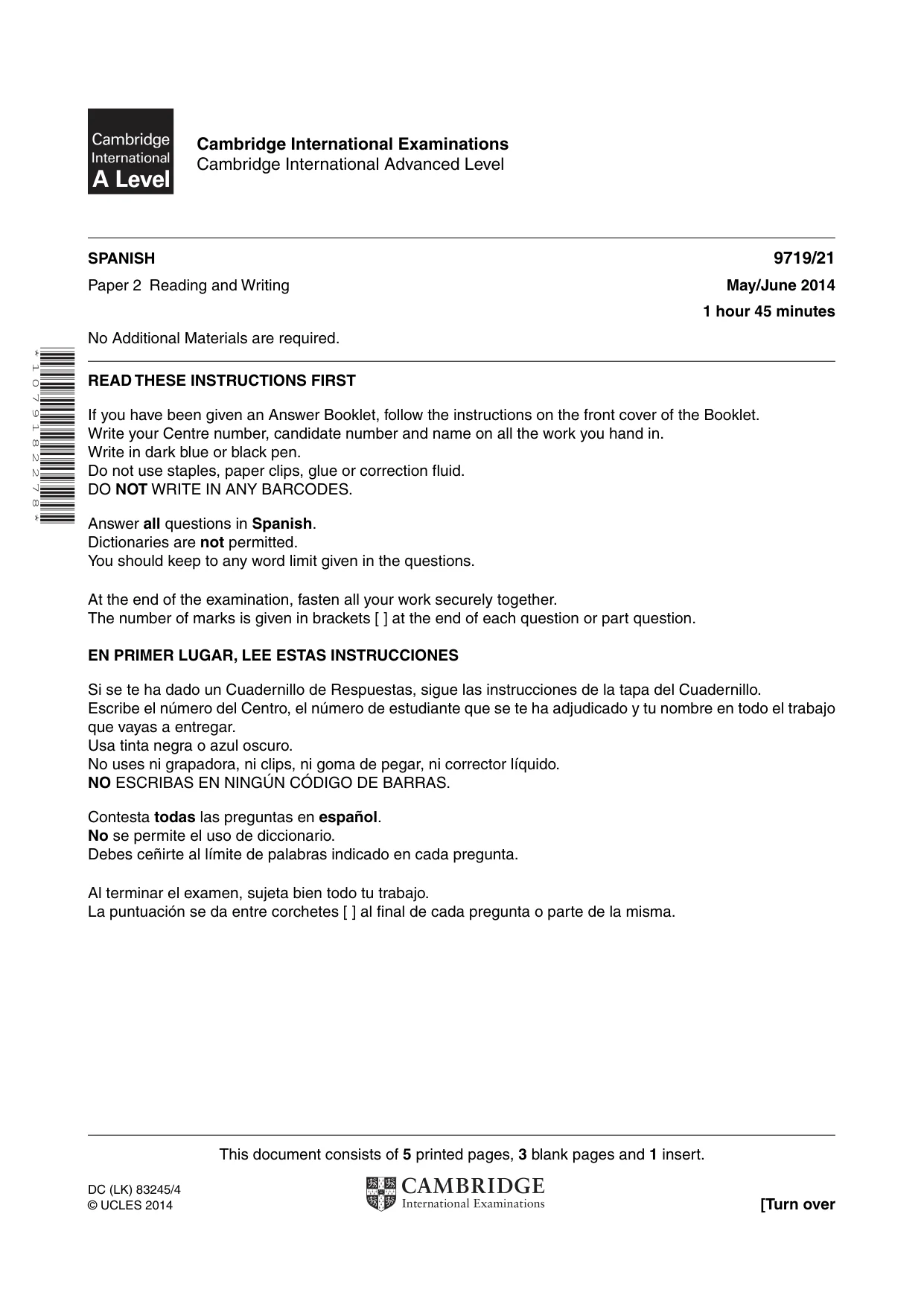
This document consists of 5 printed pages, 3 blank pages and 1 insert. DC (LK) 83245/4 © UCLES 2014 [Turn over Cambridge International Examinations Cambridge International Advanced Level * 1 0 7 9 1 8 2 2 7 8 * SPANISH 9719/21 Paper 2 Reading and Writing May/June 2014 1 hour 45 minutes No Additional Materials are required. READ THESE INSTRUCTIONS FIRST If you have been given an Answer Booklet, follow the instructions on the front cover of the Booklet. Write your Centre number, candidate number and name on all the work you hand in. Write in dark blue or black pen. Do not use staples, paper clips, glue or correction fluid. DO NOT WRITE IN ANY BARCODES. Answer all questions in Spanish. Dictionaries are not permitted. You should keep to any word limit given in the questions. At the end of the examination, fasten all your work securely together. The number of marks is given in brackets [ ] at the end of each question or part question. EN PRIMER LUGAR, LEE ESTAS INSTRUCCIONES Si se te ha dado un Cuadernillo de Respuestas, sigue las instrucciones de la tapa del Cuadernillo. Escribe el número del Centro, el número de estudiante que se te ha adjudicado y tu nombre en todo el trabajo que vayas a entregar. Usa tinta negra o azul oscuro. No uses ni grapadora, ni clips, ni goma de pegar, ni corrector líquido. NO ESCRIBAS EN NINGÚN CÓDIGO DE BARRAS. Contesta todas las preguntas en español. No se permite el uso de diccionario. Debes ceñirte al límite de palabras indicado en cada pregunta. Al terminar el examen, sujeta bien todo tu trabajo. La puntuación se da entre corchetes [ ] al final de cada pregunta o parte de la misma.
Question paper, page 2
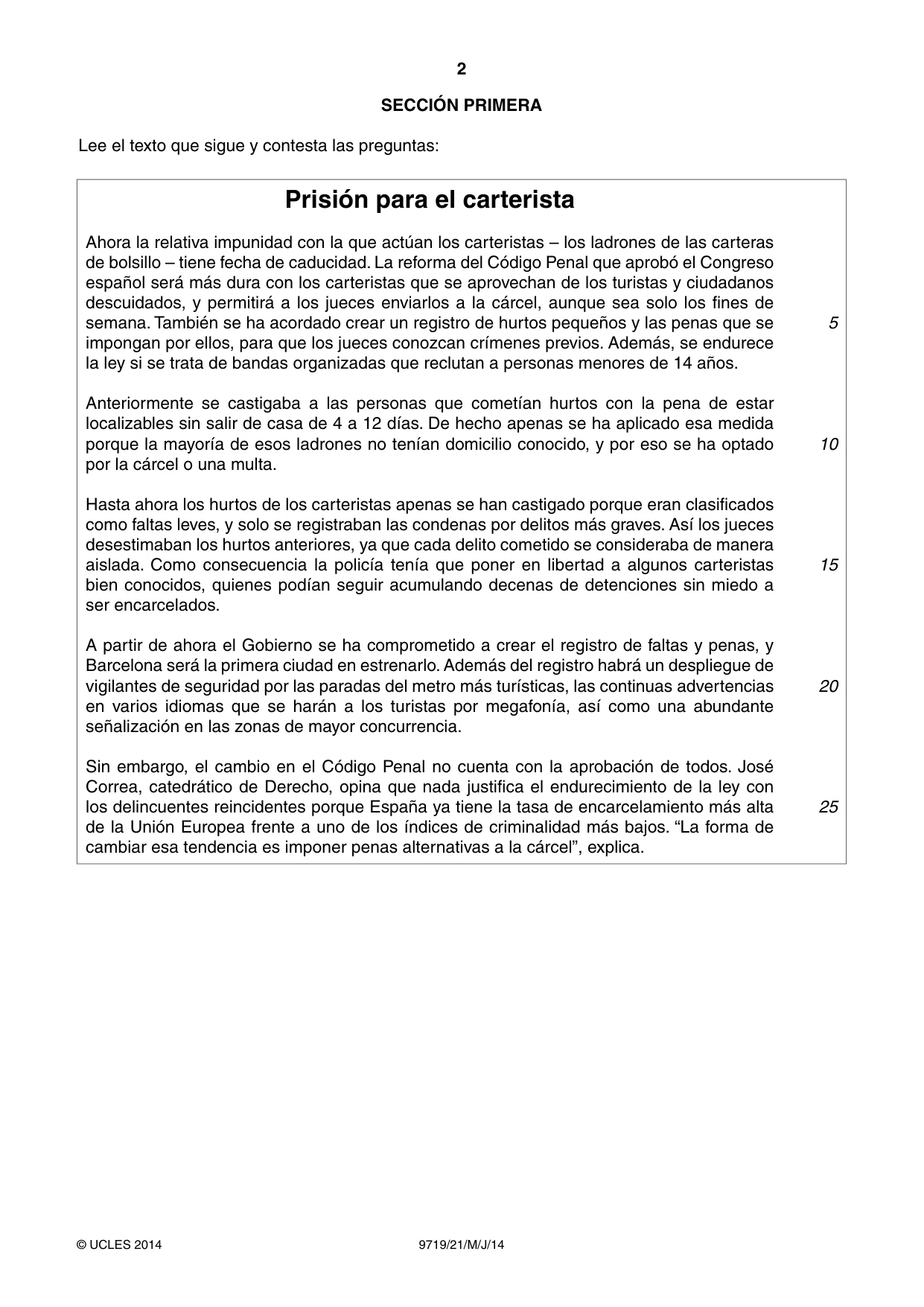
2 9719/21/M/J/14 © UCLES 2014 SECCIÓN PRIMERA Lee el texto que sigue y contesta las preguntas: Prisión para el carterista Ahora la relativa impunidad con la que actúan los carteristas – los ladrones de las carteras de bolsillo – tiene fecha de caducidad. La reforma del Código Penal que aprobó el Congreso español será más dura con los carteristas que se aprovechan de los turistas y ciudadanos descuidados, y permitirá a los jueces enviarlos a la cárcel, aunque sea solo los fines de semana. También se ha acordado crear un registro de hurtos pequeños y las penas que se impongan por ellos, para que los jueces conozcan crímenes previos. Además, se endurece la ley si se trata de bandas organizadas que reclutan a personas menores de 14 años. Anteriormente se castigaba a las personas que cometían hurtos con la pena de estar localizables sin salir de casa de 4 a 12 días. De hecho apenas se ha aplicado esa medida porque la mayoría de esos ladrones no tenían domicilio conocido, y por eso se ha optado por la cárcel o una multa. Hasta ahora los hurtos de los carteristas apenas se han castigado porque eran clasificados como faltas leves, y solo se registraban las condenas por delitos más graves. Así los jueces desestimaban los hurtos anteriores, ya que cada delito cometido se consideraba de manera aislada. Como consecuencia la policía tenía que poner en libertad a algunos carteristas bien conocidos, quienes podían seguir acumulando decenas de detenciones sin miedo a ser encarcelados. A partir de ahora el Gobierno se ha comprometido a crear el registro de faltas y penas, y Barcelona será la primera ciudad en estrenarlo. Además del registro habrá un despliegue de vigilantes de seguridad por las paradas del metro más turísticas, las continuas advertencias en varios idiomas que se harán a los turistas por megafonía, así como una abundante señalización en las zonas de mayor concurrencia. Sin embargo, el cambio en el Código Penal no cuenta con la aprobación de todos. José Correa, catedrático de Derecho, opina que nada justifica el endurecimiento de la ley con los delincuentes reincidentes porque España ya tiene la tasa de encarcelamiento más alta de la Unión Europea frente a uno de los índices de criminalidad más bajos. “La forma de cambiar esa tendencia es imponer penas alternativas a la cárcel”, explica. 5 10 15 20 25
Question paper, page 3
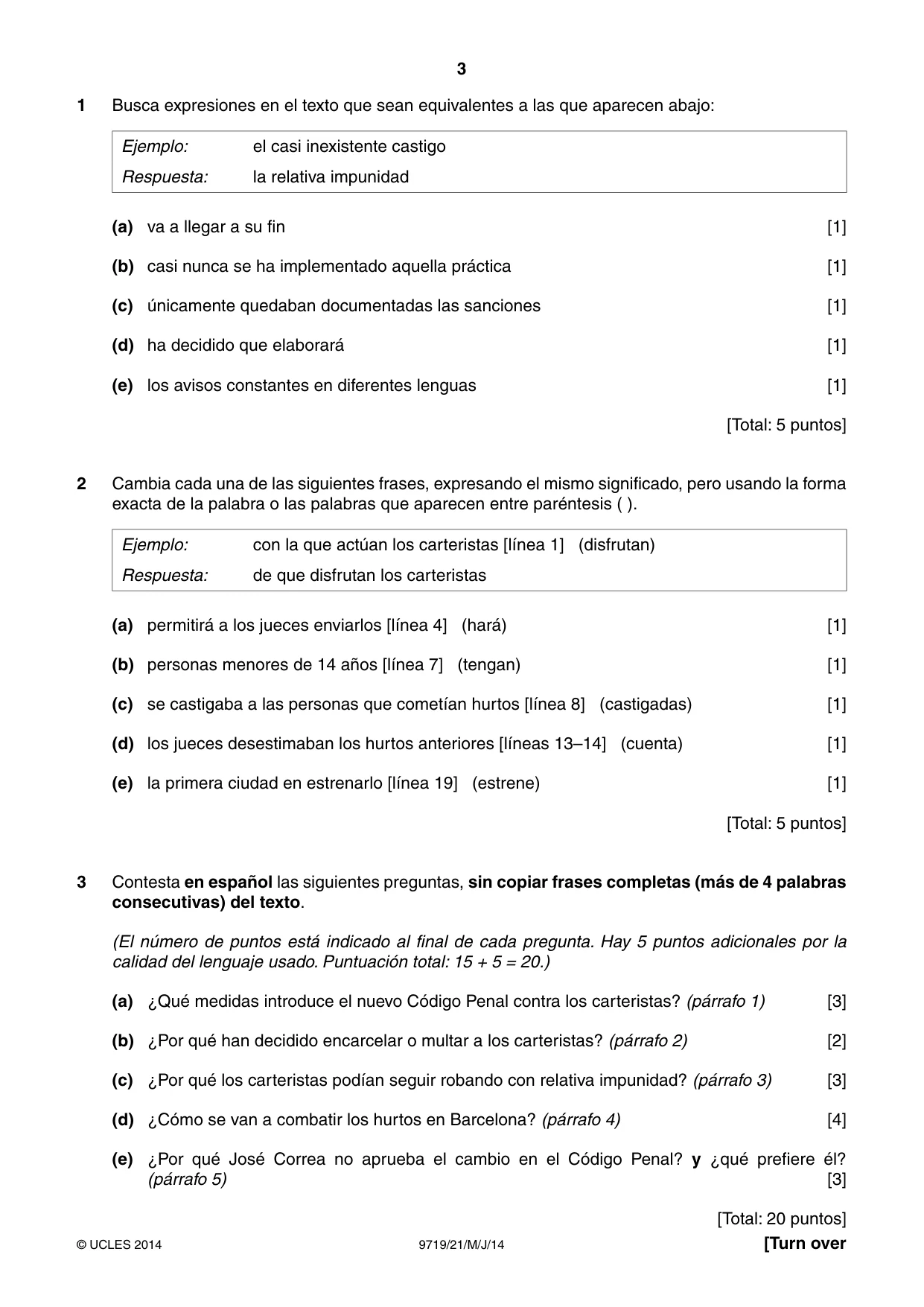
3 9719/21/M/J/14 © UCLES 2014 [Turn over 1 Busca expresiones en el texto que sean equivalentes a las que aparecen abajo: Ejemplo: el casi inexistente castigo Respuesta: la relativa impunidad (a) va a llegar a su fin [1] (b) casi nunca se ha implementado aquella práctica [1] (c) únicamente quedaban documentadas las sanciones [1] (d) ha decidido que elaborará [1] (e) los avisos constantes en diferentes lenguas [1] [Total: 5 puntos] 2 Cambia cada una de las siguientes frases, expresando el mismo significado, pero usando la forma exacta de la palabra o las palabras que aparecen entre paréntesis ( ). Ejemplo: con la que actúan los carteristas [línea 1] (disfrutan) Respuesta: de que disfrutan los carteristas (a) permitirá a los jueces enviarlos [línea 4] (hará) [1] (b) personas menores de 14 años [línea 7] (tengan) [1] (c) se castigaba a las personas que cometían hurtos [línea 8] (castigadas) [1] (d) los jueces desestimaban los hurtos anteriores [líneas 13–14] (cuenta) [1] (e) la primera ciudad en estrenarlo [línea 19] (estrene) [1] [Total: 5 puntos] 3 Contesta en español las siguientes preguntas, sin copiar frases completas (más de 4 palabras consecutivas) del texto. (El número de puntos está indicado al final de cada pregunta. Hay 5 puntos adicionales por la calidad del lenguaje usado. Puntuación total: 15 + 5 = 20.) (a) ¿Qué medidas introduce el nuevo Código Penal contra los carteristas? (párrafo 1) [3] (b) ¿Por qué han decidido encarcelar o multar a los carteristas? (párrafo 2) [2] (c) ¿Por qué los carteristas podían seguir robando con relativa impunidad? (párrafo 3) [3] (d) ¿Cómo se van a combatir los hurtos en Barcelona? (párrafo 4) [4] (e) ¿Por qué José Correa no aprueba el cambio en el Código Penal? y ¿qué prefiere él? (párrafo 5) [3] [Total: 20 puntos]
Question paper, page 4
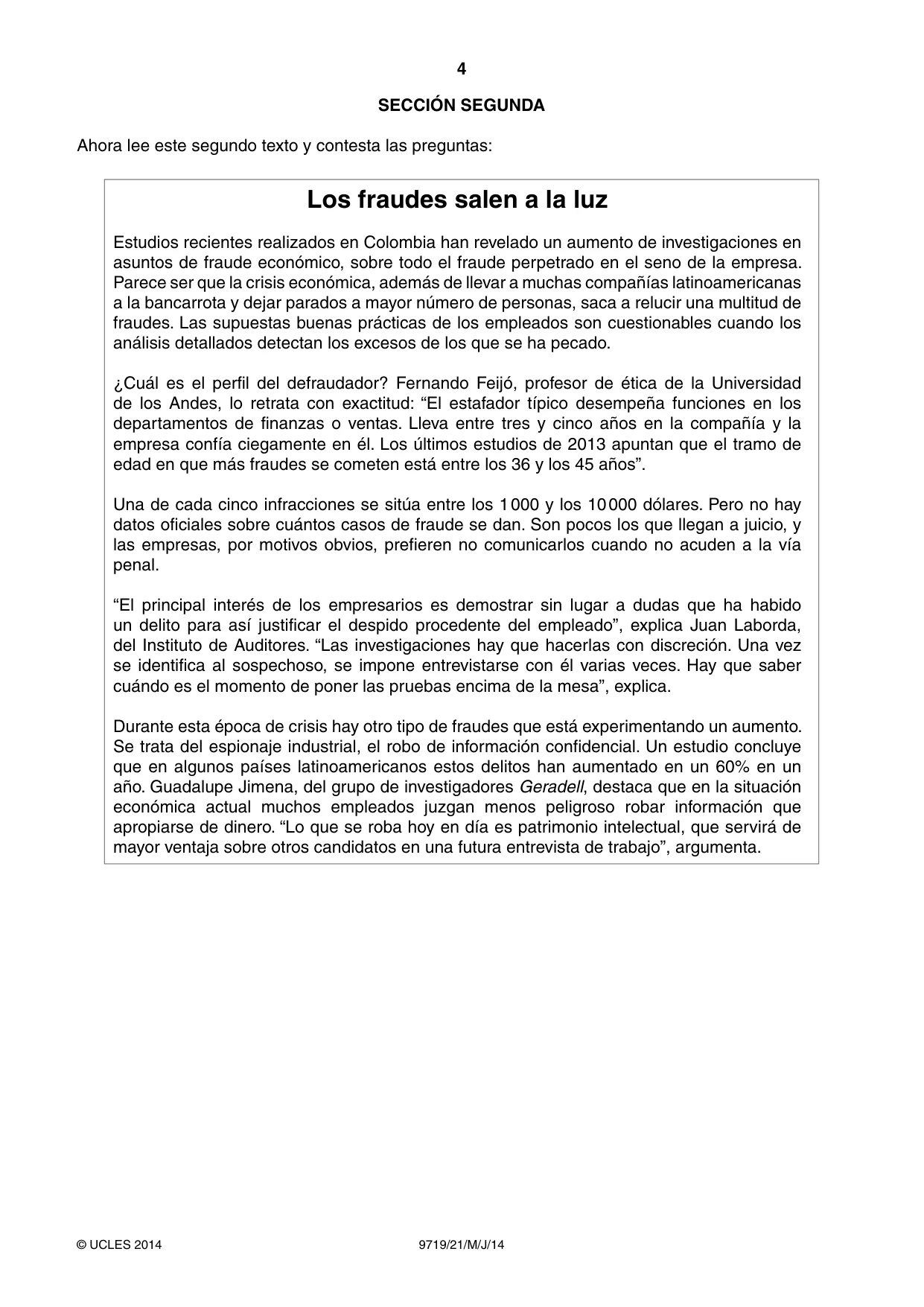
4 9719/21/M/J/14 © UCLES 2014 SECCIÓN SEGUNDA Ahora lee este segundo texto y contesta las preguntas: Los fraudes salen a la luz Estudios recientes realizados en Colombia han revelado un aumento de investigaciones en asuntos de fraude económico, sobre todo el fraude perpetrado en el seno de la empresa. Parece ser que la crisis económica, además de llevar a muchas compañías latinoamericanas a la bancarrota y dejar parados a mayor número de personas, saca a relucir una multitud de fraudes. Las supuestas buenas prácticas de los empleados son cuestionables cuando los análisis detallados detectan los excesos de los que se ha pecado. ¿Cuál es el perfil del defraudador? Fernando Feijó, profesor de ética de la Universidad de los Andes, lo retrata con exactitud: “El estafador típico desempeña funciones en los departamentos de finanzas o ventas. Lleva entre tres y cinco años en la compañía y la empresa confía ciegamente en él. Los últimos estudios de 2013 apuntan que el tramo de edad en que más fraudes se cometen está entre los 36 y los 45 años”. Una de cada cinco infracciones se sitúa entre los 1 000 y los 10 000 dólares. Pero no hay datos oficiales sobre cuántos casos de fraude se dan. Son pocos los que llegan a juicio, y las empresas, por motivos obvios, prefieren no comunicarlos cuando no acuden a la vía penal. “El principal interés de los empresarios es demostrar sin lugar a dudas que ha habido un delito para así justificar el despido procedente del empleado”, explica Juan Laborda, del Instituto de Auditores. “Las investigaciones hay que hacerlas con discreción. Una vez se identifica al sospechoso, se impone entrevistarse con él varias veces. Hay que saber cuándo es el momento de poner las pruebas encima de la mesa”, explica. Durante esta época de crisis hay otro tipo de fraudes que está experimentando un aumento. Se trata del espionaje industrial, el robo de información confidencial. Un estudio concluye que en algunos países latinoamericanos estos delitos han aumentado en un 60% en un año. Guadalupe Jimena, del grupo de investigadores Geradell, destaca que en la situación económica actual muchos empleados juzgan menos peligroso robar información que apropiarse de dinero. “Lo que se roba hoy en día es patrimonio intelectual, que servirá de mayor ventaja sobre otros candidatos en una futura entrevista de trabajo”, argumenta.
Question paper, page 5
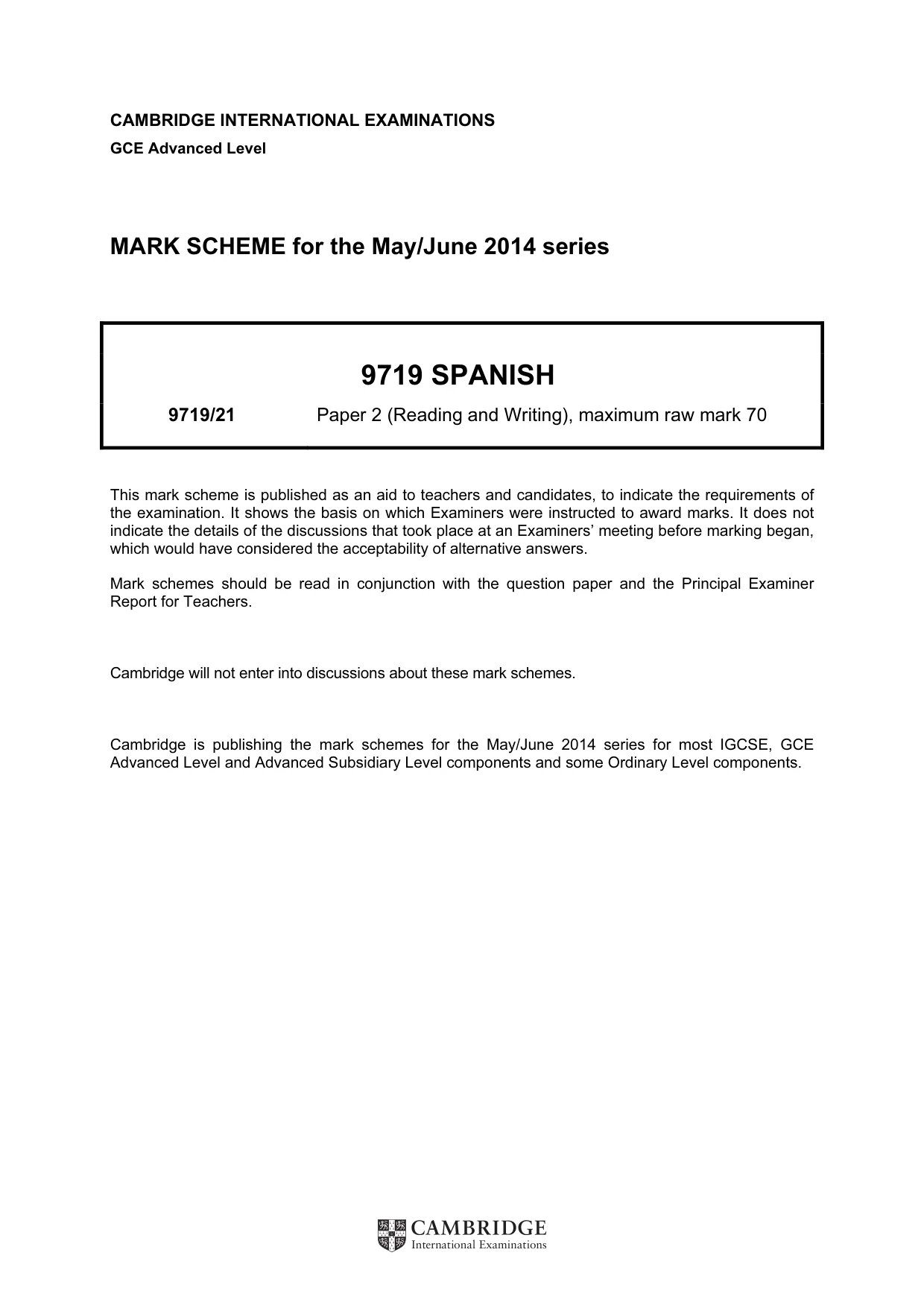
5 9719/21/M/J/14 © UCLES 2014 4 Contesta en español las siguientes preguntas, sin copiar frases completas (más de 4 palabras consecutivas) del texto. (El número de puntos está indicado al final de cada pregunta. Hay 5 puntos adicionales por la calidad del lenguaje usado. Puntuación total: 15 + 5 = 20.) (a) ¿Qué efectos tiene la crisis económica? (párrafo 1) [3] (b) ¿Cómo se caracteriza el defraudador típico? (párrafo 2) [4] (c) ¿Por qué hay muy pocos datos oficiales sobre los fraudes que ocurren? (párrafo 3) [2] (d) Según Juan Laborda: (i) ¿por qué buscan los empresarios una evidencia clara del fraude? (párrafo 4) [1] (ii) ¿cómo hay que poner de manifiesto el fraude? (párrafo 4) [3] (e) ¿Por qué ha aumentado el espionaje industrial? (párrafo 5) [2] [Total: 20 puntos] 5 Escribe en español un máximo de 140 palabras para completar las dos tareas siguientes. (a) Escribe un resumen de lo que se dice en los dos textos sobre cómo se persigue a los criminales en la actualidad. [10] (b) ¿Hay mucho crimen en tu país? Da tus opiniones. [5] (NOTA: Escribe un máximo de 140 palabras) [Calidad del lenguaje: 5] [Total: 20 puntos]
Question paper, page 6
6 9719/21/M/J/14 © UCLES 2014 BLANK PAGE
Question paper, page 7
7 9719/21/M/J/14 © UCLES 2014 BLANK PAGE
Question paper, page 8
8 9719/21/M/J/14 © UCLES 2014 Copyright Acknowledgments: Section 1 © Pere Ríos; ‘Cama caliente’ en prisión para el carterista ; El País; http://www.elpais.com/articulo/sociedad/Cama/caliente/prision/carterista elpepusoc/20100501elpepisoc_1/Tes; 1 May 2010. Section 2 © Bernat García; Fin de la permisividad ; El País; http://elpais.com/diario/2009/06/29/sociedad/1246226401_850215.html; 29 June 2009. Permission to reproduce items where third-party owned material protected by copyright is included has been sought and cleared where possible. Every reasonable effort has been made by the publisher (UCLES) to trace copyright holders, but if any items requiring clearance have unwittingly been included, the publisher will be pleased to make amends at the earliest possible opportunity. Cambridge International Examinations is part of the Cambridge Assessment Group. Cambridge Assessment is the brand name of University of Cambridge Local Examinations Syndicate (UCLES), which is itself a department of the University of Cambridge. BLANK PAGE
Mark scheme, page 1
CAMBRIDGE INTERNATIONAL EXAMINATIONS GCE Advanced Level MARK SCHEME for the May/June 2014 series 9719 SPANISH 9719/21 Paper 2 (Reading and Writing), maximum raw mark 70 This mark scheme is published as an aid to teachers and candidates, to indicate the requirements of the examination. It shows the basis on which Examiners were instructed to award marks. It does not indicate the details of the discussions that took place at an Examiners’ meeting before marking began, which would have considered the acceptability of alternative answers. Mark schemes should be read in conjunction with the question paper and the Principal Examiner Report for Teachers. Cambridge will not enter into discussions about these mark schemes. Cambridge is publishing the mark schemes for the May/June 2014 series for most IGCSE, GCE Advanced Level and Advanced Subsidiary Level components and some Ordinary Level components.
Mark scheme, page 2
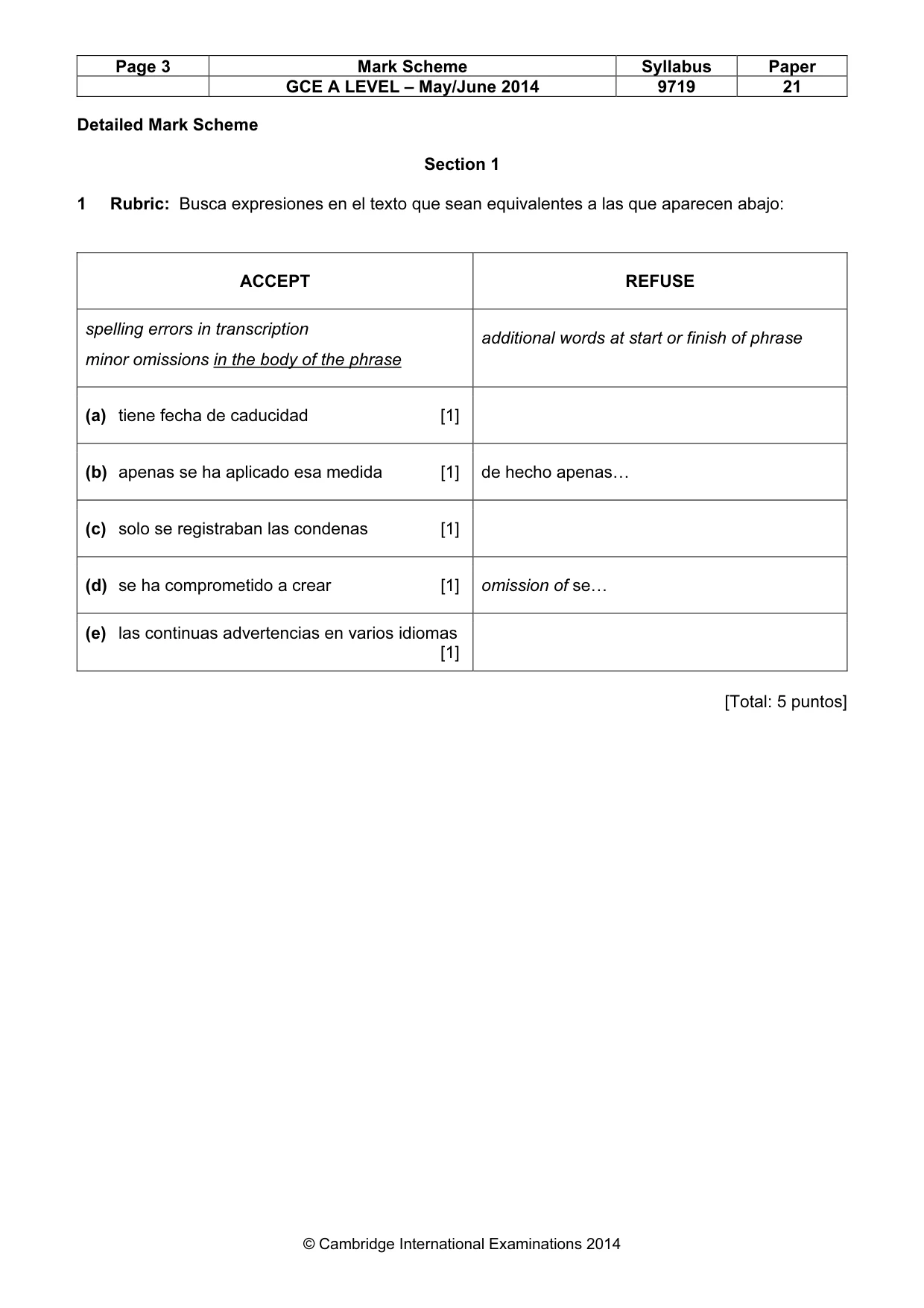
Page 2 Mark Scheme Syllabus Paper GCE A LEVEL – May/June 2014 9719 21 © Cambridge International Examinations 2014 1 General Marking Notes 2 General Marking Principles 2.1 Please note that it is not possible to list all acceptable alternatives in the Detailed Mark Scheme provided on the following pages. You will need to consider all alternative answers and unexpected approaches in candidates' scripts, make a decision on whether they communicate the required elements, in consultation with the Principal Examiner if necessary, and award marks accordingly. 2.2 Crossing out: (a) If a candidate changes his/her mind over an answer and crosses out an attempt, award a mark if the final attempt is correct. (b) If a candidate crosses out an answer to a whole question but makes no second attempt at it, mark the crossed out work. 2.3 Annotation used in marking: (a) BOD = Benefit of the Doubt and is used to indicate material considered by the Examiner and judged to be more correct than incorrect: the benefit of the doubt is given to the candidate and the mark is awarded. (b) NBOD = No Benefit of the Doubt and is used to indicate material considered by the Examiner and judged to be more incorrect than correct: the benefit of the doubt is not given to the candidate and the mark is not awarded. (c) caret = to indicate where something which is key to the response is missing. 2.4 No response and '0' marks There is a NR (No Response) option in scoris. Award NR (No Response): • If there is nothing written at all in the answer space or • If there is only a comment which does not in any way relate to the question being asked (e.g. 'can’t do' or 'don’t know') or • If there is only a mark which isn’t an attempt at the question (e.g. a dash, a question mark). Award 0: • If there is any attempt that earns no credit. This could, for example, include the candidate copying all or some of the question, or any working that does not earn any marks, whether crossed out or not.
Mark scheme, page 3
Page 3 Mark Scheme Syllabus Paper GCE A LEVEL – May/June 2014 9719 21 © Cambridge International Examinations 2014 Detailed Mark Scheme Section 1 1 Rubric: Busca expresiones en el texto que sean equivalentes a las que aparecen abajo: ACCEPT REFUSE spelling errors in transcription minor omissions in the body of the phrase additional words at start or finish of phrase (a) tiene fecha de caducidad [1] (b) apenas se ha aplicado esa medida [1] de hecho apenas… (c) solo se registraban las condenas [1] (d) se ha comprometido a crear [1] omission of se… (e) las continuas advertencias en varios idiomas [1] [Total: 5 puntos]
Mark scheme, page 4
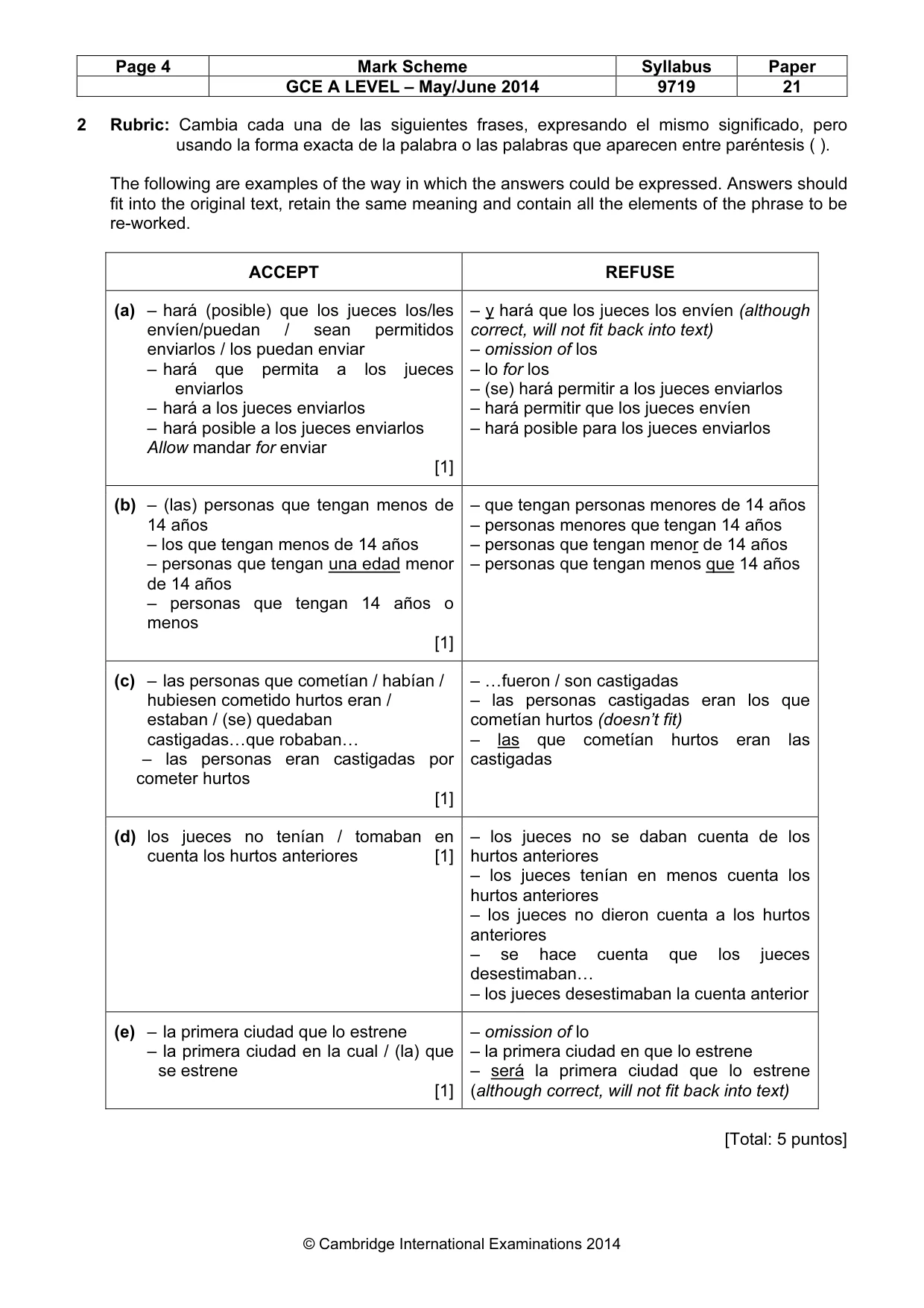
Page 4 Mark Scheme Syllabus Paper GCE A LEVEL – May/June 2014 9719 21 © Cambridge International Examinations 2014 2 Rubric: Cambia cada una de las siguientes frases, expresando el mismo significado, pero usando la forma exacta de la palabra o las palabras que aparecen entre paréntesis ( ). The following are examples of the way in which the answers could be expressed. Answers should fit into the original text, retain the same meaning and contain all the elements of the phrase to be re-worked. ACCEPT REFUSE (a) – hará (posible) que los jueces los/les envíen/puedan / sean permitidos enviarlos / los puedan enviar – hará que permita a los jueces enviarlos – hará a los jueces enviarlos – hará posible a los jueces enviarlos Allow mandar for enviar [1] – y hará que los jueces los envíen (although correct, will not fit back into text) – omission of los – lo for los – (se) hará permitir a los jueces enviarlos – hará permitir que los jueces envíen – hará posible para los jueces enviarlos (b) – (las) personas que tengan menos de 14 años – los que tengan menos de 14 años – personas que tengan una edad menor de 14 años – personas que tengan 14 años o menos [1] – que tengan personas menores de 14 años – personas menores que tengan 14 años – personas que tengan menor de 14 años – personas que tengan menos que 14 años (c) – las personas que cometían / habían / hubiesen cometido hurtos eran / estaban / (se) quedaban castigadas…que robaban… – las personas eran castigadas por cometer hurtos [1] – …fueron / son castigadas – las personas castigadas eran los que cometían hurtos (doesn’t fit) – las que cometían hurtos eran las castigadas (d) los jueces no tenían / tomaban en cuenta los hurtos anteriores [1] – los jueces no se daban cuenta de los hurtos anteriores – los jueces tenían en menos cuenta los hurtos anteriores – los jueces no dieron cuenta a los hurtos anteriores – se hace cuenta que los jueces desestimaban… – los jueces desestimaban la cuenta anterior (e) – la primera ciudad que lo estrene – la primera ciudad en la cual / (la) que se estrene [1] – omission of lo – la primera ciudad en que lo estrene – será la primera ciudad que lo estrene (although correct, will not fit back into text) [Total: 5 puntos]
Mark scheme, page 5
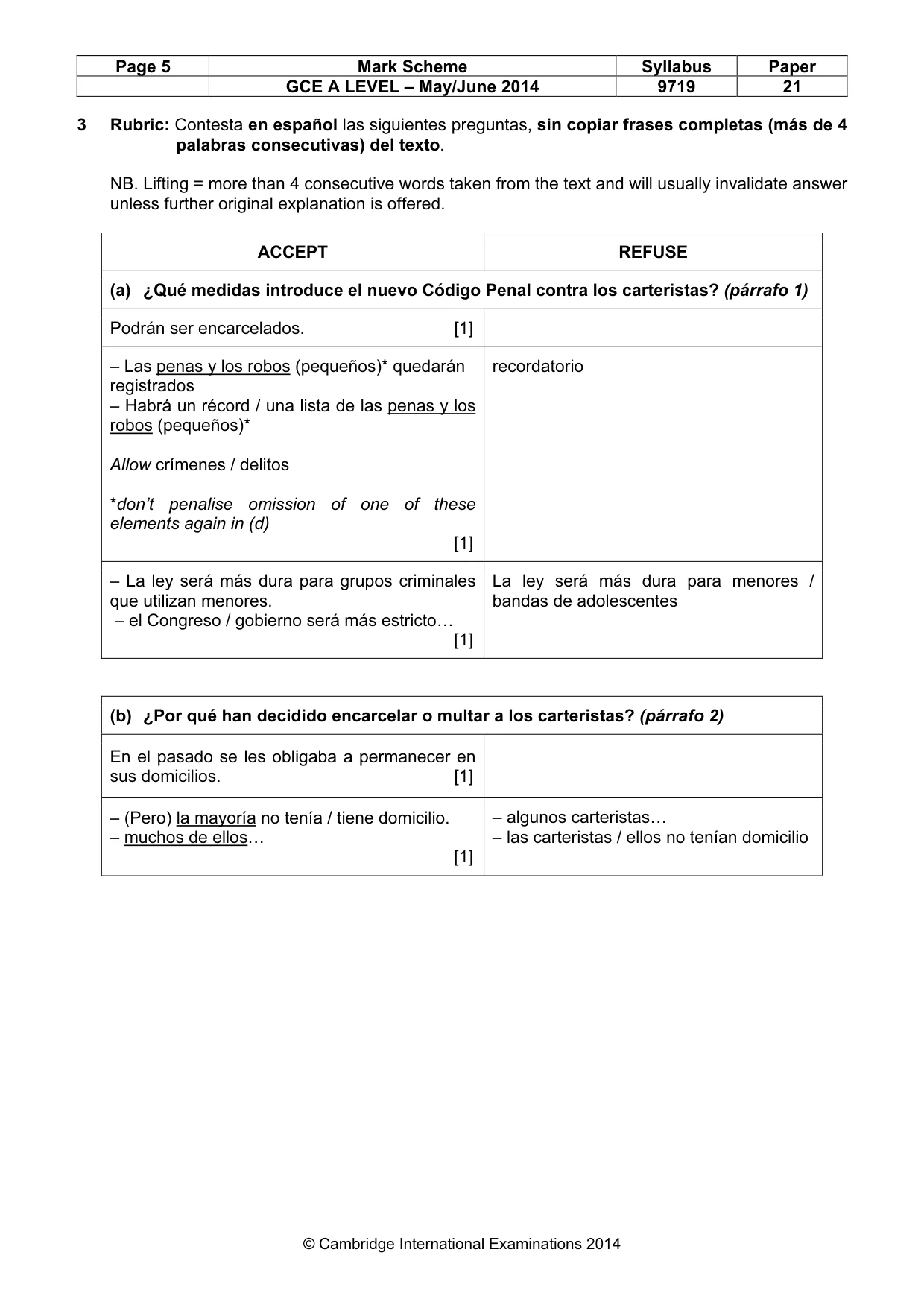
Page 5 Mark Scheme Syllabus Paper GCE A LEVEL – May/June 2014 9719 21 © Cambridge International Examinations 2014 3 Rubric: Contesta en español las siguientes preguntas, sin copiar frases completas (más de 4 palabras consecutivas) del texto. NB. Lifting = more than 4 consecutive words taken from the text and will usually invalidate answer unless further original explanation is offered. ACCEPT REFUSE (a) ¿Qué medidas introduce el nuevo Código Penal contra los carteristas? (párrafo 1) Podrán ser encarcelados. [1] – Las penas y los robos (pequeños)* quedarán registrados – Habrá un récord / una lista de las penas y los robos (pequeños)* Allow crímenes / delitos *don’t penalise omission of one of these elements again in (d) [1] recordatorio – La ley será más dura para grupos criminales que utilizan menores. – el Congreso / gobierno será más estricto… [1] La ley será más dura para menores / bandas de adolescentes (b) ¿Por qué han decidido encarcelar o multar a los carteristas? (párrafo 2) En el pasado se les obligaba a permanecer en sus domicilios. [1] – (Pero) la mayoría no tenía / tiene domicilio. – muchos de ellos… [1] – algunos carteristas… – las carteristas / ellos no tenían domicilio
Mark scheme, page 6
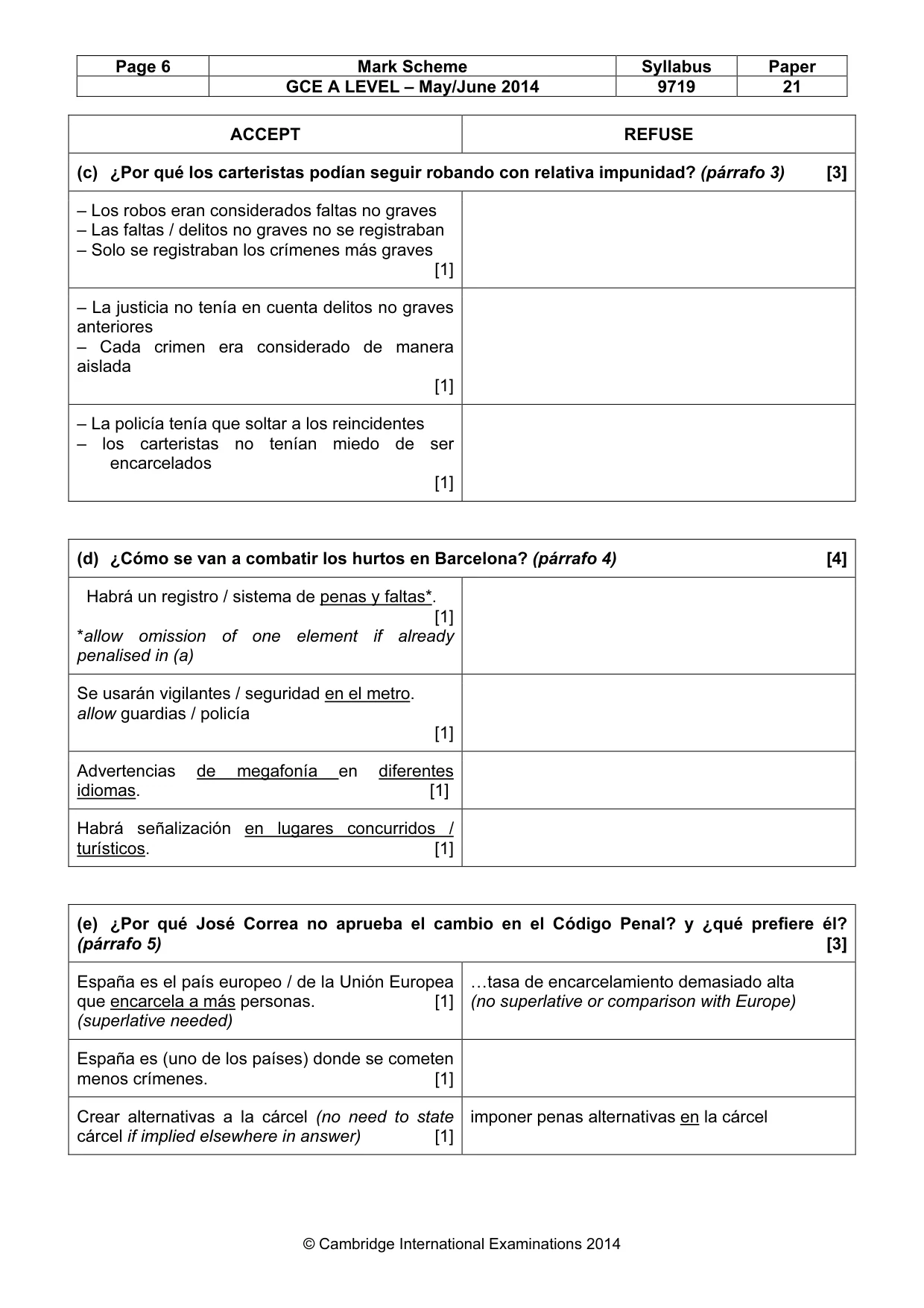
Page 6 Mark Scheme Syllabus Paper GCE A LEVEL – May/June 2014 9719 21 © Cambridge International Examinations 2014 ACCEPT REFUSE (c) ¿Por qué los carteristas podían seguir robando con relativa impunidad? (párrafo 3) [3] – Los robos eran considerados faltas no graves – Las faltas / delitos no graves no se registraban – Solo se registraban los crímenes más graves [1] – La justicia no tenía en cuenta delitos no graves anteriores – Cada crimen era considerado de manera aislada [1] – La policía tenía que soltar a los reincidentes – los carteristas no tenían miedo de ser encarcelados [1] (d) ¿Cómo se van a combatir los hurtos en Barcelona? (párrafo 4) [4] Habrá un registro / sistema de penas y faltas*. [1] *allow omission of one element if already penalised in (a) Se usarán vigilantes / seguridad en el metro. allow guardias / policía [1] Advertencias de megafonía en diferentes idiomas. [1] Habrá señalización en lugares concurridos / turísticos. [1] (e) ¿Por qué José Correa no aprueba el cambio en el Código Penal? y ¿qué prefiere él? (párrafo 5) [3] España es el país europeo / de la Unión Europea que encarcela a más personas. [1] (superlative needed) …tasa de encarcelamiento demasiado alta (no superlative or comparison with Europe) España es (uno de los países) donde se cometen menos crímenes. [1] Crear alternativas a la cárcel (no need to state cárcel if implied elsewhere in answer) [1] imponer penas alternativas en la cárcel
Mark scheme, page 7
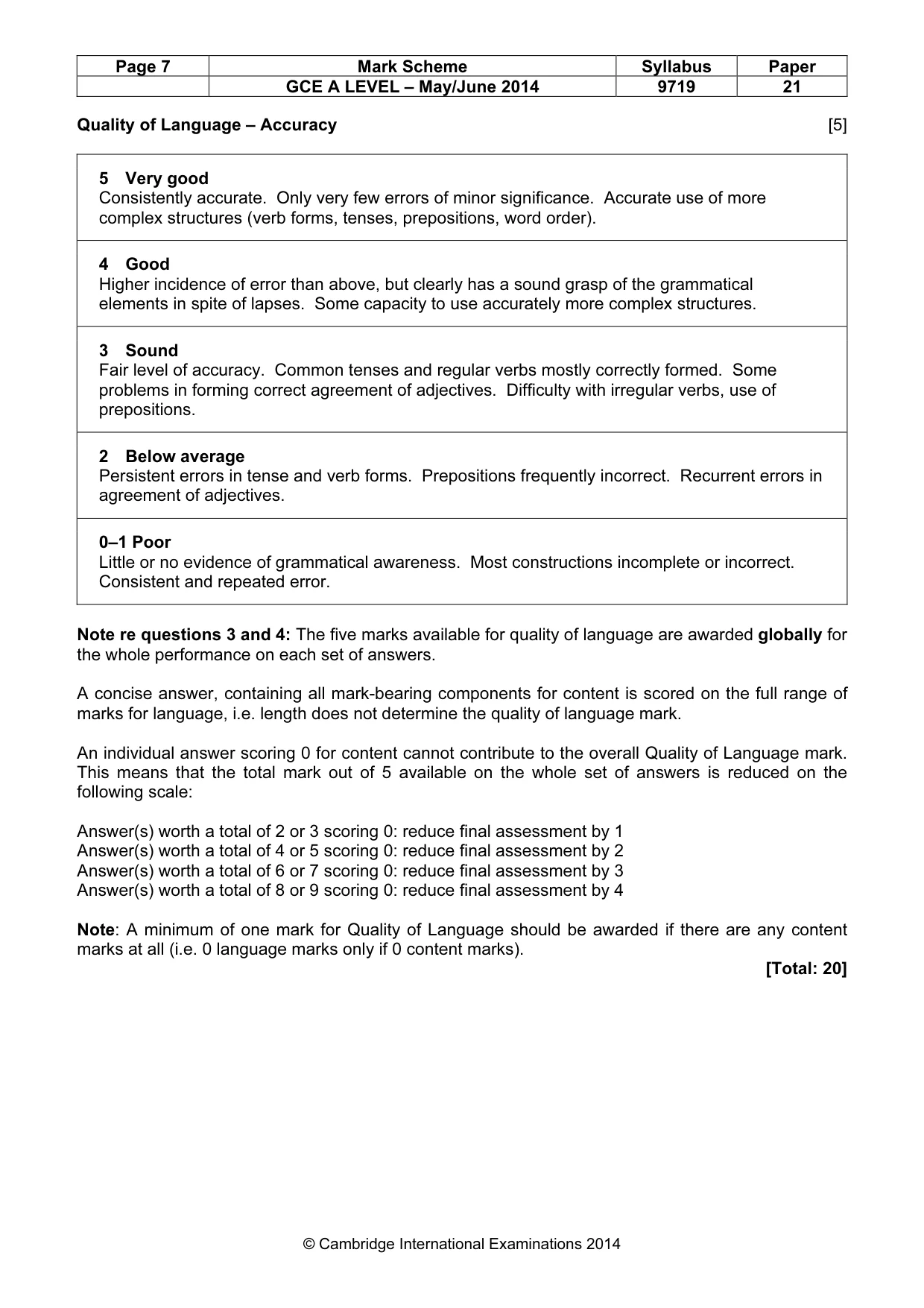
Page 7 Mark Scheme Syllabus Paper GCE A LEVEL – May/June 2014 9719 21 © Cambridge International Examinations 2014 Quality of Language – Accuracy [5] 5 Very good Consistently accurate. Only very few errors of minor significance. Accurate use of more complex structures (verb forms, tenses, prepositions, word order). 4 Good Higher incidence of error than above, but clearly has a sound grasp of the grammatical elements in spite of lapses. Some capacity to use accurately more complex structures. 3 Sound Fair level of accuracy. Common tenses and regular verbs mostly correctly formed. Some problems in forming correct agreement of adjectives. Difficulty with irregular verbs, use of prepositions. 2 Below average Persistent errors in tense and verb forms. Prepositions frequently incorrect. Recurrent errors in agreement of adjectives. 0–1 Poor Little or no evidence of grammatical awareness. Most constructions incomplete or incorrect. Consistent and repeated error. Note re questions 3 and 4: The five marks available for quality of language are awarded globally for the whole performance on each set of answers. A concise answer, containing all mark-bearing components for content is scored on the full range of marks for language, i.e. length does not determine the quality of language mark. An individual answer scoring 0 for content cannot contribute to the overall Quality of Language mark. This means that the total mark out of 5 available on the whole set of answers is reduced on the following scale: Answer(s) worth a total of 2 or 3 scoring 0: reduce final assessment by 1 Answer(s) worth a total of 4 or 5 scoring 0: reduce final assessment by 2 Answer(s) worth a total of 6 or 7 scoring 0: reduce final assessment by 3 Answer(s) worth a total of 8 or 9 scoring 0: reduce final assessment by 4 Note: A minimum of one mark for Quality of Language should be awarded if there are any content marks at all (i.e. 0 language marks only if 0 content marks). [Total: 20]
Mark scheme, page 8
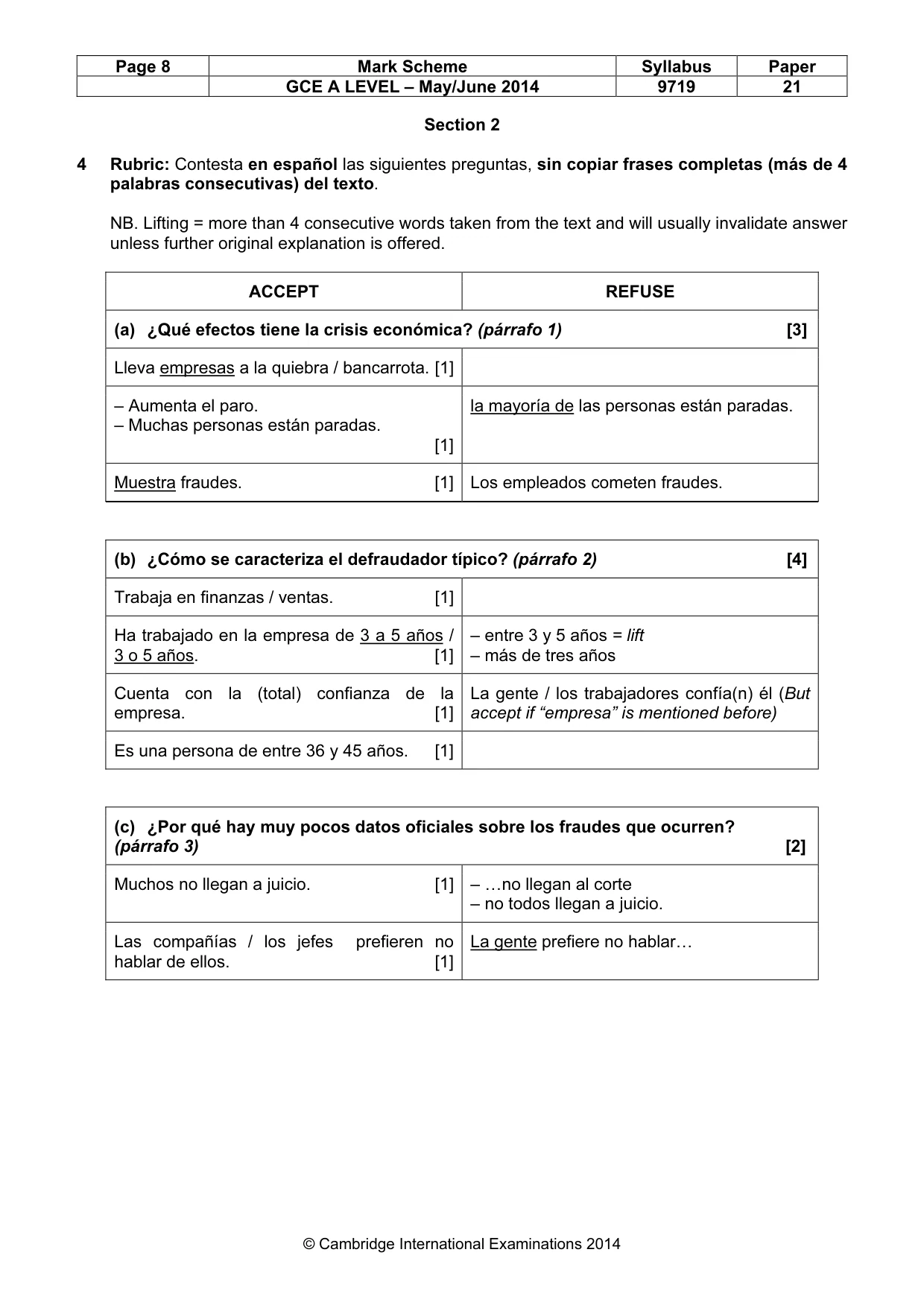
Page 8 Mark Scheme Syllabus Paper GCE A LEVEL – May/June 2014 9719 21 © Cambridge International Examinations 2014 Section 2 4 Rubric: Contesta en español las siguientes preguntas, sin copiar frases completas (más de 4 palabras consecutivas) del texto. NB. Lifting = more than 4 consecutive words taken from the text and will usually invalidate answer unless further original explanation is offered. ACCEPT REFUSE (a) ¿Qué efectos tiene la crisis económica? (párrafo 1) [3] Lleva empresas a la quiebra / bancarrota. [1] – Aumenta el paro. – Muchas personas están paradas. [1] la mayoría de las personas están paradas. Muestra fraudes. [1] Los empleados cometen fraudes. (b) ¿Cómo se caracteriza el defraudador típico? (párrafo 2) [4] Trabaja en finanzas / ventas. [1] Ha trabajado en la empresa de 3 a 5 años / 3 o 5 años. [1] – entre 3 y 5 años = lift – más de tres años Cuenta con la (total) confianza de la empresa. [1] La gente / los trabajadores confía(n) él (But accept if “empresa” is mentioned before) Es una persona de entre 36 y 45 años. [1] (c) ¿Por qué hay muy pocos datos oficiales sobre los fraudes que ocurren? (párrafo 3) [2] Muchos no llegan a juicio. [1] – …no llegan al corte – no todos llegan a juicio. Las compañías / los jefes prefieren no hablar de ellos. [1] La gente prefiere no hablar…
Mark scheme, page 9
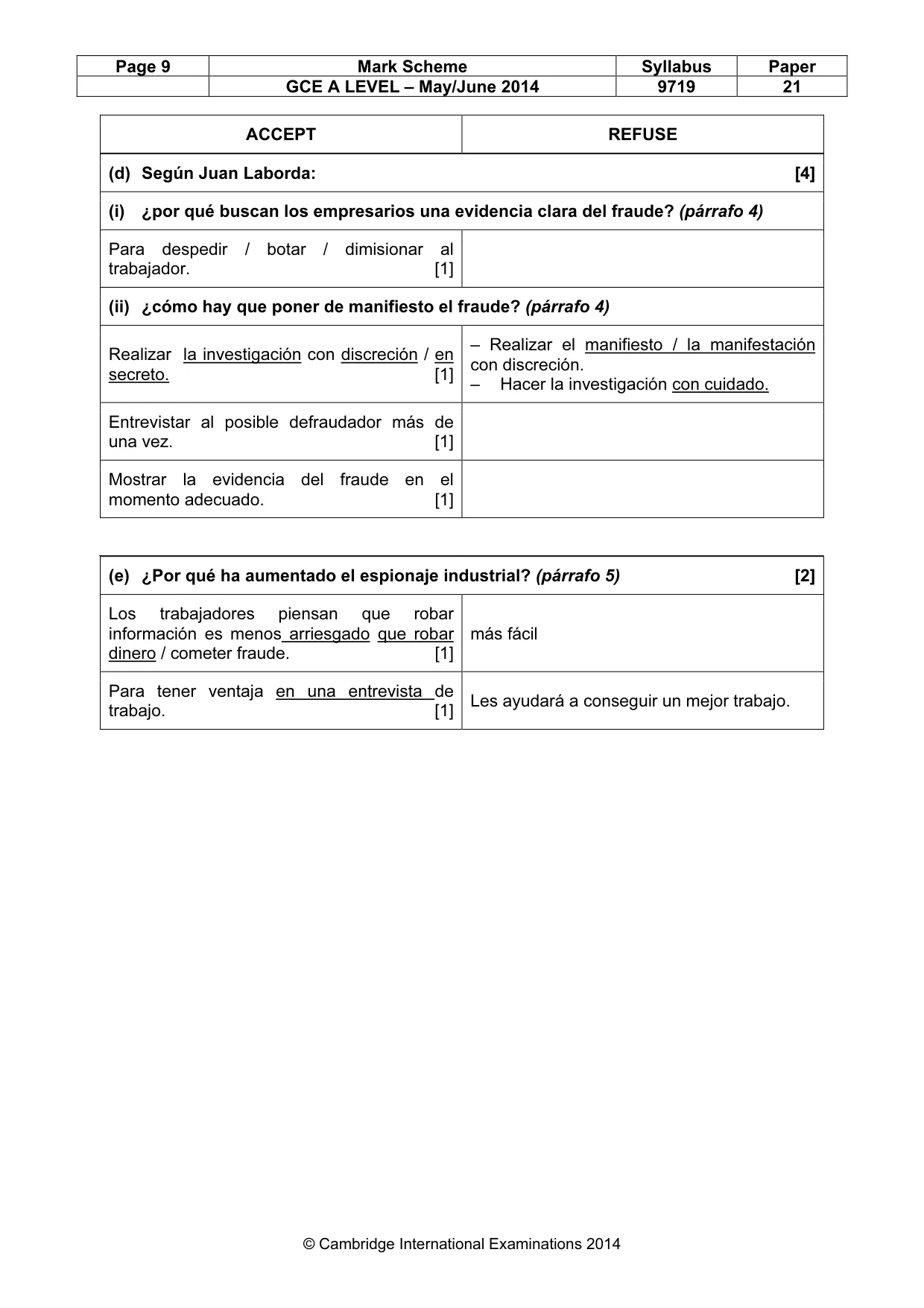
Page 9 Mark Scheme Syllabus Paper GCE A LEVEL – May/June 2014 9719 21 © Cambridge International Examinations 2014 ACCEPT REFUSE (d) Según Juan Laborda: [4] (i) ¿por qué buscan los empresarios una evidencia clara del fraude? (párrafo 4) Para despedir / botar / dimisionar al trabajador. [1] (ii) ¿cómo hay que poner de manifiesto el fraude? (párrafo 4) Realizar la investigación con discreción / en secreto. [1] – Realizar el manifiesto / la manifestación con discreción. – Hacer la investigación con cuidado. Entrevistar al posible defraudador más de una vez. [1] Mostrar la evidencia del fraude en el momento adecuado. [1] (e) ¿Por qué ha aumentado el espionaje industrial? (párrafo 5) [2] Los trabajadores piensan que robar información es menos arriesgado que robar dinero / cometer fraude. [1] más fácil Para tener ventaja en una entrevista de trabajo. [1] Les ayudará a conseguir un mejor trabajo.
Mark scheme, page 10
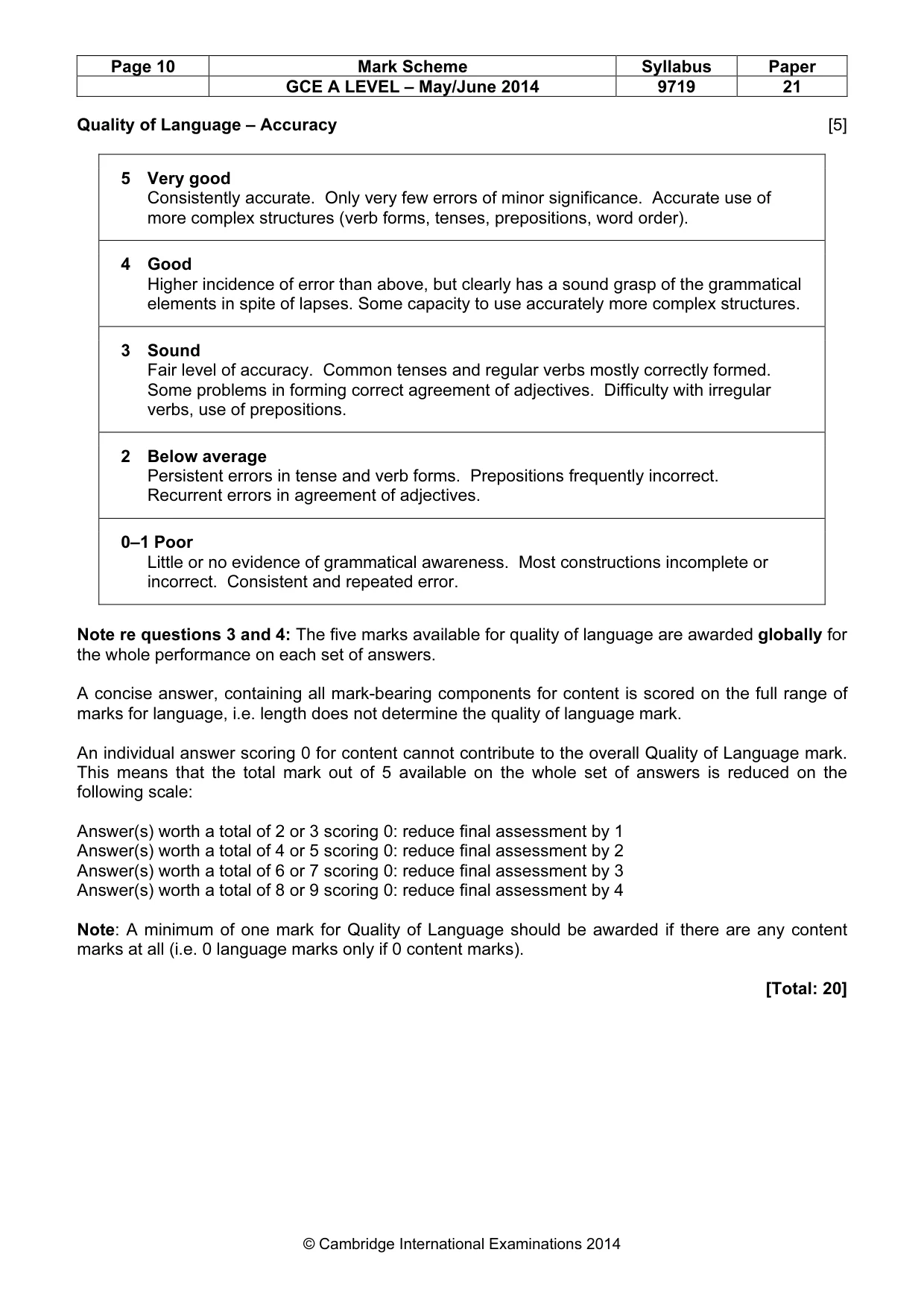
Page 10 Mark Scheme Syllabus Paper GCE A LEVEL – May/June 2014 9719 21 © Cambridge International Examinations 2014 Quality of Language – Accuracy [5] 5 Very good Consistently accurate. Only very few errors of minor significance. Accurate use of more complex structures (verb forms, tenses, prepositions, word order). 4 Good Higher incidence of error than above, but clearly has a sound grasp of the grammatical elements in spite of lapses. Some capacity to use accurately more complex structures. 3 Sound Fair level of accuracy. Common tenses and regular verbs mostly correctly formed. Some problems in forming correct agreement of adjectives. Difficulty with irregular verbs, use of prepositions. 2 Below average Persistent errors in tense and verb forms. Prepositions frequently incorrect. Recurrent errors in agreement of adjectives. 0–1 Poor Little or no evidence of grammatical awareness. Most constructions incomplete or incorrect. Consistent and repeated error. Note re questions 3 and 4: The five marks available for quality of language are awarded globally for the whole performance on each set of answers. A concise answer, containing all mark-bearing components for content is scored on the full range of marks for language, i.e. length does not determine the quality of language mark. An individual answer scoring 0 for content cannot contribute to the overall Quality of Language mark. This means that the total mark out of 5 available on the whole set of answers is reduced on the following scale: Answer(s) worth a total of 2 or 3 scoring 0: reduce final assessment by 1 Answer(s) worth a total of 4 or 5 scoring 0: reduce final assessment by 2 Answer(s) worth a total of 6 or 7 scoring 0: reduce final assessment by 3 Answer(s) worth a total of 8 or 9 scoring 0: reduce final assessment by 4 Note: A minimum of one mark for Quality of Language should be awarded if there are any content marks at all (i.e. 0 language marks only if 0 content marks). [Total: 20]
Mark scheme, page 11
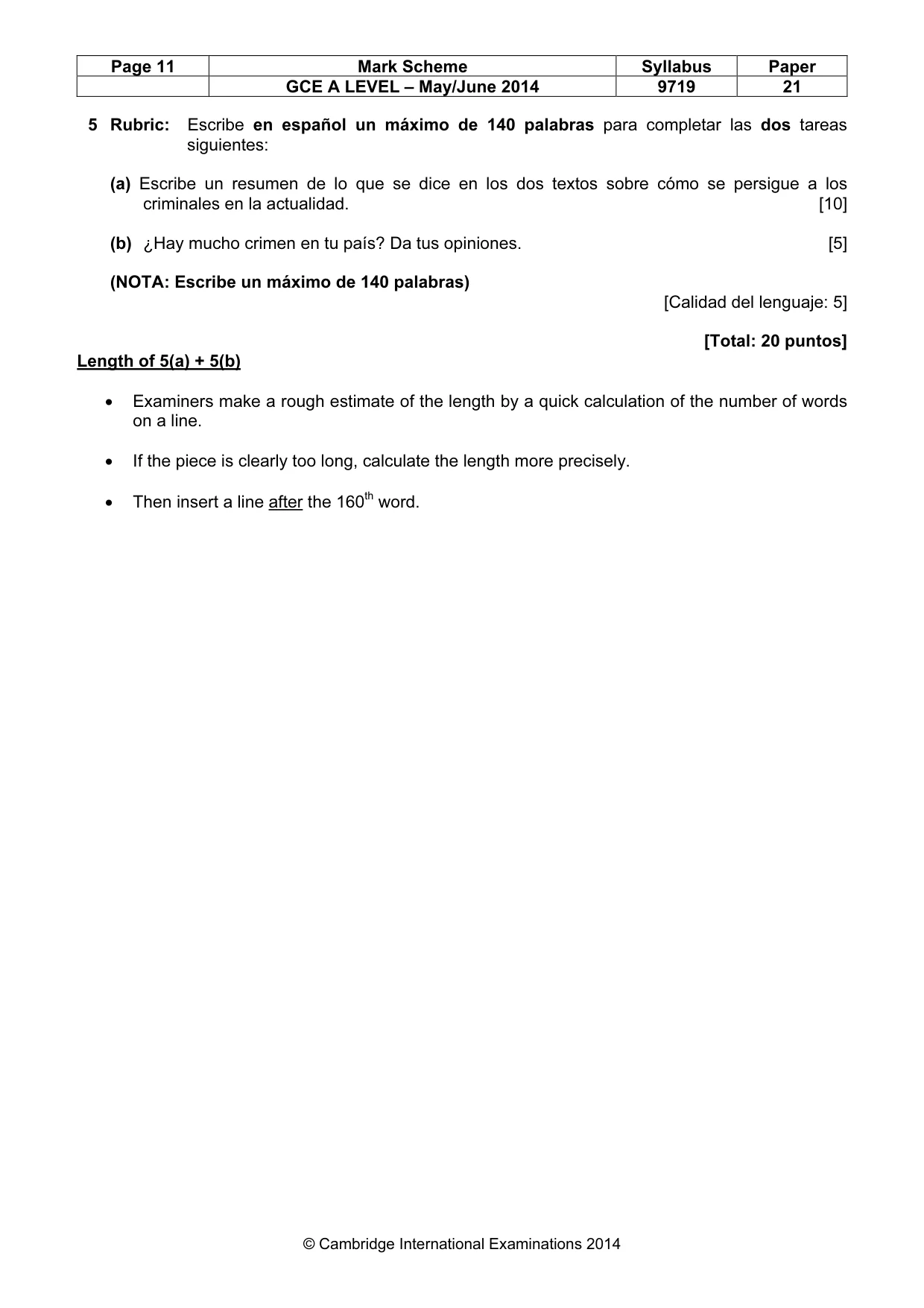
Page 11 Mark Scheme Syllabus Paper GCE A LEVEL – May/June 2014 9719 21 © Cambridge International Examinations 2014 5 Rubric: Escribe en español un máximo de 140 palabras para completar las dos tareas siguientes: (a) Escribe un resumen de lo que se dice en los dos textos sobre cómo se persigue a los criminales en la actualidad. [10] (b) ¿Hay mucho crimen en tu país? Da tus opiniones. [5] (NOTA: Escribe un máximo de 140 palabras) [Calidad del lenguaje: 5] [Total: 20 puntos] Length of 5(a) + 5(b) • Examiners make a rough estimate of the length by a quick calculation of the number of words on a line. • If the piece is clearly too long, calculate the length more precisely. • Then insert a line after the 160th word.
Mark scheme, page 12
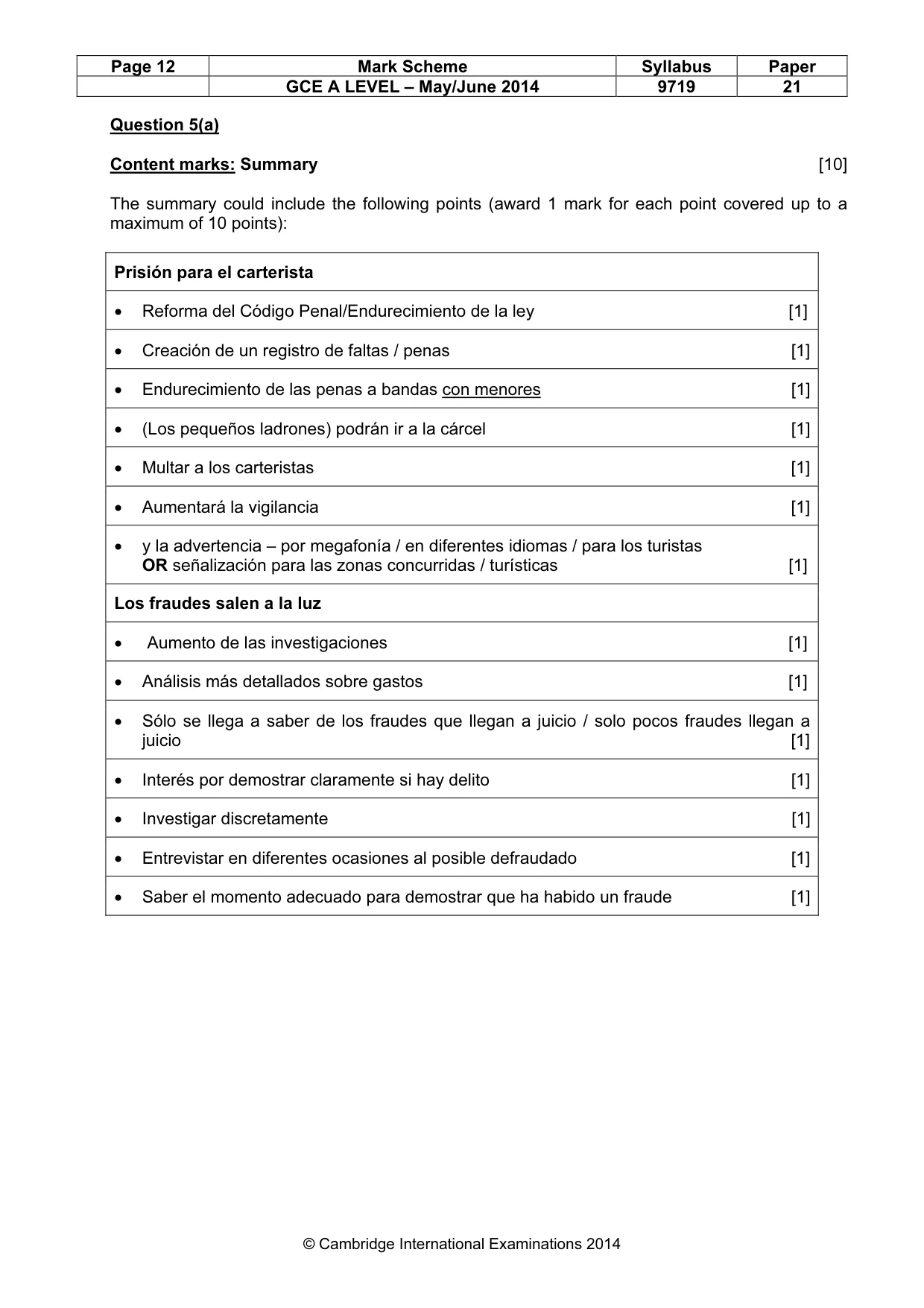
Page 12 Mark Scheme Syllabus Paper GCE A LEVEL – May/June 2014 9719 21 © Cambridge International Examinations 2014 Question 5(a) Content marks: Summary [10] The summary could include the following points (award 1 mark for each point covered up to a maximum of 10 points): Prisión para el carterista • Reforma del Código Penal/Endurecimiento de la ley [1] • Creación de un registro de faltas / penas [1] • Endurecimiento de las penas a bandas con menores [1] • (Los pequeños ladrones) podrán ir a la cárcel [1] • Multar a los carteristas [1] • Aumentará la vigilancia [1] • y la advertencia – por megafonía / en diferentes idiomas / para los turistas OR señalización para las zonas concurridas / turísticas [1] Los fraudes salen a la luz • Aumento de las investigaciones [1] • Análisis más detallados sobre gastos [1] • Sólo se llega a saber de los fraudes que llegan a juicio / solo pocos fraudes llegan a juicio [1] • Interés por demostrar claramente si hay delito [1] • Investigar discretamente [1] • Entrevistar en diferentes ocasiones al posible defraudado [1] • Saber el momento adecuado para demostrar que ha habido un fraude [1]
Mark scheme, page 13
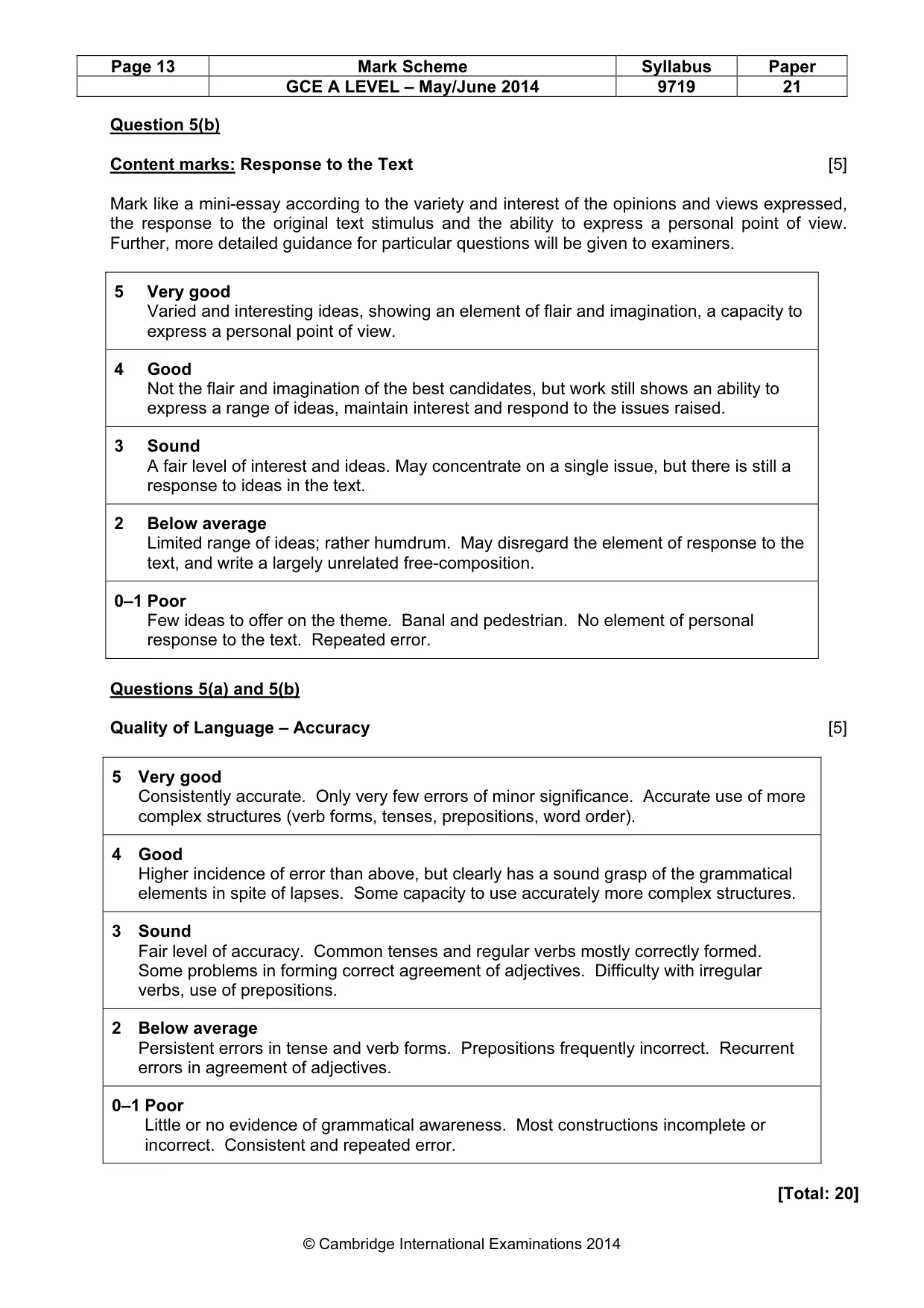
Page 13 Mark Scheme Syllabus Paper GCE A LEVEL – May/June 2014 9719 21 © Cambridge International Examinations 2014 Question 5(b) Content marks: Response to the Text [5] Mark like a mini-essay according to the variety and interest of the opinions and views expressed, the response to the original text stimulus and the ability to express a personal point of view. Further, more detailed guidance for particular questions will be given to examiners. 5 Very good Varied and interesting ideas, showing an element of flair and imagination, a capacity to express a personal point of view. 4 Good Not the flair and imagination of the best candidates, but work still shows an ability to express a range of ideas, maintain interest and respond to the issues raised. 3 Sound A fair level of interest and ideas. May concentrate on a single issue, but there is still a response to ideas in the text. 2 Below average Limited range of ideas; rather humdrum. May disregard the element of response to the text, and write a largely unrelated free-composition. 0–1 Poor Few ideas to offer on the theme. Banal and pedestrian. No element of personal response to the text. Repeated error. Questions 5(a) and 5(b) Quality of Language – Accuracy [5] 5 Very good Consistently accurate. Only very few errors of minor significance. Accurate use of more complex structures (verb forms, tenses, prepositions, word order). 4 Good Higher incidence of error than above, but clearly has a sound grasp of the grammatical elements in spite of lapses. Some capacity to use accurately more complex structures. 3 Sound Fair level of accuracy. Common tenses and regular verbs mostly correctly formed. Some problems in forming correct agreement of adjectives. Difficulty with irregular verbs, use of prepositions. 2 Below average Persistent errors in tense and verb forms. Prepositions frequently incorrect. Recurrent errors in agreement of adjectives. 0–1 Poor Little or no evidence of grammatical awareness. Most constructions incomplete or incorrect. Consistent and repeated error. [Total: 20]
What you needed in this session
Cambridge’s own grade thresholds for 2014 May/June, Paper 2 · Variant 1. A higher threshold means an easier paper — the bar moves with how the cohort did.