Cambridge A Level Spanish (A Level only) 9719 — 2012 Oct/Nov Paper 2 · Variant 3
9719/23/O/N/12 · 70 marks · ≈79 min
The question paper and its mark scheme, free to read here and free to download. This is Cambridge’s own paper, exactly as it was sat.
Question paper8 pages


Mark scheme9 pages
Answers below. Sit the paper first if you are practising.
Paper as text
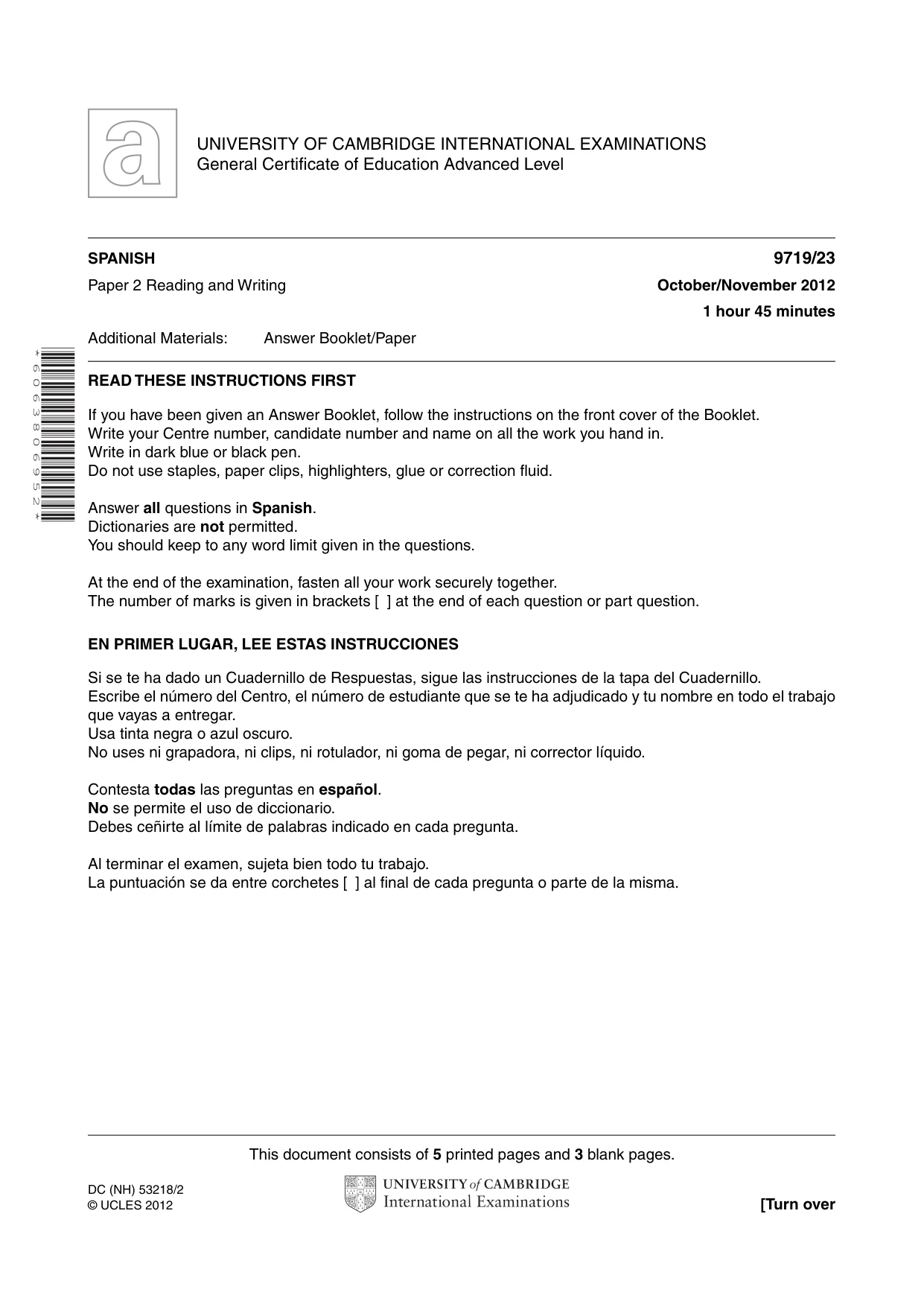
Question paper, page 1
This document consists of 5 printed pages and 3 blank pages. DC (NH) 53218/2 © UCLES 2012 [Turn over * 6 0 6 3 8 0 6 9 5 2 * SPANISH 9719/23 Paper 2 Reading and Writing October/November 2012 1 hour 45 minutes Additional Materials: Answer Booklet/Paper READ THESE INSTRUCTIONS FIRST If you have been given an Answer Booklet, follow the instructions on the front cover of the Booklet. Write your Centre number, candidate number and name on all the work you hand in. Write in dark blue or black pen. Do not use staples, paper clips, highlighters, glue or correction fluid. Answer all questions in Spanish. Dictionaries are not permitted. You should keep to any word limit given in the questions. At the end of the examination, fasten all your work securely together. The number of marks is given in brackets [ ] at the end of each question or part question. EN PRIMER LUGAR, LEE ESTAS INSTRUCCIONES Si se te ha dado un Cuadernillo de Respuestas, sigue las instrucciones de la tapa del Cuadernillo. Escribe el número del Centro, el número de estudiante que se te ha adjudicado y tu nombre en todo el trabajo que vayas a entregar. Usa tinta negra o azul oscuro. No uses ni grapadora, ni clips, ni rotulador, ni goma de pegar, ni corrector líquido. Contesta todas las preguntas en español. No se permite el uso de diccionario. Debes ceñirte al límite de palabras indicado en cada pregunta. Al terminar el examen, sujeta bien todo tu trabajo. La puntuación se da entre corchetes [ ] al final de cada pregunta o parte de la misma. UNIVERSITY OF CAMBRIDGE INTERNATIONAL EXAMINATIONS General Certificate of Education Advanced Level
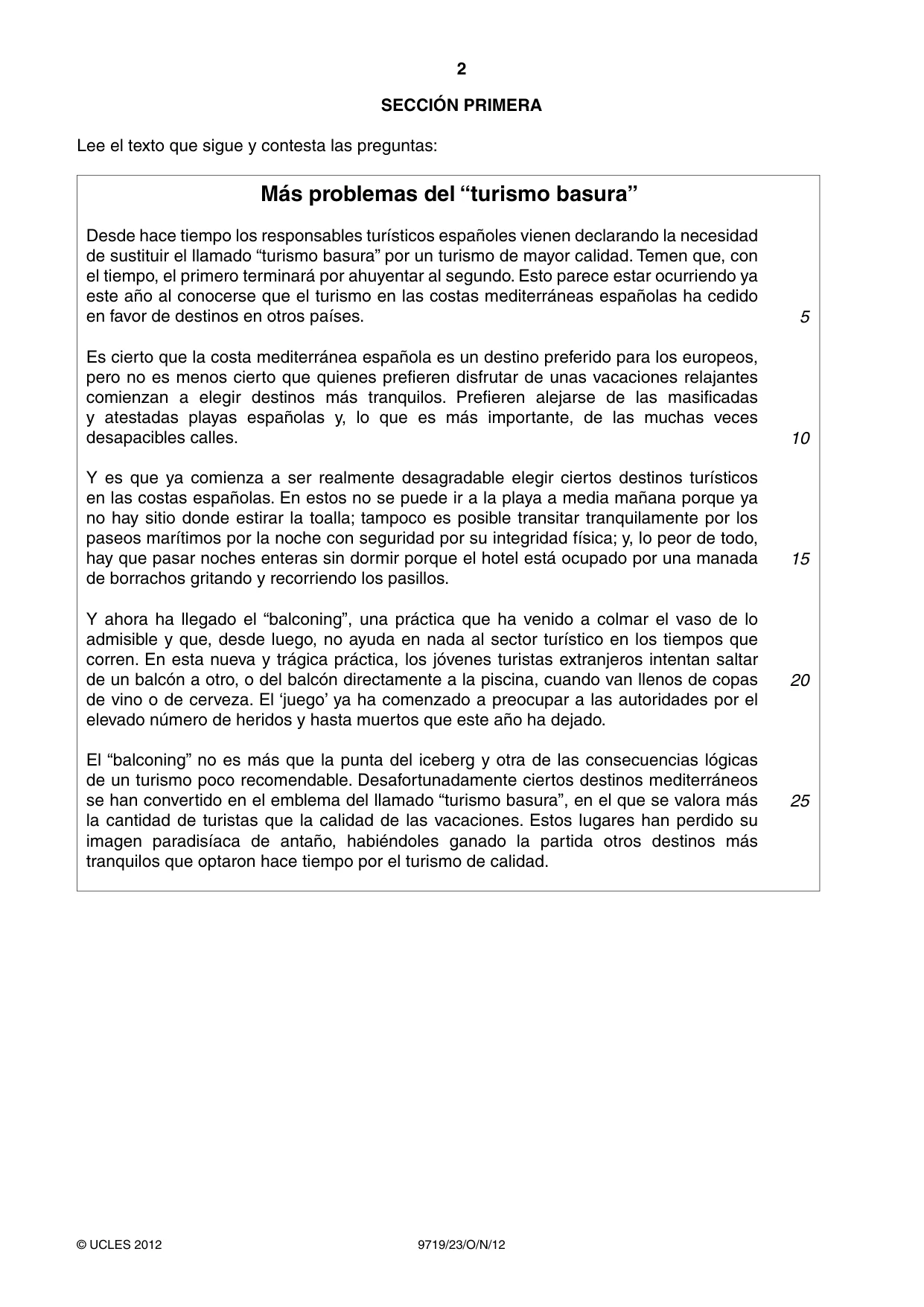
Question paper, page 2
2 9719/23/O/N/12 © UCLES 2012 SECCIÓN PRIMERA Lee el texto que sigue y contesta las preguntas: Más problemas del “turismo basura” Desde hace tiempo los responsables turísticos españoles vienen declarando la necesidad de sustituir el llamado “turismo basura” por un turismo de mayor calidad. Temen que, con el tiempo, el primero terminará por ahuyentar al segundo. Esto parece estar ocurriendo ya este año al conocerse que el turismo en las costas mediterráneas españolas ha cedido en favor de destinos en otros países. Es cierto que la costa mediterránea española es un destino preferido para los europeos, pero no es menos cierto que quienes prefieren disfrutar de unas vacaciones relajantes comienzan a elegir destinos más tranquilos. Prefieren alejarse de las masificadas y atestadas playas españolas y, lo que es más importante, de las muchas veces desapacibles calles. Y es que ya comienza a ser realmente desagradable elegir ciertos destinos turísticos en las costas españolas. En estos no se puede ir a la playa a media mañana porque ya no hay sitio donde estirar la toalla; tampoco es posible transitar tranquilamente por los paseos marítimos por la noche con seguridad por su integridad física; y, lo peor de todo, hay que pasar noches enteras sin dormir porque el hotel está ocupado por una manada de borrachos gritando y recorriendo los pasillos. Y ahora ha llegado el “balconing”, una práctica que ha venido a colmar el vaso de lo admisible y que, desde luego, no ayuda en nada al sector turístico en los tiempos que corren. En esta nueva y trágica práctica, los jóvenes turistas extranjeros intentan saltar de un balcón a otro, o del balcón directamente a la piscina, cuando van llenos de copas de vino o de cerveza. El ‘juego’ ya ha comenzado a preocupar a las autoridades por el elevado número de heridos y hasta muertos que este año ha dejado. El “balconing” no es más que la punta del iceberg y otra de las consecuencias lógicas de un turismo poco recomendable. Desafortunadamente ciertos destinos mediterráneos se han convertido en el emblema del llamado “turismo basura”, en el que se valora más la cantidad de turistas que la calidad de las vacaciones. Estos lugares han perdido su imagen paradisíaca de antaño, habiéndoles ganado la partida otros destinos más tranquilos que optaron hace tiempo por el turismo de calidad. 5 10 15 20 25
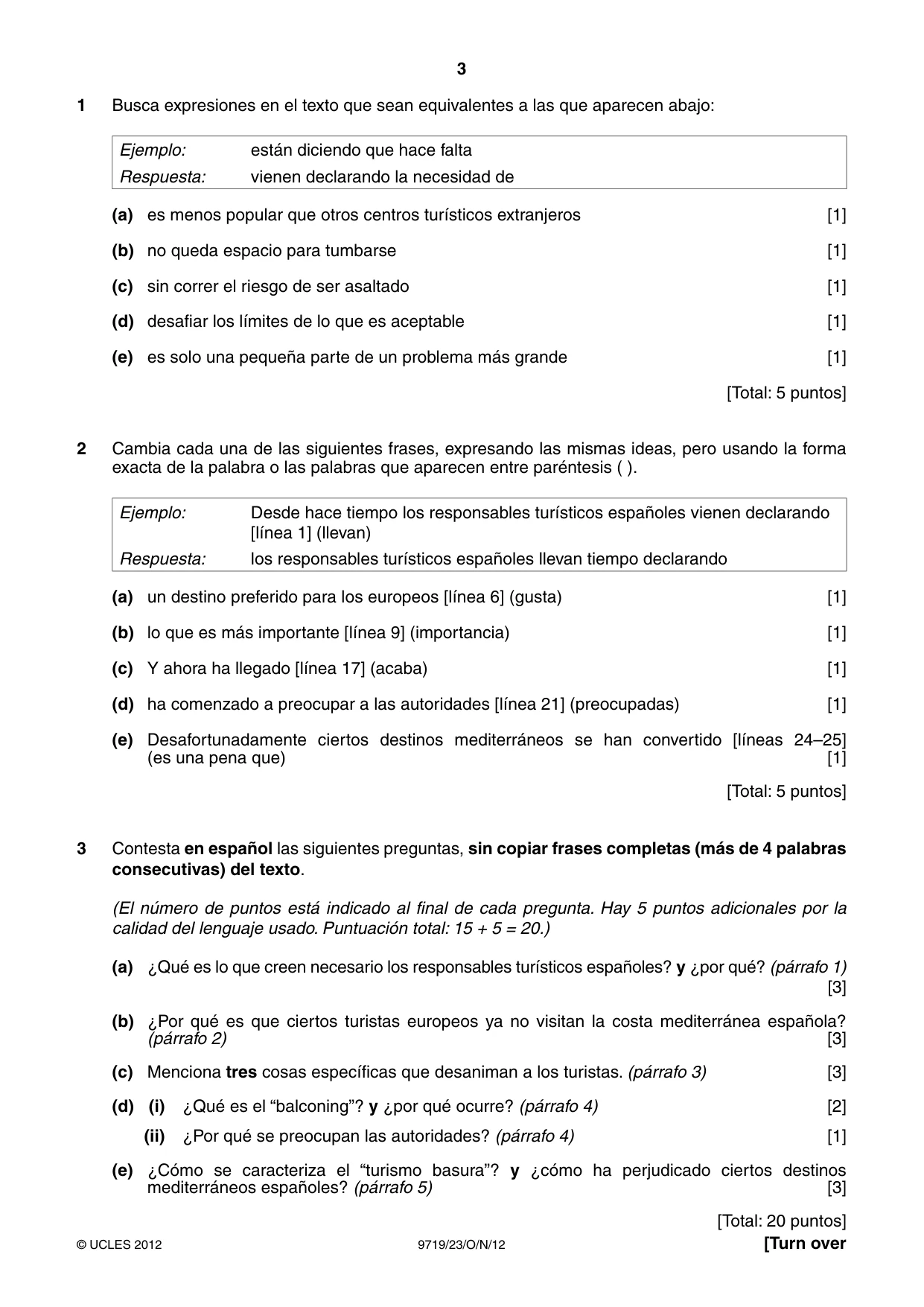
Question paper, page 3
3 9719/23/O/N/12 © UCLES 2012 [Turn over 1 Busca expresiones en el texto que sean equivalentes a las que aparecen abajo: Ejemplo: están diciendo que hace falta Respuesta: vienen declarando la necesidad de (a) es menos popular que otros centros turísticos extranjeros [1] (b) no queda espacio para tumbarse [1] (c) sin correr el riesgo de ser asaltado [1] (d) desafiar los límites de lo que es aceptable [1] (e) es solo una pequeña parte de un problema más grande [1] [Total: 5 puntos] 2 Cambia cada una de las siguientes frases, expresando las mismas ideas, pero usando la forma exacta de la palabra o las palabras que aparecen entre paréntesis ( ). Ejemplo: Desde hace tiempo los responsables turísticos españoles vienen declarando [línea 1] (llevan) Respuesta: los responsables turísticos españoles llevan tiempo declarando (a) un destino preferido para los europeos [línea 6] (gusta) [1] (b) lo que es más importante [línea 9] (importancia) [1] (c) Y ahora ha llegado [línea 17] (acaba) [1] (d) ha comenzado a preocupar a las autoridades [línea 21] (preocupadas) [1] (e) Desafortunadamente ciertos destinos mediterráneos se han convertido [líneas 24–25] (es una pena que) [1] [Total: 5 puntos] 3 Contesta en español las siguientes preguntas, sin copiar frases completas (más de 4 palabras consecutivas) del texto. (El número de puntos está indicado al final de cada pregunta. Hay 5 puntos adicionales por la calidad del lenguaje usado. Puntuación total: 15 + 5 = 20.) (a) ¿Qué es lo que creen necesario los responsables turísticos españoles? y ¿por qué? (párrafo 1) [3] (b) ¿Por qué es que ciertos turistas europeos ya no visitan la costa mediterránea española? (párrafo 2) [3] (c) Menciona tres cosas específicas que desaniman a los turistas. (párrafo 3) [3] (d) (i) ¿Qué es el “balconing”? y ¿por qué ocurre? (párrafo 4) [2] (ii) ¿Por qué se preocupan las autoridades? (párrafo 4) [1] (e) ¿Cómo se caracteriza el “turismo basura”? y ¿cómo ha perjudicado ciertos destinos mediterráneos españoles? (párrafo 5) [3] [Total: 20 puntos]
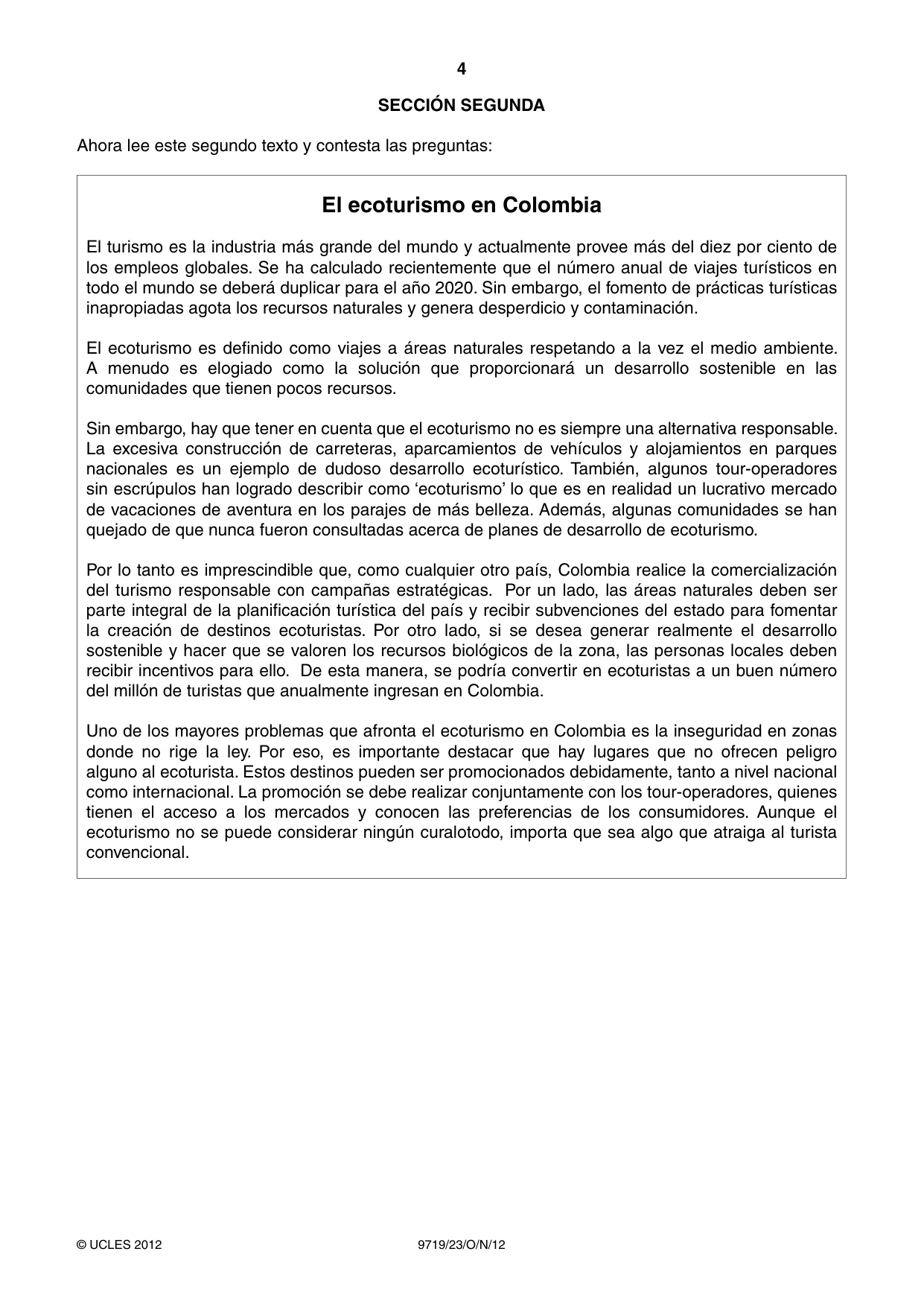
Question paper, page 4
4 9719/23/O/N/12 © UCLES 2012 SECCIÓN SEGUNDA Ahora lee este segundo texto y contesta las preguntas: El ecoturismo en Colombia El turismo es la industria más grande del mundo y actualmente provee más del diez por ciento de los empleos globales. Se ha calculado recientemente que el número anual de viajes turísticos en todo el mundo se deberá duplicar para el año 2020. Sin embargo, el fomento de prácticas turísticas inapropiadas agota los recursos naturales y genera desperdicio y contaminación. El ecoturismo es definido como viajes a áreas naturales respetando a la vez el medio ambiente. A menudo es elogiado como la solución que proporcionará un desarrollo sostenible en las comunidades que tienen pocos recursos. Sin embargo, hay que tener en cuenta que el ecoturismo no es siempre una alternativa responsable. La excesiva construcción de carreteras, aparcamientos de vehículos y alojamientos en parques nacionales es un ejemplo de dudoso desarrollo ecoturístico. También, algunos tour-operadores sin escrúpulos han logrado describir como ‘ecoturismo’ lo que es en realidad un lucrativo mercado de vacaciones de aventura en los parajes de más belleza. Además, algunas comunidades se han quejado de que nunca fueron consultadas acerca de planes de desarrollo de ecoturismo. Por lo tanto es imprescindible que, como cualquier otro país, Colombia realice la comercialización del turismo responsable con campañas estratégicas. Por un lado, las áreas naturales deben ser parte integral de la planificación turística del país y recibir subvenciones del estado para fomentar la creación de destinos ecoturistas. Por otro lado, si se desea generar realmente el desarrollo sostenible y hacer que se valoren los recursos biológicos de la zona, las personas locales deben recibir incentivos para ello. De esta manera, se podría convertir en ecoturistas a un buen número del millón de turistas que anualmente ingresan en Colombia. Uno de los mayores problemas que afronta el ecoturismo en Colombia es la inseguridad en zonas donde no rige la ley. Por eso, es importante destacar que hay lugares que no ofrecen peligro alguno al ecoturista. Estos destinos pueden ser promocionados debidamente, tanto a nivel nacional como internacional. La promoción se debe realizar conjuntamente con los tour-operadores, quienes tienen el acceso a los mercados y conocen las preferencias de los consumidores. Aunque el ecoturismo no se puede considerar ningún curalotodo, importa que sea algo que atraiga al turista convencional.
Question paper, page 5
5 9719/23/O/N/12 © UCLES 2012 4 Contesta en español las siguientes preguntas, sin copiar frases completas (más de 4 palabras consecutivas) del texto. (El número de puntos está indicado al final de cada pregunta. Hay 5 puntos adicionales por la calidad del lenguaje usado. Puntuación total: 15 + 5 = 20.) (a) ¿Cuáles son los aspectos positivos y negativos del turismo? (párrafo 1) [3] (b) Según el texto, ¿qué es exactamente el ecoturismo? y ¿cómo puede ayudar a las poblaciones locales? (párrafo 2) [2] (c) ¿Por qué el ecoturismo no es siempre una alternativa responsable para las áreas naturales y sus poblaciones? (párrafo 3) [3] (d) ¿Qué hay que hacer para promocionar el ecoturismo en un país como Colombia? (párrafo 4) [4] (e) ¿Cómo se atraerá a los ecoturistas? (párrafo 5) [3] [Total: 20 puntos] 5 Escribe en español un máximo de 140 palabras para completar las dos tareas siguientes. (a) Escribe un resumen de lo que se dice en los dos textos sobre los aspectos negativos del turismo basura y del ecoturismo. [10] (b) ¿El turismo es bueno o malo para tu país? Da tus opiniones. [5] (NOTA: Escribe un máximo de 140 palabras) [Calidad de lenguaje: 5] [Total: 20 puntos]
Question paper, page 6
6 9719/23/O/N/12 © UCLES 2012 BLANK PAGE
Question paper, page 7
7 9719/23/O/N/12 © UCLES 2012 BLANK PAGE
Question paper, page 8
8 9719/23/O/N/12 © UCLES 2012 BLANK PAGE Copyright Acknowledgements: Text 1 © El ‘balconing’: Otra Consecuecia Del ‘turismo Basura’; http://www.articuloz.com/otros-articulos/el-balconing-otra-consecuencia-del-turismo- basura-2998869.html. Text 2 © http://ecoturismounab.galeon.com. Permission to reproduce items where third-party owned material protected by copyright is included has been sought and cleared where possible. Every reasonable effort has been made by the publisher (UCLES) to trace copyright holders, but if any items requiring clearance have unwittingly been included, the publisher will be pleased to make amends at the earliest possible opportunity. University of Cambridge International Examinations is part of the Cambridge Assessment Group. Cambridge Assessment is the brand name of University of Cambridge Local Examinations Syndicate (UCLES), which is itself a department of the University of Cambridge.
Mark scheme, page 1
CAMBRIDGE INTERNATIONAL EXAMINATIONS GCE Advanced Level MARK SCHEME for the October/November 2012 series 9719 SPANISH 9719/23 Paper 2 (Reading and Writing), maximum raw mark 70 This mark scheme is published as an aid to teachers and candidates, to indicate the requirements of the examination. It shows the basis on which Examiners were instructed to award marks. It does not indicate the details of the discussions that took place at an Examiners’ meeting before marking began, which would have considered the acceptability of alternative answers. Mark schemes should be read in conjunction with the question paper and the Principal Examiner Report for Teachers. Cambridge will not enter into discussions about these mark schemes. Cambridge is publishing the mark schemes for the October/November 2012 series for most IGCSE, GCE Advanced Level and Advanced Subsidiary Level components and some Ordinary Level components.
Mark scheme, page 2
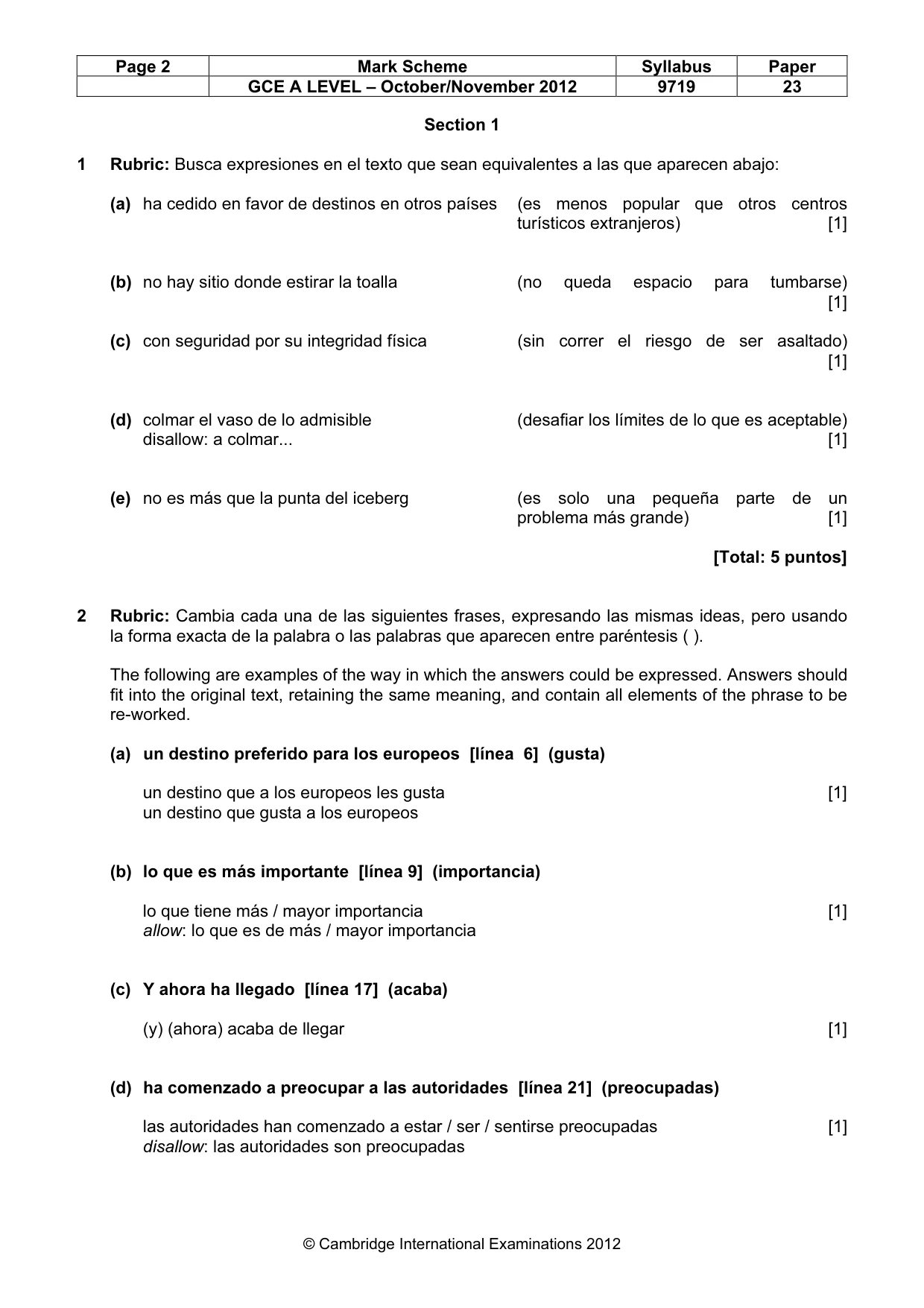
Page 2 Mark Scheme Syllabus Paper GCE A LEVEL – October/November 2012 9719 23 © Cambridge International Examinations 2012 Section 1 1 Rubric: Busca expresiones en el texto que sean equivalentes a las que aparecen abajo: (a) ha cedido en favor de destinos en otros países (es menos popular que otros centros turísticos extranjeros) [1] (b) no hay sitio donde estirar la toalla (no queda espacio para tumbarse) [1] (c) con seguridad por su integridad física (sin correr el riesgo de ser asaltado) [1] (d) colmar el vaso de lo admisible (desafiar los límites de lo que es aceptable) disallow: a colmar... [1] (e) no es más que la punta del iceberg (es solo una pequeña parte de un problema más grande) [1] [Total: 5 puntos] 2 Rubric: Cambia cada una de las siguientes frases, expresando las mismas ideas, pero usando la forma exacta de la palabra o las palabras que aparecen entre paréntesis ( ). The following are examples of the way in which the answers could be expressed. Answers should fit into the original text, retaining the same meaning, and contain all elements of the phrase to be re-worked. (a) un destino preferido para los europeos [línea 6] (gusta) un destino que a los europeos les gusta [1] un destino que gusta a los europeos (b) lo que es más importante [línea 9] (importancia) lo que tiene más / mayor importancia [1] allow: lo que es de más / mayor importancia (c) Y ahora ha llegado [línea 17] (acaba) (y) (ahora) acaba de llegar [1] (d) ha comenzado a preocupar a las autoridades [línea 21] (preocupadas) las autoridades han comenzado a estar / ser / sentirse preocupadas [1] disallow: las autoridades son preocupadas
Mark scheme, page 3
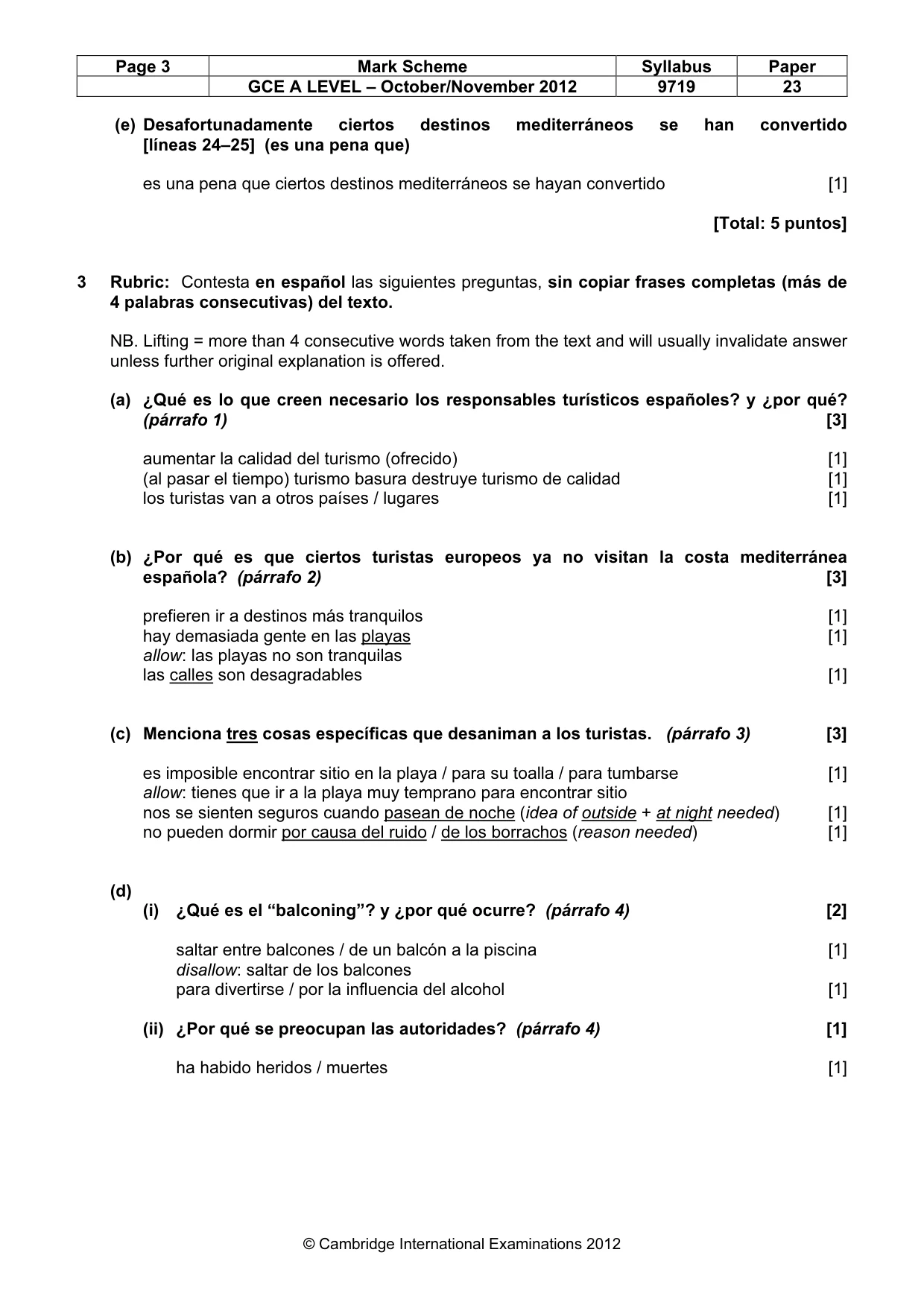
Page 3 Mark Scheme Syllabus Paper GCE A LEVEL – October/November 2012 9719 23 © Cambridge International Examinations 2012 (e) Desafortunadamente ciertos destinos mediterráneos se han convertido [líneas 24–25] (es una pena que) es una pena que ciertos destinos mediterráneos se hayan convertido [1] [Total: 5 puntos] 3 Rubric: Contesta en español las siguientes preguntas, sin copiar frases completas (más de 4 palabras consecutivas) del texto. NB. Lifting = more than 4 consecutive words taken from the text and will usually invalidate answer unless further original explanation is offered. (a) ¿Qué es lo que creen necesario los responsables turísticos españoles? y ¿por qué? (párrafo 1) [3] aumentar la calidad del turismo (ofrecido) [1] (al pasar el tiempo) turismo basura destruye turismo de calidad [1] los turistas van a otros países / lugares [1] (b) ¿Por qué es que ciertos turistas europeos ya no visitan la costa mediterránea española? (párrafo 2) [3] prefieren ir a destinos más tranquilos [1] hay demasiada gente en las playas [1] allow: las playas no son tranquilas las calles son desagradables [1] (c) Menciona tres cosas específicas que desaniman a los turistas. (párrafo 3) [3] es imposible encontrar sitio en la playa / para su toalla / para tumbarse [1] allow: tienes que ir a la playa muy temprano para encontrar sitio nos se sienten seguros cuando pasean de noche (idea of outside + at night needed) [1] no pueden dormir por causa del ruido / de los borrachos (reason needed) [1] (d) (i) ¿Qué es el “balconing”? y ¿por qué ocurre? (párrafo 4) [2] saltar entre balcones / de un balcón a la piscina [1] disallow: saltar de los balcones para divertirse / por la influencia del alcohol [1] (ii) ¿Por qué se preocupan las autoridades? (párrafo 4) [1] ha habido heridos / muertes [1]
Mark scheme, page 4
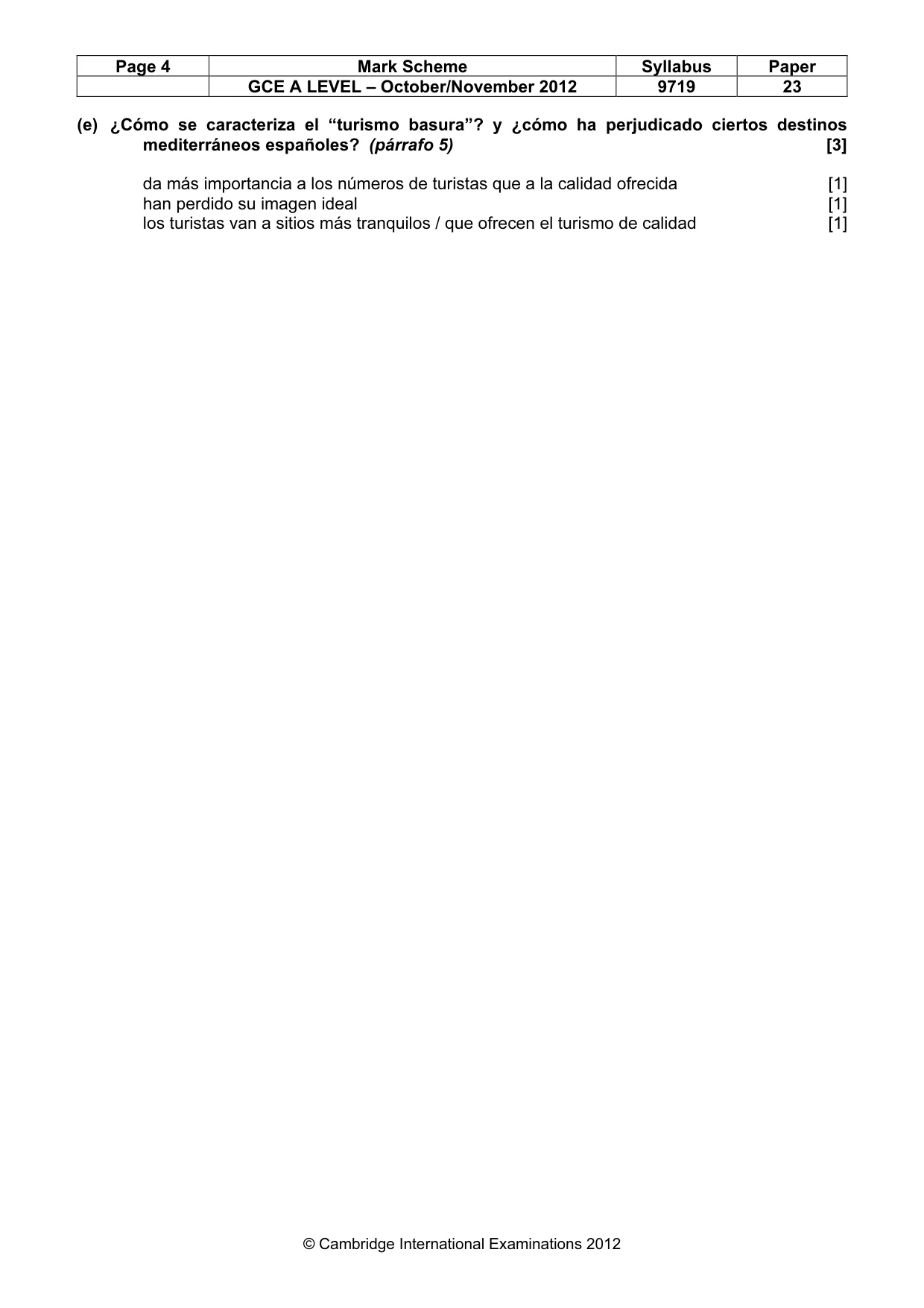
Page 4 Mark Scheme Syllabus Paper GCE A LEVEL – October/November 2012 9719 23 © Cambridge International Examinations 2012 (e) ¿Cómo se caracteriza el “turismo basura”? y ¿cómo ha perjudicado ciertos destinos mediterráneos españoles? (párrafo 5) [3] da más importancia a los números de turistas que a la calidad ofrecida [1] han perdido su imagen ideal [1] los turistas van a sitios más tranquilos / que ofrecen el turismo de calidad [1]
Mark scheme, page 5
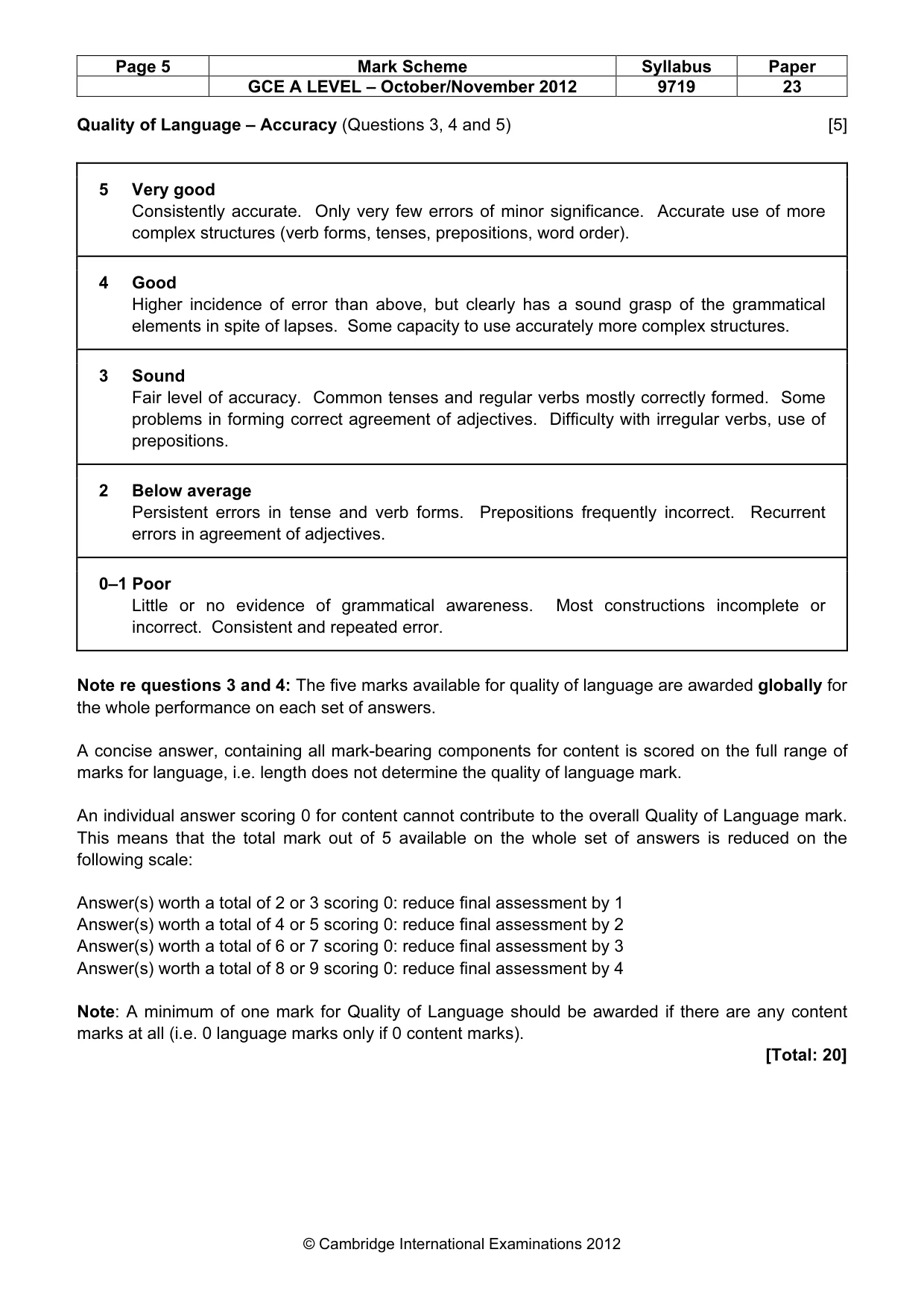
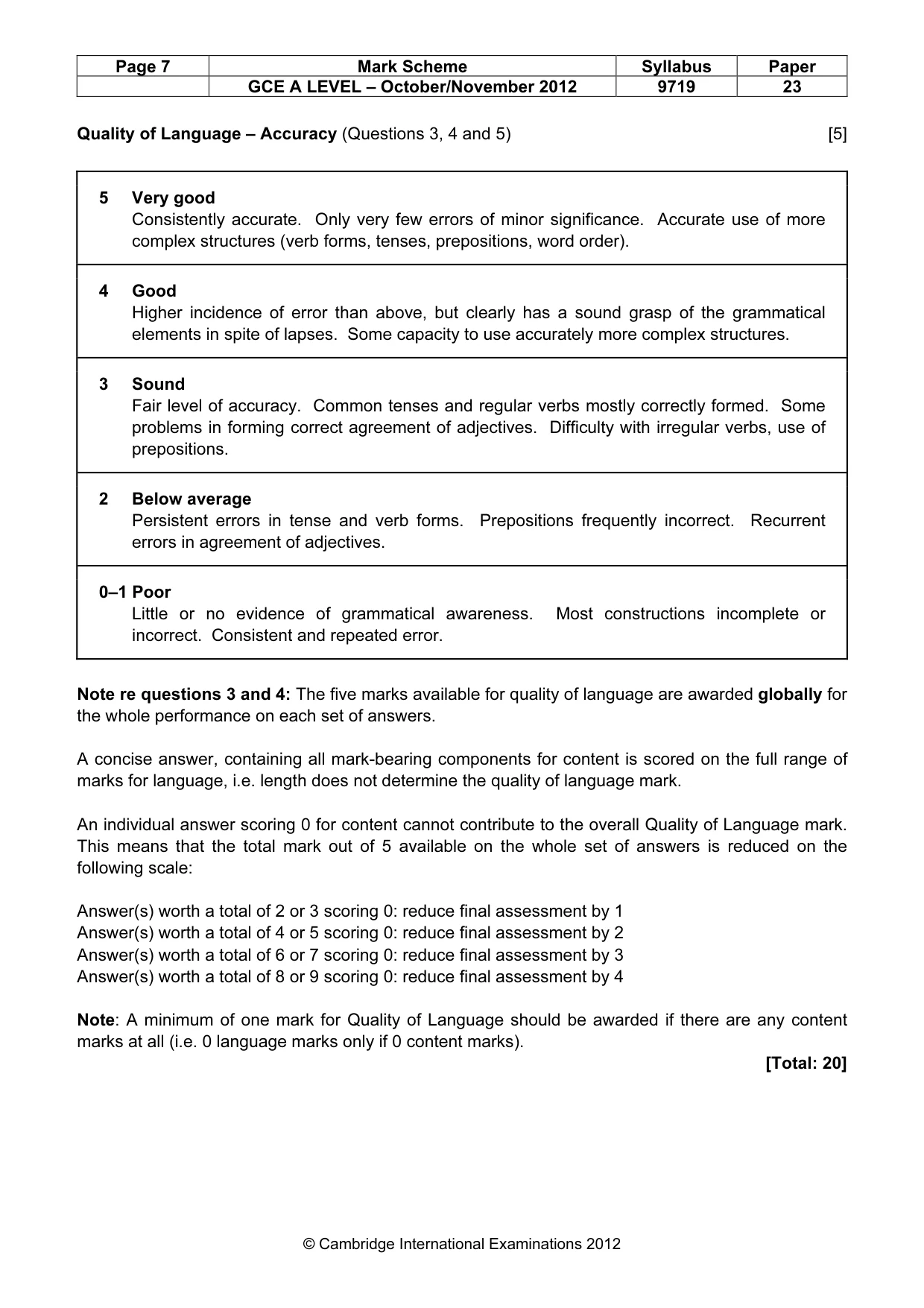
Page 5 Mark Scheme Syllabus Paper GCE A LEVEL – October/November 2012 9719 23 © Cambridge International Examinations 2012 Quality of Language – Accuracy (Questions 3, 4 and 5) [5] 5 Very good Consistently accurate. Only very few errors of minor significance. Accurate use of more complex structures (verb forms, tenses, prepositions, word order). 4 Good Higher incidence of error than above, but clearly has a sound grasp of the grammatical elements in spite of lapses. Some capacity to use accurately more complex structures. 3 Sound Fair level of accuracy. Common tenses and regular verbs mostly correctly formed. Some problems in forming correct agreement of adjectives. Difficulty with irregular verbs, use of prepositions. 2 Below average Persistent errors in tense and verb forms. Prepositions frequently incorrect. Recurrent errors in agreement of adjectives. 0–1 Poor Little or no evidence of grammatical awareness. Most constructions incomplete or incorrect. Consistent and repeated error. Note re questions 3 and 4: The five marks available for quality of language are awarded globally for the whole performance on each set of answers. A concise answer, containing all mark-bearing components for content is scored on the full range of marks for language, i.e. length does not determine the quality of language mark. An individual answer scoring 0 for content cannot contribute to the overall Quality of Language mark. This means that the total mark out of 5 available on the whole set of answers is reduced on the following scale: Answer(s) worth a total of 2 or 3 scoring 0: reduce final assessment by 1 Answer(s) worth a total of 4 or 5 scoring 0: reduce final assessment by 2 Answer(s) worth a total of 6 or 7 scoring 0: reduce final assessment by 3 Answer(s) worth a total of 8 or 9 scoring 0: reduce final assessment by 4 Note: A minimum of one mark for Quality of Language should be awarded if there are any content marks at all (i.e. 0 language marks only if 0 content marks). [Total: 20]
Mark scheme, page 6
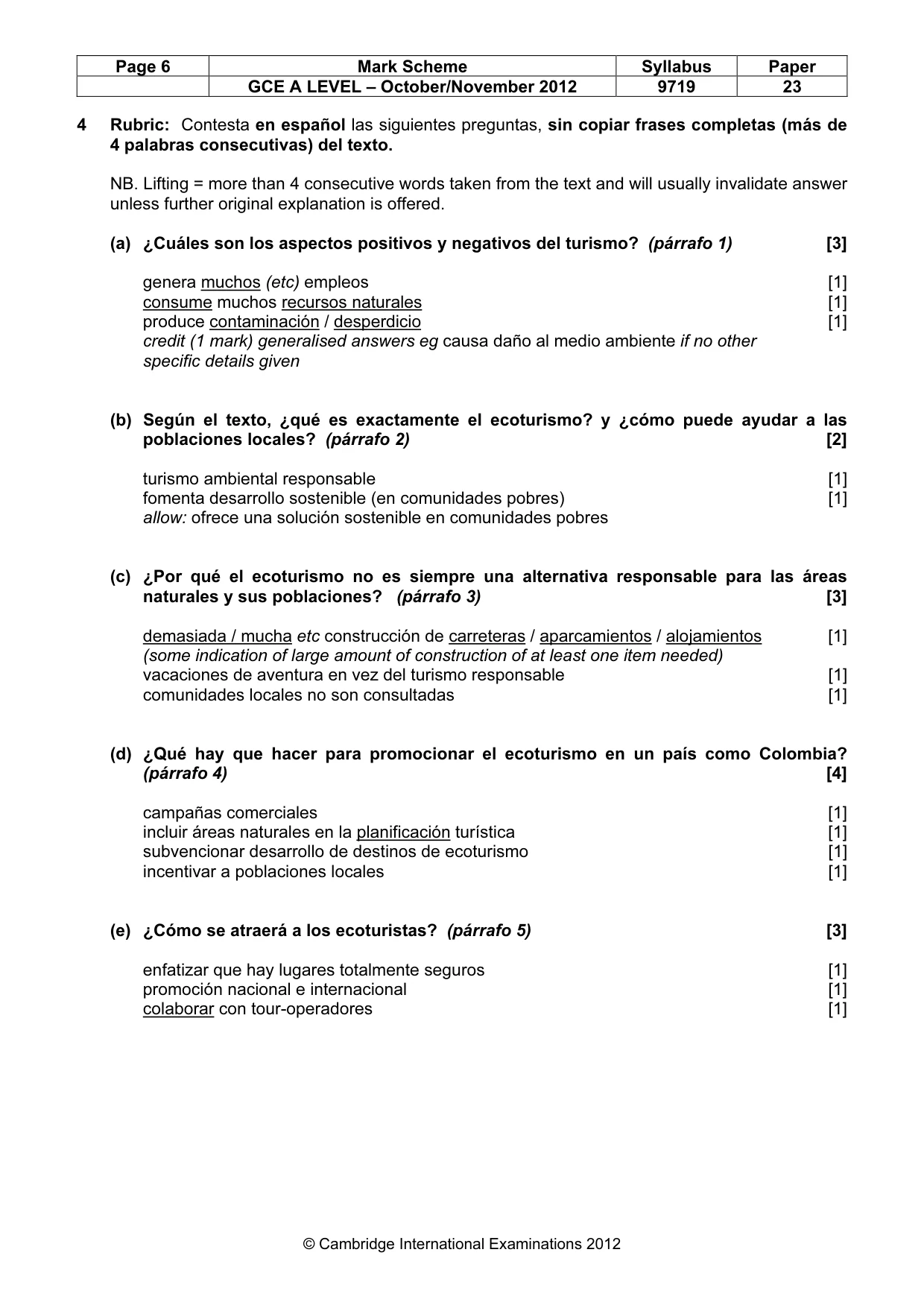
Page 6 Mark Scheme Syllabus Paper GCE A LEVEL – October/November 2012 9719 23 © Cambridge International Examinations 2012 4 Rubric: Contesta en español las siguientes preguntas, sin copiar frases completas (más de 4 palabras consecutivas) del texto. NB. Lifting = more than 4 consecutive words taken from the text and will usually invalidate answer unless further original explanation is offered. (a) ¿Cuáles son los aspectos positivos y negativos del turismo? (párrafo 1) [3] genera muchos (etc) empleos [1] consume muchos recursos naturales [1] produce contaminación / desperdicio [1] credit (1 mark) generalised answers eg causa daño al medio ambiente if no other specific details given (b) Según el texto, ¿qué es exactamente el ecoturismo? y ¿cómo puede ayudar a las poblaciones locales? (párrafo 2) [2] turismo ambiental responsable [1] fomenta desarrollo sostenible (en comunidades pobres) [1] allow: ofrece una solución sostenible en comunidades pobres (c) ¿Por qué el ecoturismo no es siempre una alternativa responsable para las áreas naturales y sus poblaciones? (párrafo 3) [3] demasiada / mucha etc construcción de carreteras / aparcamientos / alojamientos [1] (some indication of large amount of construction of at least one item needed) vacaciones de aventura en vez del turismo responsable [1] comunidades locales no son consultadas [1] (d) ¿Qué hay que hacer para promocionar el ecoturismo en un país como Colombia? (párrafo 4) [4] campañas comerciales [1] incluir áreas naturales en la planificación turística [1] subvencionar desarrollo de destinos de ecoturismo [1] incentivar a poblaciones locales [1] (e) ¿Cómo se atraerá a los ecoturistas? (párrafo 5) [3] enfatizar que hay lugares totalmente seguros [1] promoción nacional e internacional [1] colaborar con tour-operadores [1]
Mark scheme, page 7
Page 7 Mark Scheme Syllabus Paper GCE A LEVEL – October/November 2012 9719 23 © Cambridge International Examinations 2012 Quality of Language – Accuracy (Questions 3, 4 and 5) [5] 5 Very good Consistently accurate. Only very few errors of minor significance. Accurate use of more complex structures (verb forms, tenses, prepositions, word order). 4 Good Higher incidence of error than above, but clearly has a sound grasp of the grammatical elements in spite of lapses. Some capacity to use accurately more complex structures. 3 Sound Fair level of accuracy. Common tenses and regular verbs mostly correctly formed. Some problems in forming correct agreement of adjectives. Difficulty with irregular verbs, use of prepositions. 2 Below average Persistent errors in tense and verb forms. Prepositions frequently incorrect. Recurrent errors in agreement of adjectives. 0–1 Poor Little or no evidence of grammatical awareness. Most constructions incomplete or incorrect. Consistent and repeated error. Note re questions 3 and 4: The five marks available for quality of language are awarded globally for the whole performance on each set of answers. A concise answer, containing all mark-bearing components for content is scored on the full range of marks for language, i.e. length does not determine the quality of language mark. An individual answer scoring 0 for content cannot contribute to the overall Quality of Language mark. This means that the total mark out of 5 available on the whole set of answers is reduced on the following scale: Answer(s) worth a total of 2 or 3 scoring 0: reduce final assessment by 1 Answer(s) worth a total of 4 or 5 scoring 0: reduce final assessment by 2 Answer(s) worth a total of 6 or 7 scoring 0: reduce final assessment by 3 Answer(s) worth a total of 8 or 9 scoring 0: reduce final assessment by 4 Note: A minimum of one mark for Quality of Language should be awarded if there are any content marks at all (i.e. 0 language marks only if 0 content marks). [Total: 20]
Mark scheme, page 8
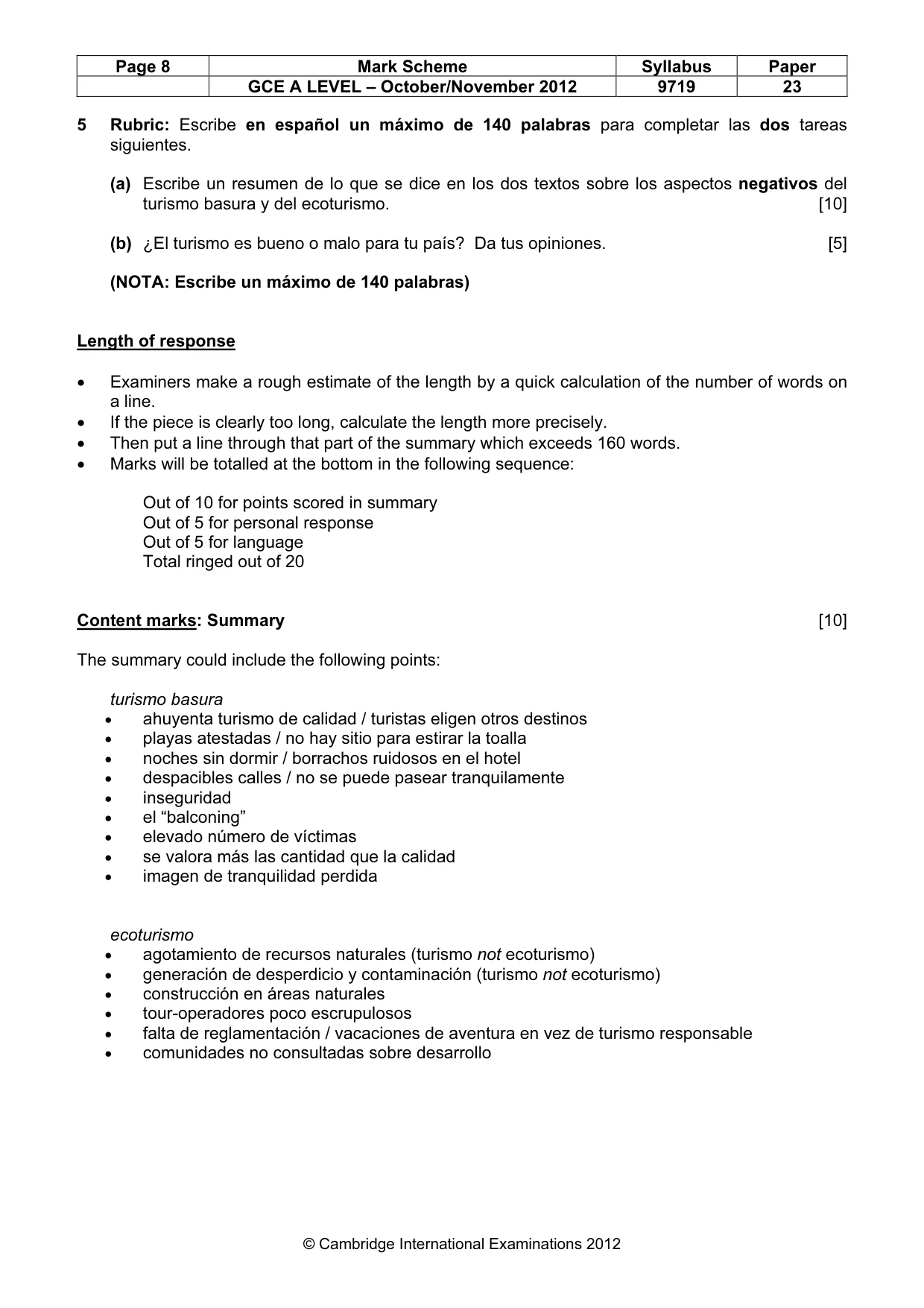
Page 8 Mark Scheme Syllabus Paper GCE A LEVEL – October/November 2012 9719 23 © Cambridge International Examinations 2012 5 Rubric: Escribe en español un máximo de 140 palabras para completar las dos tareas siguientes. (a) Escribe un resumen de lo que se dice en los dos textos sobre los aspectos negativos del turismo basura y del ecoturismo. [10] (b) ¿El turismo es bueno o malo para tu país? Da tus opiniones. [5] (NOTA: Escribe un máximo de 140 palabras) Length of response • Examiners make a rough estimate of the length by a quick calculation of the number of words on a line. • If the piece is clearly too long, calculate the length more precisely. • Then put a line through that part of the summary which exceeds 160 words. • Marks will be totalled at the bottom in the following sequence: Out of 10 for points scored in summary Out of 5 for personal response Out of 5 for language Total ringed out of 20 Content marks: Summary [10] The summary could include the following points: turismo basura • ahuyenta turismo de calidad / turistas eligen otros destinos • playas atestadas / no hay sitio para estirar la toalla • noches sin dormir / borrachos ruidosos en el hotel • despacibles calles / no se puede pasear tranquilamente • inseguridad • el “balconing” • elevado número de víctimas • se valora más las cantidad que la calidad • imagen de tranquilidad perdida ecoturismo • agotamiento de recursos naturales (turismo not ecoturismo) • generación de desperdicio y contaminación (turismo not ecoturismo) • construcción en áreas naturales • tour-operadores poco escrupulosos • falta de reglamentación / vacaciones de aventura en vez de turismo responsable • comunidades no consultadas sobre desarrollo
Mark scheme, page 9
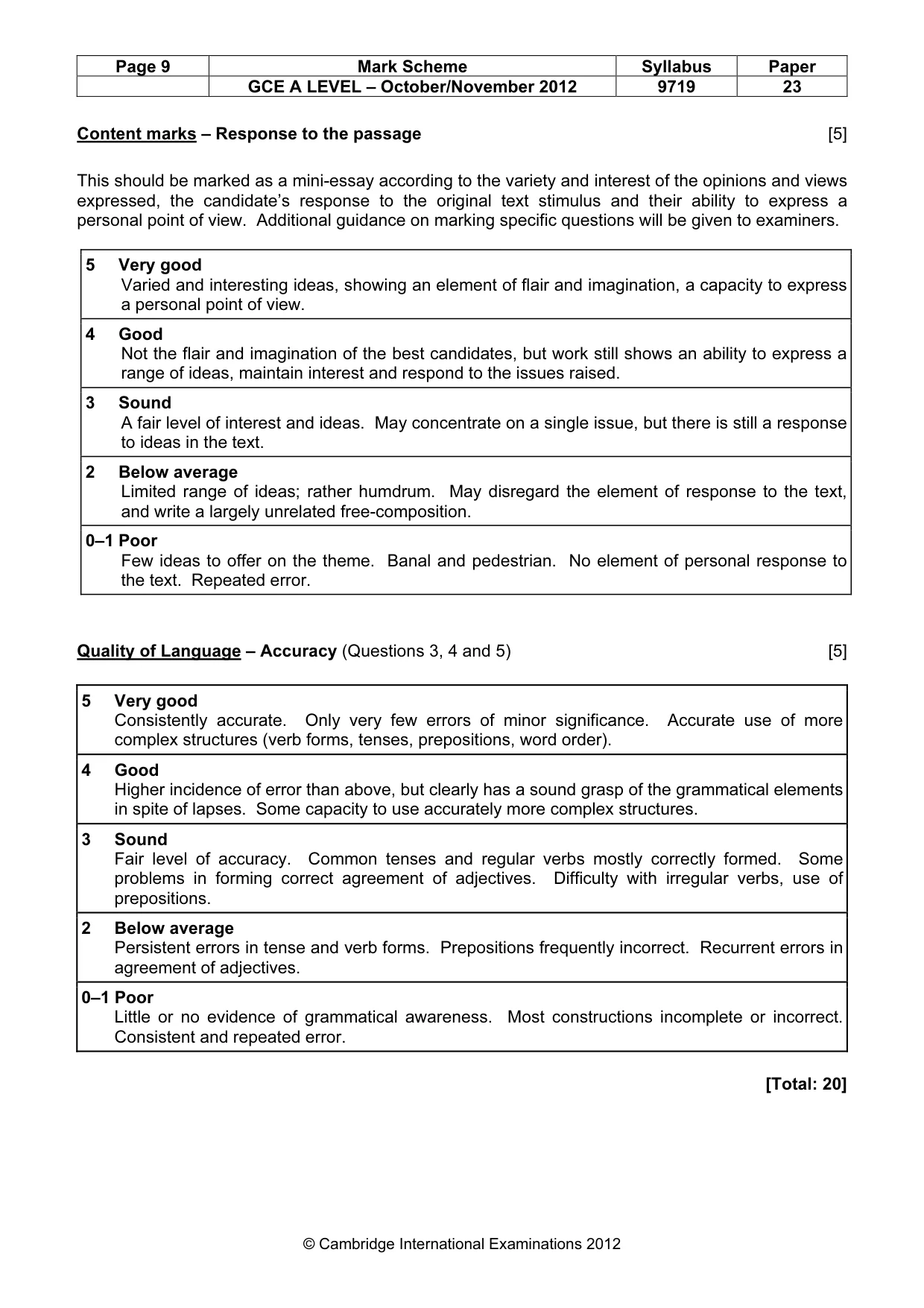
Page 9 Mark Scheme Syllabus Paper GCE A LEVEL – October/November 2012 9719 23 © Cambridge International Examinations 2012 Content marks – Response to the passage [5] This should be marked as a mini-essay according to the variety and interest of the opinions and views expressed, the candidate’s response to the original text stimulus and their ability to express a personal point of view. Additional guidance on marking specific questions will be given to examiners. 5 Very good Varied and interesting ideas, showing an element of flair and imagination, a capacity to express a personal point of view. 4 Good Not the flair and imagination of the best candidates, but work still shows an ability to express a range of ideas, maintain interest and respond to the issues raised. 3 Sound A fair level of interest and ideas. May concentrate on a single issue, but there is still a response to ideas in the text. 2 Below average Limited range of ideas; rather humdrum. May disregard the element of response to the text, and write a largely unrelated free-composition. 0–1 Poor Few ideas to offer on the theme. Banal and pedestrian. No element of personal response to the text. Repeated error. Quality of Language – Accuracy (Questions 3, 4 and 5) [5] 5 Very good Consistently accurate. Only very few errors of minor significance. Accurate use of more complex structures (verb forms, tenses, prepositions, word order). 4 Good Higher incidence of error than above, but clearly has a sound grasp of the grammatical elements in spite of lapses. Some capacity to use accurately more complex structures. 3 Sound Fair level of accuracy. Common tenses and regular verbs mostly correctly formed. Some problems in forming correct agreement of adjectives. Difficulty with irregular verbs, use of prepositions. 2 Below average Persistent errors in tense and verb forms. Prepositions frequently incorrect. Recurrent errors in agreement of adjectives. 0–1 Poor Little or no evidence of grammatical awareness. Most constructions incomplete or incorrect. Consistent and repeated error. [Total: 20]
What you needed in this session
Cambridge’s own grade thresholds for 2012 Oct/Nov, Paper 2 · Variant 3. A higher threshold means an easier paper — the bar moves with how the cohort did.