Cambridge A Level Sociology 9699 — 2020 Oct/Nov Paper 2 · Variant 2
9699/22/O/N/20 · 50 marks · ≈56 min
The question paper and its mark scheme, free to read here and free to download. This is Cambridge’s own paper, exactly as it was sat.
Question paper4 pages


Mark scheme10 pages
Answers below. Sit the paper first if you are practising.
Paper as text
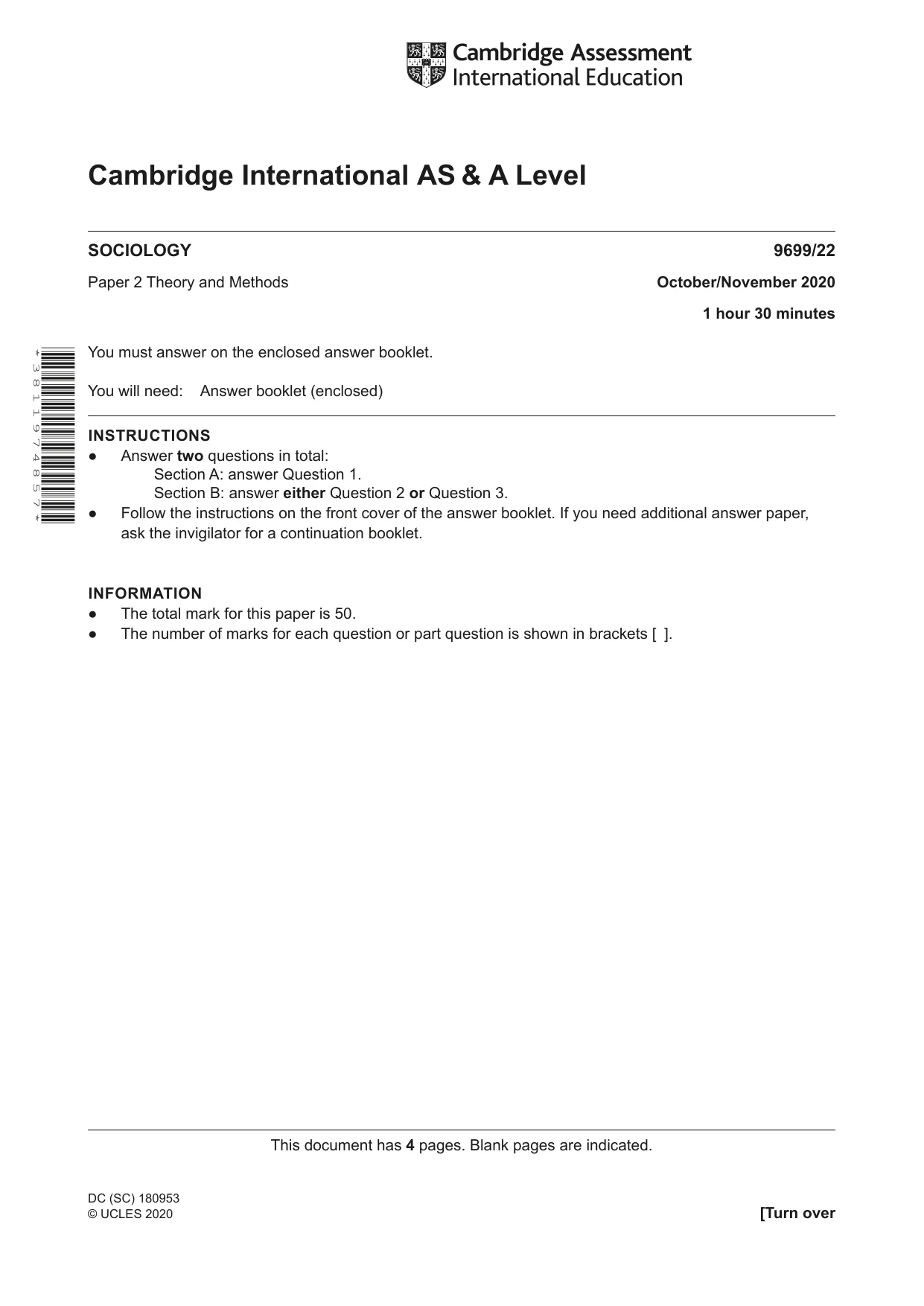
Question paper, page 1
Cambridge International AS & A Level This document has 4 pages. Blank pages are indicated. DC (SC) 180953 © UCLES 2020 [Turn over SOCIOLOGY 9699/22 Paper 2 Theory and Methods October/November 2020 1 hour 30 minutes You must answer on the enclosed answer booklet. You will need: Answer booklet (enclosed) INSTRUCTIONS ● Answer two questions in total: Section A: answer Question 1. Section B: answer either Question 2 or Question 3. ● Follow the instructions on the front cover of the answer booklet. If you need additional answer paper, ask the invigilator for a continuation booklet. INFORMATION ● The total mark for this paper is 50. ● The number of marks for each question or part question is shown in brackets [ ]. * 3 8 1 1 9 7 4 8 5 7 *
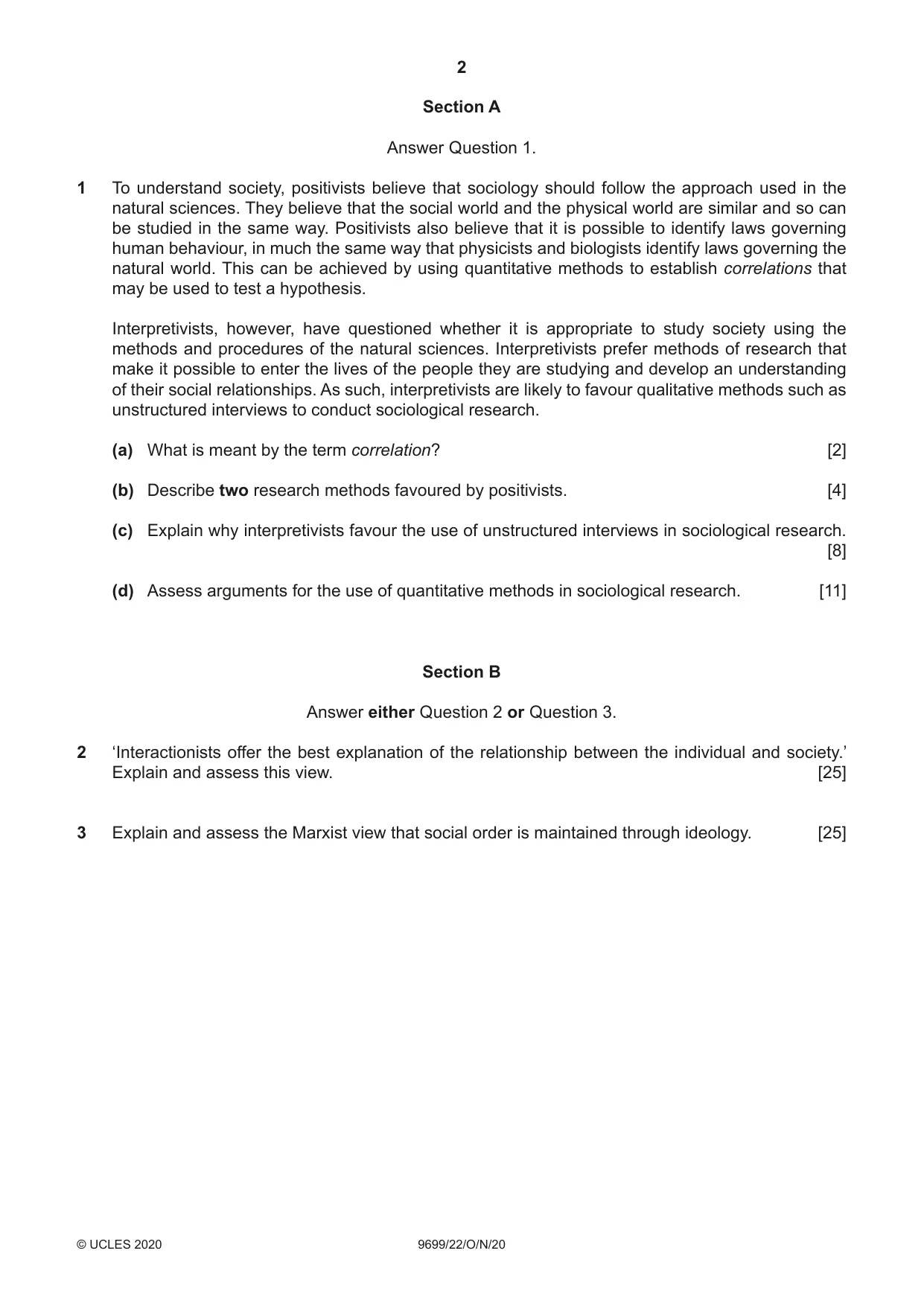
Question paper, page 2
2 9699/22/O/N/20 © UCLES 2020 Section A Answer Question 1. 1 To understand society, positivists believe that sociology should follow the approach used in the natural sciences. They believe that the social world and the physical world are similar and so can be studied in the same way. Positivists also believe that it is possible to identify laws governing human behaviour, in much the same way that physicists and biologists identify laws governing the natural world. This can be achieved by using quantitative methods to establish correlations that may be used to test a hypothesis. Interpretivists, however, have questioned whether it is appropriate to study society using the methods and procedures of the natural sciences. Interpretivists prefer methods of research that make it possible to enter the lives of the people they are studying and develop an understanding of their social relationships. As such, interpretivists are likely to favour qualitative methods such as unstructured interviews to conduct sociological research. (a) What is meant by the term correlation? [2] (b) Describe two research methods favoured by positivists. [4] (c) Explain why interpretivists favour the use of unstructured interviews in sociological research. [8] (d) Assess arguments for the use of quantitative methods in sociological research. [11] Section B Answer either Question 2 or Question 3. 2 ‘Interactionists offer the best explanation of the relationship between the individual and society.’ Explain and assess this view. [25] 3 Explain and assess the Marxist view that social order is maintained through ideology. [25]
Question paper, page 3
3 9699/22/O/N/20 © UCLES 2020 BLANK PAGE
Question paper, page 4
4 9699/22/O/N/20 © UCLES 2020 Permission to reproduce items where third-party owned material protected by copyright is included has been sought and cleared where possible. Every reasonable effort has been made by the publisher (UCLES) to trace copyright holders, but if any items requiring clearance have unwittingly been included, the publisher will be pleased to make amends at the earliest possible opportunity. To avoid the issue of disclosure of answer-related information to candidates, all copyright acknowledgements are reproduced online in the Cambridge Assessment International Education Copyright Acknowledgements Booklet. This is produced for each series of examinations and is freely available to download at www.cambridgeinternational.org after the live examination series. Cambridge Assessment International Education is part of the Cambridge Assessment Group. Cambridge Assessment is the brand name of the University of Cambridge Local Examinations Syndicate (UCLES), which itself is a department of the University of Cambridge. BLANK PAGE
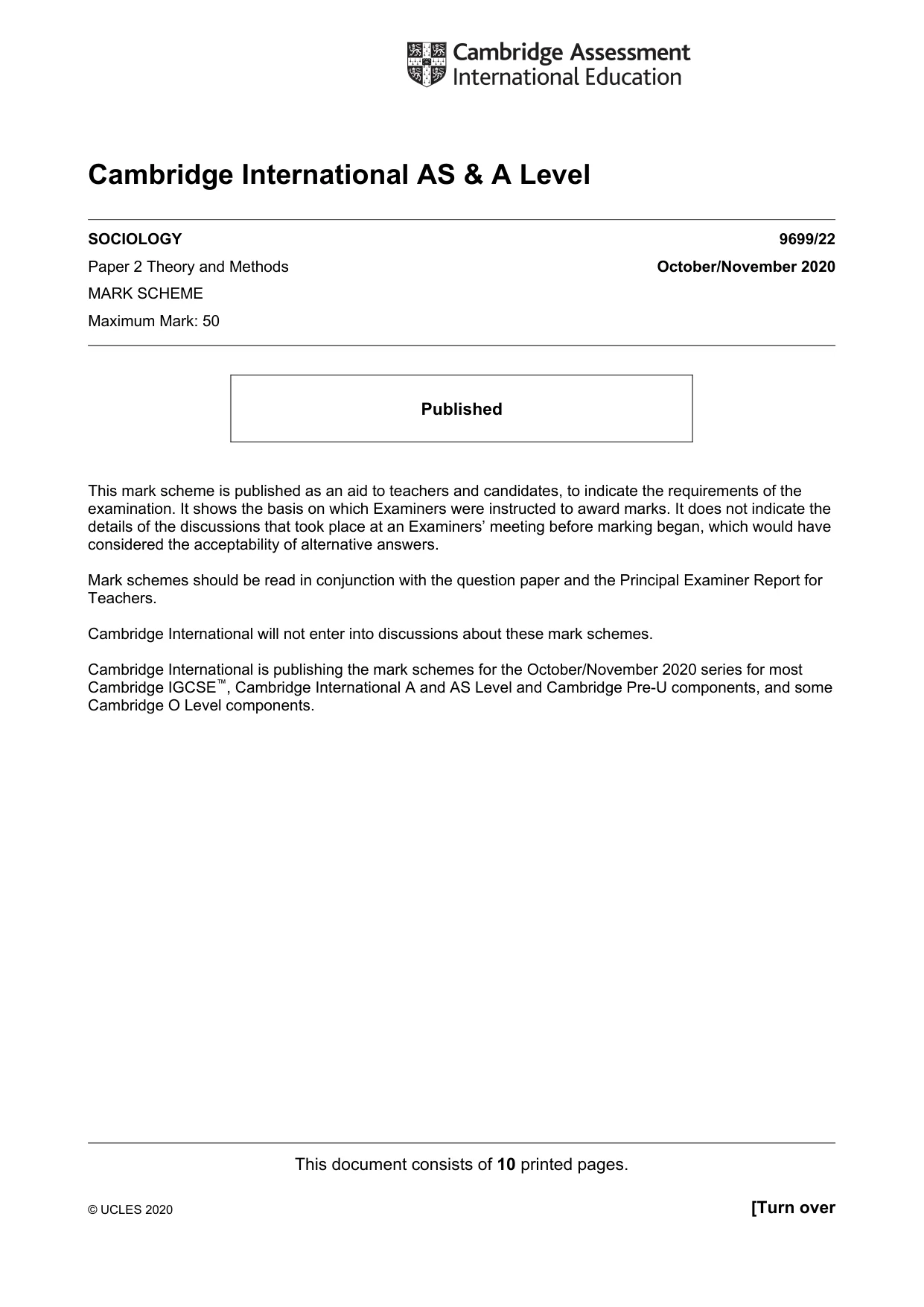
Mark scheme, page 1
This document consists of 10 printed pages. © UCLES 2020 [Turn over Cambridge International AS & A Level SOCIOLOGY 9699/22 Paper 2 Theory and Methods October/November 2020 MARK SCHEME Maximum Mark: 50 Published This mark scheme is published as an aid to teachers and candidates, to indicate the requirements of the examination. It shows the basis on which Examiners were instructed to award marks. It does not indicate the details of the discussions that took place at an Examiners’ meeting before marking began, which would have considered the acceptability of alternative answers. Mark schemes should be read in conjunction with the question paper and the Principal Examiner Report for Teachers. Cambridge International will not enter into discussions about these mark schemes. Cambridge International is publishing the mark schemes for the October/November 2020 series for most Cambridge IGCSE™, Cambridge International A and AS Level and Cambridge Pre-U components, and some Cambridge O Level components.
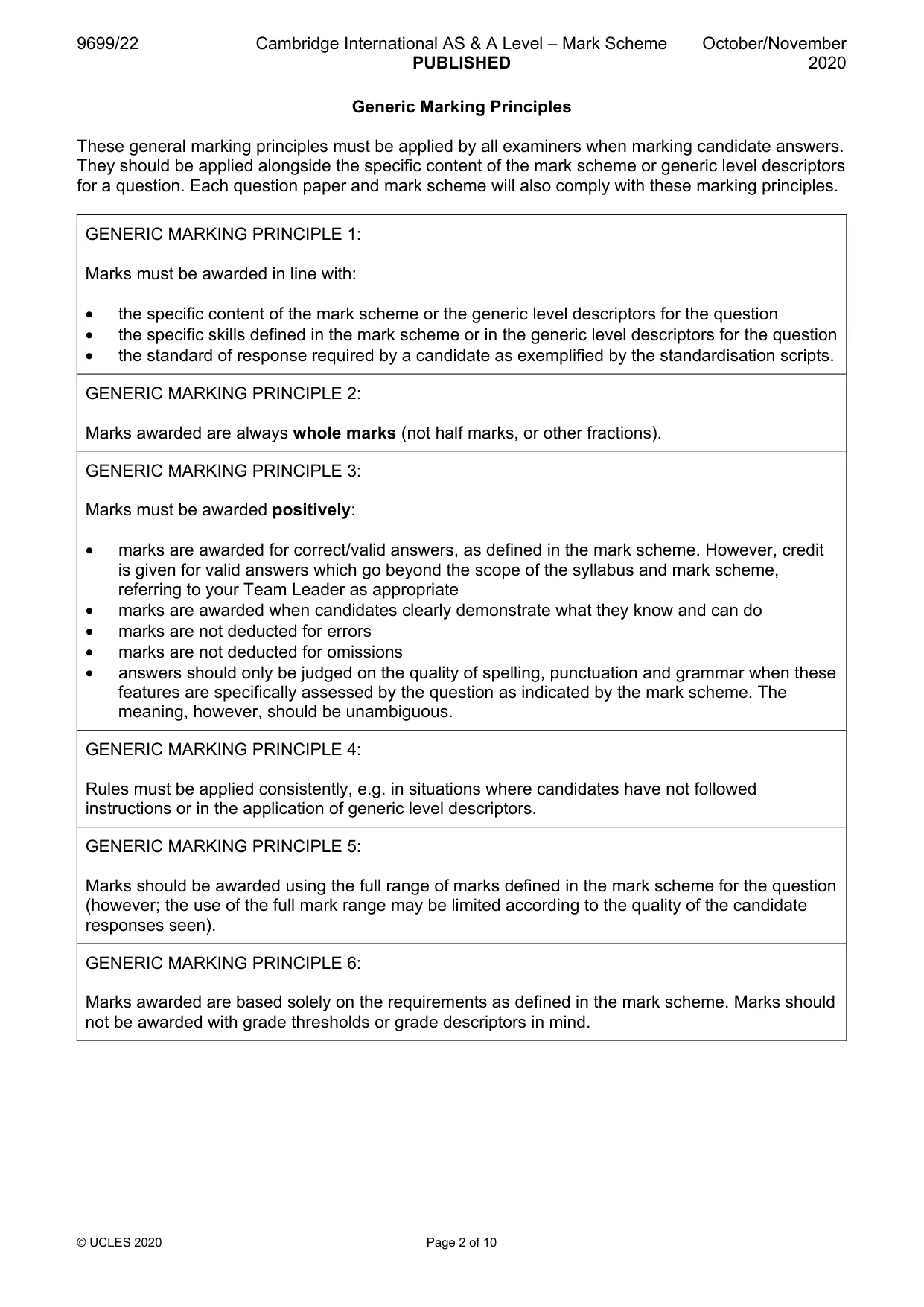
Mark scheme, page 2
9699/22 Cambridge International AS & A Level – Mark Scheme PUBLISHED October/November 2020 © UCLES 2020 Page 2 of 10 Generic Marking Principles These general marking principles must be applied by all examiners when marking candidate answers. They should be applied alongside the specific content of the mark scheme or generic level descriptors for a question. Each question paper and mark scheme will also comply with these marking principles. GENERIC MARKING PRINCIPLE 1: Marks must be awarded in line with: • the specific content of the mark scheme or the generic level descriptors for the question • the specific skills defined in the mark scheme or in the generic level descriptors for the question • the standard of response required by a candidate as exemplified by the standardisation scripts. GENERIC MARKING PRINCIPLE 2: Marks awarded are always whole marks (not half marks, or other fractions). GENERIC MARKING PRINCIPLE 3: Marks must be awarded positively: • marks are awarded for correct/valid answers, as defined in the mark scheme. However, credit is given for valid answers which go beyond the scope of the syllabus and mark scheme, referring to your Team Leader as appropriate • marks are awarded when candidates clearly demonstrate what they know and can do • marks are not deducted for errors • marks are not deducted for omissions • answers should only be judged on the quality of spelling, punctuation and grammar when these features are specifically assessed by the question as indicated by the mark scheme. The meaning, however, should be unambiguous. GENERIC MARKING PRINCIPLE 4: Rules must be applied consistently, e.g. in situations where candidates have not followed instructions or in the application of generic level descriptors. GENERIC MARKING PRINCIPLE 5: Marks should be awarded using the full range of marks defined in the mark scheme for the question (however; the use of the full mark range may be limited according to the quality of the candidate responses seen). GENERIC MARKING PRINCIPLE 6: Marks awarded are based solely on the requirements as defined in the mark scheme. Marks should not be awarded with grade thresholds or grade descriptors in mind.
Mark scheme, page 3
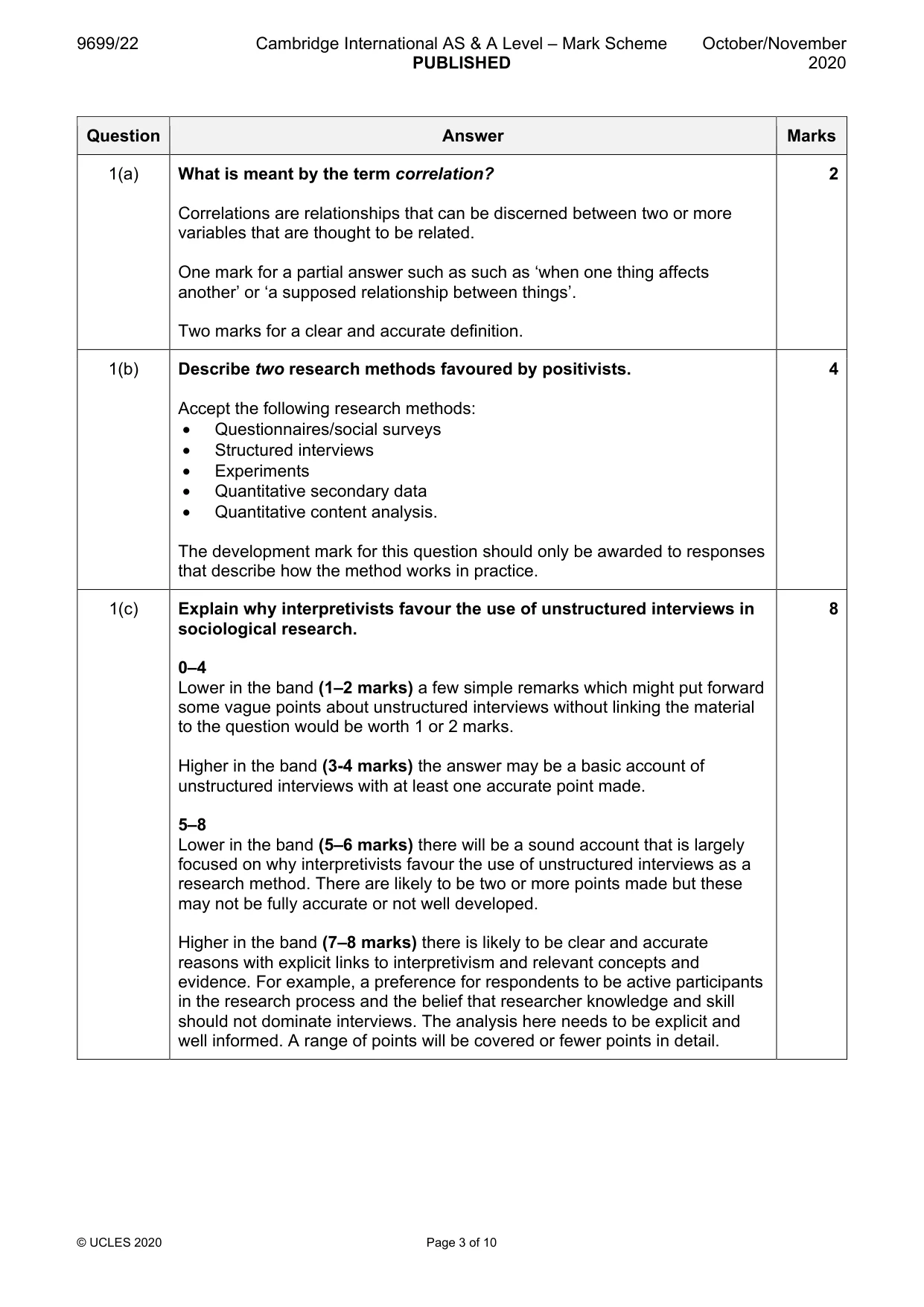
9699/22 Cambridge International AS & A Level – Mark Scheme PUBLISHED October/November 2020 © UCLES 2020 Page 3 of 10 Question Answer Marks 1(a) What is meant by the term correlation? Correlations are relationships that can be discerned between two or more variables that are thought to be related. One mark for a partial answer such as such as ‘when one thing affects another’ or ‘a supposed relationship between things’. Two marks for a clear and accurate definition. 2 1(b) Describe two research methods favoured by positivists. Accept the following research methods: • Questionnaires/social surveys • Structured interviews • Experiments • Quantitative secondary data • Quantitative content analysis. The development mark for this question should only be awarded to responses that describe how the method works in practice. 4 1(c) Explain why interpretivists favour the use of unstructured interviews in sociological research. 0–4 Lower in the band (1–2 marks) a few simple remarks which might put forward some vague points about unstructured interviews without linking the material to the question would be worth 1 or 2 marks. Higher in the band (3-4 marks) the answer may be a basic account of unstructured interviews with at least one accurate point made. 5–8 Lower in the band (5–6 marks) there will be a sound account that is largely focused on why interpretivists favour the use of unstructured interviews as a research method. There are likely to be two or more points made but these may not be fully accurate or not well developed. Higher in the band (7–8 marks) there is likely to be clear and accurate reasons with explicit links to interpretivism and relevant concepts and evidence. For example, a preference for respondents to be active participants in the research process and the belief that researcher knowledge and skill should not dominate interviews. The analysis here needs to be explicit and well informed. A range of points will be covered or fewer points in detail. 8
Mark scheme, page 4
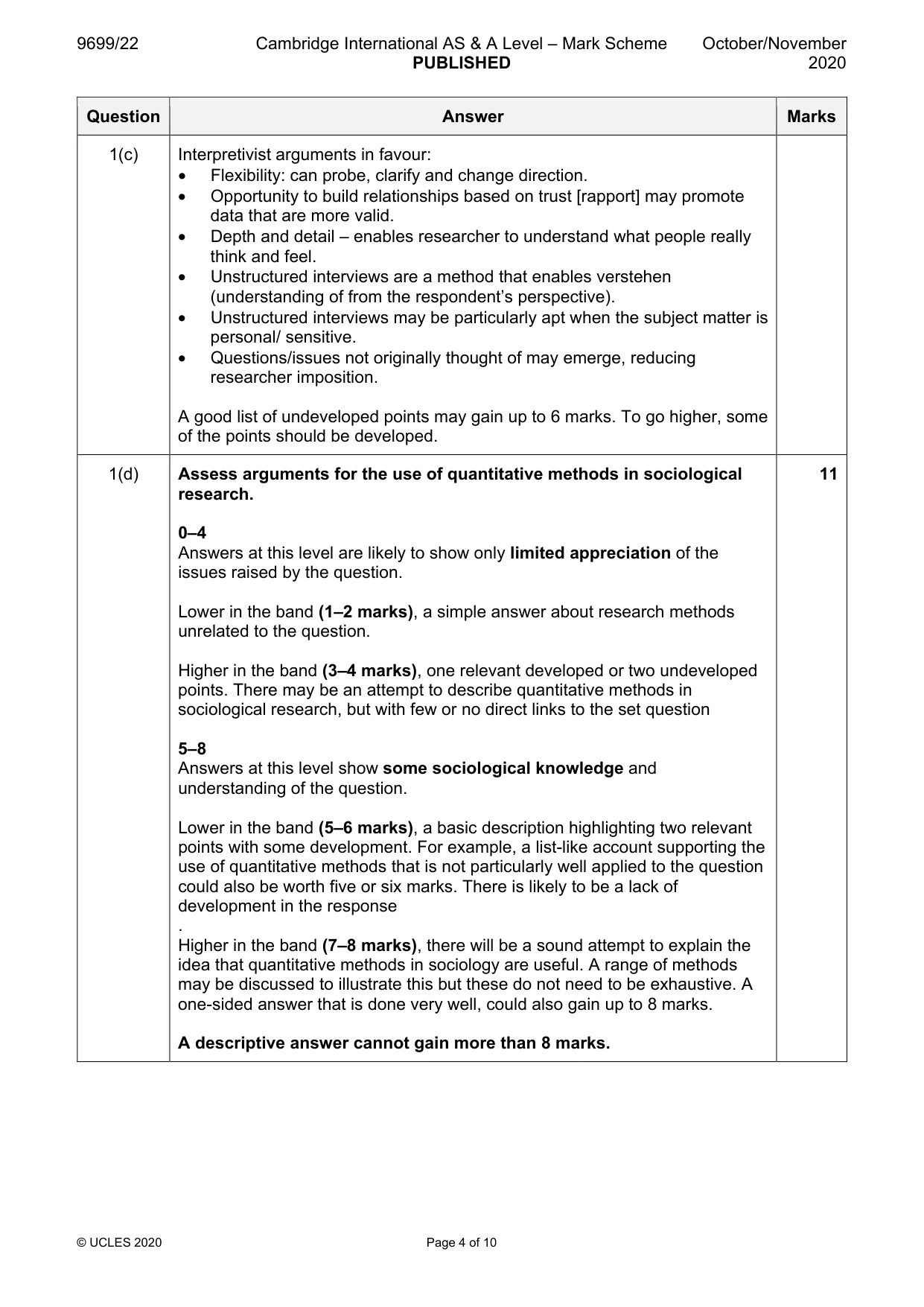
9699/22 Cambridge International AS & A Level – Mark Scheme PUBLISHED October/November 2020 © UCLES 2020 Page 4 of 10 Question Answer Marks 1(c) Interpretivist arguments in favour: • Flexibility: can probe, clarify and change direction. • Opportunity to build relationships based on trust [rapport] may promote data that are more valid. • Depth and detail – enables researcher to understand what people really think and feel. • Unstructured interviews are a method that enables verstehen (understanding of from the respondent’s perspective). • Unstructured interviews may be particularly apt when the subject matter is personal/ sensitive. • Questions/issues not originally thought of may emerge, reducing researcher imposition. A good list of undeveloped points may gain up to 6 marks. To go higher, some of the points should be developed. 1(d) Assess arguments for the use of quantitative methods in sociological research. 0–4 Answers at this level are likely to show only limited appreciation of the issues raised by the question. Lower in the band (1–2 marks), a simple answer about research methods unrelated to the question. Higher in the band (3–4 marks), one relevant developed or two undeveloped points. There may be an attempt to describe quantitative methods in sociological research, but with few or no direct links to the set question 5–8 Answers at this level show some sociological knowledge and understanding of the question. Lower in the band (5–6 marks), a basic description highlighting two relevant points with some development. For example, a list-like account supporting the use of quantitative methods that is not particularly well applied to the question could also be worth five or six marks. There is likely to be a lack of development in the response . Higher in the band (7–8 marks), there will be a sound attempt to explain the idea that quantitative methods in sociology are useful. A range of methods may be discussed to illustrate this but these do not need to be exhaustive. A one-sided answer that is done very well, could also gain up to 8 marks. A descriptive answer cannot gain more than 8 marks. 11
Mark scheme, page 5
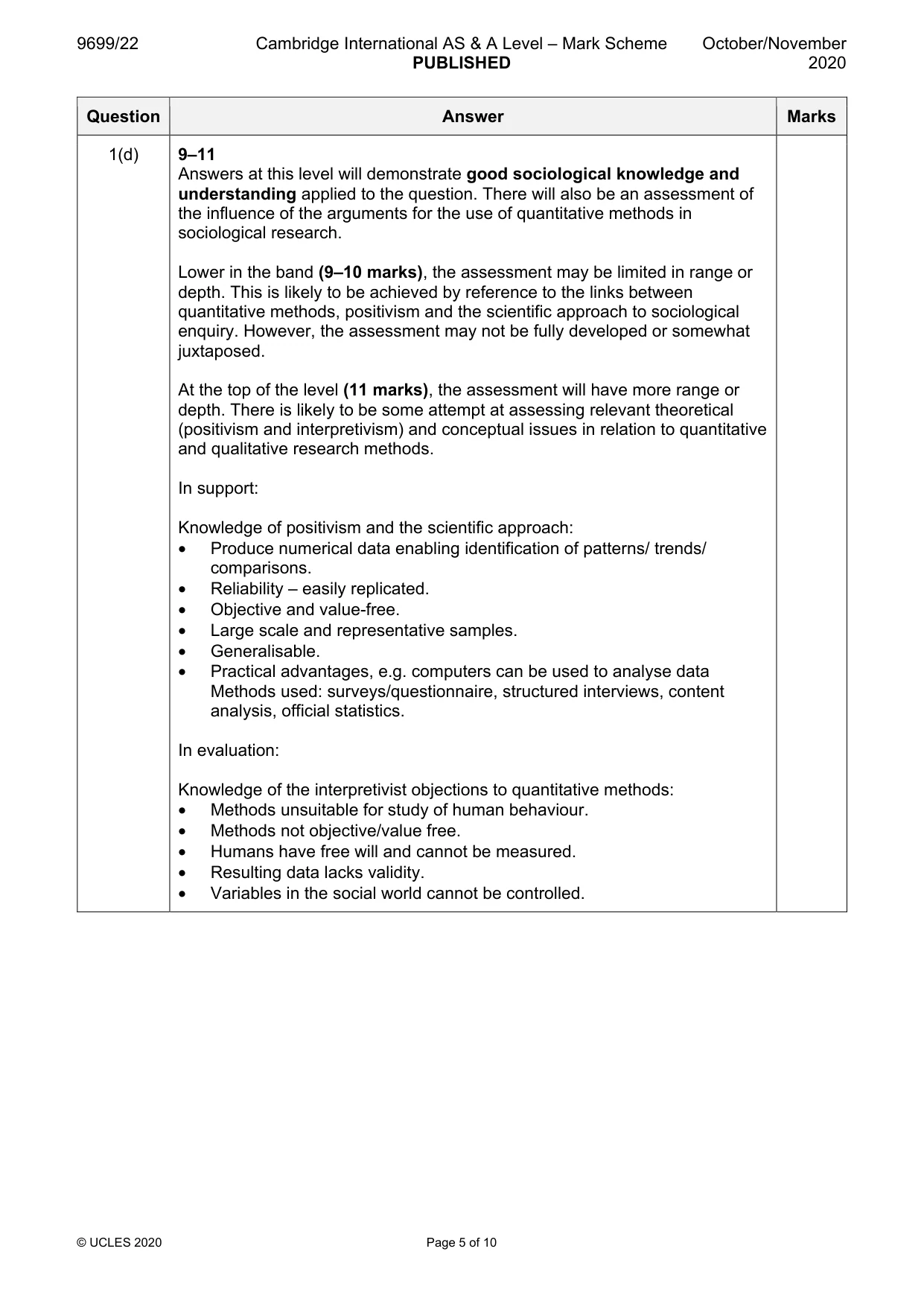
9699/22 Cambridge International AS & A Level – Mark Scheme PUBLISHED October/November 2020 © UCLES 2020 Page 5 of 10 Question Answer Marks 1(d) 9–11 Answers at this level will demonstrate good sociological knowledge and understanding applied to the question. There will also be an assessment of the influence of the arguments for the use of quantitative methods in sociological research. Lower in the band (9–10 marks), the assessment may be limited in range or depth. This is likely to be achieved by reference to the links between quantitative methods, positivism and the scientific approach to sociological enquiry. However, the assessment may not be fully developed or somewhat juxtaposed. At the top of the level (11 marks), the assessment will have more range or depth. There is likely to be some attempt at assessing relevant theoretical (positivism and interpretivism) and conceptual issues in relation to quantitative and qualitative research methods. In support: Knowledge of positivism and the scientific approach: • Produce numerical data enabling identification of patterns/ trends/ comparisons. • Reliability – easily replicated. • Objective and value-free. • Large scale and representative samples. • Generalisable. • Practical advantages, e.g. computers can be used to analyse data Methods used: surveys/questionnaire, structured interviews, content analysis, official statistics. In evaluation: Knowledge of the interpretivist objections to quantitative methods: • Methods unsuitable for study of human behaviour. • Methods not objective/value free. • Humans have free will and cannot be measured. • Resulting data lacks validity. • Variables in the social world cannot be controlled.
Mark scheme, page 6
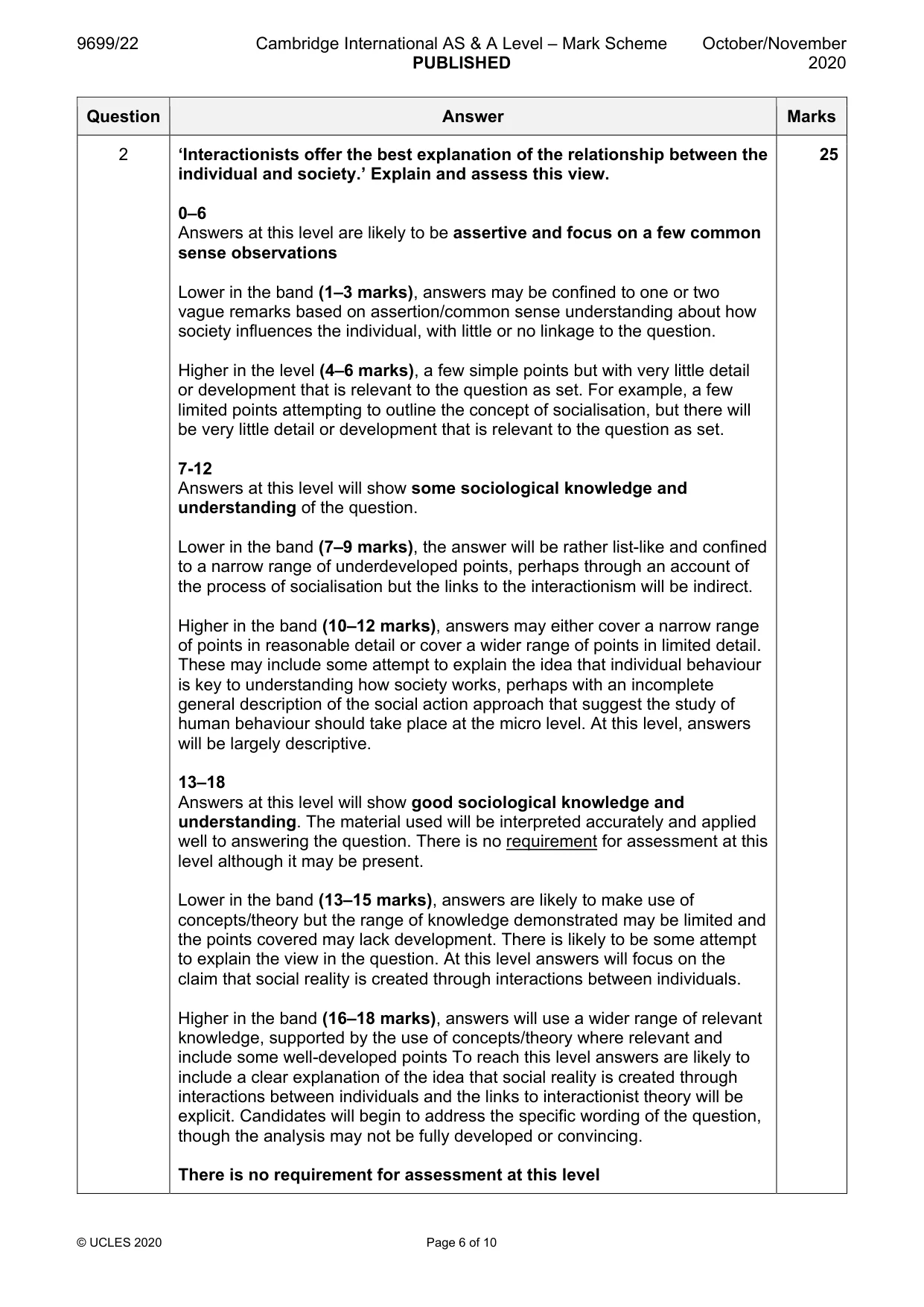
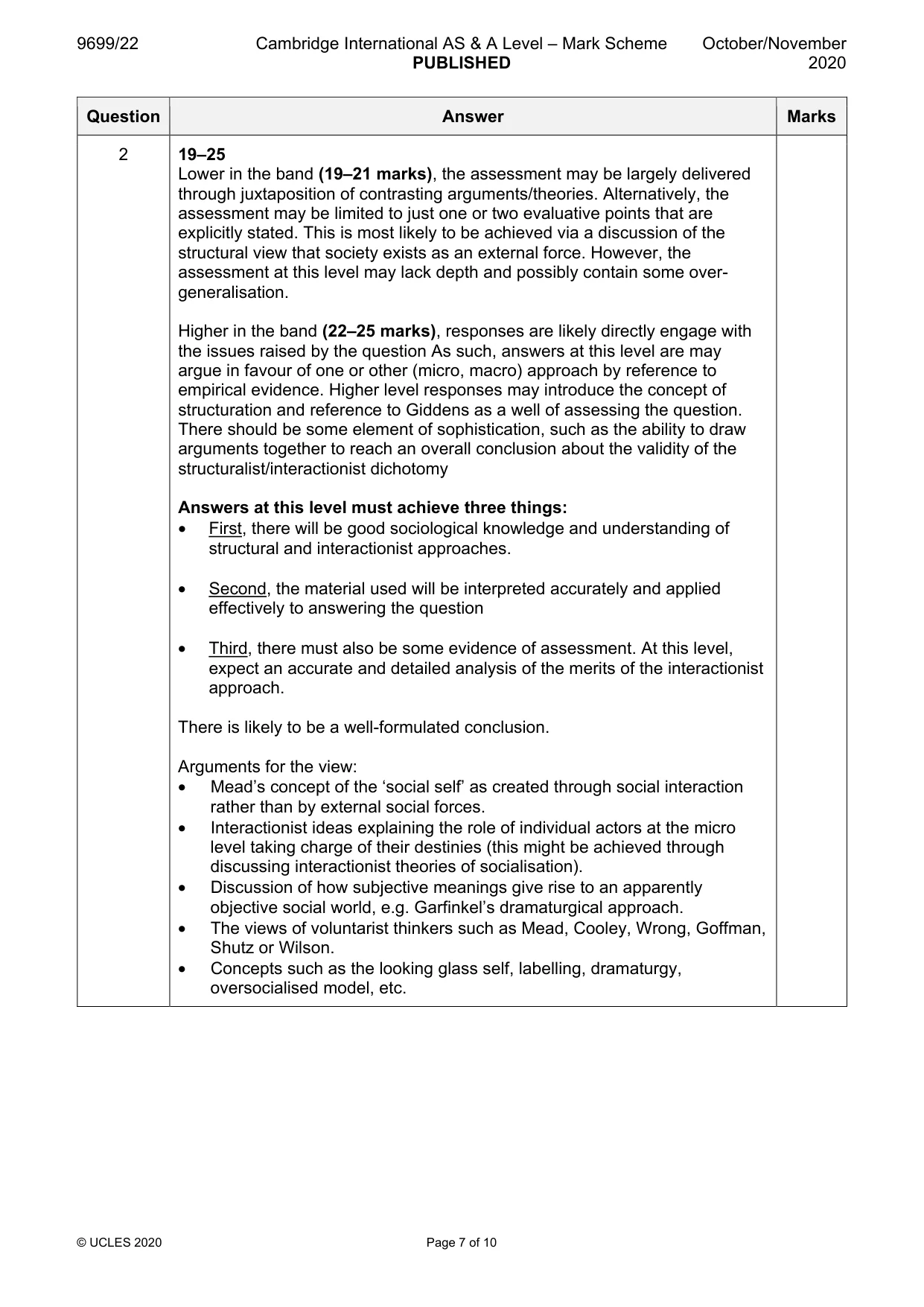
9699/22 Cambridge International AS & A Level – Mark Scheme PUBLISHED October/November 2020 © UCLES 2020 Page 6 of 10 Question Answer Marks 2 ‘Interactionists offer the best explanation of the relationship between the individual and society.’ Explain and assess this view. 0–6 Answers at this level are likely to be assertive and focus on a few common sense observations Lower in the band (1–3 marks), answers may be confined to one or two vague remarks based on assertion/common sense understanding about how society influences the individual, with little or no linkage to the question. Higher in the level (4–6 marks), a few simple points but with very little detail or development that is relevant to the question as set. For example, a few limited points attempting to outline the concept of socialisation, but there will be very little detail or development that is relevant to the question as set. 7-12 Answers at this level will show some sociological knowledge and understanding of the question. Lower in the band (7–9 marks), the answer will be rather list-like and confined to a narrow range of underdeveloped points, perhaps through an account of the process of socialisation but the links to the interactionism will be indirect. Higher in the band (10–12 marks), answers may either cover a narrow range of points in reasonable detail or cover a wider range of points in limited detail. These may include some attempt to explain the idea that individual behaviour is key to understanding how society works, perhaps with an incomplete general description of the social action approach that suggest the study of human behaviour should take place at the micro level. At this level, answers will be largely descriptive. 13–18 Answers at this level will show good sociological knowledge and understanding. The material used will be interpreted accurately and applied well to answering the question. There is no requirement for assessment at this level although it may be present. Lower in the band (13–15 marks), answers are likely to make use of concepts/theory but the range of knowledge demonstrated may be limited and the points covered may lack development. There is likely to be some attempt to explain the view in the question. At this level answers will focus on the claim that social reality is created through interactions between individuals. Higher in the band (16–18 marks), answers will use a wider range of relevant knowledge, supported by the use of concepts/theory where relevant and include some well-developed points To reach this level answers are likely to include a clear explanation of the idea that social reality is created through interactions between individuals and the links to interactionist theory will be explicit. Candidates will begin to address the specific wording of the question, though the analysis may not be fully developed or convincing. There is no requirement for assessment at this level 25
Mark scheme, page 7
9699/22 Cambridge International AS & A Level – Mark Scheme PUBLISHED October/November 2020 © UCLES 2020 Page 7 of 10 Question Answer Marks 2 19–25 Lower in the band (19–21 marks), the assessment may be largely delivered through juxtaposition of contrasting arguments/theories. Alternatively, the assessment may be limited to just one or two evaluative points that are explicitly stated. This is most likely to be achieved via a discussion of the structural view that society exists as an external force. However, the assessment at this level may lack depth and possibly contain some over- generalisation. Higher in the band (22–25 marks), responses are likely directly engage with the issues raised by the question As such, answers at this level are may argue in favour of one or other (micro, macro) approach by reference to empirical evidence. Higher level responses may introduce the concept of structuration and reference to Giddens as a well of assessing the question. There should be some element of sophistication, such as the ability to draw arguments together to reach an overall conclusion about the validity of the structuralist/interactionist dichotomy Answers at this level must achieve three things: • First, there will be good sociological knowledge and understanding of structural and interactionist approaches. • Second, the material used will be interpreted accurately and applied effectively to answering the question • Third, there must also be some evidence of assessment. At this level, expect an accurate and detailed analysis of the merits of the interactionist approach. There is likely to be a well-formulated conclusion. Arguments for the view: • Mead’s concept of the ‘social self’ as created through social interaction rather than by external social forces. • Interactionist ideas explaining the role of individual actors at the micro level taking charge of their destinies (this might be achieved through discussing interactionist theories of socialisation). • Discussion of how subjective meanings give rise to an apparently objective social world, e.g. Garfinkel’s dramaturgical approach. • The views of voluntarist thinkers such as Mead, Cooley, Wrong, Goffman, Shutz or Wilson. • Concepts such as the looking glass self, labelling, dramaturgy, oversocialised model, etc.
Mark scheme, page 8
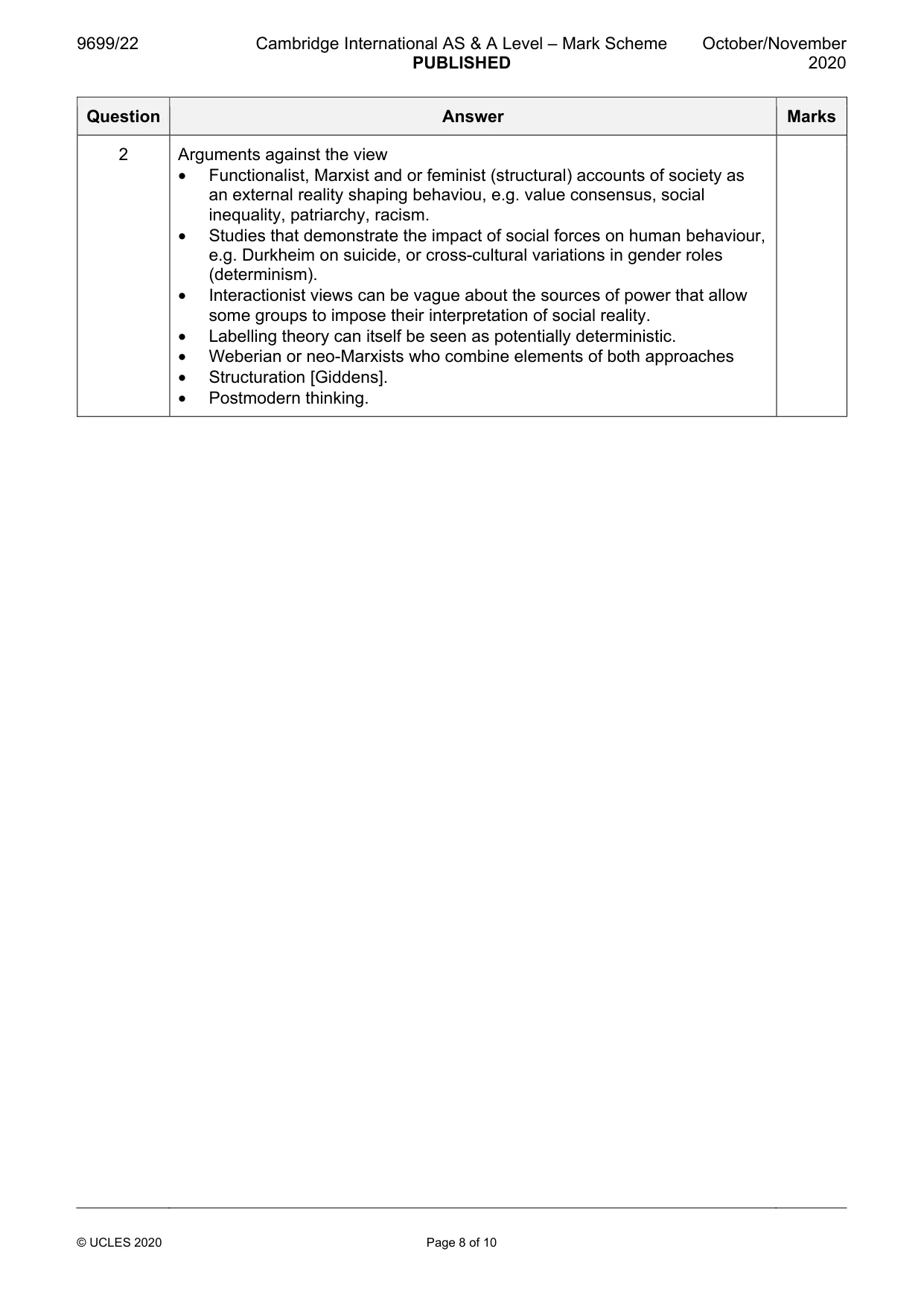
9699/22 Cambridge International AS & A Level – Mark Scheme PUBLISHED October/November 2020 © UCLES 2020 Page 8 of 10 Question Answer Marks 2 Arguments against the view • Functionalist, Marxist and or feminist (structural) accounts of society as an external reality shaping behaviou, e.g. value consensus, social inequality, patriarchy, racism. • Studies that demonstrate the impact of social forces on human behaviour, e.g. Durkheim on suicide, or cross-cultural variations in gender roles (determinism). • Interactionist views can be vague about the sources of power that allow some groups to impose their interpretation of social reality. • Labelling theory can itself be seen as potentially deterministic. • Weberian or neo-Marxists who combine elements of both approaches • Structuration [Giddens]. • Postmodern thinking.
Mark scheme, page 9
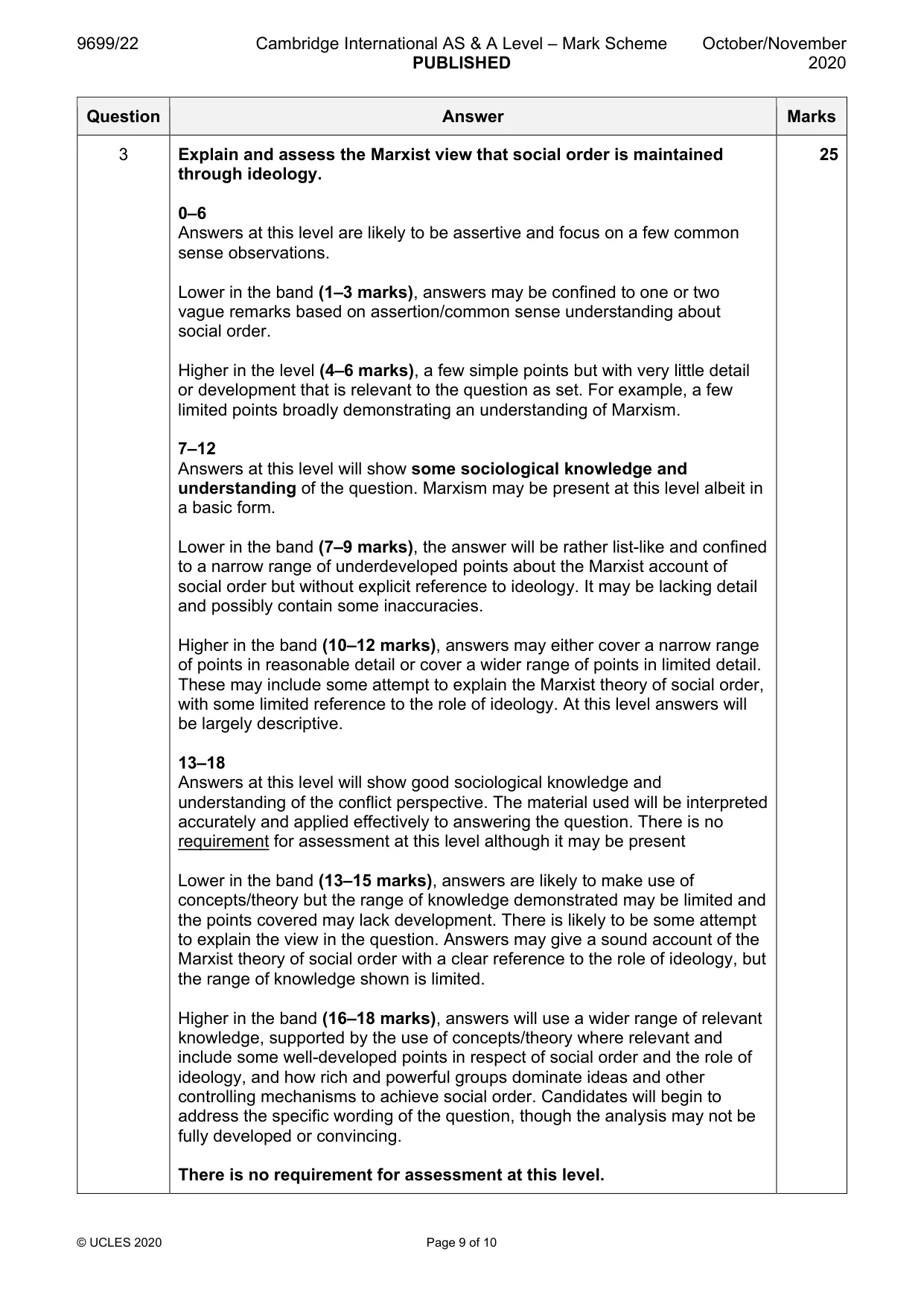
9699/22 Cambridge International AS & A Level – Mark Scheme PUBLISHED October/November 2020 © UCLES 2020 Page 9 of 10 Question Answer Marks 3 Explain and assess the Marxist view that social order is maintained through ideology. 0–6 Answers at this level are likely to be assertive and focus on a few common sense observations. Lower in the band (1–3 marks), answers may be confined to one or two vague remarks based on assertion/common sense understanding about social order. Higher in the level (4–6 marks), a few simple points but with very little detail or development that is relevant to the question as set. For example, a few limited points broadly demonstrating an understanding of Marxism. 7–12 Answers at this level will show some sociological knowledge and understanding of the question. Marxism may be present at this level albeit in a basic form. Lower in the band (7–9 marks), the answer will be rather list-like and confined to a narrow range of underdeveloped points about the Marxist account of social order but without explicit reference to ideology. It may be lacking detail and possibly contain some inaccuracies. Higher in the band (10–12 marks), answers may either cover a narrow range of points in reasonable detail or cover a wider range of points in limited detail. These may include some attempt to explain the Marxist theory of social order, with some limited reference to the role of ideology. At this level answers will be largely descriptive. 13–18 Answers at this level will show good sociological knowledge and understanding of the conflict perspective. The material used will be interpreted accurately and applied effectively to answering the question. There is no requirement for assessment at this level although it may be present Lower in the band (13–15 marks), answers are likely to make use of concepts/theory but the range of knowledge demonstrated may be limited and the points covered may lack development. There is likely to be some attempt to explain the view in the question. Answers may give a sound account of the Marxist theory of social order with a clear reference to the role of ideology, but the range of knowledge shown is limited. Higher in the band (16–18 marks), answers will use a wider range of relevant knowledge, supported by the use of concepts/theory where relevant and include some well-developed points in respect of social order and the role of ideology, and how rich and powerful groups dominate ideas and other controlling mechanisms to achieve social order. Candidates will begin to address the specific wording of the question, though the analysis may not be fully developed or convincing. There is no requirement for assessment at this level. 25
Mark scheme, page 10
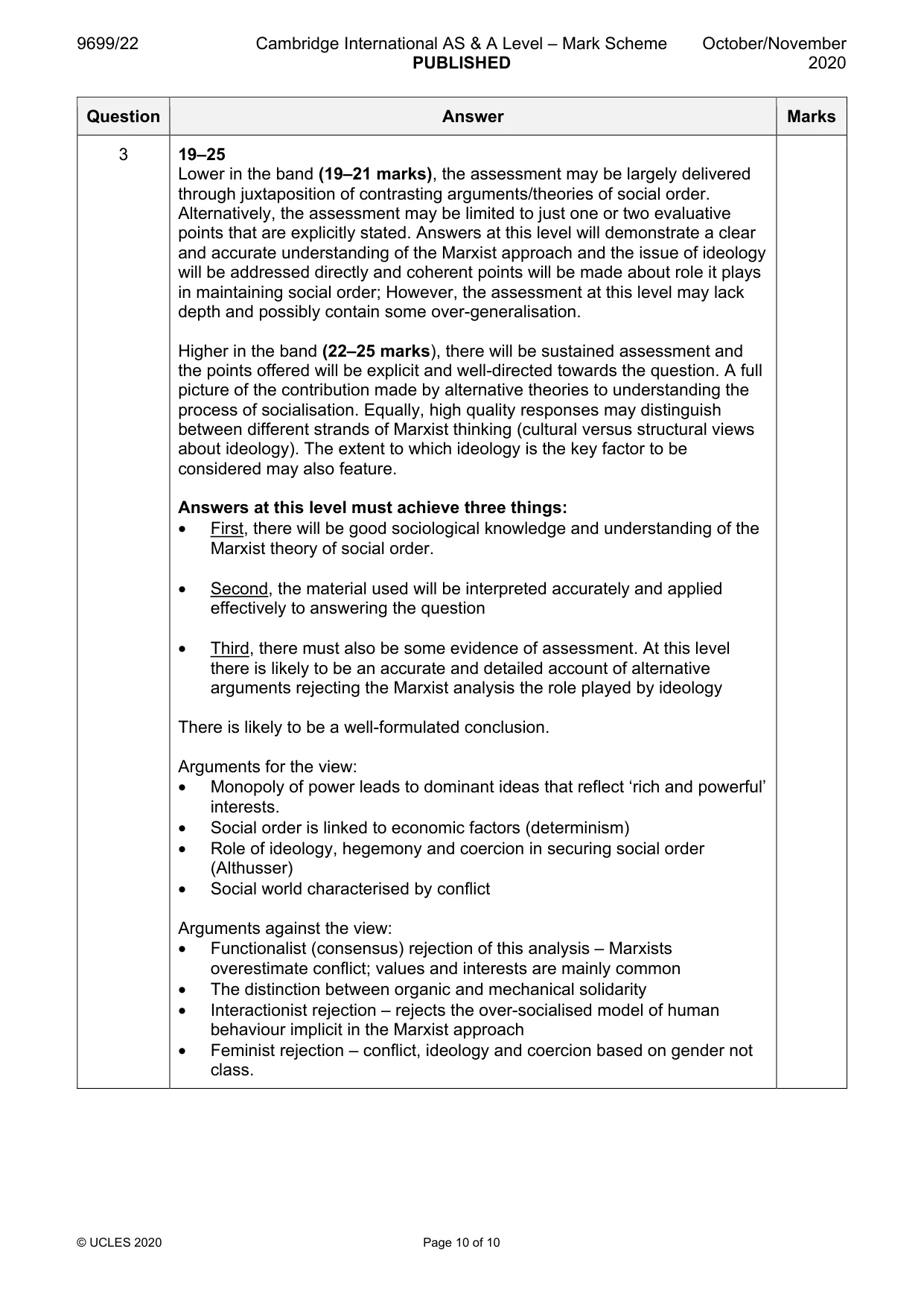
9699/22 Cambridge International AS & A Level – Mark Scheme PUBLISHED October/November 2020 © UCLES 2020 Page 10 of 10 Question Answer Marks 3 19–25 Lower in the band (19–21 marks), the assessment may be largely delivered through juxtaposition of contrasting arguments/theories of social order. Alternatively, the assessment may be limited to just one or two evaluative points that are explicitly stated. Answers at this level will demonstrate a clear and accurate understanding of the Marxist approach and the issue of ideology will be addressed directly and coherent points will be made about role it plays in maintaining social order; However, the assessment at this level may lack depth and possibly contain some over-generalisation. Higher in the band (22–25 marks), there will be sustained assessment and the points offered will be explicit and well-directed towards the question. A full picture of the contribution made by alternative theories to understanding the process of socialisation. Equally, high quality responses may distinguish between different strands of Marxist thinking (cultural versus structural views about ideology). The extent to which ideology is the key factor to be considered may also feature. Answers at this level must achieve three things: • First, there will be good sociological knowledge and understanding of the Marxist theory of social order. • Second, the material used will be interpreted accurately and applied effectively to answering the question • Third, there must also be some evidence of assessment. At this level there is likely to be an accurate and detailed account of alternative arguments rejecting the Marxist analysis the role played by ideology There is likely to be a well-formulated conclusion. Arguments for the view: • Monopoly of power leads to dominant ideas that reflect ‘rich and powerful’ interests. • Social order is linked to economic factors (determinism) • Role of ideology, hegemony and coercion in securing social order (Althusser) • Social world characterised by conflict Arguments against the view: • Functionalist (consensus) rejection of this analysis – Marxists overestimate conflict; values and interests are mainly common • The distinction between organic and mechanical solidarity • Interactionist rejection – rejects the over-socialised model of human behaviour implicit in the Marxist approach • Feminist rejection – conflict, ideology and coercion based on gender not class.
What you needed in this session
Cambridge’s own grade thresholds for 2020 Oct/Nov, Paper 2 · Variant 2. A higher threshold means an easier paper — the bar moves with how the cohort did.