Cambridge A Level Sociology 9699 — 2020 Oct/Nov Paper 1 · Variant 3
9699/13/O/N/20 · 50 marks · ≈56 min
The question paper and its mark scheme, free to read here and free to download. This is Cambridge’s own paper, exactly as it was sat.
Question paper4 pages


Mark scheme10 pages
Answers below. Sit the paper first if you are practising.
Paper as text
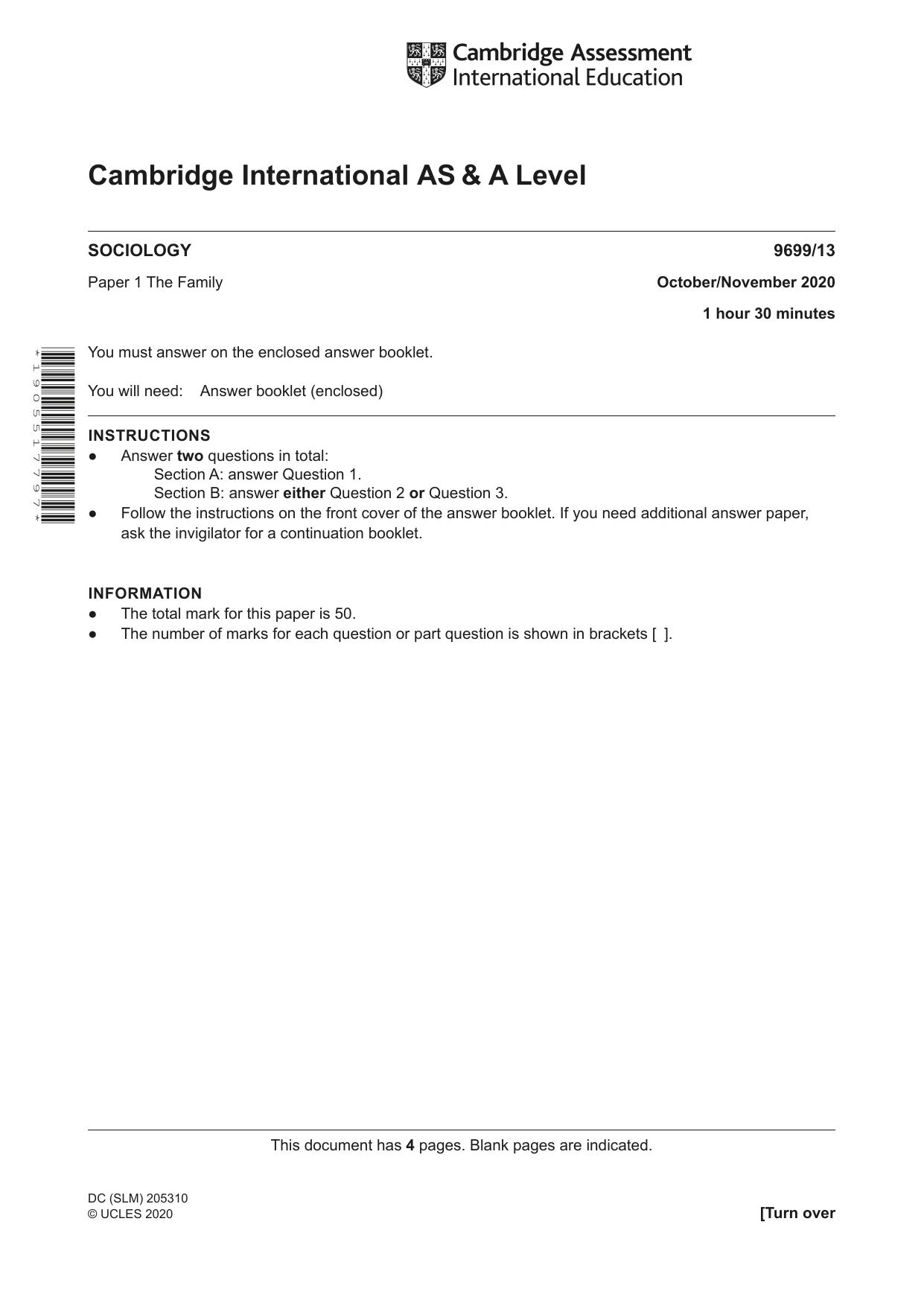
Question paper, page 1
Cambridge International AS & A Level * 1 9 0 5 5 1 7 7 9 7 * DC (SLM) 205310 © UCLES 2020 [Turn over This document has 4 pages. Blank pages are indicated. SOCIOLOGY 9699/13 Paper 1 The Family October/November 2020 1 hour 30 minutes You must answer on the enclosed answer booklet. You will need: Answer booklet (enclosed) INSTRUCTIONS ● Answer two questions in total: Section A: answer Question 1. Section B: answer either Question 2 or Question 3. ● Follow the instructions on the front cover of the answer booklet. If you need additional answer paper, ask the invigilator for a continuation booklet. INFORMATION ● The total mark for this paper is 50. ● The number of marks for each question or part question is shown in brackets [ ].
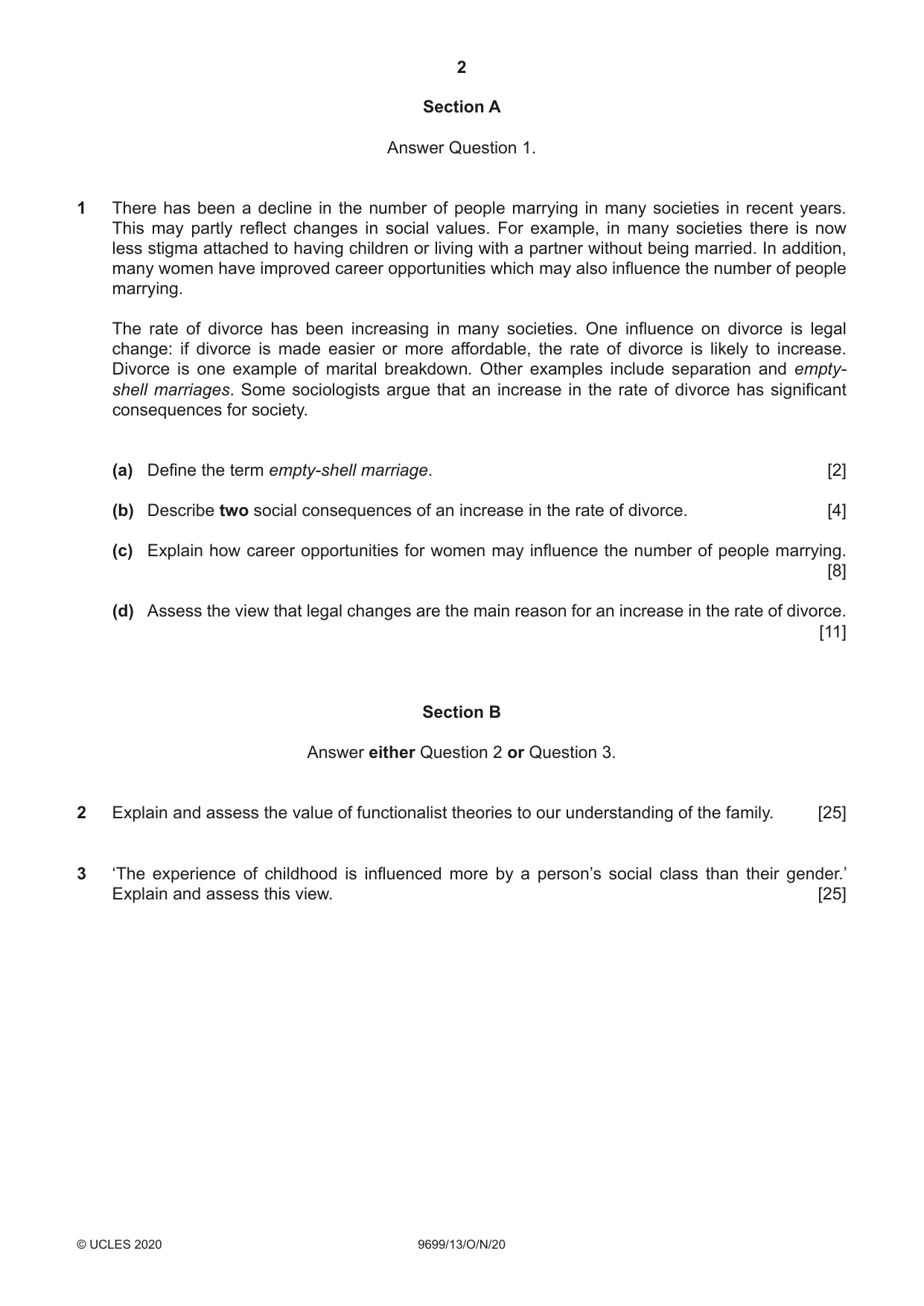
Question paper, page 2
2 9699/13/O/N/20 © UCLES 2020 Section A Answer Question 1. 1 There has been a decline in the number of people marrying in many societies in recent years. This may partly reflect changes in social values. For example, in many societies there is now less stigma attached to having children or living with a partner without being married. In addition, many women have improved career opportunities which may also influence the number of people marrying. The rate of divorce has been increasing in many societies. One influence on divorce is legal change: if divorce is made easier or more affordable, the rate of divorce is likely to increase. Divorce is one example of marital breakdown. Other examples include separation and empty- shell marriages. Some sociologists argue that an increase in the rate of divorce has significant consequences for society. (a) Define the term empty-shell marriage. [2] (b) Describe two social consequences of an increase in the rate of divorce. [4] (c) Explain how career opportunities for women may influence the number of people marrying. [8] (d) Assess the view that legal changes are the main reason for an increase in the rate of divorce. [11] Section B Answer either Question 2 or Question 3. 2 Explain and assess the value of functionalist theories to our understanding of the family. [25] 3 ‘The experience of childhood is influenced more by a person’s social class than their gender.’ Explain and assess this view. [25]
Question paper, page 3
3 9699/13/O/N/20 © UCLES 2020 BLANK PAGE
Question paper, page 4
4 9699/13/O/N/20 © UCLES 2020 Permission to reproduce items where third-party owned material protected by copyright is included has been sought and cleared where possible. Every reasonable effort has been made by the publisher (UCLES) to trace copyright holders, but if any items requiring clearance have unwittingly been included, the publisher will be pleased to make amends at the earliest possible opportunity. To avoid the issue of disclosure of answer-related information to candidates, all copyright acknowledgements are reproduced online in the Cambridge Assessment International Education Copyright Acknowledgements Booklet. This is produced for each series of examinations and is freely available to download at www.cambridgeinternational.org after the live examination series. Cambridge Assessment International Education is part of the Cambridge Assessment Group. Cambridge Assessment is the brand name of the University of Cambridge Local Examinations Syndicate (UCLES), which itself is a department of the University of Cambridge. BLANK PAGE
Mark scheme, page 1
This document consists of 10 printed pages. © UCLES 2020 [Turn over Cambridge International AS & A Level SOCIOLOGY 9699/13 Paper 1 October/November 2020 MARK SCHEME Maximum Mark: 50 Published This mark scheme is published as an aid to teachers and candidates, to indicate the requirements of the examination. It shows the basis on which Examiners were instructed to award marks. It does not indicate the details of the discussions that took place at an Examiners’ meeting before marking began, which would have considered the acceptability of alternative answers. Mark schemes should be read in conjunction with the question paper and the Principal Examiner Report for Teachers. Cambridge International will not enter into discussions about these mark schemes. Cambridge International is publishing the mark schemes for the October/November 2020 series for most Cambridge IGCSE™, Cambridge International A and AS Level and Cambridge Pre-U components, and some Cambridge O Level components.
Mark scheme, page 2
9699/13 Cambridge International AS & A Level – Mark Scheme PUBLISHED October/November 2020 © UCLES 2020 Page 2 of 10 Generic Marking Principles These general marking principles must be applied by all examiners when marking candidate answers. They should be applied alongside the specific content of the mark scheme or generic level descriptors for a question. Each question paper and mark scheme will also comply with these marking principles. GENERIC MARKING PRINCIPLE 1: Marks must be awarded in line with: • the specific content of the mark scheme or the generic level descriptors for the question • the specific skills defined in the mark scheme or in the generic level descriptors for the question • the standard of response required by a candidate as exemplified by the standardisation scripts. GENERIC MARKING PRINCIPLE 2: Marks awarded are always whole marks (not half marks, or other fractions). GENERIC MARKING PRINCIPLE 3: Marks must be awarded positively: • marks are awarded for correct/valid answers, as defined in the mark scheme. However, credit is given for valid answers which go beyond the scope of the syllabus and mark scheme, referring to your Team Leader as appropriate • marks are awarded when candidates clearly demonstrate what they know and can do • marks are not deducted for errors • marks are not deducted for omissions • answers should only be judged on the quality of spelling, punctuation and grammar when these features are specifically assessed by the question as indicated by the mark scheme. The meaning, however, should be unambiguous. GENERIC MARKING PRINCIPLE 4: Rules must be applied consistently, e.g. in situations where candidates have not followed instructions or in the application of generic level descriptors. GENERIC MARKING PRINCIPLE 5: Marks should be awarded using the full range of marks defined in the mark scheme for the question (however; the use of the full mark range may be limited according to the quality of the candidate responses seen). GENERIC MARKING PRINCIPLE 6: Marks awarded are based solely on the requirements as defined in the mark scheme. Marks should not be awarded with grade thresholds or grade descriptors in mind.
Mark scheme, page 3
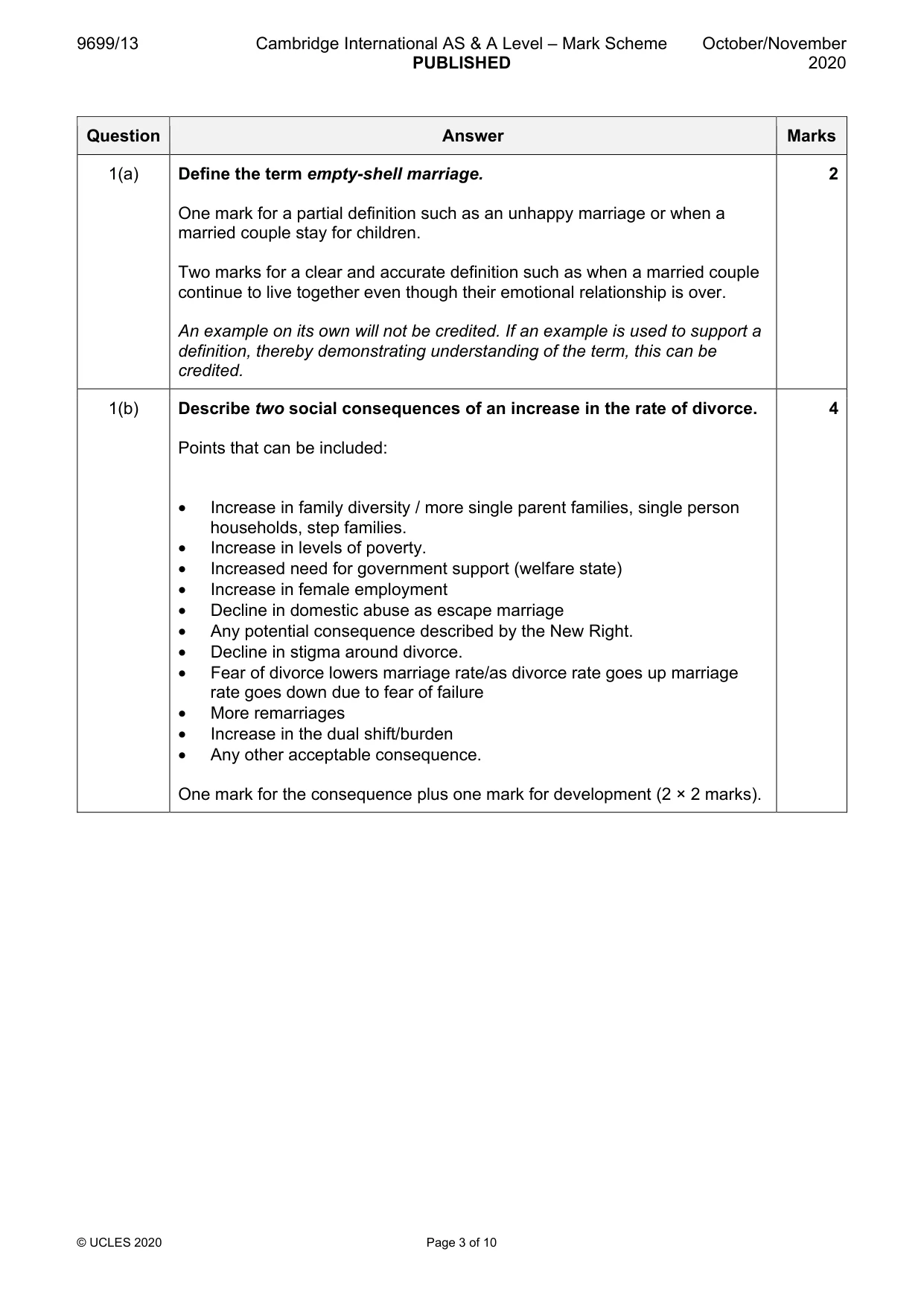
9699/13 Cambridge International AS & A Level – Mark Scheme PUBLISHED October/November 2020 © UCLES 2020 Page 3 of 10 Question Answer Marks 1(a) Define the term empty-shell marriage. One mark for a partial definition such as an unhappy marriage or when a married couple stay for children. Two marks for a clear and accurate definition such as when a married couple continue to live together even though their emotional relationship is over. An example on its own will not be credited. If an example is used to support a definition, thereby demonstrating understanding of the term, this can be credited. 2 1(b) Describe two social consequences of an increase in the rate of divorce. Points that can be included: • Increase in family diversity / more single parent families, single person households, step families. • Increase in levels of poverty. • Increased need for government support (welfare state) • Increase in female employment • Decline in domestic abuse as escape marriage • Any potential consequence described by the New Right. • Decline in stigma around divorce. • Fear of divorce lowers marriage rate/as divorce rate goes up marriage rate goes down due to fear of failure • More remarriages • Increase in the dual shift/burden • Any other acceptable consequence. One mark for the consequence plus one mark for development (2 × 2 marks). 4
Mark scheme, page 4
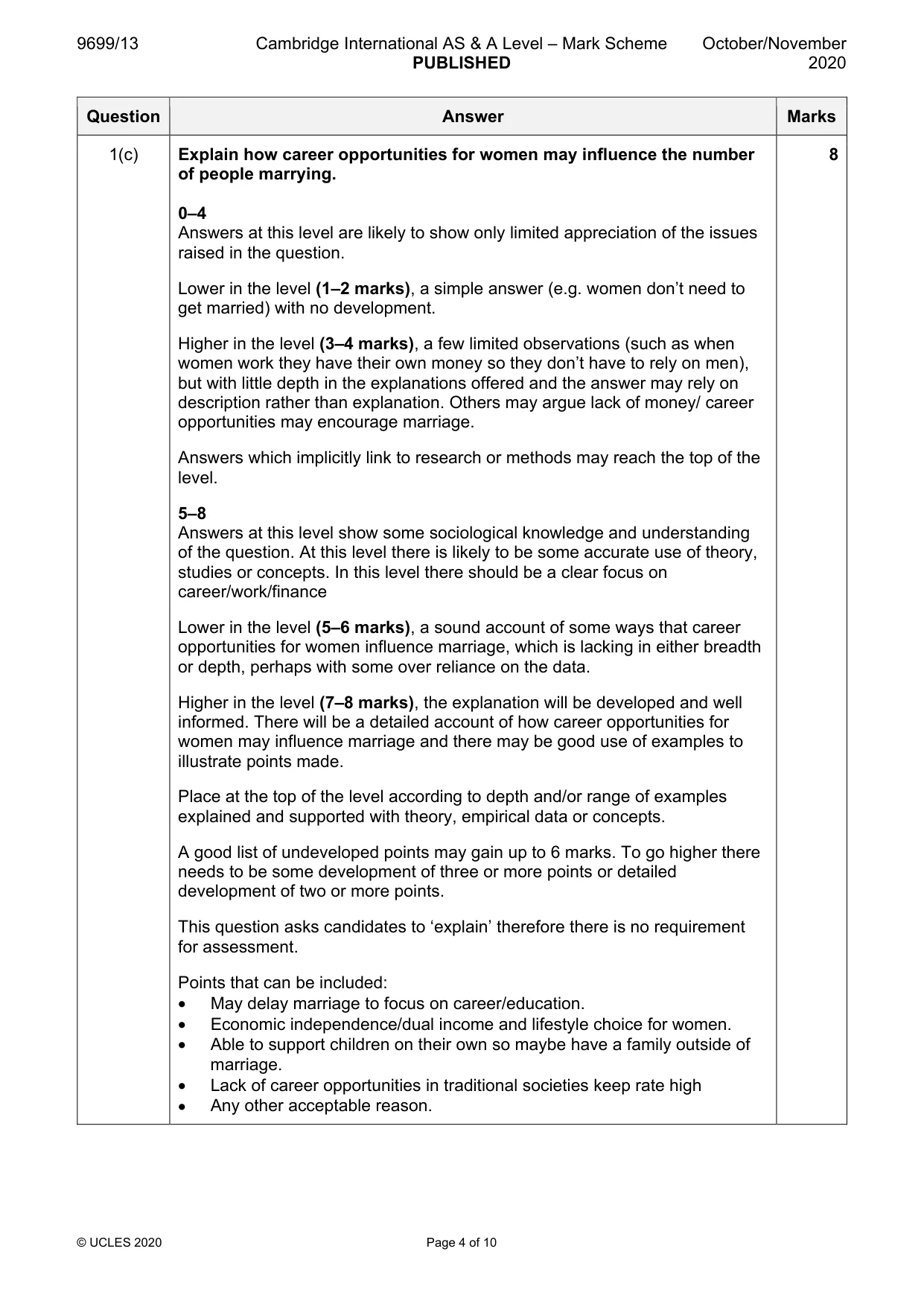
9699/13 Cambridge International AS & A Level – Mark Scheme PUBLISHED October/November 2020 © UCLES 2020 Page 4 of 10 Question Answer Marks 1(c) Explain how career opportunities for women may influence the number of people marrying. 0–4 Answers at this level are likely to show only limited appreciation of the issues raised in the question. Lower in the level (1–2 marks), a simple answer (e.g. women don’t need to get married) with no development. Higher in the level (3–4 marks), a few limited observations (such as when women work they have their own money so they don’t have to rely on men), but with little depth in the explanations offered and the answer may rely on description rather than explanation. Others may argue lack of money/ career opportunities may encourage marriage. Answers which implicitly link to research or methods may reach the top of the level. 5–8 Answers at this level show some sociological knowledge and understanding of the question. At this level there is likely to be some accurate use of theory, studies or concepts. In this level there should be a clear focus on career/work/finance Lower in the level (5–6 marks), a sound account of some ways that career opportunities for women influence marriage, which is lacking in either breadth or depth, perhaps with some over reliance on the data. Higher in the level (7–8 marks), the explanation will be developed and well informed. There will be a detailed account of how career opportunities for women may influence marriage and there may be good use of examples to illustrate points made. Place at the top of the level according to depth and/or range of examples explained and supported with theory, empirical data or concepts. A good list of undeveloped points may gain up to 6 marks. To go higher there needs to be some development of three or more points or detailed development of two or more points. This question asks candidates to ‘explain’ therefore there is no requirement for assessment. Points that can be included: • May delay marriage to focus on career/education. • Economic independence/dual income and lifestyle choice for women. • Able to support children on their own so maybe have a family outside of marriage. • Lack of career opportunities in traditional societies keep rate high • Any other acceptable reason. 8
Mark scheme, page 5
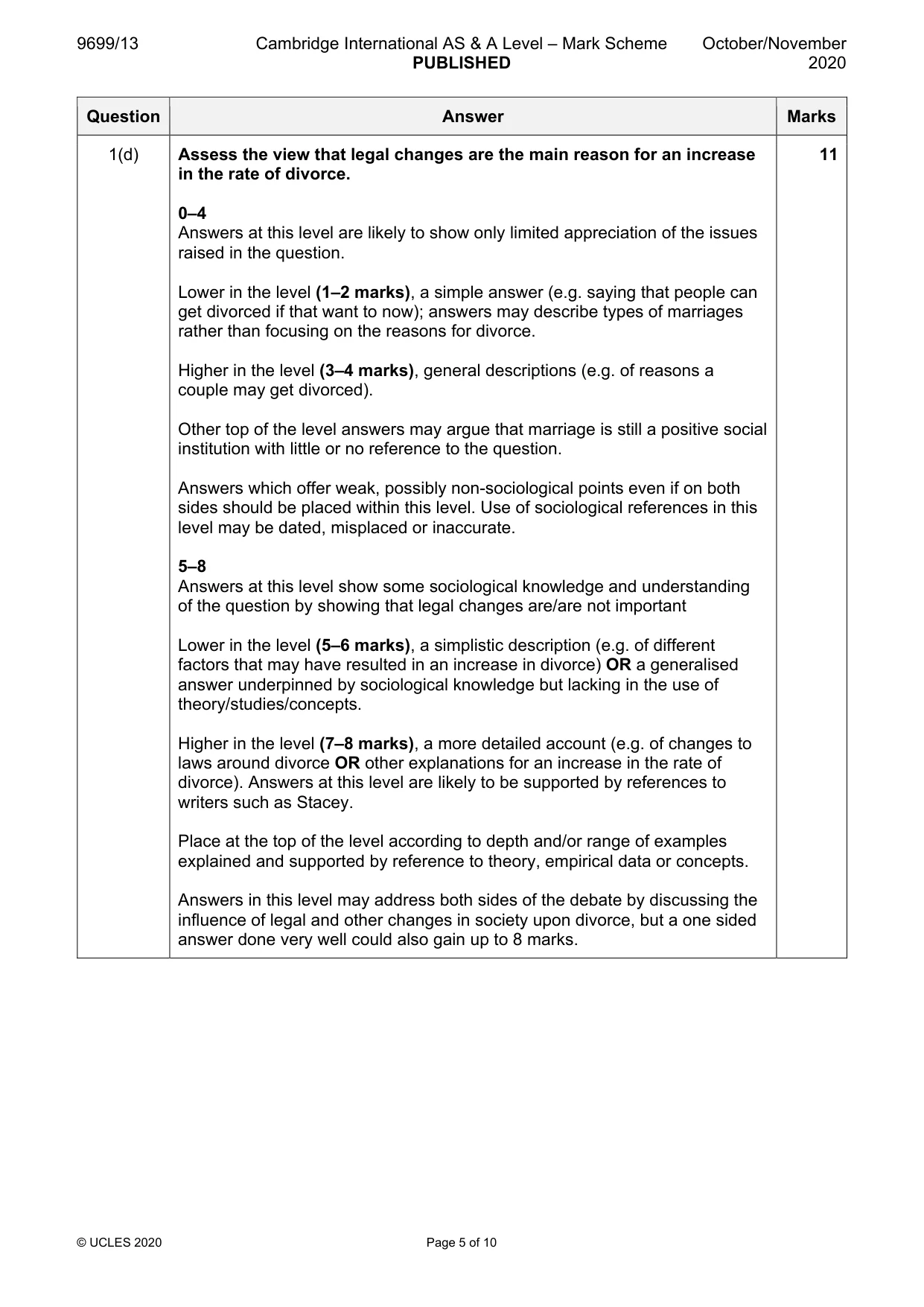
9699/13 Cambridge International AS & A Level – Mark Scheme PUBLISHED October/November 2020 © UCLES 2020 Page 5 of 10 Question Answer Marks 1(d) Assess the view that legal changes are the main reason for an increase in the rate of divorce. 0–4 Answers at this level are likely to show only limited appreciation of the issues raised in the question. Lower in the level (1–2 marks), a simple answer (e.g. saying that people can get divorced if that want to now); answers may describe types of marriages rather than focusing on the reasons for divorce. Higher in the level (3–4 marks), general descriptions (e.g. of reasons a couple may get divorced). Other top of the level answers may argue that marriage is still a positive social institution with little or no reference to the question. Answers which offer weak, possibly non-sociological points even if on both sides should be placed within this level. Use of sociological references in this level may be dated, misplaced or inaccurate. 5–8 Answers at this level show some sociological knowledge and understanding of the question by showing that legal changes are/are not important Lower in the level (5–6 marks), a simplistic description (e.g. of different factors that may have resulted in an increase in divorce) OR a generalised answer underpinned by sociological knowledge but lacking in the use of theory/studies/concepts. Higher in the level (7–8 marks), a more detailed account (e.g. of changes to laws around divorce OR other explanations for an increase in the rate of divorce). Answers at this level are likely to be supported by references to writers such as Stacey. Place at the top of the level according to depth and/or range of examples explained and supported by reference to theory, empirical data or concepts. Answers in this level may address both sides of the debate by discussing the influence of legal and other changes in society upon divorce, but a one sided answer done very well could also gain up to 8 marks. 11
Mark scheme, page 6
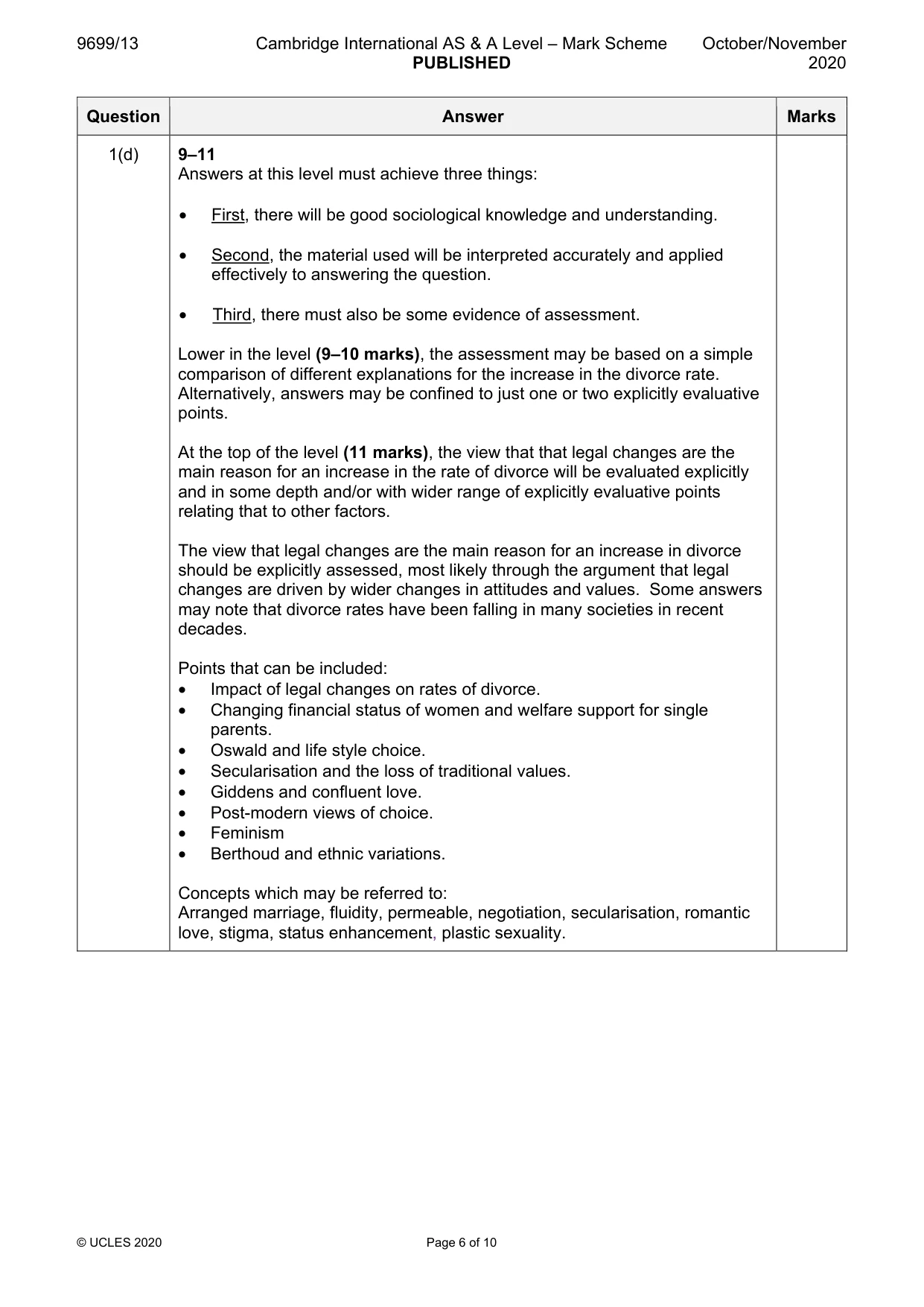
9699/13 Cambridge International AS & A Level – Mark Scheme PUBLISHED October/November 2020 © UCLES 2020 Page 6 of 10 Question Answer Marks 1(d) 9–11 Answers at this level must achieve three things: • First, there will be good sociological knowledge and understanding. • Second, the material used will be interpreted accurately and applied effectively to answering the question. • Third, there must also be some evidence of assessment. Lower in the level (9–10 marks), the assessment may be based on a simple comparison of different explanations for the increase in the divorce rate. Alternatively, answers may be confined to just one or two explicitly evaluative points. At the top of the level (11 marks), the view that that legal changes are the main reason for an increase in the rate of divorce will be evaluated explicitly and in some depth and/or with wider range of explicitly evaluative points relating that to other factors. The view that legal changes are the main reason for an increase in divorce should be explicitly assessed, most likely through the argument that legal changes are driven by wider changes in attitudes and values. Some answers may note that divorce rates have been falling in many societies in recent decades. Points that can be included: • Impact of legal changes on rates of divorce. • Changing financial status of women and welfare support for single parents. • Oswald and life style choice. • Secularisation and the loss of traditional values. • Giddens and confluent love. • Post-modern views of choice. • Feminism • Berthoud and ethnic variations. Concepts which may be referred to: Arranged marriage, fluidity, permeable, negotiation, secularisation, romantic love, stigma, status enhancement, plastic sexuality.
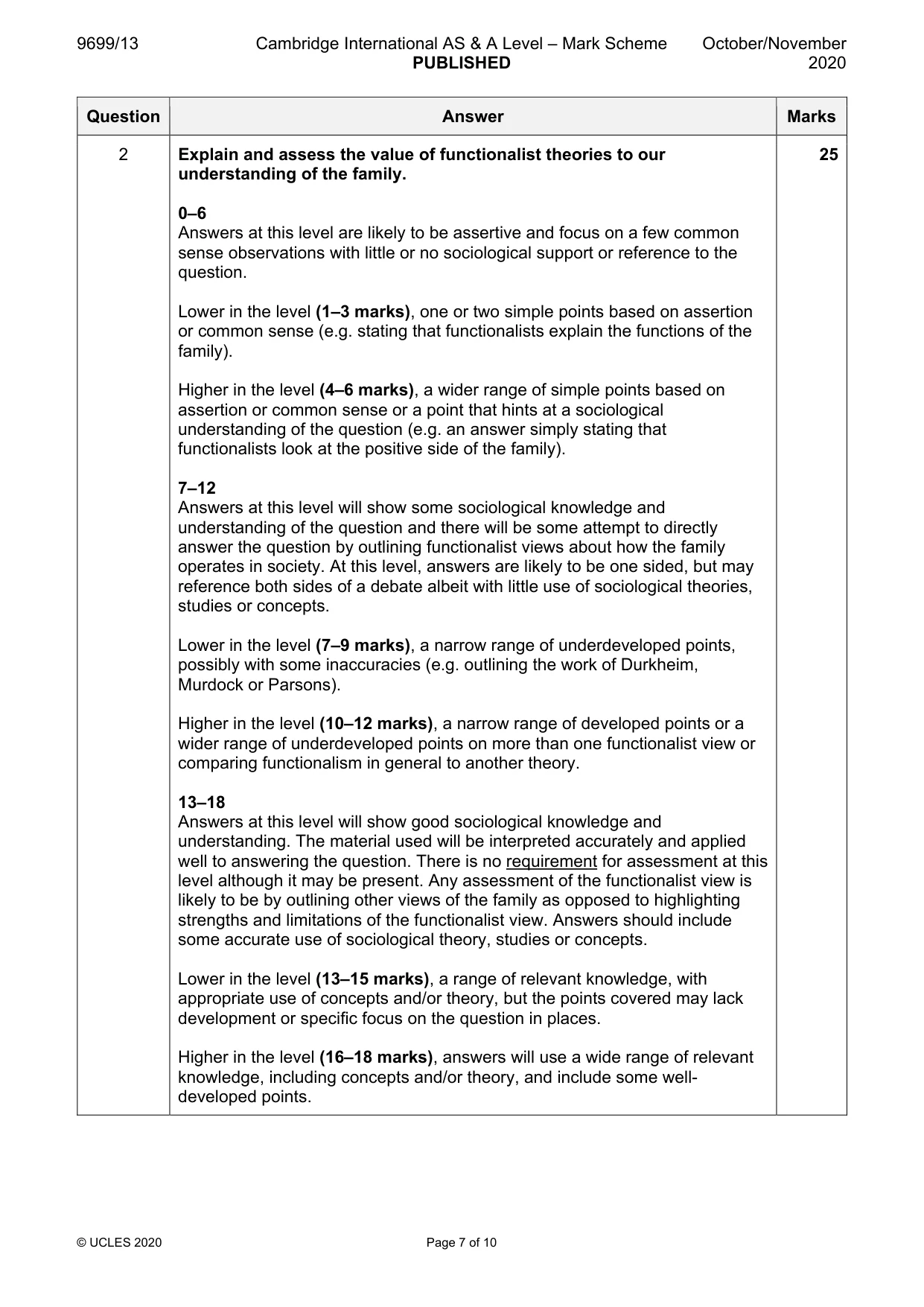
Mark scheme, page 7
9699/13 Cambridge International AS & A Level – Mark Scheme PUBLISHED October/November 2020 © UCLES 2020 Page 7 of 10 Question Answer Marks 2 Explain and assess the value of functionalist theories to our understanding of the family. 0–6 Answers at this level are likely to be assertive and focus on a few common sense observations with little or no sociological support or reference to the question. Lower in the level (1–3 marks), one or two simple points based on assertion or common sense (e.g. stating that functionalists explain the functions of the family). Higher in the level (4–6 marks), a wider range of simple points based on assertion or common sense or a point that hints at a sociological understanding of the question (e.g. an answer simply stating that functionalists look at the positive side of the family). 7–12 Answers at this level will show some sociological knowledge and understanding of the question and there will be some attempt to directly answer the question by outlining functionalist views about how the family operates in society. At this level, answers are likely to be one sided, but may reference both sides of a debate albeit with little use of sociological theories, studies or concepts. Lower in the level (7–9 marks), a narrow range of underdeveloped points, possibly with some inaccuracies (e.g. outlining the work of Durkheim, Murdock or Parsons). Higher in the level (10–12 marks), a narrow range of developed points or a wider range of underdeveloped points on more than one functionalist view or comparing functionalism in general to another theory. 13–18 Answers at this level will show good sociological knowledge and understanding. The material used will be interpreted accurately and applied well to answering the question. There is no requirement for assessment at this level although it may be present. Any assessment of the functionalist view is likely to be by outlining other views of the family as opposed to highlighting strengths and limitations of the functionalist view. Answers should include some accurate use of sociological theory, studies or concepts. Lower in the level (13–15 marks), a range of relevant knowledge, with appropriate use of concepts and/or theory, but the points covered may lack development or specific focus on the question in places. Higher in the level (16–18 marks), answers will use a wide range of relevant knowledge, including concepts and/or theory, and include some well- developed points. 25
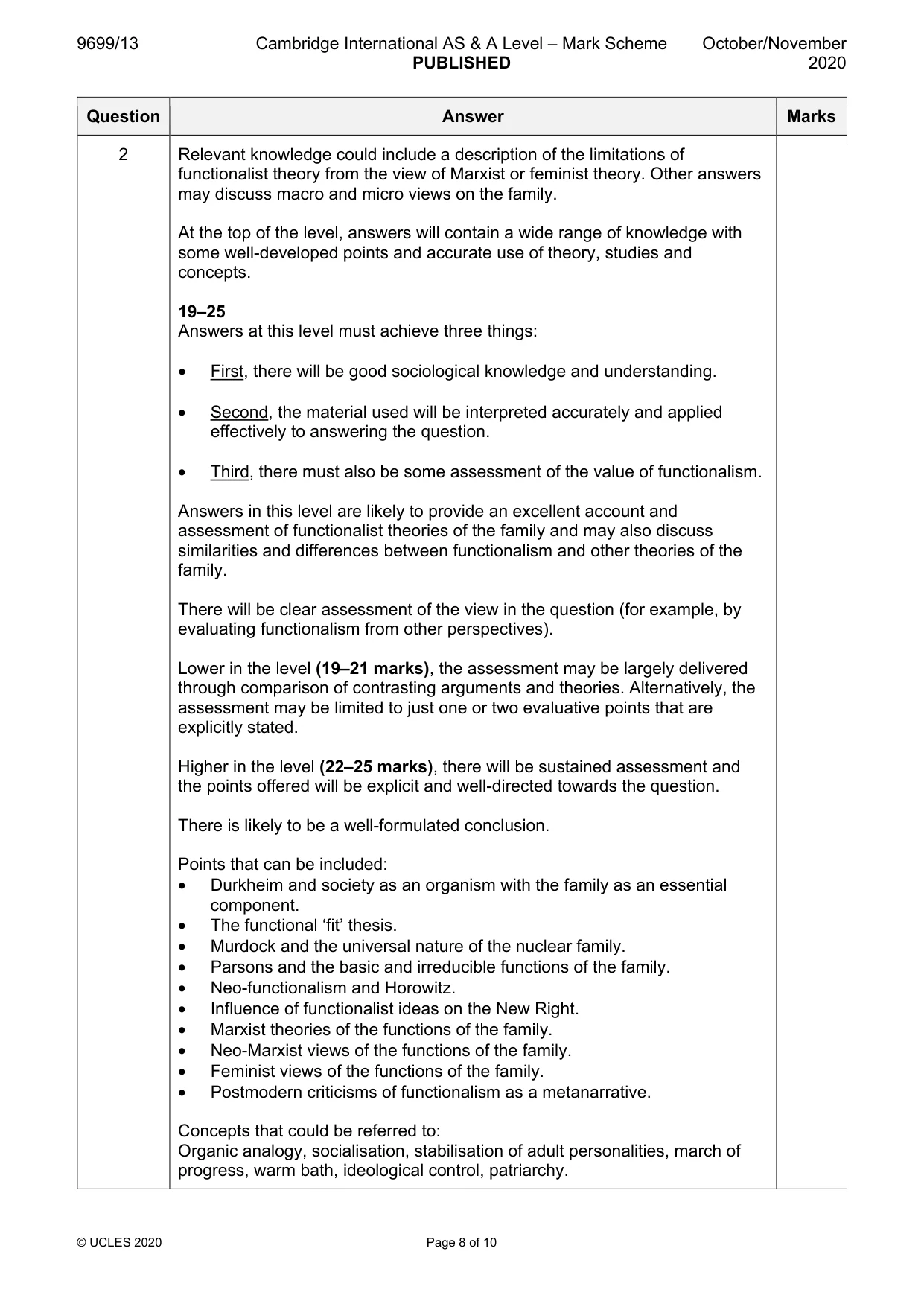
Mark scheme, page 8
9699/13 Cambridge International AS & A Level – Mark Scheme PUBLISHED October/November 2020 © UCLES 2020 Page 8 of 10 Question Answer Marks 2 Relevant knowledge could include a description of the limitations of functionalist theory from the view of Marxist or feminist theory. Other answers may discuss macro and micro views on the family. At the top of the level, answers will contain a wide range of knowledge with some well-developed points and accurate use of theory, studies and concepts. 19–25 Answers at this level must achieve three things: • First, there will be good sociological knowledge and understanding. • Second, the material used will be interpreted accurately and applied effectively to answering the question. • Third, there must also be some assessment of the value of functionalism. Answers in this level are likely to provide an excellent account and assessment of functionalist theories of the family and may also discuss similarities and differences between functionalism and other theories of the family. There will be clear assessment of the view in the question (for example, by evaluating functionalism from other perspectives). Lower in the level (19–21 marks), the assessment may be largely delivered through comparison of contrasting arguments and theories. Alternatively, the assessment may be limited to just one or two evaluative points that are explicitly stated. Higher in the level (22–25 marks), there will be sustained assessment and the points offered will be explicit and well-directed towards the question. There is likely to be a well-formulated conclusion. Points that can be included: • Durkheim and society as an organism with the family as an essential component. • The functional ‘fit’ thesis. • Murdock and the universal nature of the nuclear family. • Parsons and the basic and irreducible functions of the family. • Neo-functionalism and Horowitz. • Influence of functionalist ideas on the New Right. • Marxist theories of the functions of the family. • Neo-Marxist views of the functions of the family. • Feminist views of the functions of the family. • Postmodern criticisms of functionalism as a metanarrative. Concepts that could be referred to: Organic analogy, socialisation, stabilisation of adult personalities, march of progress, warm bath, ideological control, patriarchy.
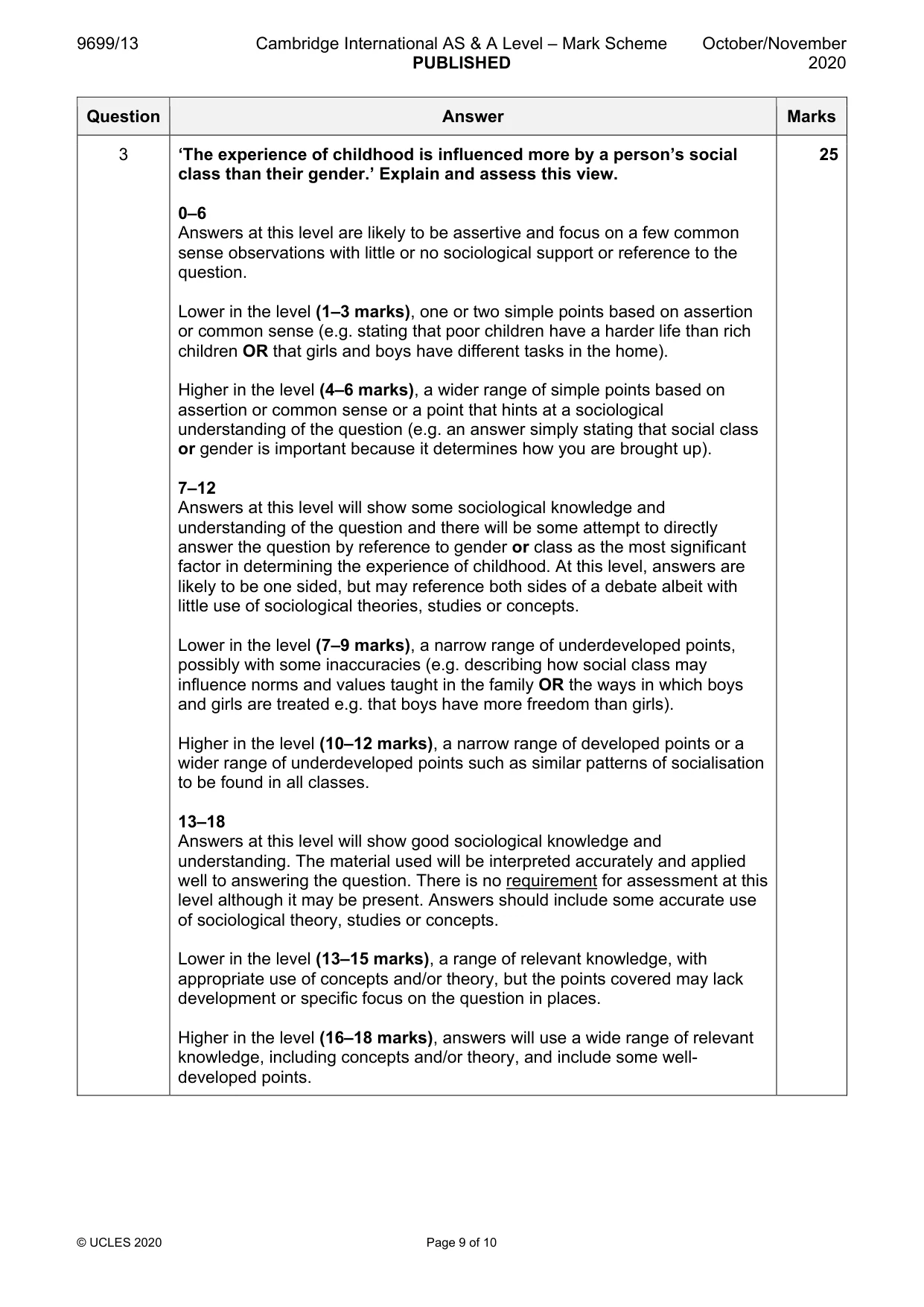
Mark scheme, page 9
9699/13 Cambridge International AS & A Level – Mark Scheme PUBLISHED October/November 2020 © UCLES 2020 Page 9 of 10 Question Answer Marks 3 ‘The experience of childhood is influenced more by a person’s social class than their gender.’ Explain and assess this view. 0–6 Answers at this level are likely to be assertive and focus on a few common sense observations with little or no sociological support or reference to the question. Lower in the level (1–3 marks), one or two simple points based on assertion or common sense (e.g. stating that poor children have a harder life than rich children OR that girls and boys have different tasks in the home). Higher in the level (4–6 marks), a wider range of simple points based on assertion or common sense or a point that hints at a sociological understanding of the question (e.g. an answer simply stating that social class or gender is important because it determines how you are brought up). 7–12 Answers at this level will show some sociological knowledge and understanding of the question and there will be some attempt to directly answer the question by reference to gender or class as the most significant factor in determining the experience of childhood. At this level, answers are likely to be one sided, but may reference both sides of a debate albeit with little use of sociological theories, studies or concepts. Lower in the level (7–9 marks), a narrow range of underdeveloped points, possibly with some inaccuracies (e.g. describing how social class may influence norms and values taught in the family OR the ways in which boys and girls are treated e.g. that boys have more freedom than girls). Higher in the level (10–12 marks), a narrow range of developed points or a wider range of underdeveloped points such as similar patterns of socialisation to be found in all classes. 13–18 Answers at this level will show good sociological knowledge and understanding. The material used will be interpreted accurately and applied well to answering the question. There is no requirement for assessment at this level although it may be present. Answers should include some accurate use of sociological theory, studies or concepts. Lower in the level (13–15 marks), a range of relevant knowledge, with appropriate use of concepts and/or theory, but the points covered may lack development or specific focus on the question in places. Higher in the level (16–18 marks), answers will use a wide range of relevant knowledge, including concepts and/or theory, and include some well- developed points. 25
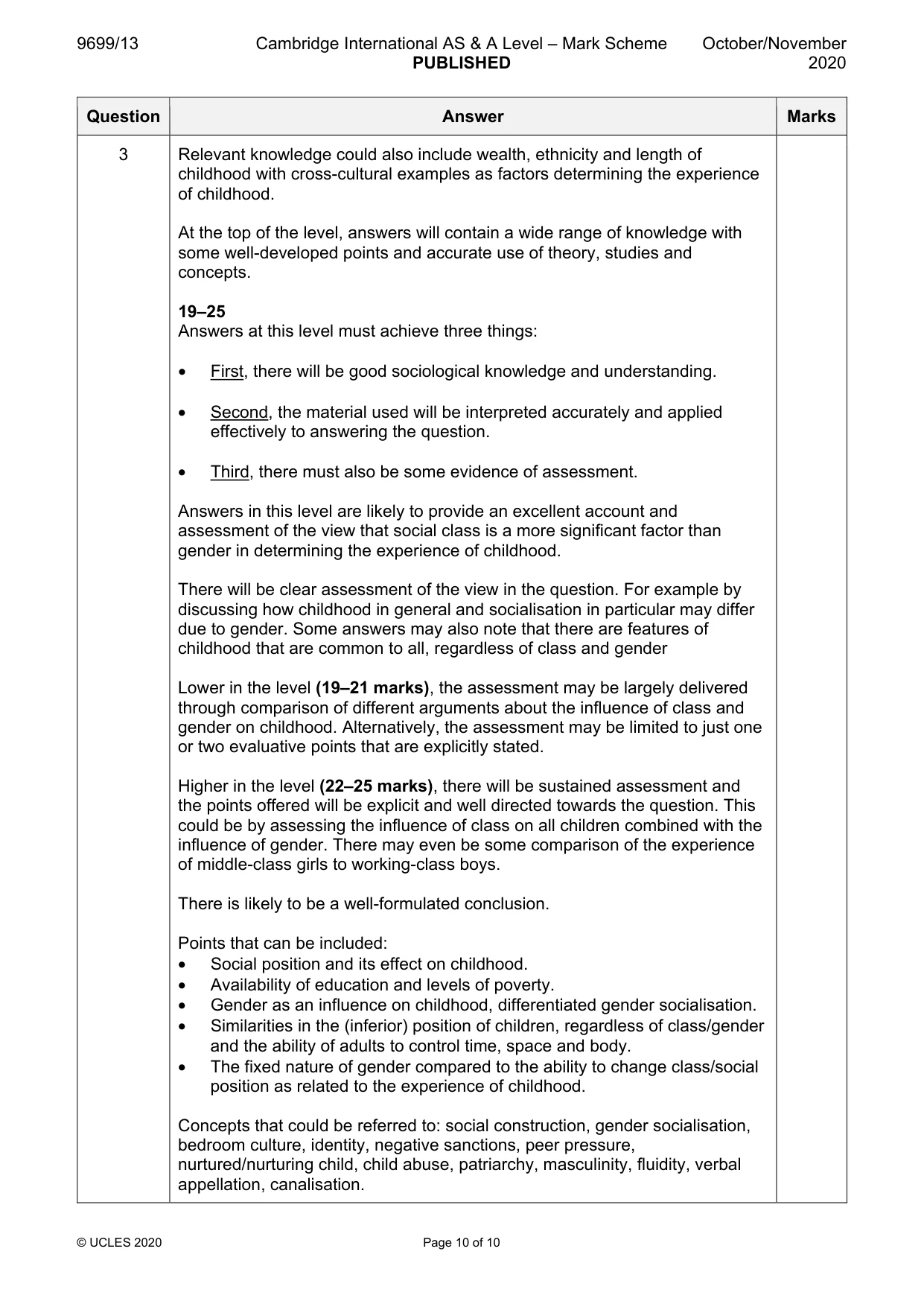
Mark scheme, page 10
9699/13 Cambridge International AS & A Level – Mark Scheme PUBLISHED October/November 2020 © UCLES 2020 Page 10 of 10 Question Answer Marks 3 Relevant knowledge could also include wealth, ethnicity and length of childhood with cross-cultural examples as factors determining the experience of childhood. At the top of the level, answers will contain a wide range of knowledge with some well-developed points and accurate use of theory, studies and concepts. 19–25 Answers at this level must achieve three things: • First, there will be good sociological knowledge and understanding. • Second, the material used will be interpreted accurately and applied effectively to answering the question. • Third, there must also be some evidence of assessment. Answers in this level are likely to provide an excellent account and assessment of the view that social class is a more significant factor than gender in determining the experience of childhood. There will be clear assessment of the view in the question. For example by discussing how childhood in general and socialisation in particular may differ due to gender. Some answers may also note that there are features of childhood that are common to all, regardless of class and gender Lower in the level (19–21 marks), the assessment may be largely delivered through comparison of different arguments about the influence of class and gender on childhood. Alternatively, the assessment may be limited to just one or two evaluative points that are explicitly stated. Higher in the level (22–25 marks), there will be sustained assessment and the points offered will be explicit and well directed towards the question. This could be by assessing the influence of class on all children combined with the influence of gender. There may even be some comparison of the experience of middle-class girls to working-class boys. There is likely to be a well-formulated conclusion. Points that can be included: • Social position and its effect on childhood. • Availability of education and levels of poverty. • Gender as an influence on childhood, differentiated gender socialisation. • Similarities in the (inferior) position of children, regardless of class/gender and the ability of adults to control time, space and body. • The fixed nature of gender compared to the ability to change class/social position as related to the experience of childhood. Concepts that could be referred to: social construction, gender socialisation, bedroom culture, identity, negative sanctions, peer pressure, nurtured/nurturing child, child abuse, patriarchy, masculinity, fluidity, verbal appellation, canalisation.
What you needed in this session
Cambridge’s own grade thresholds for 2020 Oct/Nov, Paper 1 · Variant 3. A higher threshold means an easier paper — the bar moves with how the cohort did.