Cambridge A Level Sociology 9699 — 2025 May/June Paper 1 · Variant 3
9699/13/M/J/25 · 60 marks · 90 min
The question paper and its mark scheme, free to read here and free to download. This is Cambridge’s own paper, exactly as it was sat.
Question paper4 pages


Mark scheme19 pages
Answers below. Sit the paper first if you are practising.


Paper as text
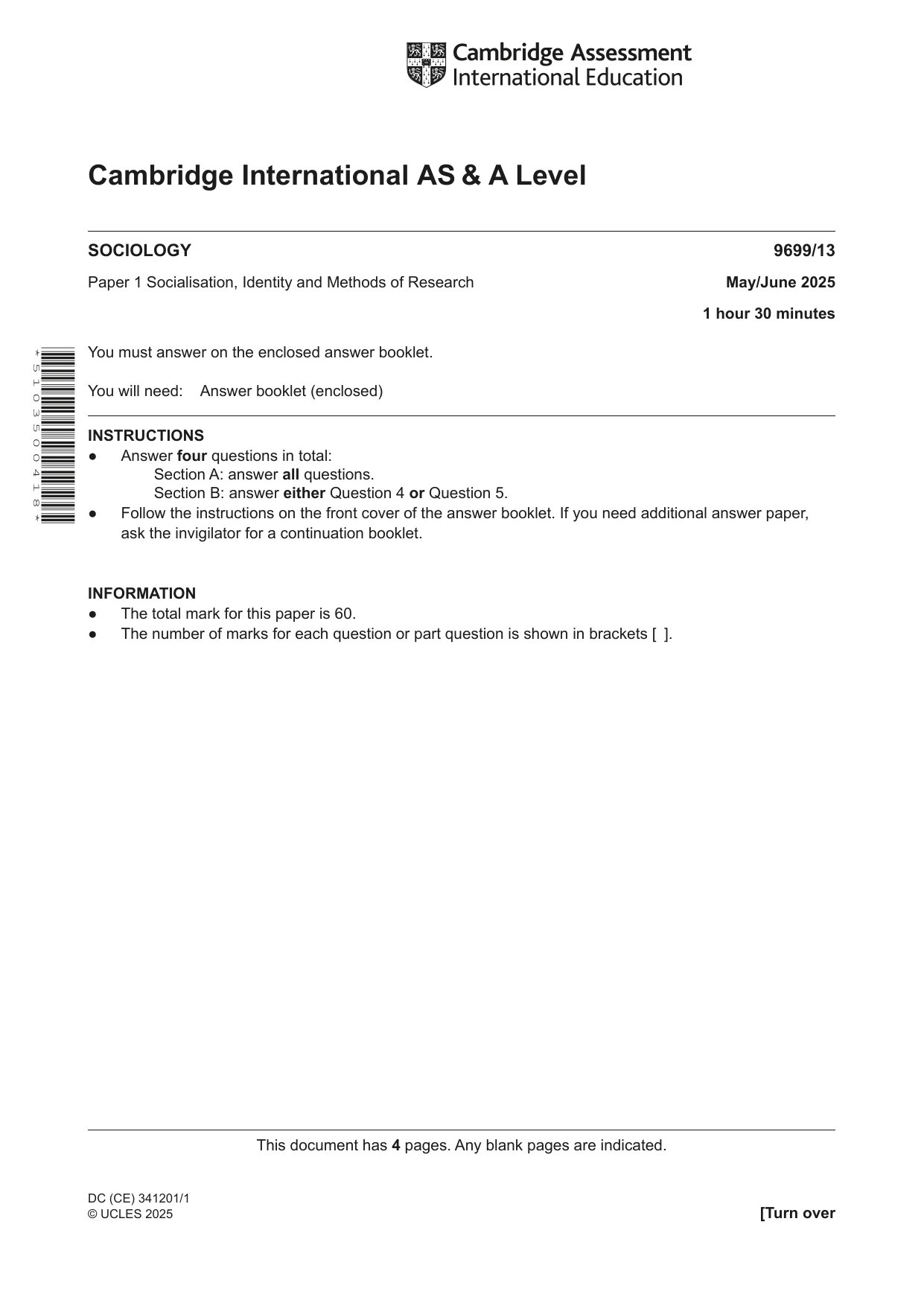
Question paper, page 1
This document has 4 pages. Any blank pages are indicated. [Turn over Cambridge International AS & A Level DC (CE) 341201/1 © UCLES 2025 * 5 1 0 3 5 0 0 4 1 8 * SOCIOLOGY 9699/13 Paper 1 Socialisation, Identity and Methods of Research May/June 2025 1 hour 30 minutes You must answer on the enclosed answer booklet. You will need: Answer booklet (enclosed) INSTRUCTIONS ● Answer four questions in total: Section A: answer all questions. Section B: answer either Question 4 or Question 5. ● Follow the instructions on the front cover of the answer booklet. If you need additional answer paper, ask the invigilator for a continuation booklet. INFORMATION ● The total mark for this paper is 60. ● The number of marks for each question or part question is shown in brackets [ ].
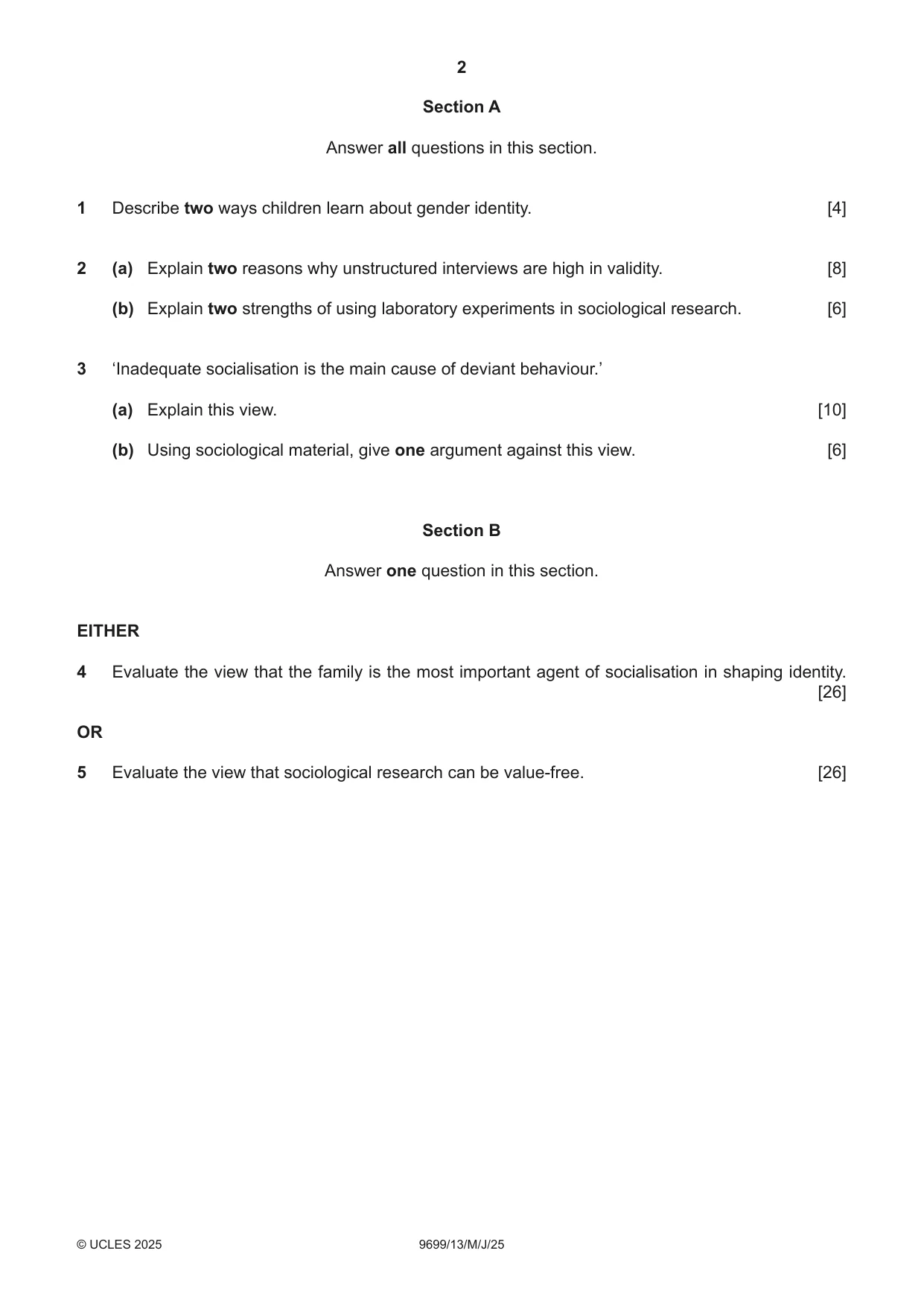
Question paper, page 2
2 9699/13/M/J/25 © UCLES 2025 Section A Answer all questions in this section. 1 Describe two ways children learn about gender identity. [4] 2 (a) Explain two reasons why unstructured interviews are high in validity. [8] (b) Explain two strengths of using laboratory experiments in sociological research. [6] 3 ‘Inadequate socialisation is the main cause of deviant behaviour.’ (a) Explain this view. [10] (b) Using sociological material, give one argument against this view. [6] Section B Answer one question in this section. EITHER 4 Evaluate the view that the family is the most important agent of socialisation in shaping identity. [26] OR 5 Evaluate the view that sociological research can be value-free. [26]
Question paper, page 3
3 9699/13/M/J/25 © UCLES 2025 BLANK PAGE
Question paper, page 4
4 9699/13/M/J/25 © UCLES 2025 Permission to reproduce items where third-party owned material protected by copyright is included has been sought and cleared where possible. Every reasonable effort has been made by the publisher (UCLES) to trace copyright holders, but if any items requiring clearance have unwittingly been included, the publisher will be pleased to make amends at the earliest possible opportunity. To avoid the issue of disclosure of answer-related information to candidates, all copyright acknowledgements are reproduced online in the Cambridge Assessment International Education Copyright Acknowledgements Booklet. This is produced for each series of examinations and is freely available to download at www.cambridgeinternational.org after the live examination series. Cambridge Assessment International Education is part of Cambridge Assessment. Cambridge Assessment is the brand name of the University of Cambridge Local Examinations Syndicate (UCLES), which is a department of the University of Cambridge. BLANK PAGE
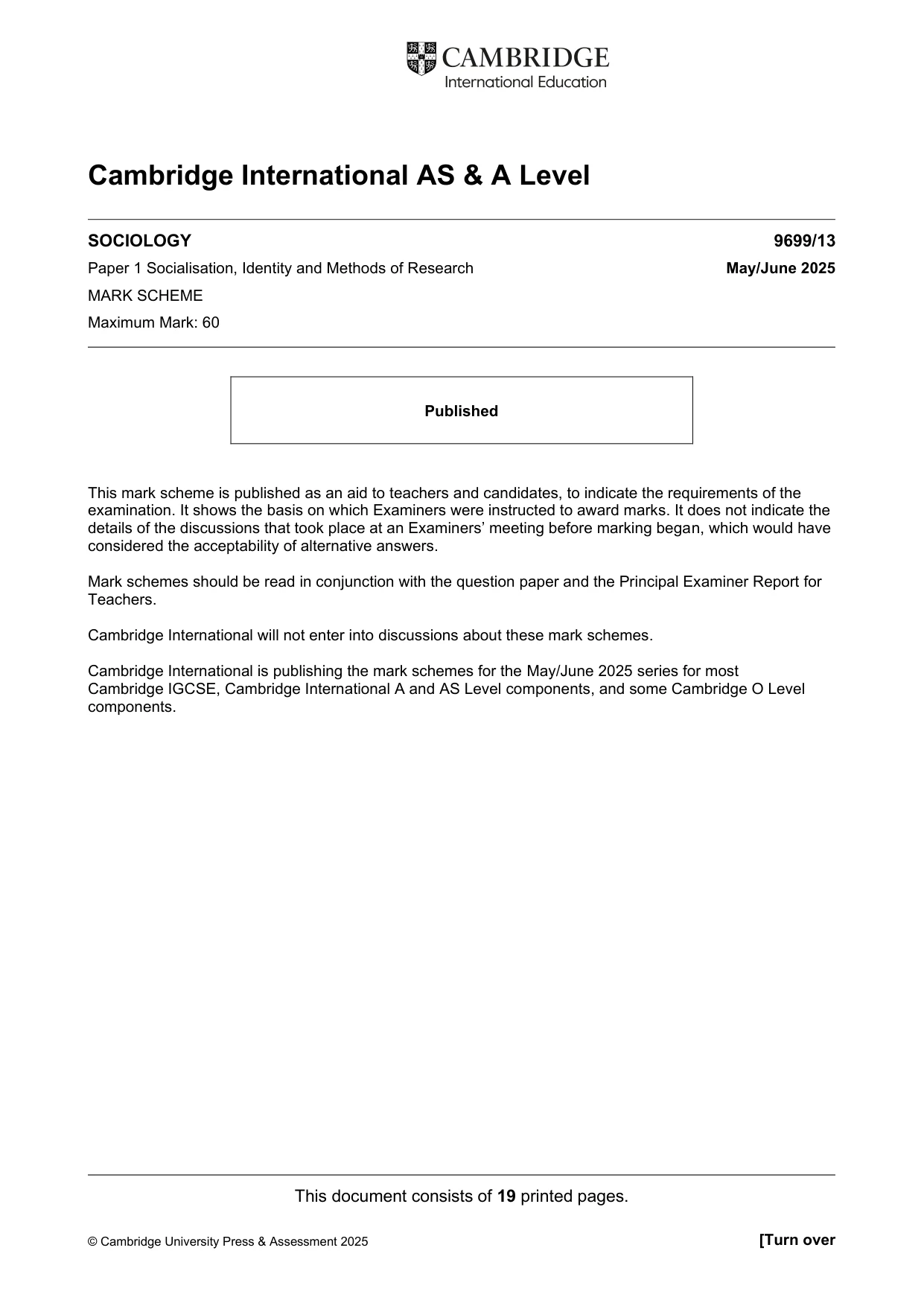
Mark scheme, page 1
This document consists of 19 printed pages. © Cambridge University Press & Assessment 2025 [Turn over Cambridge International AS & A Level SOCIOLOGY 9699/13 Paper 1 Socialisation, Identity and Methods of Research May/June 2025 MARK SCHEME Maximum Mark: 60 Published This mark scheme is published as an aid to teachers and candidates, to indicate the requirements of the examination. It shows the basis on which Examiners were instructed to award marks. It does not indicate the details of the discussions that took place at an Examiners’ meeting before marking began, which would have considered the acceptability of alternative answers. Mark schemes should be read in conjunction with the question paper and the Principal Examiner Report for Teachers. Cambridge International will not enter into discussions about these mark schemes. Cambridge International is publishing the mark schemes for the May/June 2025 series for most Cambridge IGCSE, Cambridge International A and AS Level components, and some Cambridge O Level components.
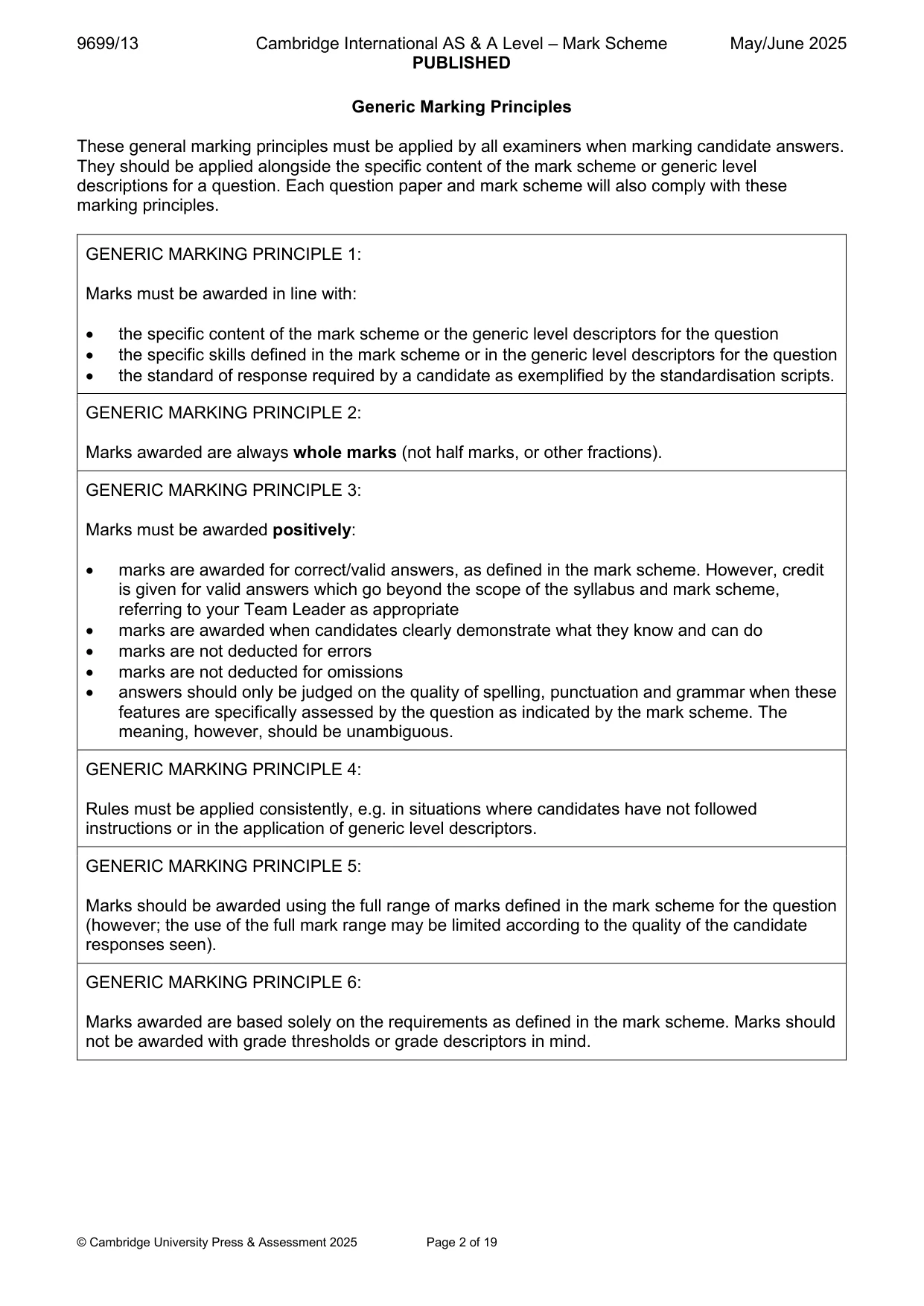
Mark scheme, page 2
9699/13 Cambridge International AS & A Level – Mark Scheme PUBLISHED May/June 2025 © Cambridge University Press & Assessment 2025 Page 2 of 19 Generic Marking Principles These general marking principles must be applied by all examiners when marking candidate answers. They should be applied alongside the specific content of the mark scheme or generic level descriptions for a question. Each question paper and mark scheme will also comply with these marking principles. GENERIC MARKING PRINCIPLE 1: Marks must be awarded in line with: • the specific content of the mark scheme or the generic level descriptors for the question • the specific skills defined in the mark scheme or in the generic level descriptors for the question • the standard of response required by a candidate as exemplified by the standardisation scripts. GENERIC MARKING PRINCIPLE 2: Marks awarded are always whole marks (not half marks, or other fractions). GENERIC MARKING PRINCIPLE 3: Marks must be awarded positively: • marks are awarded for correct/valid answers, as defined in the mark scheme. However, credit is given for valid answers which go beyond the scope of the syllabus and mark scheme, referring to your Team Leader as appropriate • marks are awarded when candidates clearly demonstrate what they know and can do • marks are not deducted for errors • marks are not deducted for omissions • answers should only be judged on the quality of spelling, punctuation and grammar when these features are specifically assessed by the question as indicated by the mark scheme. The meaning, however, should be unambiguous. GENERIC MARKING PRINCIPLE 4: Rules must be applied consistently, e.g. in situations where candidates have not followed instructions or in the application of generic level descriptors. GENERIC MARKING PRINCIPLE 5: Marks should be awarded using the full range of marks defined in the mark scheme for the question (however; the use of the full mark range may be limited according to the quality of the candidate responses seen). GENERIC MARKING PRINCIPLE 6: Marks awarded are based solely on the requirements as defined in the mark scheme. Marks should not be awarded with grade thresholds or grade descriptors in mind.
Mark scheme, page 3
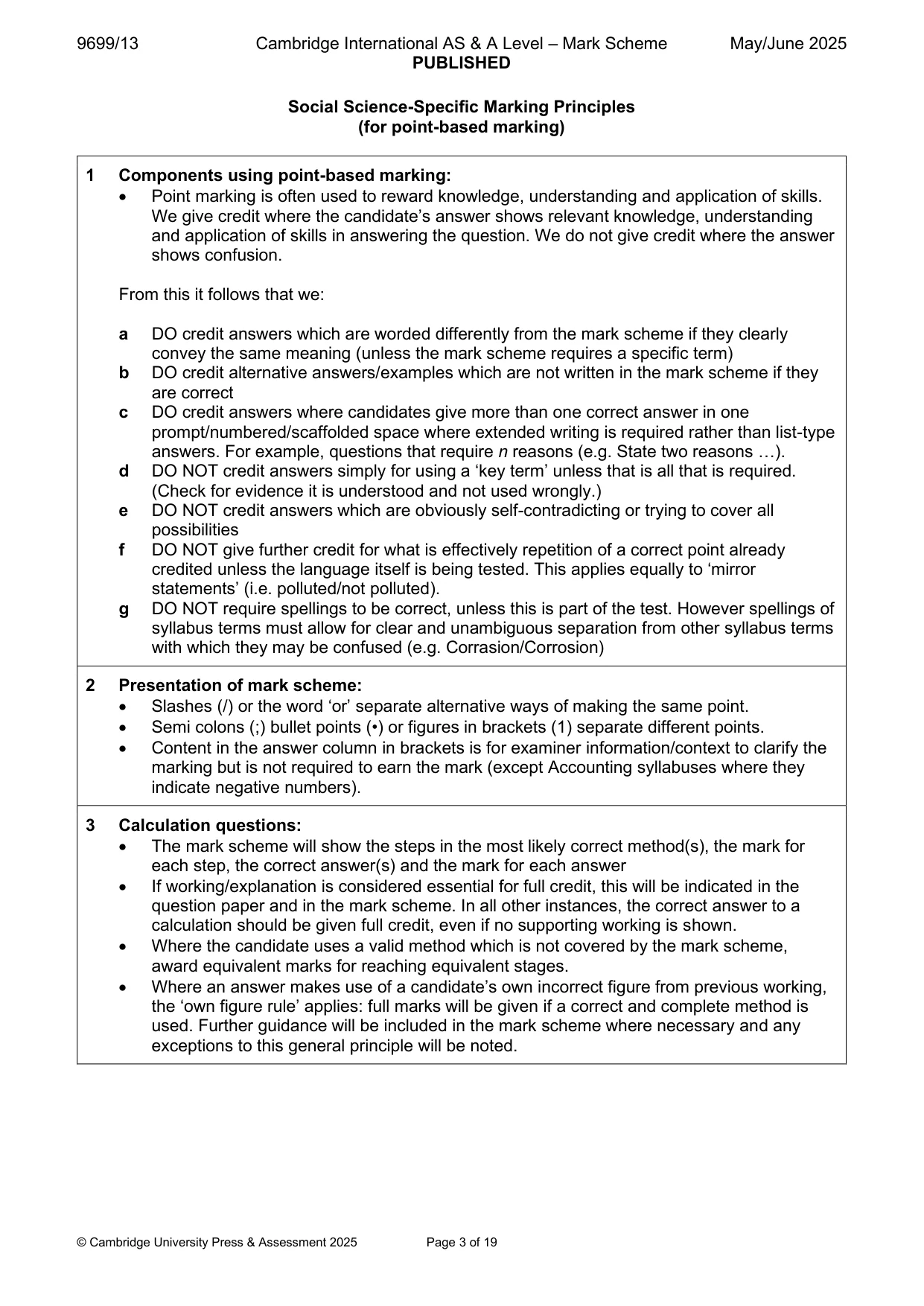
9699/13 Cambridge International AS & A Level – Mark Scheme PUBLISHED May/June 2025 © Cambridge University Press & Assessment 2025 Page 3 of 19 Social Science-Specific Marking Principles (for point-based marking) 1 Components using point-based marking: • Point marking is often used to reward knowledge, understanding and application of skills. We give credit where the candidate’s answer shows relevant knowledge, understanding and application of skills in answering the question. We do not give credit where the answer shows confusion. From this it follows that we: a DO credit answers which are worded differently from the mark scheme if they clearly convey the same meaning (unless the mark scheme requires a specific term) b DO credit alternative answers/examples which are not written in the mark scheme if they are correct c DO credit answers where candidates give more than one correct answer in one prompt/numbered/scaffolded space where extended writing is required rather than list-type answers. For example, questions that require n reasons (e.g. State two reasons …). d DO NOT credit answers simply for using a ‘key term’ unless that is all that is required. (Check for evidence it is understood and not used wrongly.) e DO NOT credit answers which are obviously self-contradicting or trying to cover all possibilities f DO NOT give further credit for what is effectively repetition of a correct point already credited unless the language itself is being tested. This applies equally to ‘mirror statements’ (i.e. polluted/not polluted). g DO NOT require spellings to be correct, unless this is part of the test. However spellings of syllabus terms must allow for clear and unambiguous separation from other syllabus terms with which they may be confused (e.g. Corrasion/Corrosion) 2 Presentation of mark scheme: • Slashes (/) or the word ‘or’ separate alternative ways of making the same point. • Semi colons (;) bullet points (•) or figures in brackets (1) separate different points. • Content in the answer column in brackets is for examiner information/context to clarify the marking but is not required to earn the mark (except Accounting syllabuses where they indicate negative numbers). 3 Calculation questions: • The mark scheme will show the steps in the most likely correct method(s), the mark for each step, the correct answer(s) and the mark for each answer • If working/explanation is considered essential for full credit, this will be indicated in the question paper and in the mark scheme. In all other instances, the correct answer to a calculation should be given full credit, even if no supporting working is shown. • Where the candidate uses a valid method which is not covered by the mark scheme, award equivalent marks for reaching equivalent stages. • Where an answer makes use of a candidate’s own incorrect figure from previous working, the ‘own figure rule’ applies: full marks will be given if a correct and complete method is used. Further guidance will be included in the mark scheme where necessary and any exceptions to this general principle will be noted.
Mark scheme, page 4
9699/13 Cambridge International AS & A Level – Mark Scheme PUBLISHED May/June 2025 © Cambridge University Press & Assessment 2025 Page 4 of 19 4 Annotation: • For point marking, ticks can be used to indicate correct answers and crosses can be used to indicate wrong answers. There is no direct relationship between ticks and marks. Ticks have no defined meaning for levels of response marking. • For levels of response marking, the level awarded should be annotated on the script. • Other annotations will be used by examiners as agreed during standardisation, and the meaning will be understood by all examiners who marked that paper.
Mark scheme, page 5
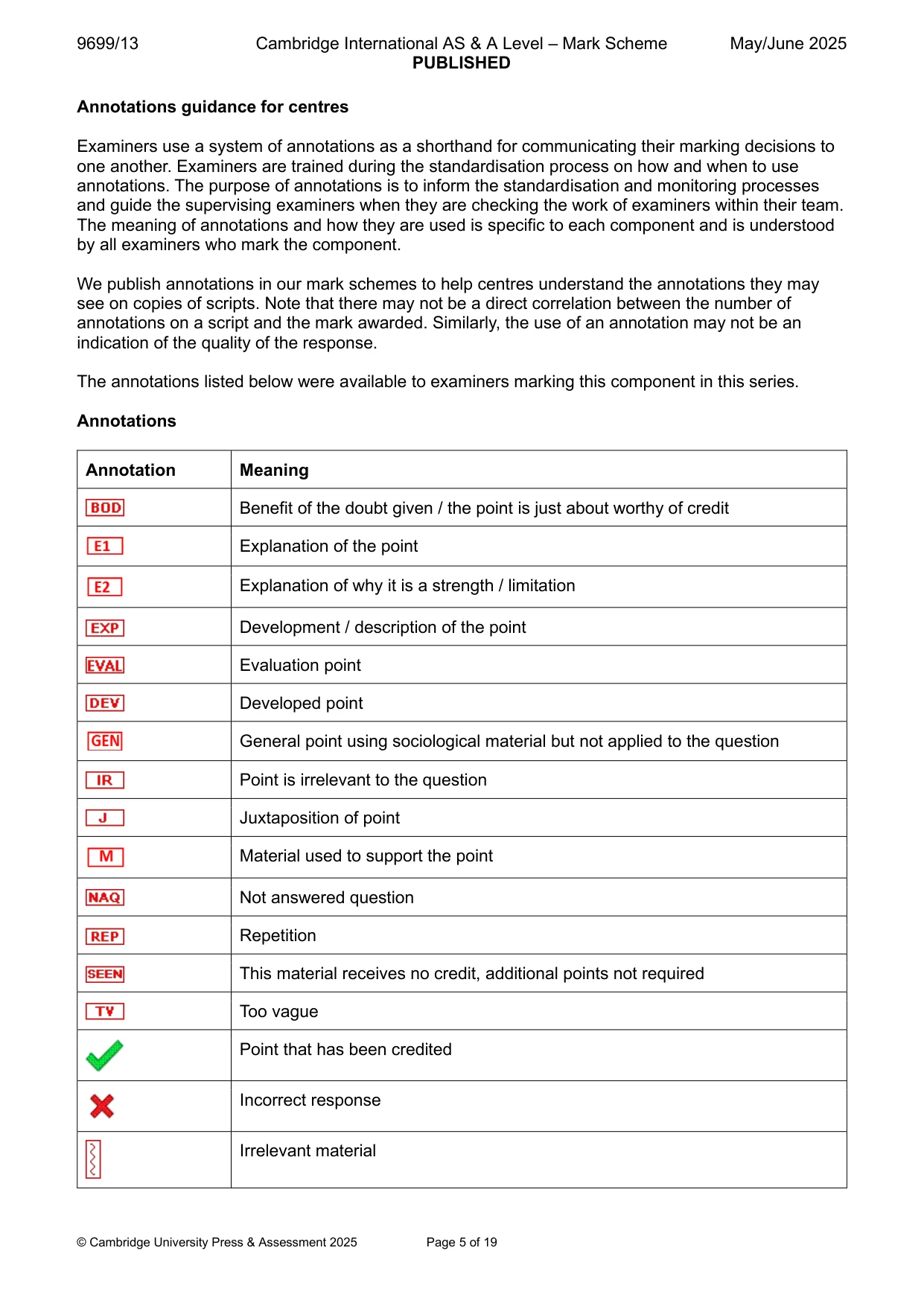
9699/13 Cambridge International AS & A Level – Mark Scheme PUBLISHED May/June 2025 © Cambridge University Press & Assessment 2025 Page 5 of 19 Annotations guidance for centres Examiners use a system of annotations as a shorthand for communicating their marking decisions to one another. Examiners are trained during the standardisation process on how and when to use annotations. The purpose of annotations is to inform the standardisation and monitoring processes and guide the supervising examiners when they are checking the work of examiners within their team. The meaning of annotations and how they are used is specific to each component and is understood by all examiners who mark the component. We publish annotations in our mark schemes to help centres understand the annotations they may see on copies of scripts. Note that there may not be a direct correlation between the number of annotations on a script and the mark awarded. Similarly, the use of an annotation may not be an indication of the quality of the response. The annotations listed below were available to examiners marking this component in this series. Annotations Annotation Meaning Benefit of the doubt given / the point is just about worthy of credit Explanation of the point Explanation of why it is a strength / limitation Development / description of the point Evaluation point Developed point General point using sociological material but not applied to the question Point is irrelevant to the question Juxtaposition of point Material used to support the point Not answered question Repetition This material receives no credit, additional points not required Too vague Point that has been credited Incorrect response Irrelevant material
Mark scheme, page 6
9699/13 Cambridge International AS & A Level – Mark Scheme PUBLISHED May/June 2025 © Cambridge University Press & Assessment 2025 Page 6 of 19 Annotation Meaning On-page comment On page comment Highlighter Identification of a point
Mark scheme, page 7
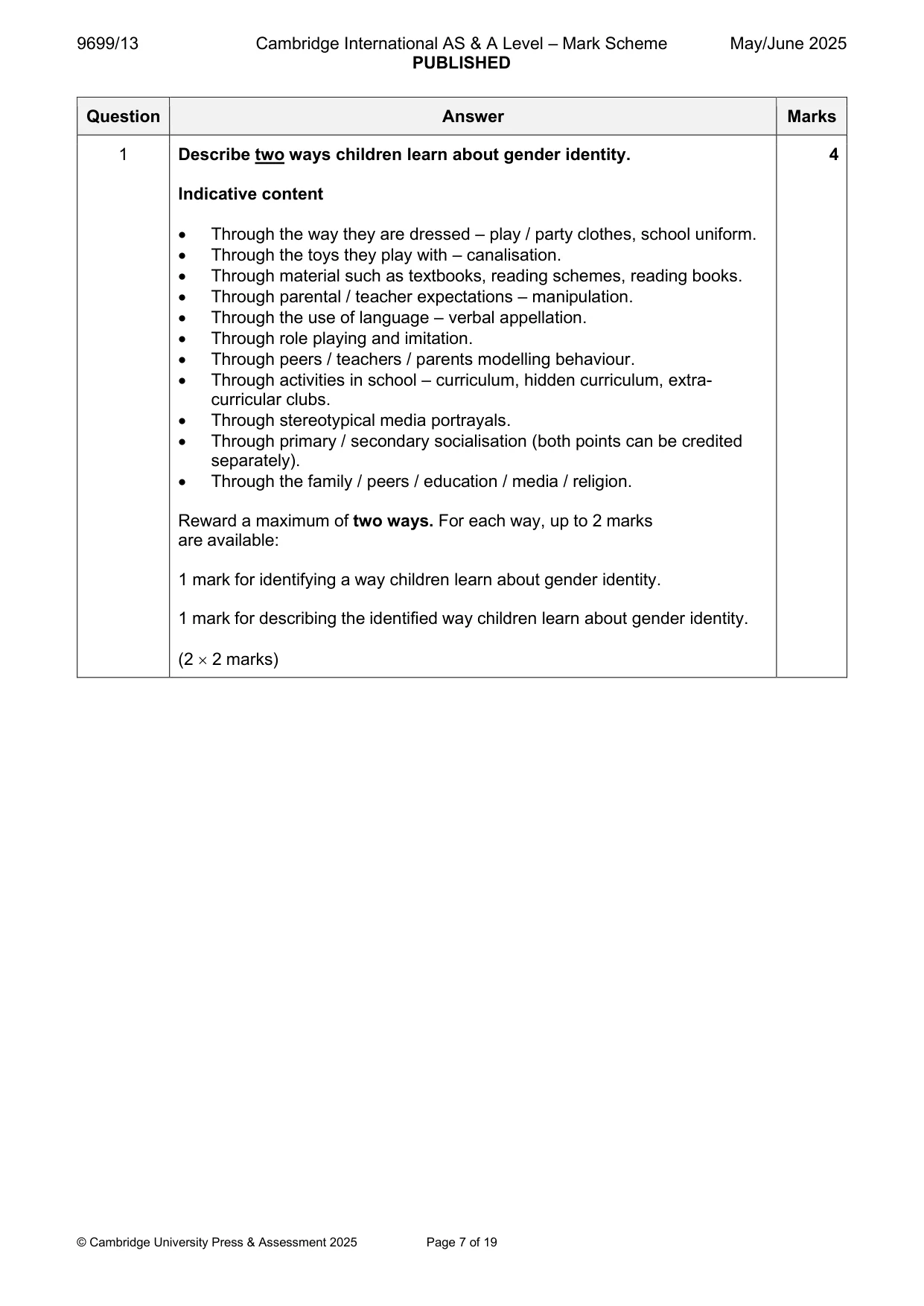
9699/13 Cambridge International AS & A Level – Mark Scheme PUBLISHED May/June 2025 © Cambridge University Press & Assessment 2025 Page 7 of 19 Question Answer Marks 1 Describe two ways children learn about gender identity. Indicative content • Through the way they are dressed – play / party clothes, school uniform. • Through the toys they play with – canalisation. • Through material such as textbooks, reading schemes, reading books. • Through parental / teacher expectations – manipulation. • Through the use of language – verbal appellation. • Through role playing and imitation. • Through peers / teachers / parents modelling behaviour. • Through activities in school – curriculum, hidden curriculum, extra- curricular clubs. • Through stereotypical media portrayals. • Through primary / secondary socialisation (both points can be credited separately). • Through the family / peers / education / media / religion. Reward a maximum of two ways. For each way, up to 2 marks are available: 1 mark for identifying a way children learn about gender identity. 1 mark for describing the identified way children learn about gender identity. (2 2 marks) 4
Mark scheme, page 8
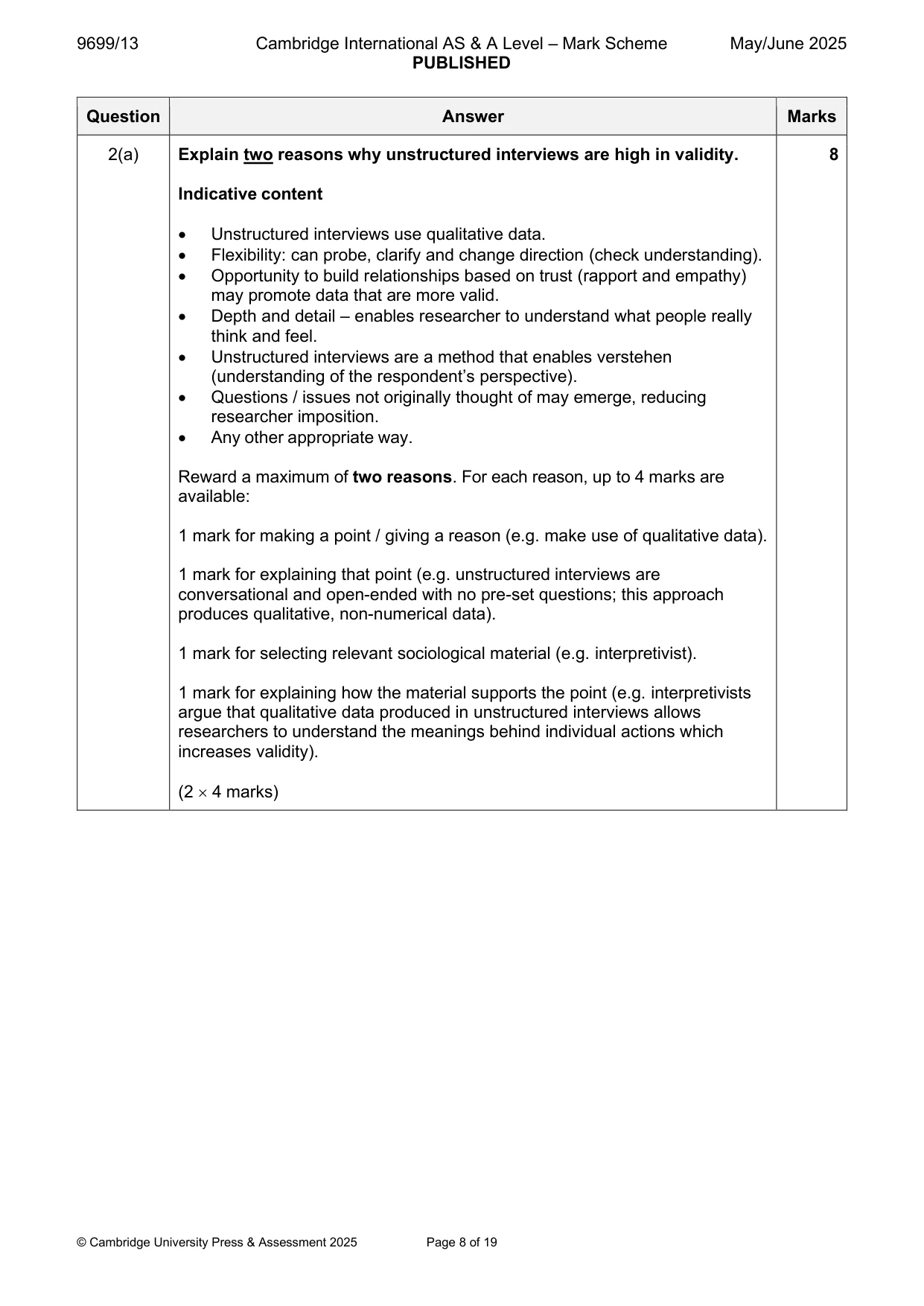
9699/13 Cambridge International AS & A Level – Mark Scheme PUBLISHED May/June 2025 © Cambridge University Press & Assessment 2025 Page 8 of 19 Question Answer Marks 2(a) Explain two reasons why unstructured interviews are high in validity. Indicative content • Unstructured interviews use qualitative data. • Flexibility: can probe, clarify and change direction (check understanding). • Opportunity to build relationships based on trust (rapport and empathy) may promote data that are more valid. • Depth and detail – enables researcher to understand what people really think and feel. • Unstructured interviews are a method that enables verstehen (understanding of the respondent’s perspective). • Questions / issues not originally thought of may emerge, reducing researcher imposition. • Any other appropriate way. Reward a maximum of two reasons. For each reason, up to 4 marks are available: 1 mark for making a point / giving a reason (e.g. make use of qualitative data). 1 mark for explaining that point (e.g. unstructured interviews are conversational and open-ended with no pre-set questions; this approach produces qualitative, non-numerical data). 1 mark for selecting relevant sociological material (e.g. interpretivist). 1 mark for explaining how the material supports the point (e.g. interpretivists argue that qualitative data produced in unstructured interviews allows researchers to understand the meanings behind individual actions which increases validity). (2 4 marks) 8
Mark scheme, page 9
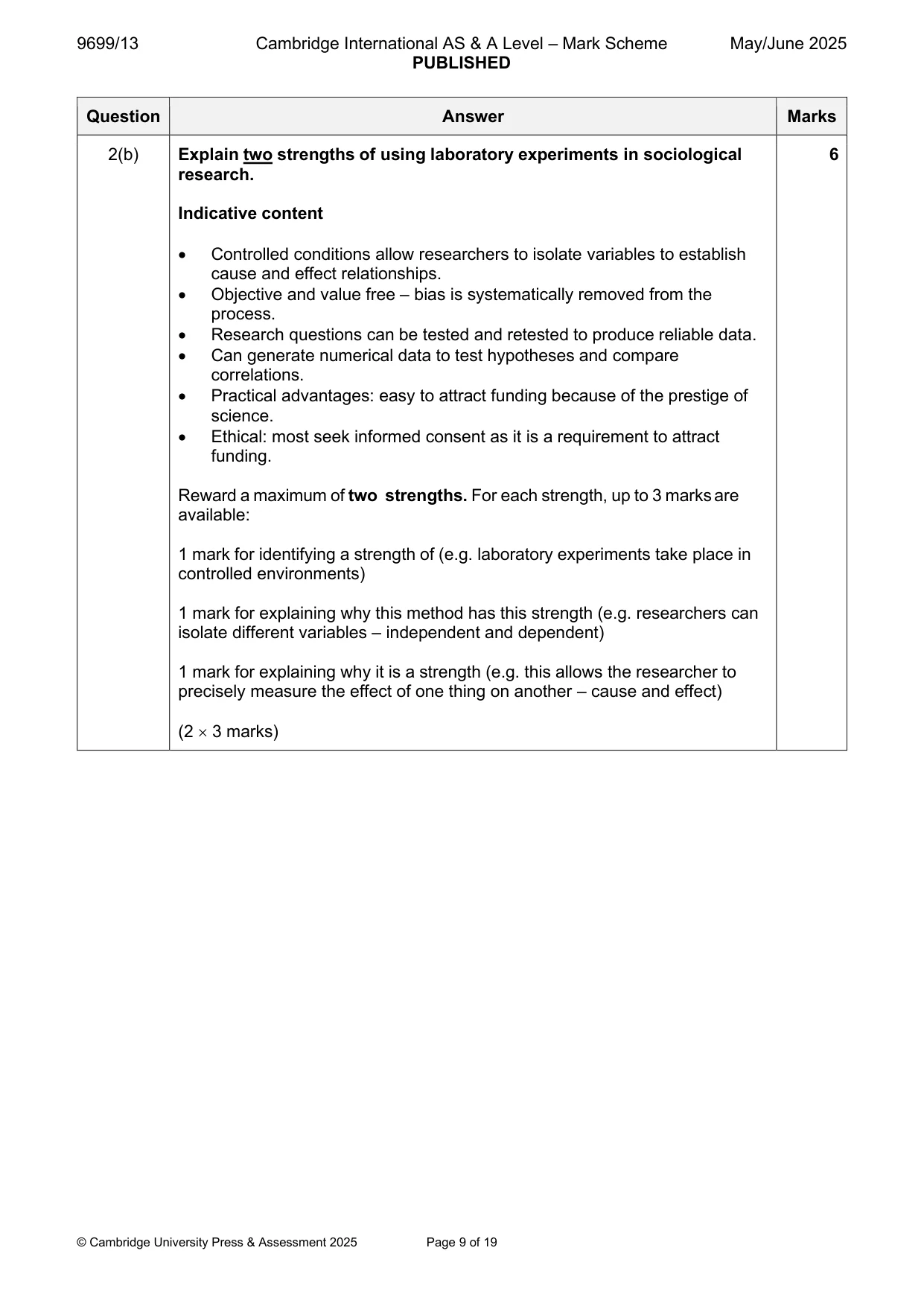
9699/13 Cambridge International AS & A Level – Mark Scheme PUBLISHED May/June 2025 © Cambridge University Press & Assessment 2025 Page 9 of 19 Question Answer Marks 2(b) Explain two strengths of using laboratory experiments in sociological research. Indicative content • Controlled conditions allow researchers to isolate variables to establish cause and effect relationships. • Objective and value free – bias is systematically removed from the process. • Research questions can be tested and retested to produce reliable data. • Can generate numerical data to test hypotheses and compare correlations. • Practical advantages: easy to attract funding because of the prestige of science. • Ethical: most seek informed consent as it is a requirement to attract funding. Reward a maximum of two strengths. For each strength, up to 3 marks are available: 1 mark for identifying a strength of (e.g. laboratory experiments take place in controlled environments) 1 mark for explaining why this method has this strength (e.g. researchers can isolate different variables – independent and dependent) 1 mark for explaining why it is a strength (e.g. this allows the researcher to precisely measure the effect of one thing on another – cause and effect) (2 3 marks) 6
Mark scheme, page 10
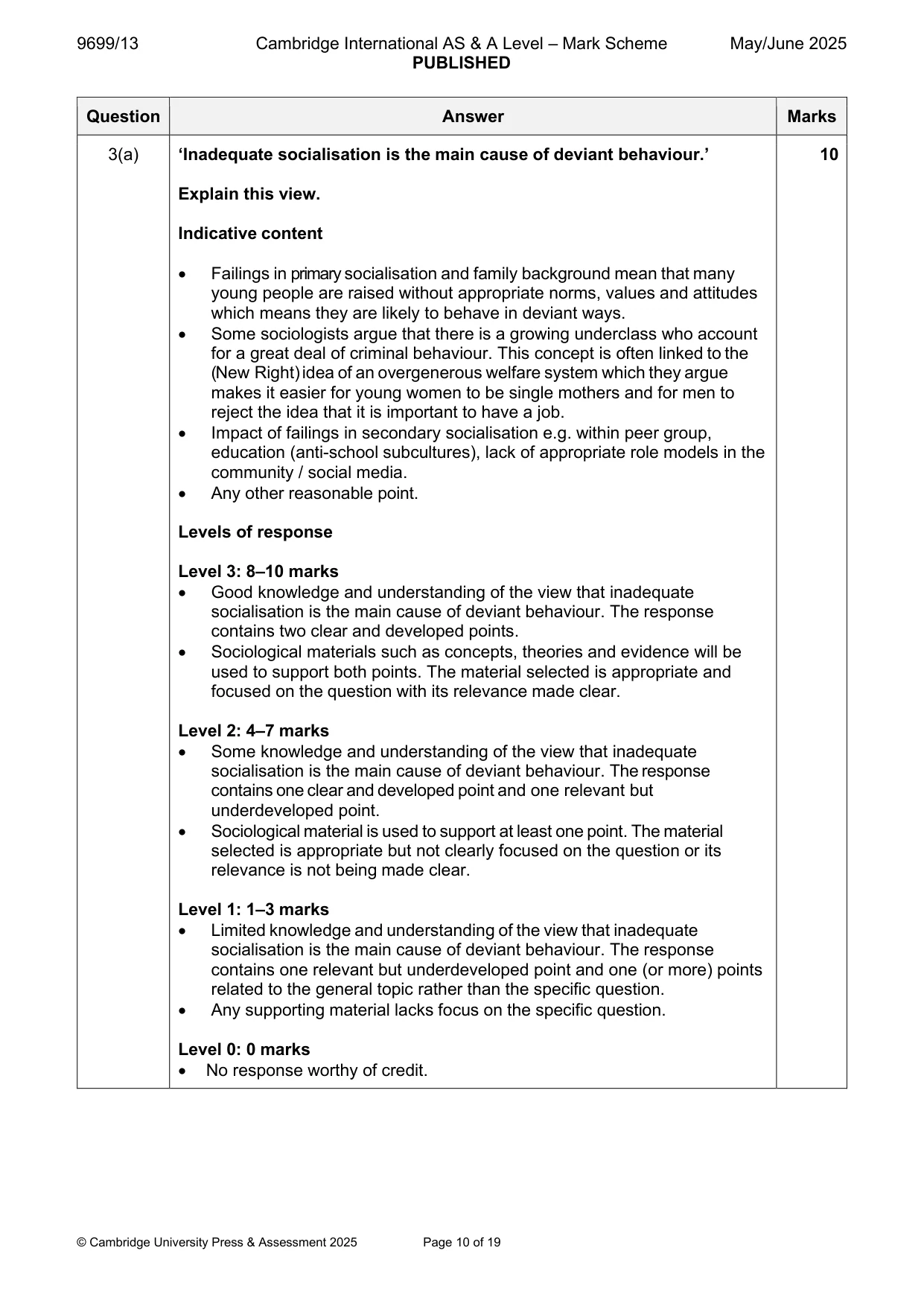
9699/13 Cambridge International AS & A Level – Mark Scheme PUBLISHED May/June 2025 © Cambridge University Press & Assessment 2025 Page 10 of 19 Question Answer Marks 3(a) ‘Inadequate socialisation is the main cause of deviant behaviour.’ Explain this view. Indicative content • Failings in primary socialisation and family background mean that many young people are raised without appropriate norms, values and attitudes which means they are likely to behave in deviant ways. • Some sociologists argue that there is a growing underclass who account for a great deal of criminal behaviour. This concept is often linked to the (New Right) idea of an overgenerous welfare system which they argue makes it easier for young women to be single mothers and for men to reject the idea that it is important to have a job. • Impact of failings in secondary socialisation e.g. within peer group, education (anti-school subcultures), lack of appropriate role models in the community / social media. • Any other reasonable point. Levels of response Level 3: 8–10 marks • Good knowledge and understanding of the view that inadequate socialisation is the main cause of deviant behaviour. The response contains two clear and developed points. • Sociological materials such as concepts, theories and evidence will be used to support both points. The material selected is appropriate and focused on the question with its relevance made clear. Level 2: 4–7 marks • Some knowledge and understanding of the view that inadequate socialisation is the main cause of deviant behaviour. The response contains one clear and developed point and one relevant but underdeveloped point. • Sociological material is used to support at least one point. The material selected is appropriate but not clearly focused on the question or its relevance is not being made clear. Level 1: 1–3 marks • Limited knowledge and understanding of the view that inadequate socialisation is the main cause of deviant behaviour. The response contains one relevant but underdeveloped point and one (or more) points related to the general topic rather than the specific question. • Any supporting material lacks focus on the specific question. Level 0: 0 marks • No response worthy of credit. 10
Mark scheme, page 11
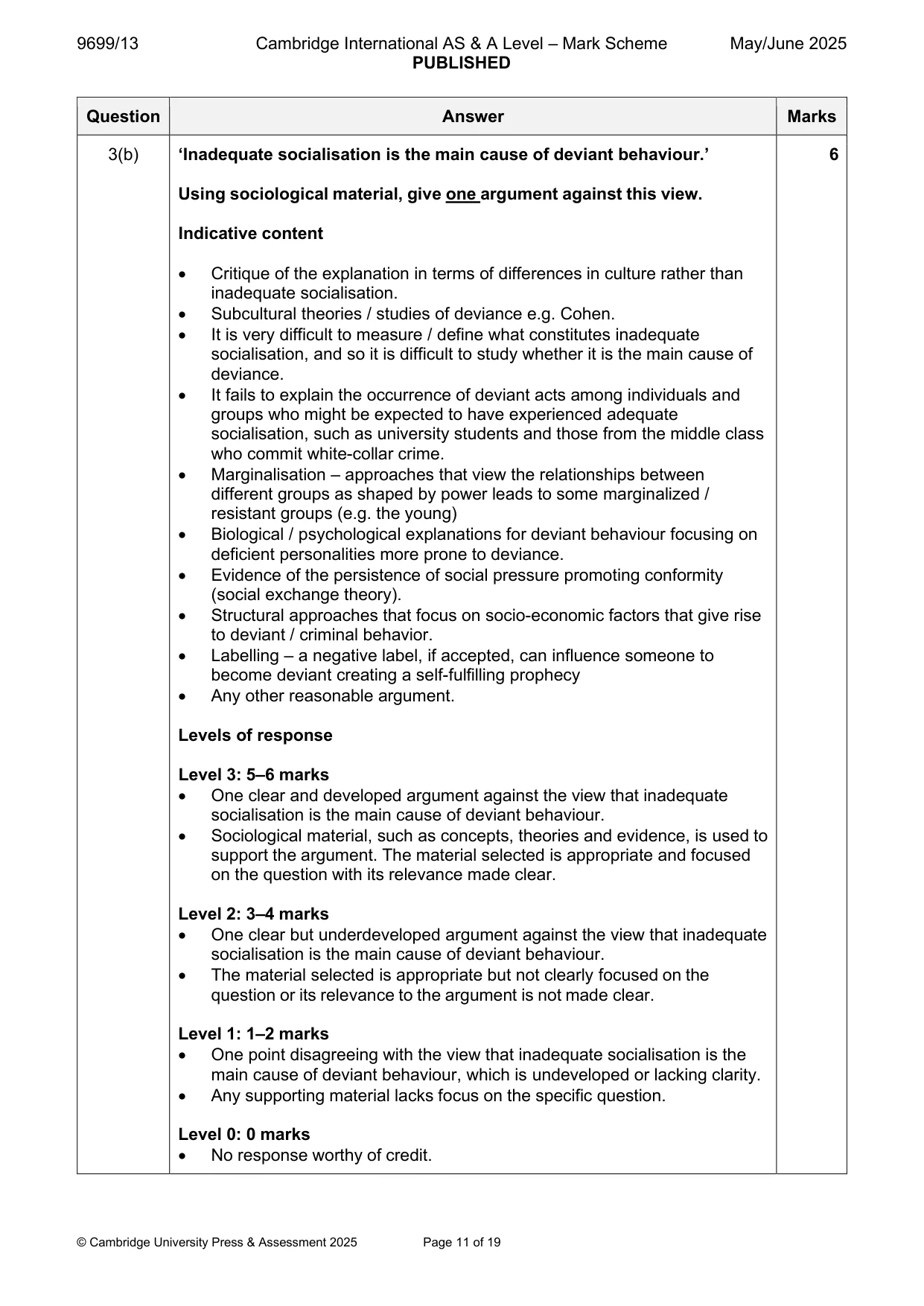
9699/13 Cambridge International AS & A Level – Mark Scheme PUBLISHED May/June 2025 © Cambridge University Press & Assessment 2025 Page 11 of 19 Question Answer Marks 3(b) ‘Inadequate socialisation is the main cause of deviant behaviour.’ Using sociological material, give one argument against this view. Indicative content • Critique of the explanation in terms of differences in culture rather than inadequate socialisation. • Subcultural theories / studies of deviance e.g. Cohen. • It is very difficult to measure / define what constitutes inadequate socialisation, and so it is difficult to study whether it is the main cause of deviance. • It fails to explain the occurrence of deviant acts among individuals and groups who might be expected to have experienced adequate socialisation, such as university students and those from the middle class who commit white-collar crime. • Marginalisation – approaches that view the relationships between different groups as shaped by power leads to some marginalized / resistant groups (e.g. the young) • Biological / psychological explanations for deviant behaviour focusing on deficient personalities more prone to deviance. • Evidence of the persistence of social pressure promoting conformity (social exchange theory). • Structural approaches that focus on socio-economic factors that give rise to deviant / criminal behavior. • Labelling – a negative label, if accepted, can influence someone to become deviant creating a self-fulfilling prophecy • Any other reasonable argument. Levels of response Level 3: 5–6 marks • One clear and developed argument against the view that inadequate socialisation is the main cause of deviant behaviour. • Sociological material, such as concepts, theories and evidence, is used to support the argument. The material selected is appropriate and focused on the question with its relevance made clear. Level 2: 3–4 marks • One clear but underdeveloped argument against the view that inadequate socialisation is the main cause of deviant behaviour. • The material selected is appropriate but not clearly focused on the question or its relevance to the argument is not made clear. Level 1: 1–2 marks • One point disagreeing with the view that inadequate socialisation is the main cause of deviant behaviour, which is undeveloped or lacking clarity. • Any supporting material lacks focus on the specific question. Level 0: 0 marks • No response worthy of credit. 6
Mark scheme, page 12
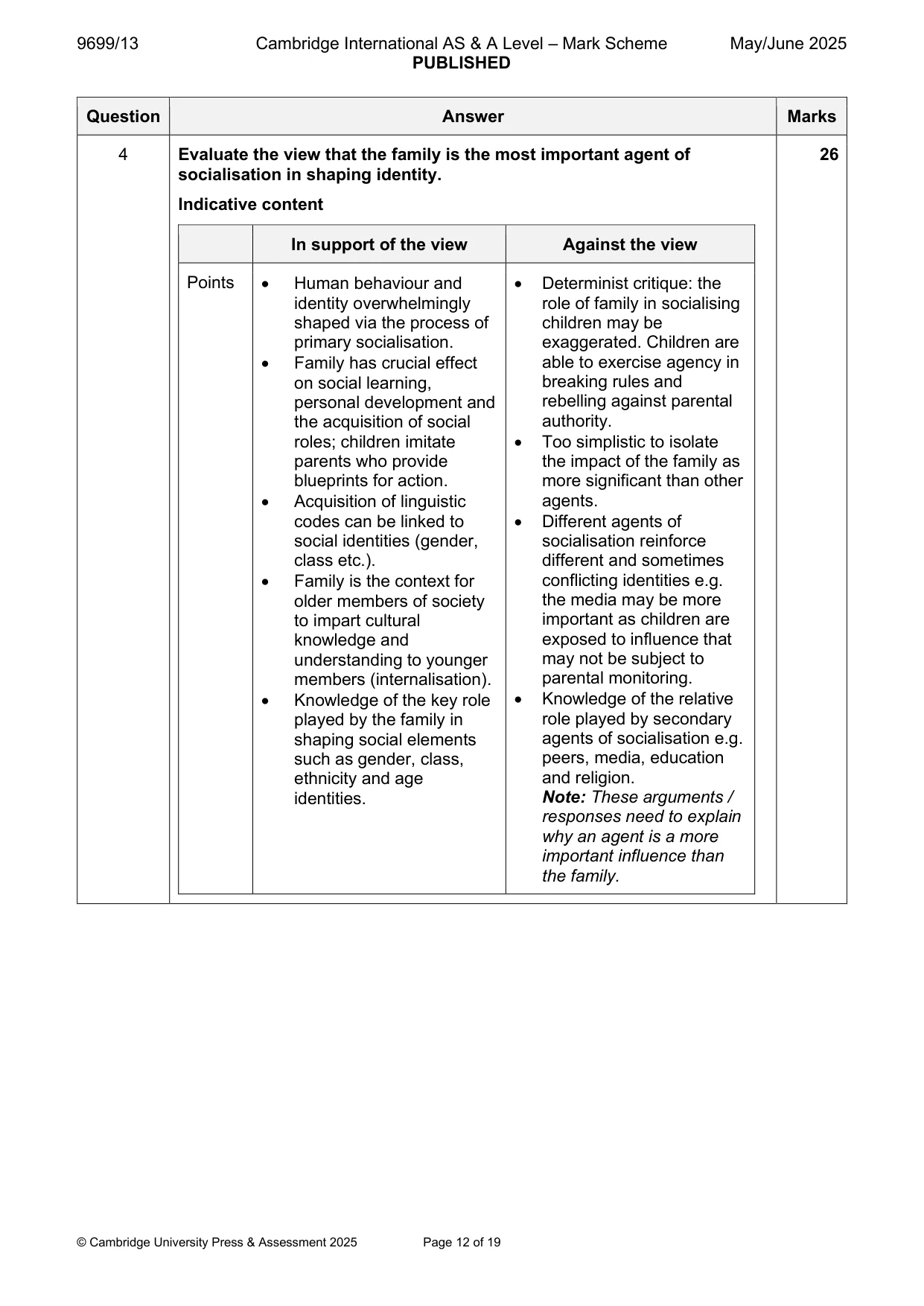
9699/13 Cambridge International AS & A Level – Mark Scheme PUBLISHED May/June 2025 © Cambridge University Press & Assessment 2025 Page 12 of 19 Question Answer Marks 4 Evaluate the view that the family is the most important agent of socialisation in shaping identity. Indicative content In support of the view Against the view Points • Human behaviour and identity overwhelmingly shaped via the process of primary socialisation. • Family has crucial effect on social learning, personal development and the acquisition of social roles; children imitate parents who provide blueprints for action. • Acquisition of linguistic codes can be linked to social identities (gender, class etc.). • Family is the context for older members of society to impart cultural knowledge and understanding to younger members (internalisation). • Knowledge of the key role played by the family in shaping social elements such as gender, class, ethnicity and age identities. • Determinist critique: the role of family in socialising children may be exaggerated. Children are able to exercise agency in breaking rules and rebelling against parental authority. • Too simplistic to isolate the impact of the family as more significant than other agents. • Different agents of socialisation reinforce different and sometimes conflicting identities e.g. the media may be more important as children are exposed to influence that may not be subject to parental monitoring. • Knowledge of the relative role played by secondary agents of socialisation e.g. peers, media, education and religion. Note: These arguments / responses need to explain why an agent is a more important influence than the family. 26
Mark scheme, page 13
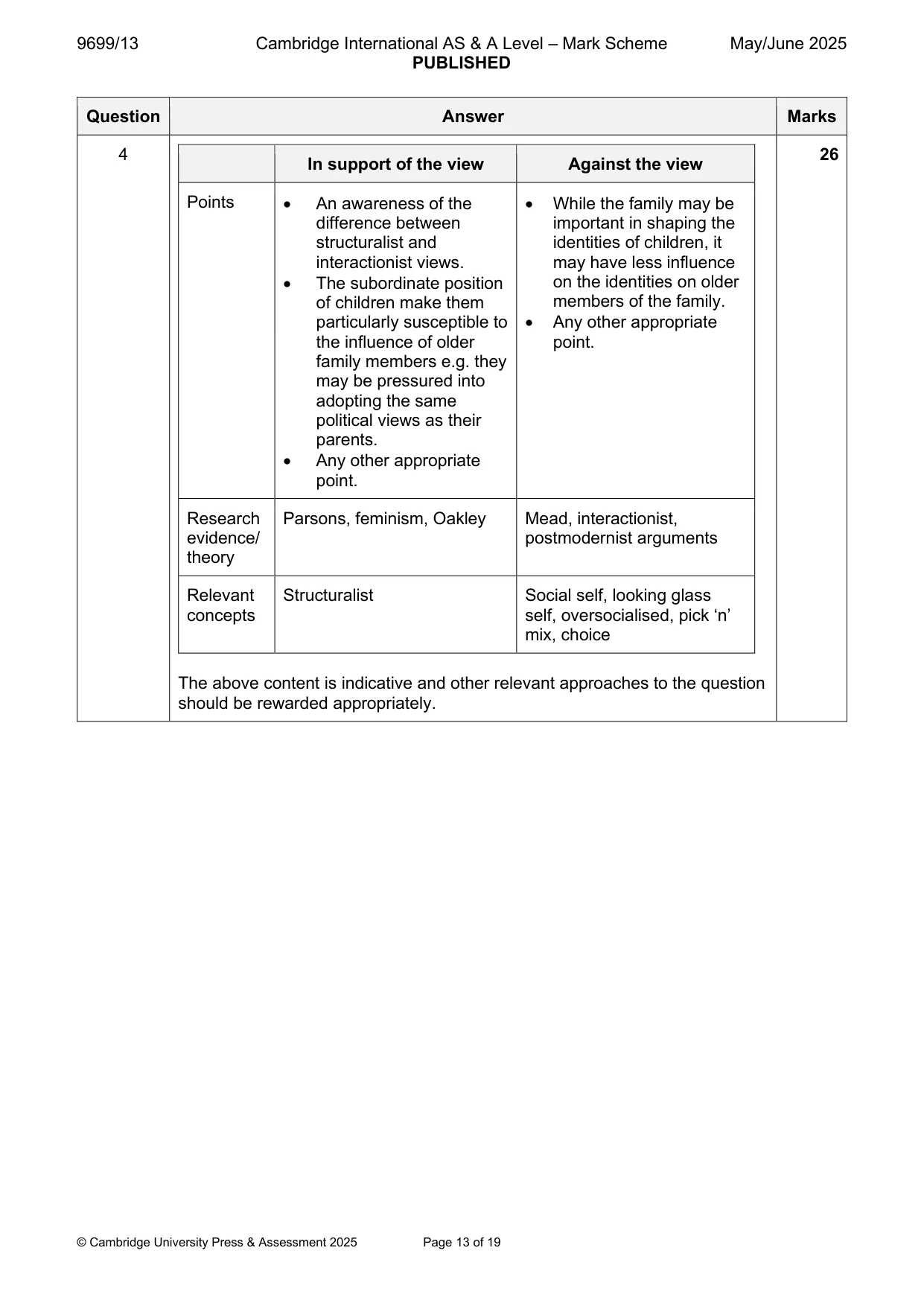
9699/13 Cambridge International AS & A Level – Mark Scheme PUBLISHED May/June 2025 © Cambridge University Press & Assessment 2025 Page 13 of 19 Question Answer Marks 4 In support of the view Against the view Points • An awareness of the difference between structuralist and interactionist views. • The subordinate position of children make them particularly susceptible to the influence of older family members e.g. they may be pressured into adopting the same political views as their parents. • Any other appropriate point. • While the family may be important in shaping the identities of children, it may have less influence on the identities on older members of the family. • Any other appropriate point. Research evidence/ theory Parsons, feminism, Oakley Mead, interactionist, postmodernist arguments Relevant concepts Structuralist Social self, looking glass self, oversocialised, pick ‘n’ mix, choice The above content is indicative and other relevant approaches to the question should be rewarded appropriately. 26
Mark scheme, page 14
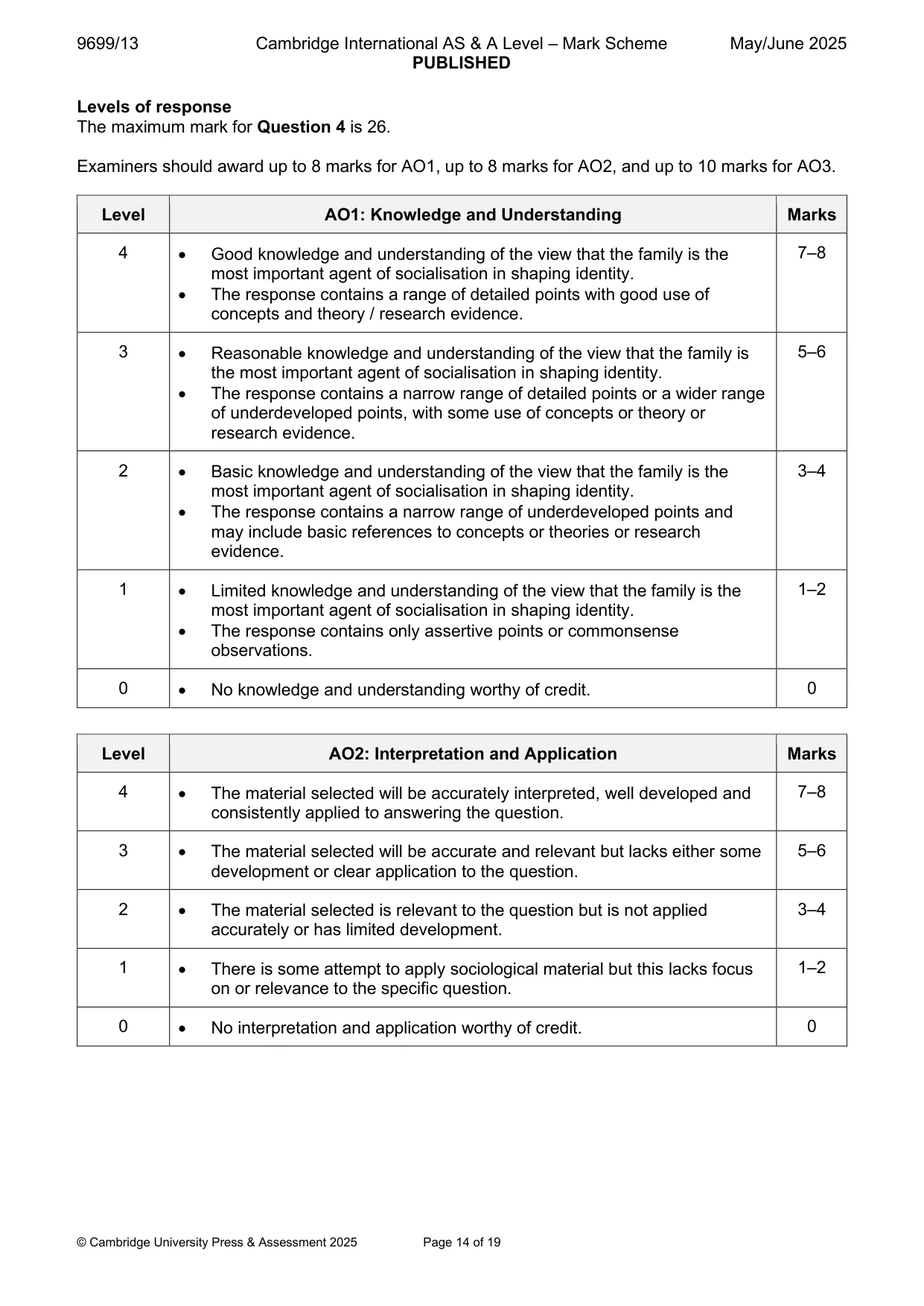
9699/13 Cambridge International AS & A Level – Mark Scheme PUBLISHED May/June 2025 © Cambridge University Press & Assessment 2025 Page 14 of 19 Levels of response The maximum mark for Question 4 is 26. Examiners should award up to 8 marks for AO1, up to 8 marks for AO2, and up to 10 marks for AO3. Level AO1: Knowledge and Understanding Marks 4 • Good knowledge and understanding of the view that the family is the most important agent of socialisation in shaping identity. • The response contains a range of detailed points with good use of concepts and theory / research evidence. 7–8 3 • Reasonable knowledge and understanding of the view that the family is the most important agent of socialisation in shaping identity. • The response contains a narrow range of detailed points or a wider range of underdeveloped points, with some use of concepts or theory or research evidence. 5–6 2 • Basic knowledge and understanding of the view that the family is the most important agent of socialisation in shaping identity. • The response contains a narrow range of underdeveloped points and may include basic references to concepts or theories or research evidence. 3–4 1 • Limited knowledge and understanding of the view that the family is the most important agent of socialisation in shaping identity. • The response contains only assertive points or commonsense observations. 1–2 0 • No knowledge and understanding worthy of credit. 0 Level AO2: Interpretation and Application Marks 4 • The material selected will be accurately interpreted, well developed and consistently applied to answering the question. 7–8 3 • The material selected will be accurate and relevant but lacks either some development or clear application to the question. 5–6 2 • The material selected is relevant to the question but is not applied accurately or has limited development. 3–4 1 • There is some attempt to apply sociological material but this lacks focus on or relevance to the specific question. 1–2 0 • No interpretation and application worthy of credit. 0
Mark scheme, page 15
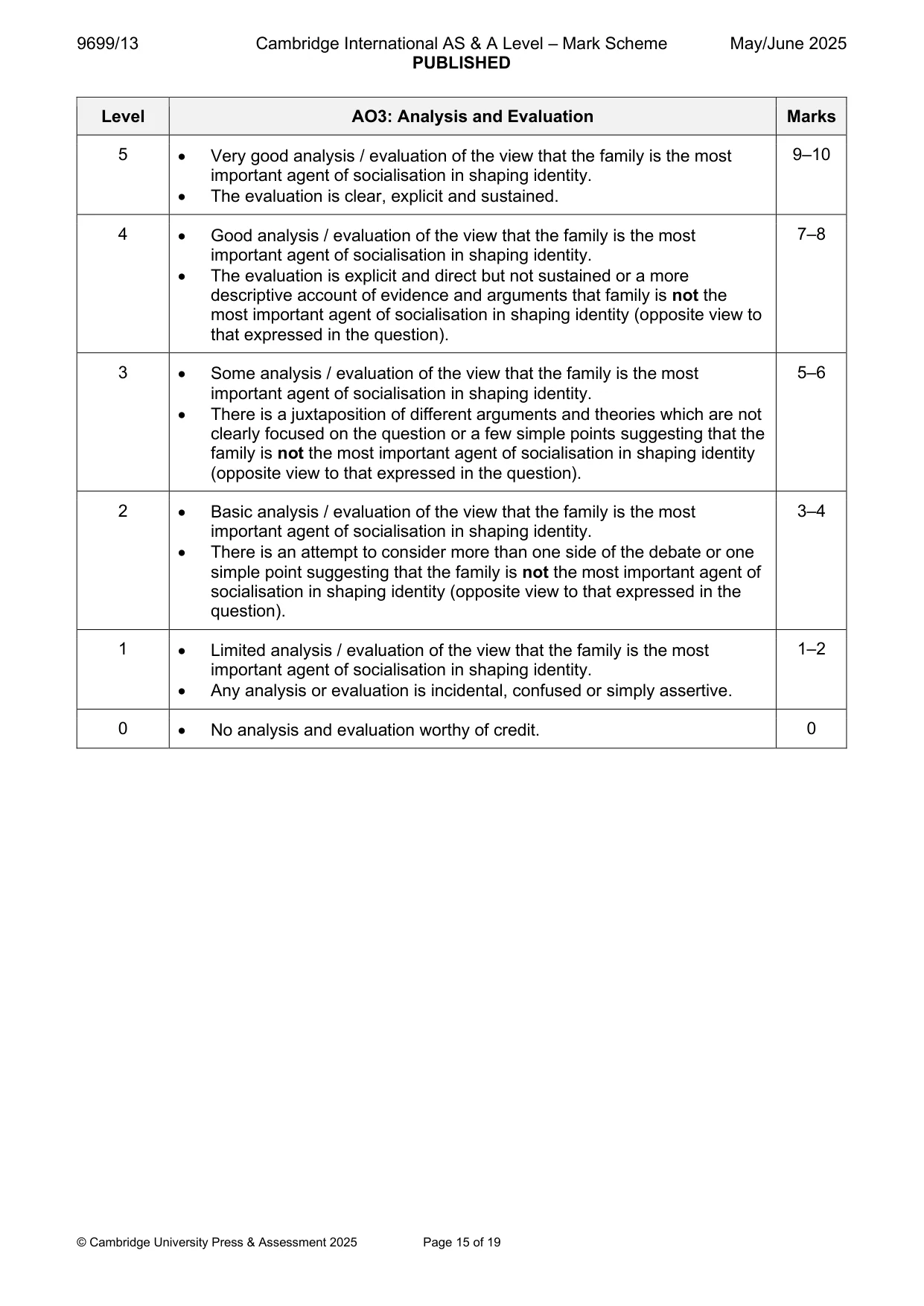
9699/13 Cambridge International AS & A Level – Mark Scheme PUBLISHED May/June 2025 © Cambridge University Press & Assessment 2025 Page 15 of 19 Level AO3: Analysis and Evaluation Marks 5 • Very good analysis / evaluation of the view that the family is the most important agent of socialisation in shaping identity. • The evaluation is clear, explicit and sustained. 9–10 4 • Good analysis / evaluation of the view that the family is the most important agent of socialisation in shaping identity. • The evaluation is explicit and direct but not sustained or a more descriptive account of evidence and arguments that family is not the most important agent of socialisation in shaping identity (opposite view to that expressed in the question). 7–8 3 • Some analysis / evaluation of the view that the family is the most important agent of socialisation in shaping identity. • There is a juxtaposition of different arguments and theories which are not clearly focused on the question or a few simple points suggesting that the family is not the most important agent of socialisation in shaping identity (opposite view to that expressed in the question). 5–6 2 • Basic analysis / evaluation of the view that the family is the most important agent of socialisation in shaping identity. • There is an attempt to consider more than one side of the debate or one simple point suggesting that the family is not the most important agent of socialisation in shaping identity (opposite view to that expressed in the question). 3–4 1 • Limited analysis / evaluation of the view that the family is the most important agent of socialisation in shaping identity. • Any analysis or evaluation is incidental, confused or simply assertive. 1–2 0 • No analysis and evaluation worthy of credit. 0
Mark scheme, page 16
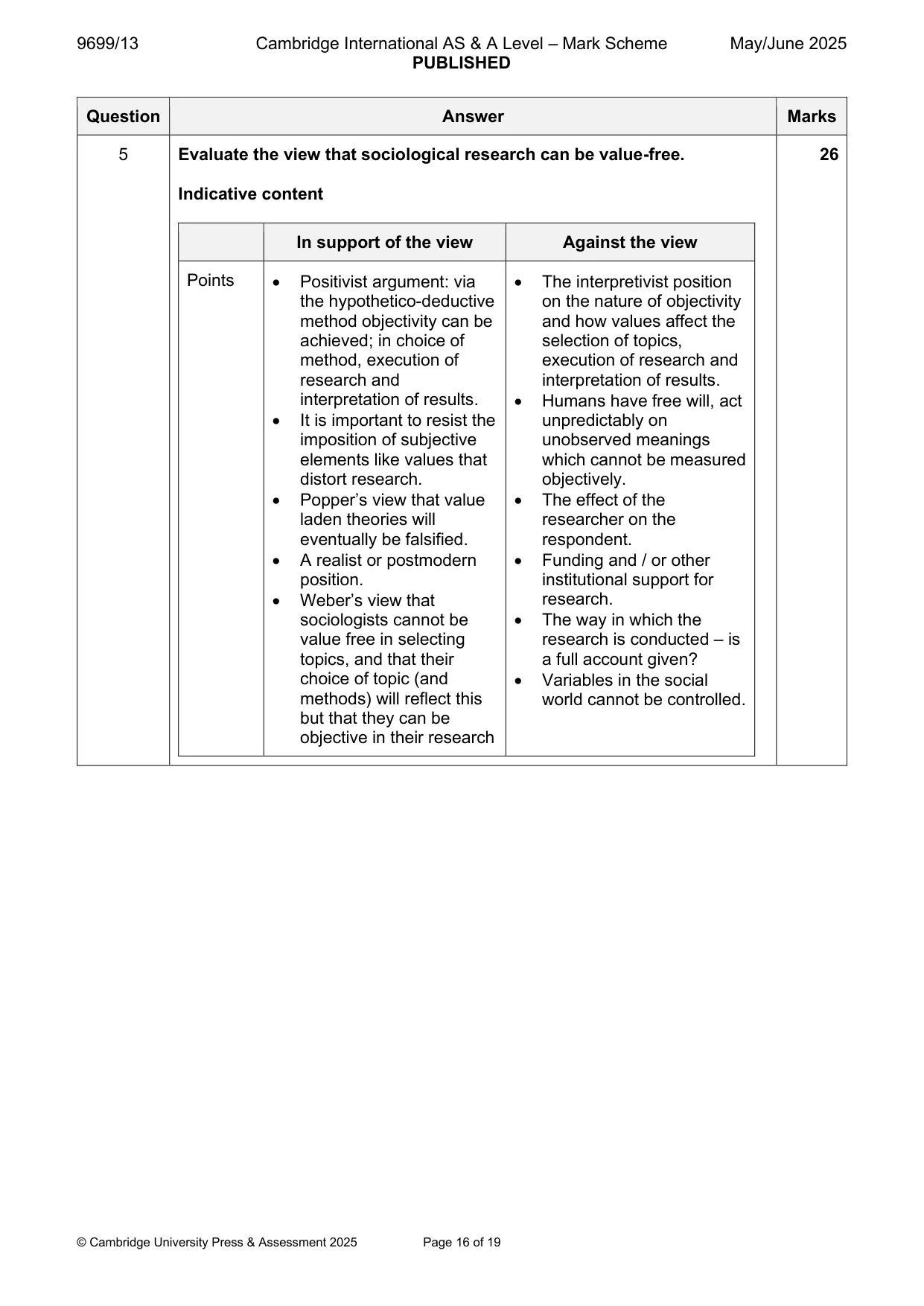
9699/13 Cambridge International AS & A Level – Mark Scheme PUBLISHED May/June 2025 © Cambridge University Press & Assessment 2025 Page 16 of 19 Question Answer Marks 5 Evaluate the view that sociological research can be value-free. Indicative content In support of the view Against the view Points • Positivist argument: via the hypothetico-deductive method objectivity can be achieved; in choice of method, execution of research and interpretation of results. • It is important to resist the imposition of subjective elements like values that distort research. • Popper’s view that value laden theories will eventually be falsified. • A realist or postmodern position. • Weber’s view that sociologists cannot be value free in selecting topics, and that their choice of topic (and methods) will reflect this but that they can be objective in their research • The interpretivist position on the nature of objectivity and how values affect the selection of topics, execution of research and interpretation of results. • Humans have free will, act unpredictably on unobserved meanings which cannot be measured objectively. • The effect of the researcher on the respondent. • Funding and / or other institutional support for research. • The way in which the research is conducted – is a full account given? • Variables in the social world cannot be controlled. 26
Mark scheme, page 17
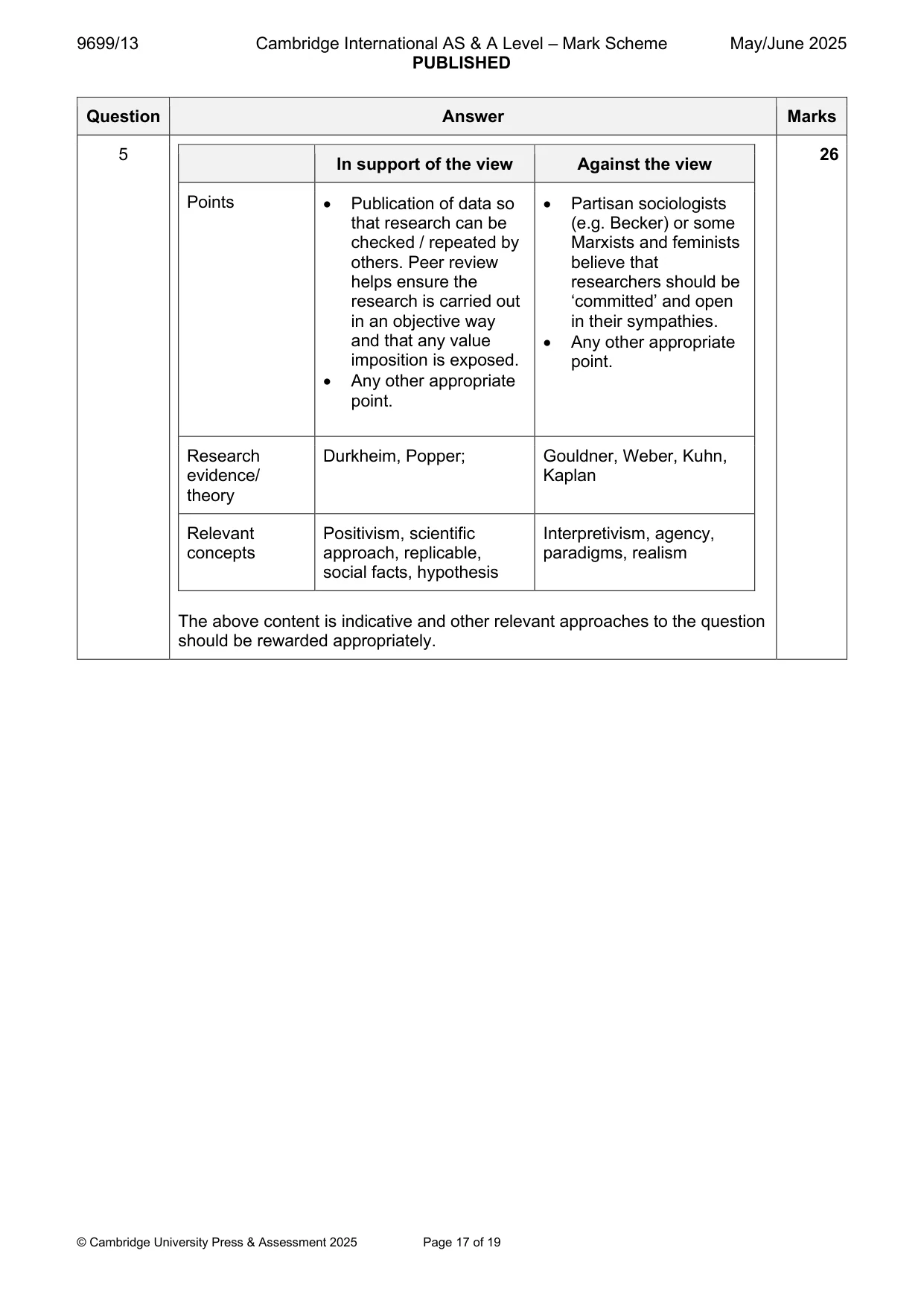
9699/13 Cambridge International AS & A Level – Mark Scheme PUBLISHED May/June 2025 © Cambridge University Press & Assessment 2025 Page 17 of 19 Question Answer Marks 5 In support of the view Against the view Points • Publication of data so that research can be checked / repeated by others. Peer review helps ensure the research is carried out in an objective way and that any value imposition is exposed. • Any other appropriate point. • Partisan sociologists (e.g. Becker) or some Marxists and feminists believe that researchers should be ‘committed’ and open in their sympathies. • Any other appropriate point. Research evidence/ theory Durkheim, Popper; Gouldner, Weber, Kuhn, Kaplan Relevant concepts Positivism, scientific approach, replicable, social facts, hypothesis Interpretivism, agency, paradigms, realism The above content is indicative and other relevant approaches to the question should be rewarded appropriately. 26
Mark scheme, page 18
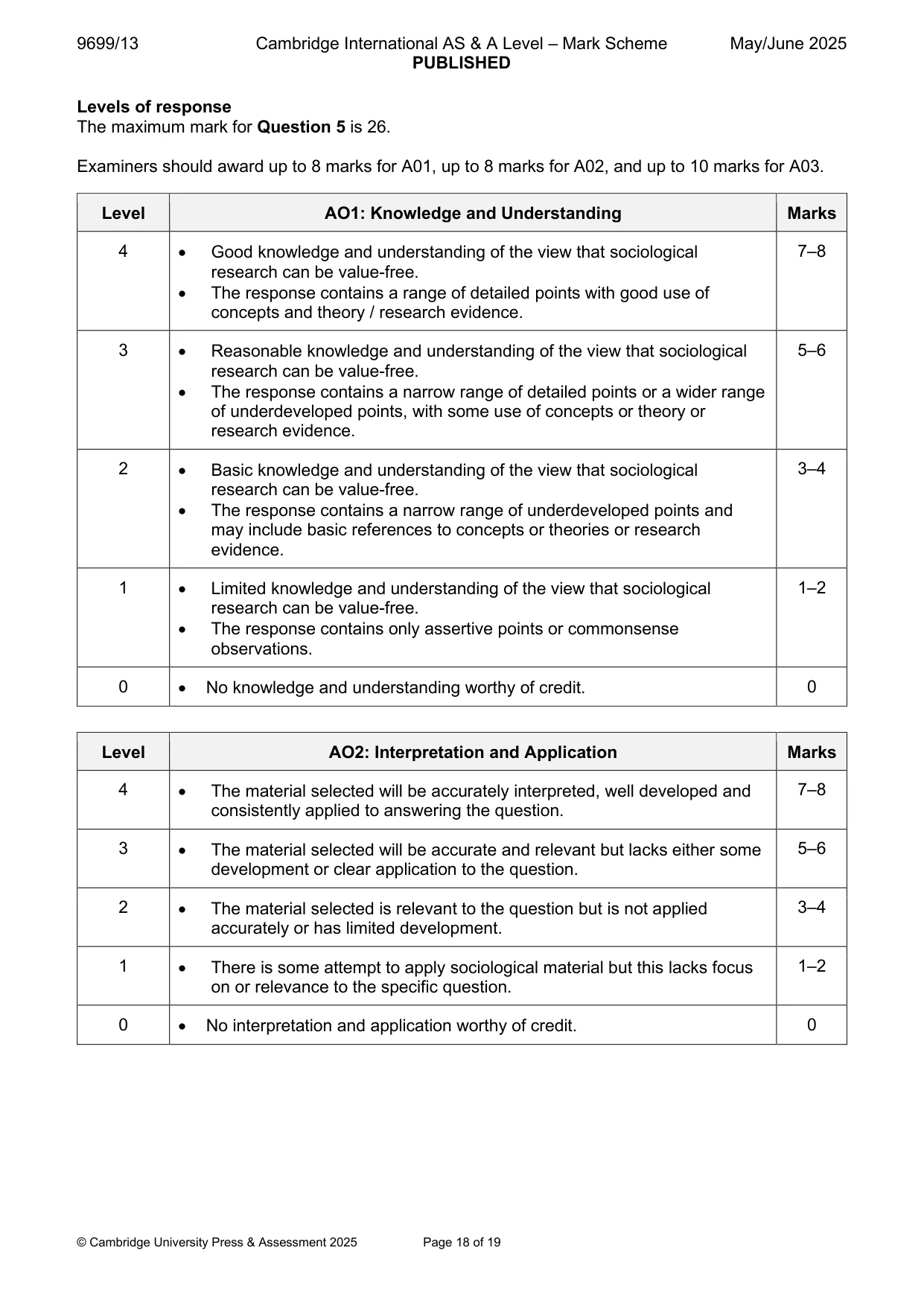
9699/13 Cambridge International AS & A Level – Mark Scheme PUBLISHED May/June 2025 © Cambridge University Press & Assessment 2025 Page 18 of 19 Levels of response The maximum mark for Question 5 is 26. Examiners should award up to 8 marks for A01, up to 8 marks for A02, and up to 10 marks for A03. Level AO1: Knowledge and Understanding Marks 4 • Good knowledge and understanding of the view that sociological research can be value-free. • The response contains a range of detailed points with good use of concepts and theory / research evidence. 7–8 3 • Reasonable knowledge and understanding of the view that sociological research can be value-free. • The response contains a narrow range of detailed points or a wider range of underdeveloped points, with some use of concepts or theory or research evidence. 5–6 2 • Basic knowledge and understanding of the view that sociological research can be value-free. • The response contains a narrow range of underdeveloped points and may include basic references to concepts or theories or research evidence. 3–4 1 • Limited knowledge and understanding of the view that sociological research can be value-free. • The response contains only assertive points or commonsense observations. 1–2 0 • No knowledge and understanding worthy of credit. 0 Level AO2: Interpretation and Application Marks 4 • The material selected will be accurately interpreted, well developed and consistently applied to answering the question. 7–8 3 • The material selected will be accurate and relevant but lacks either some development or clear application to the question. 5–6 2 • The material selected is relevant to the question but is not applied accurately or has limited development. 3–4 1 • There is some attempt to apply sociological material but this lacks focus on or relevance to the specific question. 1–2 0 • No interpretation and application worthy of credit. 0
Mark scheme, page 19
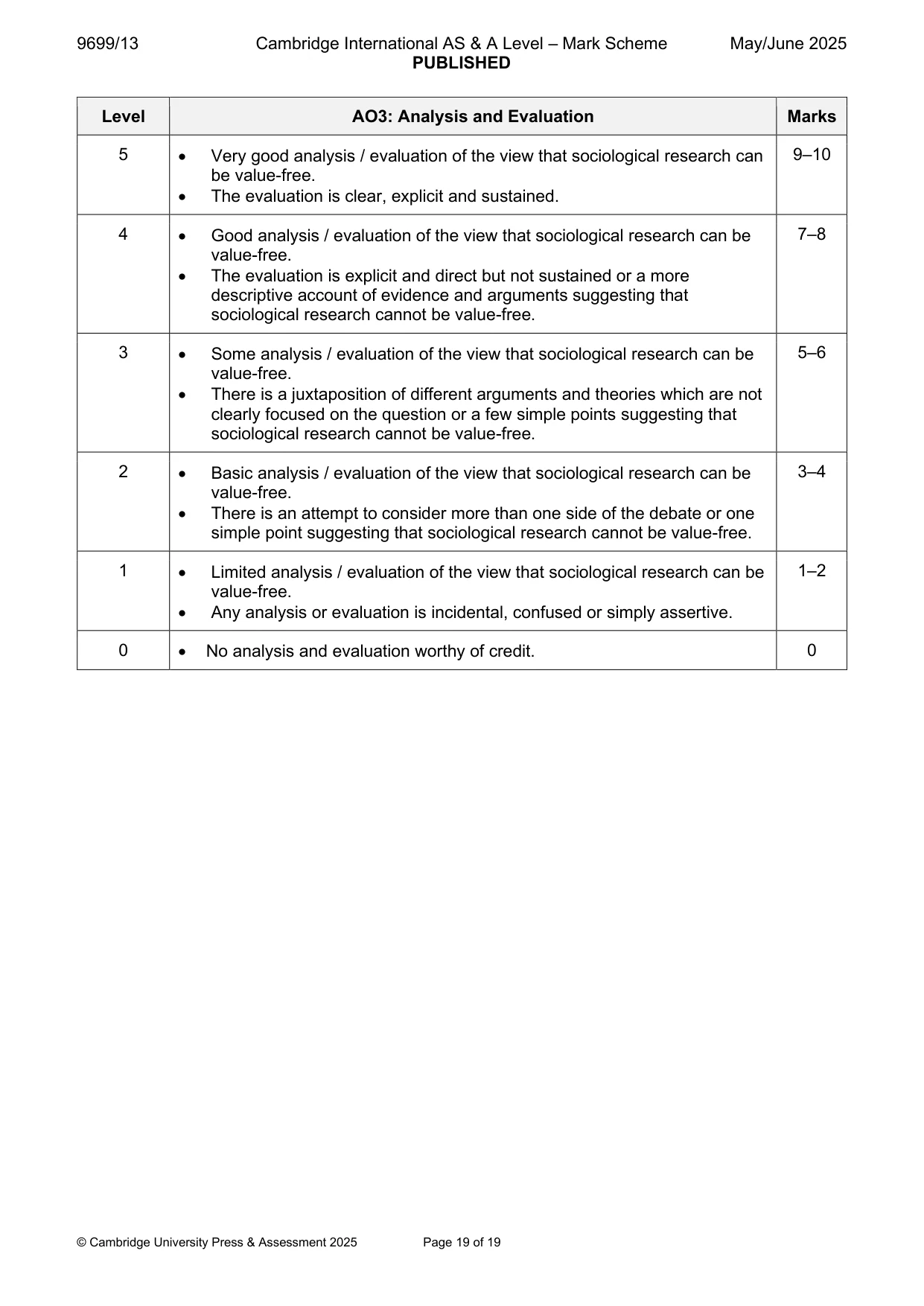
9699/13 Cambridge International AS & A Level – Mark Scheme PUBLISHED May/June 2025 © Cambridge University Press & Assessment 2025 Page 19 of 19 Level AO3: Analysis and Evaluation Marks 5 • Very good analysis / evaluation of the view that sociological research can be value-free. • The evaluation is clear, explicit and sustained. 9–10 4 • Good analysis / evaluation of the view that sociological research can be value-free. • The evaluation is explicit and direct but not sustained or a more descriptive account of evidence and arguments suggesting that sociological research cannot be value-free. 7–8 3 • Some analysis / evaluation of the view that sociological research can be value-free. • There is a juxtaposition of different arguments and theories which are not clearly focused on the question or a few simple points suggesting that sociological research cannot be value-free. 5–6 2 • Basic analysis / evaluation of the view that sociological research can be value-free. • There is an attempt to consider more than one side of the debate or one simple point suggesting that sociological research cannot be value-free. 3–4 1 • Limited analysis / evaluation of the view that sociological research can be value-free. • Any analysis or evaluation is incidental, confused or simply assertive. 1–2 0 • No analysis and evaluation worthy of credit. 0
What you needed in this session
Cambridge’s own grade thresholds for 2025 May/June, Paper 1 · Variant 3. A higher threshold means an easier paper — the bar moves with how the cohort did.