Cambridge A Level Sociology 9699 — 2020 May/June Paper 2 · Variant 2
9699/22/M/J/20
The question paper and its mark scheme, free to read here and free to download. This is Cambridge’s own paper, exactly as it was sat.
Question paper4 pages

Mark scheme8 pages
Answers below. Sit the paper first if you are practising.
Paper as text
Question paper, page 1
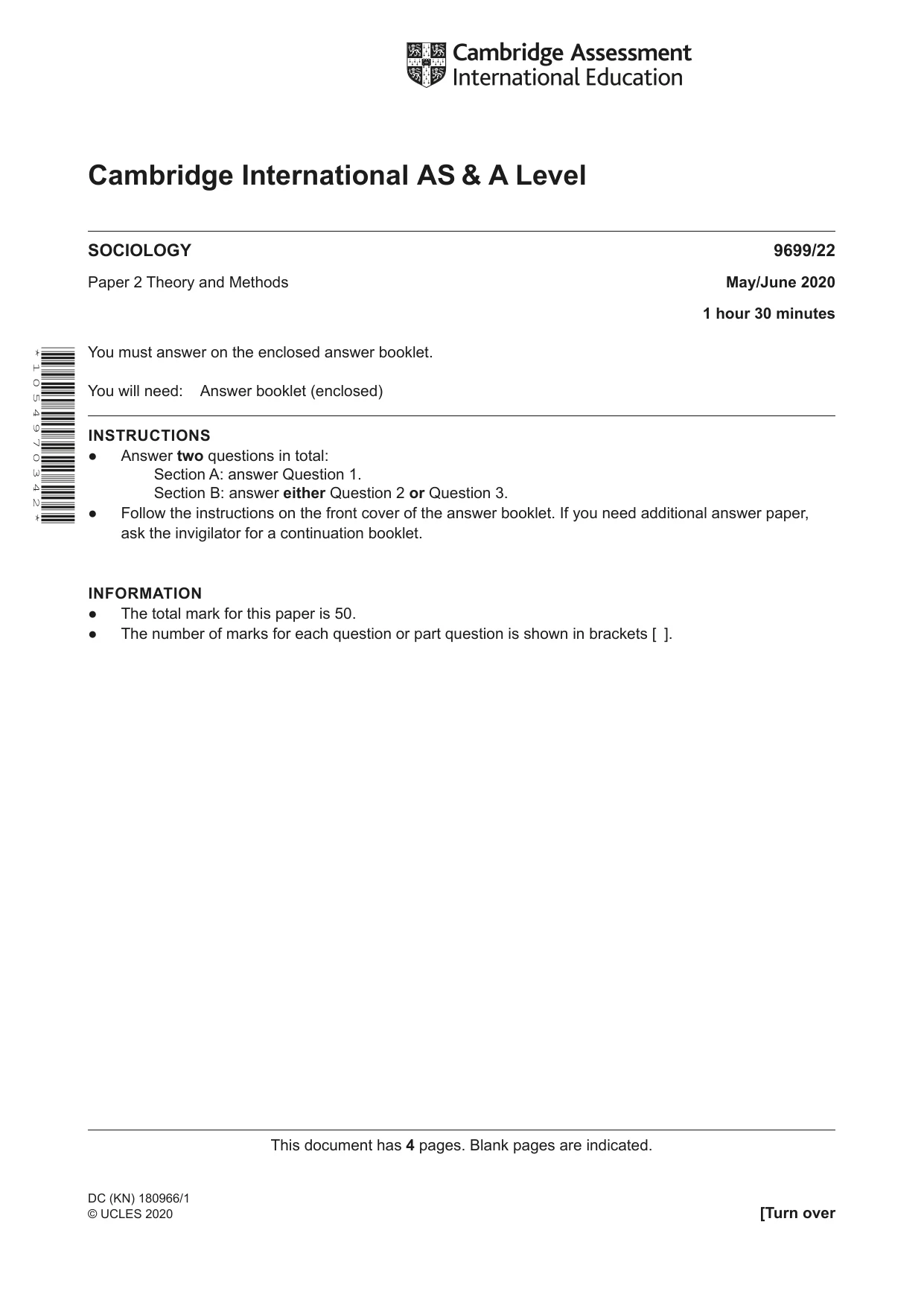
Cambridge International AS & A Level DC (KN) 180966/1 © UCLES 2020 [Turn over This document has 4 pages. Blank pages are indicated. * 1 0 5 4 9 7 0 3 4 2 * SOCIOLOGY 9699/22 Paper 2 Theory and Methods May/June 2020 1 hour 30 minutes You must answer on the enclosed answer booklet. You will need: Answer booklet (enclosed) INSTRUCTIONS ● Answer two questions in total: Section A: answer Question 1. Section B: answer either Question 2 or Question 3. ● Follow the instructions on the front cover of the answer booklet. If you need additional answer paper, ask the invigilator for a continuation booklet. INFORMATION ● The total mark for this paper is 50. ● The number of marks for each question or part question is shown in brackets [ ].
Question paper, page 2
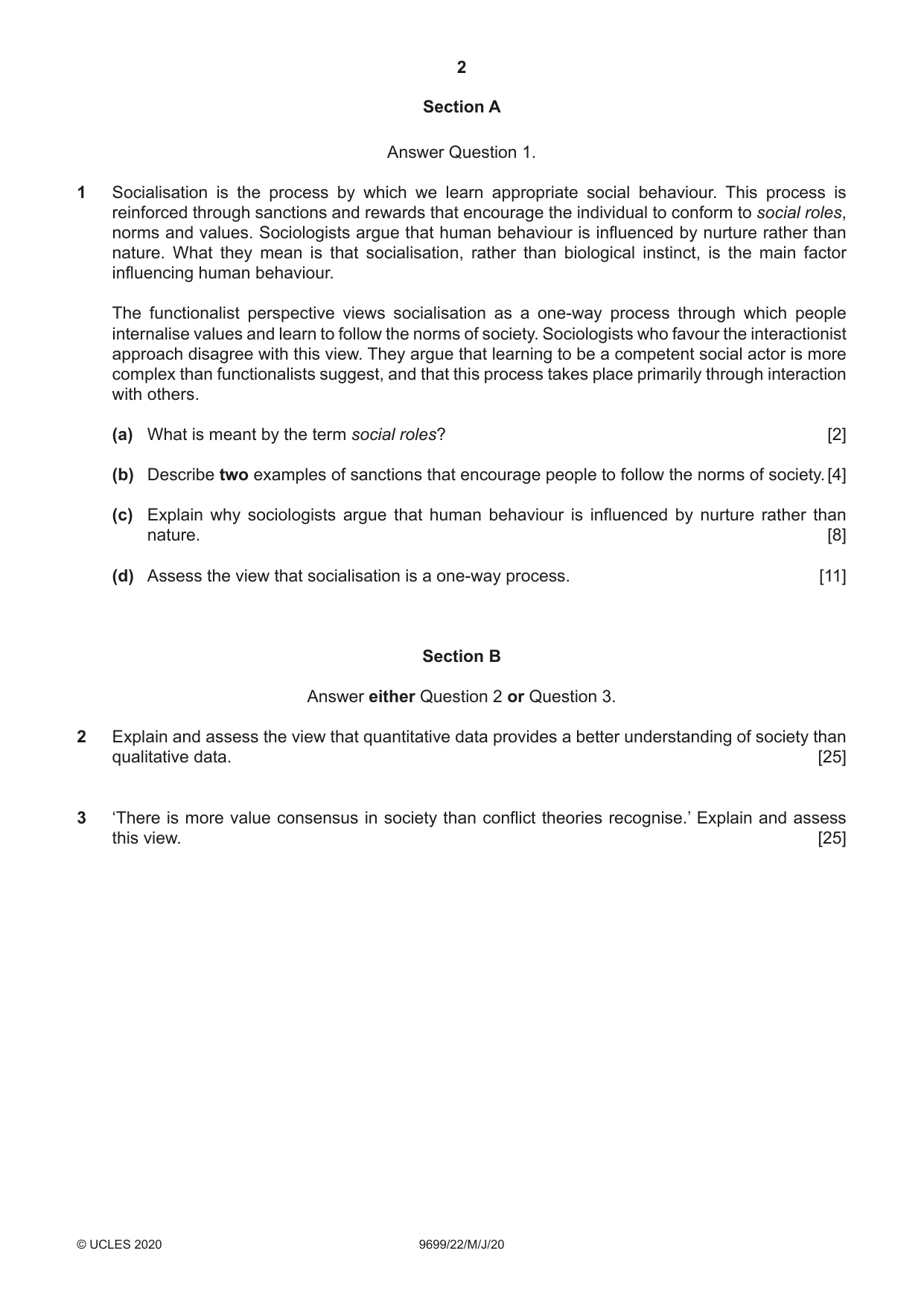
2 9699/22/M/J/20 © UCLES 2020 Section A Answer Question 1. 1 Socialisation is the process by which we learn appropriate social behaviour. This process is reinforced through sanctions and rewards that encourage the individual to conform to social roles, norms and values. Sociologists argue that human behaviour is influenced by nurture rather than nature. What they mean is that socialisation, rather than biological instinct, is the main factor influencing human behaviour. The functionalist perspective views socialisation as a one-way process through which people internalise values and learn to follow the norms of society. Sociologists who favour the interactionist approach disagree with this view. They argue that learning to be a competent social actor is more complex than functionalists suggest, and that this process takes place primarily through interaction with others. (a) What is meant by the term social roles? [2] (b) Describe two examples of sanctions that encourage people to follow the norms of society. [4] (c) Explain why sociologists argue that human behaviour is influenced by nurture rather than nature. [8] (d) Assess the view that socialisation is a one-way process. [11] Section B Answer either Question 2 or Question 3. 2 Explain and assess the view that quantitative data provides a better understanding of society than qualitative data. [25] 3 ‘There is more value consensus in society than conflict theories recognise.’ Explain and assess this view. [25]
Question paper, page 3
3 9699/22/M/J/20 © UCLES 2020 BLANK PAGE
Question paper, page 4
4 9699/22/M/J/20 © UCLES 2020 Permission to reproduce items where third-party owned material protected by copyright is included has been sought and cleared where possible. Every reasonable effort has been made by the publisher (UCLES) to trace copyright holders, but if any items requiring clearance have unwittingly been included, the publisher will be pleased to make amends at the earliest possible opportunity. To avoid the issue of disclosure of answer-related information to candidates, all copyright acknowledgements are reproduced online in the Cambridge Assessment International Education Copyright Acknowledgements Booklet. This is produced for each series of examinations and is freely available to download at www.cambridgeinternational.org after the live examination series. Cambridge Assessment International Education is part of the Cambridge Assessment Group. Cambridge Assessment is the brand name of the University of Cambridge Local Examinations Syndicate (UCLES), which itself is a department of the University of Cambridge. BLANK PAGE
Mark scheme, page 1
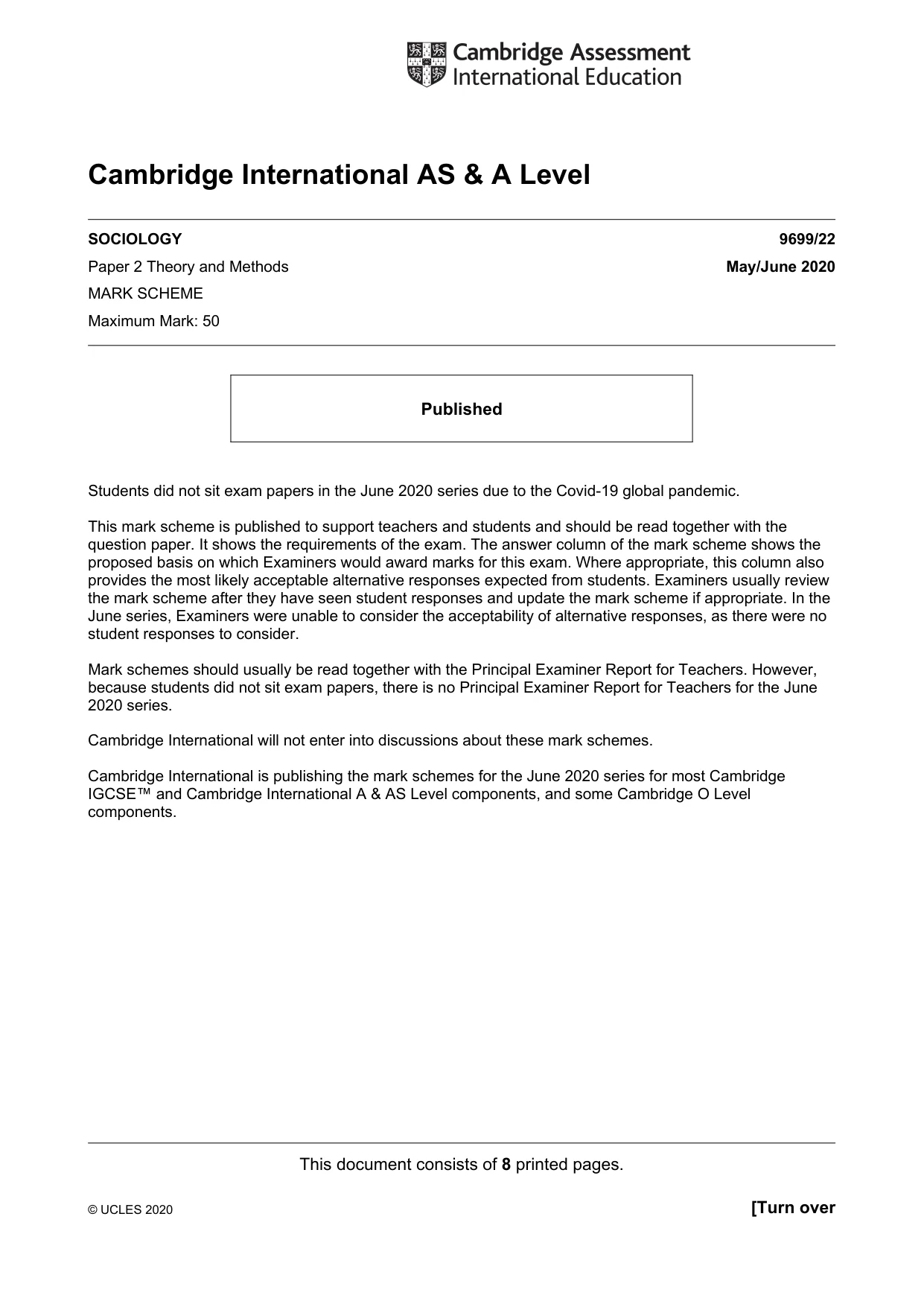
This document consists of 8 printed pages. © UCLES 2020 [Turn over Cambridge International AS & A Level SOCIOLOGY 9699/22 Paper 2 Theory and Methods May/June 2020 MARK SCHEME Maximum Mark: 50 Published Students did not sit exam papers in the June 2020 series due to the Covid-19 global pandemic. This mark scheme is published to support teachers and students and should be read together with the question paper. It shows the requirements of the exam. The answer column of the mark scheme shows the proposed basis on which Examiners would award marks for this exam. Where appropriate, this column also provides the most likely acceptable alternative responses expected from students. Examiners usually review the mark scheme after they have seen student responses and update the mark scheme if appropriate. In the June series, Examiners were unable to consider the acceptability of alternative responses, as there were no student responses to consider. Mark schemes should usually be read together with the Principal Examiner Report for Teachers. However, because students did not sit exam papers, there is no Principal Examiner Report for Teachers for the June 2020 series. Cambridge International will not enter into discussions about these mark schemes. Cambridge International is publishing the mark schemes for the June 2020 series for most Cambridge IGCSE™ and Cambridge International A & AS Level components, and some Cambridge O Level components.
Mark scheme, page 2
9699/22 Cambridge International AS & A Level – Mark Scheme PUBLISHED May/June 2020 © UCLES 2020 Page 2 of 8 Generic Marking Principles These general marking principles must be applied by all examiners when marking candidate answers. They should be applied alongside the specific content of the mark scheme or generic level descriptors for a question. Each question paper and mark scheme will also comply with these marking principles. GENERIC MARKING PRINCIPLE 1: Marks must be awarded in line with: • the specific content of the mark scheme or the generic level descriptors for the question • the specific skills defined in the mark scheme or in the generic level descriptors for the question • the standard of response required by a candidate as exemplified by the standardisation scripts. GENERIC MARKING PRINCIPLE 2: Marks awarded are always whole marks (not half marks, or other fractions). GENERIC MARKING PRINCIPLE 3: Marks must be awarded positively: • marks are awarded for correct/valid answers, as defined in the mark scheme. However, credit is given for valid answers which go beyond the scope of the syllabus and mark scheme, referring to your Team Leader as appropriate • marks are awarded when candidates clearly demonstrate what they know and can do • marks are not deducted for errors • marks are not deducted for omissions • answers should only be judged on the quality of spelling, punctuation and grammar when these features are specifically assessed by the question as indicated by the mark scheme. The meaning, however, should be unambiguous. GENERIC MARKING PRINCIPLE 4: Rules must be applied consistently e.g. in situations where candidates have not followed instructions or in the application of generic level descriptors. GENERIC MARKING PRINCIPLE 5: Marks should be awarded using the full range of marks defined in the mark scheme for the question (however; the use of the full mark range may be limited according to the quality of the candidate responses seen). GENERIC MARKING PRINCIPLE 6: Marks awarded are based solely on the requirements as defined in the mark scheme. Marks should not be awarded with grade thresholds or grade descriptors in mind.
Mark scheme, page 3
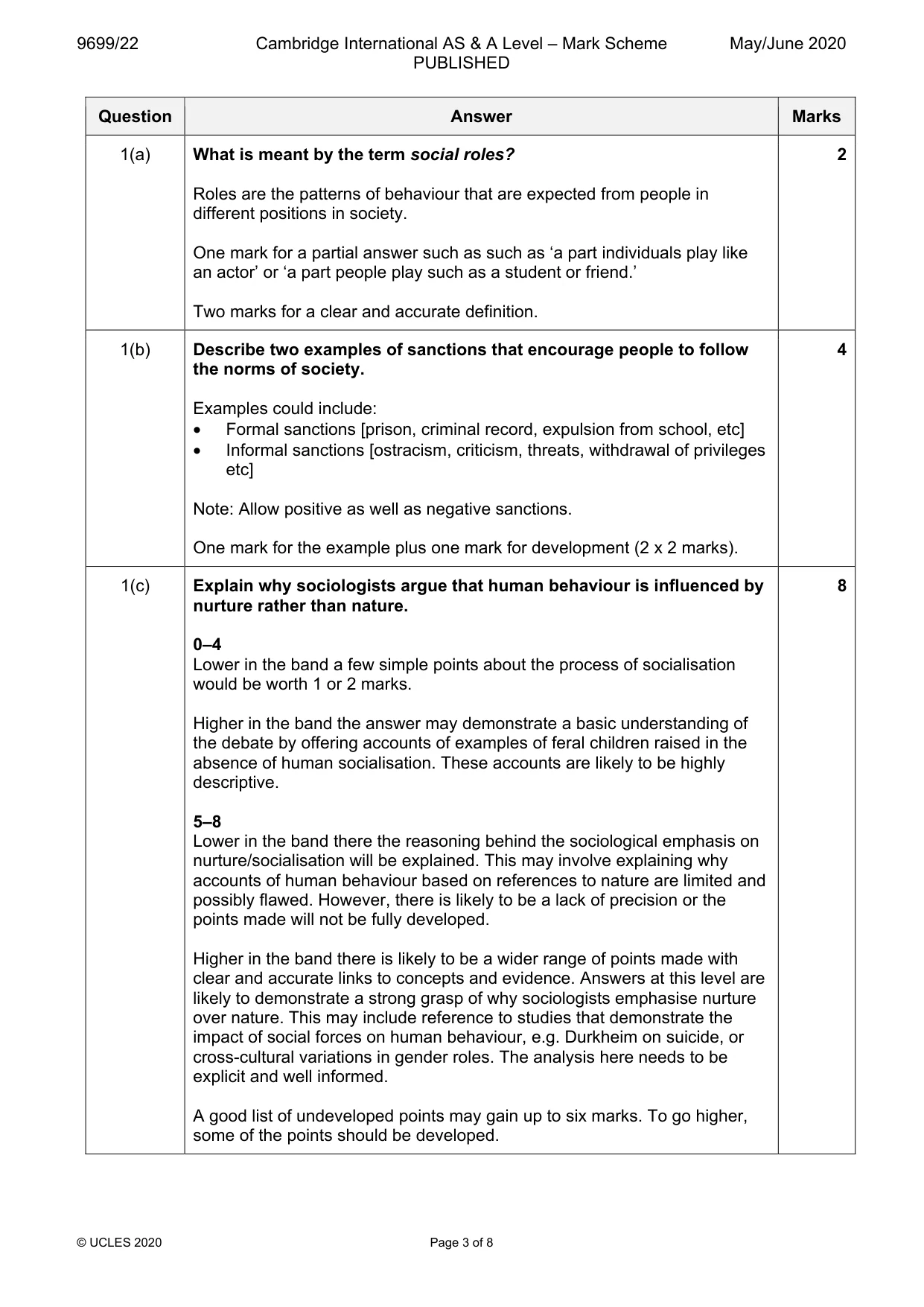
9699/22 Cambridge International AS & A Level – Mark Scheme PUBLISHED May/June 2020 © UCLES 2020 Page 3 of 8 Question Answer Marks 1(a) What is meant by the term social roles? Roles are the patterns of behaviour that are expected from people in different positions in society. One mark for a partial answer such as such as ‘a part individuals play like an actor’ or ‘a part people play such as a student or friend.’ Two marks for a clear and accurate definition. 2 1(b) Describe two examples of sanctions that encourage people to follow the norms of society. Examples could include: • Formal sanctions [prison, criminal record, expulsion from school, etc] • Informal sanctions [ostracism, criticism, threats, withdrawal of privileges etc] Note: Allow positive as well as negative sanctions. One mark for the example plus one mark for development (2 x 2 marks). 4 1(c) Explain why sociologists argue that human behaviour is influenced by nurture rather than nature. 0–4 Lower in the band a few simple points about the process of socialisation would be worth 1 or 2 marks. Higher in the band the answer may demonstrate a basic understanding of the debate by offering accounts of examples of feral children raised in the absence of human socialisation. These accounts are likely to be highly descriptive. 5–8 Lower in the band there the reasoning behind the sociological emphasis on nurture/socialisation will be explained. This may involve explaining why accounts of human behaviour based on references to nature are limited and possibly flawed. However, there is likely to be a lack of precision or the points made will not be fully developed. Higher in the band there is likely to be a wider range of points made with clear and accurate links to concepts and evidence. Answers at this level are likely to demonstrate a strong grasp of why sociologists emphasise nurture over nature. This may include reference to studies that demonstrate the impact of social forces on human behaviour, e.g. Durkheim on suicide, or cross-cultural variations in gender roles. The analysis here needs to be explicit and well informed. A good list of undeveloped points may gain up to six marks. To go higher, some of the points should be developed. 8
Mark scheme, page 4
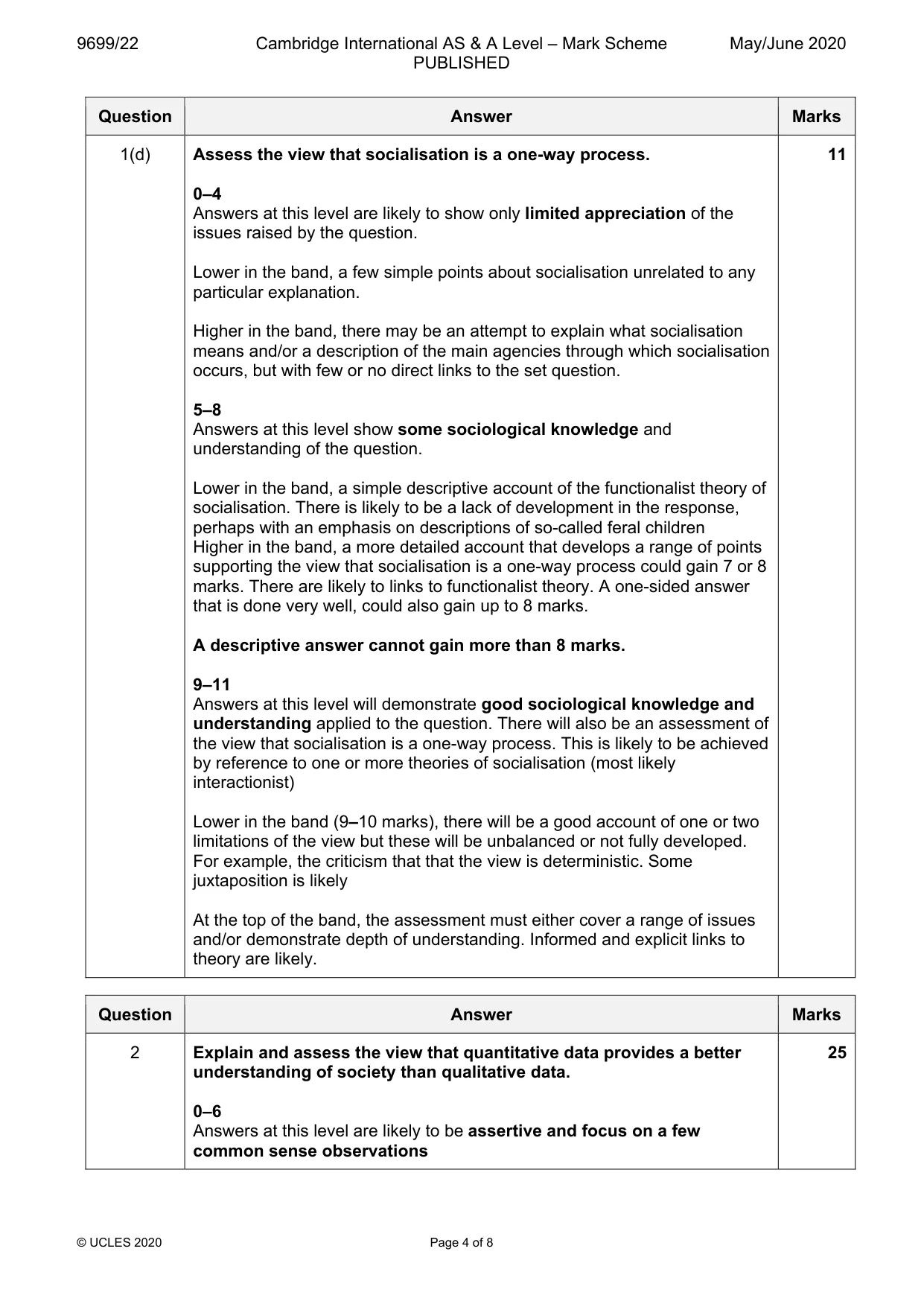
9699/22 Cambridge International AS & A Level – Mark Scheme PUBLISHED May/June 2020 © UCLES 2020 Page 4 of 8 Question Answer Marks 1(d) Assess the view that socialisation is a one-way process. 0–4 Answers at this level are likely to show only limited appreciation of the issues raised by the question. Lower in the band, a few simple points about socialisation unrelated to any particular explanation. Higher in the band, there may be an attempt to explain what socialisation means and/or a description of the main agencies through which socialisation occurs, but with few or no direct links to the set question. 5–8 Answers at this level show some sociological knowledge and understanding of the question. Lower in the band, a simple descriptive account of the functionalist theory of socialisation. There is likely to be a lack of development in the response, perhaps with an emphasis on descriptions of so-called feral children Higher in the band, a more detailed account that develops a range of points supporting the view that socialisation is a one-way process could gain 7 or 8 marks. There are likely to links to functionalist theory. A one-sided answer that is done very well, could also gain up to 8 marks. A descriptive answer cannot gain more than 8 marks. 9–11 Answers at this level will demonstrate good sociological knowledge and understanding applied to the question. There will also be an assessment of the view that socialisation is a one-way process. This is likely to be achieved by reference to one or more theories of socialisation (most likely interactionist) Lower in the band (9–10 marks), there will be a good account of one or two limitations of the view but these will be unbalanced or not fully developed. For example, the criticism that that the view is deterministic. Some juxtaposition is likely At the top of the band, the assessment must either cover a range of issues and/or demonstrate depth of understanding. Informed and explicit links to theory are likely. 11 Question Answer Marks 2 Explain and assess the view that quantitative data provides a better understanding of society than qualitative data. 0–6 Answers at this level are likely to be assertive and focus on a few common sense observations 25
Mark scheme, page 5
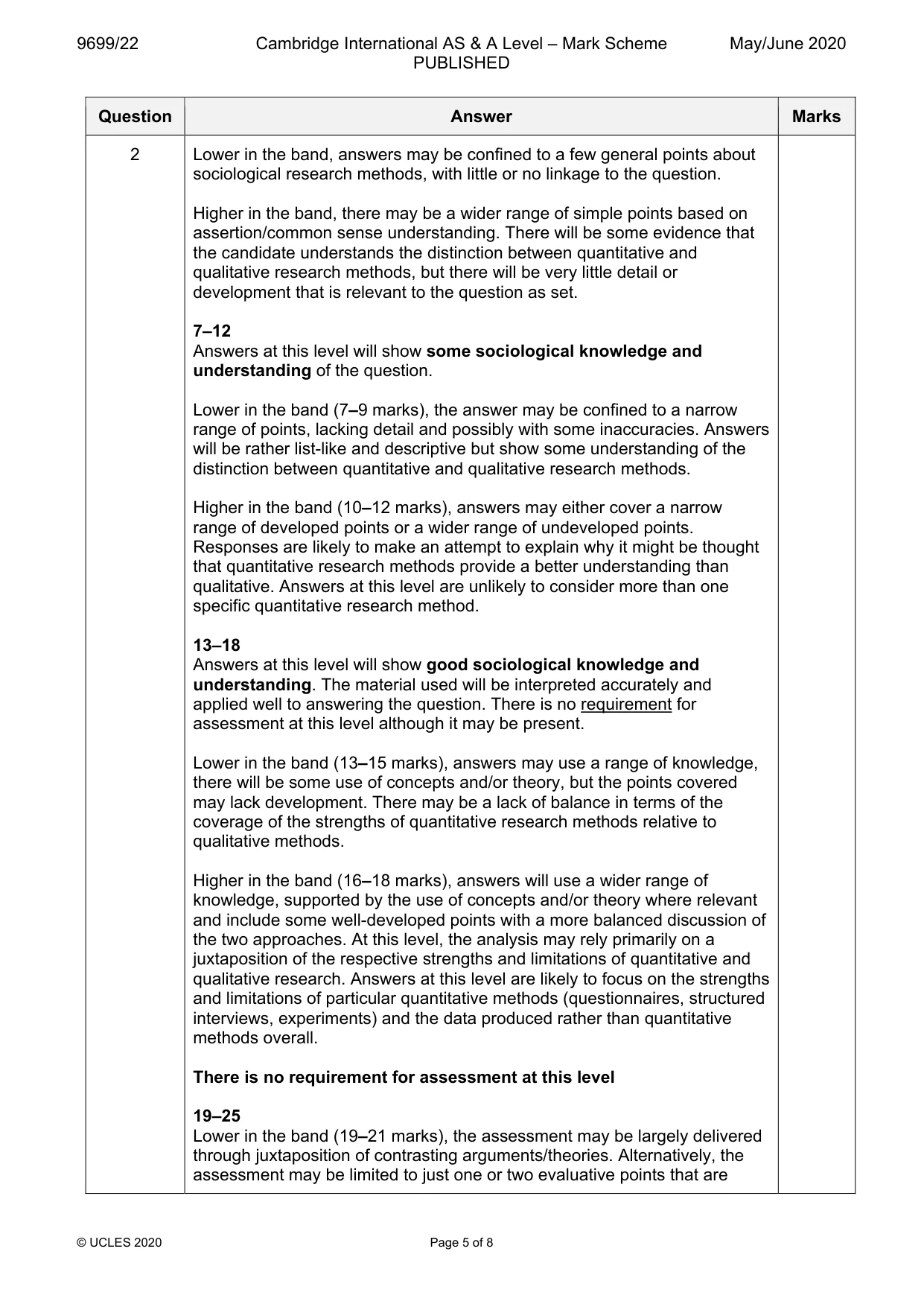
9699/22 Cambridge International AS & A Level – Mark Scheme PUBLISHED May/June 2020 © UCLES 2020 Page 5 of 8 Question Answer Marks 2 Lower in the band, answers may be confined to a few general points about sociological research methods, with little or no linkage to the question. Higher in the band, there may be a wider range of simple points based on assertion/common sense understanding. There will be some evidence that the candidate understands the distinction between quantitative and qualitative research methods, but there will be very little detail or development that is relevant to the question as set. 7–12 Answers at this level will show some sociological knowledge and understanding of the question. Lower in the band (7–9 marks), the answer may be confined to a narrow range of points, lacking detail and possibly with some inaccuracies. Answers will be rather list-like and descriptive but show some understanding of the distinction between quantitative and qualitative research methods. Higher in the band (10–12 marks), answers may either cover a narrow range of developed points or a wider range of undeveloped points. Responses are likely to make an attempt to explain why it might be thought that quantitative research methods provide a better understanding than qualitative. Answers at this level are unlikely to consider more than one specific quantitative research method. 13–18 Answers at this level will show good sociological knowledge and understanding. The material used will be interpreted accurately and applied well to answering the question. There is no requirement for assessment at this level although it may be present. Lower in the band (13–15 marks), answers may use a range of knowledge, there will be some use of concepts and/or theory, but the points covered may lack development. There may be a lack of balance in terms of the coverage of the strengths of quantitative research methods relative to qualitative methods. Higher in the band (16–18 marks), answers will use a wider range of knowledge, supported by the use of concepts and/or theory where relevant and include some well-developed points with a more balanced discussion of the two approaches. At this level, the analysis may rely primarily on a juxtaposition of the respective strengths and limitations of quantitative and qualitative research. Answers at this level are likely to focus on the strengths and limitations of particular quantitative methods (questionnaires, structured interviews, experiments) and the data produced rather than quantitative methods overall. There is no requirement for assessment at this level 19–25 Lower in the band (19–21 marks), the assessment may be largely delivered through juxtaposition of contrasting arguments/theories. Alternatively, the assessment may be limited to just one or two evaluative points that are
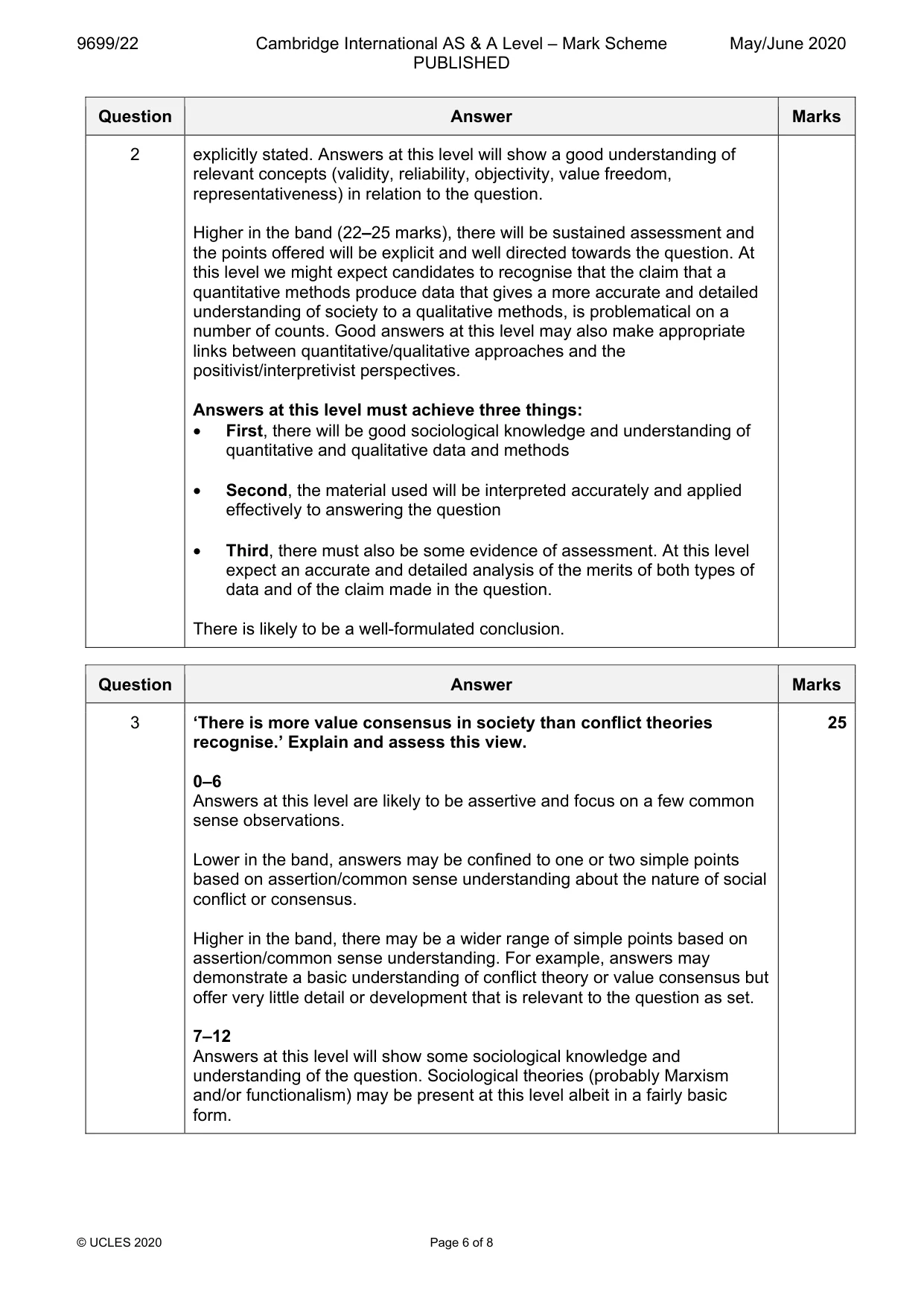
Mark scheme, page 6
9699/22 Cambridge International AS & A Level – Mark Scheme PUBLISHED May/June 2020 © UCLES 2020 Page 6 of 8 Question Answer Marks 2 explicitly stated. Answers at this level will show a good understanding of relevant concepts (validity, reliability, objectivity, value freedom, representativeness) in relation to the question. Higher in the band (22–25 marks), there will be sustained assessment and the points offered will be explicit and well directed towards the question. At this level we might expect candidates to recognise that the claim that a quantitative methods produce data that gives a more accurate and detailed understanding of society to a qualitative methods, is problematical on a number of counts. Good answers at this level may also make appropriate links between quantitative/qualitative approaches and the positivist/interpretivist perspectives. Answers at this level must achieve three things: • First, there will be good sociological knowledge and understanding of quantitative and qualitative data and methods • Second, the material used will be interpreted accurately and applied effectively to answering the question • Third, there must also be some evidence of assessment. At this level expect an accurate and detailed analysis of the merits of both types of data and of the claim made in the question. There is likely to be a well-formulated conclusion. Question Answer Marks 3 ‘There is more value consensus in society than conflict theories recognise.’ Explain and assess this view. 0–6 Answers at this level are likely to be assertive and focus on a few common sense observations. Lower in the band, answers may be confined to one or two simple points based on assertion/common sense understanding about the nature of social conflict or consensus. Higher in the band, there may be a wider range of simple points based on assertion/common sense understanding. For example, answers may demonstrate a basic understanding of conflict theory or value consensus but offer very little detail or development that is relevant to the question as set. 7–12 Answers at this level will show some sociological knowledge and understanding of the question. Sociological theories (probably Marxism and/or functionalism) may be present at this level albeit in a fairly basic form. 25
Mark scheme, page 7
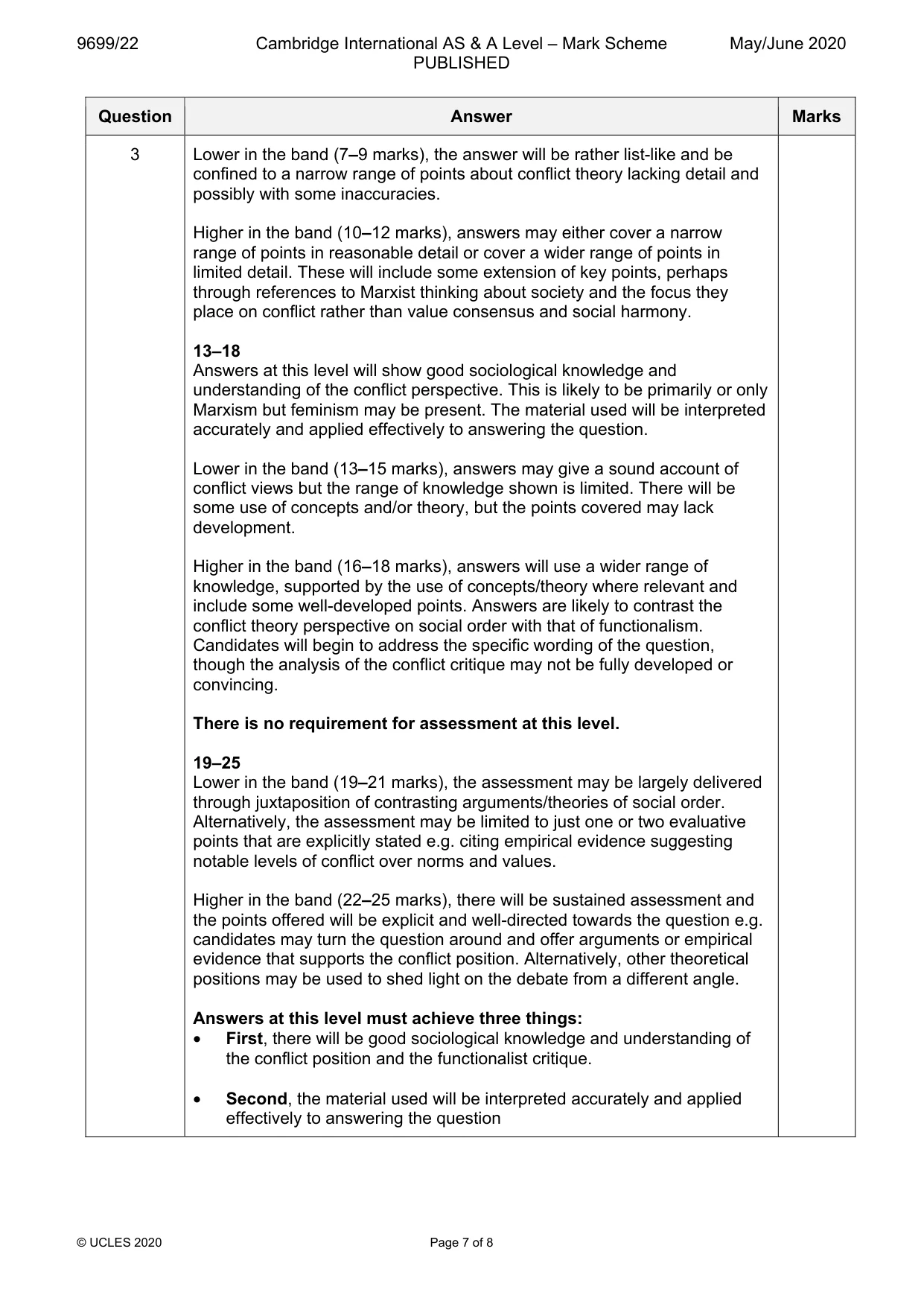
9699/22 Cambridge International AS & A Level – Mark Scheme PUBLISHED May/June 2020 © UCLES 2020 Page 7 of 8 Question Answer Marks 3 Lower in the band (7–9 marks), the answer will be rather list-like and be confined to a narrow range of points about conflict theory lacking detail and possibly with some inaccuracies. Higher in the band (10–12 marks), answers may either cover a narrow range of points in reasonable detail or cover a wider range of points in limited detail. These will include some extension of key points, perhaps through references to Marxist thinking about society and the focus they place on conflict rather than value consensus and social harmony. 13–18 Answers at this level will show good sociological knowledge and understanding of the conflict perspective. This is likely to be primarily or only Marxism but feminism may be present. The material used will be interpreted accurately and applied effectively to answering the question. Lower in the band (13–15 marks), answers may give a sound account of conflict views but the range of knowledge shown is limited. There will be some use of concepts and/or theory, but the points covered may lack development. Higher in the band (16–18 marks), answers will use a wider range of knowledge, supported by the use of concepts/theory where relevant and include some well-developed points. Answers are likely to contrast the conflict theory perspective on social order with that of functionalism. Candidates will begin to address the specific wording of the question, though the analysis of the conflict critique may not be fully developed or convincing. There is no requirement for assessment at this level. 19–25 Lower in the band (19–21 marks), the assessment may be largely delivered through juxtaposition of contrasting arguments/theories of social order. Alternatively, the assessment may be limited to just one or two evaluative points that are explicitly stated e.g. citing empirical evidence suggesting notable levels of conflict over norms and values. Higher in the band (22–25 marks), there will be sustained assessment and the points offered will be explicit and well-directed towards the question e.g. candidates may turn the question around and offer arguments or empirical evidence that supports the conflict position. Alternatively, other theoretical positions may be used to shed light on the debate from a different angle. Answers at this level must achieve three things: • First, there will be good sociological knowledge and understanding of the conflict position and the functionalist critique. • Second, the material used will be interpreted accurately and applied effectively to answering the question
Mark scheme, page 8
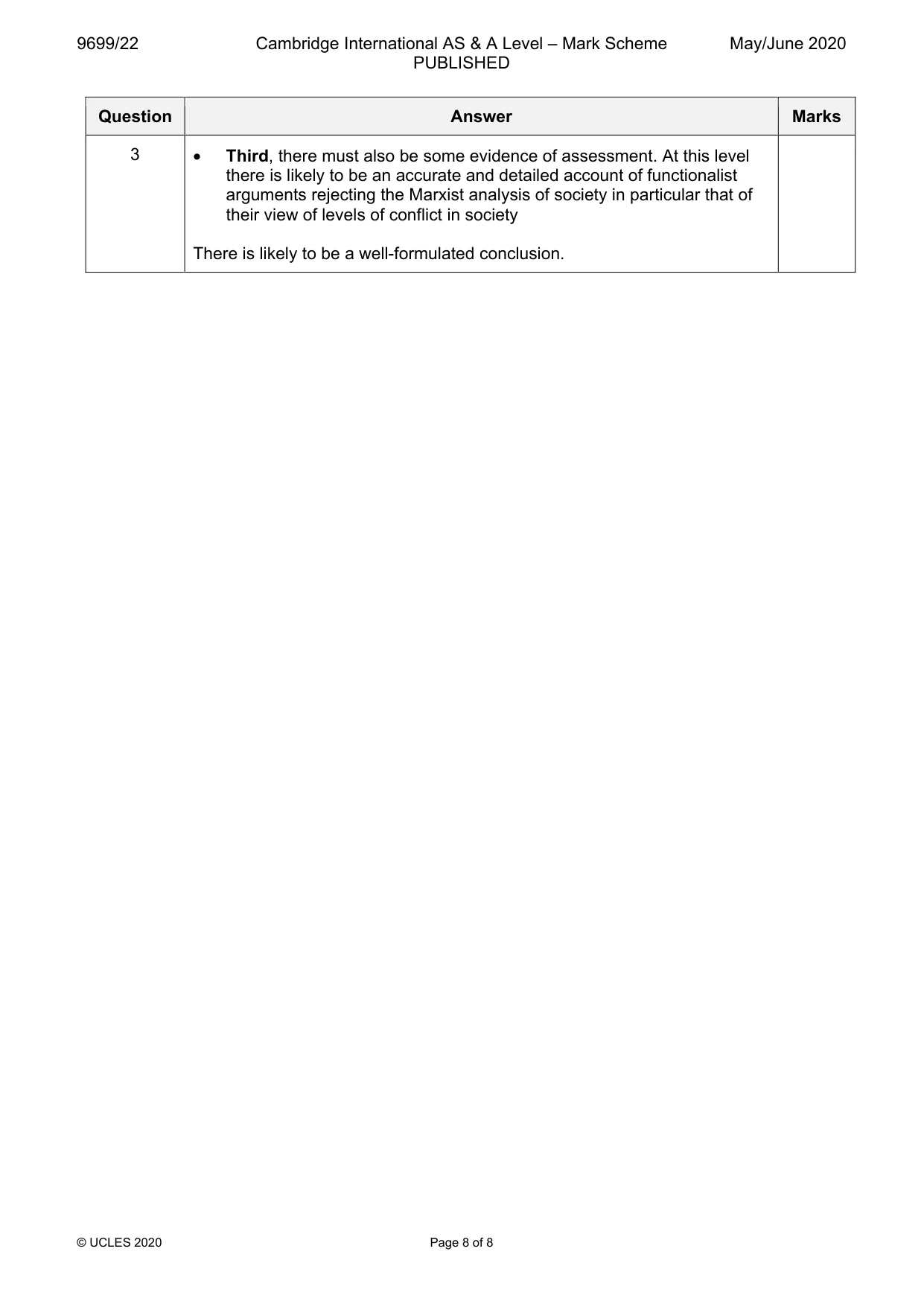
9699/22 Cambridge International AS & A Level – Mark Scheme PUBLISHED May/June 2020 © UCLES 2020 Page 8 of 8 Question Answer Marks 3 • Third, there must also be some evidence of assessment. At this level there is likely to be an accurate and detailed account of functionalist arguments rejecting the Marxist analysis of society in particular that of their view of levels of conflict in society There is likely to be a well-formulated conclusion.