Cambridge A Level Sociology 9699 — 2019 Feb/March Paper 3 · Variant 2
9699/32/F/M/19 · 75 marks · ≈84 min
The question paper and its mark scheme, free to read here and free to download. This is Cambridge’s own paper, exactly as it was sat.
Question paper4 pages

Mark scheme21 pages
Answers below. Sit the paper first if you are practising.
Paper as text
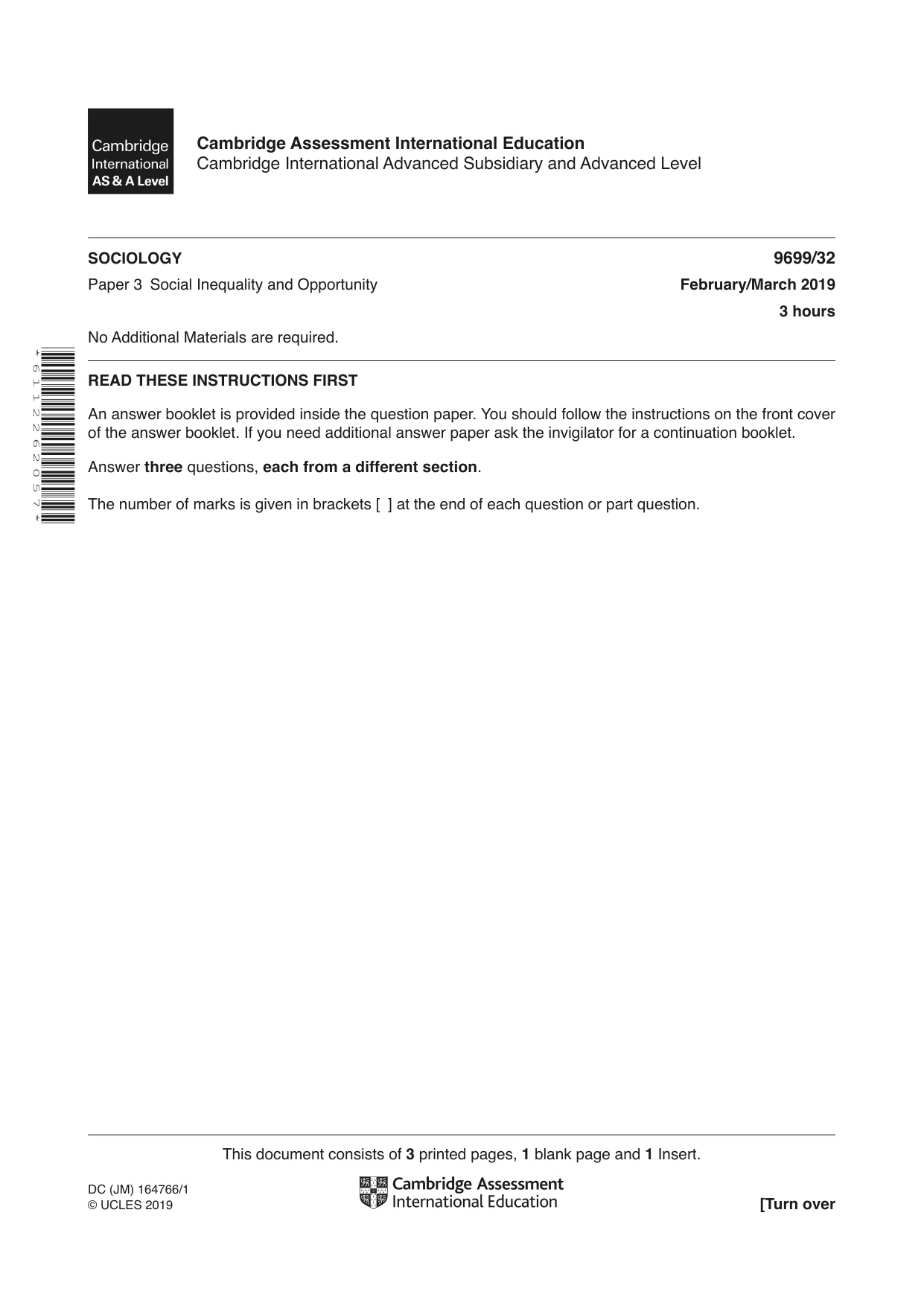
Question paper, page 1
This document consists of 3 printed pages, 1 blank page and 1 Insert. DC (JM) 164766/1 © UCLES 2019 [Turn over * 6 1 1 2 2 6 2 0 5 7 * Cambridge Assessment International Education Cambridge International Advanced Subsidiary and Advanced Level SOCIOLOGY 9699/32 Paper 3 Social Inequality and Opportunity February/March 2019 3 hours No Additional Materials are required. READ THESE INSTRUCTIONS FIRST An answer booklet is provided inside the question paper. You should follow the instructions on the front cover of the answer booklet. If you need additional answer paper ask the invigilator for a continuation booklet. Answer three questions, each from a different section. The number of marks is given in brackets [ ] at the end of each question or part question.
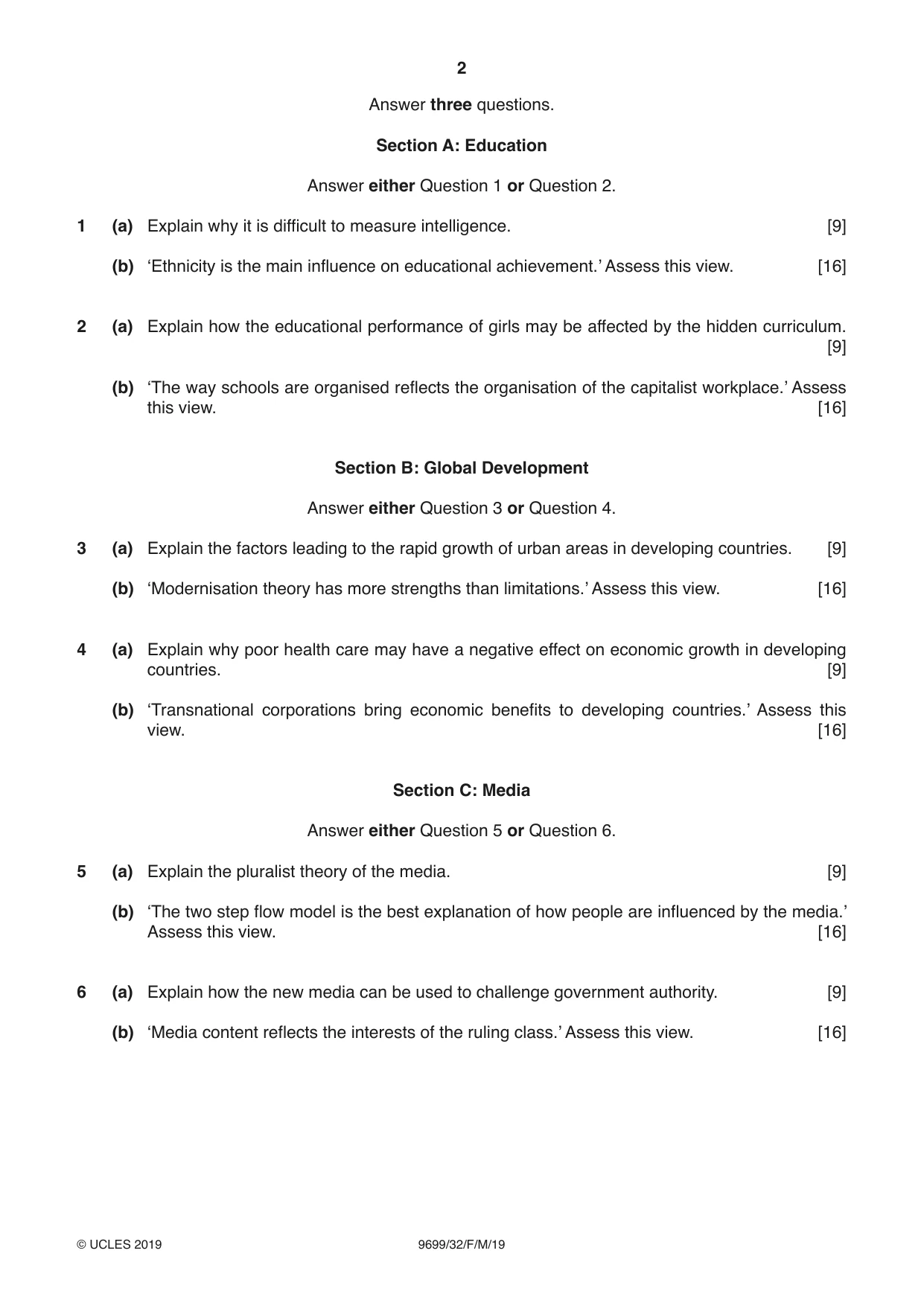
Question paper, page 2
2 9699/32/F/M/19 © UCLES 2019 Answer three questions. Section A: Education Answer either Question 1 or Question 2. 1 (a) Explain why it is difficult to measure intelligence. [9] (b) ‘Ethnicity is the main influence on educational achievement.’ Assess this view. [16] 2 (a) Explain how the educational performance of girls may be affected by the hidden curriculum. [9] (b) ‘The way schools are organised reflects the organisation of the capitalist workplace.’ Assess this view. [16] Section B: Global Development Answer either Question 3 or Question 4. 3 (a) Explain the factors leading to the rapid growth of urban areas in developing countries. [9] (b) ‘Modernisation theory has more strengths than limitations.’ Assess this view. [16] 4 (a) Explain why poor health care may have a negative effect on economic growth in developing countries. [9] (b) ‘Transnational corporations bring economic benefits to developing countries.’ Assess this view. [16] Section C: Media Answer either Question 5 or Question 6. 5 (a) Explain the pluralist theory of the media. [9] (b) ‘The two step flow model is the best explanation of how people are influenced by the media.’ Assess this view. [16] 6 (a) Explain how the new media can be used to challenge government authority. [9] (b) ‘Media content reflects the interests of the ruling class.’ Assess this view. [16]
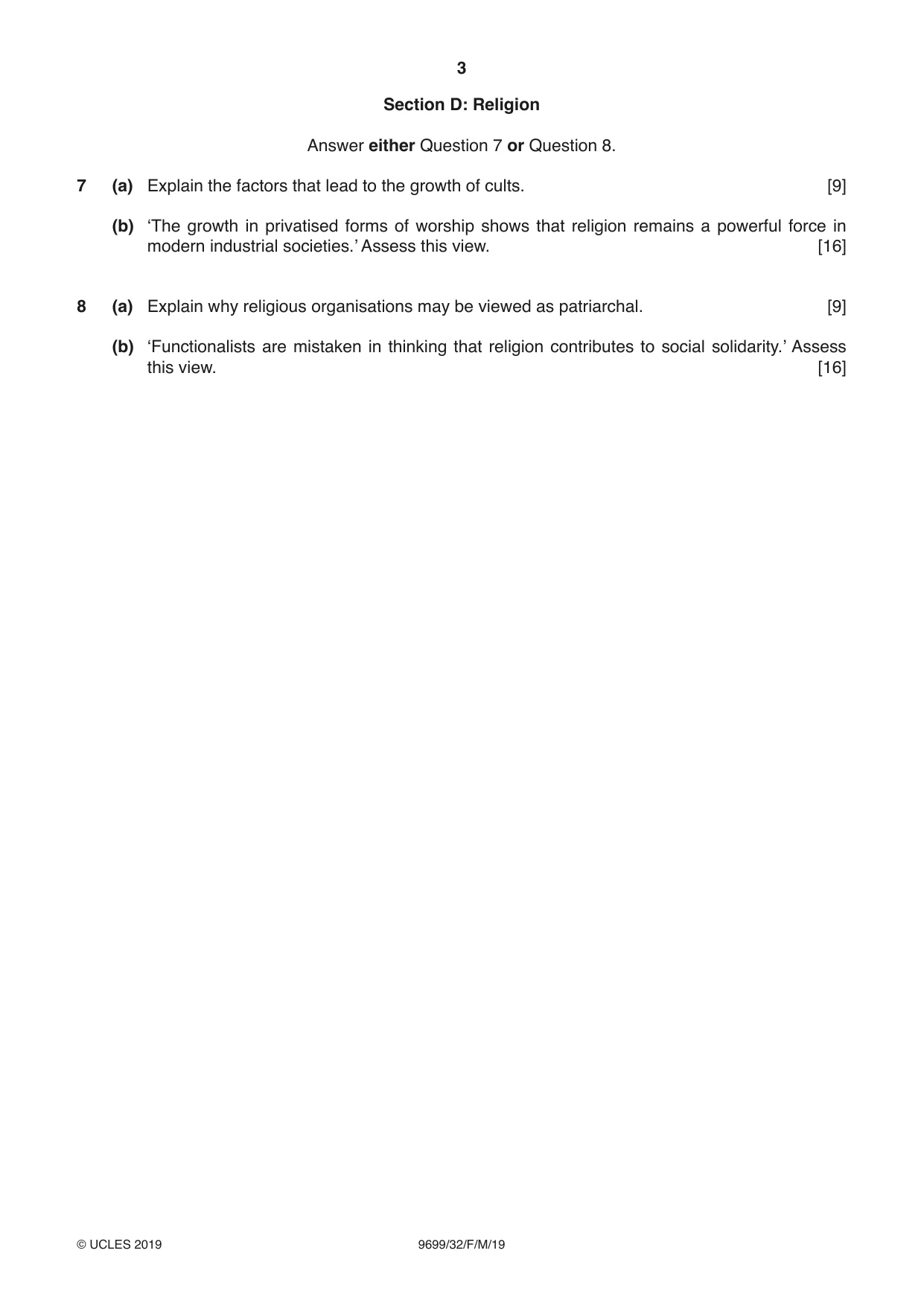
Question paper, page 3
3 9699/32/F/M/19 © UCLES 2019 Section D: Religion Answer either Question 7 or Question 8. 7 (a) Explain the factors that lead to the growth of cults. [9] (b) ‘The growth in privatised forms of worship shows that religion remains a powerful force in modern industrial societies.’ Assess this view. [16] 8 (a) Explain why religious organisations may be viewed as patriarchal. [9] (b) ‘Functionalists are mistaken in thinking that religion contributes to social solidarity.’ Assess this view. [16]
Question paper, page 4
4 9699/32/F/M/19 © UCLES 2019 BLANK PAGE Permission to reproduce items where third-party owned material protected by copyright is included has been sought and cleared where possible. Every reasonable effort has been made by the publisher (UCLES) to trace copyright holders, but if any items requiring clearance have unwittingly been included, the publisher will be pleased to make amends at the earliest possible opportunity. To avoid the issue of disclosure of answer-related information to candidates, all copyright acknowledgements are reproduced online in the Cambridge Assessment International Education Copyright Acknowledgements Booklet. This is produced for each series of examinations and is freely available to download at www.cambridgeinternational.org after the live examination series. Cambridge Assessment International Education is part of the Cambridge Assessment Group. Cambridge Assessment is the brand name of the University of Cambridge Local Examinations Syndicate (UCLES), which itself is a department of the University of Cambridge.
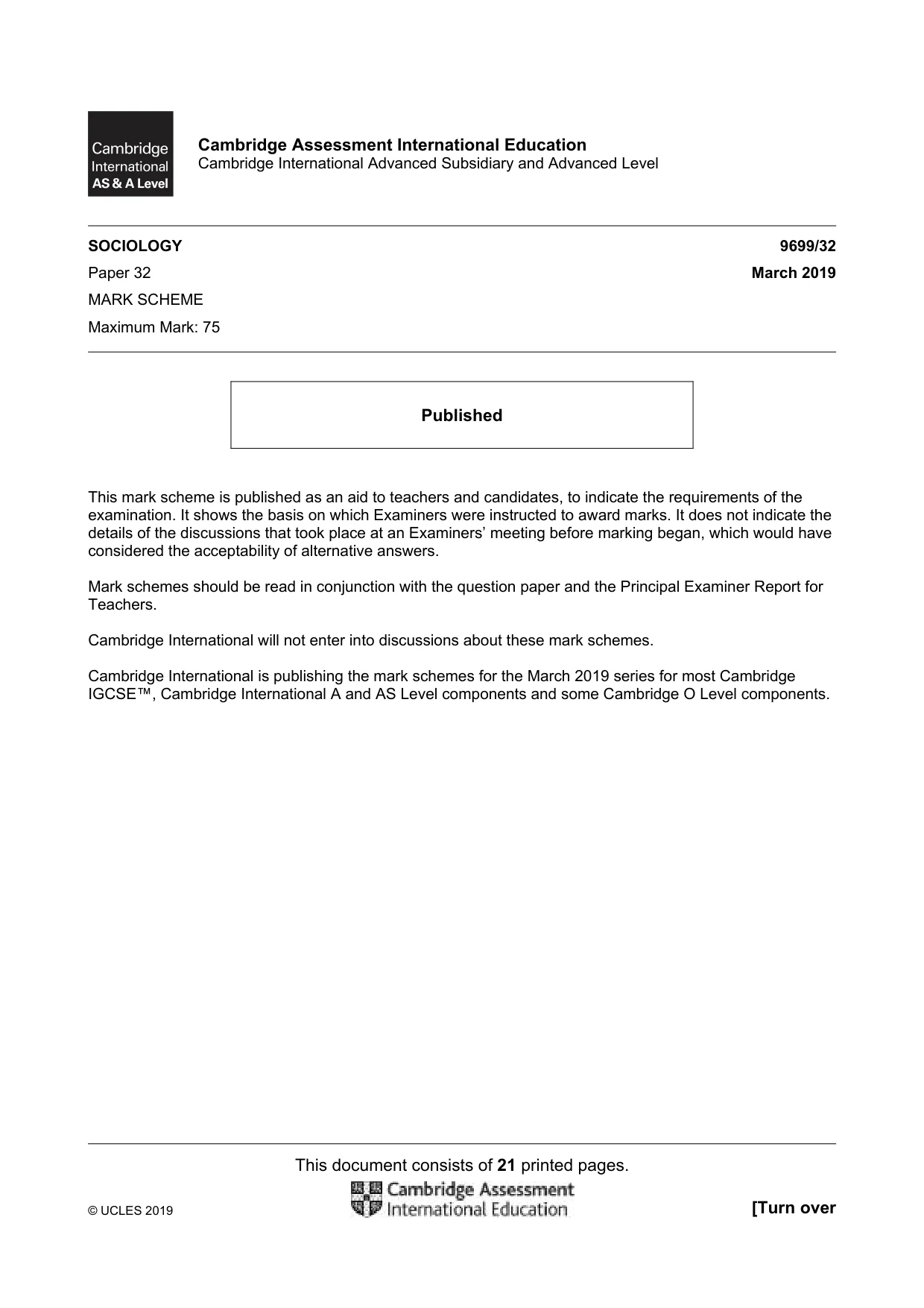
Mark scheme, page 1
This document consists of 21 printed pages. © UCLES 2019 [Turn over Cambridge Assessment International Education Cambridge International Advanced Subsidiary and Advanced Level SOCIOLOGY 9699/32 Paper 32 March 2019 MARK SCHEME Maximum Mark: 75 Published This mark scheme is published as an aid to teachers and candidates, to indicate the requirements of the examination. It shows the basis on which Examiners were instructed to award marks. It does not indicate the details of the discussions that took place at an Examiners’ meeting before marking began, which would have considered the acceptability of alternative answers. Mark schemes should be read in conjunction with the question paper and the Principal Examiner Report for Teachers. Cambridge International will not enter into discussions about these mark schemes. Cambridge International is publishing the mark schemes for the March 2019 series for most Cambridge IGCSE™, Cambridge International A and AS Level components and some Cambridge O Level components.
Mark scheme, page 2
9699/32 Cambridge International AS/A Level – Mark Scheme PUBLISHED March 2019 © UCLES 2019 Page 2 of 21 Generic Marking Principles These general marking principles must be applied by all examiners when marking candidate answers. They should be applied alongside the specific content of the mark scheme or generic level descriptors for a question. Each question paper and mark scheme will also comply with these marking principles. GENERIC MARKING PRINCIPLE 1: Marks must be awarded in line with: • the specific content of the mark scheme or the generic level descriptors for the question • the specific skills defined in the mark scheme or in the generic level descriptors for the question • the standard of response required by a candidate as exemplified by the standardisation scripts. GENERIC MARKING PRINCIPLE 2: Marks awarded are always whole marks (not half marks, or other fractions). GENERIC MARKING PRINCIPLE 3: Marks must be awarded positively: • marks are awarded for correct/valid answers, as defined in the mark scheme. However, credit is given for valid answers which go beyond the scope of the syllabus and mark scheme, referring to your Team Leader as appropriate • marks are awarded when candidates clearly demonstrate what they know and can do • marks are not deducted for errors • marks are not deducted for omissions • answers should only be judged on the quality of spelling, punctuation and grammar when these features are specifically assessed by the question as indicated by the mark scheme. The meaning, however, should be unambiguous. GENERIC MARKING PRINCIPLE 4: Rules must be applied consistently e.g. in situations where candidates have not followed instructions or in the application of generic level descriptors. GENERIC MARKING PRINCIPLE 5: Marks should be awarded using the full range of marks defined in the mark scheme for the question (however; the use of the full mark range may be limited according to the quality of the candidate responses seen). GENERIC MARKING PRINCIPLE 6: Marks awarded are based solely on the requirements as defined in the mark scheme. Marks should not be awarded with grade thresholds or grade descriptors in mind.
Mark scheme, page 3
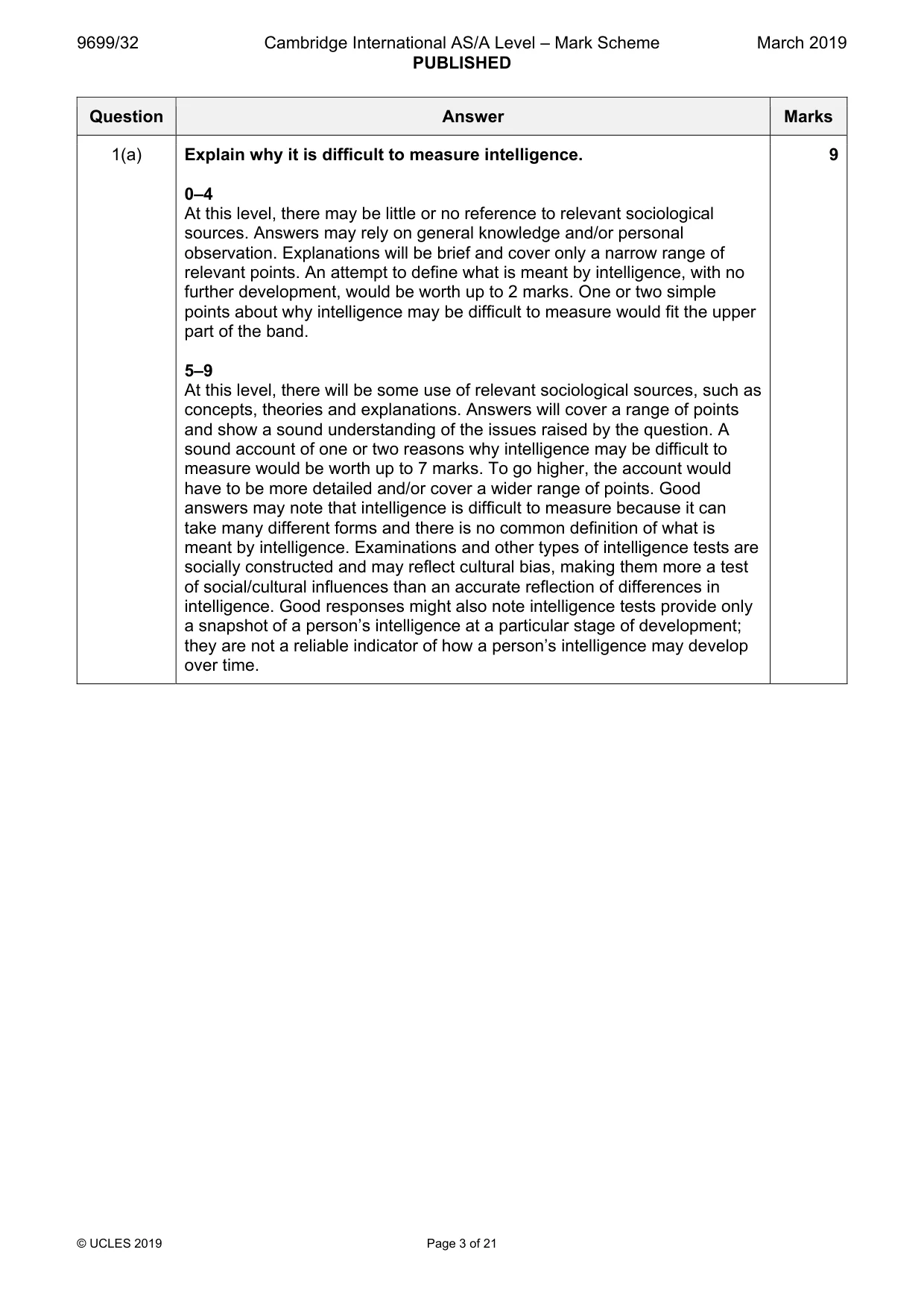
9699/32 Cambridge International AS/A Level – Mark Scheme PUBLISHED March 2019 © UCLES 2019 Page 3 of 21 Question Answer Marks 1(a) Explain why it is difficult to measure intelligence. 0–4 At this level, there may be little or no reference to relevant sociological sources. Answers may rely on general knowledge and/or personal observation. Explanations will be brief and cover only a narrow range of relevant points. An attempt to define what is meant by intelligence, with no further development, would be worth up to 2 marks. One or two simple points about why intelligence may be difficult to measure would fit the upper part of the band. 5–9 At this level, there will be some use of relevant sociological sources, such as concepts, theories and explanations. Answers will cover a range of points and show a sound understanding of the issues raised by the question. A sound account of one or two reasons why intelligence may be difficult to measure would be worth up to 7 marks. To go higher, the account would have to be more detailed and/or cover a wider range of points. Good answers may note that intelligence is difficult to measure because it can take many different forms and there is no common definition of what is meant by intelligence. Examinations and other types of intelligence tests are socially constructed and may reflect cultural bias, making them more a test of social/cultural influences than an accurate reflection of differences in intelligence. Good responses might also note intelligence tests provide only a snapshot of a person’s intelligence at a particular stage of development; they are not a reliable indicator of how a person’s intelligence may develop over time. 9
Mark scheme, page 4
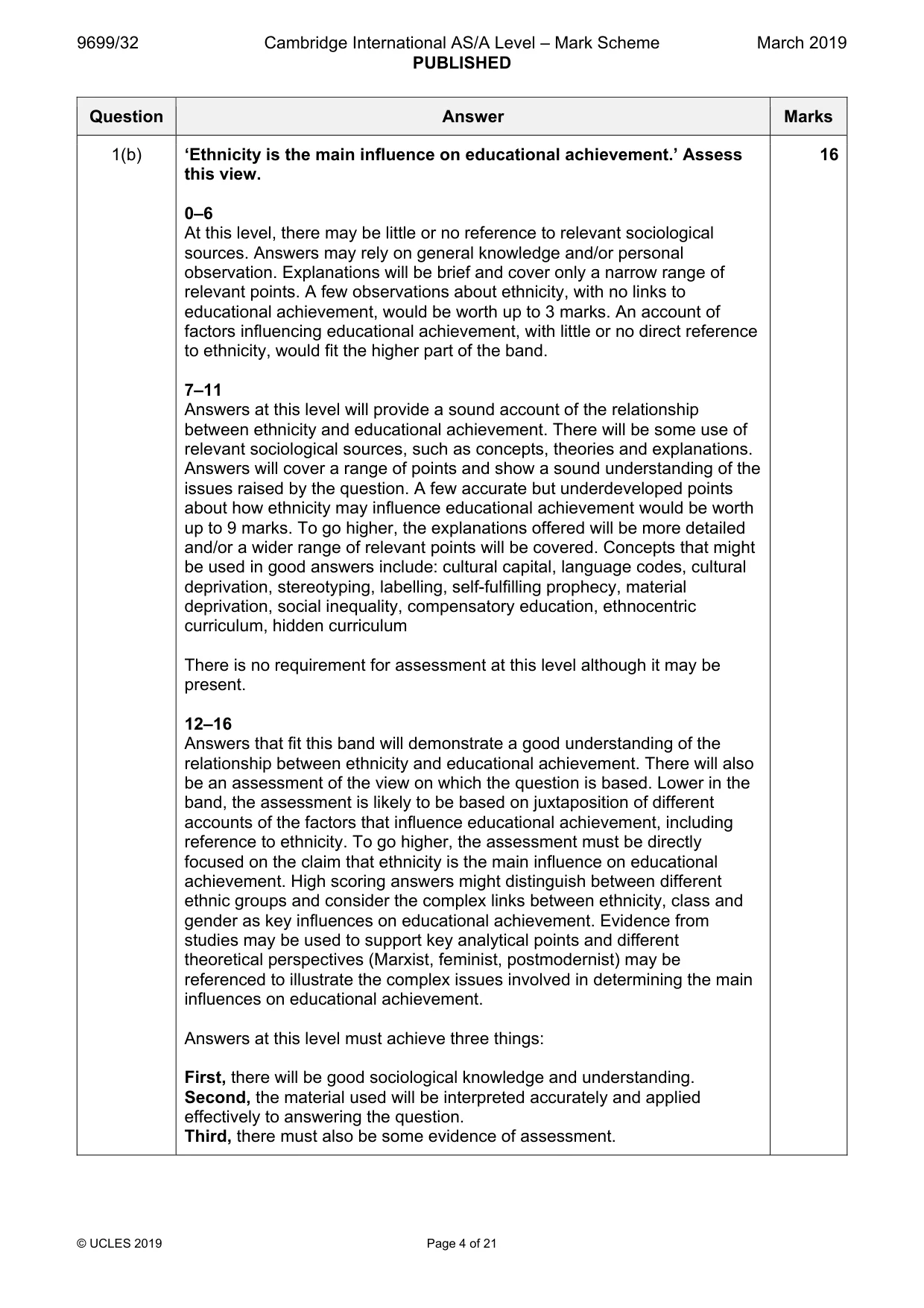
9699/32 Cambridge International AS/A Level – Mark Scheme PUBLISHED March 2019 © UCLES 2019 Page 4 of 21 Question Answer Marks 1(b) ‘Ethnicity is the main influence on educational achievement.’ Assess this view. 0–6 At this level, there may be little or no reference to relevant sociological sources. Answers may rely on general knowledge and/or personal observation. Explanations will be brief and cover only a narrow range of relevant points. A few observations about ethnicity, with no links to educational achievement, would be worth up to 3 marks. An account of factors influencing educational achievement, with little or no direct reference to ethnicity, would fit the higher part of the band. 7–11 Answers at this level will provide a sound account of the relationship between ethnicity and educational achievement. There will be some use of relevant sociological sources, such as concepts, theories and explanations. Answers will cover a range of points and show a sound understanding of the issues raised by the question. A few accurate but underdeveloped points about how ethnicity may influence educational achievement would be worth up to 9 marks. To go higher, the explanations offered will be more detailed and/or a wider range of relevant points will be covered. Concepts that might be used in good answers include: cultural capital, language codes, cultural deprivation, stereotyping, labelling, self-fulfilling prophecy, material deprivation, social inequality, compensatory education, ethnocentric curriculum, hidden curriculum There is no requirement for assessment at this level although it may be present. 12–16 Answers that fit this band will demonstrate a good understanding of the relationship between ethnicity and educational achievement. There will also be an assessment of the view on which the question is based. Lower in the band, the assessment is likely to be based on juxtaposition of different accounts of the factors that influence educational achievement, including reference to ethnicity. To go higher, the assessment must be directly focused on the claim that ethnicity is the main influence on educational achievement. High scoring answers might distinguish between different ethnic groups and consider the complex links between ethnicity, class and gender as key influences on educational achievement. Evidence from studies may be used to support key analytical points and different theoretical perspectives (Marxist, feminist, postmodernist) may be referenced to illustrate the complex issues involved in determining the main influences on educational achievement. Answers at this level must achieve three things: First, there will be good sociological knowledge and understanding. Second, the material used will be interpreted accurately and applied effectively to answering the question. Third, there must also be some evidence of assessment. 16
Mark scheme, page 5
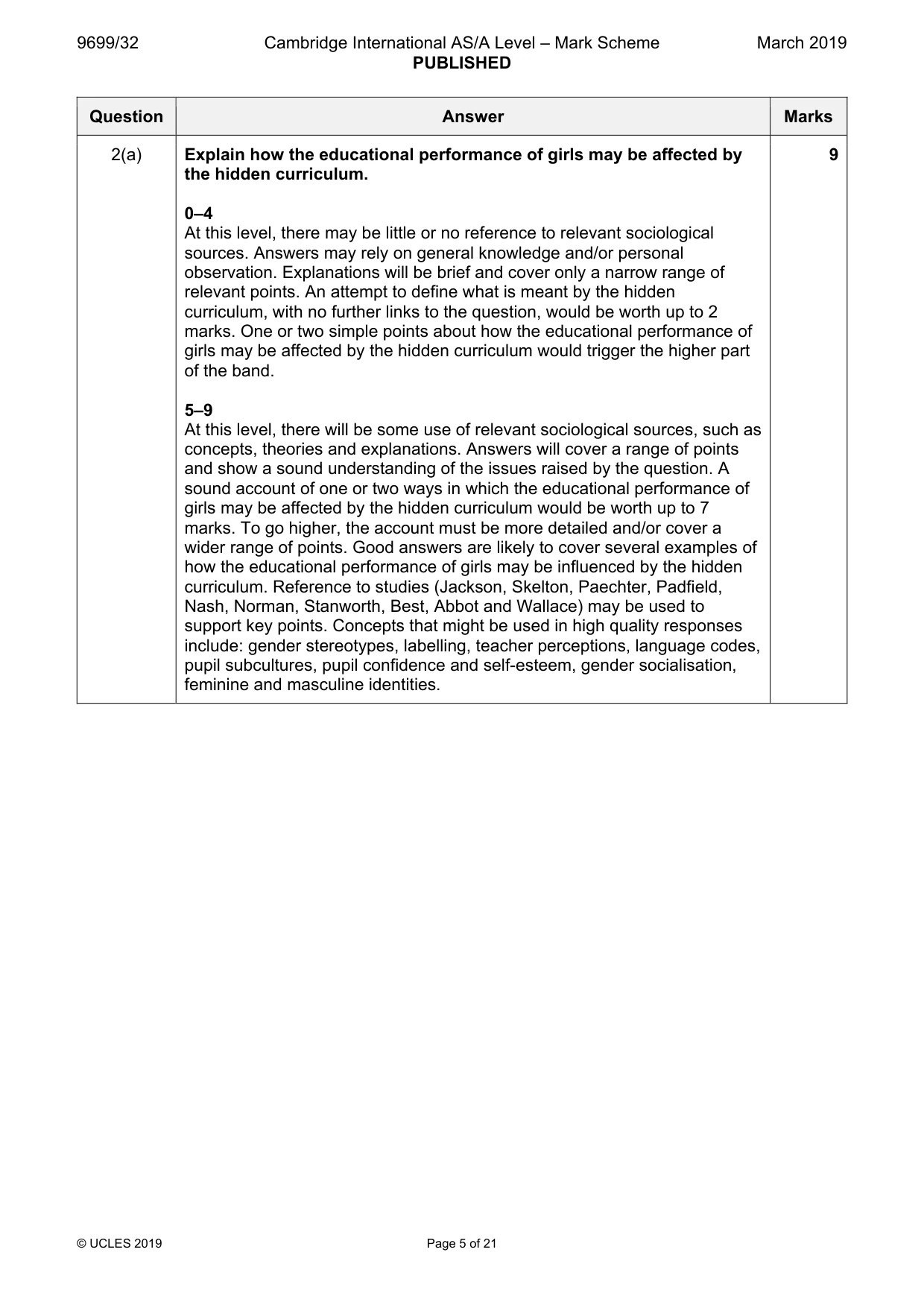
9699/32 Cambridge International AS/A Level – Mark Scheme PUBLISHED March 2019 © UCLES 2019 Page 5 of 21 Question Answer Marks 2(a) Explain how the educational performance of girls may be affected by the hidden curriculum. 0–4 At this level, there may be little or no reference to relevant sociological sources. Answers may rely on general knowledge and/or personal observation. Explanations will be brief and cover only a narrow range of relevant points. An attempt to define what is meant by the hidden curriculum, with no further links to the question, would be worth up to 2 marks. One or two simple points about how the educational performance of girls may be affected by the hidden curriculum would trigger the higher part of the band. 5–9 At this level, there will be some use of relevant sociological sources, such as concepts, theories and explanations. Answers will cover a range of points and show a sound understanding of the issues raised by the question. A sound account of one or two ways in which the educational performance of girls may be affected by the hidden curriculum would be worth up to 7 marks. To go higher, the account must be more detailed and/or cover a wider range of points. Good answers are likely to cover several examples of how the educational performance of girls may be influenced by the hidden curriculum. Reference to studies (Jackson, Skelton, Paechter, Padfield, Nash, Norman, Stanworth, Best, Abbot and Wallace) may be used to support key points. Concepts that might be used in high quality responses include: gender stereotypes, labelling, teacher perceptions, language codes, pupil subcultures, pupil confidence and self-esteem, gender socialisation, feminine and masculine identities. 9
Mark scheme, page 6
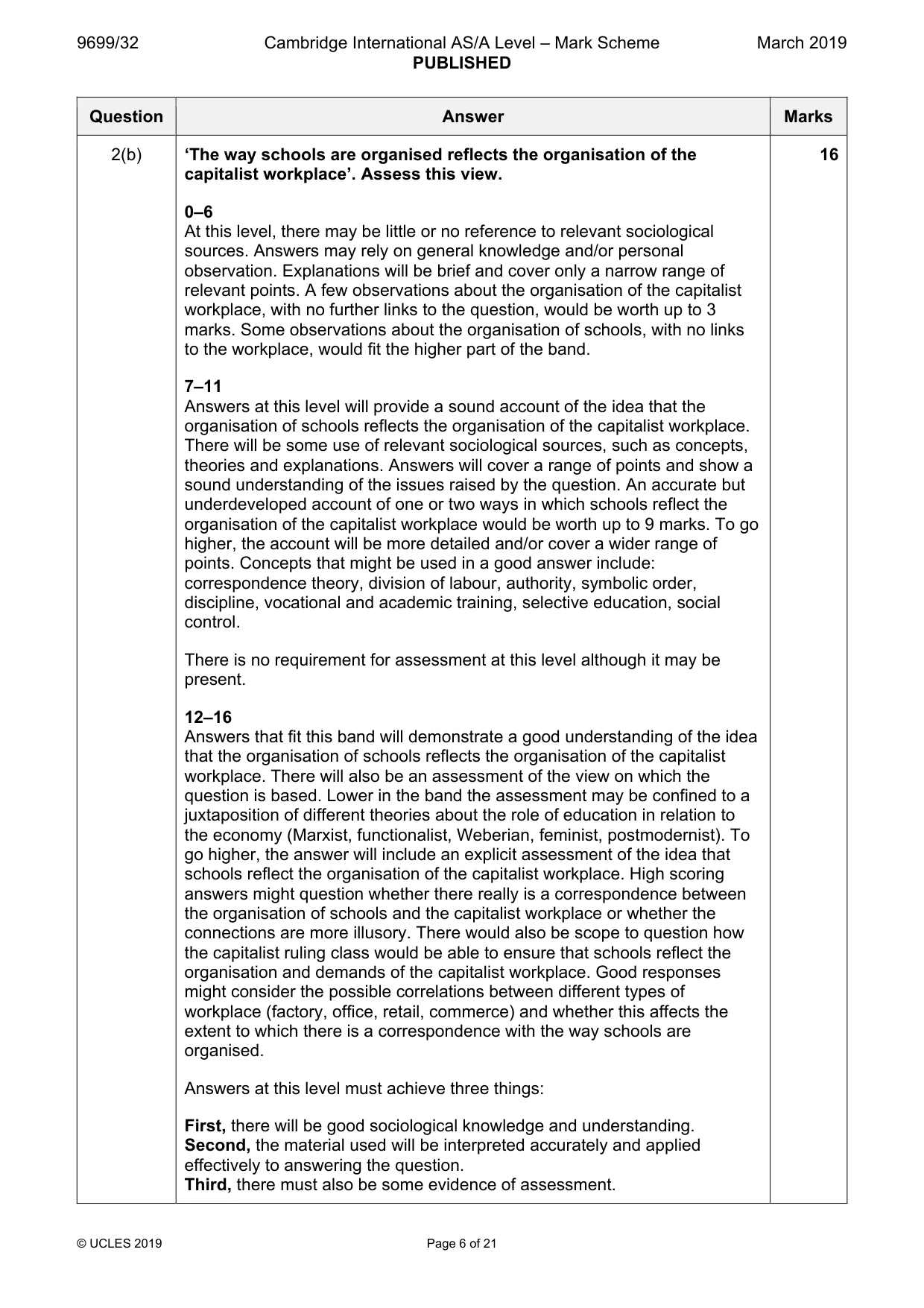
9699/32 Cambridge International AS/A Level – Mark Scheme PUBLISHED March 2019 © UCLES 2019 Page 6 of 21 Question Answer Marks 2(b) ‘The way schools are organised reflects the organisation of the capitalist workplace’. Assess this view. 0–6 At this level, there may be little or no reference to relevant sociological sources. Answers may rely on general knowledge and/or personal observation. Explanations will be brief and cover only a narrow range of relevant points. A few observations about the organisation of the capitalist workplace, with no further links to the question, would be worth up to 3 marks. Some observations about the organisation of schools, with no links to the workplace, would fit the higher part of the band. 7–11 Answers at this level will provide a sound account of the idea that the organisation of schools reflects the organisation of the capitalist workplace. There will be some use of relevant sociological sources, such as concepts, theories and explanations. Answers will cover a range of points and show a sound understanding of the issues raised by the question. An accurate but underdeveloped account of one or two ways in which schools reflect the organisation of the capitalist workplace would be worth up to 9 marks. To go higher, the account will be more detailed and/or cover a wider range of points. Concepts that might be used in a good answer include: correspondence theory, division of labour, authority, symbolic order, discipline, vocational and academic training, selective education, social control. There is no requirement for assessment at this level although it may be present. 12–16 Answers that fit this band will demonstrate a good understanding of the idea that the organisation of schools reflects the organisation of the capitalist workplace. There will also be an assessment of the view on which the question is based. Lower in the band the assessment may be confined to a juxtaposition of different theories about the role of education in relation to the economy (Marxist, functionalist, Weberian, feminist, postmodernist). To go higher, the answer will include an explicit assessment of the idea that schools reflect the organisation of the capitalist workplace. High scoring answers might question whether there really is a correspondence between the organisation of schools and the capitalist workplace or whether the connections are more illusory. There would also be scope to question how the capitalist ruling class would be able to ensure that schools reflect the organisation and demands of the capitalist workplace. Good responses might consider the possible correlations between different types of workplace (factory, office, retail, commerce) and whether this affects the extent to which there is a correspondence with the way schools are organised. Answers at this level must achieve three things: First, there will be good sociological knowledge and understanding. Second, the material used will be interpreted accurately and applied effectively to answering the question. Third, there must also be some evidence of assessment. 16
Mark scheme, page 7
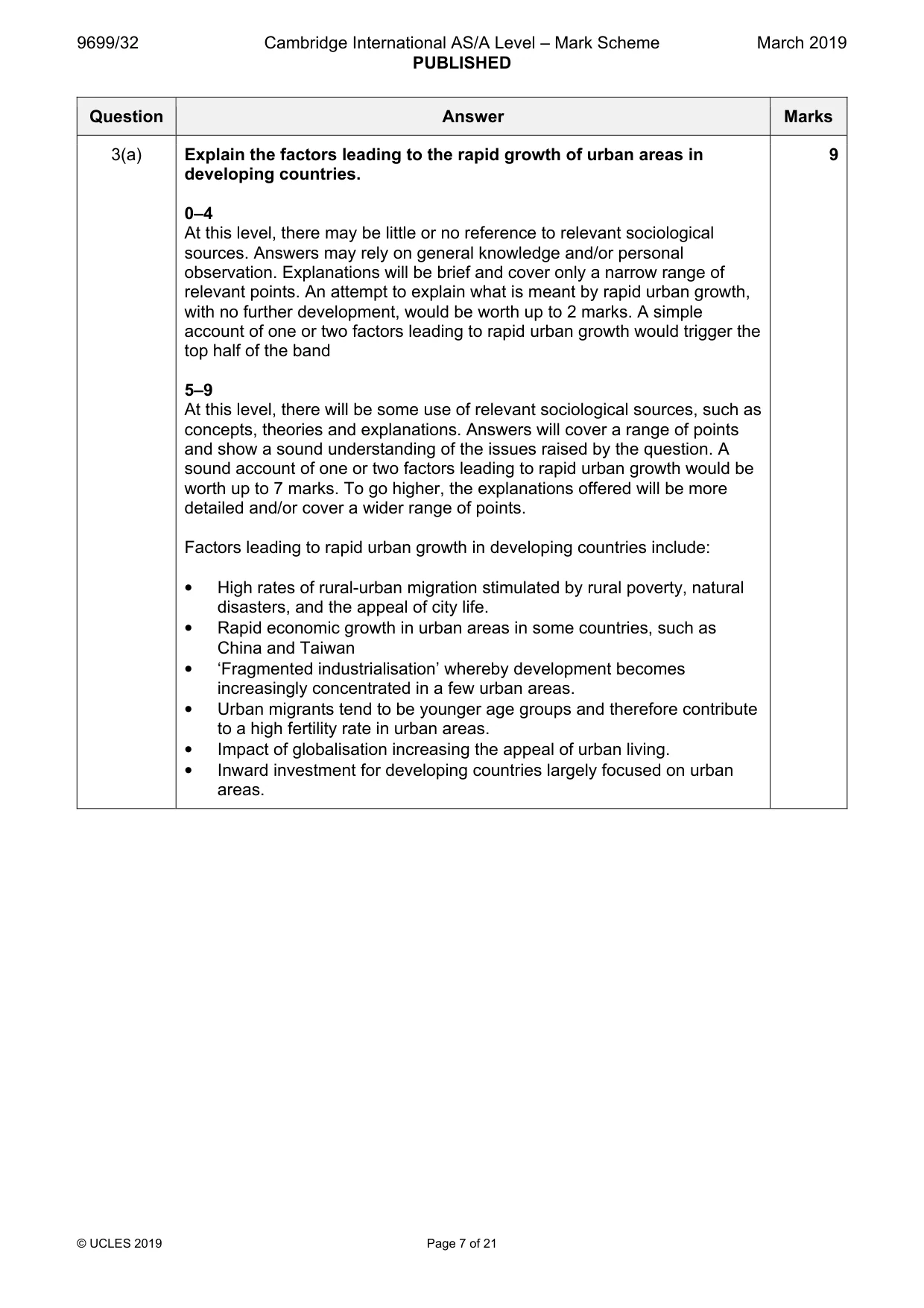
9699/32 Cambridge International AS/A Level – Mark Scheme PUBLISHED March 2019 © UCLES 2019 Page 7 of 21 Question Answer Marks 3(a) Explain the factors leading to the rapid growth of urban areas in developing countries. 0–4 At this level, there may be little or no reference to relevant sociological sources. Answers may rely on general knowledge and/or personal observation. Explanations will be brief and cover only a narrow range of relevant points. An attempt to explain what is meant by rapid urban growth, with no further development, would be worth up to 2 marks. A simple account of one or two factors leading to rapid urban growth would trigger the top half of the band 5–9 At this level, there will be some use of relevant sociological sources, such as concepts, theories and explanations. Answers will cover a range of points and show a sound understanding of the issues raised by the question. A sound account of one or two factors leading to rapid urban growth would be worth up to 7 marks. To go higher, the explanations offered will be more detailed and/or cover a wider range of points. Factors leading to rapid urban growth in developing countries include: • High rates of rural-urban migration stimulated by rural poverty, natural disasters, and the appeal of city life. • Rapid economic growth in urban areas in some countries, such as China and Taiwan • ‘Fragmented industrialisation’ whereby development becomes increasingly concentrated in a few urban areas. • Urban migrants tend to be younger age groups and therefore contribute to a high fertility rate in urban areas. • Impact of globalisation increasing the appeal of urban living. • Inward investment for developing countries largely focused on urban areas. 9
Mark scheme, page 8
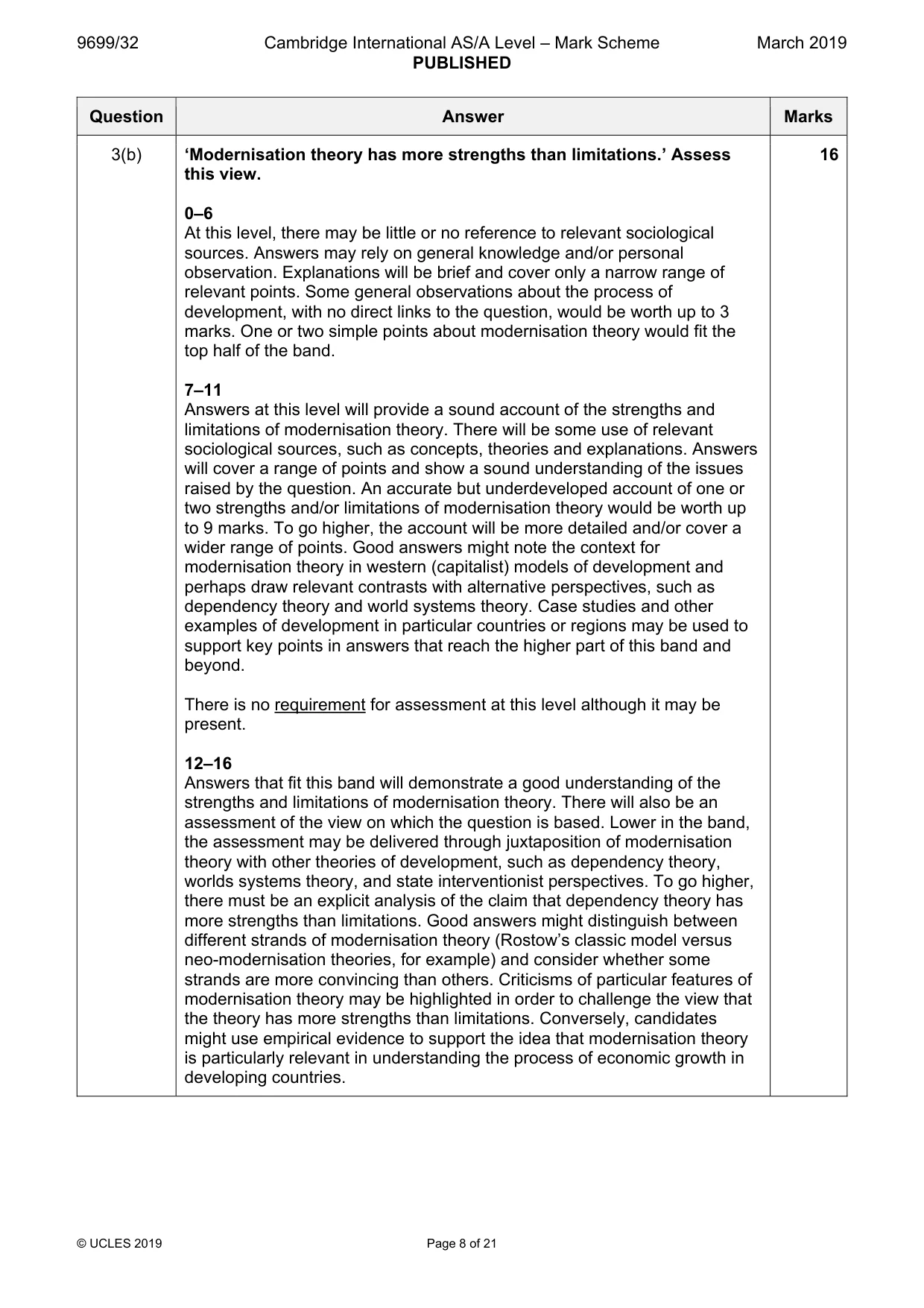
9699/32 Cambridge International AS/A Level – Mark Scheme PUBLISHED March 2019 © UCLES 2019 Page 8 of 21 Question Answer Marks 3(b) ‘Modernisation theory has more strengths than limitations.’ Assess this view. 0–6 At this level, there may be little or no reference to relevant sociological sources. Answers may rely on general knowledge and/or personal observation. Explanations will be brief and cover only a narrow range of relevant points. Some general observations about the process of development, with no direct links to the question, would be worth up to 3 marks. One or two simple points about modernisation theory would fit the top half of the band. 7–11 Answers at this level will provide a sound account of the strengths and limitations of modernisation theory. There will be some use of relevant sociological sources, such as concepts, theories and explanations. Answers will cover a range of points and show a sound understanding of the issues raised by the question. An accurate but underdeveloped account of one or two strengths and/or limitations of modernisation theory would be worth up to 9 marks. To go higher, the account will be more detailed and/or cover a wider range of points. Good answers might note the context for modernisation theory in western (capitalist) models of development and perhaps draw relevant contrasts with alternative perspectives, such as dependency theory and world systems theory. Case studies and other examples of development in particular countries or regions may be used to support key points in answers that reach the higher part of this band and beyond. There is no requirement for assessment at this level although it may be present. 12–16 Answers that fit this band will demonstrate a good understanding of the strengths and limitations of modernisation theory. There will also be an assessment of the view on which the question is based. Lower in the band, the assessment may be delivered through juxtaposition of modernisation theory with other theories of development, such as dependency theory, worlds systems theory, and state interventionist perspectives. To go higher, there must be an explicit analysis of the claim that dependency theory has more strengths than limitations. Good answers might distinguish between different strands of modernisation theory (Rostow’s classic model versus neo-modernisation theories, for example) and consider whether some strands are more convincing than others. Criticisms of particular features of modernisation theory may be highlighted in order to challenge the view that the theory has more strengths than limitations. Conversely, candidates might use empirical evidence to support the idea that modernisation theory is particularly relevant in understanding the process of economic growth in developing countries. 16
Mark scheme, page 9
9699/32 Cambridge International AS/A Level – Mark Scheme PUBLISHED March 2019 © UCLES 2019 Page 9 of 21 Question Answer Marks 3(b) Answers at this level must achieve three things: First, there will be good sociological knowledge and understanding. Second, the material used will be interpreted accurately and applied effectively to answering the question. Third, there must also be some evidence of assessment.
Mark scheme, page 10
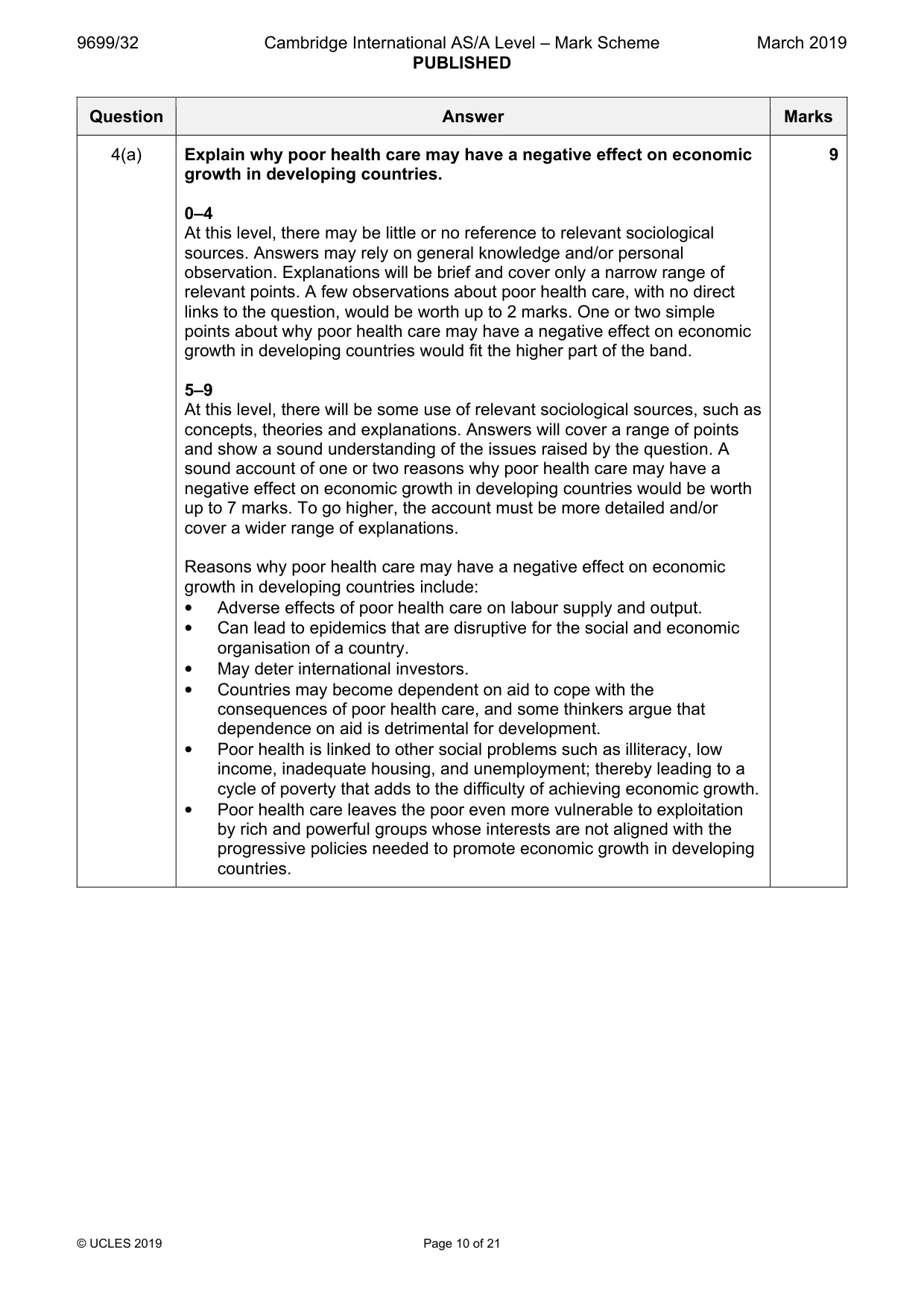
9699/32 Cambridge International AS/A Level – Mark Scheme PUBLISHED March 2019 © UCLES 2019 Page 10 of 21 Question Answer Marks 4(a) Explain why poor health care may have a negative effect on economic growth in developing countries. 0–4 At this level, there may be little or no reference to relevant sociological sources. Answers may rely on general knowledge and/or personal observation. Explanations will be brief and cover only a narrow range of relevant points. A few observations about poor health care, with no direct links to the question, would be worth up to 2 marks. One or two simple points about why poor health care may have a negative effect on economic growth in developing countries would fit the higher part of the band. 5–9 At this level, there will be some use of relevant sociological sources, such as concepts, theories and explanations. Answers will cover a range of points and show a sound understanding of the issues raised by the question. A sound account of one or two reasons why poor health care may have a negative effect on economic growth in developing countries would be worth up to 7 marks. To go higher, the account must be more detailed and/or cover a wider range of explanations. Reasons why poor health care may have a negative effect on economic growth in developing countries include: • Adverse effects of poor health care on labour supply and output. • Can lead to epidemics that are disruptive for the social and economic organisation of a country. • May deter international investors. • Countries may become dependent on aid to cope with the consequences of poor health care, and some thinkers argue that dependence on aid is detrimental for development. • Poor health is linked to other social problems such as illiteracy, low income, inadequate housing, and unemployment; thereby leading to a cycle of poverty that adds to the difficulty of achieving economic growth. • Poor health care leaves the poor even more vulnerable to exploitation by rich and powerful groups whose interests are not aligned with the progressive policies needed to promote economic growth in developing countries. 9
Mark scheme, page 11
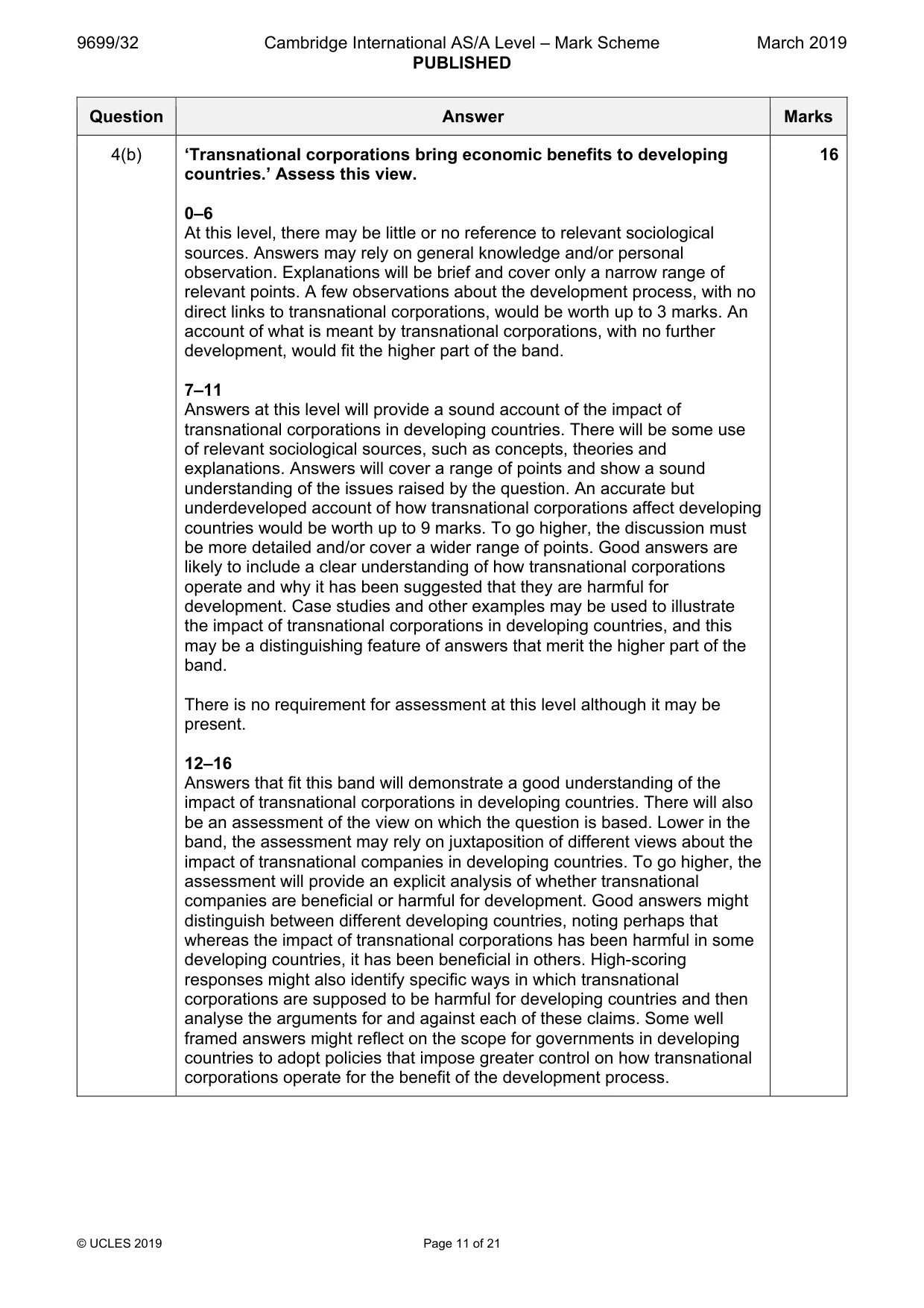
9699/32 Cambridge International AS/A Level – Mark Scheme PUBLISHED March 2019 © UCLES 2019 Page 11 of 21 Question Answer Marks 4(b) ‘Transnational corporations bring economic benefits to developing countries.’ Assess this view. 0–6 At this level, there may be little or no reference to relevant sociological sources. Answers may rely on general knowledge and/or personal observation. Explanations will be brief and cover only a narrow range of relevant points. A few observations about the development process, with no direct links to transnational corporations, would be worth up to 3 marks. An account of what is meant by transnational corporations, with no further development, would fit the higher part of the band. 7–11 Answers at this level will provide a sound account of the impact of transnational corporations in developing countries. There will be some use of relevant sociological sources, such as concepts, theories and explanations. Answers will cover a range of points and show a sound understanding of the issues raised by the question. An accurate but underdeveloped account of how transnational corporations affect developing countries would be worth up to 9 marks. To go higher, the discussion must be more detailed and/or cover a wider range of points. Good answers are likely to include a clear understanding of how transnational corporations operate and why it has been suggested that they are harmful for development. Case studies and other examples may be used to illustrate the impact of transnational corporations in developing countries, and this may be a distinguishing feature of answers that merit the higher part of the band. There is no requirement for assessment at this level although it may be present. 12–16 Answers that fit this band will demonstrate a good understanding of the impact of transnational corporations in developing countries. There will also be an assessment of the view on which the question is based. Lower in the band, the assessment may rely on juxtaposition of different views about the impact of transnational companies in developing countries. To go higher, the assessment will provide an explicit analysis of whether transnational companies are beneficial or harmful for development. Good answers might distinguish between different developing countries, noting perhaps that whereas the impact of transnational corporations has been harmful in some developing countries, it has been beneficial in others. High-scoring responses might also identify specific ways in which transnational corporations are supposed to be harmful for developing countries and then analyse the arguments for and against each of these claims. Some well framed answers might reflect on the scope for governments in developing countries to adopt policies that impose greater control on how transnational corporations operate for the benefit of the development process. 16
Mark scheme, page 12
9699/32 Cambridge International AS/A Level – Mark Scheme PUBLISHED March 2019 © UCLES 2019 Page 12 of 21 Question Answer Marks 4(b) Answers at this level must achieve three things: First, there will be good sociological knowledge and understanding. Second, the material used will be interpreted accurately and applied effectively to answering the question. Third, there must also be some evidence of assessment.
Mark scheme, page 13
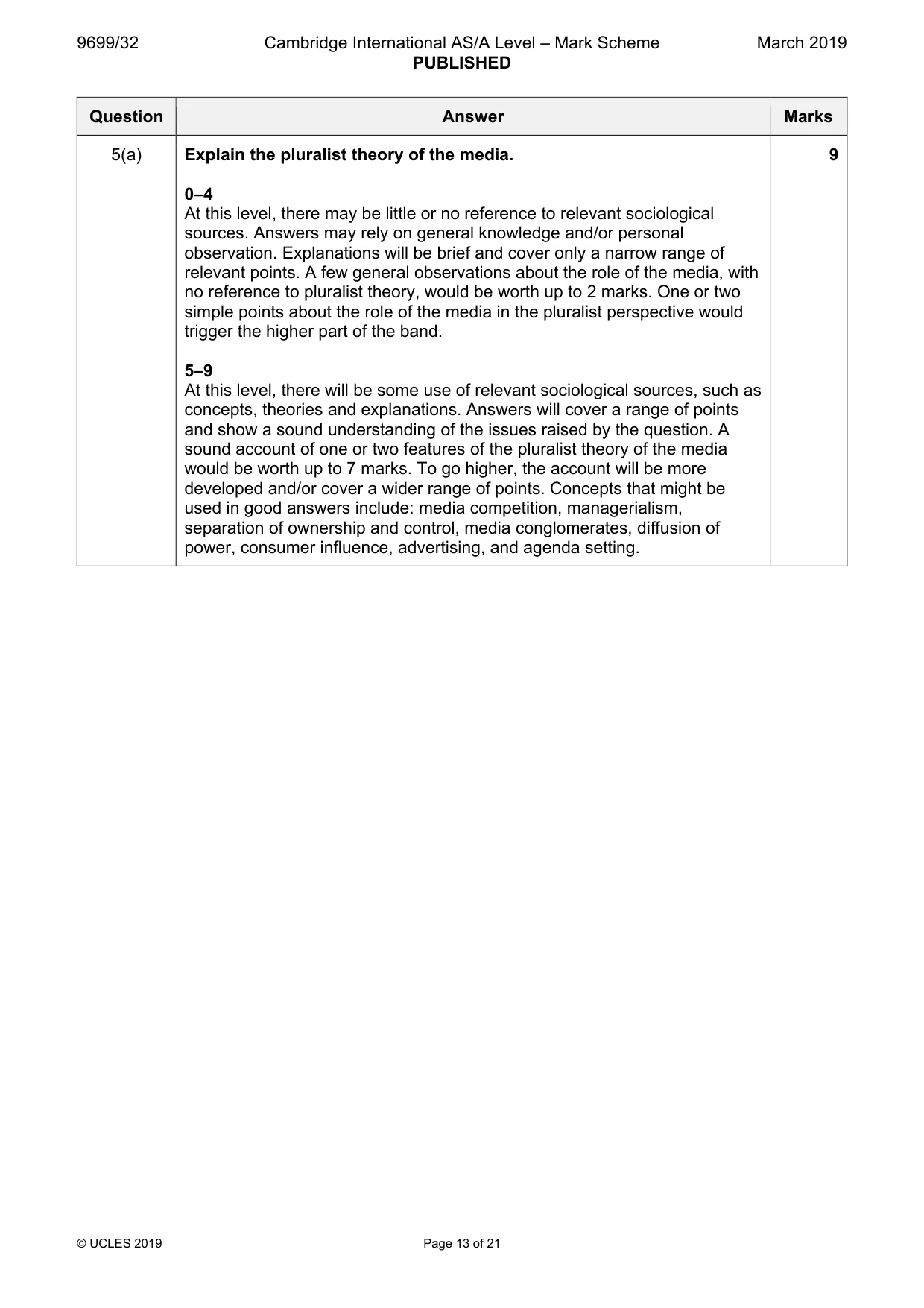
9699/32 Cambridge International AS/A Level – Mark Scheme PUBLISHED March 2019 © UCLES 2019 Page 13 of 21 Question Answer Marks 5(a) Explain the pluralist theory of the media. 0–4 At this level, there may be little or no reference to relevant sociological sources. Answers may rely on general knowledge and/or personal observation. Explanations will be brief and cover only a narrow range of relevant points. A few general observations about the role of the media, with no reference to pluralist theory, would be worth up to 2 marks. One or two simple points about the role of the media in the pluralist perspective would trigger the higher part of the band. 5–9 At this level, there will be some use of relevant sociological sources, such as concepts, theories and explanations. Answers will cover a range of points and show a sound understanding of the issues raised by the question. A sound account of one or two features of the pluralist theory of the media would be worth up to 7 marks. To go higher, the account will be more developed and/or cover a wider range of points. Concepts that might be used in good answers include: media competition, managerialism, separation of ownership and control, media conglomerates, diffusion of power, consumer influence, advertising, and agenda setting. 9
Mark scheme, page 14
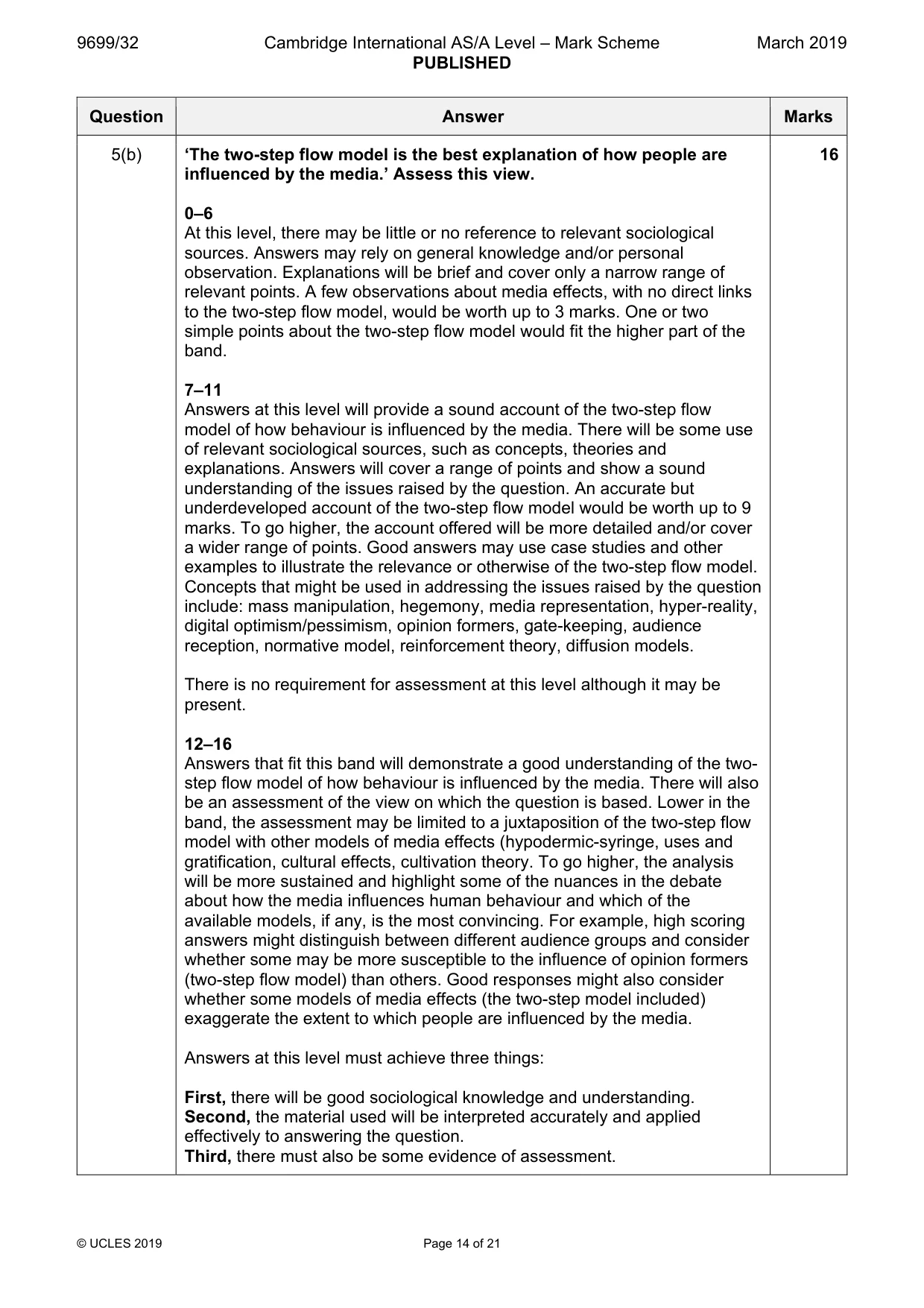
9699/32 Cambridge International AS/A Level – Mark Scheme PUBLISHED March 2019 © UCLES 2019 Page 14 of 21 Question Answer Marks 5(b) ‘The two-step flow model is the best explanation of how people are influenced by the media.’ Assess this view. 0–6 At this level, there may be little or no reference to relevant sociological sources. Answers may rely on general knowledge and/or personal observation. Explanations will be brief and cover only a narrow range of relevant points. A few observations about media effects, with no direct links to the two-step flow model, would be worth up to 3 marks. One or two simple points about the two-step flow model would fit the higher part of the band. 7–11 Answers at this level will provide a sound account of the two-step flow model of how behaviour is influenced by the media. There will be some use of relevant sociological sources, such as concepts, theories and explanations. Answers will cover a range of points and show a sound understanding of the issues raised by the question. An accurate but underdeveloped account of the two-step flow model would be worth up to 9 marks. To go higher, the account offered will be more detailed and/or cover a wider range of points. Good answers may use case studies and other examples to illustrate the relevance or otherwise of the two-step flow model. Concepts that might be used in addressing the issues raised by the question include: mass manipulation, hegemony, media representation, hyper-reality, digital optimism/pessimism, opinion formers, gate-keeping, audience reception, normative model, reinforcement theory, diffusion models. There is no requirement for assessment at this level although it may be present. 12–16 Answers that fit this band will demonstrate a good understanding of the two- step flow model of how behaviour is influenced by the media. There will also be an assessment of the view on which the question is based. Lower in the band, the assessment may be limited to a juxtaposition of the two-step flow model with other models of media effects (hypodermic-syringe, uses and gratification, cultural effects, cultivation theory. To go higher, the analysis will be more sustained and highlight some of the nuances in the debate about how the media influences human behaviour and which of the available models, if any, is the most convincing. For example, high scoring answers might distinguish between different audience groups and consider whether some may be more susceptible to the influence of opinion formers (two-step flow model) than others. Good responses might also consider whether some models of media effects (the two-step model included) exaggerate the extent to which people are influenced by the media. Answers at this level must achieve three things: First, there will be good sociological knowledge and understanding. Second, the material used will be interpreted accurately and applied effectively to answering the question. Third, there must also be some evidence of assessment. 16
Mark scheme, page 15
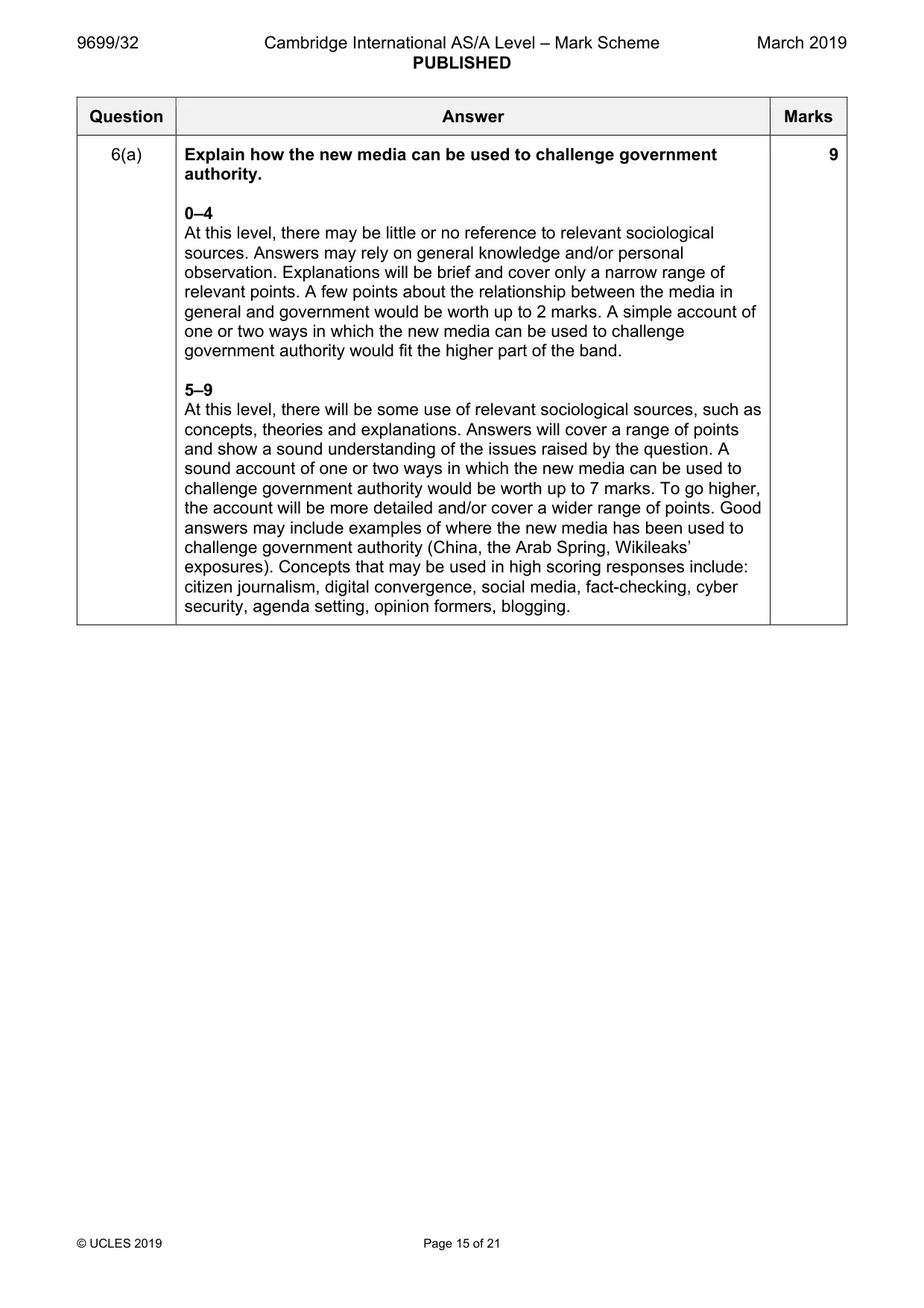
9699/32 Cambridge International AS/A Level – Mark Scheme PUBLISHED March 2019 © UCLES 2019 Page 15 of 21 Question Answer Marks 6(a) Explain how the new media can be used to challenge government authority. 0–4 At this level, there may be little or no reference to relevant sociological sources. Answers may rely on general knowledge and/or personal observation. Explanations will be brief and cover only a narrow range of relevant points. A few points about the relationship between the media in general and government would be worth up to 2 marks. A simple account of one or two ways in which the new media can be used to challenge government authority would fit the higher part of the band. 5–9 At this level, there will be some use of relevant sociological sources, such as concepts, theories and explanations. Answers will cover a range of points and show a sound understanding of the issues raised by the question. A sound account of one or two ways in which the new media can be used to challenge government authority would be worth up to 7 marks. To go higher, the account will be more detailed and/or cover a wider range of points. Good answers may include examples of where the new media has been used to challenge government authority (China, the Arab Spring, Wikileaks’ exposures). Concepts that may be used in high scoring responses include: citizen journalism, digital convergence, social media, fact-checking, cyber security, agenda setting, opinion formers, blogging. 9
Mark scheme, page 16
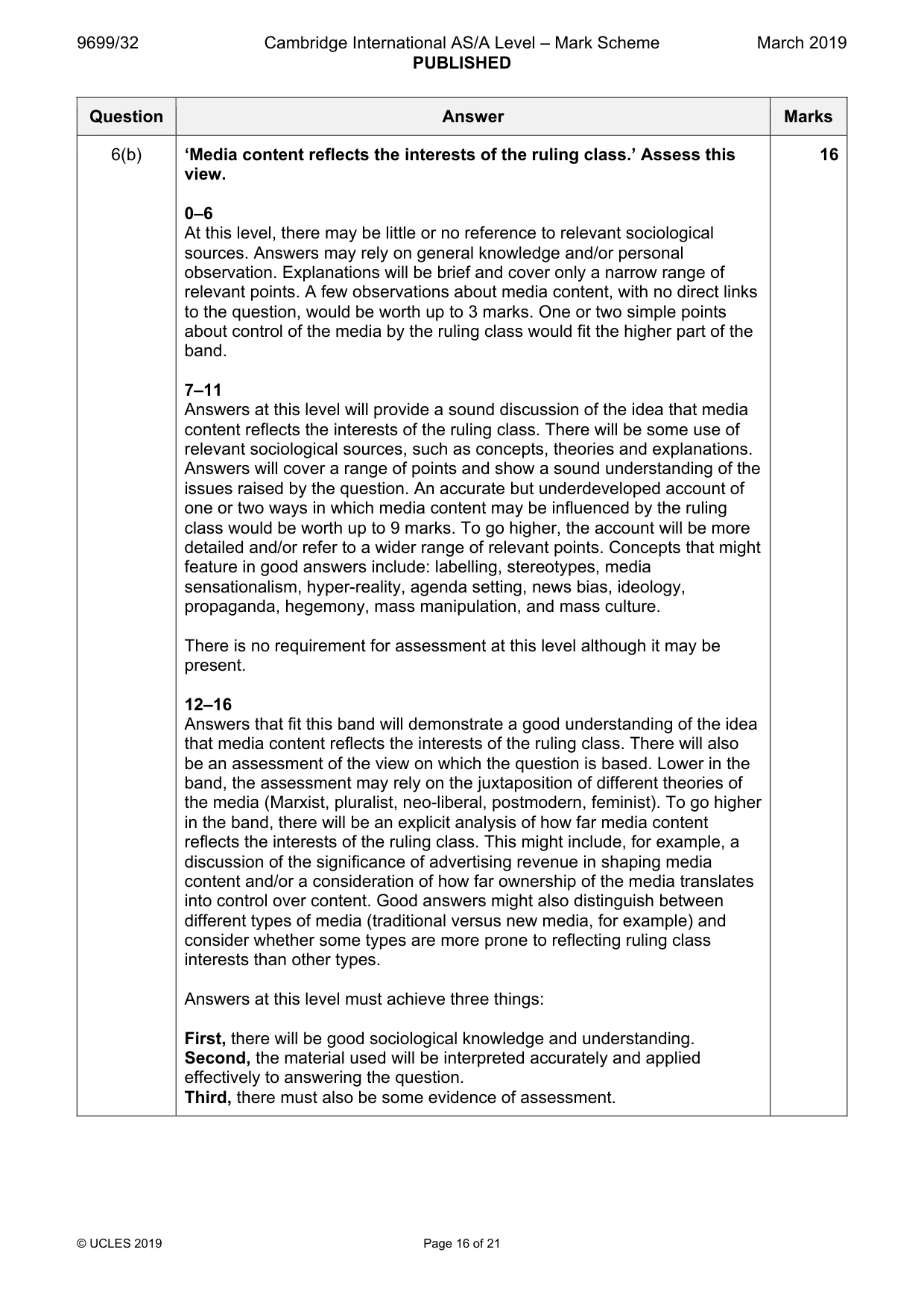
9699/32 Cambridge International AS/A Level – Mark Scheme PUBLISHED March 2019 © UCLES 2019 Page 16 of 21 Question Answer Marks 6(b) ‘Media content reflects the interests of the ruling class.’ Assess this view. 0–6 At this level, there may be little or no reference to relevant sociological sources. Answers may rely on general knowledge and/or personal observation. Explanations will be brief and cover only a narrow range of relevant points. A few observations about media content, with no direct links to the question, would be worth up to 3 marks. One or two simple points about control of the media by the ruling class would fit the higher part of the band. 7–11 Answers at this level will provide a sound discussion of the idea that media content reflects the interests of the ruling class. There will be some use of relevant sociological sources, such as concepts, theories and explanations. Answers will cover a range of points and show a sound understanding of the issues raised by the question. An accurate but underdeveloped account of one or two ways in which media content may be influenced by the ruling class would be worth up to 9 marks. To go higher, the account will be more detailed and/or refer to a wider range of relevant points. Concepts that might feature in good answers include: labelling, stereotypes, media sensationalism, hyper-reality, agenda setting, news bias, ideology, propaganda, hegemony, mass manipulation, and mass culture. There is no requirement for assessment at this level although it may be present. 12–16 Answers that fit this band will demonstrate a good understanding of the idea that media content reflects the interests of the ruling class. There will also be an assessment of the view on which the question is based. Lower in the band, the assessment may rely on the juxtaposition of different theories of the media (Marxist, pluralist, neo-liberal, postmodern, feminist). To go higher in the band, there will be an explicit analysis of how far media content reflects the interests of the ruling class. This might include, for example, a discussion of the significance of advertising revenue in shaping media content and/or a consideration of how far ownership of the media translates into control over content. Good answers might also distinguish between different types of media (traditional versus new media, for example) and consider whether some types are more prone to reflecting ruling class interests than other types. Answers at this level must achieve three things: First, there will be good sociological knowledge and understanding. Second, the material used will be interpreted accurately and applied effectively to answering the question. Third, there must also be some evidence of assessment. 16
Mark scheme, page 17
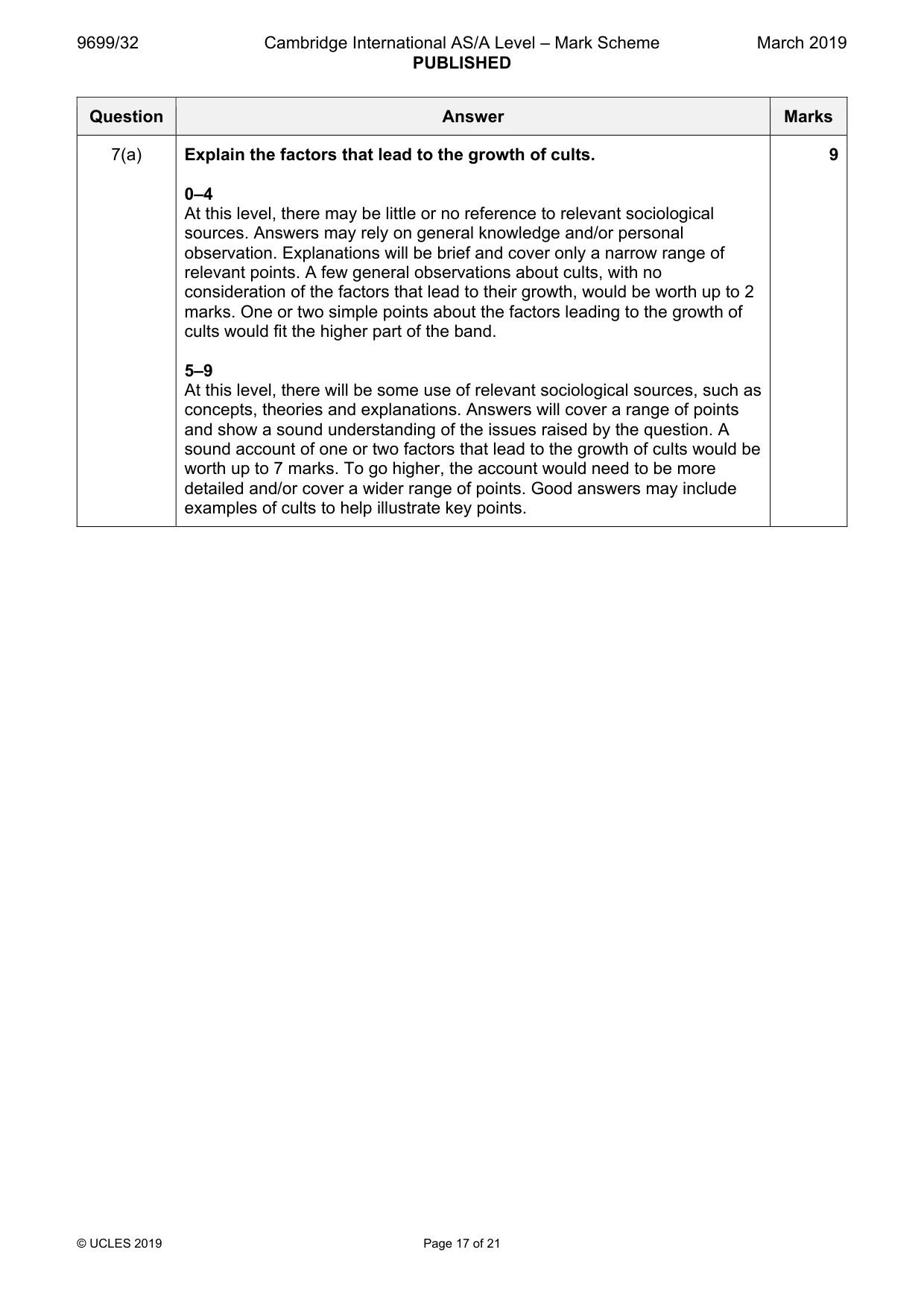
9699/32 Cambridge International AS/A Level – Mark Scheme PUBLISHED March 2019 © UCLES 2019 Page 17 of 21 Question Answer Marks 7(a) Explain the factors that lead to the growth of cults. 0–4 At this level, there may be little or no reference to relevant sociological sources. Answers may rely on general knowledge and/or personal observation. Explanations will be brief and cover only a narrow range of relevant points. A few general observations about cults, with no consideration of the factors that lead to their growth, would be worth up to 2 marks. One or two simple points about the factors leading to the growth of cults would fit the higher part of the band. 5–9 At this level, there will be some use of relevant sociological sources, such as concepts, theories and explanations. Answers will cover a range of points and show a sound understanding of the issues raised by the question. A sound account of one or two factors that lead to the growth of cults would be worth up to 7 marks. To go higher, the account would need to be more detailed and/or cover a wider range of points. Good answers may include examples of cults to help illustrate key points. 9
Mark scheme, page 18
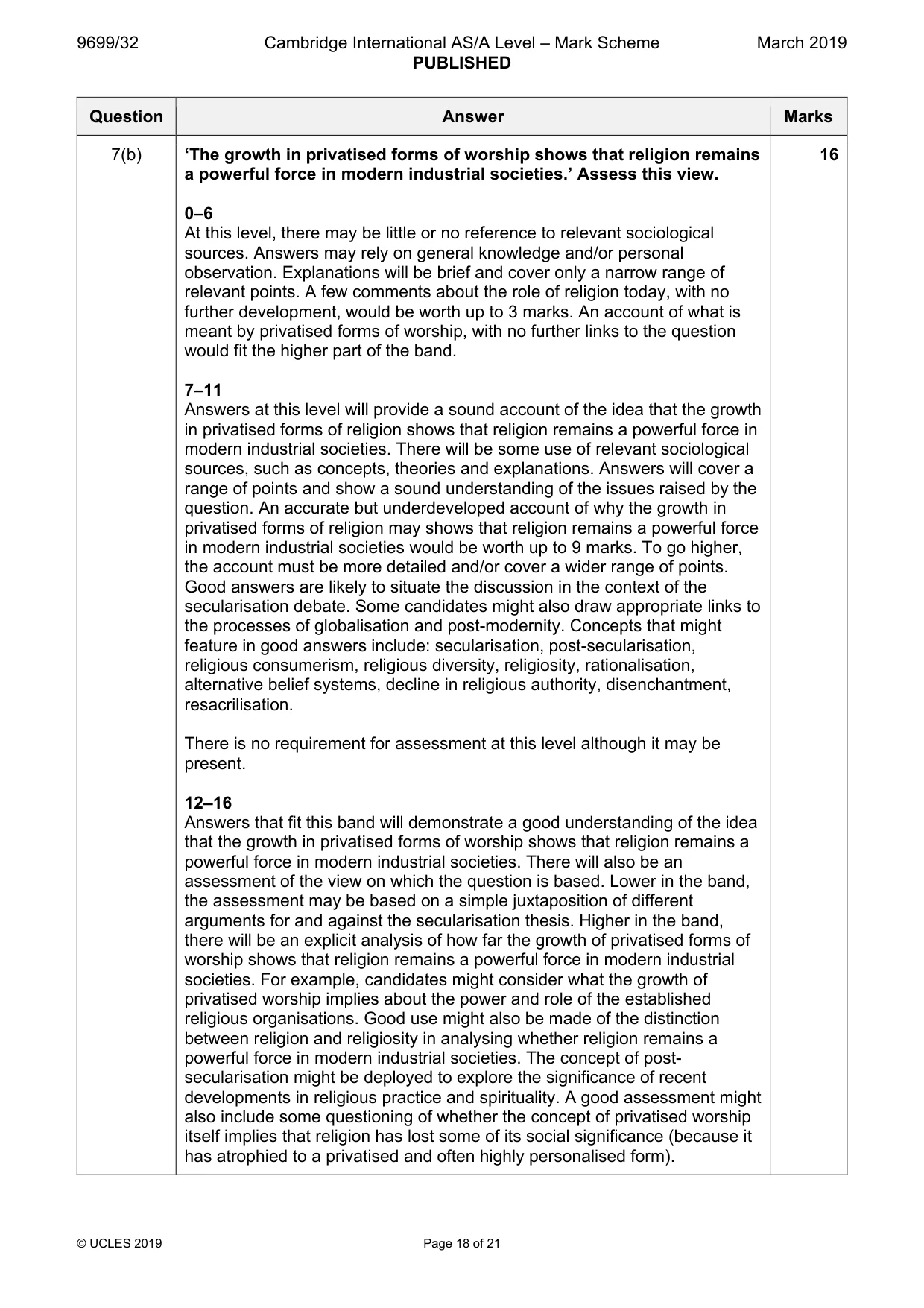
9699/32 Cambridge International AS/A Level – Mark Scheme PUBLISHED March 2019 © UCLES 2019 Page 18 of 21 Question Answer Marks 7(b) ‘The growth in privatised forms of worship shows that religion remains a powerful force in modern industrial societies.’ Assess this view. 0–6 At this level, there may be little or no reference to relevant sociological sources. Answers may rely on general knowledge and/or personal observation. Explanations will be brief and cover only a narrow range of relevant points. A few comments about the role of religion today, with no further development, would be worth up to 3 marks. An account of what is meant by privatised forms of worship, with no further links to the question would fit the higher part of the band. 7–11 Answers at this level will provide a sound account of the idea that the growth in privatised forms of religion shows that religion remains a powerful force in modern industrial societies. There will be some use of relevant sociological sources, such as concepts, theories and explanations. Answers will cover a range of points and show a sound understanding of the issues raised by the question. An accurate but underdeveloped account of why the growth in privatised forms of religion may shows that religion remains a powerful force in modern industrial societies would be worth up to 9 marks. To go higher, the account must be more detailed and/or cover a wider range of points. Good answers are likely to situate the discussion in the context of the secularisation debate. Some candidates might also draw appropriate links to the processes of globalisation and post-modernity. Concepts that might feature in good answers include: secularisation, post-secularisation, religious consumerism, religious diversity, religiosity, rationalisation, alternative belief systems, decline in religious authority, disenchantment, resacrilisation. There is no requirement for assessment at this level although it may be present. 12–16 Answers that fit this band will demonstrate a good understanding of the idea that the growth in privatised forms of worship shows that religion remains a powerful force in modern industrial societies. There will also be an assessment of the view on which the question is based. Lower in the band, the assessment may be based on a simple juxtaposition of different arguments for and against the secularisation thesis. Higher in the band, there will be an explicit analysis of how far the growth of privatised forms of worship shows that religion remains a powerful force in modern industrial societies. For example, candidates might consider what the growth of privatised worship implies about the power and role of the established religious organisations. Good use might also be made of the distinction between religion and religiosity in analysing whether religion remains a powerful force in modern industrial societies. The concept of post- secularisation might be deployed to explore the significance of recent developments in religious practice and spirituality. A good assessment might also include some questioning of whether the concept of privatised worship itself implies that religion has lost some of its social significance (because it has atrophied to a privatised and often highly personalised form). 16
Mark scheme, page 19
9699/32 Cambridge International AS/A Level – Mark Scheme PUBLISHED March 2019 © UCLES 2019 Page 19 of 21 Question Answer Marks 7(b) Answers at this level must achieve three things: First, there will be good sociological knowledge and understanding. Second, the material used will be interpreted accurately and applied effectively to answering the question. Third, there must also be some evidence of assessment.
Mark scheme, page 20
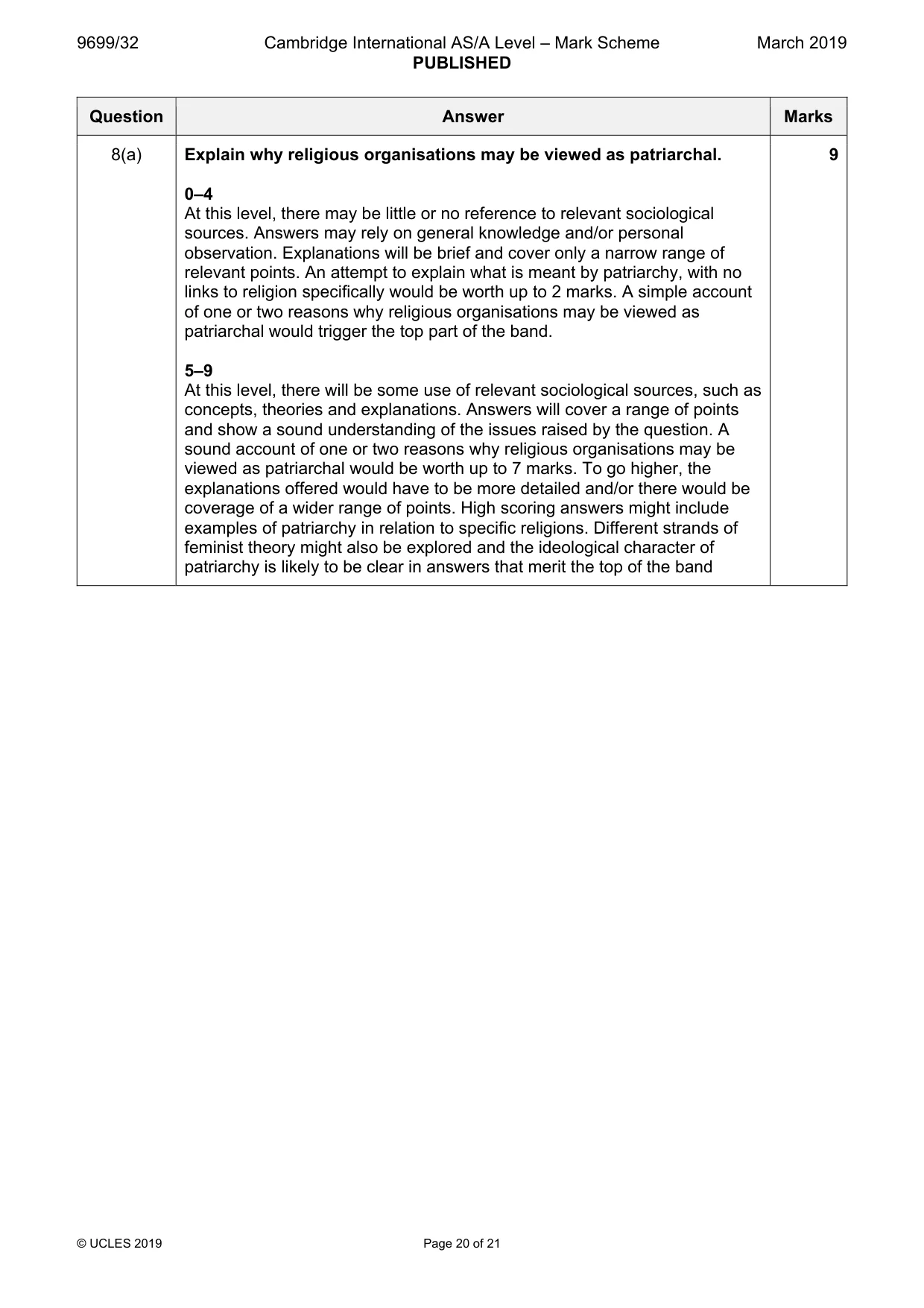
9699/32 Cambridge International AS/A Level – Mark Scheme PUBLISHED March 2019 © UCLES 2019 Page 20 of 21 Question Answer Marks 8(a) Explain why religious organisations may be viewed as patriarchal. 0–4 At this level, there may be little or no reference to relevant sociological sources. Answers may rely on general knowledge and/or personal observation. Explanations will be brief and cover only a narrow range of relevant points. An attempt to explain what is meant by patriarchy, with no links to religion specifically would be worth up to 2 marks. A simple account of one or two reasons why religious organisations may be viewed as patriarchal would trigger the top part of the band. 5–9 At this level, there will be some use of relevant sociological sources, such as concepts, theories and explanations. Answers will cover a range of points and show a sound understanding of the issues raised by the question. A sound account of one or two reasons why religious organisations may be viewed as patriarchal would be worth up to 7 marks. To go higher, the explanations offered would have to be more detailed and/or there would be coverage of a wider range of points. High scoring answers might include examples of patriarchy in relation to specific religions. Different strands of feminist theory might also be explored and the ideological character of patriarchy is likely to be clear in answers that merit the top of the band 9
Mark scheme, page 21
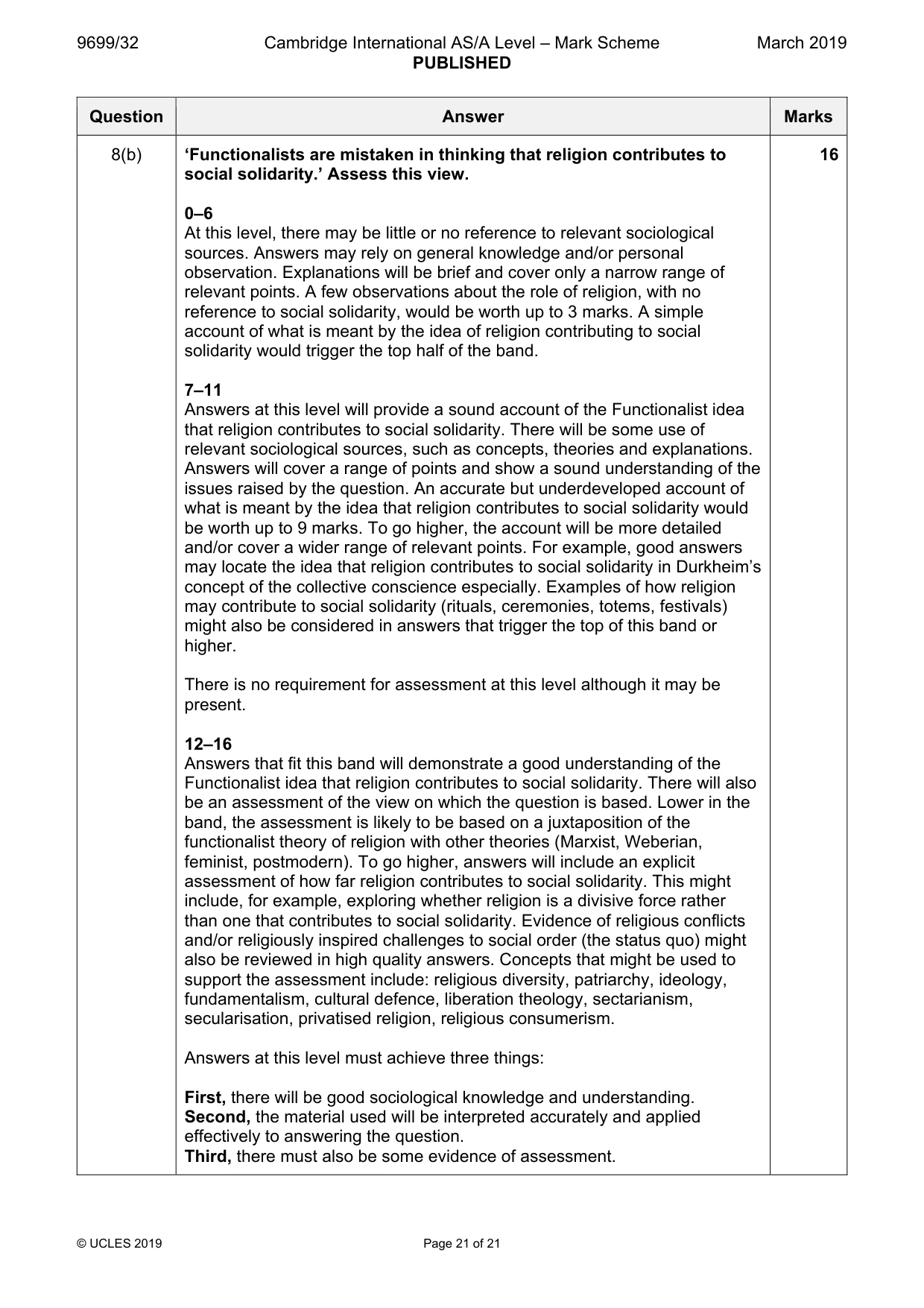
9699/32 Cambridge International AS/A Level – Mark Scheme PUBLISHED March 2019 © UCLES 2019 Page 21 of 21 Question Answer Marks 8(b) ‘Functionalists are mistaken in thinking that religion contributes to social solidarity.’ Assess this view. 0–6 At this level, there may be little or no reference to relevant sociological sources. Answers may rely on general knowledge and/or personal observation. Explanations will be brief and cover only a narrow range of relevant points. A few observations about the role of religion, with no reference to social solidarity, would be worth up to 3 marks. A simple account of what is meant by the idea of religion contributing to social solidarity would trigger the top half of the band. 7–11 Answers at this level will provide a sound account of the Functionalist idea that religion contributes to social solidarity. There will be some use of relevant sociological sources, such as concepts, theories and explanations. Answers will cover a range of points and show a sound understanding of the issues raised by the question. An accurate but underdeveloped account of what is meant by the idea that religion contributes to social solidarity would be worth up to 9 marks. To go higher, the account will be more detailed and/or cover a wider range of relevant points. For example, good answers may locate the idea that religion contributes to social solidarity in Durkheim’s concept of the collective conscience especially. Examples of how religion may contribute to social solidarity (rituals, ceremonies, totems, festivals) might also be considered in answers that trigger the top of this band or higher. There is no requirement for assessment at this level although it may be present. 12–16 Answers that fit this band will demonstrate a good understanding of the Functionalist idea that religion contributes to social solidarity. There will also be an assessment of the view on which the question is based. Lower in the band, the assessment is likely to be based on a juxtaposition of the functionalist theory of religion with other theories (Marxist, Weberian, feminist, postmodern). To go higher, answers will include an explicit assessment of how far religion contributes to social solidarity. This might include, for example, exploring whether religion is a divisive force rather than one that contributes to social solidarity. Evidence of religious conflicts and/or religiously inspired challenges to social order (the status quo) might also be reviewed in high quality answers. Concepts that might be used to support the assessment include: religious diversity, patriarchy, ideology, fundamentalism, cultural defence, liberation theology, sectarianism, secularisation, privatised religion, religious consumerism. Answers at this level must achieve three things: First, there will be good sociological knowledge and understanding. Second, the material used will be interpreted accurately and applied effectively to answering the question. Third, there must also be some evidence of assessment. 16
What you needed in this session
Cambridge’s own grade thresholds for 2019 Feb/March, Paper 3 · Variant 2. A higher threshold means an easier paper — the bar moves with how the cohort did.