Cambridge A Level Sociology 9699 — 2018 May/June Paper 2 · Variant 2
9699/22/M/J/18 · 50 marks · ≈56 min
The question paper and its mark scheme, free to read here and free to download. This is Cambridge’s own paper, exactly as it was sat.
Question paper4 pages


Mark scheme13 pages
Answers below. Sit the paper first if you are practising.
Paper as text
Question paper, page 1
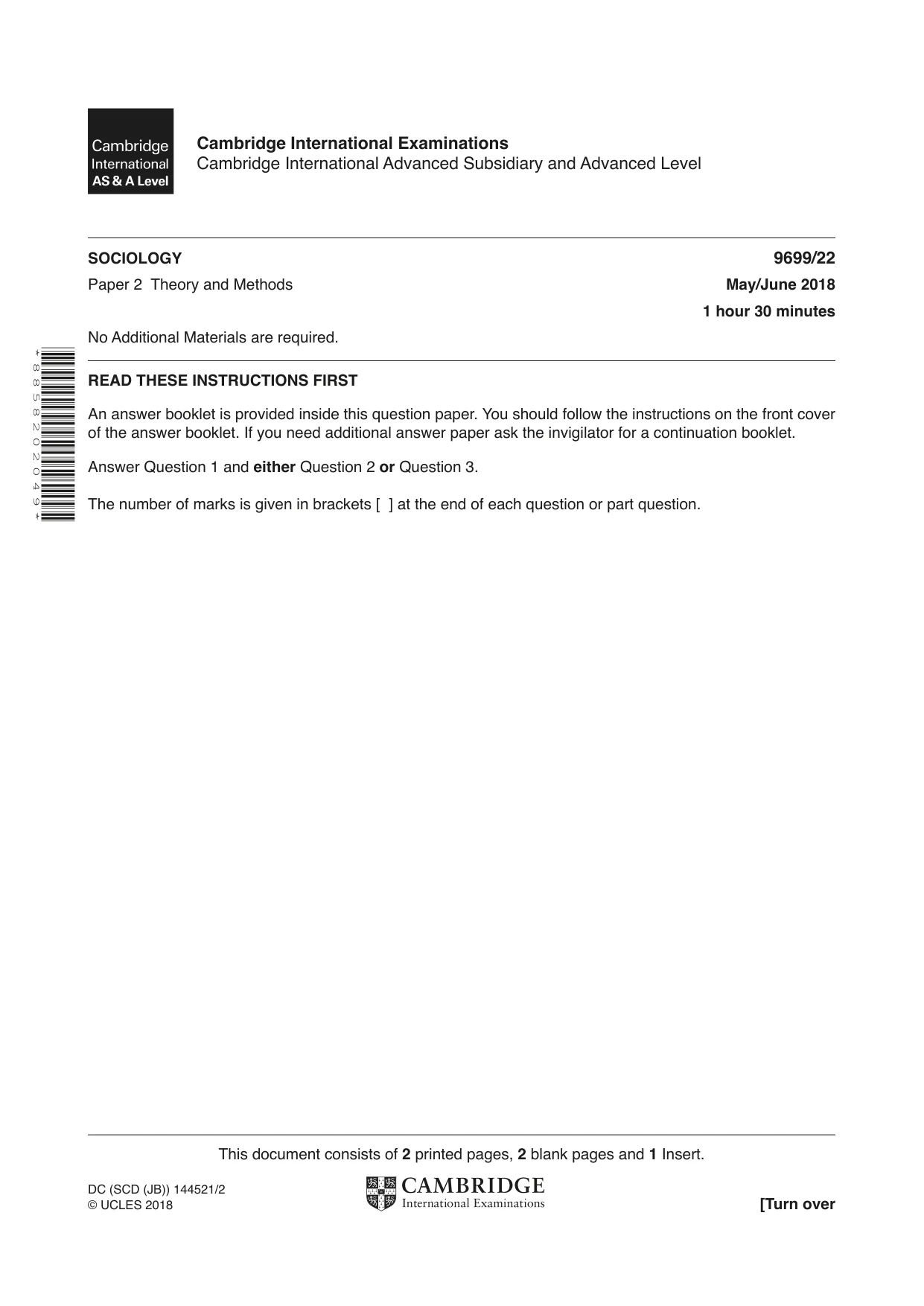
* 8 8 5 8 2 0 2 0 4 9 * This document consists of 2 printed pages, 2 blank pages and 1 Insert. DC (SCD (JB)) 144521/2 © UCLES 2018 [Turn over Cambridge International Examinations Cambridge International Advanced Subsidiary and Advanced Level SOCIOLOGY 9699/22 Paper 2 Theory and Methods May/June 2018 1 hour 30 minutes No Additional Materials are required. READ THESE INSTRUCTIONS FIRST An answer booklet is provided inside this question paper. You should follow the instructions on the front cover of the answer booklet. If you need additional answer paper ask the invigilator for a continuation booklet. Answer Question 1 and either Question 2 or Question 3. The number of marks is given in brackets [ ] at the end of each question or part question.
Question paper, page 2
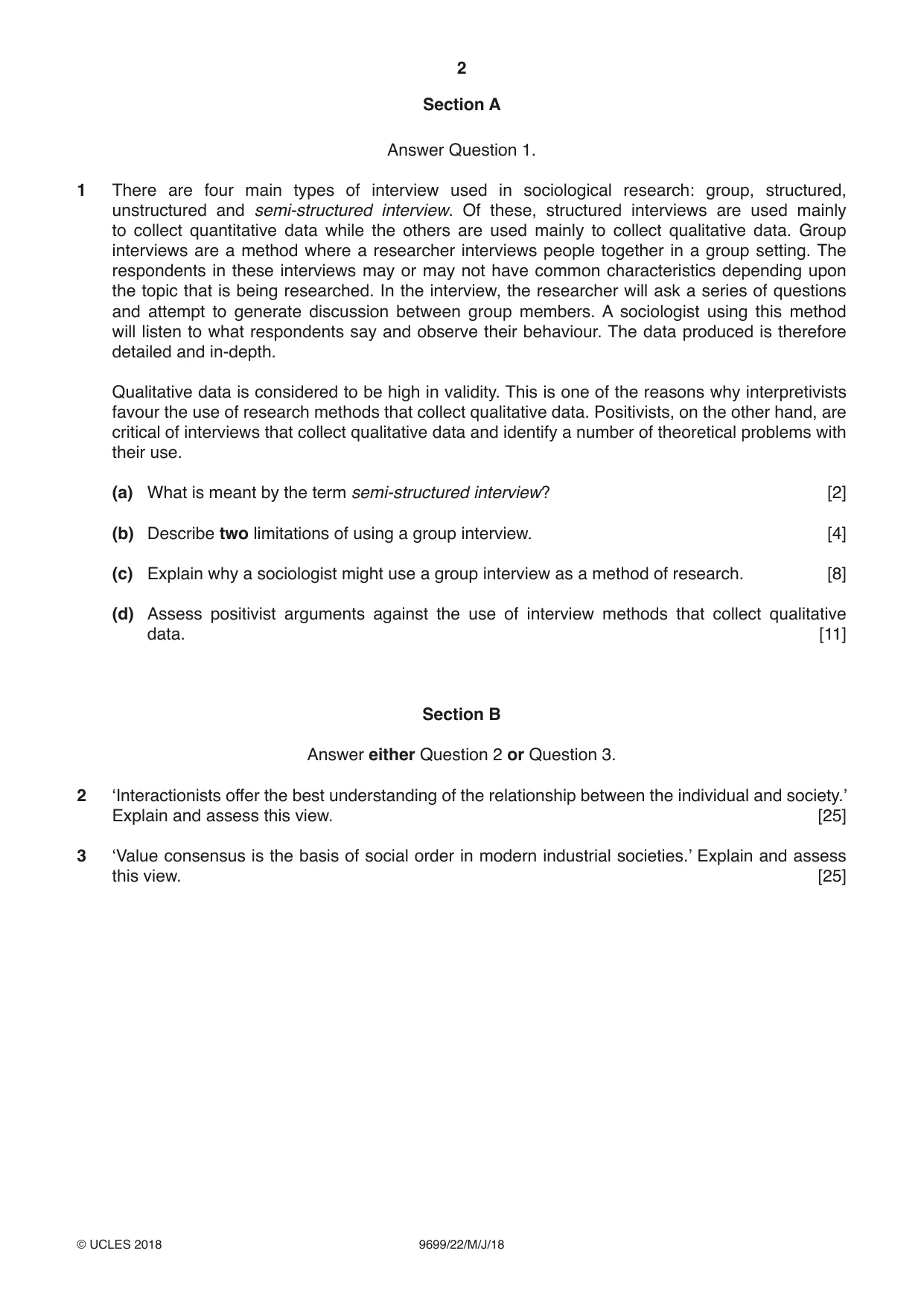
2 9699/22/M/J/18 © UCLES 2018 Section A Answer Question 1. 1 There are four main types of interview used in sociological research: group, structured, unstructured and semi-structured interview. Of these, structured interviews are used mainly to collect quantitative data while the others are used mainly to collect qualitative data. Group interviews are a method where a researcher interviews people together in a group setting. The respondents in these interviews may or may not have common characteristics depending upon the topic that is being researched. In the interview, the researcher will ask a series of questions and attempt to generate discussion between group members. A sociologist using this method will listen to what respondents say and observe their behaviour. The data produced is therefore detailed and in-depth. Qualitative data is considered to be high in validity. This is one of the reasons why interpretivists favour the use of research methods that collect qualitative data. Positivists, on the other hand, are critical of interviews that collect qualitative data and identify a number of theoretical problems with their use. (a) What is meant by the term semi-structured interview? [2] (b) Describe two limitations of using a group interview. [4] (c) Explain why a sociologist might use a group interview as a method of research. [8] (d) Assess positivist arguments against the use of interview methods that collect qualitative data. [11] Section B Answer either Question 2 or Question 3. 2 ‘Interactionists offer the best understanding of the relationship between the individual and society.’ Explain and assess this view. [25] 3 ‘Value consensus is the basis of social order in modern industrial societies.’ Explain and assess this view. [25]
Question paper, page 3
3 9699/22/M/J/18 © UCLES 2018 BLANK PAGE
Question paper, page 4
4 9699/22/M/J/18 © UCLES 2018 BLANK PAGE Permission to reproduce items where third-party owned material protected by copyright is included has been sought and cleared where possible. Every reasonable effort has been made by the publisher (UCLES) to trace copyright holders, but if any items requiring clearance have unwittingly been included, the publisher will be pleased to make amends at the earliest possible opportunity. To avoid the issue of disclosure of answer-related information to candidates, all copyright acknowledgements are reproduced online in the Cambridge International Examinations Copyright Acknowledgements Booklet. This is produced for each series of examinations and is freely available to download at www.cie.org.uk after the live examination series. Cambridge International Examinations is part of the Cambridge Assessment Group. Cambridge Assessment is the brand name of University of Cambridge Local Examinations Syndicate (UCLES), which is itself a department of the University of Cambridge.
Mark scheme, page 1
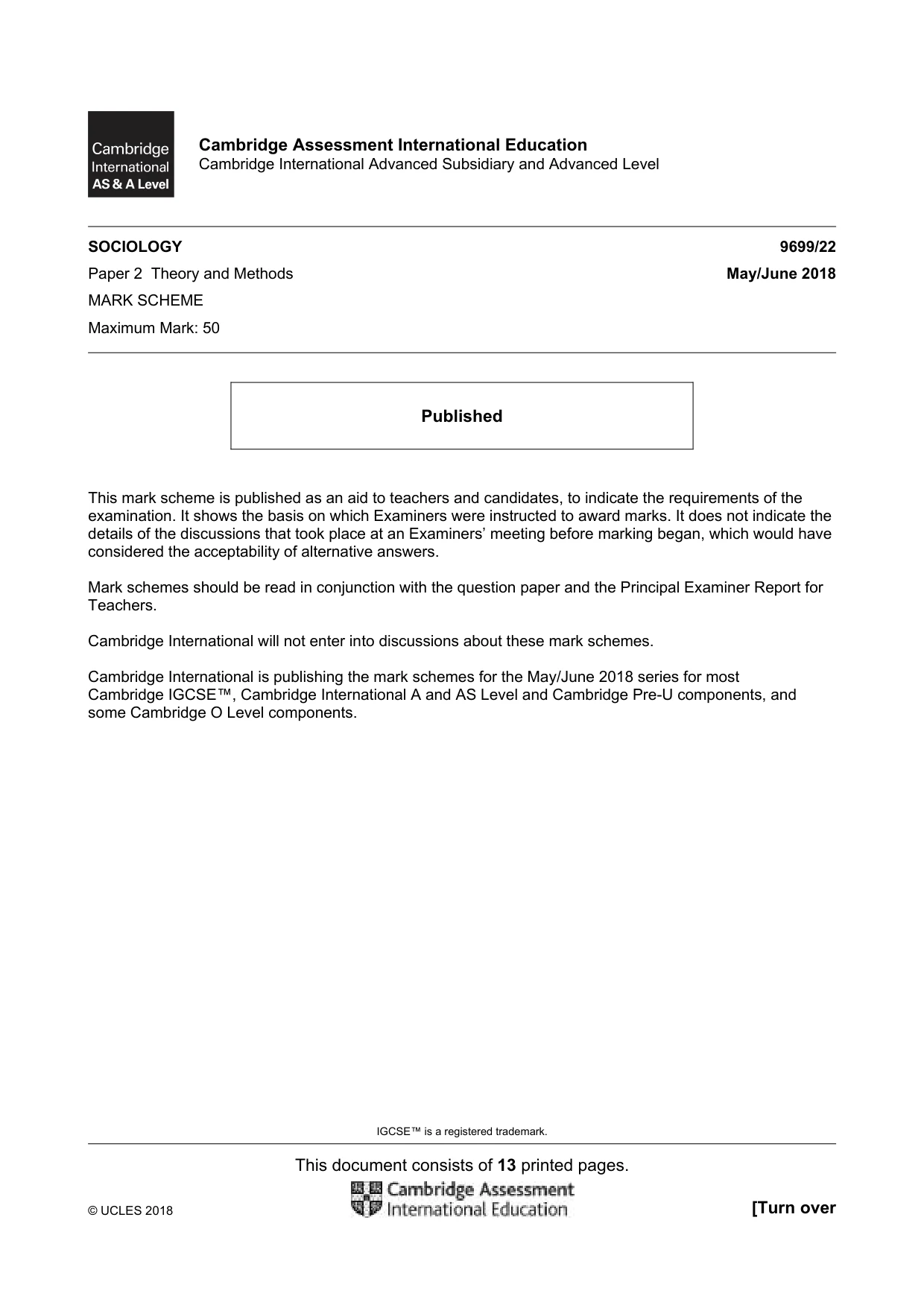
IGCSE™ is a registered trademark. This document consists of 13 printed pages. © UCLES 2018 [Turn over Cambridge Assessment International Education Cambridge International Advanced Subsidiary and Advanced Level SOCIOLOGY 9699/22 Paper 2 Theory and Methods May/June 2018 MARK SCHEME Maximum Mark: 50 Published This mark scheme is published as an aid to teachers and candidates, to indicate the requirements of the examination. It shows the basis on which Examiners were instructed to award marks. It does not indicate the details of the discussions that took place at an Examiners’ meeting before marking began, which would have considered the acceptability of alternative answers. Mark schemes should be read in conjunction with the question paper and the Principal Examiner Report for Teachers. Cambridge International will not enter into discussions about these mark schemes. Cambridge International is publishing the mark schemes for the May/June 2018 series for most Cambridge IGCSE™, Cambridge International A and AS Level and Cambridge Pre-U components, and some Cambridge O Level components.
Mark scheme, page 2
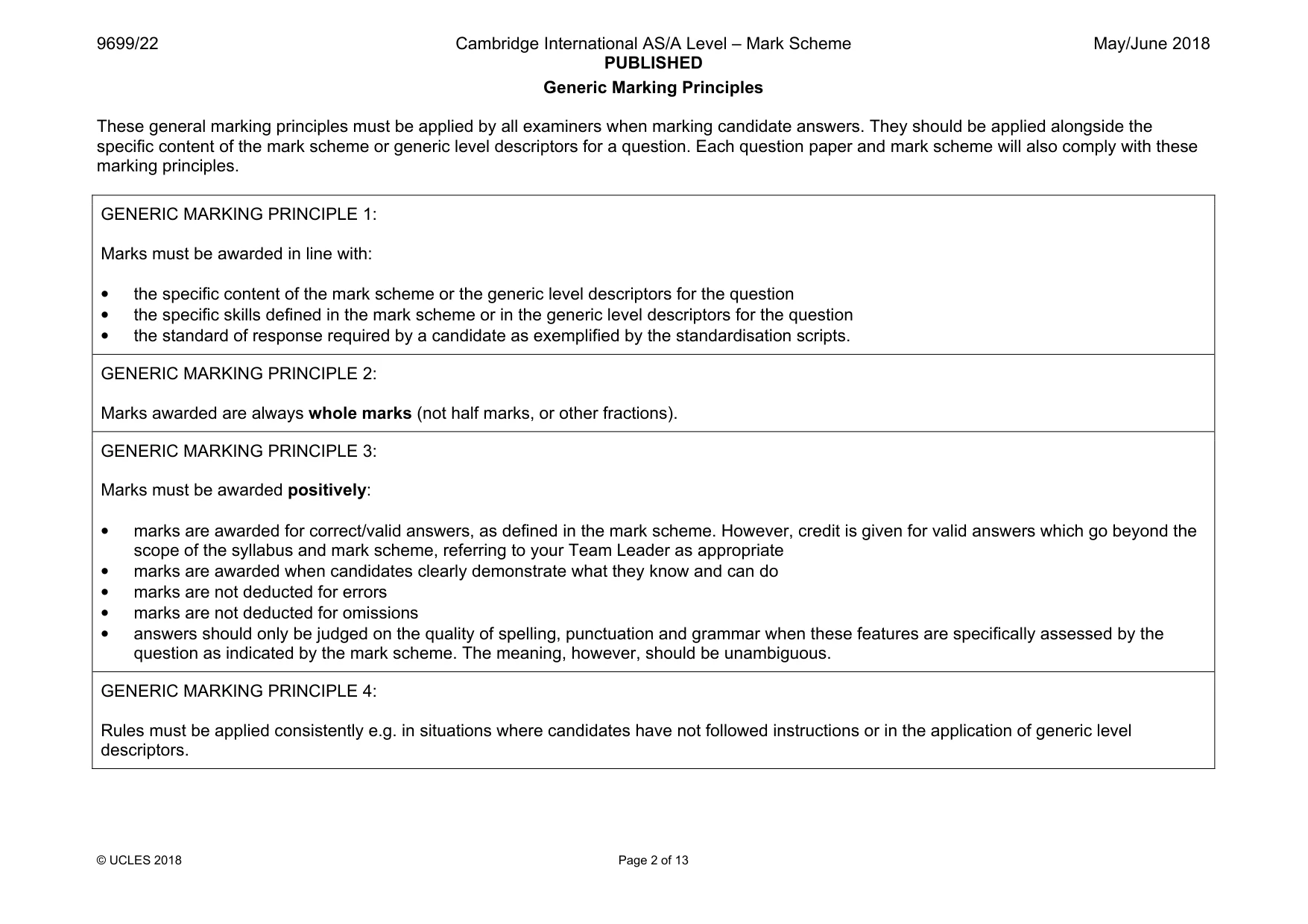
9699/22 Cambridge International AS/A Level – Mark Scheme PUBLISHED May/June 2018 © UCLES 2018 Page 2 of 13 Generic Marking Principles These general marking principles must be applied by all examiners when marking candidate answers. They should be applied alongside the specific content of the mark scheme or generic level descriptors for a question. Each question paper and mark scheme will also comply with these marking principles. GENERIC MARKING PRINCIPLE 1: Marks must be awarded in line with: • the specific content of the mark scheme or the generic level descriptors for the question • the specific skills defined in the mark scheme or in the generic level descriptors for the question • the standard of response required by a candidate as exemplified by the standardisation scripts. GENERIC MARKING PRINCIPLE 2: Marks awarded are always whole marks (not half marks, or other fractions). GENERIC MARKING PRINCIPLE 3: Marks must be awarded positively: • marks are awarded for correct/valid answers, as defined in the mark scheme. However, credit is given for valid answers which go beyond the scope of the syllabus and mark scheme, referring to your Team Leader as appropriate • marks are awarded when candidates clearly demonstrate what they know and can do • marks are not deducted for errors • marks are not deducted for omissions • answers should only be judged on the quality of spelling, punctuation and grammar when these features are specifically assessed by the question as indicated by the mark scheme. The meaning, however, should be unambiguous. GENERIC MARKING PRINCIPLE 4: Rules must be applied consistently e.g. in situations where candidates have not followed instructions or in the application of generic level descriptors.
Mark scheme, page 3
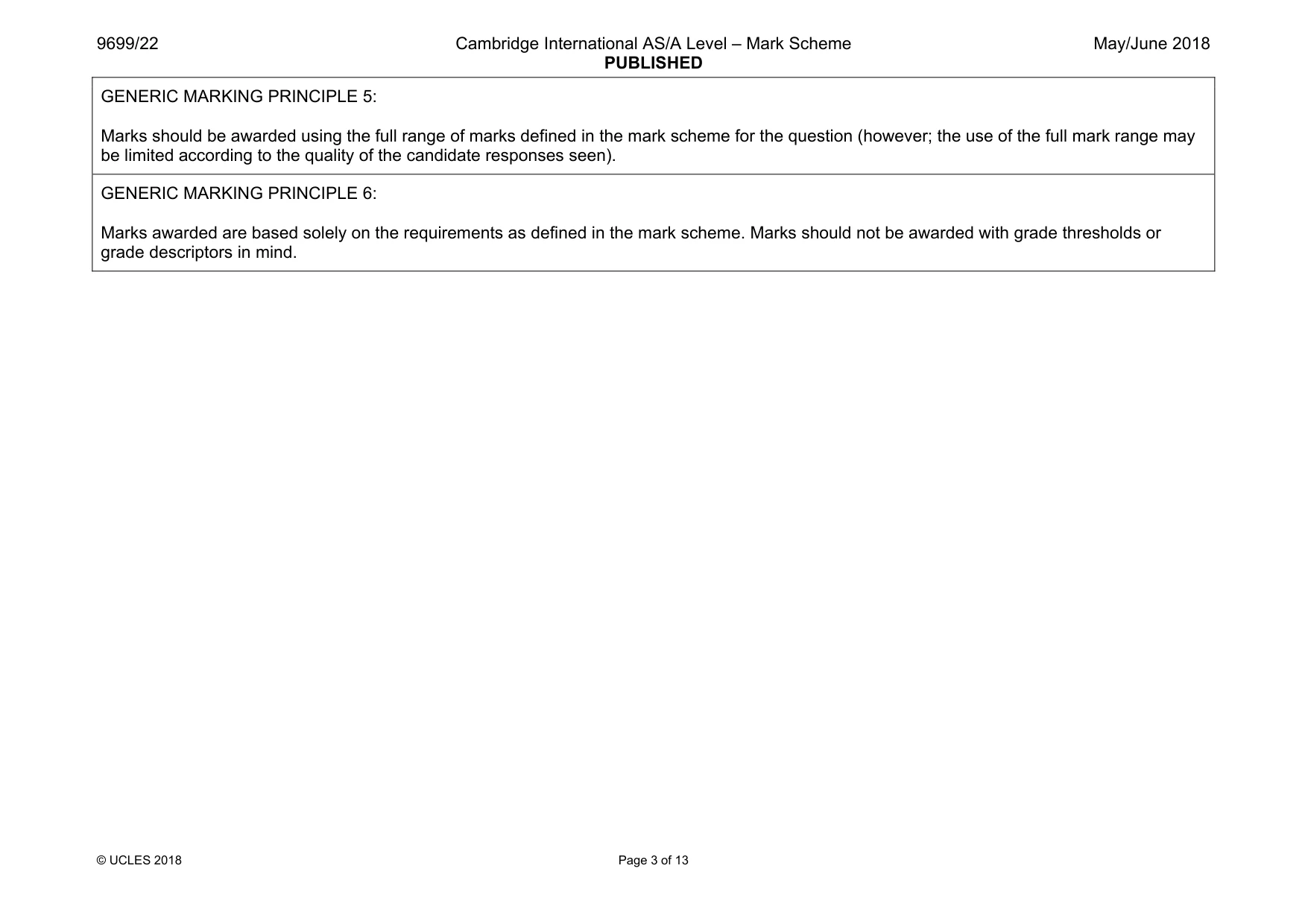
9699/22 Cambridge International AS/A Level – Mark Scheme PUBLISHED May/June 2018 © UCLES 2018 Page 3 of 13 GENERIC MARKING PRINCIPLE 5: Marks should be awarded using the full range of marks defined in the mark scheme for the question (however; the use of the full mark range may be limited according to the quality of the candidate responses seen). GENERIC MARKING PRINCIPLE 6: Marks awarded are based solely on the requirements as defined in the mark scheme. Marks should not be awarded with grade thresholds or grade descriptors in mind.
Mark scheme, page 4
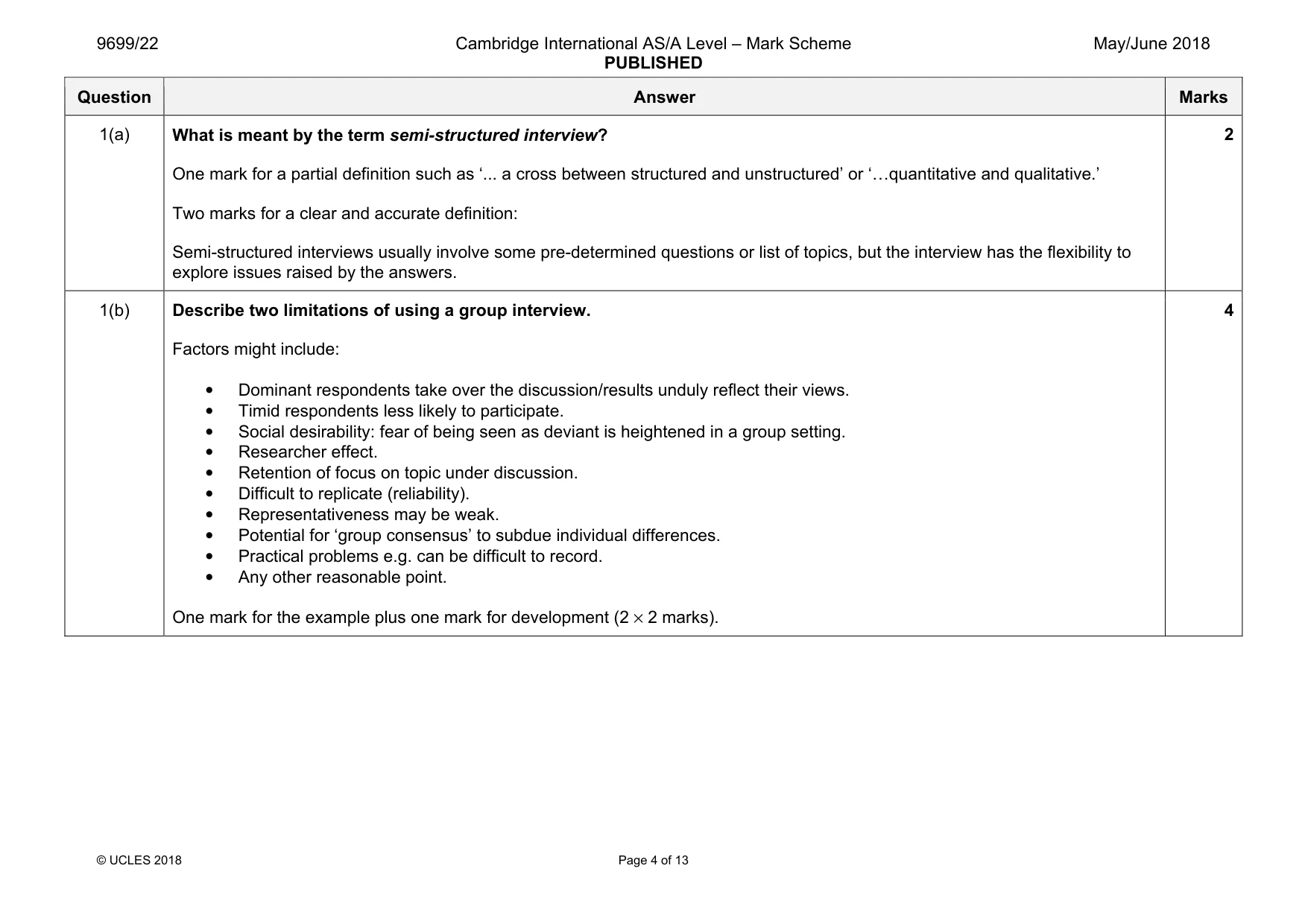
9699/22 Cambridge International AS/A Level – Mark Scheme PUBLISHED May/June 2018 © UCLES 2018 Page 4 of 13 Question Answer Marks 1(a) What is meant by the term semi-structured interview? One mark for a partial definition such as ‘... a cross between structured and unstructured’ or ‘«quantitative and qualitative.’ Two marks for a clear and accurate definition: Semi-structured interviews usually involve some pre-determined questions or list of topics, but the interview has the flexibility to explore issues raised by the answers. 2 1(b) Describe two limitations of using a group interview. Factors might include: • Dominant respondents take over the discussion/results unduly reflect their views. • Timid respondents less likely to participate. • Social desirability: fear of being seen as deviant is heightened in a group setting. • Researcher effect. • Retention of focus on topic under discussion. • Difficult to replicate (reliability). • Representativeness may be weak. • Potential for ‘group consensus’ to subdue individual differences. • Practical problems e.g. can be difficult to record. • Any other reasonable point. One mark for the example plus one mark for development (2 × 2 marks). 4
Mark scheme, page 5
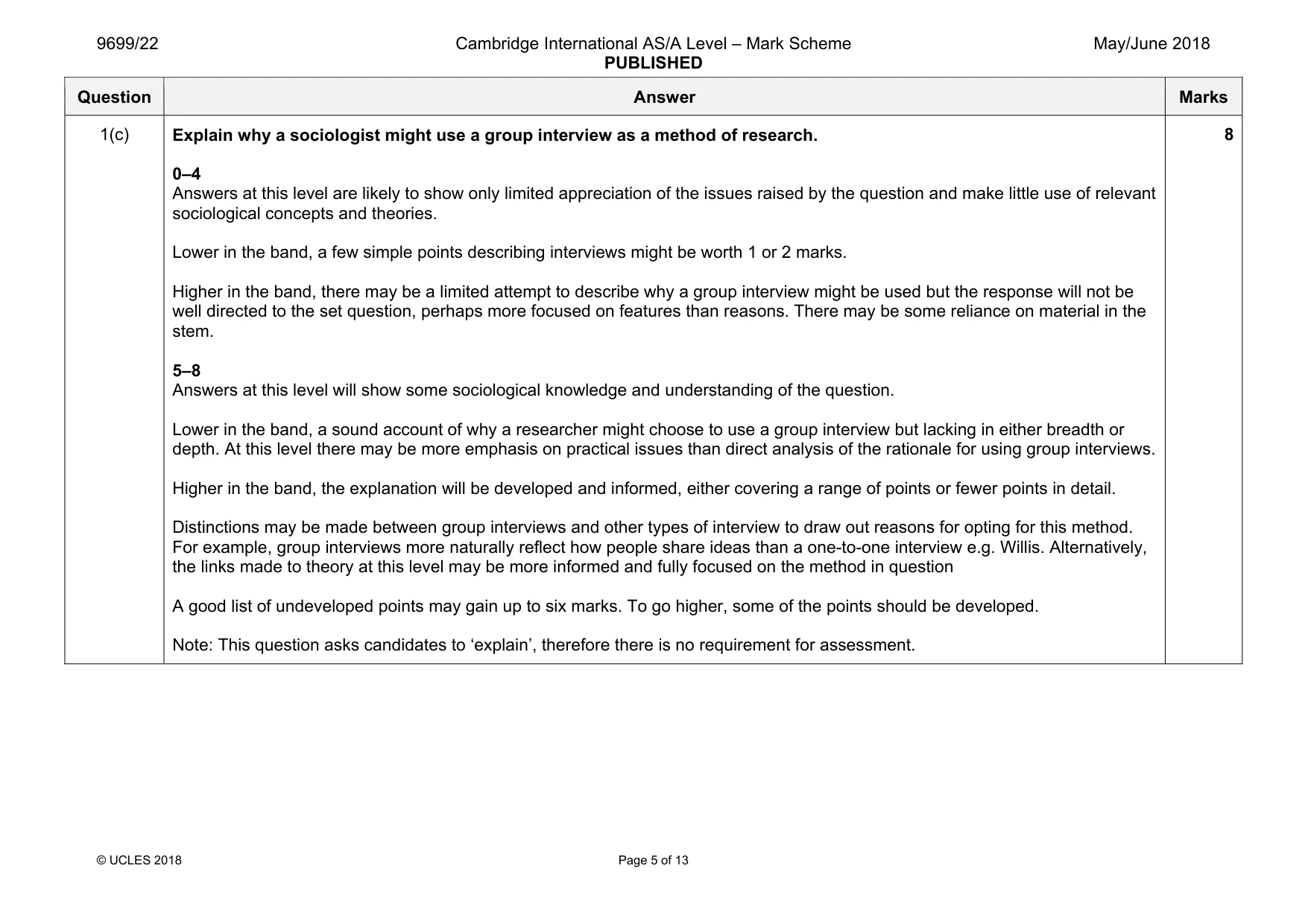
9699/22 Cambridge International AS/A Level – Mark Scheme PUBLISHED May/June 2018 © UCLES 2018 Page 5 of 13 Question Answer Marks 1(c) Explain why a sociologist might use a group interview as a method of research. 0–4 Answers at this level are likely to show only limited appreciation of the issues raised by the question and make little use of relevant sociological concepts and theories. Lower in the band, a few simple points describing interviews might be worth 1 or 2 marks. Higher in the band, there may be a limited attempt to describe why a group interview might be used but the response will not be well directed to the set question, perhaps more focused on features than reasons. There may be some reliance on material in the stem. 5–8 Answers at this level will show some sociological knowledge and understanding of the question. Lower in the band, a sound account of why a researcher might choose to use a group interview but lacking in either breadth or depth. At this level there may be more emphasis on practical issues than direct analysis of the rationale for using group interviews. Higher in the band, the explanation will be developed and informed, either covering a range of points or fewer points in detail. Distinctions may be made between group interviews and other types of interview to draw out reasons for opting for this method. For example, group interviews more naturally reflect how people share ideas than a one-to-one interview e.g. Willis. Alternatively, the links made to theory at this level may be more informed and fully focused on the method in question A good list of undeveloped points may gain up to six marks. To go higher, some of the points should be developed. Note: This question asks candidates to ‘explain’, therefore there is no requirement for assessment. 8
Mark scheme, page 6
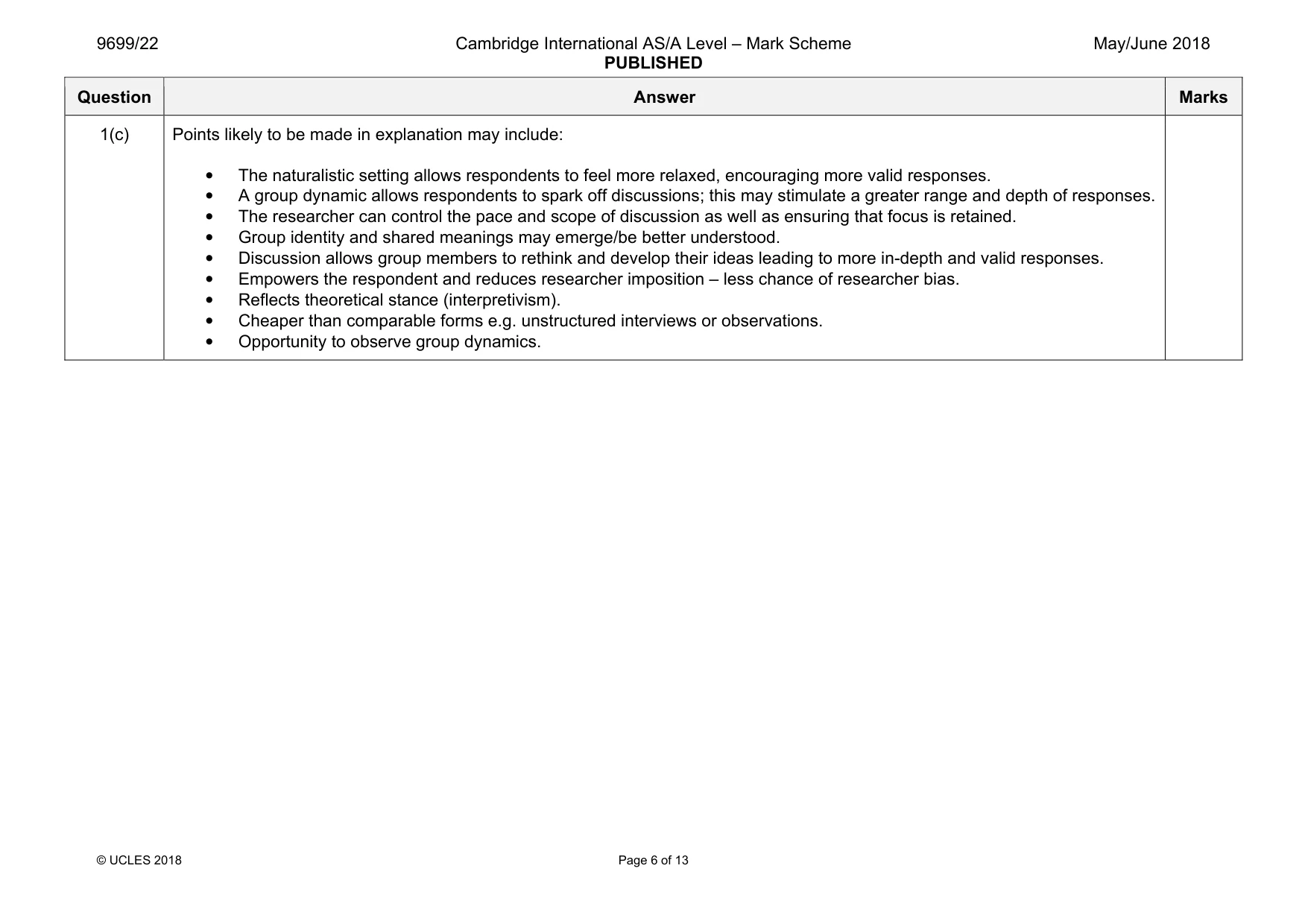
9699/22 Cambridge International AS/A Level – Mark Scheme PUBLISHED May/June 2018 © UCLES 2018 Page 6 of 13 Question Answer Marks 1(c) Points likely to be made in explanation may include: • The naturalistic setting allows respondents to feel more relaxed, encouraging more valid responses. • A group dynamic allows respondents to spark off discussions; this may stimulate a greater range and depth of responses. • The researcher can control the pace and scope of discussion as well as ensuring that focus is retained. • Group identity and shared meanings may emerge/be better understood. • Discussion allows group members to rethink and develop their ideas leading to more in-depth and valid responses. • Empowers the respondent and reduces researcher imposition – less chance of researcher bias. • Reflects theoretical stance (interpretivism). • Cheaper than comparable forms e.g. unstructured interviews or observations. • Opportunity to observe group dynamics.
Mark scheme, page 7
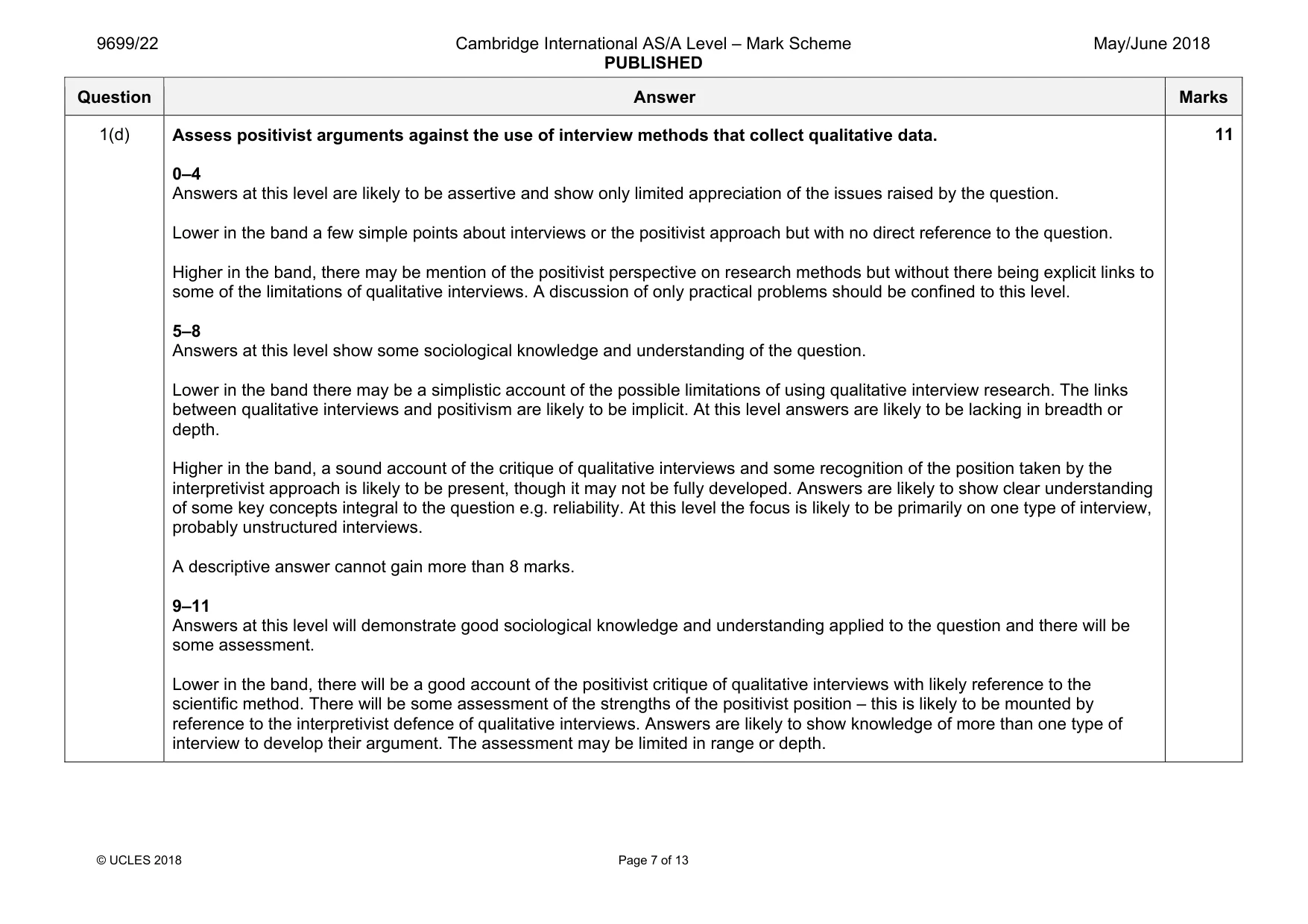
9699/22 Cambridge International AS/A Level – Mark Scheme PUBLISHED May/June 2018 © UCLES 2018 Page 7 of 13 Question Answer Marks 1(d) Assess positivist arguments against the use of interview methods that collect qualitative data. 0–4 Answers at this level are likely to be assertive and show only limited appreciation of the issues raised by the question. Lower in the band a few simple points about interviews or the positivist approach but with no direct reference to the question. Higher in the band, there may be mention of the positivist perspective on research methods but without there being explicit links to some of the limitations of qualitative interviews. A discussion of only practical problems should be confined to this level. 5–8 Answers at this level show some sociological knowledge and understanding of the question. Lower in the band there may be a simplistic account of the possible limitations of using qualitative interview research. The links between qualitative interviews and positivism are likely to be implicit. At this level answers are likely to be lacking in breadth or depth. Higher in the band, a sound account of the critique of qualitative interviews and some recognition of the position taken by the interpretivist approach is likely to be present, though it may not be fully developed. Answers are likely to show clear understanding of some key concepts integral to the question e.g. reliability. At this level the focus is likely to be primarily on one type of interview, probably unstructured interviews. A descriptive answer cannot gain more than 8 marks. 9–11 Answers at this level will demonstrate good sociological knowledge and understanding applied to the question and there will be some assessment. Lower in the band, there will be a good account of the positivist critique of qualitative interviews with likely reference to the scientific method. There will be some assessment of the strengths of the positivist position – this is likely to be mounted by reference to the interpretivist defence of qualitative interviews. Answers are likely to show knowledge of more than one type of interview to develop their argument. The assessment may be limited in range or depth. 11
Mark scheme, page 8
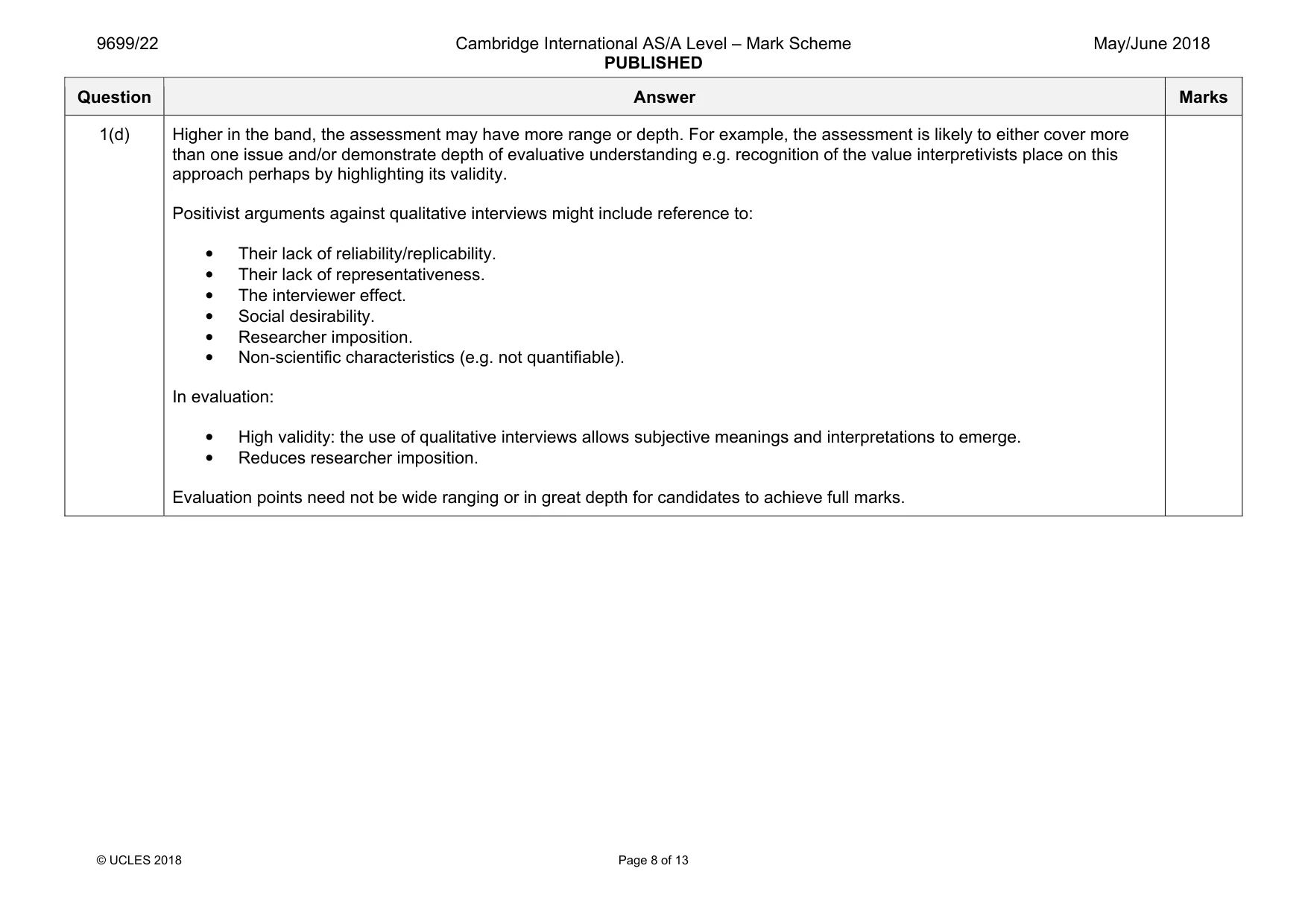
9699/22 Cambridge International AS/A Level – Mark Scheme PUBLISHED May/June 2018 © UCLES 2018 Page 8 of 13 Question Answer Marks 1(d) Higher in the band, the assessment may have more range or depth. For example, the assessment is likely to either cover more than one issue and/or demonstrate depth of evaluative understanding e.g. recognition of the value interpretivists place on this approach perhaps by highlighting its validity. Positivist arguments against qualitative interviews might include reference to: • Their lack of reliability/replicability. • Their lack of representativeness. • The interviewer effect. • Social desirability. • Researcher imposition. • Non-scientific characteristics (e.g. not quantifiable). In evaluation: • High validity: the use of qualitative interviews allows subjective meanings and interpretations to emerge. • Reduces researcher imposition. Evaluation points need not be wide ranging or in great depth for candidates to achieve full marks.
Mark scheme, page 9
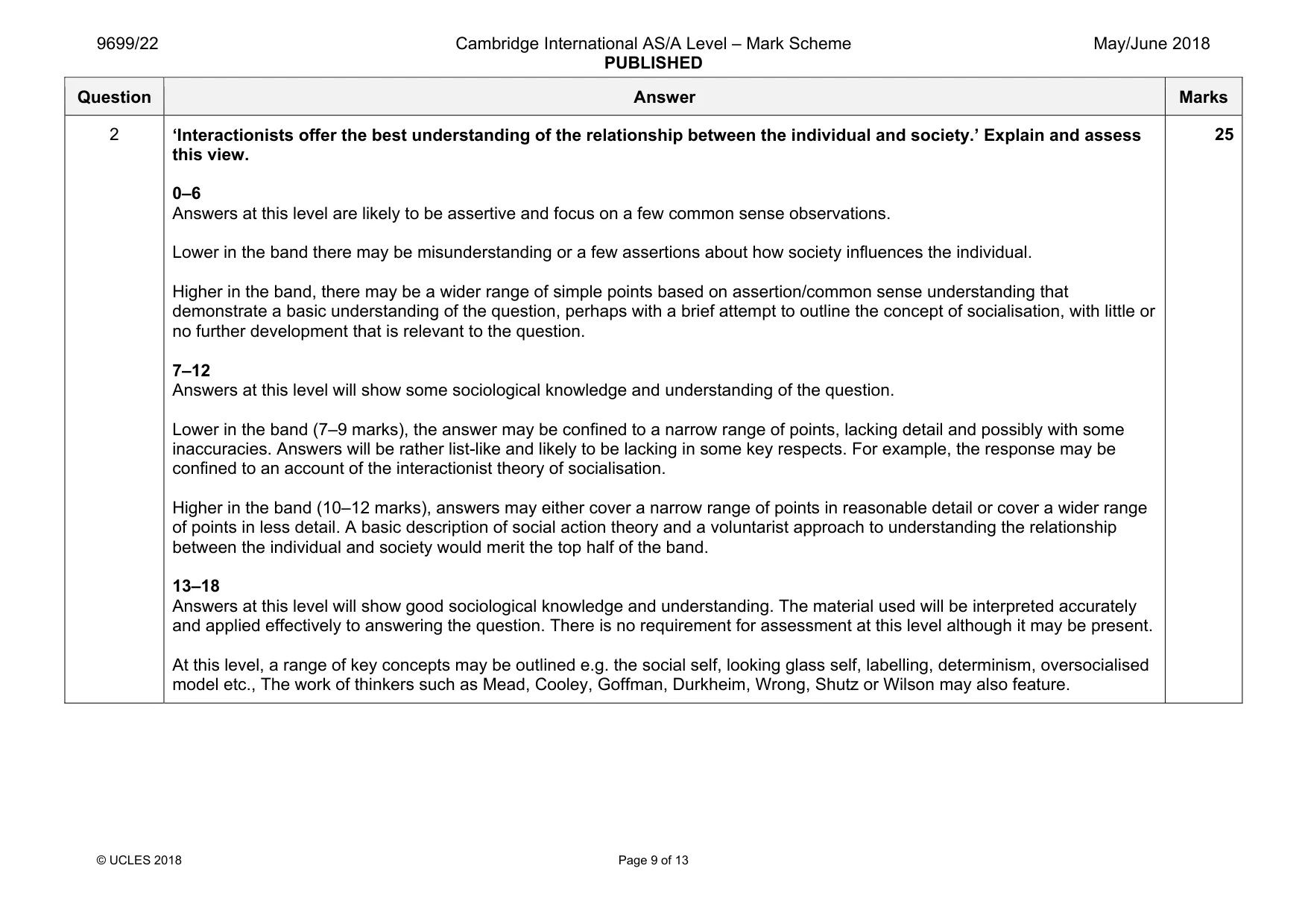
9699/22 Cambridge International AS/A Level – Mark Scheme PUBLISHED May/June 2018 © UCLES 2018 Page 9 of 13 Question Answer Marks 2 ‘Interactionists offer the best understanding of the relationship between the individual and society.’ Explain and assess this view. 0–6 Answers at this level are likely to be assertive and focus on a few common sense observations. Lower in the band there may be misunderstanding or a few assertions about how society influences the individual. Higher in the band, there may be a wider range of simple points based on assertion/common sense understanding that demonstrate a basic understanding of the question, perhaps with a brief attempt to outline the concept of socialisation, with little or no further development that is relevant to the question. 7–12 Answers at this level will show some sociological knowledge and understanding of the question. Lower in the band (7–9 marks), the answer may be confined to a narrow range of points, lacking detail and possibly with some inaccuracies. Answers will be rather list-like and likely to be lacking in some key respects. For example, the response may be confined to an account of the interactionist theory of socialisation. Higher in the band (10–12 marks), answers may either cover a narrow range of points in reasonable detail or cover a wider range of points in less detail. A basic description of social action theory and a voluntarist approach to understanding the relationship between the individual and society would merit the top half of the band. 13–18 Answers at this level will show good sociological knowledge and understanding. The material used will be interpreted accurately and applied effectively to answering the question. There is no requirement for assessment at this level although it may be present. At this level, a range of key concepts may be outlined e.g. the social self, looking glass self, labelling, determinism, oversocialised model etc., The work of thinkers such as Mead, Cooley, Goffman, Durkheim, Wrong, Shutz or Wilson may also feature. 25
Mark scheme, page 10
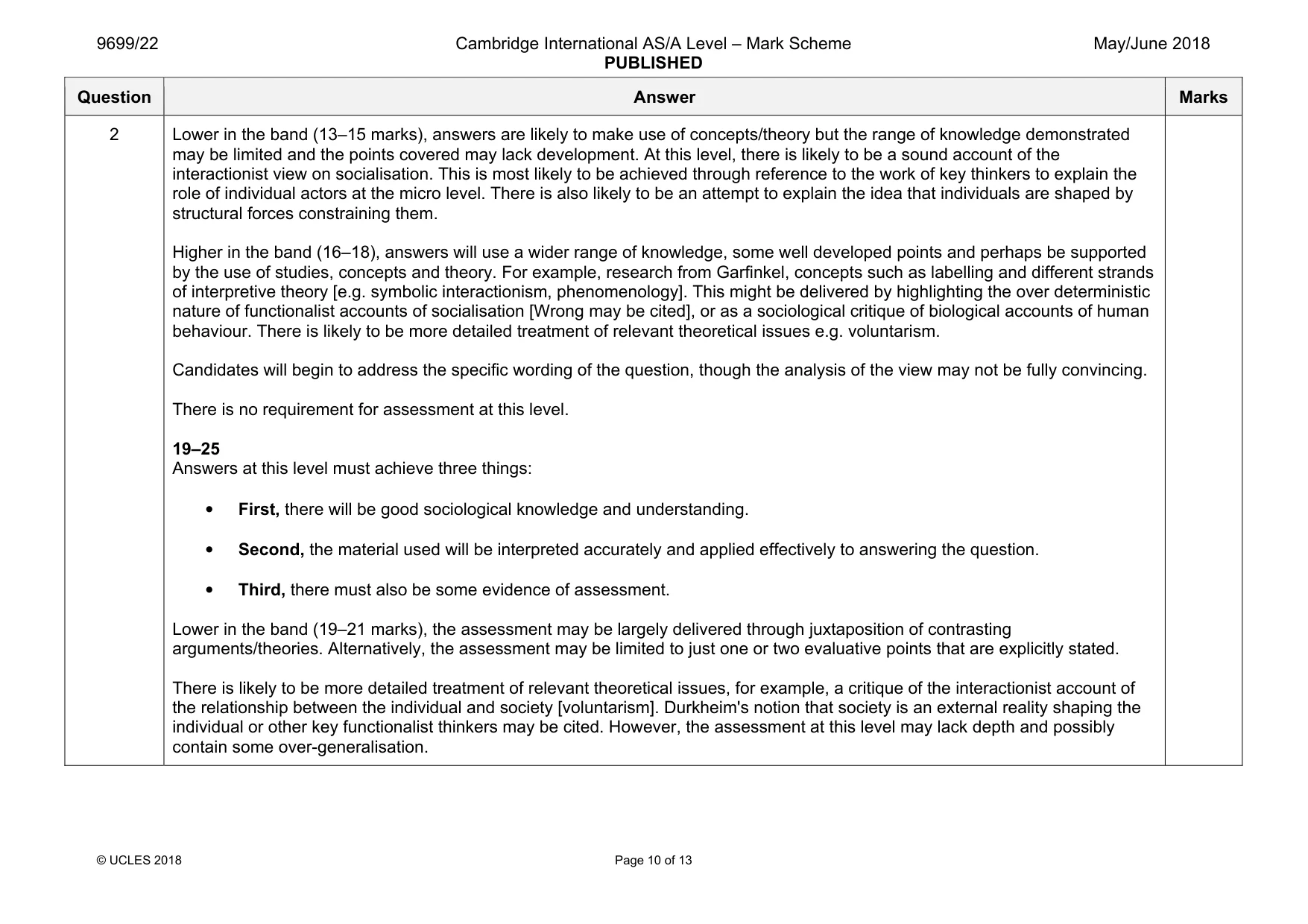
9699/22 Cambridge International AS/A Level – Mark Scheme PUBLISHED May/June 2018 © UCLES 2018 Page 10 of 13 Question Answer Marks 2 Lower in the band (13–15 marks), answers are likely to make use of concepts/theory but the range of knowledge demonstrated may be limited and the points covered may lack development. At this level, there is likely to be a sound account of the interactionist view on socialisation. This is most likely to be achieved through reference to the work of key thinkers to explain the role of individual actors at the micro level. There is also likely to be an attempt to explain the idea that individuals are shaped by structural forces constraining them. Higher in the band (16–18), answers will use a wider range of knowledge, some well developed points and perhaps be supported by the use of studies, concepts and theory. For example, research from Garfinkel, concepts such as labelling and different strands of interpretive theory [e.g. symbolic interactionism, phenomenology]. This might be delivered by highlighting the over deterministic nature of functionalist accounts of socialisation [Wrong may be cited], or as a sociological critique of biological accounts of human behaviour. There is likely to be more detailed treatment of relevant theoretical issues e.g. voluntarism. Candidates will begin to address the specific wording of the question, though the analysis of the view may not be fully convincing. There is no requirement for assessment at this level. 19–25 Answers at this level must achieve three things: • First, there will be good sociological knowledge and understanding. • Second, the material used will be interpreted accurately and applied effectively to answering the question. • Third, there must also be some evidence of assessment. Lower in the band (19–21 marks), the assessment may be largely delivered through juxtaposition of contrasting arguments/theories. Alternatively, the assessment may be limited to just one or two evaluative points that are explicitly stated. There is likely to be more detailed treatment of relevant theoretical issues, for example, a critique of the interactionist account of the relationship between the individual and society [voluntarism]. Durkheim's notion that society is an external reality shaping the individual or other key functionalist thinkers may be cited. However, the assessment at this level may lack depth and possibly contain some over-generalisation.
Mark scheme, page 11
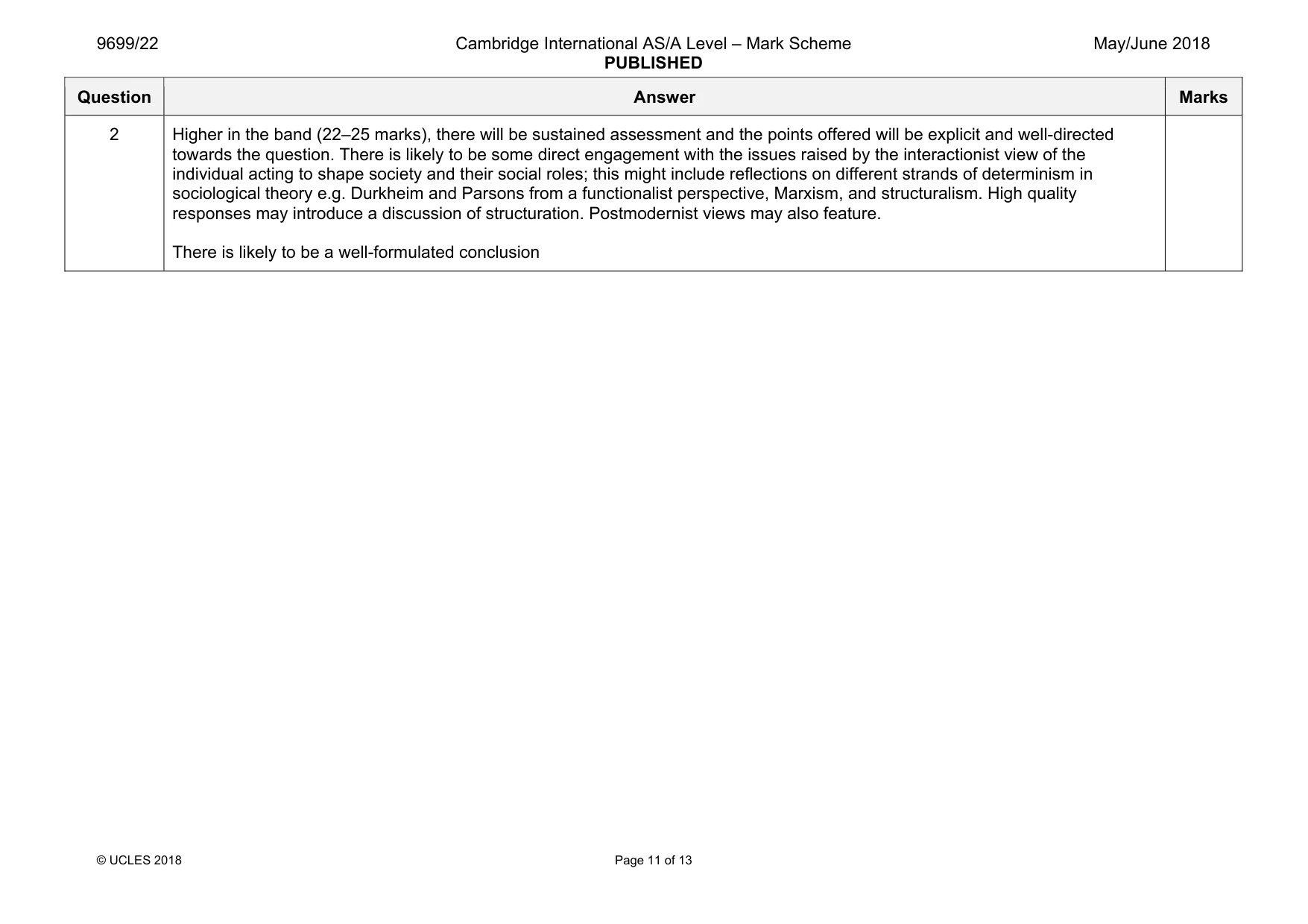
9699/22 Cambridge International AS/A Level – Mark Scheme PUBLISHED May/June 2018 © UCLES 2018 Page 11 of 13 Question Answer Marks 2 Higher in the band (22–25 marks), there will be sustained assessment and the points offered will be explicit and well-directed towards the question. There is likely to be some direct engagement with the issues raised by the interactionist view of the individual acting to shape society and their social roles; this might include reflections on different strands of determinism in sociological theory e.g. Durkheim and Parsons from a functionalist perspective, Marxism, and structuralism. High quality responses may introduce a discussion of structuration. Postmodernist views may also feature. There is likely to be a well-formulated conclusion
Mark scheme, page 12
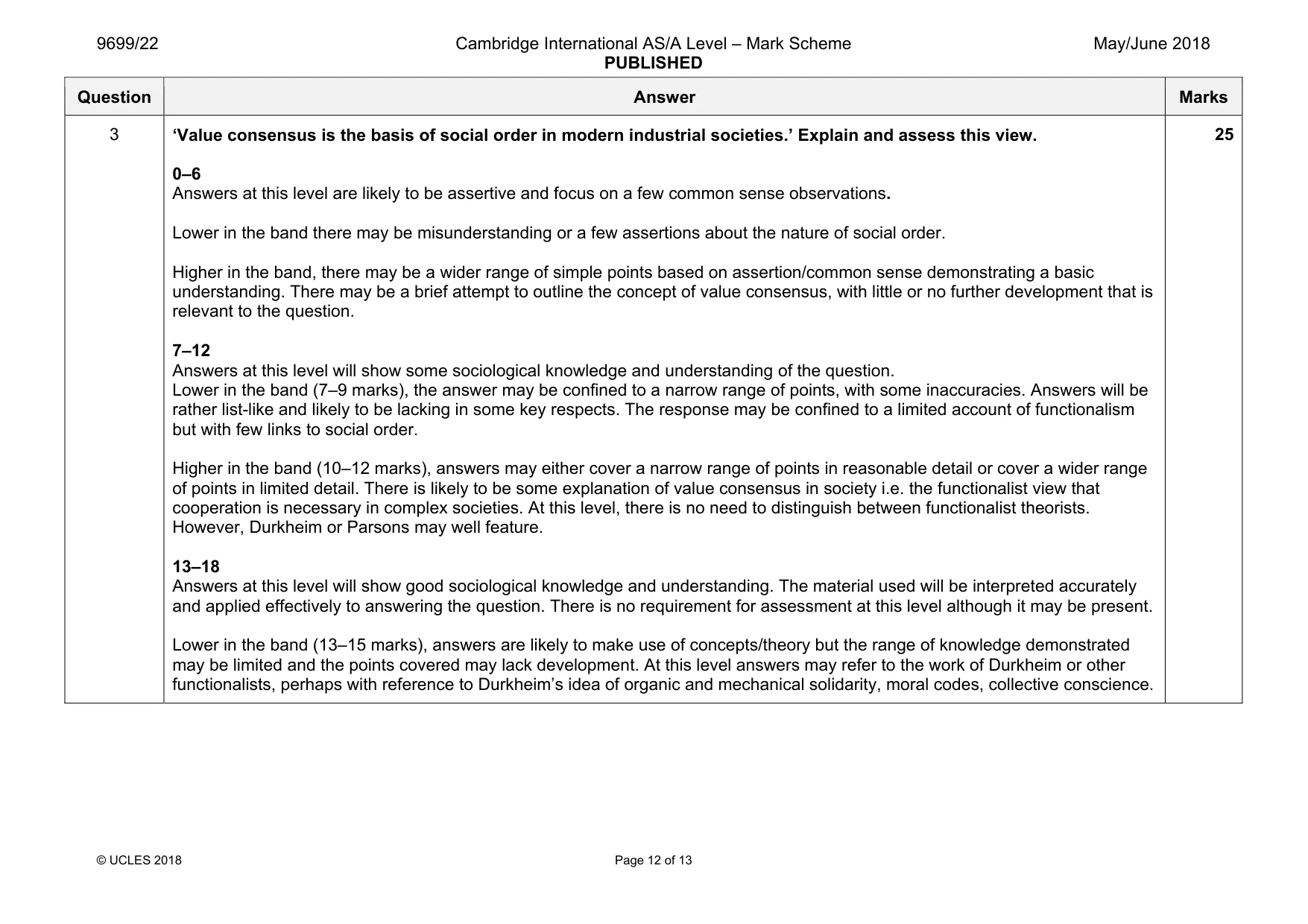
9699/22 Cambridge International AS/A Level – Mark Scheme PUBLISHED May/June 2018 © UCLES 2018 Page 12 of 13 Question Answer Marks 3 ‘Value consensus is the basis of social order in modern industrial societies.’ Explain and assess this view. 0–6 Answers at this level are likely to be assertive and focus on a few common sense observations. Lower in the band there may be misunderstanding or a few assertions about the nature of social order. Higher in the band, there may be a wider range of simple points based on assertion/common sense demonstrating a basic understanding. There may be a brief attempt to outline the concept of value consensus, with little or no further development that is relevant to the question. 7–12 Answers at this level will show some sociological knowledge and understanding of the question. Lower in the band (7–9 marks), the answer may be confined to a narrow range of points, with some inaccuracies. Answers will be rather list-like and likely to be lacking in some key respects. The response may be confined to a limited account of functionalism but with few links to social order. Higher in the band (10–12 marks), answers may either cover a narrow range of points in reasonable detail or cover a wider range of points in limited detail. There is likely to be some explanation of value consensus in society i.e. the functionalist view that cooperation is necessary in complex societies. At this level, there is no need to distinguish between functionalist theorists. However, Durkheim or Parsons may well feature. 13–18 Answers at this level will show good sociological knowledge and understanding. The material used will be interpreted accurately and applied effectively to answering the question. There is no requirement for assessment at this level although it may be present. Lower in the band (13–15 marks), answers are likely to make use of concepts/theory but the range of knowledge demonstrated may be limited and the points covered may lack development. At this level answers may refer to the work of Durkheim or other functionalists, perhaps with reference to Durkheim’s idea of organic and mechanical solidarity, moral codes, collective conscience. 25
Mark scheme, page 13
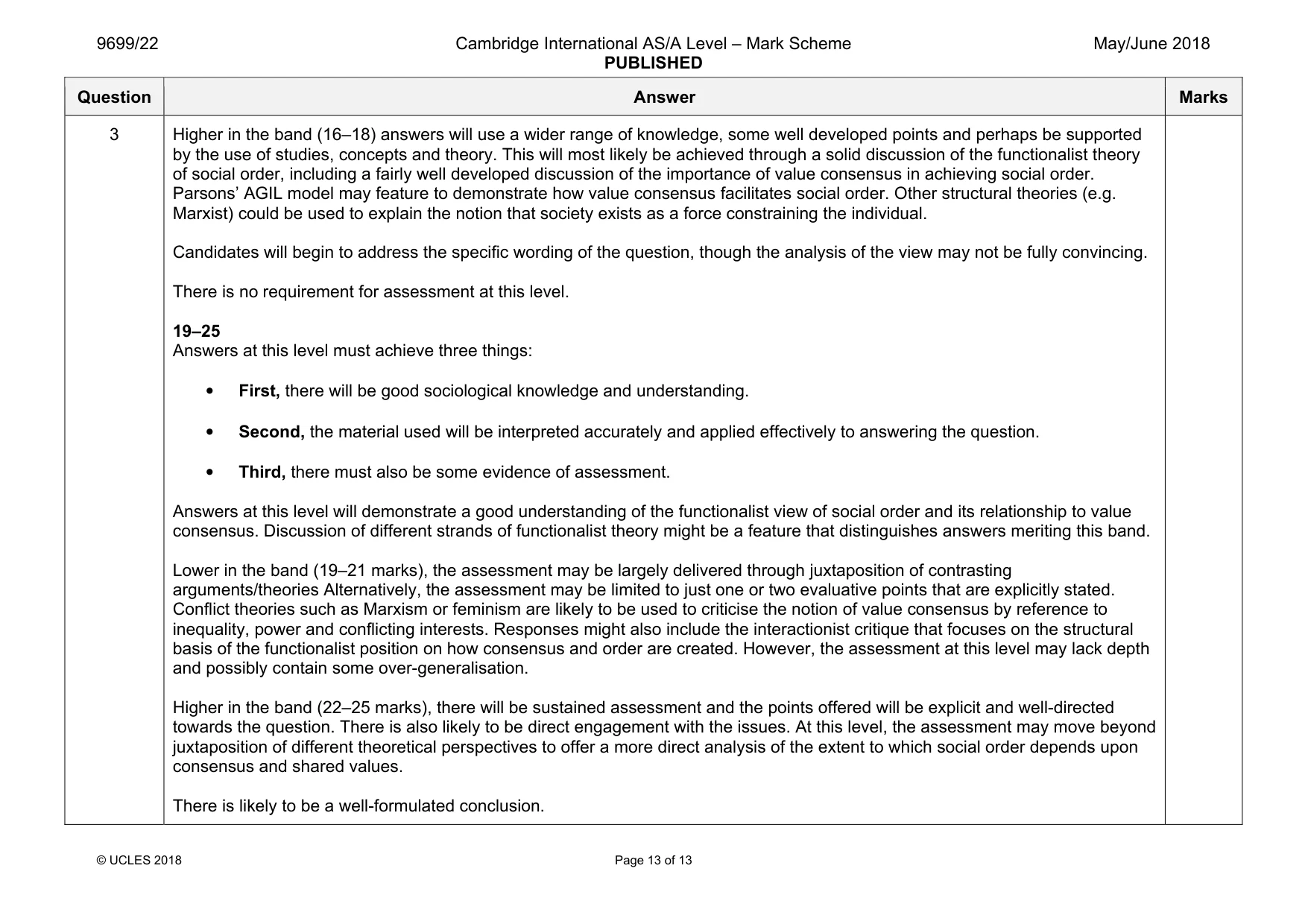
9699/22 Cambridge International AS/A Level – Mark Scheme PUBLISHED May/June 2018 © UCLES 2018 Page 13 of 13 Question Answer Marks 3 Higher in the band (16–18) answers will use a wider range of knowledge, some well developed points and perhaps be supported by the use of studies, concepts and theory. This will most likely be achieved through a solid discussion of the functionalist theory of social order, including a fairly well developed discussion of the importance of value consensus in achieving social order. Parsons’ AGIL model may feature to demonstrate how value consensus facilitates social order. Other structural theories (e.g. Marxist) could be used to explain the notion that society exists as a force constraining the individual. Candidates will begin to address the specific wording of the question, though the analysis of the view may not be fully convincing. There is no requirement for assessment at this level. 19–25 Answers at this level must achieve three things: • First, there will be good sociological knowledge and understanding. • Second, the material used will be interpreted accurately and applied effectively to answering the question. • Third, there must also be some evidence of assessment. Answers at this level will demonstrate a good understanding of the functionalist view of social order and its relationship to value consensus. Discussion of different strands of functionalist theory might be a feature that distinguishes answers meriting this band. Lower in the band (19–21 marks), the assessment may be largely delivered through juxtaposition of contrasting arguments/theories Alternatively, the assessment may be limited to just one or two evaluative points that are explicitly stated. Conflict theories such as Marxism or feminism are likely to be used to criticise the notion of value consensus by reference to inequality, power and conflicting interests. Responses might also include the interactionist critique that focuses on the structural basis of the functionalist position on how consensus and order are created. However, the assessment at this level may lack depth and possibly contain some over-generalisation. Higher in the band (22–25 marks), there will be sustained assessment and the points offered will be explicit and well-directed towards the question. There is also likely to be direct engagement with the issues. At this level, the assessment may move beyond juxtaposition of different theoretical perspectives to offer a more direct analysis of the extent to which social order depends upon consensus and shared values. There is likely to be a well-formulated conclusion.
What you needed in this session
Cambridge’s own grade thresholds for 2018 May/June, Paper 2 · Variant 2. A higher threshold means an easier paper — the bar moves with how the cohort did.