Cambridge A Level Sociology 9699 — 2018 May/June Paper 1 · Variant 3
9699/13/M/J/18 · 50 marks · ≈56 min
The question paper and its mark scheme, free to read here and free to download. This is Cambridge’s own paper, exactly as it was sat.
Question paper4 pages


Mark scheme13 pages
Answers below. Sit the paper first if you are practising.
Paper as text
Question paper, page 1
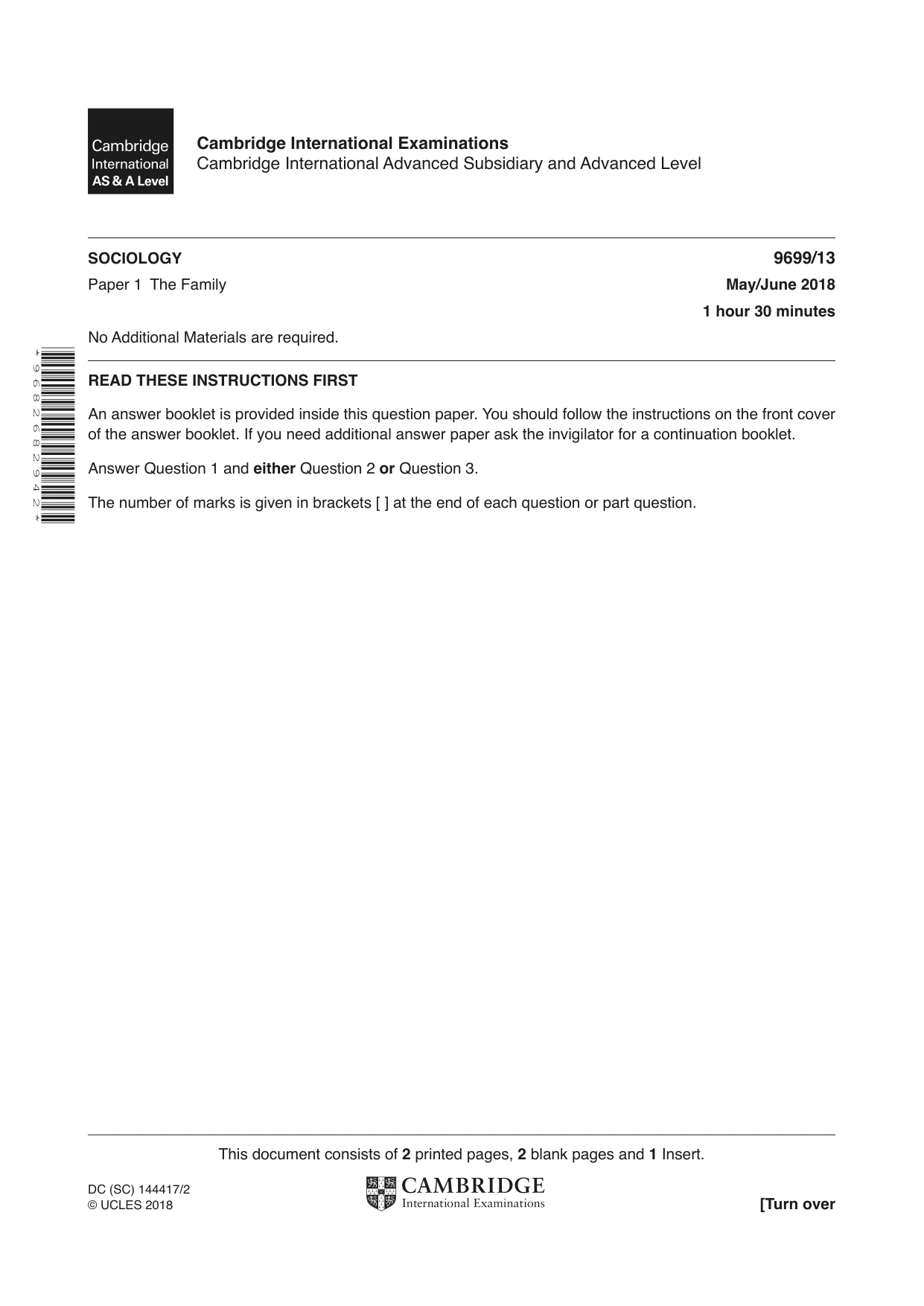
* 9 6 8 2 6 8 2 9 4 2 * This document consists of 2 printed pages, 2 blank pages and 1 Insert. DC (SC) 144417/2 © UCLES 2018 [Turn over Cambridge International Examinations Cambridge International Advanced Subsidiary and Advanced Level SOCIOLOGY 9699/13 Paper 1 The Family May/June 2018 1 hour 30 minutes No Additional Materials are required. READ THESE INSTRUCTIONS FIRST An answer booklet is provided inside this question paper. You should follow the instructions on the front cover of the answer booklet. If you need additional answer paper ask the invigilator for a continuation booklet. Answer Question 1 and either Question 2 or Question 3. The number of marks is given in brackets [ ] at the end of each question or part question.
Question paper, page 2
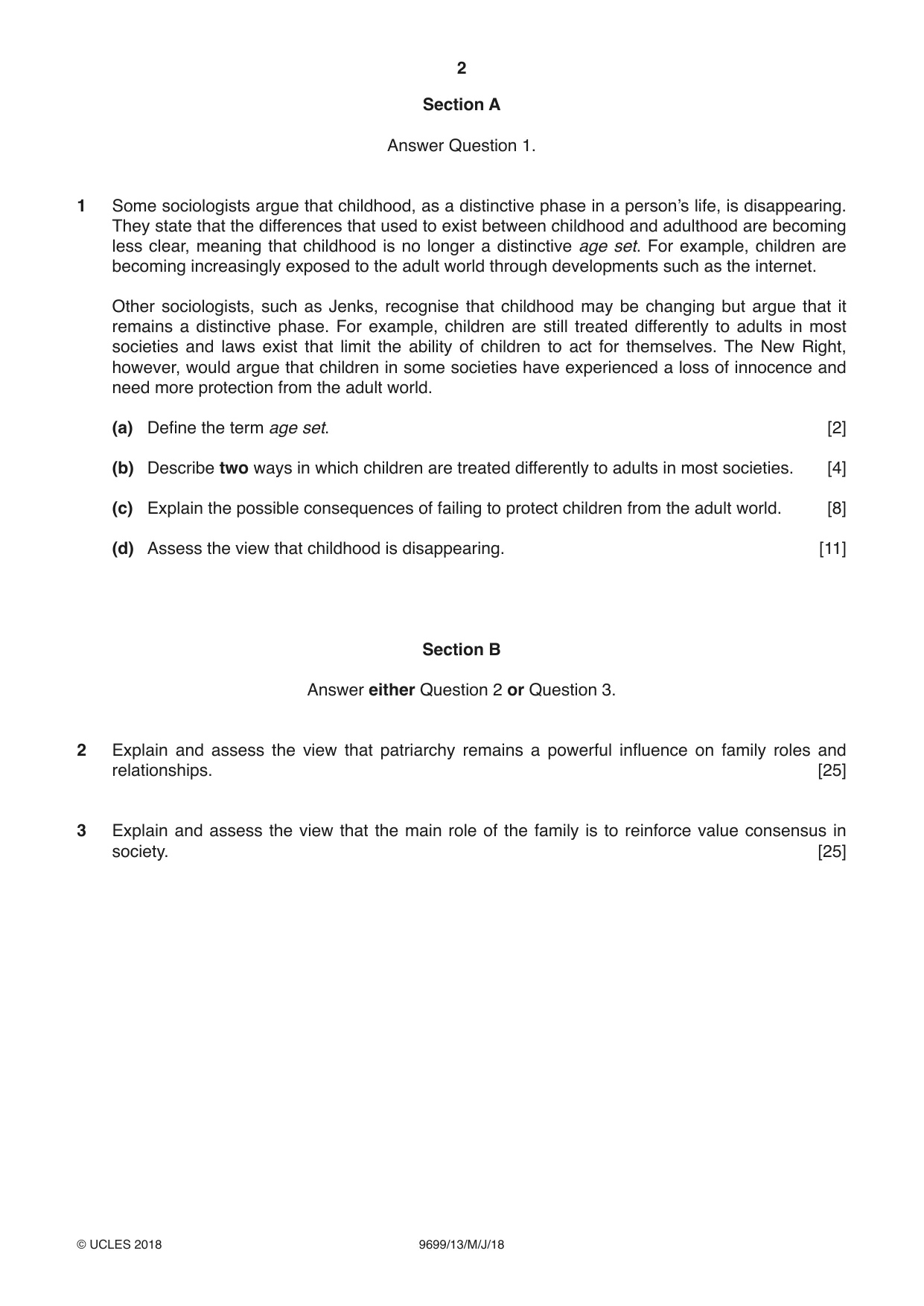
2 9699/13/M/J/18 © UCLES 2018 Section A Answer Question 1. 1 Some sociologists argue that childhood, as a distinctive phase in a person’s life, is disappearing. They state that the differences that used to exist between childhood and adulthood are becoming less clear, meaning that childhood is no longer a distinctive age set. For example, children are becoming increasingly exposed to the adult world through developments such as the internet. Other sociologists, such as Jenks, recognise that childhood may be changing but argue that it remains a distinctive phase. For example, children are still treated differently to adults in most societies and laws exist that limit the ability of children to act for themselves. The New Right, however, would argue that children in some societies have experienced a loss of innocence and need more protection from the adult world. (a) Define the term age set. [2] (b) Describe two ways in which children are treated differently to adults in most societies. [4] (c) Explain the possible consequences of failing to protect children from the adult world. [8] (d) Assess the view that childhood is disappearing. [11] Section B Answer either Question 2 or Question 3. 2 Explain and assess the view that patriarchy remains a powerful influence on family roles and relationships. [25] 3 Explain and assess the view that the main role of the family is to reinforce value consensus in society. [25]
Question paper, page 3
3 9699/13/M/J/18 © UCLES 2018 BLANK PAGE
Question paper, page 4
4 9699/13/M/J/18 © UCLES 2018 Permission to reproduce items where third-party owned material protected by copyright is included has been sought and cleared where possible. Every reasonable effort has been made by the publisher (UCLES) to trace copyright holders, but if any items requiring clearance have unwittingly been included, the publisher will be pleased to make amends at the earliest possible opportunity. To avoid the issue of disclosure of answer-related information to candidates, all copyright acknowledgements are reproduced online in the Cambridge International Examinations Copyright Acknowledgements Booklet. This is produced for each series of examinations and is freely available to download at www.cie.org.uk after the live examination series. Cambridge International Examinations is part of the Cambridge Assessment Group. Cambridge Assessment is the brand name of University of Cambridge Local Examinations Syndicate (UCLES), which is itself a department of the University of Cambridge. BLANK PAGE
Mark scheme, page 1
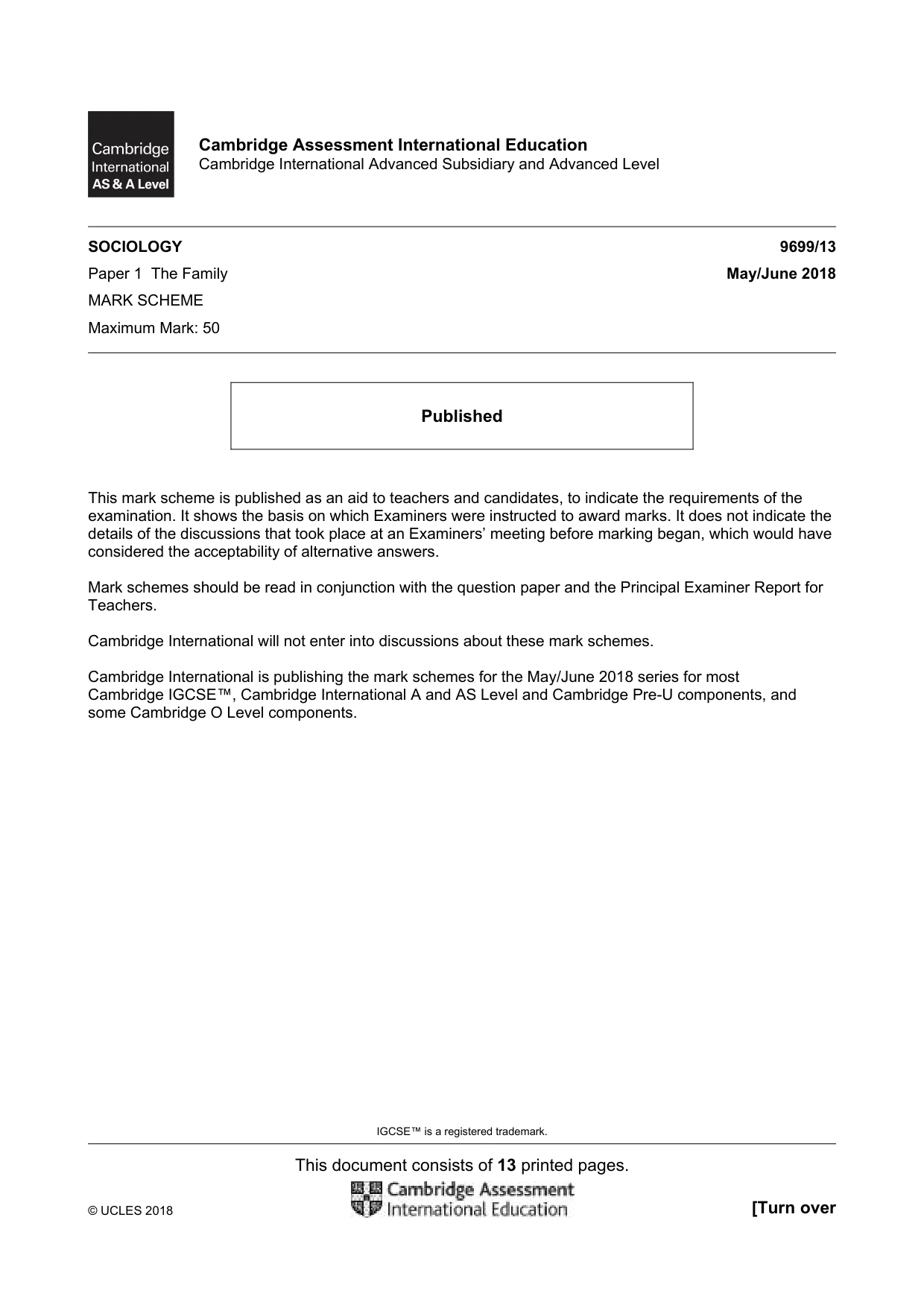
IGCSE™ is a registered trademark. This document consists of 13 printed pages. © UCLES 2018 [Turn over Cambridge Assessment International Education Cambridge International Advanced Subsidiary and Advanced Level SOCIOLOGY 9699/13 Paper 1 The Family May/June 2018 MARK SCHEME Maximum Mark: 50 Published This mark scheme is published as an aid to teachers and candidates, to indicate the requirements of the examination. It shows the basis on which Examiners were instructed to award marks. It does not indicate the details of the discussions that took place at an Examiners’ meeting before marking began, which would have considered the acceptability of alternative answers. Mark schemes should be read in conjunction with the question paper and the Principal Examiner Report for Teachers. Cambridge International will not enter into discussions about these mark schemes. Cambridge International is publishing the mark schemes for the May/June 2018 series for most Cambridge IGCSE™, Cambridge International A and AS Level and Cambridge Pre-U components, and some Cambridge O Level components.
Mark scheme, page 2
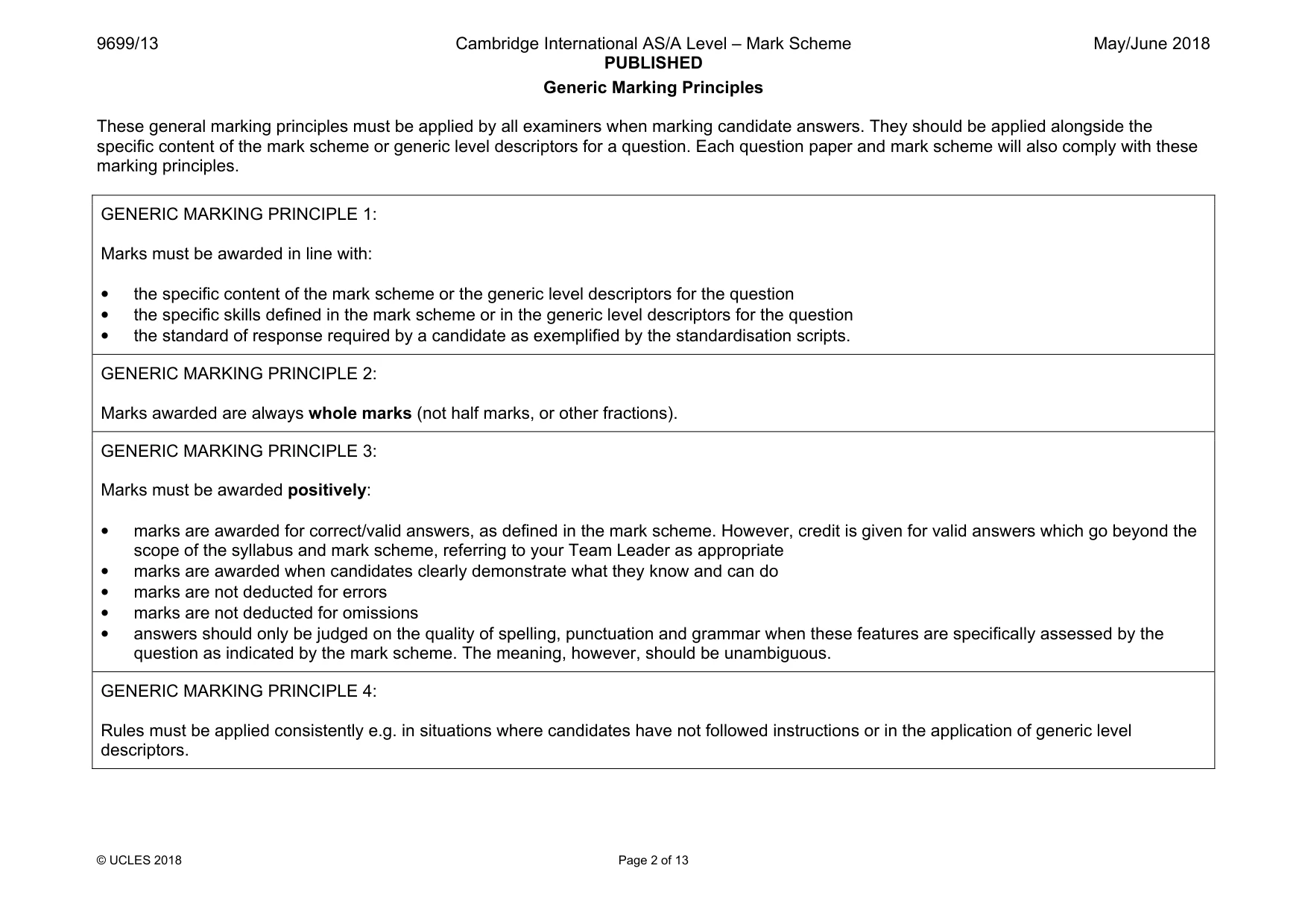
9699/13 Cambridge International AS/A Level – Mark Scheme PUBLISHED May/June 2018 © UCLES 2018 Page 2 of 13 Generic Marking Principles These general marking principles must be applied by all examiners when marking candidate answers. They should be applied alongside the specific content of the mark scheme or generic level descriptors for a question. Each question paper and mark scheme will also comply with these marking principles. GENERIC MARKING PRINCIPLE 1: Marks must be awarded in line with: • the specific content of the mark scheme or the generic level descriptors for the question • the specific skills defined in the mark scheme or in the generic level descriptors for the question • the standard of response required by a candidate as exemplified by the standardisation scripts. GENERIC MARKING PRINCIPLE 2: Marks awarded are always whole marks (not half marks, or other fractions). GENERIC MARKING PRINCIPLE 3: Marks must be awarded positively: • marks are awarded for correct/valid answers, as defined in the mark scheme. However, credit is given for valid answers which go beyond the scope of the syllabus and mark scheme, referring to your Team Leader as appropriate • marks are awarded when candidates clearly demonstrate what they know and can do • marks are not deducted for errors • marks are not deducted for omissions • answers should only be judged on the quality of spelling, punctuation and grammar when these features are specifically assessed by the question as indicated by the mark scheme. The meaning, however, should be unambiguous. GENERIC MARKING PRINCIPLE 4: Rules must be applied consistently e.g. in situations where candidates have not followed instructions or in the application of generic level descriptors.
Mark scheme, page 3
9699/13 Cambridge International AS/A Level – Mark Scheme PUBLISHED May/June 2018 © UCLES 2018 Page 3 of 13 GENERIC MARKING PRINCIPLE 5: Marks should be awarded using the full range of marks defined in the mark scheme for the question (however; the use of the full mark range may be limited according to the quality of the candidate responses seen). GENERIC MARKING PRINCIPLE 6: Marks awarded are based solely on the requirements as defined in the mark scheme. Marks should not be awarded with grade thresholds or grade descriptors in mind.
Mark scheme, page 4
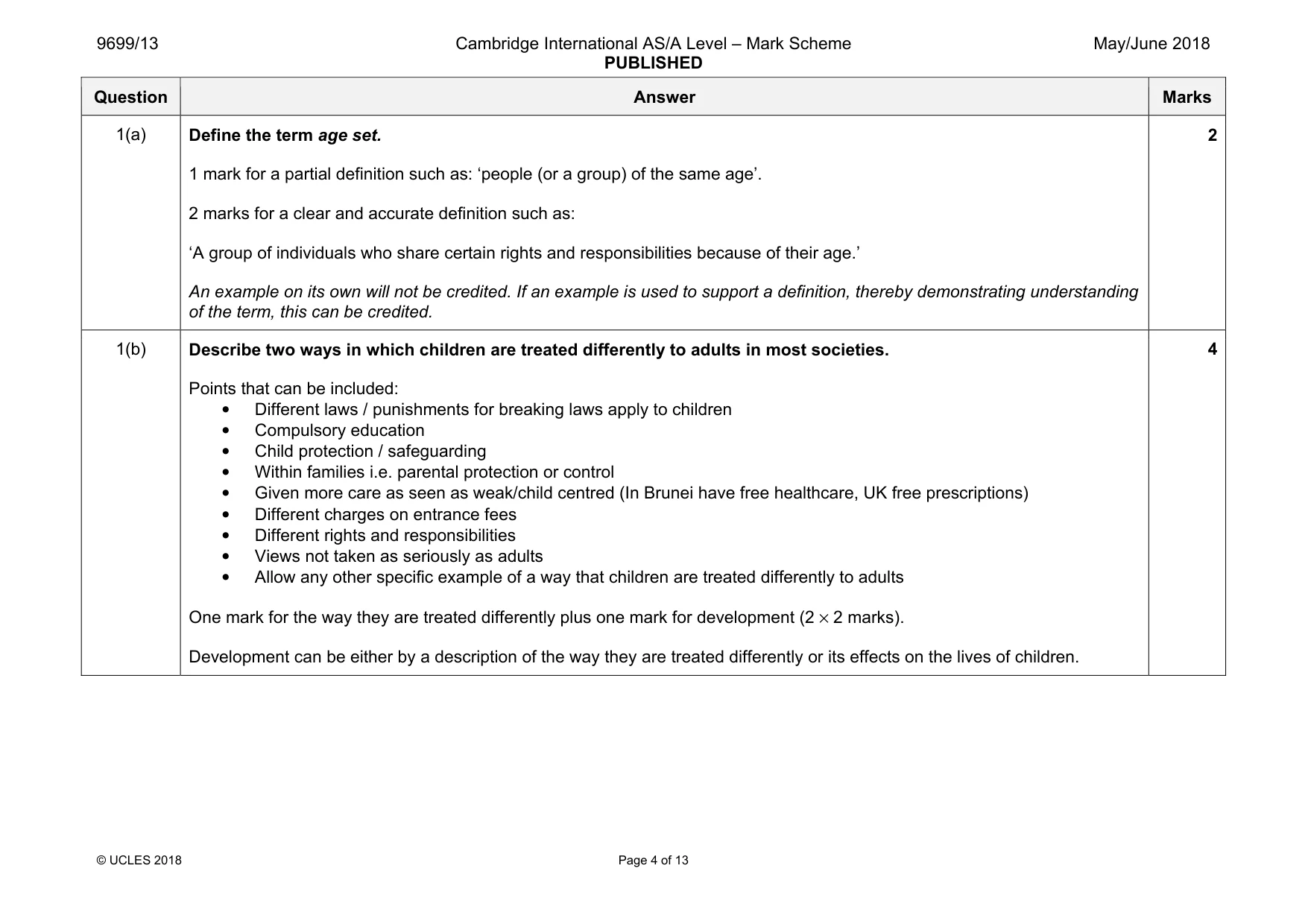
9699/13 Cambridge International AS/A Level – Mark Scheme PUBLISHED May/June 2018 © UCLES 2018 Page 4 of 13 Question Answer Marks 1(a) Define the term age set. 1 mark for a partial definition such as: ‘people (or a group) of the same age’. 2 marks for a clear and accurate definition such as: ‘A group of individuals who share certain rights and responsibilities because of their age.’ An example on its own will not be credited. If an example is used to support a definition, thereby demonstrating understanding of the term, this can be credited. 2 1(b) Describe two ways in which children are treated differently to adults in most societies. Points that can be included: • Different laws / punishments for breaking laws apply to children • Compulsory education • Child protection / safeguarding • Within families i.e. parental protection or control • Given more care as seen as weak/child centred (In Brunei have free healthcare, UK free prescriptions) • Different charges on entrance fees • Different rights and responsibilities • Views not taken as seriously as adults • Allow any other specific example of a way that children are treated differently to adults One mark for the way they are treated differently plus one mark for development (2 × 2 marks). Development can be either by a description of the way they are treated differently or its effects on the lives of children. 4
Mark scheme, page 5
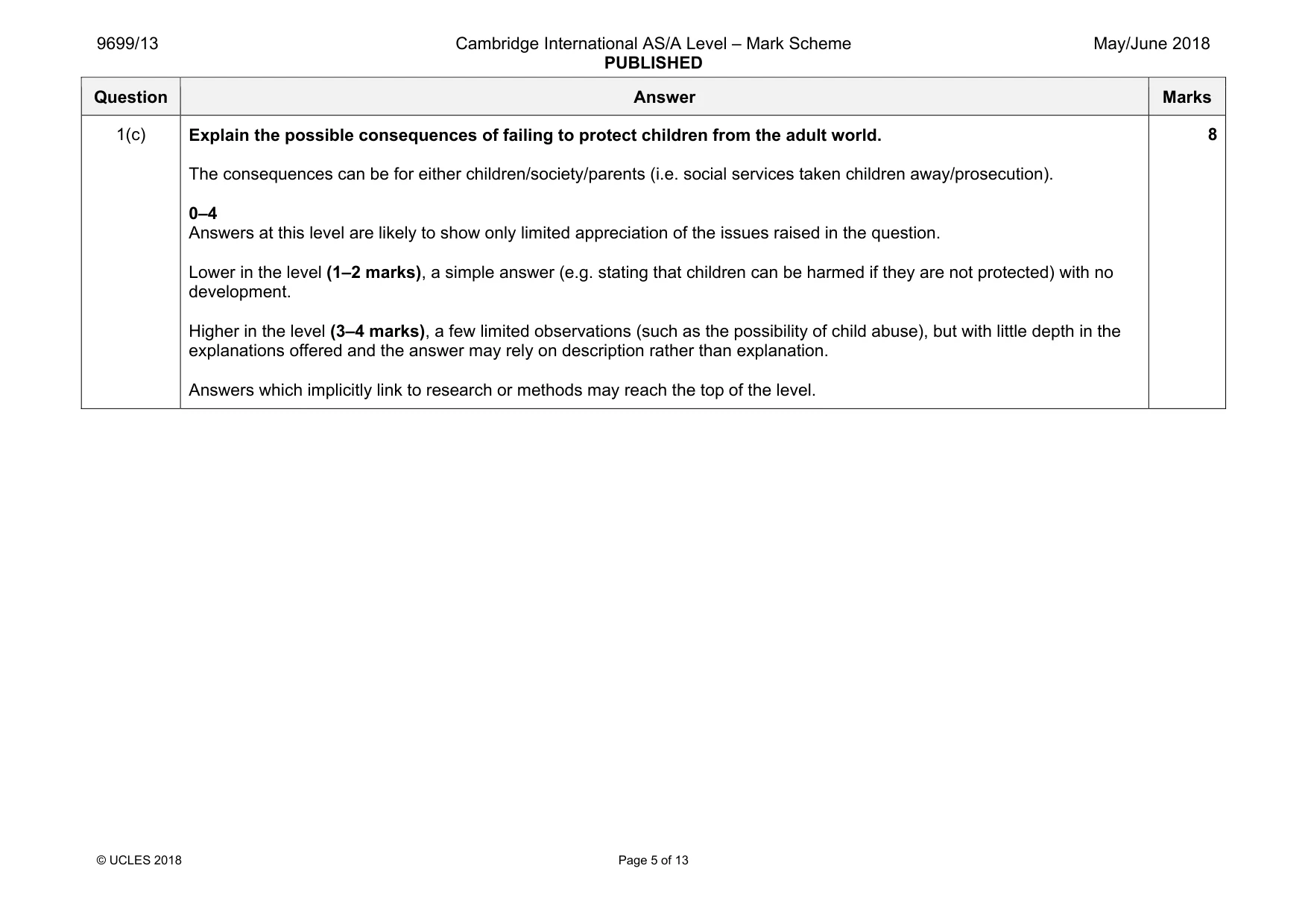
9699/13 Cambridge International AS/A Level – Mark Scheme PUBLISHED May/June 2018 © UCLES 2018 Page 5 of 13 Question Answer Marks 1(c) Explain the possible consequences of failing to protect children from the adult world. The consequences can be for either children/society/parents (i.e. social services taken children away/prosecution). 0–4 Answers at this level are likely to show only limited appreciation of the issues raised in the question. Lower in the level (1–2 marks), a simple answer (e.g. stating that children can be harmed if they are not protected) with no development. Higher in the level (3–4 marks), a few limited observations (such as the possibility of child abuse), but with little depth in the explanations offered and the answer may rely on description rather than explanation. Answers which implicitly link to research or methods may reach the top of the level. 8
Mark scheme, page 6
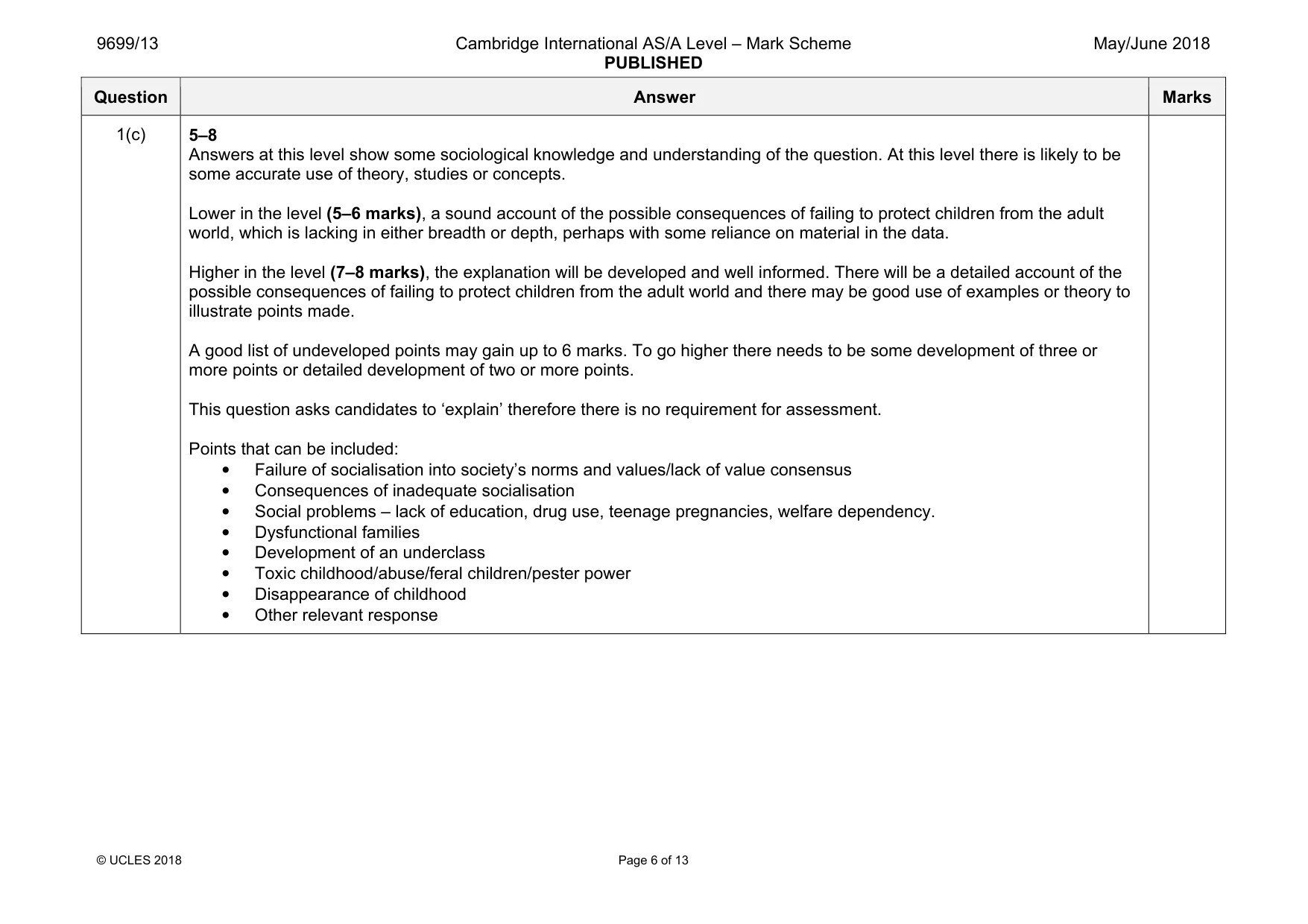
9699/13 Cambridge International AS/A Level – Mark Scheme PUBLISHED May/June 2018 © UCLES 2018 Page 6 of 13 Question Answer Marks 1(c) 5–8 Answers at this level show some sociological knowledge and understanding of the question. At this level there is likely to be some accurate use of theory, studies or concepts. Lower in the level (5–6 marks), a sound account of the possible consequences of failing to protect children from the adult world, which is lacking in either breadth or depth, perhaps with some reliance on material in the data. Higher in the level (7–8 marks), the explanation will be developed and well informed. There will be a detailed account of the possible consequences of failing to protect children from the adult world and there may be good use of examples or theory to illustrate points made. A good list of undeveloped points may gain up to 6 marks. To go higher there needs to be some development of three or more points or detailed development of two or more points. This question asks candidates to ‘explain’ therefore there is no requirement for assessment. Points that can be included: • Failure of socialisation into society’s norms and values/lack of value consensus • Consequences of inadequate socialisation • Social problems – lack of education, drug use, teenage pregnancies, welfare dependency. • Dysfunctional families • Development of an underclass • Toxic childhood/abuse/feral children/pester power • Disappearance of childhood • Other relevant response
Mark scheme, page 7
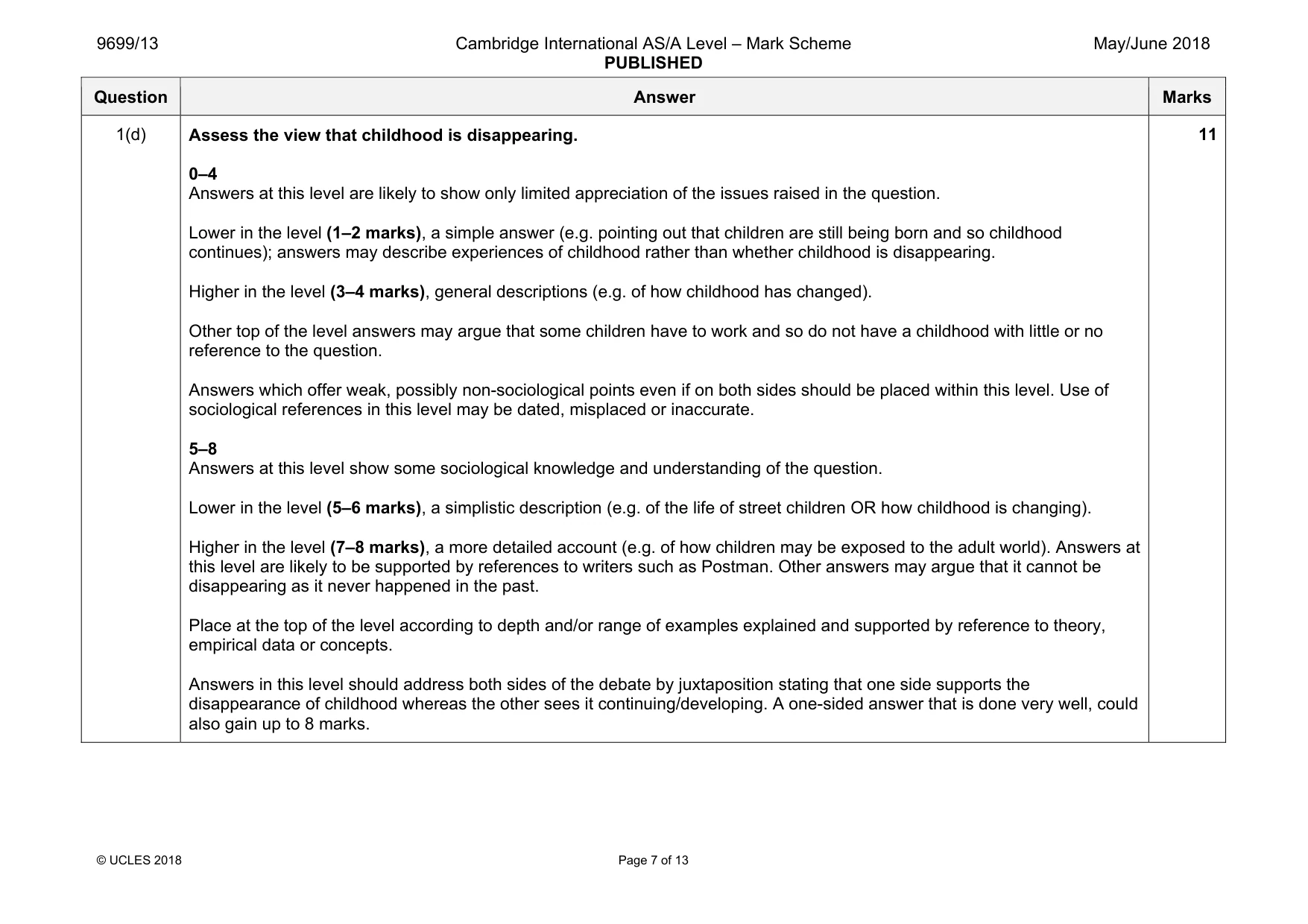
9699/13 Cambridge International AS/A Level – Mark Scheme PUBLISHED May/June 2018 © UCLES 2018 Page 7 of 13 Question Answer Marks 1(d) Assess the view that childhood is disappearing. 0–4 Answers at this level are likely to show only limited appreciation of the issues raised in the question. Lower in the level (1–2 marks), a simple answer (e.g. pointing out that children are still being born and so childhood continues); answers may describe experiences of childhood rather than whether childhood is disappearing. Higher in the level (3–4 marks), general descriptions (e.g. of how childhood has changed). Other top of the level answers may argue that some children have to work and so do not have a childhood with little or no reference to the question. Answers which offer weak, possibly non-sociological points even if on both sides should be placed within this level. Use of sociological references in this level may be dated, misplaced or inaccurate. 5–8 Answers at this level show some sociological knowledge and understanding of the question. Lower in the level (5–6 marks), a simplistic description (e.g. of the life of street children OR how childhood is changing). Higher in the level (7–8 marks), a more detailed account (e.g. of how children may be exposed to the adult world). Answers at this level are likely to be supported by references to writers such as Postman. Other answers may argue that it cannot be disappearing as it never happened in the past. Place at the top of the level according to depth and/or range of examples explained and supported by reference to theory, empirical data or concepts. Answers in this level should address both sides of the debate by juxtaposition stating that one side supports the disappearance of childhood whereas the other sees it continuing/developing. A one-sided answer that is done very well, could also gain up to 8 marks. 11
Mark scheme, page 8
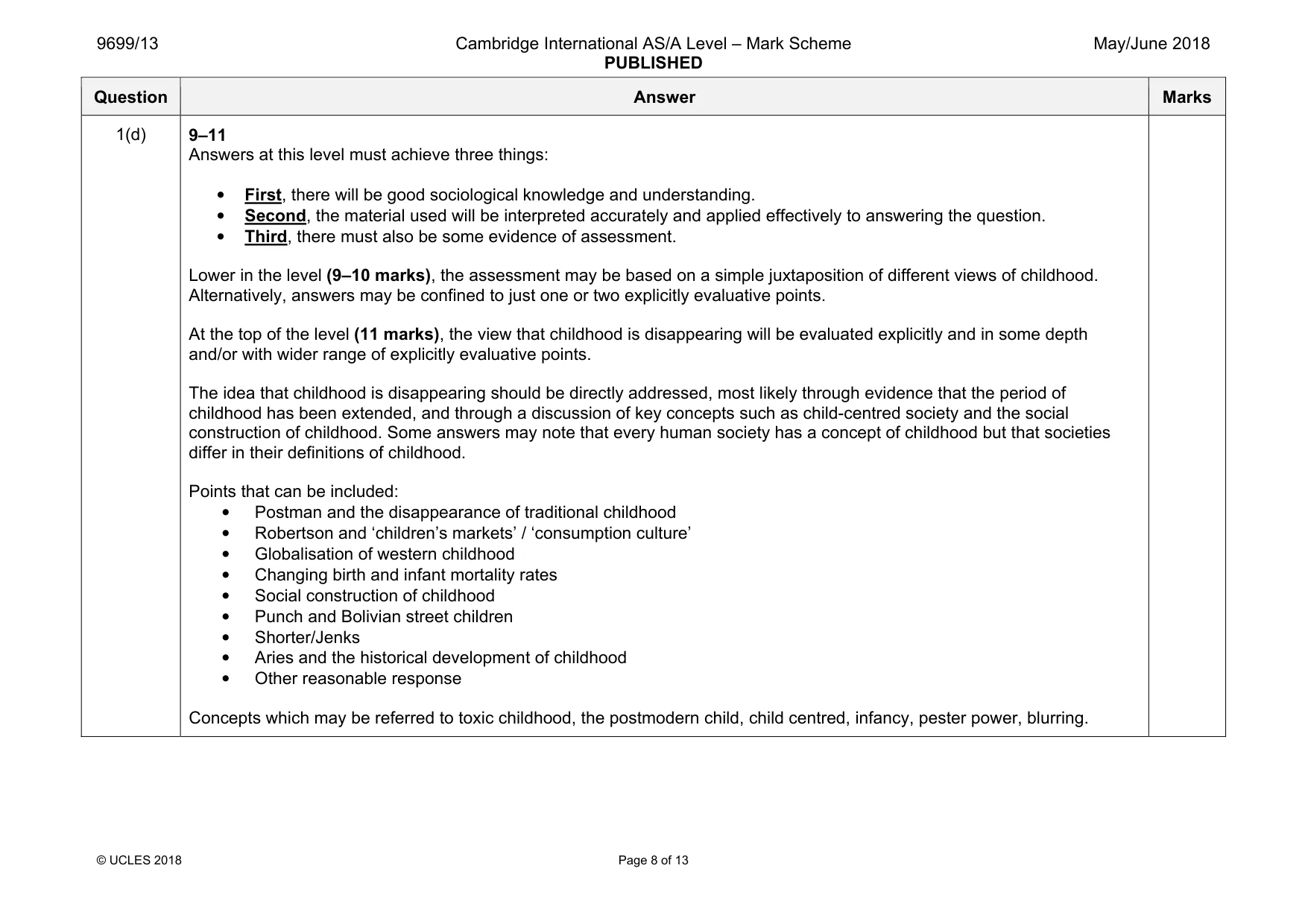
9699/13 Cambridge International AS/A Level – Mark Scheme PUBLISHED May/June 2018 © UCLES 2018 Page 8 of 13 Question Answer Marks 1(d) 9–11 Answers at this level must achieve three things: • First, there will be good sociological knowledge and understanding. • Second, the material used will be interpreted accurately and applied effectively to answering the question. • Third, there must also be some evidence of assessment. Lower in the level (9–10 marks), the assessment may be based on a simple juxtaposition of different views of childhood. Alternatively, answers may be confined to just one or two explicitly evaluative points. At the top of the level (11 marks), the view that childhood is disappearing will be evaluated explicitly and in some depth and/or with wider range of explicitly evaluative points. The idea that childhood is disappearing should be directly addressed, most likely through evidence that the period of childhood has been extended, and through a discussion of key concepts such as child-centred society and the social construction of childhood. Some answers may note that every human society has a concept of childhood but that societies differ in their definitions of childhood. Points that can be included: • Postman and the disappearance of traditional childhood • Robertson and ‘children’s markets’ / ‘consumption culture’ • Globalisation of western childhood • Changing birth and infant mortality rates • Social construction of childhood • Punch and Bolivian street children • Shorter/Jenks • Aries and the historical development of childhood • Other reasonable response Concepts which may be referred to toxic childhood, the postmodern child, child centred, infancy, pester power, blurring.
Mark scheme, page 9
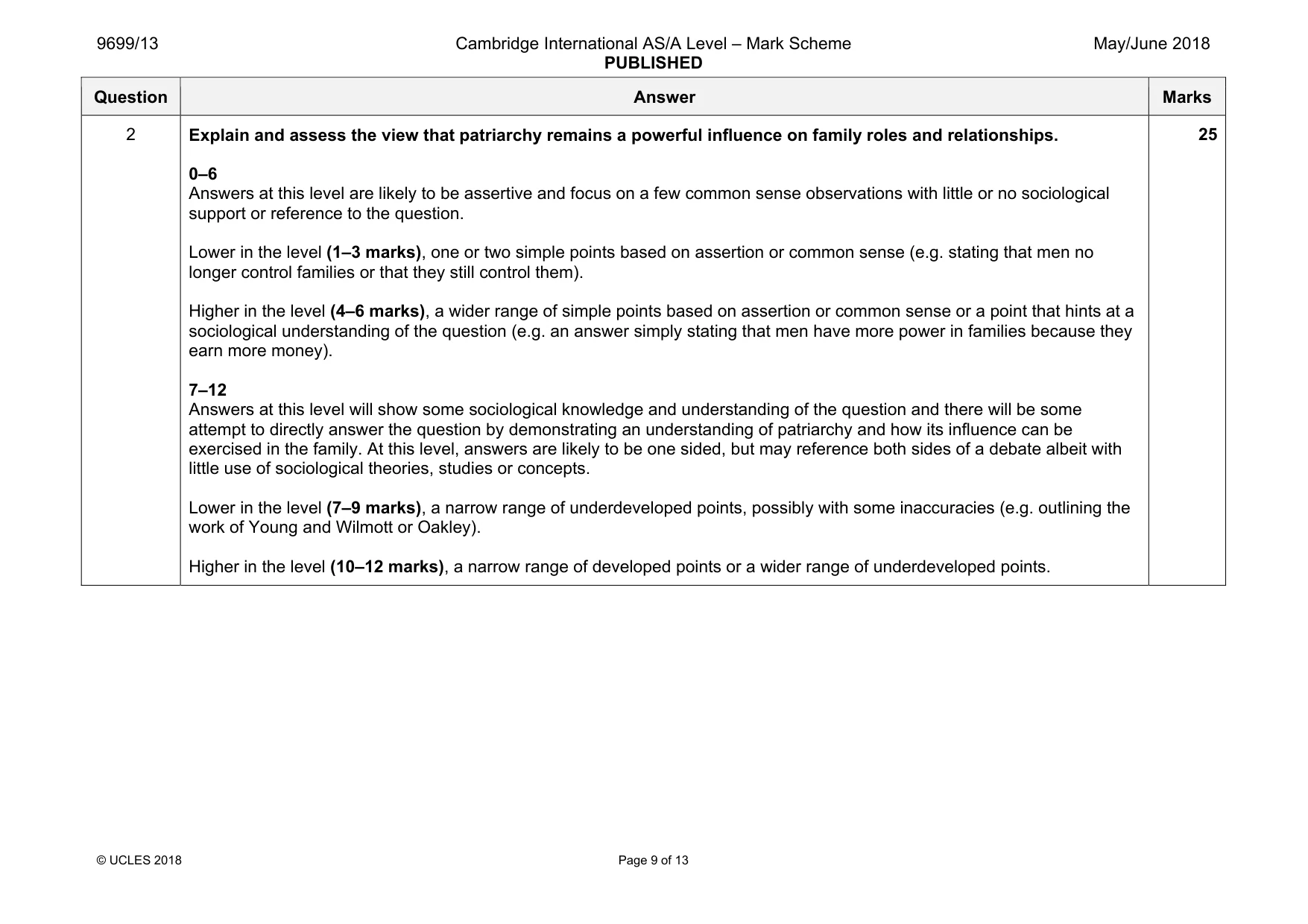
9699/13 Cambridge International AS/A Level – Mark Scheme PUBLISHED May/June 2018 © UCLES 2018 Page 9 of 13 Question Answer Marks 2 Explain and assess the view that patriarchy remains a powerful influence on family roles and relationships. 0–6 Answers at this level are likely to be assertive and focus on a few common sense observations with little or no sociological support or reference to the question. Lower in the level (1–3 marks), one or two simple points based on assertion or common sense (e.g. stating that men no longer control families or that they still control them). Higher in the level (4–6 marks), a wider range of simple points based on assertion or common sense or a point that hints at a sociological understanding of the question (e.g. an answer simply stating that men have more power in families because they earn more money). 7–12 Answers at this level will show some sociological knowledge and understanding of the question and there will be some attempt to directly answer the question by demonstrating an understanding of patriarchy and how its influence can be exercised in the family. At this level, answers are likely to be one sided, but may reference both sides of a debate albeit with little use of sociological theories, studies or concepts. Lower in the level (7–9 marks), a narrow range of underdeveloped points, possibly with some inaccuracies (e.g. outlining the work of Young and Wilmott or Oakley). Higher in the level (10–12 marks), a narrow range of developed points or a wider range of underdeveloped points. 25
Mark scheme, page 10
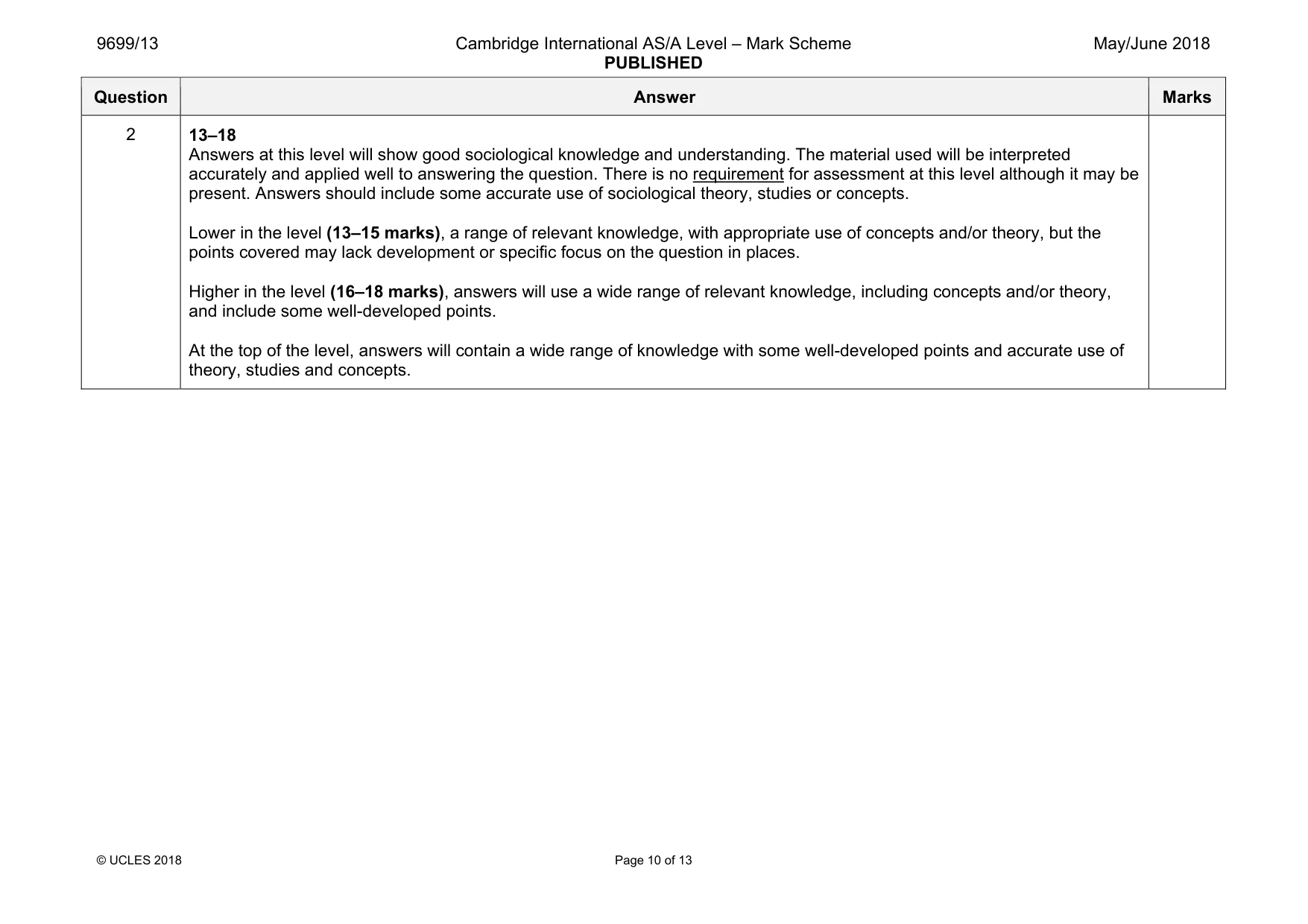
9699/13 Cambridge International AS/A Level – Mark Scheme PUBLISHED May/June 2018 © UCLES 2018 Page 10 of 13 Question Answer Marks 2 13–18 Answers at this level will show good sociological knowledge and understanding. The material used will be interpreted accurately and applied well to answering the question. There is no requirement for assessment at this level although it may be present. Answers should include some accurate use of sociological theory, studies or concepts. Lower in the level (13–15 marks), a range of relevant knowledge, with appropriate use of concepts and/or theory, but the points covered may lack development or specific focus on the question in places. Higher in the level (16–18 marks), answers will use a wide range of relevant knowledge, including concepts and/or theory, and include some well-developed points. At the top of the level, answers will contain a wide range of knowledge with some well-developed points and accurate use of theory, studies and concepts.
Mark scheme, page 11
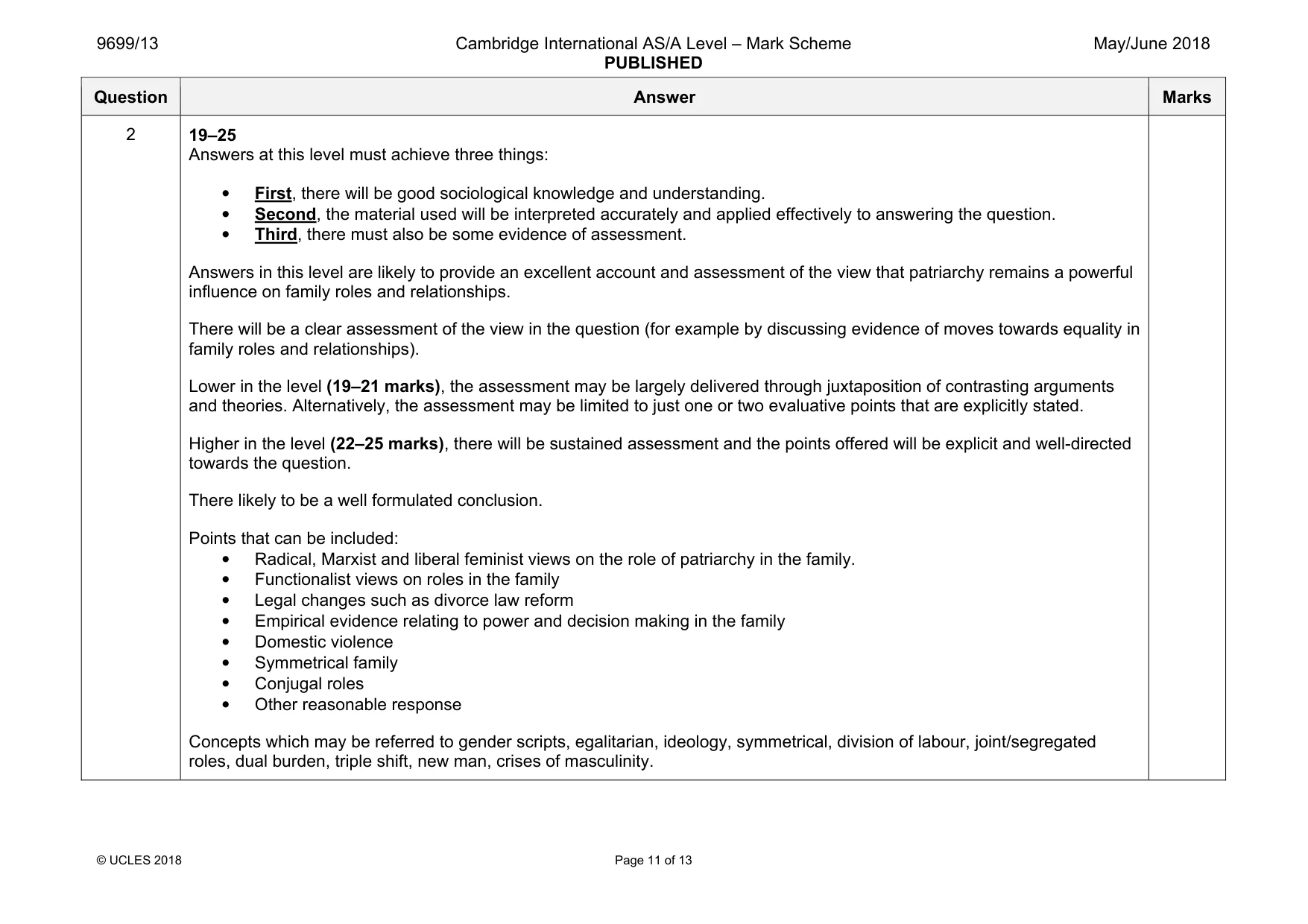
9699/13 Cambridge International AS/A Level – Mark Scheme PUBLISHED May/June 2018 © UCLES 2018 Page 11 of 13 Question Answer Marks 2 19–25 Answers at this level must achieve three things: • First, there will be good sociological knowledge and understanding. • Second, the material used will be interpreted accurately and applied effectively to answering the question. • Third, there must also be some evidence of assessment. Answers in this level are likely to provide an excellent account and assessment of the view that patriarchy remains a powerful influence on family roles and relationships. There will be a clear assessment of the view in the question (for example by discussing evidence of moves towards equality in family roles and relationships). Lower in the level (19–21 marks), the assessment may be largely delivered through juxtaposition of contrasting arguments and theories. Alternatively, the assessment may be limited to just one or two evaluative points that are explicitly stated. Higher in the level (22–25 marks), there will be sustained assessment and the points offered will be explicit and well-directed towards the question. There likely to be a well formulated conclusion. Points that can be included: • Radical, Marxist and liberal feminist views on the role of patriarchy in the family. • Functionalist views on roles in the family • Legal changes such as divorce law reform • Empirical evidence relating to power and decision making in the family • Domestic violence • Symmetrical family • Conjugal roles • Other reasonable response Concepts which may be referred to gender scripts, egalitarian, ideology, symmetrical, division of labour, joint/segregated roles, dual burden, triple shift, new man, crises of masculinity.
Mark scheme, page 12
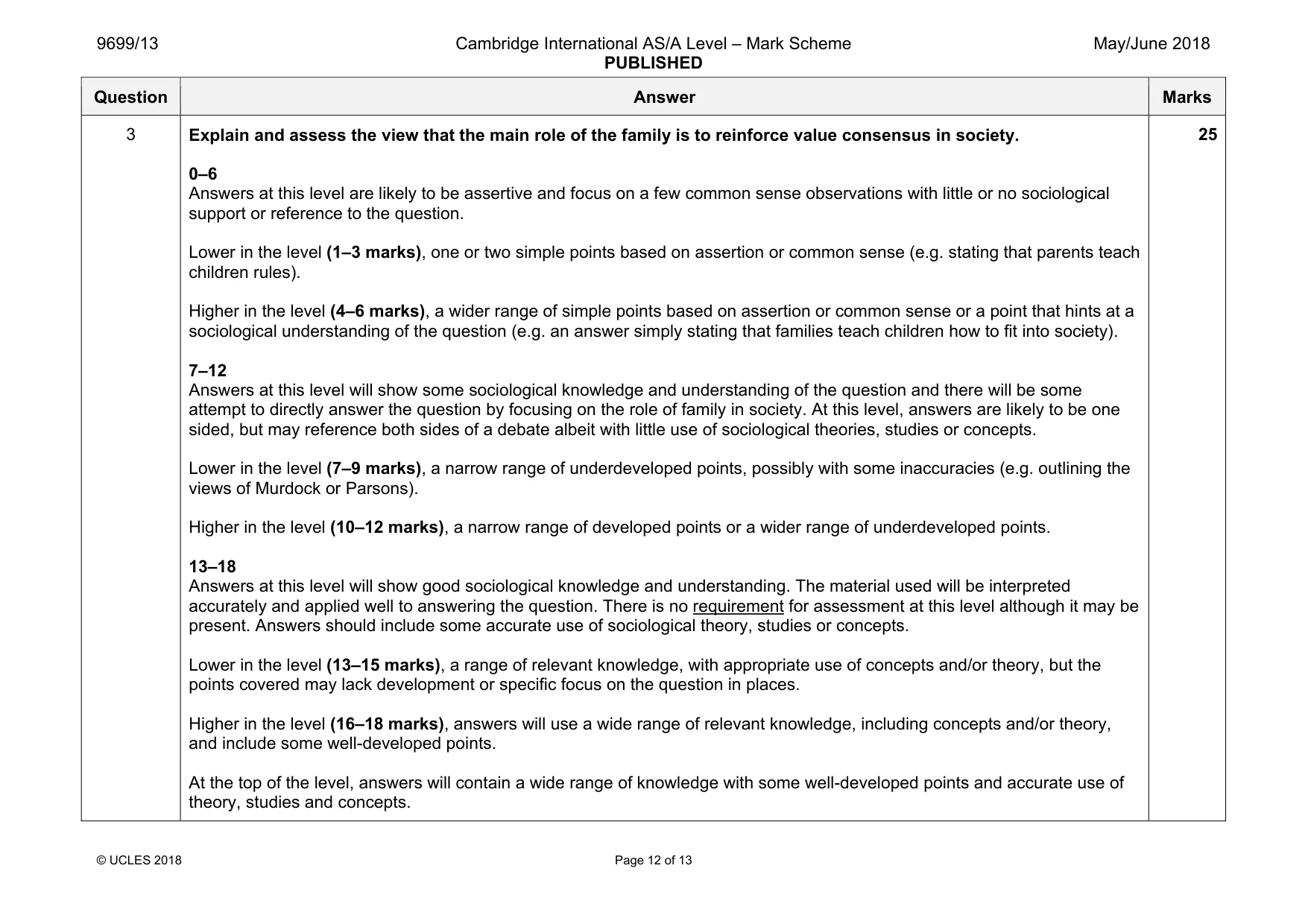
9699/13 Cambridge International AS/A Level – Mark Scheme PUBLISHED May/June 2018 © UCLES 2018 Page 12 of 13 Question Answer Marks 3 Explain and assess the view that the main role of the family is to reinforce value consensus in society. 0–6 Answers at this level are likely to be assertive and focus on a few common sense observations with little or no sociological support or reference to the question. Lower in the level (1–3 marks), one or two simple points based on assertion or common sense (e.g. stating that parents teach children rules). Higher in the level (4–6 marks), a wider range of simple points based on assertion or common sense or a point that hints at a sociological understanding of the question (e.g. an answer simply stating that families teach children how to fit into society). 7–12 Answers at this level will show some sociological knowledge and understanding of the question and there will be some attempt to directly answer the question by focusing on the role of family in society. At this level, answers are likely to be one sided, but may reference both sides of a debate albeit with little use of sociological theories, studies or concepts. Lower in the level (7–9 marks), a narrow range of underdeveloped points, possibly with some inaccuracies (e.g. outlining the views of Murdock or Parsons). Higher in the level (10–12 marks), a narrow range of developed points or a wider range of underdeveloped points. 13–18 Answers at this level will show good sociological knowledge and understanding. The material used will be interpreted accurately and applied well to answering the question. There is no requirement for assessment at this level although it may be present. Answers should include some accurate use of sociological theory, studies or concepts. Lower in the level (13–15 marks), a range of relevant knowledge, with appropriate use of concepts and/or theory, but the points covered may lack development or specific focus on the question in places. Higher in the level (16–18 marks), answers will use a wide range of relevant knowledge, including concepts and/or theory, and include some well-developed points. At the top of the level, answers will contain a wide range of knowledge with some well-developed points and accurate use of theory, studies and concepts. 25
Mark scheme, page 13
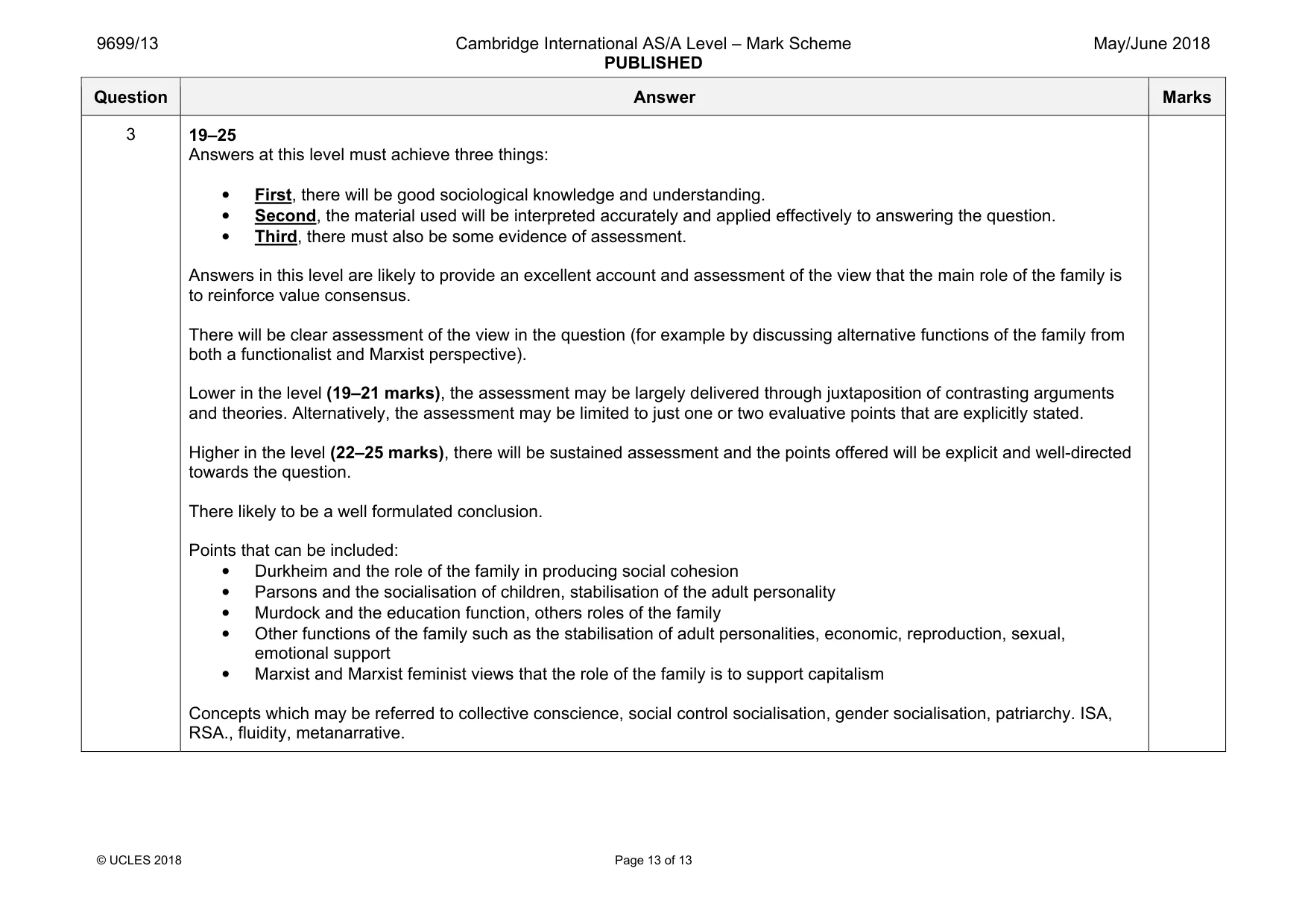
9699/13 Cambridge International AS/A Level – Mark Scheme PUBLISHED May/June 2018 © UCLES 2018 Page 13 of 13 Question Answer Marks 3 19–25 Answers at this level must achieve three things: • First, there will be good sociological knowledge and understanding. • Second, the material used will be interpreted accurately and applied effectively to answering the question. • Third, there must also be some evidence of assessment. Answers in this level are likely to provide an excellent account and assessment of the view that the main role of the family is to reinforce value consensus. There will be clear assessment of the view in the question (for example by discussing alternative functions of the family from both a functionalist and Marxist perspective). Lower in the level (19–21 marks), the assessment may be largely delivered through juxtaposition of contrasting arguments and theories. Alternatively, the assessment may be limited to just one or two evaluative points that are explicitly stated. Higher in the level (22–25 marks), there will be sustained assessment and the points offered will be explicit and well-directed towards the question. There likely to be a well formulated conclusion. Points that can be included: • Durkheim and the role of the family in producing social cohesion • Parsons and the socialisation of children, stabilisation of the adult personality • Murdock and the education function, others roles of the family • Other functions of the family such as the stabilisation of adult personalities, economic, reproduction, sexual, emotional support • Marxist and Marxist feminist views that the role of the family is to support capitalism Concepts which may be referred to collective conscience, social control socialisation, gender socialisation, patriarchy. ISA, RSA., fluidity, metanarrative.
What you needed in this session
Cambridge’s own grade thresholds for 2018 May/June, Paper 1 · Variant 3. A higher threshold means an easier paper — the bar moves with how the cohort did.