Cambridge A Level Sociology 9699 — 2017 Oct/Nov Paper 1 · Variant 1
9699/11/O/N/17 · 50 marks · ≈56 min
The question paper and its mark scheme, free to read here and free to download. This is Cambridge’s own paper, exactly as it was sat.
Question paper4 pages

Mark scheme10 pages
Answers below. Sit the paper first if you are practising.
Paper as text
Question paper, page 1
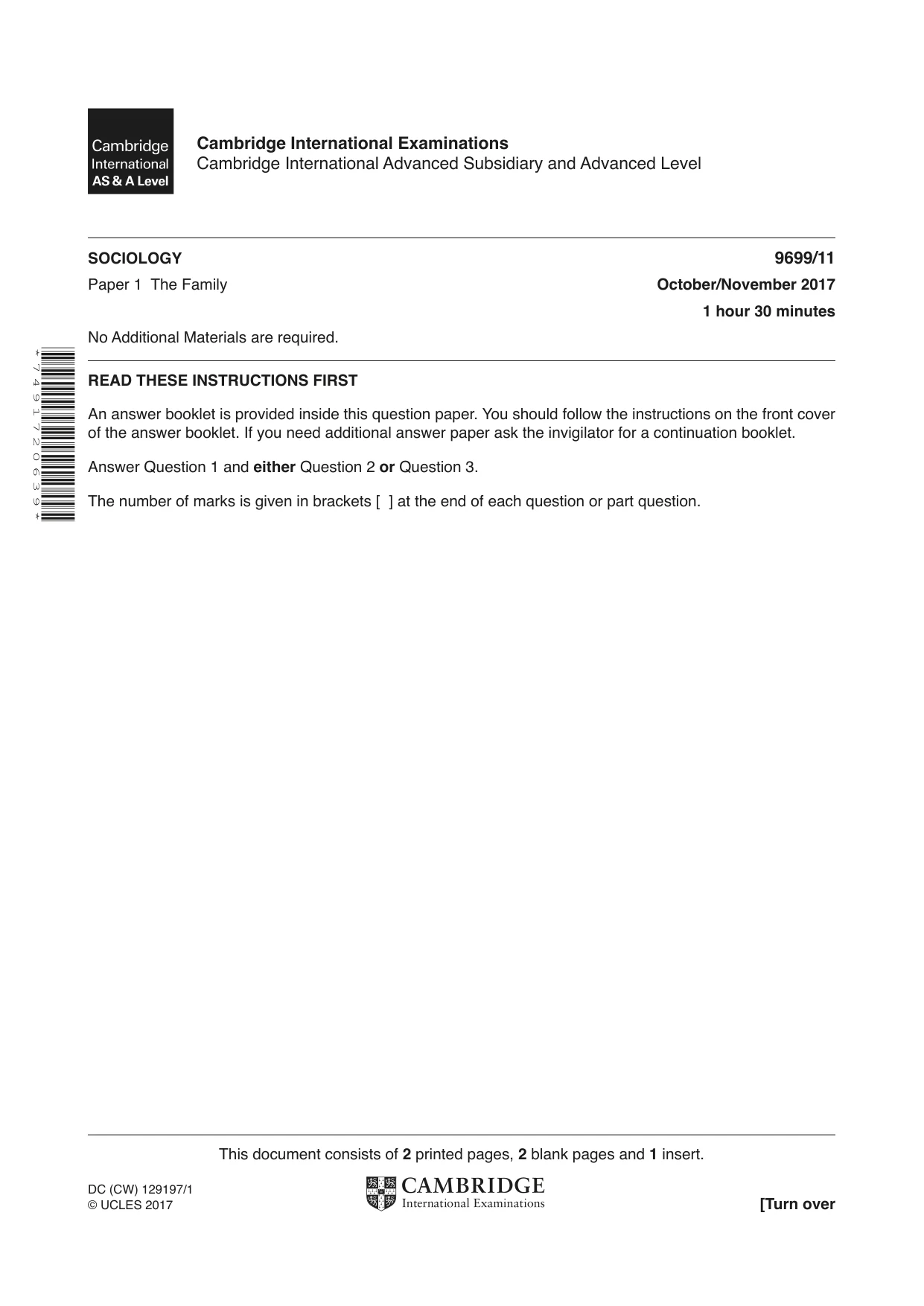
* 7 4 9 1 7 2 0 6 3 9 * This document consists of 2 printed pages, 2 blank pages and 1 insert. DC (CW) 129197/1 © UCLES 2017 [Turn over Cambridge International Examinations Cambridge International Advanced Subsidiary and Advanced Level SOCIOLOGY 9699/11 Paper 1 The Family October/November 2017 1 hour 30 minutes No Additional Materials are required. READ THESE INSTRUCTIONS FIRST An answer booklet is provided inside this question paper. You should follow the instructions on the front cover of the answer booklet. If you need additional answer paper ask the invigilator for a continuation booklet. Answer Question 1 and either Question 2 or Question 3. The number of marks is given in brackets [ ] at the end of each question or part question.
Question paper, page 2
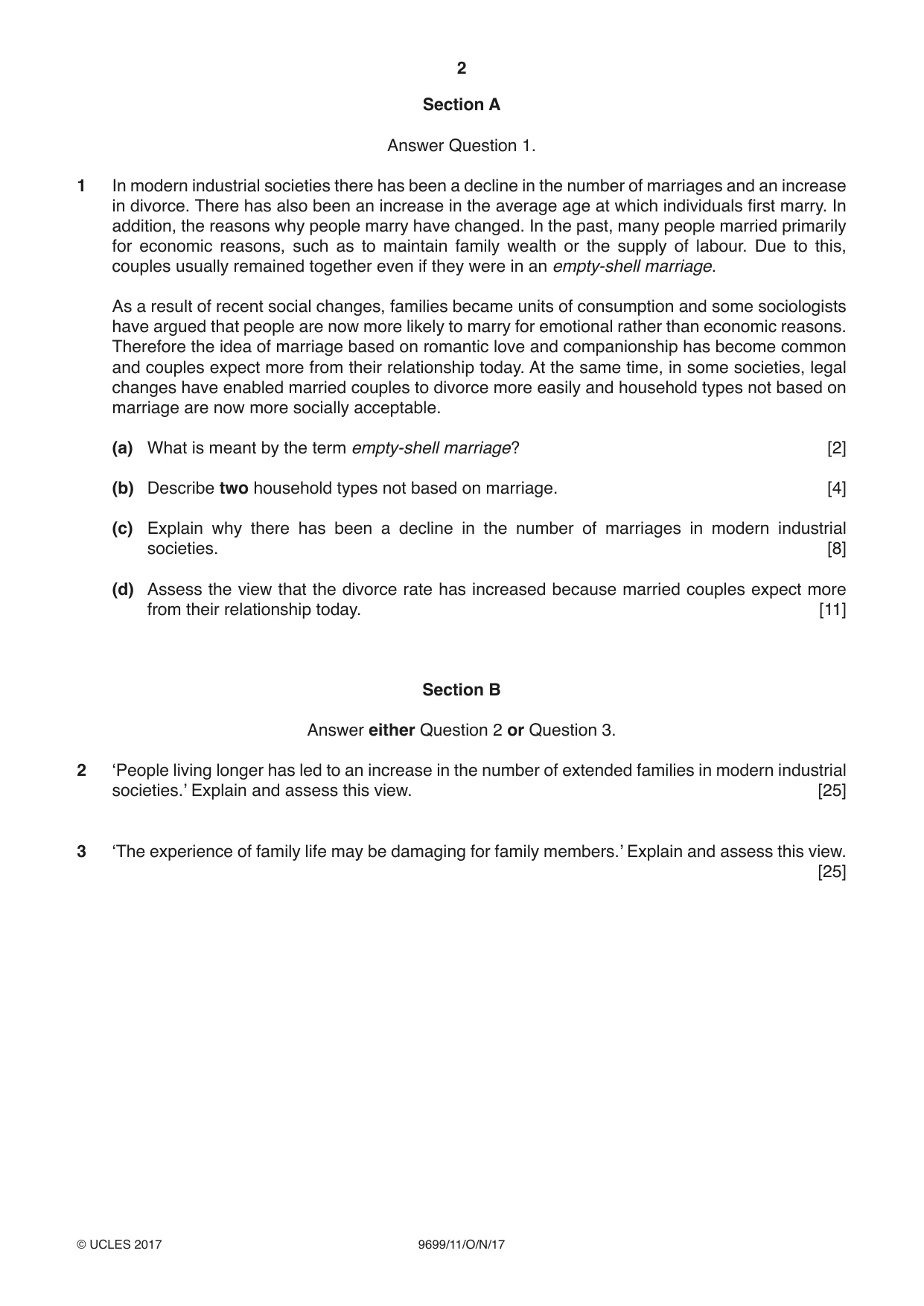
2 9699/11/O/N/17 © UCLES 2017 Section A Answer Question 1. 1 In modern industrial societies there has been a decline in the number of marriages and an increase in divorce. There has also been an increase in the average age at which individuals first marry. In addition, the reasons why people marry have changed. In the past, many people married primarily for economic reasons, such as to maintain family wealth or the supply of labour. Due to this, couples usually remained together even if they were in an empty-shell marriage. As a result of recent social changes, families became units of consumption and some sociologists have argued that people are now more likely to marry for emotional rather than economic reasons. Therefore the idea of marriage based on romantic love and companionship has become common and couples expect more from their relationship today. At the same time, in some societies, legal changes have enabled married couples to divorce more easily and household types not based on marriage are now more socially acceptable. (a) What is meant by the term empty-shell marriage? [2] (b) Describe two household types not based on marriage. [4] (c) Explain why there has been a decline in the number of marriages in modern industrial societies. [8] (d) Assess the view that the divorce rate has increased because married couples expect more from their relationship today. [11] Section B Answer either Question 2 or Question 3. 2 ‘People living longer has led to an increase in the number of extended families in modern industrial societies.’ Explain and assess this view. [25] 3 ‘The experience of family life may be damaging for family members.’ Explain and assess this view. [25]
Question paper, page 3
3 9699/11/O/N/17 © UCLES 2017 BLANK PAGE
Question paper, page 4
4 9699/11/O/N/17 © UCLES 2017 Permission to reproduce items where third-party owned material protected by copyright is included has been sought and cleared where possible. Every reasonable effort has been made by the publisher (UCLES) to trace copyright holders, but if any items requiring clearance have unwittingly been included, the publisher will be pleased to make amends at the earliest possible opportunity. To avoid the issue of disclosure of answer-related information to candidates, all copyright acknowledgements are reproduced online in the Cambridge International Examinations Copyright Acknowledgements Booklet. This is produced for each series of examinations and is freely available to download at www.cie.org.uk after the live examination series. Cambridge International Examinations is part of the Cambridge Assessment Group. Cambridge Assessment is the brand name of University of Cambridge Local Examinations Syndicate (UCLES), which is itself a department of the University of Cambridge. BLANK PAGE
Mark scheme, page 1
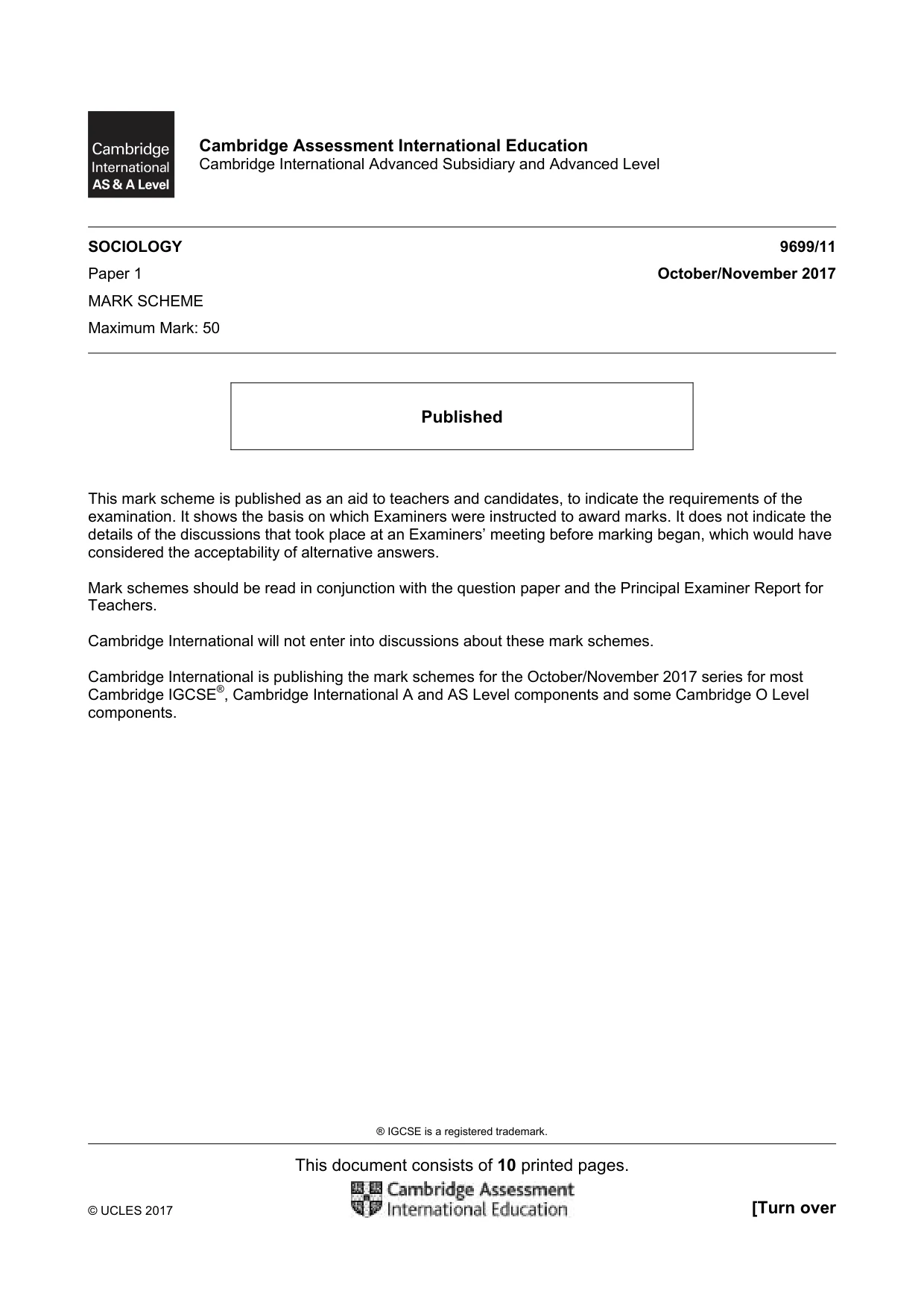
® IGCSE is a registered trademark. This document consists of 10 printed pages. © UCLES 2017 [Turn over Cambridge Assessment International Education Cambridge International Advanced Subsidiary and Advanced Level SOCIOLOGY 9699/11 Paper 1 October/November 2017 MARK SCHEME Maximum Mark: 50 Published This mark scheme is published as an aid to teachers and candidates, to indicate the requirements of the examination. It shows the basis on which Examiners were instructed to award marks. It does not indicate the details of the discussions that took place at an Examiners’ meeting before marking began, which would have considered the acceptability of alternative answers. Mark schemes should be read in conjunction with the question paper and the Principal Examiner Report for Teachers. Cambridge International will not enter into discussions about these mark schemes. Cambridge International is publishing the mark schemes for the October/November 2017 series for most Cambridge IGCSE®, Cambridge International A and AS Level components and some Cambridge O Level components.
Mark scheme, page 2
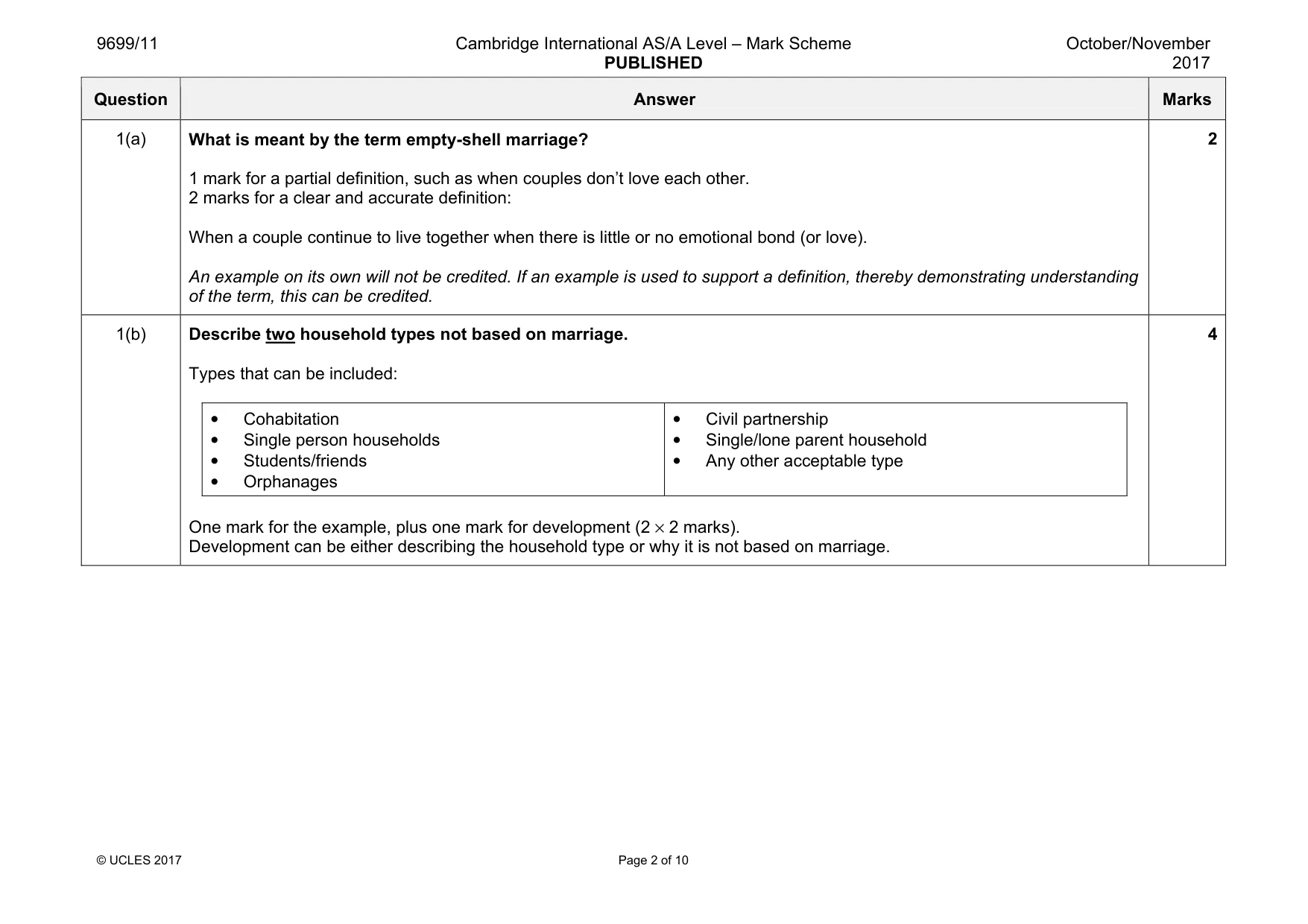
9699/11 Cambridge International AS/A Level – Mark Scheme PUBLISHED October/November 2017 © UCLES 2017 Page 2 of 10 Question Answer Marks 1(a) What is meant by the term empty-shell marriage? 1 mark for a partial definition, such as when couples don’t love each other. 2 marks for a clear and accurate definition: When a couple continue to live together when there is little or no emotional bond (or love). An example on its own will not be credited. If an example is used to support a definition, thereby demonstrating understanding of the term, this can be credited. 2 1(b) Describe two household types not based on marriage. Types that can be included: • Cohabitation • Single person households • Students/friends • Orphanages • Civil partnership • Single/lone parent household • Any other acceptable type One mark for the example, plus one mark for development (2 × 2 marks). Development can be either describing the household type or why it is not based on marriage. 4
Mark scheme, page 3
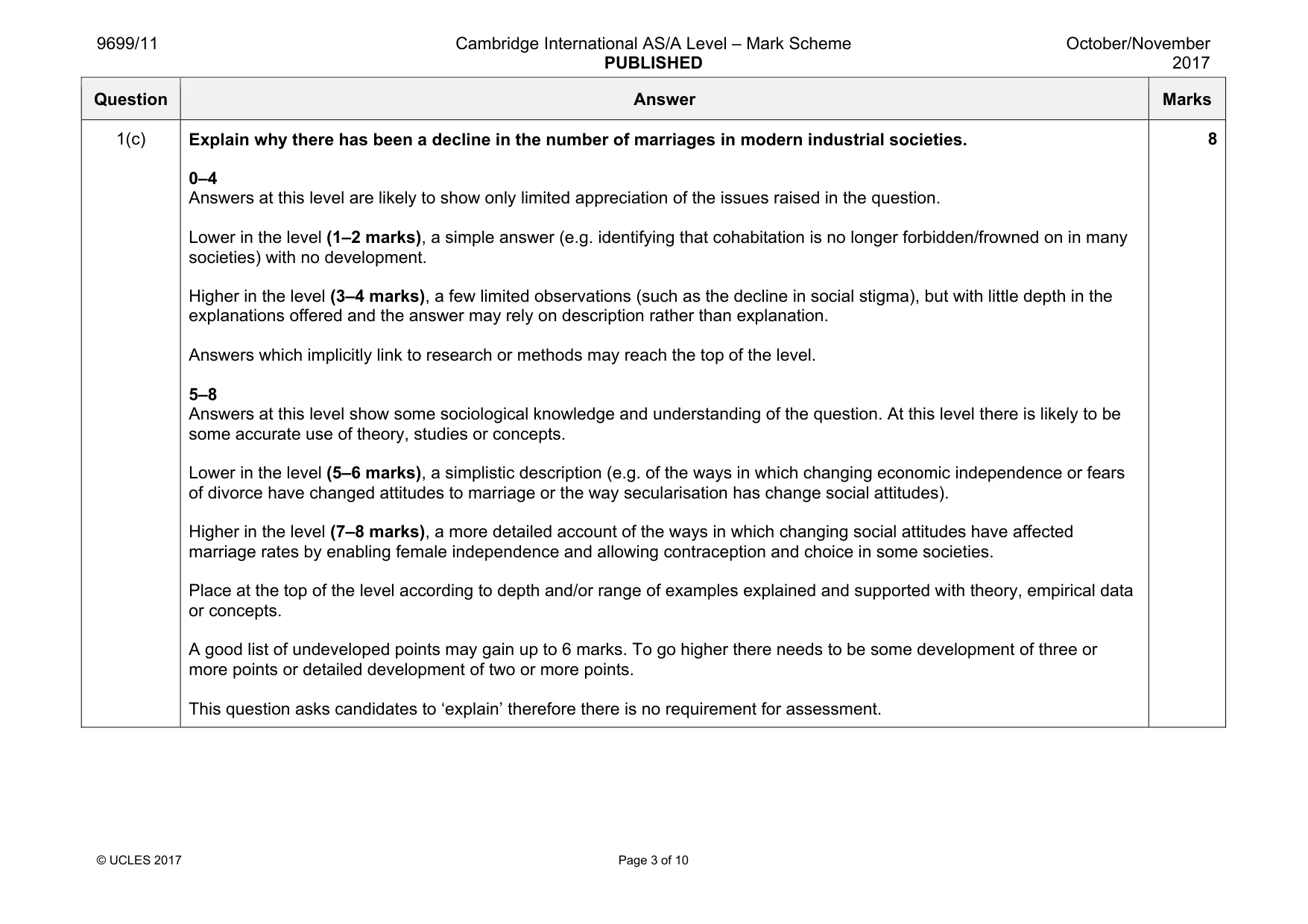
9699/11 Cambridge International AS/A Level – Mark Scheme PUBLISHED October/November 2017 © UCLES 2017 Page 3 of 10 Question Answer Marks 1(c) Explain why there has been a decline in the number of marriages in modern industrial societies. 0–4 Answers at this level are likely to show only limited appreciation of the issues raised in the question. Lower in the level (1–2 marks), a simple answer (e.g. identifying that cohabitation is no longer forbidden/frowned on in many societies) with no development. Higher in the level (3–4 marks), a few limited observations (such as the decline in social stigma), but with little depth in the explanations offered and the answer may rely on description rather than explanation. Answers which implicitly link to research or methods may reach the top of the level. 5–8 Answers at this level show some sociological knowledge and understanding of the question. At this level there is likely to be some accurate use of theory, studies or concepts. Lower in the level (5–6 marks), a simplistic description (e.g. of the ways in which changing economic independence or fears of divorce have changed attitudes to marriage or the way secularisation has change social attitudes). Higher in the level (7–8 marks), a more detailed account of the ways in which changing social attitudes have affected marriage rates by enabling female independence and allowing contraception and choice in some societies. Place at the top of the level according to depth and/or range of examples explained and supported with theory, empirical data or concepts. A good list of undeveloped points may gain up to 6 marks. To go higher there needs to be some development of three or more points or detailed development of two or more points. This question asks candidates to ‘explain’ therefore there is no requirement for assessment. 8
Mark scheme, page 4
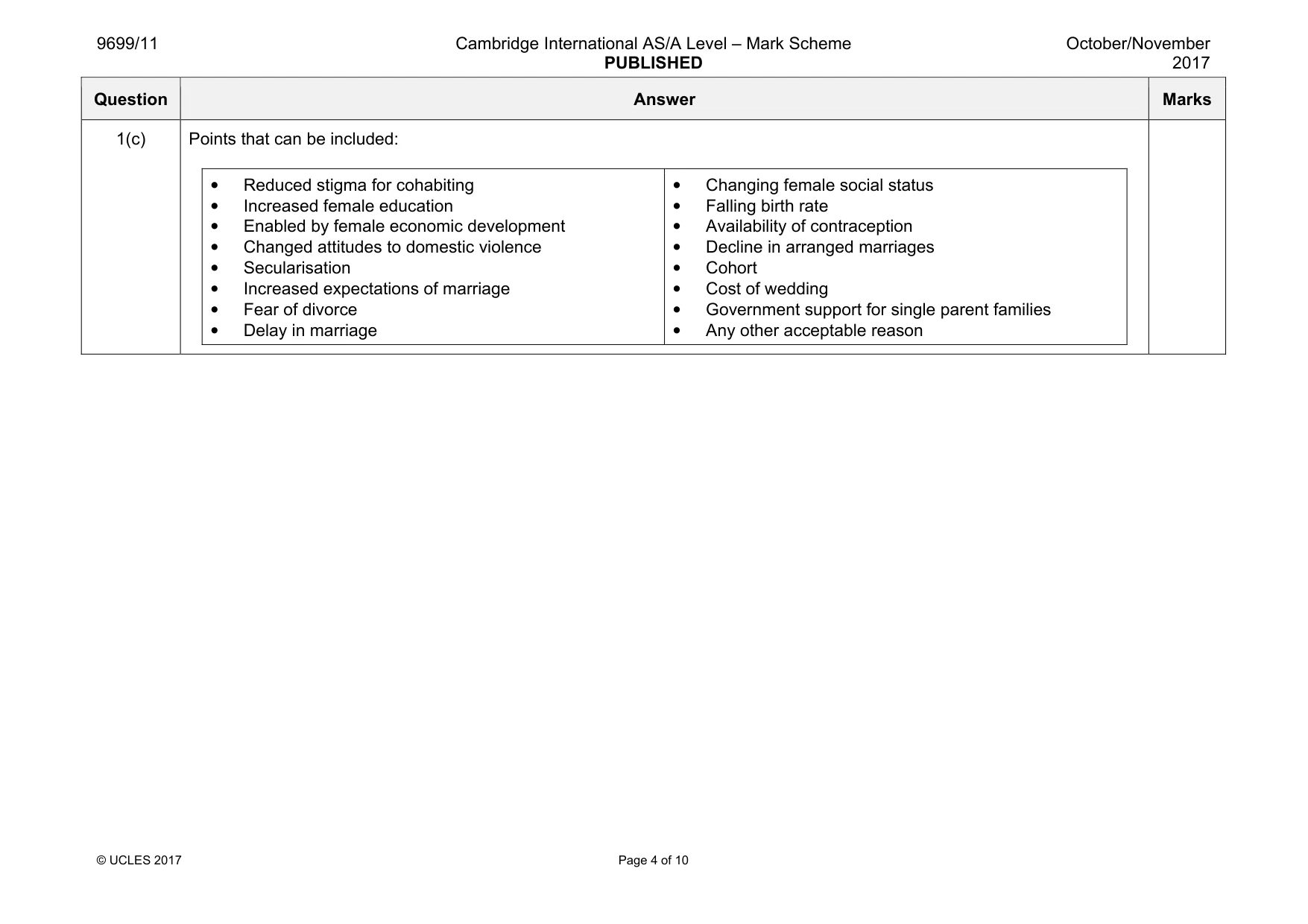
9699/11 Cambridge International AS/A Level – Mark Scheme PUBLISHED October/November 2017 © UCLES 2017 Page 4 of 10 Question Answer Marks 1(c) Points that can be included: • Reduced stigma for cohabiting • Increased female education • Enabled by female economic development • Changed attitudes to domestic violence • Secularisation • Increased expectations of marriage • Fear of divorce • Delay in marriage • Changing female social status • Falling birth rate • Availability of contraception • Decline in arranged marriages • Cohort • Cost of wedding • Government support for single parent families • Any other acceptable reason
Mark scheme, page 5
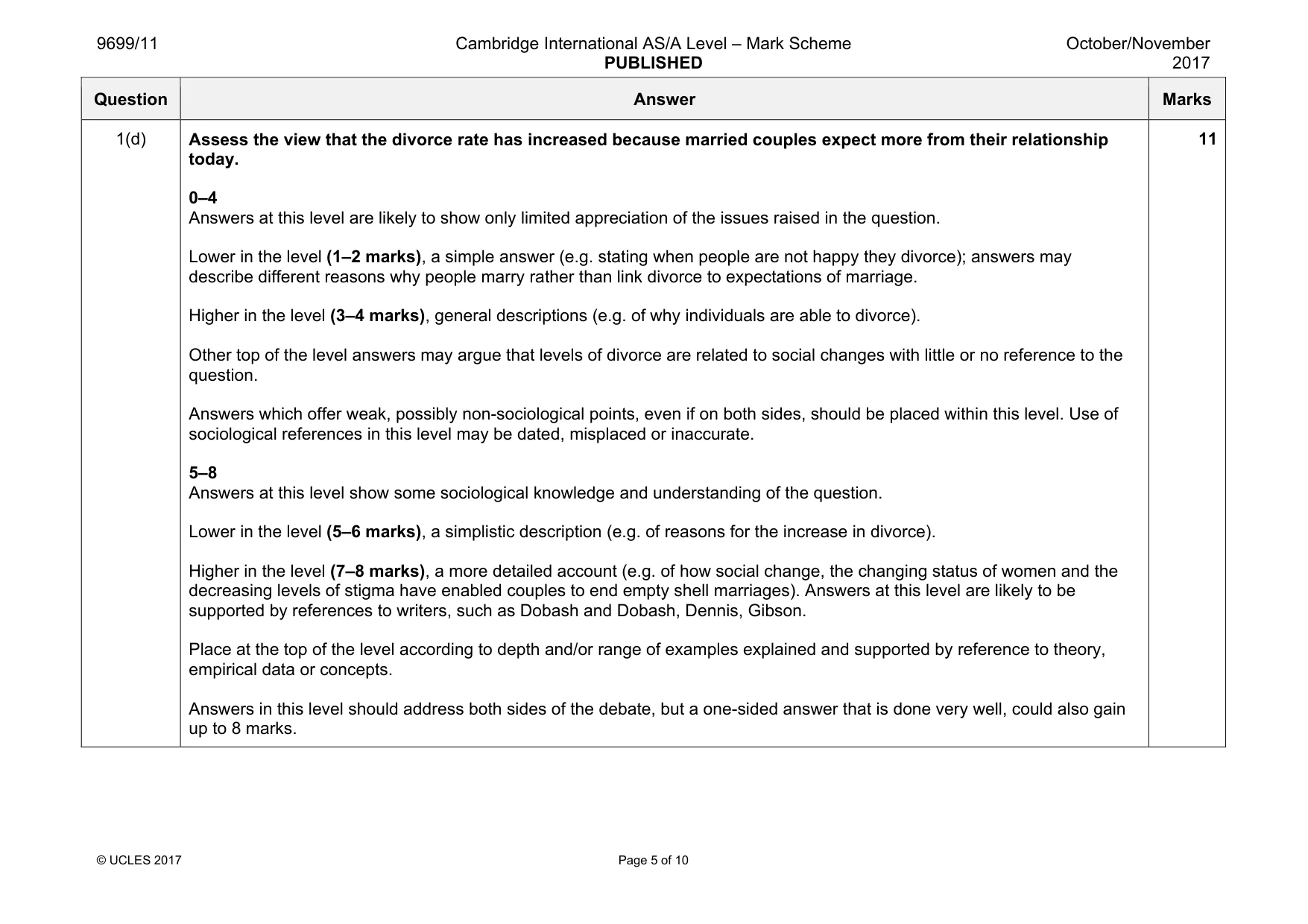
9699/11 Cambridge International AS/A Level – Mark Scheme PUBLISHED October/November 2017 © UCLES 2017 Page 5 of 10 Question Answer Marks 1(d) Assess the view that the divorce rate has increased because married couples expect more from their relationship today. 0–4 Answers at this level are likely to show only limited appreciation of the issues raised in the question. Lower in the level (1–2 marks), a simple answer (e.g. stating when people are not happy they divorce); answers may describe different reasons why people marry rather than link divorce to expectations of marriage. Higher in the level (3–4 marks), general descriptions (e.g. of why individuals are able to divorce). Other top of the level answers may argue that levels of divorce are related to social changes with little or no reference to the question. Answers which offer weak, possibly non-sociological points, even if on both sides, should be placed within this level. Use of sociological references in this level may be dated, misplaced or inaccurate. 5–8 Answers at this level show some sociological knowledge and understanding of the question. Lower in the level (5–6 marks), a simplistic description (e.g. of reasons for the increase in divorce). Higher in the level (7–8 marks), a more detailed account (e.g. of how social change, the changing status of women and the decreasing levels of stigma have enabled couples to end empty shell marriages). Answers at this level are likely to be supported by references to writers, such as Dobash and Dobash, Dennis, Gibson. Place at the top of the level according to depth and/or range of examples explained and supported by reference to theory, empirical data or concepts. Answers in this level should address both sides of the debate, but a one-sided answer that is done very well, could also gain up to 8 marks. 11
Mark scheme, page 6
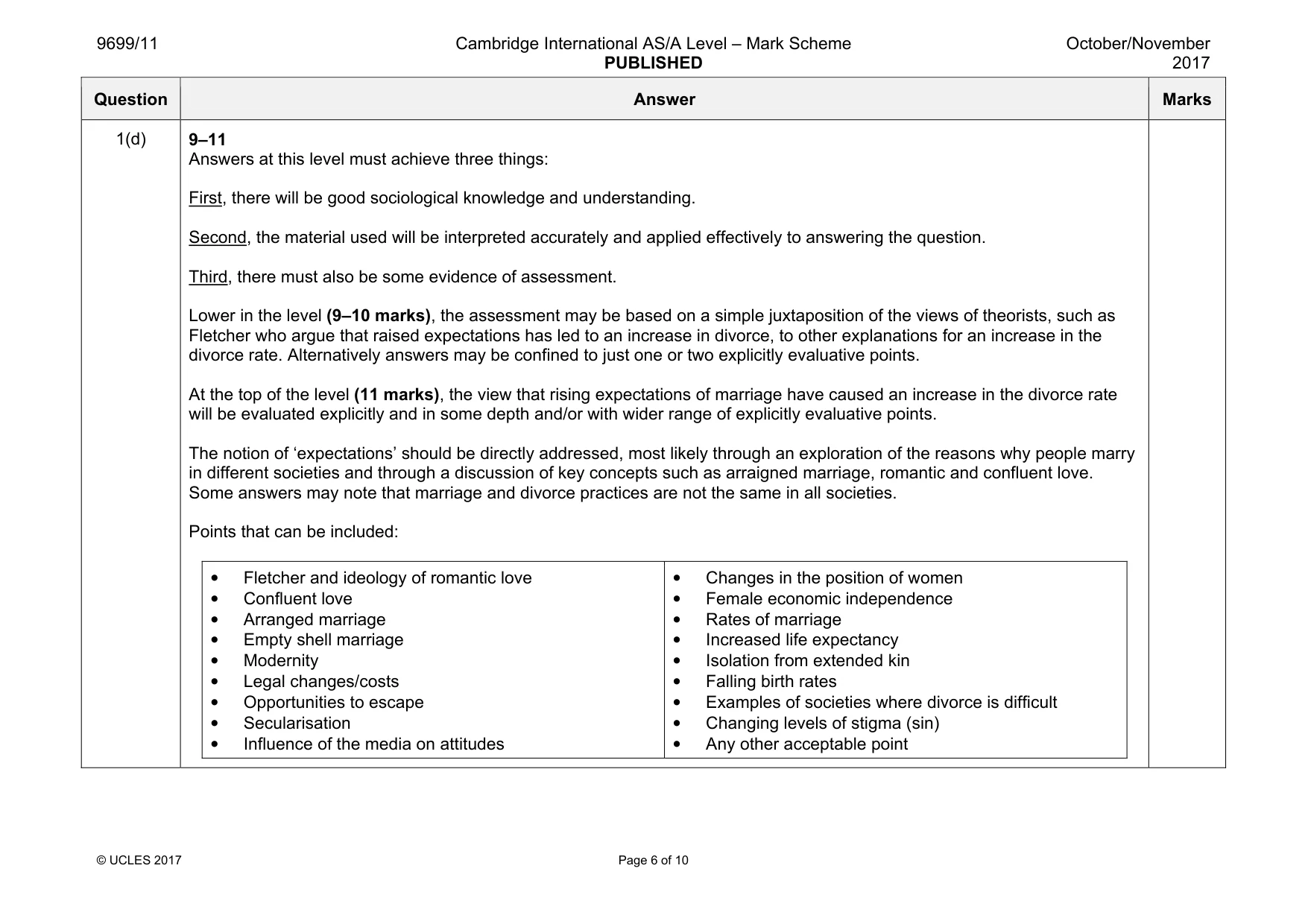
9699/11 Cambridge International AS/A Level – Mark Scheme PUBLISHED October/November 2017 © UCLES 2017 Page 6 of 10 Question Answer Marks 1(d) 9–11 Answers at this level must achieve three things: First, there will be good sociological knowledge and understanding. Second, the material used will be interpreted accurately and applied effectively to answering the question. Third, there must also be some evidence of assessment. Lower in the level (9–10 marks), the assessment may be based on a simple juxtaposition of the views of theorists, such as Fletcher who argue that raised expectations has led to an increase in divorce, to other explanations for an increase in the divorce rate. Alternatively answers may be confined to just one or two explicitly evaluative points. At the top of the level (11 marks), the view that rising expectations of marriage have caused an increase in the divorce rate will be evaluated explicitly and in some depth and/or with wider range of explicitly evaluative points. The notion of ‘expectations’ should be directly addressed, most likely through an exploration of the reasons why people marry in different societies and through a discussion of key concepts such as arraigned marriage, romantic and confluent love. Some answers may note that marriage and divorce practices are not the same in all societies. Points that can be included: • Fletcher and ideology of romantic love • Confluent love • Arranged marriage • Empty shell marriage • Modernity • Legal changes/costs • Opportunities to escape • Secularisation • Influence of the media on attitudes • Changes in the position of women • Female economic independence • Rates of marriage • Increased life expectancy • Isolation from extended kin • Falling birth rates • Examples of societies where divorce is difficult • Changing levels of stigma (sin) • Any other acceptable point
Mark scheme, page 7
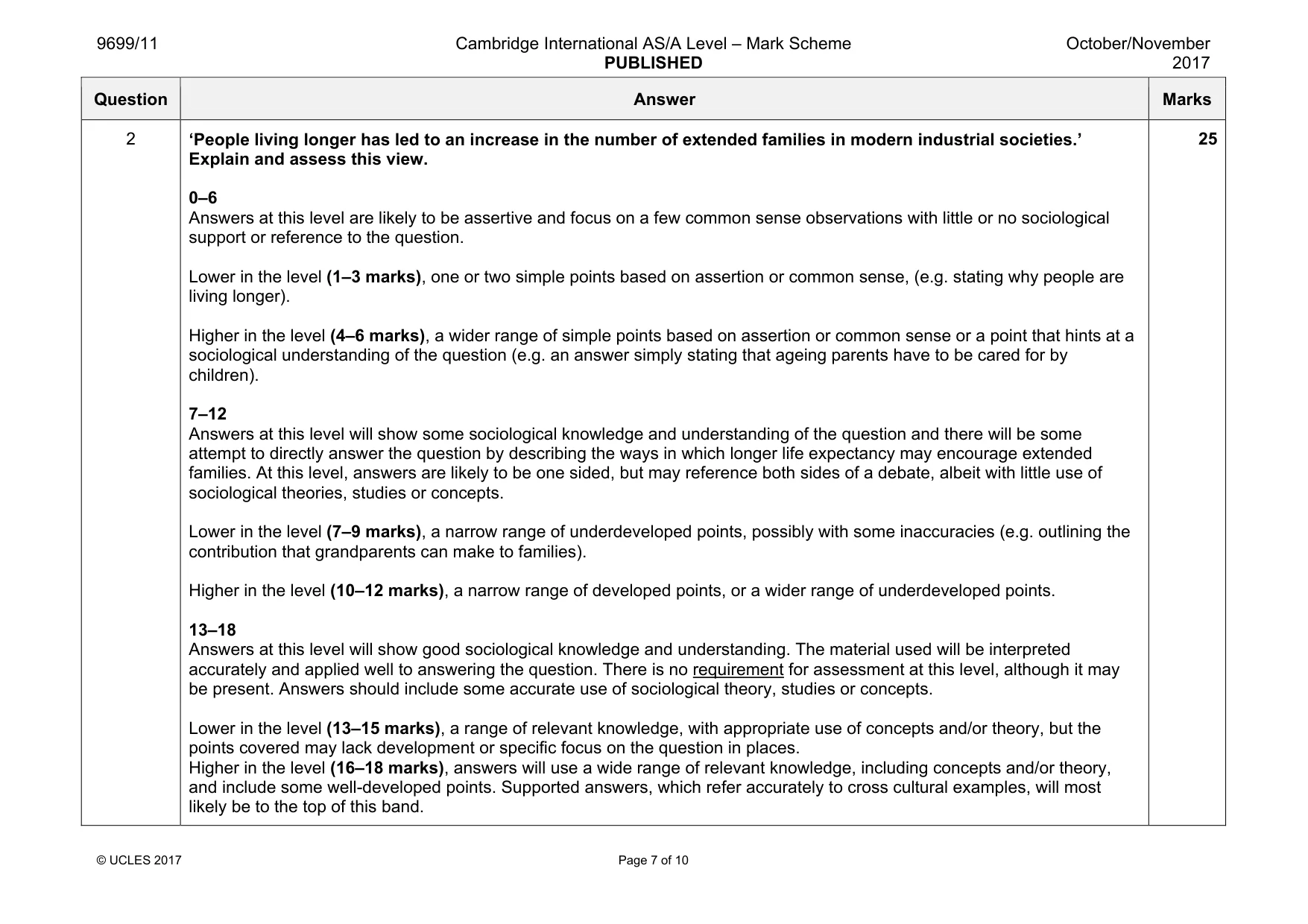
9699/11 Cambridge International AS/A Level – Mark Scheme PUBLISHED October/November 2017 © UCLES 2017 Page 7 of 10 Question Answer Marks 2 ‘People living longer has led to an increase in the number of extended families in modern industrial societies.’ Explain and assess this view. 0–6 Answers at this level are likely to be assertive and focus on a few common sense observations with little or no sociological support or reference to the question. Lower in the level (1–3 marks), one or two simple points based on assertion or common sense, (e.g. stating why people are living longer). Higher in the level (4–6 marks), a wider range of simple points based on assertion or common sense or a point that hints at a sociological understanding of the question (e.g. an answer simply stating that ageing parents have to be cared for by children). 7–12 Answers at this level will show some sociological knowledge and understanding of the question and there will be some attempt to directly answer the question by describing the ways in which longer life expectancy may encourage extended families. At this level, answers are likely to be one sided, but may reference both sides of a debate, albeit with little use of sociological theories, studies or concepts. Lower in the level (7–9 marks), a narrow range of underdeveloped points, possibly with some inaccuracies (e.g. outlining the contribution that grandparents can make to families). Higher in the level (10–12 marks), a narrow range of developed points, or a wider range of underdeveloped points. 13–18 Answers at this level will show good sociological knowledge and understanding. The material used will be interpreted accurately and applied well to answering the question. There is no requirement for assessment at this level, although it may be present. Answers should include some accurate use of sociological theory, studies or concepts. Lower in the level (13–15 marks), a range of relevant knowledge, with appropriate use of concepts and/or theory, but the points covered may lack development or specific focus on the question in places. Higher in the level (16–18 marks), answers will use a wide range of relevant knowledge, including concepts and/or theory, and include some well-developed points. Supported answers, which refer accurately to cross cultural examples, will most likely be to the top of this band. 25
Mark scheme, page 8
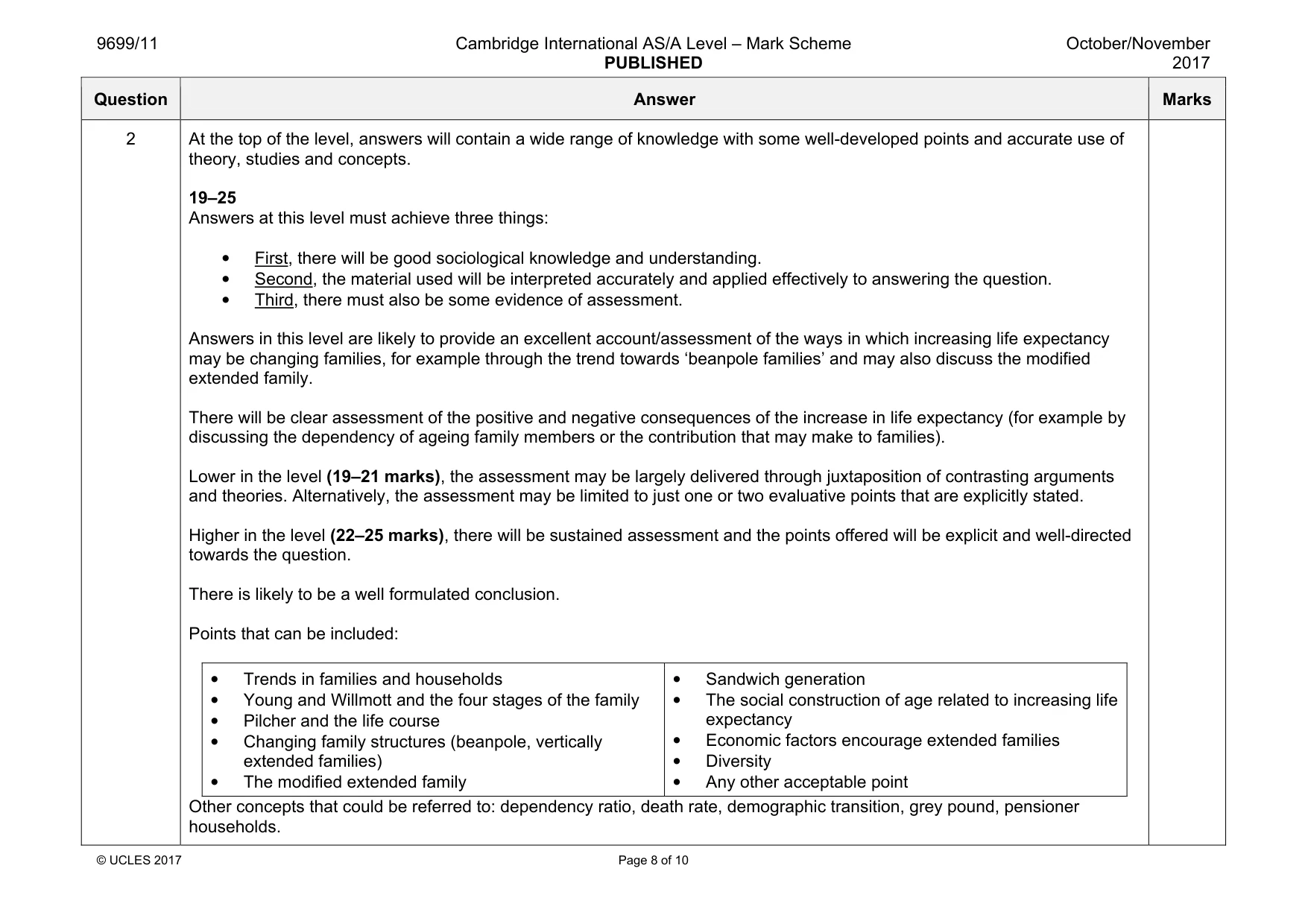
9699/11 Cambridge International AS/A Level – Mark Scheme PUBLISHED October/November 2017 © UCLES 2017 Page 8 of 10 Question Answer Marks 2 At the top of the level, answers will contain a wide range of knowledge with some well-developed points and accurate use of theory, studies and concepts. 19–25 Answers at this level must achieve three things: • First, there will be good sociological knowledge and understanding. • Second, the material used will be interpreted accurately and applied effectively to answering the question. • Third, there must also be some evidence of assessment. Answers in this level are likely to provide an excellent account/assessment of the ways in which increasing life expectancy may be changing families, for example through the trend towards ‘beanpole families’ and may also discuss the modified extended family. There will be clear assessment of the positive and negative consequences of the increase in life expectancy (for example by discussing the dependency of ageing family members or the contribution that may make to families). Lower in the level (19–21 marks), the assessment may be largely delivered through juxtaposition of contrasting arguments and theories. Alternatively, the assessment may be limited to just one or two evaluative points that are explicitly stated. Higher in the level (22–25 marks), there will be sustained assessment and the points offered will be explicit and well-directed towards the question. There is likely to be a well formulated conclusion. Points that can be included: • Trends in families and households • Young and Willmott and the four stages of the family • Pilcher and the life course • Changing family structures (beanpole, vertically extended families) • The modified extended family • Sandwich generation • The social construction of age related to increasing life expectancy • Economic factors encourage extended families • Diversity • Any other acceptable point Other concepts that could be referred to: dependency ratio, death rate, demographic transition, grey pound, pensioner households.
Mark scheme, page 9
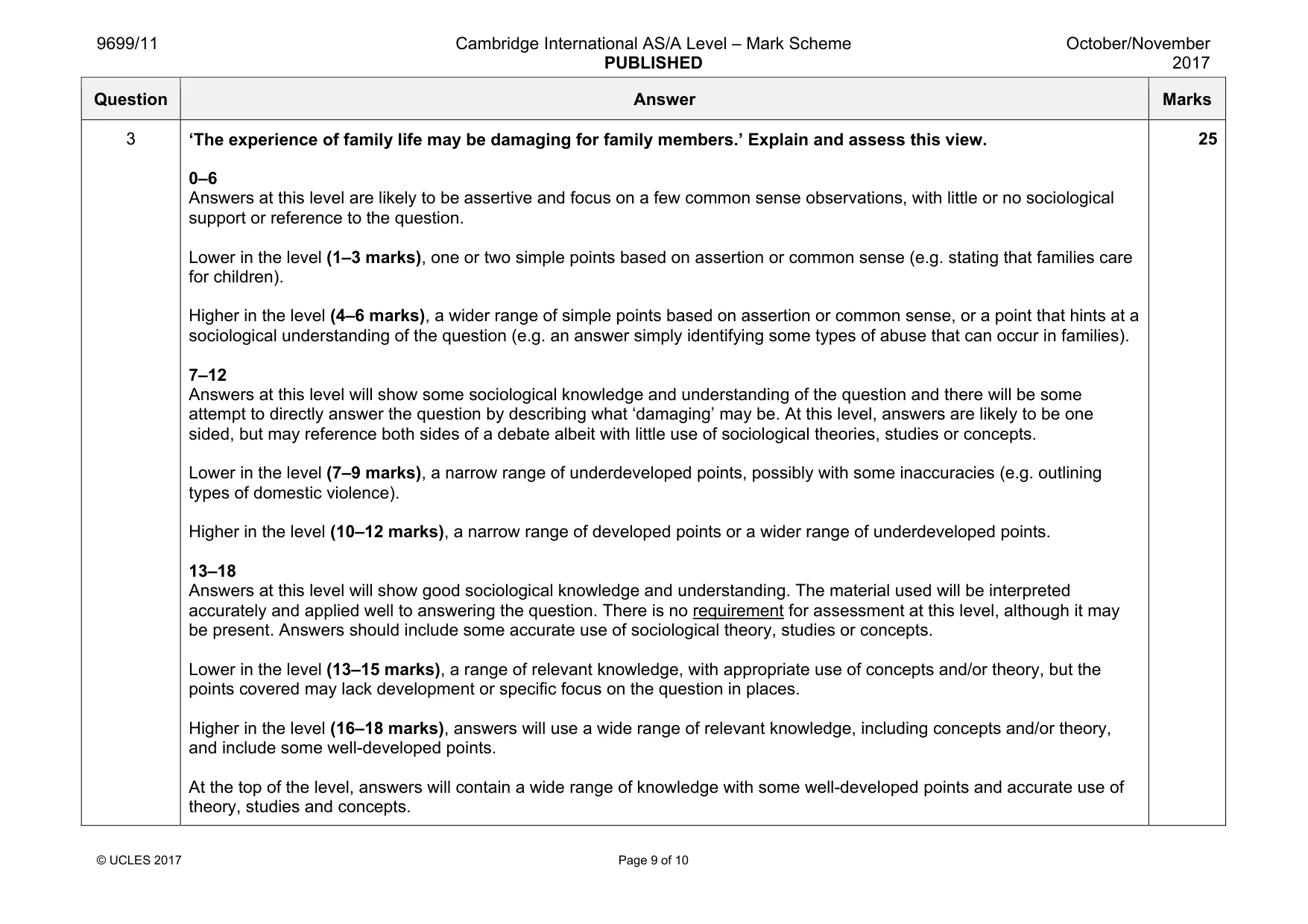
9699/11 Cambridge International AS/A Level – Mark Scheme PUBLISHED October/November 2017 © UCLES 2017 Page 9 of 10 Question Answer Marks 3 ‘The experience of family life may be damaging for family members.’ Explain and assess this view. 0–6 Answers at this level are likely to be assertive and focus on a few common sense observations, with little or no sociological support or reference to the question. Lower in the level (1–3 marks), one or two simple points based on assertion or common sense (e.g. stating that families care for children). Higher in the level (4–6 marks), a wider range of simple points based on assertion or common sense, or a point that hints at a sociological understanding of the question (e.g. an answer simply identifying some types of abuse that can occur in families). 7–12 Answers at this level will show some sociological knowledge and understanding of the question and there will be some attempt to directly answer the question by describing what ‘damaging’ may be. At this level, answers are likely to be one sided, but may reference both sides of a debate albeit with little use of sociological theories, studies or concepts. Lower in the level (7–9 marks), a narrow range of underdeveloped points, possibly with some inaccuracies (e.g. outlining types of domestic violence). Higher in the level (10–12 marks), a narrow range of developed points or a wider range of underdeveloped points. 13–18 Answers at this level will show good sociological knowledge and understanding. The material used will be interpreted accurately and applied well to answering the question. There is no requirement for assessment at this level, although it may be present. Answers should include some accurate use of sociological theory, studies or concepts. Lower in the level (13–15 marks), a range of relevant knowledge, with appropriate use of concepts and/or theory, but the points covered may lack development or specific focus on the question in places. Higher in the level (16–18 marks), answers will use a wide range of relevant knowledge, including concepts and/or theory, and include some well-developed points. At the top of the level, answers will contain a wide range of knowledge with some well-developed points and accurate use of theory, studies and concepts. 25
Mark scheme, page 10
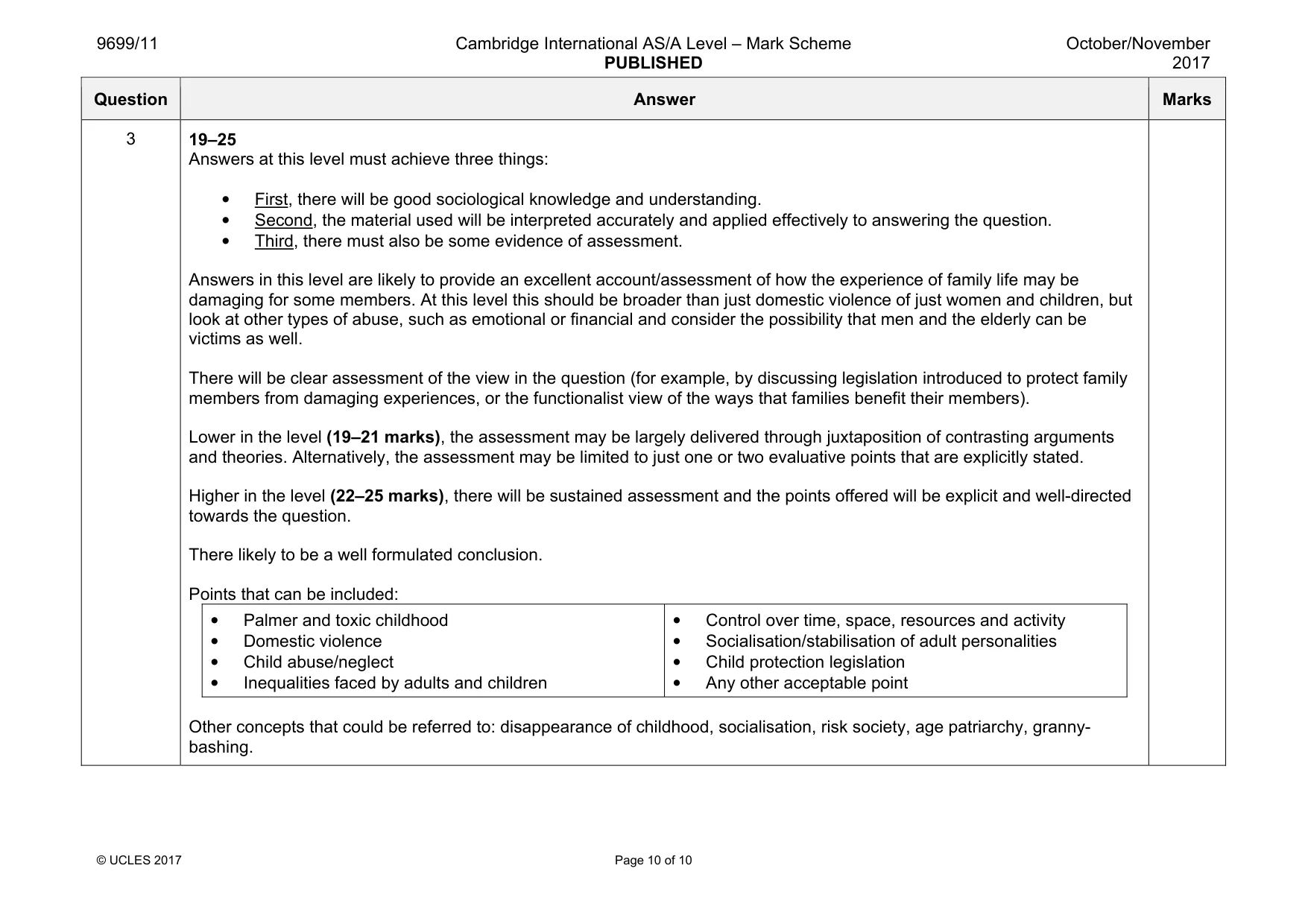
9699/11 Cambridge International AS/A Level – Mark Scheme PUBLISHED October/November 2017 © UCLES 2017 Page 10 of 10 Question Answer Marks 3 19–25 Answers at this level must achieve three things: • First, there will be good sociological knowledge and understanding. • Second, the material used will be interpreted accurately and applied effectively to answering the question. • Third, there must also be some evidence of assessment. Answers in this level are likely to provide an excellent account/assessment of how the experience of family life may be damaging for some members. At this level this should be broader than just domestic violence of just women and children, but look at other types of abuse, such as emotional or financial and consider the possibility that men and the elderly can be victims as well. There will be clear assessment of the view in the question (for example, by discussing legislation introduced to protect family members from damaging experiences, or the functionalist view of the ways that families benefit their members). Lower in the level (19–21 marks), the assessment may be largely delivered through juxtaposition of contrasting arguments and theories. Alternatively, the assessment may be limited to just one or two evaluative points that are explicitly stated. Higher in the level (22–25 marks), there will be sustained assessment and the points offered will be explicit and well-directed towards the question. There likely to be a well formulated conclusion. Points that can be included: • Palmer and toxic childhood • Domestic violence • Child abuse/neglect • Inequalities faced by adults and children • Control over time, space, resources and activity • Socialisation/stabilisation of adult personalities • Child protection legislation • Any other acceptable point Other concepts that could be referred to: disappearance of childhood, socialisation, risk society, age patriarchy, granny- bashing.
What you needed in this session
Cambridge’s own grade thresholds for 2017 Oct/Nov, Paper 1 · Variant 1. A higher threshold means an easier paper — the bar moves with how the cohort did.