Cambridge A Level Sociology 9699 — 2025 Oct/Nov Paper 1 · Variant 1
9699/11/O/N/25 · 60 marks · 90 min
The question paper and its mark scheme, free to read here and free to download. This is Cambridge’s own paper, exactly as it was sat.
Question paper4 pages


Mark scheme18 pages
Answers below. Sit the paper first if you are practising.



Paper as text
Question paper, page 1
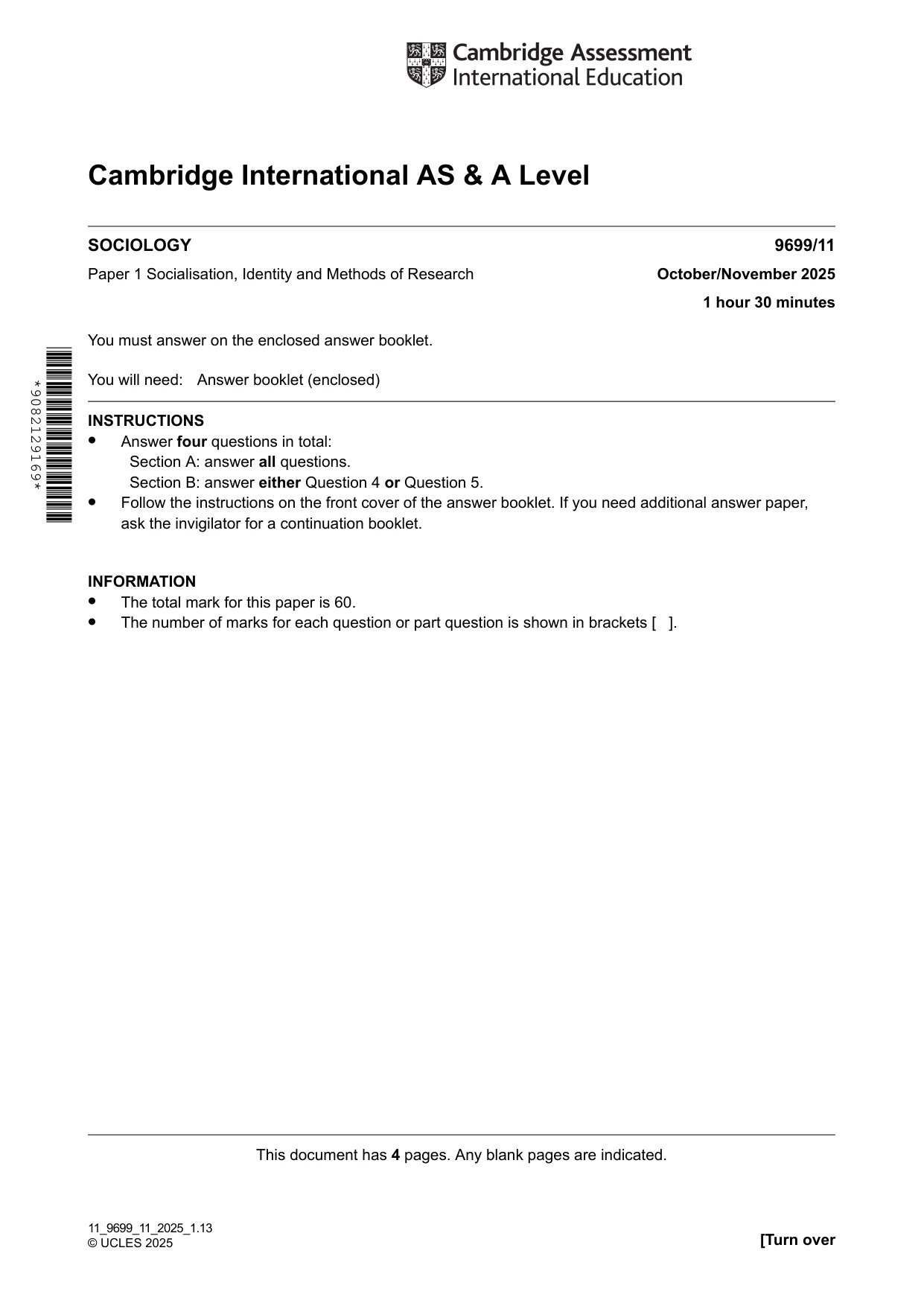
Cambridge International AS & A Level 9699/11 October/November 2025 1 hour 30 minutes SOCIOLOGY Paper 1 Socialisation, Identity and Methods of Research You must answer on the enclosed answer booklet. You will need: Answer booklet (enclosed) INSTRUCTIONS • Answer four questions in total: Section A: answer all questions. Section B: answer either Question 4 or Question 5. • Follow the instructions on the front cover of the answer booklet. If you need additional answer paper, ask the invigilator for a continuation booklet. INFORMATION • The total mark for this paper is 60. • The number of marks for each question or part question is shown in brackets [ ]. This document has 4 pages. Any blank pages are indicated. [Turn over 11_9699_11_2025_1.13 © UCLES 2025 *9082129169*
Question paper, page 2
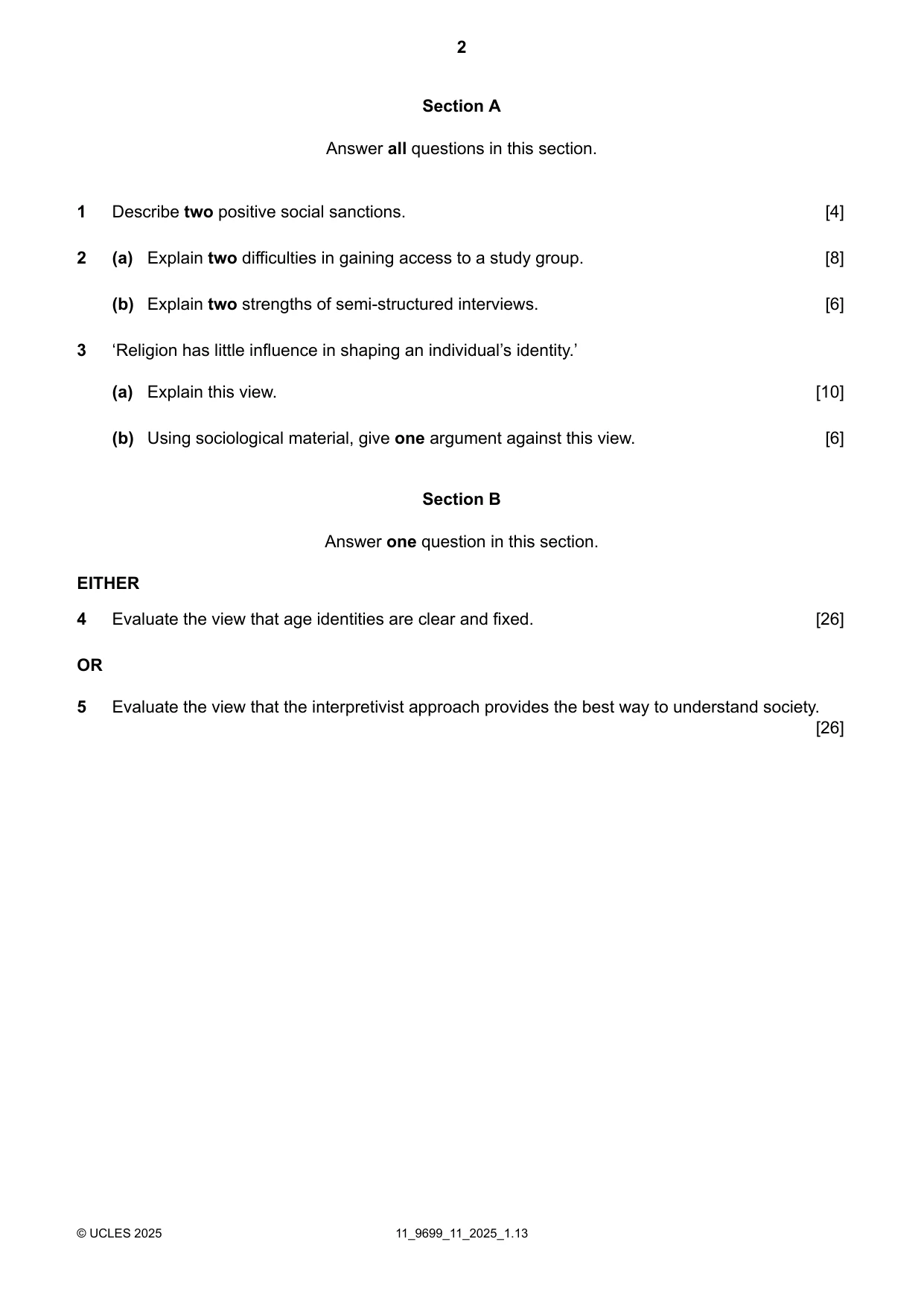
Section A Answer all questions in this section. Describe two positive social sanctions. [4] 1 Explain two difficulties in gaining access to a study group. [8] (a) 2 Explain two strengths of semi-structured interviews. [6] (b) ‘Religion has little influence in shaping an individual’s identity.’ 3 Explain this view. [10] (a) Using sociological material, give one argument against this view. [6] (b) Section B Answer one question in this section. EITHER Evaluate the view that age identities are clear and fixed. [26] 4 OR Evaluate the view that the interpretivist approach provides the best way to understand society. [26] 5 11_9699_11_2025_1.13 © UCLES 2025 2
Question paper, page 3
BLANK PAGE 11_9699_11_2025_1.13 © UCLES 2025 3
Question paper, page 4
BLANK PAGE Permission to reproduce items where third-party owned material protected by copyright is included has been sought and cleared where possible. Every reasonable effort has been made by the publisher (UCLES) to trace copyright holders, but if any items requiring clearance have unwittingly been included, the publisher will be pleased to make amends at the earliest possible opportunity. To avoid the issue of disclosure of answer-related information to candidates, all copyright acknowledgements are reproduced online in the Cambridge Assessment International Education Copyright Acknowledgements Booklet. This is produced for each series of examinations and is freely available to download at www.cambridgeinternational.org after the live examination series. Cambridge Assessment International Education is part of Cambridge Assessment. Cambridge Assessment is the brand name of the University of Cambridge Local Examinations Syndicate (UCLES), which is a department of the University of Cambridge. 11_9699_11_2025_1.13 © UCLES 2025 4
Mark scheme, page 1
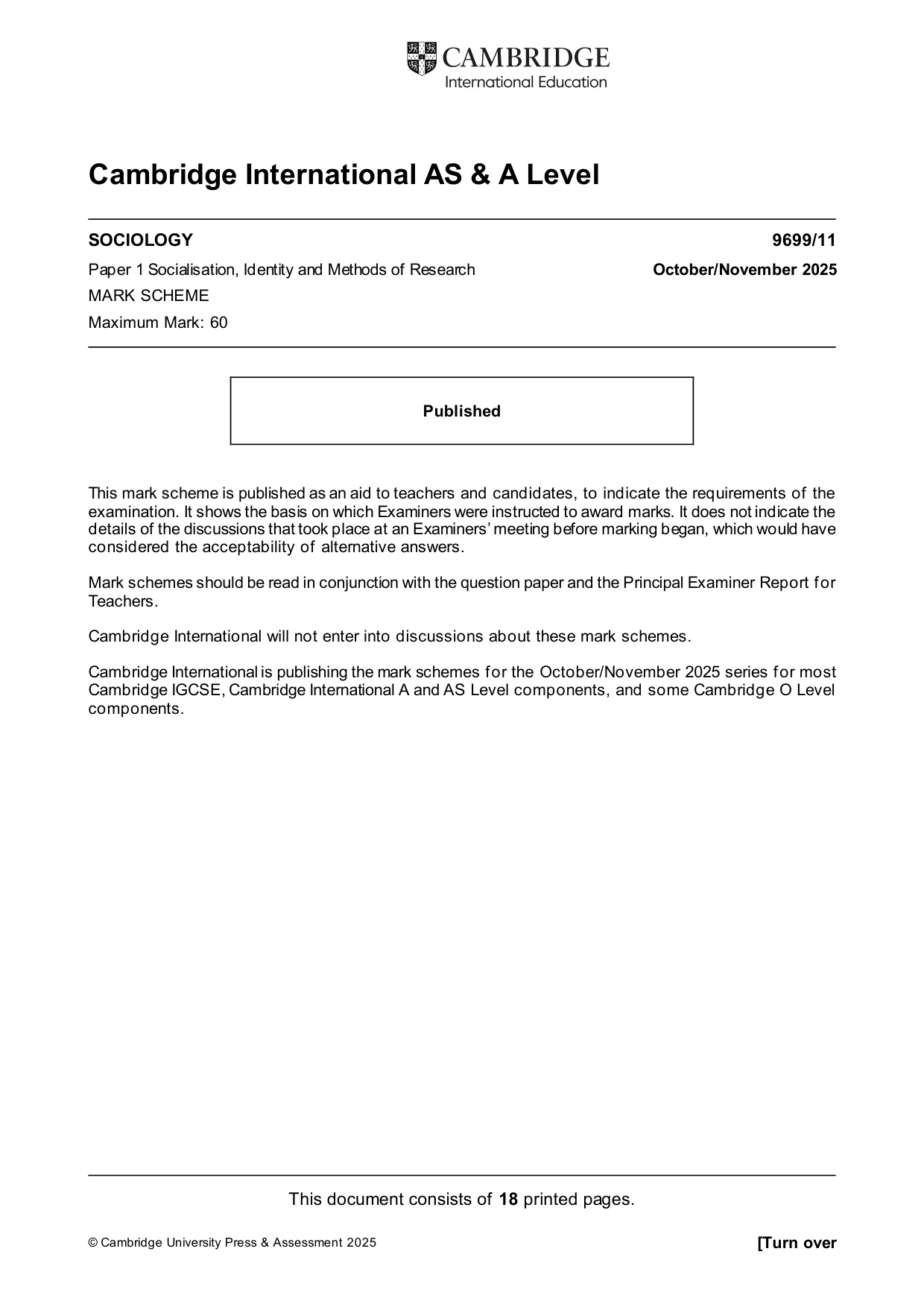
This document consists of 18 printed pages. © Cambridge University Press & Assessment 2025 [Turn over Cambridge International AS & A Level SOCIOLOGY 9699/11 Paper 1 Socialisation, Identity and Methods of Research October/November 2025 MARK SCHEME Maximum Mark: 60 Published This mark scheme is published as an aid to teachers and candidates, to indicate the requirements of the examination. It shows the basis on which Examiners were instructed to award marks. It does not indicate the details of the discussions that took place at an Examiners’ meeting before marking began, which would have considered the acceptability of alternative answers. Mark schemes should be read in conjunction with the question paper and the Principal Examiner Report for Teachers. Cambridge International will not enter into discussions about these mark schemes. Cambridge International is publishing the mark schemes for the October/November 2025 series for most Cambridge IGCSE, Cambridge International A and AS Level components, and some Cambridge O Level components.
Mark scheme, page 2
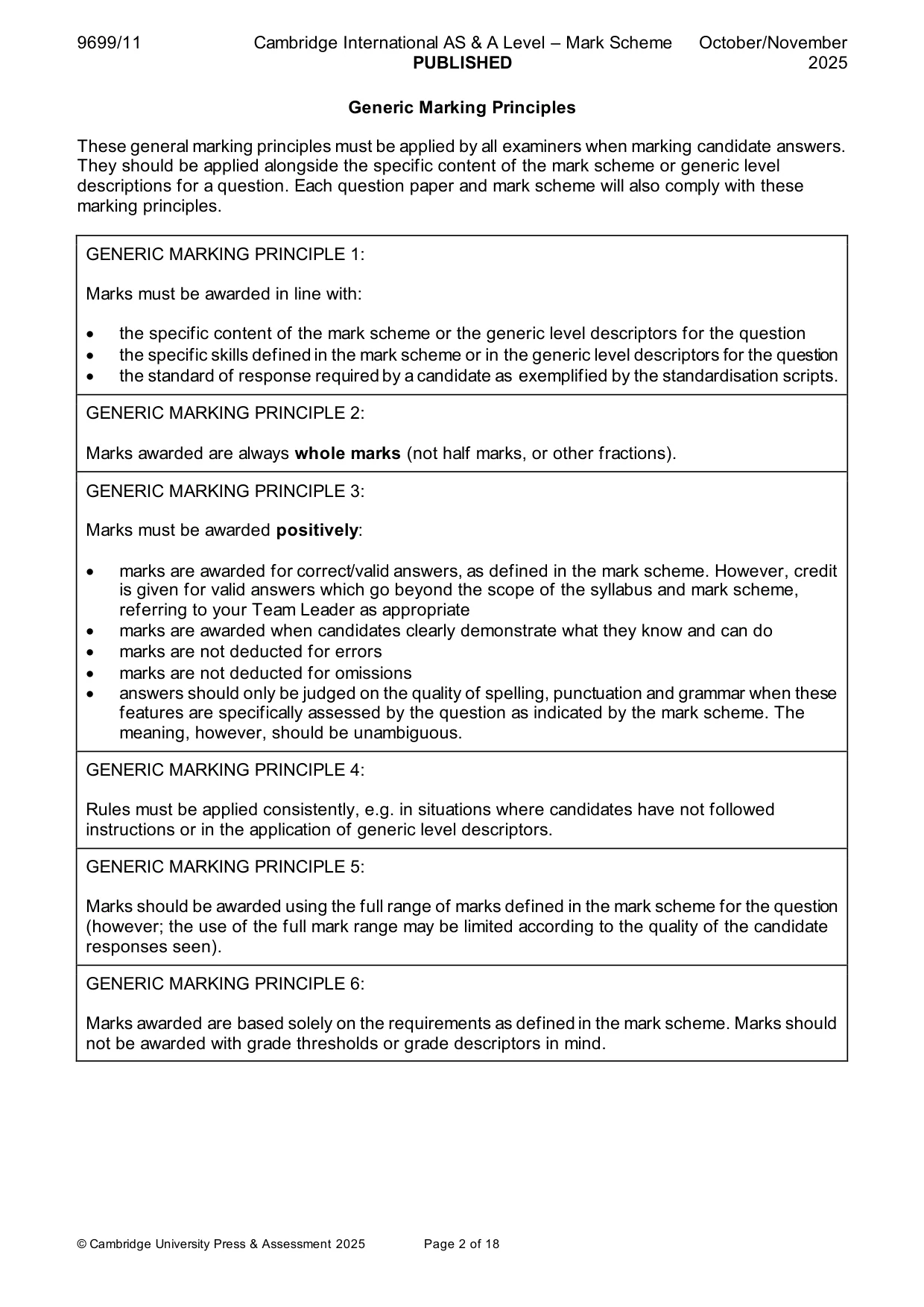
9699/11 Cambridge International AS & A Level – Mark Scheme PUBLISHED October/November 2025 © Cambridge University Press & Assessment 2025 Page 2 of 18 Generic Marking Principles These general marking principles must be applied by all examiners when marking candidate answers. They should be applied alongside the specific content of the mark scheme or generic level descriptions for a question. Each question paper and mark scheme will also comply with these marking principles. GENERIC MARKING PRINCIPLE 1: Marks must be awarded in line with: • the specific content of the mark scheme or the generic level descriptors for the question • the specific skills defined in the mark scheme or in the generic level descriptors for the question • the standard of response required by a candidate as exemplified by the standardisation scripts. GENERIC MARKING PRINCIPLE 2: Marks awarded are always whole marks (not half marks, or other fractions). GENERIC MARKING PRINCIPLE 3: Marks must be awarded positively: • marks are awarded for correct/valid answers, as defined in the mark scheme. However, credit is given for valid answers which go beyond the scope of the syllabus and mark scheme, referring to your Team Leader as appropriate • marks are awarded when candidates clearly demonstrate what they know and can do • marks are not deducted for errors • marks are not deducted for omissions • answers should only be judged on the quality of spelling, punctuation and grammar when these features are specifically assessed by the question as indicated by the mark scheme. The meaning, however, should be unambiguous. GENERIC MARKING PRINCIPLE 4: Rules must be applied consistently, e.g. in situations where candidates have not followed instructions or in the application of generic level descriptors. GENERIC MARKING PRINCIPLE 5: Marks should be awarded using the full range of marks defined in the mark scheme for the question (however; the use of the full mark range may be limited according to the quality of the candidate responses seen). GENERIC MARKING PRINCIPLE 6: Marks awarded are based solely on the requirements as defined in the mark scheme. Marks should not be awarded with grade thresholds or grade descriptors in mind.
Mark scheme, page 3
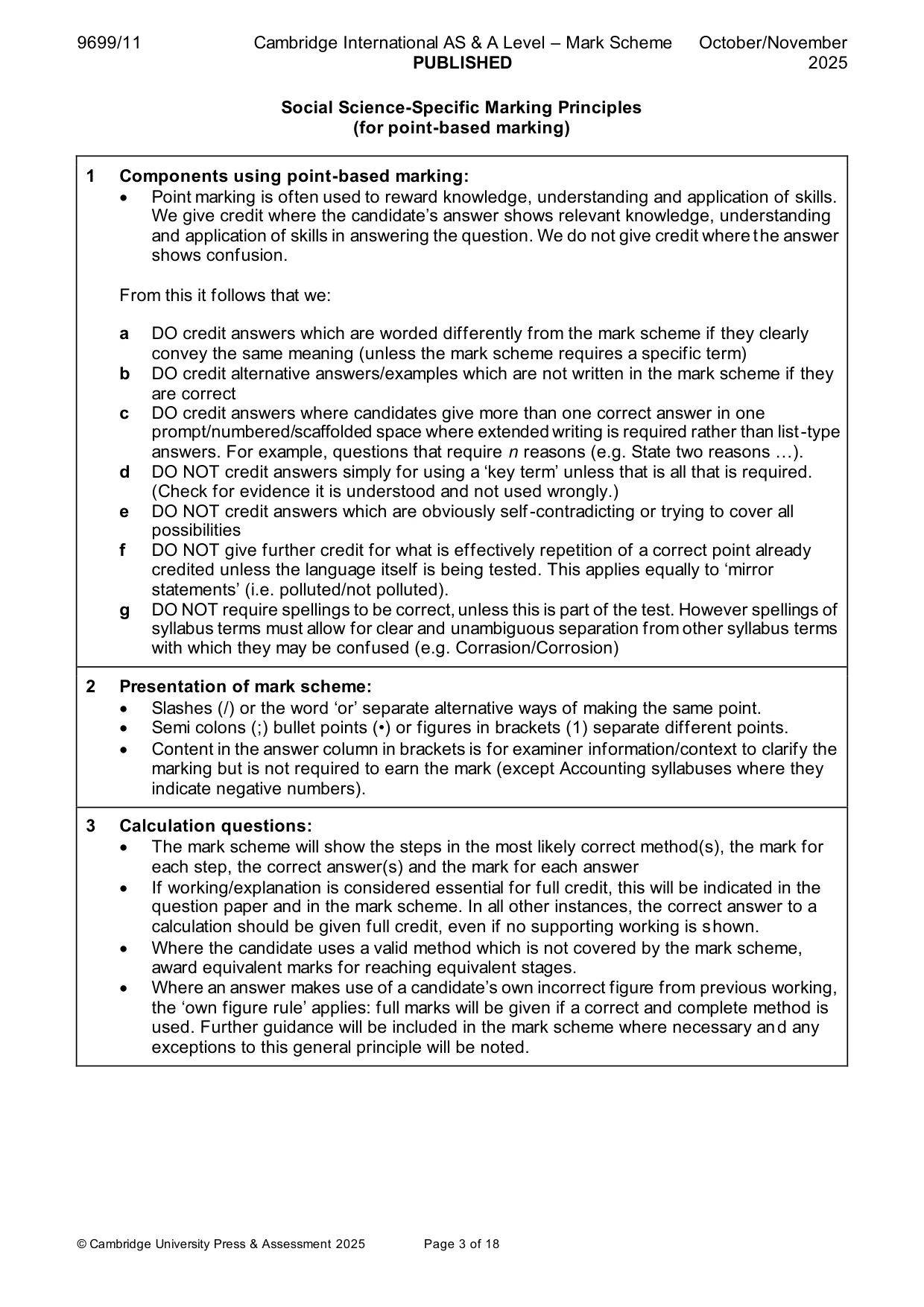
9699/11 Cambridge International AS & A Level – Mark Scheme PUBLISHED October/November 2025 © Cambridge University Press & Assessment 2025 Page 3 of 18 Social Science-Specific Marking Principles (for point-based marking) 1 Components using point-based marking: • Point marking is often used to reward knowledge, understanding and application of skills. We give credit where the candidate’s answer shows relevant knowledge, understanding and application of skills in answering the question. We do not give credit where the answer shows confusion. From this it follows that we: a DO credit answers which are worded differently from the mark scheme if they clearly convey the same meaning (unless the mark scheme requires a specific term) b DO credit alternative answers/examples which are not written in the mark scheme if they are correct c DO credit answers where candidates give more than one correct answer in one prompt/numbered/scaffolded space where extended writing is required rather than list-type answers. For example, questions that require n reasons (e.g. State two reasons …). d DO NOT credit answers simply for using a ‘key term’ unless that is all that is required. (Check for evidence it is understood and not used wrongly.) e DO NOT credit answers which are obviously self-contradicting or trying to cover all possibilities f DO NOT give further credit for what is effectively repetition of a correct point already credited unless the language itself is being tested. This applies equally to ‘mirror statements’ (i.e. polluted/not polluted). g DO NOT require spellings to be correct, unless this is part of the test. However spellings of syllabus terms must allow for clear and unambiguous separation from other syllabus terms with which they may be confused (e.g. Corrasion/Corrosion) 2 Presentation of mark scheme: • Slashes (/) or the word ‘or’ separate alternative ways of making the same point. • Semi colons (;) bullet points (•) or figures in brackets (1) separate different points. • Content in the answer column in brackets is for examiner information/context to clarify the marking but is not required to earn the mark (except Accounting syllabuses where they indicate negative numbers). 3 Calculation questions: • The mark scheme will show the steps in the most likely correct method(s), the mark for each step, the correct answer(s) and the mark for each answer • If working/explanation is considered essential for full credit, this will be indicated in the question paper and in the mark scheme. In all other instances, the correct answer to a calculation should be given full credit, even if no supporting working is shown. • Where the candidate uses a valid method which is not covered by the mark scheme, award equivalent marks for reaching equivalent stages. • Where an answer makes use of a candidate’s own incorrect figure from previous working, the ‘own figure rule’ applies: full marks will be given if a correct and complete method is used. Further guidance will be included in the mark scheme where necessary and any exceptions to this general principle will be noted.
Mark scheme, page 4
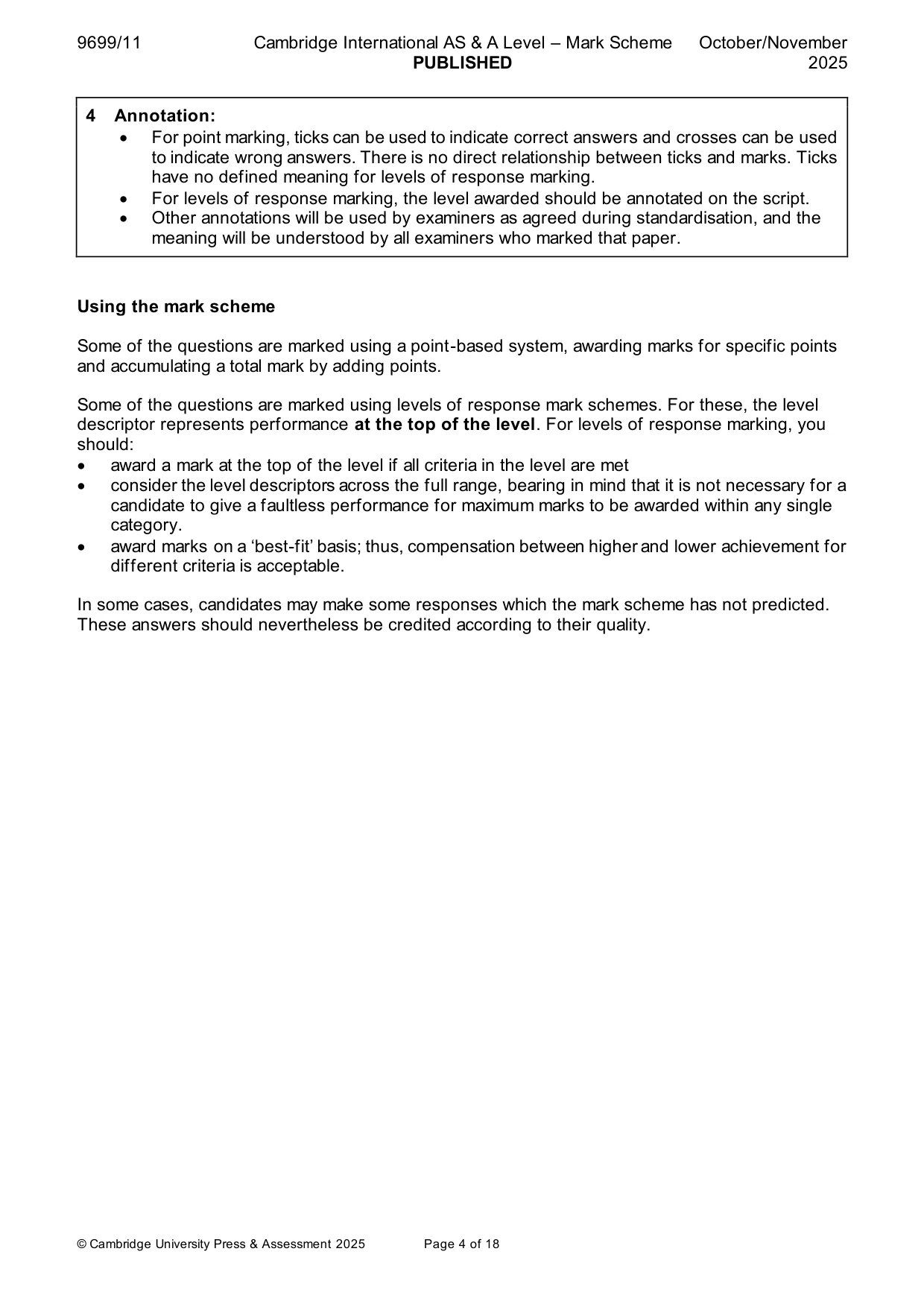
9699/11 Cambridge International AS & A Level – Mark Scheme PUBLISHED October/November 2025 © Cambridge University Press & Assessment 2025 Page 4 of 18 4 Annotation: • For point marking, ticks can be used to indicate correct answers and crosses can be used to indicate wrong answers. There is no direct relationship between ticks and marks. Ticks have no defined meaning for levels of response marking. • For levels of response marking, the level awarded should be annotated on the script. • Other annotations will be used by examiners as agreed during standardisation, and the meaning will be understood by all examiners who marked that paper. Using the mark scheme Some of the questions are marked using a point-based system, awarding marks for specific points and accumulating a total mark by adding points. Some of the questions are marked using levels of response mark schemes. For these, the level descriptor represents performance at the top of the level. For levels of response marking, you should: • award a mark at the top of the level if all criteria in the level are met • consider the level descriptors across the full range, bearing in mind that it is not necessary for a candidate to give a faultless performance for maximum marks to be awarded within any single category. • award marks on a ‘best-fit’ basis; thus, compensation between higher and lower achievement for different criteria is acceptable. In some cases, candidates may make some responses which the mark scheme has not predicted. These answers should nevertheless be credited according to their quality.
Mark scheme, page 5
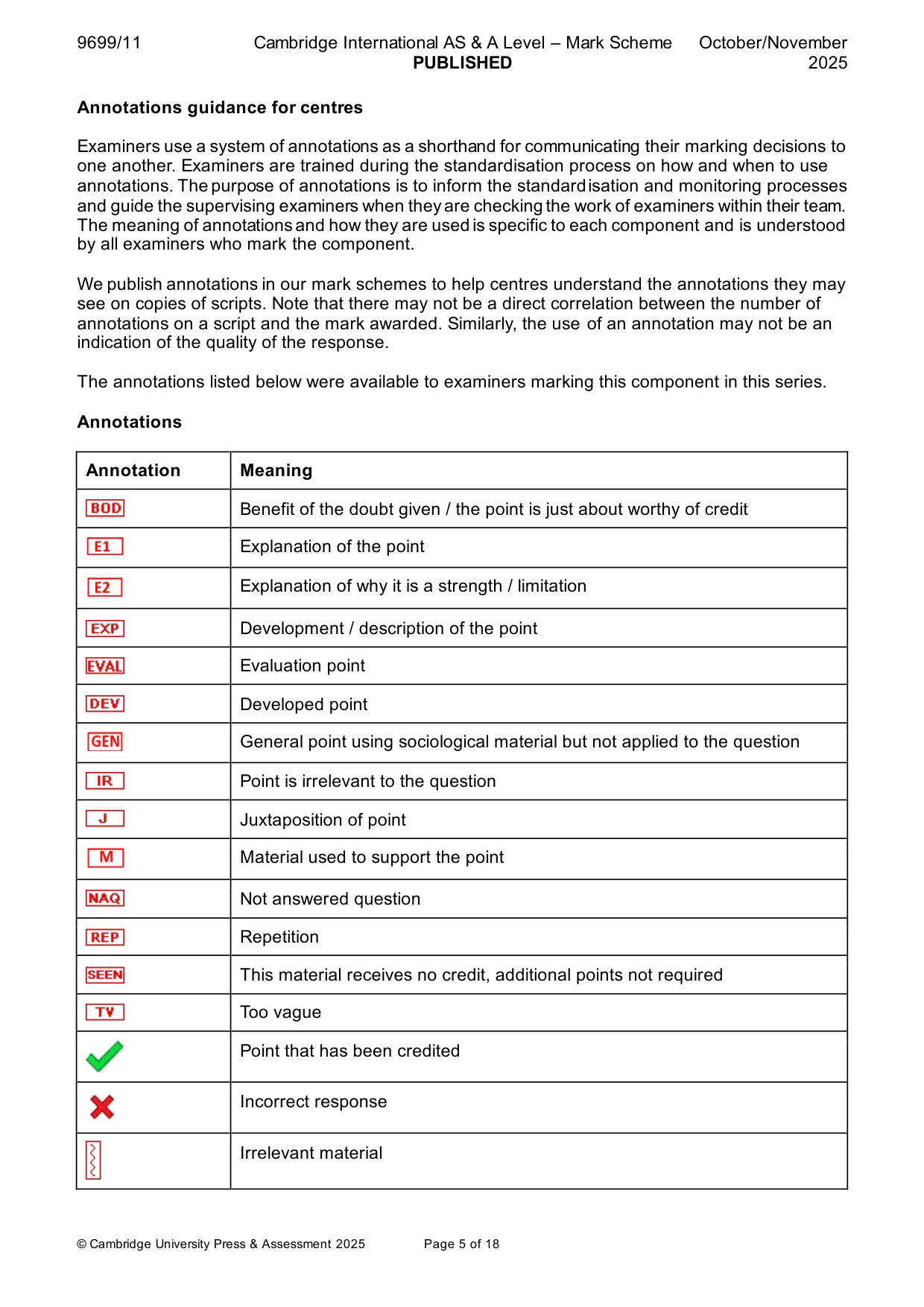
9699/11 Cambridge International AS & A Level – Mark Scheme PUBLISHED October/November 2025 © Cambridge University Press & Assessment 2025 Page 5 of 18 Annotations guidance for centres Examiners use a system of annotations as a shorthand for communicating their marking decisions to one another. Examiners are trained during the standardisation process on how and when to use annotations. The purpose of annotations is to inform the standardisation and monitoring processes and guide the supervising examiners when they are checking the work of examiners within their team. The meaning of annotations and how they are used is specific to each component and is understood by all examiners who mark the component. We publish annotations in our mark schemes to help centres understand the annotations they may see on copies of scripts. Note that there may not be a direct correlation between the number of annotations on a script and the mark awarded. Similarly, the use of an annotation may not be an indication of the quality of the response. The annotations listed below were available to examiners marking this component in this series. Annotations Annotation Meaning Benefit of the doubt given / the point is just about worthy of credit Explanation of the point Explanation of why it is a strength / limitation Development / description of the point Evaluation point Developed point General point using sociological material but not applied to the question Point is irrelevant to the question Juxtaposition of point Material used to support the point Not answered question Repetition This material receives no credit, additional points not required Too vague Point that has been credited Incorrect response Irrelevant material
Mark scheme, page 6
9699/11 Cambridge International AS & A Level – Mark Scheme PUBLISHED October/November 2025 © Cambridge University Press & Assessment 2025 Page 6 of 18 Annotation Meaning On-page comment On page comment Highlighter Identification of a point
Mark scheme, page 7
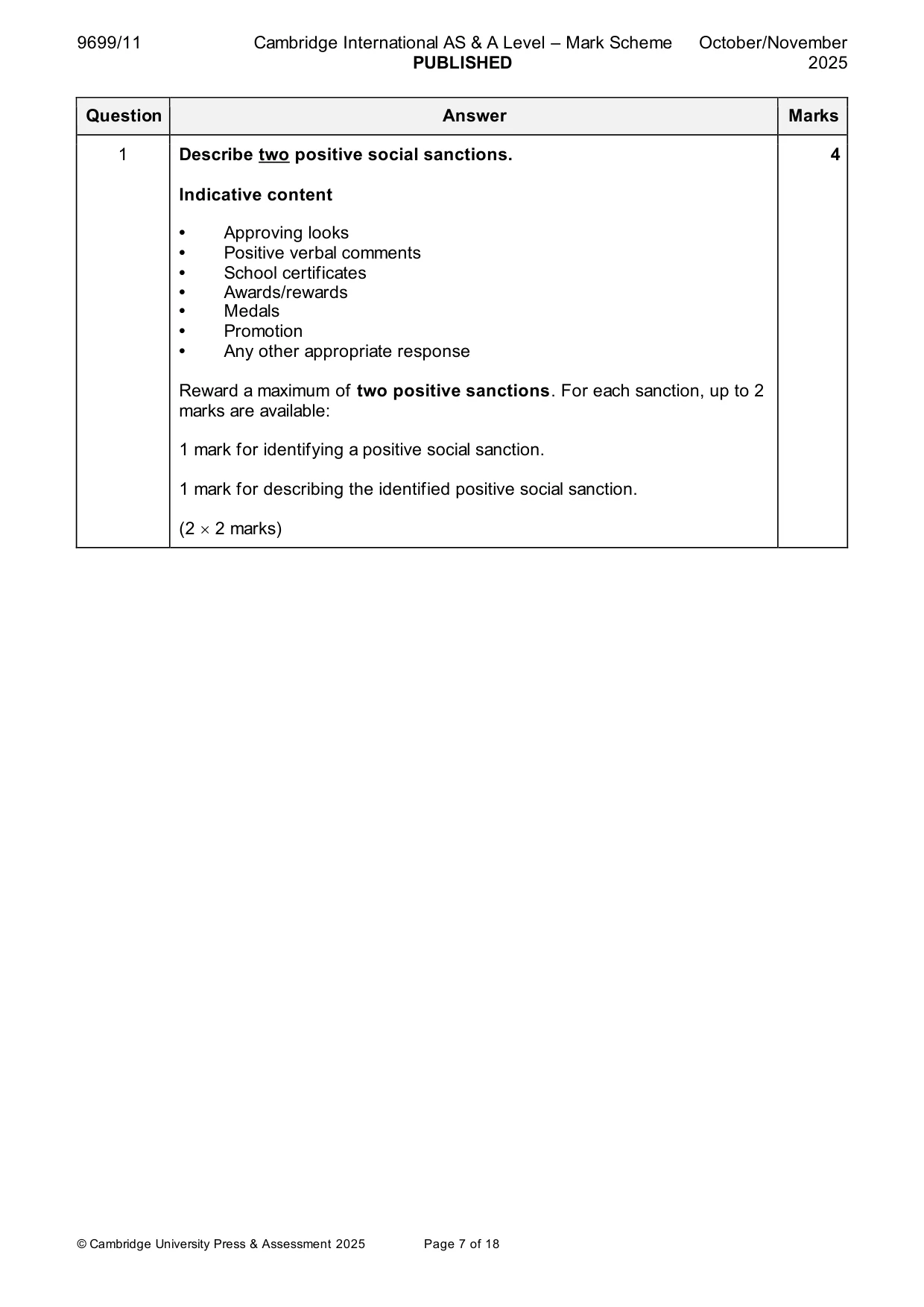
9699/11 Cambridge International AS & A Level – Mark Scheme PUBLISHED October/November 2025 © Cambridge University Press & Assessment 2025 Page 7 of 18 Question Answer Marks 1 Describe two positive social sanctions. Indicative content • Approving looks • Positive verbal comments • School certificates • Awards/rewards • Medals • Promotion • Any other appropriate response Reward a maximum of two positive sanctions. For each sanction, up to 2 marks are available: 1 mark for identifying a positive social sanction. 1 mark for describing the identified positive social sanction. (2 2 marks) 4
Mark scheme, page 8
9699/11 Cambridge International AS & A Level – Mark Scheme PUBLISHED October/November 2025 © Cambridge University Press & Assessment 2025 Page 8 of 18 Question Answer Marks 2(a) Explain two difficulties in gaining access to a study group. Indicative content • Being accepted by the group. • Making contact with the group. • Managing to gain access in the group without arousing suspicion e.g. in covert research a gatekeeper may be needed to explain your presence. • Social differences between the researcher and the group may make it difficult to undertake covert observation. • Blending into the group if the sociologist is from a different social background. • Legal/ethical issues may constrain the level of access. • Practical issues – it could be expensive, e.g. having to pay to gain entry into a club to observe members/travel to observe a group in a different place. • Any other appropriate response. Reward a maximum of two difficulties. Up to 4 marks are available for each reason: 1 mark for making a point / giving a reason (e.g. being accepted by the group). 1 mark for explaining that point (e.g. depending on the type of research [e.g. participant observation] researchers may need to earn the trust of the target group at the beginning of the study). 1 mark for selecting relevant sociological material (e.g. building rapport). 1 mark for explaining how the material supports the point (e.g. a successful participant observer inspires trust and acceptance to enable study group members to act naturally). (2 4 marks) 8
Mark scheme, page 9
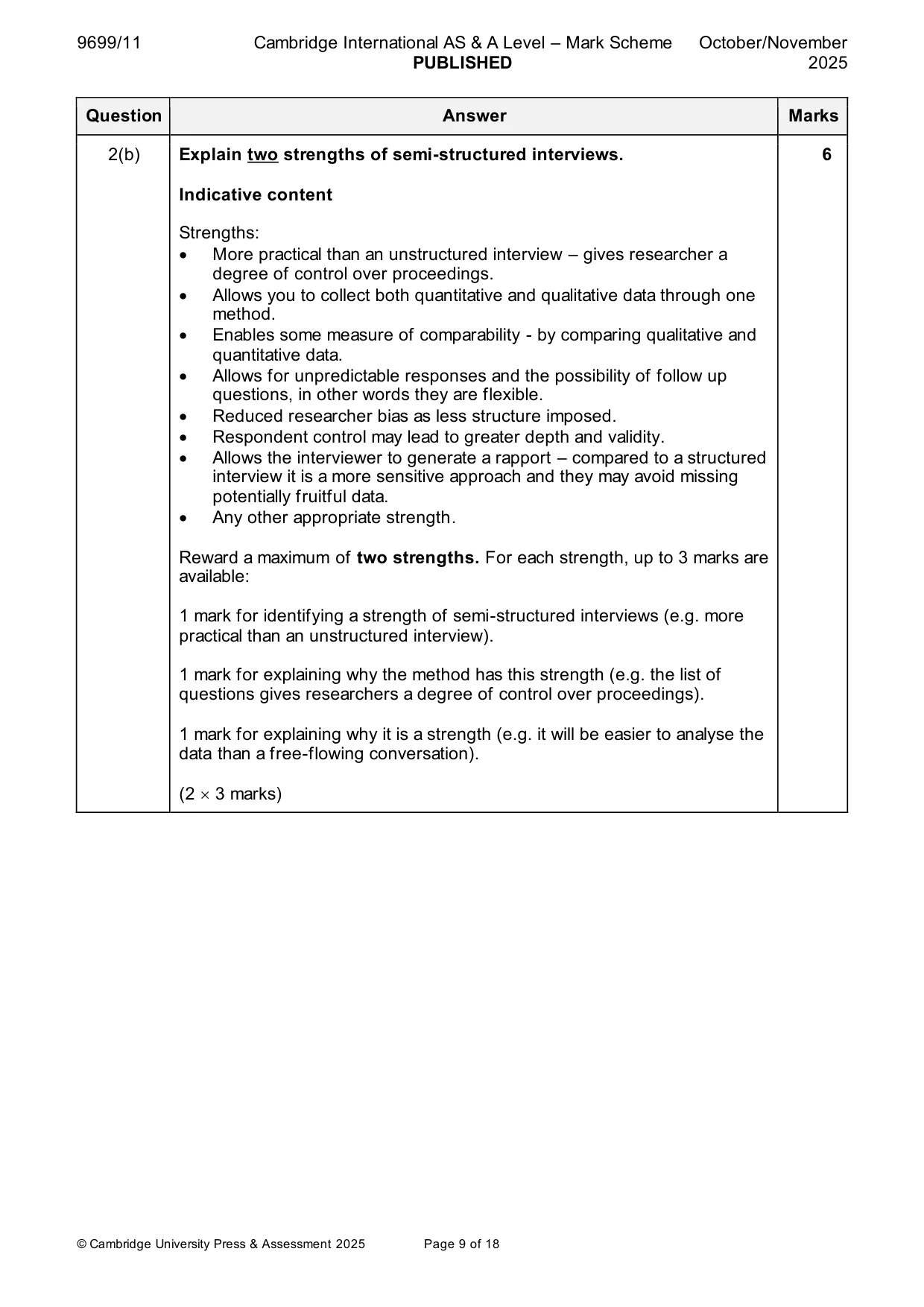
9699/11 Cambridge International AS & A Level – Mark Scheme PUBLISHED October/November 2025 © Cambridge University Press & Assessment 2025 Page 9 of 18 Question Answer Marks 2(b) Explain two strengths of semi-structured interviews. Indicative content Strengths: • More practical than an unstructured interview – gives researcher a degree of control over proceedings. • Allows you to collect both quantitative and qualitative data through one method. • Enables some measure of comparability - by comparing qualitative and quantitative data. • Allows for unpredictable responses and the possibility of follow up questions, in other words they are flexible. • Reduced researcher bias as less structure imposed. • Respondent control may lead to greater depth and validity. • Allows the interviewer to generate a rapport – compared to a structured interview it is a more sensitive approach and they may avoid missing potentially fruitful data. • Any other appropriate strength. Reward a maximum of two strengths. For each strength, up to 3 marks are available: 1 mark for identifying a strength of semi-structured interviews (e.g. more practical than an unstructured interview). 1 mark for explaining why the method has this strength (e.g. the list of questions gives researchers a degree of control over proceedings). 1 mark for explaining why it is a strength (e.g. it will be easier to analyse the data than a free-flowing conversation). (2 3 marks) 6
Mark scheme, page 10
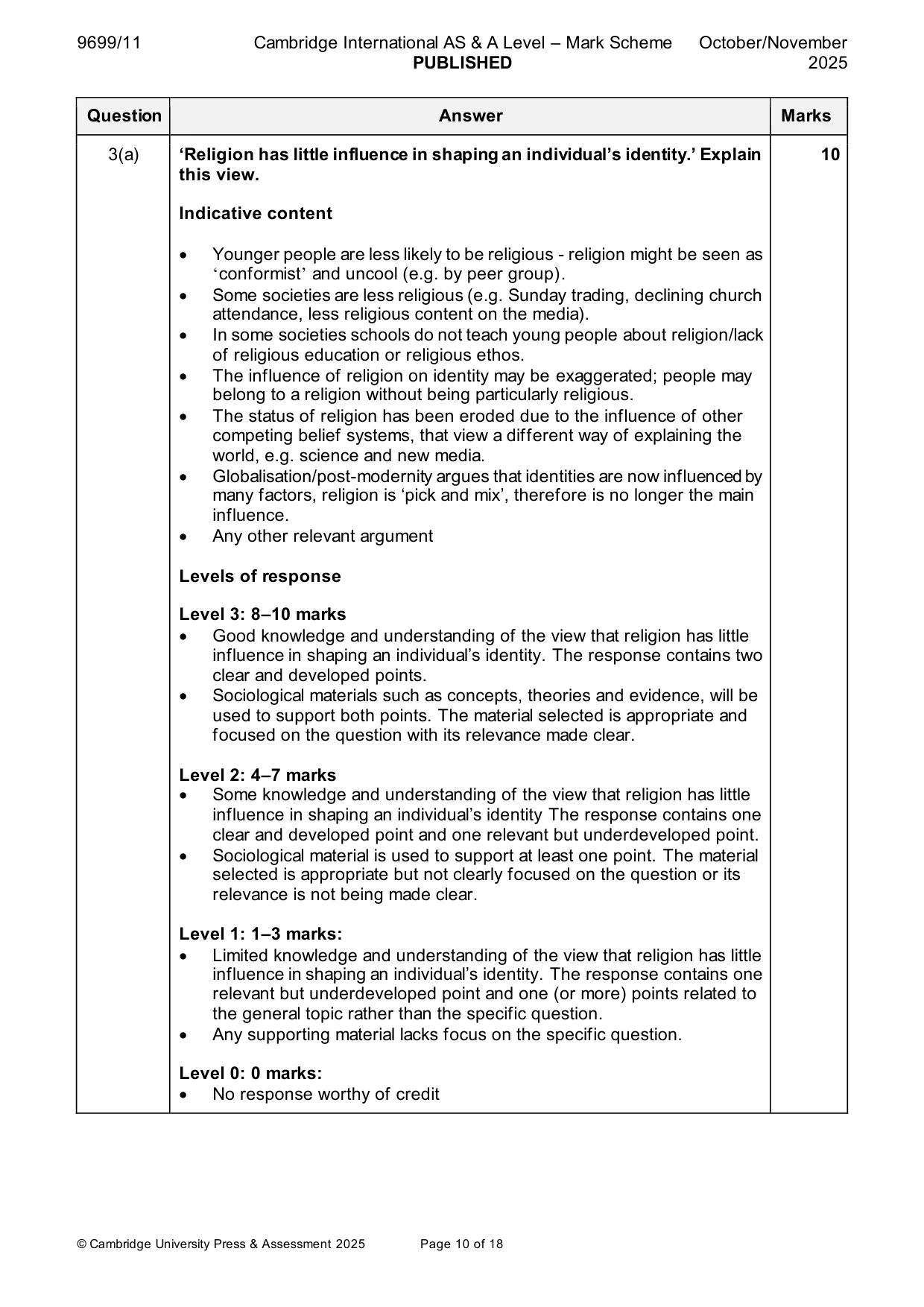
9699/11 Cambridge International AS & A Level – Mark Scheme PUBLISHED October/November 2025 © Cambridge University Press & Assessment 2025 Page 10 of 18 Question Answer Marks 3(a) ‘Religion has little influence in shaping an individual’s identity.’ Explain this view. Indicative content • Younger people are less likely to be religious - religion might be seen as ‘conformist’ and uncool (e.g. by peer group). • Some societies are less religious (e.g. Sunday trading, declining church attendance, less religious content on the media). • In some societies schools do not teach young people about religion/lack of religious education or religious ethos. • The influence of religion on identity may be exaggerated; people may belong to a religion without being particularly religious. • The status of religion has been eroded due to the influence of other competing belief systems, that view a different way of explaining the world, e.g. science and new media. • Globalisation/post-modernity argues that identities are now influenced by many factors, religion is ‘pick and mix’, therefore is no longer the main influence. • Any other relevant argument Levels of response Level 3: 8–10 marks • Good knowledge and understanding of the view that religion has little influence in shaping an individual’s identity. The response contains two clear and developed points. • Sociological materials such as concepts, theories and evidence, will be used to support both points. The material selected is appropriate and focused on the question with its relevance made clear. Level 2: 4–7 marks • Some knowledge and understanding of the view that religion has little influence in shaping an individual’s identity The response contains one clear and developed point and one relevant but underdeveloped point. • Sociological material is used to support at least one point. The material selected is appropriate but not clearly focused on the question or its relevance is not being made clear. Level 1: 1–3 marks: • Limited knowledge and understanding of the view that religion has little influence in shaping an individual’s identity. The response contains one relevant but underdeveloped point and one (or more) points related to the general topic rather than the specific question. • Any supporting material lacks focus on the specific question. Level 0: 0 marks: • No response worthy of credit 10
Mark scheme, page 11
9699/11 Cambridge International AS & A Level – Mark Scheme PUBLISHED October/November 2025 © Cambridge University Press & Assessment 2025 Page 11 of 18 Question Answer Marks 3(b) ‘Religion has little influence in shaping an individual’s identity.’ Using sociological material, give one argument against this view. Indicative content • In some countries, ethnic minority groups show much higher degrees of religiosity than the majority group (though this varies between them). This tends to reflect the stronger beliefs of their originating countries (Bird). • Young people from Muslim backgrounds are more likely to be religious and there is a gowning evangelical Christian movement as some young people regard consumerism etc. as vacuous and look for meaning in life. • Religion can act as a basis for community solidarity following migration and helps maintain cultural identity for minority groups (‘cultural transition’). Durkheim. • Can help groups cope with disadvantage and oppression - ‘cultural defence’ is when religious identity becomes a way of asserting ethnic pride and often as a means of resisting racism and building positive identity (Pryce/black Caribbean community). • In some countries, major belief systems such as Islam, Hinduism and Buddhism continue to be the major influence on socialisation practices. This is less the case in Western societies but there are exceptions, • e.g. US • The emergence of New Religious Movements. • The role of religion in influencing identity may be stronger for some groups, e.g. older people and women. • Any other relevant argument. Levels of response Level 3: 5–6 marks: • One clear and developed argument against the view that religion has little influence in shaping an individual’s identity. • Sociological material, such as concepts, theories and evidence, is used to support the argument. • The material selected is appropriate and focused on the question with its relevance made clear. Level 2: 3–4 marks: • One clear but underdeveloped argument against the view that religion has little influence in shaping an individual’s identity. • The material selected is appropriate but not clearly focused on the question or its relevance to the argument is not made clear. Level 1: 1–2 marks: • One point disagreeing with the view that religion has little influence in shaping an individual’s identity, which is undeveloped or lacking clarity. • Any supporting material lacks focus on the specific question. Level 0: 0 marks: • No response worthy of credit. 6
Mark scheme, page 12
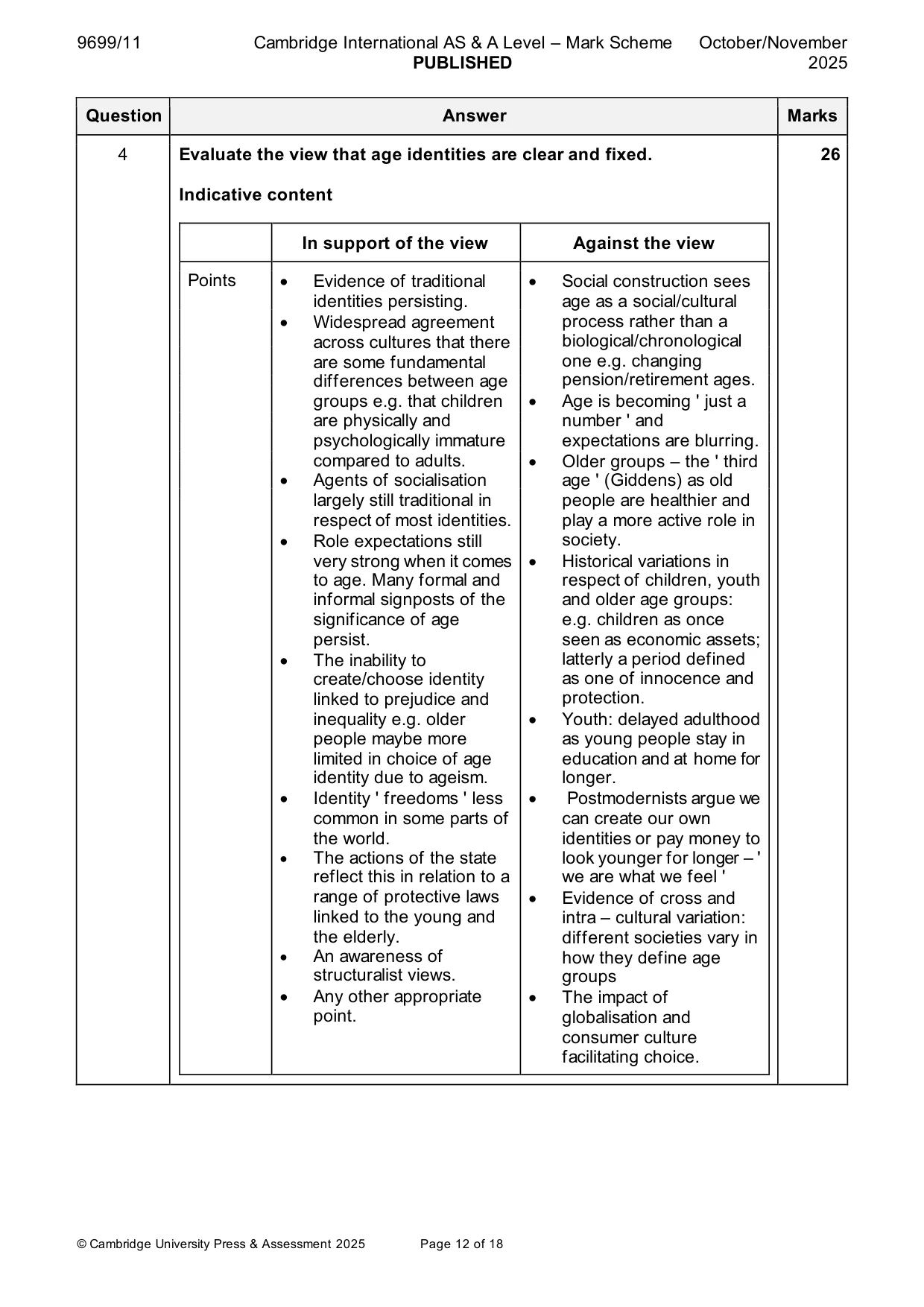
9699/11 Cambridge International AS & A Level – Mark Scheme PUBLISHED October/November 2025 © Cambridge University Press & Assessment 2025 Page 12 of 18 Question Answer Marks 4 Evaluate the view that age identities are clear and fixed. Indicative content In support of the view Against the view Points • Evidence of traditional identities persisting. • Widespread agreement across cultures that there are some fundamental differences between age groups e.g. that children are physically and psychologically immature compared to adults. • Agents of socialisation largely still traditional in respect of most identities. • Role expectations still very strong when it comes to age. Many formal and informal signposts of the significance of age persist. • The inability to create/choose identity linked to prejudice and inequality e.g. older people maybe more limited in choice of age identity due to ageism. • Identity ' freedoms ' less common in some parts of the world. • The actions of the state reflect this in relation to a range of protective laws linked to the young and the elderly. • An awareness of structuralist views. • Any other appropriate point. • Social construction sees age as a social/cultural process rather than a biological/chronological one e.g. changing pension/retirement ages. • Age is becoming ' just a number ' and expectations are blurring. • Older groups – the ' third age ' (Giddens) as old people are healthier and play a more active role in society. • Historical variations in respect of children, youth and older age groups: e.g. children as once seen as economic assets; latterly a period defined as one of innocence and protection. • Youth: delayed adulthood as young people stay in education and at home for longer. • Postmodernists argue we can create our own identities or pay money to look younger for longer – ' we are what we feel ' • Evidence of cross and intra – cultural variation: different societies vary in how they define age groups • The impact of globalisation and consumer culture facilitating choice. 26
Mark scheme, page 13
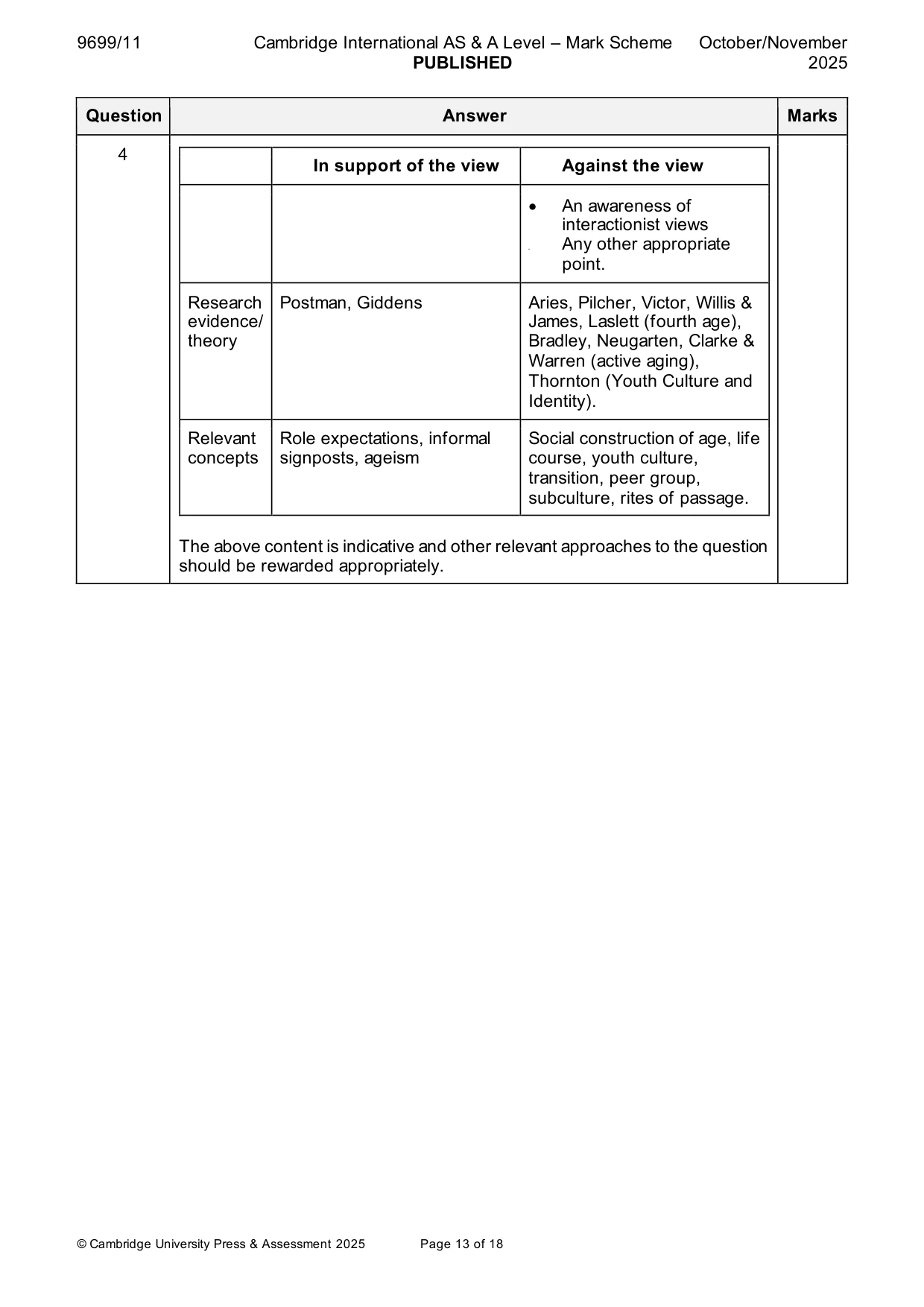
9699/11 Cambridge International AS & A Level – Mark Scheme PUBLISHED October/November 2025 © Cambridge University Press & Assessment 2025 Page 13 of 18 Question Answer Marks 4 In support of the view Against the view • An awareness of interactionist views • Any other appropriate point. Research evidence/ theory Postman, Giddens Aries, Pilcher, Victor, Willis & James, Laslett (fourth age), Bradley, Neugarten, Clarke & Warren (active aging), Thornton (Youth Culture and Identity). Relevant concepts Role expectations, informal signposts, ageism Social construction of age, life course, youth culture, transition, peer group, subculture, rites of passage. The above content is indicative and other relevant approaches to the question should be rewarded appropriately.
Mark scheme, page 14
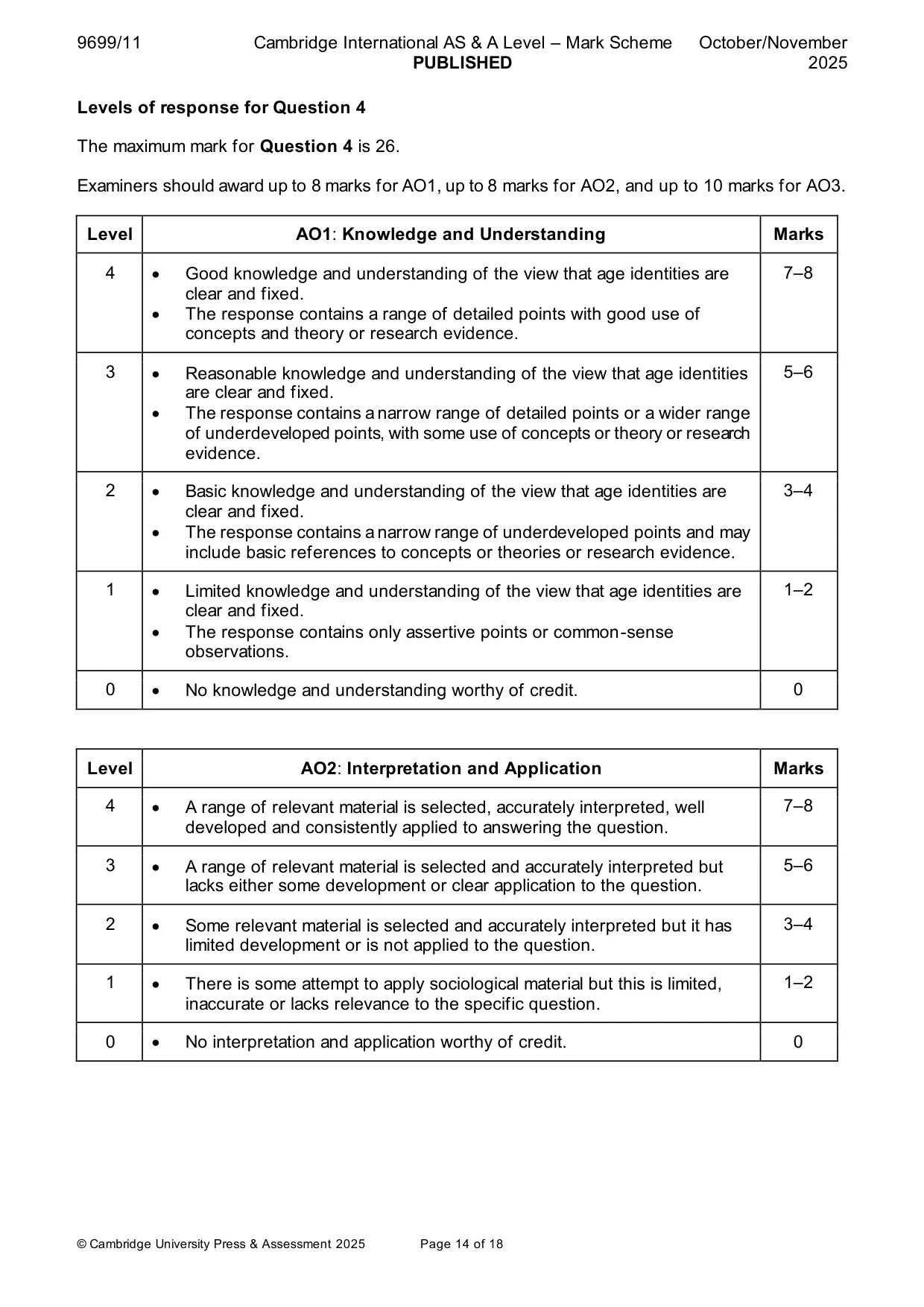
9699/11 Cambridge International AS & A Level – Mark Scheme PUBLISHED October/November 2025 © Cambridge University Press & Assessment 2025 Page 14 of 18 Levels of response for Question 4 The maximum mark for Question 4 is 26. Examiners should award up to 8 marks for AO1, up to 8 marks for AO2, and up to 10 marks for AO3. Level AO1: Knowledge and Understanding Marks 4 • Good knowledge and understanding of the view that age identities are clear and fixed. • The response contains a range of detailed points with good use of concepts and theory or research evidence. 7–8 3 • Reasonable knowledge and understanding of the view that age identities are clear and fixed. • The response contains a narrow range of detailed points or a wider range of underdeveloped points, with some use of concepts or theory or research evidence. 5–6 2 • Basic knowledge and understanding of the view that age identities are clear and fixed. • The response contains a narrow range of underdeveloped points and may include basic references to concepts or theories or research evidence. 3–4 1 • Limited knowledge and understanding of the view that age identities are clear and fixed. • The response contains only assertive points or common-sense observations. 1–2 0 • No knowledge and understanding worthy of credit. 0 Level AO2: Interpretation and Application Marks 4 • A range of relevant material is selected, accurately interpreted, well developed and consistently applied to answering the question. 7–8 3 • A range of relevant material is selected and accurately interpreted but lacks either some development or clear application to the question. 5–6 2 • Some relevant material is selected and accurately interpreted but it has limited development or is not applied to the question. 3–4 1 • There is some attempt to apply sociological material but this is limited, inaccurate or lacks relevance to the specific question. 1–2 0 • No interpretation and application worthy of credit. 0
Mark scheme, page 15
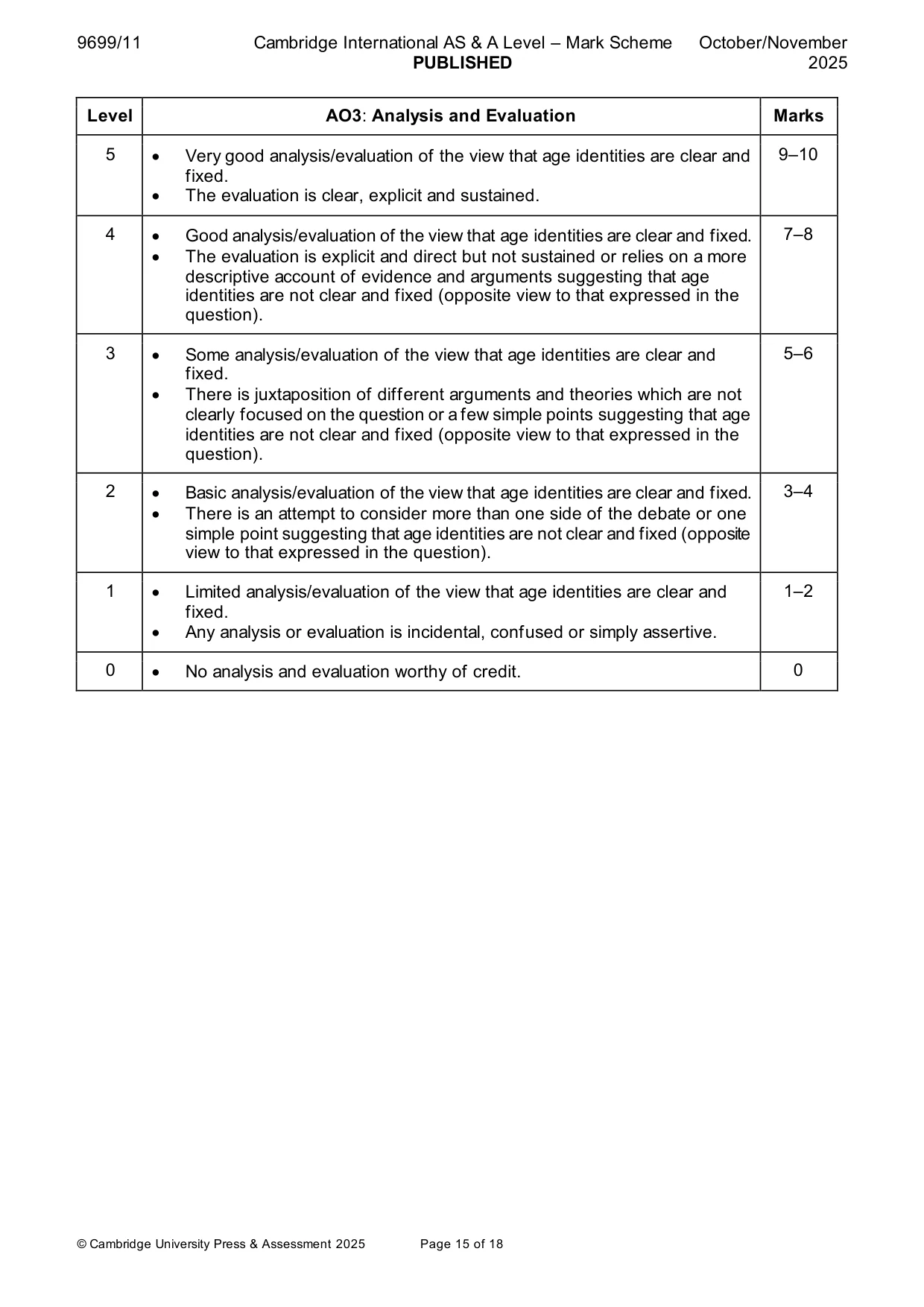
9699/11 Cambridge International AS & A Level – Mark Scheme PUBLISHED October/November 2025 © Cambridge University Press & Assessment 2025 Page 15 of 18 Level AO3: Analysis and Evaluation Marks 5 • Very good analysis/evaluation of the view that age identities are clear and fixed. • The evaluation is clear, explicit and sustained. 9–10 4 • Good analysis/evaluation of the view that age identities are clear and fixed. • The evaluation is explicit and direct but not sustained or relies on a more descriptive account of evidence and arguments suggesting that age identities are not clear and fixed (opposite view to that expressed in the question). 7–8 3 • Some analysis/evaluation of the view that age identities are clear and fixed. • There is juxtaposition of different arguments and theories which are not clearly focused on the question or a few simple points suggesting that age identities are not clear and fixed (opposite view to that expressed in the question). 5–6 2 • Basic analysis/evaluation of the view that age identities are clear and fixed. • There is an attempt to consider more than one side of the debate or one simple point suggesting that age identities are not clear and fixed (opposite view to that expressed in the question). 3–4 1 • Limited analysis/evaluation of the view that age identities are clear and fixed. • Any analysis or evaluation is incidental, confused or simply assertive. 1–2 0 • No analysis and evaluation worthy of credit. 0
Mark scheme, page 16
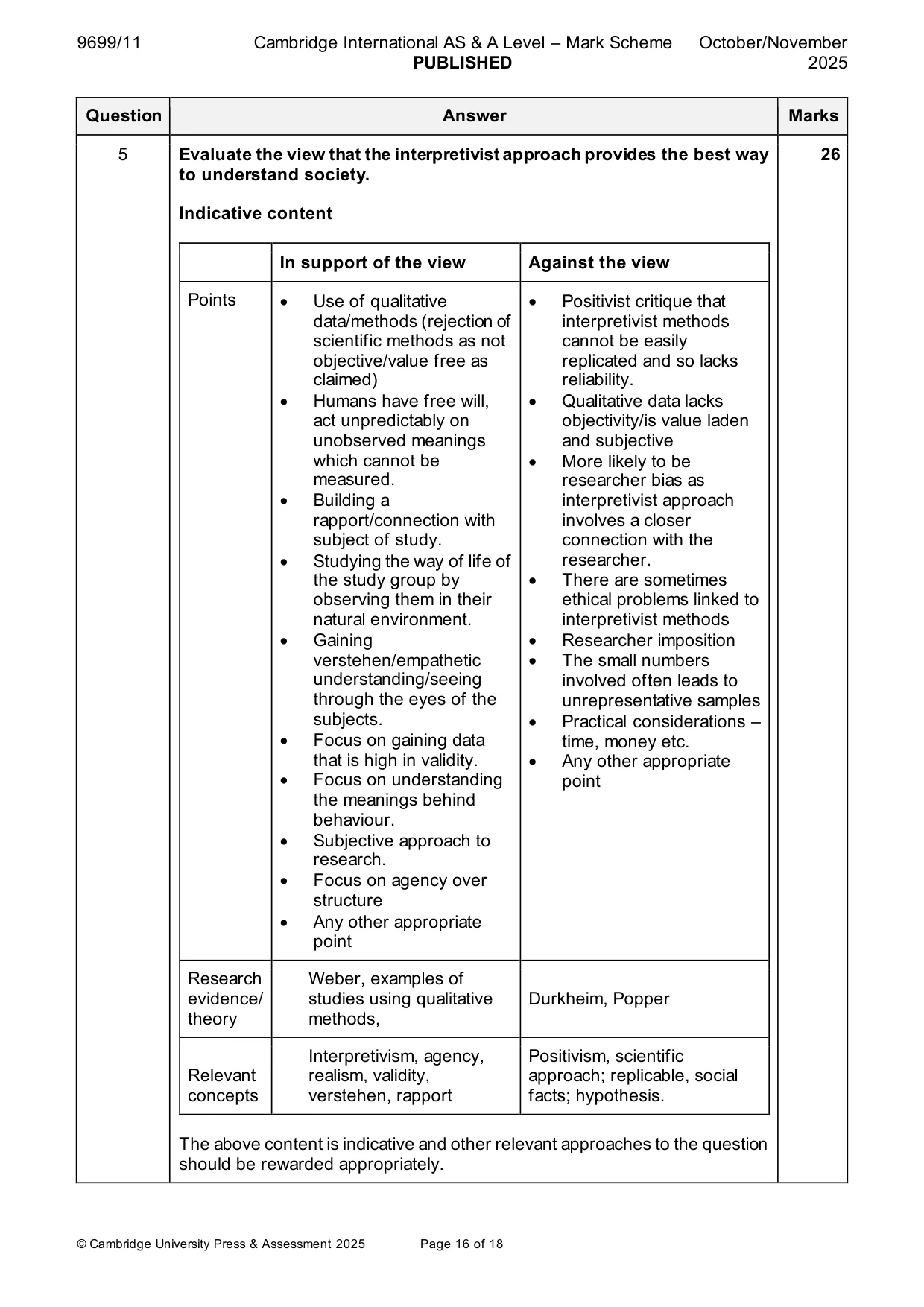
9699/11 Cambridge International AS & A Level – Mark Scheme PUBLISHED October/November 2025 © Cambridge University Press & Assessment 2025 Page 16 of 18 Question Answer Marks 5 Evaluate the view that the interpretivist approach provides the best way to understand society. Indicative content In support of the view Against the view Points • Use of qualitative data/methods (rejection of scientific methods as not objective/value free as claimed) • Humans have free will, act unpredictably on unobserved meanings which cannot be measured. • Building a rapport/connection with subject of study. • Studying the way of life of the study group by observing them in their natural environment. • Gaining verstehen/empathetic understanding/seeing through the eyes of the subjects. • Focus on gaining data that is high in validity. • Focus on understanding the meanings behind behaviour. • Subjective approach to research. • Focus on agency over structure • Any other appropriate point • Positivist critique that interpretivist methods cannot be easily replicated and so lacks reliability. • Qualitative data lacks objectivity/is value laden and subjective • More likely to be researcher bias as interpretivist approach involves a closer connection with the researcher. • There are sometimes ethical problems linked to interpretivist methods • Researcher imposition • The small numbers involved often leads to unrepresentative samples • Practical considerations – time, money etc. • Any other appropriate point Research evidence/ theory Weber, examples of studies using qualitative methods, Durkheim, Popper Relevant concepts Interpretivism, agency, realism, validity, verstehen, rapport Positivism, scientific approach; replicable, social facts; hypothesis. The above content is indicative and other relevant approaches to the question should be rewarded appropriately. 26
Mark scheme, page 17
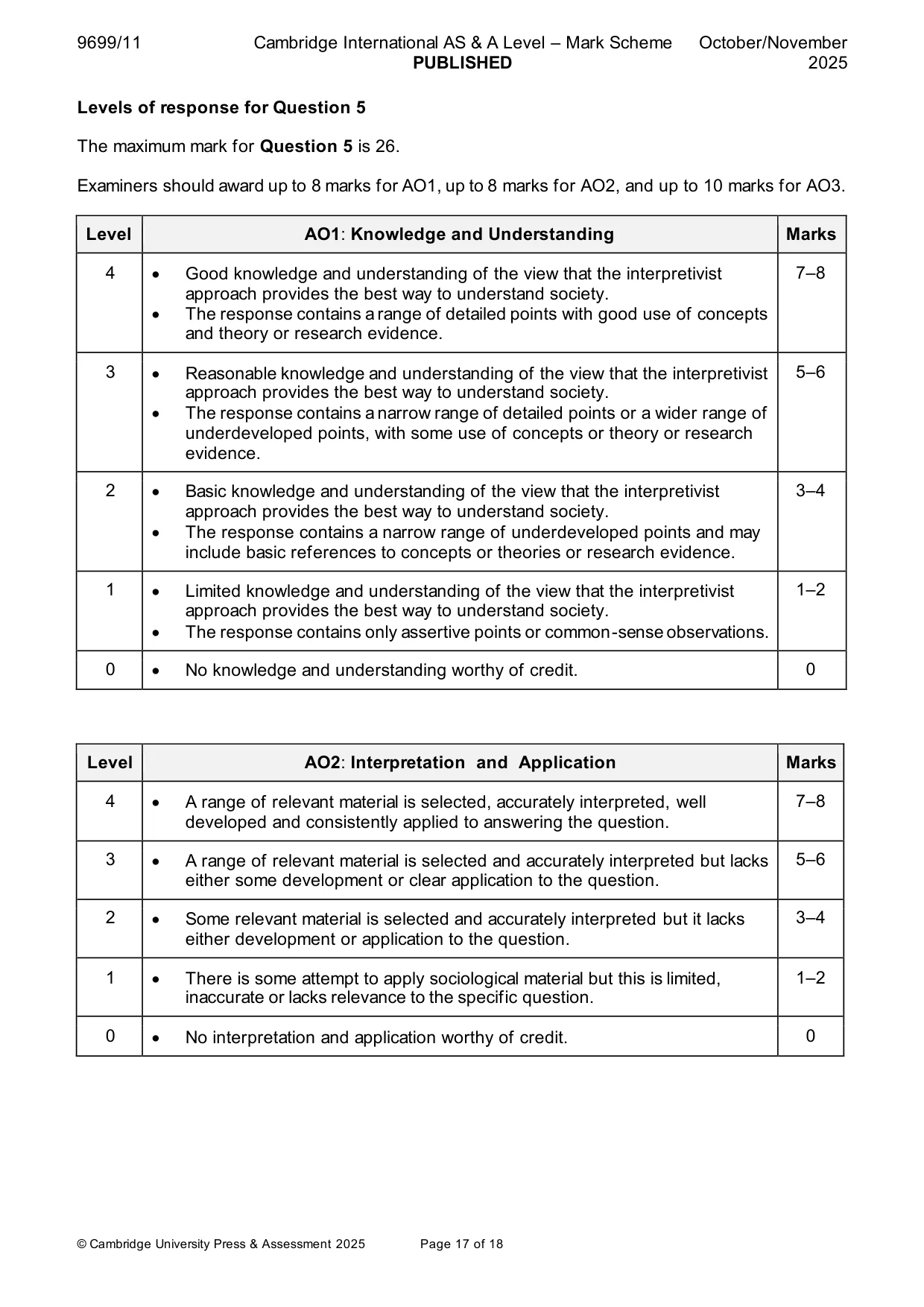
9699/11 Cambridge International AS & A Level – Mark Scheme PUBLISHED October/November 2025 © Cambridge University Press & Assessment 2025 Page 17 of 18 Levels of response for Question 5 The maximum mark for Question 5 is 26. Examiners should award up to 8 marks for AO1, up to 8 marks for AO2, and up to 10 marks for AO3. Level AO1: Knowledge and Understanding Marks 4 • Good knowledge and understanding of the view that the interpretivist approach provides the best way to understand society. • The response contains a range of detailed points with good use of concepts and theory or research evidence. 7–8 3 • Reasonable knowledge and understanding of the view that the interpretivist approach provides the best way to understand society. • The response contains a narrow range of detailed points or a wider range of underdeveloped points, with some use of concepts or theory or research evidence. 5–6 2 • Basic knowledge and understanding of the view that the interpretivist approach provides the best way to understand society. • The response contains a narrow range of underdeveloped points and may include basic references to concepts or theories or research evidence. 3–4 1 • Limited knowledge and understanding of the view that the interpretivist approach provides the best way to understand society. • The response contains only assertive points or common-sense observations. 1–2 0 • No knowledge and understanding worthy of credit. 0 Level AO2: Interpretation and Application Marks 4 • A range of relevant material is selected, accurately interpreted, well developed and consistently applied to answering the question. 7–8 3 • A range of relevant material is selected and accurately interpreted but lacks either some development or clear application to the question. 5–6 2 • Some relevant material is selected and accurately interpreted but it lacks either development or application to the question. 3–4 1 • There is some attempt to apply sociological material but this is limited, inaccurate or lacks relevance to the specific question. 1–2 0 • No interpretation and application worthy of credit. 0
Mark scheme, page 18
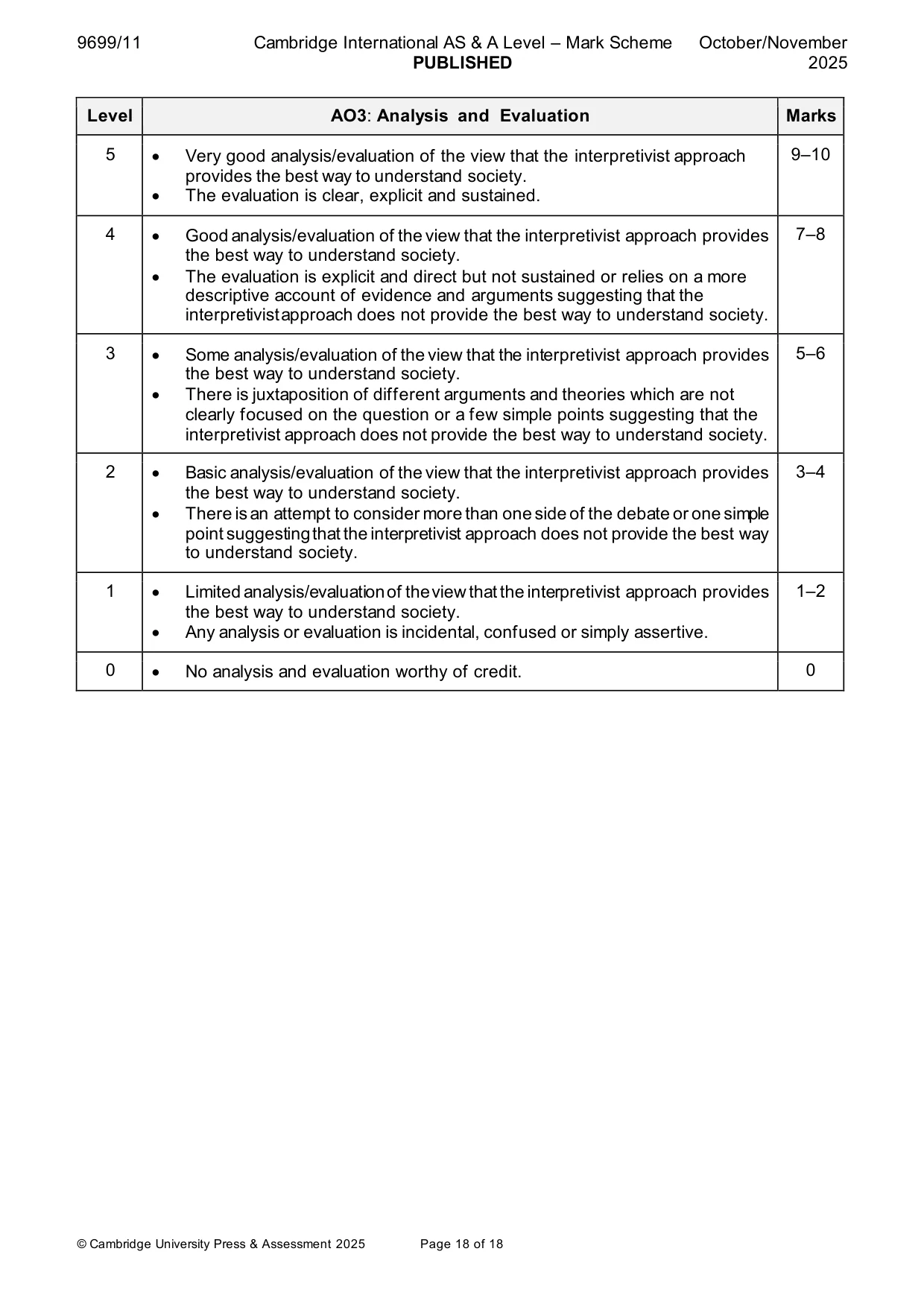
9699/11 Cambridge International AS & A Level – Mark Scheme PUBLISHED October/November 2025 © Cambridge University Press & Assessment 2025 Page 18 of 18 Level AO3: Analysis and Evaluation Marks 5 • Very good analysis/evaluation of the view that the interpretivist approach provides the best way to understand society. • The evaluation is clear, explicit and sustained. 9–10 4 • Good analysis/evaluation of the view that the interpretivist approach provides the best way to understand society. • The evaluation is explicit and direct but not sustained or relies on a more descriptive account of evidence and arguments suggesting that the interpretivist approach does not provide the best way to understand society. 7–8 3 • Some analysis/evaluation of the view that the interpretivist approach provides the best way to understand society. • There is juxtaposition of different arguments and theories which are not clearly focused on the question or a few simple points suggesting that the interpretivist approach does not provide the best way to understand society. 5–6 2 • Basic analysis/evaluation of the view that the interpretivist approach provides the best way to understand society. • There is an attempt to consider more than one side of the debate or one simple point suggesting that the interpretivist approach does not provide the best way to understand society. 3–4 1 • Limited analysis/evaluation of the view that the interpretivist approach provides the best way to understand society. • Any analysis or evaluation is incidental, confused or simply assertive. 1–2 0 • No analysis and evaluation worthy of credit. 0
What you needed in this session
Cambridge’s own grade thresholds for 2025 Oct/Nov, Paper 1 · Variant 1. A higher threshold means an easier paper — the bar moves with how the cohort did.