Cambridge A Level Sociology 9699 — 2017 May/June Paper 1 · Variant 3
9699/13/M/J/17 · 50 marks · ≈56 min
The question paper and its mark scheme, free to read here and free to download. This is Cambridge’s own paper, exactly as it was sat.
Question paper4 pages


Mark scheme11 pages
Answers below. Sit the paper first if you are practising.
Paper as text
Question paper, page 1
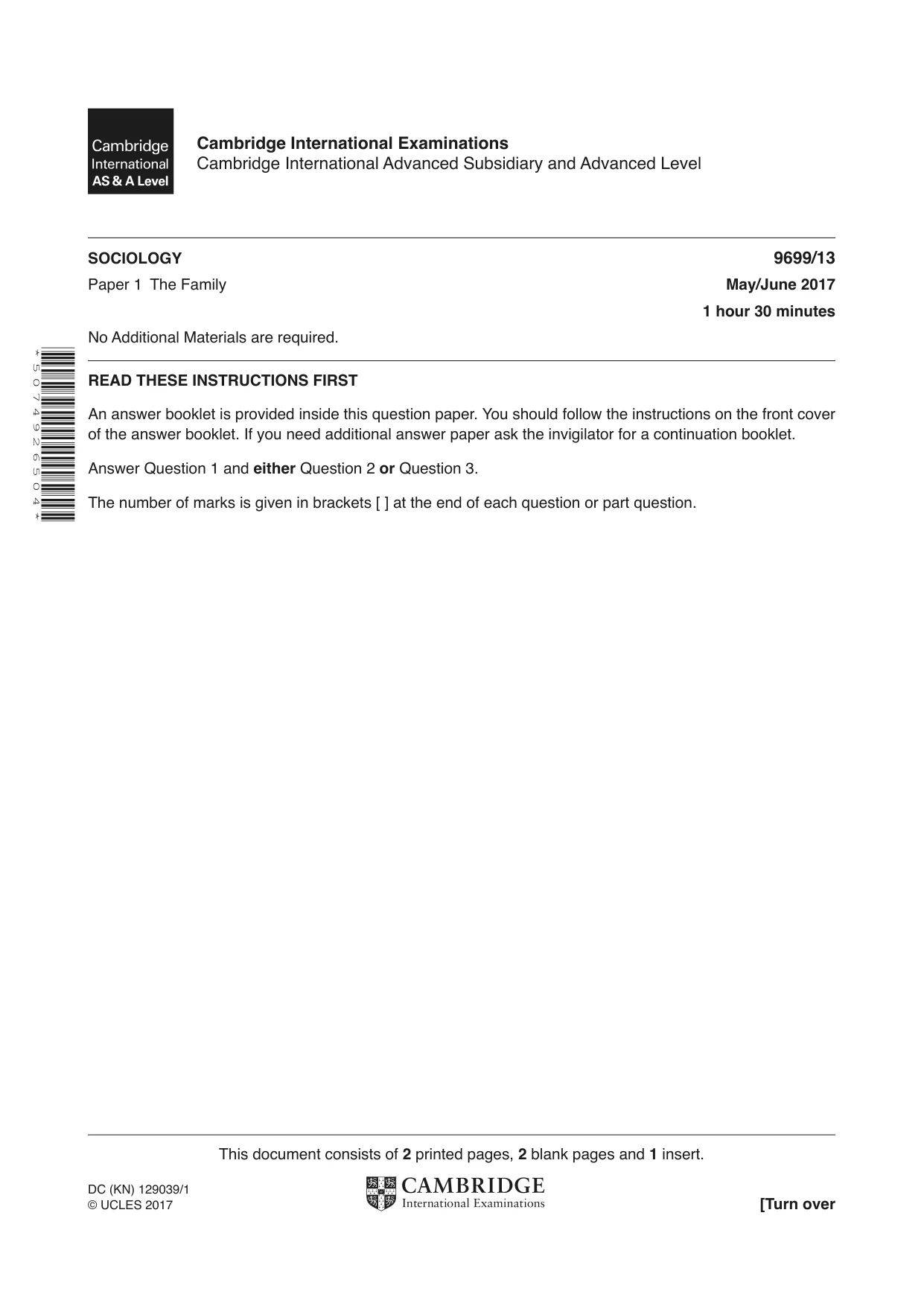
This document consists of 2 printed pages, 2 blank pages and 1 insert. DC (KN) 129039/1 © UCLES 2017 [Turn over Cambridge International Examinations Cambridge International Advanced Subsidiary and Advanced Level * 5 0 7 4 9 2 6 5 0 4 * SOCIOLOGY 9699/13 Paper 1 The Family May/June 2017 1 hour 30 minutes No Additional Materials are required. READ THESE INSTRUCTIONS FIRST An answer booklet is provided inside this question paper. You should follow the instructions on the front cover of the answer booklet. If you need additional answer paper ask the invigilator for a continuation booklet. Answer Question 1 and either Question 2 or Question 3. The number of marks is given in brackets [ ] at the end of each question or part question.
Question paper, page 2
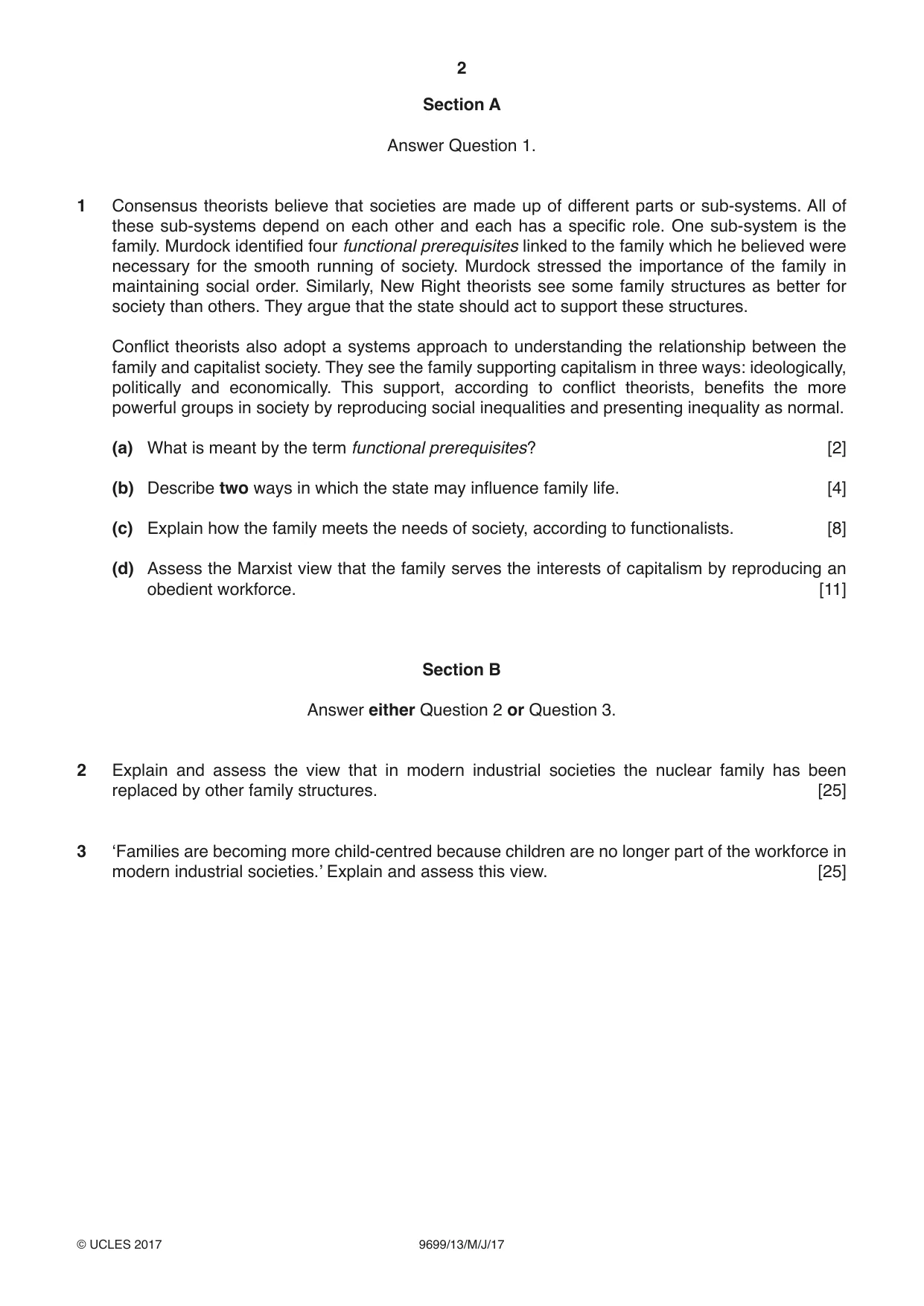
2 9699/13/M/J/17 © UCLES 2017 Section A Answer Question 1. 1 Consensus theorists believe that societies are made up of different parts or sub-systems. All of these sub-systems depend on each other and each has a specific role. One sub-system is the family. Murdock identified four functional prerequisites linked to the family which he believed were necessary for the smooth running of society. Murdock stressed the importance of the family in maintaining social order. Similarly, New Right theorists see some family structures as better for society than others. They argue that the state should act to support these structures. Conflict theorists also adopt a systems approach to understanding the relationship between the family and capitalist society. They see the family supporting capitalism in three ways: ideologically, politically and economically. This support, according to conflict theorists, benefits the more powerful groups in society by reproducing social inequalities and presenting inequality as normal. (a) What is meant by the term functional prerequisites? [2] (b) Describe two ways in which the state may influence family life. [4] (c) Explain how the family meets the needs of society, according to functionalists. [8] (d) Assess the Marxist view that the family serves the interests of capitalism by reproducing an obedient workforce. [11] Section B Answer either Question 2 or Question 3. 2 Explain and assess the view that in modern industrial societies the nuclear family has been replaced by other family structures. [25] 3 ‘Families are becoming more child-centred because children are no longer part of the workforce in modern industrial societies.’ Explain and assess this view. [25]
Question paper, page 3
3 9699/13/M/J/17 © UCLES 2017 BLANK PAGE
Question paper, page 4
4 9699/13/M/J/17 © UCLES 2017 Permission to reproduce items where third-party owned material protected by copyright is included has been sought and cleared where possible. Every reasonable effort has been made by the publisher (UCLES) to trace copyright holders, but if any items requiring clearance have unwittingly been included, the publisher will be pleased to make amends at the earliest possible opportunity. To avoid the issue of disclosure of answer-related information to candidates, all copyright acknowledgements are reproduced online in the Cambridge International Examinations Copyright Acknowledgements Booklet. This is produced for each series of examinations and is freely available to download at www.cie.org.uk after the live examination series. Cambridge International Examinations is part of the Cambridge Assessment Group. Cambridge Assessment is the brand name of University of Cambridge Local Examinations Syndicate (UCLES), which is itself a department of the University of Cambridge. BLANK PAGE
Mark scheme, page 1
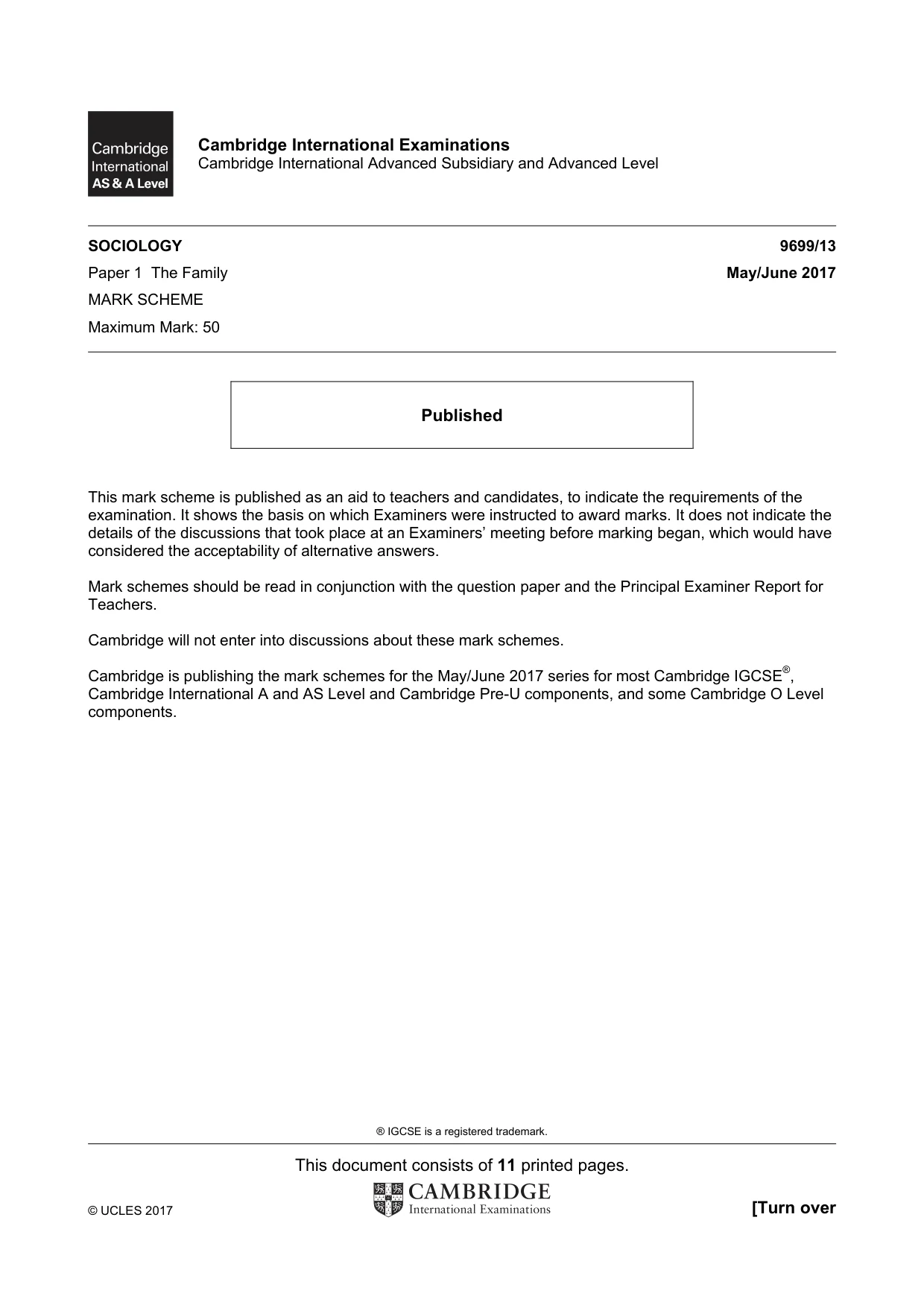
® IGCSE is a registered trademark. This document consists of 11 printed pages. © UCLES 2017 [Turn over Cambridge International Examinations Cambridge International Advanced Subsidiary and Advanced Level SOCIOLOGY 9699/13 Paper 1 The Family May/June 2017 MARK SCHEME Maximum Mark: 50 Published This mark scheme is published as an aid to teachers and candidates, to indicate the requirements of the examination. It shows the basis on which Examiners were instructed to award marks. It does not indicate the details of the discussions that took place at an Examiners’ meeting before marking began, which would have considered the acceptability of alternative answers. Mark schemes should be read in conjunction with the question paper and the Principal Examiner Report for Teachers. Cambridge will not enter into discussions about these mark schemes. Cambridge is publishing the mark schemes for the May/June 2017 series for most Cambridge IGCSE®, Cambridge International A and AS Level and Cambridge Pre-U components, and some Cambridge O Level components.
Mark scheme, page 2
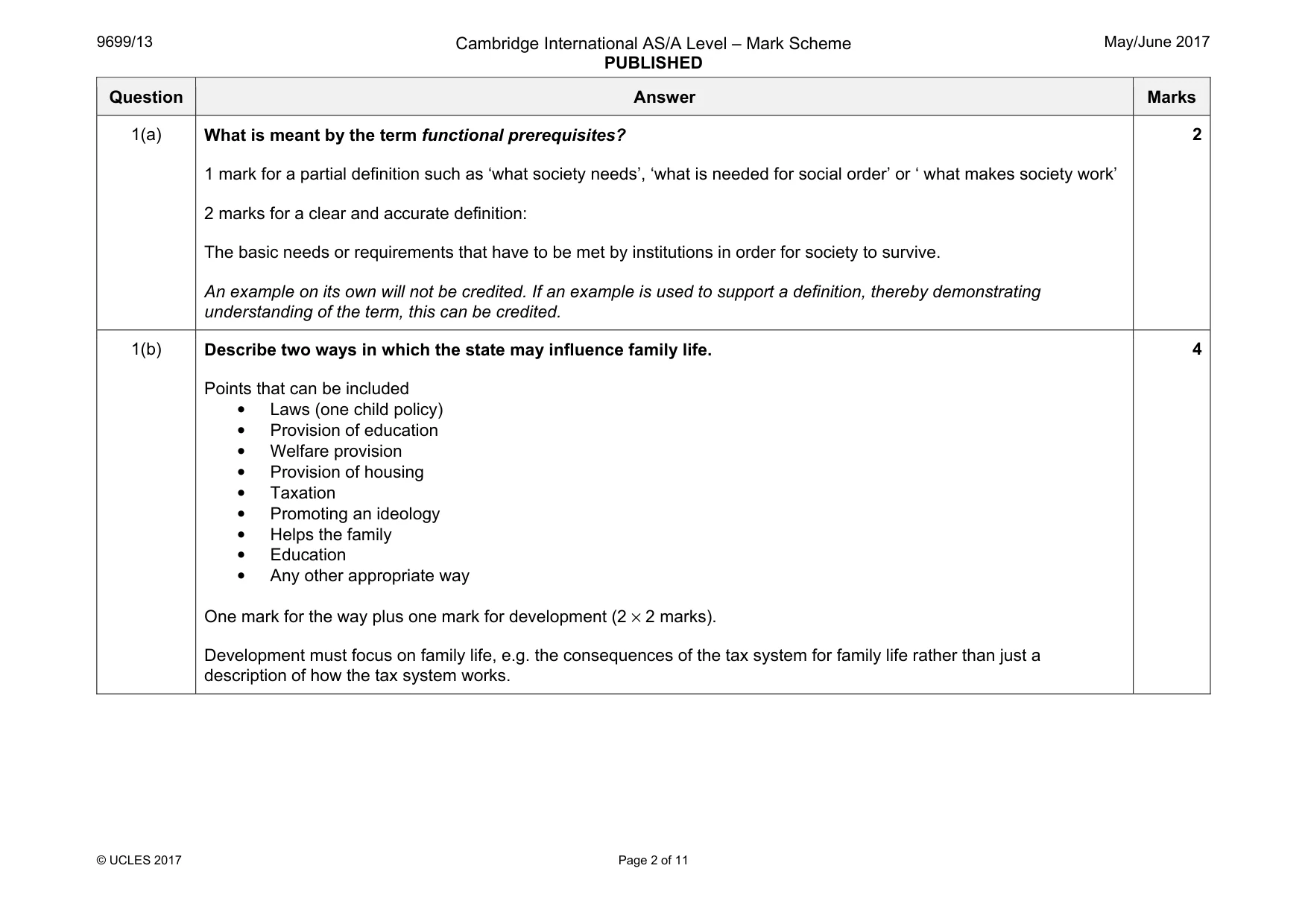
9699/13 Cambridge International AS/A Level – Mark Scheme PUBLISHED May/June 2017 © UCLES 2017 Page 2 of 11 Question Answer Marks 1(a) What is meant by the term functional prerequisites? 1 mark for a partial definition such as ‘what society needs’, ‘what is needed for social order’ or ‘ what makes society work’ 2 marks for a clear and accurate definition: The basic needs or requirements that have to be met by institutions in order for society to survive. An example on its own will not be credited. If an example is used to support a definition, thereby demonstrating understanding of the term, this can be credited. 2 1(b) Describe two ways in which the state may influence family life. Points that can be included • Laws (one child policy) • Provision of education • Welfare provision • Provision of housing • Taxation • Promoting an ideology • Helps the family • Education • Any other appropriate way One mark for the way plus one mark for development (2 × 2 marks). Development must focus on family life, e.g. the consequences of the tax system for family life rather than just a description of how the tax system works. 4
Mark scheme, page 3
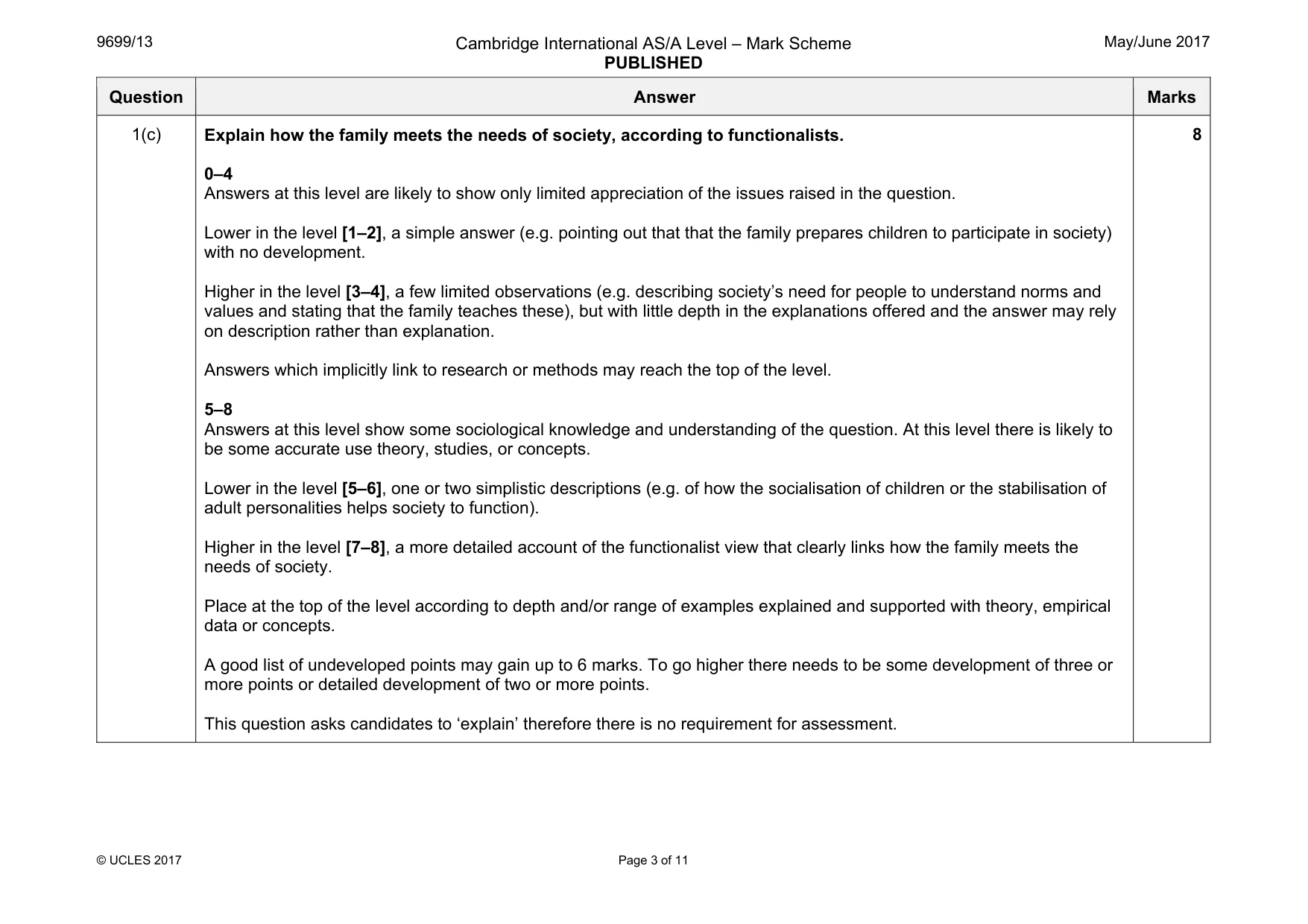
9699/13 Cambridge International AS/A Level – Mark Scheme PUBLISHED May/June 2017 © UCLES 2017 Page 3 of 11 Question Answer Marks 1(c) Explain how the family meets the needs of society, according to functionalists. 0–4 Answers at this level are likely to show only limited appreciation of the issues raised in the question. Lower in the level [1–2], a simple answer (e.g. pointing out that that the family prepares children to participate in society) with no development. Higher in the level [3–4], a few limited observations (e.g. describing society’s need for people to understand norms and values and stating that the family teaches these), but with little depth in the explanations offered and the answer may rely on description rather than explanation. Answers which implicitly link to research or methods may reach the top of the level. 5–8 Answers at this level show some sociological knowledge and understanding of the question. At this level there is likely to be some accurate use theory, studies, or concepts. Lower in the level [5–6], one or two simplistic descriptions (e.g. of how the socialisation of children or the stabilisation of adult personalities helps society to function). Higher in the level [7–8], a more detailed account of the functionalist view that clearly links how the family meets the needs of society. Place at the top of the level according to depth and/or range of examples explained and supported with theory, empirical data or concepts. A good list of undeveloped points may gain up to 6 marks. To go higher there needs to be some development of three or more points or detailed development of two or more points. This question asks candidates to ‘explain’ therefore there is no requirement for assessment. 8
Mark scheme, page 4
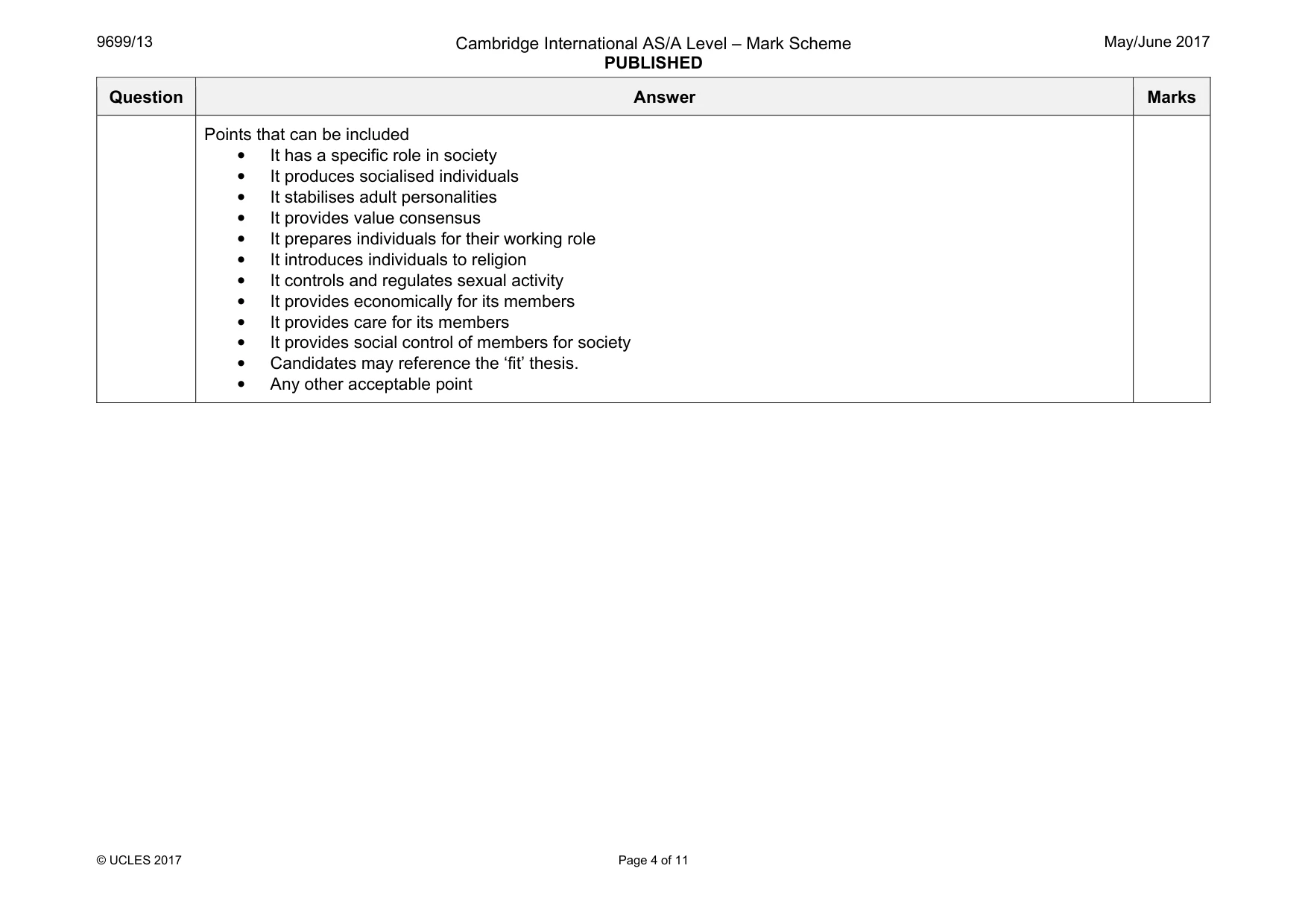
9699/13 Cambridge International AS/A Level – Mark Scheme PUBLISHED May/June 2017 © UCLES 2017 Page 4 of 11 Question Answer Marks Points that can be included • It has a specific role in society • It produces socialised individuals • It stabilises adult personalities • It provides value consensus • It prepares individuals for their working role • It introduces individuals to religion • It controls and regulates sexual activity • It provides economically for its members • It provides care for its members • It provides social control of members for society • Candidates may reference the ‘fit’ thesis. • Any other acceptable point
Mark scheme, page 5
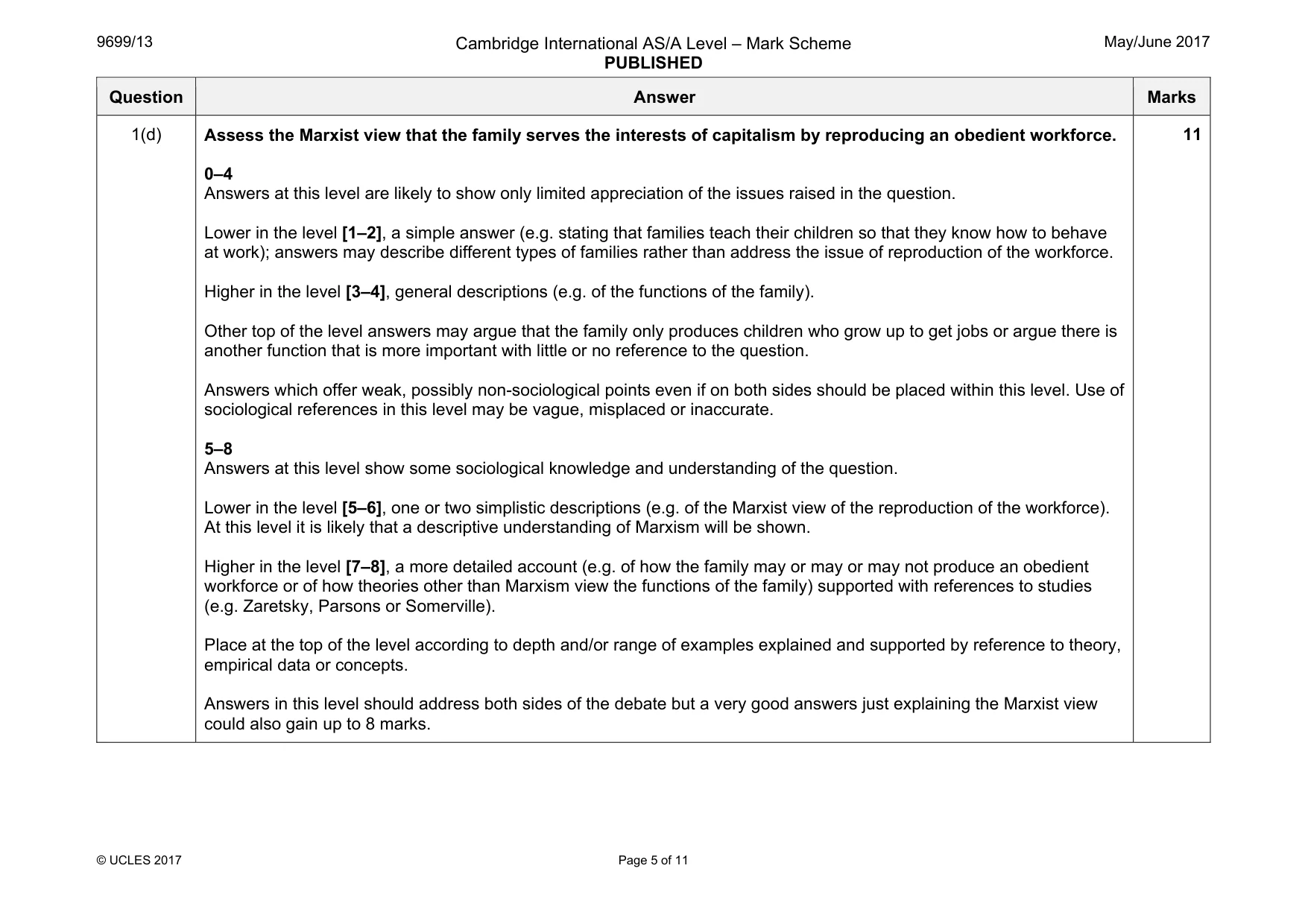
9699/13 Cambridge International AS/A Level – Mark Scheme PUBLISHED May/June 2017 © UCLES 2017 Page 5 of 11 Question Answer Marks 1(d) Assess the Marxist view that the family serves the interests of capitalism by reproducing an obedient workforce. 0–4 Answers at this level are likely to show only limited appreciation of the issues raised in the question. Lower in the level [1–2], a simple answer (e.g. stating that families teach their children so that they know how to behave at work); answers may describe different types of families rather than address the issue of reproduction of the workforce. Higher in the level [3–4], general descriptions (e.g. of the functions of the family). Other top of the level answers may argue that the family only produces children who grow up to get jobs or argue there is another function that is more important with little or no reference to the question. Answers which offer weak, possibly non-sociological points even if on both sides should be placed within this level. Use of sociological references in this level may be vague, misplaced or inaccurate. 5–8 Answers at this level show some sociological knowledge and understanding of the question. Lower in the level [5–6], one or two simplistic descriptions (e.g. of the Marxist view of the reproduction of the workforce). At this level it is likely that a descriptive understanding of Marxism will be shown. Higher in the level [7–8], a more detailed account (e.g. of how the family may or may or may not produce an obedient workforce or of how theories other than Marxism view the functions of the family) supported with references to studies (e.g. Zaretsky, Parsons or Somerville). Place at the top of the level according to depth and/or range of examples explained and supported by reference to theory, empirical data or concepts. Answers in this level should address both sides of the debate but a very good answers just explaining the Marxist view could also gain up to 8 marks. 11
Mark scheme, page 6
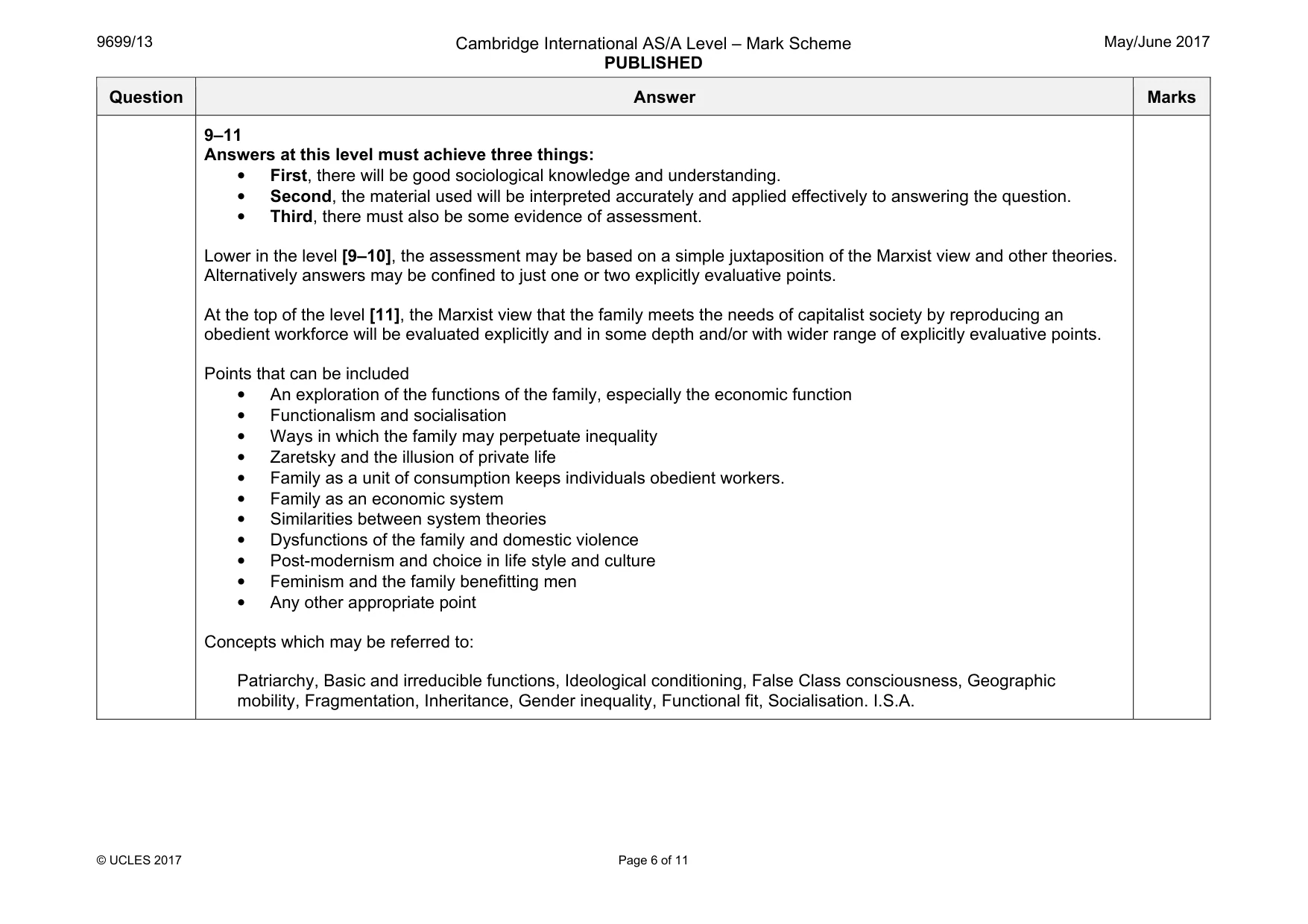
9699/13 Cambridge International AS/A Level – Mark Scheme PUBLISHED May/June 2017 © UCLES 2017 Page 6 of 11 Question Answer Marks 9–11 Answers at this level must achieve three things: • First, there will be good sociological knowledge and understanding. • Second, the material used will be interpreted accurately and applied effectively to answering the question. • Third, there must also be some evidence of assessment. Lower in the level [9–10], the assessment may be based on a simple juxtaposition of the Marxist view and other theories. Alternatively answers may be confined to just one or two explicitly evaluative points. At the top of the level [11], the Marxist view that the family meets the needs of capitalist society by reproducing an obedient workforce will be evaluated explicitly and in some depth and/or with wider range of explicitly evaluative points. Points that can be included • An exploration of the functions of the family, especially the economic function • Functionalism and socialisation • Ways in which the family may perpetuate inequality • Zaretsky and the illusion of private life • Family as a unit of consumption keeps individuals obedient workers. • Family as an economic system • Similarities between system theories • Dysfunctions of the family and domestic violence • Post-modernism and choice in life style and culture • Feminism and the family benefitting men • Any other appropriate point Concepts which may be referred to: Patriarchy, Basic and irreducible functions, Ideological conditioning, False Class consciousness, Geographic mobility, Fragmentation, Inheritance, Gender inequality, Functional fit, Socialisation. I.S.A.
Mark scheme, page 7
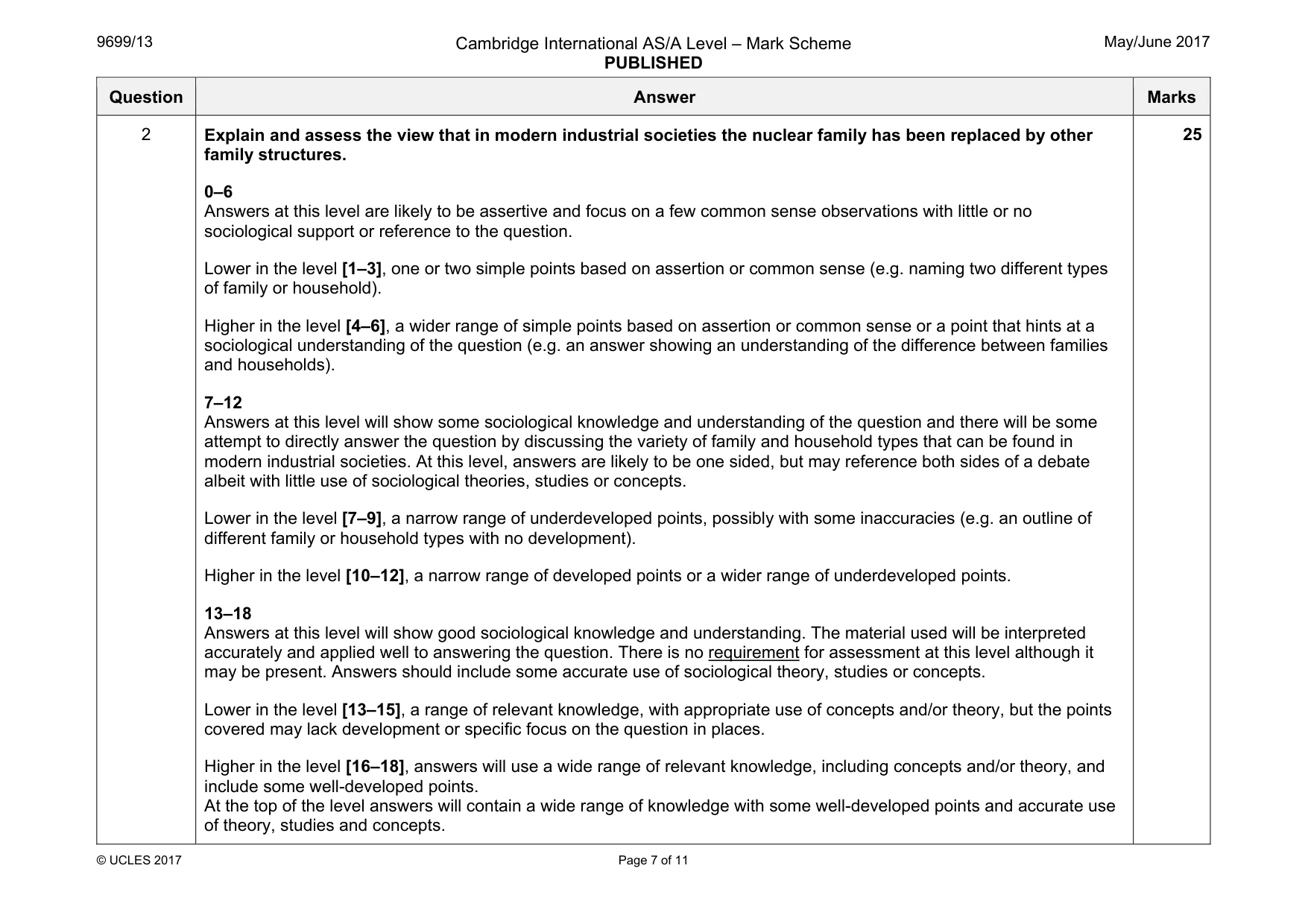
9699/13 Cambridge International AS/A Level – Mark Scheme PUBLISHED May/June 2017 © UCLES 2017 Page 7 of 11 Question Answer Marks 2 Explain and assess the view that in modern industrial societies the nuclear family has been replaced by other family structures. 0–6 Answers at this level are likely to be assertive and focus on a few common sense observations with little or no sociological support or reference to the question. Lower in the level [1–3], one or two simple points based on assertion or common sense (e.g. naming two different types of family or household). Higher in the level [4–6], a wider range of simple points based on assertion or common sense or a point that hints at a sociological understanding of the question (e.g. an answer showing an understanding of the difference between families and households). 7–12 Answers at this level will show some sociological knowledge and understanding of the question and there will be some attempt to directly answer the question by discussing the variety of family and household types that can be found in modern industrial societies. At this level, answers are likely to be one sided, but may reference both sides of a debate albeit with little use of sociological theories, studies or concepts. Lower in the level [7–9], a narrow range of underdeveloped points, possibly with some inaccuracies (e.g. an outline of different family or household types with no development). Higher in the level [10–12], a narrow range of developed points or a wider range of underdeveloped points. 13–18 Answers at this level will show good sociological knowledge and understanding. The material used will be interpreted accurately and applied well to answering the question. There is no requirement for assessment at this level although it may be present. Answers should include some accurate use of sociological theory, studies or concepts. Lower in the level [13–15], a range of relevant knowledge, with appropriate use of concepts and/or theory, but the points covered may lack development or specific focus on the question in places. Higher in the level [16–18], answers will use a wide range of relevant knowledge, including concepts and/or theory, and include some well-developed points. At the top of the level answers will contain a wide range of knowledge with some well-developed points and accurate use of theory, studies and concepts. 25
Mark scheme, page 8
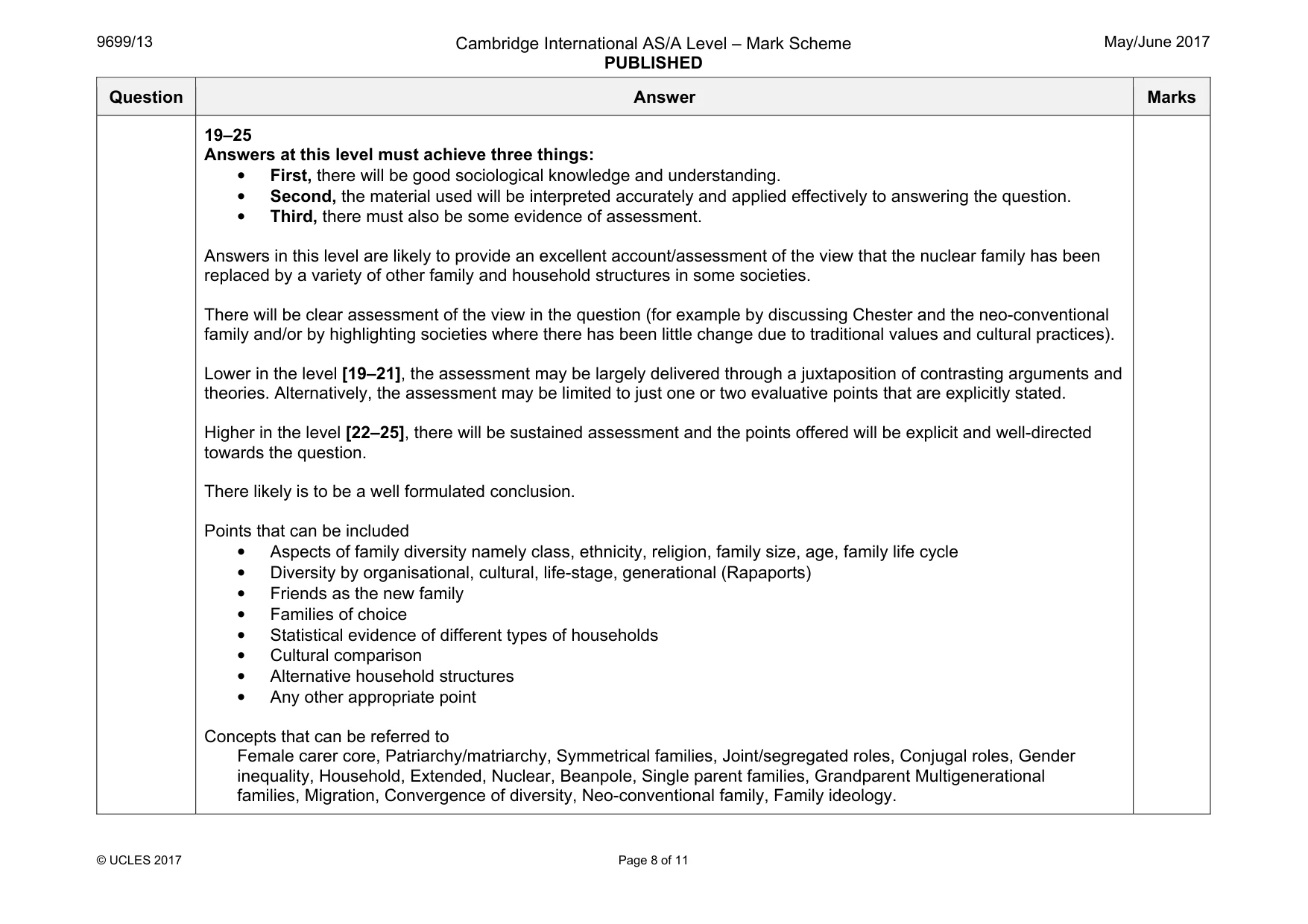
9699/13 Cambridge International AS/A Level – Mark Scheme PUBLISHED May/June 2017 © UCLES 2017 Page 8 of 11 Question Answer Marks 19–25 Answers at this level must achieve three things: • First, there will be good sociological knowledge and understanding. • Second, the material used will be interpreted accurately and applied effectively to answering the question. • Third, there must also be some evidence of assessment. Answers in this level are likely to provide an excellent account/assessment of the view that the nuclear family has been replaced by a variety of other family and household structures in some societies. There will be clear assessment of the view in the question (for example by discussing Chester and the neo-conventional family and/or by highlighting societies where there has been little change due to traditional values and cultural practices). Lower in the level [19–21], the assessment may be largely delivered through a juxtaposition of contrasting arguments and theories. Alternatively, the assessment may be limited to just one or two evaluative points that are explicitly stated. Higher in the level [22–25], there will be sustained assessment and the points offered will be explicit and well-directed towards the question. There likely is to be a well formulated conclusion. Points that can be included • Aspects of family diversity namely class, ethnicity, religion, family size, age, family life cycle • Diversity by organisational, cultural, life-stage, generational (Rapaports) • Friends as the new family • Families of choice • Statistical evidence of different types of households • Cultural comparison • Alternative household structures • Any other appropriate point Concepts that can be referred to Female carer core, Patriarchy/matriarchy, Symmetrical families, Joint/segregated roles, Conjugal roles, Gender inequality, Household, Extended, Nuclear, Beanpole, Single parent families, Grandparent Multigenerational families, Migration, Convergence of diversity, Neo-conventional family, Family ideology.
Mark scheme, page 9
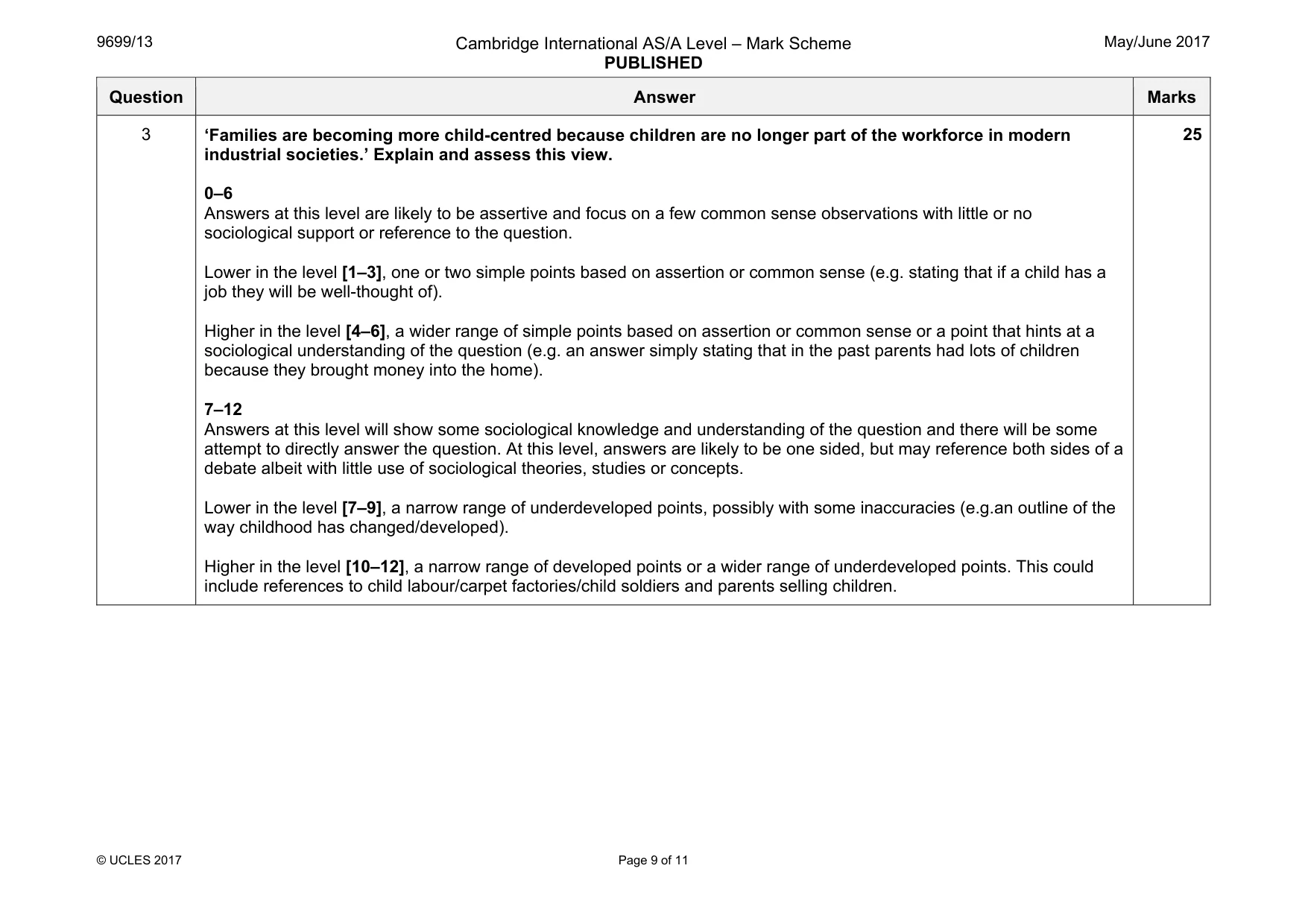
9699/13 Cambridge International AS/A Level – Mark Scheme PUBLISHED May/June 2017 © UCLES 2017 Page 9 of 11 Question Answer Marks 3 ‘Families are becoming more child-centred because children are no longer part of the workforce in modern industrial societies.’ Explain and assess this view. 0–6 Answers at this level are likely to be assertive and focus on a few common sense observations with little or no sociological support or reference to the question. Lower in the level [1–3], one or two simple points based on assertion or common sense (e.g. stating that if a child has a job they will be well-thought of). Higher in the level [4–6], a wider range of simple points based on assertion or common sense or a point that hints at a sociological understanding of the question (e.g. an answer simply stating that in the past parents had lots of children because they brought money into the home). 7–12 Answers at this level will show some sociological knowledge and understanding of the question and there will be some attempt to directly answer the question. At this level, answers are likely to be one sided, but may reference both sides of a debate albeit with little use of sociological theories, studies or concepts. Lower in the level [7–9], a narrow range of underdeveloped points, possibly with some inaccuracies (e.g.an outline of the way childhood has changed/developed). Higher in the level [10–12], a narrow range of developed points or a wider range of underdeveloped points. This could include references to child labour/carpet factories/child soldiers and parents selling children. 25
Mark scheme, page 10
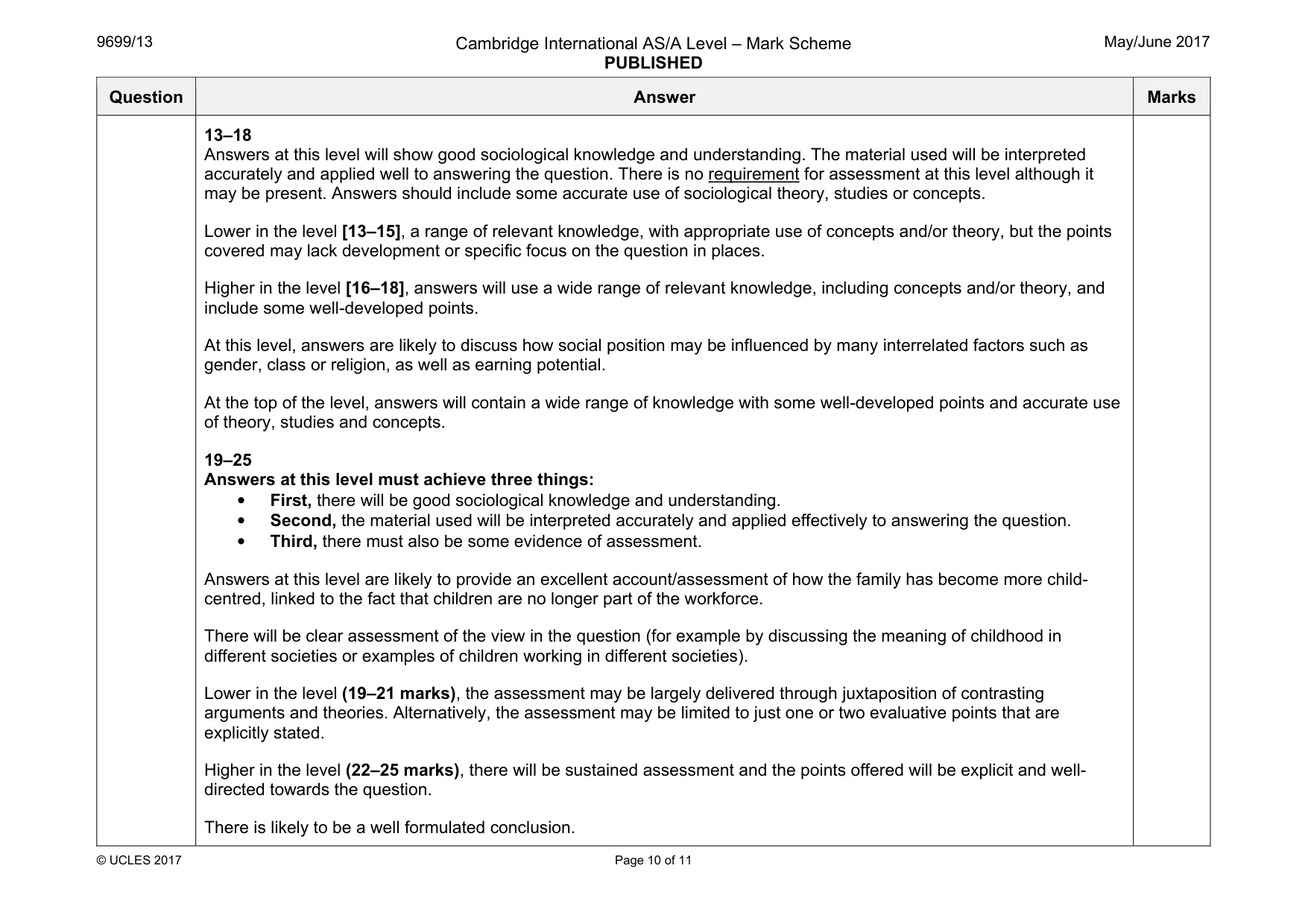
9699/13 Cambridge International AS/A Level – Mark Scheme PUBLISHED May/June 2017 © UCLES 2017 Page 10 of 11 Question Answer Marks 13–18 Answers at this level will show good sociological knowledge and understanding. The material used will be interpreted accurately and applied well to answering the question. There is no requirement for assessment at this level although it may be present. Answers should include some accurate use of sociological theory, studies or concepts. Lower in the level [13–15], a range of relevant knowledge, with appropriate use of concepts and/or theory, but the points covered may lack development or specific focus on the question in places. Higher in the level [16–18], answers will use a wide range of relevant knowledge, including concepts and/or theory, and include some well-developed points. At this level, answers are likely to discuss how social position may be influenced by many interrelated factors such as gender, class or religion, as well as earning potential. At the top of the level, answers will contain a wide range of knowledge with some well-developed points and accurate use of theory, studies and concepts. 19–25 Answers at this level must achieve three things: • First, there will be good sociological knowledge and understanding. • Second, the material used will be interpreted accurately and applied effectively to answering the question. • Third, there must also be some evidence of assessment. Answers at this level are likely to provide an excellent account/assessment of how the family has become more child- centred, linked to the fact that children are no longer part of the workforce. There will be clear assessment of the view in the question (for example by discussing the meaning of childhood in different societies or examples of children working in different societies). Lower in the level (19–21 marks), the assessment may be largely delivered through juxtaposition of contrasting arguments and theories. Alternatively, the assessment may be limited to just one or two evaluative points that are explicitly stated. Higher in the level (22–25 marks), there will be sustained assessment and the points offered will be explicit and well- directed towards the question. There is likely to be a well formulated conclusion.
Mark scheme, page 11
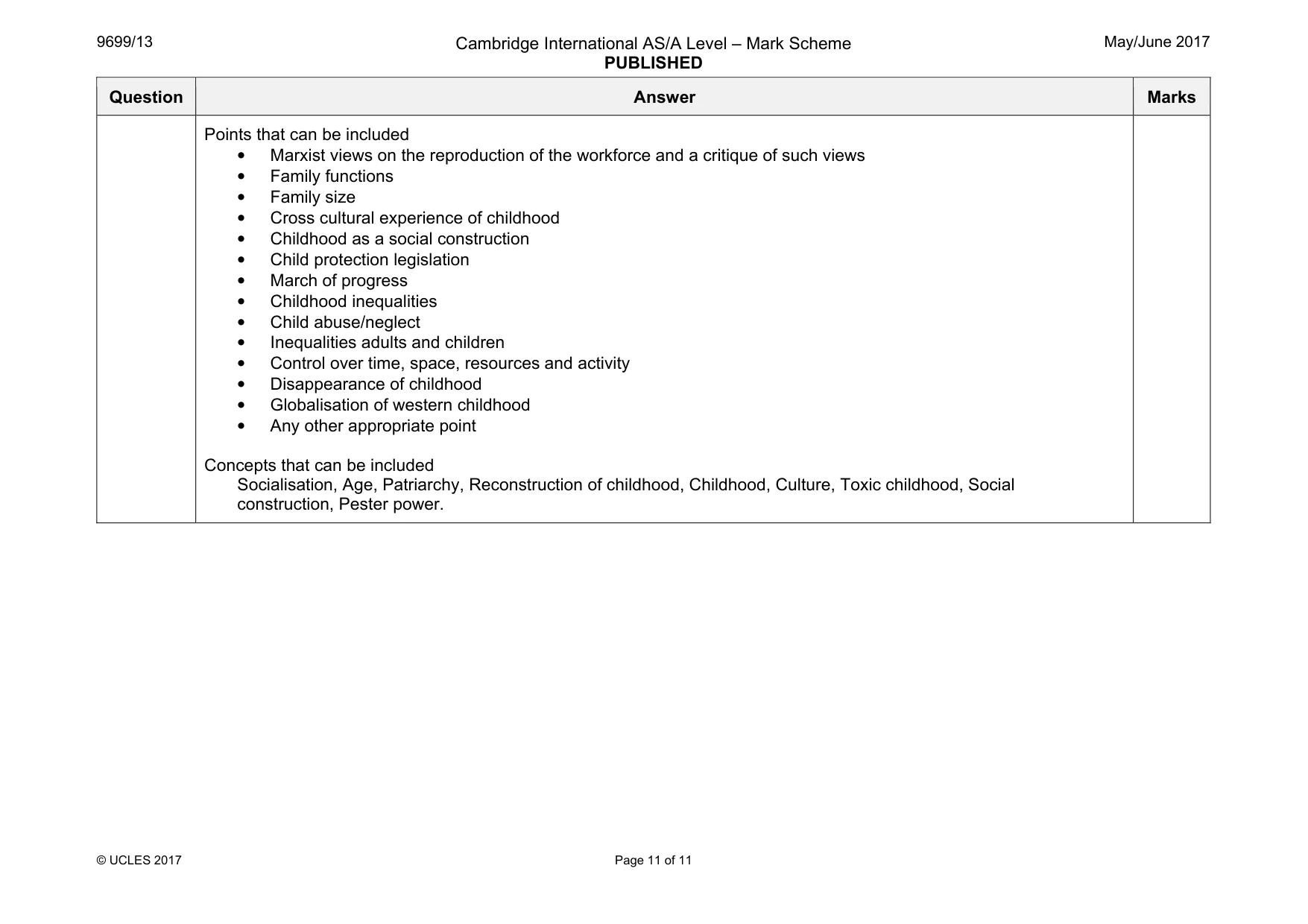
9699/13 Cambridge International AS/A Level – Mark Scheme PUBLISHED May/June 2017 © UCLES 2017 Page 11 of 11 Question Answer Marks Points that can be included • Marxist views on the reproduction of the workforce and a critique of such views • Family functions • Family size • Cross cultural experience of childhood • Childhood as a social construction • Child protection legislation • March of progress • Childhood inequalities • Child abuse/neglect • Inequalities adults and children • Control over time, space, resources and activity • Disappearance of childhood • Globalisation of western childhood • Any other appropriate point Concepts that can be included Socialisation, Age, Patriarchy, Reconstruction of childhood, Childhood, Culture, Toxic childhood, Social construction, Pester power.
What you needed in this session
Cambridge’s own grade thresholds for 2017 May/June, Paper 1 · Variant 3. A higher threshold means an easier paper — the bar moves with how the cohort did.