Cambridge A Level Sociology 9699 — 2015 May/June Paper 3 · Variant 2
9699/32/M/J/15 · 75 marks · ≈84 min
The question paper and its mark scheme, free to read here and free to download. This is Cambridge’s own paper, exactly as it was sat.
Question paper4 pages

Mark scheme17 pages
Answers below. Sit the paper first if you are practising.
Paper as text
Question paper, page 1
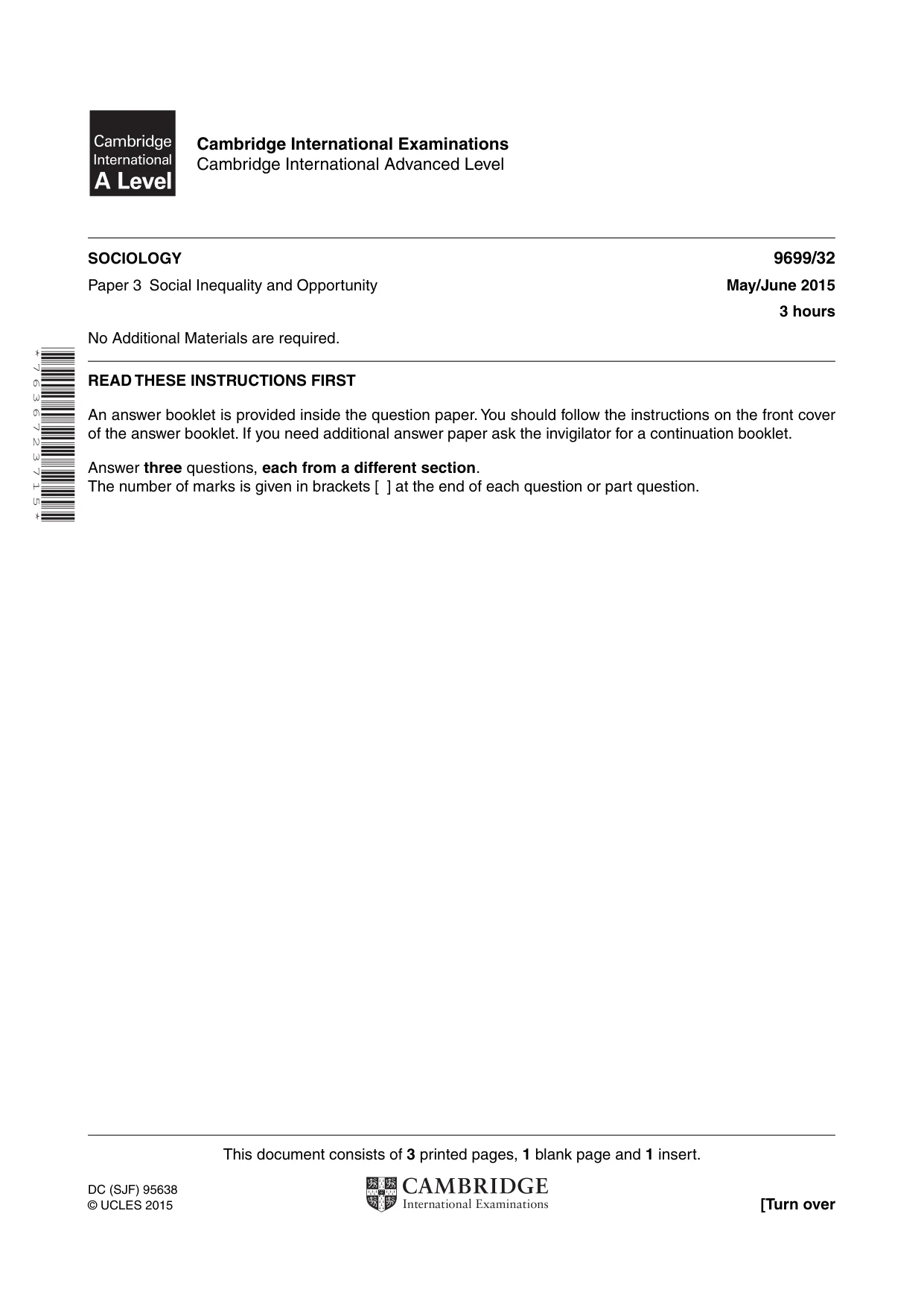
This document consists of 3 printed pages, 1 blank page and 1 insert. DC (SJF) 95638 © UCLES 2015 [Turn over Cambridge International Examinations Cambridge International Advanced Level * 7 6 3 6 7 2 3 7 1 5 * SOCIOLOGY 9699/32 Paper 3 Social Inequality and Opportunity May/June 2015 3 hours No Additional Materials are required. READ THESE INSTRUCTIONS FIRST An answer booklet is provided inside the question paper. You should follow the instructions on the front cover of the answer booklet. If you need additional answer paper ask the invigilator for a continuation booklet. Answer three questions, each from a different section. The number of marks is given in brackets [ ] at the end of each question or part question.
Question paper, page 2
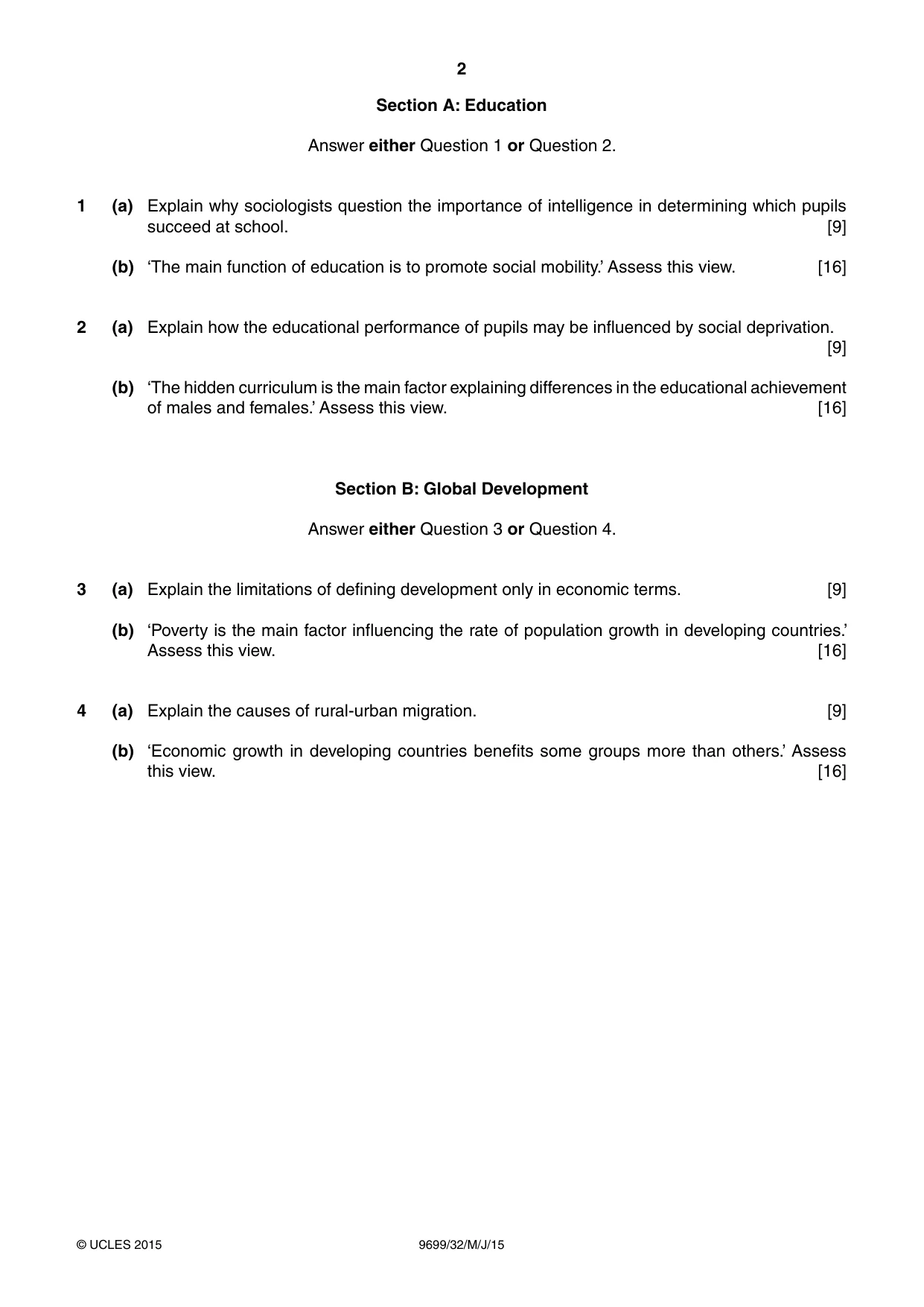
2 9699/32/M/J/15 © UCLES 2015 Section A: Education Answer either Question 1 or Question 2. 1 (a) Explain why sociologists question the importance of intelligence in determining which pupils succeed at school. [9] (b) ‘The main function of education is to promote social mobility.’ Assess this view. [16] 2 (a) Explain how the educational performance of pupils may be influenced by social deprivation. [9] (b) ‘The hidden curriculum is the main factor explaining differences in the educational achievement of males and females.’ Assess this view. [16] Section B: Global Development Answer either Question 3 or Question 4. 3 (a) Explain the limitations of defining development only in economic terms. [9] (b) ‘Poverty is the main factor influencing the rate of population growth in developing countries.’ Assess this view. [16] 4 (a) Explain the causes of rural-urban migration. [9] (b) ‘Economic growth in developing countries benefits some groups more than others.’ Assess this view. [16]
Question paper, page 3
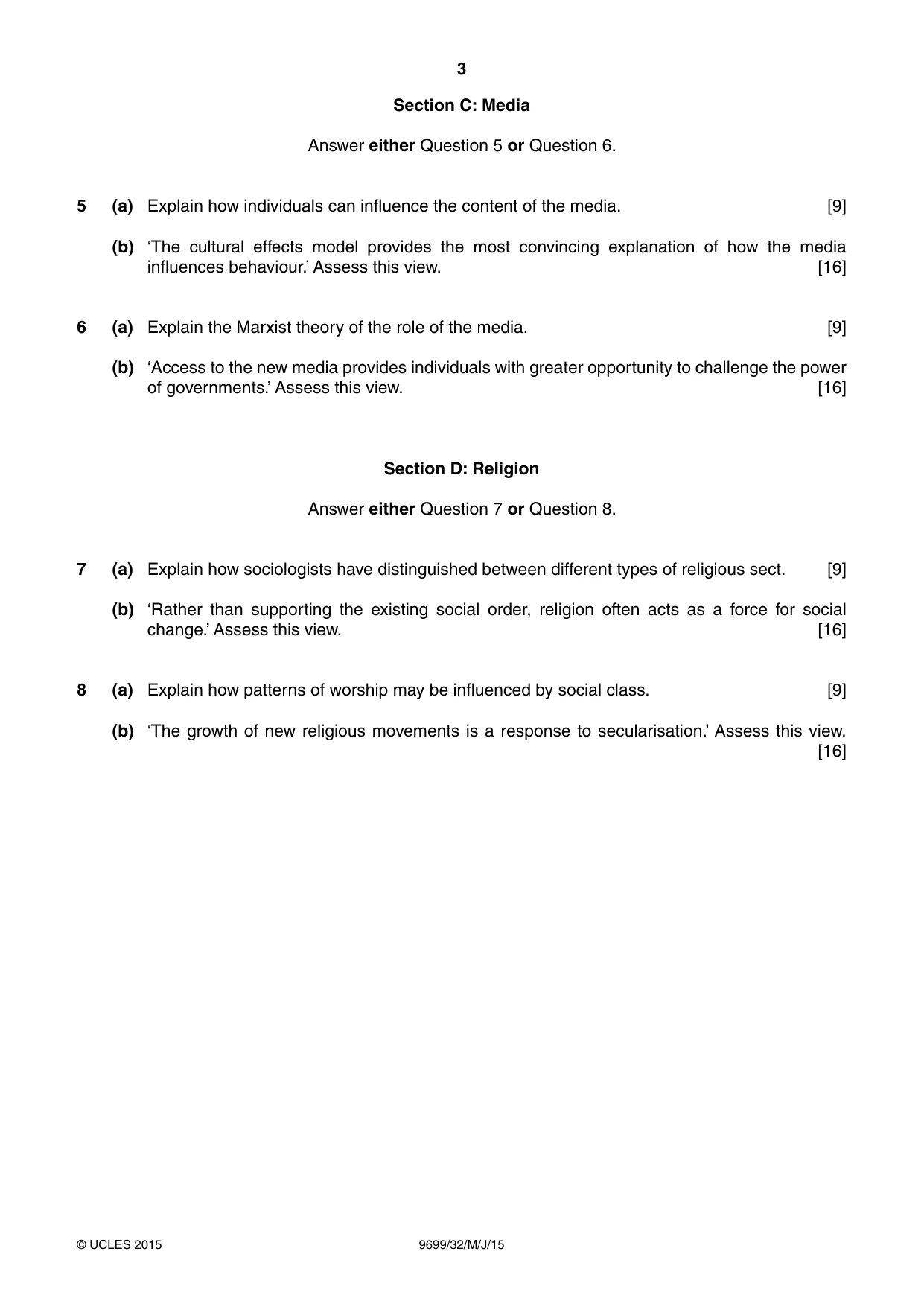
3 9699/32/M/J/15 © UCLES 2015 Section C: Media Answer either Question 5 or Question 6. 5 (a) Explain how individuals can influence the content of the media. [9] (b) ‘The cultural effects model provides the most convincing explanation of how the media influences behaviour.’ Assess this view. [16] 6 (a) Explain the Marxist theory of the role of the media. [9] (b) ‘Access to the new media provides individuals with greater opportunity to challenge the power of governments.’ Assess this view. [16] Section D: Religion Answer either Question 7 or Question 8. 7 (a) Explain how sociologists have distinguished between different types of religious sect. [9] (b) ‘Rather than supporting the existing social order, religion often acts as a force for social change.’ Assess this view. [16] 8 (a) Explain how patterns of worship may be influenced by social class. [9] (b) ‘The growth of new religious movements is a response to secularisation.’ Assess this view. [16]
Question paper, page 4
4 9699/32/M/J/15 © UCLES 2015 BLANK PAGE Permission to reproduce items where third-party owned material protected by copyright is included has been sought and cleared where possible. Every reasonable effort has been made by the publisher (UCLES) to trace copyright holders, but if any items requiring clearance have unwittingly been included, the publisher will be pleased to make amends at the earliest possible opportunity. To avoid the issue of disclosure of answer-related information to candidates, all copyright acknowledgements are reproduced online in the Cambridge International Examinations Copyright Acknowledgements Booklet. This is produced for each series of examinations and is freely available to download at www.cie.org.uk after the live examination series. Cambridge International Examinations is part of the Cambridge Assessment Group. Cambridge Assessment is the brand name of University of Cambridge Local Examinations Syndicate (UCLES), which is itself a department of the University of Cambridge.
Mark scheme, page 1
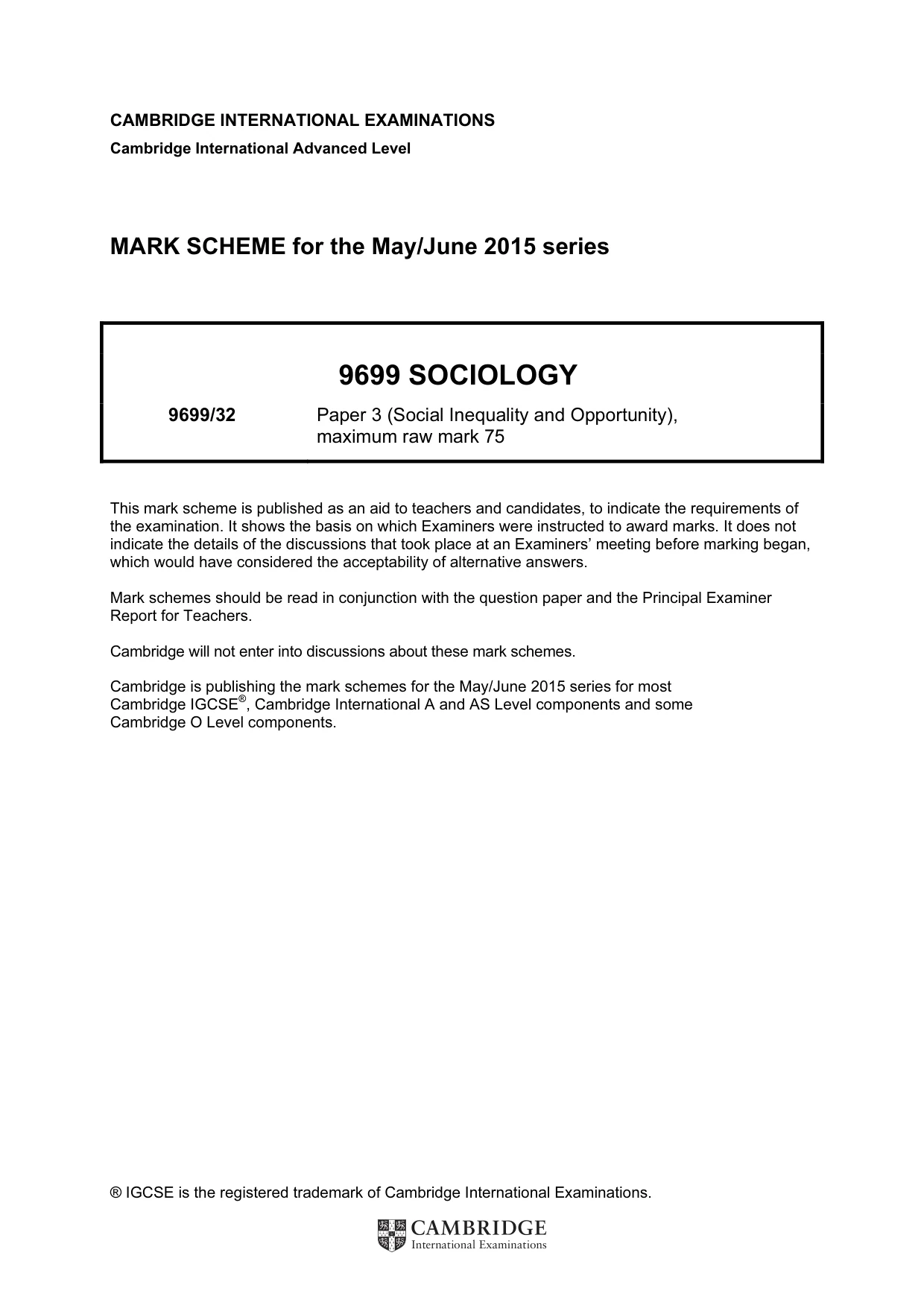
® IGCSE is the registered trademark of Cambridge International Examinations. CAMBRIDGE INTERNATIONAL EXAMINATIONS Cambridge International Advanced Level MARK SCHEME for the May/June 2015 series 9699 SOCIOLOGY 9699/32 Paper 3 (Social Inequality and Opportunity), maximum raw mark 75 This mark scheme is published as an aid to teachers and candidates, to indicate the requirements of the examination. It shows the basis on which Examiners were instructed to award marks. It does not indicate the details of the discussions that took place at an Examiners’ meeting before marking began, which would have considered the acceptability of alternative answers. Mark schemes should be read in conjunction with the question paper and the Principal Examiner Report for Teachers. Cambridge will not enter into discussions about these mark schemes. Cambridge is publishing the mark schemes for the May/June 2015 series for most Cambridge IGCSE®, Cambridge International A and AS Level components and some Cambridge O Level components.
Mark scheme, page 2
Page 2 Mark Scheme Syllabus Paper Cambridge International A Level – May/June 2015 9699 32 © Cambridge International Examinations 2015 Section A: Education 1 (a) Explain why sociologists question the importance of intelligence in determining which pupils succeed at school. [9] 0–4 At this level, there may be little or no reference to relevant sociological sources. Answers may rely on general knowledge and/or personal observation. Explanations will be brief and cover only a narrow range of relevant points. A few general observations about the nature of intelligence, with little or no direct relevance to the question, would fit the lower part of the band. An answer that offers some common sense observations about the importance of intelligence in influencing educational achievement would trigger the top of the mark band. A response that focuses on criticisms of IQ tests, without any more direct links to the question, would also be worth 3 or 4 marks. Answers that discuss influences on educational achievement in general, without focusing on the limitations of those explanations that draw on the notion of innate intelligence, can score no more than 4 marks. 5–9 At this level, there will be some use of relevant sociological sources, such as concepts, theories and explanations. Answers will cover a range of points and show a sound understanding of the issues raised by the question. Lower in the band, answers will provide a sound account of one or two reasons why sociologists question the importance of intelligence in determining which pupils succeed in school. The thrust of the answer will be to convey the importance that sociologists attribute to social factors (as opposed to biological or psychological factors) in explaining educational achievement. To reach the top of the band, the answer must cover a range of sociological arguments against explaining educational achievement in terms of innate intelligence. The response at this level will demonstrate a good understanding of the relevant debates and provide a coherent explanation of the relevant sociological perspective.
Mark scheme, page 3
Page 3 Mark Scheme Syllabus Paper Cambridge International A Level – May/June 2015 9699 32 © Cambridge International Examinations 2015 (b) ‘The main function of education is to promote social mobility’. Assess this view. [16] 0–6 At this level, there may be little or no reference to relevant sociological sources. Answers may rely on general knowledge and/or personal observation. Explanations will be brief and cover only a narrow range of relevant points. An answer based on a few assertions about social mobility in general would be worth 1 or 2 marks. A few simple points about the functions or role of education, with no direct reference to social mobility, would fit the higher part of the band. 7–11 Answers at this level will provide a sound sociological account of the ways in which the education system may contribute to social mobility. Lower in the band, the answer may be list-like and references to relevant concepts, theories and thinkers will be lacking. Higher in the band, answers will provide a more substantial account of the links between education and social mobility. There may also be an attempt to identify other functions of the education system. However, there may be little or no assessment at this level. 12–16 Answers that fit this band will demonstrate a good understanding of the links between education and social mobility. Knowledge of other functions served by the education system will be evident. There will also be an assessment of the view on which the question is based. Lower in the band the assessment may be based on a juxtaposition of different theories of education, such as the functionalist and the Marxist views. Higher in the band the assessment will be more explicit and may include a critical analysis of the extent to which education systems promote social mobility. Good answers may also note that the idea that schools promote social mobility may serve ideological functions.
Mark scheme, page 4
Page 4 Mark Scheme Syllabus Paper Cambridge International A Level – May/June 2015 9699 32 © Cambridge International Examinations 2015 2 (a) Explain how the educational performance of pupils may be influenced by social deprivation. [9] 0–4 At this level, there may be little or no reference to relevant sociological sources. Answers may rely on general knowledge and/or personal observation. Explanations will be brief and cover only a narrow range of relevant points. A few simple points about the nature of social deprivation, with no direct links to educational performance, would be worth 1 or 2 marks. Answers that lack references to sociological sources, but provide a few common sense observations about the links between social deprivation and educational performance, would fit the upper part of the band. 5–9 At this level, there will be some use of relevant sociological sources, such as concepts, theories and explanations. Answers will cover a range of points and show a sound understanding of the issues raised by the question. Lower in the band, answers may be confined to describing just one or two ways in which pupil performance may be influenced by social deprivation. References to appropriate concepts, evidence and theories may be limited at this level. To reach the top part of the band, the response must be more developed in terms of either the range of points covered or else in the depth of the sociological content used to explain the links between social deprivation and pupil performance. Good answers may address both material and cultural influences on pupil performance arising from social deprivation.
Mark scheme, page 5
Page 5 Mark Scheme Syllabus Paper Cambridge International A Level – May/June 2015 9699 32 © Cambridge International Examinations 2015 (b) 'The hidden curriculum is the main factor explaining differences in the educational achievement of males and females.' Assess this view. [16] 0–6 At this level, there may be little or no reference to relevant sociological sources. Answers may rely on general knowledge and/or personal observation. Explanations will be brief and cover only a narrow range of relevant points. An attempt to define the concept of the hidden curriculum, with no further development, would fit the lower part of the band. Answers that discuss differences between the educational performance of males and females, with no further links to the question, would trigger the top half of the band. Answers that discuss the influences on educational achievement in general, with no references to gender differences, can achieve no more than 6 marks. 7–11 Answers at this level will demonstrate a sound understanding of the role of the hidden curriculum in influencing the educational performance of males and females. Lower in the band, the answers may be confined to explaining how educational performance may be influenced by the hidden curriculum. Better answers within this band may also include a discussion of other factors that may influence the educational achievements of males and females. Another way of triggering the top of the band would be to support the account of the hidden curriculum with references to appropriate studies of gender differences in education. 12–16 Answers that fit this band will demonstrate a good understanding of how gender differences in educational achievement may be influenced by the hidden curriculum. Other factors that may affect educational achievement will be identified and there will be an assessment of the view on which the question is based. Lower in the band the assessment may rely on a simple juxtaposition of different theories or factors that may explain gender differences in educational achievement. To trigger the top part of the band, however, the assessment must also include a more direct engagement with the question of how important the hidden curriculum is in explaining gender differences in educational achievement. Good answers may discuss the extent to which pupils are able to resist or overcome the influences of the hidden curriculum. Evidence about changing patterns in the educational performance of males and females may also be used effectively in high quality responses.
Mark scheme, page 6
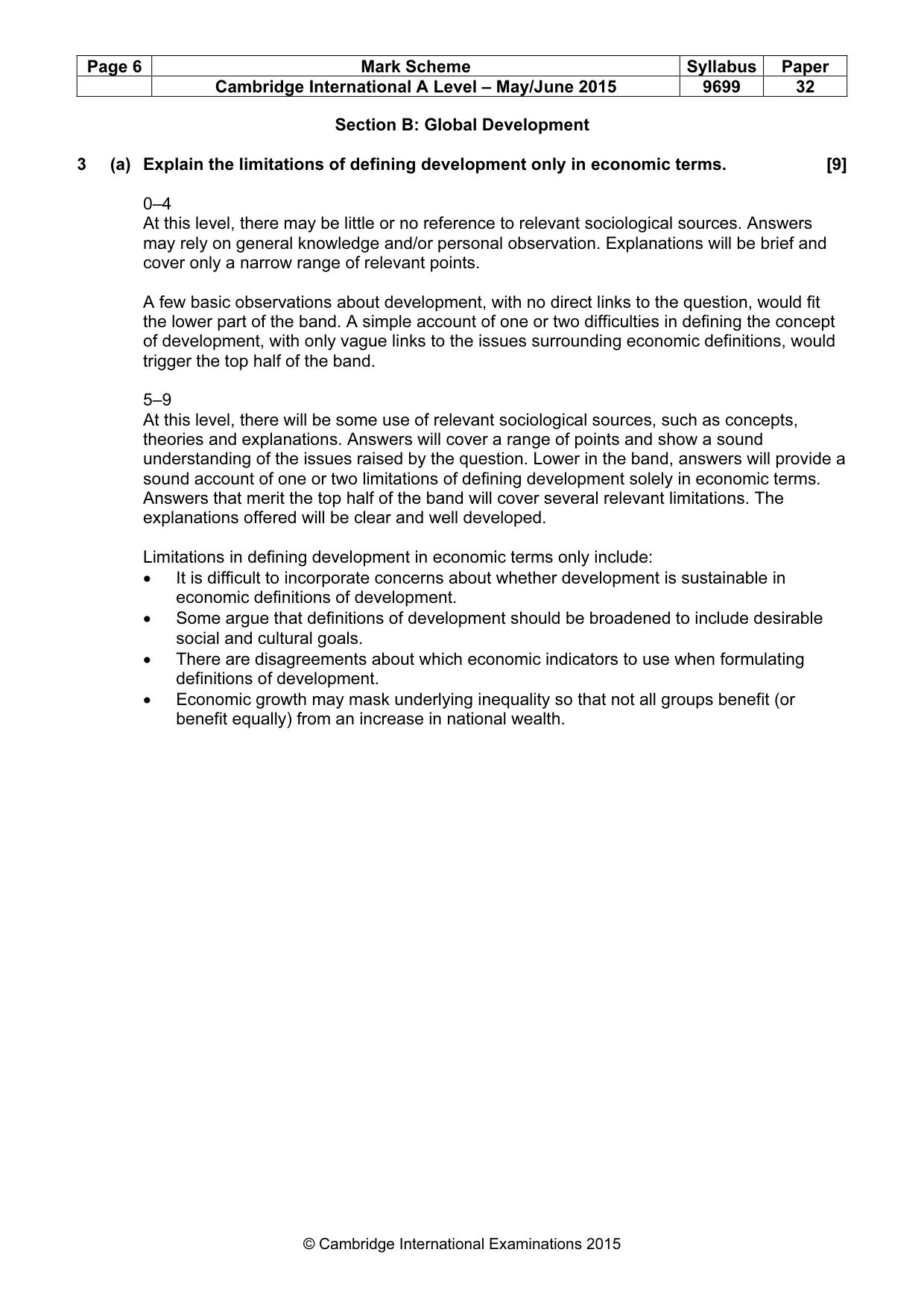
Page 6 Mark Scheme Syllabus Paper Cambridge International A Level – May/June 2015 9699 32 © Cambridge International Examinations 2015 Section B: Global Development 3 (a) Explain the limitations of defining development only in economic terms. [9] 0–4 At this level, there may be little or no reference to relevant sociological sources. Answers may rely on general knowledge and/or personal observation. Explanations will be brief and cover only a narrow range of relevant points. A few basic observations about development, with no direct links to the question, would fit the lower part of the band. A simple account of one or two difficulties in defining the concept of development, with only vague links to the issues surrounding economic definitions, would trigger the top half of the band. 5–9 At this level, there will be some use of relevant sociological sources, such as concepts, theories and explanations. Answers will cover a range of points and show a sound understanding of the issues raised by the question. Lower in the band, answers will provide a sound account of one or two limitations of defining development solely in economic terms. Answers that merit the top half of the band will cover several relevant limitations. The explanations offered will be clear and well developed. Limitations in defining development in economic terms only include: • It is difficult to incorporate concerns about whether development is sustainable in economic definitions of development. • Some argue that definitions of development should be broadened to include desirable social and cultural goals. • There are disagreements about which economic indicators to use when formulating definitions of development. • Economic growth may mask underlying inequality so that not all groups benefit (or benefit equally) from an increase in national wealth.
Mark scheme, page 7
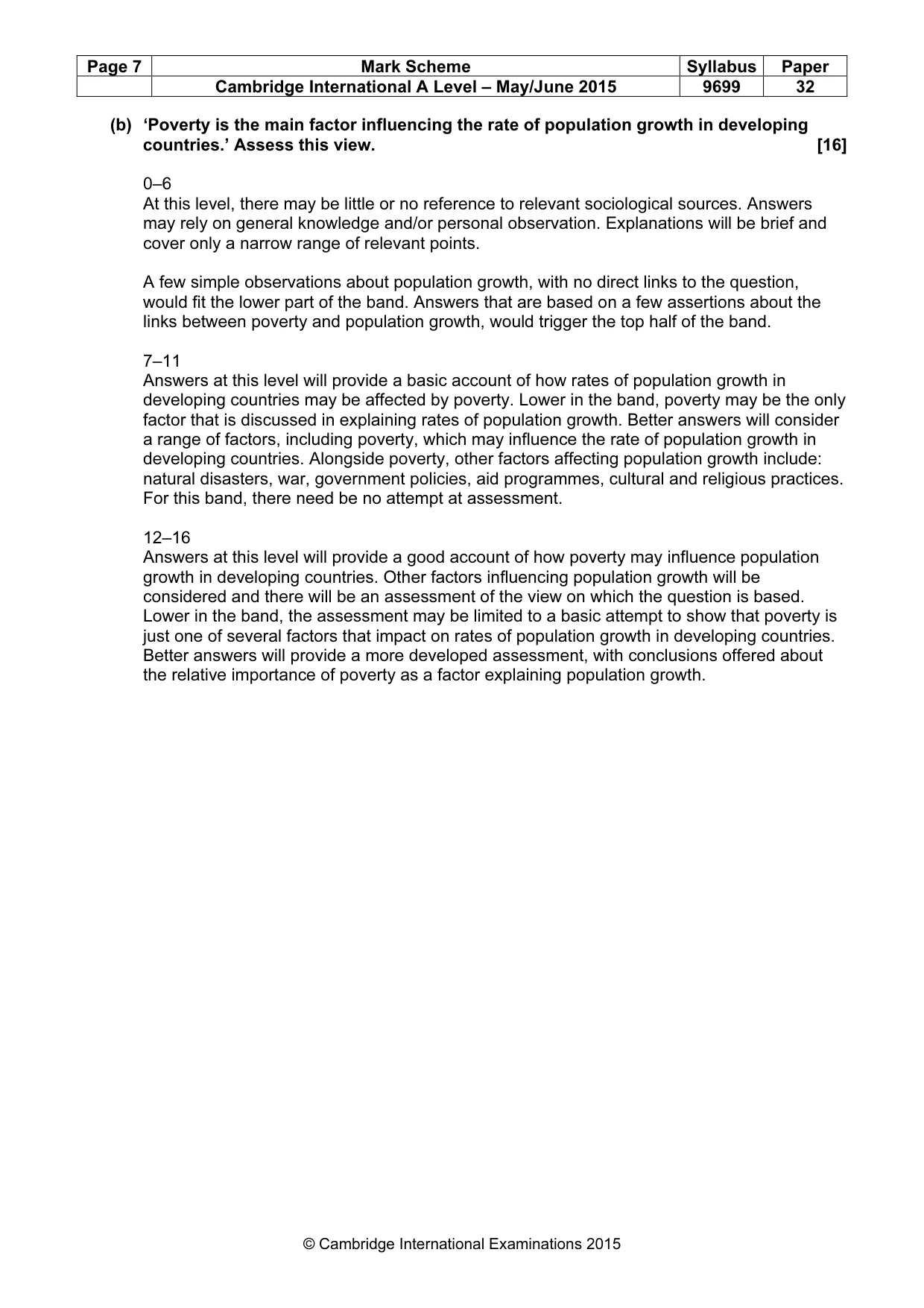
Page 7 Mark Scheme Syllabus Paper Cambridge International A Level – May/June 2015 9699 32 © Cambridge International Examinations 2015 (b) ‘Poverty is the main factor influencing the rate of population growth in developing countries.’ Assess this view. [16] 0–6 At this level, there may be little or no reference to relevant sociological sources. Answers may rely on general knowledge and/or personal observation. Explanations will be brief and cover only a narrow range of relevant points. A few simple observations about population growth, with no direct links to the question, would fit the lower part of the band. Answers that are based on a few assertions about the links between poverty and population growth, would trigger the top half of the band. 7–11 Answers at this level will provide a basic account of how rates of population growth in developing countries may be affected by poverty. Lower in the band, poverty may be the only factor that is discussed in explaining rates of population growth. Better answers will consider a range of factors, including poverty, which may influence the rate of population growth in developing countries. Alongside poverty, other factors affecting population growth include: natural disasters, war, government policies, aid programmes, cultural and religious practices. For this band, there need be no attempt at assessment. 12–16 Answers at this level will provide a good account of how poverty may influence population growth in developing countries. Other factors influencing population growth will be considered and there will be an assessment of the view on which the question is based. Lower in the band, the assessment may be limited to a basic attempt to show that poverty is just one of several factors that impact on rates of population growth in developing countries. Better answers will provide a more developed assessment, with conclusions offered about the relative importance of poverty as a factor explaining population growth.
Mark scheme, page 8
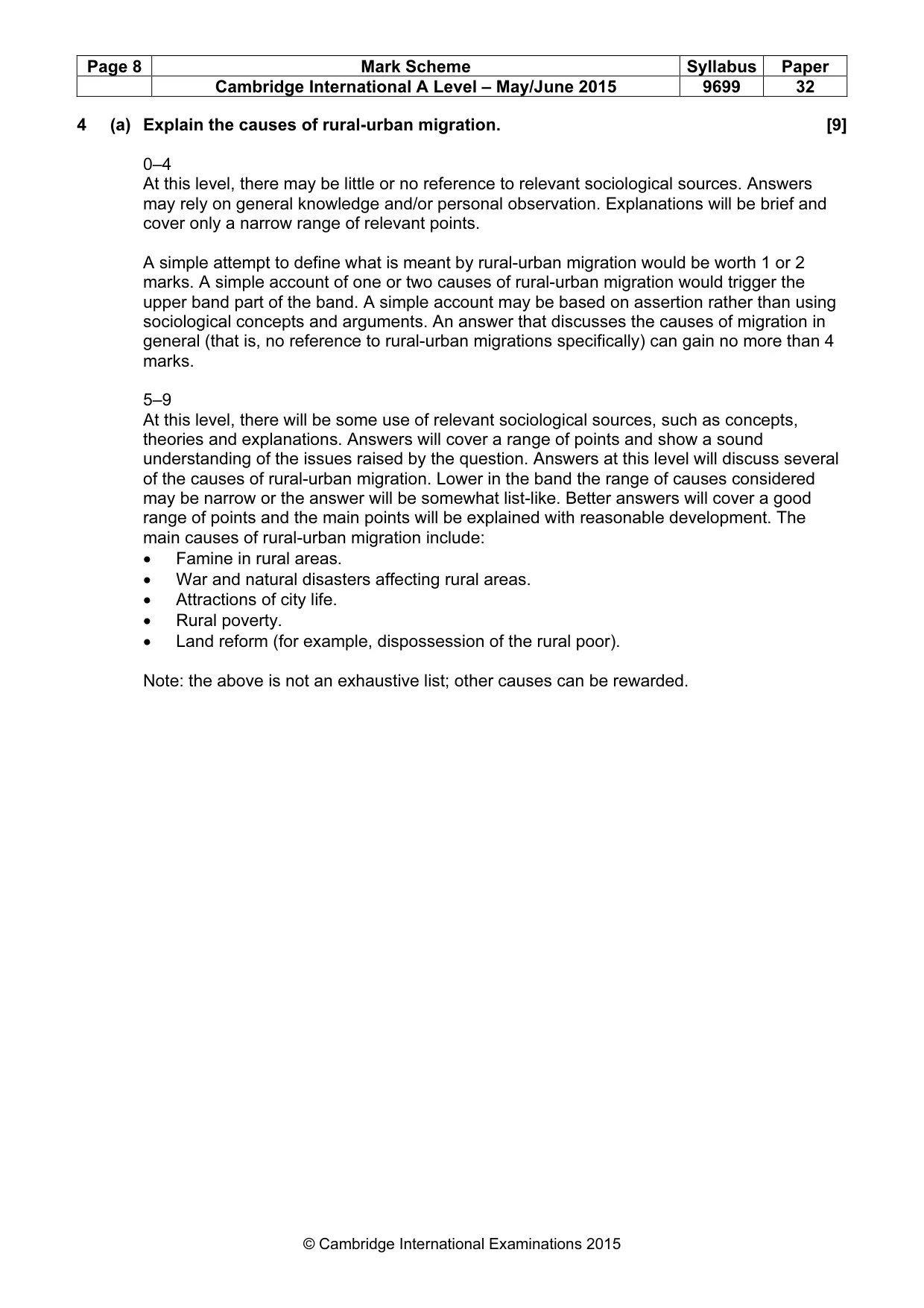
Page 8 Mark Scheme Syllabus Paper Cambridge International A Level – May/June 2015 9699 32 © Cambridge International Examinations 2015 4 (a) Explain the causes of rural-urban migration. [9] 0–4 At this level, there may be little or no reference to relevant sociological sources. Answers may rely on general knowledge and/or personal observation. Explanations will be brief and cover only a narrow range of relevant points. A simple attempt to define what is meant by rural-urban migration would be worth 1 or 2 marks. A simple account of one or two causes of rural-urban migration would trigger the upper band part of the band. A simple account may be based on assertion rather than using sociological concepts and arguments. An answer that discusses the causes of migration in general (that is, no reference to rural-urban migrations specifically) can gain no more than 4 marks. 5–9 At this level, there will be some use of relevant sociological sources, such as concepts, theories and explanations. Answers will cover a range of points and show a sound understanding of the issues raised by the question. Answers at this level will discuss several of the causes of rural-urban migration. Lower in the band the range of causes considered may be narrow or the answer will be somewhat list-like. Better answers will cover a good range of points and the main points will be explained with reasonable development. The main causes of rural-urban migration include: • Famine in rural areas. • War and natural disasters affecting rural areas. • Attractions of city life. • Rural poverty. • Land reform (for example, dispossession of the rural poor). Note: the above is not an exhaustive list; other causes can be rewarded.
Mark scheme, page 9
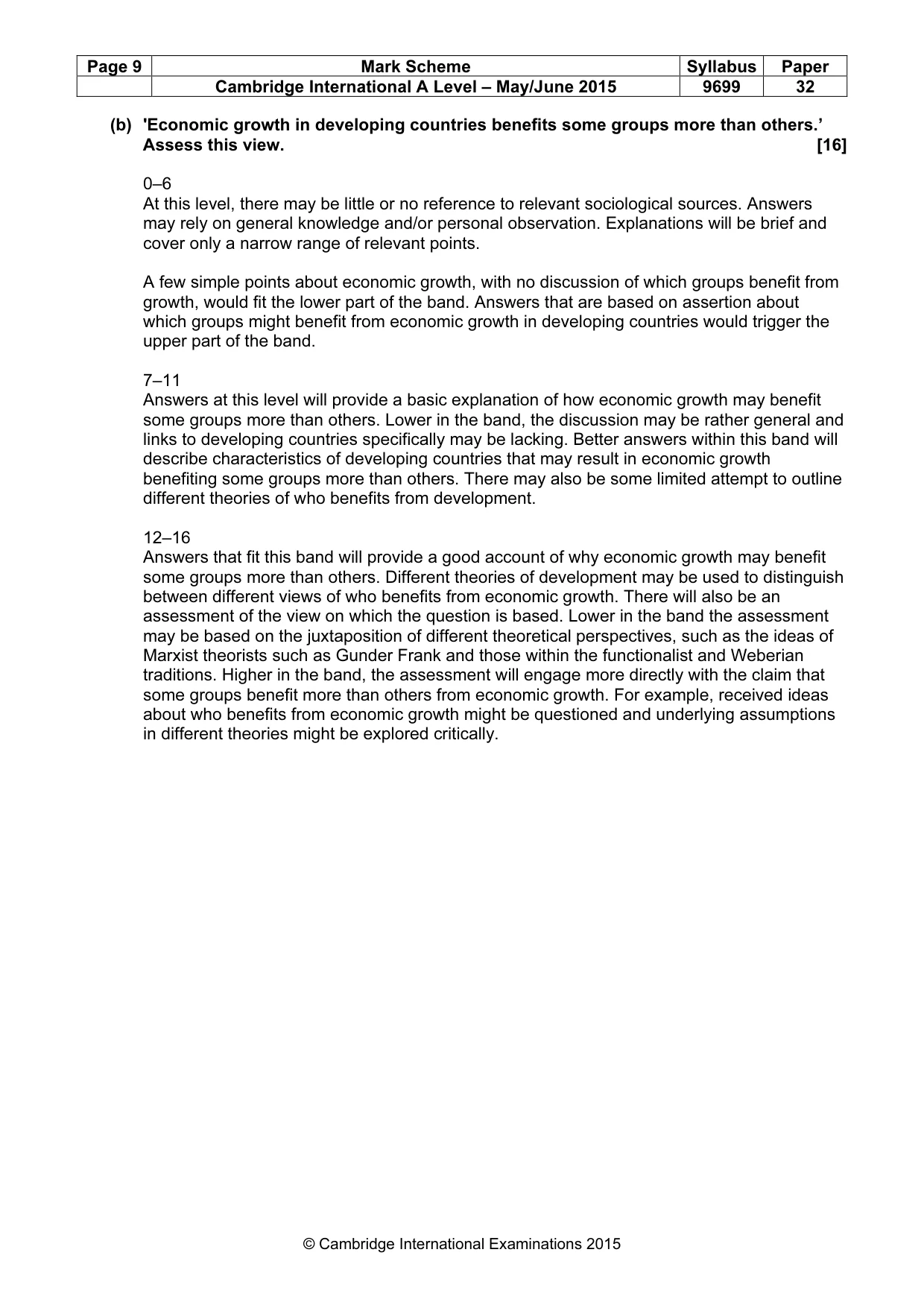
Page 9 Mark Scheme Syllabus Paper Cambridge International A Level – May/June 2015 9699 32 © Cambridge International Examinations 2015 (b) 'Economic growth in developing countries benefits some groups more than others.’ Assess this view. [16] 0–6 At this level, there may be little or no reference to relevant sociological sources. Answers may rely on general knowledge and/or personal observation. Explanations will be brief and cover only a narrow range of relevant points. A few simple points about economic growth, with no discussion of which groups benefit from growth, would fit the lower part of the band. Answers that are based on assertion about which groups might benefit from economic growth in developing countries would trigger the upper part of the band. 7–11 Answers at this level will provide a basic explanation of how economic growth may benefit some groups more than others. Lower in the band, the discussion may be rather general and links to developing countries specifically may be lacking. Better answers within this band will describe characteristics of developing countries that may result in economic growth benefiting some groups more than others. There may also be some limited attempt to outline different theories of who benefits from development. 12–16 Answers that fit this band will provide a good account of why economic growth may benefit some groups more than others. Different theories of development may be used to distinguish between different views of who benefits from economic growth. There will also be an assessment of the view on which the question is based. Lower in the band the assessment may be based on the juxtaposition of different theoretical perspectives, such as the ideas of Marxist theorists such as Gunder Frank and those within the functionalist and Weberian traditions. Higher in the band, the assessment will engage more directly with the claim that some groups benefit more than others from economic growth. For example, received ideas about who benefits from economic growth might be questioned and underlying assumptions in different theories might be explored critically.
Mark scheme, page 10
Page 10 Mark Scheme Syllabus Paper Cambridge International A Level – May/June 2015 9699 32 © Cambridge International Examinations 2015 Section C: Media 5 (a) Explain how individuals can influence the content of the media. [9] 0–4 At this level, there may be little or no reference to relevant sociological sources. Answers may rely on general knowledge and/or personal observation. Explanations will be brief and cover only a narrow range of relevant points. A few observations about the content of the media, with no direct links to the question, would be worth 1 or 2 marks. Answers that rely on a few assertions about the means through which individuals can influence the content of the media would trigger the upper part of the band. Likewise, a list-like account of some means of influencing the media would fit the top half of the band. 5–9 At this level, there will be some use of relevant sociological sources, such as concepts, theories and explanations. Answers will cover a range of points and show a sound understanding of the issues raised by the question. A basic account of one or two means through which individuals can influence the content of the media would trigger the lower part of the band. Better answers will provide a more detailed account and/or cover a wider range of relevant means of influencing the media. Means through which individuals can influence the content of the media include: • Consumer choices i.e. decisions to purchase this or that media product. • Media pressure groups such as the National Viewers Association. • Letters of complaint. • Use of citizen journalism and other facilities linked to the new media. • Application of indirect pressure through the political process, such as supporting government initiatives for regulating the media. • Participation in media consumer panels focus groups. Note: while the reference to ‘individuals’ in the question is meant to be ‘ordinary citizens’ it could also be taken to include actors within the media industry operating as individuals; for example, individual editors or journalists or owners.
Mark scheme, page 11
Page 11 Mark Scheme Syllabus Paper Cambridge International A Level – May/June 2015 9699 32 © Cambridge International Examinations 2015 (b) ‘The cultural effects model provides the most convincing explanation of how the media influences behaviour.’ Assess this view. [16] 0–6 At this level, there may be little or no reference to relevant sociological sources. Answers may rely on general knowledge and/or personal observation. Explanations will be brief and cover only a narrow range of relevant points. A few simple points about the impact of the media on human behaviour would fit the lower part of the band. Answers that attempt to explain the influence of the media on human behaviour in general terms, with no direct references to theories of media influence, would trigger the higher part of the band. 7–11 Answers at this level will provide a basic account of the cultural effects model. Lower in the band the account may lack detail. Better answers will offer a more sustained account of the cultural effects model. Good answers within this band may also provide a summary of some other theories of media influence, such as the hypodermic-syringe model. At this level there may be little or no assessment of the view on which the question is based. 12–16 Answers at this level will provide a good account of cultural effects model of media influence. There will be a discussion of other theories that attempt to explain the influence of the media on human behaviour. To reach this level there must also be an assessment of the cultural effects model. Lower in the band the assessment may be limited to the juxtaposition of different theories of media influence. Better answers at this level will also include some direct engagement with the issue raised by the question. This might be based on, for example, an analysis of the internal coherence of the cultural effects model. Some responses might use references to research evidence to evaluate the different theories of media influence.
Mark scheme, page 12
Page 12 Mark Scheme Syllabus Paper Cambridge International A Level – May/June 2015 9699 32 © Cambridge International Examinations 2015 6 (a) Explain the Marxist theory of the role of the media. [9] 0–4 At this level, there may be little or no reference to relevant sociological sources. Answers may rely on general knowledge and/or personal observation. Explanations will be brief and cover only a narrow range of relevant points. A few general observations about the role of the media, with no direct links to Marxist theory, would fit the lower part of the band. Some basic points about the Marxist theory in general could score up to 4 marks. Likewise, a few points about the nature of the media, with echoes of Marxist theory implied, would trigger the top half of the band. 5–9 At this level, there will be some use of relevant sociological sources, such as concepts, theories and explanations. Answers will cover a range of points and show a sound understanding of the issues raised by the question. Answers at this level will provide a sound account of the Marxist theory of the media. Lower in the band the response may lack some detail and nuances in the Marxist approach may be overlooked. Better answers will offer a sustained explanation of the Marxist theory. This might include references to different Marxist thinkers, though this is not essential for gaining full marks. The question asks for an explanation of the Marxist theory and so assessment is not required, nor would it be credited.
Mark scheme, page 13
Page 13 Mark Scheme Syllabus Paper Cambridge International A Level – May/June 2015 9699 32 © Cambridge International Examinations 2015 (b) ‘Access to the new media provides individuals with greater opportunity to challenge the power of governments.' Assess this view. [16] 0–6 At this level, there may be little or no reference to relevant sociological sources. Answers may rely on general knowledge and/or personal observation. Explanations will be brief and cover only a narrow range of relevant points. A few assertions about the power of the media in general, with little sociological foundation, would fit the lower half of the band. Likewise, a few assertions about the nature of government power, with no direct links to the question, would be worth up to 3 marks. Answers that demonstrate some knowledge of the new media, without making clear links to the issues raised by the question, would trigger the upper half of the band. 7–11 A basic account of how the new media has created opportunities for individuals to build social networks and contribute to debates in society would be worth 7 to 9 marks. To go higher within this band the answer would need to be more focused on the issue of challenging government power through use of the new media. This could be achieved by, for example, discussing theoretical contributions to debates about the media and political power. Likewise, good use might be made of sociological accounts of the role of the new media in specific examples of political events such as the democratic transition in the Middle East and power struggles in China. There may be little or no evidence of assessment at this level. 12–16 Answers at this level will provide a sound account of how access to the new media provides individuals with greater opportunity to challenge government power. The discussion may be theoretical and/or based on analysis of particular examples of where the new media has played a part in shaping the outcome of political events. Answers at this level will also include an assessment of the view on which the question is based. Lower in the band the assessment may be confined to a few basic points about the effectiveness of the new media as an instrument for challenging government power. Better answers will provide a more sustained assessment, demonstrating subtlety in the analysis and reaching clear conclusions about the potential of the new media for promoting democracy and freedom of political expression.
Mark scheme, page 14
Page 14 Mark Scheme Syllabus Paper Cambridge International A Level – May/June 2015 9699 32 © Cambridge International Examinations 2015 Section D: Religion 7 (a) Explain how sociologists have distinguished between different types of religious sect. [9] 0–4 At this level, there may be little or no reference to relevant sociological sources. Answers may rely on general knowledge and/or personal observation. Explanations will be brief and cover only a narrow range of relevant points. A few observations about the nature of religious movements in general, with no direct links to the question, would fit the lower half of the band. A basic account of what is meant by a sect, with little attempt to distinguish between different types of sect, could gain up to 3 marks. A list-like summary of a few types of sects would fit the higher part of the band. 5–9 At this level, there will be some use of relevant sociological sources, such as concepts, theories and explanations. Answers will cover a range of points and show a sound understanding of the issues raised by the question. Answers at this level will provide a sound account of one or more sociological accounts of differences in types of religious sect. Lower in the band the response may lack detail. Better answers will distinguish between different types of sect with greater accuracy and clarity. The discussion at this level will focus directly on specific sociological contributions to distinguishing different types of sect.
Mark scheme, page 15
Page 15 Mark Scheme Syllabus Paper Cambridge International A Level – May/June 2015 9699 32 © Cambridge International Examinations 2015 (b) ‘Rather than supporting the existing social order, religion often acts as a force for social change’. Assess this view. [16] 0–6 At this level, there may be little or no reference to relevant sociological sources. Answers may rely on general knowledge and/or personal observation. Explanations will be brief and cover only a narrow range of relevant points. A few assertions about the nature of religious belief, without direct links to the question, would fit the lower part of the band. A brief outline of the functions of religion, with no further development, would trigger the upper part of the band. An answer that discusses only the role of religion in supporting the existing social order could gain no more than 6 marks. 7–11 Answers at this level will explain how religion can act as a force for social change. Lower in the band the account may lack detail and illustration. Better answers may offer examples to show how religion can act as a force for social change. Good answers within this band may also demonstrate an understanding of the debates between those who see religion as a conservative force primarily and those who recognise the power of religion to challenge the status quo. Within this band there may be little or no attempt to assess the view on which the question is based. 12–16 Answers at this level will demonstrate a good understanding of the how religion can act as a force for social change. This will be complemented with awareness of the alternative view that religion may serve more as a support for the existing social order. There will also be an assessment of the view on which the question is based. Lower in the band, the assessment may be limited to contrasting the idea that religion is a force for social change with the functionalist and Marxist notions that religion supports the existing social order. Better answers will engage more directly with the issues raised by the question and develop well- reasoned arguments about the extent to which religion is a force for social change. High- quality answers may also show other elements of sophistication, such as good analysis of examples of religion acting as a force for social change.
Mark scheme, page 16
Page 16 Mark Scheme Syllabus Paper Cambridge International A Level – May/June 2015 9699 32 © Cambridge International Examinations 2015 8 (a) Explain how patterns of worship may be influenced by social class. [9] 0–4 At this level, there may be little or no reference to relevant sociological sources. Answers may rely on general knowledge and/or personal observation. Explanations will be brief and cover only a narrow range of relevant points. A few observations about religious practice in general, with no direct links to the question, would fit the lower part of the band. Answers that trigger the top part of the band are likely to rely on assertions about how patterns of worship and religious belief are impacted by social class. Answers of this kind will lack references to appropriate sociological concepts, theories and evidence. Tangential responses that focus on explaining the Marxist theory of religion, with no further development, could gain up to 2 marks. 5–9 At this level, there will be some use of relevant sociological sources, such as concepts, theories and explanations. Answers will cover a range of points and show a sound understanding of the issues raised by the question. A basic sociological account of one or two ways in which religious practice may reflect social class influences would fit the lower part of the band. To go higher, the answer must provide greater detail about the influence of social class and/or consider a wider range of examples of how religious practice may reflect social class factors. Use of references to relevant studies is not essential to gain high marks, but it would be one way of demonstrating a good understanding of the relevant issues.
Mark scheme, page 17
Page 17 Mark Scheme Syllabus Paper Cambridge International A Level – May/June 2015 9699 32 © Cambridge International Examinations 2015 (b) ‘The growth of new religious movements is a response to secularisation’. Assess this view. [16] 0–6 At this level, there may be little or no reference to relevant sociological sources. Answers may rely on general knowledge and/or personal observation. Explanations will be brief and cover only a narrow range of relevant points. A few simple points about new religious movements, with no direct links to the issue of secularisation, would fit the lower part of the band. A basic account of what is meant by secularisation, with little or no reference to the growth of new religious movements would merit the higher part of the band. 7–11 An answer that offers a simple view of how secularisation may have led to the growth of new religious movements, could gain up to 9 marks. To go higher, the explanation must be more detailed and demonstrate a deeper understanding of the nature of new religious movements. Good answers at this level may touch on some other possible reasons for the growth of new religious movements, although assessment of the view on which the question is based is not required to reach to top of the band. 12–16 Answers at this level will provide a good account of the possible links between secularisation and the growth of new religious movements. Other reasons for the growth of new religious movements will be considered. There will also be an assessment of the view on which the question is based. Lower in the band the assessment may be through the simple juxtaposition of two or more contrasting explanations for the growth of new religious movements. Higher in the band the assessment will engage more directly with the issues raised by the question and clear conclusions will be reached about the relative merits of the explanations discussed. Good use of post-modernist contributions to the debate about the impact of secularisation may be a feature of answers that merit the top part of the band. Candidates may also draw distinctions between different types of new religious movements as a contribution to analysing the issues raised by the question.
What you needed in this session
Cambridge’s own grade thresholds for 2015 May/June, Paper 3 · Variant 2. A higher threshold means an easier paper — the bar moves with how the cohort did.