Cambridge A Level Sociology 9699 — 2011 Oct/Nov Paper 2 · Variant 2
9699/22/O/N/11 · 50 marks · ≈56 min
The question paper and its mark scheme, free to read here and free to download. This is Cambridge’s own paper, exactly as it was sat.
Question paper16 pages









Mark scheme5 pages
Answers below. Sit the paper first if you are practising.

Paper as text
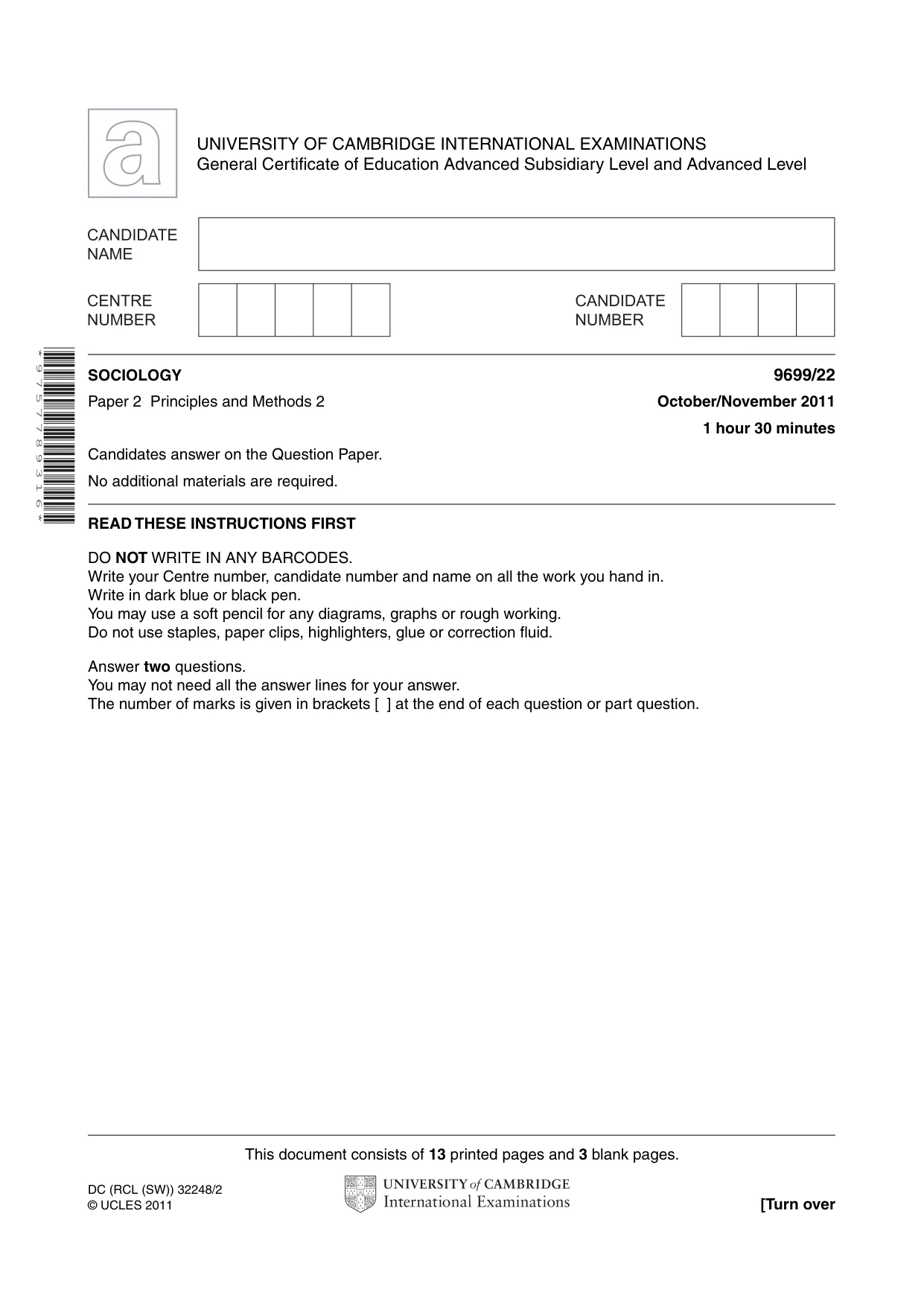
Question paper, page 1
This document consists of 13 printed pages and 3 blank pages. DC (RCL (SW)) 32248/2 © UCLES 2011 [Turn over UNIVERSITY OF CAMBRIDGE INTERNATIONAL EXAMINATIONS General Certificate of Education Advanced Subsidiary Level and Advanced Level SOCIOLOGY 9699/22 Paper 2 Principles and Methods 2 October/November 2011 1 hour 30 minutes Candidates answer on the Question Paper. No additional materials are required. READ THESE INSTRUCTIONS FIRST DO NOT WRITE IN ANY BARCODES. Write your Centre number, candidate number and name on all the work you hand in. Write in dark blue or black pen. You may use a soft pencil for any diagrams, graphs or rough working. Do not use staples, paper clips, highlighters, glue or correction fluid. Answer two questions. You may not need all the answer lines for your answer. The number of marks is given in brackets [ ] at the end of each question or part question. * 9 7 5 7 7 8 9 3 1 6 *
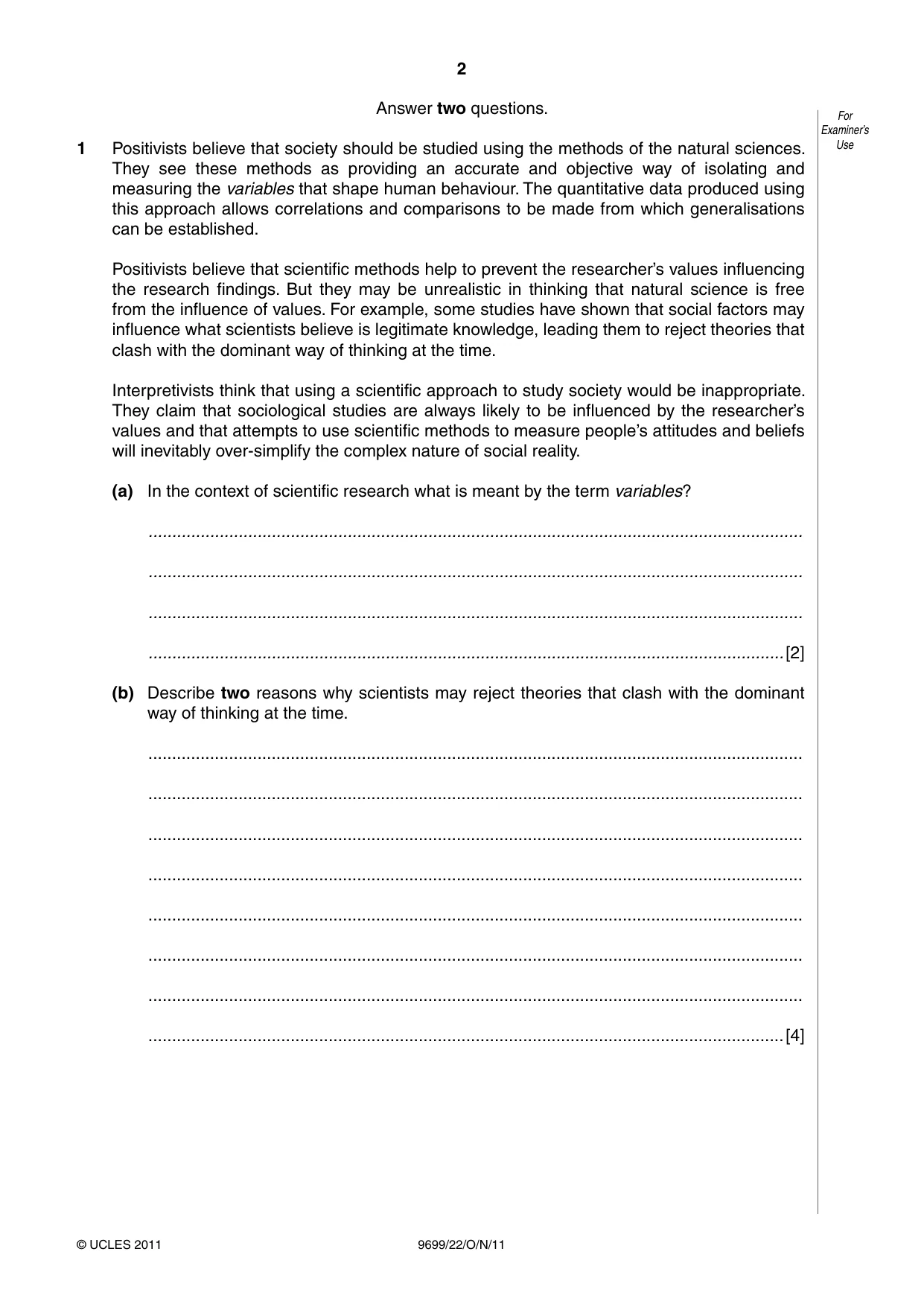
Question paper, page 2
2 9699/22/O/N/11 © UCLES 2011 For Examiner’s Use Answer two questions. 1 Positivists believe that society should be studied using the methods of the natural sciences. They see these methods as providing an accurate and objective way of isolating and measuring the variables that shape human behaviour. The quantitative data produced using this approach allows correlations and comparisons to be made from which generalisations can be established. Positivists believe that scientific methods help to prevent the researcher’s values influencing the research findings. But they may be unrealistic in thinking that natural science is free from the influence of values. For example, some studies have shown that social factors may influence what scientists believe is legitimate knowledge, leading them to reject theories that clash with the dominant way of thinking at the time. Interpretivists think that using a scientific approach to study society would be inappropriate. They claim that sociological studies are always likely to be influenced by the researcher’s values and that attempts to use scientific methods to measure people’s attitudes and beliefs will inevitably over-simplify the complex nature of social reality. (a) In the context of scientific research what is meant by the term variables? … … … …[2] (b) Describe two reasons why scientists may reject theories that clash with the dominant way of thinking at the time. … … … … … … … …[4]
Question paper, page 3
3 9699/22/O/N/11 © UCLES 2011 [Turn over For Examiner’s Use (c) Explain why attempts to measure people’s attitudes and beliefs may over-simplify the complex nature of social reality. … … … … … … … … … … … … … … … … … … … … … … … …[8]
Question paper, page 4
4 9699/22/O/N/11 © UCLES 2011 For Examiner’s Use (d) Assess the interpretivist view that the methods of the natural sciences are inappropriate for studying society. … … … … … … … … … … … … … … … … … … … … … … … … … … …
Question paper, page 5
5 9699/22/O/N/11 © UCLES 2011 [Turn over For Examiner’s Use … … … … … …[11]
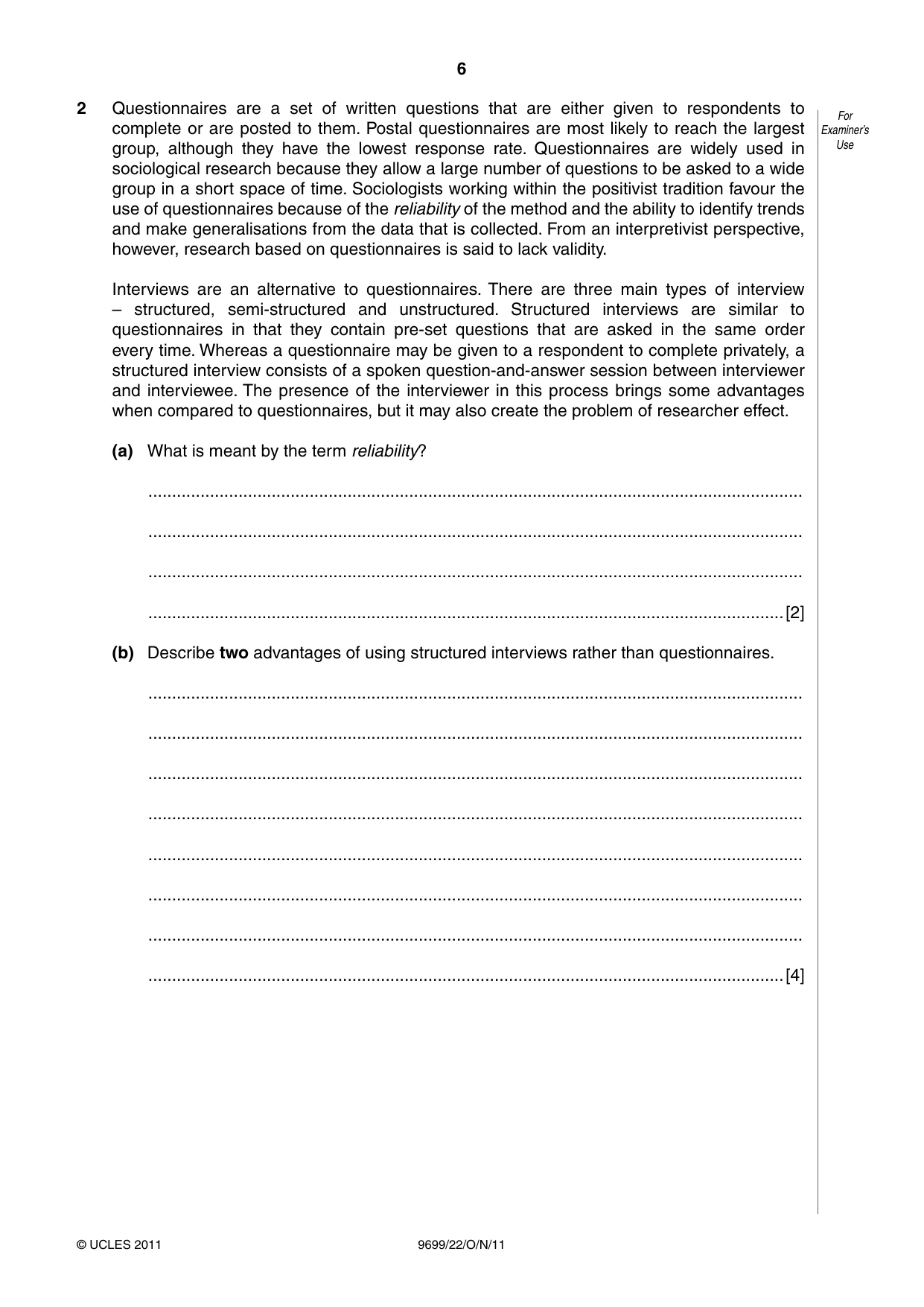
Question paper, page 6
6 9699/22/O/N/11 © UCLES 2011 For Examiner’s Use 2 Questionnaires are a set of written questions that are either given to respondents to complete or are posted to them. Postal questionnaires are most likely to reach the largest group, although they have the lowest response rate. Questionnaires are widely used in sociological research because they allow a large number of questions to be asked to a wide group in a short space of time. Sociologists working within the positivist tradition favour the use of questionnaires because of the reliability of the method and the ability to identify trends and make generalisations from the data that is collected. From an interpretivist perspective, however, research based on questionnaires is said to lack validity. Interviews are an alternative to questionnaires. There are three main types of interview – structured, semi-structured and unstructured. Structured interviews are similar to questionnaires in that they contain pre-set questions that are asked in the same order every time. Whereas a questionnaire may be given to a respondent to complete privately, a structured interview consists of a spoken question-and-answer session between interviewer and interviewee. The presence of the interviewer in this process brings some advantages when compared to questionnaires, but it may also create the problem of researcher effect. (a) What is meant by the term reliability? … … … …[2] (b) Describe two advantages of using structured interviews rather than questionnaires. … … … … … … … …[4]
Question paper, page 7
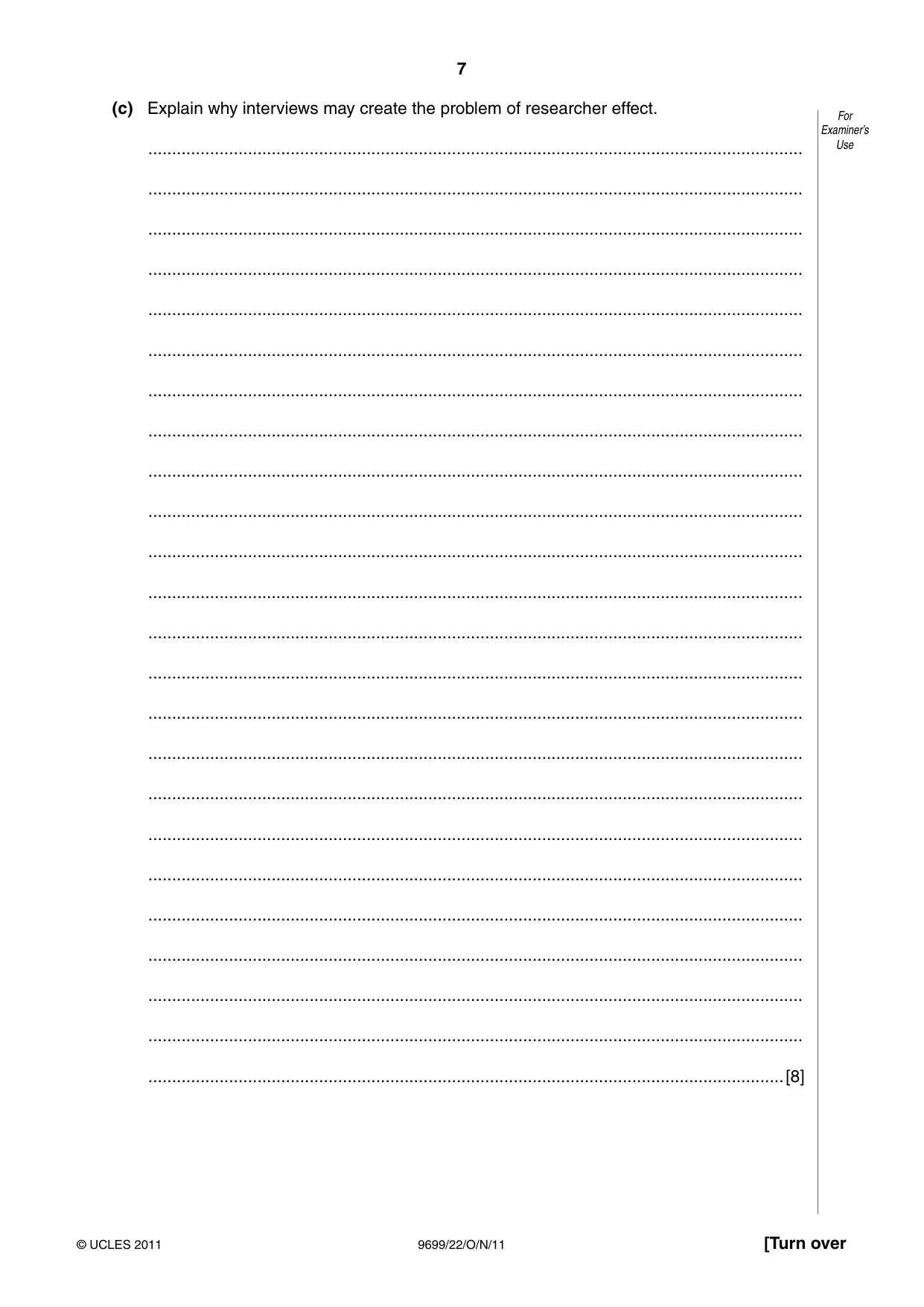
7 9699/22/O/N/11 © UCLES 2011 [Turn over For Examiner’s Use (c) Explain why interviews may create the problem of researcher effect. … … … … … … … … … … … … … … … … … … … … … … … …[8]
Question paper, page 8
8 9699/22/O/N/11 © UCLES 2011 For Examiner’s Use (d) Assess the usefulness of questionnaires as a method of sociological research. … … … … … … … … … … … … … … … … … … … … … … … … … … …
Question paper, page 9
9 9699/22/O/N/11 © UCLES 2011 [Turn over For Examiner’s Use … … … … … …[11]
Question paper, page 10
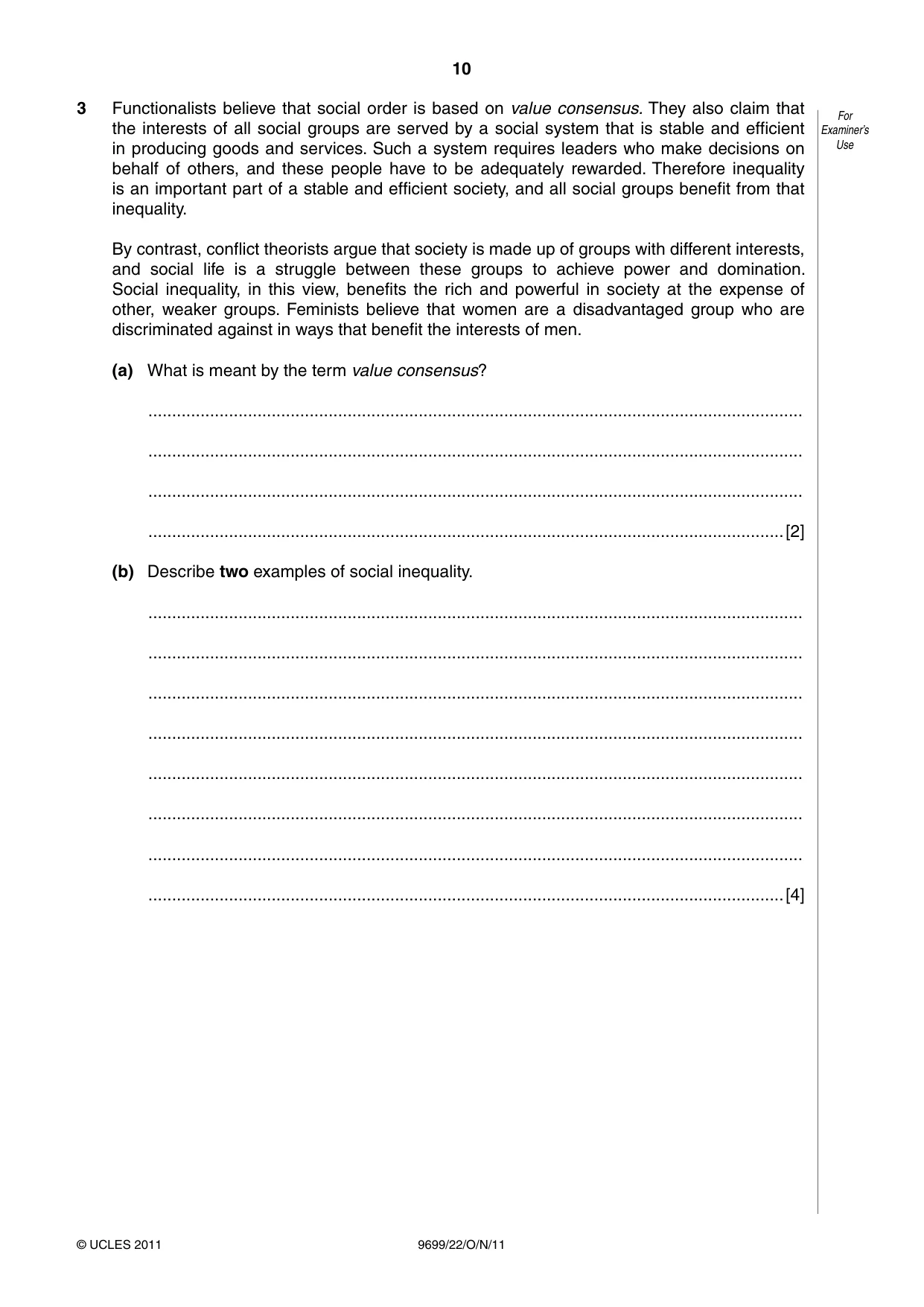
10 9699/22/O/N/11 © UCLES 2011 For Examiner’s Use 3 Functionalists believe that social order is based on value consensus. They also claim that the interests of all social groups are served by a social system that is stable and efficient in producing goods and services. Such a system requires leaders who make decisions on behalf of others, and these people have to be adequately rewarded. Therefore inequality is an important part of a stable and efficient society, and all social groups benefit from that inequality. By contrast, conflict theorists argue that society is made up of groups with different interests, and social life is a struggle between these groups to achieve power and domination. Social inequality, in this view, benefits the rich and powerful in society at the expense of other, weaker groups. Feminists believe that women are a disadvantaged group who are discriminated against in ways that benefit the interests of men. (a) What is meant by the term value consensus? … … … …[2] (b) Describe two examples of social inequality. … … … … … … … …[4]
Question paper, page 11
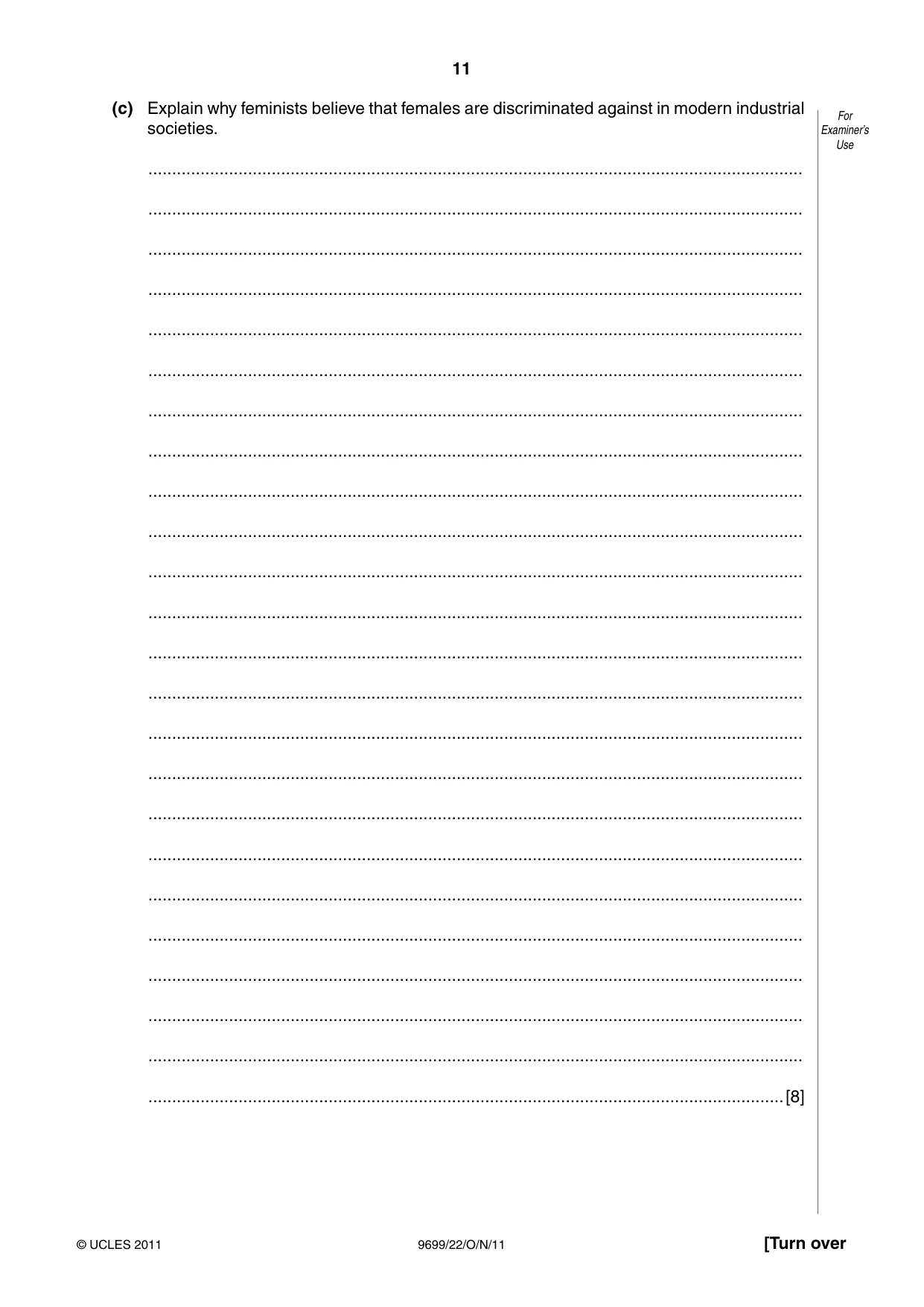
11 9699/22/O/N/11 © UCLES 2011 [Turn over For Examiner’s Use (c) Explain why feminists believe that females are discriminated against in modern industrial societies. … … … … … … … … … … … … … … … … … … … … … … … …[8]
Question paper, page 12
12 9699/22/O/N/11 © UCLES 2011 For Examiner’s Use (d) Assess the functionalist view that all groups benefit from social inequality. … … … … … … … … … … … … … … … … … … … … … … … … … … …
Question paper, page 13
13 9699/22/O/N/11 © UCLES 2011 For Examiner’s Use … … … … … …[11]
Question paper, page 14
14 9699/22/O/N/11 © UCLES 2011 BLANK PAGE
Question paper, page 15
15 9699/22/O/N/11 © UCLES 2011 BLANK PAGE
Question paper, page 16
16 9699/22/O/N/11 © UCLES 2011 Permission to reproduce items where third-party owned material protected by copyright is included has been sought and cleared where possible. Every reasonable effort has been made by the publisher (UCLES) to trace copyright holders, but if any items requiring clearance have unwittingly been included, the publisher will be pleased to make amends at the earliest possible opportunity. University of Cambridge International Examinations is part of the Cambridge Assessment Group. Cambridge Assessment is the brand name of University of Cambridge Local Examinations Syndicate (UCLES), which is itself a department of the University of Cambridge. BLANK PAGE
Mark scheme, page 1
UNIVERSITY OF CAMBRIDGE INTERNATIONAL EXAMINATIONS GCE Advanced Subsidiary Level and GCE Advanced Level MARK SCHEME for the October/November 2011 question paper for the guidance of teachers 9699 SOCIOLOGY 9699/22 Paper 2 (Data Response), maximum raw mark 50 This mark scheme is published as an aid to teachers and candidates, to indicate the requirements of the examination. It shows the basis on which Examiners were instructed to award marks. It does not indicate the details of the discussions that took place at an Examiners’ meeting before marking began, which would have considered the acceptability of alternative answers. Mark schemes must be read in conjunction with the question papers and the report on the examination. • Cambridge will not enter into discussions or correspondence in connection with these mark schemes. Cambridge is publishing the mark schemes for the October/November 2011 question papers for most IGCSE, GCE Advanced Level and Advanced Subsidiary Level syllabuses and some Ordinary Level syllabuses.
Mark scheme, page 2
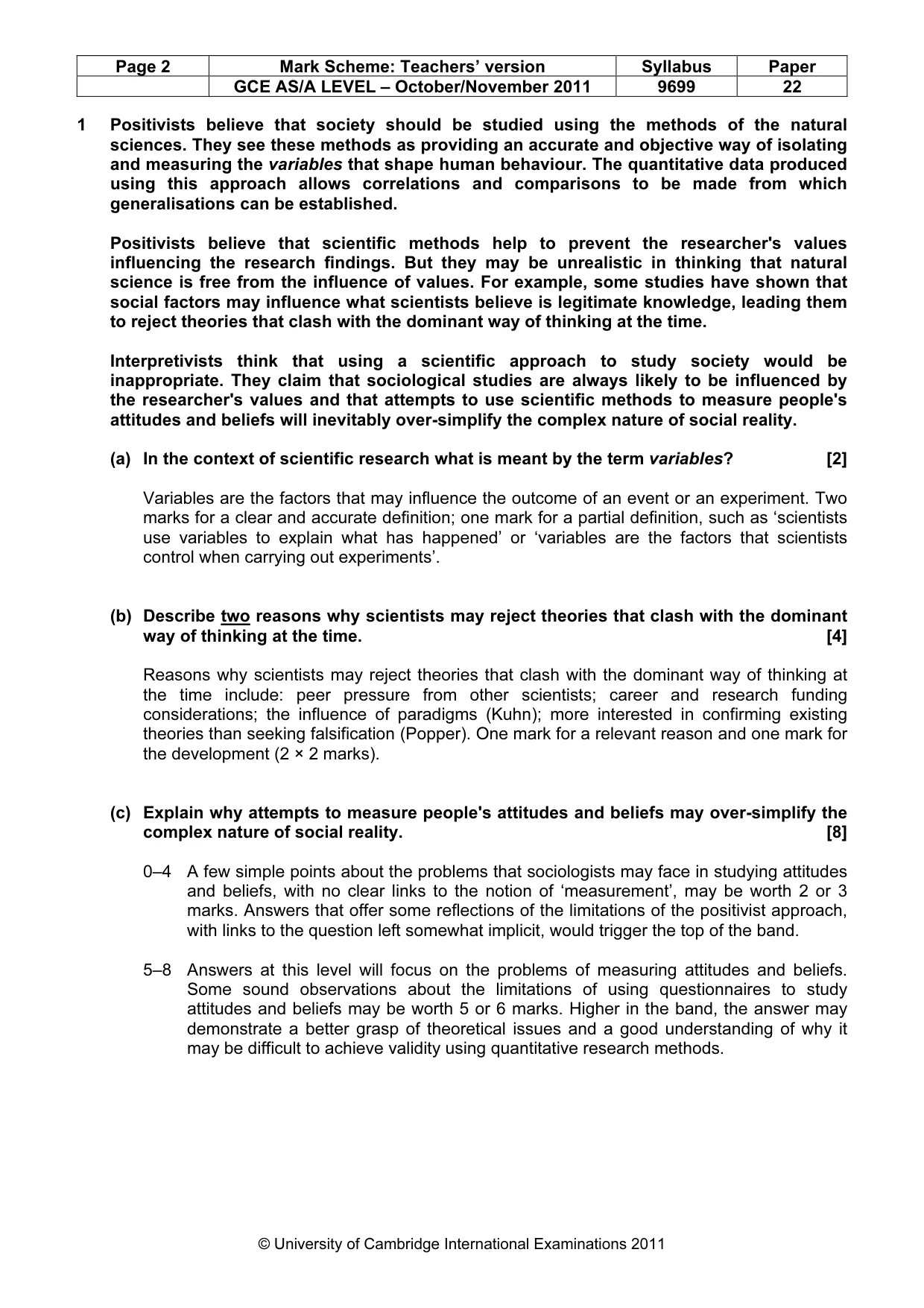
Page 2 Mark Scheme: Teachers’ version Syllabus Paper GCE AS/A LEVEL – October/November 2011 9699 22 © University of Cambridge International Examinations 2011 1 Positivists believe that society should be studied using the methods of the natural sciences. They see these methods as providing an accurate and objective way of isolating and measuring the variables that shape human behaviour. The quantitative data produced using this approach allows correlations and comparisons to be made from which generalisations can be established. Positivists believe that scientific methods help to prevent the researcher's values influencing the research findings. But they may be unrealistic in thinking that natural science is free from the influence of values. For example, some studies have shown that social factors may influence what scientists believe is legitimate knowledge, leading them to reject theories that clash with the dominant way of thinking at the time. Interpretivists think that using a scientific approach to study society would be inappropriate. They claim that sociological studies are always likely to be influenced by the researcher's values and that attempts to use scientific methods to measure people's attitudes and beliefs will inevitably over-simplify the complex nature of social reality. (a) In the context of scientific research what is meant by the term variables? [2] Variables are the factors that may influence the outcome of an event or an experiment. Two marks for a clear and accurate definition; one mark for a partial definition, such as ‘scientists use variables to explain what has happened’ or ‘variables are the factors that scientists control when carrying out experiments’. (b) Describe two reasons why scientists may reject theories that clash with the dominant way of thinking at the time. [4] Reasons why scientists may reject theories that clash with the dominant way of thinking at the time include: peer pressure from other scientists; career and research funding considerations; the influence of paradigms (Kuhn); more interested in confirming existing theories than seeking falsification (Popper). One mark for a relevant reason and one mark for the development (2 × 2 marks). (c) Explain why attempts to measure people's attitudes and beliefs may over-simplify the complex nature of social reality. [8] 0–4 A few simple points about the problems that sociologists may face in studying attitudes and beliefs, with no clear links to the notion of ‘measurement’, may be worth 2 or 3 marks. Answers that offer some reflections of the limitations of the positivist approach, with links to the question left somewhat implicit, would trigger the top of the band. 5–8 Answers at this level will focus on the problems of measuring attitudes and beliefs. Some sound observations about the limitations of using questionnaires to study attitudes and beliefs may be worth 5 or 6 marks. Higher in the band, the answer may demonstrate a better grasp of theoretical issues and a good understanding of why it may be difficult to achieve validity using quantitative research methods.
Mark scheme, page 3
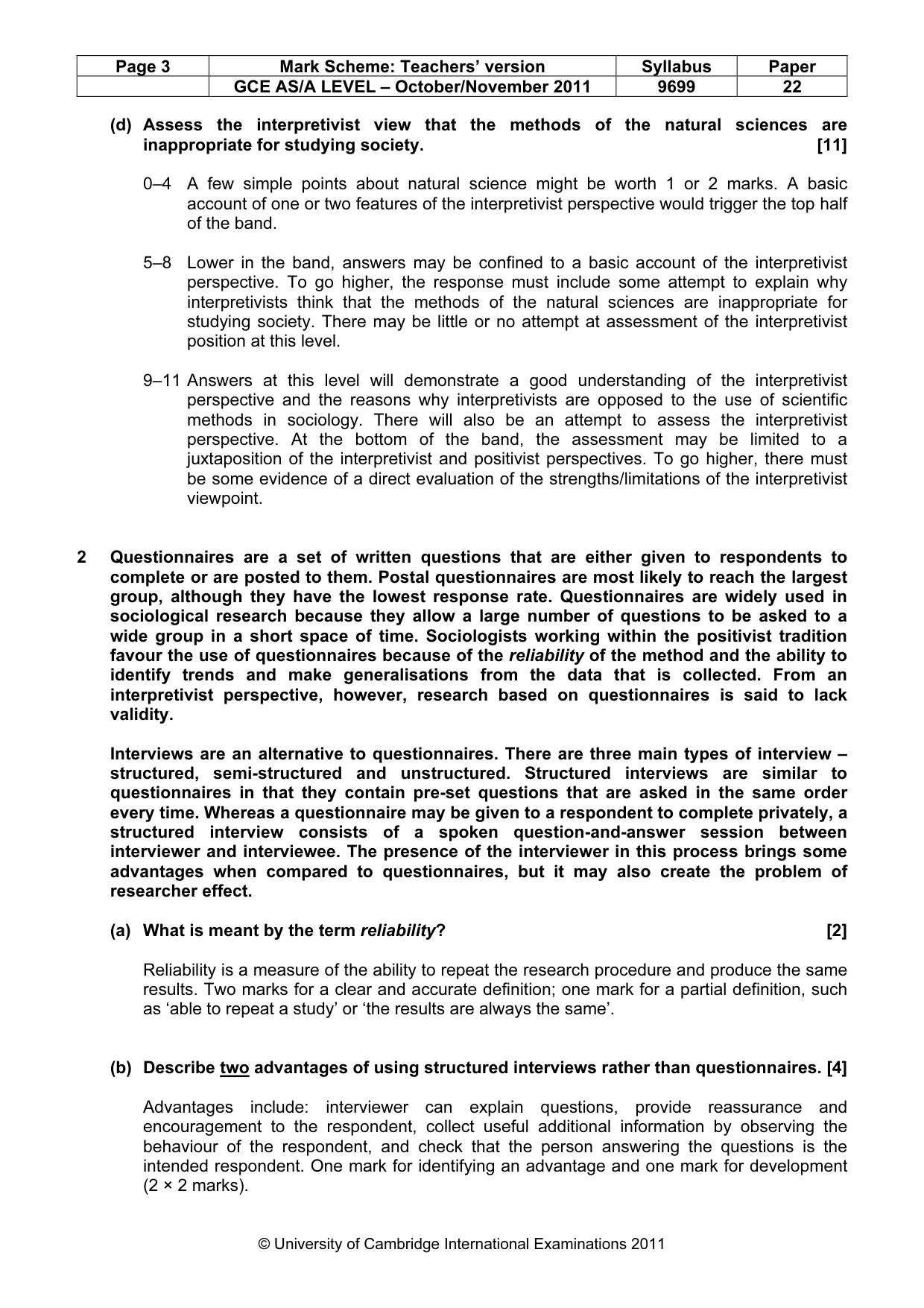
Page 3 Mark Scheme: Teachers’ version Syllabus Paper GCE AS/A LEVEL – October/November 2011 9699 22 © University of Cambridge International Examinations 2011 (d) Assess the interpretivist view that the methods of the natural sciences are inappropriate for studying society. [11] 0–4 A few simple points about natural science might be worth 1 or 2 marks. A basic account of one or two features of the interpretivist perspective would trigger the top half of the band. 5–8 Lower in the band, answers may be confined to a basic account of the interpretivist perspective. To go higher, the response must include some attempt to explain why interpretivists think that the methods of the natural sciences are inappropriate for studying society. There may be little or no attempt at assessment of the interpretivist position at this level. 9–11 Answers at this level will demonstrate a good understanding of the interpretivist perspective and the reasons why interpretivists are opposed to the use of scientific methods in sociology. There will also be an attempt to assess the interpretivist perspective. At the bottom of the band, the assessment may be limited to a juxtaposition of the interpretivist and positivist perspectives. To go higher, there must be some evidence of a direct evaluation of the strengths/limitations of the interpretivist viewpoint. 2 Questionnaires are a set of written questions that are either given to respondents to complete or are posted to them. Postal questionnaires are most likely to reach the largest group, although they have the lowest response rate. Questionnaires are widely used in sociological research because they allow a large number of questions to be asked to a wide group in a short space of time. Sociologists working within the positivist tradition favour the use of questionnaires because of the reliability of the method and the ability to identify trends and make generalisations from the data that is collected. From an interpretivist perspective, however, research based on questionnaires is said to lack validity. Interviews are an alternative to questionnaires. There are three main types of interview – structured, semi-structured and unstructured. Structured interviews are similar to questionnaires in that they contain pre-set questions that are asked in the same order every time. Whereas a questionnaire may be given to a respondent to complete privately, a structured interview consists of a spoken question-and-answer session between interviewer and interviewee. The presence of the interviewer in this process brings some advantages when compared to questionnaires, but it may also create the problem of researcher effect. (a) What is meant by the term reliability? [2] Reliability is a measure of the ability to repeat the research procedure and produce the same results. Two marks for a clear and accurate definition; one mark for a partial definition, such as ‘able to repeat a study’ or ‘the results are always the same’. (b) Describe two advantages of using structured interviews rather than questionnaires. [4] Advantages include: interviewer can explain questions, provide reassurance and encouragement to the respondent, collect useful additional information by observing the behaviour of the respondent, and check that the person answering the questions is the intended respondent. One mark for identifying an advantage and one mark for development (2 × 2 marks).
Mark scheme, page 4
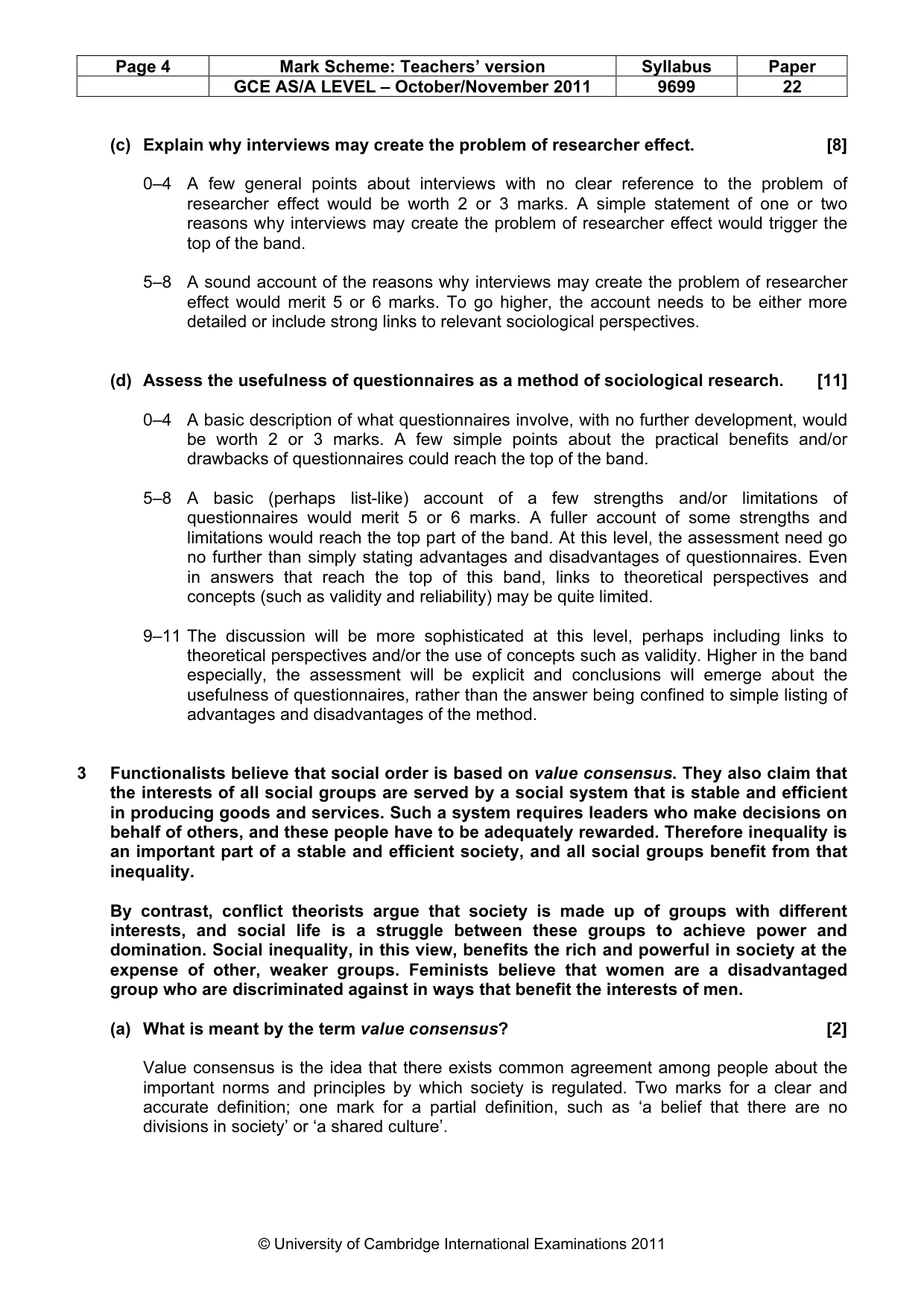
Page 4 Mark Scheme: Teachers’ version Syllabus Paper GCE AS/A LEVEL – October/November 2011 9699 22 © University of Cambridge International Examinations 2011 (c) Explain why interviews may create the problem of researcher effect. [8] 0–4 A few general points about interviews with no clear reference to the problem of researcher effect would be worth 2 or 3 marks. A simple statement of one or two reasons why interviews may create the problem of researcher effect would trigger the top of the band. 5–8 A sound account of the reasons why interviews may create the problem of researcher effect would merit 5 or 6 marks. To go higher, the account needs to be either more detailed or include strong links to relevant sociological perspectives. (d) Assess the usefulness of questionnaires as a method of sociological research. [11] 0–4 A basic description of what questionnaires involve, with no further development, would be worth 2 or 3 marks. A few simple points about the practical benefits and/or drawbacks of questionnaires could reach the top of the band. 5–8 A basic (perhaps list-like) account of a few strengths and/or limitations of questionnaires would merit 5 or 6 marks. A fuller account of some strengths and limitations would reach the top part of the band. At this level, the assessment need go no further than simply stating advantages and disadvantages of questionnaires. Even in answers that reach the top of this band, links to theoretical perspectives and concepts (such as validity and reliability) may be quite limited. 9–11 The discussion will be more sophisticated at this level, perhaps including links to theoretical perspectives and/or the use of concepts such as validity. Higher in the band especially, the assessment will be explicit and conclusions will emerge about the usefulness of questionnaires, rather than the answer being confined to simple listing of advantages and disadvantages of the method. 3 Functionalists believe that social order is based on value consensus. They also claim that the interests of all social groups are served by a social system that is stable and efficient in producing goods and services. Such a system requires leaders who make decisions on behalf of others, and these people have to be adequately rewarded. Therefore inequality is an important part of a stable and efficient society, and all social groups benefit from that inequality. By contrast, conflict theorists argue that society is made up of groups with different interests, and social life is a struggle between these groups to achieve power and domination. Social inequality, in this view, benefits the rich and powerful in society at the expense of other, weaker groups. Feminists believe that women are a disadvantaged group who are discriminated against in ways that benefit the interests of men. (a) What is meant by the term value consensus? [2] Value consensus is the idea that there exists common agreement among people about the important norms and principles by which society is regulated. Two marks for a clear and accurate definition; one mark for a partial definition, such as ‘a belief that there are no divisions in society’ or ‘a shared culture’.
Mark scheme, page 5
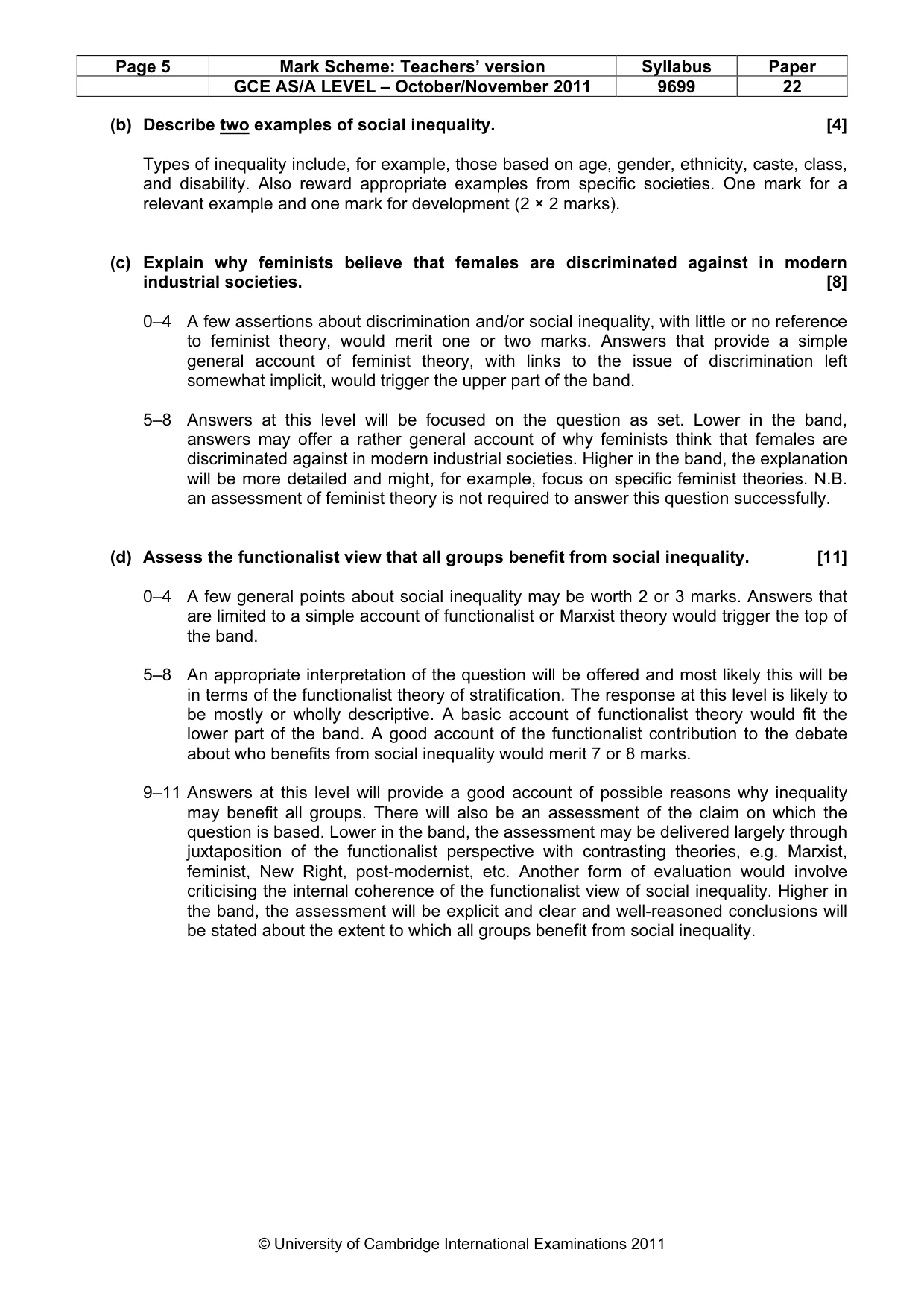
Page 5 Mark Scheme: Teachers’ version Syllabus Paper GCE AS/A LEVEL – October/November 2011 9699 22 © University of Cambridge International Examinations 2011 (b) Describe two examples of social inequality. [4] Types of inequality include, for example, those based on age, gender, ethnicity, caste, class, and disability. Also reward appropriate examples from specific societies. One mark for a relevant example and one mark for development (2 × 2 marks). (c) Explain why feminists believe that females are discriminated against in modern industrial societies. [8] 0–4 A few assertions about discrimination and/or social inequality, with little or no reference to feminist theory, would merit one or two marks. Answers that provide a simple general account of feminist theory, with links to the issue of discrimination left somewhat implicit, would trigger the upper part of the band. 5–8 Answers at this level will be focused on the question as set. Lower in the band, answers may offer a rather general account of why feminists think that females are discriminated against in modern industrial societies. Higher in the band, the explanation will be more detailed and might, for example, focus on specific feminist theories. N.B. an assessment of feminist theory is not required to answer this question successfully. (d) Assess the functionalist view that all groups benefit from social inequality. [11] 0–4 A few general points about social inequality may be worth 2 or 3 marks. Answers that are limited to a simple account of functionalist or Marxist theory would trigger the top of the band. 5–8 An appropriate interpretation of the question will be offered and most likely this will be in terms of the functionalist theory of stratification. The response at this level is likely to be mostly or wholly descriptive. A basic account of functionalist theory would fit the lower part of the band. A good account of the functionalist contribution to the debate about who benefits from social inequality would merit 7 or 8 marks. 9–11 Answers at this level will provide a good account of possible reasons why inequality may benefit all groups. There will also be an assessment of the claim on which the question is based. Lower in the band, the assessment may be delivered largely through juxtaposition of the functionalist perspective with contrasting theories, e.g. Marxist, feminist, New Right, post-modernist, etc. Another form of evaluation would involve criticising the internal coherence of the functionalist view of social inequality. Higher in the band, the assessment will be explicit and clear and well-reasoned conclusions will be stated about the extent to which all groups benefit from social inequality.
What you needed in this session
Cambridge’s own grade thresholds for 2011 Oct/Nov, Paper 2 · Variant 2. A higher threshold means an easier paper — the bar moves with how the cohort did.