Cambridge A Level Psychology (from 2018) 9990 — 2020 Oct/Nov Paper 1 · Variant 1
9990/11/O/N/20 · 60 marks · ≈68 min
The question paper and its mark scheme, free to read here and free to download. This is Cambridge’s own paper, exactly as it was sat.
Question paper12 pages



Mark scheme11 pages
Answers below. Sit the paper first if you are practising.
Paper as text
Question paper, page 1
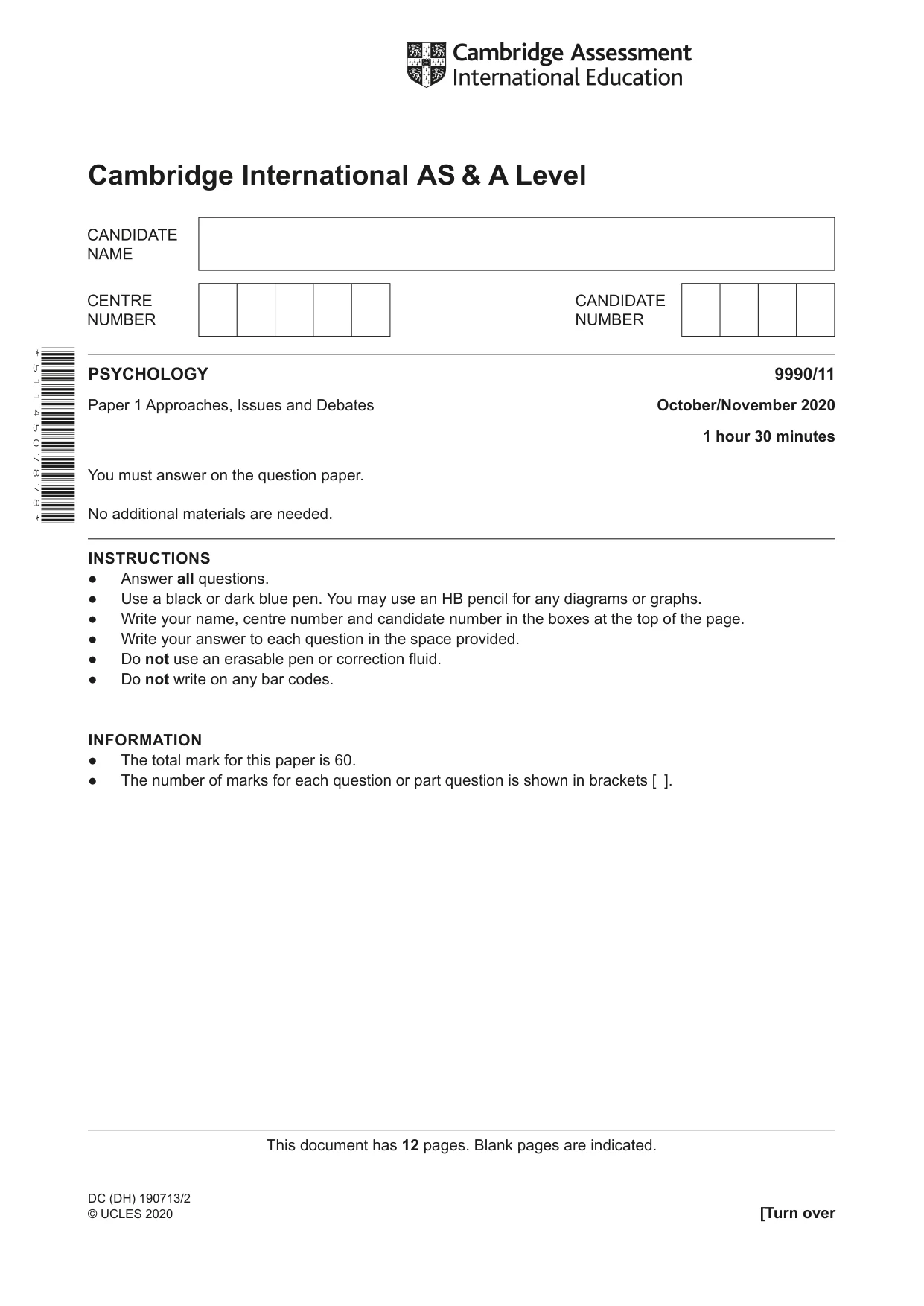
Cambridge International AS & A Level This document has 12 pages. Blank pages are indicated. DC (DH) 190713/2 © UCLES 2020 [Turn over * 5 1 1 4 5 0 7 8 7 8 * PSYCHOLOGY 9990/11 Paper 1 Approaches, Issues and Debates October/November 2020 1 hour 30 minutes You must answer on the question paper. No additional materials are needed. INSTRUCTIONS ● Answer all questions. ● Use a black or dark blue pen. You may use an HB pencil for any diagrams or graphs. ● Write your name, centre number and candidate number in the boxes at the top of the page. ● Write your answer to each question in the space provided. ● Do not use an erasable pen or correction fluid. ● Do not write on any bar codes. INFORMATION ● The total mark for this paper is 60. ● The number of marks for each question or part question is shown in brackets [ ].
Question paper, page 2
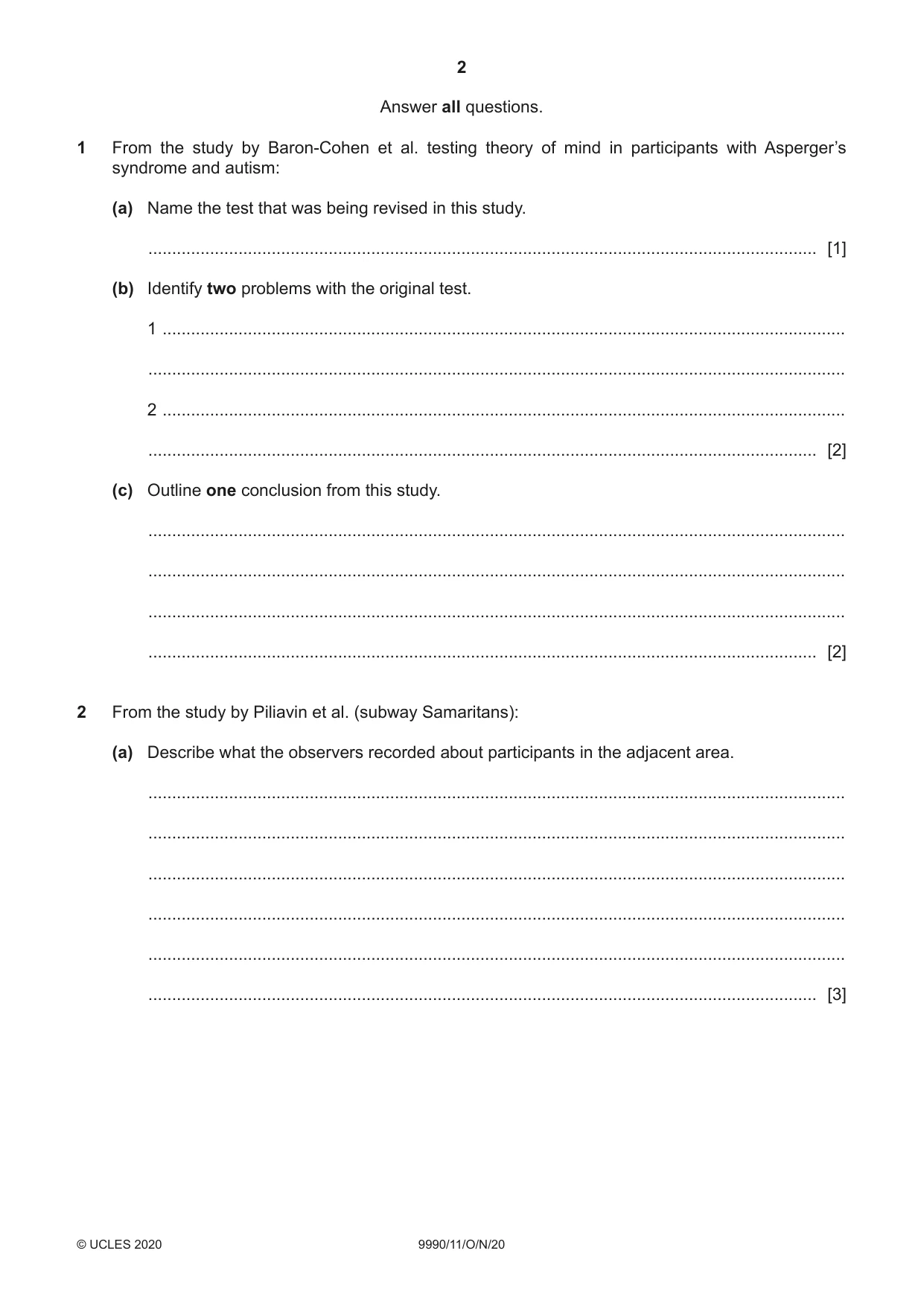
2 9990/11/O/N/20 © UCLES 2020 Answer all questions. 1 From the study by Baron-Cohen et al. testing theory of mind in participants with Asperger’s syndrome and autism: (a) Name the test that was being revised in this study. … [1] (b) Identify two problems with the original test. 1 … … 2 … … [2] (c) Outline one conclusion from this study. … … … … [2] 2 From the study by Piliavin et al. (subway Samaritans): (a) Describe what the observers recorded about participants in the adjacent area. … … … … … … [3]
Question paper, page 3
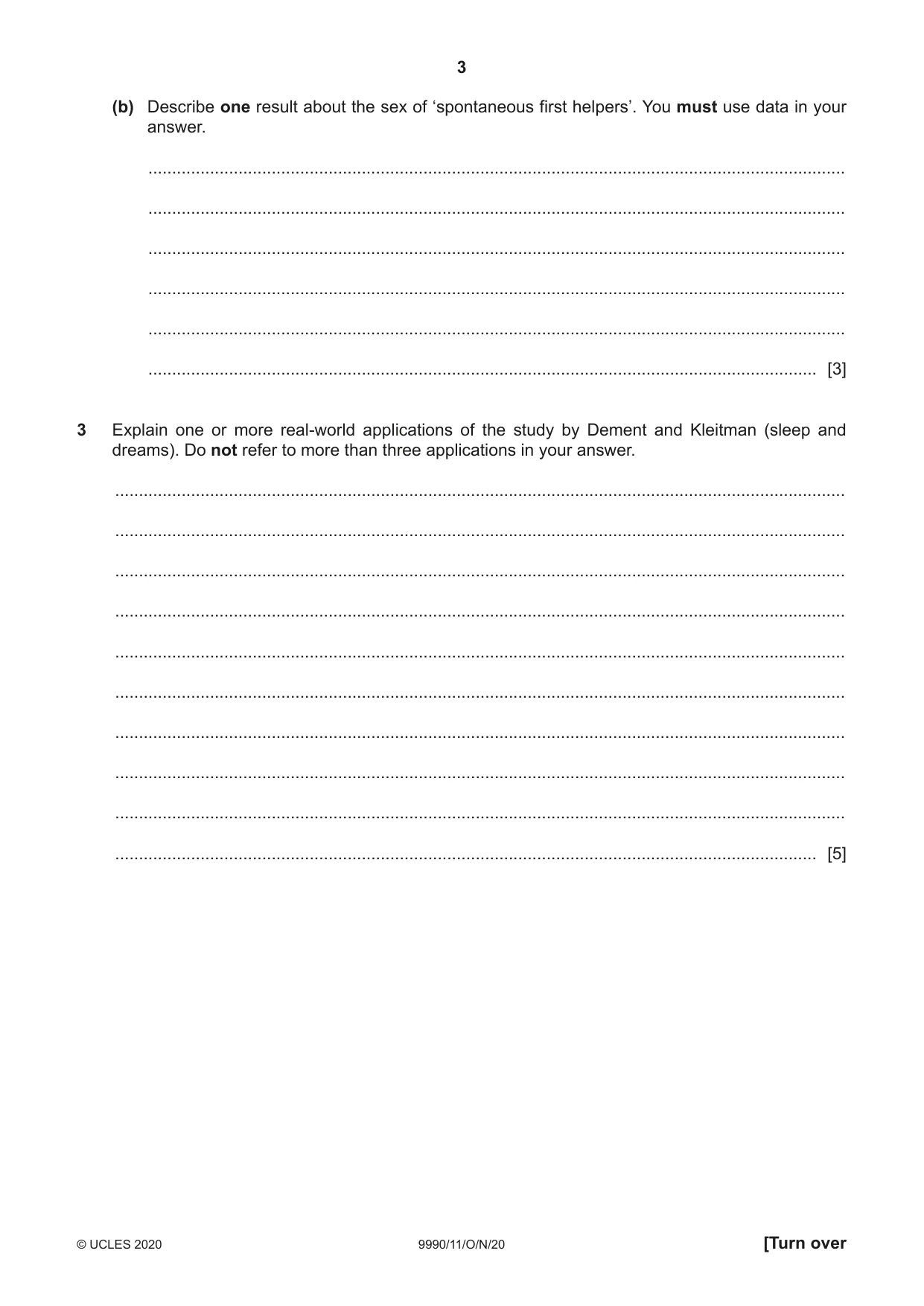
3 9990/11/O/N/20 © UCLES 2020 [Turn over (b) Describe one result about the sex of ‘spontaneous first helpers’. You must use data in your answer. … … … … … … [3] 3 Explain one or more real-world applications of the study by Dement and Kleitman (sleep and dreams). Do not refer to more than three applications in your answer. … … … … … … … … … … [5]
Question paper, page 4
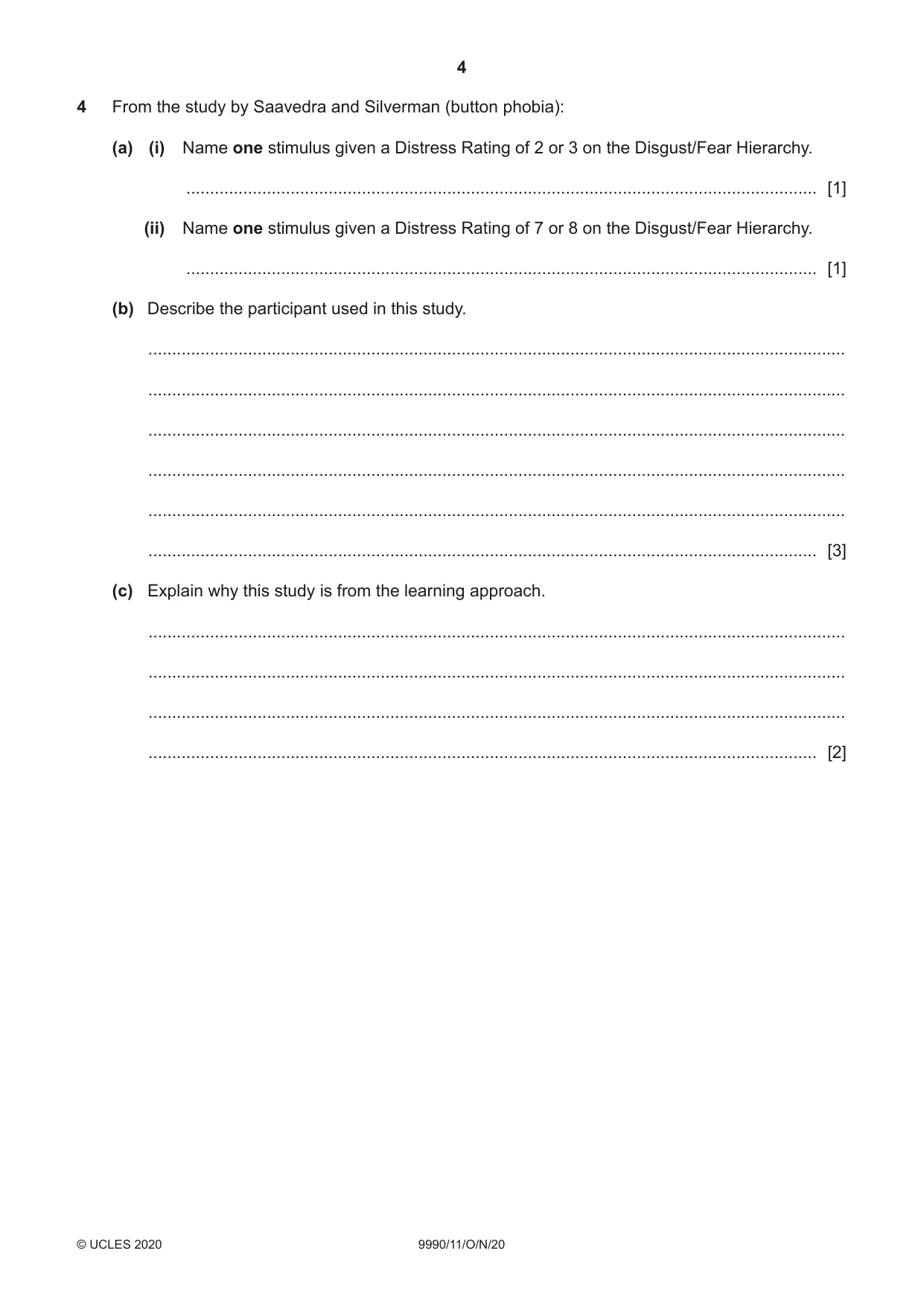
4 9990/11/O/N/20 © UCLES 2020 4 From the study by Saavedra and Silverman (button phobia): (a) (i) Name one stimulus given a Distress Rating of 2 or 3 on the Disgust/Fear Hierarchy. … [1] (ii) Name one stimulus given a Distress Rating of 7 or 8 on the Disgust/Fear Hierarchy. … [1] (b) Describe the participant used in this study. … … … … … … [3] (c) Explain why this study is from the learning approach. … … … … [2]
Question paper, page 5
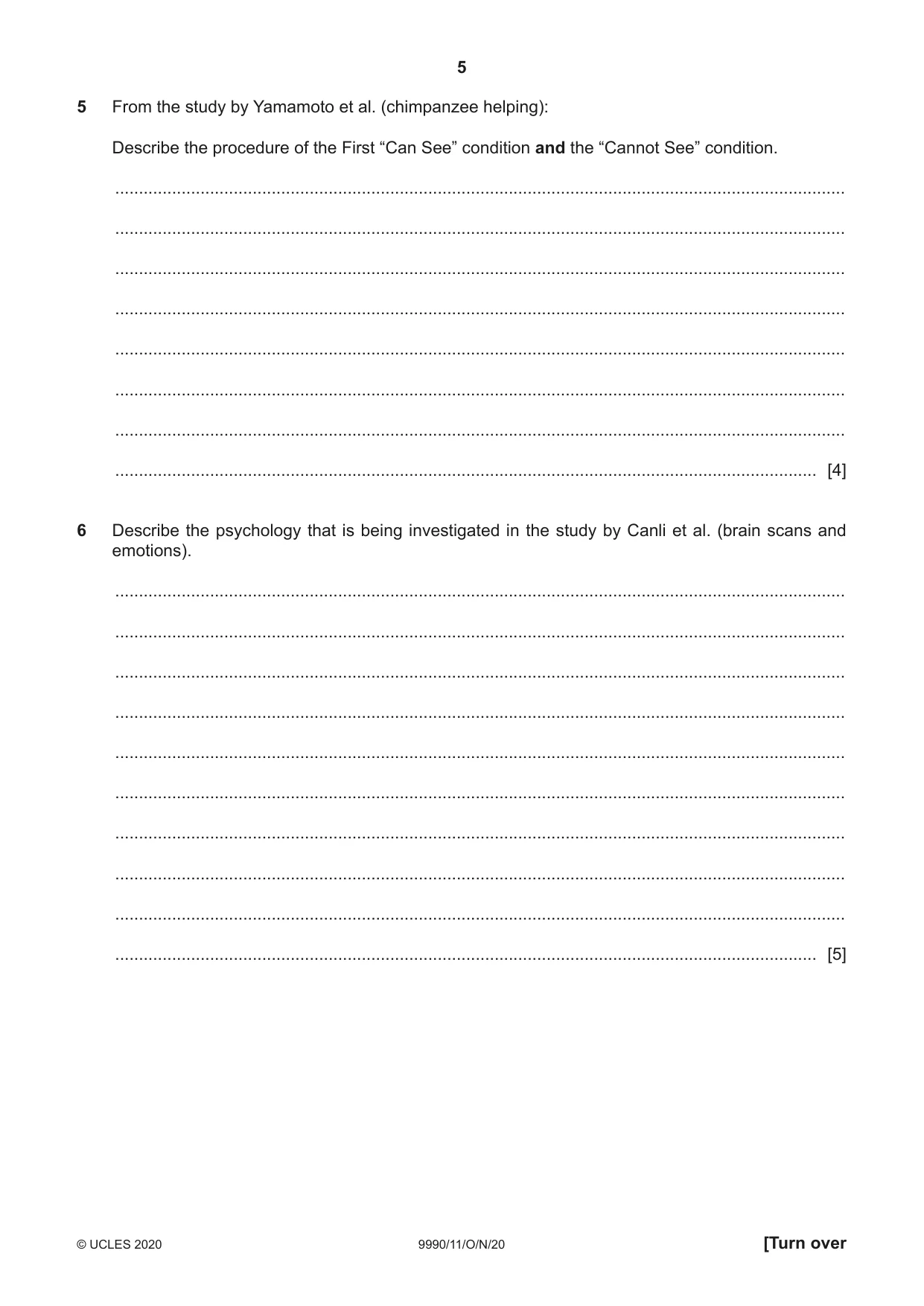
5 9990/11/O/N/20 © UCLES 2020 [Turn over 5 From the study by Yamamoto et al. (chimpanzee helping): Describe the procedure of the First “Can See” condition and the “Cannot See” condition. … … … … … … … … [4] 6 Describe the psychology that is being investigated in the study by Canli et al. (brain scans and emotions). … … … … … … … … … … [5]
Question paper, page 6
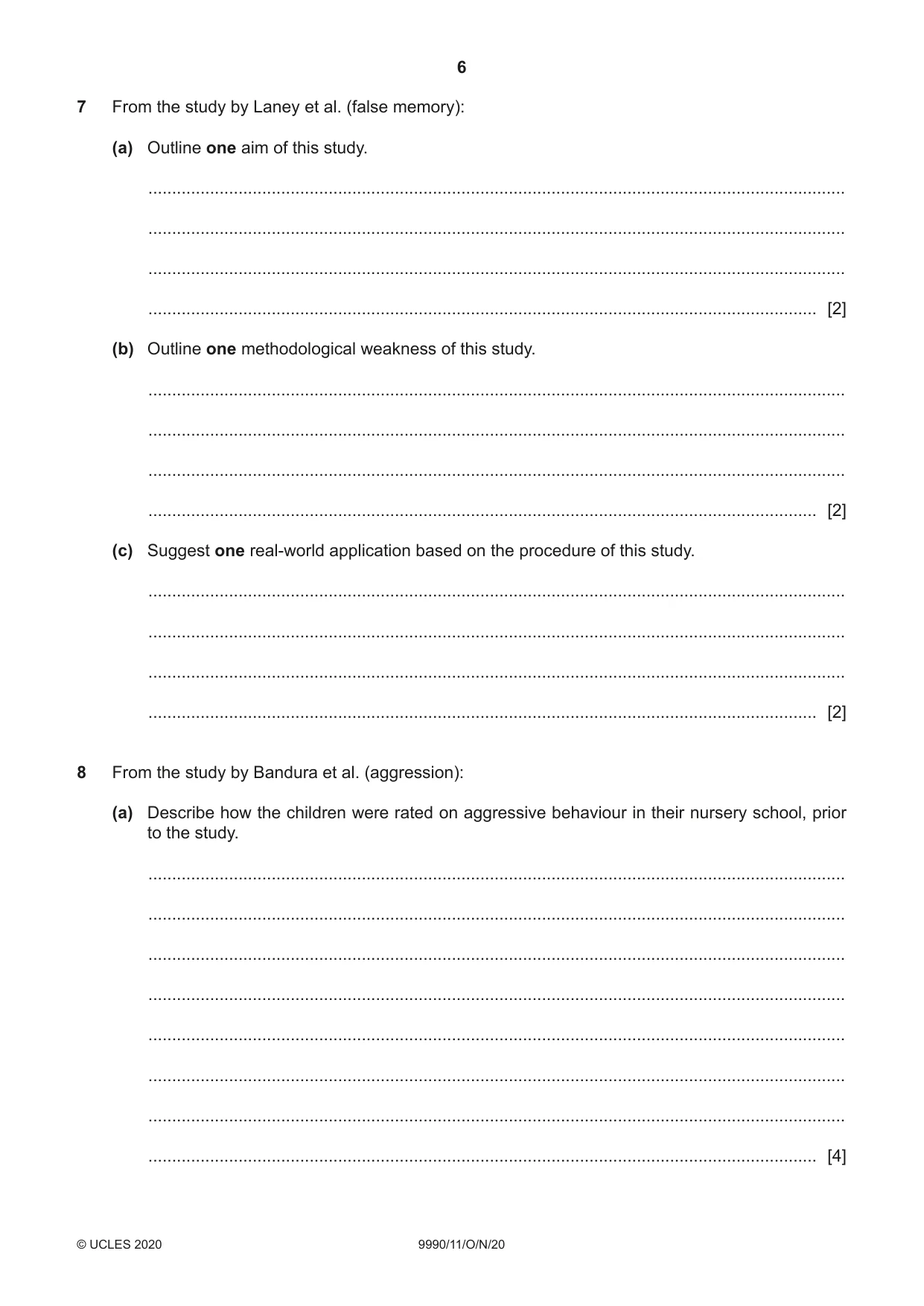
6 9990/11/O/N/20 © UCLES 2020 7 From the study by Laney et al. (false memory): (a) Outline one aim of this study. … … … … [2] (b) Outline one methodological weakness of this study. … … … … [2] (c) Suggest one real-world application based on the procedure of this study. … … … … [2] 8 From the study by Bandura et al. (aggression): (a) Describe how the children were rated on aggressive behaviour in their nursery school, prior to the study. … … … … … … … … [4]
Question paper, page 7
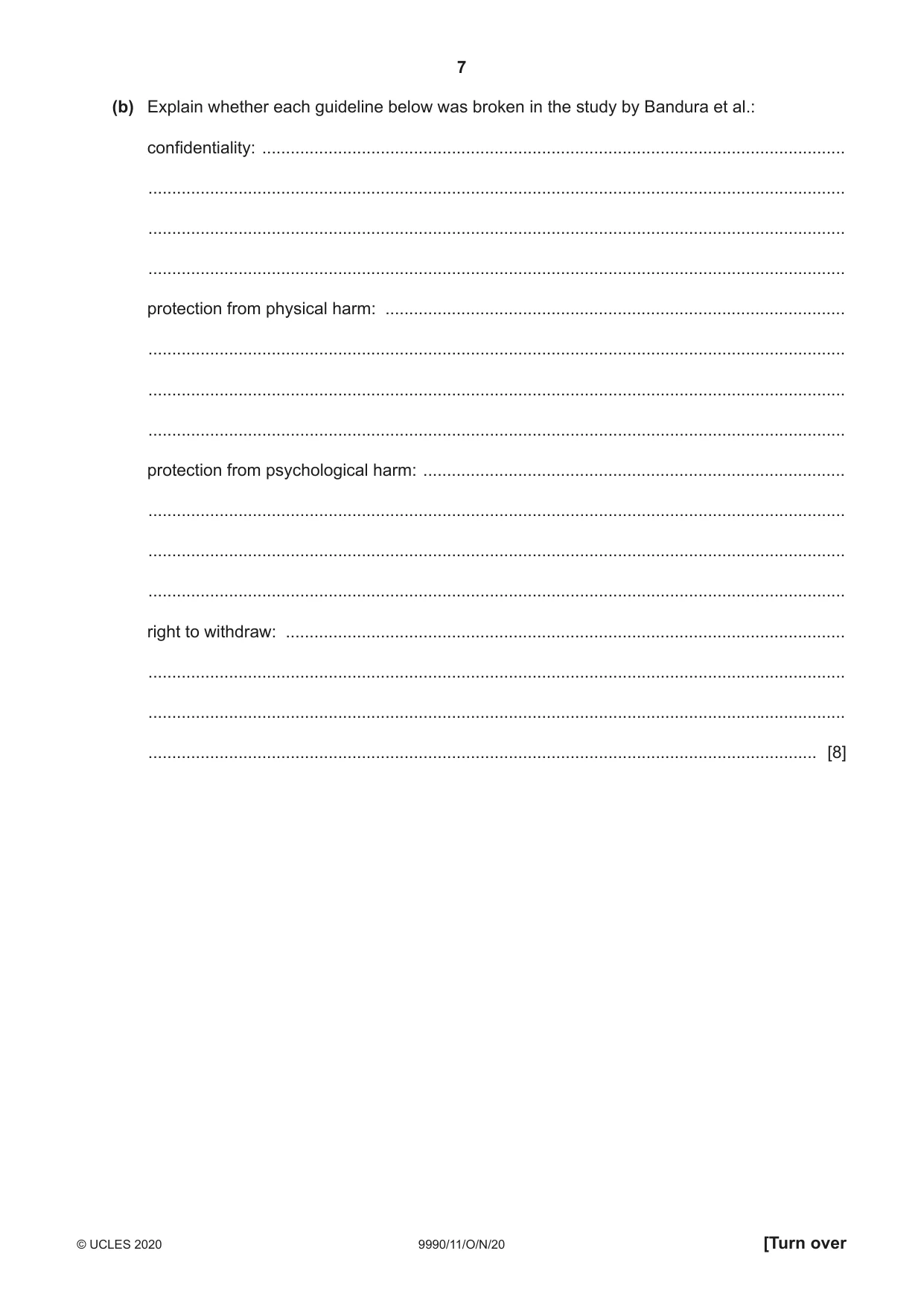
7 9990/11/O/N/20 © UCLES 2020 [Turn over (b) Explain whether each guideline below was broken in the study by Bandura et al.: confidentiality: … … … … protection from physical harm: … … … … protection from psychological harm: … … … … right to withdraw: … … … … [8]
Question paper, page 8
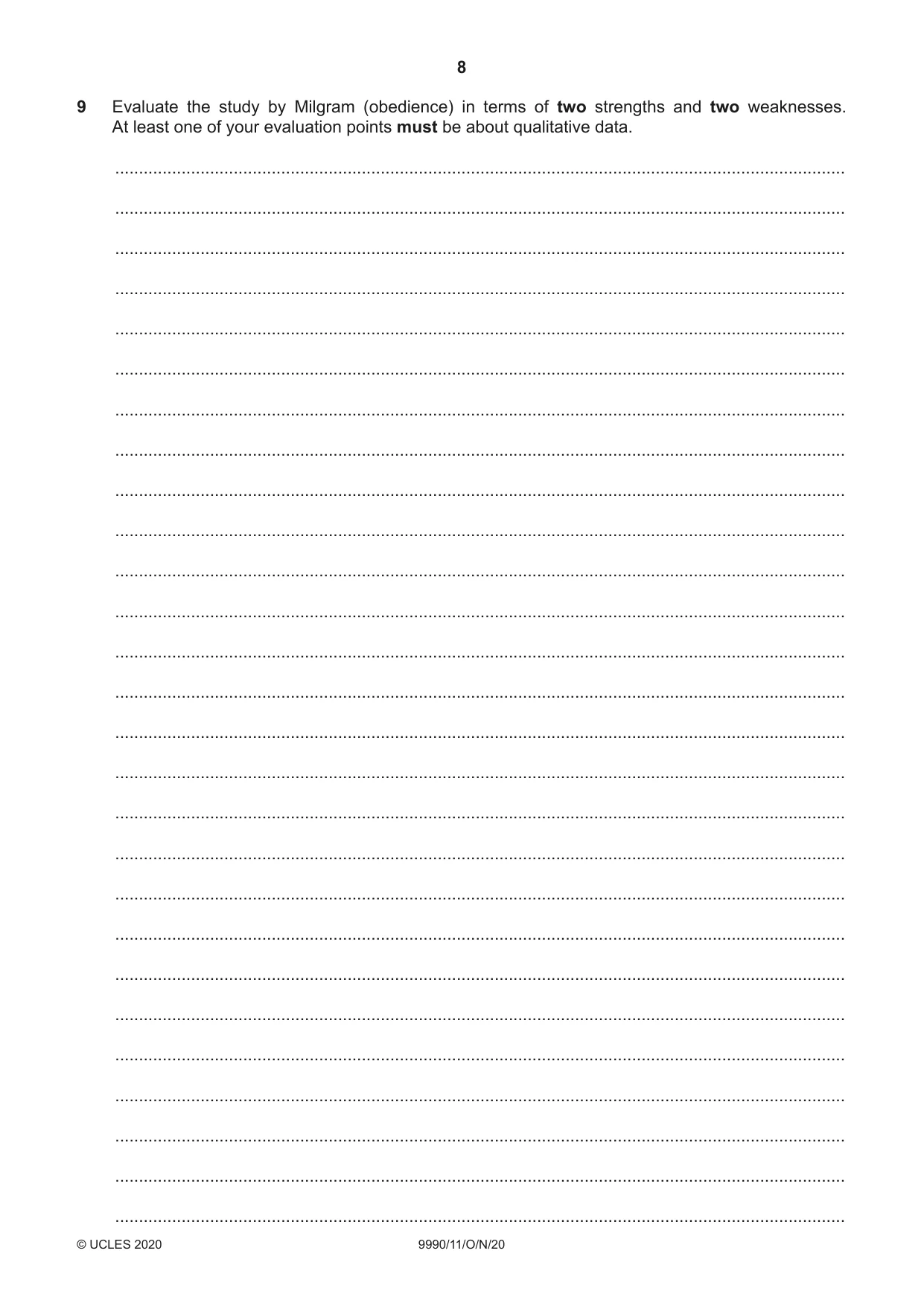
8 9990/11/O/N/20 © UCLES 2020 9 Evaluate the study by Milgram (obedience) in terms of two strengths and two weaknesses. At least one of your evaluation points must be about qualitative data. … … … … … … … … … … … … … … … … … … … … … … … … … … …
Question paper, page 9
9 9990/11/O/N/20 © UCLES 2020 … … … … … … … … … … … … … … [10]
Question paper, page 10
10 9990/11/O/N/20 © UCLES 2020 BLANK PAGE
Question paper, page 11
11 9990/11/O/N/20 © UCLES 2020 BLANK PAGE
Question paper, page 12
12 9990/11/O/N/20 © UCLES 2020 Permission to reproduce items where third-party owned material protected by copyright is included has been sought and cleared where possible. Every reasonable effort has been made by the publisher (UCLES) to trace copyright holders, but if any items requiring clearance have unwittingly been included, the publisher will be pleased to make amends at the earliest possible opportunity. To avoid the issue of disclosure of answer-related information to candidates, all copyright acknowledgements are reproduced online in the Cambridge Assessment International Education Copyright Acknowledgements Booklet. This is produced for each series of examinations and is freely available to download at www.cambridgeinternational.org after the live examination series. Cambridge Assessment International Education is part of the Cambridge Assessment Group. Cambridge Assessment is the brand name of the University of Cambridge Local Examinations Syndicate (UCLES), which itself is a department of the University of Cambridge. BLANK PAGE
Mark scheme, page 1
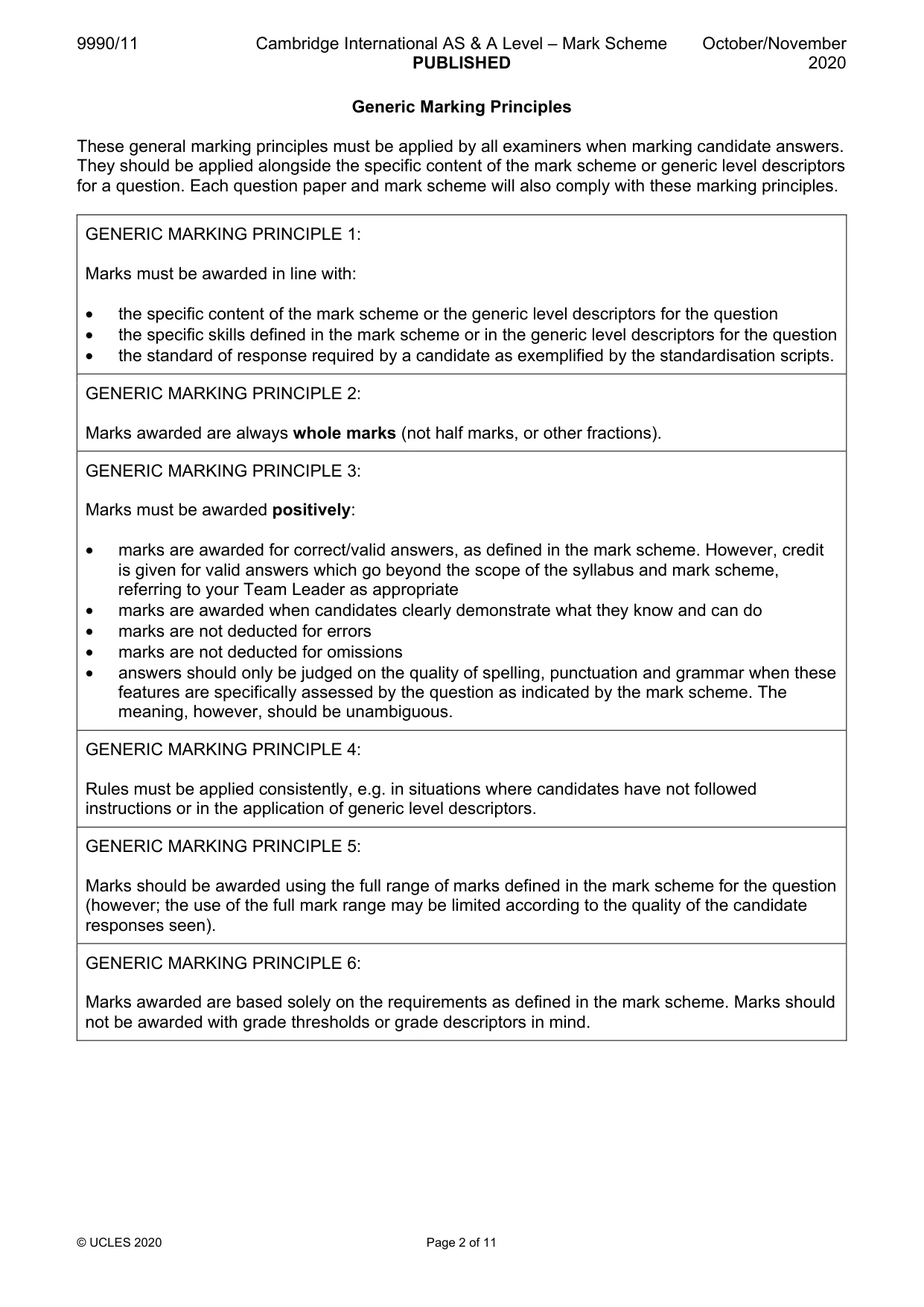
This document consists of 11 printed pages. © UCLES 2020 [Turn over Cambridge International AS & A Level PSYCHOLOGY 9990/11 Paper 1 Approaches, Issues and Debates October/November 2020 MARK SCHEME Maximum Mark: 60 Published This mark scheme is published as an aid to teachers and candidates, to indicate the requirements of the examination. It shows the basis on which Examiners were instructed to award marks. It does not indicate the details of the discussions that took place at an Examiners’ meeting before marking began, which would have considered the acceptability of alternative answers. Mark schemes should be read in conjunction with the question paper and the Principal Examiner Report for Teachers. Cambridge International will not enter into discussions about these mark schemes. Cambridge International is publishing the mark schemes for the October/November 2020 series for most Cambridge IGCSE™, Cambridge International A and AS Level and Cambridge Pre-U components, and some Cambridge O Level components.
Mark scheme, page 2
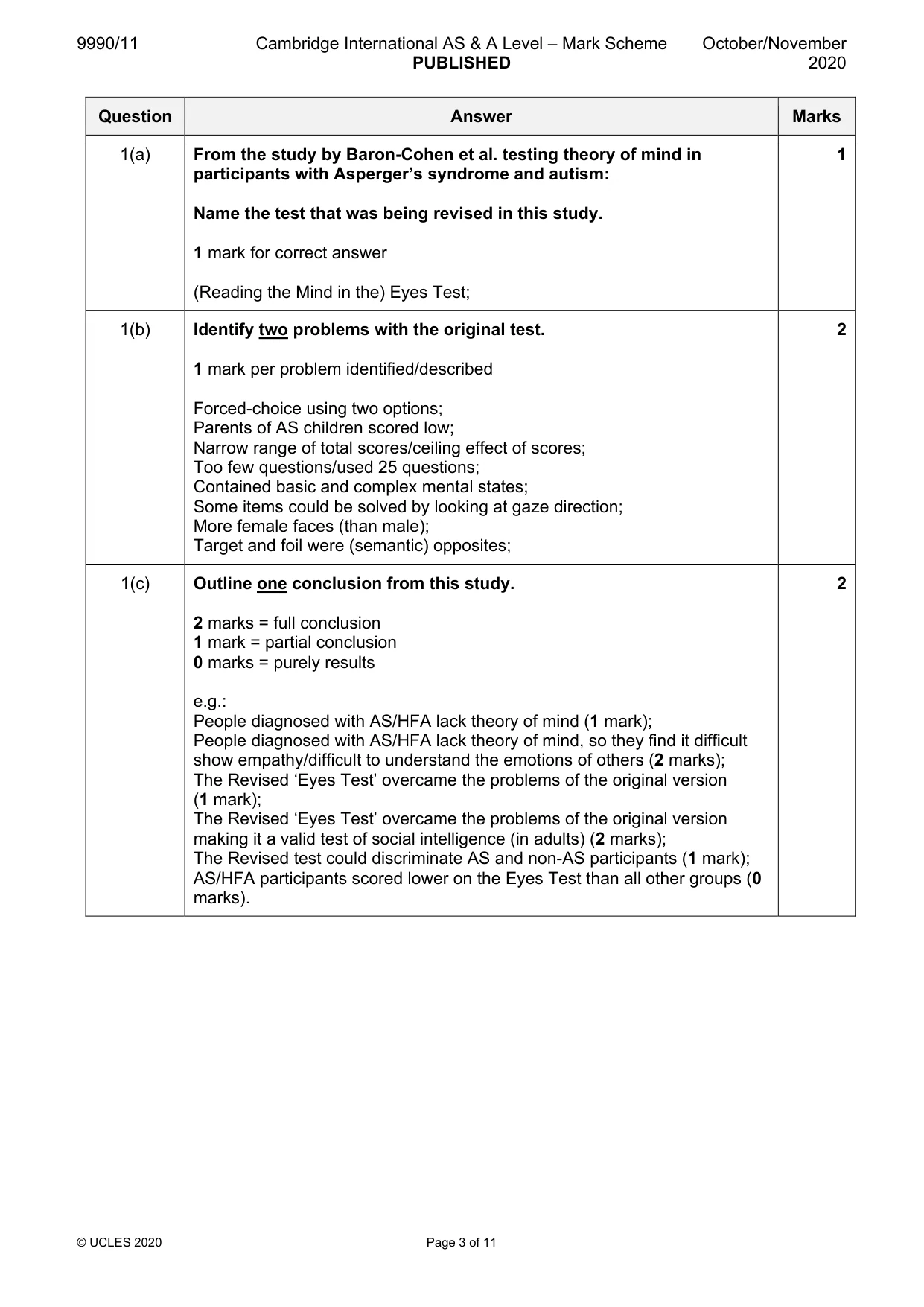
9990/11 Cambridge International AS & A Level – Mark Scheme PUBLISHED October/November 2020 © UCLES 2020 Page 2 of 11 Generic Marking Principles These general marking principles must be applied by all examiners when marking candidate answers. They should be applied alongside the specific content of the mark scheme or generic level descriptors for a question. Each question paper and mark scheme will also comply with these marking principles. GENERIC MARKING PRINCIPLE 1: Marks must be awarded in line with: • the specific content of the mark scheme or the generic level descriptors for the question • the specific skills defined in the mark scheme or in the generic level descriptors for the question • the standard of response required by a candidate as exemplified by the standardisation scripts. GENERIC MARKING PRINCIPLE 2: Marks awarded are always whole marks (not half marks, or other fractions). GENERIC MARKING PRINCIPLE 3: Marks must be awarded positively: • marks are awarded for correct/valid answers, as defined in the mark scheme. However, credit is given for valid answers which go beyond the scope of the syllabus and mark scheme, referring to your Team Leader as appropriate • marks are awarded when candidates clearly demonstrate what they know and can do • marks are not deducted for errors • marks are not deducted for omissions • answers should only be judged on the quality of spelling, punctuation and grammar when these features are specifically assessed by the question as indicated by the mark scheme. The meaning, however, should be unambiguous. GENERIC MARKING PRINCIPLE 4: Rules must be applied consistently, e.g. in situations where candidates have not followed instructions or in the application of generic level descriptors. GENERIC MARKING PRINCIPLE 5: Marks should be awarded using the full range of marks defined in the mark scheme for the question (however; the use of the full mark range may be limited according to the quality of the candidate responses seen). GENERIC MARKING PRINCIPLE 6: Marks awarded are based solely on the requirements as defined in the mark scheme. Marks should not be awarded with grade thresholds or grade descriptors in mind.
Mark scheme, page 3
9990/11 Cambridge International AS & A Level – Mark Scheme PUBLISHED October/November 2020 © UCLES 2020 Page 3 of 11 Question Answer Marks 1(a) From the study by Baron-Cohen et al. testing theory of mind in participants with Asperger’s syndrome and autism: Name the test that was being revised in this study. 1 mark for correct answer (Reading the Mind in the) Eyes Test; 1 1(b) Identify two problems with the original test. 1 mark per problem identified/described Forced-choice using two options; Parents of AS children scored low; Narrow range of total scores/ceiling effect of scores; Too few questions/used 25 questions; Contained basic and complex mental states; Some items could be solved by looking at gaze direction; More female faces (than male); Target and foil were (semantic) opposites; 2 1(c) Outline one conclusion from this study. 2 marks = full conclusion 1 mark = partial conclusion 0 marks = purely results e.g.: People diagnosed with AS/HFA lack theory of mind (1 mark); People diagnosed with AS/HFA lack theory of mind, so they find it difficult show empathy/difficult to understand the emotions of others (2 marks); The Revised ‘Eyes Test’ overcame the problems of the original version (1 mark); The Revised ‘Eyes Test’ overcame the problems of the original version making it a valid test of social intelligence (in adults) (2 marks); The Revised test could discriminate AS and non-AS participants (1 mark); AS/HFA participants scored lower on the Eyes Test than all other groups (0 marks). 2
Mark scheme, page 4
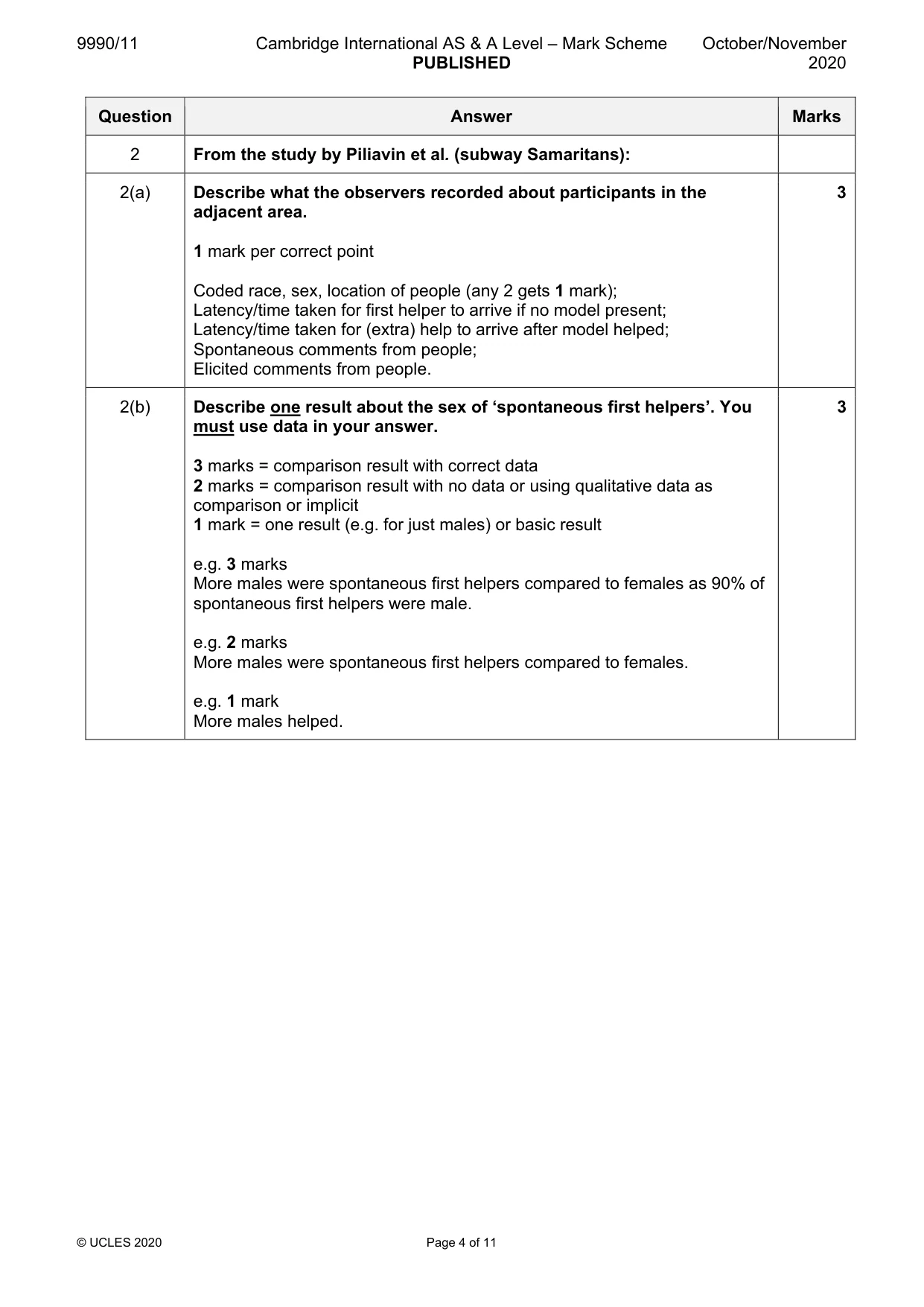
9990/11 Cambridge International AS & A Level – Mark Scheme PUBLISHED October/November 2020 © UCLES 2020 Page 4 of 11 Question Answer Marks 2 From the study by Piliavin et al. (subway Samaritans): 2(a) Describe what the observers recorded about participants in the adjacent area. 1 mark per correct point Coded race, sex, location of people (any 2 gets 1 mark); Latency/time taken for first helper to arrive if no model present; Latency/time taken for (extra) help to arrive after model helped; Spontaneous comments from people; Elicited comments from people. 3 2(b) Describe one result about the sex of ‘spontaneous first helpers’. You must use data in your answer. 3 marks = comparison result with correct data 2 marks = comparison result with no data or using qualitative data as comparison or implicit 1 mark = one result (e.g. for just males) or basic result e.g. 3 marks More males were spontaneous first helpers compared to females as 90% of spontaneous first helpers were male. e.g. 2 marks More males were spontaneous first helpers compared to females. e.g. 1 mark More males helped. 3
Mark scheme, page 5
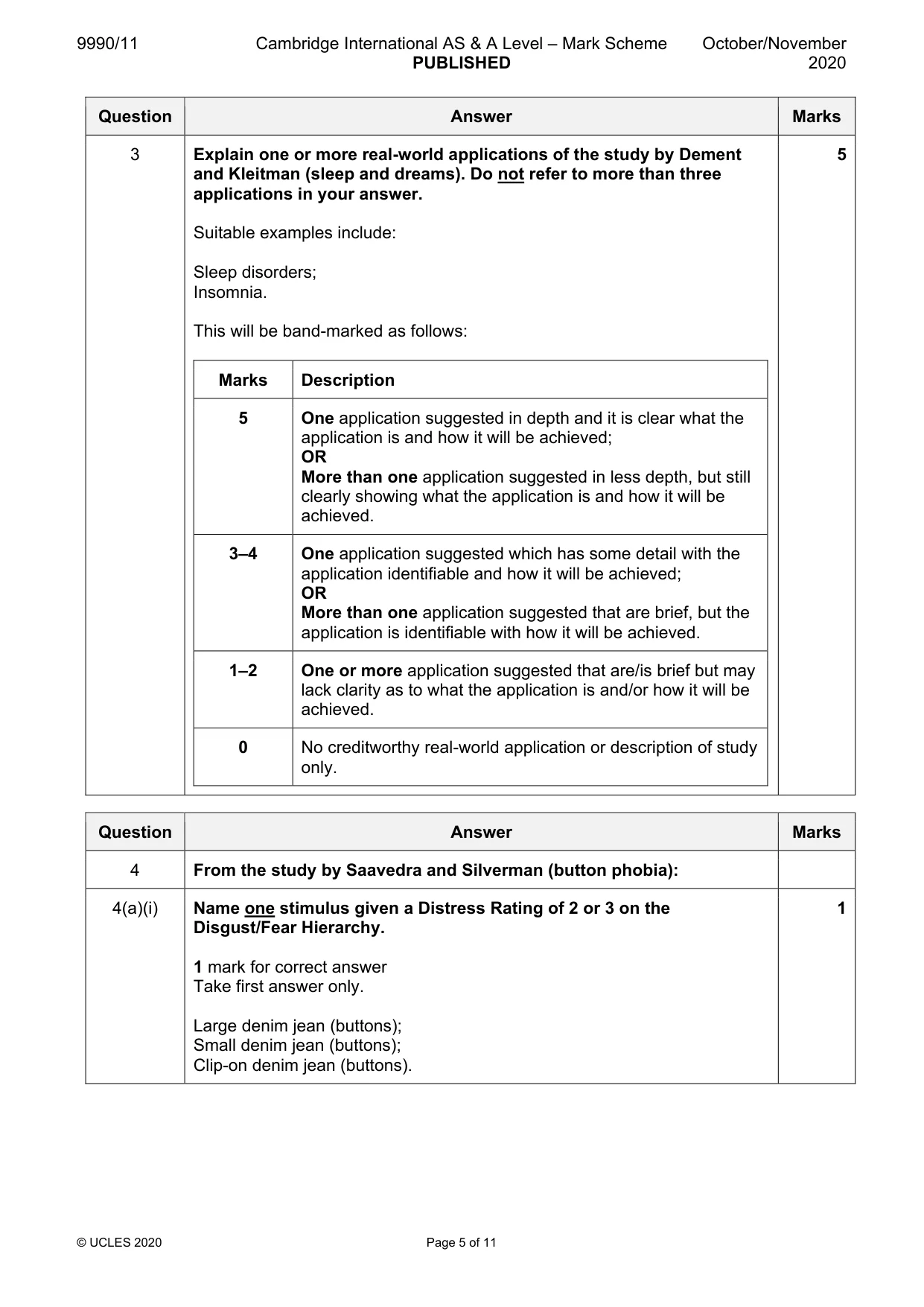
9990/11 Cambridge International AS & A Level – Mark Scheme PUBLISHED October/November 2020 © UCLES 2020 Page 5 of 11 Question Answer Marks 3 Explain one or more real-world applications of the study by Dement and Kleitman (sleep and dreams). Do not refer to more than three applications in your answer. Suitable examples include: Sleep disorders; Insomnia. This will be band-marked as follows: Marks Description 5 One application suggested in depth and it is clear what the application is and how it will be achieved; OR More than one application suggested in less depth, but still clearly showing what the application is and how it will be achieved. 3–4 One application suggested which has some detail with the application identifiable and how it will be achieved; OR More than one application suggested that are brief, but the application is identifiable with how it will be achieved. 1–2 One or more application suggested that are/is brief but may lack clarity as to what the application is and/or how it will be achieved. 0 No creditworthy real-world application or description of study only. 5 Question Answer Marks 4 From the study by Saavedra and Silverman (button phobia): 4(a)(i) Name one stimulus given a Distress Rating of 2 or 3 on the Disgust/Fear Hierarchy. 1 mark for correct answer Take first answer only. Large denim jean (buttons); Small denim jean (buttons); Clip-on denim jean (buttons). 1
Mark scheme, page 6
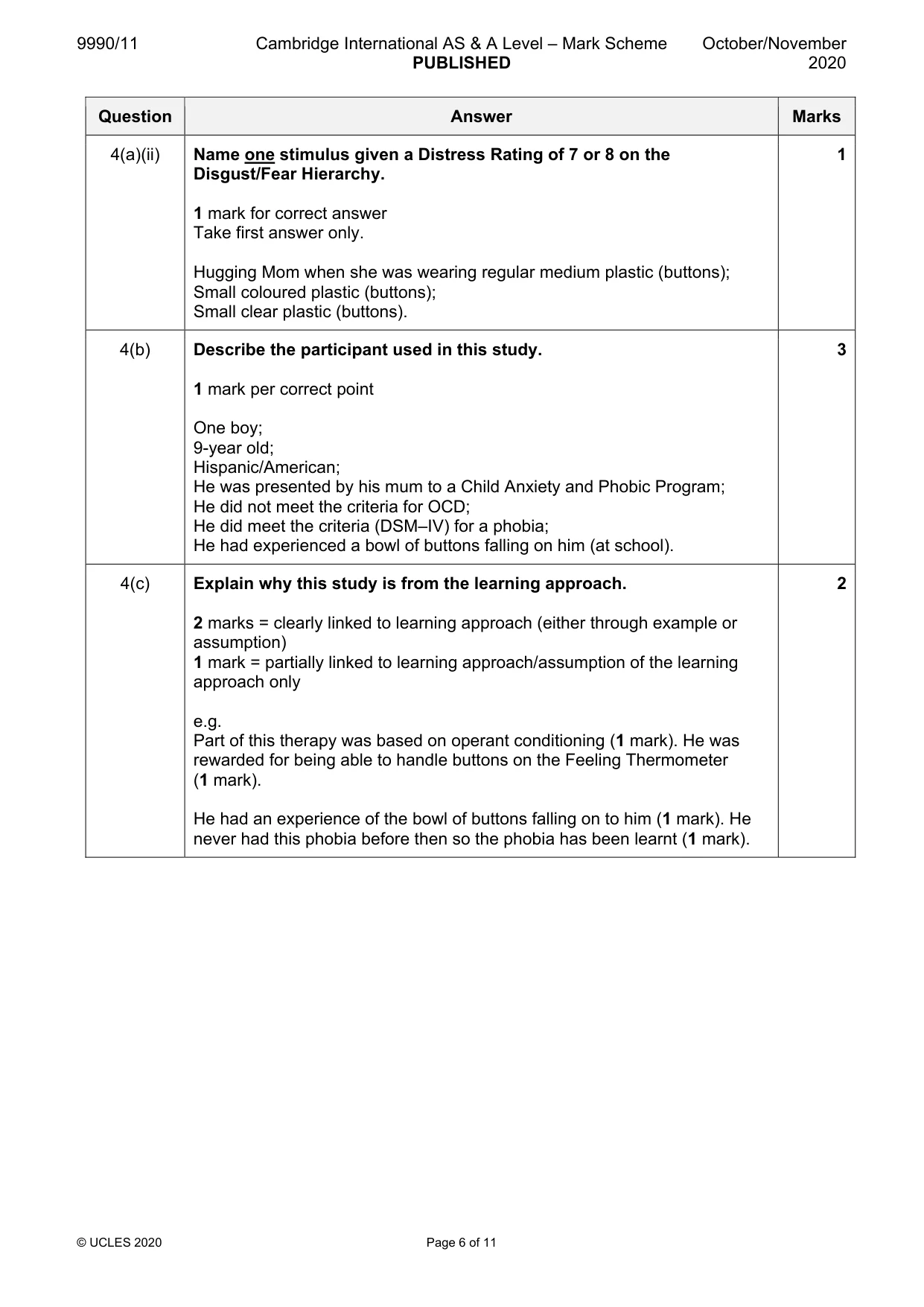
9990/11 Cambridge International AS & A Level – Mark Scheme PUBLISHED October/November 2020 © UCLES 2020 Page 6 of 11 Question Answer Marks 4(a)(ii) Name one stimulus given a Distress Rating of 7 or 8 on the Disgust/Fear Hierarchy. 1 mark for correct answer Take first answer only. Hugging Mom when she was wearing regular medium plastic (buttons); Small coloured plastic (buttons); Small clear plastic (buttons). 1 4(b) Describe the participant used in this study. 1 mark per correct point One boy; 9-year old; Hispanic/American; He was presented by his mum to a Child Anxiety and Phobic Program; He did not meet the criteria for OCD; He did meet the criteria (DSM–IV) for a phobia; He had experienced a bowl of buttons falling on him (at school). 3 4(c) Explain why this study is from the learning approach. 2 marks = clearly linked to learning approach (either through example or assumption) 1 mark = partially linked to learning approach/assumption of the learning approach only e.g. Part of this therapy was based on operant conditioning (1 mark). He was rewarded for being able to handle buttons on the Feeling Thermometer (1 mark). He had an experience of the bowl of buttons falling on to him (1 mark). He never had this phobia before then so the phobia has been learnt (1 mark). 2
Mark scheme, page 7
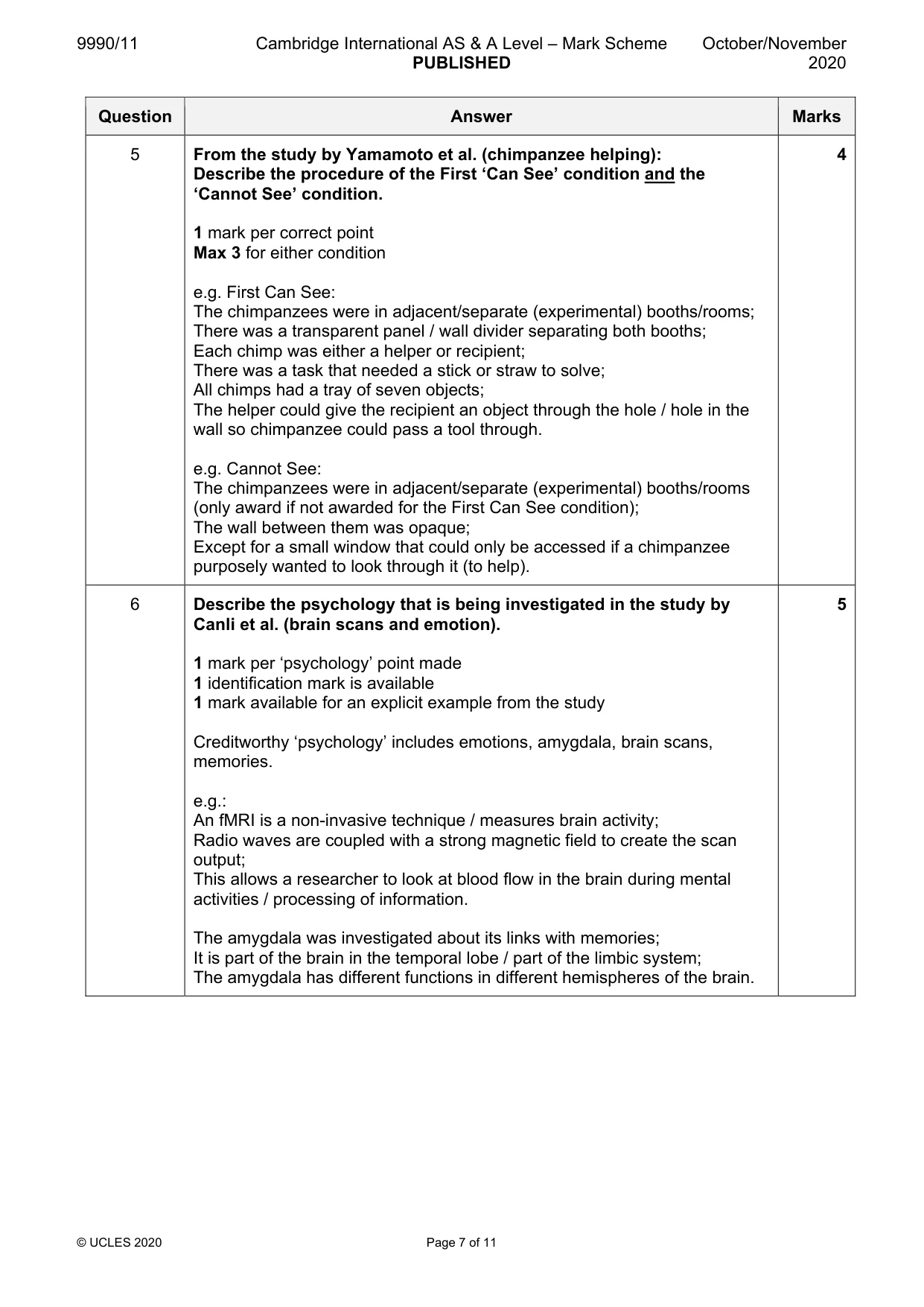
9990/11 Cambridge International AS & A Level – Mark Scheme PUBLISHED October/November 2020 © UCLES 2020 Page 7 of 11 Question Answer Marks 5 From the study by Yamamoto et al. (chimpanzee helping): Describe the procedure of the First ‘Can See’ condition and the ‘Cannot See’ condition. 1 mark per correct point Max 3 for either condition e.g. First Can See: The chimpanzees were in adjacent/separate (experimental) booths/rooms; There was a transparent panel / wall divider separating both booths; Each chimp was either a helper or recipient; There was a task that needed a stick or straw to solve; All chimps had a tray of seven objects; The helper could give the recipient an object through the hole / hole in the wall so chimpanzee could pass a tool through. e.g. Cannot See: The chimpanzees were in adjacent/separate (experimental) booths/rooms (only award if not awarded for the First Can See condition); The wall between them was opaque; Except for a small window that could only be accessed if a chimpanzee purposely wanted to look through it (to help). 4 6 Describe the psychology that is being investigated in the study by Canli et al. (brain scans and emotion). 1 mark per ‘psychology’ point made 1 identification mark is available 1 mark available for an explicit example from the study Creditworthy ‘psychology’ includes emotions, amygdala, brain scans, memories. e.g.: An fMRI is a non-invasive technique / measures brain activity; Radio waves are coupled with a strong magnetic field to create the scan output; This allows a researcher to look at blood flow in the brain during mental activities / processing of information. The amygdala was investigated about its links with memories; It is part of the brain in the temporal lobe / part of the limbic system; The amygdala has different functions in different hemispheres of the brain. 5
Mark scheme, page 8
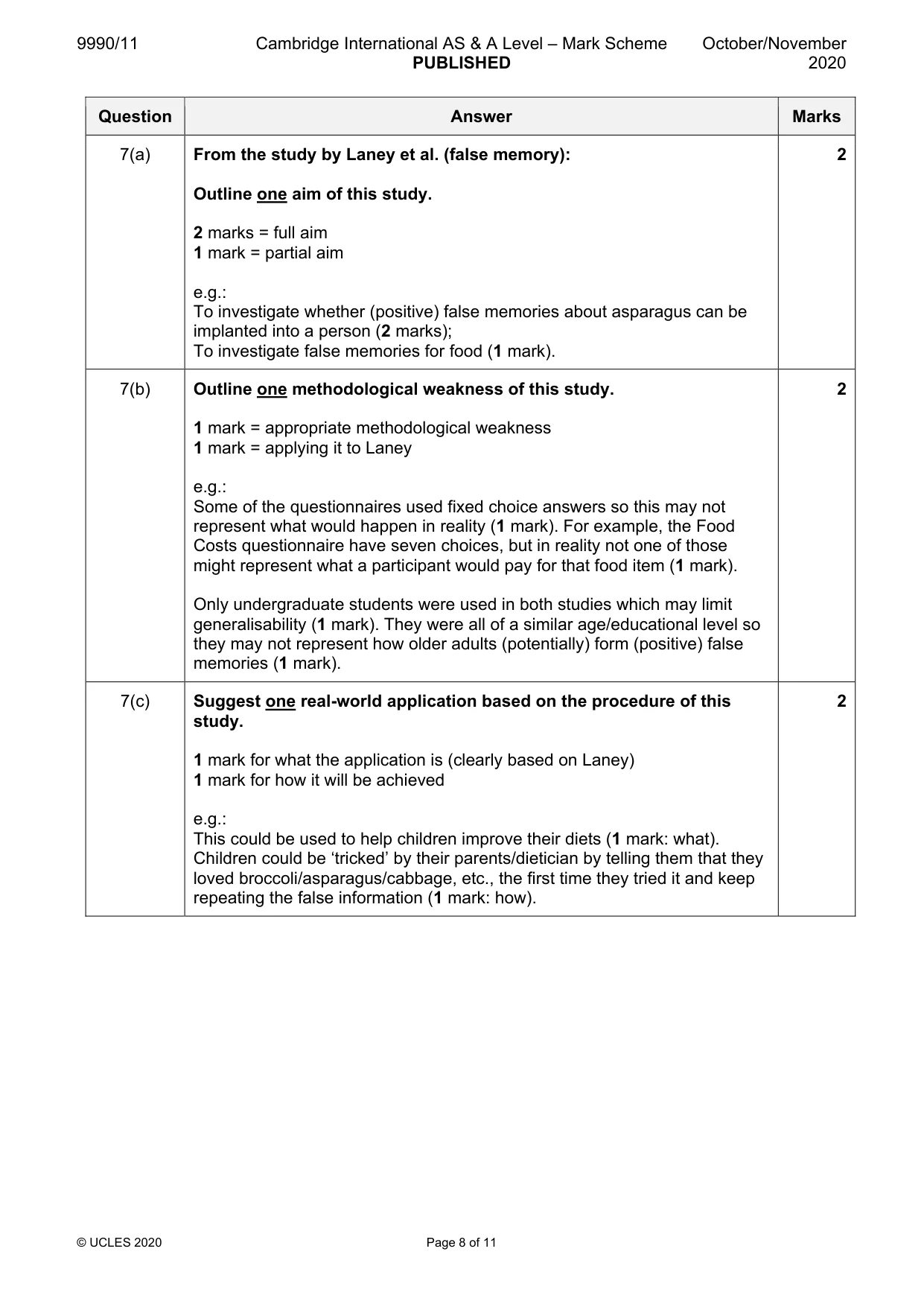
9990/11 Cambridge International AS & A Level – Mark Scheme PUBLISHED October/November 2020 © UCLES 2020 Page 8 of 11 Question Answer Marks 7(a) From the study by Laney et al. (false memory): Outline one aim of this study. 2 marks = full aim 1 mark = partial aim e.g.: To investigate whether (positive) false memories about asparagus can be implanted into a person (2 marks); To investigate false memories for food (1 mark). 2 7(b) Outline one methodological weakness of this study. 1 mark = appropriate methodological weakness 1 mark = applying it to Laney e.g.: Some of the questionnaires used fixed choice answers so this may not represent what would happen in reality (1 mark). For example, the Food Costs questionnaire have seven choices, but in reality not one of those might represent what a participant would pay for that food item (1 mark). Only undergraduate students were used in both studies which may limit generalisability (1 mark). They were all of a similar age/educational level so they may not represent how older adults (potentially) form (positive) false memories (1 mark). 2 7(c) Suggest one real-world application based on the procedure of this study. 1 mark for what the application is (clearly based on Laney) 1 mark for how it will be achieved e.g.: This could be used to help children improve their diets (1 mark: what). Children could be ‘tricked’ by their parents/dietician by telling them that they loved broccoli/asparagus/cabbage, etc., the first time they tried it and keep repeating the false information (1 mark: how). 2
Mark scheme, page 9
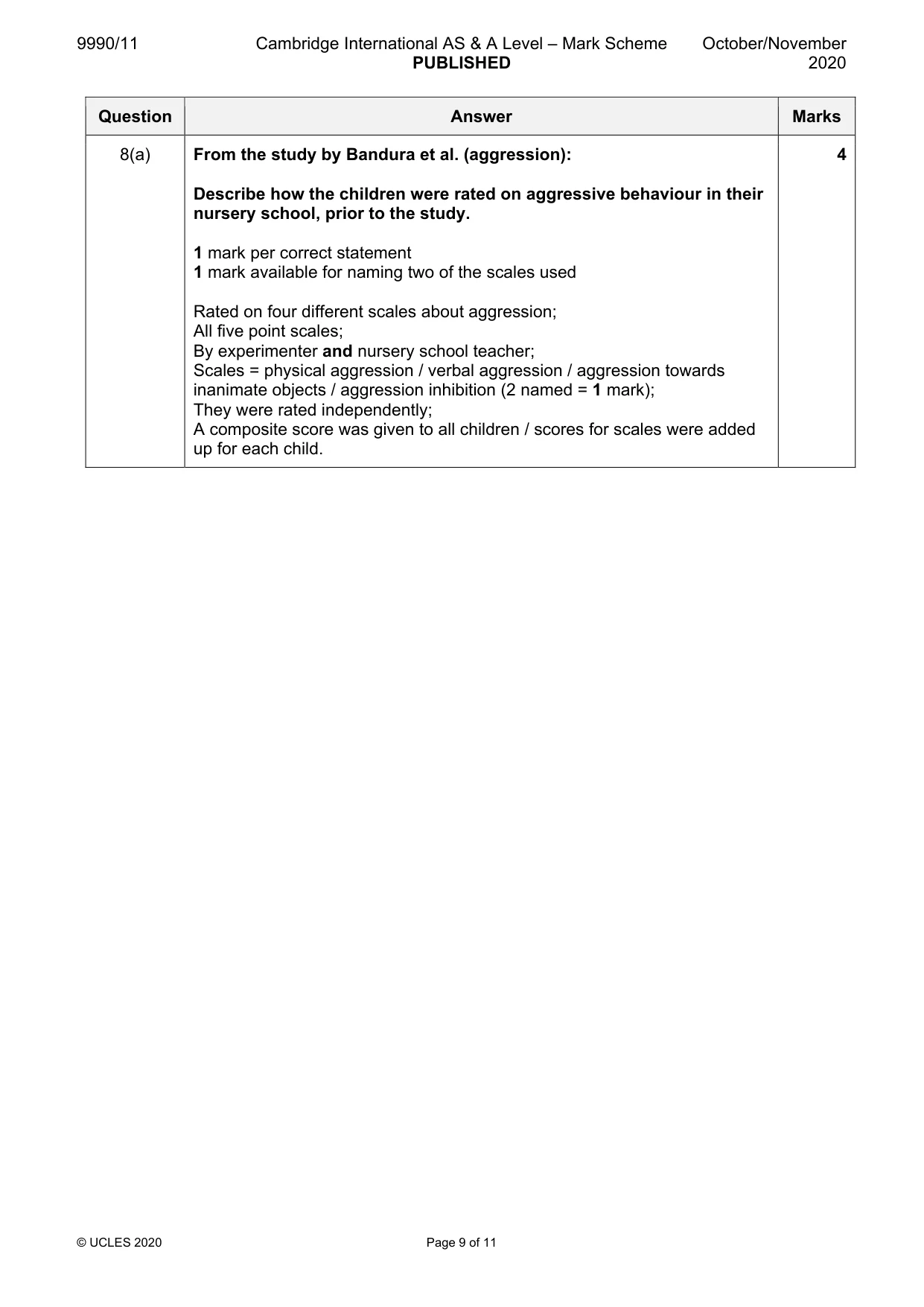
9990/11 Cambridge International AS & A Level – Mark Scheme PUBLISHED October/November 2020 © UCLES 2020 Page 9 of 11 Question Answer Marks 8(a) From the study by Bandura et al. (aggression): Describe how the children were rated on aggressive behaviour in their nursery school, prior to the study. 1 mark per correct statement 1 mark available for naming two of the scales used Rated on four different scales about aggression; All five point scales; By experimenter and nursery school teacher; Scales = physical aggression / verbal aggression / aggression towards inanimate objects / aggression inhibition (2 named = 1 mark); They were rated independently; A composite score was given to all children / scores for scales were added up for each child. 4
Mark scheme, page 10
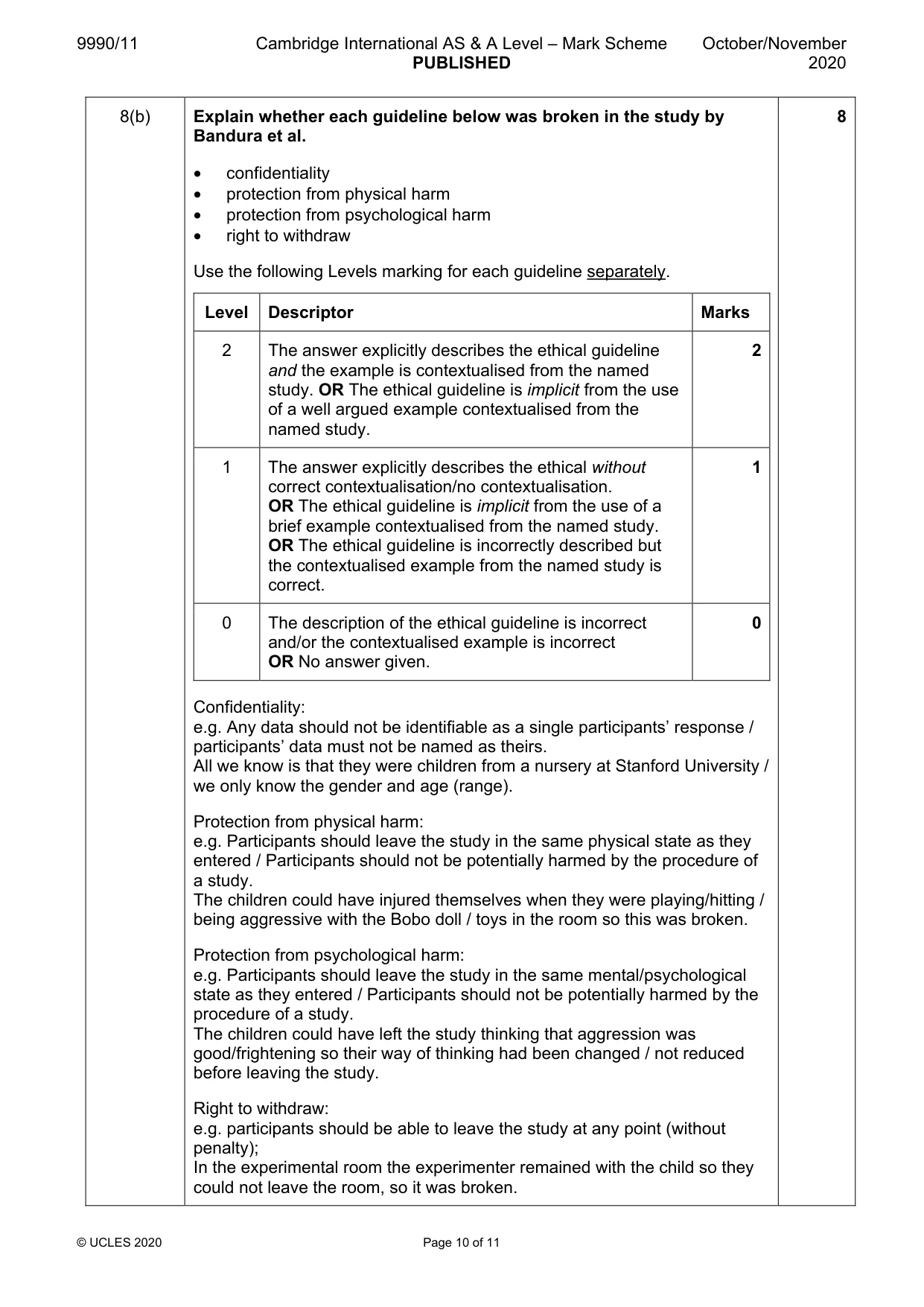
9990/11 Cambridge International AS & A Level – Mark Scheme PUBLISHED October/November 2020 © UCLES 2020 Page 10 of 11 8(b) Explain whether each guideline below was broken in the study by Bandura et al. • confidentiality • protection from physical harm • protection from psychological harm • right to withdraw Use the following Levels marking for each guideline separately. Level Descriptor Marks 2 The answer explicitly describes the ethical guideline and the example is contextualised from the named study. OR The ethical guideline is implicit from the use of a well argued example contextualised from the named study. 2 1 The answer explicitly describes the ethical without correct contextualisation/no contextualisation. OR The ethical guideline is implicit from the use of a brief example contextualised from the named study. OR The ethical guideline is incorrectly described but the contextualised example from the named study is correct. 1 0 The description of the ethical guideline is incorrect and/or the contextualised example is incorrect OR No answer given. 0 Confidentiality: e.g. Any data should not be identifiable as a single participants’ response / participants’ data must not be named as theirs. All we know is that they were children from a nursery at Stanford University / we only know the gender and age (range). Protection from physical harm: e.g. Participants should leave the study in the same physical state as they entered / Participants should not be potentially harmed by the procedure of a study. The children could have injured themselves when they were playing/hitting / being aggressive with the Bobo doll / toys in the room so this was broken. Protection from psychological harm: e.g. Participants should leave the study in the same mental/psychological state as they entered / Participants should not be potentially harmed by the procedure of a study. The children could have left the study thinking that aggression was good/frightening so their way of thinking had been changed / not reduced before leaving the study. Right to withdraw: e.g. participants should be able to leave the study at any point (without penalty); In the experimental room the experimenter remained with the child so they could not leave the room, so it was broken. 8
Mark scheme, page 11
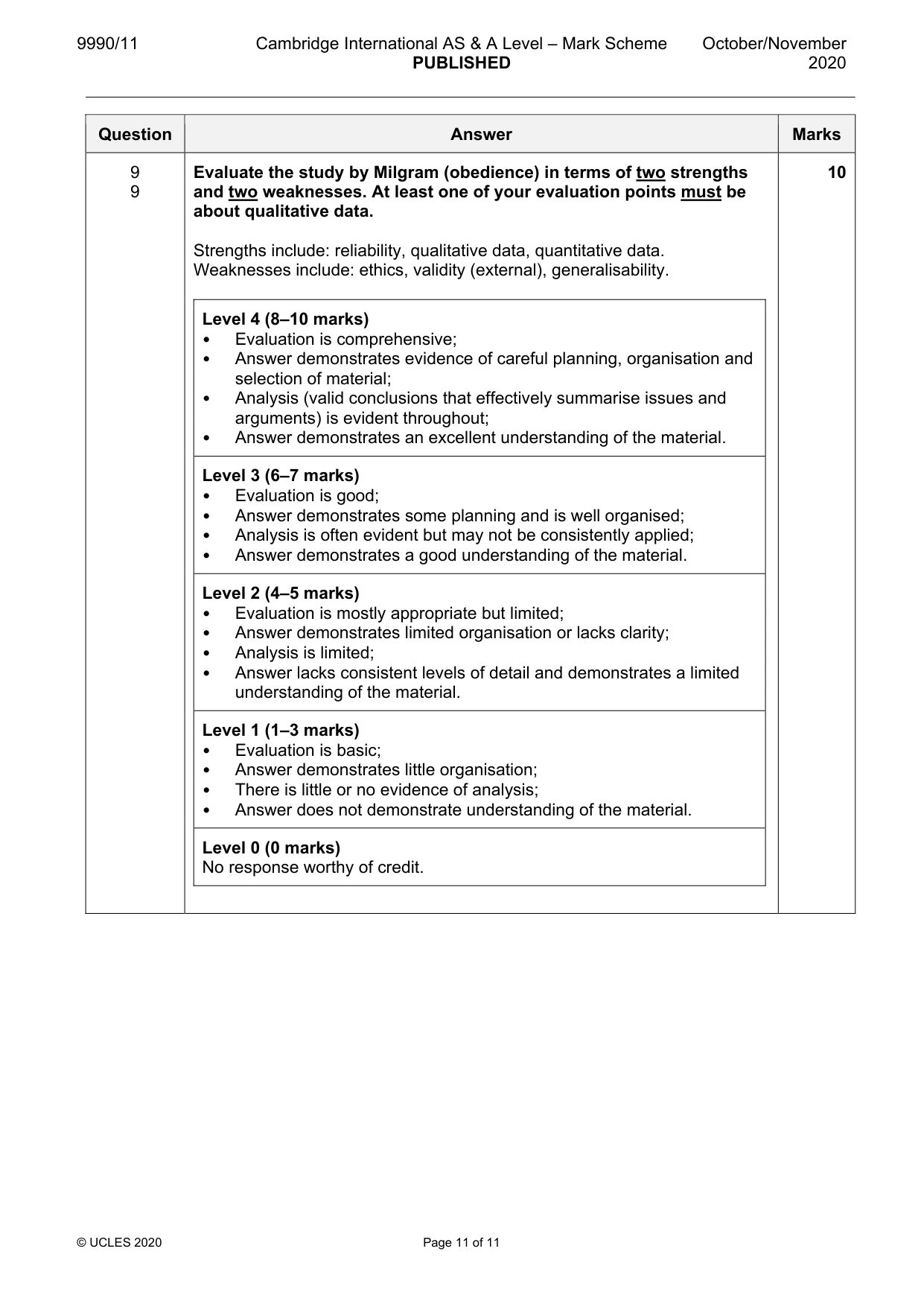
9990/11 Cambridge International AS & A Level – Mark Scheme PUBLISHED October/November 2020 © UCLES 2020 Page 11 of 11 Question Answer Marks 9 9 Evaluate the study by Milgram (obedience) in terms of two strengths and two weaknesses. At least one of your evaluation points must be about qualitative data. Strengths include: reliability, qualitative data, quantitative data. Weaknesses include: ethics, validity (external), generalisability. Level 4 (8–10 marks) • Evaluation is comprehensive; • Answer demonstrates evidence of careful planning, organisation and selection of material; • Analysis (valid conclusions that effectively summarise issues and arguments) is evident throughout; • Answer demonstrates an excellent understanding of the material. Level 3 (6–7 marks) • Evaluation is good; • Answer demonstrates some planning and is well organised; • Analysis is often evident but may not be consistently applied; • Answer demonstrates a good understanding of the material. Level 2 (4–5 marks) • Evaluation is mostly appropriate but limited; • Answer demonstrates limited organisation or lacks clarity; • Analysis is limited; • Answer lacks consistent levels of detail and demonstrates a limited understanding of the material. Level 1 (1–3 marks) • Evaluation is basic; • Answer demonstrates little organisation; • There is little or no evidence of analysis; • Answer does not demonstrate understanding of the material. Level 0 (0 marks) No response worthy of credit. 10
What you needed in this session
Cambridge’s own grade thresholds for 2020 Oct/Nov, Paper 1 · Variant 1. A higher threshold means an easier paper — the bar moves with how the cohort did.