Cambridge A Level Psychology (from 2018) 9990 — 2020 May/June Paper 3 · Variant 3
9990/33/M/J/20 · 8 questions · 120 marks · ≈135 min
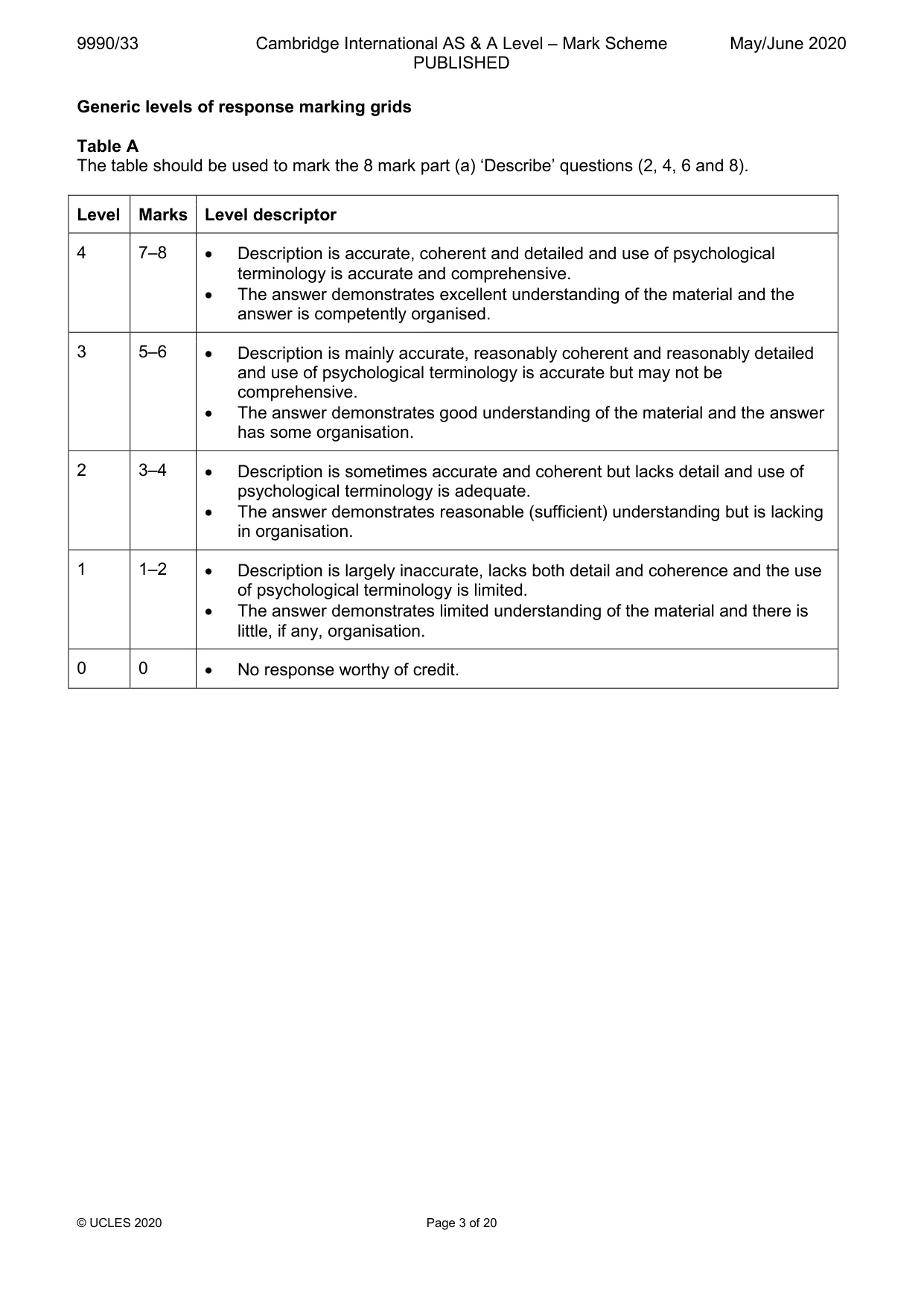
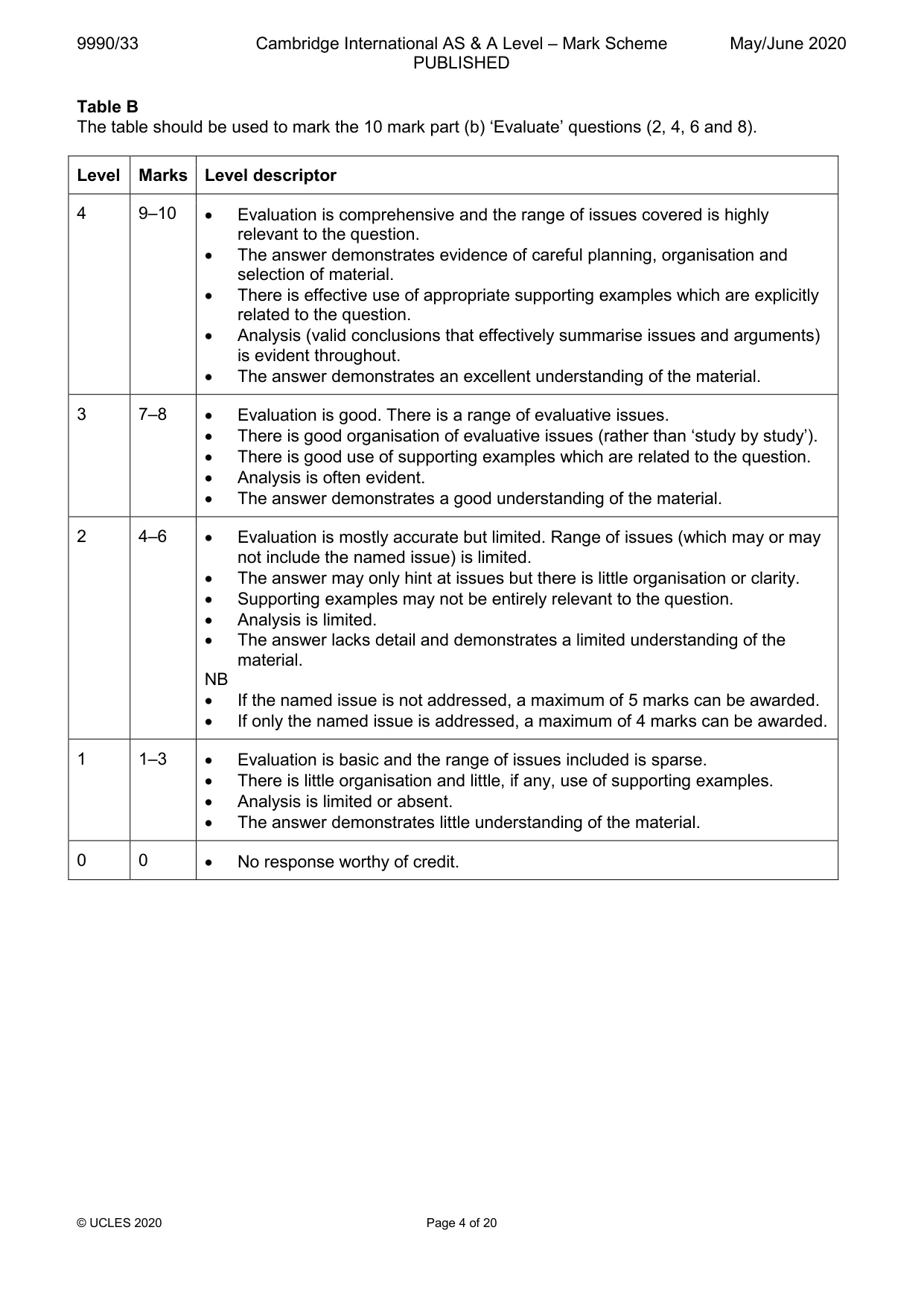
The question paper and its mark scheme, free to read here and free to download. This is Cambridge’s own paper, exactly as it was sat.
Question paper4 pages


Mark scheme20 pages
Answers below. Sit the paper first if you are practising.

Questions as text
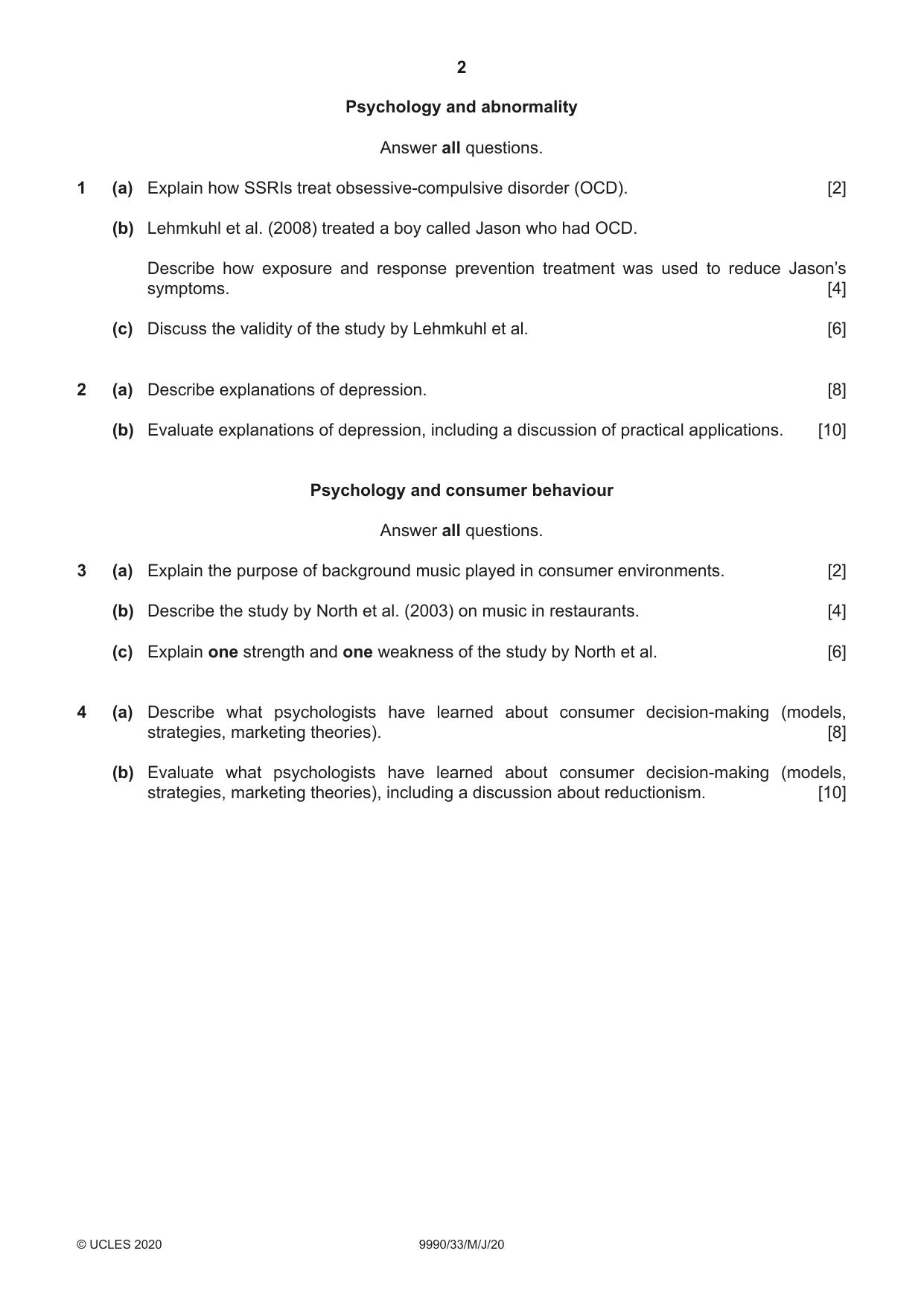
Q1 · Explain how SSRIs treat obsessive-compulsive disorder (OCD)
1 (a) Explain how SSRIs treat obsessive-compulsive disorder (OCD). [2] (b) Lehmkuhl et al. (2008) treated a boy called Jason who had OCD. Describe how exposure and response prevention treatment was used to reduce Jason’s symptoms. [4] (c) Discuss the validity of the study by Lehmkuhl et al. [6]
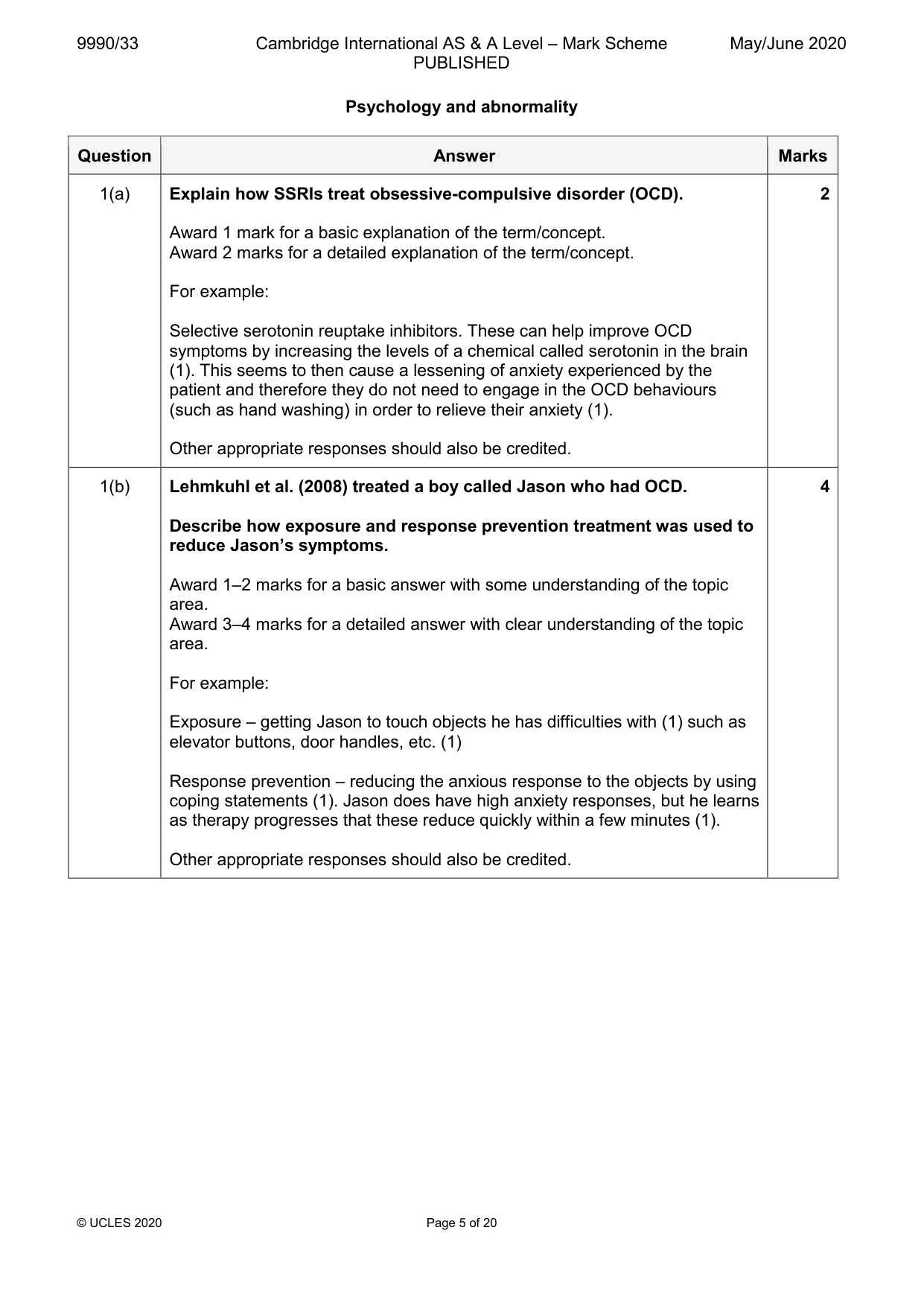
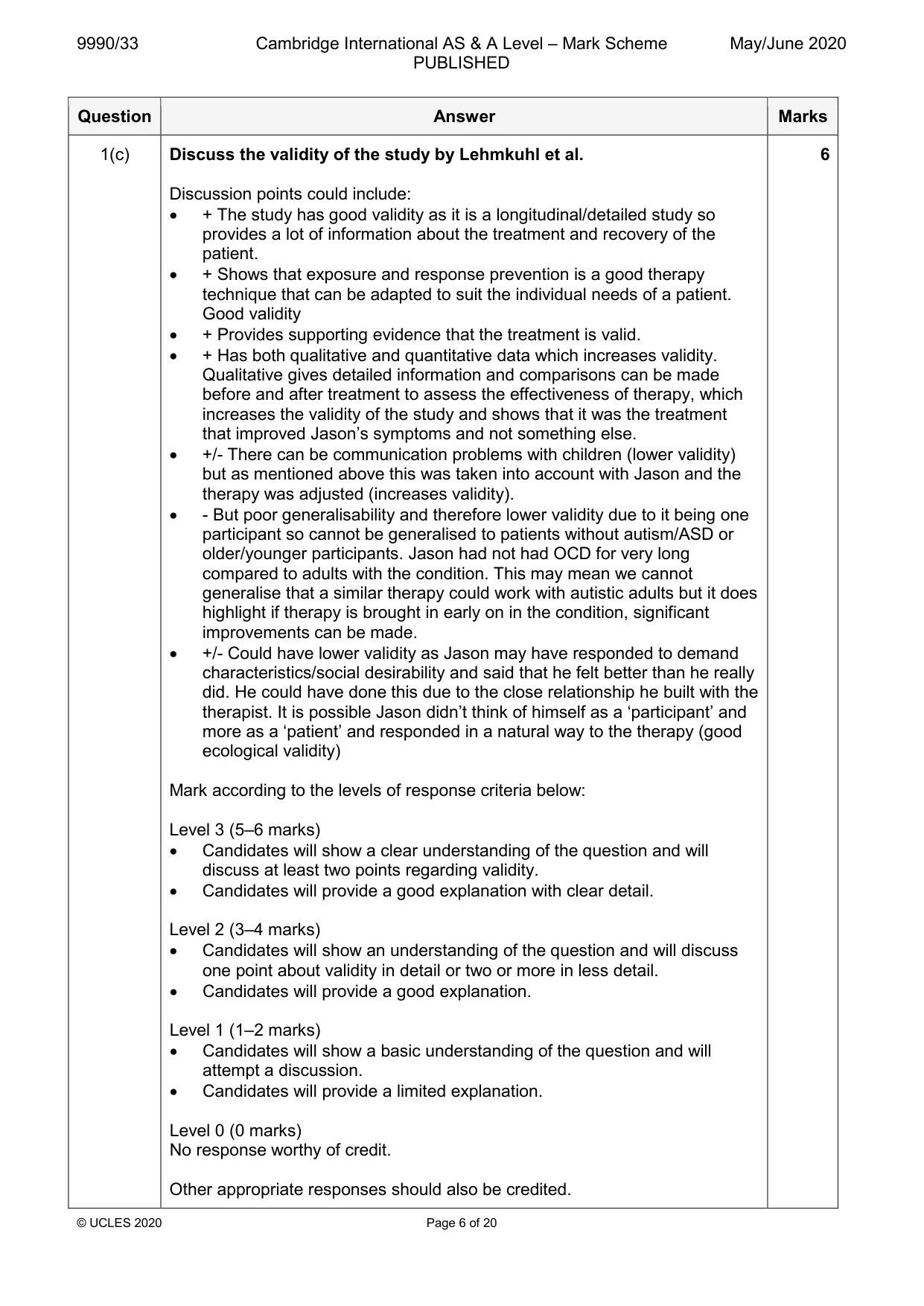
Mark scheme: Question Answer Marks 1(a) Explain how SSRIs treat obsessive-compulsive disorder (OCD). 2 Award 1 mark for a basic explanation of the term/concept. Award 2 marks for a detailed explanation of the term/concept. For example: Selective serotonin reuptake inhibitors. These can help improve OCD symptoms by increasing the levels of a chemical called serotonin in the brain (1). This seems to then cause a lessening of anxiety experienced by the patient and therefore they do not need to engage in the OCD behaviours (such as hand washing) in order to relieve their anxiety (1). Other appropriate responses should also be credited. 1(b) Lehmkuhl et al. (2008) treated a boy called Jason who had OCD. 4 Describe how exposure and response prevention treatment was used to reduce Jason’s symptoms. Award 1–2 marks for a basic answer with some understanding of the topic area. Award 3–4 marks for a detailed answer with clear understanding of the topic area. For example: Exposure – getting Jason to touch objects he has difficulties with (1) such as elevator buttons, door handles, etc. (1) Response prevention – reducing the anxious response to the objects by using coping statements (1). Jason does have high anxiety responses, but he learns as therapy progresses that these reduce quickly within a few minutes (1). Other appropriate responses should also be credited. 1(c) Discuss the validity of the study by Lehmkuhl et al. 6 Discussion points could include: • + The study has good validity as it is a longitudinal/detailed study so provides a lot of information about the treatment and recovery of the patient. • + Shows that exposure and response prevention is a good therapy technique that can be adapted to suit the individual needs of a patient. Good validity • + Provides supporting evidence that the treatment is valid. • + Has both qualitative and quantitative data which increases validity. Qualitative gives detailed information and comparisons can be made before and after treatment to assess the effectiveness of therapy, which increases the validity of the study and shows that it was the treatment that improved Jason’s symptoms and not something else. • +/- There can be communication problems with children (lower validity) but as mentioned above this was taken into account with Jason and the therapy was adjusted (increases validity). • - But poor generalisability and therefore lower validity due to it being one participant so cannot be generalised to patients without autism/ASD or older/younger participants. Jason had not had OCD for very long compared to adults with the condition. This may mean we cannot generalise that a similar therapy could work with autistic adults but it does highlight if therapy is brought in early on in the condition, significant improvements can be made. • +/- Could have lower validity as Jason may have responded to demand characteristics/social desirability and said that he felt better than he really did. He could have done this due to the close relationship he built with the therapist. It is possible Jason didn’t think of himself as a ‘participant’ and more as a ‘patient’ and responded in a natural way to the therapy (good ecological validity) Mark according to the levels of response criteria below: Level 3 (5–6 marks) • Candidates will show a clear understanding of the question and will discuss at least two points regarding validity. • Candidates will provide a good explanation with clear detail. Level 2 (3–4 marks) • Candidates will show an understanding of the question and will discuss one point about validity in detail or two or more in less detail. • Candidates will provide a good explanation. Level 1 (1–2 marks) • Candidates will show a basic understanding of the question and will attempt a discussion. • Candidates will provide a limited explanation. Level 0 (0 marks) No response worthy of credit. Other appropriate responses should also be credited.
Q2 · Describe explanations of depression
2 (a) Describe explanations of depression. [8] (b) Evaluate explanations of depression, including a discussion of practical applications. [10] Psychology and consumer behaviour Answer all questions.
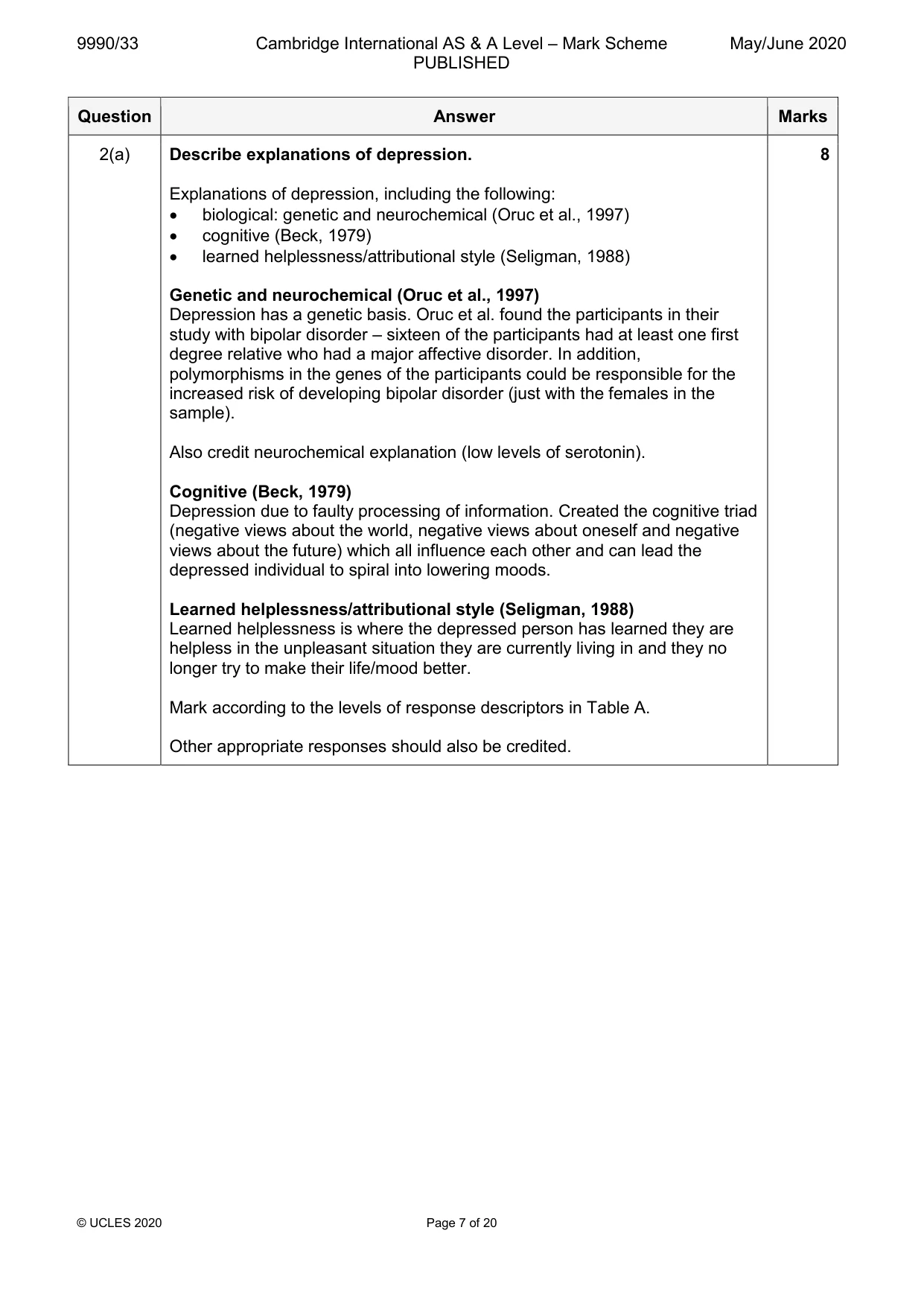
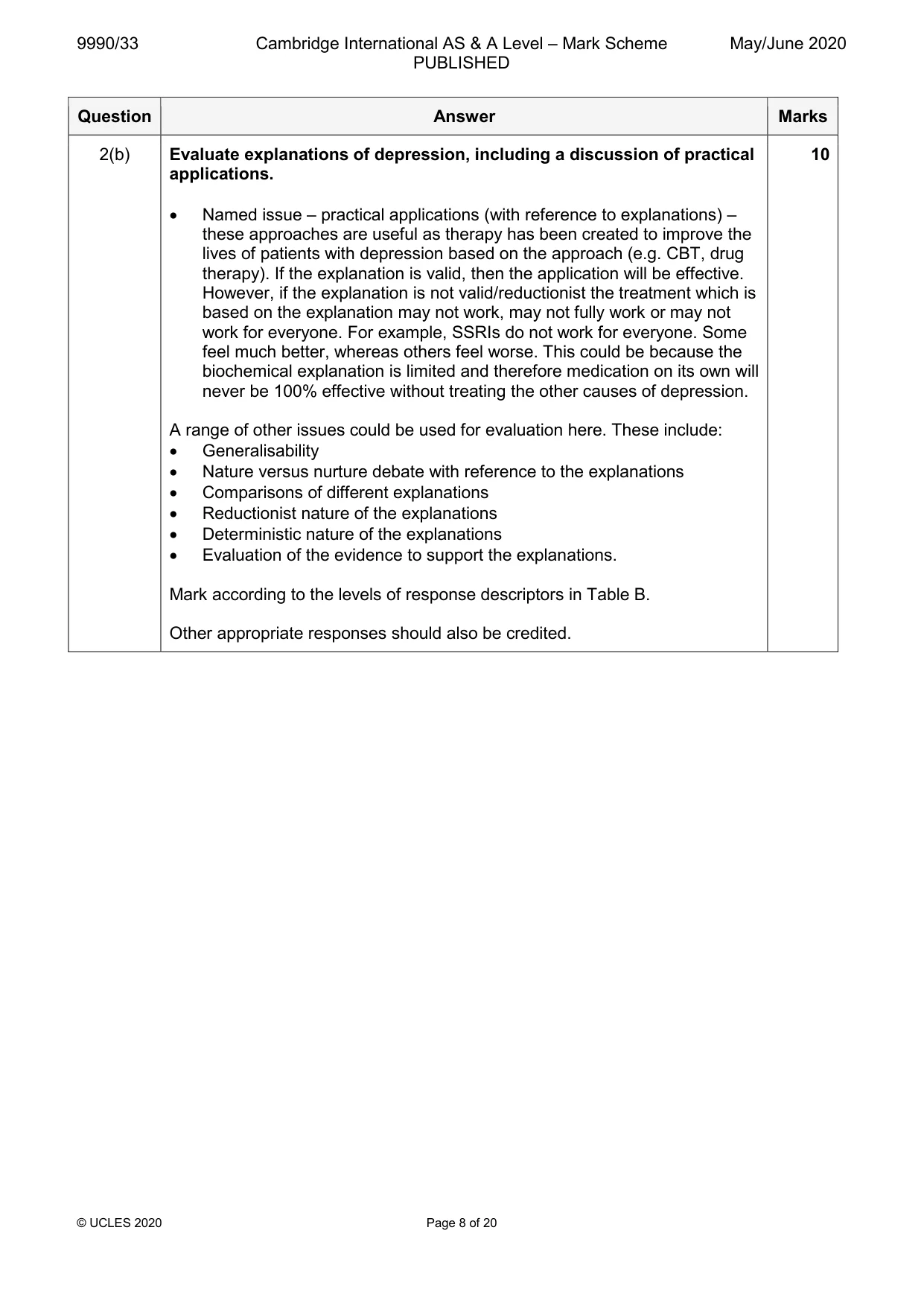
Mark scheme: 2(a) Describe explanations of depression. 8 Explanations of depression, including the following: • biological: genetic and neurochemical (Oruc et al., 1997) • cognitive (Beck, 1979) • learned helplessness/attributional style (Seligman, 1988) Genetic and neurochemical (Oruc et al., 1997) Depression has a genetic basis. Oruc et al. found the participants in their study with bipolar disorder – sixteen of the participants had at least one first degree relative who had a major affective disorder. In addition, polymorphisms in the genes of the participants could be responsible for the increased risk of developing bipolar disorder (just with the females in the sample). Also credit neurochemical explanation (low levels of serotonin). Cognitive (Beck, 1979) Depression due to faulty processing of information. Created the cognitive triad (negative views about the world, negative views about oneself and negative views about the future) which all influence each other and can lead the depressed individual to spiral into lowering moods. Learned helplessness/attributional style (Seligman, 1988) Learned helplessness is where the depressed person has learned they are helpless in the unpleasant situation they are currently living in and they no longer try to make their life/mood better. Mark according to the levels of response descriptors in Table A. Other appropriate responses should also be credited. 2(b) Evaluate explanations of depression, including a discussion of practical 10 applications. • Named issue – practical applications (with reference to explanations) – these approaches are useful as therapy has been created to improve the lives of patients with depression based on the approach (e.g. CBT, drug therapy). If the explanation is valid, then the application will be effective. However, if the explanation is not valid/reductionist the treatment which is based on the explanation may not work, may not fully work or may not work for everyone. For example, SSRIs do not work for everyone. Some feel much better, whereas others feel worse. This could be because the biochemical explanation is limited and therefore medication on its own will never be 100% effective without treating the other causes of depression. A range of other issues could be used for evaluation here. These include: • Generalisability • Nature versus nurture debate with reference to the explanations • Comparisons of different explanations • Reductionist nature of the explanations • Deterministic nature of the explanations • Evaluation of the evidence to support the explanations. Mark according to the levels of response descriptors in Table B. Other appropriate responses should also be credited. Psychology and consumer behaviour
More questions on Mood (affective) disorders: depressive disorder (unipolar) and bipolar disorder
Q3 · Explain the purpose of background music played in consumer environments
3 (a) Explain the purpose of background music played in consumer environments. [2] (b) Describe the study by North et al. (2003) on music in restaurants. [4] (c) Explain one strength and one weakness of the study by North et al. [6]
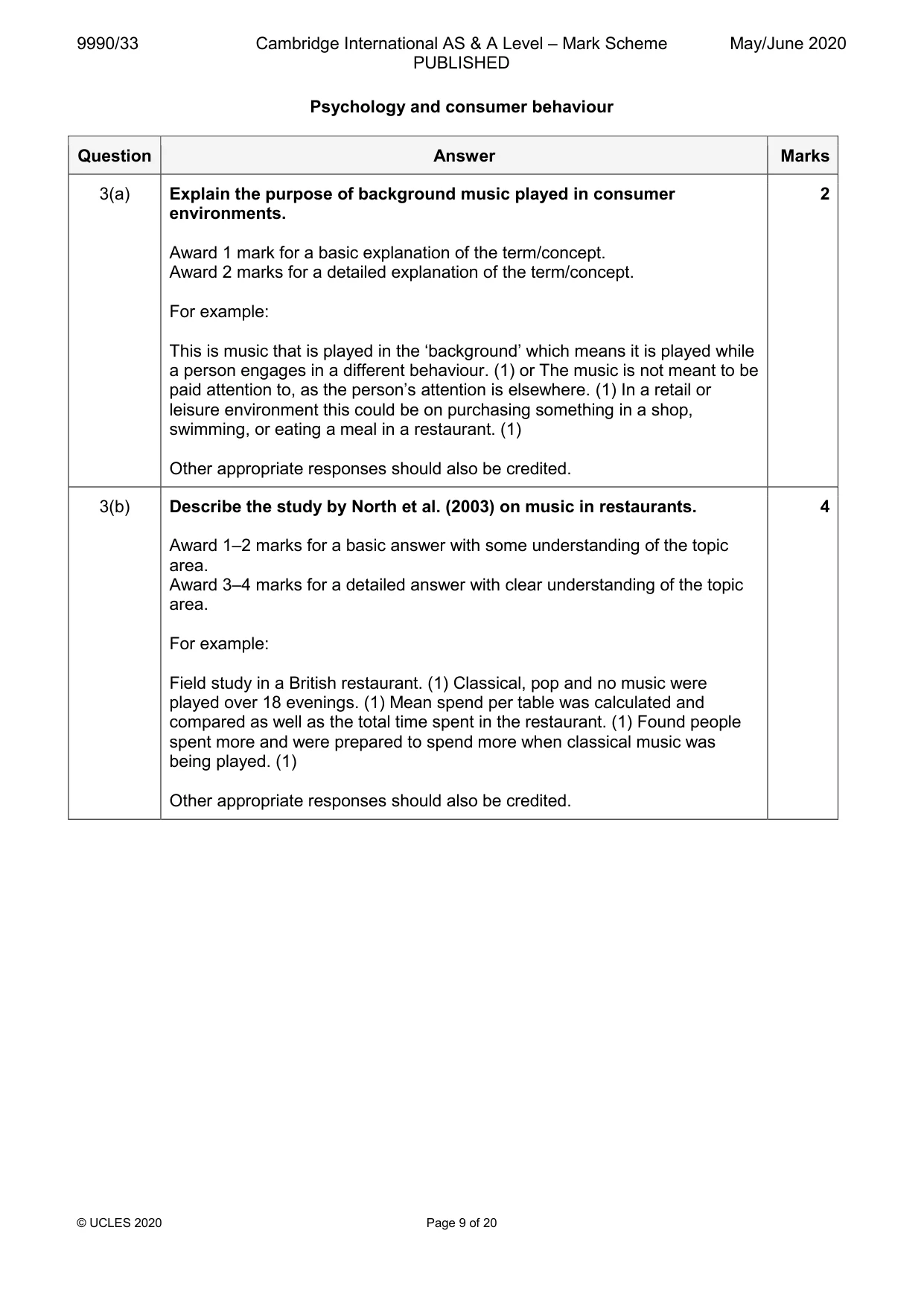
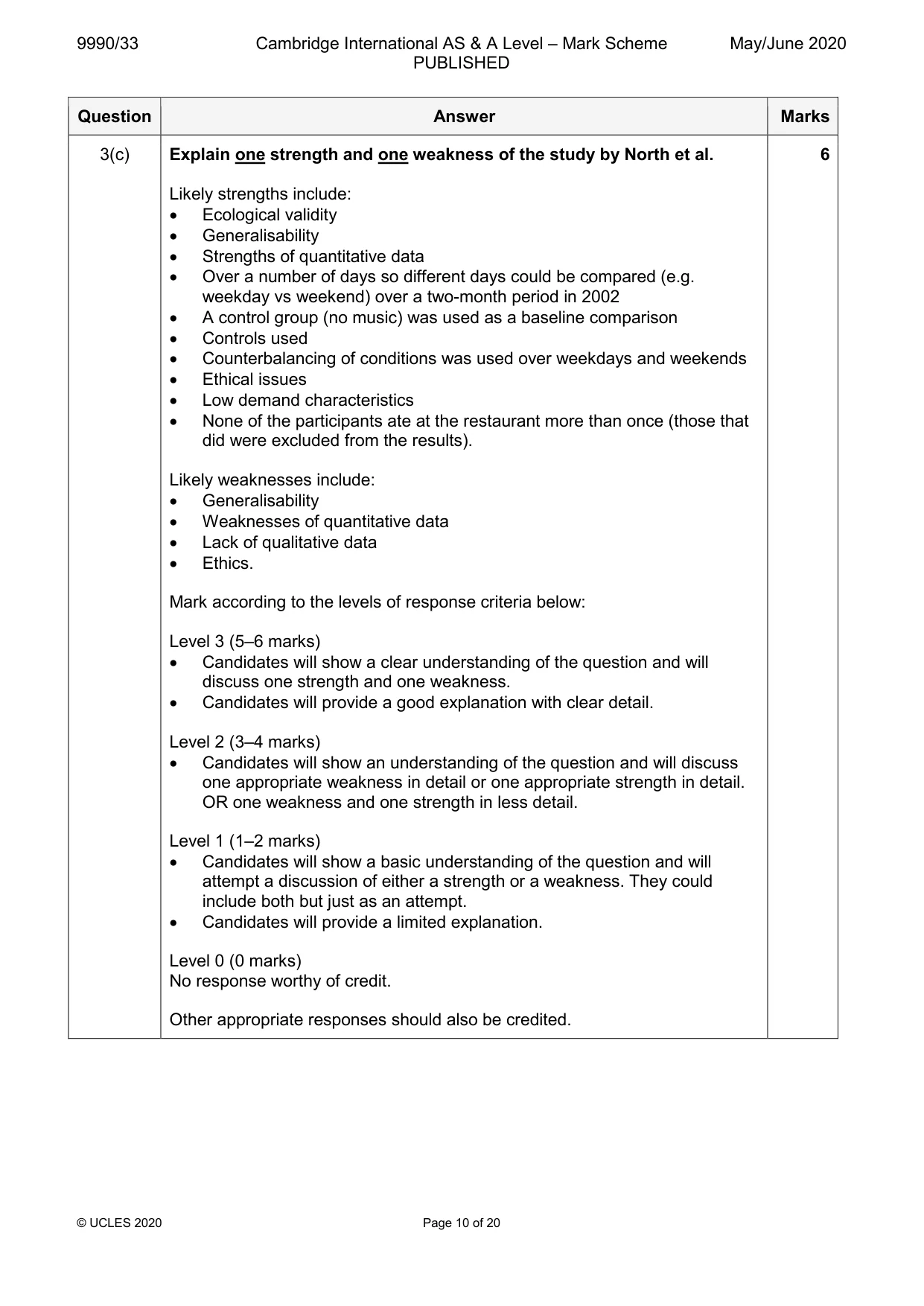
Mark scheme: 3(a) Explain the purpose of background music played in consumer 2 environments. Award 1 mark for a basic explanation of the term/concept. Award 2 marks for a detailed explanation of the term/concept. For example: This is music that is played in the ‘background’ which means it is played while a person engages in a different behaviour. (1) or The music is not meant to be paid attention to, as the person’s attention is elsewhere. (1) In a retail or leisure environment this could be on purchasing something in a shop, swimming, or eating a meal in a restaurant. (1) Other appropriate responses should also be credited. 3(b) Describe the study by North et al. (2003) on music in restaurants. 4 Award 1–2 marks for a basic answer with some understanding of the topic area. Award 3–4 marks for a detailed answer with clear understanding of the topic area. For example: Field study in a British restaurant. (1) Classical, pop and no music were played over 18 evenings. (1) Mean spend per table was calculated and compared as well as the total time spent in the restaurant. (1) Found people spent more and were prepared to spend more when classical music was being played. (1) Other appropriate responses should also be credited. 3(c) Explain one strength and one weakness of the study by North et al. 6 Likely strengths include: • Ecological validity • Generalisability • Strengths of quantitative data • Over a number of days so different days could be compared (e.g. weekday vs weekend) over a two-month period in 2002 • A control group (no music) was used as a baseline comparison • Controls used • Counterbalancing of conditions was used over weekdays and weekends • Ethical issues • Low demand characteristics • None of the participants ate at the restaurant more than once (those that did were excluded from the results). Likely weaknesses include: • Generalisability • Weaknesses of quantitative data • Lack of qualitative data • Ethics. Mark according to the levels of response criteria below: Level 3 (5–6 marks) • Candidates will show a clear understanding of the question and will discuss one strength and one weakness. • Candidates will provide a good explanation with clear detail. Level 2 (3–4 marks) • Candidates will show an understanding of the question and will discuss one appropriate weakness in detail or one appropriate strength in detail. OR one weakness and one strength in less detail. Level 1 (1–2 marks) • Candidates will show a basic understanding of the question and will attempt a discussion of either a strength or a weakness. They could include both but just as an attempt. • Candidates will provide a limited explanation. Level 0 (0 marks) No response worthy of credit. Other appropriate responses should also be credited.
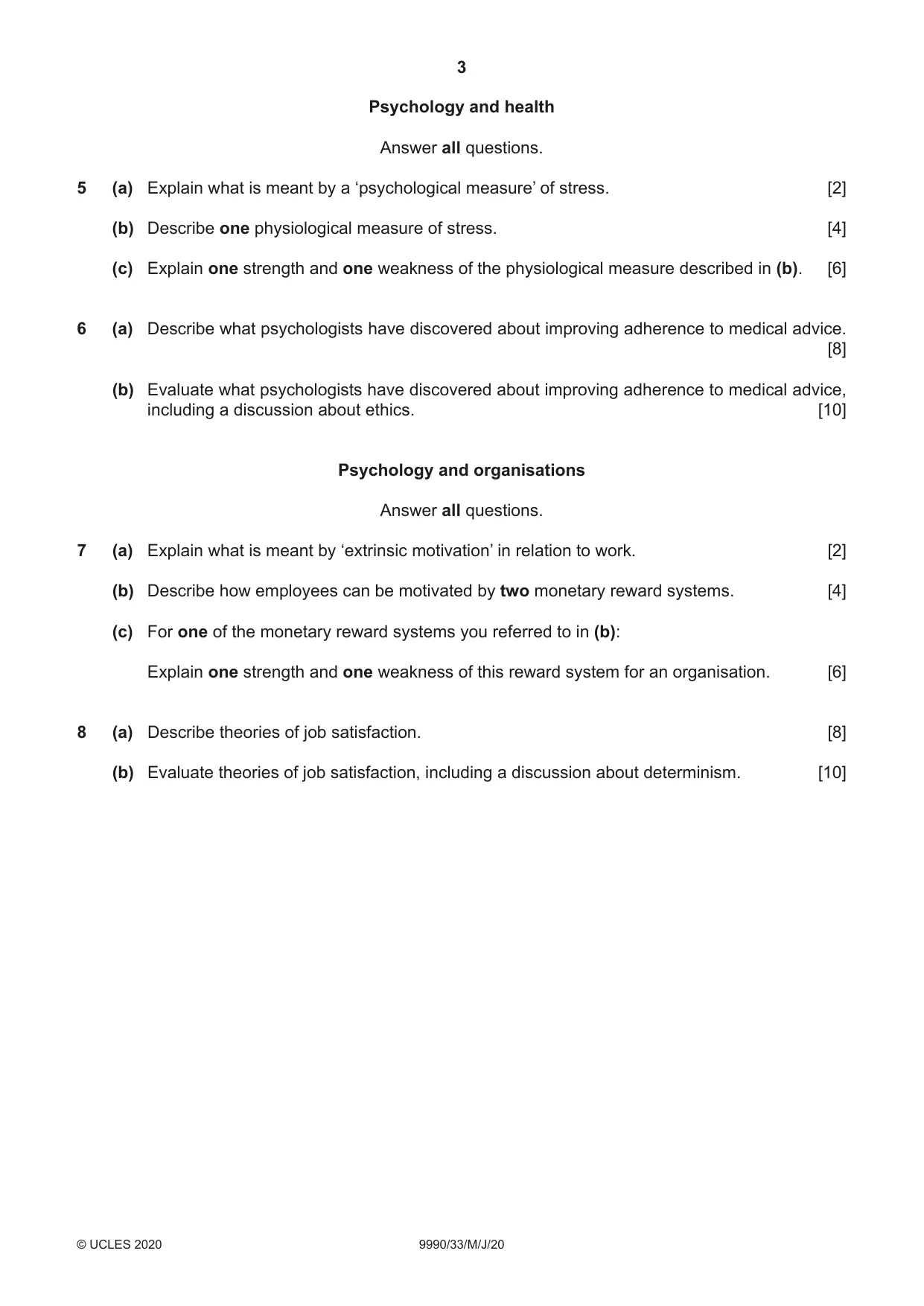
Q4 · Describe what psychologists have learned about consumer decision-making (models…
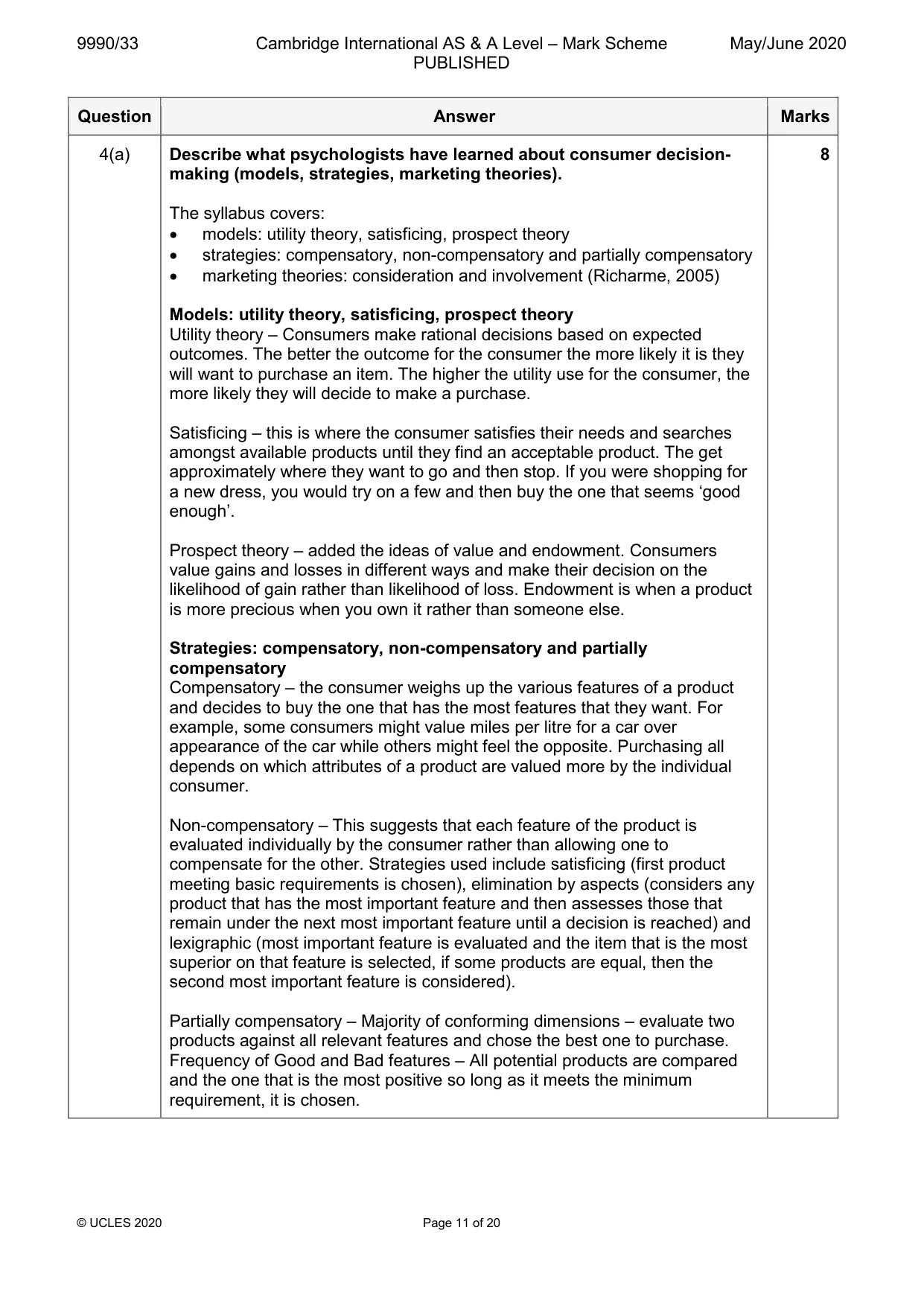
4 (a) Describe what psychologists have learned about consumer decision-making (models, strategies, marketing theories). [8] (b) Evaluate what psychologists have learned about consumer decision-making (models, strategies, marketing theories), including a discussion about reductionism. [10] Psychology and health Answer all questions.
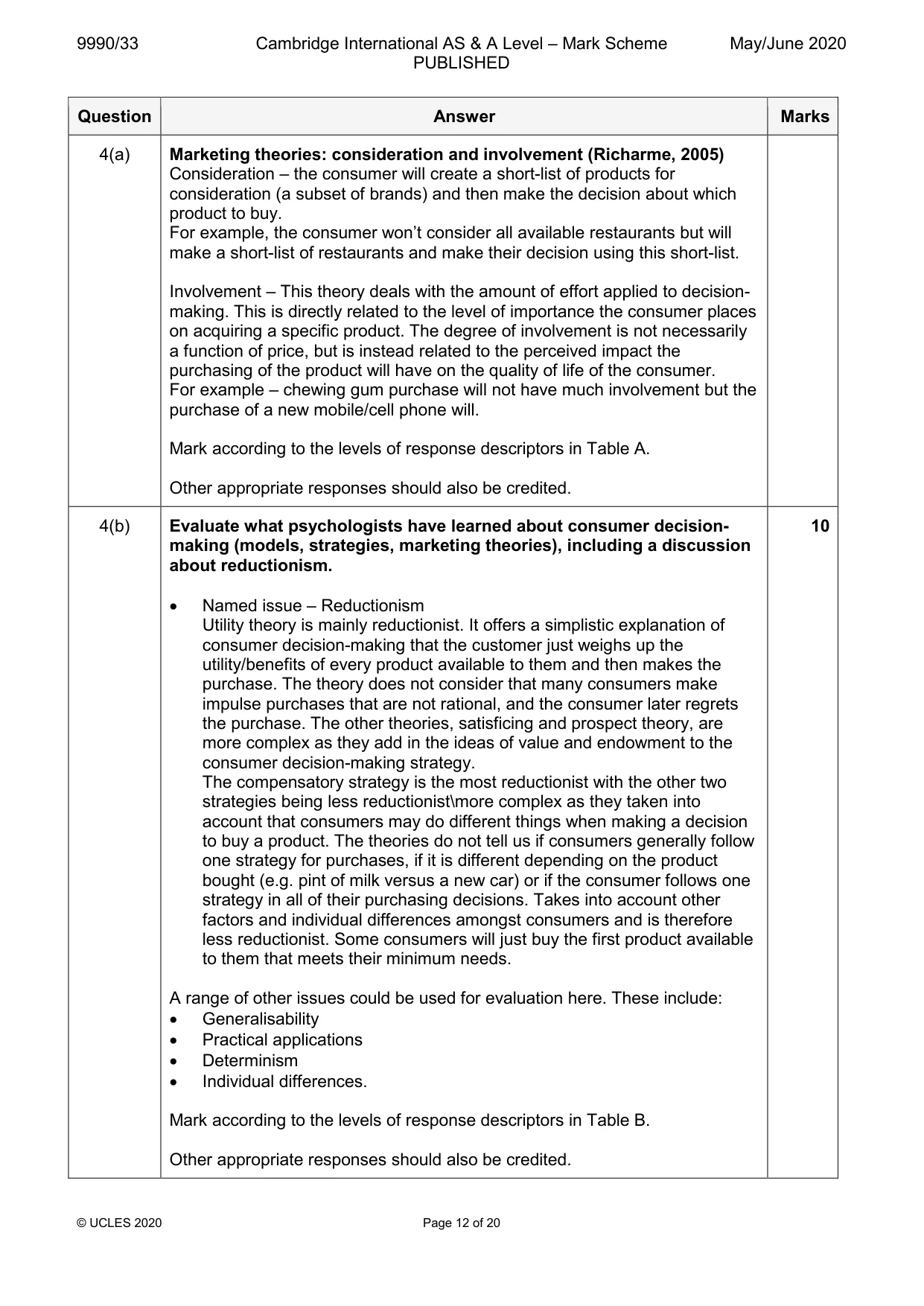
Mark scheme: 4(a) Describe what psychologists have learned about consumer decision- 8 making (models, strategies, marketing theories). The syllabus covers: • models: utility theory, satisficing, prospect theory • strategies: compensatory, non-compensatory and partially compensatory • marketing theories: consideration and involvement (Richarme, 2005) Models: utility theory, satisficing, prospect theory Utility theory – Consumers make rational decisions based on expected outcomes. The better the outcome for the consumer the more likely it is they will want to purchase an item. The higher the utility use for the consumer, the more likely they will decide to make a purchase. Satisficing – this is where the consumer satisfies their needs and searches amongst available products until they find an acceptable product. The get approximately where they want to go and then stop. If you were shopping for a new dress, you would try on a few and then buy the one that seems ‘good enough’. Prospect theory – added the ideas of value and endowment. Consumers value gains and losses in different ways and make their decision on the likelihood of gain rather than likelihood of loss. Endowment is when a product is more precious when you own it rather than someone else. Strategies: compensatory, non-compensatory and partially compensatory Compensatory – the consumer weighs up the various features of a product and decides to buy the one that has the most features that they want. For example, some consumers might value miles per litre for a car over appearance of the car while others might feel the opposite. Purchasing all depends on which attributes of a product are valued more by the individual consumer. Non-compensatory – This suggests that each feature of the product is evaluated individually by the consumer rather than allowing one to compensate for the other. Strategies used include satisficing (first product meeting basic requirements is chosen), elimination by aspects (considers any product that has the most important feature and then assesses those that remain under the next most important feature until a decision is reached) and lexigraphic (most important feature is evaluated and the item that is the most superior on that feature is selected, if some products are equal, then the second most important feature is considered). Partially compensatory – Majority of conforming dimensions – evaluate two products against all relevant features and chose the best one to purchase. Frequency of Good and Bad features – All potential products are compared and the one that is the most positive so long as it meets the minimum requirement, it is chosen. 4(a) Marketing theories: consideration and involvement (Richarme, 2005) Consideration – the consumer will create a short-list of products for consideration (a subset of brands) and then make the decision about which product to buy. For example, the consumer won’t consider all available restaurants but will make a short-list of restaurants and make their decision using this short-list. Involvement – This theory deals with the amount of effort applied to decision- making. This is directly related to the level of importance the consumer places on acquiring a specific product. The degree of involvement is not necessarily a function of price, but is instead related to the perceived impact the purchasing of the product will have on the quality of life of the consumer. For example – chewing gum purchase will not have much involvement but the purchase of a new mobile/cell phone will. Mark according to the levels of response descriptors in Table A. Other appropriate responses should also be credited. 4(b) Evaluate what psychologists have learned about consumer decision- 10 making (models, strategies, marketing theories), including a discussion about reductionism. • Named issue – Reductionism Utility theory is mainly reductionist. It offers a simplistic explanation of consumer decision-making that the customer just weighs up the utility/benefits of every product available to them and then makes the purchase. The theory does not consider that many consumers make impulse purchases that are not rational, and the consumer later regrets the purchase. The other theories, satisficing and prospect theory, are more complex as they add in the ideas of value and endowment to the consumer decision-making strategy. The compensatory strategy is the most reductionist with the other two strategies being less reductionist\more complex as they taken into account that consumers may do different things when making a decision to buy a product. The theories do not tell us if consumers generally follow one strategy for purchases, if it is different depending on the product bought (e.g. pint of milk versus a new car) or if the consumer follows one strategy in all of their purchasing decisions. Takes into account other factors and individual differences amongst consumers and is therefore less reductionist. Some consumers will just buy the first product available to them that meets their minimum needs. A range of other issues could be used for evaluation here. These include: • Generalisability • Practical applications • Determinism • Individual differences. Mark according to the levels of response descriptors in Table B. Other appropriate responses should also be credited. Psychology and health
Q5 · Explain what is meant by a ‘psychological measure’ of stress
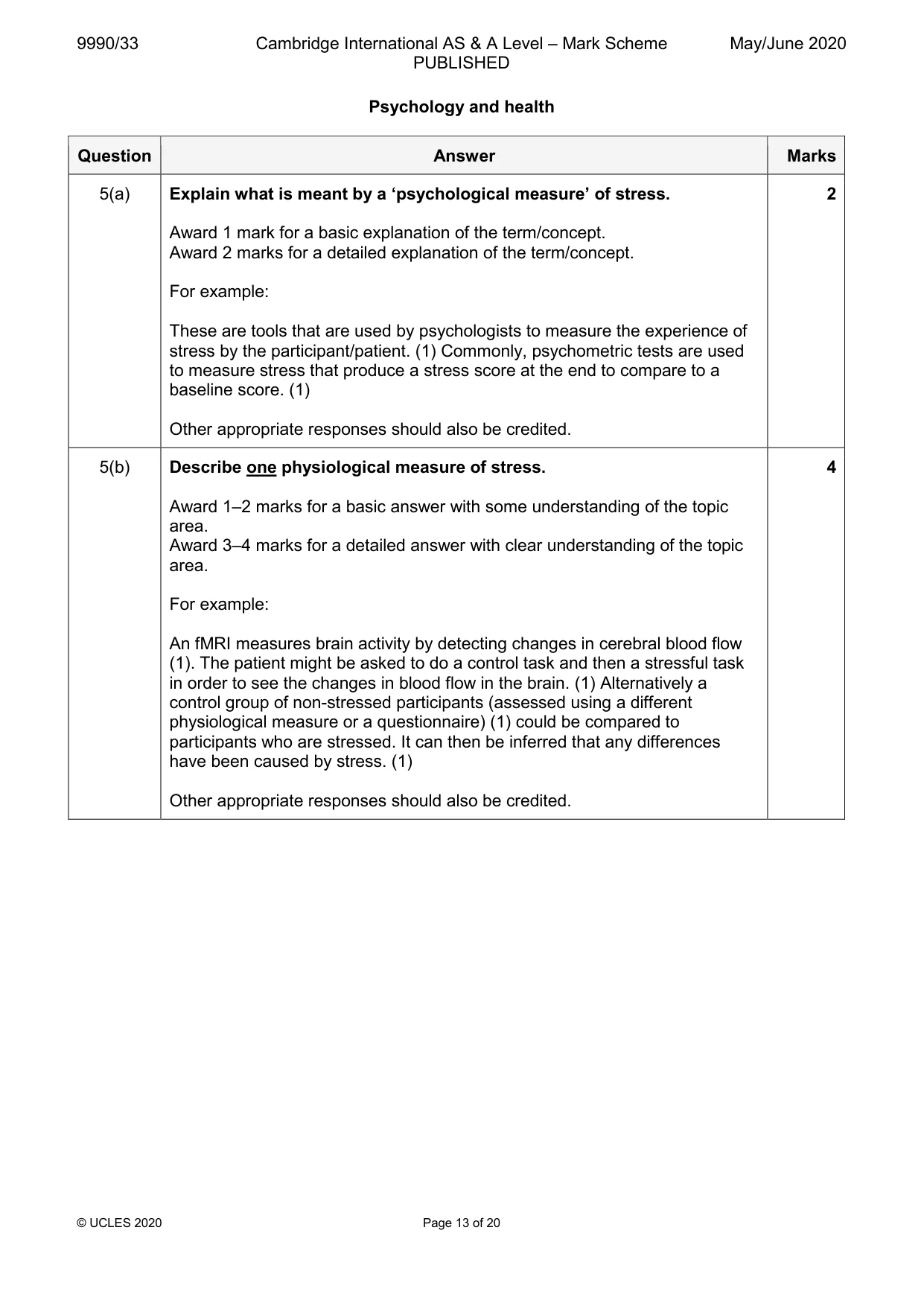
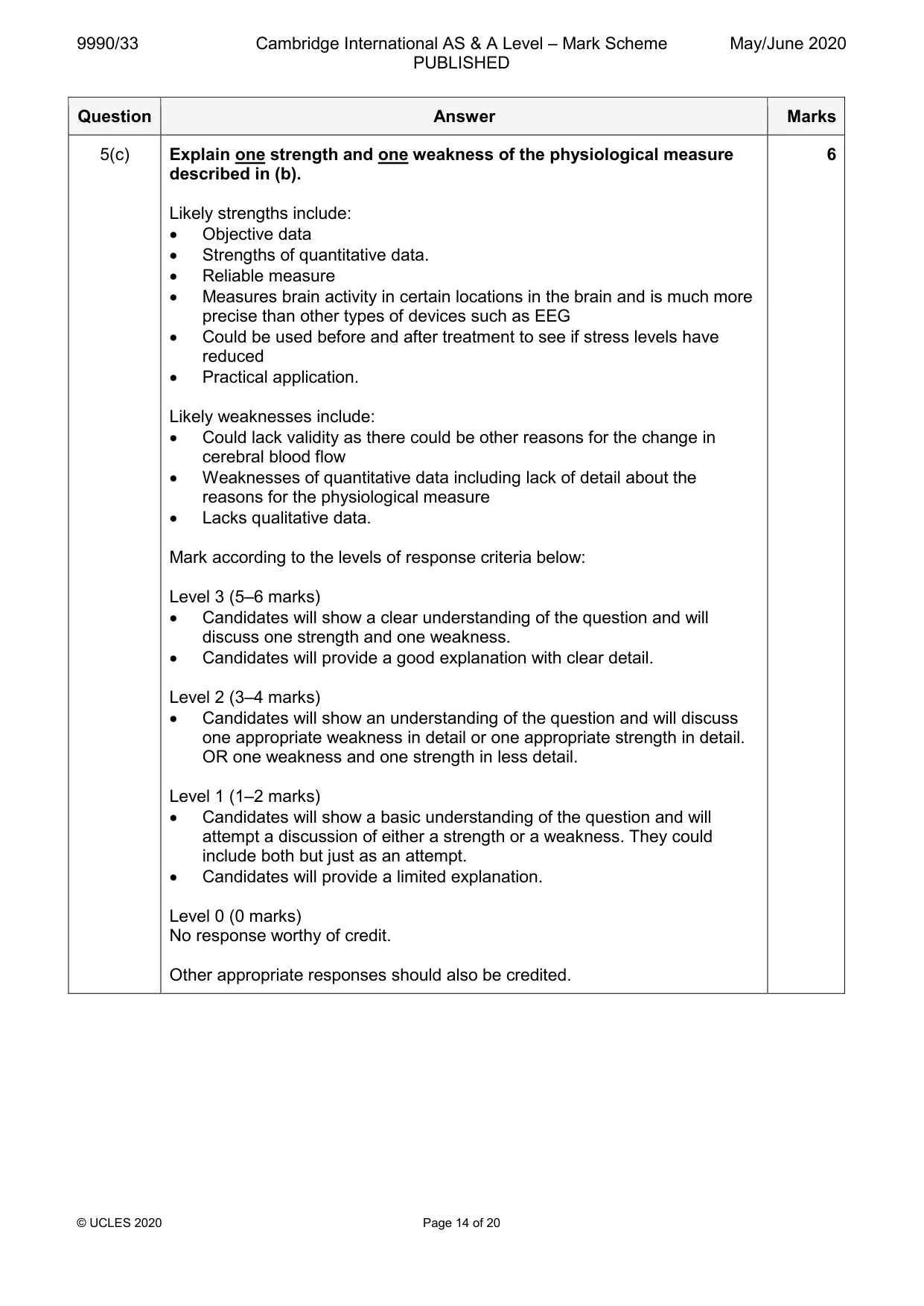
5 (a) Explain what is meant by a ‘psychological measure’ of stress. [2] (b) Describe one physiological measure of stress. [4] (c) Explain one strength and one weakness of the physiological measure described in (b). [6]
Mark scheme: 5(a) Explain what is meant by a ‘psychological measure’ of stress. 2 Award 1 mark for a basic explanation of the term/concept. Award 2 marks for a detailed explanation of the term/concept. For example: These are tools that are used by psychologists to measure the experience of stress by the participant/patient. (1) Commonly, psychometric tests are used to measure stress that produce a stress score at the end to compare to a baseline score. (1) Other appropriate responses should also be credited. 5(b) Describe one physiological measure of stress. 4 Award 1–2 marks for a basic answer with some understanding of the topic area. Award 3–4 marks for a detailed answer with clear understanding of the topic area. For example: An fMRI measures brain activity by detecting changes in cerebral blood flow (1). The patient might be asked to do a control task and then a stressful task in order to see the changes in blood flow in the brain. (1) Alternatively a control group of non-stressed participants (assessed using a different physiological measure or a questionnaire) (1) could be compared to participants who are stressed. It can then be inferred that any differences have been caused by stress. (1) Other appropriate responses should also be credited. 5(c) Explain one strength and one weakness of the physiological measure 6 described in (b). Likely strengths include: • Objective data • Strengths of quantitative data. • Reliable measure • Measures brain activity in certain locations in the brain and is much more precise than other types of devices such as EEG • Could be used before and after treatment to see if stress levels have reduced • Practical application. Likely weaknesses include: • Could lack validity as there could be other reasons for the change in cerebral blood flow • Weaknesses of quantitative data including lack of detail about the reasons for the physiological measure • Lacks qualitative data. Mark according to the levels of response criteria below: Level 3 (5–6 marks) • Candidates will show a clear understanding of the question and will discuss one strength and one weakness. • Candidates will provide a good explanation with clear detail. Level 2 (3–4 marks) • Candidates will show an understanding of the question and will discuss one appropriate weakness in detail or one appropriate strength in detail. OR one weakness and one strength in less detail. Level 1 (1–2 marks) • Candidates will show a basic understanding of the question and will attempt a discussion of either a strength or a weakness. They could include both but just as an attempt. • Candidates will provide a limited explanation. Level 0 (0 marks) No response worthy of credit. Other appropriate responses should also be credited.
Q6 · Describe what psychologists have discovered about improving adherence to medical advice
6 (a) Describe what psychologists have discovered about improving adherence to medical advice. [8] (b) Evaluate what psychologists have discovered about improving adherence to medical advice, including a discussion about ethics. [10] Psychology and organisations Answer all questions.
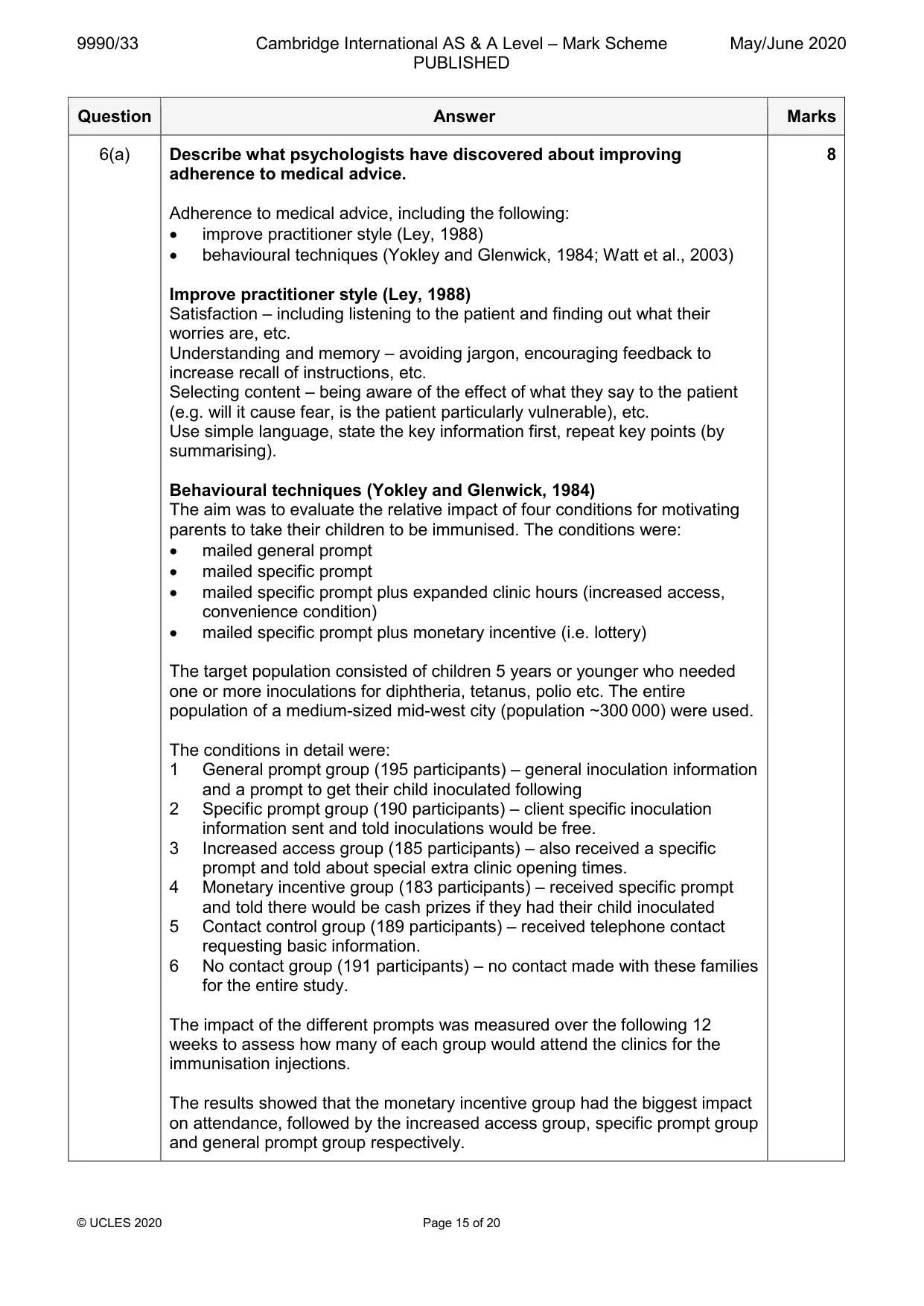
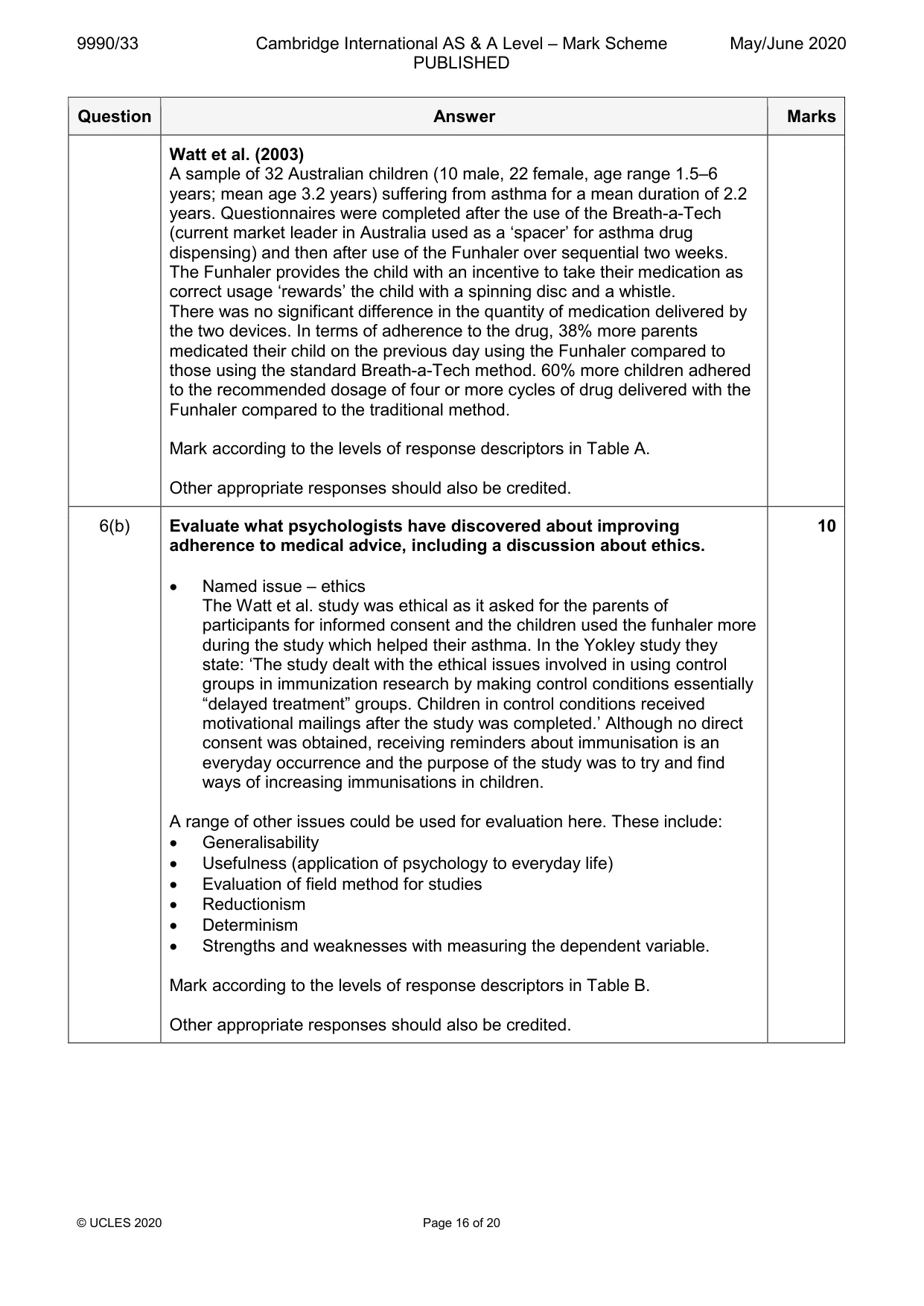
Mark scheme: 6(a) Describe what psychologists have discovered about improving 8 adherence to medical advice. Adherence to medical advice, including the following: • improve practitioner style (Ley, 1988) • behavioural techniques (Yokley and Glenwick, 1984; Watt et al., 2003) Improve practitioner style (Ley, 1988) Satisfaction – including listening to the patient and finding out what their worries are, etc. Understanding and memory – avoiding jargon, encouraging feedback to increase recall of instructions, etc. Selecting content – being aware of the effect of what they say to the patient (e.g. will it cause fear, is the patient particularly vulnerable), etc. Use simple language, state the key information first, repeat key points (by summarising). Behavioural techniques (Yokley and Glenwick, 1984) The aim was to evaluate the relative impact of four conditions for motivating parents to take their children to be immunised. The conditions were: • mailed general prompt • mailed specific prompt • mailed specific prompt plus expanded clinic hours (increased access, convenience condition) • mailed specific prompt plus monetary incentive (i.e. lottery) The target population consisted of children 5 years or younger who needed one or more inoculations for diphtheria, tetanus, polio etc. The entire population of a medium-sized mid-west city (population ~300 000) were used. The conditions in detail were: 1 General prompt group (195 participants) – general inoculation information and a prompt to get their child inoculated following 2 Specific prompt group (190 participants) – client specific inoculation information sent and told inoculations would be free. 3 Increased access group (185 participants) – also received a specific prompt and told about special extra clinic opening times. 4 Monetary incentive group (183 participants) – received specific prompt and told there would be cash prizes if they had their child inoculated 5 Contact control group (189 participants) – received telephone contact requesting basic information. 6 No contact group (191 participants) – no contact made with these families for the entire study. The impact of the different prompts was measured over the following 12 weeks to assess how many of each group would attend the clinics for the immunisation injections. The results showed that the monetary incentive group had the biggest impact on attendance, followed by the increased access group, specific prompt group and general prompt group respectively. Watt et al. (2003) A sample of 32 Australian children (10 male, 22 female, age range 1.5–6 years; mean age 3.2 years) suffering from asthma for a mean duration of 2.2 years. Questionnaires were completed after the use of the Breath-a-Tech (current market leader in Australia used as a ‘spacer’ for asthma drug dispensing) and then after use of the Funhaler over sequential two weeks. The Funhaler provides the child with an incentive to take their medication as correct usage ‘rewards’ the child with a spinning disc and a whistle. There was no significant difference in the quantity of medication delivered by the two devices. In terms of adherence to the drug, 38% more parents medicated their child on the previous day using the Funhaler compared to those using the standard Breath-a-Tech method. 60% more children adhered to the recommended dosage of four or more cycles of drug delivered with the Funhaler compared to the traditional method. Mark according to the levels of response descriptors in Table A. Other appropriate responses should also be credited. 6(b) Evaluate what psychologists have discovered about improving 10 adherence to medical advice, including a discussion about ethics. • Named issue – ethics The Watt et al. study was ethical as it asked for the parents of participants for informed consent and the children used the funhaler more during the study which helped their asthma. In the Yokley study they state: ‘The study dealt with the ethical issues involved in using control groups in immunization research by making control conditions essentially “delayed treatment” groups. Children in control conditions received motivational mailings after the study was completed.’ Although no direct consent was obtained, receiving reminders about immunisation is an everyday occurrence and the purpose of the study was to try and find ways of increasing immunisations in children. A range of other issues could be used for evaluation here. These include: • Generalisability • Usefulness (application of psychology to everyday life) • Evaluation of field method for studies • Reductionism • Determinism • Strengths and weaknesses with measuring the dependent variable. Mark according to the levels of response descriptors in Table B. Other appropriate responses should also be credited. Psychology and organisations Question Answer Marks
More questions on 2 Health promotion in schools and worksites
Q7 · Explain what is meant by ‘extrinsic motivation’ in relation to work
7 (a) Explain what is meant by ‘extrinsic motivation’ in relation to work. [2] (b) Describe how employees can be motivated by two monetary reward systems. [4] (c) For one of the monetary reward systems you referred to in (b): Explain one strength and one weakness of this reward system for an organisation. [6]
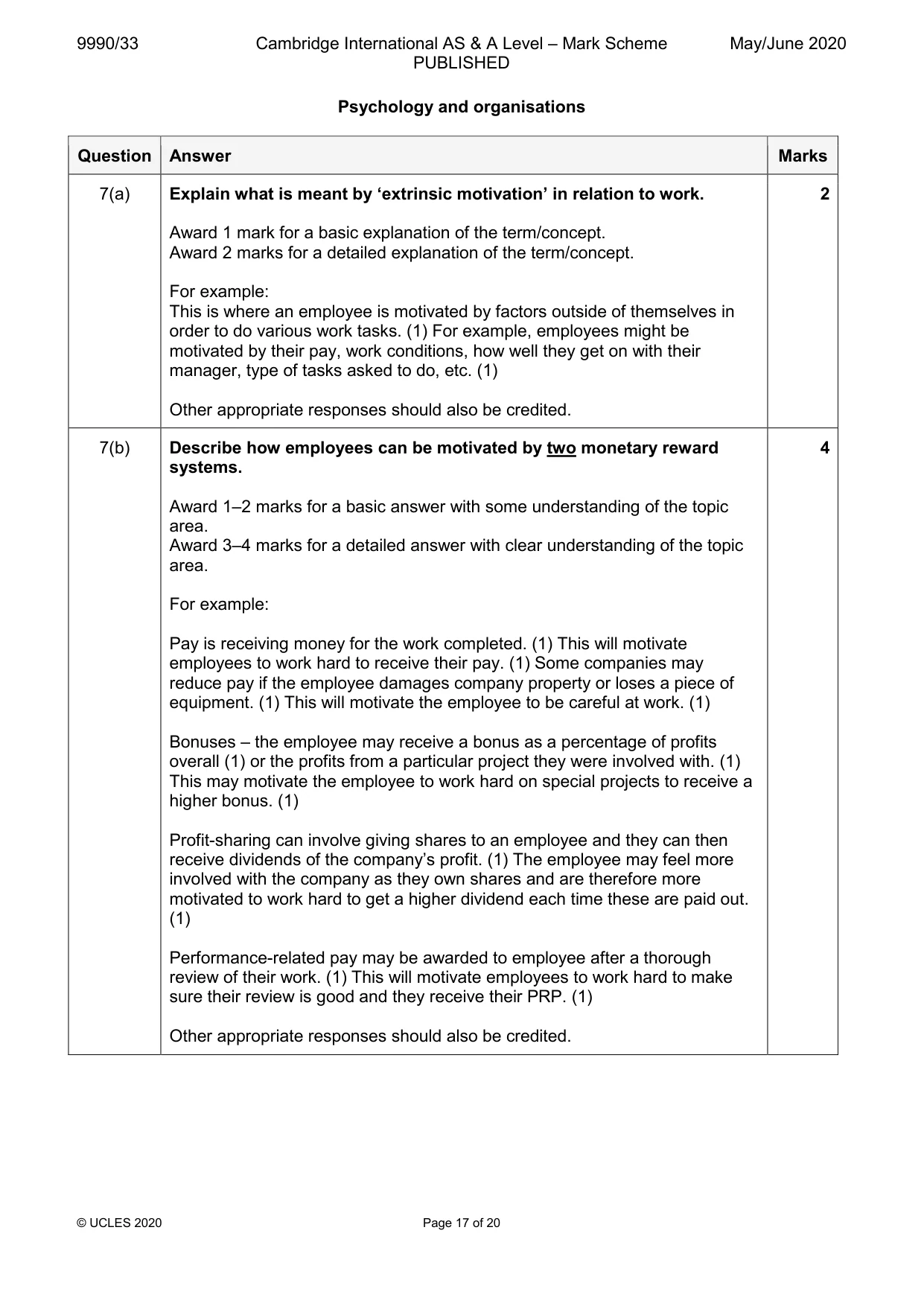
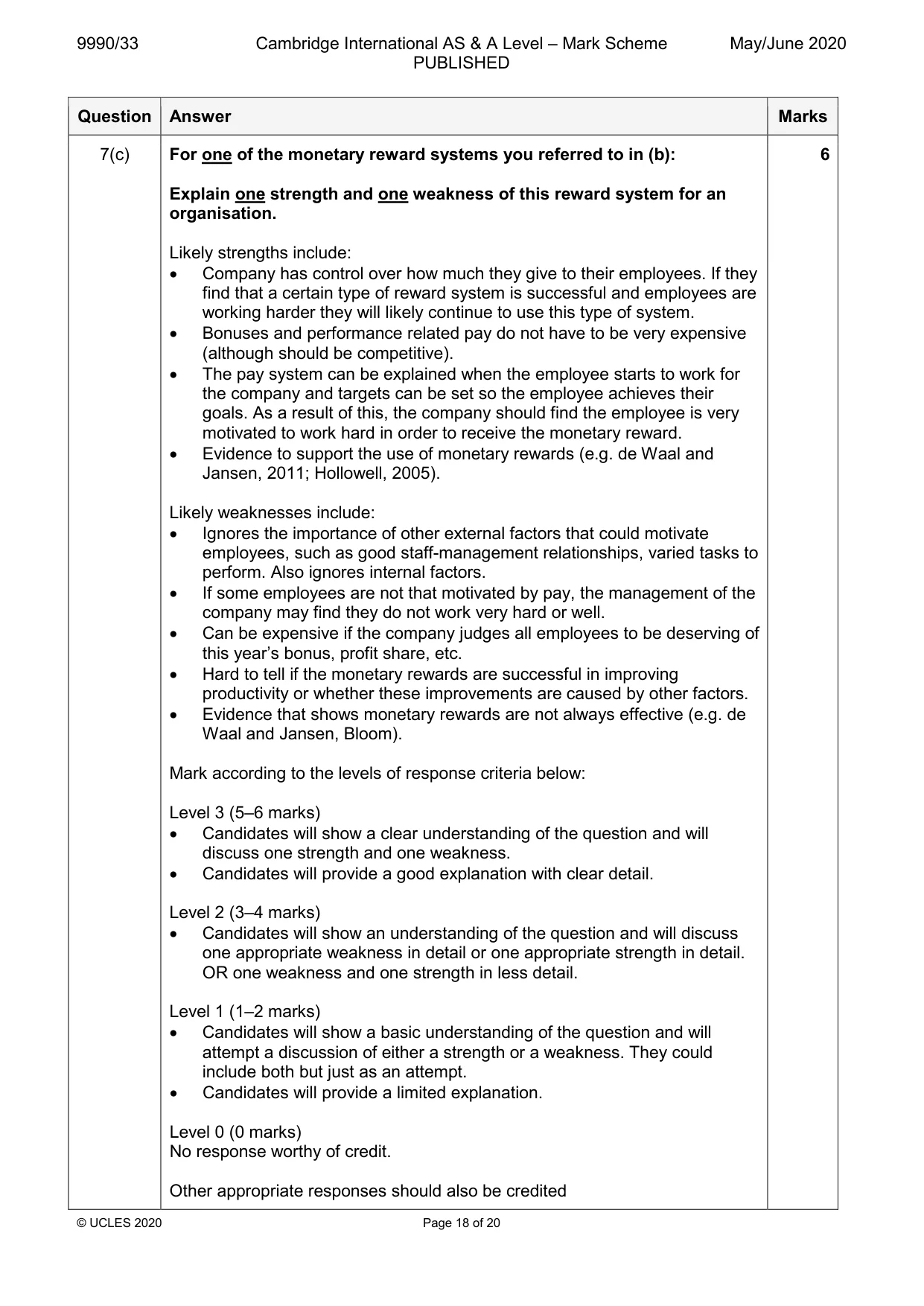
Mark scheme: 7(a) Explain what is meant by ‘extrinsic motivation’ in relation to work. 2 Award 1 mark for a basic explanation of the term/concept. Award 2 marks for a detailed explanation of the term/concept. For example: This is where an employee is motivated by factors outside of themselves in order to do various work tasks. (1) For example, employees might be motivated by their pay, work conditions, how well they get on with their manager, type of tasks asked to do, etc. (1) Other appropriate responses should also be credited. 7(b) Describe how employees can be motivated by two monetary reward 4 systems. Award 1–2 marks for a basic answer with some understanding of the topic area. Award 3–4 marks for a detailed answer with clear understanding of the topic area. For example: Pay is receiving money for the work completed. (1) This will motivate employees to work hard to receive their pay. (1) Some companies may reduce pay if the employee damages company property or loses a piece of equipment. (1) This will motivate the employee to be careful at work. (1) Bonuses – the employee may receive a bonus as a percentage of profits overall (1) or the profits from a particular project they were involved with. (1) This may motivate the employee to work hard on special projects to receive a higher bonus. (1) Profit-sharing can involve giving shares to an employee and they can then receive dividends of the company’s profit. (1) The employee may feel more involved with the company as they own shares and are therefore more motivated to work hard to get a higher dividend each time these are paid out. (1) Performance-related pay may be awarded to employee after a thorough review of their work. (1) This will motivate employees to work hard to make sure their review is good and they receive their PRP. (1) Other appropriate responses should also be credited. Question Answer Marks 7(c) For one of the monetary reward systems you referred to in (b): 6 Explain one strength and one weakness of this reward system for an organisation. Likely strengths include: • Company has control over how much they give to their employees. If they find that a certain type of reward system is successful and employees are working harder they will likely continue to use this type of system. • Bonuses and performance related pay do not have to be very expensive (although should be competitive). • The pay system can be explained when the employee starts to work for the company and targets can be set so the employee achieves their goals. As a result of this, the company should find the employee is very motivated to work hard in order to receive the monetary reward. • Evidence to support the use of monetary rewards (e.g. de Waal and Jansen, 2011; Hollowell, 2005). Likely weaknesses include: • Ignores the importance of other external factors that could motivate employees, such as good staff-management relationships, varied tasks to perform. Also ignores internal factors. • If some employees are not that motivated by pay, the management of the company may find they do not work very hard or well. • Can be expensive if the company judges all employees to be deserving of this year’s bonus, profit share, etc. • Hard to tell if the monetary rewards are successful in improving productivity or whether these improvements are caused by other factors. • Evidence that shows monetary rewards are not always effective (e.g. de Waal and Jansen, Bloom). Mark according to the levels of response criteria below: Level 3 (5–6 marks) • Candidates will show a clear understanding of the question and will discuss one strength and one weakness. • Candidates will provide a good explanation with clear detail. Level 2 (3–4 marks) • Candidates will show an understanding of the question and will discuss one appropriate weakness in detail or one appropriate strength in detail. OR one weakness and one strength in less detail. Level 1 (1–2 marks) • Candidates will show a basic understanding of the question and will attempt a discussion of either a strength or a weakness. They could include both but just as an attempt. • Candidates will provide a limited explanation. Level 0 (0 marks) No response worthy of credit. Other appropriate responses should also be credited Question Answer Marks
Q8 · Describe theories of job satisfaction
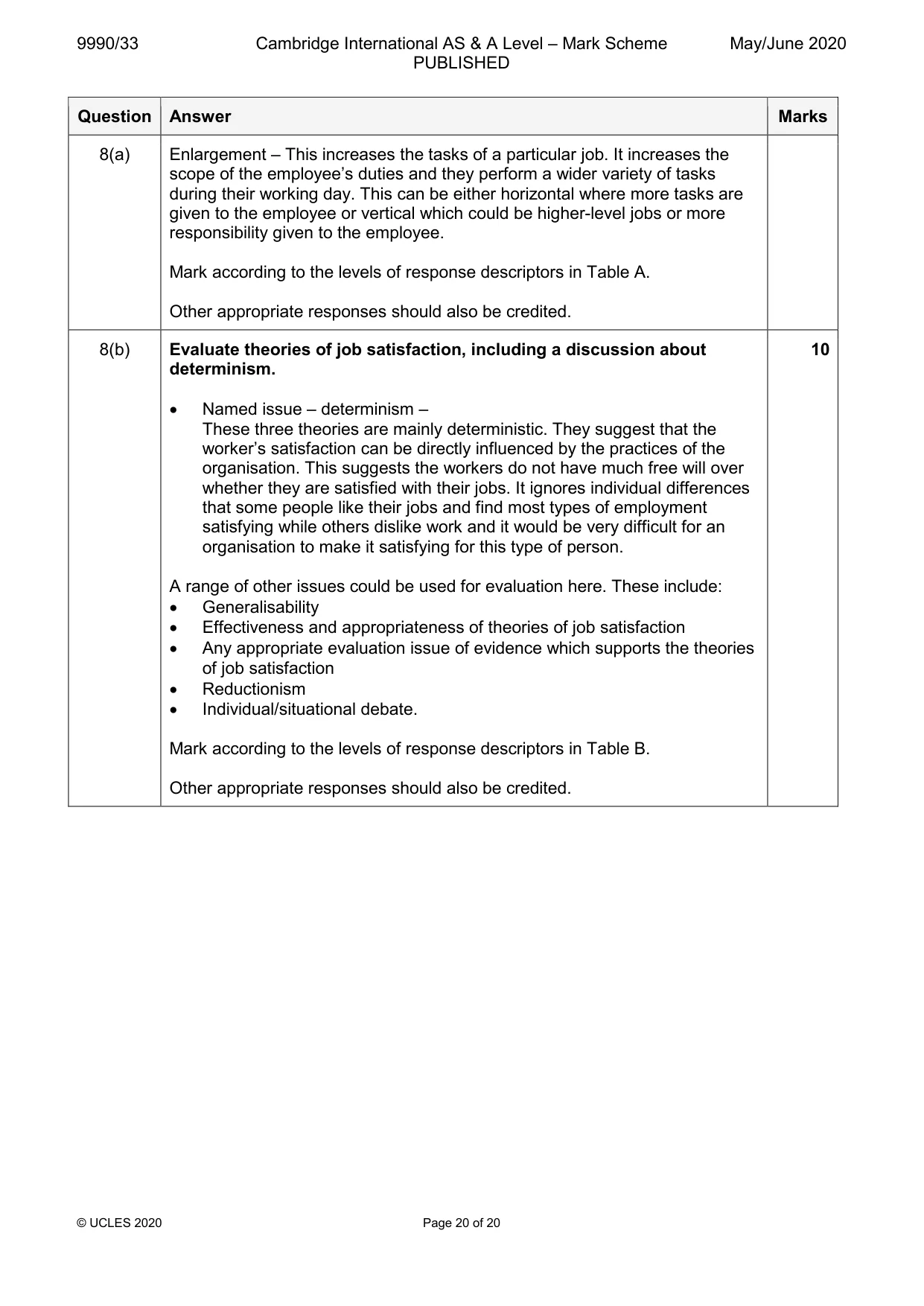
8 (a) Describe theories of job satisfaction. [8] (b) Evaluate theories of job satisfaction, including a discussion about determinism. [10]
Mark scheme: 8(a) Describe theories of job satisfaction. 8 Theories of job satisfaction, including the following: • two factor theory (Herzberg, 1959) • job characteristics theory (Hackman and Oldham, 1976) • techniques of job design: enrichment, rotation and enlargement Two factor theory (Herzberg, 1959) Job satisfaction and job dissatisfaction are independent of each other. Some factors in the job cause satisfaction while other, different factors can cause dissatisfaction. Herzberg surveyed 200 workers at a factor in Pittsburgh, USA. Qualitative data was collected to find out what they found good and bad about their job. From this he developed the theory that there are two main factors at work – Motivators – content of job (recognition, content of work, advancement, responsibility, etc.) and Hygienes – need to be present to achieve job satisfaction, e.g. level of supervision, job security, salary, working conditions, etc.) In order to remove dissatisfaction hygiene factors must be met, e.g. pay a good wage. Then motivating factors must be dealt with (e.g. make promotions available to staff, give more responsibility, etc.). Job characteristics theory (Hackman and Oldham, 1976) Core job characteristics that will appeal to workers and improve job satisfaction include: • Skill variety • Task identity • Autonomy • Task significance • Feedback. These together bring about three psychological states about the work. Experience meaningfulness at work, have knowledge of the result of their work in order to enable the worker to grow and develop in their job and experience responsibility over their work. Techniques of job design: enrichment, rotation and enlargement These can allow for increased satisfaction at work. Enrichment – Redesigning the job to make it more challenging and interesting for the employee. These will usually involve more skills and a higher level of responsibility. They will feel more in control of their job and this should lead to greater satisfaction at work. Rotation – Change the tasks the workers are expected to do in their job on a regular basis. Employees could rotate around jobs within the same work environment (e.g. within a factor, kitchen or office) or they could move between departments for even more variety. This will build the skills of the worker and make them more useful to the company who could make use of these skills as and when required. Question Answer Marks 8(a) Enlargement – This increases the tasks of a particular job. It increases the scope of the employee’s duties and they perform a wider variety of tasks during their working day. This can be either horizontal where more tasks are given to the employee or vertical which could be higher-level jobs or more responsibility given to the employee. Mark according to the levels of response descriptors in Table A. Other appropriate responses should also be credited. 8(b) Evaluate theories of job satisfaction, including a discussion about 10 determinism. • Named issue – determinism – These three theories are mainly deterministic. They suggest that the worker’s satisfaction can be directly influenced by the practices of the organisation. This suggests the workers do not have much free will over whether they are satisfied with their jobs. It ignores individual differences that some people like their jobs and find most types of employment satisfying while others dislike work and it would be very difficult for an organisation to make it satisfying for this type of person. A range of other issues could be used for evaluation here. These include: • Generalisability • Effectiveness and appropriateness of theories of job satisfaction • Any appropriate evaluation issue of evidence which supports the theories of job satisfaction • Reductionism • Individual/situational debate. Mark according to the levels of response descriptors in Table B. Other appropriate responses should also be credited.
What was in this paper
The subtopics covered by these 8 questions, and how many questions each got. Open one in a new tab to see every Cambridge question on it.