Cambridge A Level Psychology (from 2018) 9990 — 2019 May/June Paper 1 · Variant 2
9990/12/M/J/19 · 60 marks · ≈68 min
The question paper and its mark scheme, free to read here and free to download. This is Cambridge’s own paper, exactly as it was sat.
Question paper8 pages
Mark scheme11 pages
Answers below. Sit the paper first if you are practising.
Paper as text
Question paper, page 1
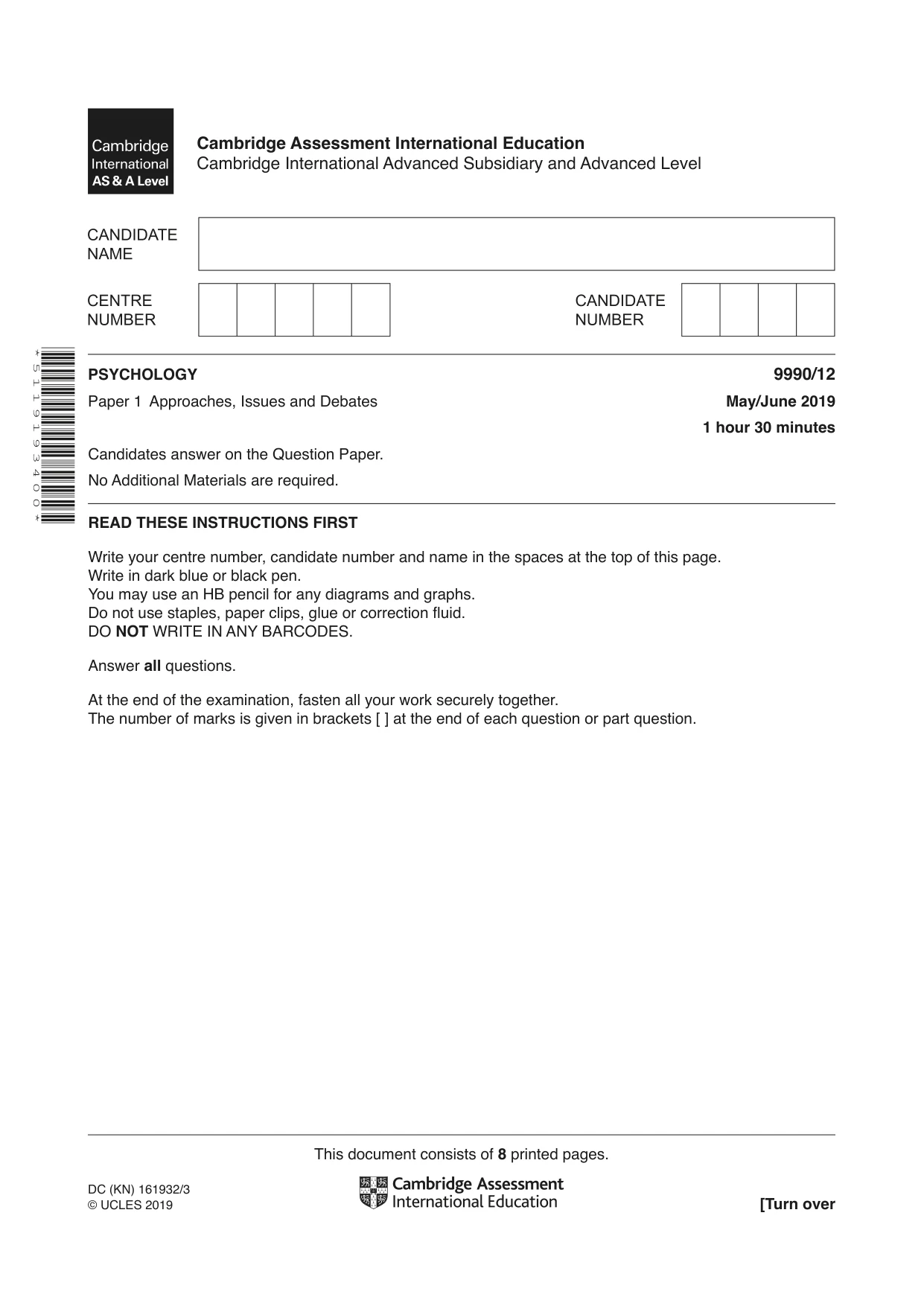
This document consists of 8 printed pages. DC (KN) 161932/3 © UCLES 2019 [Turn over Cambridge Assessment International Education Cambridge International Advanced Subsidiary and Advanced Level * 5 1 1 9 1 9 3 4 0 0 * PSYCHOLOGY 9990/12 Paper 1 Approaches, Issues and Debates May/June 2019 1 hour 30 minutes Candidates answer on the Question Paper. No Additional Materials are required. READ THESE INSTRUCTIONS FIRST Write your centre number, candidate number and name in the spaces at the top of this page. Write in dark blue or black pen. You may use an HB pencil for any diagrams and graphs. Do not use staples, paper clips, glue or correction fluid. DO NOT WRITE IN ANY BARCODES. Answer all questions. At the end of the examination, fasten all your work securely together. The number of marks is given in brackets [ ] at the end of each question or part question.
Question paper, page 2
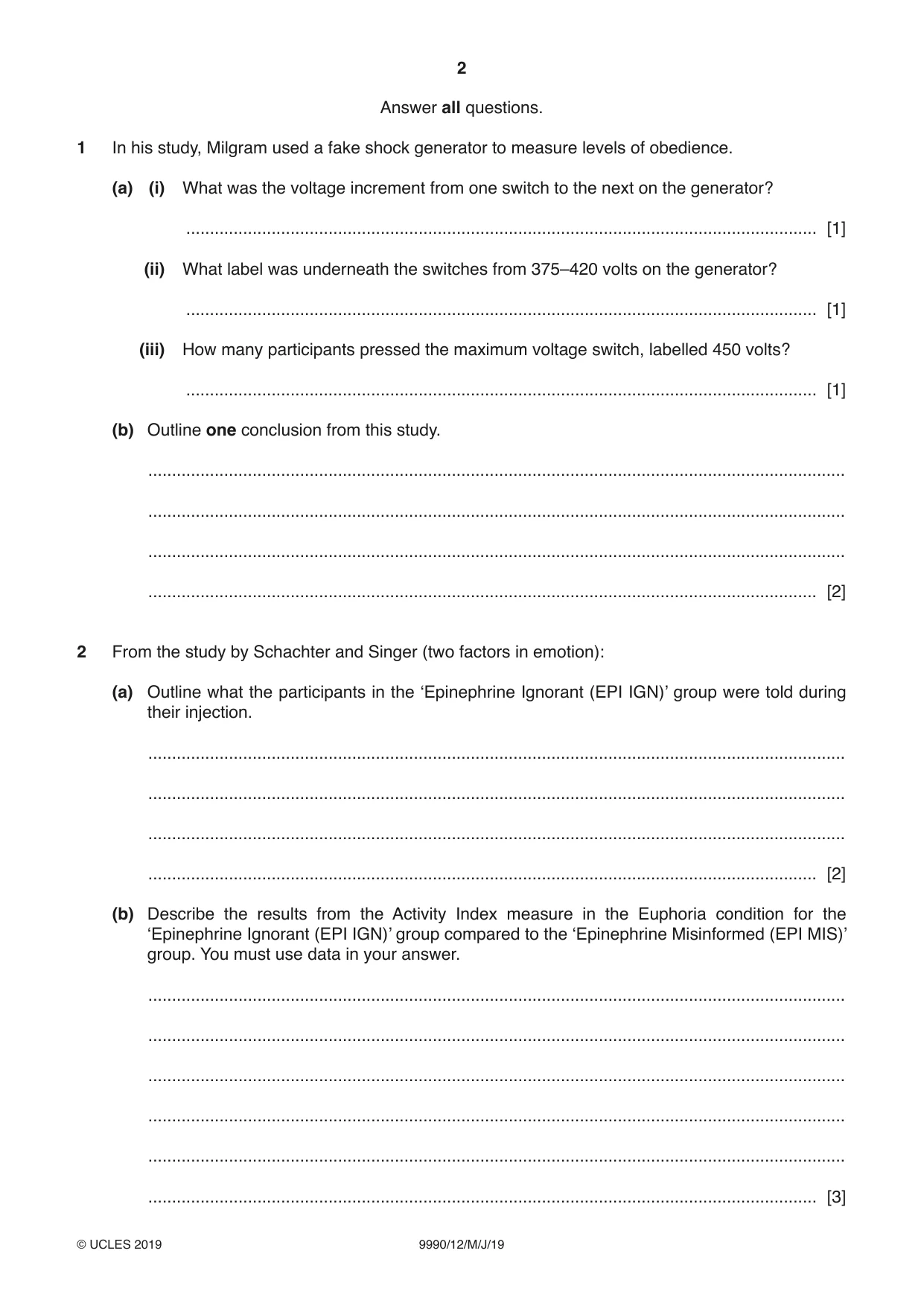
2 9990/12/M/J/19 © UCLES 2019 Answer all questions. 1 In his study, Milgram used a fake shock generator to measure levels of obedience. (a) (i) What was the voltage increment from one switch to the next on the generator? … [1] (ii) What label was underneath the switches from 375–420 volts on the generator? … [1] (iii) How many participants pressed the maximum voltage switch, labelled 450 volts? … [1] (b) Outline one conclusion from this study. … … … … [2] 2 From the study by Schachter and Singer (two factors in emotion): (a) Outline what the participants in the ‘Epinephrine Ignorant (EPI IGN)’ group were told during their injection. … … … … [2] (b) Describe the results from the Activity Index measure in the Euphoria condition for the ‘Epinephrine Ignorant (EPI IGN)’ group compared to the ‘Epinephrine Misinformed (EPI MIS)’ group. You must use data in your answer. … … … … … … [3]
Question paper, page 3
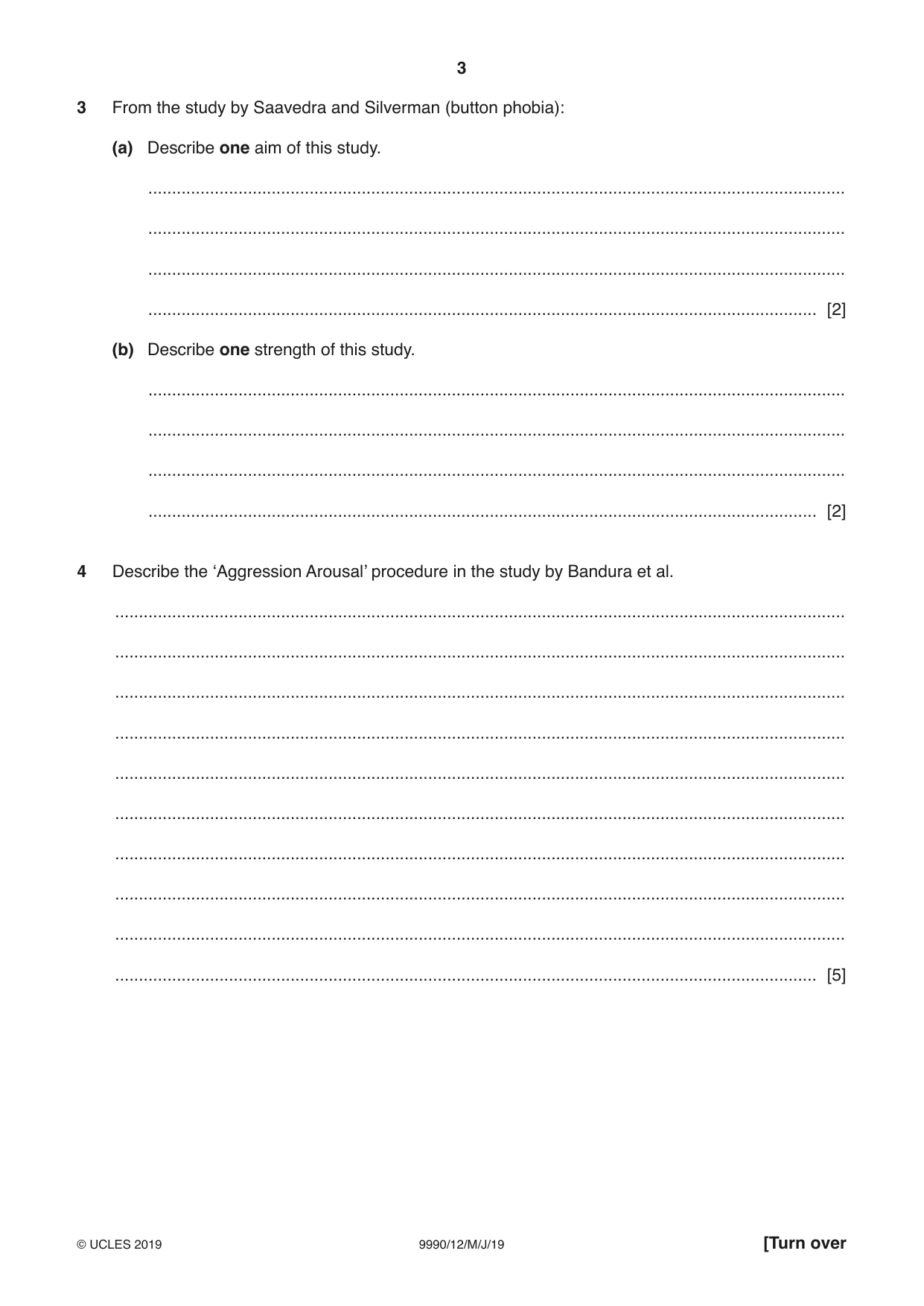
3 9990/12/M/J/19 © UCLES 2019 [Turn over 3 From the study by Saavedra and Silverman (button phobia): (a) Describe one aim of this study. … … … … [2] (b) Describe one strength of this study. … … … … [2] 4 Describe the ‘Aggression Arousal’ procedure in the study by Bandura et al. … … … … … … … … … … [5]
Question paper, page 4
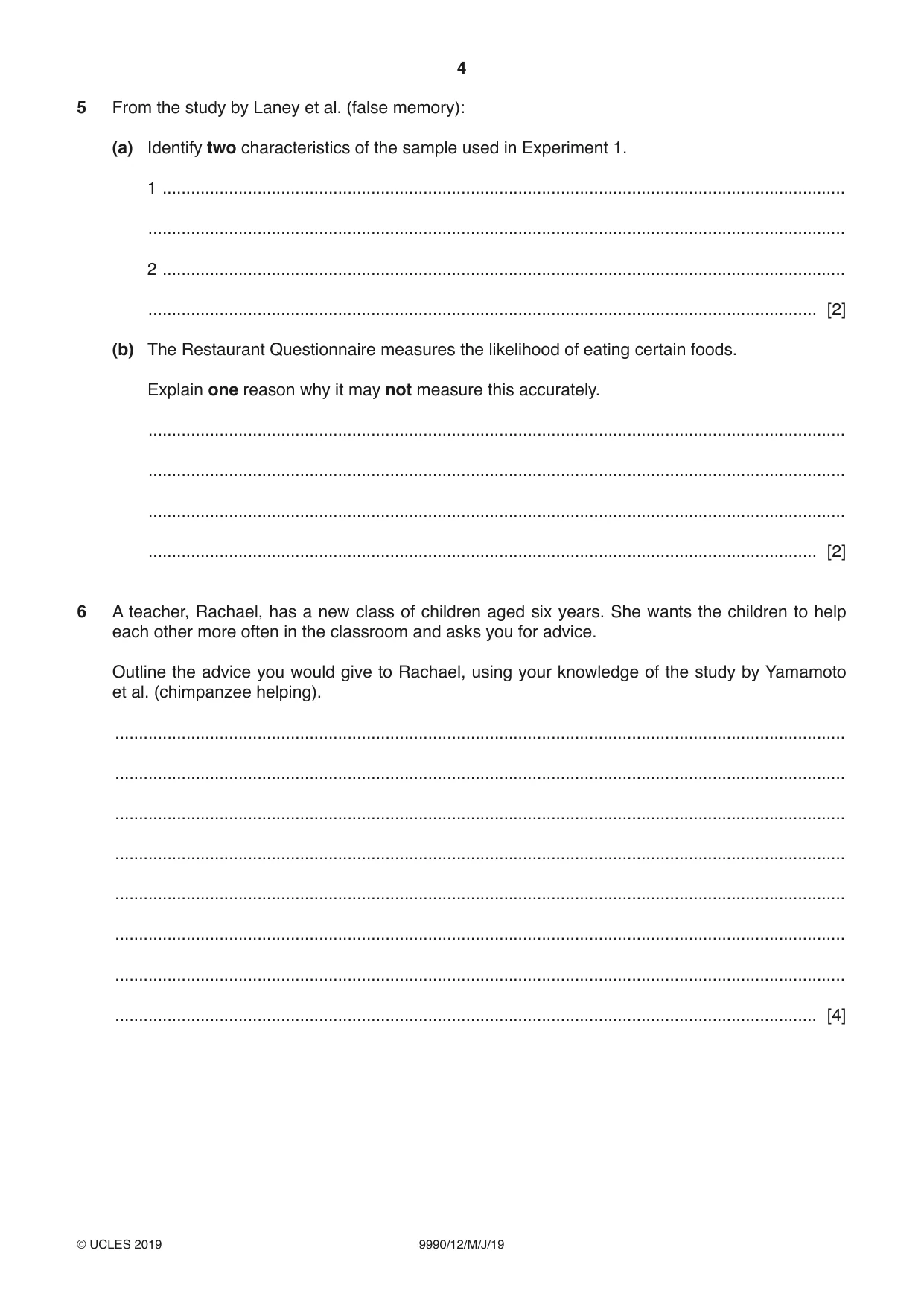
4 9990/12/M/J/19 © UCLES 2019 5 From the study by Laney et al. (false memory): (a) Identify two characteristics of the sample used in Experiment 1. 1 … … 2 … … [2] (b) The Restaurant Questionnaire measures the likelihood of eating certain foods. Explain one reason why it may not measure this accurately. … … … … [2] 6 A teacher, Rachael, has a new class of children aged six years. She wants the children to help each other more often in the classroom and asks you for advice. Outline the advice you would give to Rachael, using your knowledge of the study by Yamamoto et al. (chimpanzee helping). … … … … … … … … [4]
Question paper, page 5
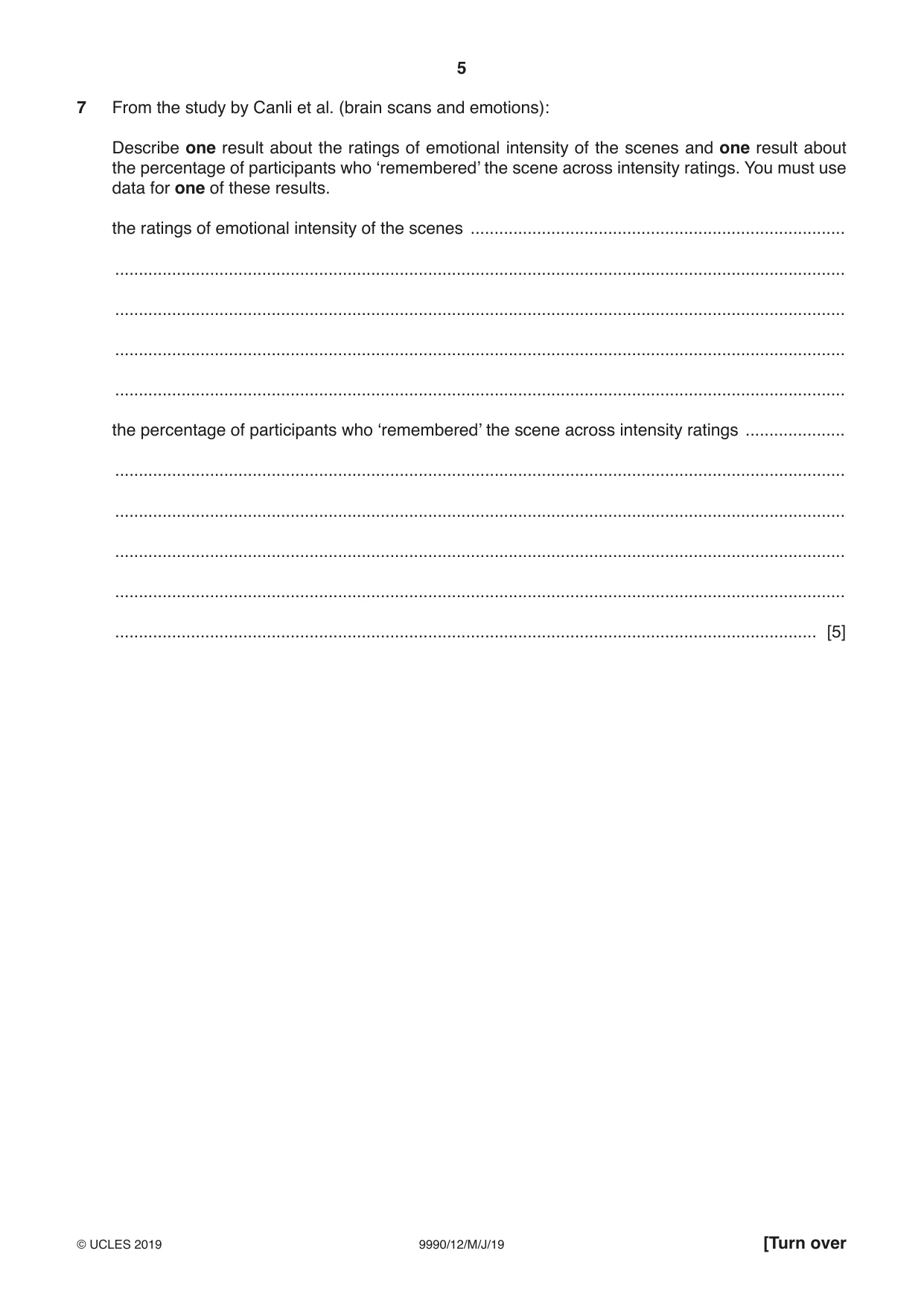
5 9990/12/M/J/19 © UCLES 2019 [Turn over 7 From the study by Canli et al. (brain scans and emotions): Describe one result about the ratings of emotional intensity of the scenes and one result about the percentage of participants who ‘remembered’ the scene across intensity ratings. You must use data for one of these results. the ratings of emotional intensity of the scenes … … … … … the percentage of participants who ‘remembered’ the scene across intensity ratings … … … … … … [5]
Question paper, page 6
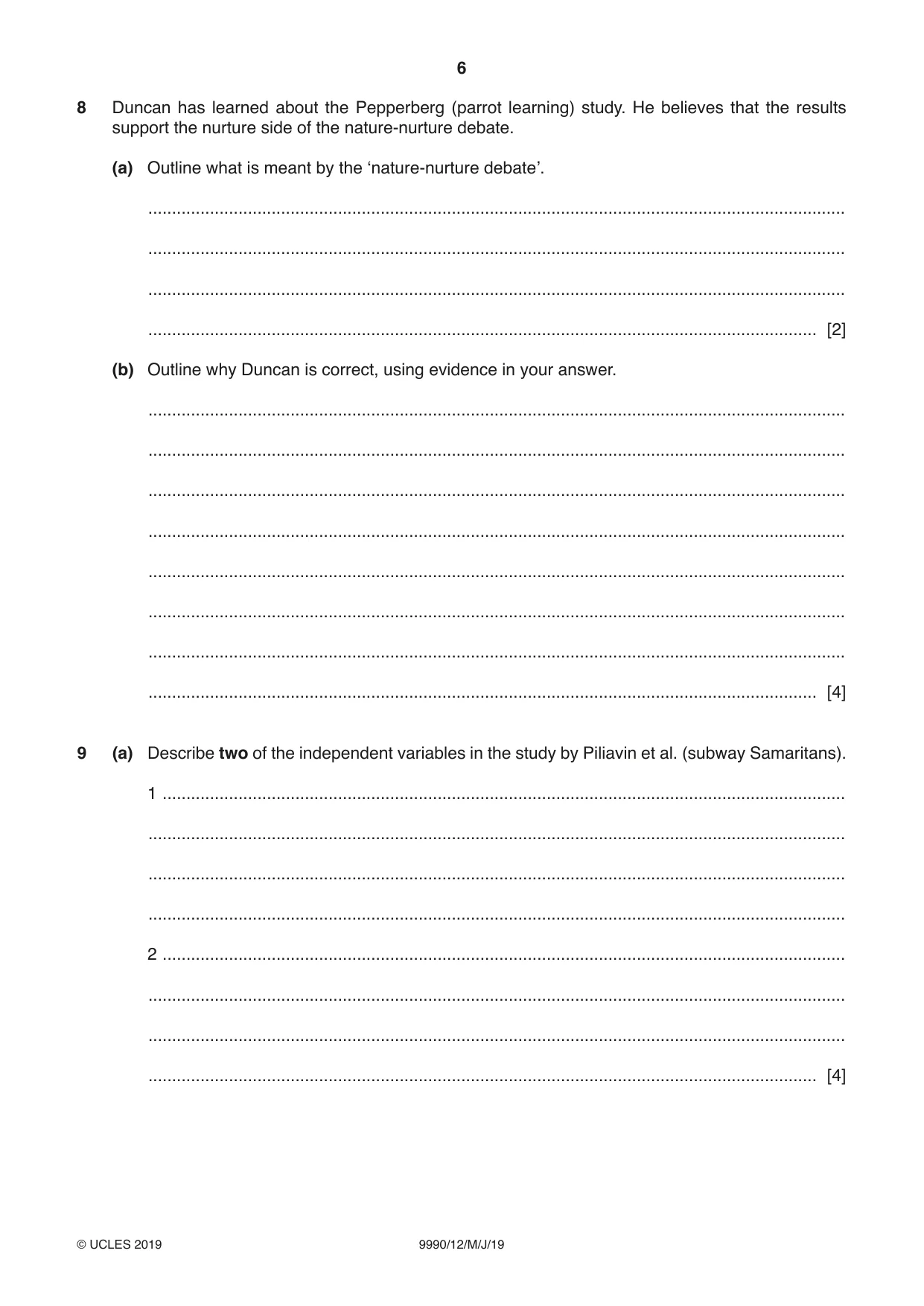
6 9990/12/M/J/19 © UCLES 2019 8 Duncan has learned about the Pepperberg (parrot learning) study. He believes that the results support the nurture side of the nature-nurture debate. (a) Outline what is meant by the ‘nature-nurture debate’. … … … … [2] (b) Outline why Duncan is correct, using evidence in your answer. … … … … … … … … [4] 9 (a) Describe two of the independent variables in the study by Piliavin et al. (subway Samaritans). 1 … … … … 2 … … … … [4]
Question paper, page 7
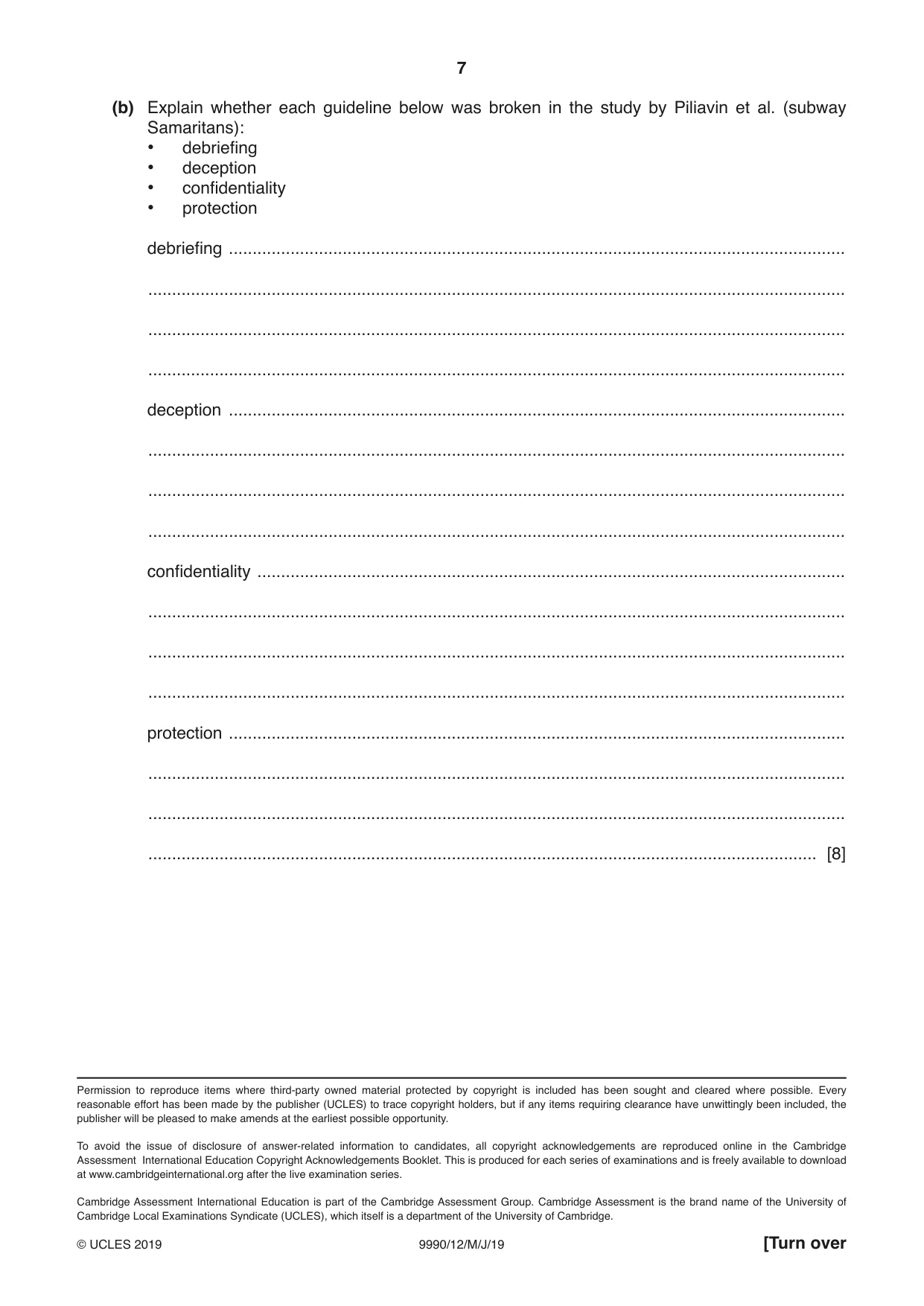
7 9990/12/M/J/19 © UCLES 2019 [Turn over (b) Explain whether each guideline below was broken in the study by Piliavin et al. (subway Samaritans): • debriefing • deception • confidentiality • protection debriefing … … … … deception … … … … confidentiality … … … … protection … … … … [8] Permission to reproduce items where third-party owned material protected by copyright is included has been sought and cleared where possible. Every reasonable effort has been made by the publisher (UCLES) to trace copyright holders, but if any items requiring clearance have unwittingly been included, the publisher will be pleased to make amends at the earliest possible opportunity. To avoid the issue of disclosure of answer-related information to candidates, all copyright acknowledgements are reproduced online in the Cambridge Assessment International Education Copyright Acknowledgements Booklet. This is produced for each series of examinations and is freely available to download at www.cambridgeinternational.org after the live examination series. Cambridge Assessment International Education is part of the Cambridge Assessment Group. Cambridge Assessment is the brand name of the University of Cambridge Local Examinations Syndicate (UCLES), which itself is a department of the University of Cambridge.
Question paper, page 8
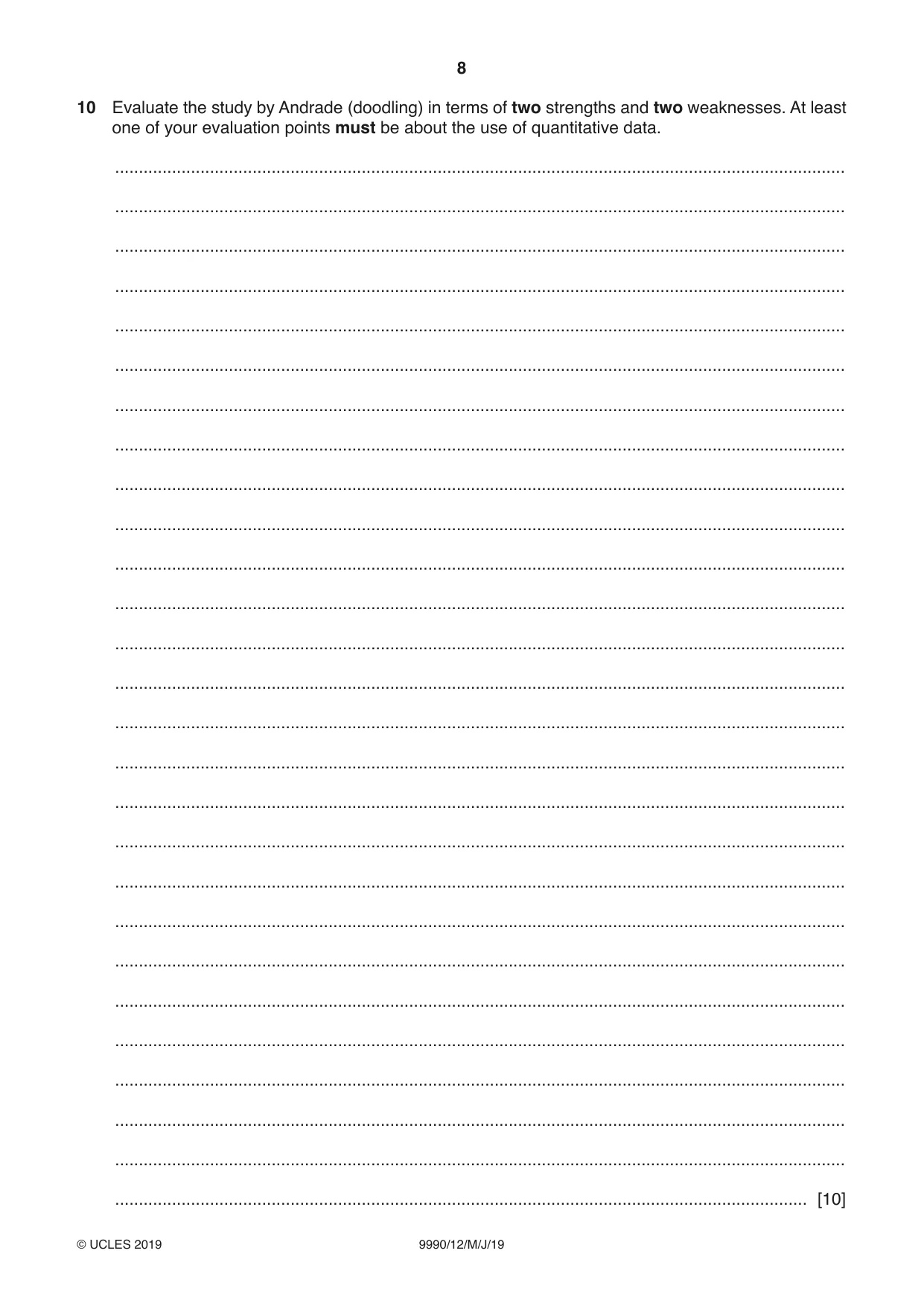
8 9990/12/M/J/19 © UCLES 2019 10 Evaluate the study by Andrade (doodling) in terms of two strengths and two weaknesses. At least one of your evaluation points must be about the use of quantitative data. … … … … … … … … … … … … … … … … … … … … … … … … … … … [10]
Mark scheme, page 1
This document consists of 11 printed pages. © UCLES 2019 [Turn over Cambridge Assessment International Education Cambridge International Advanced Subsidiary and Advanced Level PSYCHOLOGY 9990/12 Paper 1 Approaches, issues and debates May/June 2019 MARK SCHEME Maximum Mark: 60 Published This mark scheme is published as an aid to teachers and candidates, to indicate the requirements of the examination. It shows the basis on which Examiners were instructed to award marks. It does not indicate the details of the discussions that took place at an Examiners’ meeting before marking began, which would have considered the acceptability of alternative answers. Mark schemes should be read in conjunction with the question paper and the Principal Examiner Report for Teachers. Cambridge International will not enter into discussions about these mark schemes. Cambridge International is publishing the mark schemes for the May/June 2019 series for most Cambridge IGCSE™, Cambridge International A and AS Level and Cambridge Pre-U components, and some Cambridge O Level components.
Mark scheme, page 2
9990/12 Cambridge International AS/A Level – Mark Scheme PUBLISHED May/June 2019 © UCLES 2019 Page 2 of 11 Generic Marking Principles These general marking principles must be applied by all examiners when marking candidate answers. They should be applied alongside the specific content of the mark scheme or generic level descriptors for a question. Each question paper and mark scheme will also comply with these marking principles. GENERIC MARKING PRINCIPLE 1: Marks must be awarded in line with: • the specific content of the mark scheme or the generic level descriptors for the question • the specific skills defined in the mark scheme or in the generic level descriptors for the question • the standard of response required by a candidate as exemplified by the standardisation scripts. GENERIC MARKING PRINCIPLE 2: Marks awarded are always whole marks (not half marks, or other fractions). GENERIC MARKING PRINCIPLE 3: Marks must be awarded positively: • marks are awarded for correct/valid answers, as defined in the mark scheme. However, credit is given for valid answers which go beyond the scope of the syllabus and mark scheme, referring to your Team Leader as appropriate • marks are awarded when candidates clearly demonstrate what they know and can do • marks are not deducted for errors • marks are not deducted for omissions • answers should only be judged on the quality of spelling, punctuation and grammar when these features are specifically assessed by the question as indicated by the mark scheme. The meaning, however, should be unambiguous. GENERIC MARKING PRINCIPLE 4: Rules must be applied consistently e.g. in situations where candidates have not followed instructions or in the application of generic level descriptors. GENERIC MARKING PRINCIPLE 5: Marks should be awarded using the full range of marks defined in the mark scheme for the question (however; the use of the full mark range may be limited according to the quality of the candidate responses seen). GENERIC MARKING PRINCIPLE 6: Marks awarded are based solely on the requirements as defined in the mark scheme. Marks should not be awarded with grade thresholds or grade descriptors in mind.
Mark scheme, page 3
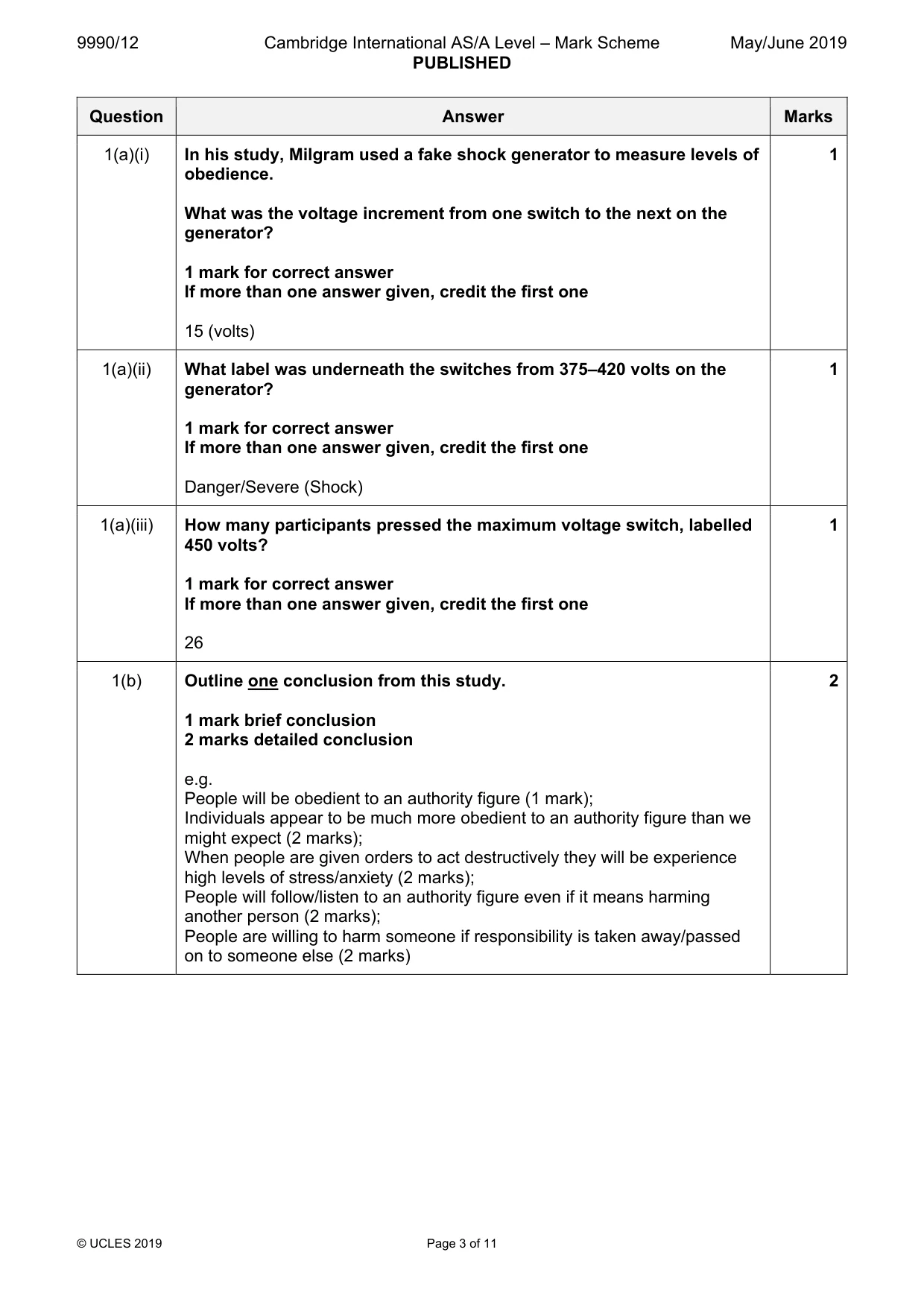
9990/12 Cambridge International AS/A Level – Mark Scheme PUBLISHED May/June 2019 © UCLES 2019 Page 3 of 11 Question Answer Marks 1(a)(i) In his study, Milgram used a fake shock generator to measure levels of obedience. What was the voltage increment from one switch to the next on the generator? 1 mark for correct answer If more than one answer given, credit the first one 15 (volts) 1 1(a)(ii) What label was underneath the switches from 375–420 volts on the generator? 1 mark for correct answer If more than one answer given, credit the first one Danger/Severe (Shock) 1 1(a)(iii) How many participants pressed the maximum voltage switch, labelled 450 volts? 1 mark for correct answer If more than one answer given, credit the first one 26 1 1(b) Outline one conclusion from this study. 1 mark brief conclusion 2 marks detailed conclusion e.g. People will be obedient to an authority figure (1 mark); Individuals appear to be much more obedient to an authority figure than we might expect (2 marks); When people are given orders to act destructively they will be experience high levels of stress/anxiety (2 marks); People will follow/listen to an authority figure even if it means harming another person (2 marks); People are willing to harm someone if responsibility is taken away/passed on to someone else (2 marks) 2
Mark scheme, page 4
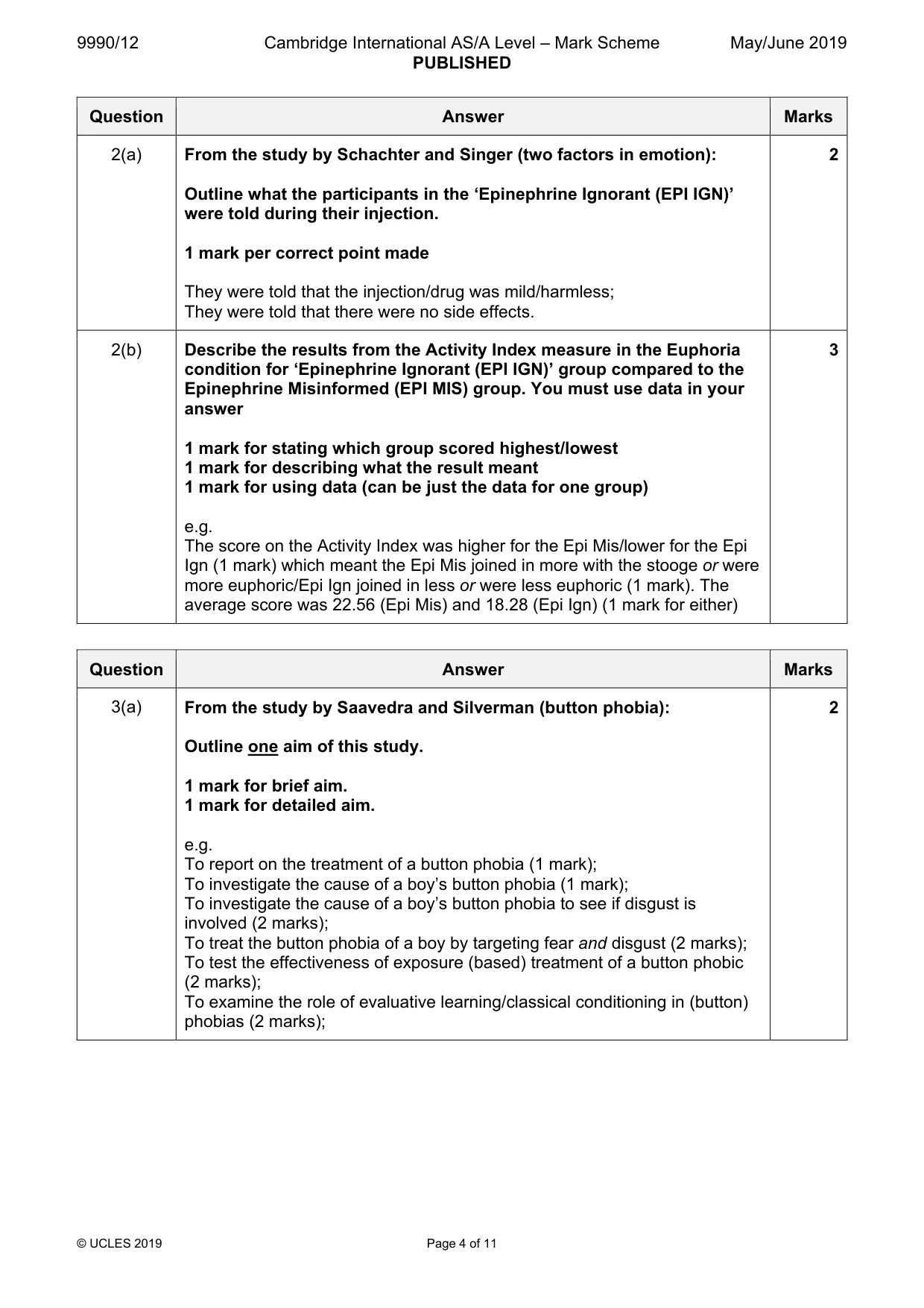
9990/12 Cambridge International AS/A Level – Mark Scheme PUBLISHED May/June 2019 © UCLES 2019 Page 4 of 11 Question Answer Marks 2(a) From the study by Schachter and Singer (two factors in emotion): Outline what the participants in the ‘Epinephrine Ignorant (EPI IGN)’ were told during their injection. 1 mark per correct point made They were told that the injection/drug was mild/harmless; They were told that there were no side effects. 2 2(b) Describe the results from the Activity Index measure in the Euphoria condition for ‘Epinephrine Ignorant (EPI IGN)’ group compared to the Epinephrine Misinformed (EPI MIS) group. You must use data in your answer 1 mark for stating which group scored highest/lowest 1 mark for describing what the result meant 1 mark for using data (can be just the data for one group) e.g. The score on the Activity Index was higher for the Epi Mis/lower for the Epi Ign (1 mark) which meant the Epi Mis joined in more with the stooge or were more euphoric/Epi Ign joined in less or were less euphoric (1 mark). The average score was 22.56 (Epi Mis) and 18.28 (Epi Ign) (1 mark for either) 3 Question Answer Marks 3(a) From the study by Saavedra and Silverman (button phobia): Outline one aim of this study. 1 mark for brief aim. 1 mark for detailed aim. e.g. To report on the treatment of a button phobia (1 mark); To investigate the cause of a boy’s button phobia (1 mark); To investigate the cause of a boy’s button phobia to see if disgust is involved (2 marks); To treat the button phobia of a boy by targeting fear and disgust (2 marks); To test the effectiveness of exposure (based) treatment of a button phobic (2 marks); To examine the role of evaluative learning/classical conditioning in (button) phobias (2 marks); 2
Mark scheme, page 5
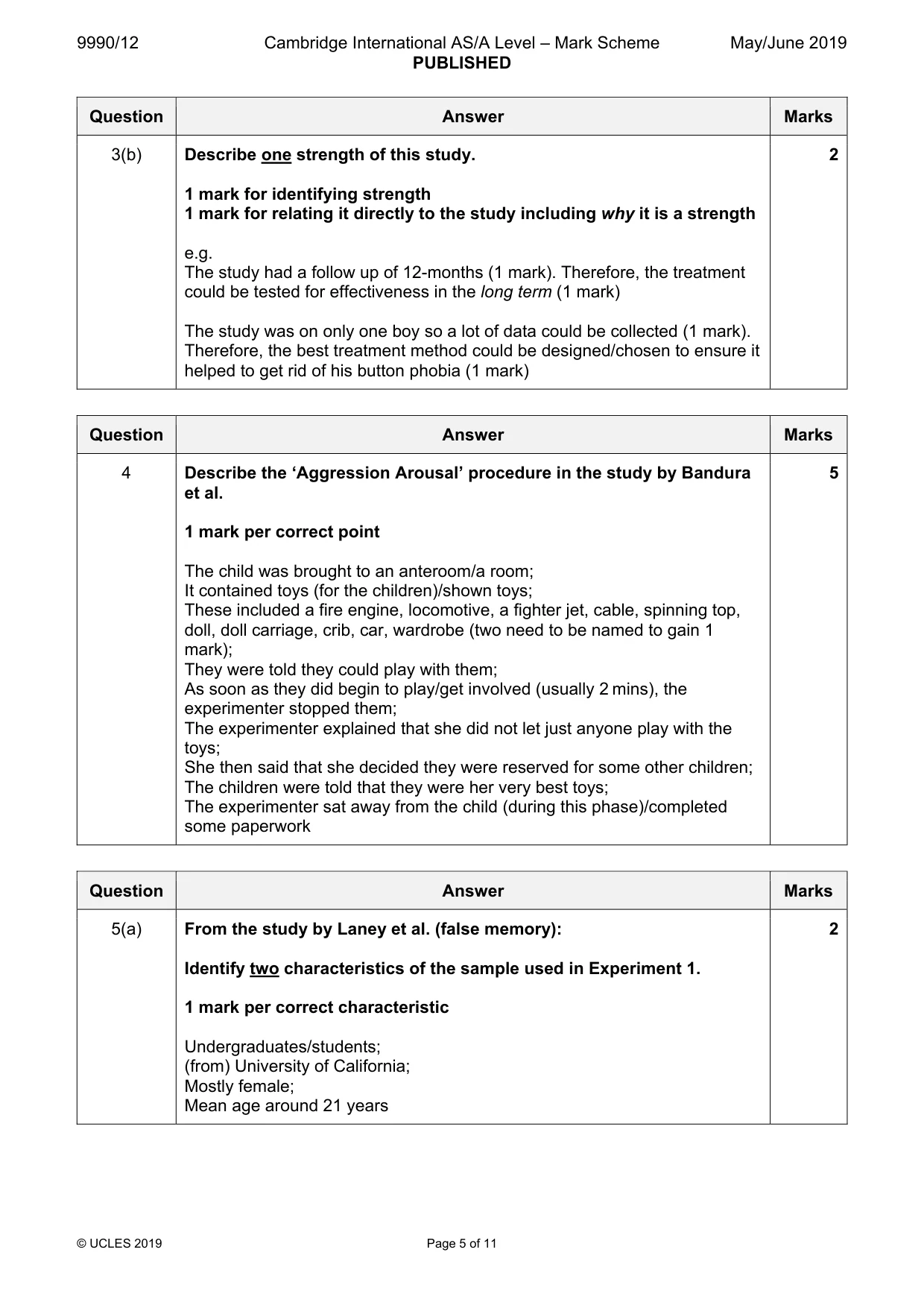
9990/12 Cambridge International AS/A Level – Mark Scheme PUBLISHED May/June 2019 © UCLES 2019 Page 5 of 11 Question Answer Marks 3(b) Describe one strength of this study. 1 mark for identifying strength 1 mark for relating it directly to the study including why it is a strength e.g. The study had a follow up of 12-months (1 mark). Therefore, the treatment could be tested for effectiveness in the long term (1 mark) The study was on only one boy so a lot of data could be collected (1 mark). Therefore, the best treatment method could be designed/chosen to ensure it helped to get rid of his button phobia (1 mark) 2 Question Answer Marks 4 Describe the ‘Aggression Arousal’ procedure in the study by Bandura et al. 1 mark per correct point The child was brought to an anteroom/a room; It contained toys (for the children)/shown toys; These included a fire engine, locomotive, a fighter jet, cable, spinning top, doll, doll carriage, crib, car, wardrobe (two need to be named to gain 1 mark); They were told they could play with them; As soon as they did begin to play/get involved (usually 2 mins), the experimenter stopped them; The experimenter explained that she did not let just anyone play with the toys; She then said that she decided they were reserved for some other children; The children were told that they were her very best toys; The experimenter sat away from the child (during this phase)/completed some paperwork 5 Question Answer Marks 5(a) From the study by Laney et al. (false memory): Identify two characteristics of the sample used in Experiment 1. 1 mark per correct characteristic Undergraduates/students; (from) University of California; Mostly female; Mean age around 21 years 2
Mark scheme, page 6
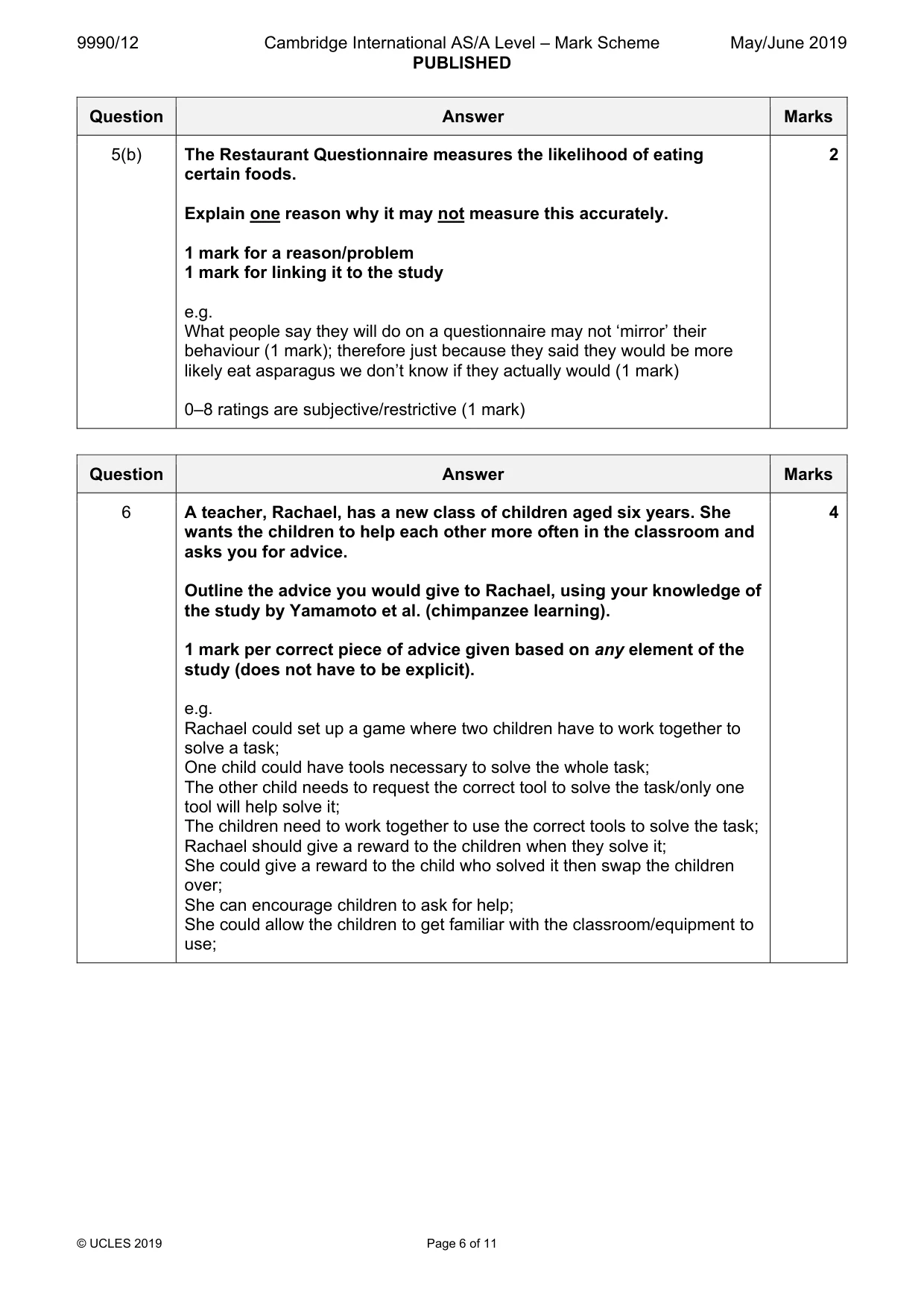
9990/12 Cambridge International AS/A Level – Mark Scheme PUBLISHED May/June 2019 © UCLES 2019 Page 6 of 11 Question Answer Marks 5(b) The Restaurant Questionnaire measures the likelihood of eating certain foods. Explain one reason why it may not measure this accurately. 1 mark for a reason/problem 1 mark for linking it to the study e.g. What people say they will do on a questionnaire may not ‘mirror’ their behaviour (1 mark); therefore just because they said they would be more likely eat asparagus we don’t know if they actually would (1 mark) 0–8 ratings are subjective/restrictive (1 mark) 2 Question Answer Marks 6 A teacher, Rachael, has a new class of children aged six years. She wants the children to help each other more often in the classroom and asks you for advice. Outline the advice you would give to Rachael, using your knowledge of the study by Yamamoto et al. (chimpanzee learning). 1 mark per correct piece of advice given based on any element of the study (does not have to be explicit). e.g. Rachael could set up a game where two children have to work together to solve a task; One child could have tools necessary to solve the whole task; The other child needs to request the correct tool to solve the task/only one tool will help solve it; The children need to work together to use the correct tools to solve the task; Rachael should give a reward to the children when they solve it; She could give a reward to the child who solved it then swap the children over; She can encourage children to ask for help; She could allow the children to get familiar with the classroom/equipment to use; 4
Mark scheme, page 7
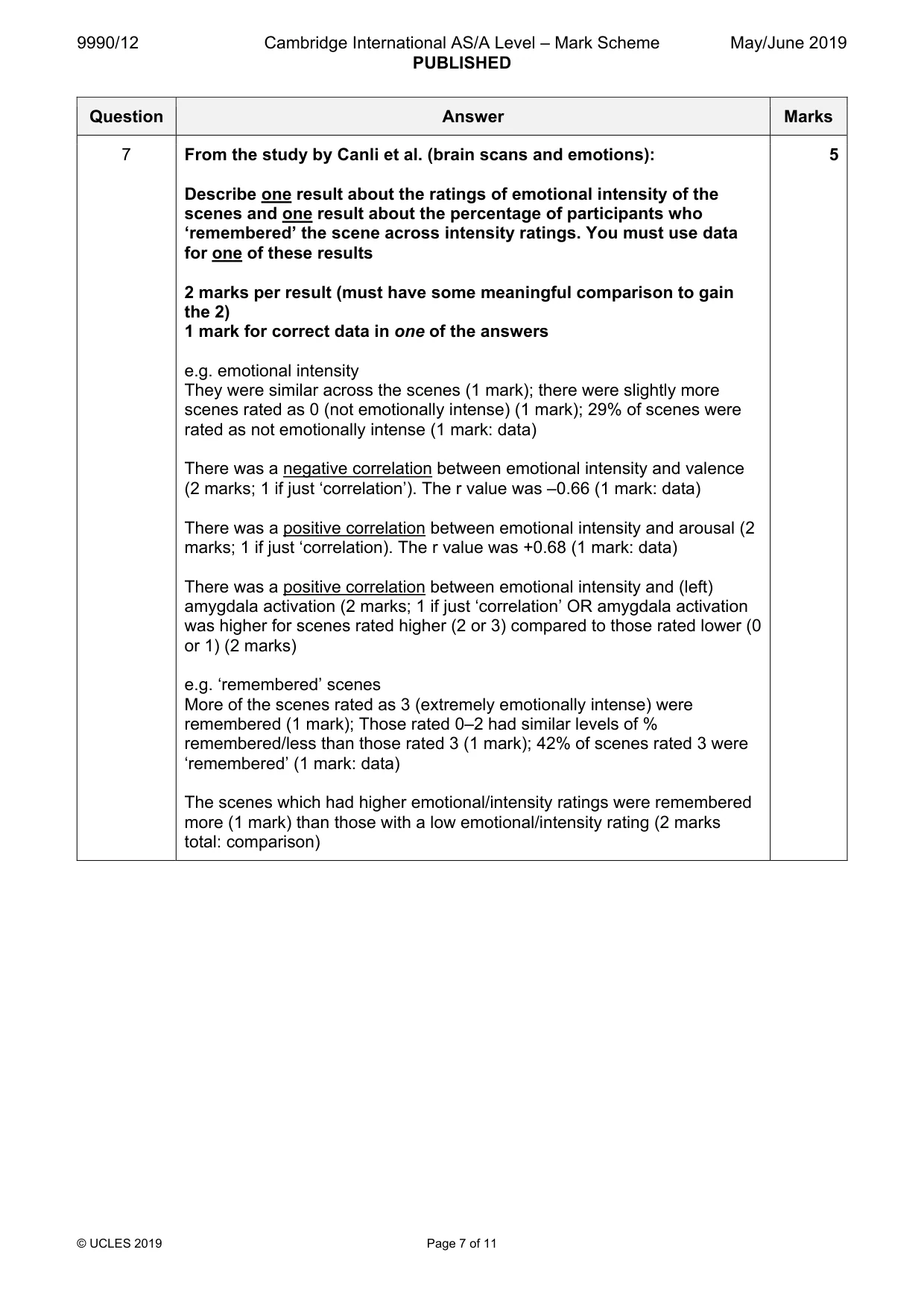
9990/12 Cambridge International AS/A Level – Mark Scheme PUBLISHED May/June 2019 © UCLES 2019 Page 7 of 11 Question Answer Marks 7 From the study by Canli et al. (brain scans and emotions): Describe one result about the ratings of emotional intensity of the scenes and one result about the percentage of participants who ‘remembered’ the scene across intensity ratings. You must use data for one of these results 2 marks per result (must have some meaningful comparison to gain the 2) 1 mark for correct data in one of the answers e.g. emotional intensity They were similar across the scenes (1 mark); there were slightly more scenes rated as 0 (not emotionally intense) (1 mark); 29% of scenes were rated as not emotionally intense (1 mark: data) There was a negative correlation between emotional intensity and valence (2 marks; 1 if just ‘correlation’). The r value was –0.66 (1 mark: data) There was a positive correlation between emotional intensity and arousal (2 marks; 1 if just ‘correlation). The r value was +0.68 (1 mark: data) There was a positive correlation between emotional intensity and (left) amygdala activation (2 marks; 1 if just ‘correlation’ OR amygdala activation was higher for scenes rated higher (2 or 3) compared to those rated lower (0 or 1) (2 marks) e.g. ‘remembered’ scenes More of the scenes rated as 3 (extremely emotionally intense) were remembered (1 mark); Those rated 0–2 had similar levels of % remembered/less than those rated 3 (1 mark); 42% of scenes rated 3 were ‘remembered’ (1 mark: data) The scenes which had higher emotional/intensity ratings were remembered more (1 mark) than those with a low emotional/intensity rating (2 marks total: comparison) 5
Mark scheme, page 8
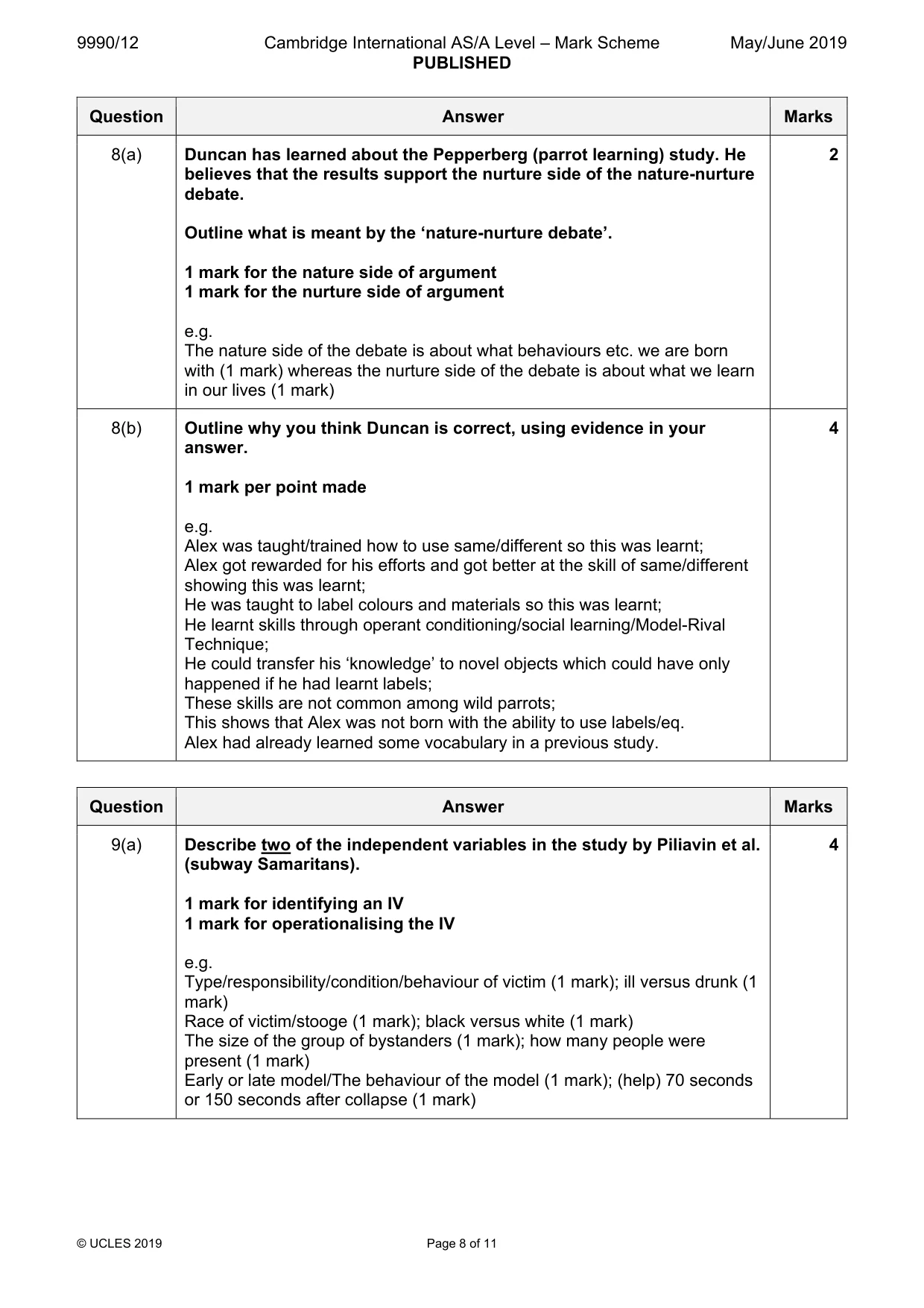
9990/12 Cambridge International AS/A Level – Mark Scheme PUBLISHED May/June 2019 © UCLES 2019 Page 8 of 11 Question Answer Marks 8(a) Duncan has learned about the Pepperberg (parrot learning) study. He believes that the results support the nurture side of the nature-nurture debate. Outline what is meant by the ‘nature-nurture debate’. 1 mark for the nature side of argument 1 mark for the nurture side of argument e.g. The nature side of the debate is about what behaviours etc. we are born with (1 mark) whereas the nurture side of the debate is about what we learn in our lives (1 mark) 2 8(b) Outline why you think Duncan is correct, using evidence in your answer. 1 mark per point made e.g. Alex was taught/trained how to use same/different so this was learnt; Alex got rewarded for his efforts and got better at the skill of same/different showing this was learnt; He was taught to label colours and materials so this was learnt; He learnt skills through operant conditioning/social learning/Model-Rival Technique; He could transfer his ‘knowledge’ to novel objects which could have only happened if he had learnt labels; These skills are not common among wild parrots; This shows that Alex was not born with the ability to use labels/eq. Alex had already learned some vocabulary in a previous study. 4 Question Answer Marks 9(a) Describe two of the independent variables in the study by Piliavin et al. (subway Samaritans). 1 mark for identifying an IV 1 mark for operationalising the IV e.g. Type/responsibility/condition/behaviour of victim (1 mark); ill versus drunk (1 mark) Race of victim/stooge (1 mark); black versus white (1 mark) The size of the group of bystanders (1 mark); how many people were present (1 mark) Early or late model/The behaviour of the model (1 mark); (help) 70 seconds or 150 seconds after collapse (1 mark) 4
Mark scheme, page 9
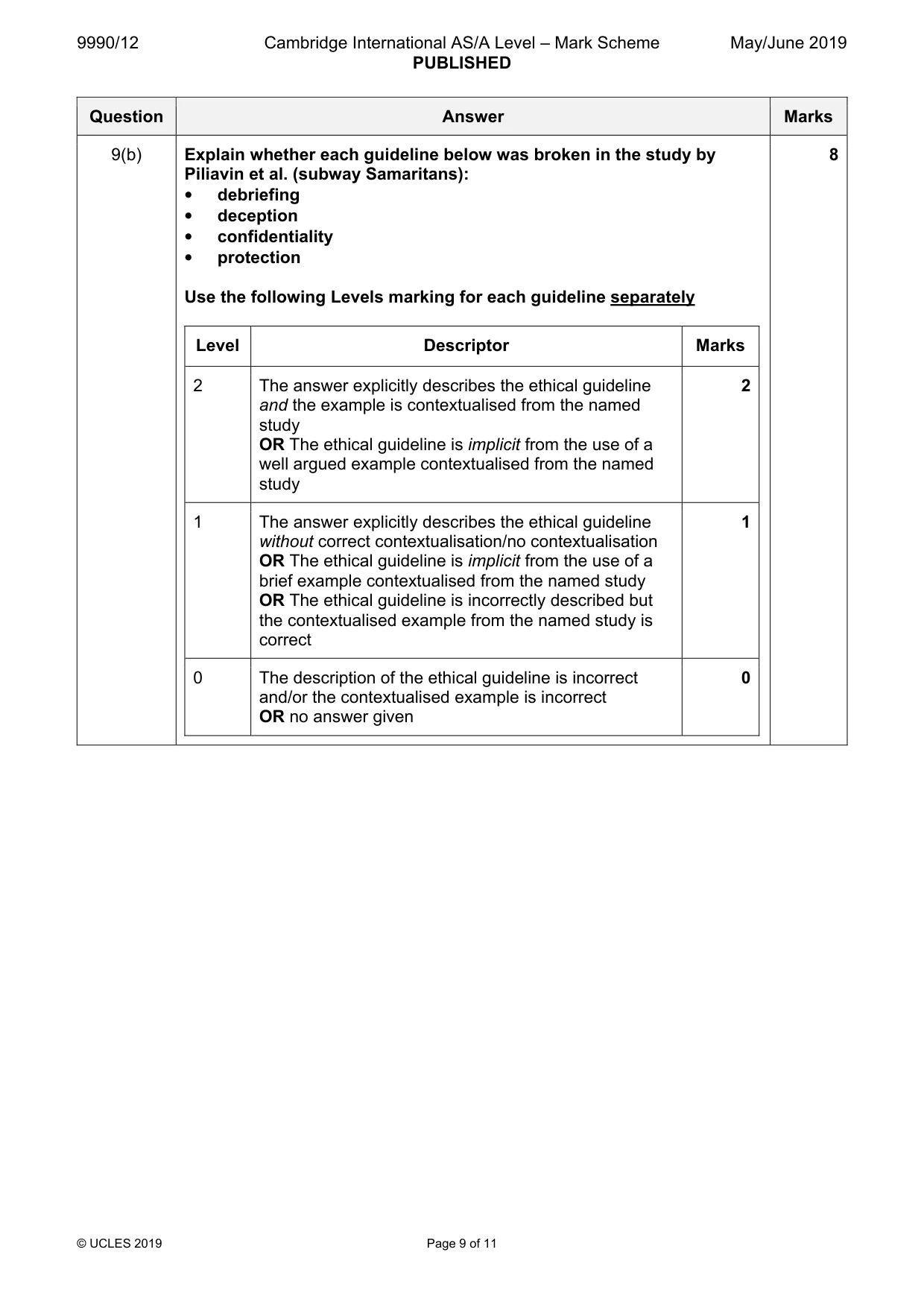
9990/12 Cambridge International AS/A Level – Mark Scheme PUBLISHED May/June 2019 © UCLES 2019 Page 9 of 11 Question Answer Marks 9(b) Explain whether each guideline below was broken in the study by Piliavin et al. (subway Samaritans): • debriefing • deception • confidentiality • protection Use the following Levels marking for each guideline separately Level Descriptor Marks 2 The answer explicitly describes the ethical guideline and the example is contextualised from the named study OR The ethical guideline is implicit from the use of a well argued example contextualised from the named study 2 1 The answer explicitly describes the ethical guideline without correct contextualisation/no contextualisation OR The ethical guideline is implicit from the use of a brief example contextualised from the named study OR The ethical guideline is incorrectly described but the contextualised example from the named study is correct 1 0 The description of the ethical guideline is incorrect and/or the contextualised example is incorrect OR no answer given 0 8
Mark scheme, page 10
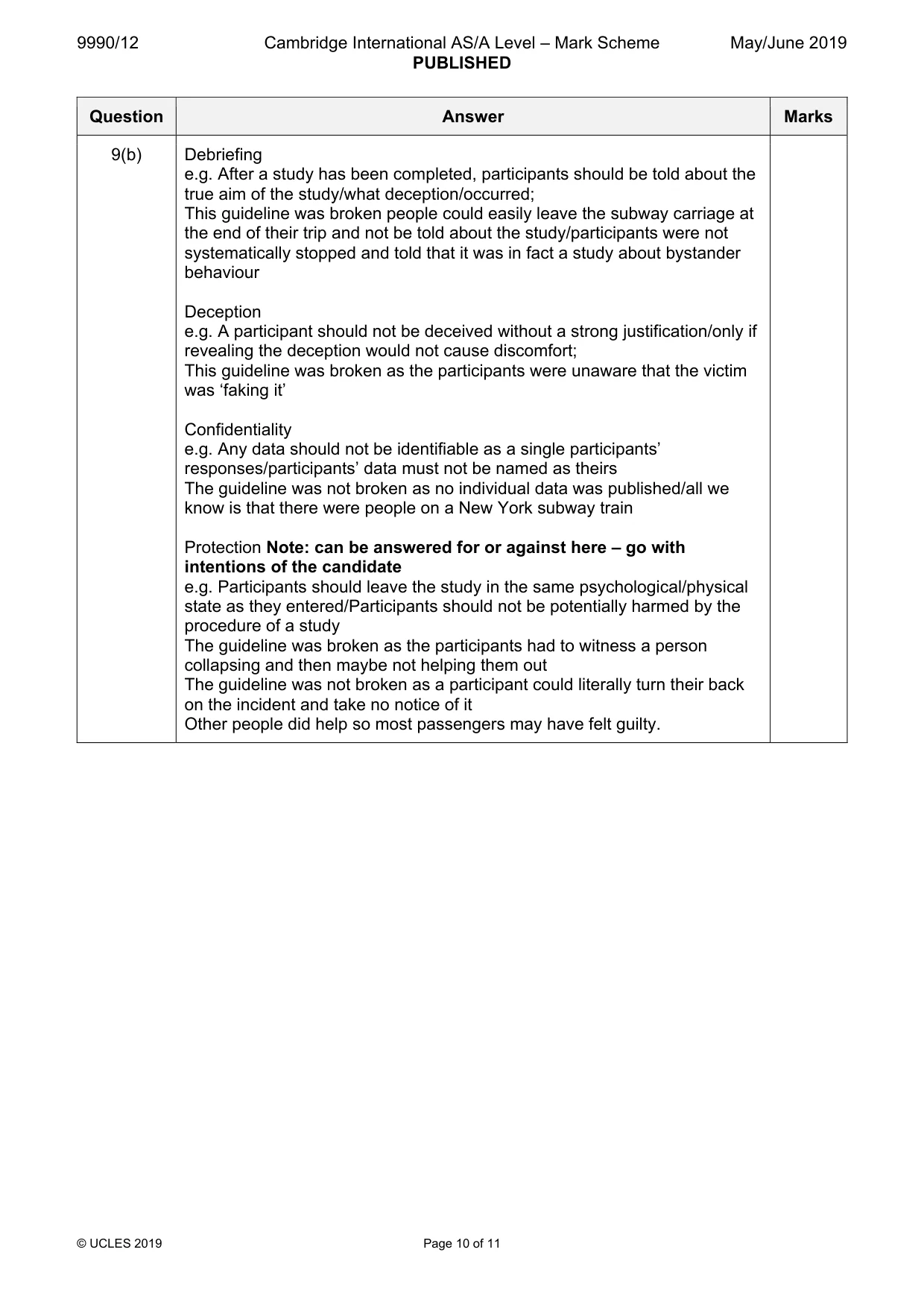
9990/12 Cambridge International AS/A Level – Mark Scheme PUBLISHED May/June 2019 © UCLES 2019 Page 10 of 11 Question Answer Marks 9(b) Debriefing e.g. After a study has been completed, participants should be told about the true aim of the study/what deception/occurred; This guideline was broken people could easily leave the subway carriage at the end of their trip and not be told about the study/participants were not systematically stopped and told that it was in fact a study about bystander behaviour Deception e.g. A participant should not be deceived without a strong justification/only if revealing the deception would not cause discomfort; This guideline was broken as the participants were unaware that the victim was ‘faking it’ Confidentiality e.g. Any data should not be identifiable as a single participants’ responses/participants’ data must not be named as theirs The guideline was not broken as no individual data was published/all we know is that there were people on a New York subway train Protection Note: can be answered for or against here – go with intentions of the candidate e.g. Participants should leave the study in the same psychological/physical state as they entered/Participants should not be potentially harmed by the procedure of a study The guideline was broken as the participants had to witness a person collapsing and then maybe not helping them out The guideline was not broken as a participant could literally turn their back on the incident and take no notice of it Other people did help so most passengers may have felt guilty.
Mark scheme, page 11
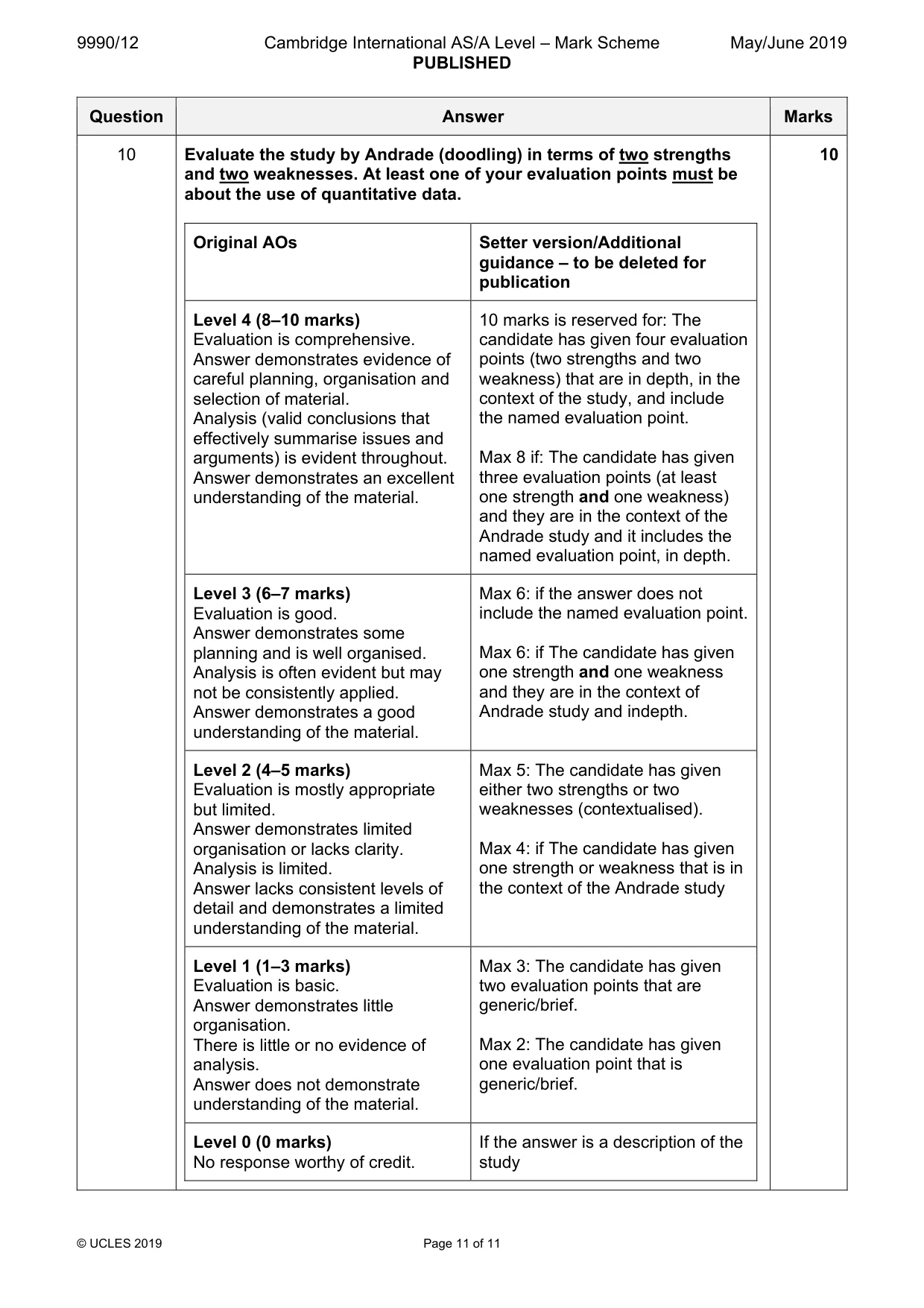
9990/12 Cambridge International AS/A Level – Mark Scheme PUBLISHED May/June 2019 © UCLES 2019 Page 11 of 11 Question Answer Marks 10 Evaluate the study by Andrade (doodling) in terms of two strengths and two weaknesses. At least one of your evaluation points must be about the use of quantitative data. Original AOs Setter version/Additional guidance – to be deleted for publication Level 4 (8–10 marks) Evaluation is comprehensive. Answer demonstrates evidence of careful planning, organisation and selection of material. Analysis (valid conclusions that effectively summarise issues and arguments) is evident throughout. Answer demonstrates an excellent understanding of the material. 10 marks is reserved for: The candidate has given four evaluation points (two strengths and two weakness) that are in depth, in the context of the study, and include the named evaluation point. Max 8 if: The candidate has given three evaluation points (at least one strength and one weakness) and they are in the context of the Andrade study and it includes the named evaluation point, in depth. Level 3 (6–7 marks) Evaluation is good. Answer demonstrates some planning and is well organised. Analysis is often evident but may not be consistently applied. Answer demonstrates a good understanding of the material. Max 6: if the answer does not include the named evaluation point. Max 6: if The candidate has given one strength and one weakness and they are in the context of Andrade study and indepth. Level 2 (4–5 marks) Evaluation is mostly appropriate but limited. Answer demonstrates limited organisation or lacks clarity. Analysis is limited. Answer lacks consistent levels of detail and demonstrates a limited understanding of the material. Max 5: The candidate has given either two strengths or two weaknesses (contextualised). Max 4: if The candidate has given one strength or weakness that is in the context of the Andrade study Level 1 (1–3 marks) Evaluation is basic. Answer demonstrates little organisation. There is little or no evidence of analysis. Answer does not demonstrate understanding of the material. Max 3: The candidate has given two evaluation points that are generic/brief. Max 2: The candidate has given one evaluation point that is generic/brief. Level 0 (0 marks) No response worthy of credit. If the answer is a description of the study 10
What you needed in this session
Cambridge’s own grade thresholds for 2019 May/June, Paper 1 · Variant 2. A higher threshold means an easier paper — the bar moves with how the cohort did.