Cambridge A Level Psychology (from 2018) 9990 — 2019 Feb/March Paper 1 · Variant 2
9990/12/F/M/19 · 60 marks · ≈68 min
The question paper and its mark scheme, free to read here and free to download. This is Cambridge’s own paper, exactly as it was sat.
Question paper12 pages



Mark scheme9 pages
Answers below. Sit the paper first if you are practising.
Paper as text
Question paper, page 1
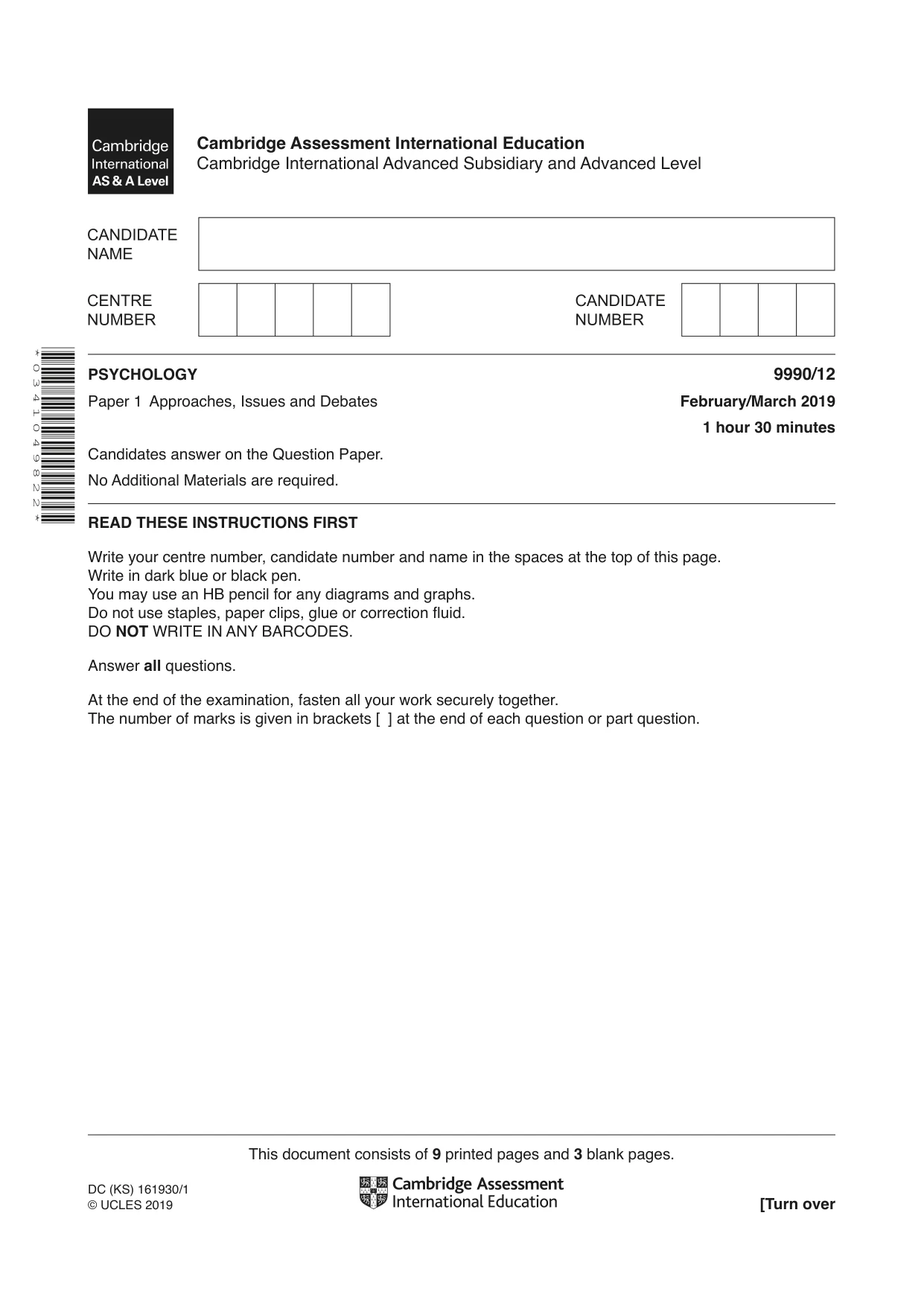
This document consists of 9 printed pages and 3 blank pages. DC (KS) 161930/1 © UCLES 2019 [Turn over Cambridge Assessment International Education Cambridge International Advanced Subsidiary and Advanced Level * 0 3 4 1 0 4 9 8 2 2 * PSYCHOLOGY 9990/12 Paper 1 Approaches, Issues and Debates February/March 2019 1 hour 30 minutes Candidates answer on the Question Paper. No Additional Materials are required. READ THESE INSTRUCTIONS FIRST Write your centre number, candidate number and name in the spaces at the top of this page. Write in dark blue or black pen. You may use an HB pencil for any diagrams and graphs. Do not use staples, paper clips, glue or correction fluid. DO NOT WRITE IN ANY BARCODES. Answer all questions. At the end of the examination, fasten all your work securely together. The number of marks is given in brackets [ ] at the end of each question or part question.
Question paper, page 2
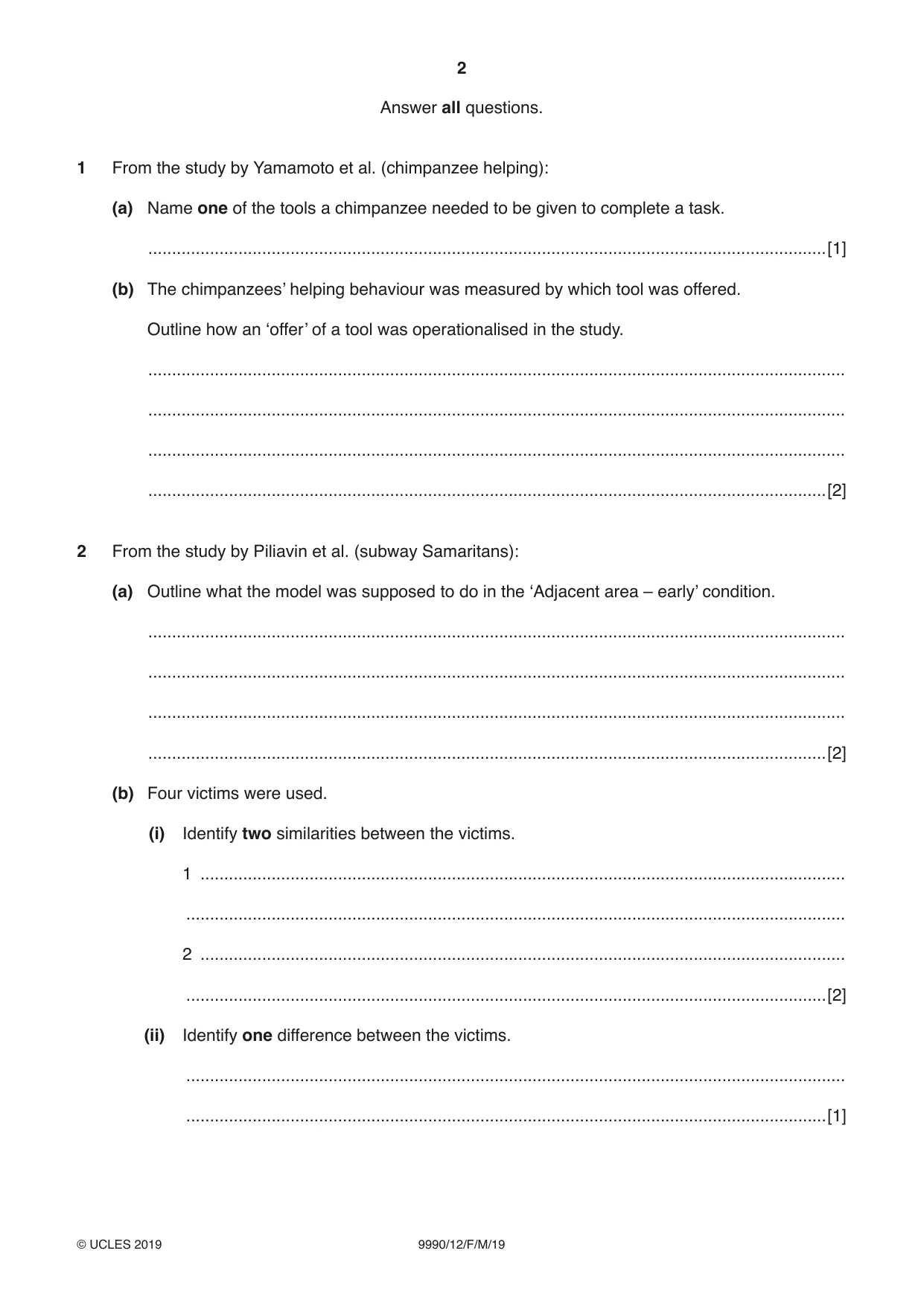
2 9990/12/F/M/19 © UCLES 2019 Answer all questions. 1 From the study by Yamamoto et al. (chimpanzee helping): (a) Name one of the tools a chimpanzee needed to be given to complete a task. …[1] (b) The chimpanzees’ helping behaviour was measured by which tool was offered. Outline how an ‘offer’ of a tool was operationalised in the study. … … … …[2] 2 From the study by Piliavin et al. (subway Samaritans): (a) Outline what the model was supposed to do in the ‘Adjacent area – early’ condition. … … … …[2] (b) Four victims were used. (i) Identify two similarities between the victims. 1 … … 2 … …[2] (ii) Identify one difference between the victims. … …[1]
Question paper, page 3
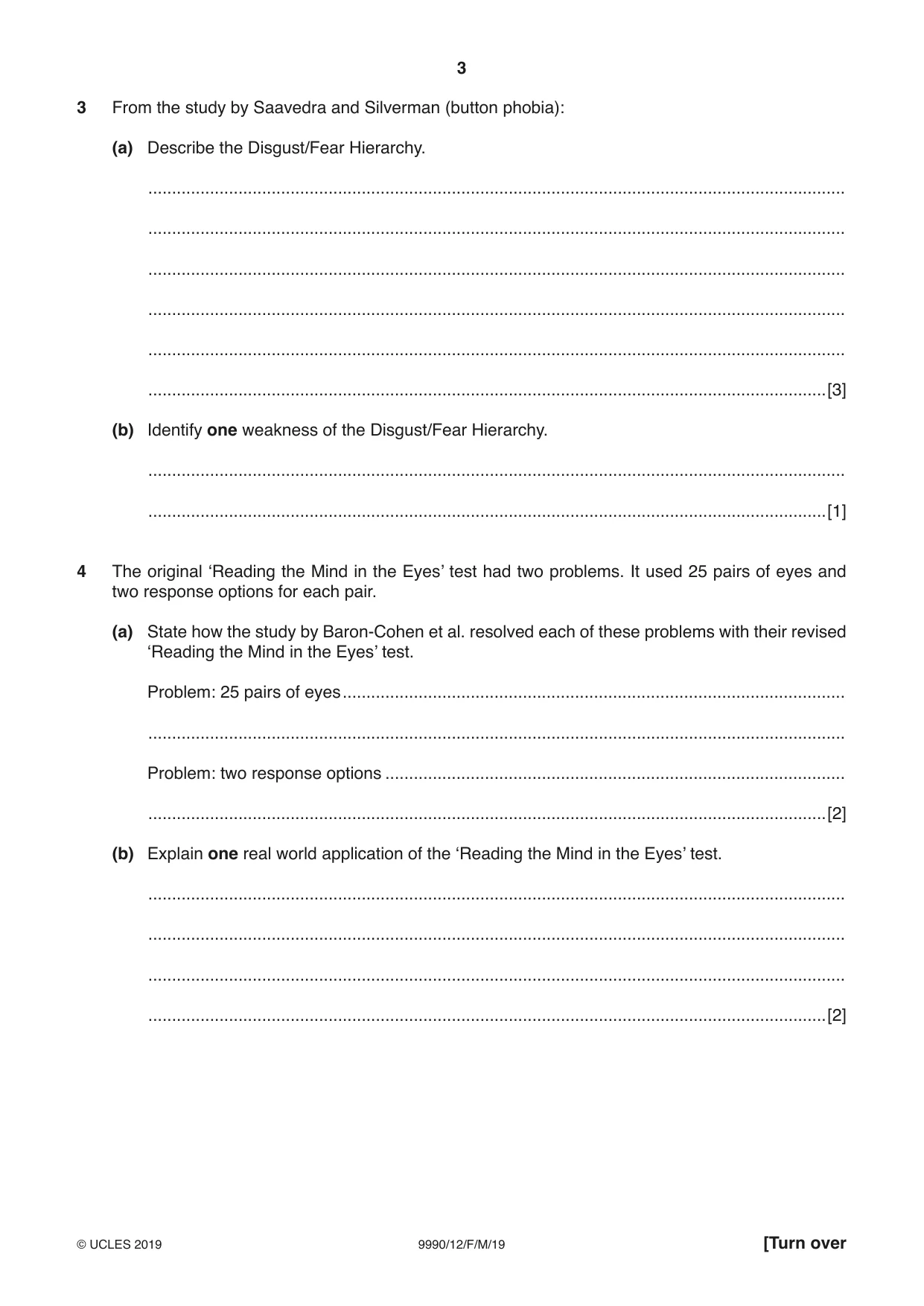
3 9990/12/F/M/19 © UCLES 2019 [Turn over 3 From the study by Saavedra and Silverman (button phobia): (a) Describe the Disgust/Fear Hierarchy. … … … … … …[3] (b) Identify one weakness of the Disgust/Fear Hierarchy. … …[1] 4 The original ‘Reading the Mind in the Eyes’ test had two problems. It used 25 pairs of eyes and two response options for each pair. (a) State how the study by Baron-Cohen et al. resolved each of these problems with their revised ‘Reading the Mind in the Eyes’ test. Problem: 25 pairs of eyes … … Problem: two response options … …[2] (b) Explain one real world application of the ‘Reading the Mind in the Eyes’ test. … … … …[2]
Question paper, page 4
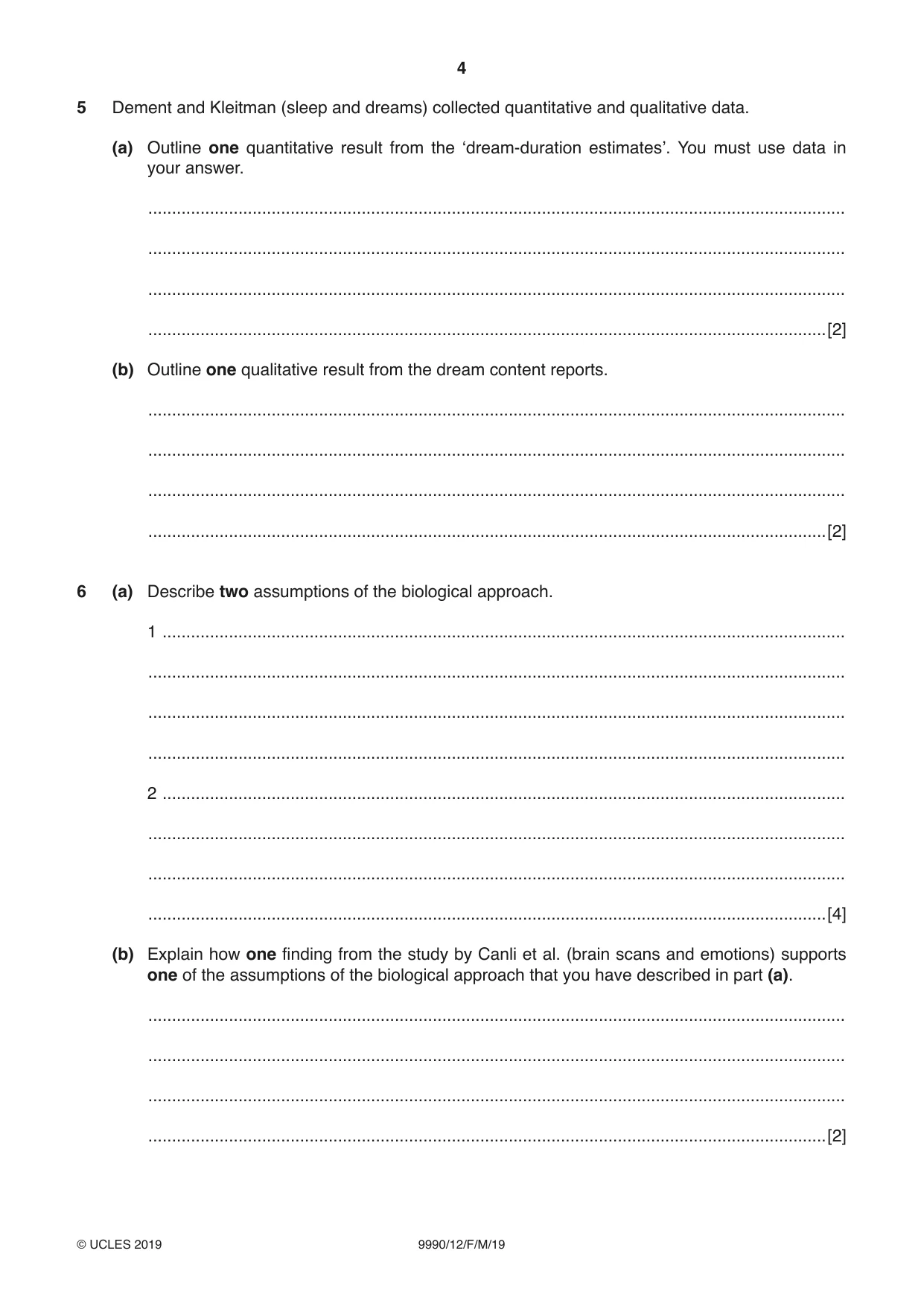
4 9990/12/F/M/19 © UCLES 2019 5 Dement and Kleitman (sleep and dreams) collected quantitative and qualitative data. (a) Outline one quantitative result from the ‘dream-duration estimates’. You must use data in your answer. … … … …[2] (b) Outline one qualitative result from the dream content reports. … … … …[2] 6 (a) Describe two assumptions of the biological approach. 1 … … … … 2 … … … …[4] (b) Explain how one finding from the study by Canli et al. (brain scans and emotions) supports one of the assumptions of the biological approach that you have described in part (a). … … … …[2]
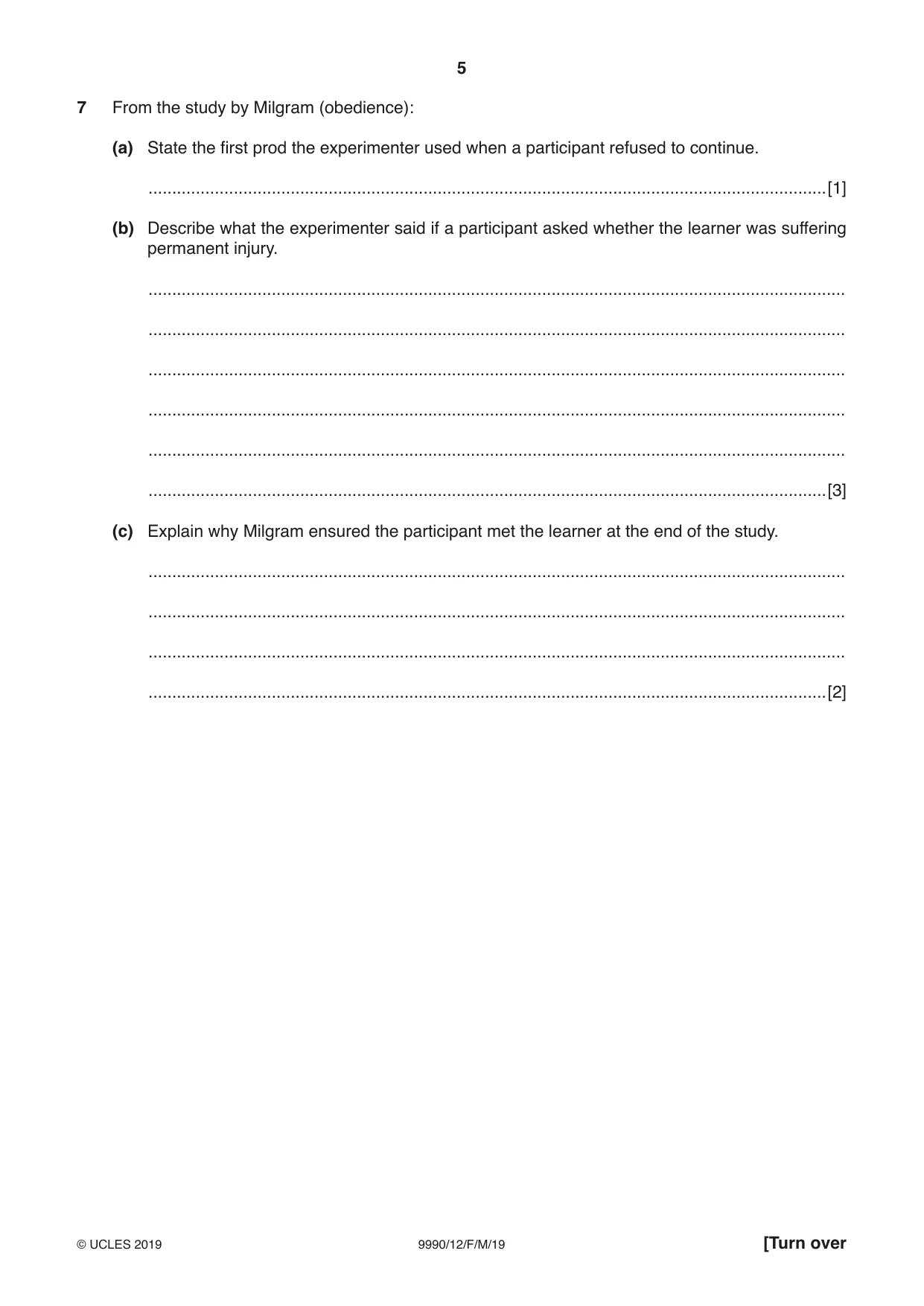
Question paper, page 5
5 9990/12/F/M/19 © UCLES 2019 [Turn over 7 From the study by Milgram (obedience): (a) State the first prod the experimenter used when a participant refused to continue. …[1] (b) Describe what the experimenter said if a participant asked whether the learner was suffering permanent injury. … … … … … …[3] (c) Explain why Milgram ensured the participant met the learner at the end of the study. … … … …[2]
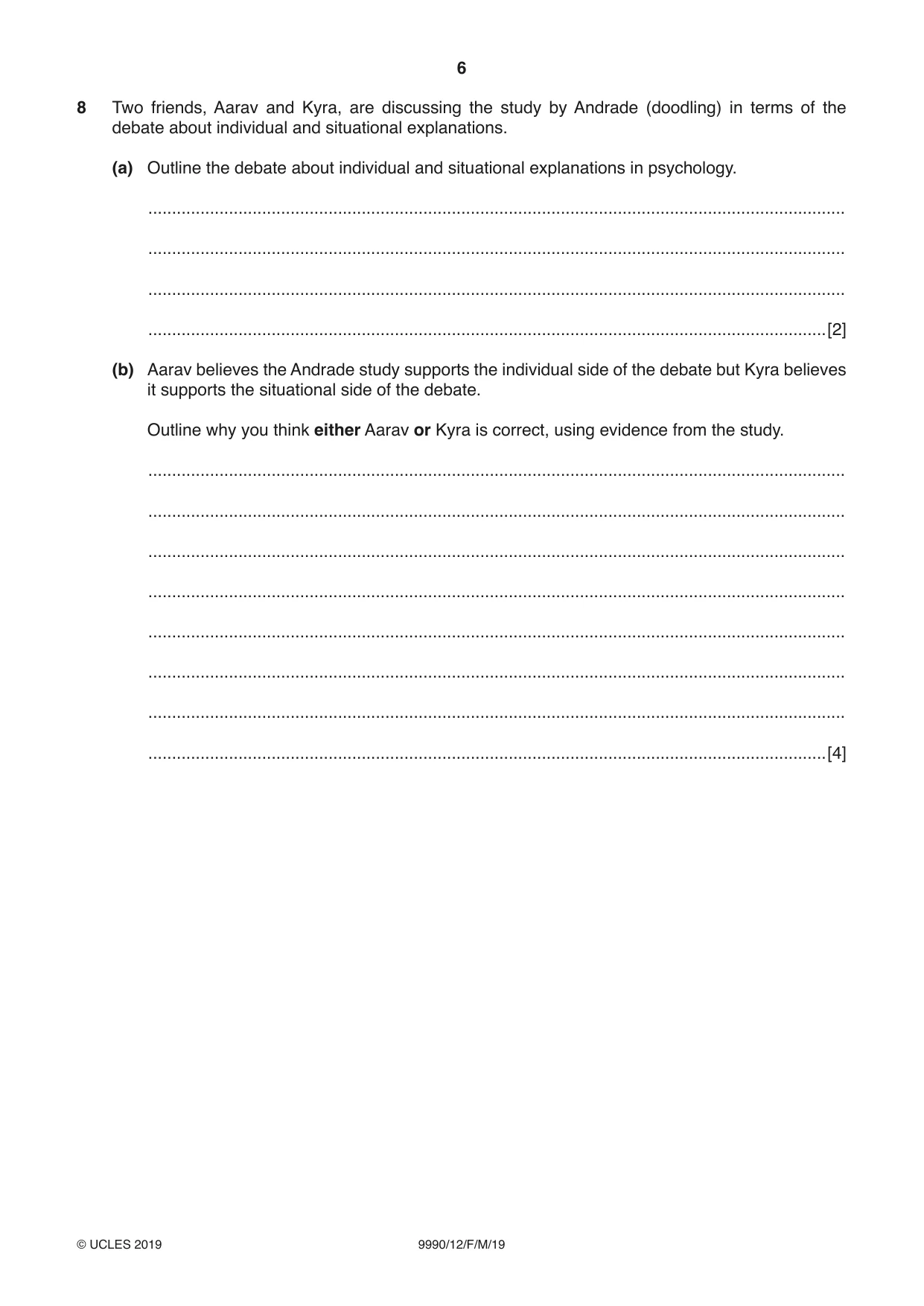
Question paper, page 6
6 9990/12/F/M/19 © UCLES 2019 8 Two friends, Aarav and Kyra, are discussing the study by Andrade (doodling) in terms of the debate about individual and situational explanations. (a) Outline the debate about individual and situational explanations in psychology. … … … …[2] (b) Aarav believes the Andrade study supports the individual side of the debate but Kyra believes it supports the situational side of the debate. Outline why you think either Aarav or Kyra is correct, using evidence from the study. … … … … … … … …[4]
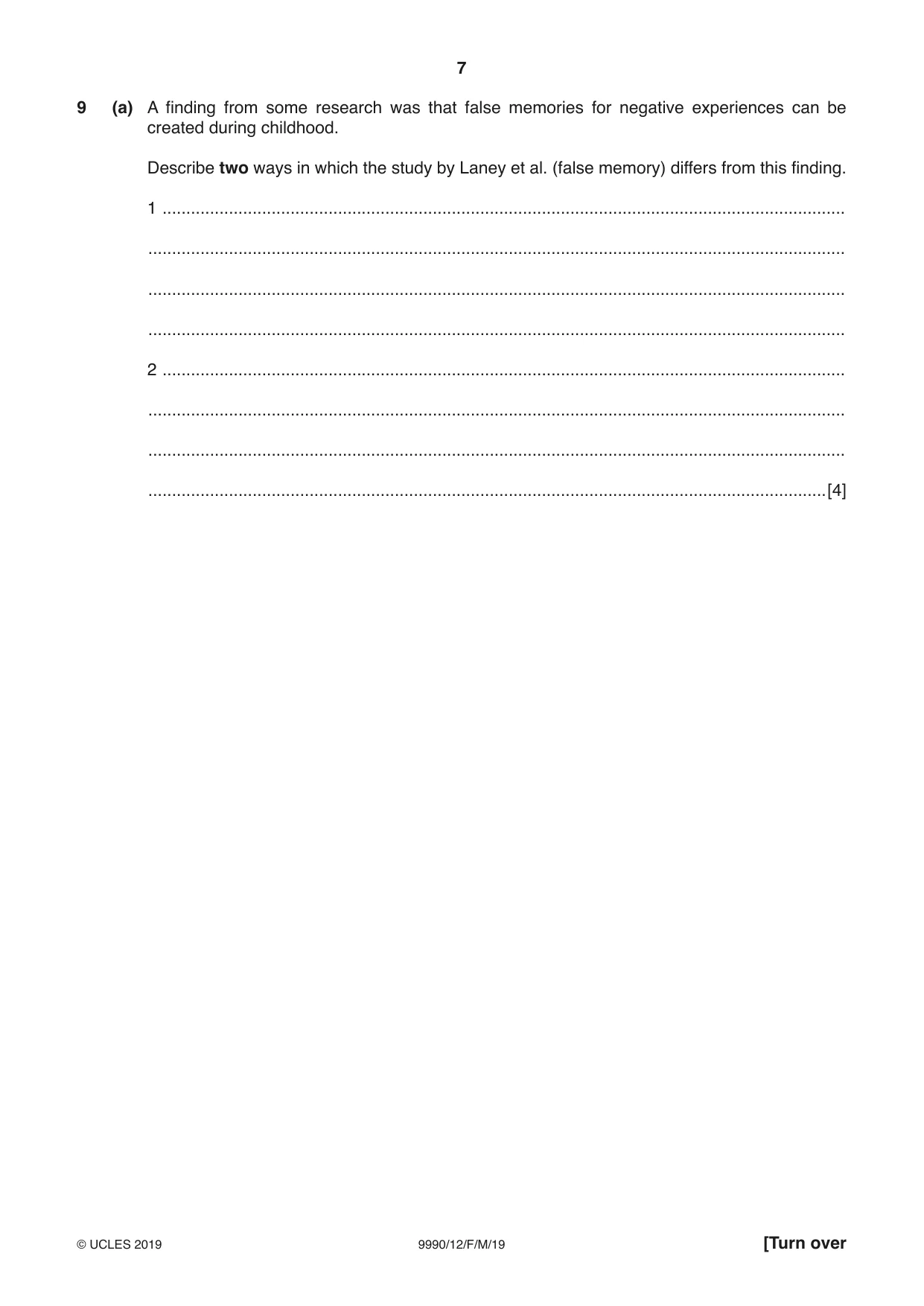
Question paper, page 7
7 9990/12/F/M/19 © UCLES 2019 [Turn over 9 (a) A finding from some research was that false memories for negative experiences can be created during childhood. Describe two ways in which the study by Laney et al. (false memory) differs from this finding. 1 … … … … 2 … … … …[4]
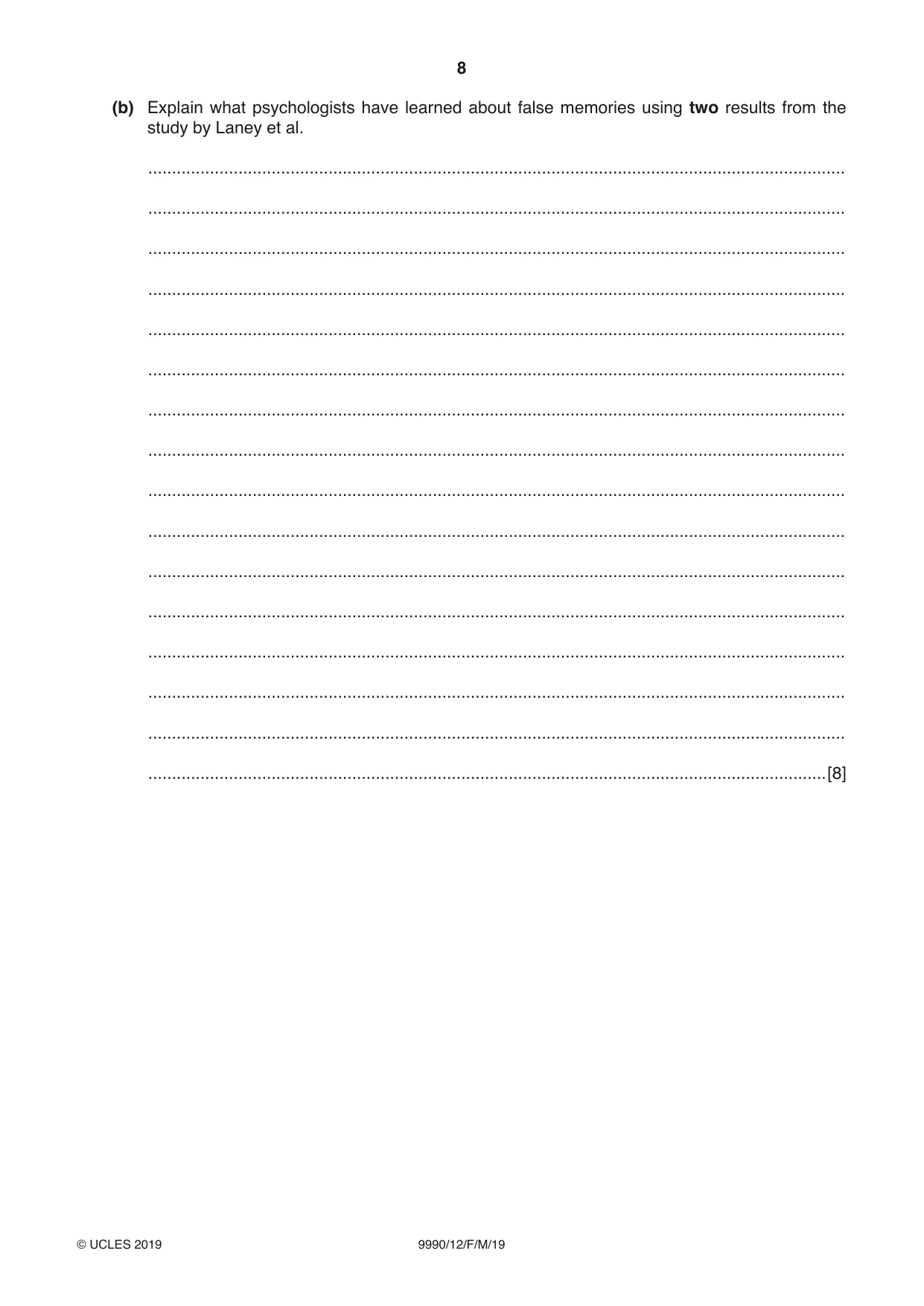
Question paper, page 8
8 9990/12/F/M/19 © UCLES 2019 (b) Explain what psychologists have learned about false memories using two results from the study by Laney et al. … … … … … … … … … … … … … … … …[8]
Question paper, page 9
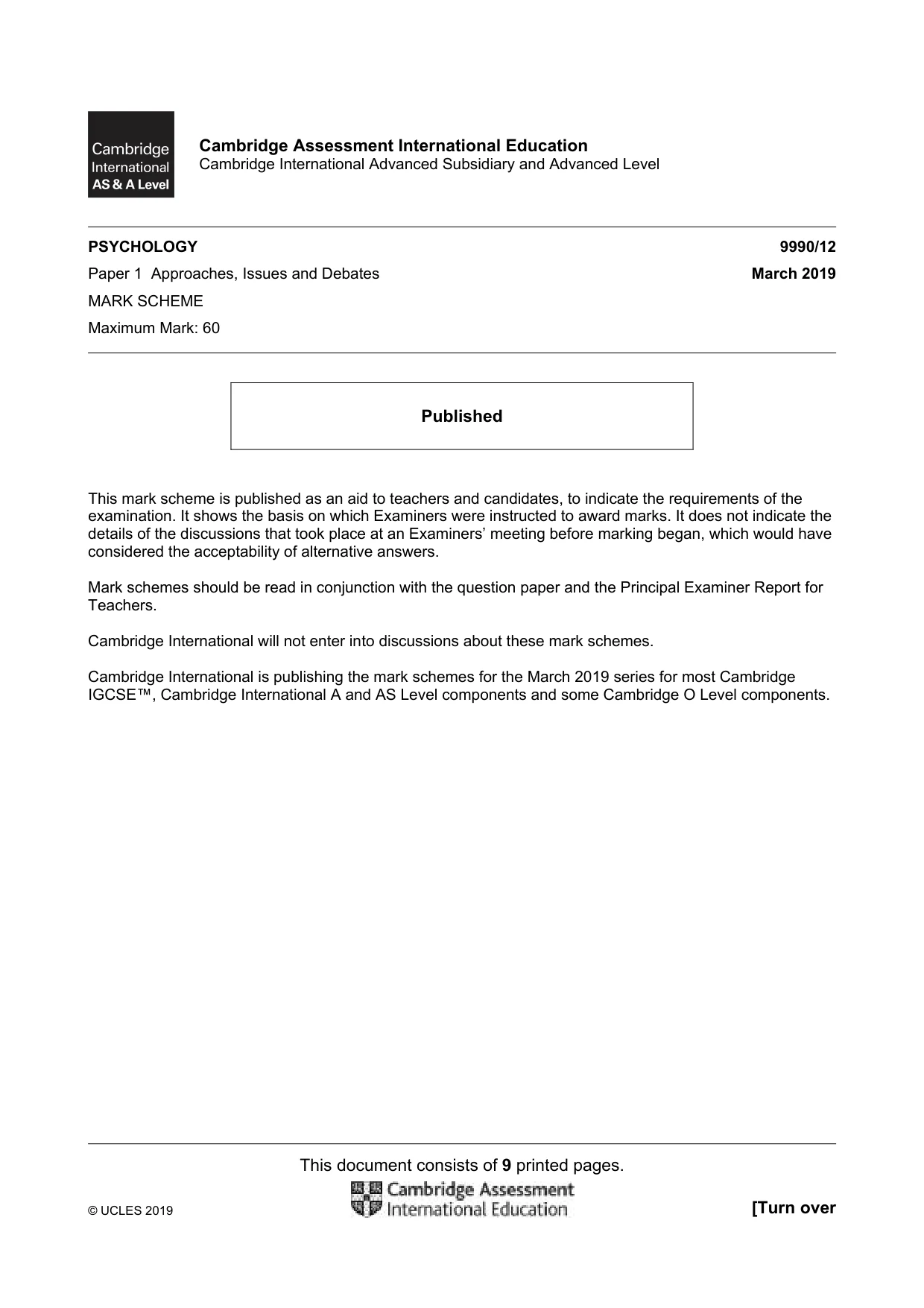
9 9990/12/F/M/19 © UCLES 2019 10 Evaluate the study by Bandura et al. (aggression) in terms of two strengths and two weaknesses. At least one of your evaluation points must be about ethics. … … … … … … … … … … … … … … … … … … … … … … …[10]
Question paper, page 10
10 9990/12/F/M/19 © UCLES 2019 BLANK PAGE
Question paper, page 11
11 9990/12/F/M/19 © UCLES 2019 BLANK PAGE
Question paper, page 12
12 9990/12/F/M/19 © UCLES 2019 Permission to reproduce items where third-party owned material protected by copyright is included has been sought and cleared where possible. Every reasonable effort has been made by the publisher (UCLES) to trace copyright holders, but if any items requiring clearance have unwittingly been included, the publisher will be pleased to make amends at the earliest possible opportunity. To avoid the issue of disclosure of answer-related information to candidates, all copyright acknowledgements are reproduced online in the Cambridge Assessment International Education Copyright Acknowledgements Booklet. This is produced for each series of examinations and is freely available to download at www.cambridgeinternational.org after the live examination series. Cambridge Assessment International Education is part of the Cambridge Assessment Group. Cambridge Assessment is the brand name of the University of Cambridge Local Examinations Syndicate (UCLES), which itself is a department of the University of Cambridge. BLANK PAGE
Mark scheme, page 1
This document consists of 9 printed pages. © UCLES 2019 [Turn over Cambridge Assessment International Education Cambridge International Advanced Subsidiary and Advanced Level PSYCHOLOGY 9990/12 Paper 1 Approaches, Issues and Debates March 2019 MARK SCHEME Maximum Mark: 60 Published This mark scheme is published as an aid to teachers and candidates, to indicate the requirements of the examination. It shows the basis on which Examiners were instructed to award marks. It does not indicate the details of the discussions that took place at an Examiners’ meeting before marking began, which would have considered the acceptability of alternative answers. Mark schemes should be read in conjunction with the question paper and the Principal Examiner Report for Teachers. Cambridge International will not enter into discussions about these mark schemes. Cambridge International is publishing the mark schemes for the March 2019 series for most Cambridge IGCSE™, Cambridge International A and AS Level components and some Cambridge O Level components.
Mark scheme, page 2
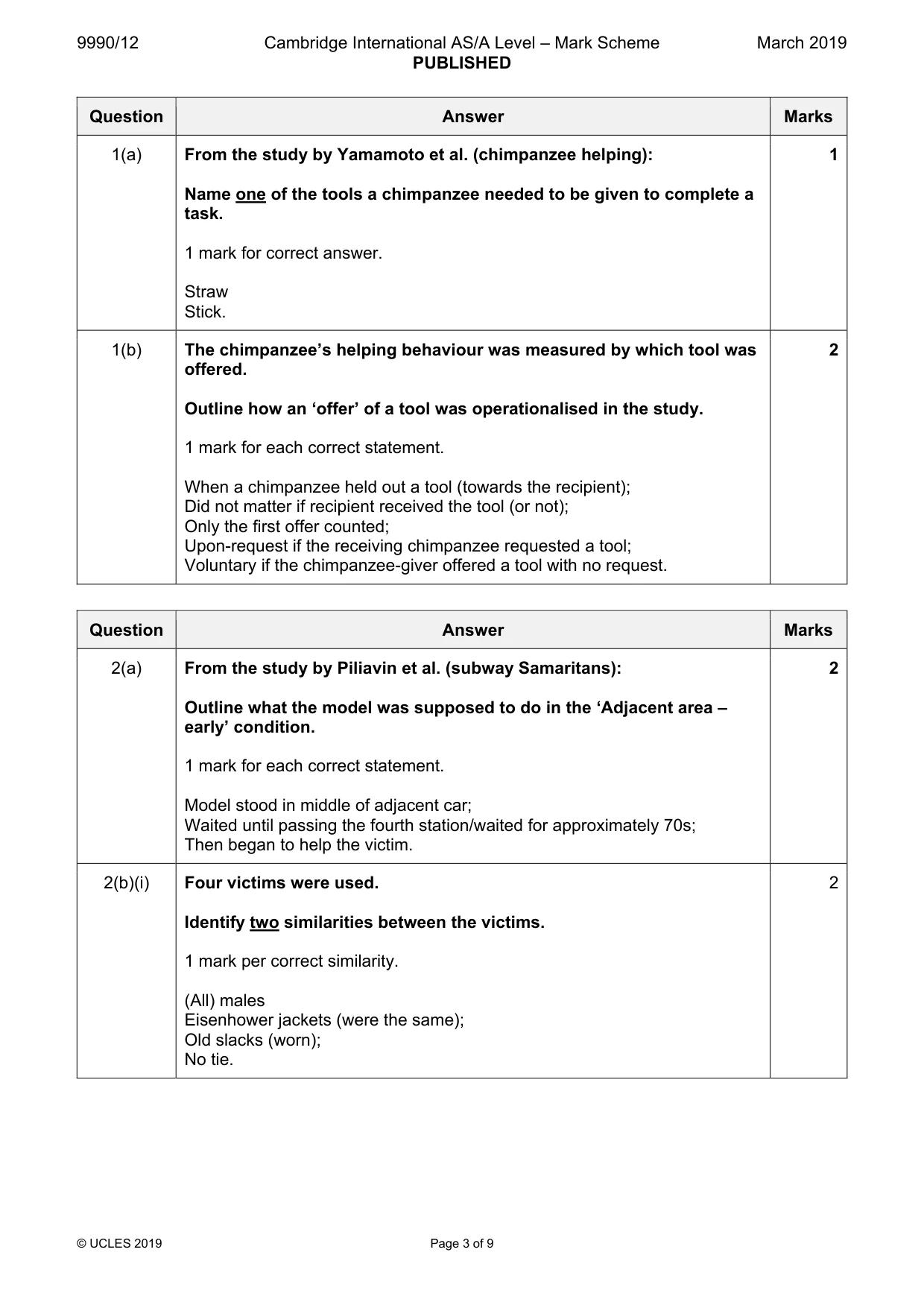
9990/12 Cambridge International AS/A Level – Mark Scheme PUBLISHED March 2019 © UCLES 2019 Page 2 of 9 Generic Marking Principles These general marking principles must be applied by all examiners when marking candidate answers. They should be applied alongside the specific content of the mark scheme or generic level descriptors for a question. Each question paper and mark scheme will also comply with these marking principles. GENERIC MARKING PRINCIPLE 1: Marks must be awarded in line with: • the specific content of the mark scheme or the generic level descriptors for the question • the specific skills defined in the mark scheme or in the generic level descriptors for the question • the standard of response required by a candidate as exemplified by the standardisation scripts. GENERIC MARKING PRINCIPLE 2: Marks awarded are always whole marks (not half marks, or other fractions). GENERIC MARKING PRINCIPLE 3: Marks must be awarded positively: • marks are awarded for correct/valid answers, as defined in the mark scheme. However, credit is given for valid answers which go beyond the scope of the syllabus and mark scheme, referring to your Team Leader as appropriate • marks are awarded when candidates clearly demonstrate what they know and can do • marks are not deducted for errors • marks are not deducted for omissions • answers should only be judged on the quality of spelling, punctuation and grammar when these features are specifically assessed by the question as indicated by the mark scheme. The meaning, however, should be unambiguous. GENERIC MARKING PRINCIPLE 4: Rules must be applied consistently e.g. in situations where candidates have not followed instructions or in the application of generic level descriptors. GENERIC MARKING PRINCIPLE 5: Marks should be awarded using the full range of marks defined in the mark scheme for the question (however; the use of the full mark range may be limited according to the quality of the candidate responses seen). GENERIC MARKING PRINCIPLE 6: Marks awarded are based solely on the requirements as defined in the mark scheme. Marks should not be awarded with grade thresholds or grade descriptors in mind.
Mark scheme, page 3
9990/12 Cambridge International AS/A Level – Mark Scheme PUBLISHED March 2019 © UCLES 2019 Page 3 of 9 Question Answer Marks 1(a) From the study by Yamamoto et al. (chimpanzee helping): Name one of the tools a chimpanzee needed to be given to complete a task. 1 mark for correct answer. Straw Stick. 1 1(b) The chimpanzee’s helping behaviour was measured by which tool was offered. Outline how an ‘offer’ of a tool was operationalised in the study. 1 mark for each correct statement. When a chimpanzee held out a tool (towards the recipient); Did not matter if recipient received the tool (or not); Only the first offer counted; Upon-request if the receiving chimpanzee requested a tool; Voluntary if the chimpanzee-giver offered a tool with no request. 2 Question Answer Marks 2(a) From the study by Piliavin et al. (subway Samaritans): Outline what the model was supposed to do in the ‘Adjacent area – early’ condition. 1 mark for each correct statement. Model stood in middle of adjacent car; Waited until passing the fourth station/waited for approximately 70s; Then began to help the victim. 2 2(b)(i) Four victims were used. Identify two similarities between the victims. 1 mark per correct similarity. (All) males Eisenhower jackets (were the same); Old slacks (worn); No tie. 2
Mark scheme, page 4
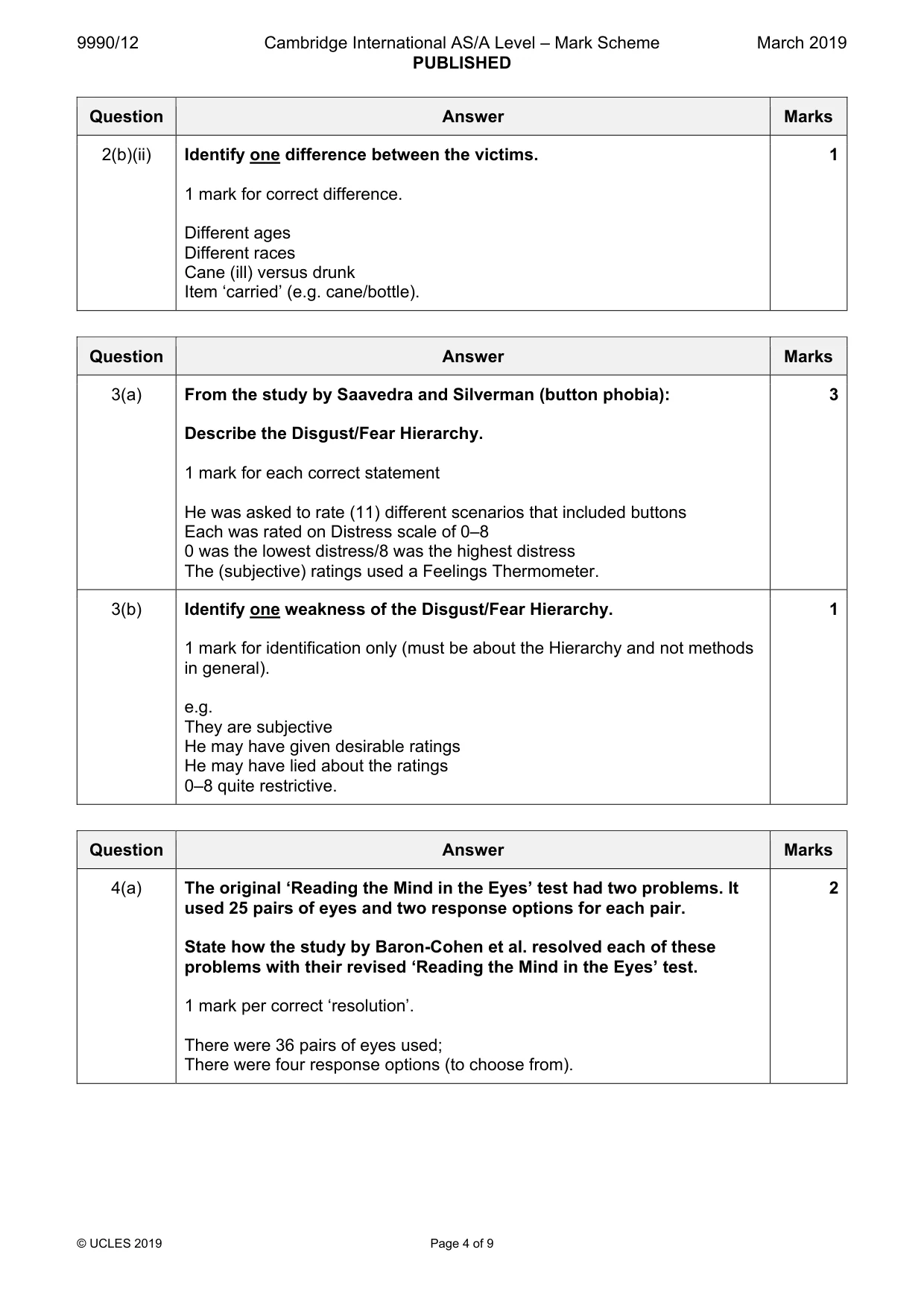
9990/12 Cambridge International AS/A Level – Mark Scheme PUBLISHED March 2019 © UCLES 2019 Page 4 of 9 Question Answer Marks 2(b)(ii) Identify one difference between the victims. 1 mark for correct difference. Different ages Different races Cane (ill) versus drunk Item ‘carried’ (e.g. cane/bottle). 1 Question Answer Marks 3(a) From the study by Saavedra and Silverman (button phobia): Describe the Disgust/Fear Hierarchy. 1 mark for each correct statement He was asked to rate (11) different scenarios that included buttons Each was rated on Distress scale of 0–8 0 was the lowest distress/8 was the highest distress The (subjective) ratings used a Feelings Thermometer. 3 3(b) Identify one weakness of the Disgust/Fear Hierarchy. 1 mark for identification only (must be about the Hierarchy and not methods in general). e.g. They are subjective He may have given desirable ratings He may have lied about the ratings 0–8 quite restrictive. 1 Question Answer Marks 4(a) The original ‘Reading the Mind in the Eyes’ test had two problems. It used 25 pairs of eyes and two response options for each pair. State how the study by Baron-Cohen et al. resolved each of these problems with their revised ‘Reading the Mind in the Eyes’ test. 1 mark per correct ‘resolution’. There were 36 pairs of eyes used; There were four response options (to choose from). 2
Mark scheme, page 5
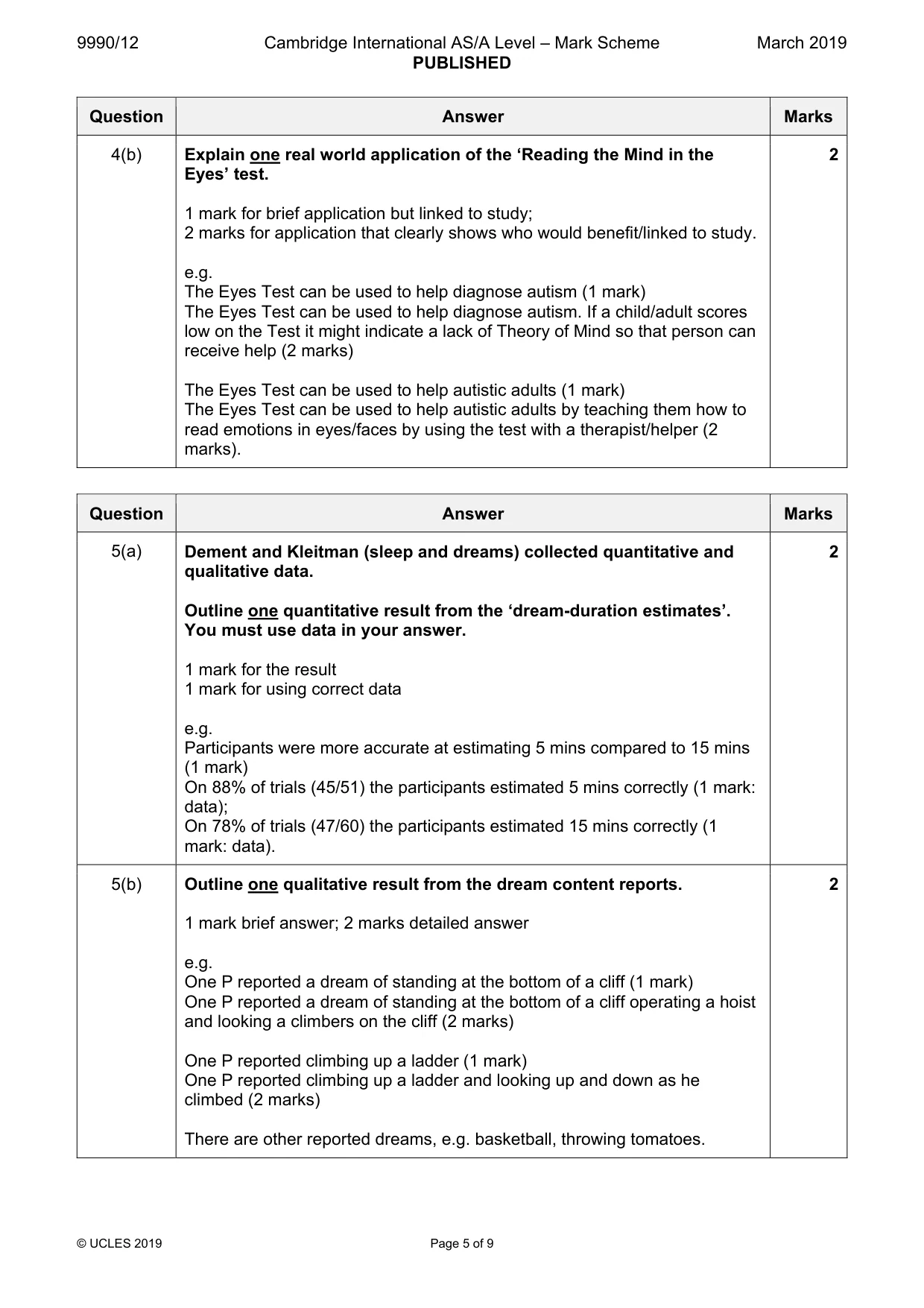
9990/12 Cambridge International AS/A Level – Mark Scheme PUBLISHED March 2019 © UCLES 2019 Page 5 of 9 Question Answer Marks 4(b) Explain one real world application of the ‘Reading the Mind in the Eyes’ test. 1 mark for brief application but linked to study; 2 marks for application that clearly shows who would benefit/linked to study. e.g. The Eyes Test can be used to help diagnose autism (1 mark) The Eyes Test can be used to help diagnose autism. If a child/adult scores low on the Test it might indicate a lack of Theory of Mind so that person can receive help (2 marks) The Eyes Test can be used to help autistic adults (1 mark) The Eyes Test can be used to help autistic adults by teaching them how to read emotions in eyes/faces by using the test with a therapist/helper (2 marks). 2 Question Answer Marks 5(a) Dement and Kleitman (sleep and dreams) collected quantitative and qualitative data. Outline one quantitative result from the ‘dream-duration estimates’. You must use data in your answer. 1 mark for the result 1 mark for using correct data e.g. Participants were more accurate at estimating 5 mins compared to 15 mins (1 mark) On 88% of trials (45/51) the participants estimated 5 mins correctly (1 mark: data); On 78% of trials (47/60) the participants estimated 15 mins correctly (1 mark: data). 2 5(b) Outline one qualitative result from the dream content reports. 1 mark brief answer; 2 marks detailed answer e.g. One P reported a dream of standing at the bottom of a cliff (1 mark) One P reported a dream of standing at the bottom of a cliff operating a hoist and looking a climbers on the cliff (2 marks) One P reported climbing up a ladder (1 mark) One P reported climbing up a ladder and looking up and down as he climbed (2 marks) There are other reported dreams, e.g. basketball, throwing tomatoes. 2
Mark scheme, page 6
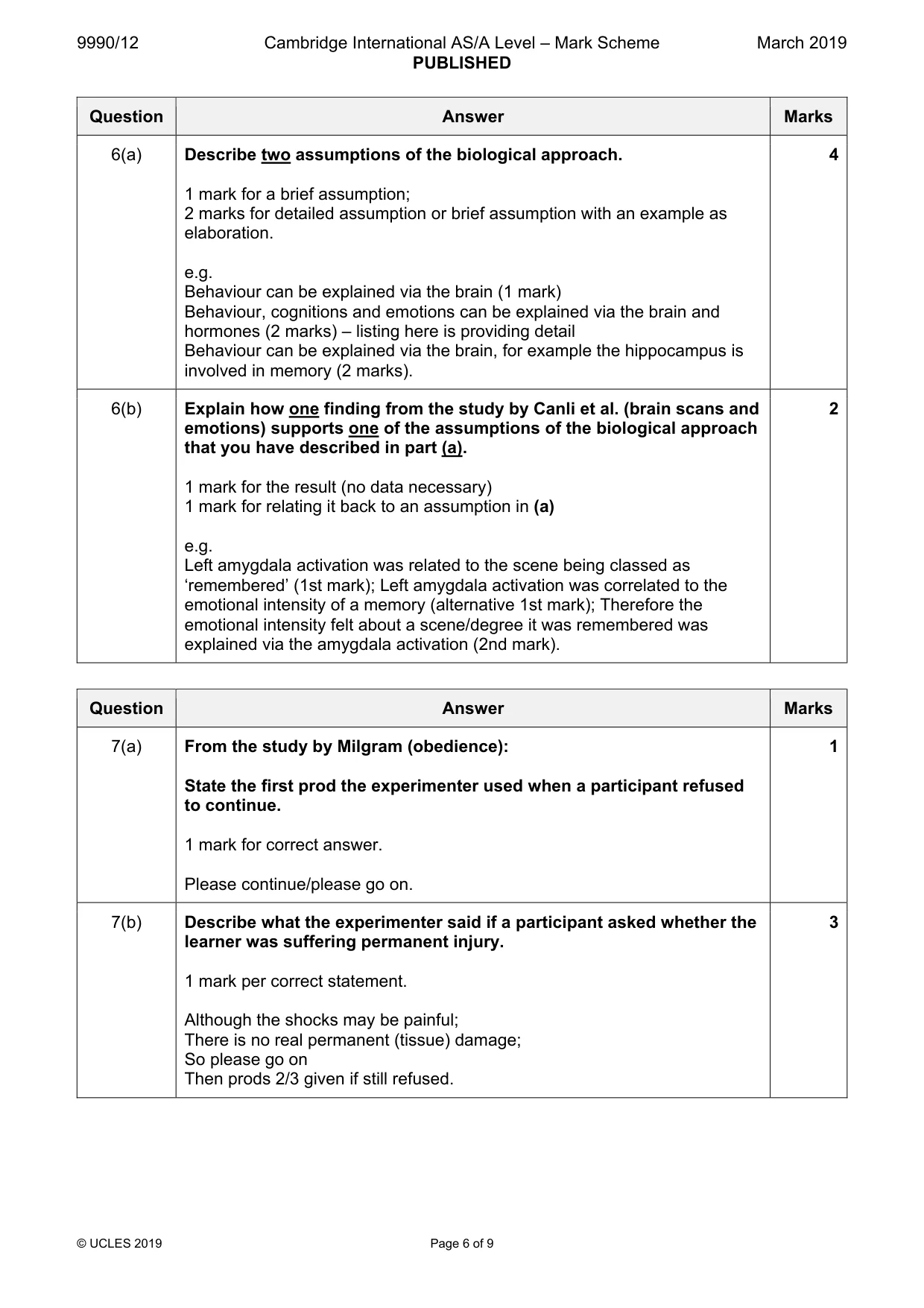
9990/12 Cambridge International AS/A Level – Mark Scheme PUBLISHED March 2019 © UCLES 2019 Page 6 of 9 Question Answer Marks 6(a) Describe two assumptions of the biological approach. 1 mark for a brief assumption; 2 marks for detailed assumption or brief assumption with an example as elaboration. e.g. Behaviour can be explained via the brain (1 mark) Behaviour, cognitions and emotions can be explained via the brain and hormones (2 marks) – listing here is providing detail Behaviour can be explained via the brain, for example the hippocampus is involved in memory (2 marks). 4 6(b) Explain how one finding from the study by Canli et al. (brain scans and emotions) supports one of the assumptions of the biological approach that you have described in part (a). 1 mark for the result (no data necessary) 1 mark for relating it back to an assumption in (a) e.g. Left amygdala activation was related to the scene being classed as ‘remembered’ (1st mark); Left amygdala activation was correlated to the emotional intensity of a memory (alternative 1st mark); Therefore the emotional intensity felt about a scene/degree it was remembered was explained via the amygdala activation (2nd mark). 2 Question Answer Marks 7(a) From the study by Milgram (obedience): State the first prod the experimenter used when a participant refused to continue. 1 mark for correct answer. Please continue/please go on. 1 7(b) Describe what the experimenter said if a participant asked whether the learner was suffering permanent injury. 1 mark per correct statement. Although the shocks may be painful; There is no real permanent (tissue) damage; So please go on Then prods 2/3 given if still refused. 3
Mark scheme, page 7
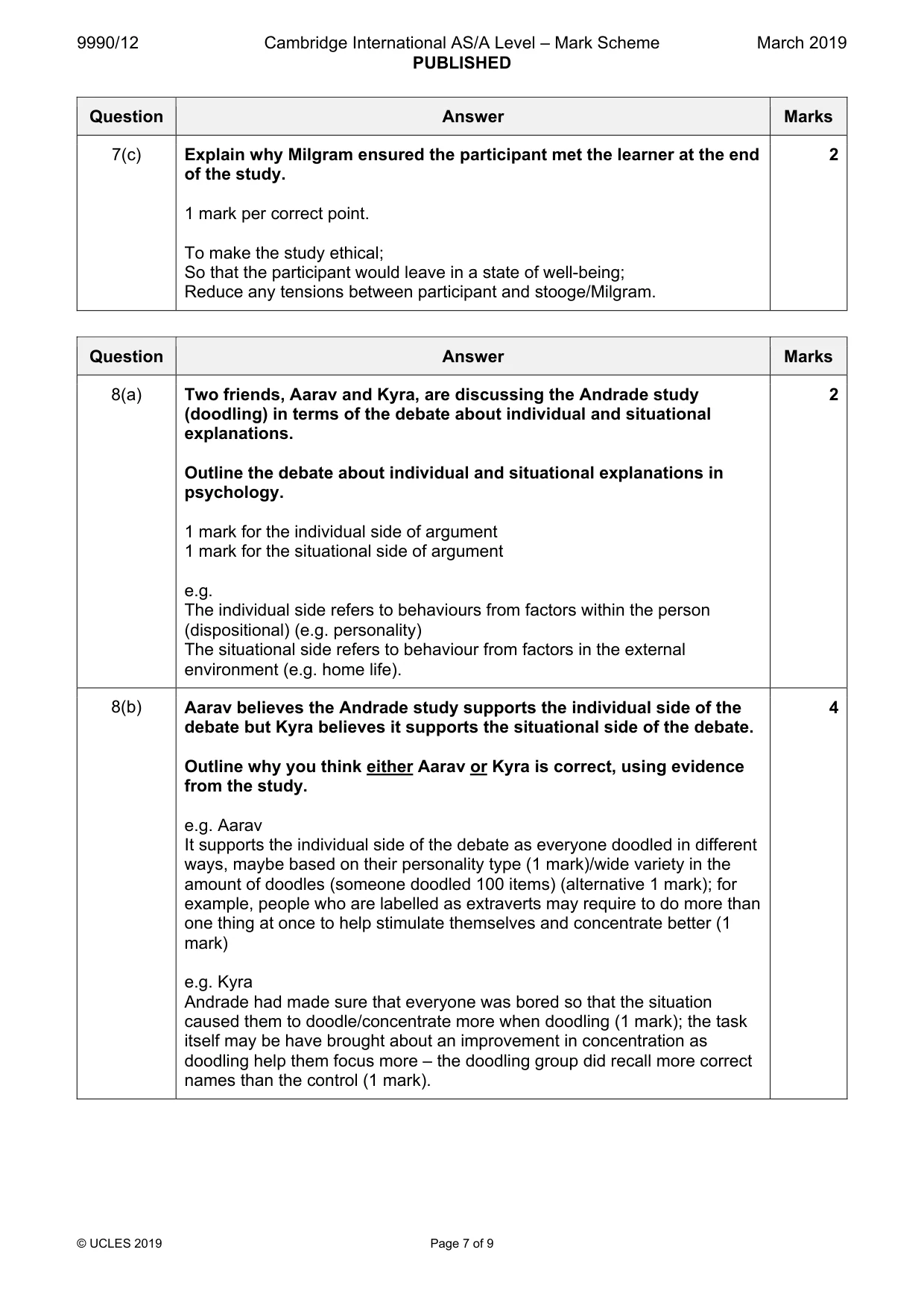
9990/12 Cambridge International AS/A Level – Mark Scheme PUBLISHED March 2019 © UCLES 2019 Page 7 of 9 Question Answer Marks 7(c) Explain why Milgram ensured the participant met the learner at the end of the study. 1 mark per correct point. To make the study ethical; So that the participant would leave in a state of well-being; Reduce any tensions between participant and stooge/Milgram. 2 Question Answer Marks 8(a) Two friends, Aarav and Kyra, are discussing the Andrade study (doodling) in terms of the debate about individual and situational explanations. Outline the debate about individual and situational explanations in psychology. 1 mark for the individual side of argument 1 mark for the situational side of argument e.g. The individual side refers to behaviours from factors within the person (dispositional) (e.g. personality) The situational side refers to behaviour from factors in the external environment (e.g. home life). 2 8(b) Aarav believes the Andrade study supports the individual side of the debate but Kyra believes it supports the situational side of the debate. Outline why you think either Aarav or Kyra is correct, using evidence from the study. e.g. Aarav It supports the individual side of the debate as everyone doodled in different ways, maybe based on their personality type (1 mark)/wide variety in the amount of doodles (someone doodled 100 items) (alternative 1 mark); for example, people who are labelled as extraverts may require to do more than one thing at once to help stimulate themselves and concentrate better (1 mark) e.g. Kyra Andrade had made sure that everyone was bored so that the situation caused them to doodle/concentrate more when doodling (1 mark); the task itself may be have brought about an improvement in concentration as doodling help them focus more – the doodling group did recall more correct names than the control (1 mark). 4
Mark scheme, page 8
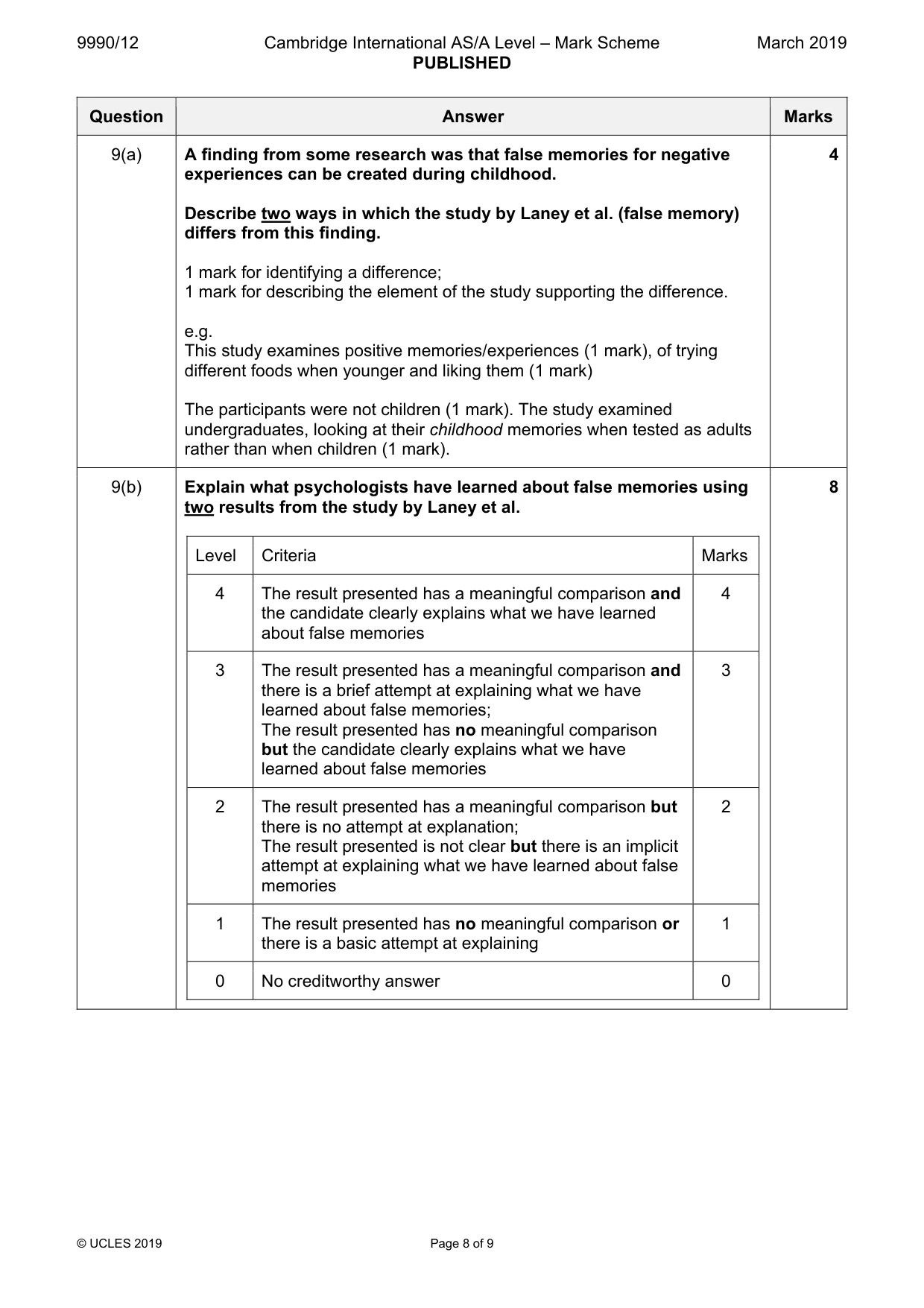
9990/12 Cambridge International AS/A Level – Mark Scheme PUBLISHED March 2019 © UCLES 2019 Page 8 of 9 Question Answer Marks 9(a) A finding from some research was that false memories for negative experiences can be created during childhood. Describe two ways in which the study by Laney et al. (false memory) differs from this finding. 1 mark for identifying a difference; 1 mark for describing the element of the study supporting the difference. e.g. This study examines positive memories/experiences (1 mark), of trying different foods when younger and liking them (1 mark) The participants were not children (1 mark). The study examined undergraduates, looking at their childhood memories when tested as adults rather than when children (1 mark). 4 9(b) Explain what psychologists have learned about false memories using two results from the study by Laney et al. Level Criteria Marks 4 The result presented has a meaningful comparison and the candidate clearly explains what we have learned about false memories 4 3 The result presented has a meaningful comparison and there is a brief attempt at explaining what we have learned about false memories; The result presented has no meaningful comparison but the candidate clearly explains what we have learned about false memories 3 2 The result presented has a meaningful comparison but there is no attempt at explanation; The result presented is not clear but there is an implicit attempt at explaining what we have learned about false memories 2 1 The result presented has no meaningful comparison or there is a basic attempt at explaining 1 0 No creditworthy answer 0 8
Mark scheme, page 9
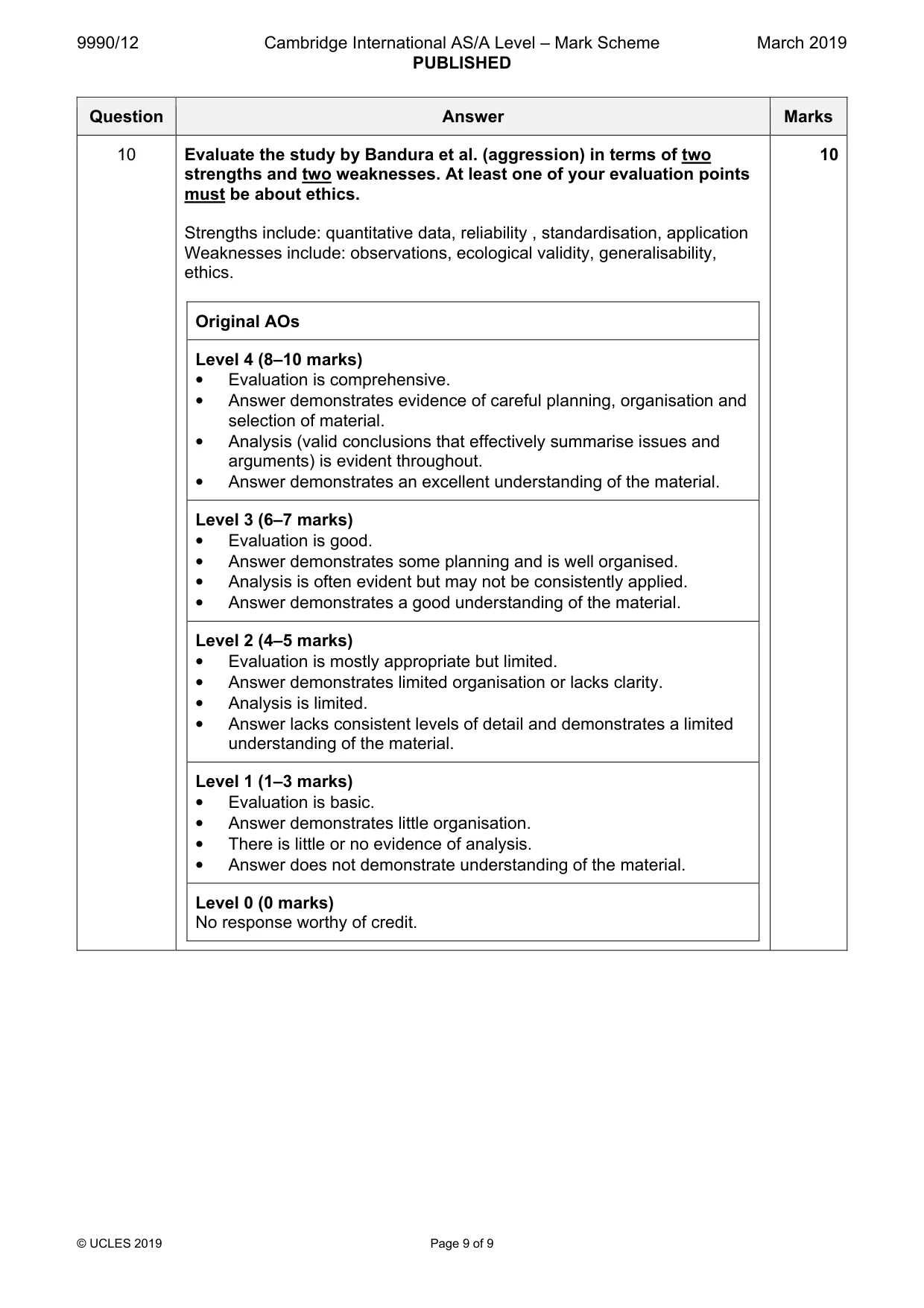
9990/12 Cambridge International AS/A Level – Mark Scheme PUBLISHED March 2019 © UCLES 2019 Page 9 of 9 Question Answer Marks 10 Evaluate the study by Bandura et al. (aggression) in terms of two strengths and two weaknesses. At least one of your evaluation points must be about ethics. Strengths include: quantitative data, reliability , standardisation, application Weaknesses include: observations, ecological validity, generalisability, ethics. Original AOs Level 4 (8–10 marks) • Evaluation is comprehensive. • Answer demonstrates evidence of careful planning, organisation and selection of material. • Analysis (valid conclusions that effectively summarise issues and arguments) is evident throughout. • Answer demonstrates an excellent understanding of the material. Level 3 (6–7 marks) • Evaluation is good. • Answer demonstrates some planning and is well organised. • Analysis is often evident but may not be consistently applied. • Answer demonstrates a good understanding of the material. Level 2 (4–5 marks) • Evaluation is mostly appropriate but limited. • Answer demonstrates limited organisation or lacks clarity. • Analysis is limited. • Answer lacks consistent levels of detail and demonstrates a limited understanding of the material. Level 1 (1–3 marks) • Evaluation is basic. • Answer demonstrates little organisation. • There is little or no evidence of analysis. • Answer does not demonstrate understanding of the material. Level 0 (0 marks) No response worthy of credit. 10
What you needed in this session
Cambridge’s own grade thresholds for 2019 Feb/March, Paper 1 · Variant 2. A higher threshold means an easier paper — the bar moves with how the cohort did.