Cambridge A Level Psychology (from 2018) 9990 — 2018 Feb/March Paper 1 · Variant 2
9990/12/F/M/18 · 60 marks · ≈68 min
The question paper and its mark scheme, free to read here and free to download. This is Cambridge’s own paper, exactly as it was sat.
Question paper12 pages




Mark scheme11 pages
Answers below. Sit the paper first if you are practising.
Paper as text
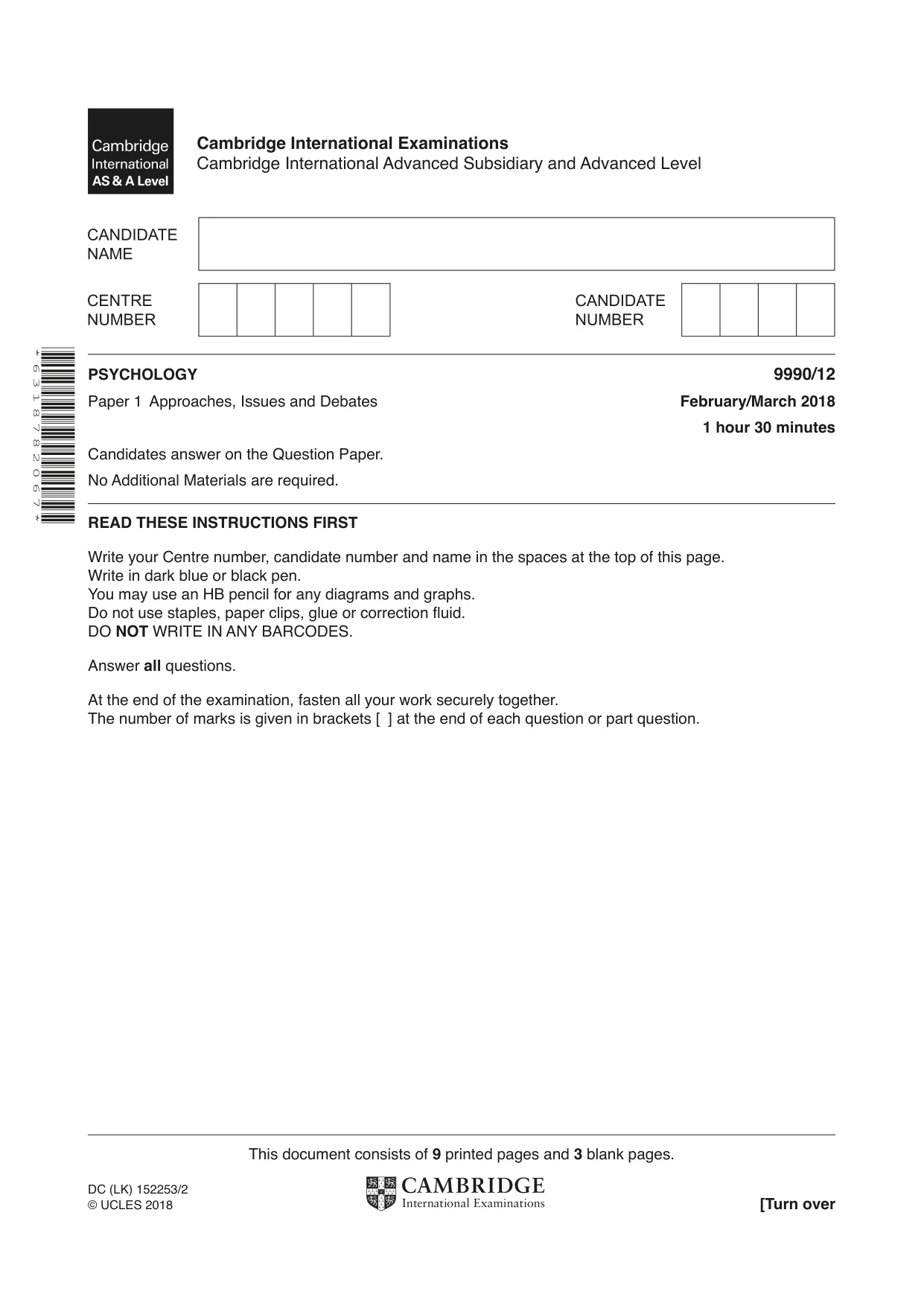
Question paper, page 1
This document consists of 9 printed pages and 3 blank pages. DC (LK) 152253/2 © UCLES 2018 [Turn over * 6 3 1 8 7 8 2 0 6 7 * PSYCHOLOGY 9990/12 Paper 1 Approaches, Issues and Debates February/March 2018 1 hour 30 minutes Candidates answer on the Question Paper. No Additional Materials are required. READ THESE INSTRUCTIONS FIRST Write your Centre number, candidate number and name in the spaces at the top of this page. Write in dark blue or black pen. You may use an HB pencil for any diagrams and graphs. Do not use staples, paper clips, glue or correction fluid. DO NOT WRITE IN ANY BARCODES. Answer all questions. At the end of the examination, fasten all your work securely together. The number of marks is given in brackets [ ] at the end of each question or part question. Cambridge International Examinations Cambridge International Advanced Subsidiary and Advanced Level
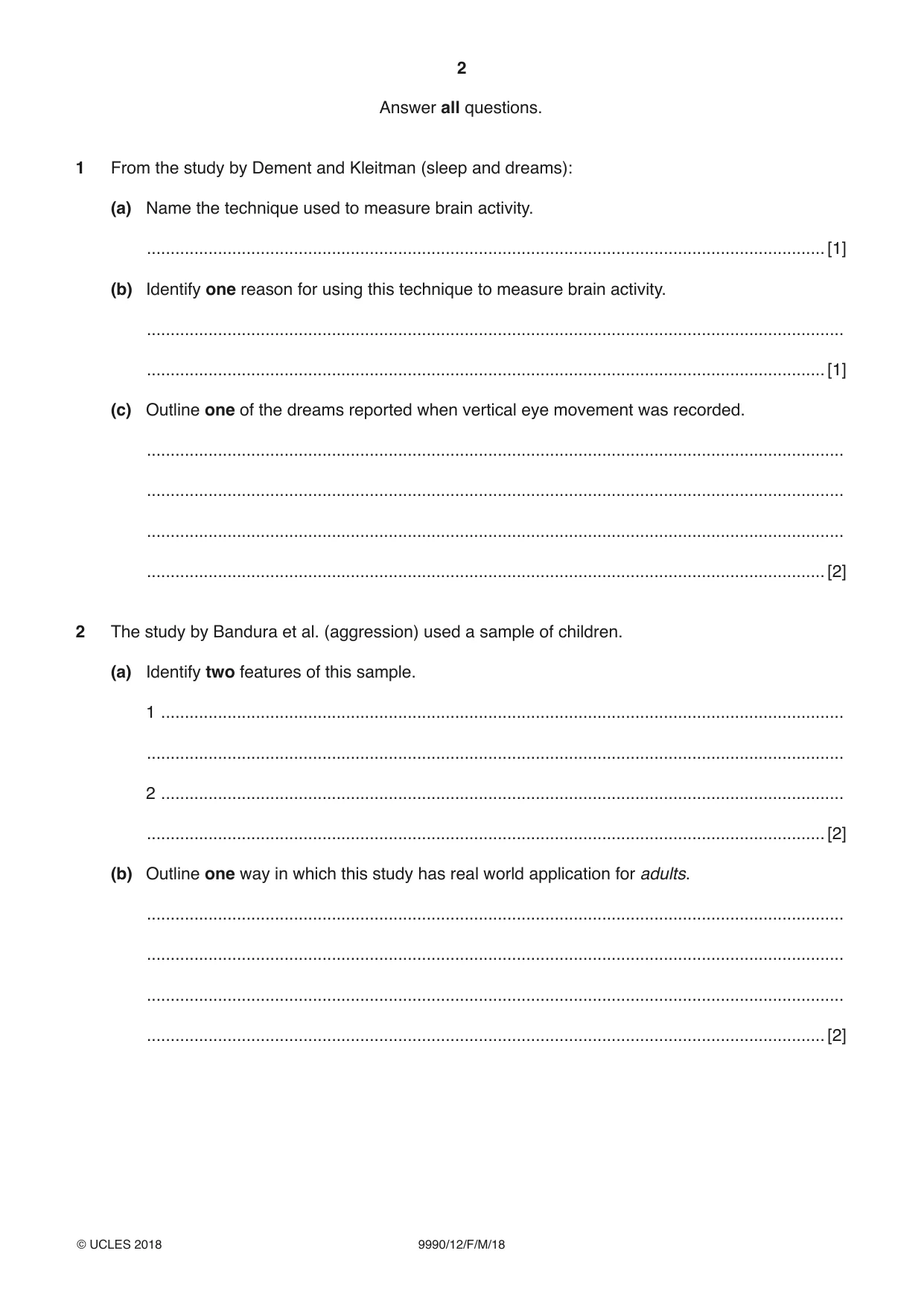
Question paper, page 2
2 9990/12/F/M/18 © UCLES 2018 Answer all questions. 1 From the study by Dement and Kleitman (sleep and dreams): (a) Name the technique used to measure brain activity. … [1] (b) Identify one reason for using this technique to measure brain activity. … … [1] (c) Outline one of the dreams reported when vertical eye movement was recorded. … … … … [2] 2 The study by Bandura et al. (aggression) used a sample of children. (a) Identify two features of this sample. 1 … … 2 … … [2] (b) Outline one way in which this study has real world application for adults. … … … … [2]
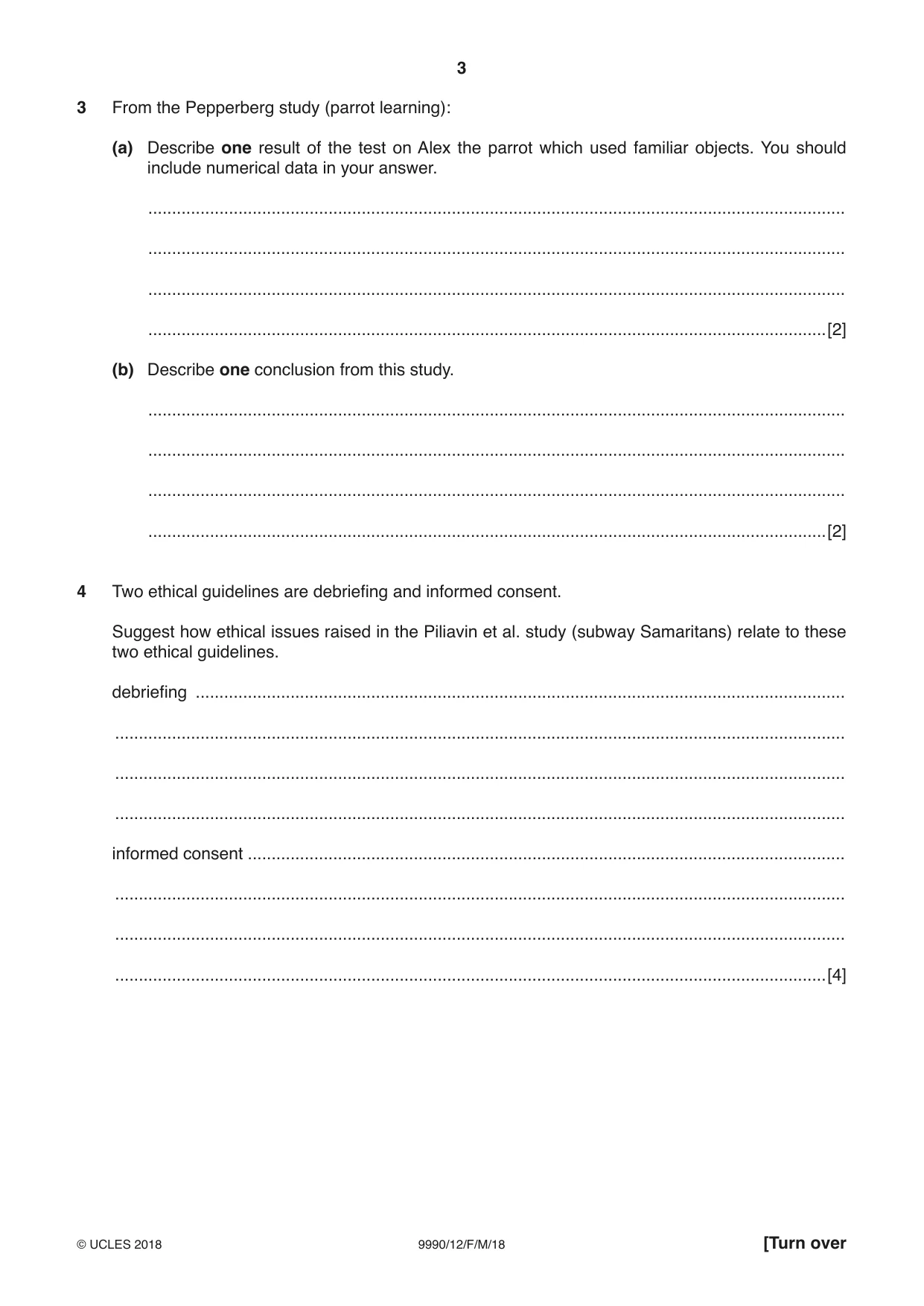
Question paper, page 3
3 9990/12/F/M/18 © UCLES 2018 [Turn over 3 From the Pepperberg study (parrot learning): (a) Describe one result of the test on Alex the parrot which used familiar objects. You should include numerical data in your answer. … … … …[2] (b) Describe one conclusion from this study. … … … …[2] 4 Two ethical guidelines are debriefing and informed consent. Suggest how ethical issues raised in the Piliavin et al. study (subway Samaritans) relate to these two ethical guidelines. debriefing … … … … informed consent … … … …[4]
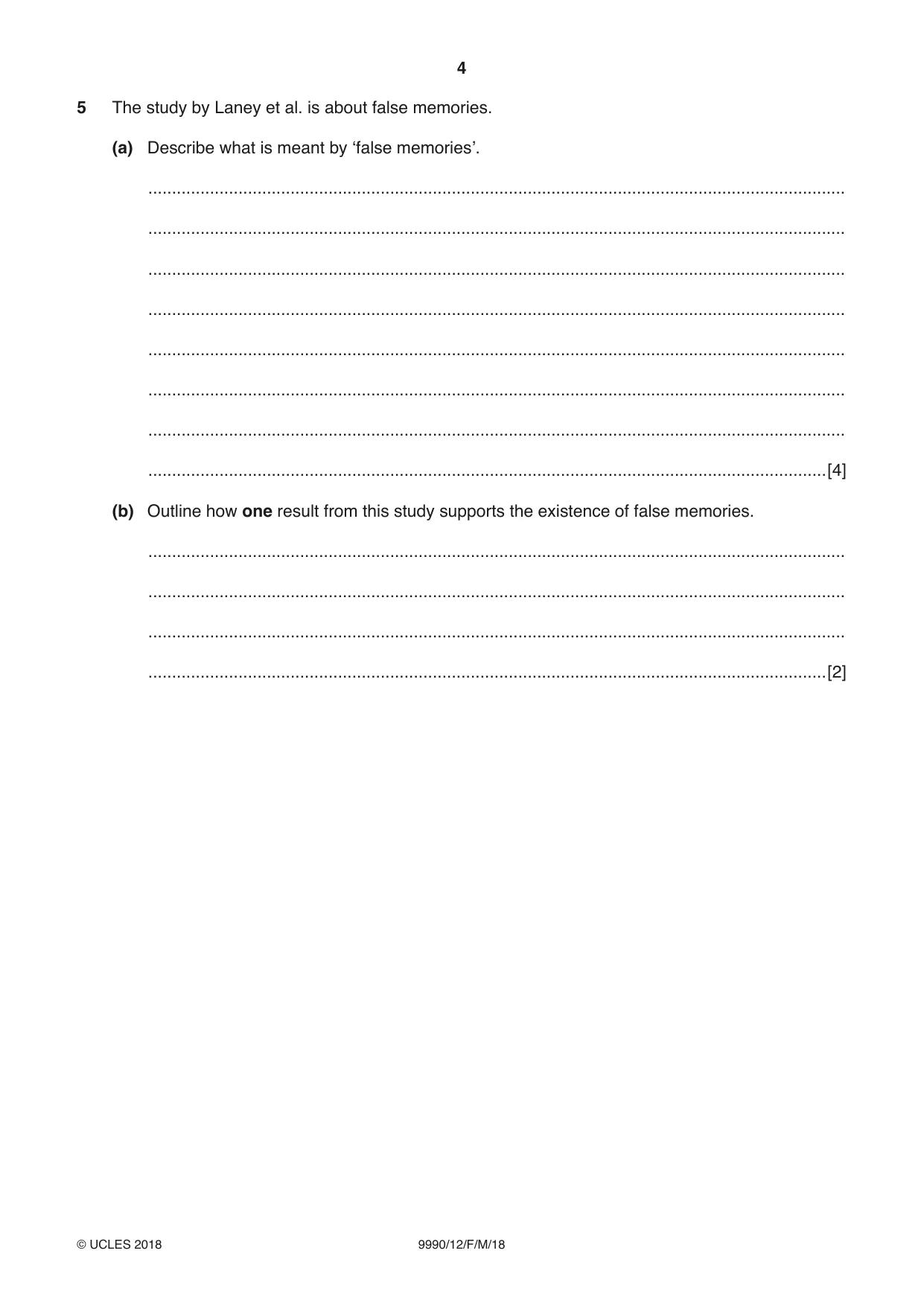
Question paper, page 4
4 9990/12/F/M/18 © UCLES 2018 5 The study by Laney et al. is about false memories. (a) Describe what is meant by ‘false memories’. … … … … … … … …[4] (b) Outline how one result from this study supports the existence of false memories. … … … …[2]
Question paper, page 5
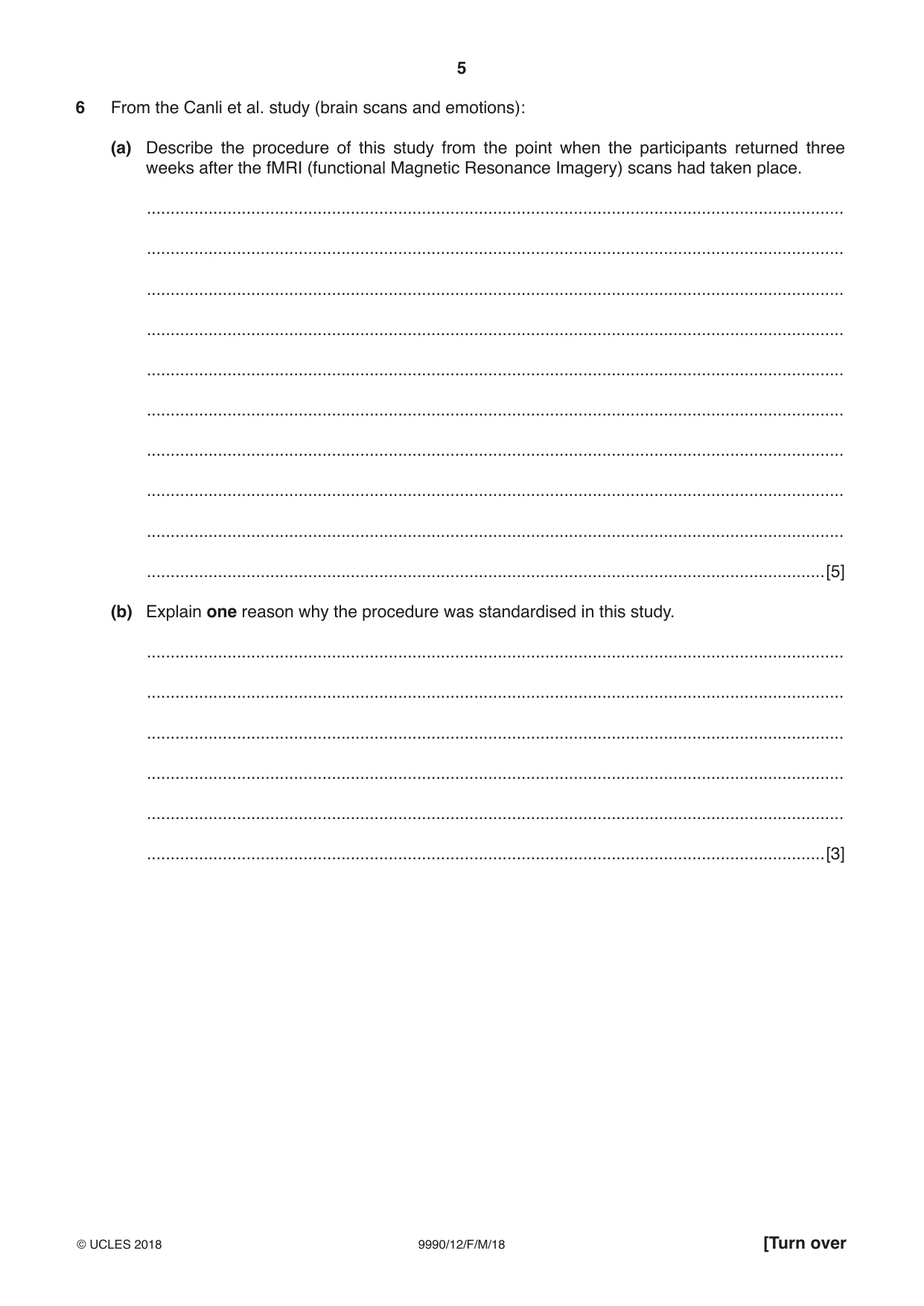
5 9990/12/F/M/18 © UCLES 2018 [Turn over 6 From the Canli et al. study (brain scans and emotions): (a) Describe the procedure of this study from the point when the participants returned three weeks after the fMRI (functional Magnetic Resonance Imagery) scans had taken place. … … … … … … … … … …[5] (b) Explain one reason why the procedure was standardised in this study. … … … … … …[3]
Question paper, page 6
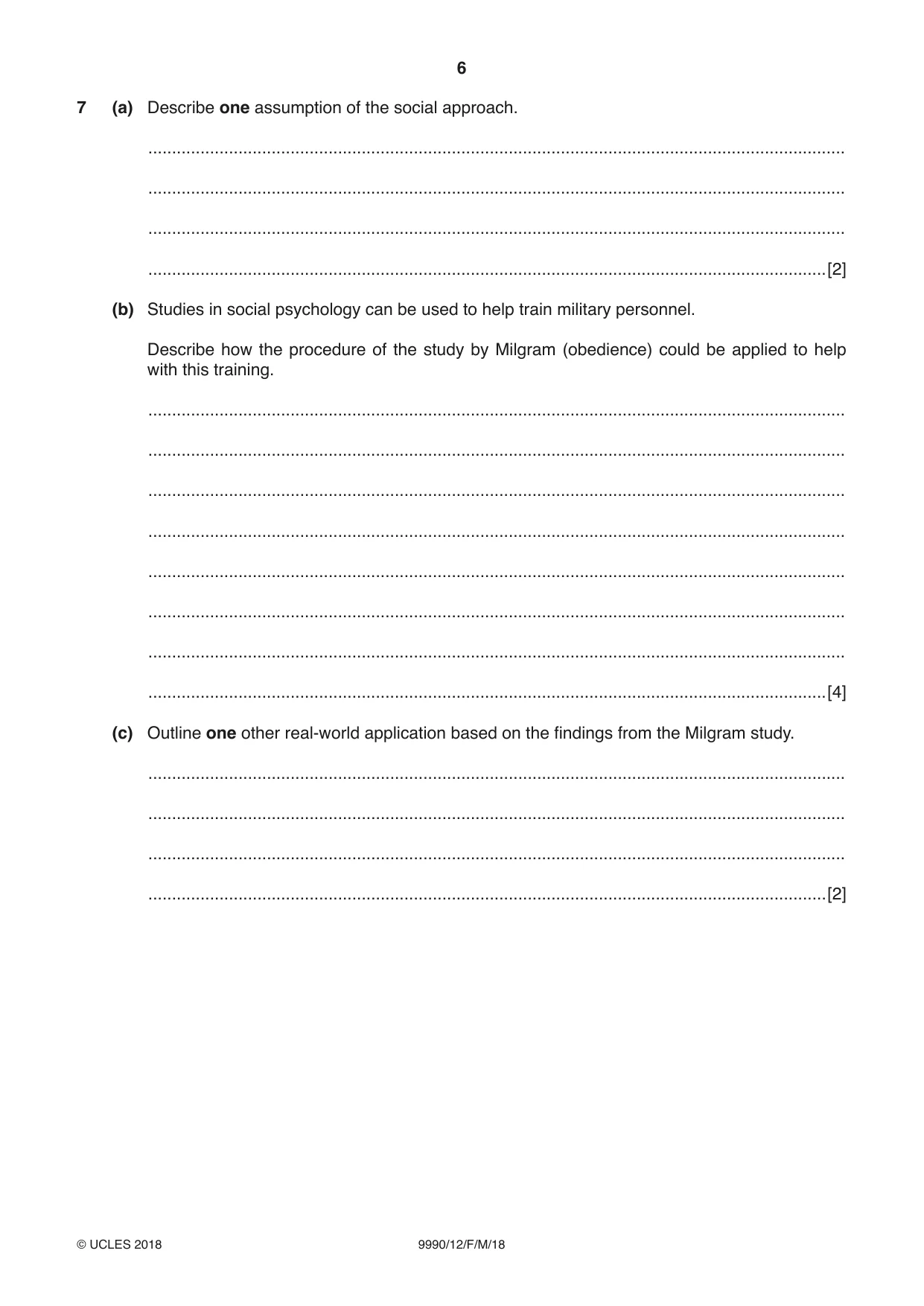
6 9990/12/F/M/18 © UCLES 2018 7 (a) Describe one assumption of the social approach. … … … …[2] (b) Studies in social psychology can be used to help train military personnel. Describe how the procedure of the study by Milgram (obedience) could be applied to help with this training. … … … … … … … …[4] (c) Outline one other real-world application based on the findings from the Milgram study. … … … …[2]
Question paper, page 7
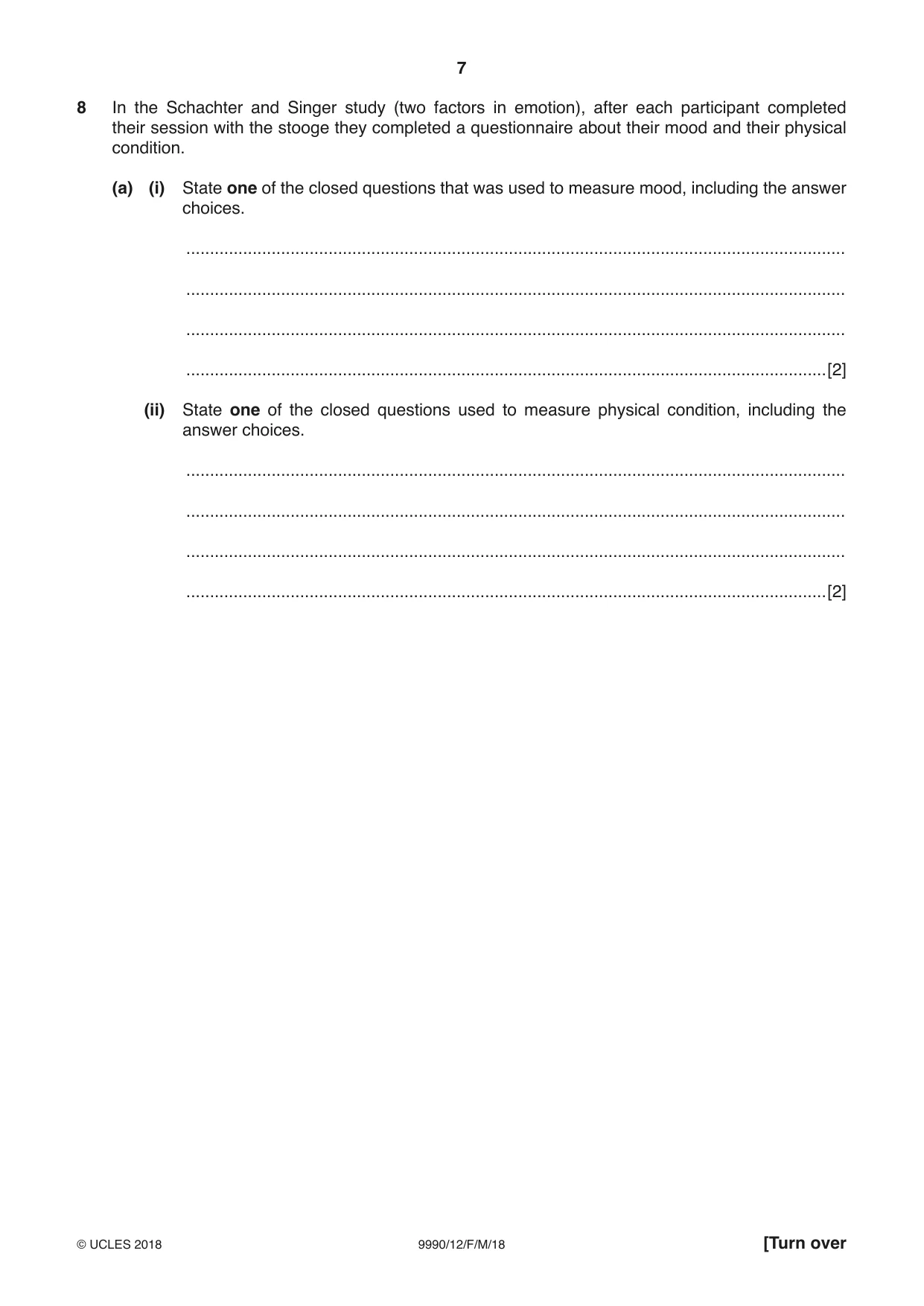
7 9990/12/F/M/18 © UCLES 2018 [Turn over 8 In the Schachter and Singer study (two factors in emotion), after each participant completed their session with the stooge they completed a questionnaire about their mood and their physical condition. (a) (i) State one of the closed questions that was used to measure mood, including the answer choices. … … … …[2] (ii) State one of the closed questions used to measure physical condition, including the answer choices. … … … …[2]
Question paper, page 8
8 9990/12/F/M/18 © UCLES 2018 (b) Explain one similarity and one difference between the Schachter and Singer study and one other core study from the biological approach. … … … … … … … … … … … … … … … …[8]
Question paper, page 9
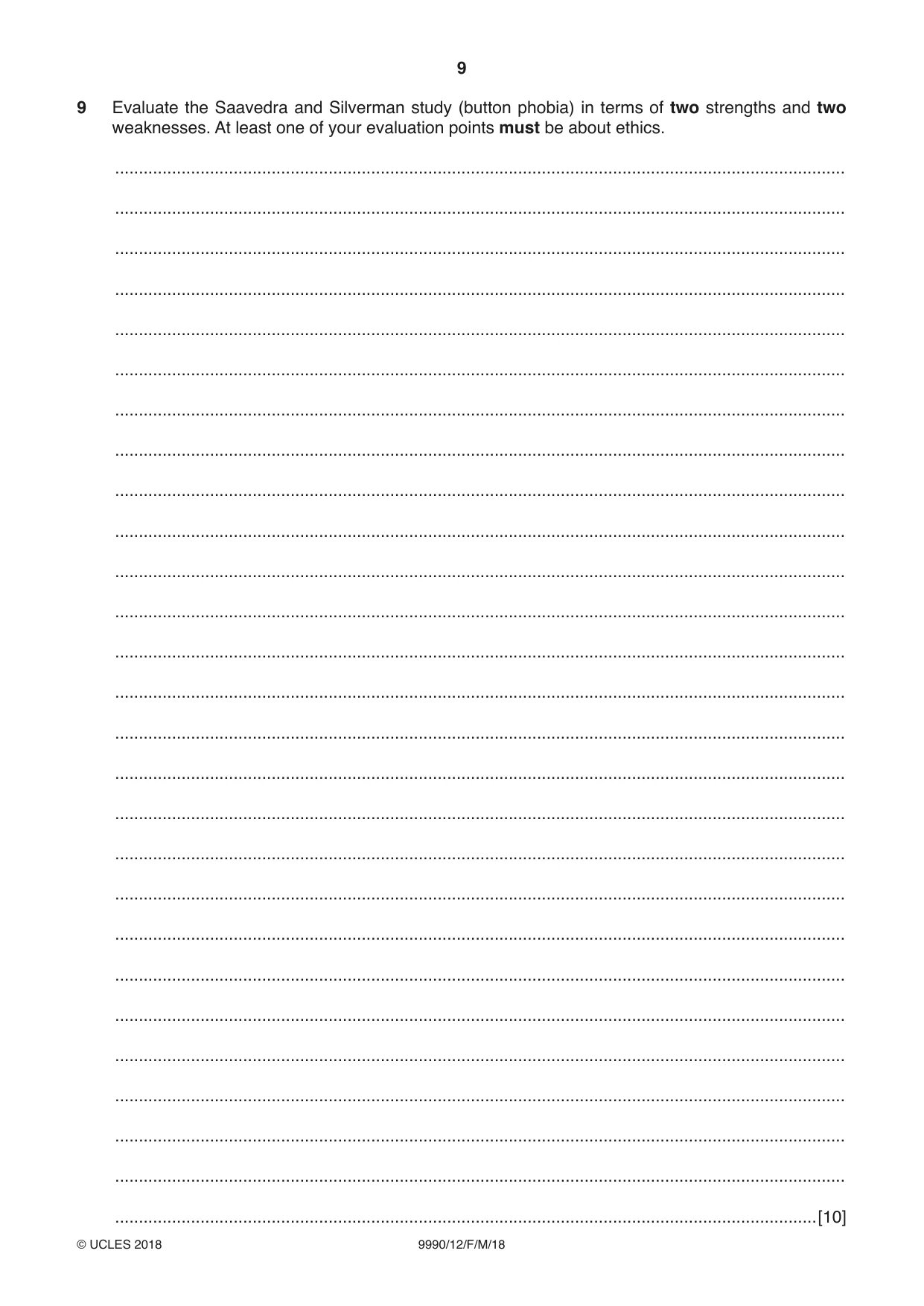
9 9990/12/F/M/18 © UCLES 2018 9 Evaluate the Saavedra and Silverman study (button phobia) in terms of two strengths and two weaknesses. At least one of your evaluation points must be about ethics. … … … … … … … … … … … … … … … … … … … … … … … … … … …[10]
Question paper, page 10
10 9990/12/F/M/18 © UCLES 2018 BLANK PAGE
Question paper, page 11
11 9990/12/F/M/18 © UCLES 2018 BLANK PAGE
Question paper, page 12
12 9990/12/F/M/18 © UCLES 2018 Permission to reproduce items where third-party owned material protected by copyright is included has been sought and cleared where possible. Every reasonable effort has been made by the publisher (UCLES) to trace copyright holders, but if any items requiring clearance have unwittingly been included, the publisher will be pleased to make amends at the earliest possible opportunity. To avoid the issue of disclosure of answer-related information to candidates, all copyright acknowledgements are reproduced online in the Cambridge International Examinations Copyright Acknowledgements Booklet. This is produced for each series of examinations and is freely available to download at www.cie.org.uk after the live examination series. Cambridge International Examinations is part of the Cambridge Assessment Group. Cambridge Assessment is the brand name of University of Cambridge Local Examinations Syndicate (UCLES), which is itself a department of the University of Cambridge. BLANK PAGE
Mark scheme, page 1
® IGCSE is a registered trademark. This document consists of 11 printed pages. © UCLES 2018 [Turn over Cambridge Assessment International Education Cambridge International Advanced Subsidiary and Advanced Level PSYCHOLOGY 9990/12 Paper 1 Approaches, Issues and Debates March 2018 MARK SCHEME Maximum Mark: 60 Published This mark scheme is published as an aid to teachers and candidates, to indicate the requirements of the examination. It shows the basis on which Examiners were instructed to award marks. It does not indicate the details of the discussions that took place at an Examiners’ meeting before marking began, which would have considered the acceptability of alternative answers. Mark schemes should be read in conjunction with the question paper and the Principal Examiner Report for Teachers. Cambridge International will not enter into discussions about these mark schemes. Cambridge International is publishing the mark schemes for the March 2018 series for most Cambridge IGCSE®, Cambridge International A and AS Level components and some Cambridge O Level components.
Mark scheme, page 2
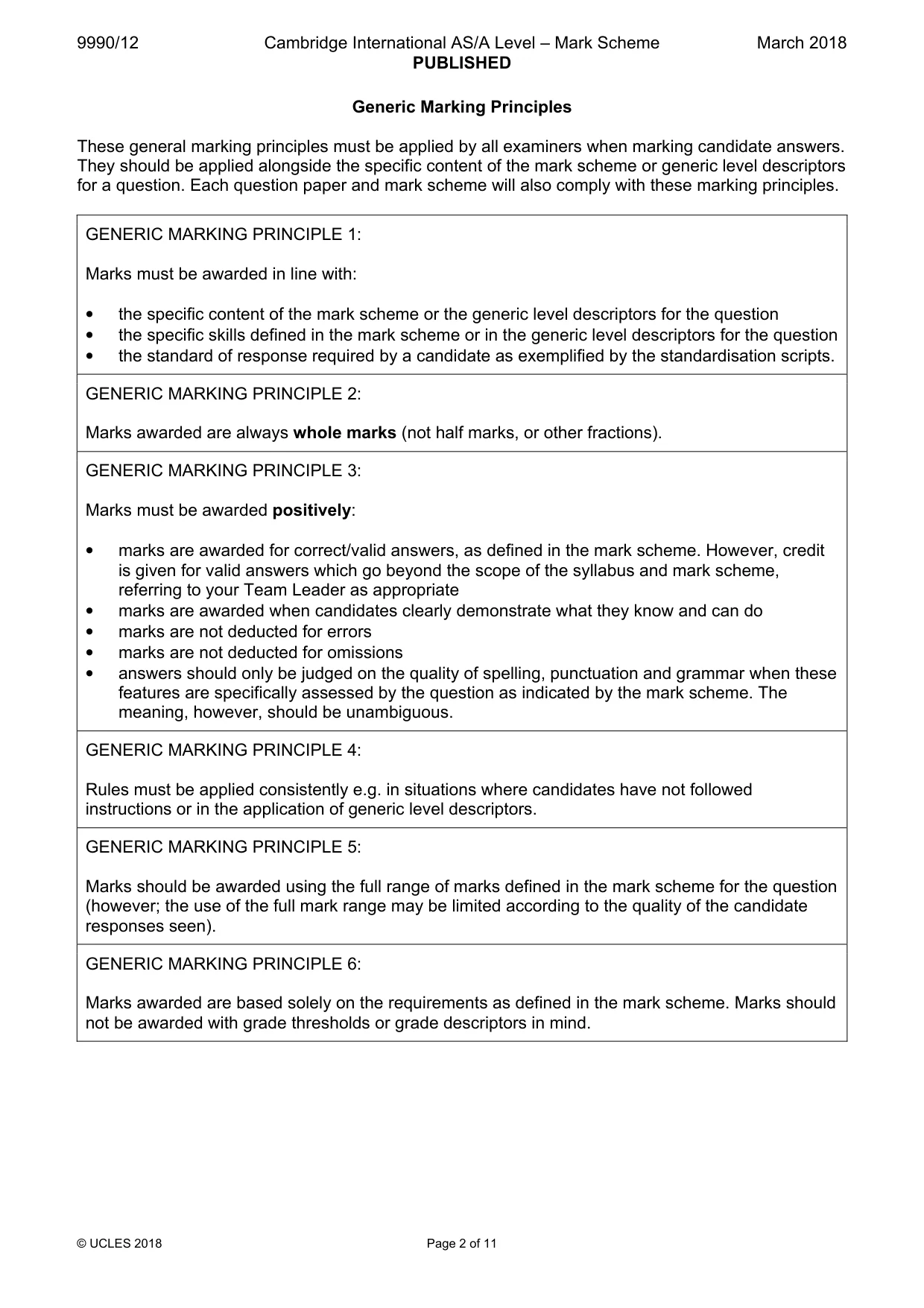
9990/12 Cambridge International AS/A Level – Mark Scheme PUBLISHED March 2018 © UCLES 2018 Page 2 of 11 Generic Marking Principles These general marking principles must be applied by all examiners when marking candidate answers. They should be applied alongside the specific content of the mark scheme or generic level descriptors for a question. Each question paper and mark scheme will also comply with these marking principles. GENERIC MARKING PRINCIPLE 1: Marks must be awarded in line with: • the specific content of the mark scheme or the generic level descriptors for the question • the specific skills defined in the mark scheme or in the generic level descriptors for the question • the standard of response required by a candidate as exemplified by the standardisation scripts. GENERIC MARKING PRINCIPLE 2: Marks awarded are always whole marks (not half marks, or other fractions). GENERIC MARKING PRINCIPLE 3: Marks must be awarded positively: • marks are awarded for correct/valid answers, as defined in the mark scheme. However, credit is given for valid answers which go beyond the scope of the syllabus and mark scheme, referring to your Team Leader as appropriate • marks are awarded when candidates clearly demonstrate what they know and can do • marks are not deducted for errors • marks are not deducted for omissions • answers should only be judged on the quality of spelling, punctuation and grammar when these features are specifically assessed by the question as indicated by the mark scheme. The meaning, however, should be unambiguous. GENERIC MARKING PRINCIPLE 4: Rules must be applied consistently e.g. in situations where candidates have not followed instructions or in the application of generic level descriptors. GENERIC MARKING PRINCIPLE 5: Marks should be awarded using the full range of marks defined in the mark scheme for the question (however; the use of the full mark range may be limited according to the quality of the candidate responses seen). GENERIC MARKING PRINCIPLE 6: Marks awarded are based solely on the requirements as defined in the mark scheme. Marks should not be awarded with grade thresholds or grade descriptors in mind.
Mark scheme, page 3
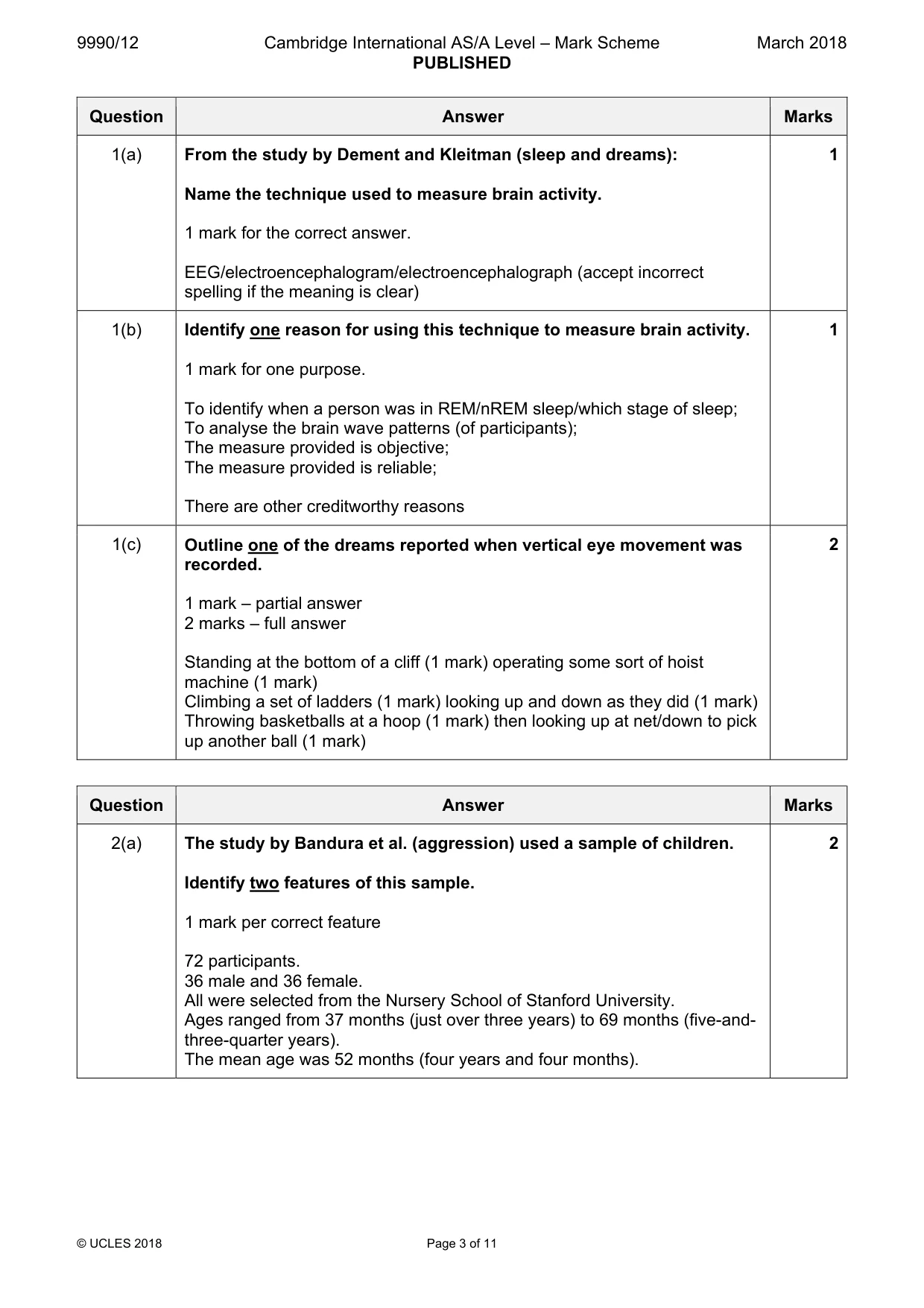
9990/12 Cambridge International AS/A Level – Mark Scheme PUBLISHED March 2018 © UCLES 2018 Page 3 of 11 Question Answer Marks 1(a) From the study by Dement and Kleitman (sleep and dreams): Name the technique used to measure brain activity. 1 mark for the correct answer. EEG/electroencephalogram/electroencephalograph (accept incorrect spelling if the meaning is clear) 1 1(b) Identify one reason for using this technique to measure brain activity. 1 mark for one purpose. To identify when a person was in REM/nREM sleep/which stage of sleep; To analyse the brain wave patterns (of participants); The measure provided is objective; The measure provided is reliable; There are other creditworthy reasons 1 1(c) Outline one of the dreams reported when vertical eye movement was recorded. 1 mark – partial answer 2 marks – full answer Standing at the bottom of a cliff (1 mark) operating some sort of hoist machine (1 mark) Climbing a set of ladders (1 mark) looking up and down as they did (1 mark) Throwing basketballs at a hoop (1 mark) then looking up at net/down to pick up another ball (1 mark) 2 Question Answer Marks 2(a) The study by Bandura et al. (aggression) used a sample of children. Identify two features of this sample. 1 mark per correct feature 72 participants. 36 male and 36 female. All were selected from the Nursery School of Stanford University. Ages ranged from 37 months (just over three years) to 69 months (five-and- three-quarter years). The mean age was 52 months (four years and four months). 2
Mark scheme, page 4
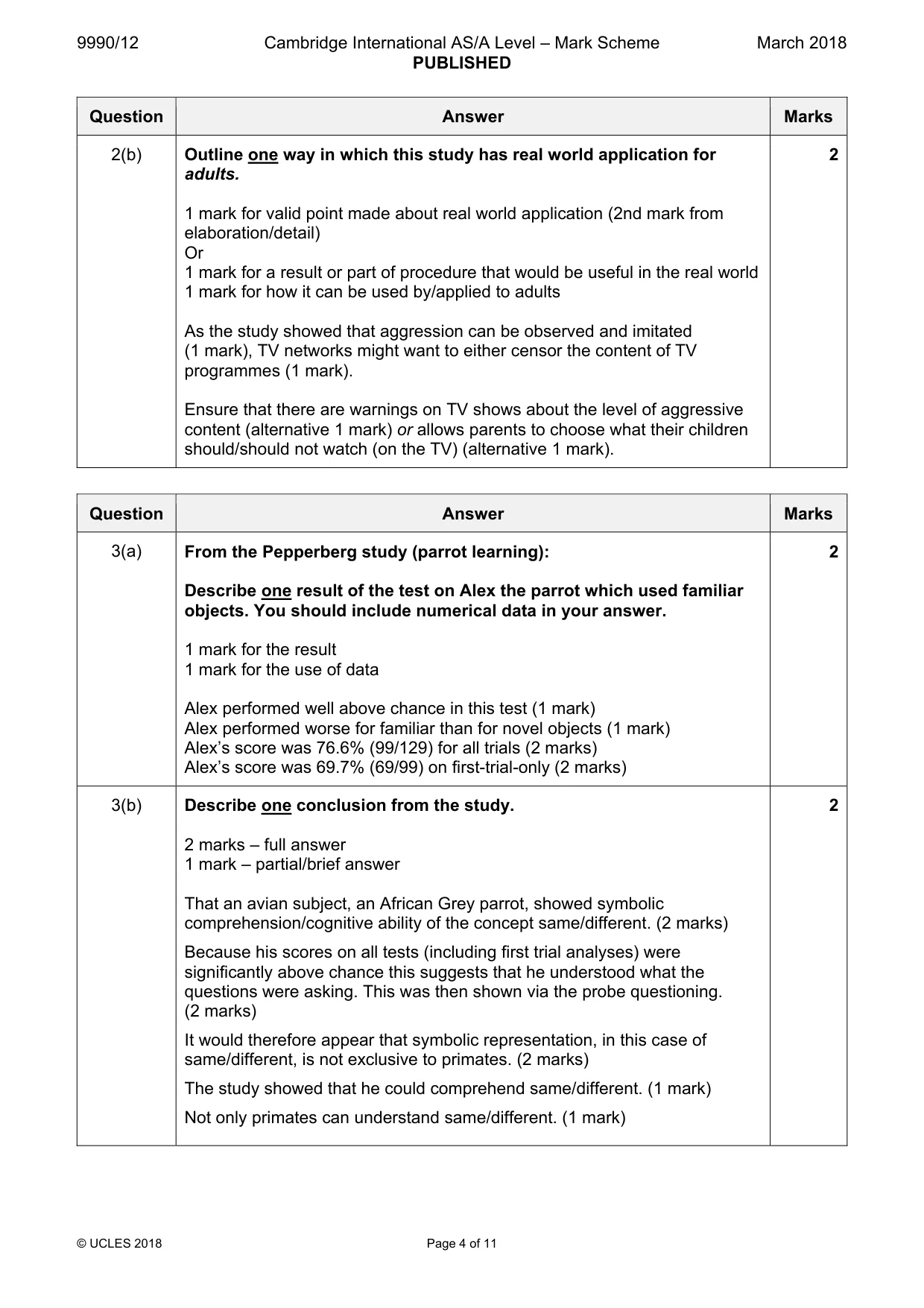
9990/12 Cambridge International AS/A Level – Mark Scheme PUBLISHED March 2018 © UCLES 2018 Page 4 of 11 Question Answer Marks 2(b) Outline one way in which this study has real world application for adults. 1 mark for valid point made about real world application (2nd mark from elaboration/detail) Or 1 mark for a result or part of procedure that would be useful in the real world 1 mark for how it can be used by/applied to adults As the study showed that aggression can be observed and imitated (1 mark), TV networks might want to either censor the content of TV programmes (1 mark). Ensure that there are warnings on TV shows about the level of aggressive content (alternative 1 mark) or allows parents to choose what their children should/should not watch (on the TV) (alternative 1 mark). 2 Question Answer Marks 3(a) From the Pepperberg study (parrot learning): Describe one result of the test on Alex the parrot which used familiar objects. You should include numerical data in your answer. 1 mark for the result 1 mark for the use of data Alex performed well above chance in this test (1 mark) Alex performed worse for familiar than for novel objects (1 mark) Alex’s score was 76.6% (99/129) for all trials (2 marks) Alex’s score was 69.7% (69/99) on first-trial-only (2 marks) 2 3(b) Describe one conclusion from the study. 2 marks – full answer 1 mark – partial/brief answer That an avian subject, an African Grey parrot, showed symbolic comprehension/cognitive ability of the concept same/different. (2 marks) Because his scores on all tests (including first trial analyses) were significantly above chance this suggests that he understood what the questions were asking. This was then shown via the probe questioning. (2 marks) It would therefore appear that symbolic representation, in this case of same/different, is not exclusive to primates. (2 marks) The study showed that he could comprehend same/different. (1 mark) Not only primates can understand same/different. (1 mark) 2
Mark scheme, page 5
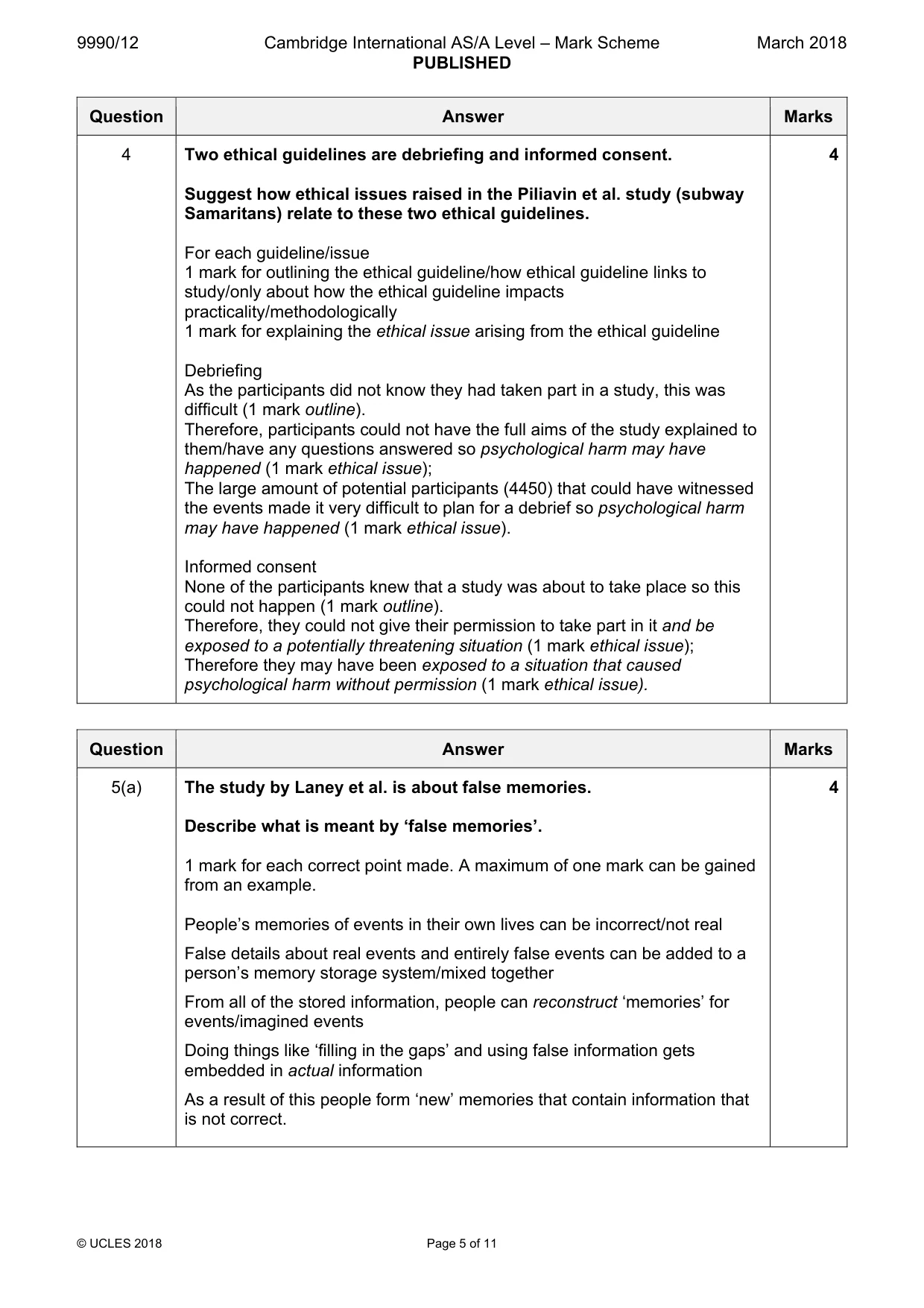
9990/12 Cambridge International AS/A Level – Mark Scheme PUBLISHED March 2018 © UCLES 2018 Page 5 of 11 Question Answer Marks 4 Two ethical guidelines are debriefing and informed consent. Suggest how ethical issues raised in the Piliavin et al. study (subway Samaritans) relate to these two ethical guidelines. For each guideline/issue 1 mark for outlining the ethical guideline/how ethical guideline links to study/only about how the ethical guideline impacts practicality/methodologically 1 mark for explaining the ethical issue arising from the ethical guideline Debriefing As the participants did not know they had taken part in a study, this was difficult (1 mark outline). Therefore, participants could not have the full aims of the study explained to them/have any questions answered so psychological harm may have happened (1 mark ethical issue); The large amount of potential participants (4450) that could have witnessed the events made it very difficult to plan for a debrief so psychological harm may have happened (1 mark ethical issue). Informed consent None of the participants knew that a study was about to take place so this could not happen (1 mark outline). Therefore, they could not give their permission to take part in it and be exposed to a potentially threatening situation (1 mark ethical issue); Therefore they may have been exposed to a situation that caused psychological harm without permission (1 mark ethical issue). 4 Question Answer Marks 5(a) The study by Laney et al. is about false memories. Describe what is meant by ‘false memories’. 1 mark for each correct point made. A maximum of one mark can be gained from an example. People’s memories of events in their own lives can be incorrect/not real False details about real events and entirely false events can be added to a person’s memory storage system/mixed together From all of the stored information, people can reconstruct ‘memories’ for events/imagined events Doing things like ‘filling in the gaps’ and using false information gets embedded in actual information As a result of this people form ‘new’ memories that contain information that is not correct. 4
Mark scheme, page 6
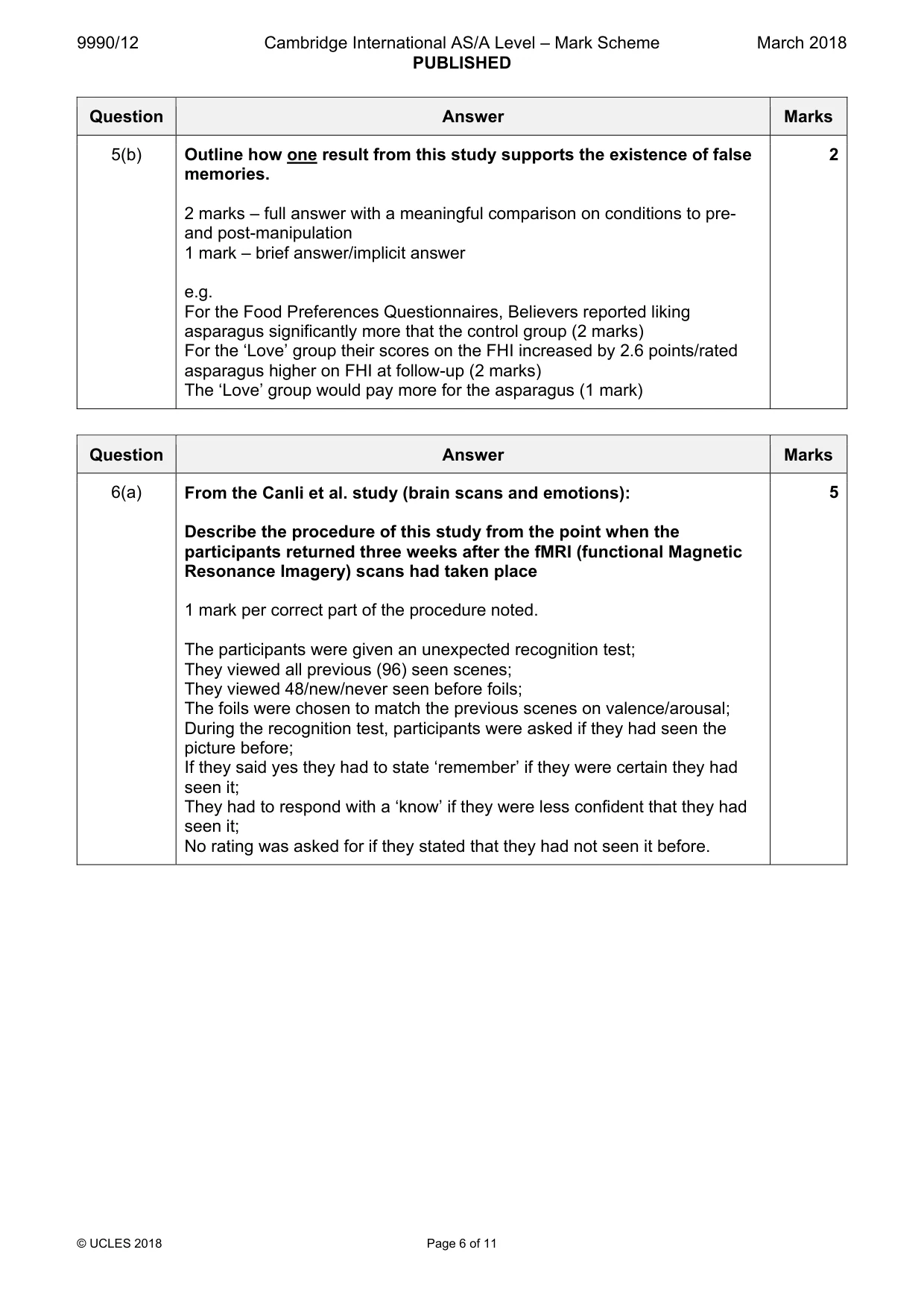
9990/12 Cambridge International AS/A Level – Mark Scheme PUBLISHED March 2018 © UCLES 2018 Page 6 of 11 Question Answer Marks 5(b) Outline how one result from this study supports the existence of false memories. 2 marks – full answer with a meaningful comparison on conditions to pre- and post-manipulation 1 mark – brief answer/implicit answer e.g. For the Food Preferences Questionnaires, Believers reported liking asparagus significantly more that the control group (2 marks) For the ‘Love’ group their scores on the FHI increased by 2.6 points/rated asparagus higher on FHI at follow-up (2 marks) The ‘Love’ group would pay more for the asparagus (1 mark) 2 Question Answer Marks 6(a) From the Canli et al. study (brain scans and emotions): Describe the procedure of this study from the point when the participants returned three weeks after the fMRI (functional Magnetic Resonance Imagery) scans had taken place 1 mark per correct part of the procedure noted. The participants were given an unexpected recognition test; They viewed all previous (96) seen scenes; They viewed 48/new/never seen before foils; The foils were chosen to match the previous scenes on valence/arousal; During the recognition test, participants were asked if they had seen the picture before; If they said yes they had to state ‘remember’ if they were certain they had seen it; They had to respond with a ‘know’ if they were less confident that they had seen it; No rating was asked for if they stated that they had not seen it before. 5
Mark scheme, page 7
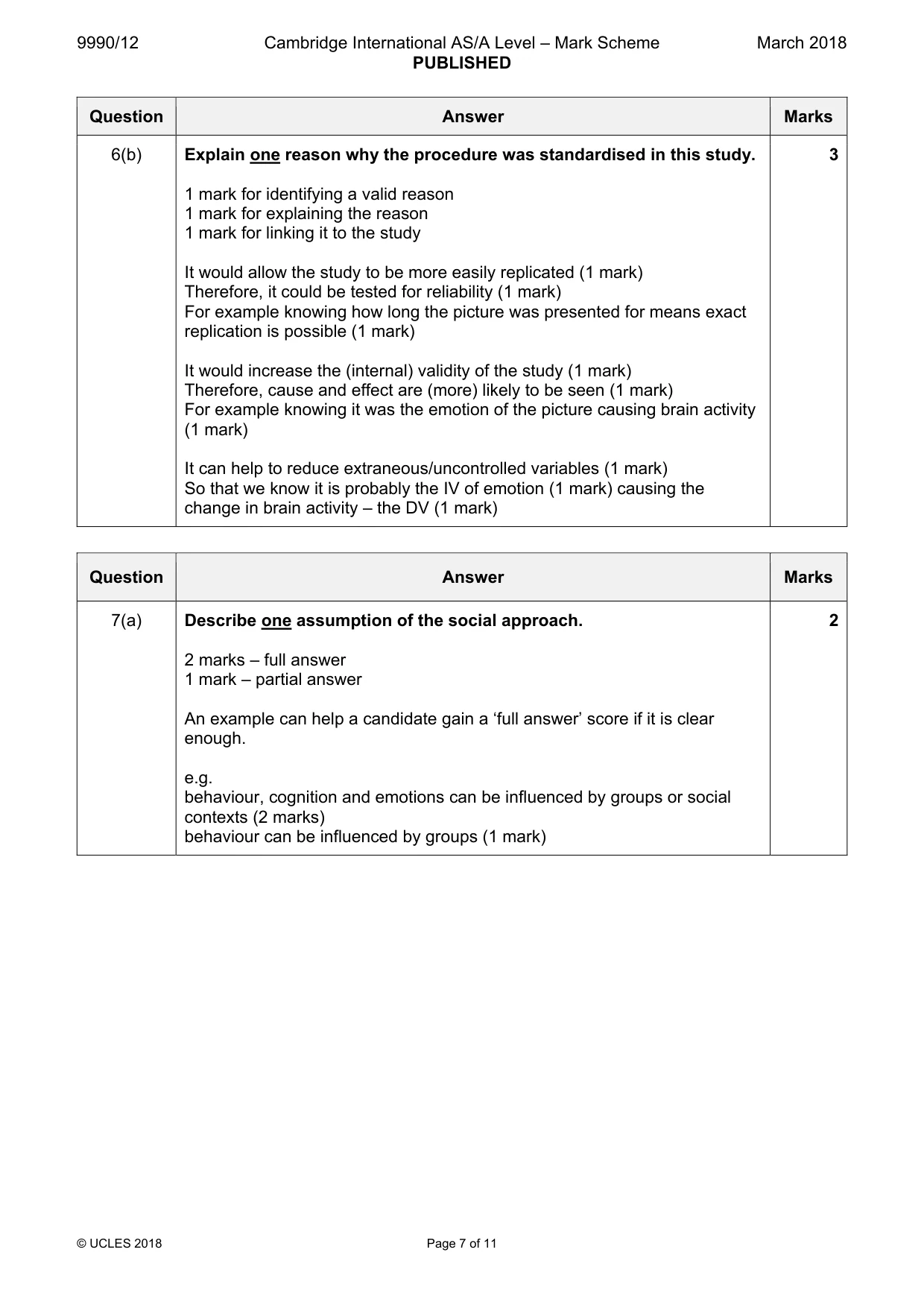
9990/12 Cambridge International AS/A Level – Mark Scheme PUBLISHED March 2018 © UCLES 2018 Page 7 of 11 Question Answer Marks 6(b) Explain one reason why the procedure was standardised in this study. 1 mark for identifying a valid reason 1 mark for explaining the reason 1 mark for linking it to the study It would allow the study to be more easily replicated (1 mark) Therefore, it could be tested for reliability (1 mark) For example knowing how long the picture was presented for means exact replication is possible (1 mark) It would increase the (internal) validity of the study (1 mark) Therefore, cause and effect are (more) likely to be seen (1 mark) For example knowing it was the emotion of the picture causing brain activity (1 mark) It can help to reduce extraneous/uncontrolled variables (1 mark) So that we know it is probably the IV of emotion (1 mark) causing the change in brain activity – the DV (1 mark) 3 Question Answer Marks 7(a) Describe one assumption of the social approach. 2 marks – full answer 1 mark – partial answer An example can help a candidate gain a ‘full answer’ score if it is clear enough. e.g. behaviour, cognition and emotions can be influenced by groups or social contexts (2 marks) behaviour can be influenced by groups (1 mark) 2
Mark scheme, page 8
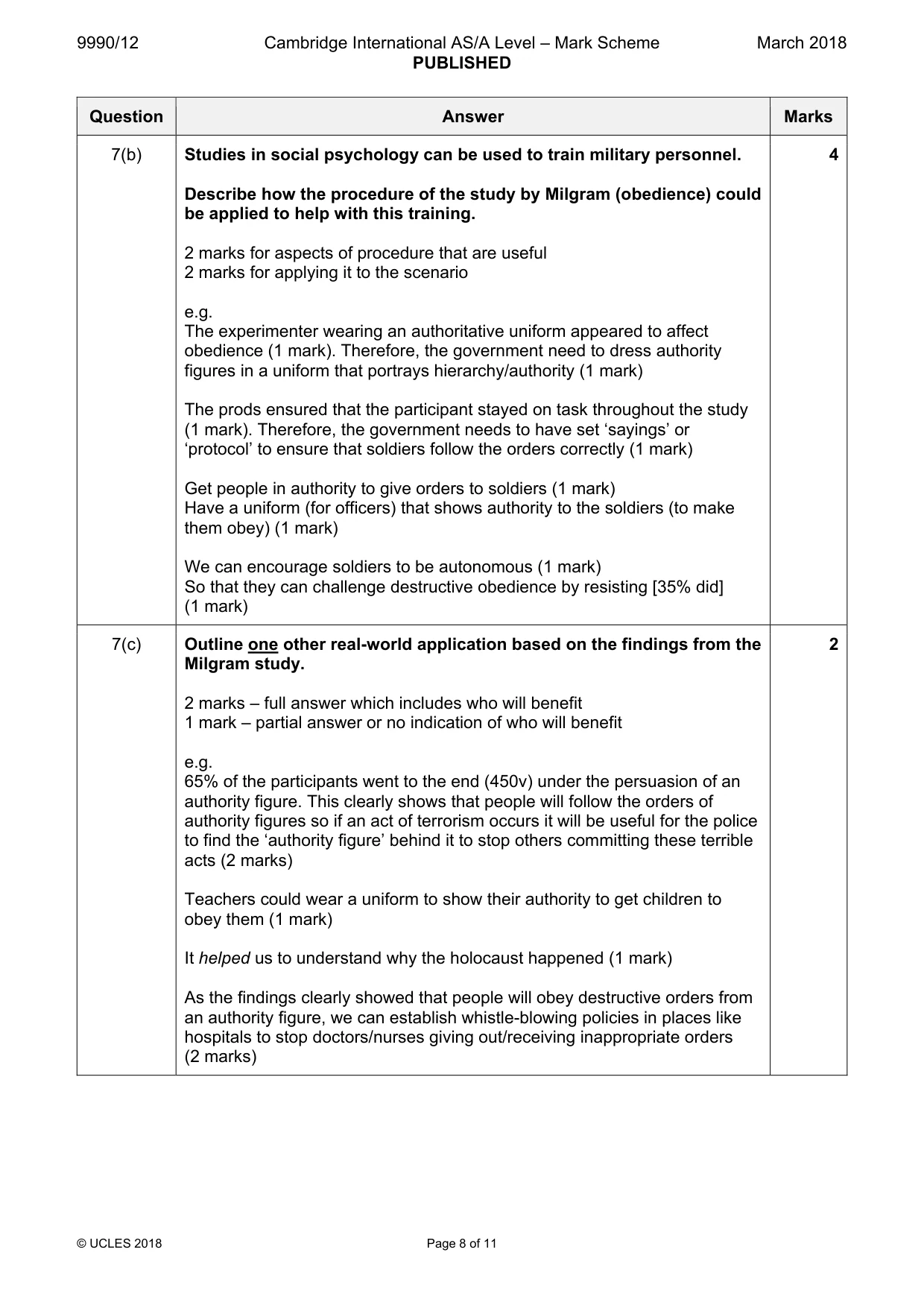
9990/12 Cambridge International AS/A Level – Mark Scheme PUBLISHED March 2018 © UCLES 2018 Page 8 of 11 Question Answer Marks 7(b) Studies in social psychology can be used to train military personnel. Describe how the procedure of the study by Milgram (obedience) could be applied to help with this training. 2 marks for aspects of procedure that are useful 2 marks for applying it to the scenario e.g. The experimenter wearing an authoritative uniform appeared to affect obedience (1 mark). Therefore, the government need to dress authority figures in a uniform that portrays hierarchy/authority (1 mark) The prods ensured that the participant stayed on task throughout the study (1 mark). Therefore, the government needs to have set ‘sayings’ or ‘protocol’ to ensure that soldiers follow the orders correctly (1 mark) Get people in authority to give orders to soldiers (1 mark) Have a uniform (for officers) that shows authority to the soldiers (to make them obey) (1 mark) We can encourage soldiers to be autonomous (1 mark) So that they can challenge destructive obedience by resisting [35% did] (1 mark) 4 7(c) Outline one other real-world application based on the findings from the Milgram study. 2 marks – full answer which includes who will benefit 1 mark – partial answer or no indication of who will benefit e.g. 65% of the participants went to the end (450v) under the persuasion of an authority figure. This clearly shows that people will follow the orders of authority figures so if an act of terrorism occurs it will be useful for the police to find the ‘authority figure’ behind it to stop others committing these terrible acts (2 marks) Teachers could wear a uniform to show their authority to get children to obey them (1 mark) It helped us to understand why the holocaust happened (1 mark) As the findings clearly showed that people will obey destructive orders from an authority figure, we can establish whistle-blowing policies in places like hospitals to stop doctors/nurses giving out/receiving inappropriate orders (2 marks) 2
Mark scheme, page 9
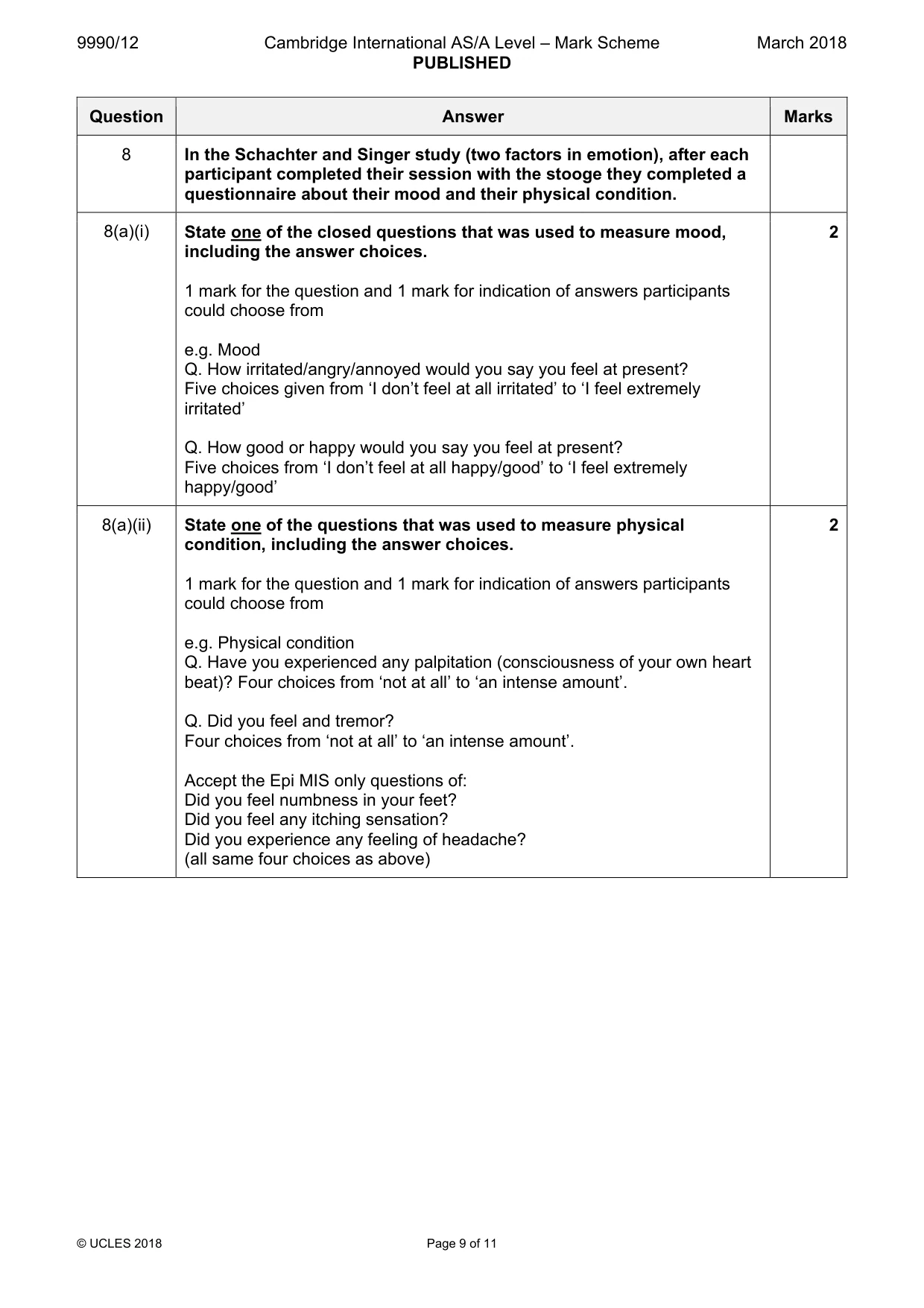
9990/12 Cambridge International AS/A Level – Mark Scheme PUBLISHED March 2018 © UCLES 2018 Page 9 of 11 Question Answer Marks 8 In the Schachter and Singer study (two factors in emotion), after each participant completed their session with the stooge they completed a questionnaire about their mood and their physical condition. 8(a)(i) State one of the closed questions that was used to measure mood, including the answer choices. 1 mark for the question and 1 mark for indication of answers participants could choose from e.g. Mood Q. How irritated/angry/annoyed would you say you feel at present? Five choices given from ‘I don’t feel at all irritated’ to ‘I feel extremely irritated’ Q. How good or happy would you say you feel at present? Five choices from ‘I don’t feel at all happy/good’ to ‘I feel extremely happy/good’ 2 8(a)(ii) State one of the questions that was used to measure physical condition, including the answer choices. 1 mark for the question and 1 mark for indication of answers participants could choose from e.g. Physical condition Q. Have you experienced any palpitation (consciousness of your own heart beat)? Four choices from ‘not at all’ to ‘an intense amount’. Q. Did you feel and tremor? Four choices from ‘not at all’ to ‘an intense amount’. Accept the Epi MIS only questions of: Did you feel numbness in your feet? Did you feel any itching sensation? Did you experience any feeling of headache? (all same four choices as above) 2
Mark scheme, page 10
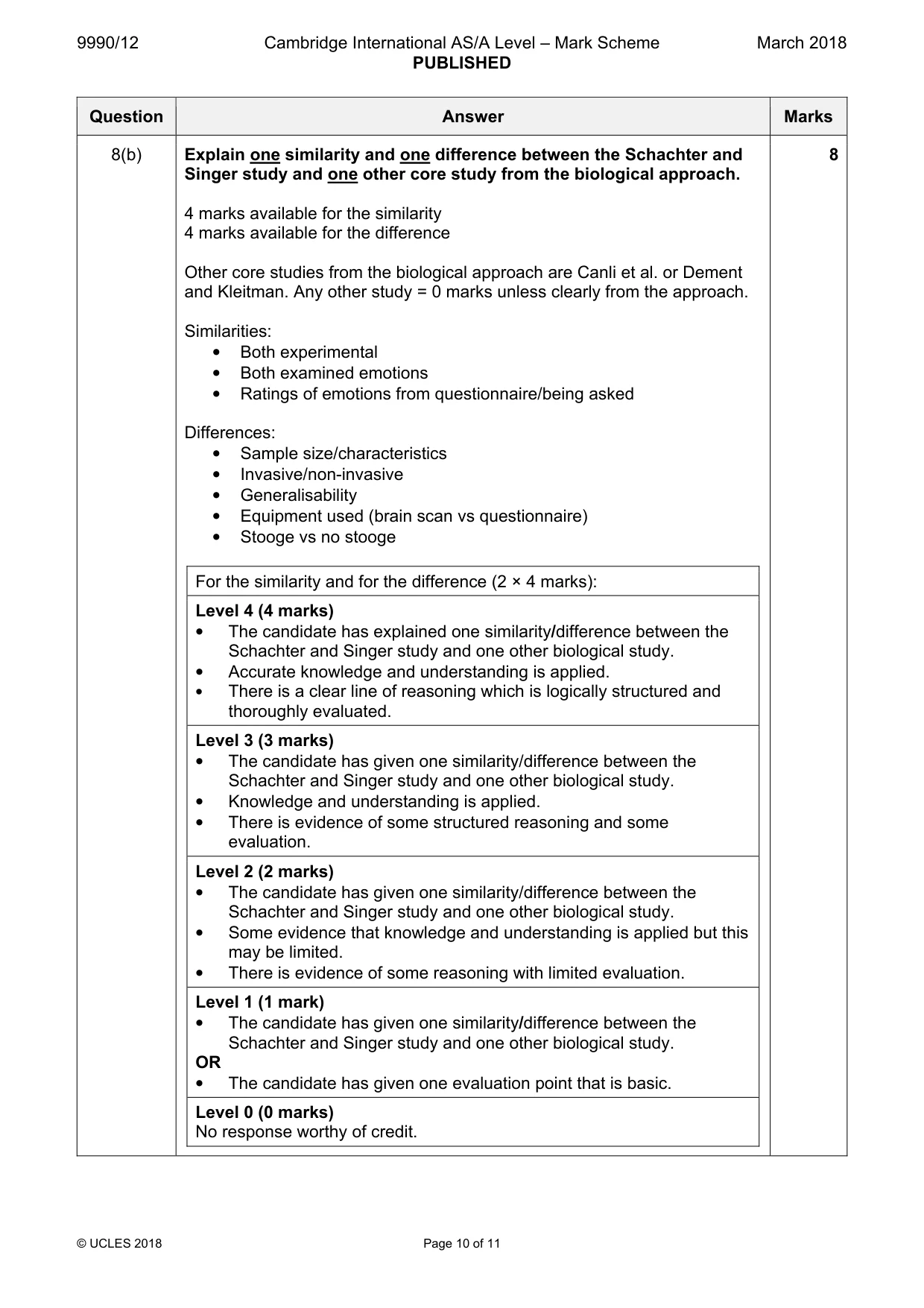
9990/12 Cambridge International AS/A Level – Mark Scheme PUBLISHED March 2018 © UCLES 2018 Page 10 of 11 Question Answer Marks 8(b) Explain one similarity and one difference between the Schachter and Singer study and one other core study from the biological approach. 4 marks available for the similarity 4 marks available for the difference Other core studies from the biological approach are Canli et al. or Dement and Kleitman. Any other study = 0 marks unless clearly from the approach. Similarities: • Both experimental • Both examined emotions • Ratings of emotions from questionnaire/being asked Differences: • Sample size/characteristics • Invasive/non-invasive • Generalisability • Equipment used (brain scan vs questionnaire) • Stooge vs no stooge For the similarity and for the difference (2 × 4 marks): Level 4 (4 marks) • The candidate has explained one similarity/difference between the Schachter and Singer study and one other biological study. • Accurate knowledge and understanding is applied. • There is a clear line of reasoning which is logically structured and thoroughly evaluated. Level 3 (3 marks) • The candidate has given one similarity/difference between the Schachter and Singer study and one other biological study. • Knowledge and understanding is applied. • There is evidence of some structured reasoning and some evaluation. Level 2 (2 marks) • The candidate has given one similarity/difference between the Schachter and Singer study and one other biological study. • Some evidence that knowledge and understanding is applied but this may be limited. • There is evidence of some reasoning with limited evaluation. Level 1 (1 mark) • The candidate has given one similarity/difference between the Schachter and Singer study and one other biological study. OR • The candidate has given one evaluation point that is basic. Level 0 (0 marks) No response worthy of credit. 8
Mark scheme, page 11
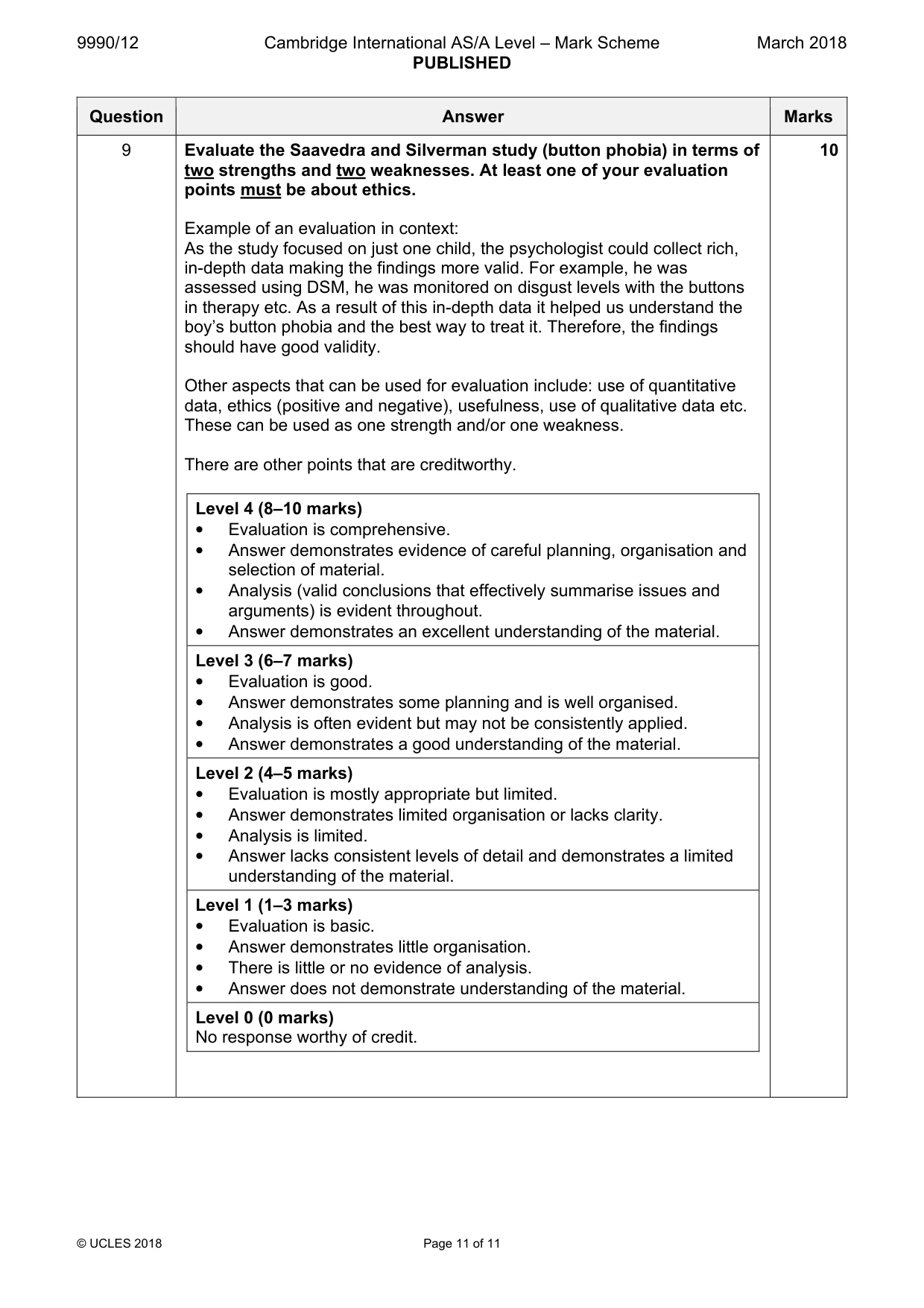
9990/12 Cambridge International AS/A Level – Mark Scheme PUBLISHED March 2018 © UCLES 2018 Page 11 of 11 Question Answer Marks 9 Evaluate the Saavedra and Silverman study (button phobia) in terms of two strengths and two weaknesses. At least one of your evaluation points must be about ethics. Example of an evaluation in context: As the study focused on just one child, the psychologist could collect rich, in-depth data making the findings more valid. For example, he was assessed using DSM, he was monitored on disgust levels with the buttons in therapy etc. As a result of this in-depth data it helped us understand the boy’s button phobia and the best way to treat it. Therefore, the findings should have good validity. Other aspects that can be used for evaluation include: use of quantitative data, ethics (positive and negative), usefulness, use of qualitative data etc. These can be used as one strength and/or one weakness. There are other points that are creditworthy. Level 4 (8–10 marks) • Evaluation is comprehensive. • Answer demonstrates evidence of careful planning, organisation and selection of material. • Analysis (valid conclusions that effectively summarise issues and arguments) is evident throughout. • Answer demonstrates an excellent understanding of the material. Level 3 (6–7 marks) • Evaluation is good. • Answer demonstrates some planning and is well organised. • Analysis is often evident but may not be consistently applied. • Answer demonstrates a good understanding of the material. Level 2 (4–5 marks) • Evaluation is mostly appropriate but limited. • Answer demonstrates limited organisation or lacks clarity. • Analysis is limited. • Answer lacks consistent levels of detail and demonstrates a limited understanding of the material. Level 1 (1–3 marks) • Evaluation is basic. • Answer demonstrates little organisation. • There is little or no evidence of analysis. • Answer does not demonstrate understanding of the material. Level 0 (0 marks) No response worthy of credit. 10
What you needed in this session
Cambridge’s own grade thresholds for 2018 Feb/March, Paper 1 · Variant 2. A higher threshold means an easier paper — the bar moves with how the cohort did.