Cambridge A Level Physics 9702 — 2016 Oct/Nov Paper 3 · Variant 3
9702/33/O/N/16 · 40 marks · ≈45 min
The question paper and its mark scheme, free to read here and free to download. This is Cambridge’s own paper, exactly as it was sat.
Question paper12 pages

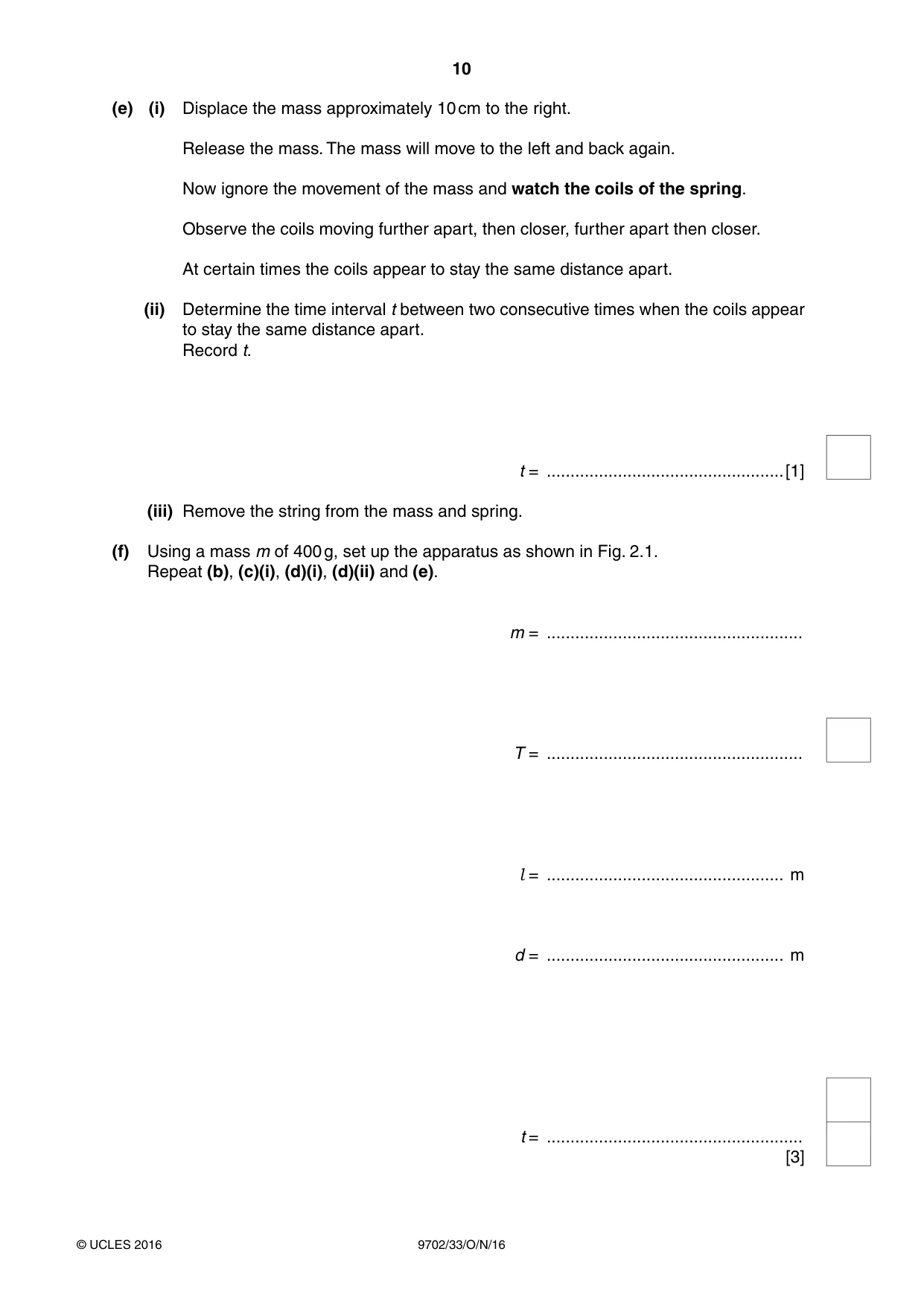
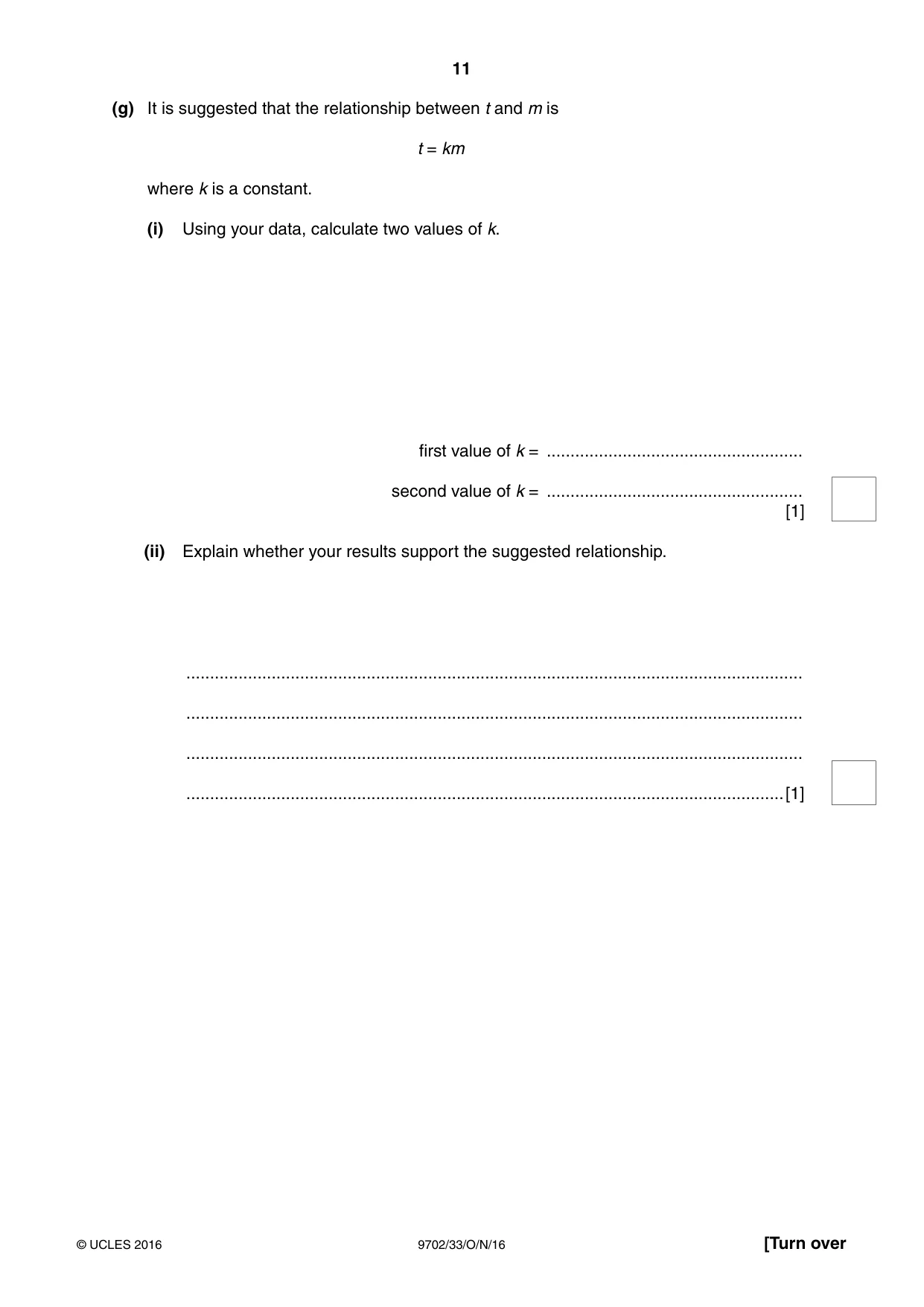
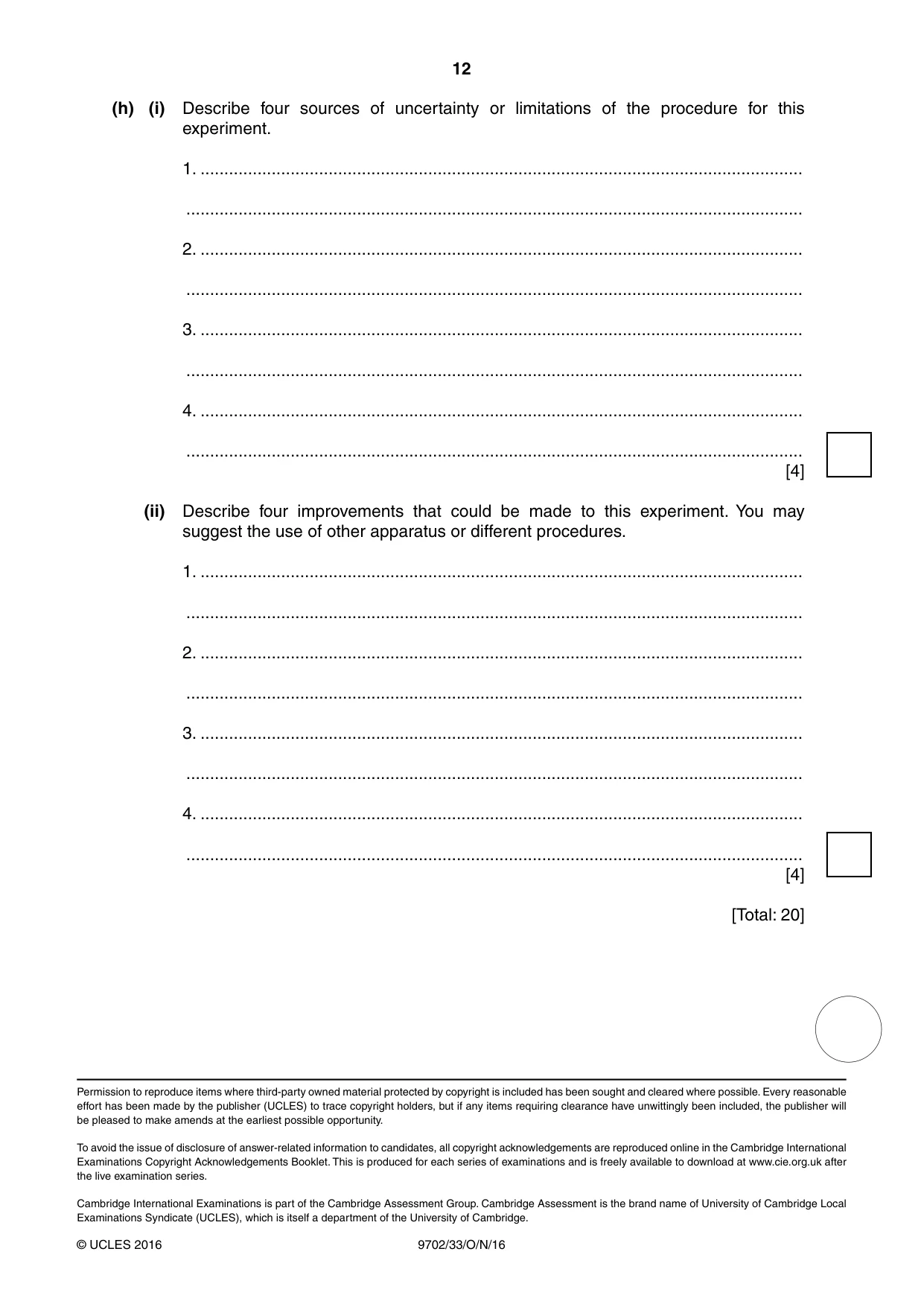
Mark scheme4 pages
Answers below. Sit the paper first if you are practising.
Paper as text
Question paper, page 1
This document consists of 12 printed pages. DC (LEG/FD) 117495/2 © UCLES 2016 [Turn over Cambridge International Examinations Cambridge International Advanced Subsidiary and Advanced Level * 4 3 9 3 6 1 3 8 7 3 * PHYSICS 9702/33 Paper 3 Advanced Practical Skills 1 October/November 2016 2 hours Candidates answer on the Question Paper. Additional Materials: As listed in the Confidential Instructions. READ THESE INSTRUCTIONS FIRST Write your Centre number, candidate number and name on all the work you hand in. Write in dark blue or black pen. You may use an HB pencil for any diagrams or graphs. Do not use staples, paper clips, glue or correction fluid. DO NOT WRITE IN ANY BARCODES. Answer both questions. You will be allowed to work with the apparatus for a maximum of one hour for each question. You are expected to record all your observations as soon as these observations are made, and to plan the presentation of the records so that it is not necessary to make a fair copy of them. You are reminded of the need for good English and clear presentation in your answers. Electronic calculators may be used. You may lose marks if you do not show your working or if you do not use appropriate units. Additional answer paper and graph paper should be used only if it becomes necessary to do so. At the end of the examination, fasten all your work securely together. The number of marks is given in brackets [ ] at the end of each question or part question. For Examiner’s Use 1 2 Total
Question paper, page 2
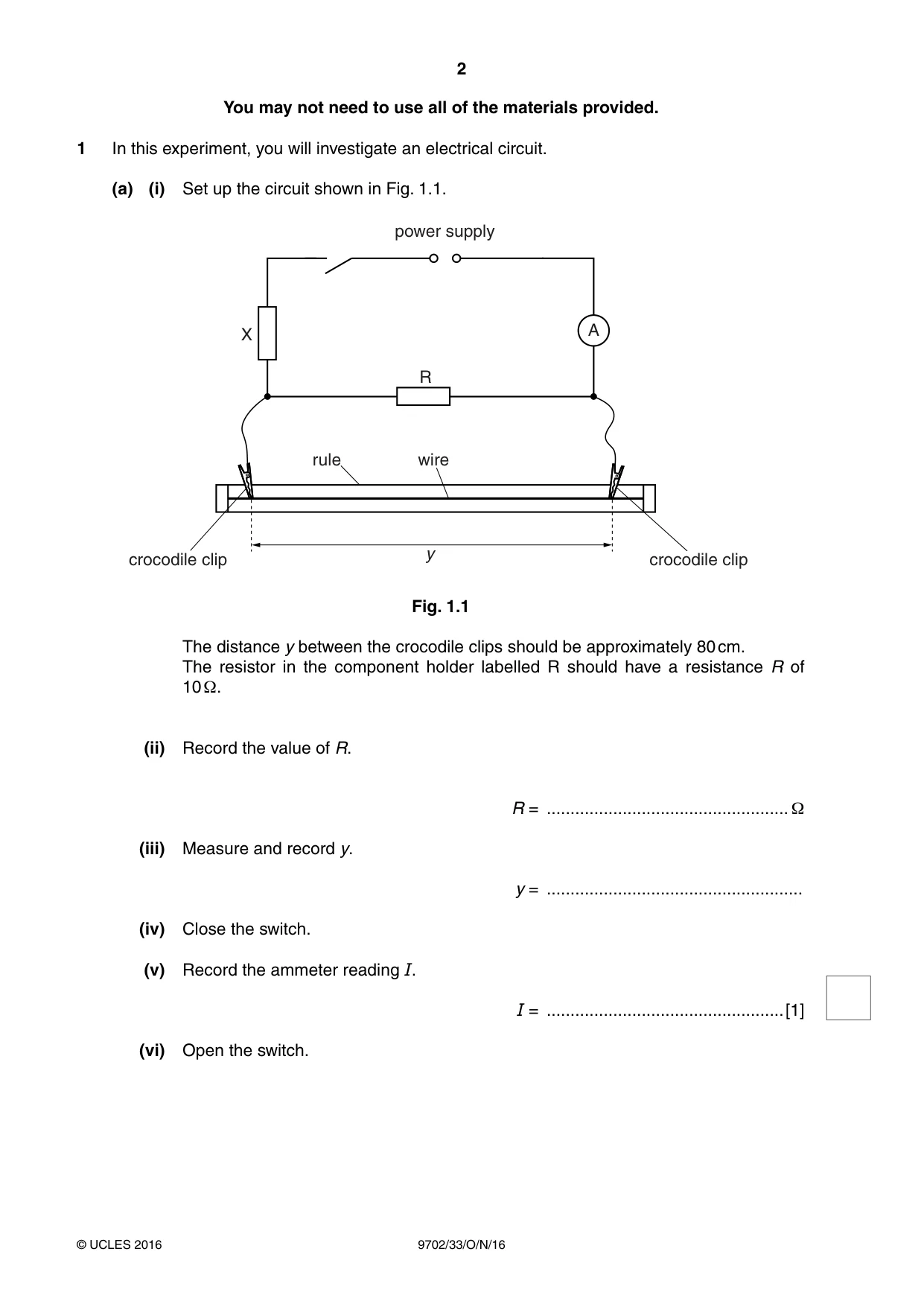
2 9702/33/O/N/16 © UCLES 2016 You may not need to use all of the materials provided. 1 In this experiment, you will investigate an electrical circuit. (a) (i) Set up the circuit shown in Fig. 1.1. A power supply crocodile clip crocodile clip X R rule wire y Fig. 1.1 The distance y between the crocodile clips should be approximately 80 cm. The resistor in the component holder labelled R should have a resistance R of 10 Ω. (ii) Record the value of R. R = … Ω (iii) Measure and record y. y = … (iv) Close the switch. (v) Record the ammeter reading I. I = …[1] (vi) Open the switch.
Question paper, page 3
3 9702/33/O/N/16 © UCLES 2016 [Turn over (b) (i) Remove the resistor in the component holder labelled R. Select a different resistor labelled with a numerical value and connect it in the component holder labelled R. Record the value of resistance R. R = … Ω (ii) Close the switch. (iii) Adjust the position of the crocodile clips on the wire until the ammeter reading I has the same value as in (a)(v). (iv) Measure and record y. y = … (v) Open the switch.
Question paper, page 4
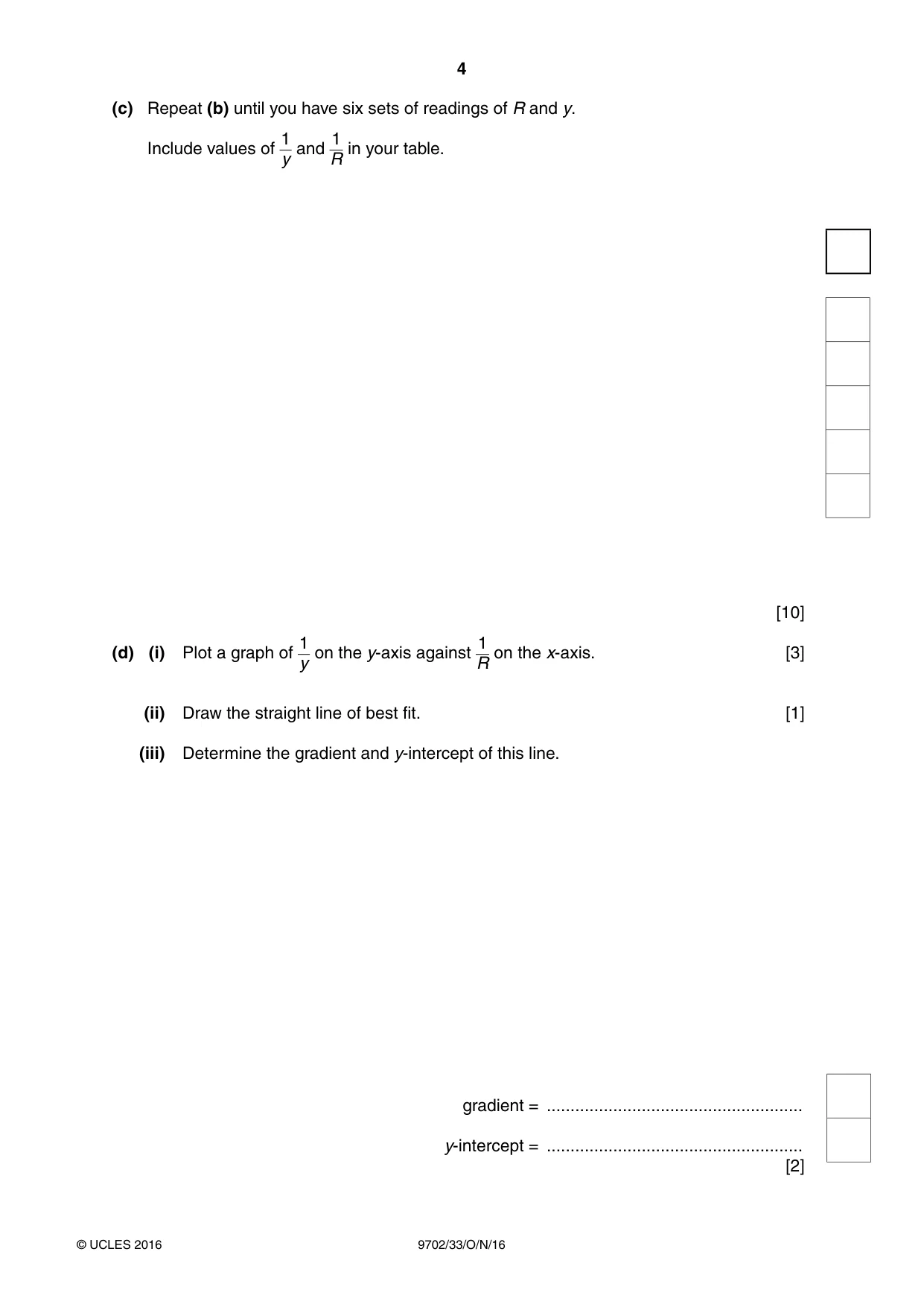
4 9702/33/O/N/16 © UCLES 2016 (c) Repeat (b) until you have six sets of readings of R and y. Include values of 1 y and 1 R in your table. [10] (d) (i) Plot a graph of 1 y on the y-axis against 1 R on the x-axis. [3] (ii) Draw the straight line of best fit. [1] (iii) Determine the gradient and y-intercept of this line. gradient = … y-intercept = … [2]
Question paper, page 5
5 9702/33/O/N/16 © UCLES 2016 [Turn over
Question paper, page 6
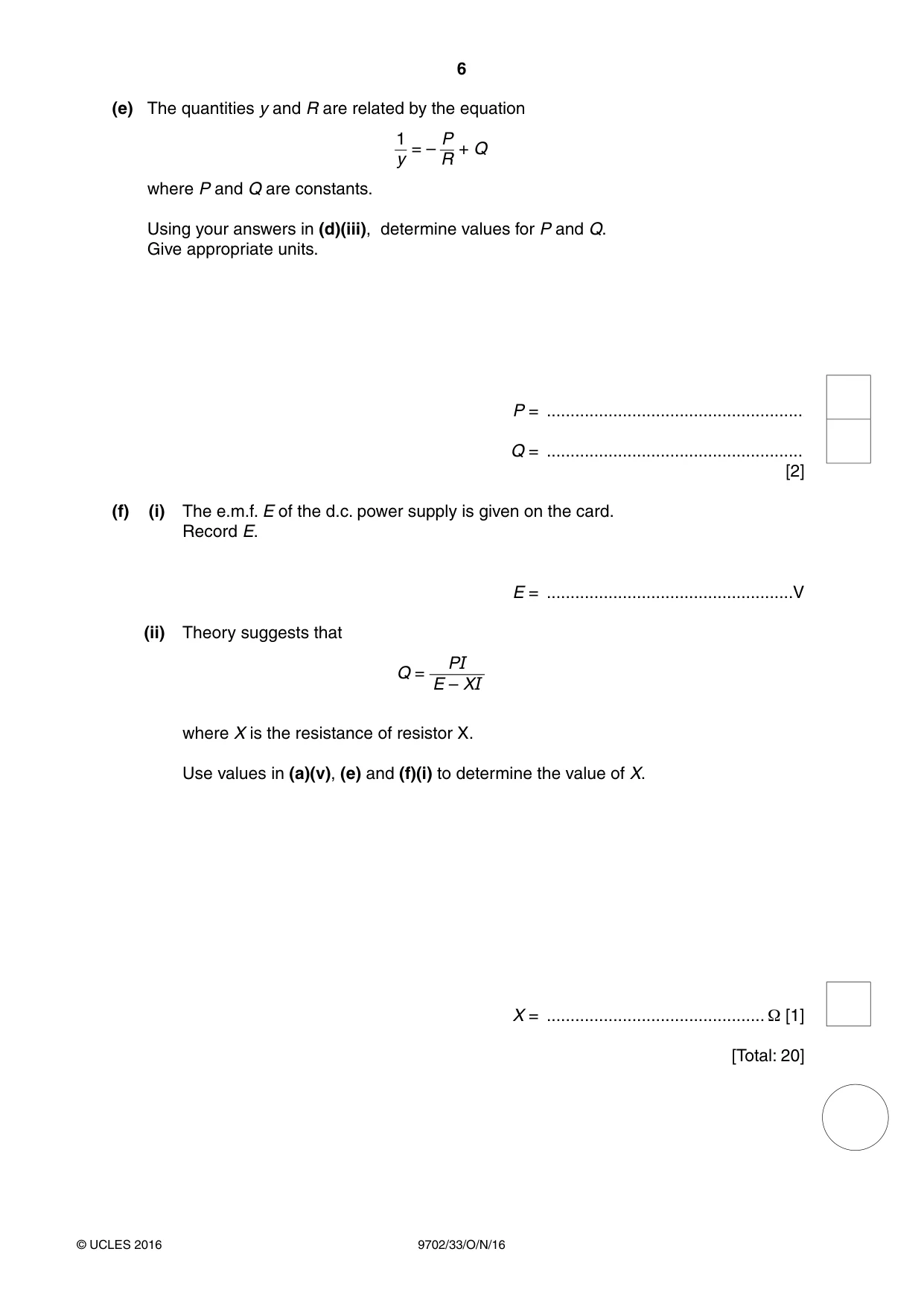
6 9702/33/O/N/16 © UCLES 2016 (e) The quantities y and R are related by the equation 1 y = – P R + Q where P and Q are constants. Using your answers in (d)(iii), determine values for P and Q. Give appropriate units. P = … Q = … [2] (f) (i) The e.m.f. E of the d.c. power supply is given on the card. Record E. E = …V (ii) Theory suggests that Q = PI E – XI where X is the resistance of resistor X. Use values in (a)(v), (e) and (f)(i) to determine the value of X. X = … Ω [1] [Total: 20]
Question paper, page 7
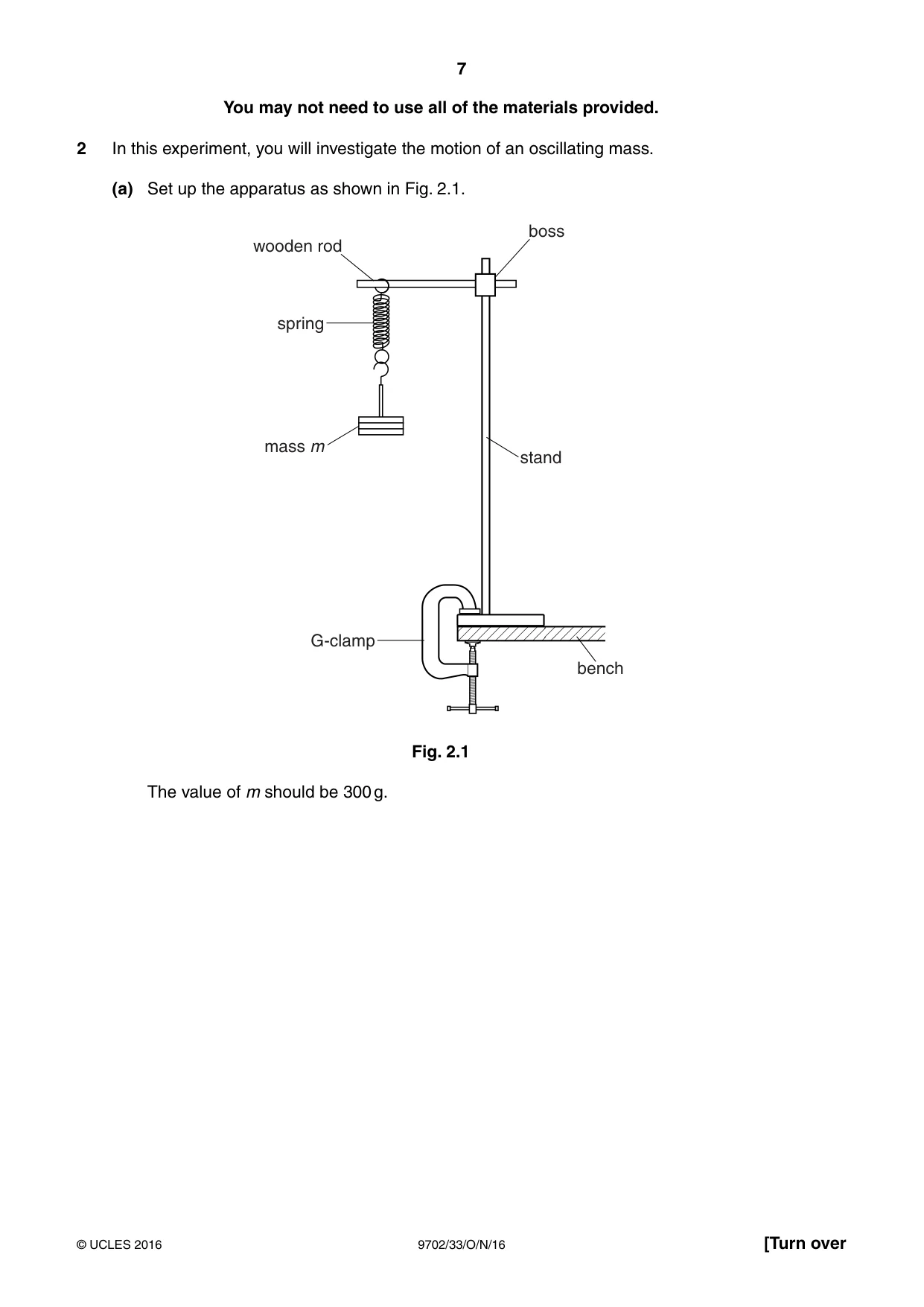
7 9702/33/O/N/16 © UCLES 2016 [Turn over You may not need to use all of the materials provided. 2 In this experiment, you will investigate the motion of an oscillating mass. (a) Set up the apparatus as shown in Fig. 2.1. wooden rod spring mass m boss stand bench G-clamp Fig. 2.1 The value of m should be 300 g.
Question paper, page 8
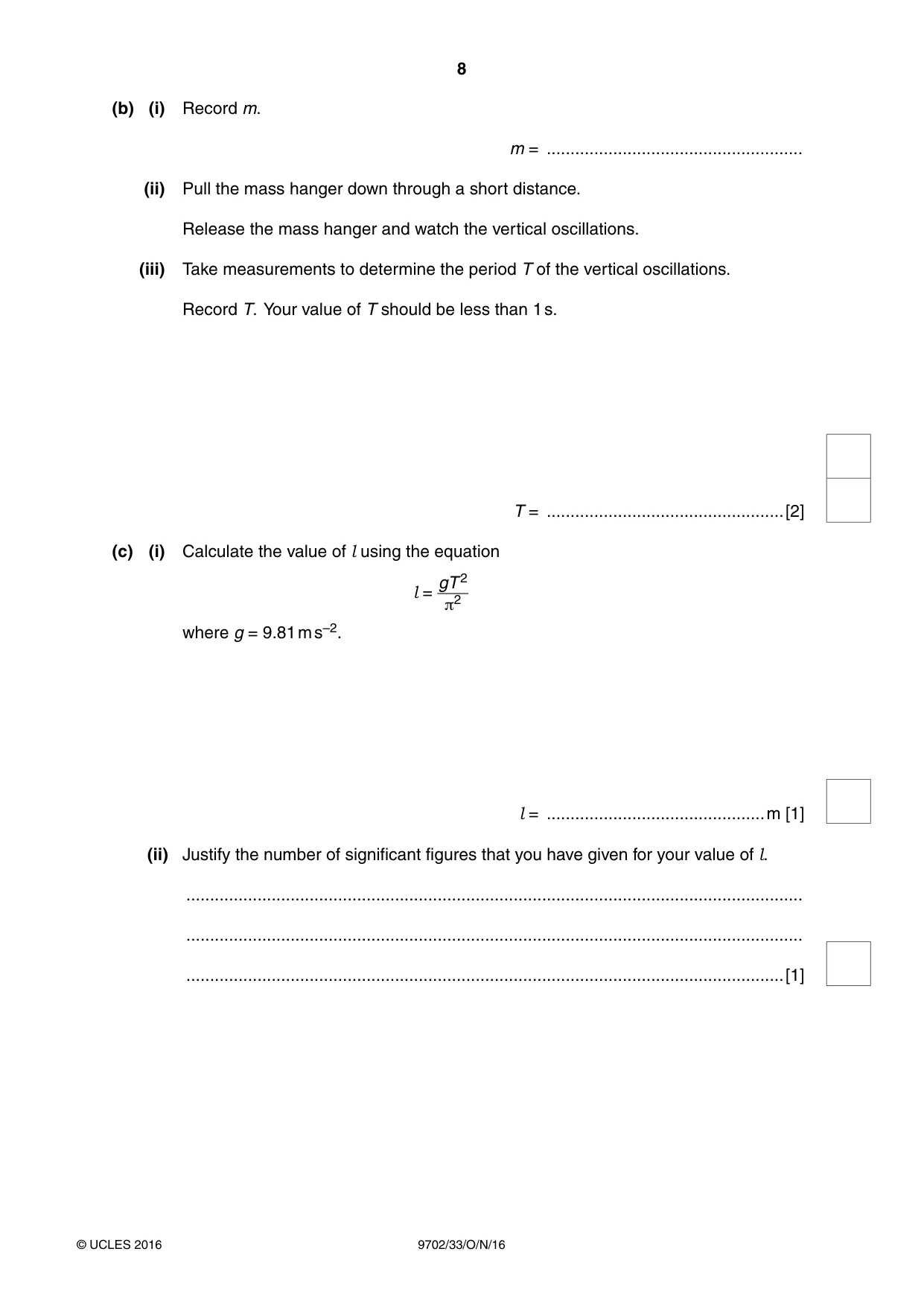
8 9702/33/O/N/16 © UCLES 2016 (b) (i) Record m. m = … (ii) Pull the mass hanger down through a short distance. Release the mass hanger and watch the vertical oscillations. (iii) Take measurements to determine the period T of the vertical oscillations. Record T. Your value of T should be less than 1 s. T = …[2] (c) (i) Calculate the value of l using the equation l = gT 2 π2 where g = 9.81 m s–2. l = …m [1] (ii) Justify the number of significant figures that you have given for your value of l. … … …[1]
Question paper, page 9
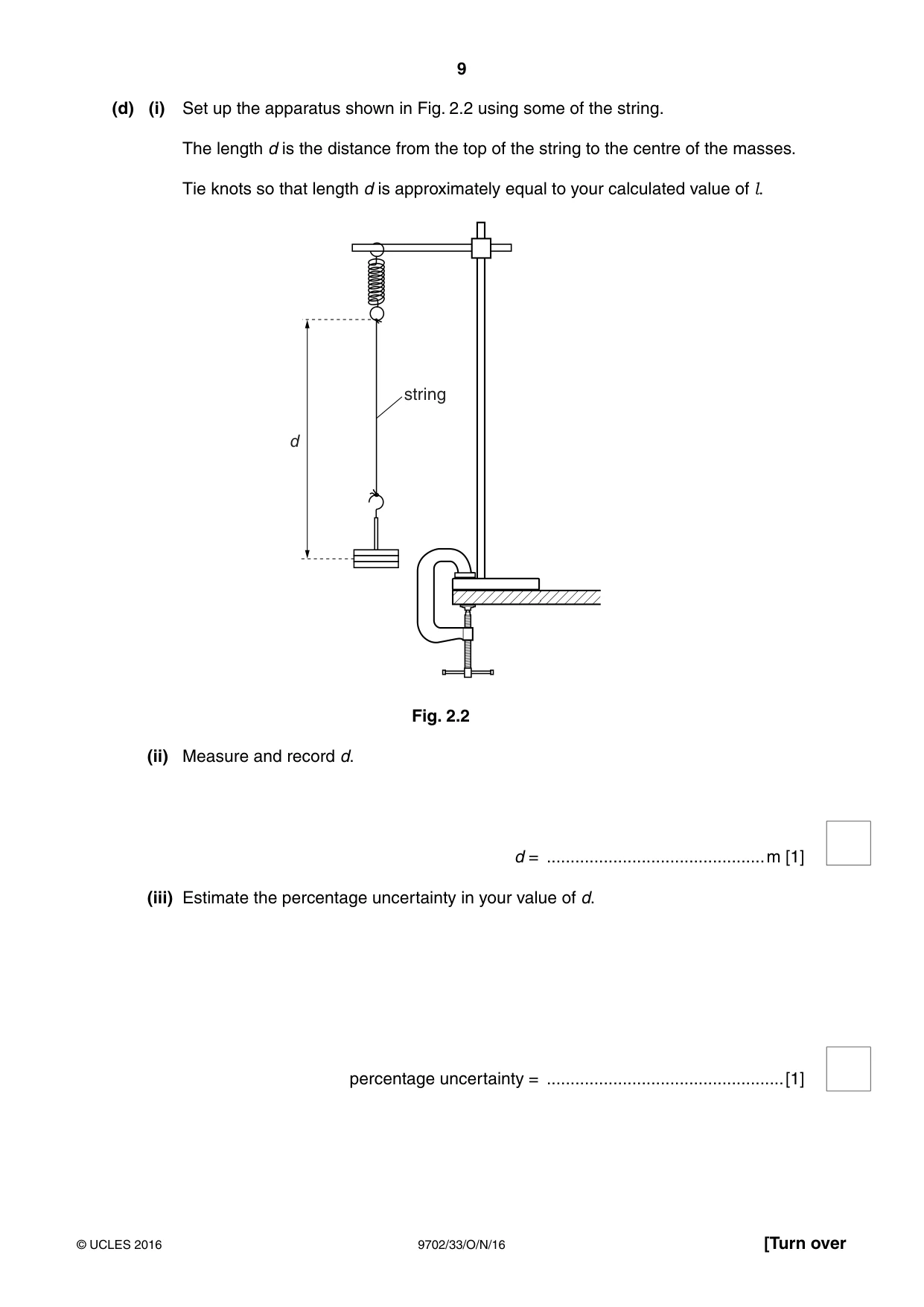
9 9702/33/O/N/16 © UCLES 2016 [Turn over (d) (i) Set up the apparatus shown in Fig. 2.2 using some of the string. The length d is the distance from the top of the string to the centre of the masses. Tie knots so that length d is approximately equal to your calculated value of l. d string Fig. 2.2 (ii) Measure and record d. d = …m [1] (iii) Estimate the percentage uncertainty in your value of d. percentage uncertainty = …[1]
Question paper, page 10
10 9702/33/O/N/16 © UCLES 2016 (e) (i) Displace the mass approximately 10 cm to the right. Release the mass. The mass will move to the left and back again. Now ignore the movement of the mass and watch the coils of the spring. Observe the coils moving further apart, then closer, further apart then closer. At certain times the coils appear to stay the same distance apart. (ii) Determine the time interval t between two consecutive times when the coils appear to stay the same distance apart. Record t. t = …[1] (iii) Remove the string from the mass and spring. (f) Using a mass m of 400 g, set up the apparatus as shown in Fig. 2.1. Repeat (b), (c)(i), (d)(i), (d)(ii) and (e). m = … T = … l = … m d = … m t = … [3]
Question paper, page 11
11 9702/33/O/N/16 © UCLES 2016 [Turn over (g) It is suggested that the relationship between t and m is t = km where k is a constant. (i) Using your data, calculate two values of k. first value of k = … second value of k = … [1] (ii) Explain whether your results support the suggested relationship. … … … …[1]
Question paper, page 12
12 9702/33/O/N/16 © UCLES 2016 Permission to reproduce items where third-party owned material protected by copyright is included has been sought and cleared where possible. Every reasonable effort has been made by the publisher (UCLES) to trace copyright holders, but if any items requiring clearance have unwittingly been included, the publisher will be pleased to make amends at the earliest possible opportunity. To avoid the issue of disclosure of answer-related information to candidates, all copyright acknowledgements are reproduced online in the Cambridge International Examinations Copyright Acknowledgements Booklet. This is produced for each series of examinations and is freely available to download at www.cie.org.uk after the live examination series. Cambridge International Examinations is part of the Cambridge Assessment Group. Cambridge Assessment is the brand name of University of Cambridge Local Examinations Syndicate (UCLES), which is itself a department of the University of Cambridge. (h) (i) Describe four sources of uncertainty or limitations of the procedure for this experiment. 1. … … 2. … … 3. … … 4. … … [4] (ii) Describe four improvements that could be made to this experiment. You may suggest the use of other apparatus or different procedures. 1. … … 2. … … 3. … … 4. … … [4] [Total: 20]
Mark scheme, page 1
® IGCSE is the registered trademark of Cambridge International Examinations. This document consists of 4 printed pages. © UCLES 2016 [Turn over Cambridge International Examinations Cambridge International Advanced Subsidiary and Advanced Level PHYSICS 9702/33 Paper 3 Advanced Practical Skills 1 October/November 2016 MARK SCHEME Maximum Mark: 40 Published This mark scheme is published as an aid to teachers and candidates, to indicate the requirements of the examination. It shows the basis on which Examiners were instructed to award marks. It does not indicate the details of the discussions that took place at an Examiners’ meeting before marking began, which would have considered the acceptability of alternative answers. Mark schemes should be read in conjunction with the question paper and the Principal Examiner Report for Teachers. Cambridge will not enter into discussions about these mark schemes. Cambridge is publishing the mark schemes for the October/November 2016 series for most Cambridge IGCSE®, Cambridge International A and AS Level components and some Cambridge O Level components.
Mark scheme, page 2
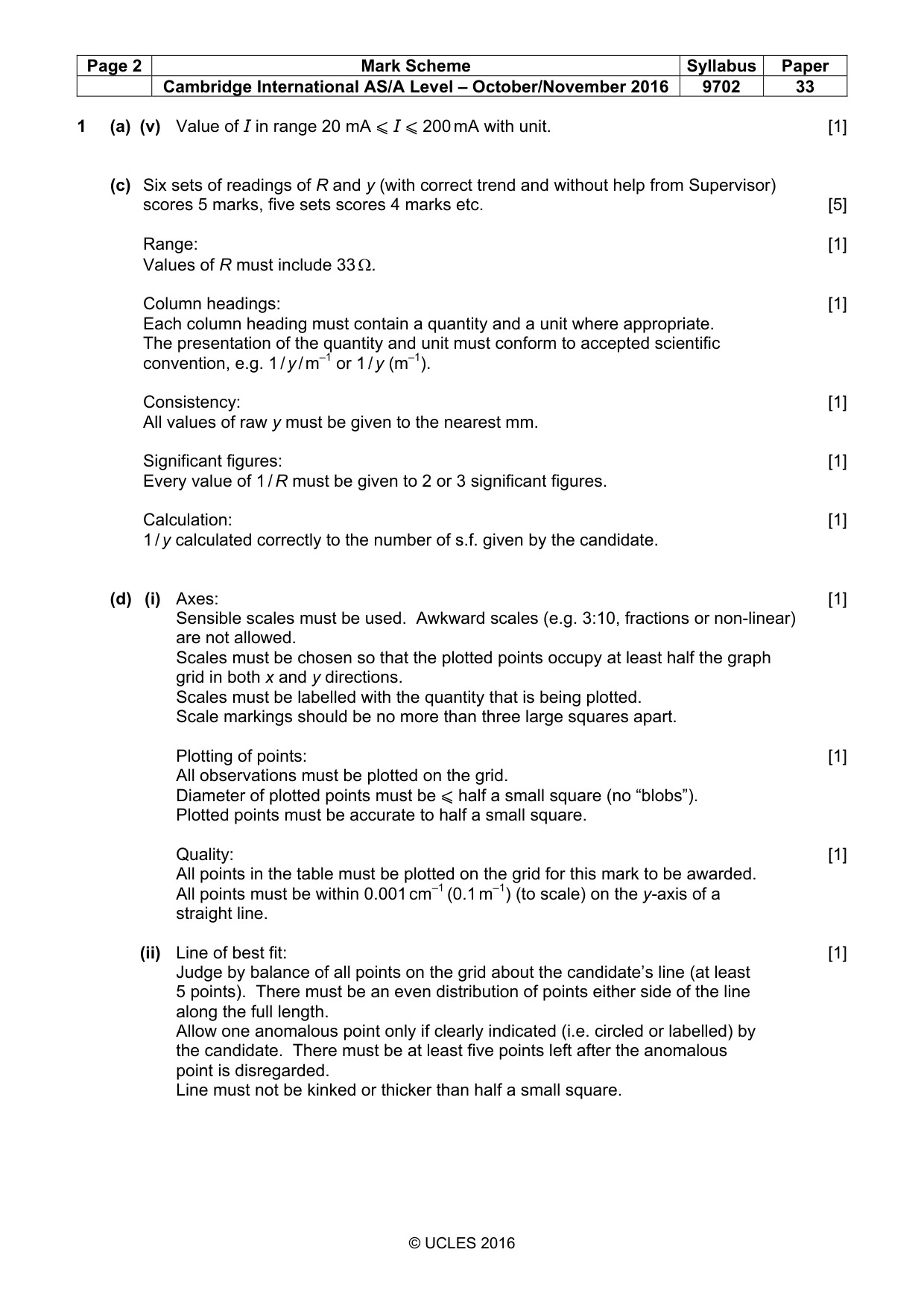
Page 2 Mark Scheme Syllabus Paper Cambridge International AS/A Level – October/November 2016 9702 33 © UCLES 2016 1 (a) (v) Value of I in range 20 mA ⩽ I ⩽ 200 mA with unit. [1] (c) Six sets of readings of R and y (with correct trend and without help from Supervisor) scores 5 marks, five sets scores 4 marks etc. [5] Range: [1] Values of R must include 33 Ω. Column headings: [1] Each column heading must contain a quantity and a unit where appropriate. The presentation of the quantity and unit must conform to accepted scientific convention, e.g. 1 / y / m–1 or 1 / y (m–1). Consistency: [1] All values of raw y must be given to the nearest mm. Significant figures: [1] Every value of 1 / R must be given to 2 or 3 significant figures. Calculation: [1] 1 / y calculated correctly to the number of s.f. given by the candidate. (d) (i) Axes: [1] Sensible scales must be used. Awkward scales (e.g. 3:10, fractions or non-linear) are not allowed. Scales must be chosen so that the plotted points occupy at least half the graph grid in both x and y directions. Scales must be labelled with the quantity that is being plotted. Scale markings should be no more than three large squares apart. Plotting of points: [1] All observations must be plotted on the grid. Diameter of plotted points must be ⩽ half a small square (no “blobs”). Plotted points must be accurate to half a small square. Quality: [1] All points in the table must be plotted on the grid for this mark to be awarded. All points must be within 0.001 cm–1 (0.1 m–1) (to scale) on the y-axis of a straight line. (ii) Line of best fit: [1] Judge by balance of all points on the grid about the candidate’s line (at least 5 points). There must be an even distribution of points either side of the line along the full length. Allow one anomalous point only if clearly indicated (i.e. circled or labelled) by the candidate. There must be at least five points left after the anomalous point is disregarded. Line must not be kinked or thicker than half a small square.
Mark scheme, page 3
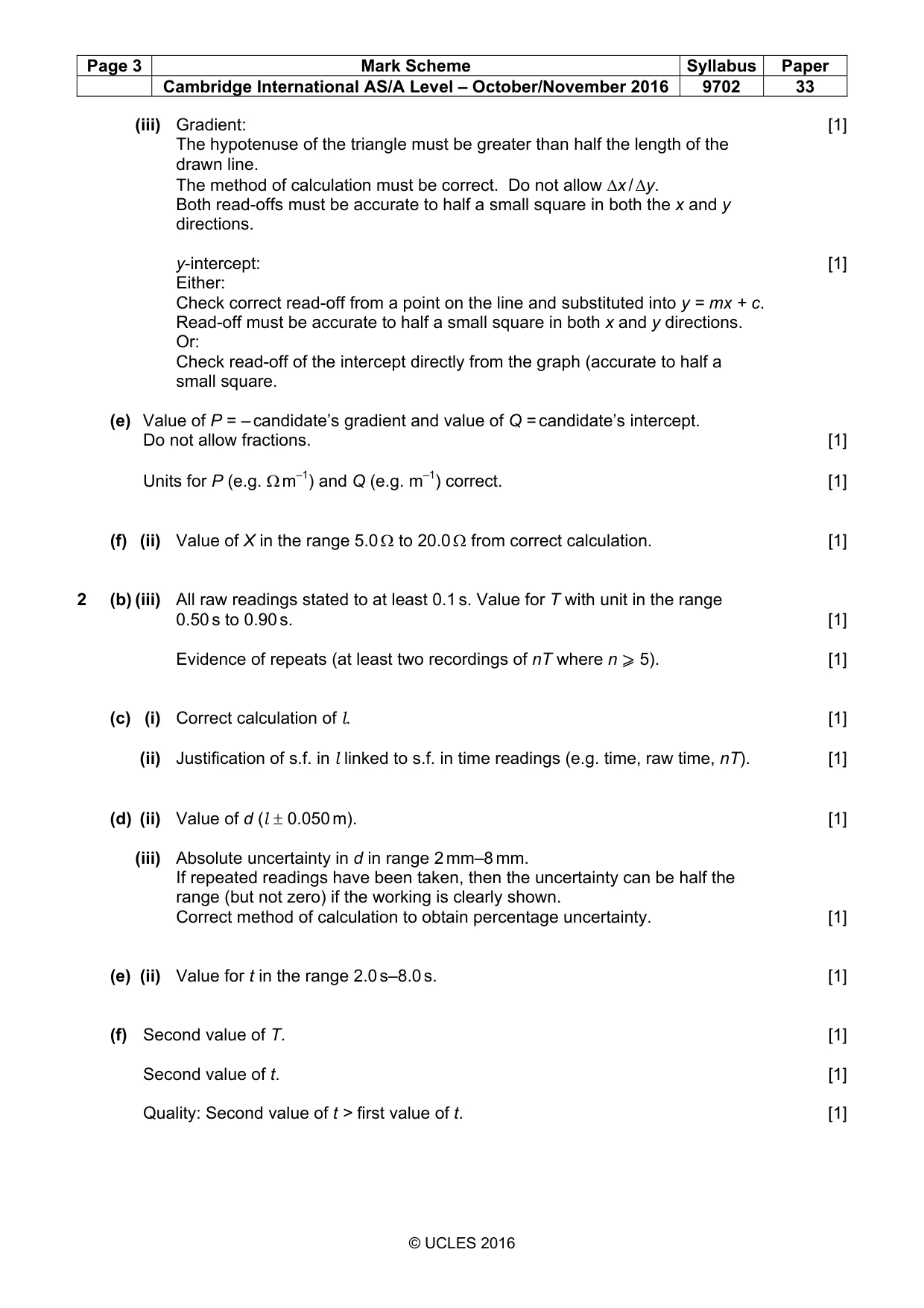
Page 3 Mark Scheme Syllabus Paper Cambridge International AS/A Level – October/November 2016 9702 33 © UCLES 2016 (iii) Gradient: [1] The hypotenuse of the triangle must be greater than half the length of the drawn line. The method of calculation must be correct. Do not allow ∆x / ∆y. Both read-offs must be accurate to half a small square in both the x and y directions. y-intercept: [1] Either: Check correct read-off from a point on the line and substituted into y = mx + c. Read-off must be accurate to half a small square in both x and y directions. Or: Check read-off of the intercept directly from the graph (accurate to half a small square. (e) Value of P = – candidate’s gradient and value of Q = candidate’s intercept. Do not allow fractions. [1] Units for P (e.g. Ω m–1) and Q (e.g. m–1) correct. [1] (f) (ii) Value of X in the range 5.0 Ω to 20.0 Ω from correct calculation. [1] 2 (b) (iii) All raw readings stated to at least 0.1 s. Value for T with unit in the range 0.50 s to 0.90 s. [1] Evidence of repeats (at least two recordings of nT where n ⩾ 5). [1] (c) (i) Correct calculation of l. [1] (ii) Justification of s.f. in l linked to s.f. in time readings (e.g. time, raw time, nT). [1] (d) (ii) Value of d (l ± 0.050 m). [1] (iii) Absolute uncertainty in d in range 2 mm–8 mm. If repeated readings have been taken, then the uncertainty can be half the range (but not zero) if the working is clearly shown. Correct method of calculation to obtain percentage uncertainty. [1] (e) (ii) Value for t in the range 2.0 s–8.0 s. [1] (f) Second value of T. [1] Second value of t. [1] Quality: Second value of t > first value of t. [1]
Mark scheme, page 4
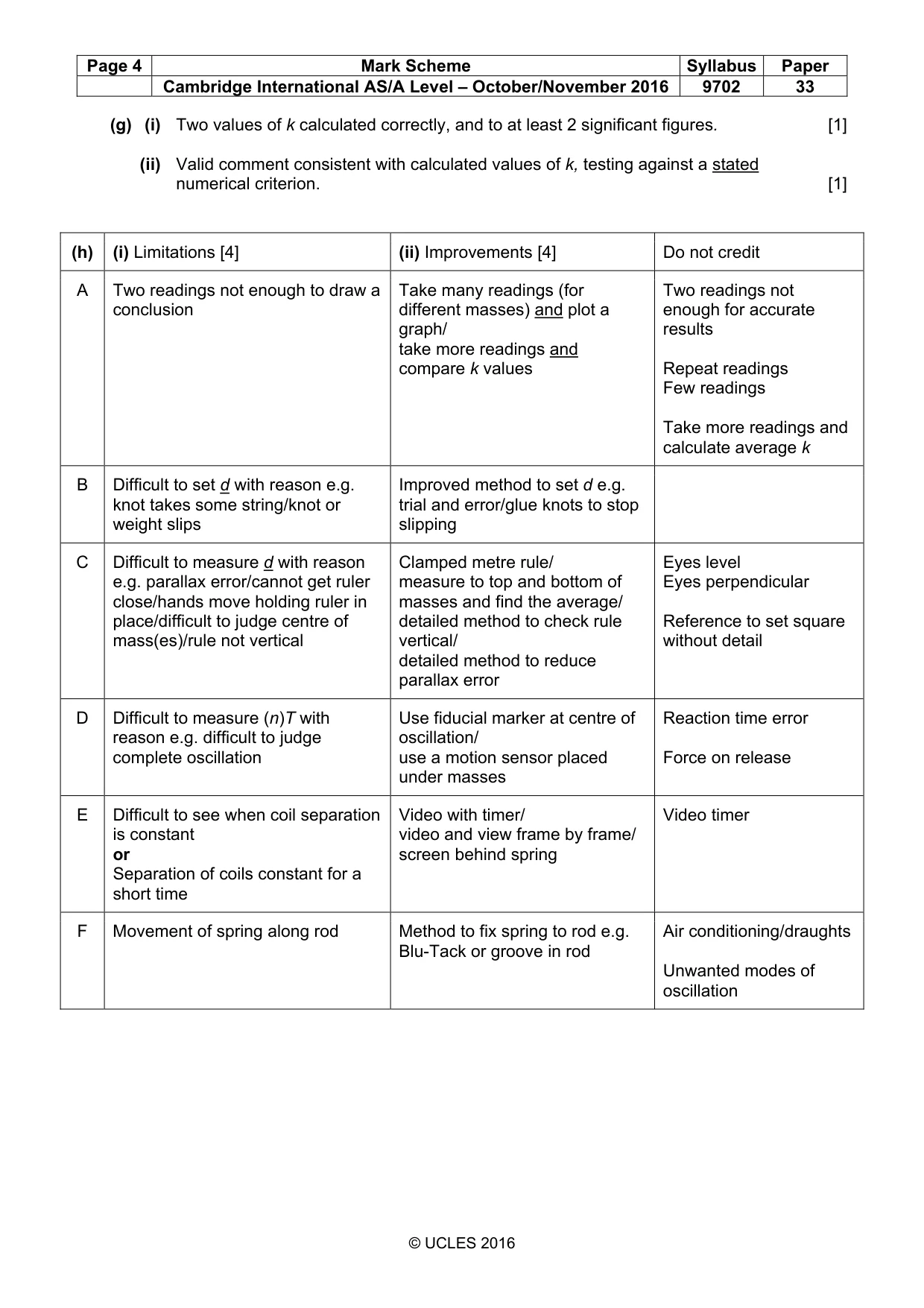
Page 4 Mark Scheme Syllabus Paper Cambridge International AS/A Level – October/November 2016 9702 33 © UCLES 2016 (g) (i) Two values of k calculated correctly, and to at least 2 significant figures. [1] (ii) Valid comment consistent with calculated values of k, testing against a stated numerical criterion. [1] (h) (i) Limitations [4] (ii) Improvements [4] Do not credit A Two readings not enough to draw a conclusion Take many readings (for different masses) and plot a graph/ take more readings and compare k values Two readings not enough for accurate results Repeat readings Few readings Take more readings and calculate average k B Difficult to set d with reason e.g. knot takes some string/knot or weight slips Improved method to set d e.g. trial and error/glue knots to stop slipping C Difficult to measure d with reason e.g. parallax error/cannot get ruler close/hands move holding ruler in place/difficult to judge centre of mass(es)/rule not vertical Clamped metre rule/ measure to top and bottom of masses and find the average/ detailed method to check rule vertical/ detailed method to reduce parallax error Eyes level Eyes perpendicular Reference to set square without detail D Difficult to measure (n)T with reason e.g. difficult to judge complete oscillation Use fiducial marker at centre of oscillation/ use a motion sensor placed under masses Reaction time error Force on release E Difficult to see when coil separation is constant or Separation of coils constant for a short time Video with timer/ video and view frame by frame/ screen behind spring Video timer F Movement of spring along rod Method to fix spring to rod e.g. Blu-Tack or groove in rod Air conditioning/draughts Unwanted modes of oscillation
What you needed in this session
Cambridge’s own grade thresholds for 2016 Oct/Nov, Paper 3 · Variant 3. A higher threshold means an easier paper — the bar moves with how the cohort did.